Several years before the outbreak of World War I (WWI), James Bryce began an exhaustive empirical study of democracy, or what he termed “popular government.” As a member of parliament from 1880 to 1907, Bryce had participated in some of the great debates about political reform in Edwardian Britain. As a professor at Oxford, he had written The American Commonwealth that analyzed American political institutions by reproducing the travels of Alexis de Tocqueville a half century earlier.Footnote 1 As British Ambassador to the United States from 1907 to 1913, he witnessed how the egalitarianism that Tocqueville identified in the 1830s as the core of American democracy had been transformed into an economic oligarchy. All these experiences left Bryce increasingly unsatisfied with, as he put it, the “references, usually vague and disconnected, to history and to events happening in other countries” that masqueraded as empirical knowledge about democracy. He wondered if “something might be done to provide a solid basis for argument and judgment by examining a certain number of popular governments in their actual working, comparing them with one another, and setting forth the various merits and defects that belonged to each.”Footnote 2
He then literally traveled around the world, conducting fieldwork in New Zealand, Australia, Canada, Switzerland, France, and the United States in search of, as he put it, “Facts, Facts, Facts!” Published in 1921, his 700-page Modern Democracies was a synthesis of his life’s work.
Two facts, in particular, emerged from his research. First, there had been an undeniable proliferation of democracies worldwide over his lifetime. Whereas “a century ago there was in the Old World only one tiny spot in which the working of democracy could be studied,” Bryce finds that “there are now more than one hundred representative assemblies at work all over the earth legislating for self-governing communities.”Footnote 3 The second was that democracy had become recognized as the proverbial “only game in town”:
A not less significant change has been the universal acceptance of democracy as the normal and natural form of government. Seventy years ago, as those who are now old can well remember, the approaching rise of the masses to power was regarded by the educated classes of Europe as a menace to order and prosperity. Thus, the word Democracy awakened dislike and fear. Now it is a word of praise. Popular power is welcomed, extolled, worshipped. The few whom it repels or alarms rarely avow their sentiments. Men have almost ceased to study its phenomena because they now seem to have become part of the established order of things. The old question – What is the best form of government? – is almost obsolete because the center of interest has been shifting. It is not the nature of democracy, nor even the variety of the shapes it wears, that are to-day in debate, but rather the purposes to which it may be turned, the social and economic changes it may be used to affect.Footnote 4
The rise of authoritarianism in many European states within several years of the publication of Modern Democracies made it clear that democracy had not, in fact, become “part of the established order of things.” Other regime types – from competitive authoritarianism to totalitarianism – emerged as alternatives to liberal democracy in the 1920s and 1930s. Writing in 1938, Bryce’s longtime friend and fellow academic A. Lawrence Lowell admitted that “reading Modern Democracies a score of years after it was written, one is impressed by how far from the direction then expected the political currents of the world have run.”Footnote 5 And yet that democratic heritage still mattered when Lowell interpreted the ominous geopolitical trends of the time; he pointed out that of the four revisionist powers of Germany, Italy, Japan, and the Soviet Union, “none of them had enjoyed a successful democracy.”Footnote 6 In the aftermath of World War II (WWII), there was arguably no more urgent question in comparative politics than why Great Britain, France, and several other smaller European states had democratized before WWI, while others – particularly Germany – had failed. Many canonical works in democratization emerged from this comparison as both modernization theorists and their critics mined nineteenth- and early twentieth-century European history for empirical illustrations of their theories.Footnote 7 Writing at another highpoint of democratic optimism forty years later, Samuel Huntington renamed the territory that Bryce had covered in Modern Democracies as the “first wave” of democratization. This concept has become widespread in the literature, even though Huntington’s overriding concern was the “third wave” of democratization that began in the early 1970s.Footnote 8
The first wave is more than an academic construct: It is an integral chapter in the stories that European democracies tell themselves. The common element in these narratives of democratization is that today’s consolidated democracy is the product of a stepwise progression of democratic achievements beginning centuries ago. This is the history that one learns in high school, the history one finds on the websites of national parliaments, and the history politicians rely on for ceremonial occasions. Typical of the latter are remarks by British Prime Minister Gordon Brown in 2007 who perceived “a golden thread which runs through British history” extending from a “long-ago day in Runnymede in 1215 when arbitrary power was fully challenged with the Magna Carta, on to the first bill of rights in 1689 where Britain became the first country where parliament asserted power over the king, to the democratic reform acts.”Footnote 9
One might be tempted to dismiss such rosy narratives in Great Britain as the legacy of Whig history, which Herbert Butterfield famously defined as “the tendency of many historians to write on the side of Protestants and Whigs, to praise revolutions provided they have been successful, to emphasize certain principles of progress in the past and to produce a story which is the ratification if not the glorification of the present.”Footnote 10 But such stories are hardly confined to the UK. Sweden has embraced a national narrative that “stresses the heritage of a free and politically active farming class, economic egalitarianism, and a responsive state.”Footnote 11 That Sweden was one of the least democratic states in Europe prior to WWI, and that its regime more closely resembled Prussia’s rather than England’s for most of the “first wave,” has little salience in Swedish historical memory. In Denmark, a conservative government, with a strong push from the radical right Danish People’s Party, established a committee “for the purpose of drawing up a democracy canon” in 2006. The goal, according to Prime Minister Anders Fogh Rasmussen, was to “highlight Danish and international historical philosophical trends and political texts that have had a special impact on the development of fundamental freedoms and democracy in Denmark.”Footnote 12 The final product was a Whiggish document that told “a rather nice story of Danish Democracy” with the central message that the “Danes have preferred reform to revolution.”Footnote 13
These narratives are preferable to the jingoistic ones that predominated in Europe a century earlier. They also contain important elements of truth; some moments of political liberalization deserve to be commemorated, if not celebrated. Yet we should recognize historical mythmaking when we see it, and these narratives of democratization that politicians embrace are not consistent with the historical record. The intellectual problem, however, is that political scientists still have a view of the first wave that largely follows Bryce in focusing on its democratic features, and most literature on the period – both classic and contemporary – is still concerned primarily with explaining the emergence of democracy against the backdrop of royal absolutism. According to Daniel Ziblatt, for example, the triumph of democracy in Western Europe “occurred in the reactionary shadow that followed the French Revolution, facing new and not entirely understood economic dislocations and absent the certainty of carrying out the reforms with the democratic transition playbook in hand.” As such, he continues, “the relative success of democratic reforms in late-nineteenth century Europe should strike contemporary political scientists as nearly an unfathomable puzzle.”Footnote 14
Judging from the volume of research within the last two decades, the puzzle remains unresolved. Daron Acemoglu and James Robinson helped jumpstart the debate about the origins of European democracy with their article “Why Did the West Extend the Franchise” and their extension of the argument in Economic Origins of Dictatorship and Democracy (2006). The authors used both the 1832 and 1867 Reform Acts in Great Britain to illustrate that the old regime only extends the franchise under the threat of revolution.Footnote 15 Both advocates and critics of the political economy approach reexamined nineteenth and early twentieth-century European history for further illustrative examples.Footnote 16 The result has been a rebirth of the field of European political development as scholars use the first wave to generate and test specific theories about democratization.Footnote 17
1.1 A Ripple, Not a Wave
But what about authoritarianism? Bryce’s count of democracies before WWI included only seven countries: Australia, Canada, France, New Zealand, the United States, the United Kingdom, and Switzerland.Footnote 18 Nondemocratic regimes were the norm in pre-WWI Europe, but most of the literature on European political development is devoted to explaining democratic exceptionalism.
The goal of this book is to reduce this asymmetry by asking a different macro-question about the first wave. The puzzle is not that democracy was so successful over this period, but that the transition to some form of mass politics in the birthplace of both the Enlightenment and industrial revolutions produced so few democratic successes. If there was indeed a democratic first wave, it was an extraordinarily small one. And if this is true, then it is not the democratic achievements of the first wave, but rather the successful blocking strategies of the old regime that deserve our attention today.
Other scholars have made similar arguments before. Writing in 1980, Arno Mayer noted that “the conventional wisdom is still that Europe broke out of its ancien régime and approached or crossed the threshold of modernity well before 1914.”Footnote 19 He challenged this view in The Persistence of the Old Regime and concluded that “down to 1914, the ‘steel frame’ of Europe’s political societies continued to be heavily feudal and nobilitarian.” Mayer continued that “in spite of vast national and constitutional variations, there were significant family resemblances among all the regimes” and speculated that “perhaps this affinity was rooted first and foremost in the enduring importance of landed interests and of rural society throughout Europe.”Footnote 20 For Mayer, then, the endurance of authoritarianism was ultimately explained by the persistence of feudalistic class relations in otherwise industrializing societies, which were in turn, per Marxist theory, the result of the existing factors of production.
Mayer is correct that the landed elite retained far more power in pre-WWI Europe than most historians had assumed. Yet to ascribe this endurance primarily to material forces obscures the success of the old regime in springing back into shape in the face of enormous challenges. Resilience is more accurate than persistence, for what is most remarkable about the endurance of authoritarianism in Western Europe is how creative – and indeed how successful – old regime elites were in avoiding the system of one-person, one-vote. Consider that it took democratic reformers nearly a century to enact the program that 60,000 English citizens demanded on August 16, 1819, and that the Chartists – the largest working-class movement in British history – mobilized for universal suffrage in the 1840s. The rise of socialism on the continent similarly challenged the old regime, for one of the major demands of socialist parties everywhere was universal and equal manhood suffrage. The old regime proved resilient here as well, for nowhere in Europe did socialist pressure lead to full democratization before WWI. The few genuine cases of democratization in Europe also created an additional challenge to authoritarians, for democratic reformers could point to existing democratic systems as models. Swedish reformers, for example, could draw inspiration from Norway (1898) and Denmark (1901), and all of Europe after 1875 could look toward France. The old regime was resilient in that it, by and large, found paths around democracy before the transformations caused by WWI.
These authoritarian features of European political development have become clearer to scholars in recent years. One of the central lessons Sheri Berman draws from the European past is that “achieving consolidated liberal democracy easily or quickly is extremely unusual,” noting further that “even the cases most often heralded as having done so had far more trouble and took much longer than most observers recognize.”Footnote 21 For Ziblatt too, the first wave was an “age defined not only by democratization but also by conservative counter-movements.”Footnote 22 Amel Ahmed shows that nineteenth-century European elites who feared democracy designed a myriad of “exclusionary safeguards” into their electoral systems to preserve their power.Footnote 23 David Bateman demonstrates that the first wave in the United States, Great Britain, and France was marked by nearly simultaneous enfranchisements and disenfranchisements. The short-lived French Second Republic (1848–1851), for example, retracted the universal suffrage it had proclaimed only two years earlier and committed “among the largest single disenfranchisements by an otherwise democratic regime in world history” with its Electoral Law of May 31, 1850, that cut the electorate from ten to seven million.Footnote 24 But it is in fact an older work – Robert Goldstein’s Political Repression in 19th Century Europe published in 1983 – that comes closest to my own argument.Footnote 25 Goldstein writes:
The highly systematized, institutionalized, day-to-day, and non-violent nature of most class-biased suffrage systems made them both extraordinarily effective instruments of political repression and extremely easy to underestimate in historical retrospect. Most political scientists and historians are well aware that such systems were widespread in nineteenth-century Europe. However, they generally tend to point this out once or twice in passing, even in lengthy studies dealing with European politics and social history (because the discrimination was so institutionalized and was rarely manifested in spectacular incidents), without analyzing the impact that suffrage restrictions had on the basic nature of European political development during the era.Footnote 26
One line of thinking holds that such suffrage restrictions were part of a broader set of counter-majoritarian institutions – such as unelected upper legislative chambers, plural voting, and militaries outside of civilian control – that served democracy’s long-term interests by reassuring old regime elites that they would still hold disproportionate influence under the new system.Footnote 27 I reach the opposite conclusion and agree with Ziblatt that “rather than ‘way stations’ on the path to fuller democracy, counter-majoritarian institutions may be permanent detours.”Footnote 28 To take one example, the 1866 reforms in Sweden that were deeply counter-majoritarian have often been described as “society preserving” and an important step in preparing the old regime elite for future democratization. Yet it is equally plausible to ask: “Why did [1866] become a roadblock against further reform, allowing Sweden to become one of the least democratic countries in Western Europe, rather than a stepping-stone for reformism?”Footnote 29
By taking a “glass half empty” approach to first-wave democratization, some unappreciated features of European political development come into sharper view. There are legions of studies of the European roots of liberal democracy, but few about the European origins of competitive oligarchy and competitive authoritarianism. Competitive oligarchy is no longer common, as the idea of explicitly limiting the right to vote along class, ethnic, or gender lines is no longer considered consistent with the practice of elections themselves. It was, however, in nineteenth- and even early twentieth-century Western Europe. Competitive oligarchies were underpinned by a liberal ideology that viewed the vote not as a right but as a privilege based on “capacity.” We often forget that “liberal democracy” is a twentieth-century invention, and that many of the leading liberal politicians and intellectuals viewed universal suffrage as a threat to civilization, as a “menace and order to prosperity” according to Bryce. During the entirety of the first wave, elites constructed, or fought desperately to preserve, counter-majoritarian institutions to secure their positions. Up until the eve of WWI, they had been relatively successful overall, leading to the conclusion that competitive oligarchy might well have persisted longer had it not been for an exogenous event of extraordinary magnitude.
Competitive authoritarianism, by contrast, is widespread today, leading some to conclude that it is a new form of regime type. The scholars who introduced the term take this position: Steven Levitsky and Lucan Way claim that competitive authoritarianism was an unintended consequence of the end of Cold War.Footnote 30 No longer able to count on anti-communism or anti-capitalism to receive foreign aid, they argue, autocracies around the world introduced elections and democratic reforms largely in the interests of preserving ties with the only surviving superpower, one that had rediscovered its zeal for democracy promotion. Some of these regimes democratized, but most either reverted to authoritarianism or achieved a competitive authoritarian equilibrium.
This book demonstrates that competitive authoritarianism is not historically bounded, as Levitsky and Way argue, and that its portability across time is one of its most underappreciated strengths as a regime category. I argue that competitive authoritarianism was designed to stabilize monarchies/empires in Europe, first in Bonapartist France and then in Imperial Germany. Both states combined universal suffrage and regular elections with counter-majoritarian institutions and electoral manipulation. Neither could really be described as a “halfway house” on the way to full democracy, as they survived intact for nearly two and five decades, respectively. An investigation of European political development before WWI offers further evidence that competitive authoritarianism is neither historically bounded nor necessarily unstable.Footnote 31
Overall, the fact of democratic consolidation in most of contemporary Europe should not blind us to the old regime’s success in preserving non-majoritarian institutions or harnessing universal suffrage to its own advantage. Karl Polanyi, commenting on the entirely unrelated matter of the Tudor’s attempts to stem the enclosure movement in seventeenth-century Britain, puts the issue better than I can. Whereas economic liberals, whom Polanyi was arguing against, claimed that the eventual triumph of the enclosure movement demonstrated the futility of state action against market forces, Polanyi stresses that this is the wrong point to draw. “Why should the ultimate victory of a trend be taken as proof of the ineffectiveness of the efforts to slow down its progress? And why should the purpose of these measures not be seen precisely in that which they achieved, i.e., in the slowing down of the rate of change?”Footnote 32
If this reading of the first wave is more plausible than its alternatives, four theoretical implications follow. The first is that modernization theory fails to explain the very cases that generated it. Modernization theory was a product of the early cold war, and social scientists studied European history for examples of economic development – which was conceived as liberal economic development – that ushered in political liberalization. The United Kingdom offered an excellent example as the first state to industrialize, to produce a middle class, and to include that class into the decision-making apparatus of the state. That this story of political development was quintessentially Whiggish was not viewed as problematic by proponents of the theory. However, if Great Britain, Belgium, and the Netherlands are better understood as cases of competitive oligarchy rather than vanguard democracies, the democratizing power of the middle class during the first wave needs serious revision.Footnote 33
A second implication is that another prominent theory of democratization – that elites only agree to redistribution (through democracy) given a credible threat of revolution – also fails to capture the major elements of the first wave. I will show that in case after case – including the ones identified by proponents of the theory – the key decision-makers either did not perceive there to be a revolutionary situation, or that they reacted through repression rather than concession. The more interesting point is not that the threat of revolution hypothesis finds little empirical support, but why it does not. My answer is that the old regime developed new forces of coercion – specifically the police – to deal with potential insurrections. The police have not featured prominently in studies of European political development, despite the fact that the first modern police force was created in London in 1829 to deal not only with crime but also with political unrest. The nationalization of policing in the UK occurred during a major period of Chartist agitation, and by 1867 the domestic police were large enough to control any crowd of demonstrators. Police were even more important in the French Second Empire (1851–1870), where they not only monitored public opinion but were also expected to “manage elections” and produce Bonapartist victories. Police, in short, were an integral and underappreciated part of the old regime.
A third implication is that partial democracy is neither a halfway house on the road to full democracy nor a temporary respite from authoritarianism. This claim would have been much more provocative – arguably even heretical – during the crest of the “transitology paradigm.” Huntington asserted in 1991 that “the experience of a third wave strongly suggests that liberalized authoritarianism is not a stable equilibrium; the halfway house does not stand.”Footnote 34 Three decades later, Jason Brownlee’s claim that partial democracy is less “a way station, than a way of life” looks closer to the mark.Footnote 35 One of the major changes in the field of comparative politics has been the (re)discovery of nondemocratic regimes as worthy of study in themselves. The long nineteenth century in Europe offers a wide array of variations on authoritarianism that this book has only started to uncover.
Fourth, a revised survey of the first wave reveals that international war played a much greater role in the democratization of Europe than most analyses suggest. The wave metaphor implies that WWI was the culmination of a long process, a time in which many states made a final transition to democracy. On closer inspection, however, WWI was transformative rather than incremental. It was only in the context of an international war of previously unimaginable carnage that a group of supposed first-wave democratizers adopted universal suffrage and/or abolished their counter-majoritarian institutions.
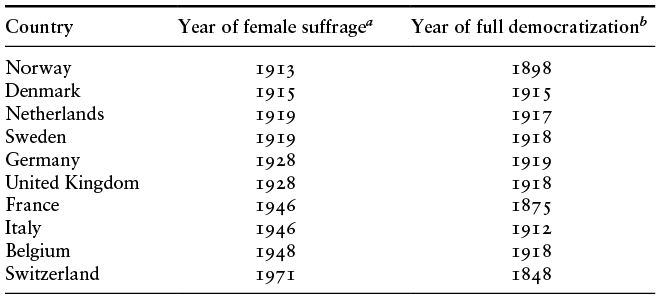
Before developing these arguments, we should note up front that there are two other compelling challenges to the conventional view of democratization in Europe. First, one could argue that no state in Europe was democratic until all adult women could vote (see Table 1.1). Since there were several states in the world where women could vote before WWI, it is impossible to argue that the West was somehow incapable of enfranchising women at this point in its historical development. Women were demanding, and in the case of some radical suffragette movements in Britain, fighting for the vote on the eve of WWI. Second, one can also plausibly argue that democratization and colonialism were not compatible, and thus democracy only truly arrived after decolonization in the two decades following WWII. Even then, the persistence of systemic racism and highly restrictive citizenship policies still undercut democratic quality in former colonizers, as they do in the United States. Hopefully scholars will follow Michael Hanford’s lead in pursuing this foundational critique of the West’s democratic heritage.Footnote 36 This book is less ambitious by accepting a much lower standard for democracy and demonstrating that much of Europe failed to meet even that.
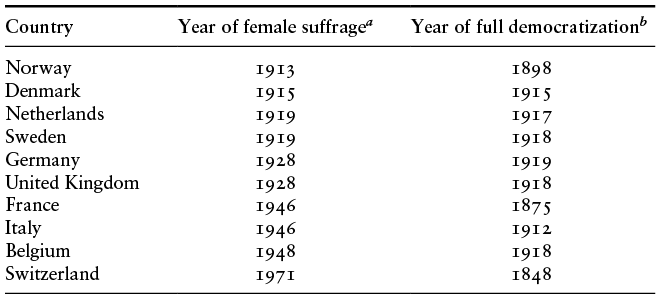
a From Pamela Paxton, “Women’s Suffrage in the Measurement of Democracy: Problems of Operationalization.” Studies in Comparative International Development 35 (September 2000), 92–111.
b From Ruth Collier, Path’s Toward Democracy.
1.2 Historiography and the First Wave
This book uses mostly qualitative data.Footnote 37 Much of it is primary source, but the bulk of the evidence comes from secondary sources. This raises an immediate methodological issue, for as Marcus Kreuzer notes “political scientists commonly draw on history but often do not read actual historians carefully.”Footnote 38 His concerns echo those of Ian Lustick, who warns political scientists that “the work of historians is not understood to be, and cannot legitimately be treated by others as, an unproblematic background narrative from which theoretically neutral data can be elicited for the framing of problems and the testing of theories.”Footnote 39 Many political scientists would surely concede this point, yet most still appear to operate under the assumption that an actual historical record exists and that historians are in the business of reconstructing the facts, much as survey researchers are in the business of capturing the state of public opinion. Political scientists are generally quite attuned to the methodological strengths and limitations of survey research, but they often fail to make such distinctions among historical works.
For example, take the case of the political regime of “liberal Italy” from unification in 1861 to the fascist seizure of power in 1922. The first histories of this period were written either by liberals, who praised the regime’s progressive achievements, or by communists, who were the victims of its repression. After the fall of the fascist regime, the histories of liberal Italy increasingly presented it as an authoritarian precursor to the totalitarian state. Several decades after that, a “revisionist” history of liberal Italy began to appear, which was not hagiographic but nonetheless insisted that the regime had some positive democratic elements. Understanding the historiography of the British “age of reform,” the Second Empire of Louis Napoleon Bonaparte, or Wilhelmine Germany involves reaching a similar command of competing ideological and methodological perspectives that have shifted over time. In other words, political scientists need to uncover and make transparent the historiography of a period as a preliminary step in “reading history carefully.” It was not shocking that modernization theorists in the 1950s drew on Whig histories, or that Marxist academics in the 1960s relied on a “history from below,” but political scientists need to recognize how a wholesale embrace of one historiographical perspective influences the specific evidence they then use to test their hypotheses. With very few exceptions, political scientists have ignored this basic advice.
Reading carefully also means avoiding the temptation of cherry-picking historical evidence to conform to theoretical predictions. This practice takes at least two different forms. First, political scientists often choose a few words of historical text (usually the bits that support their argument) and leave out other relevant material contained in the same text. One prominent example of this is the invocation of Lord Grey’s statement on the First Reform Bill of 1832: “The Principal of my Reform is to prevent the necessity of revolution. I am reforming to preserve, not to overthrow.” Less often noted is what Grey said several breaths later: “there is no one more dedicated against annual parliaments, universal suffrage, and the [secret] ballot, than I am.”Footnote 40 Although the second statement is consistent with the first, leaving it out renders Grey more of an enlightened reformer and less a defender of the old order.
A second form of cherry-picking is selecting on the dependent variable. Here again the case of the First Reform Bill is illustrative. Many scholars have argued that the public agitation that accompanied the bill’s passage through the parliamentary system explains its ultimate success. As I argue in Chapter 3, the balance of evidence does not support this view. But the more general problem is that all the cases in which public agitation leads not to reform but to repression are left out. The snuffing out of the Luddite uprisings, the Peterloo massacre, the passage of the notorious “Six Acts,” and the crushing of the Chartists are often excluded from an “age of reform” focused on the two reforms of 1832 and 1867.
A final practice that political scientists should avoid is taking quotes of politicians at face value. This would seem obvious were it not for the fact that some prominent academics have suggested the opposite. According to Adam Przeworski, “the strongest evidence in favour of the argument that suffrage was extended to the poor under the threat of revolution,” he writes, comes “not from the events themselves but from voices of the historical protagonists.” “These voices were often so explicit,” he claims, “that one does not need to impute the motivations.”Footnote 41 I do not share this assumption. There are a host of reasons why elites would knowingly exaggerate the threat of unrest, the most important being that it added an additional argument to a policy that they supported for other goals. Invoking the threat of mass social unrest is also a classic rhetorical strategy that both proponents and opponents of democratization have used across time and space. Thus, while elites may talk a lot about revolution during periods of institutional change, there are good reasons for making a serious effort to place their claims in historical context.
1.3 Goals and Outline
To recap: My objective is to simultaneously challenge two central frameworks for understanding the first wave – gradualism and threat of revolution – while also explaining how scholars coalesced around these two paradigms. Revising conventional understandings of the first wave is critical for any future work in democratization that draws upon this period. Rather than considering the nondemocratic features of the first wave as relics of the old regime, as simple barriers to would-be democratizers, I place authoritarian resilience at the center of analysis and uncover the multiple mechanisms – institutional, ideational, and repressive – that the opponents of democracy deployed – with considerable success – across Europe before WWI.
Chapter 2 provides a synthetic review of a century of scholarship on the first wave and distills three central narratives of political development: gradualist, revolutionary, and “special” (for Germany). The seminal contribution of Robert Dahl to the field of democratization – and to European political development – is explained. It demonstrates how different data sets provide completely different interpretations of the period. Whereas Polity IV largely supports a gradualist narrative of development, V-Dem contends there was far less democratization over time and significant authoritarian resilience. The chapter closes with a snapshot of European regimes on the eve of WWI to demonstrate how far most were from democracy: only Norway and Denmark (not the cases that Bryce noted) meet the Dahlian criteria upon which most contemporary views of democracy are based.Footnote 42
Chapter 3 argues that political elites during the English “age of reform” were far less concerned with the gradual fostering of democracy than with the defense of competitive oligarchy. Synthesizing the extensive literature on the First and Second Great Reform Acts, it shows how the Whig view of the period – a view that still largely informs political science research today – overstates both the progressive ideology of reformers and the democratizing effects of the two bills. It also includes two periods that are difficult to fit into a reformist narrative and are subsequently downplayed in most accounts of the English democratization. The first is the several decades of political reaction marked by the crushing of the Luddite movement (1811–1813), the massacre at Peterloo (1819), and the passing of the Six Acts (1819). The second is the repression of the Chartist movement between 1834 and 1848. Both episodes reveal how the British state generally responded to mass protests demanding political change. Rather than conceding to the demands of would-be revolutionaries, the state developed its coercive forces – most notably the police and the Home Office – to meet the new challenge. The chapter also assesses the claim that the threat of revolution explains either of the major franchise expansions, finding that the evidence is at best mixed for 1832 and entirely unconvincing for 1867. In sum, both the traditional Whig story of progressive democratization from above and the labor-inspired view of democratization from below are myths. Even after the Second Great Reform Bill of 1867, political elites still felt they had largely dodged democracy. Great Britain would remain a competitive oligarchy until the end of WWI.
Chapter 4 turns to France between 1848 and 1870. It examines how the first competitive authoritarian regime in Europe – the Second Empire (1851–1870) – emerged from the collapse of Europe’s first modern democracy, the French Second Republic (1848–1851). Louis Napoleon tilted the playing field in otherwise competitive elections through legal chicanery and media dominance, and the Bonapartist party he created has a legitimate claim to the mantle of the world’s first hegemonic political party. This system was quite stable and was brought down by a disastrous international war and not through internal opposition to it; elections reinforced competitive authoritarianism rather than undermining the regime. Bonapartism was also the model for Europe’s second competitive authoritarian regime: Imperial Germany from 1870 to 1918. Bismarck’s observation of, and extensive personal experience in, Bonapartist France changed his hitherto arch-reactionary views on universal suffrage and led him to see the electorate as a conservative rather than liberalizing force.
Chapter 5 compares Wilhelmine Germany with Edwardian England and arrives at an unconventional conclusion about their relative stability. There is a scholarly tradition of viewing the Second Reich, particularly after the fall of Bismarck and the political ascension of King Wilhelm II, as so ridden with internal contradictions that it was in near-permanent crisis. More recently, scholars have argued that Germany was in fact democratizing, suggesting again that this major historical case of competitive authoritarianism was volatile. I find instead that the balance of evidence indicates that Imperial Germany is a good case of institutionalized competitive authoritarianism, and that it was Edwardian England rather than Wilhelmine Germany where the most serious threat of regime change existed. I contest two widely held misconceptions: (1) that the UK had transitioned to democracy significantly before the outbreak of WWI and (2) that the landed elite acquiesced in this transition. I argue instead that the UK was not only a prototypical competitive oligarchy before WWI, but that it was in a constitutional crisis and close to civil war. The political dimensions of the “Edwardian Crisis” have been neglected because they were transformed by WWI.
Chapter 6 adopts a cross-national perspective to reassess the overall strength of the first wave of democratization outside of Britain and France. It argues that four states that scholars have long considered examples of vanguard democracies or “settled cases of democracy” in northern Europe (Belgium, the Netherlands, Denmark, and Sweden) do not really fit this description. Belgium and the Netherlands were clearly competitive oligarchies on the eve of WWI. Denmark was indeed one of the most democratic states in Europe by WWI, but its path there had been marked by periods of militarism and rollbacks of suffrage. Sweden was not a democracy by any measure until after WWI. Chapter 7 turns to Italy (and briefly to Portugal and Spain) to show that the supposedly “liberal” regimes in Southern Europe were not democratic, but rather combined elements of competitive oligarchy and competitive authoritarianism.
The role of international war in the first wave of democratization is the theme of Chapter 8. Scholars have long noted an increase in franchise extensions during wars, and political economists have recently formalized this insight. Still, there is a prevailing view in the literature that international war – particularly WWI – merely hastened the ultimate success of prewar democratization efforts. I argue that international war was not the final straw for the old regime but rather was one of only a small category of exogenous events capable of dislodging a resilient system of competitive oligarchy. Chapter 9 reflects on the three major mechanisms of authoritarian resilience – ideas, institutions, and repression/cheating – in light of the current debate about the state of liberal democracy in Europe and the United States.
If the conventional view of the first wave needs revision, so too does Bryce’s reputation as a Pollyannish democrat who is most remembered for his conclusion that humanity had arrived at a “universal acceptance of democracy as the normal and natural form of government.” In fact, Bryce harbored no illusions about the eventual triumph of democracy, and indeed he expressed misgivings about the desirability of democracy itself throughout Modern Democracies. He posits no natural tendency among human societies to develop democratic institutions, noting that “as a rule, that which the mass of any people desires is not to govern itself but to be well-governed” and that “most people want good government, not democratic government.”Footnote 43 He asserts that “popular government has been usually sought and won and valued not as a good thing in itself, but as a means of getting rid of tangible grievances or seeking tangible benefits.”Footnote 44
One thing about Bryce is clear: he was not a democrat in the modern meaning of the term. He was a liberal who voted against female suffrage in Great Britain in 1918 on the grounds that women lacked the capacity to make informed political choices because “they do not meet and talk about politics” and “do not read political news in the way men do.”Footnote 45 With politicians like Bryce representing the leading edge of reform and radicalism against the old regime in many first-wave cases, it is hardly surprising that Europe was far from democracy on the eve of WWI.