


1. Introduction
In this paper we investigate the boundary dynamics of a sequence of left compositions of functions holomorphic in the unit disc ${\mathbb{D}}$
of the complex plane.
${\mathbb{D}}$
of the complex plane.
Like many topics in complex dynamics, the starting point of our analysis is the Denjoy–Wolff theorem, which states that if a holomorphic function $f\colon {\mathbb{D}} \to{\mathbb{D}}$
is not conjugate to a Euclidean rotation, then its sequence of iterates
$f\colon {\mathbb{D}} \to{\mathbb{D}}$
is not conjugate to a Euclidean rotation, then its sequence of iterates $(\,f^n)$
converges locally uniformly to a constant function
$(\,f^n)$
converges locally uniformly to a constant function $z_0\in\overline{{\mathbb{D}}}$
.
$z_0\in\overline{{\mathbb{D}}}$
.
This classical result was strengthened by Boundon, Matache and Shapiro [
Reference Bourdon, Matache and Shapiro6
], and independently by Poggi-Corradini [
Reference Poggi-Corradini12
], who showed that in many cases the sequence $(\,f^n(\zeta))$
converges to
$(\,f^n(\zeta))$
converges to $z_0$
, for Lebesgue almost all
$z_0$
, for Lebesgue almost all $\zeta$
in the unit circle
$\zeta$
in the unit circle ${\mathbb{T}}\;:\!=\;\partial{\mathbb{D}}$
(see also [
Reference Doering and Mañe8
]). Here,
${\mathbb{T}}\;:\!=\;\partial{\mathbb{D}}$
(see also [
Reference Doering and Mañe8
]). Here, $f(\zeta)$
is defined in terms of radial limits
$f(\zeta)$
is defined in terms of radial limits
 \[f(\zeta)\;:\!=\;\lim_{r\to1^-}f(r\zeta),\]
which, due to a theorem of Fatou, exist for Lebesgue almost all $\zeta\in{\mathbb{T}}$
.
$\zeta\in{\mathbb{T}}$
.
Recently, there have been many efforts towards generalising the Denjoy–Wolff theorem to include compositions of more than one map [ Reference Abate and Short3–Reference Benini, Evdoridou, Núria, Rippon and Stallard5, Reference Ferreira10, Reference Ferreira and Nicolau11 ]. Of particular interest are left iterated function systems, which are compositions of the form
 \[F_n=f_n\circ f_{n-1} \circ\cdots \circ f_1,\]
where each $f_i\colon{\mathbb{D}}\to{\mathbb{D}}$
is holomorphic. Although there are several sufficient conditions on
$f_i\colon{\mathbb{D}}\to{\mathbb{D}}$
is holomorphic. Although there are several sufficient conditions on $f_n$
that guarantee the convergence of the left iterated function system (see, for example, [
Reference Abate and Christodoulou2, Reference Abate and Short3, Reference Christodoulou and Short7
] and [
Reference Abate1
, sections 3·6, 3·7]), there is no definitive analogue of the Denjoy–Wolff theorem for
$f_n$
that guarantee the convergence of the left iterated function system (see, for example, [
Reference Abate and Christodoulou2, Reference Abate and Short3, Reference Christodoulou and Short7
] and [
Reference Abate1
, sections 3·6, 3·7]), there is no definitive analogue of the Denjoy–Wolff theorem for $F_n$
.
$F_n$
.
Our aim in this paper is to bring together the above two approaches of expanding the scope of the Denjoy–Wolff theorem. The theorem of Fatou we mentioned earlier implies that the sequence $F_n(\zeta)$
is well-defined, in terms of radial limits, for Lebesgue almost all
$F_n(\zeta)$
is well-defined, in terms of radial limits, for Lebesgue almost all $\zeta\in{\mathbb{T}}$
and all
$\zeta\in{\mathbb{T}}$
and all $n\in{\mathbb{N}}$
. Therefore, it is only natural to examine whether the dynamical behaviour of a left iterated function system in
$n\in{\mathbb{N}}$
. Therefore, it is only natural to examine whether the dynamical behaviour of a left iterated function system in ${\mathbb{D}}$
extends to the boundary.
${\mathbb{D}}$
extends to the boundary.
Our main result is the following, where $\ell$
denotes the Lebesgue probability measure in
$\ell$
denotes the Lebesgue probability measure in ${\mathbb{T}}$
.
${\mathbb{T}}$
.
Theorem 1·1. Let $(\,f_n)$
be a sequence of holomorphic self-maps of
$(\,f_n)$
be a sequence of holomorphic self-maps of ${\mathbb{D}}$
such that the left iterated function system
${\mathbb{D}}$
such that the left iterated function system $F_n=f_n\circ f_{n-1}\circ\cdots\circ f_1$
converges locally uniformly to a constant
$F_n=f_n\circ f_{n-1}\circ\cdots\circ f_1$
converges locally uniformly to a constant $z_0\in{\mathbb{D}}$
. Assume that there exists a subsequence
$z_0\in{\mathbb{D}}$
. Assume that there exists a subsequence $(\,f_{n_k})$
of
$(\,f_{n_k})$
of $(\,f_n)$
and Lebesgue measurable sets
$(\,f_n)$
and Lebesgue measurable sets $E_k\subseteq{\mathbb{T}}$
with
$E_k\subseteq{\mathbb{T}}$
with $\limsup_k \ell(E_k)\gt0$
, so that
$\limsup_k \ell(E_k)\gt0$
, so that $\lvert\,f_{n_k}(\zeta) \rvert\lt1$
for all
$\lvert\,f_{n_k}(\zeta) \rvert\lt1$
for all $\zeta\in E_k$
. Then the sequence
$\zeta\in E_k$
. Then the sequence $(F_n(\zeta))$
converges to
$(F_n(\zeta))$
converges to $z_0$
for Lebesgue almost every
$z_0$
for Lebesgue almost every $\zeta\in{\mathbb{T}}$
.
$\zeta\in{\mathbb{T}}$
.
An analysis of the boundary dynamics of holomorphic iterated function systems, with remarkable applications to the theory of transcendental dynamics, was carried out in [
Reference Benini, Evdoridou, Núria, Rippon and Stallard5
] by Benini et al., albeit from a different perspective. To be more precise, [
Reference Benini, Evdoridou, Núria, Rippon and Stallard5
, theorem B] provides a sufficient condition for the sequences $(F_n(\zeta))$
and
$(F_n(\zeta))$
and $(F_n(z))$
, for
$(F_n(z))$
, for $\zeta\in{\mathbb{T}}$
and
$\zeta\in{\mathbb{T}}$
and $z\in{\mathbb{D}}$
, to exhibit the same asymptotic behaviour. This condition, however, is only substantial when
$z\in{\mathbb{D}}$
, to exhibit the same asymptotic behaviour. This condition, however, is only substantial when $F_n(z)$
“escapes” to the boundary
$F_n(z)$
“escapes” to the boundary ${\mathbb{T}}$
; in particular it fails if one assumes that
${\mathbb{T}}$
; in particular it fails if one assumes that $F_n$
converges to
$F_n$
converges to $z_0\in{\mathbb{D}}$
, as we do in Theorem 1·1. Therefore, Theorem 1·1 can be thought of as an “interior” (or “elliptic”) companion to the theorem of Benini et al., since together they shed light into the elusive boundary dynamics of left iterated function systems.
$z_0\in{\mathbb{D}}$
, as we do in Theorem 1·1. Therefore, Theorem 1·1 can be thought of as an “interior” (or “elliptic”) companion to the theorem of Benini et al., since together they shed light into the elusive boundary dynamics of left iterated function systems.
Let us now discuss the assumptions of Theorem 1·1. Observe that if all the functions $f_n$
in Theorem 1·1 are inner, i.e.
$f_n$
in Theorem 1·1 are inner, i.e. $\lvert\,f_n(\zeta)\rvert =1$
for Lebesgue almost all
$\lvert\,f_n(\zeta)\rvert =1$
for Lebesgue almost all $\zeta\in{\mathbb{T}}$
, then the sequence
$\zeta\in{\mathbb{T}}$
, then the sequence $F_n(\zeta)$
lies on
$F_n(\zeta)$
lies on ${\mathbb{T}}$
for all n, and so the conclusion of our theorem fails trivially. Similarly, one can easily construct examples which show that our conclusion also fails if the sequence
${\mathbb{T}}$
for all n, and so the conclusion of our theorem fails trivially. Similarly, one can easily construct examples which show that our conclusion also fails if the sequence $(\,f_n)$
contains only finitely many non-inner functions.
$(\,f_n)$
contains only finitely many non-inner functions.
So, it is necessary to assume that $(\,f_n)$
contains a non-inner subsequence
$(\,f_n)$
contains a non-inner subsequence $(\,f_{n_k})$
, as we do in Theorem 1·1. Note that
$(\,f_{n_k})$
, as we do in Theorem 1·1. Note that $(\,f_n)$
is still allowed to contain infinitely many inner functions. In Theorem 1·1, however, we also assume that the Lebesgue measures of the sets which render
$(\,f_n)$
is still allowed to contain infinitely many inner functions. In Theorem 1·1, however, we also assume that the Lebesgue measures of the sets which render $(\,f_{n_k})$
non-inner do not vanish, as is evident by the positivity of the limit superior in our assumptions. This is to ensure that there is a “residual” target set which allows the sequence
$(\,f_{n_k})$
non-inner do not vanish, as is evident by the positivity of the limit superior in our assumptions. This is to ensure that there is a “residual” target set which allows the sequence $(F_n(\zeta))$
to transition to the interior of
$(F_n(\zeta))$
to transition to the interior of ${\mathbb{D}}$
, where the contracting properties of
${\mathbb{D}}$
, where the contracting properties of $f_n$
yield the desired convergence. We expect that an assumption similar to the one proposed in our main result is indeed necessary if one wishes to obtain a similar conclusion.
$f_n$
yield the desired convergence. We expect that an assumption similar to the one proposed in our main result is indeed necessary if one wishes to obtain a similar conclusion.
The techniques we employ, which are inspired by [ Reference Bourdon, Matache and Shapiro6 ], involve modifications of classical results for composition operators on Hardy space that appeared in [ Reference Shapiro15 ], in conjunction with a new perturbation technique for iterated function systems. To be more precise, the key idea of our proof is to “interweave” elliptic Möbius transformations in-between the compositions of a left iterated function system which render certain Hardy norm estimates valid.
2. Preliminaries
2·1. Hardy spaces
We denote by $H^2$
the usual Hardy space consisting of functions
$H^2$
the usual Hardy space consisting of functions $ f(z)=\sum_{n=0}^{\infty}\widehat{f}_nz^n$
holomorphic in
$ f(z)=\sum_{n=0}^{\infty}\widehat{f}_nz^n$
holomorphic in ${\mathbb{D}}$
, for which
${\mathbb{D}}$
, for which $\sum_{n=0}^{\infty}\rvert \widehat{f}_n\lvert^2\lt+\infty$
. The norm in
$\sum_{n=0}^{\infty}\rvert \widehat{f}_n\lvert^2\lt+\infty$
. The norm in $H^2$
is defined as
$H^2$
is defined as
 \begin{equation}\lVert\, f \rVert_2\;:\!=\;\lim_{r\to1^-}\left(\frac{1}{2\pi}\int_{{\mathbb{T}}} \lvert\,f(r\zeta) \rvert^2 d\ell(\zeta)\right)^{1/2}\lt+\infty,\end{equation}
where $\ell$
is the Lebesgue probability measure in the unit circle
$\ell$
is the Lebesgue probability measure in the unit circle ${\mathbb{T}}$
.
${\mathbb{T}}$
.
It is known [
Reference Duren9
, theorem 2·2] that for functions $f\in H^2$
, the radial limits
$f\in H^2$
, the radial limits $f(\zeta)\;:\!=\;\lim_{r\to1}f(r\zeta)$
exist for Lebesgue almost every
$f(\zeta)\;:\!=\;\lim_{r\to1}f(r\zeta)$
exist for Lebesgue almost every $\zeta\in{\mathbb{T}}$
. In fact, the norm in
$\zeta\in{\mathbb{T}}$
. In fact, the norm in $H^2$
can be obtained by the boundary integral
$H^2$
can be obtained by the boundary integral
 \begin{equation}\lVert\, f \rVert_2=\left(\frac{1}{2\pi}\int_{{\mathbb{T}}} \lvert\,f(\zeta) \rvert^2d\ell(\zeta)\right)^{1/2}.\end{equation}
Another way of computing this norm involving an area integral is given by the Littlewood–Paley Identity [ Reference Shapiro14 , p. 178]
 \begin{equation}\lVert\, f \rVert_2^2 = \lvert\,f(0) \rvert^2 +2\int_{{\mathbb{D}}} \lvert\,f'(z) \rvert^2 \log \frac{1}{\lvert z\rvert} dA(z),\end{equation}
where A is the Lebesgue probability measure in ${\mathbb{D}}$
.
${\mathbb{D}}$
.
2·2. Composition operators
For a holomorphic function $f\colon{\mathbb{D}}\to{\mathbb{D}}$
, we define the linear composition operator
$f\colon{\mathbb{D}}\to{\mathbb{D}}$
, we define the linear composition operator $C_f\colon H^2\to H^2$
with
$C_f\colon H^2\to H^2$
with $C_f(g)=g\circ f$
.
$C_f(g)=g\circ f$
.
Littlewodd’s Subordination Principle [
Reference Duren9
, theorem 1·7] shows that this operator is well-defined and bounded. In particular, we have $\lVert C_f \rVert \leq \sqrt{({1+\lvert \,f(0) \rvert})/({1-\lvert \,f(0) \rvert})}$
(see [
Reference Shapiro14
, p. 16]). Note that in the special case where
$\lVert C_f \rVert \leq \sqrt{({1+\lvert \,f(0) \rvert})/({1-\lvert \,f(0) \rvert})}$
(see [
Reference Shapiro14
, p. 16]). Note that in the special case where $f(0)=0$
this inequality becomes
$f(0)=0$
this inequality becomes
 \begin{equation}\lVert C_f \rVert \leq 1.\end{equation}
At this point we need to make a remark about the notation of norms. The notation $\lVert C_f \rVert$
used above denotes the operator norm induced by the
$\lVert C_f \rVert$
used above denotes the operator norm induced by the $H^2$
norm. We shall follow this convention throughout the article; i.e.
$H^2$
norm. We shall follow this convention throughout the article; i.e. $\lVert \cdot \rVert_2$
will denote the norm of a function in
$\lVert \cdot \rVert_2$
will denote the norm of a function in $H^2$
, whereas
$H^2$
, whereas $\lVert \cdot \rVert$
will denote the operator norm of a composition operator.
$\lVert \cdot \rVert$
will denote the operator norm of a composition operator.
The main tool for our proof of Theorem 1·1 is evaluating the norms of composition operators in $H^2$
. In order to do so, we require the so-called “Change of variables formula” that appears in [
Reference Shapiro14
, p. 179]. To present this, let us first define the Nevanlinna counting function of a holomorphic function
$H^2$
. In order to do so, we require the so-called “Change of variables formula” that appears in [
Reference Shapiro14
, p. 179]. To present this, let us first define the Nevanlinna counting function of a holomorphic function $f\colon{\mathbb{D}}\to{\mathbb{D}}$
, as
$f\colon{\mathbb{D}}\to{\mathbb{D}}$
, as
 \[N_f(w)=\begin{cases}\displaystyle \sum_{z\in f^{-1}(\{w\})}\log \frac{1}{\lvert z \rvert}, \quad \text{for all}, & w\in f({\mathbb{D}})\setminus\{\,f(0)\},\\ {} {} {} {} {}0, &w\notin f({\mathbb{D}})\setminus\{\,f(0)\}, \end{cases}\]
where points in the preimage $f^{-1}(\{w\})$
are repeated according to their multiplicity. The change of variables formula we promised is the following:
$f^{-1}(\{w\})$
are repeated according to their multiplicity. The change of variables formula we promised is the following:
 \begin{equation}\lVert C_f(g) \rVert_2^2 = \lvert g(\,f(0)) \rvert^2 + 2 \int_{{\mathbb{D}}}\lvert g'(w)\rvert^2 N_f(w) dA(w).\end{equation}
We now present some properties of the Nevanlinna counting function that will be important in our proofs. First, an application of Jensen’s formula yields an integral interpretation of the Nevanlinna counting function, as follows (see [ Reference Shapiro14 , p. 187]):
 \[N_f(w) = \lim_{r\to1^-}\int_{{\mathbb{T}}}\log\left\lvert \frac{w-f(r\zeta)}{1-\overline{w}f(r\zeta)}\right\rvert d\ell(\zeta) + \log\left\lvert\frac{1-\overline{w}f(0)}{w-f(0)}\right\rvert.\]
Since functions in $H^2$
have radial limits almost everywhere in
$H^2$
have radial limits almost everywhere in ${\mathbb{T}}$
, we can use Fatou’s Lemma to obtain that whenever
${\mathbb{T}}$
, we can use Fatou’s Lemma to obtain that whenever $f\in H^2$
, we have
$f\in H^2$
, we have
 \begin{equation}N_f(w) \leq \int_{{\mathbb{T}}}\log\left\lvert \frac{w-f(\zeta)}{1-\overline{w}f(\zeta)}\right\rvert d\ell(\zeta) + \log\left\lvert\frac{1-\overline{w}f(0)}{w-f(0)}\right\rvert.\end{equation}
Another estimate of the Nevanlinna counting function is the famous Littlewood’s Inequality [
Reference Shapiro14
, p.187], which states that for any $f\colon {\mathbb{D}}\to{\mathbb{D}}$
holomorphic and any
$f\colon {\mathbb{D}}\to{\mathbb{D}}$
holomorphic and any $w\in{\mathbb{D}}\setminus \{\,f(0)\}$
, we have
$w\in{\mathbb{D}}\setminus \{\,f(0)\}$
, we have
 \begin{equation}N_f(w)\leq \log\left\lvert \frac{ 1-\overline{w}f(0)}{w-f(0)}\right\rvert.\end{equation}
In fact, (2·6) is simply an intermediate step in the proof of Littlewood’s Inequality in [ Reference Shapiro14 , p.187].
2·3. Hyperbolic geometry
We finish the preliminary material by presenting some basic facts for the hyperbolic geometry of the unit disc. For a complete treatise on hyperbolic geometry, we refer to [ Reference Abate1 , chapter 1].
To start with, the hyperbolic metric d of ${\mathbb{D}}$
is defined as
${\mathbb{D}}$
is defined as
 \[d(z,w)=\frac{1}{2}\log \frac{1+\left\lvert\frac{z-w}{1-\overline{w}z}\right\rvert}{1-\left\lvert\frac{z-w}{1-\overline{w}z}\right\rvert}, \quad \text{ for all}\quad z,w\in{\mathbb{D}}.\]
It is easy to see that d is indeed a metric, which turns ${\mathbb{D}}$
into a complete metric space. The geodesics of this metric space are arcs of circles orthogonal to the unit circe
${\mathbb{D}}$
into a complete metric space. The geodesics of this metric space are arcs of circles orthogonal to the unit circe ${\mathbb{T}}$
, and the space in uniquely geodesic; i.e. any two points
${\mathbb{T}}$
, and the space in uniquely geodesic; i.e. any two points $z,w\in{\mathbb{D}}$
can be joined by a unique geodesic of
$z,w\in{\mathbb{D}}$
can be joined by a unique geodesic of $({\mathbb{D}},d)$
.
$({\mathbb{D}},d)$
.
Moreover, if $\gamma\colon[0,1]\to{\mathbb{D}}$
is a geodesic joining
$\gamma\colon[0,1]\to{\mathbb{D}}$
is a geodesic joining $z,w\in{\mathbb{D}}$
, then there exists a unique point
$z,w\in{\mathbb{D}}$
, then there exists a unique point $a\in\gamma([0,1])$
so that
$a\in\gamma([0,1])$
so that $d(z,a)=d(w,a)=d(z,w)/2$
. We call this point a the hyperbolic midpoint of z and w.
$d(z,a)=d(w,a)=d(z,w)/2$
. We call this point a the hyperbolic midpoint of z and w.
The main advantage of working with the hyperbolic metric of ${\mathbb{D}}$
, instead of the Euclidean, is the Schwarz–Pick Lemma, which can be stated as follows:
${\mathbb{D}}$
, instead of the Euclidean, is the Schwarz–Pick Lemma, which can be stated as follows:
If $f\colon{\mathbb{D}}\to{\mathbb{D}}$
is holomorphic, then
$f\colon{\mathbb{D}}\to{\mathbb{D}}$
is holomorphic, then
 \begin{equation}d(\,f(z),f(w))\leq d(z,w),\quad\text{for all}\quad z,w\in {\mathbb{D}}.\end{equation}
Equality in (2·8) is achieved for some (and hence any) $z\neq w$
if and only if
$z\neq w$
if and only if
 \[f(z)=e^{i\theta}\frac{z-a}{1-\overline{a}z}, \quad \text{for some}\ \theta\in{\mathbb{R}} \ \text{and}\ a\in{\mathbb{D}}.\]
The Möbius transformations of this form will be called automorphisms of ${\mathbb{D}}$
, and are exactly the orientation preserving isometries of d.
${\mathbb{D}}$
, and are exactly the orientation preserving isometries of d.
3. Proof of the main result
This section is dedicated to proving Theorem 1·1. For the convenience of the reader, let us recall the assumptions of Theorem 1·1. Suppose $(\,f_n)$
is a sequence of holomorphic self-maps of
$(\,f_n)$
is a sequence of holomorphic self-maps of ${\mathbb{D}}$
such that the left iterated function system
${\mathbb{D}}$
such that the left iterated function system $F_n=f_n\circ f_{n-1}\circ \cdots\circ f_1$
converges locally uniformly to a constant
$F_n=f_n\circ f_{n-1}\circ \cdots\circ f_1$
converges locally uniformly to a constant $z_0\in{\mathbb{D}}$
. We assume that there exists a subsequence
$z_0\in{\mathbb{D}}$
. We assume that there exists a subsequence $(\,f_{n_k})\subseteq (\,f_n)$
and
$(\,f_{n_k})\subseteq (\,f_n)$
and $\ell$
-measurable sets
$\ell$
-measurable sets $E_k\subset {\mathbb{T}}$
such that
$E_k\subset {\mathbb{T}}$
such that $\lvert\,f_{n_k}(\zeta)\rvert\lt1$
for all
$\lvert\,f_{n_k}(\zeta)\rvert\lt1$
for all $\zeta\in E_k$
and
$\zeta\in E_k$
and $\limsup_k \ell(E_k)\gt0$
.
$\limsup_k \ell(E_k)\gt0$
.
Our goal is to show that $F_n(\zeta)\to z_0$
, as
$F_n(\zeta)\to z_0$
, as $n\to+\infty$
, for
$n\to+\infty$
, for $\ell$
-almost all
$\ell$
-almost all $\zeta\in{\mathbb{T}}$
. Observe that if
$\zeta\in{\mathbb{T}}$
. Observe that if $f_k$
is constant, for some
$f_k$
is constant, for some $k\in{\mathbb{N}}$
, then the result is trivial due to the convergence of
$k\in{\mathbb{N}}$
, then the result is trivial due to the convergence of $(F_n)$
to
$(F_n)$
to $z_0$
. So, for the rest of the proof, we assume that all
$z_0$
. So, for the rest of the proof, we assume that all $f_n$
are non-constant self-maps of
$f_n$
are non-constant self-maps of ${\mathbb{D}}$
. Also, consider the automorphism
${\mathbb{D}}$
. Also, consider the automorphism
 \[\psi_0(z)=\frac{z-z_0}{1-\overline{z_0}z},\]
and the functions $g_n=\psi_0 \circ f_n\circ \psi_0^{-1}$
. We can see that
$g_n=\psi_0 \circ f_n\circ \psi_0^{-1}$
. We can see that $(F_n(\zeta))$
converges to
$(F_n(\zeta))$
converges to $z_0$
if and only if the sequence
$z_0$
if and only if the sequence $G_n(\zeta)=g_n\circ\cdots\circ g_1(\zeta)=\psi_0\circ F_n\circ \psi_0^{-1}(\zeta)$
converges to 0. Therefore, it suffices to assume that
$G_n(\zeta)=g_n\circ\cdots\circ g_1(\zeta)=\psi_0\circ F_n\circ \psi_0^{-1}(\zeta)$
converges to 0. Therefore, it suffices to assume that $z_0=0$
.
$z_0=0$
.
Throughout the proof we use D(z,r) to denote the Euclidean disc of radius $r\gt0$
, centred at
$r\gt0$
, centred at $z\in{\mathbb{C}}$
. Before we proceed with the main body of the proof, we require the following result from [
Reference Christodoulou and Short7
, theorem 3·3] (see, also, [
Reference Abate and Christodoulou2
, theorem 4·1 (ii)]).
$z\in{\mathbb{C}}$
. Before we proceed with the main body of the proof, we require the following result from [
Reference Christodoulou and Short7
, theorem 3·3] (see, also, [
Reference Abate and Christodoulou2
, theorem 4·1 (ii)]).
Theorem 3·1. Let f be a holomorphic self-map of ${\mathbb{D}}$
with
${\mathbb{D}}$
with $f(z_0)=z_0$
, for some
$f(z_0)=z_0$
, for some $z_0\in{\mathbb{D}}$
, which is not an automorphism of
$z_0\in{\mathbb{D}}$
, which is not an automorphism of ${\mathbb{D}}$
. If
${\mathbb{D}}$
. If $(\,f_n)$
is a sequence of holomorphic self-maps of
$(\,f_n)$
is a sequence of holomorphic self-maps of ${\mathbb{D}}$
that converges locally uniformly to f, then the left iterated function system
${\mathbb{D}}$
that converges locally uniformly to f, then the left iterated function system $F_n=f_n\circ f_{n-1}\circ\cdots \circ f_1$
converges locally uniformly to the constant
$F_n=f_n\circ f_{n-1}\circ\cdots \circ f_1$
converges locally uniformly to the constant $z_0$
.
$z_0$
.
The main idea for our proof is to find an appropriate normalisation for the compositions $F_n$
that will allow us to employ estimates on certain Hardy norms. Such a normalisation can be obtained as follows:
$F_n$
that will allow us to employ estimates on certain Hardy norms. Such a normalisation can be obtained as follows:
By passing to a subsequence of $(\,f_{n_k})$
, we can assume that there exists
$(\,f_{n_k})$
, we can assume that there exists $c\in(0,1)$
such that
$c\in(0,1)$
such that $\ell(E_k)\gt c$
, for all
$\ell(E_k)\gt c$
, for all $k\in{\mathbb{N}}$
. Moreover, for every
$k\in{\mathbb{N}}$
. Moreover, for every $\epsilon\gt0$
, and all
$\epsilon\gt0$
, and all $k\in{\mathbb{N}}$
, there exists a Lebesgue measurable set
$k\in{\mathbb{N}}$
, there exists a Lebesgue measurable set $E_k'\subseteq E_k$
and a constant
$E_k'\subseteq E_k$
and a constant $\delta_{k,\epsilon}\in(0,1)$
so that
$\delta_{k,\epsilon}\in(0,1)$
so that $\lvert\,f_{n_k}(\zeta) \rvert\lt\delta_{k,\epsilon}$
, for every
$\lvert\,f_{n_k}(\zeta) \rvert\lt\delta_{k,\epsilon}$
, for every $\zeta\in E_k'$
, and
$\zeta\in E_k'$
, and $\ell(E_k')\geq \ell(E_k)-\epsilon$
. So, without loss of generality, we also assume that for every
$\ell(E_k')\geq \ell(E_k)-\epsilon$
. So, without loss of generality, we also assume that for every $k\in{\mathbb{N}}$
, there exists
$k\in{\mathbb{N}}$
, there exists $\delta_k\in(0,1)$
, so that
$\delta_k\in(0,1)$
, so that
 \begin{equation}\lvert\,f_{n_k}(\zeta) \rvert\lt\delta_k,\quad \text{for every} \quad \zeta\in E_k\end{equation}
and $\ell(E_k)\gt c$
, for some
$\ell(E_k)\gt c$
, for some $c\in(0,1)$
.
$c\in(0,1)$
.
Next, we define the compositions $\phi_k=f_{n_{k+1}-1}\circ\cdots\circ f_{n_k}$
for
$\phi_k=f_{n_{k+1}-1}\circ\cdots\circ f_{n_k}$
for $k\geq 1$
. Then, if
$k\geq 1$
. Then, if $m\in{\mathbb{N}}$
and k is the largest integer such that
$m\in{\mathbb{N}}$
and k is the largest integer such that $m\gt n_{k+1}$
, we have that
$m\gt n_{k+1}$
, we have that
 \[F_m= f_m\circ\cdots\circ f_{n_{k+1}}\circ \phi_k\circ\phi_{k-1}\circ\cdots\circ \phi_1\circ f_{n_1-1}\circ\cdots \circ f_1, \quad \text{for all}\ m \ \text{large enough}.\]
We would first like to examine the convergence properties of $(\phi_k)$
. Since
$(\phi_k)$
. Since $(F_n)$
converges locally uniformly to 0 and all
$(F_n)$
converges locally uniformly to 0 and all $f_n$
are non-constant (as assumed in the beginning of this section), for any fixed
$f_n$
are non-constant (as assumed in the beginning of this section), for any fixed $n_0\in{\mathbb{N}}$
, the sequence
$n_0\in{\mathbb{N}}$
, the sequence $(\,f_n\circ\cdots\circ f_{n_0})$
converges to 0, pointwise on the open set
$(\,f_n\circ\cdots\circ f_{n_0})$
converges to 0, pointwise on the open set $f_{n_0-1}\circ\cdots \circ f_1\left(D(0,{1}/{2})\right)$
. Then, the Vitali–Porter Theorem [
Reference Schiff16
, p.75] implies that
$f_{n_0-1}\circ\cdots \circ f_1\left(D(0,{1}/{2})\right)$
. Then, the Vitali–Porter Theorem [
Reference Schiff16
, p.75] implies that $(\,f_n\circ\cdots\circ f_{n_0})$
converges to 0, locally uniformly as
$(\,f_n\circ\cdots\circ f_{n_0})$
converges to 0, locally uniformly as $n\to+\infty$
. So, by passing to a further subsequence if necessary, we can assume that the integers
$n\to+\infty$
. So, by passing to a further subsequence if necessary, we can assume that the integers $n_k$
are sparse enough, so that for all
$n_k$
are sparse enough, so that for all $k\in{\mathbb{N}}$
, the following hold:
$k\in{\mathbb{N}}$
, the following hold:
 \begin{align}&\phi_k\left(\overline{D\left(0,\frac{1}{2}\right)}\right)\subset D\left(0,\frac{1}{2}\right), \end{align}
 \begin{align}&\phi_k(z)\xrightarrow{k\to\infty}0,\quad\text{for all}\ z\in{\mathbb{D}},\quad \text{and}\end{align}
 \begin{align}&\lvert \phi_k(\zeta) \rvert\lt\frac{1}{2}, \quad \text{for all} \ \zeta\in E_k.\end{align}
This last inequality, (3·4), is possible due to (3·1).
The sequence $(\phi_k)$
is the key ingredient of our normalisation scheme. However, our work is not done, as we would like each
$(\phi_k)$
is the key ingredient of our normalisation scheme. However, our work is not done, as we would like each $\phi_k$
to fix the point 0, which might not happen in principle.
$\phi_k$
to fix the point 0, which might not happen in principle.
To overcome this obstacle, we consider the automorphism $e_1(z)=({\phi_1(0)-z})/({1-\overline{\phi_1(0)}z})$
and recursively define the automorphism
$e_1(z)=({\phi_1(0)-z})/({1-\overline{\phi_1(0)}z})$
and recursively define the automorphism $e_k$
with
$e_k$
with
 \[e_k(z)=\frac{\phi_k(e_{k-1}(0))-z}{1-\overline{\phi_k(e_{k-1}(0))}z}, \quad\text{for}\quad k\geq2.\]
Let us examine some properties of the automorphisms $e_k$
. Firstly, observe that each
$e_k$
. Firstly, observe that each $e_k$
is self-inverse. Moreover,
$e_k$
is self-inverse. Moreover, $e_k$
interchanges the points 0 and
$e_k$
interchanges the points 0 and $\phi_k(e_{k-1}(0))$
(or 0 and
$\phi_k(e_{k-1}(0))$
(or 0 and $\phi_1(0)$
for the case of
$\phi_1(0)$
for the case of $e_1$
). Therefore, every
$e_1$
). Therefore, every $e_k$
has a fixed point
$e_k$
has a fixed point $w_k\in{\mathbb{D}}$
, which is the hyperbolic midpoint of 0 and
$w_k\in{\mathbb{D}}$
, which is the hyperbolic midpoint of 0 and $\phi_k(e_{k-1}(0))$
(and analogously for
$\phi_k(e_{k-1}(0))$
(and analogously for $e_1$
). Now, observe that
$e_1$
). Now, observe that
 \begin{equation}e_k(0)=\phi_k(e_{k-1}(0))=\phi_k(\phi_{k-1}(e_{k-2}(0)))=\cdots=\phi_k\circ\cdots\circ \phi_1(0)\in D\left(0,\frac{1}{2}\right),\end{equation}
due to (3·2). Therefore, we have that
 \begin{equation}w_k\in D\left(0,\frac{1}{2}\right), \quad \text{for all}\ k\in{\mathbb{N}}.\end{equation}
We can in fact say more about the sequence of points $e_k(0)=\phi_k\circ\cdots\circ\phi_1(0)$
. Note that (3·2) and (3·3) imply that
$e_k(0)=\phi_k\circ\cdots\circ\phi_1(0)$
. Note that (3·2) and (3·3) imply that $(\phi_k)$
converges locally uniformly to the constant function 0 (again by the Vitali–Porter Theorem). So, we can use Theorem 3·1 in order to deduce that the left iterated function system
$(\phi_k)$
converges locally uniformly to the constant function 0 (again by the Vitali–Porter Theorem). So, we can use Theorem 3·1 in order to deduce that the left iterated function system $\Phi_k=\phi_k\circ \phi_{k-1}\circ\cdots \circ \phi_1$
converges locally uniformly to 0. This means that
$\Phi_k=\phi_k\circ \phi_{k-1}\circ\cdots \circ \phi_1$
converges locally uniformly to 0. This means that
 \begin{equation}e_k(0)=\Phi_k(0)\xrightarrow{k\to+\infty}0.\end{equation}
Next, we define the sequence of functions $\widetilde{\phi}_1=e_1\circ\phi_1$
and
$\widetilde{\phi}_1=e_1\circ\phi_1$
and $\widetilde{\phi}_k=e_k\circ \phi_k\circ e_{k-1}$
, for
$\widetilde{\phi}_k=e_k\circ \phi_k\circ e_{k-1}$
, for $k\geq 2$
. Notice that
$k\geq 2$
. Notice that $\widetilde{\phi}_k(0)=0$
for all
$\widetilde{\phi}_k(0)=0$
for all $k\geq1$
, as required for our technique. Also, since each
$k\geq1$
, as required for our technique. Also, since each $e_k$
is self-inverse, we can rewrite the composition
$e_k$
is self-inverse, we can rewrite the composition $F_m$
as follows,
$F_m$
as follows,
 \begin{align}F_m&=f_m\circ \cdots \circ f_{n_{k+1}}\circ e_k\circ e_k \circ \phi_k \circ e_{k-1}\circ e_{k-1}\circ \phi_{k-1}\circ\cdots \circ e_1\circ \phi_1\circ f_{n_1-1}\circ\cdots \circ f_1\nonumber\\ {}&= f_m\circ\cdots \circ f_{n_{k+1}}\circ e_k\circ \widetilde{\phi}_k\circ \widetilde{\phi}_{k-1}\circ \cdots\circ \widetilde{\phi}_1\circ f_{n_1-1}\circ\cdots \circ f_1,\end{align}
which is valid for all m large.
Rewriting the left iterated function system $(F_n)$
in the form (3·8) will turn out to be exactly the normalisation needed for our purposes. So, with this endeavour completed, we move on to obtaining estimates on the norms of the composition operators induced by the functions
$(F_n)$
in the form (3·8) will turn out to be exactly the normalisation needed for our purposes. So, with this endeavour completed, we move on to obtaining estimates on the norms of the composition operators induced by the functions $\widetilde{\phi_k}$
.
$\widetilde{\phi_k}$
.
Observe that (3·4) is equivalent to $\lvert \phi_k\circ e_{k-1}(\zeta) \rvert \lt {1}/{2}$
, for all
$\lvert \phi_k\circ e_{k-1}(\zeta) \rvert \lt {1}/{2}$
, for all $\zeta\in e_{k-1}(E_k)$
. Since each
$\zeta\in e_{k-1}(E_k)$
. Since each $e_k$
is an automorphism of
$e_k$
is an automorphism of ${\mathbb{D}}$
with fixed point
${\mathbb{D}}$
with fixed point $w_k\in D\left(0,{1}/{2}\right)$
(see (3·6)), there exists a universal constant
$w_k\in D\left(0,{1}/{2}\right)$
(see (3·6)), there exists a universal constant $r_0\in(0,1)$
, so that
$r_0\in(0,1)$
, so that $e_k\left(D\left(0,{1}/{2}\right)\right)\subset D(0,r_0)$
, for all
$e_k\left(D\left(0,{1}/{2}\right)\right)\subset D(0,r_0)$
, for all $k\in{\mathbb{N}}$
. Therefore,
$k\in{\mathbb{N}}$
. Therefore,
 \begin{equation}\left\lvert\widetilde{\phi}_k(\zeta)\right\rvert\lt r_0,\quad \text{for all}\quad \zeta\in e_{k-1}(E_k)\quad \text{and every}\quad k\in{\mathbb{N}}.\end{equation}
Now, simple computations show that for all $\zeta\in{\mathbb{T}}$
, we have
$\zeta\in{\mathbb{T}}$
, we have
 \begin{equation}\lvert e_k'(\zeta)\rvert = \frac{1-\lvert \phi_k(e_{k-1}(0))\rvert^2}{\left\lvert 1-\overline{\phi_k(e_{k-1}(0))}\zeta\right\rvert^2}\geq \frac{3}{16},\end{equation}
where to obtain the inequality we used the triangle inequality and (3·5). Since each $e_k$
is a conformal automorphism of
$e_k$
is a conformal automorphism of ${\mathbb{D}}$
, [
Reference Pommerenke13
, theorem 6·8] implies that
${\mathbb{D}}$
, [
Reference Pommerenke13
, theorem 6·8] implies that
 \[\ell(e_{k-1}(E_k))=\int_{E_k}\lvert e_k'(\zeta)\rvert d\ell(\zeta),\]
which, when combined with (3·10) yields
 \begin{equation}\ell\left(e_{k-1}(E_k)\right)\geq \frac{3}{16}\ell(E_k)\geq \frac{3c}{16}.\end{equation}
Our first claim is the analogue of [ Reference Shapiro15 , theorem 3·2] to our setting.
Claim 3·1. There exist constants $r_1,\delta\in(0,1)$
so that for all
$r_1,\delta\in(0,1)$
so that for all $k\in{\mathbb{N}}$
 \[N_{\widetilde{\phi}_k}(w)\leq \delta\ \log\frac{1}{\lvert w \rvert}, \quad \text{for all} \quad r_1\leq \lvert w \rvert\lt 1.\]
Proof of Claim
3·1. Let $w\in{\mathbb{D}}$
,
$w\in{\mathbb{D}}$
, $k\in{\mathbb{N}}$
and
$k\in{\mathbb{N}}$
and $\zeta\in e_{k-1}(E_k)$
. Recall that by inequality (3·9) we have that
$\zeta\in e_{k-1}(E_k)$
. Recall that by inequality (3·9) we have that $\lvert\widetilde{\phi}_k(\zeta)\rvert \lt r_0$
. So,
$\lvert\widetilde{\phi}_k(\zeta)\rvert \lt r_0$
. So,
 \begin{align}1-\left\lvert \frac{w-\widetilde{\phi}_k(\zeta)}{1-\overline{w}\widetilde{\phi}_k(\zeta)} \right\rvert^2&=\frac{(1-\lvert w \rvert^2)(1-\lvert \widetilde{\phi}_k(\zeta) \rvert^2)}{\lvert 1- \overline{w}\widetilde{\phi}_k(\zeta)\rvert^2}\geq \frac{(1-\lvert w \rvert^2)(1-{r_0}^2)}{(1+\lvert\widetilde{\phi}_k(\zeta)\rvert)^2}\nonumber\\[5pt] {}&\geq \frac{(1-\lvert w \rvert^2)(1-{r_0}^2)}{(1+r_0)^2}=\frac{(1-\lvert w \rvert^2)(1-{r_0})}{1+r_0}. \end{align}
Moreover, $1-x\leq \log({1}/{x})$
, for all
$1-x\leq \log({1}/{x})$
, for all $x\in(0,1)$
, and there exists
$x\in(0,1)$
, and there exists $r'\in(0,1)$
so that
$r'\in(0,1)$
so that $\log({1}/{x})\leq 2(1-x)$
, for all
$\log({1}/{x})\leq 2(1-x)$
, for all $x\in[r',1)$
. Write
$x\in[r',1)$
. Write $r_1\;:\!=\;\sqrt{r'}$
. Then, using these inequalities and (3·12), we get that for all
$r_1\;:\!=\;\sqrt{r'}$
. Then, using these inequalities and (3·12), we get that for all $r_1\leq\lvert w \rvert \lt1$
,
$r_1\leq\lvert w \rvert \lt1$
,
 \begin{align}\log \left\lvert \frac{1-\overline{w}\widetilde{\phi}_k(\zeta)}{w-\widetilde{\phi}_k(\zeta)} \right\rvert^2&\geq 1-\left\lvert \frac{w-\widetilde{\phi}_k(\zeta)}{1-\overline{w}\widetilde{\phi}_k(\zeta)} \right\rvert^2\geq \frac{(1-\lvert w \rvert^2)(1-{r_0})}{1+r_0}\nonumber\\[5pt] {}&\geq \frac{1-{r_0}}{2(1+r_0)}\log\frac{1}{\lvert w \rvert^2}=\frac{1-{r_0}}{1+r_0}\log\frac{1}{\lvert w \rvert}.\end{align}
Observe that
 \[\left\lvert \frac{w-\widetilde{\phi}_k(\zeta)}{1-\overline{w}\widetilde{\phi}_k(\zeta)} \right\rvert\leq 1,\]
and so
 \begin{equation}\log\left\lvert \frac{w-\widetilde{\phi}_k(\zeta)}{1-\overline{w}\widetilde{\phi}_k(\zeta)} \right\rvert\leq 0, \quad\text{for all}\ \zeta\in e_{k-1}(E_k).\end{equation}
Using inequality (3·14) and the inequality (2·6) for the Nevanlinna counting function, we obtain that for all $w\in{\mathbb{D}}$
and all
$w\in{\mathbb{D}}$
and all $k\in{\mathbb{N}}$
,
$k\in{\mathbb{N}}$
,
 \[N_{\widetilde{\phi}_k}(w)\leq \int_{{\mathbb{T}}}\log\left\lvert \frac{w-\widetilde{\phi}_k(\zeta)}{1-\overline{w}\widetilde{\phi}_k(\zeta)} \right\rvert d\ell(\zeta)+\log\frac{1}{\lvert w \rvert}\leq \int_{e_{k-1}(E_k)} \log\!\left\lvert \frac{w-\widetilde{\phi}_k(\zeta)}{1-\overline{w}\widetilde{\phi}_k(\zeta)} \right\rvert d\ell(\zeta)+\log\frac{1}{\lvert w \rvert}.\]
Therefore, restricting to $r_1\leq \lvert w\rvert \lt1$
and using (3·13) yields
$r_1\leq \lvert w\rvert \lt1$
and using (3·13) yields
 \[N_{\widetilde{\phi}_k}(w)\leq -\frac{1}{2}\frac{1-{r_0}}{1+r_0}\ell(e_{k-1}(E_k))\log\frac{1}{\lvert w \rvert} + \log\frac{1}{\lvert w \rvert} = \left(1-\frac{1}{2}\frac{1-{r_0}}{1+r_0}\ell(e_{k-1}(E_k))\right) \log\frac{1}{\lvert w \rvert}.\]
Finally, using the estimate $\ell(e_{k-1}(E_k))\geq {3c}/{16}$
from (3·11), we obtain
$\ell(e_{k-1}(E_k))\geq {3c}/{16}$
from (3·11), we obtain
 \[N_{\widetilde{\phi}_k}(w)\leq \left(1-\frac{3c(1-{r_0})}{32(1+r_0)}\right)\log\frac{1}{\lvert w \rvert},\]
which is the desired conclusion for $\delta = 1-{3c(1-{r_0})}/{32(1+r_0)}\in (0,1)$
.
$\delta = 1-{3c(1-{r_0})}/{32(1+r_0)}\in (0,1)$
.
As promised, we are now ready to prove an upper bound for the norm of the composition operator $C_{\widetilde{\phi}_k}$
, similar to [
Reference Shapiro15
, theorem 5·1]. Let us denote by
$C_{\widetilde{\phi}_k}$
, similar to [
Reference Shapiro15
, theorem 5·1]. Let us denote by $H_0^2$
the linear subspace of
$H_0^2$
the linear subspace of $H^2$
consisting of all functions
$H^2$
consisting of all functions $f\in H^2$
with
$f\in H^2$
with $f(0)=0$
. Since
$f(0)=0$
. Since $\widetilde{\phi}_k(0)=0$
, the restriction
$\widetilde{\phi}_k(0)=0$
, the restriction $C_{\widetilde{\phi}_k}\arrowvert_{H_0^2}$
is a well-defined operator on
$C_{\widetilde{\phi}_k}\arrowvert_{H_0^2}$
is a well-defined operator on $H_0^2$
.
$H_0^2$
.
Claim 3·2 There exists a constant $\nu\in(0,1)$
, such that
$\nu\in(0,1)$
, such that $\lVert C_{\widetilde{\phi}_k}\arrowvert_{H_0^2}\rVert\leq \nu$
, for all
$\lVert C_{\widetilde{\phi}_k}\arrowvert_{H_0^2}\rVert\leq \nu$
, for all $k\in{\mathbb{N}}$
.
$k\in{\mathbb{N}}$
.
For the proof of Claim 3·2, we require the following simple estimate from measure theory (for a proof, see [ Reference Shapiro15 , lemma 2·7]).
Lemma 3·3. Suppose $\mu$
is a positive, finite Borel measure on [0, 1) that has the point 1 is in its closed support. For every
$\mu$
is a positive, finite Borel measure on [0, 1) that has the point 1 is in its closed support. For every $r\in(0,1)$
, there exists a constant
$r\in(0,1)$
, there exists a constant $\gamma\in(0,1)$
, depending only on r and
$\gamma\in(0,1)$
, depending only on r and $\mu$
, such that for every non-negative, increasing function g on [0, 1), we have
$\mu$
, such that for every non-negative, increasing function g on [0, 1), we have
 \[\int_{[0,r)}g d \mu\leq \gamma \int_{[0,1)} g d \mu.\]
Proof of Claim
3·2. Suppose $g\in H_0^2$
. By the change of variables formula (2·5), we have that
$g\in H_0^2$
. By the change of variables formula (2·5), we have that
 \[\lVert C_{\widetilde{\phi}_k}(g) \rVert_2^2 = 2\int_{{\mathbb{D}}} \lvert g'(w) \rvert N_{\widetilde{\phi}_k}(w)d A(w).\]
From Claim 3·1, there exist constants $r_1,\delta\in(0,1)$
so that for all
$r_1,\delta\in(0,1)$
so that for all $w\in {\mathbb{D}}$
, with
$w\in {\mathbb{D}}$
, with $\lvert w \rvert\in[r_1,1)$
, we have
$\lvert w \rvert\in[r_1,1)$
, we have $N_{\widetilde{\phi}_k}(w)\leq \delta\log({1}/{\lvert w \rvert})$
. Also, Littlewood’s Inequality (2·7) applied to
$N_{\widetilde{\phi}_k}(w)\leq \delta\log({1}/{\lvert w \rvert})$
. Also, Littlewood’s Inequality (2·7) applied to $\widetilde{\phi}_k$
implies that
$\widetilde{\phi}_k$
implies that $N_{\widetilde{\phi}_k}(w)\leq \log({1}/{\lvert w\rvert})$
, for all
$N_{\widetilde{\phi}_k}(w)\leq \log({1}/{\lvert w\rvert})$
, for all $w\in{\mathbb{D}}\setminus\{\widetilde{\phi}_k(0)\}$
. So,
$w\in{\mathbb{D}}\setminus\{\widetilde{\phi}_k(0)\}$
. So,
 \begin{align}\lVert C_{\widetilde{\phi}_k}(g) \rVert_2^2 &= 2 \int_{\lvert w \rvert\lt r_1}\lvert g'(w)\rvert^2 N_{\widetilde{\phi}_k}(w)dA(w) + 2\int_{\lvert w \rvert\geq r_1}\lvert g'(w)\rvert^2 N_{\widetilde{\phi}_k}(w)dA(w)\nonumber \\[5pt] {}&\leq 2 \int_{\lvert w \rvert\lt r_1}\lvert g'(w)\rvert^2 \log\frac{1}{\lvert w \rvert} dA(w) + 2\delta \int_{\lvert w \rvert\geq r_1}\lvert g'(w)\rvert^2 \log\frac{1}{\lvert w \rvert}dA(w)\nonumber\\[5pt] {}&=2(1-\delta) \int_{\lvert w \rvert\lt r_1}\lvert g'(w)\rvert^2 \log\frac{1}{\lvert w \rvert} dA(w) + 2\delta \int_{{\mathbb{D}}}\lvert g'(w)\rvert^2 \log\frac{1}{\lvert w \rvert}dA(w).\end{align}
Now, define $h(r)=({1}/{2\pi})\int_0^{2\pi}\lvert g'(re^{i\theta})\rvert^2 d\theta$
, and note that it is an increasing function of
$h(r)=({1}/{2\pi})\int_0^{2\pi}\lvert g'(re^{i\theta})\rvert^2 d\theta$
, and note that it is an increasing function of $r\in[0,1)$
. Moreover, if we consider the Borel measure
$r\in[0,1)$
. Moreover, if we consider the Borel measure $d\mu(t)=2t\log({1}/{t})dt$
, then Lemma 3·3 yields a constant
$d\mu(t)=2t\log({1}/{t})dt$
, then Lemma 3·3 yields a constant $\gamma\in(0,1)$
, depending only on
$\gamma\in(0,1)$
, depending only on $r_1$
, so that
$r_1$
, so that
 \[\int_{[0,r_1)}h(r)d\mu(r)=\int_{\lvert w \rvert\lt r_1}\lvert g'(w) \rvert^2\log\frac{1}{\lvert w \rvert}d A(w)\leq \gamma \int_{{\mathbb{D}}} \lvert g'(w) \rvert^2\log\frac{1}{\lvert w \rvert}d A(w).\]
Therefore, (3·15) implies that
 \begin{equation}\lVert C_{\widetilde{\phi}_k}(g) \rVert_2^2 \leq (\gamma(1-\delta)+\delta) 2\int_{{\mathbb{D}}} \lvert g'(w) \rvert^2\log\frac{1}{\lvert w \rvert}d A(w).\end{equation}
By the Littlewood–Paley Identity (2·3), the inequality (3·16) can be rewritten as
 \[\lVert C_{\widetilde{\phi}_k}(g) \rVert_2^2 \leq (\gamma(1-\delta)+\delta)\lVert g \rVert_2^2.\]
Since $g\in H_0^2$
was arbitrary, we have that
$g\in H_0^2$
was arbitrary, we have that $\lVert C_{\widetilde{\phi}_k}\arrowvert_{H_0^2} \rVert\leq \sqrt{\gamma(1-\delta)+\delta} \lt1$
, as required.
$\lVert C_{\widetilde{\phi}_k}\arrowvert_{H_0^2} \rVert\leq \sqrt{\gamma(1-\delta)+\delta} \lt1$
, as required.
Now that the groundwork is laid, we can complete the proof of our main result.
Proof of Theorem
1·1. Since, as mentioned in the beginning of this section, we assume that $z_0=0$
, our goal is to show that the sequence
$z_0=0$
, our goal is to show that the sequence $(F_m(\zeta))$
converges to 0, as
$(F_m(\zeta))$
converges to 0, as $m\to+\infty$
, for Lebesgue almost all
$m\to+\infty$
, for Lebesgue almost all $\zeta\in{\mathbb{T}}$
.
$\zeta\in{\mathbb{T}}$
.
Recall that from our normalisation (3·8), the left iterated function system $F_m$
can be rewritten as
$F_m$
can be rewritten as
 \[F_m= f_m\circ\cdots \circ f_{n_{k+1}}\circ e_k\circ \widetilde{\phi}_k\circ \widetilde{\phi}_{k-1}\circ \cdots\circ \widetilde{\phi}_1\circ f_{n_1-1}\circ\cdots \circ f_1,\]
where k is the largest integer so that $m\gt n_{k+1}$
. Therefore,
$m\gt n_{k+1}$
. Therefore,
 \[F_{n_{k+1}-1}= e_k\circ \widetilde{\phi}_k\circ \widetilde{\phi}_{k-1}\circ \cdots\circ \widetilde{\phi}_1\circ f_{n_1-1}\circ\cdots \circ f_1.\]
For simplicity, let us also write $f=f_{n_1-1}\circ\cdots \circ f_1$
, so that
$f=f_{n_1-1}\circ\cdots \circ f_1$
, so that
 \[e_k\circ F_{n_{k+1}-1}= \widetilde{\phi}_k\circ \widetilde{\phi}_{k-1}\circ \cdots\circ \widetilde{\phi}_1\circ f,\]
recalling that the automorphisms $e_k$
are self-inverse.
$e_k$
are self-inverse.
Our first goal is to show that $(e_k\circ F_{n_{k+1}-1}(\zeta))$
converges to 0 for Lebesgue almost all
$(e_k\circ F_{n_{k+1}-1}(\zeta))$
converges to 0 for Lebesgue almost all $\zeta\in{\mathbb{T}}$
.
$\zeta\in{\mathbb{T}}$
.
Using Claim 3·2, we can find $\nu\in(0,1)$
so that
$\nu\in(0,1)$
so that $\lVert C_{\widetilde{\phi}_k}\arrowvert_{H_0^2}\rVert\leq \nu$
, for all
$\lVert C_{\widetilde{\phi}_k}\arrowvert_{H_0^2}\rVert\leq \nu$
, for all $k\in{\mathbb{N}}$
. Therefore, for the
$k\in{\mathbb{N}}$
. Therefore, for the $H^2$
norm of
$H^2$
norm of $e_k\circ F_{n_{k+1}-1}$
we get
$e_k\circ F_{n_{k+1}-1}$
we get
 \begin{align}\lVert e_k\circ F_{n_{k+1}-1} \rVert_2 &= \lVert C_{e_k\circ F_{n_{k+1}-1}}(\mathrm{id})\rVert_2 = \lVert C_f\circ C_{\widetilde{\phi}_1}\circ C_{\widetilde{\phi}_2}\circ \cdots \circ C_{\widetilde{\phi}_k}(\mathrm{id})\rVert_2\nonumber\\[5pt] {}&\leq \lVert C_f \rVert \cdot \lVert C_{\widetilde{\phi}_1}\circ C_{\widetilde{\phi}_2}\circ \cdots \circ C_{\widetilde{\phi}_k}(\mathrm{id})\rVert_2\nonumber\\[5pt] {}&\leq \lVert C_f \rVert \cdot \prod_{i=1}^{k}\lVert C_{\widetilde{\phi}_i}\arrowvert_{H_0^2}\rVert\nonumber\\[5pt] {}&\leq\lVert C_f \rVert\cdot \nu^k.\end{align}
Using the Monotone Convergence Theorem, the boundary integral form of the $H^2$
norm in (2·2), and (3·17) we obtain
$H^2$
norm in (2·2), and (3·17) we obtain
 \begin{align*}\int_{{\mathbb{T}}} \sum_{k=1}^{+\infty} \lvert e_k\circ F_{n_{k+1}-1}(\zeta)\rvert^2 d\ell(\zeta) &= \sum_{k=1}^{+\infty} \int_{{\mathbb{T}}} \lvert e_k\circ F_{n_{k+1}-1}(\zeta)\rvert^2 d\ell(\zeta) \\[5pt] &=\sum_{k=1}^{+\infty} \lVert e_k\circ F_{n_{k+1}-1} \rVert^2 \leq \lVert C_f \rVert^2\cdot \sum_{k=1}^{+\infty} \nu^{2k}\lt+\infty.\end{align*}
This means that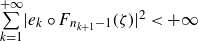 $\sum\limits_{k=1}^{+\infty} \lvert e_k\circ F_{n_{k+1}-1}(\zeta)\rvert^2\lt+\infty$
, for almost every
$\sum\limits_{k=1}^{+\infty} \lvert e_k\circ F_{n_{k+1}-1}(\zeta)\rvert^2\lt+\infty$
, for almost every $\zeta\in{\mathbb{T}}$
, and so
$\zeta\in{\mathbb{T}}$
, and so
 \begin{equation}\lvert e_k\circ F_{n_{k+1}-1}(\zeta) \rvert\xrightarrow{k\to+\infty} 0, \quad \text{for almost every}\ \zeta\in{\mathbb{T}},\end{equation}
as desired.
We finally move on to the general case where
 \begin{align*}F_m&= f_m\circ\cdots \circ f_{n_{k+1}}\circ e_k\circ \widetilde{\phi}_k\circ \widetilde{\phi}_{k-1}\circ \cdots\circ \widetilde{\phi}_1\circ f_{n_1-1}\circ\cdots \circ f_1\\[5pt] &=f_m\circ\cdots \circ f_{n_{k+1}}\circ e_k\circ F_{n_{k+1}-1},\end{align*}
and k is the largest integer so that $m\gt n_{k+1}$
. In particular,
$m\gt n_{k+1}$
. In particular, $k\to+\infty$
whenever
$k\to+\infty$
whenever $m\to+\infty$
.
$m\to+\infty$
.
Note that (3·18) implies that $e_k\circ F_{n_{k+1}-1}(\zeta)\in{\mathbb{D}}$
, for all k large, and so
$e_k\circ F_{n_{k+1}-1}(\zeta)\in{\mathbb{D}}$
, for all k large, and so $F_m(\zeta)$
also lies in
$F_m(\zeta)$
also lies in ${\mathbb{D}}$
for all m large.
${\mathbb{D}}$
for all m large.
By the triangle inequality for the hyperbolic metric and the Schwarz–Pick Lemma (2·8), we have
 \begin{align}d(\,f_m\circ\cdots\circ f_{n_{k+1}}(0),0)&\leq d(\,f_m\circ\cdots\circ f_{n_{k+1}} (0),F_m(0))+ d(F_m(0),0)\nonumber\\ {} {}&\leq d(0,F_{n_{k+1}-1}(0)) + d(F_m(0),0).\end{align}
Now, since by assumption $F_m$
converges locally uniformly to the constant 0, we have that the sequences
$F_m$
converges locally uniformly to the constant 0, we have that the sequences $(F_{n_{k+1}-1}(0)$
and
$(F_{n_{k+1}-1}(0)$
and $(F_m(0))$
both converge to 0 as m—and so also as k—tends to
$(F_m(0))$
both converge to 0 as m—and so also as k—tends to $+\infty$
. So, taking limits
$+\infty$
. So, taking limits $m\to+\infty$
in (3·19) and applying these facts yields
$m\to+\infty$
in (3·19) and applying these facts yields
 \begin{equation}f_m\circ\cdots\circ f_{n_{k+1}}(0)\xrightarrow{m\to+\infty}0.\end{equation}
To conclude the proof it suffices to note that for almost all $\zeta\in{\mathbb{D}}$
we have
$\zeta\in{\mathbb{D}}$
we have
 \begin{align*}d(F_m(\zeta),f_m\circ\cdots\circ f_{n_{k+1}}(0))\leq d(e_k\circ F_{n_{k+1}-1}(\zeta),0),\end{align*}
Acknowledgements
I would like to thank Professors M. D. Contreras and S. Díaz-Madrigal for the discussions that inspired this result, and the anonymous referee for their insightful comments and recommendations.


 Open access

