


Introduction
How senators provide advice and consent when staffing the federal bench is a focus of judicial selection scholars, with highly salient moments in the confirmation process, like Judiciary Committee hearings (Dancey et al. Reference Dancey, Nelson and Ringsmuth2020, Reference Dancey, Nelson and Ringsmuth2013, Reference Dancey, Nelson and Ringsmuth2011; Farganis and Wedeking Reference Farganis and Wedeking2014; Collins, Jr. and Ringhand Reference Collins and Ringhand2013) and senators’ floor votes (Cameron et al. Reference Cameron, Kastellec and Park2013; Kastellec et al. Reference Kastellec, Lax and Phillips2010; Overby et al. Reference Overby, Henschen, Walsh and Strauss1992) attracting the bulk of attention. Yet judicial confirmations are a multi-stage process, and the impact of Questions for the Record (QFRs) is an overlooked part of the process despite being frequently utilized by senators to scrutinize nominees.
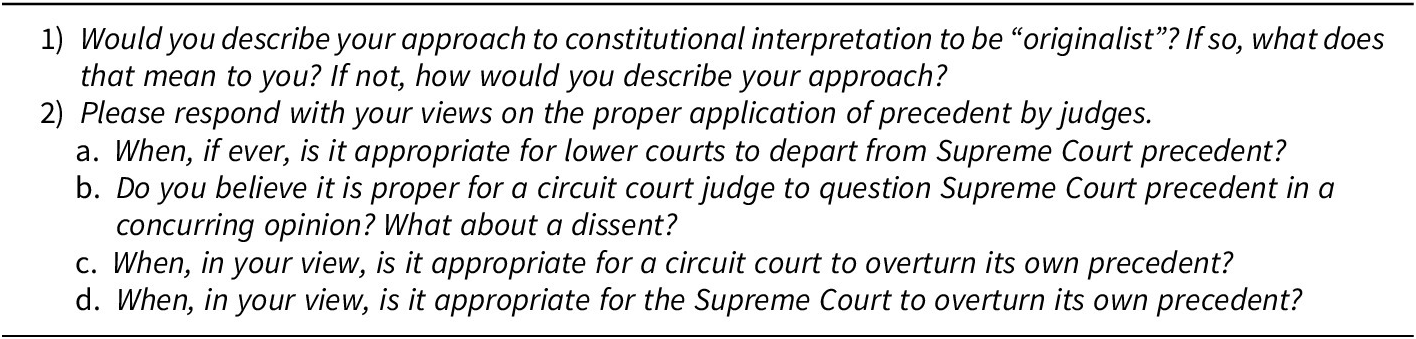
Questions for the Record operate as their name suggests: they are questions witnesses who provide testimony to a committee answer on the record, and they are frequently employed by Judiciary Committee senators during the confirmation process. Separate from a nominee’s hearing, these written questions are submitted for nominees to answer – under oath – before the committee holds its recommendation vote to advance the nomination to the full Senate for consideration (Rutkus Reference Rutkus2016). While QFRs often address similar topics to questions asked in hearings – such as methods of constitutional construction, views on the role of the courts in U.S. democracy, or the use of legislative history in statutory interpretation – they also serve as a tool for more targeted scrutiny (Steigerwalt Reference Steigerwalt2010). Senators can use QFRs with specific attention towards a nominee’s written record, which may include legal rulings later reversed on appeal, law review articles advancing specific theories of legal interpretation, public speeches, or prior legal advocacy on contentious issues.
Although QFRs have long been utilized by Judiciary Committee senators, dating back at least to the early 1970’s, few have acknowledged their potential importance during the confirmation process. Given that over 90% of circuit court nominees from 2001 to 2022 faced QFRs from at least one senator, this stage of the confirmation process stands as an understudied, but important, part of advice and consent.
To examine the factors that influence senators’ use of written questions, I compiled an original dataset of over 24,000 QFR exchanges between senators and nominees from 2001 to 2022. This includes data from over two hundred committee considerations of judicial nominees spanning across twenty-two years, from the George W. Bush administration through the first two years of the Biden presidency. Focusing on senators’ copartisanship with the president, partisan control of the White House and Senate, and interest group opposition to a nominee’s confirmation – factors found to be highly influential in lower court confirmations (Dancey et al. Reference Dancey, Nelson and Ringsmuth2020; Steigerwalt Reference Steigerwalt2010; Scherer et al. Reference Scherer, Bartels and Steigerwalt2008) – I examine who is most likely to use and receive QFRs. The results show that QFRs are generally deployed in a partisan manner: senators whose party diverges from the president’s use them at over three times the rate of copartisans. Controversial nominees who interest groups oppose are also more likely to face greater numbers of QFRs from a senator, but this effect is not as influential as studies of other parts of the process would suggest (Dancey et al. Reference Dancey, Nelson and Ringsmuth2020). Important for future considerations of the confirmation process, I show that their use has increased substantially in the post-nuclear Senate, highlighting how nuclear fallout has reverberated not only through floor processes (King and Ostrander Reference King and Ostrander2025) and nominee selection (Bird and McGee Reference Bird and McGee2023; Nash and Shepherd Reference Nash and Shepherd2020) but also through the committee process as well.
These findings – to this author’s knowledge, the first large-scale, systematic examination of the use of QFRs – provide evidence that QFRs are institutionally integrated into the Judiciary Committee’s process for vetting nominees. Although senators may choose to use written questions similar to the way they utilize questions in hearings, the flexibility and convenience of QFRs provide comparative advantages that have contributed to their increased utilization in recent sessions of Congress. And, with increasingly partisan votes to confirm nominees, these written questions may also be integral to how Judiciary Committee senators frame their decision to support – and oppose – a nominee. Altogether, this research shows that written questions are a central component of the Judiciary Committee’s confirmation process, and while the type of scrutiny nominees face may still best be understood by examining the confirmation hearing themselves (Dancey et al. Reference Dancey, Nelson and Ringsmuth2011), to fully understand how senators exercise their role in advice and consent in the modern era, we must account for these written questions rather than exclusively focusing on hearing questions.
Questions for the record in judicial confirmations
Questions for the Record are a central part of the modern confirmation process for nominees at all levels of the judicial hierarchy. In the last two decades, nearly all circuit court nominees have received these written questions from senators. Indeed, between 2001 and 2022, senators sent QFRs following 210 of the 230 circuit court hearings held by the Judiciary Committee. Every Trump, Biden, and Obama circuit court nominee responded to QFRs from at least one senator.Footnote 1 From 2001 to 2022, the typical circuit court nominee received individual QFRs from approximately one in five members of the Judiciary Committee, with the average senator asking a nominee 24 written questions.
Transcripts from William H. Rehnquist’s nomination to be a Supreme Court associate justice in 1971 document the first inclusion of written questions in Judiciary Committee transcripts. When five members of the Judiciary Committee requested an additional day of hearings to “lay to rest” allegations that Rehnquist had intimidated Black voters leading up to an election in his home state of Arizona, the remaining members of the Committee suggested the senators submit their questions in writing, permitting Rehnquist only a day to respond rather than holding another public hearing (Graham Reference Graham1971). Three of the five senators – Birch Bayh (D-IN), Philip A. Hart (D-MI), and Edward M. Kennedy (D-MA) – took advantage of this, focusing their twenty nine questions on letters Rehnquist had written to a local newspaper opposing school integration, his evasive answers during his confirmation hearing, and accusations of voter intimidation dating back to the early 1960s (U.S. Senate Committee on the Judiciary 1971). Notably, none of the senators who submitted written questions to Rehnquist voted in favor of his confirmation yet they did not formally announce their opposition until after he responded to their inquiries (Graham Reference Graham1971). Looking forward over half a century, these written questions are now a fixture in the Judiciary Committee’s confirmation procedures.
While this research focuses on their use in the confirmation of circuit court nominees, they are common for nominees to all levels of the judicial hierarchy, from the district courts to the Supreme Court. Senators employed them inconsistently in Supreme Court confirmations until Judge Robert Bork’s 1987 nomination. After this, every Supreme Court nominee has received written questions, and beginning with Chief Justice John Roberts’s confirmation in 2005, senators have submitted approximately 20% of their total questions as QFRs. Senators’ use of written questions in Supreme Court confirmations has also intensified over time. Most recently, Justice Ketanji Brown Jackson responded to over 1500 QFRs following her hearing.
As a norm, senators do not submit QFRs until after a nominee’s hearing,Footnote 2 and a nominee cannot be listed for consideration in the Committee’s Executive Business Meeting until senators receive their responses (Rutkus Reference Rutkus2016). The senator chairing a nominee’s hearing sometimes makes an announcement in their closing comments to bring attention to the importance of QFRs. During Gerard Lynch’s confirmation hearing for a position on the Second Circuit, Senator Charles Schumer (D-NY) provided an example of this: “If there are no more questions, we are going to hold the record open for a week so people can submit written questions[…]” (U.S. Senate Committee on the Judiciary 2009). Oftentimes, senators even inform the nominee of their intent to submit written questions. During Paul T. Watford’s nomination to the Ninth Circuit Court of Appeals, Senator Charles Grassley (R-IA) highlighted the importance of these questions during their exchange (U.S. Senate Committee on the Judiciary 2011, 530)Footnote 3:
Senator Grassley. I will submit some questions for answer in writing, please.
Mr. Watford. OK.
Senator Grassley. And let me suggest to you, you’ll probably do it anyway, and answer them as forthrightly as you can and as completely as you can. But sometimes, needlessly, nominees are held up just because they don’t answer questions or answer them fully. So try to get that done […]
This not only illustrates how senators have come to rely on QFRs as a routine component of the committee’s confirmation process, but also highlights how the process incentivizes nominees to respond carefully and promptly. When senators view a nominee’s responses as incomplete or inadequate, they can and do submit follow-up questions. They can even delay the Executive Business Meeting, citing the nominee’s failure to return QFRs as justification (Rutkus Reference Rutkus2016). Given the potential for delays in the confirmation process (e.g., Scherer et al. Reference Scherer, Bartels and Steigerwalt2008; Binder and Maltzman Reference Binder and Maltzman2002; Bell Reference Bell2002a), nominees have a strong incentive to keep things rolling by responding to QFRs in a timely and thorough manner. As a result, QFRs rarely delay the committee’s vote – likely because nominees recognize this timing as one of the few parts of the process they can actively control.
While Questions for the Record remain an understudied part of the confirmation process, their ultimate significance as a source of scholarly understanding lies beyond this. Steigerwalt (Reference Steigerwalt2010, 227) noted their importance to Committee senators in her interviews with Senate staffers, who commented that hearings are not always the best forum for a back-and-forth dialogue with a nominee, especially when a senator is attempting to home in on subtle legal matters. In these instances, written questions can be more useful to gather information from the nominee than the back-and-forth exchanges of oral testimony.
Additionally, the name of the procedure itself, Questions for the Record, carries weight as to their perceived seriousness: these questions become part of a nominee’s record and serve as a reference point for senators to obtain written commitments and clarifications from nominees. Former Judiciary Committee Chairman, Senator Charles Grassley (R-IA), criticized Democrats’ use of QFRs during the Trump administration, arguing that the questions themselves were merely a ploy aimed at “gumming up the process” (Grassley Reference Grassley2018). However, Grassley also frequently refers to a nominee’s written responses when justifying his public support and opposition to nominees – notably, those nominated by Democratic presidents (Arkin Reference Arkin2022; Mauriello Reference Mauriello2015; Grassley Reference Grassley2012).
Moreover, there is a significant amount of variation in how senators use this tool, both across and within sessions of Congress as well as by presidential administration. While Senator Lindsay Graham (R-SC) has used the tool rarely, submitting only 9 questions over nearly two decades on the Committee, Senator Russ Feingold (D-MN) submitted over 350 QFRs across only 5 sessions of Congress. Finally, as the Rehnquist confirmation highlights, QFRs did not always exist: they emerged in response to growing demands for increased nominee transparency. They have persisted as a useful tool amid increasing time constraints and busy Senate schedules. Taken together, these factors illustrate the evolving role of QFRs as a strategic, institutionalized component of the confirmation process – one that warrants empirical attention on its own and also as part of the larger confirmation process.
Confirmation hearings for judicial nominees
Confirmation hearings offer a clear view of the Senate’s role in advice and consent. They also provide important insights into how senators’ perception of this role changes across levels of the judiciary. The absence of a standardized confirmation experience for judicial nominees was first highlighted in the literature on confirmation duration and success in the lower courts (e.g., Binder and Maltzman Reference Binder and Maltzman2009, Reference Binder and Maltzman2002; Martinek et al. Reference Martinek, Kemper and Winkle2002). More recently, scholars have exploited variation in the process to understand when and how nominees are vetted in confirmation hearings. Because circuit and district court nominees have a lower public profile than Supreme Court nominees – whose confirmations are high-profile events marked by political conflict (Epstein and Segal Reference Epstein and Segal2005; Abraham Reference Abraham2008) – senators can exert greater discretion over the process in the lower courts (Dancey et al. Reference Dancey, Nelson and Ringsmuth2011). This flexibility introduces meaningful variation in how nominees are vetted and spotlights how senators use these proceedings to achieve their own policy and electoral goals (Dancey et al. Reference Dancey, Nelson and Ringsmuth2020). This has provided a set of findings that structure scholarly understanding of what shapes a nominee’s confirmation experience.
Foremost, the factors that most influence a nominee’s confirmation hearing are generally those that highlight overarching conflict in the process, and these factors have little – if anything – to do with the nominee. Considering both the intensity and content of questions, for most nominees, political and institutional effects outside of the nominee’s control are more salient in determining their experience than their resumes. Indeed, scholars have found little evidence that personal characteristics – from qualifications to demographics – affect nominees’ experiences before the Judiciary Committee (Dancey et al. Reference Dancey, Nelson and Ringsmuth2011, Reference Dancey, Nelson and Ringsmuth2020); (but see Boyd et al. Reference Boyd, Collins and Ringhand2023). Taken together, this suggests that senatorial behavior in confirmation hearings is shaped less by nominee characteristics than by political incentives that are activated in highly visible, public settings.
Along those same lines, one of the most influential institutional and political contexts is interbranch power. Whether the Senate is under unified partisan control affects both the level of scrutiny applied by senators, operationalized through the number of questions nominees face (Dancey et al. Reference Dancey, Nelson and Ringsmuth2011), and the types of questions senators ask (Dancey et al. Reference Dancey, Nelson and Ringsmuth2013, Reference Dancey, Nelson, Ringsmuth and Solomon2018). Divided government increases the likelihood of senators asking nominees questions on issues generally seen to divide the two parties, as compared to questions about the nominees’ ability to administer a court’s docket or their professional background (Dancey et al. Reference Dancey, Nelson and Ringsmuth2013). Notably, this finding is not limited to lower court confirmations: it reverberates across the confirmation literature more generally, affecting both the rhetoric (Truscott Reference Truscott2024) and intensity of senatorial scrutiny (Schoenherr et al. Reference Schoenherr, Lane and Armaly2020) during Supreme Court confirmation hearings.
The effects of interbranch power in the confirmation process are associated with senators’ electoral incentives. Given the public policy implications of lower court seats, the consequences of judicial confirmations are particularly high for senators whose partisanship diverges from the nominating president, as they face the prospect of confirming nominees whose policy views may be at odds with their own (Dancey et al. Reference Dancey, Nelson and Ringsmuth2011). And this is magnified by ever-tightening margins of party control and heightened polarization, encouraging senators from the opposing party to leverage the most public aspects of the confirmation process – confirmation hearings – as a platform for partisan differentiation (Lee Reference Lee2016, Reference Lee2009). Thus, it is not surprising that party control – and diverging control of the Senate and White House – exerts a strong influence on a nominee’s confirmation hearings. Yet, these studies remain confined to what is observable in the hearing room. They pay little attention to how senators extend their scrutiny and gather information about the nominee beyond these few public moments – particularly in the less visible components of the confirmation process, including Questions for the Record.
While studies show that senators’ attendance and questioning are shaped primarily by political context and institutional arrangements, one nominee-specific factor stands as a shock in the process of lower court confirmation hearings: interest group opposition to a nominee’s confirmation. Indeed, interest group opposition outweighs the judicial hierarchy in shaping lower court confirmation hearings (Dancey et al. Reference Dancey, Nelson and Ringsmuth2020). In other words, it matters less whether a nominee is being confirmed to a circuit court or district court as compared to whether the nominee is flagged as “controversial” by interest groups when senators decide whether to attend a hearing and which questions to ask.
Largely, senators’ vulnerability to interest group opposition is a consequence of partisan polarization over the last several decades. As the number and effectiveness of public interest, citizen, and “identity” groups increased (Cameron et al. Reference Cameron, Grey, Kastellec and Park2020), these issue-based organizations – such as Alliance for Justice, the Judicial Crisis Network, NARAL Pro Choice America, and Alliance Defending Freedom – have come to find senators increasingly sympathetic to their causes. This gives them the ability to have a defining role in the confirmation landscape, treating nominees as potential allies or obstacles to their policy agendas (Scherer Reference Scherer2005). Intervening selectively in lower court confirmations through elite mobilization, they raise the stakes of a nomination through their public opposition (Scherer Reference Scherer2005), with their involvement signaling to ideologically aligned senators that a nominee warrants heightened scrutiny.
Confirmation hearings for lower court nominees differ dramatically when interest groups are involved. Unlike most nominees, who are considered “acceptable” by default (Scherer et al. Reference Scherer, Bartels and Steigerwalt2008; Dancey et al. Reference Dancey, Nelson and Ringsmuth2020), hearings for interest group opposed nominees often resemble Supreme Court confirmation hearings, both in intensity and scope. Dancey et al. (Reference Dancey, Nelson and Ringsmuth2020) find that such hearings are more highly attended than those for non-controversial nominees, with the probability of participating driven largely by opposition party senators and those holding committee leadership positions. The volume of questions nominees face also increases with controversial nominees facing nearly five times the number of questions asked (Dancey et al. Reference Dancey, Nelson and Ringsmuth2020). Finally, the content of questions changes. Senatorial scrutiny tends to be more personalized (Dancey et al. Reference Dancey, Nelson and Ringsmuth2020), exploiting legal policies and salient media issues where senators can grandstand and position take to appease an audience of interest groups and partisan activists. In each case, the extent to which senators engage with nominees is closely tied to the visibility of the confirmation process and the electoral incentives that such visibility creates. However, this focus on public, politicized hearings leaves open the question of whether and how these same electoral motivations operate in less visible venues of senatorial scrutiny.
Taken together, this literature suggests that senatorial behavior in confirmation hearings is driven less by nominee characteristics than by the political and institutional contexts that shape the visibility of the confirmation process. However, when nominations become highly visible and contested, senators’ electoral incentives are activated, producing more intensive and politicized forms of vetting. While it is likely that senators scrutinize controversial nominees beyond the hearing room – in private meetings or through interactions with interest groups – these venues are largely inaccessible to researchers. Private meetings between nominees and senators are conducted confidentially and are not under oath, and records of interactions with interest groups are rarely disclosed to the public, often remaining unavailable to the public until long after the senator leaves office. As a result, our understanding of how senators vet nominees – especially controversial nominees – is limited to the hearing room despite indications that scrutiny is not confined to this platform. This is where QFRs may find their advantage. These written questions provide a unique opportunity to observe senatorial scrutiny beyond the hearing room, while maintaining their formality and public accessibility.
Research design
To examine how the factors that shape senators’ behavior in confirmation hearings generalize to the submission of QFRs, I gather observational data for all QFRs submitted in the Senate Judiciary Committee to Court of Appeals nominees from the George W. Bush administration through the first two years of the Biden presidency. Spanning twenty-two years, the dataset includes 24,837 questions posed by senators to nominees. I aggregate this dataset so that the number of observations for each nominee is equal to the number of senators on the Judiciary Committee who submitted at least one QFR to a nominee. This includes 1,042 observations across committee considerations of 202 circuit court of appeals nominees.Footnote 4
Because senators often retain their committee assignments throughout their tenure, the data features the same senators in numerous dyads across administrations – most notably, Senators Richard Durbin (D-IL), Charles Grassley (R-IA), and Patrick Leahy (D-VT), who served on the Judiciary Committee for the entire span of the data collection period. Out of these three, Senator Grassley posed the greatest number of QFRs to judicial nominees, with over 3900 submissions. Senators Durbin and Leahy filed less than half this number: Senator Durbin submitted over 1800, while Senator Leahy’s count of QFRs slightly exceeded 1500.
Collecting QFRs
I use hearing transcripts in combination with committee documents posted to the Senate Committee on the Judiciary website to gather together all written questions within the time frame of this study. Because the Committee has no formal requirement for how senators submit QFRs, senators use different formats for their submissions, which introduces a potential for inconsistency in measurement, given that the main dependent variable is a count of QFR submissions from a senator to a nominee. To overcome this, I adopt a measurement technique from studies of senatorial engagement during confirmation hearings (Dancey et al. Reference Dancey, Nelson and Ringsmuth2011; Farganis and Wedeking Reference Farganis and Wedeking2014; Schoenherr et al. Reference Schoenherr, Lane and Armaly2020). Conceptualizing of the dependent variable as the question asking intensity of a senator toward a nominee, I assume that a senator dividing written questions into subsections within a document signals that they anticipate a higher level of engagement and detail from the nominee as compared to a senator who poses multiple questions within the same section absent structured formatting between questions.
Table 1 includes an example of the written questions submitted by Senator Dianne Feinstein (D-CA) to Judge Kyle Duncan, a nominee to the U.S. Court of Appeals for the Fifth Circuit in 2017. In this example, Senator Feinstein poses three questions in her first numbered submission, while she divides the second labeled question into four subsections. Based on this formatting, I assume that the Senator is looking for a higher level of engagement from the nominee in the second labeled question as compared to multiple questions combined into a single prompt in the first labeled question. Following this, I count the first labeled question in this example as a single question, while the second is quantified based on its division into subsections. Together, this example constitutes five QFRs. I follow this decision rule for each nominee-senator dyad in the data set. Based on my review of QFR submissions, this difference in formatting is a common choice among senators.
Excerpt from Questions for the Record submitted by Senator Dianne Feinstein (D-CA) to Kyle Duncan during his nomination to the U.S. Court of Appeals for the Fifth Circuit (Feinstein Reference Feinstein2017)

I provide the descriptive statistics of the number of questions senators submit to nominees, as well as the other variables in this analysis, in Table 2. The median number of written questions is 19, and the majority of observations fall between 3 and 50 QFR submissions (tenth and ninetieth percentiles, respectively), highlighting the variability in senators’ use of written questions.
This table shows the descriptive statistics of the variables included in the QFR analysis. Before modeling, all continuous variables listed in the table are standardized and the logged value of Days to Hearing is also used due to its skewness

Political and institutional variables
Because the political and institutional context play a large role in confirmation hearings, I incorporate a number of variables from this literature in my analysis. Beginning with party control, the first variable adjusts for periods of unified and divided government. This is a dichotomous variable taking on a value of (1) when both the Senate and executive branch are controlled by the same party. Interbranch power exerts a high level of influence on the confirmation process at all levels of the judicial hierarchy (Truscott Reference Truscott2024; Schoenherr et al. Reference Schoenherr, Lane and Armaly2020; Sollenberger Reference Sollenberger2010; Bond et al. Reference Bond, Fleisher and Krutz2009; Bell Reference Bell2002b; Binder and Maltzman Reference Binder and Maltzman2002), and I expect it to have a similar effect on how senators use QFRs as well.
Because the unit of analysis is the senator-nominee dyad, and partisan differences between the senator and nominee may also affect the intensity of questions senators ask, I also analyze how a senator’s partisanship – or partisanship as compared to the nominating president’s – influences a senator’s QFR submissions. To operationalize partisan contrast between the senator and nominating president, I use a dichotomous variable coded as (1) when a senator’s party diverges from that of the nominating president, indicating that the senator is an outpartisan, and (0) otherwise. I refer to this variable as “Outparty Senator” and Table 2 shows that the vast majority of QFR submissions are from outpartisan senators, with nearly 91% falling into this category.
For similar reasons, I also include a measure of the ideological distance between a senator and a nominee. I rely on Judicial Common Space (JCS) scores for nominee ideology (Epstein et al. Reference Epstein, Martin, Segal and Westerland2007) and NOMINATE scores for senators’ ideology (Lewis et al. Reference Lewis, Poole, Rosenthal, Boche, Rudkin and Sonnet2023). To obtain the ideological distance between the two actors, I subtract the senator’s NOMINATE score from nominee’s JCS score and take the absolute value of this difference since the two scores are in the same ideological space.
Next, I consider how the court to which a nominee is seeking confirmation impacts QFR submissions from a senator to the nominee. Dancey et al. (Reference Dancey, Nelson and Ringsmuth2020) argue that such nominations can activate both partisan and institutional concerns, as narrow partisan margins on circuit courts may influence public policy outcomes. Additionally, some appeals courts play a more prominent role in shaping national policy than others. To measure the impact of nominations on critical courts (Binder and Maltzman Reference Binder and Maltzman2002), I use two variables to highlight their impact on the confirmation process. First, I incorporate a dichotomous variable to indicate when a nominee is seeking a seat on the D.C. Circuit Court of Appeals. Because of its position in the judicial hierarchy, I expect senators to be more critical of nominations to this court, leading them to use QFRs more freely. This variable takes on a (1) for D.C. Circuit nominees and (0) otherwise. I also utilize a measure of the partisan balance of the circuit court to which a nominee is seeking confirmation. Because appointments to partisan-balanced courts can have a greater impact on shifting public policy compared to courts that lean in a clear ideological direction, I expect senators to be more interested in vetting nominees who sit on courts with the same proportion of Democratic and Republican nominated judges (Dancey et al. Reference Dancey, Nelson and Ringsmuth2020; Binder and Maltzman Reference Binder and Maltzman2002). This should increase the number of written questions a senator submits.
I also look at whether a senator’s institutional position on the committee – specifically as chair or ranking member – shapes their question-asking behavior. Given the increased responsibilities of these roles to the chamber in vetting nominees, including serving as referral points for other senators and having the ability to slow confirmations (Bond et al. Reference Bond, Fleisher and Krutz2009), QFRs may be especially useful for senators in this institutional position of power.
Finally, I introduce three variables that are not included in the literature on confirmation hearings, but may impact senators’ QFR usage. The first measures the number of days between a president’s referral of a nominee for a position on a Circuit court and a nominee’s hearing. Because this variable is right skewed, I include its logged value. I expect longer durations before a nominee’s hearing to be met with fewer QFRs from a senator because they have more time to meet with a nominee and review their materials. When there is a shorter period between a president announcing the nominee and their hearing, senators may be more time constrained and turn to processes, like QFRs, to compensate for limited period in advance of the hearing to thoroughly review materials.
Additionally, I include a dichotomous variable to distinguish between nominees who had hearings after the “nuclear option” in November of 2013, effectively lowering the number of senators needed to confirm a nominee to a simple majority. In the analysis, a (1) indicates a nomination made post-cloture reform and (0) otherwise. Because presidents in the post-filibuster period can take advantage of this institutional change to propel their nominees through the process with fewer hurdles (Bird and McGee Reference Bird and McGee2023; King and Ostrander Reference King and Ostrander2025), I expect nominations in the post-filibuster period to be associated with a greater use of QFRs.
The last contextual variable I include is a senator-level indicator of whether a senator attended a nominee’s hearing. Anecdotally, the relationship between hearing attendance and QFR submissions could go in either direction: senators who attend hearings may use QFRs as a follow-up tool to extend their scrutiny beyond the hearing room, as Bayh, Hart, and Kennedy did in their follow-up questions for Rehnquist. Conversely, senators who did not attend may use QFRs to conduct due diligence, making them particularly valuable in those circumstances. However, given that political and institutional factors generally outweigh individualized scrutiny in shaping hearing behavior, I expect the former to be more likely than the latter.
Nominee-level characteristics
I incorporate five nominee-level characteristics to determine whether the findings from confirmation hearings generalize to QFRs. First, I use interest group opposition as a signal for nominee controversy (Scherer et al. Reference Scherer, Bartels and Steigerwalt2008; Steigerwalt Reference Steigerwalt2010; Dancey et al. Reference Dancey, Nelson and Ringsmuth2020). I include a binary indicator that assumes a value of (1) when one umbrella group or two smaller groups take a public stance against the nominee’s confirmation and (0) otherwise.Footnote 5 Table 2 shows that 35% of nominees faced interest group opposition in the period prior to their hearings. Because scholars have highlighted the defining role of interest groups in nominee’s confirmation experience, I expect that, when interest group’s oppose a nominee’s confirmation, senators will submit a greater number of written questions to scrutinize the nominee.
To identify whether an interest group has publicly opposed a nominee, I follow the protocol outlined by Steigerwalt (Reference Steigerwalt2010), using NexisUni, a database that includes a wide range of news, legal, and business sources, to search for any news articles or public statements released by interest groups active in judicial confirmations where they state clear opposition to a nominee. Because my analysis focuses on how nominee controversy affects senators’ QFR submissions during the committee stage of the confirmation process, I constrain the search window to the period prior to the nominee’s hearing – specifically, from the date the president announces the nomination to the day of the hearing. This period also corresponds to the time frame when interest groups are most active in opposing lower court nominees (Steigerwalt Reference Steigerwalt2010; Maltese Reference Maltese1995), as early opposition can build momentum and trigger additional group mobilization against a nominee. Moreover, this is the time when interest groups can directly voice their positions by submitting formal letters of support or opposition to the Judiciary Committee – and, simultaneously, when nominees are most likely to see their confirmations derailed (Krutz et al. Reference Krutz, Fleisher and Bond1998). In other words, although interest groups can oppose nominees at any point in the confirmation process, they are more likely to be effective during the committee stage when they can undermine the presumption of success in lower court confirmations by expanding the scope of conflict around the nominee (Krutz et al. Reference Krutz, Fleisher and Bond1998).
In addition to interest group opposition, I also incorporate a second kind of opposition: whether a home-state senator has formally opposed a nominee via blue slip. Because senators are afforded a degree of influence over judicial nominations to seats in their states through the blue slip process (Binder Reference Binder2007), I use an indicator of (1) when a nominee is opposed by one or both of their home-state senators. This is signaled by a senator either returning a negative blue slip or withholding their blue slip prior to the nominee’s hearing. Although a negative blue slip does not always block consideration of a nominee (Black et al. Reference Black, Madonna and Owens2014; Sollenberger Reference Sollenberger2010), a Judiciary Committee senator may increasingly scrutinize a nominee opposed by a home-state senator, submitting higher numbers of written questions.
Because race and gender can influence how Judiciary Committee senators vet nominees during their hearings (Boyd et al. Reference Boyd, Collins and Ringhand2023), I also include measures of nominees’ demographic characteristics, using a categorical variable to capture whether a nominee is a (1) White male, (2) Minority male, (3) White female, or (4) Minority female.
Finally, I consider how a nominee’s qualifications to be a federal circuit court judge may impact senators’ use of written questions. I utilize American Bar Association ratings to account for this effect on QFR submissions with an ordinal measure, where (2) indicates that the majority of an assigned committee rated the nominee as “Well Qualified,” (1) represents that the majority rated the nominee as “Qualified,” and (0) indicates that the committee reported the nominee as “Not Qualified.” Nominees who are viewed as more qualified may undergo less scrutiny from senators, meaning fewer QFR submissions.
Empirical results
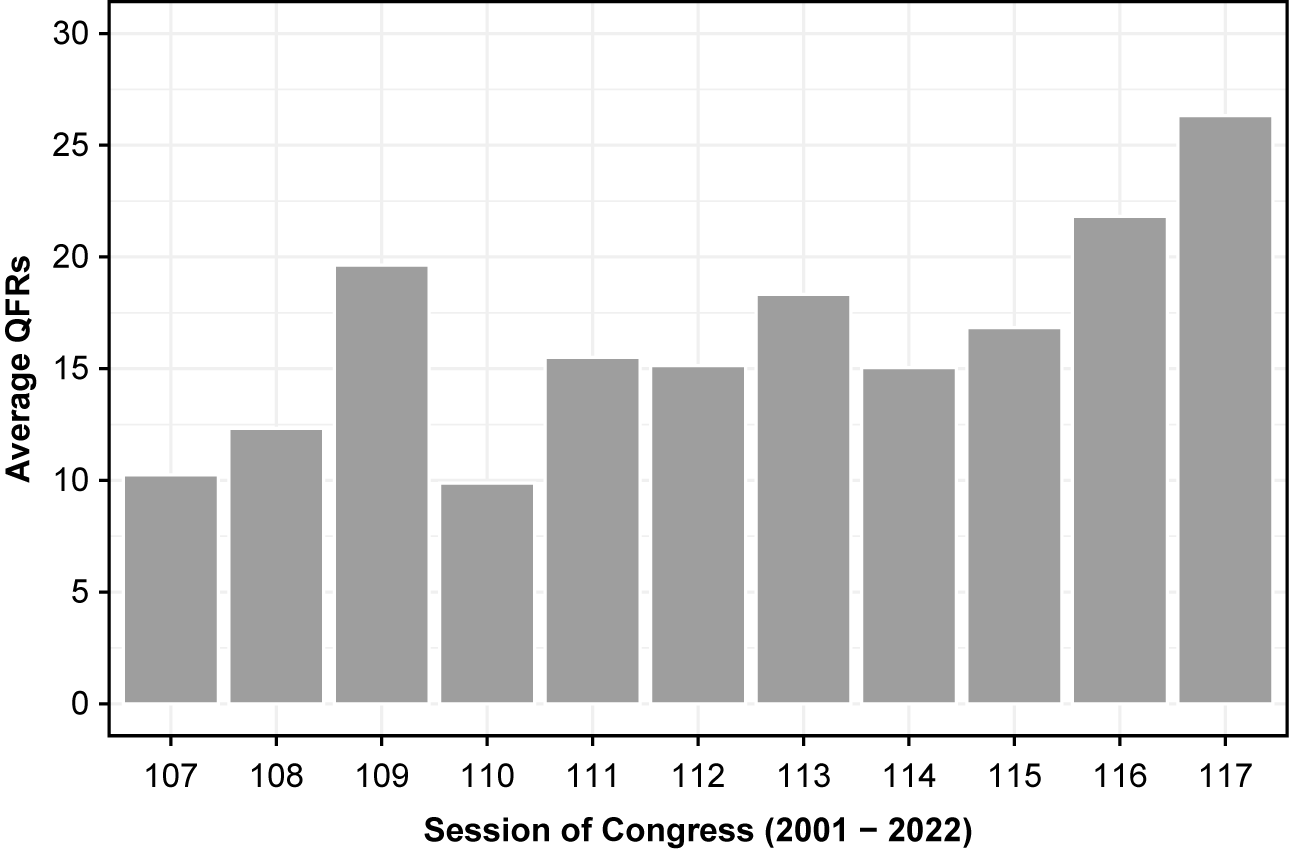
I begin my analysis by examining empirical trends in QFRs.Footnote 6 Figure 1 shows the average number of QFRs a senator submits to a nominee across sessions of Congress. The distribution shows moderate levels of QFRs submitted in earlier sessions, with averages generally ranging between approximately 10 and 15 questions per nominee. QFR usage begins to rise in later sessions of Congress, with noticeably higher levels of activity in the 116th and 117th sessions. This is where, for the first time, averages exceed 20 questions per nominee. Overall, the figure illustrates both the substantial variation across sessions and a long-term increase in the use of written questions during the confirmation process.
This figure shows the average total number of QFRs a senator submits to a nominee from the 107th (2001–2002) through the 117th (2021–2022) session of Congress.

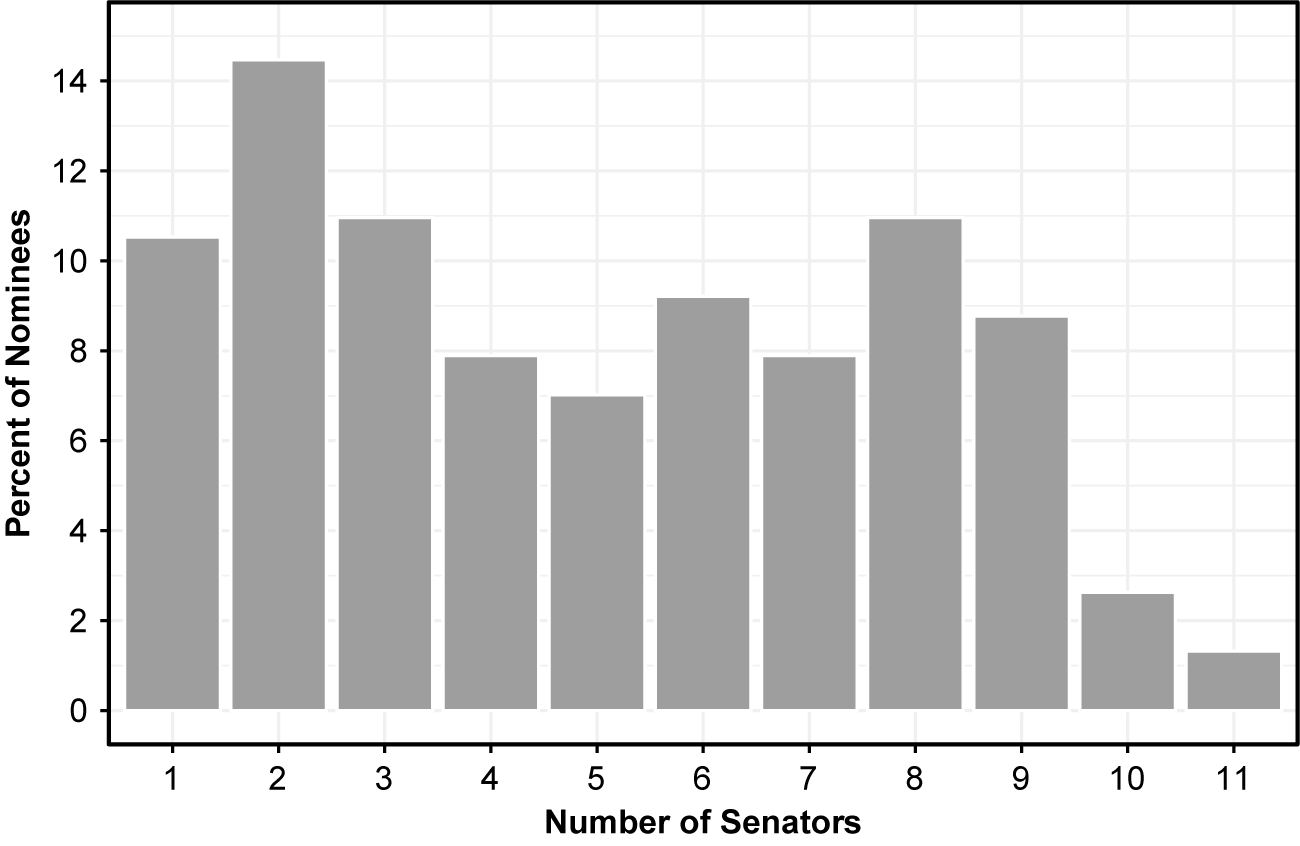
Figure 2 displays the distribution of the number of senators submitting QFRs to nominees. On average, nominees receive written questions from 5 senators. However, the distribution is bimodal, with peaks at both 2 and 8 senators, suggesting that some nominees attract limited scrutiny while others become a focal point for broader engagement – reflecting the same ideas found in the literature on confirmation hearings. Beyond the average number of questions each nominee receives from a single senator, this figure highlights how QFRs can accumulate when multiple Judiciary Committee senators choose to submit them after a hearing.
This figure shows the distribution of nominees by the number of senators submitting written questions during the committee process. A plurality of nominees – just over 14% – received QFRs from 2 senators, while only about 1% received questions from 11 members of the Committee.

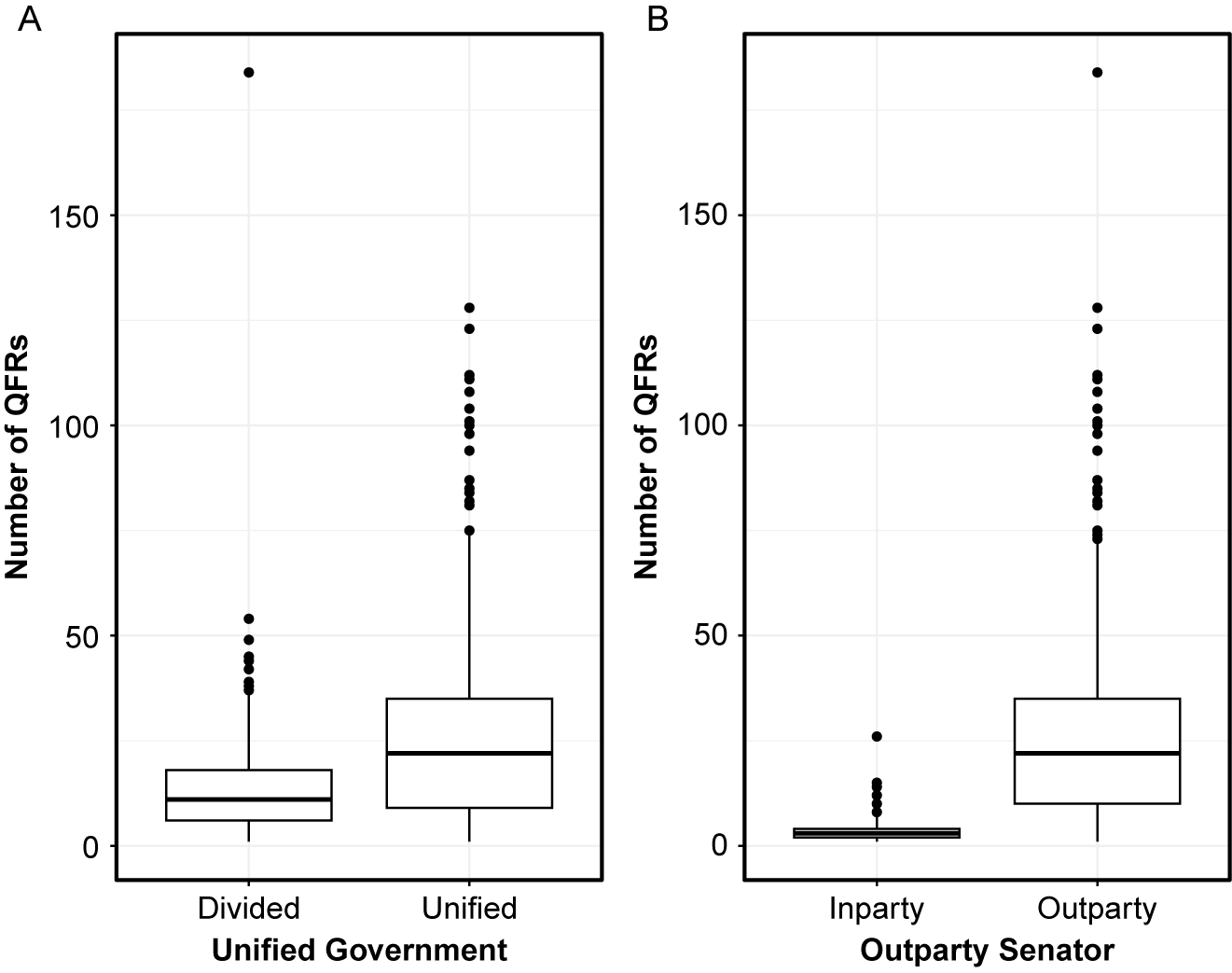
Next, I examine the relationships between QFR submissions and factors shown to be salient in structuring question-asking behavior during confirmation hearings. I look at this from three perspectives: (1) party control of the Senate and White House (“Unified Government”), (2) partisan differences between the senator and nominee (“Outparty Senator”), and (3) public opposition from interest groups (“Interest Group Opposition”).
As I highlighted above, party control of the Senate and White House – specifically, divided government – plays a compelling role in confirmation hearings, increasing the intensity of questions (Schoenherr et al. Reference Schoenherr, Lane and Armaly2020) and the types of questions senators ask (Dancey et al. Reference Dancey, Nelson and Ringsmuth2013). To examine its effect on QFRs, the left side of Figure 3 shows the distribution of written questions based on whether party control of the two branches is unified or divided. When the Senate and White House are under divided government, senators submit an average of 15 under periods of divided control, while it increases to 25 under periods of unified control (). Thus, differences in party control appear to have a notable effect on the extent to which a senator scrutinizes a nominee, with a significantly greater number of written questions submitted during periods of unified government. However, this finding should be approached with caution, given that it is only a bivariate comparison – it does not account for other factors that might influence both party control and the number of QFRs senators submit.
These boxplots show the distribution of QFR submissions across (A) unified and divided government and (B) senator–president partisanship.

To investigate the effects of partisan differences further, I examine differences between the senator and nominee to analyze whether senators are more likely to submit greater numbers of QFRs to nominees when their partisanship diverges from the nominating president. As the right side of Figure 3 shows, there is considerable difference in both the distribution of QFRs submitted by copartisan senators as compared to outpartisans and in the average number of QFRs submitted by these two groups. Outpartisan senators submit over 6 times more written questions as compared to copartisans (4 copartisan QFRs compared to 26 outpartisan QFRs,). This suggests that partisan divergence may heighten senatorial scrutiny– even outside of public venues like the hearing room. The wide range and elevated mean for outparty senators likely indicate more aggressive vetting efforts driven by skepticism toward the nominee or a desire to uncover reasons for opposition – whether rooted in political strategy or genuine concern.
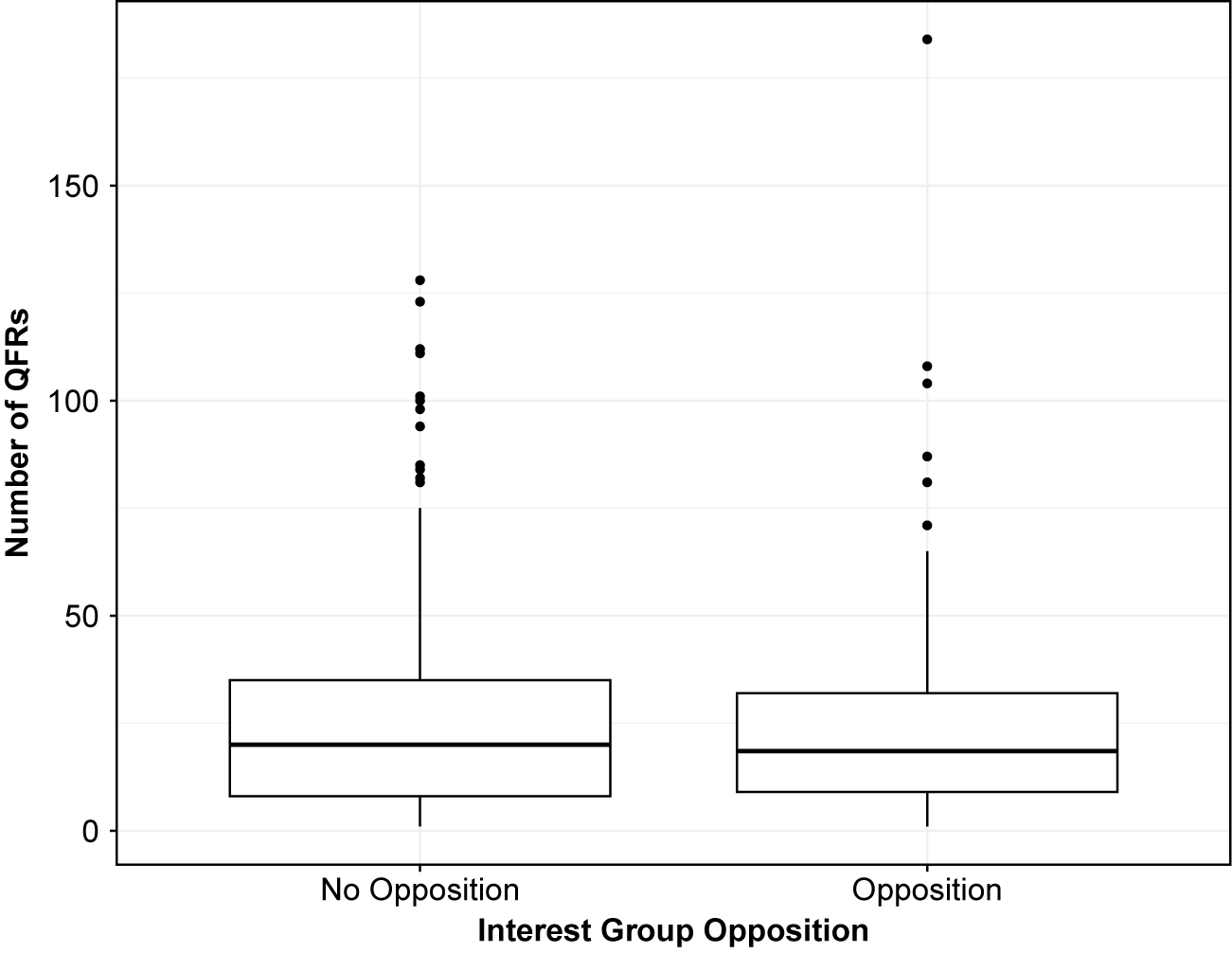
Next, I examine how interest group opposition influences the number of written questions a senator submits. As shown in Figure 4, the average number of QFRs submitted to controversial nominees is nearly identical to that of non-controversial nominees. Indeed, in this comparison, it is non-controversial nominees who average slightly more QFRs compared to controversial nominees. Though this difference is not statistically significant (25 written questions compared to 22,), it is somewhat surprising given prior research on confirmation hearings, which suggests that controversial nominees often attract much higher levels of scrutiny from senators during confirmation hearings (Dancey et al. Reference Dancey, Nelson and Ringsmuth2020, e.g.). The relative parity in QFR submissions across these groups suggests that, unlike in hearings, interest group opposition may not shape senators’ use of QFRs as sharply as it does in the hearing room for oversight. Again, though, this finding should be approached with caution given that it is a bivariate comparison.
This boxplot shows the distribution of QFR submissions based on interest group opposition to the nominee.

With the requisite caveats about bivariate analyses, these findings offer several initial takeaways to illustrate what factors may influence senators’ use of written questions. First, periods of unified government are associated with a significantly higher volume of QFRs, suggesting that when the Senate and White House are aligned, senators may be more motivated to engage in thorough vetting. Second, partisan differences between a senator and the nominating president are strongly associated with greater scrutiny. Outparty senators submit over six times as many QFRs as their copartisan counterparts, showing that partisanship plays a substantial role in structuring senators’ post-hearing engagement with nominees. In contrast, interest group opposition does not appear to meaningfully shape the number of QFRs a senator submits to a nominee. This diverges from patterns observed during hearings and suggests that senators may use QFRs differently than the questioning that occurs in the hearing room.
Together, these patterns suggest that QFRs are not simply an extension of the hearing room: they may have distinct strategic purposes, particularly when partisanship motivates further inquiry beyond the hearing room. However, these insights are limited in that they do not account for the influence of other factors. Next, I employ multivariate modeling to assess the independent effects of these variables while controlling for potential confounding factors. Again my goal in this analysis is to understand whether the factors that affect senators’ question-asking behavior in confirmation hearings similarly motivate senators when they submit written questions.
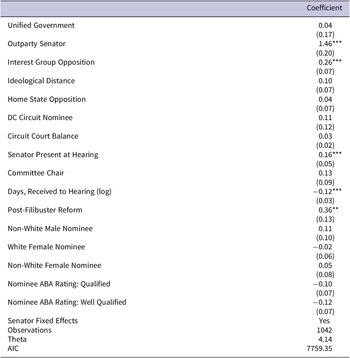
Because my outcome is a count of the number of QFRs a senator submits to a nominee, I use a negative binomial model to capture the intensity of senators’ QFR use conditional on a senator having submitted at least one written question. To account for individual-level variation in senatorial behavior, I also include senator fixed effects. Because nominees appear multiple times in the dataset, I incorporate standard errors clustered on the nominee.
The results of this model are displayed in Table 3. Positive coefficients indicate that a variable is associated with an increase in the expected count of QFRs, while negative coefficients are associated with a decrease. Beginning with the variables representing the political and institutional context of a nominee’s confirmation, we can see that, although the direction of party control is consistent with the bivariate relationship examined above, the effect is no longer significant: whether the Senate and White House are under the same party makes little difference in the number of QFRs a senator submits to a nominee.
Results from the negative binomial regression model. Cell entries present regression estimates, with clustered standard errors reported in parentheses below the estimates. All continuous variables are standardized, and the logged value of Days to Hearing is used due to the variable’s skewness. Coefficients for Senators are listed in Appendix C. *p<0.05; **p<0.01; ***p<0.001.
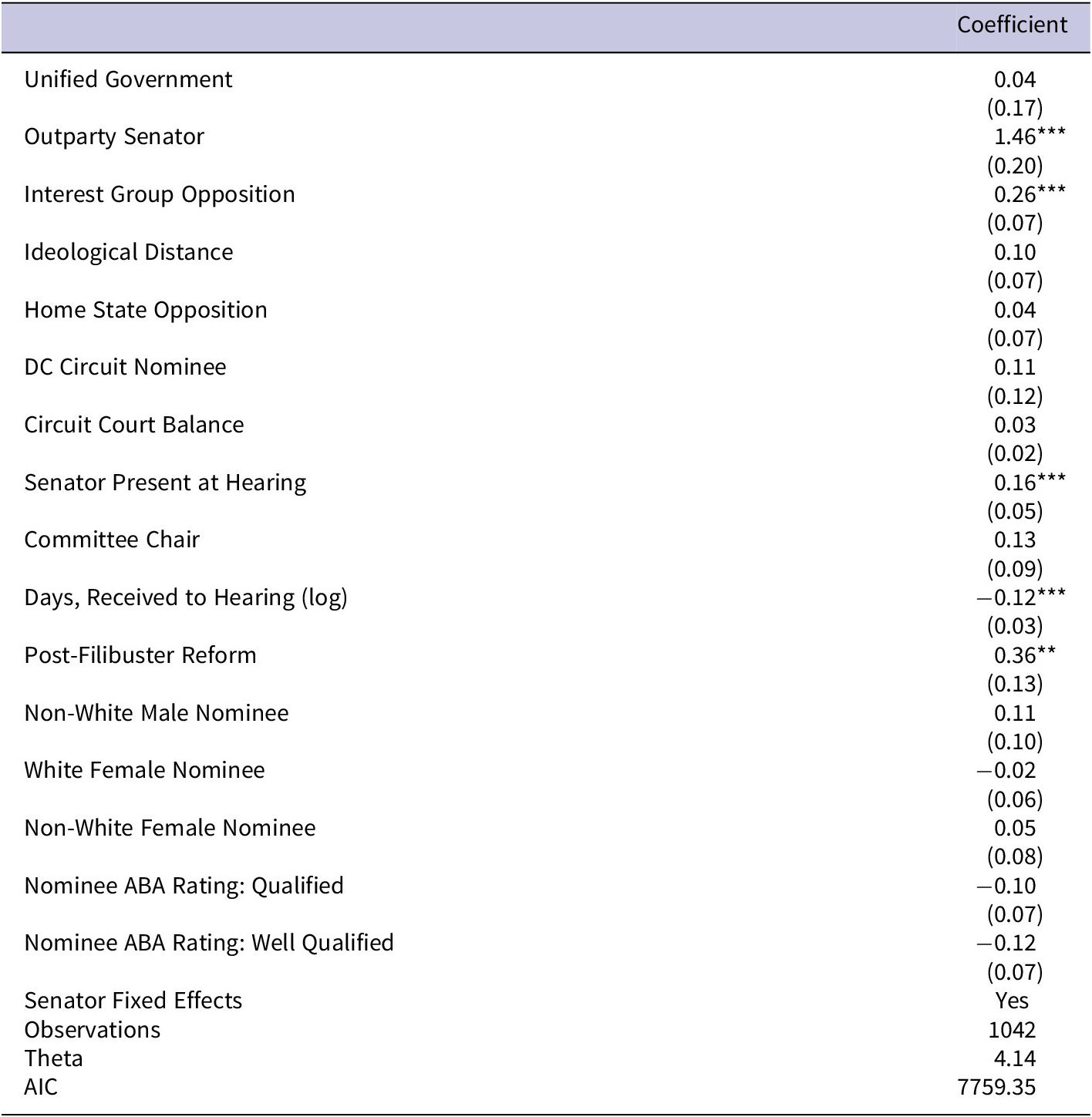
However, this is not to say partisanship – and partisan differences – do not help explain senators’ use of written questions. Instead, it is partisan differences between the senator and nominee that better explain QFR submissions. Table 2 shows that the coefficient for Outparty Senator is positive and significant, indicating that partisan differences between a senator and nominee are associated with a 330% increase in the percent of written questions a senator will submit compared to when the nominee and senator are from the same party, with all other variables held at their average values.
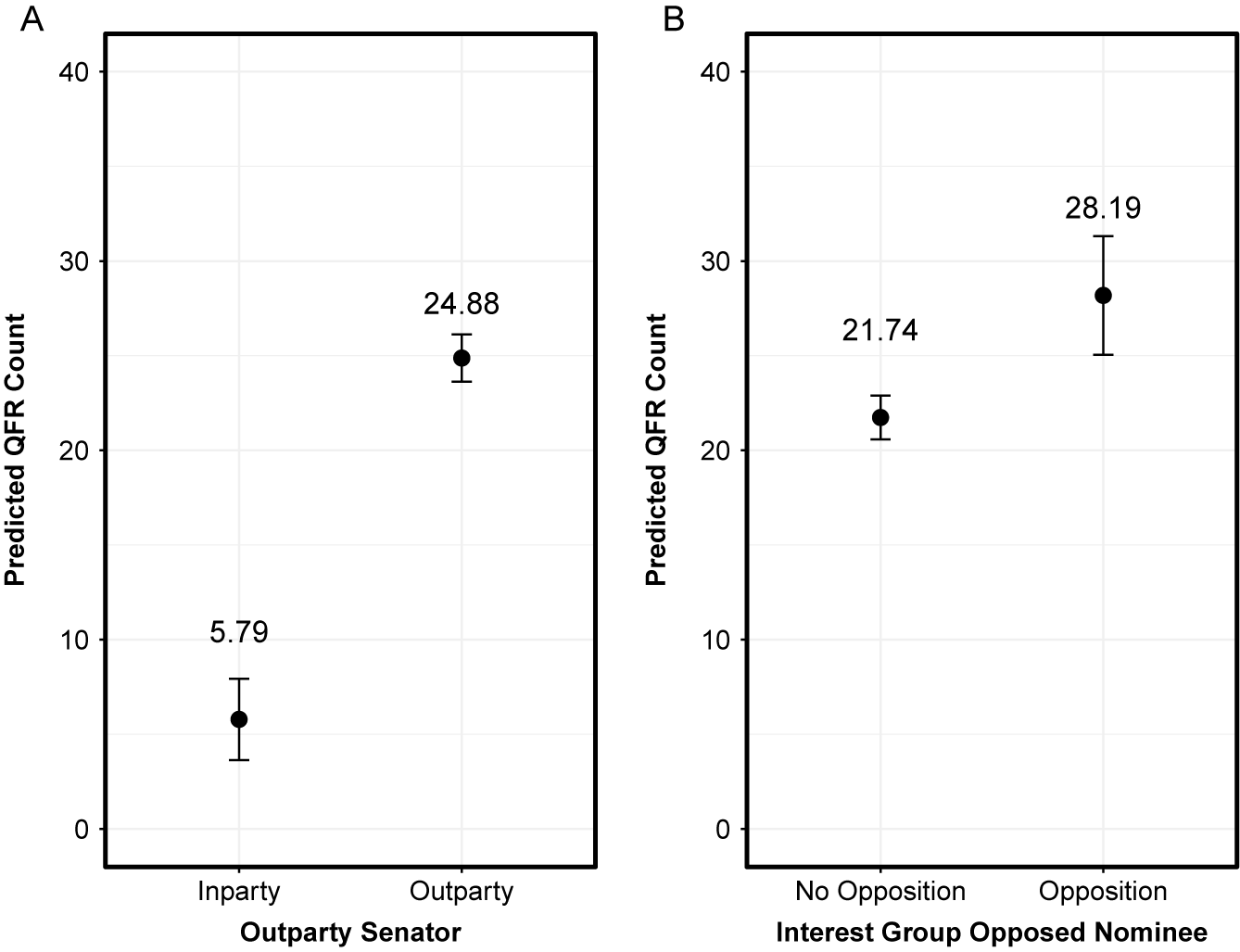
The left side of Figure 5 shows the predicted counts of QFRs for copartisan and outpartisan senators, highlighting the impact of partisan differences for submissions of written questions. This difference is substantial, with outpartisan senators predicted to submit over four times as many QFRs as their copartisan counterparts (25 QFRs compared to 6). Such a contrast highlights the salience of partisanship in shaping senators’ oversight behavior outside of the hearing room. Notably, these individual-level partisan differences hold stronger implications for senators’ use of written questions than broader institutional indicators like divided government. This suggests that partisan differences between senators and nominees may be a more immediate driver of scrutiny than chamber-level partisanship alone.
This figure shows the predicted count of QFRs a senator will submit to a nominee based on (A) Outparty coefficient and (B) Interest Group Opposition coefficients in Model 1. Vertical lines around the estimates show 95% confidence intervals. All continuous variables are standardized and held at their means, with categorical variables held at their modes.

Examining the role of interest group opposition in the model reveals it to be a significant predictor of QFR submissions, contradicting initial findings in the bivariate comparison between QFRs and controversy. Interest group opposition is associated with an increase of approximately 30% more QFRs. This finding aligns with the idea that these groups raise the stakes of a confirmation, activating senators’ electoral incentives and encouraging more rigorous scrutiny. Compared to the bivariate relationship shown on the right side of Figure 5, this effect is more consistent with theoretical accounts from the literature than the bivariate comparison.
That said, the magnitude of the effect is smaller than prior studies might suggest. For example, Dancey et al. (Reference Dancey, Nelson and Ringsmuth2020, p. 71) find that interest group opposition can increase hearing questions from 13.5 to 80 in the aggregate – a nearly five-fold increase. In contrast, the predicted counts of QFRs on the right side of Figure 5 show a more modest effect at the senator level – from 22 to 28 – when a nominee faces interest group opposition. One possible explanation is that QFRs serve more as precautionary tools: rather than simply responding to known opposition, senators may use them to probe for vulnerabilities that interest groups have not yet identified.
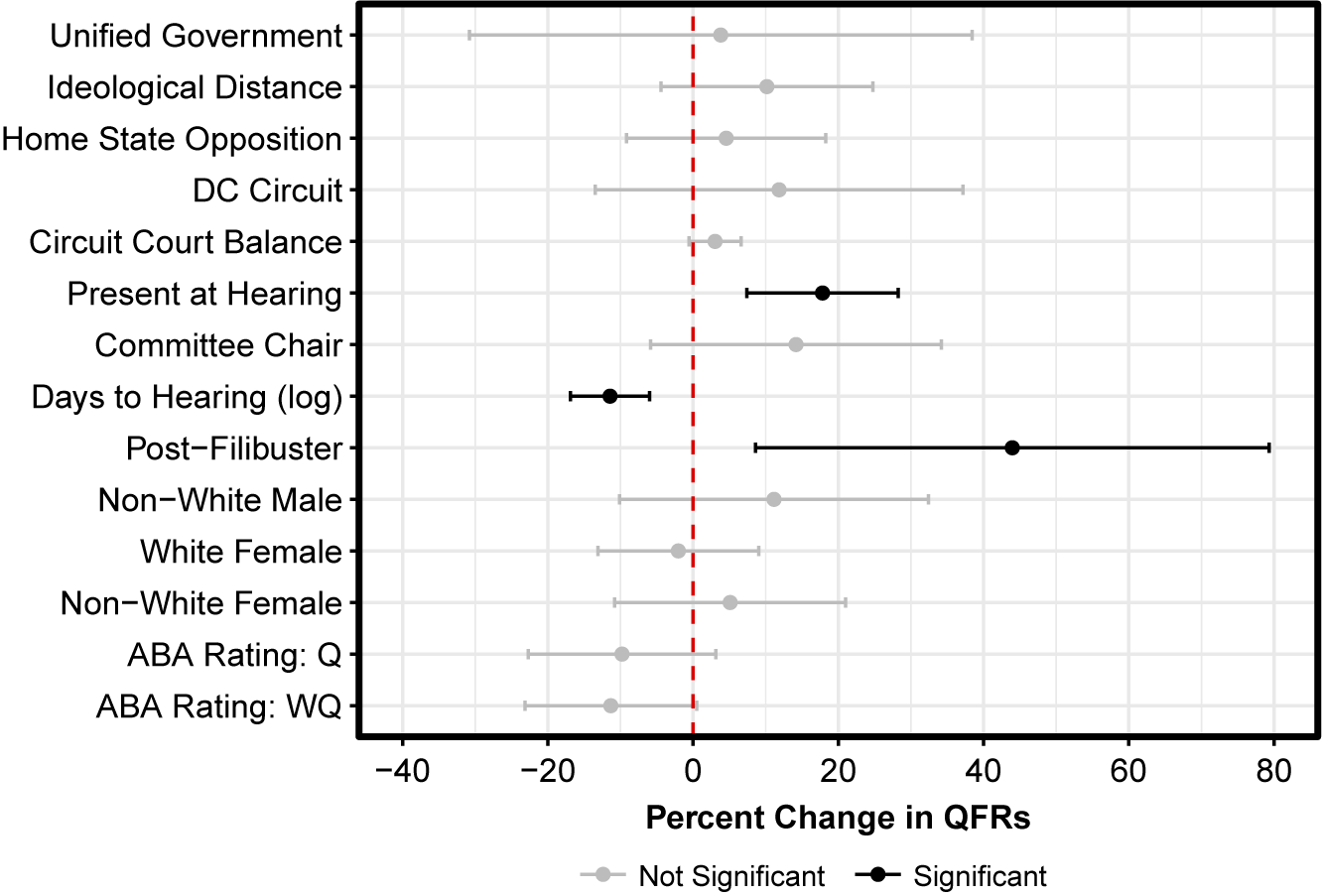
Figure 6 displays the percent change in QFRs associated with each of the additional variables included in this analysis. Three additional political and institutional factors also significantly influence senators’ use of QFRs.
This figure shows the percent change in QFRs associated with a one-unit increase for each variable. Horizontal lines around the estimates show 95% confidence intervals. Point estimates and confidence intervals for significant percent changes are indicated in black. All continuous variables are held at their means, with categorical variables held at their modes.

First, longer gaps between a president’s nomination and the nominee’s confirmation hearing are associated with a slight decrease in the number of QFRs submitted. Specifically, this effect corresponds to approximately an 11% reduction in the percent of QFRs submitted. While small in size, this finding is intuitive: when senators have more time before a hearing, they may have greater opportunity to review nominees’ records and vet them through other means. Conversely, shorter timelines may limit their ability to do this, making QFRs a valuable procedural tool for time-constrained senators.
Second, senators submit significantly more QFRs in the post-nuclear Senate, as evidenced by the positive and significant coefficient on Post-Filibuster. Nominees with hearings held after the reform receive over 40% more written questions from individual senators compared to those before cloture reform – a substantial increase. This aligns with growing partisan polarization in the Senate, and points to the effects of filibuster reform on the committee process and, potentially, how nominees are scrutinized in a post-reform Senate. As Presidents face fewer constraints on their judicial nominees, they are more likely to select ideologically extreme candidates (Bird and McGee Reference Bird and McGee2023), prompting heightened scrutiny from the opposing party. At the same time, the shift to a “boom-and-bust” confirmation process (King and Ostrander Reference King and Ostrander2025) has compressed timelines for senators to evaluate nominees, further motivating a reliance on written questions as a tool for post-hearing vetting. Together, these changes show a possible evolving strategic value in QFRs for messaging and framing opposition to a nominee in an increasingly partisan and polarized confirmation environment where bipartisan support is no longer a norm in lower court confirmations.
Third, whether a senator is present at a nominee’s hearing also has a significant and positive effect on their submissions of written questions, increasing counts of QFRs by 17%. This finding is also intuitive: hearing attendance is a choice, not a requirement for Judiciary Committee senators. For the average nominee, these responsibilities often fall on junior members, those who are not facing a re-election bid, and senators with increased committee responsibilities, like the chair and ranking member (Dancey et al. Reference Dancey, Nelson and Ringsmuth2020). Thus, if senators are choosing to attend hearings, they may be more skeptical of the nominee, and can use QFRs to follow up on questions they were unable to ask in the hearing, or those that they did not feel were adequately addressed by the nominee. Again, this highlights the efficacy of QFRs for senators in the confirmation process.
Notably, aside from whether a nominee faces interest group opposition, no other nominee-level characteristics – including race, gender, or qualifications – are significantly associated with how senators use QFRs. This finding comports with existing studies suggesting that the lower court confirmation process, and the way senators evaluate nominees, is primarily shaped by institutional dynamics and partisan politics rather than individual nominee attributes.
Together, these findings highlight that many of the factors that influence senatorial behavior during confirmation hearings – such as interest group opposition and partisan differences between the senator and nominee – also shape senators’ use of QFRs, but in different ways. While partisan differences between the senator and nominee are highly influential – associated with an over 300% increase in the number of QFRs submitted – the effect of nominee controversy is comparatively weaker than what might be expected from the literature on confirmation hearings. Moreover, the significance of additional variables that have received less attention in prior analyses – such as the impact of cloture reform and the time between a nominee’s announcement and their hearing – suggests that QFRs are way for senators to respond to a distinct set of institutional pressures. These results illustrate the value of examining QFRs as a unique procedural tool available to committee senators to further scrutinize judicial nominees.
Discussion and conclusion
Originating as a tool to promote transparency and flexibility in a time-constrained legislative environment, QFRs have grown to have an institutionalized role in senatorial vetting, and this study helps to establish their efficacy in this process. Interviews with Senate staff underscore the practicality of their efficacy: QFRs allow senators to press nominees on complex legal issues outside the constraints of oral testimony (Steigerwalt Reference Steigerwalt2010). Their very name – Questions for the Record – signals the seriousness of the process, providing senators with formal written statements and commitments from nominees. Even critics of QFR usage, such as Senator Charles Grassley, have relied on nominee responses to publicly justify support or opposition (Grassley Reference Grassley2012; Mauriello Reference Mauriello2015; Arkin Reference Arkin2022). Moreover, the variation in QFR use across sessions, senators, and presidential administrations reflects their utility in different political contexts. While Questions for the Record remain an understudied part of the confirmation process, this research establishes them as a standardized and useful procedural tool for Judiciary Committee senators.
While the findings of this research are intuitive – partisanship and interest groups influence how senators engage with nominees through QFRs – the effects of these variables suggest QFRs function differently from hearing questions. Looking at the role of partisan differences, the incentives surrounding hearing questions and QFRs differ. It reflects poorly on a president if their party is absent from a nominee’s confirmation hearing, but no such expectation exists for QFRs. Additionally, because of their comparatively less public nature, one of their primary advantages is their flexibility. Senators face time constraints and may not prioritize attending hearings for lower court nominees, especially when the political stakes are low. QFRs offer a low-cost opportunity for senators to engage in oversight and information gathering on their own terms, particularly for outparty senators who are more likely to be skeptical of a president’s nominees compared to members of his own party. Copartisans are expected to support a president’s nominee, and these senators have little incentive to expend extra effort challenging the president at this stage of the confirmation. Thus, unlike in hearings, outparty senators should be and are more active in submitting QFRs compared to copartisans, which helps to explain the effect size of partisan disparities between senators and nominees on QFR submissions. While prior research emphasizes the symbolic and partisan value of hearing participation, especially for presidential copartisans (Watson and Stookey Reference Watson and Stookey1987), this analysis shows that QFRs are driven more by partisan skepticism than by supportive members of a president’s Senate coalition.
Turning to interest group opposition, the effect of the controversy on QFR submissions is modest compared to prior work on hearing questions. However, its effect remains significant. That interest group opposition remains valuable to our understanding of QFRs illustrates the strategic role of issue advocacy in shaping senatorial behavior during lower court confirmations. There is little reason to expect the findings from hearings in this area would not extend into written questions. Controversial nominees draw attention to the confirmation process from the media and interest groups, increasing the incentives for senators to seek information about these types of nominees, their written record, and ideological leanings. Senators know they may need to defend their vote on a controversial nominee to party activists, interest groups, donors, and their constituents, giving them additional incentives to ask specific questions to the nominee that they can use to justify their vote to a skeptical constituency. Moreover, nominees are often identified by interest groups because of their prior writings or issue positions—topics that, given legal complexity and time constraints during hearings, can be difficult for senators to address in depth (Steigerwalt Reference Steigerwalt2010). QFRs provide a format better suited to these kinds of detailed inquiries.
However, the comparatively modest effect on QFR submissions suggests that senators may not always use QFRs to pursue personalized scrutiny of already controversial nominees. Instead, they may use these written questions more broadly as fishing expeditions – tools for uncovering potentially disqualifying information or signaling their diligence in the process to interest groups – even when controversy has not yet been clearly established. In this sense, QFRs may serve an anticipatory function, allowing senators to probe for issues that could later justify opposition, rather than merely responding to known concerns.
This research is limited on at least two accounts. First, it is unclear whether findings for senators’ use of QFRs during Circuit Court confirmations differ significantly from how senators use written questions to engage nominees for the federal district courts. As I highlighted above, Dancey et al. (Reference Dancey, Nelson and Ringsmuth2020) theorize that there are two types of hearings: those for the rather mundane nominees to the lower courts and those more contentious hearings for controversial nominees. In other words, the most significant factor dividing lower court confirmations is not the level of the seat, but rather, whether the nominee faces interest group opposition. If this is the case, we might expect these findings to generalize to district court nominees, but given that nominee controversy plays a smaller role in QFR submissions, it is worth investigating whether the judicial hierarchy impacts how Senators use QFRs.
Second, this research focuses almost exclusively on examining the number of QFRs senators submit.Footnote 7 A richer analysis of QFRs can be conducted using their text, and also by comparing the types of QFRs senators submit to the questions they ask during hearings. This is where honing in on strategic differences between the two question formats may be especially apparent.
Future research should examine two of the key findings from this study further. First, the substantial increase in QFR submissions following the change to cloture rules warrants closer examination, particularly as it relates to broader shifts in how nominees are vetted. While this study provides initial evidence that QFRs became a more prominent tool in the post-nuclear Senate, future work should explore whether this increase reflects a response to shorter hearing timelines (King and Ostrander Reference King and Ostrander2025), a rise in more ideological nominees (Bird and McGee Reference Bird and McGee2023), or potential shifts in senatorial strategy. Linking QFR behavior to changes in the content and tone of hearing questions, or to confirmation outcomes, could provide a clearer picture of how procedural reforms reshape the confirmation process. It is also worth considering how scholars can use senators’ questions (and nominees’ responses) to understand how – and if – Judiciary Committee senators use their questions to frame their support and opposition to these nominees. While judicial nominees were once confirmed with large bipartisan support, their confirmation votes are increasingly partisan. Given the presumption of success (Krutz et al. Reference Krutz, Fleisher and Bond1998) surrounding presidential appointments, senators likely feel the need to justify their votes – especially when they vote against a nominee’s confirmation. Linking senators’ committee activities to their voting behavior to understand how this stage affects confirmation outcomes is an especially ripe area for future research, and the recent methodological developments in machine learning and natural language processing can provide helpful tools for scholars to examine these relationships.
Supplementary material
The supplementary material for this article can be found at http://doi.org/10.1017/jlc.2026.10019.
Data availability statement
Replication materials for this article are available at the Journal of Law and Courts Dataverse (https://doi.org/10.7910/DVN/YGH6BL).
Acknowledgments
I thank Michael J. Nelson, Christopher Zorn, Marie Hojnacki, Christina L. Boyd, the reviewers, and participants at the Southern Political Science Association’s 2024 Annual Meeting for their helpful comments and commentary on this project.
Competing interests
The author declares no potential conflicts of interest with respect to the research, authorship, and/or publication of this article.



 Open access

