

Introduction
Digital transformation has significantly reshaped the global business landscape, particularly by altering how firms access, compete in, and sustain operations within international markets. In this evolving context, digital capabilities have emerged as a critical enabler of internationalization, serving as either a complementary or alternative pathway to traditional modes of global expansion (Jin & Hurd, Reference Jin and Hurd2018; Olejnik & Swoboda, Reference Olejnik and Swoboda2012; Sinkovics, Sinkovics, & Jean, Reference Sinkovics, Sinkovics and Jean2013). These capabilities, including spanning information technology systems, big data analytics, artificial intelligence (AI), and Internet-based platforms, allow firms to reduce transaction costs, circumvent geographical barriers, and overcome resource limitations traditionally associated with international market entry (Bianchi & Mathews, Reference Bianchi and Mathews2016).
Despite growing scholarly attention, the current literature tends to treat digital transformation as a monolithic, firm-level capability, often overlooking its heterogeneous, staged, and activity-specific manifestations. While digital technologies are frequently framed as universally enabling for multinational enterprises (MNEs) and born-digital firms, their role within traditional small and medium-sized enterprises (SMEs) remains under-theorized. Existing scholarship leaves important blind spots regarding the detailed and strategic deployment of digital tools across different value chain activities. For SMEs, digitalization is not merely a technological upgrade but an adaptive strategic process that requires balancing innovation, flexibility, and efficiency under severe resource limitations. This lack of detailed theoretical development treats digital transformation as a general structural shift rather than a series of deliberate, activity-specific adaptations. This study therefore addresses a central question: how do SMEs build and apply digital capabilities across value activities to support international expansion?
The goal of this study is three-fold. First, it investigates how SMEs develop digital capabilities across discrete value chain activities. Second, it examines how these capabilities contribute to export and international subsidiary expansion. Third, it explores the strategic logic SMEs employ when aligning digital tools with value creation and international objectives. By framing digital capability deployment as a form of hybrid and adaptive strategy, this study situates SME digital internationalization firmly within the strategic management literature. In doing so, the study addresses conceptual and empirical limitations in the digital internationalization literature, especially regarding SME-specific processes and firm heterogeneity.
Digital capabilities not only lower the entry threshold for foreign market participation but also serve as strategic tools for establishing and maintaining global business relationships. By embedding digital infrastructure within their value chains, firms can improve supply chain coordination, enhance customer engagement, and integrate seamlessly into global value networks (Jean, Sinkovics, & Cavusgil, Reference Jean, Sinkovics and Cavusgil2010; Marchi, De Marchi, & Gereffi, Reference Marchi, De Marchi and Gereffi2018). These affordances are particularly relevant in the context of SMEs, which often struggle to internationalize due to limited financial and human capital (Tseng & Johnsen, Reference Tseng and Johnsen2011). For SMEs, digital technologies present an opportunity to bypass structural disadvantages and build competitive advantage by enabling leaner, more agile, and globally connected operations. Consistent with the hybrid strategy perspective, SMEs that effectively integrate digital tools into critical value activities can simultaneously pursue efficiency and innovation, thereby enhancing adaptive capacity (Gutiérrez-Broncano, Linuesa-Langreo, Rubio-Andrés, & Sastre-Castillo, Reference Gutiérrez-Broncano, Linuesa-Langreo, Rubio-Andrés and Sastre-Castillo2024).
Previous literature has explored the role of digital capabilities in internationalization, focusing on MNEs and large corporations with abundant resources to implement complex digital infrastructures (Bauer, Schlund, Hornung, & Schuler, Reference Bauer, Schlund, Hornung and Schuler2018; Hausberg, Liere-Netheler, Packmohr, Pakura, & Vogelsang, Reference Hausberg, Liere-Netheler, Packmohr, Pakura and Vogelsang2019). In contrast, SMEs face unique challenges: they must balance limited resources with the need to strategically integrate digital technologies across their entire value chain. Yet, there remains a gap in understanding how SMEs develop and deploy digital capabilities in line with their organizational realities – and how these capabilities translate into successful internationalization outcomes. The systematic reviews highlight the fragmentation and inconclusiveness of current knowledge in this domain (Bargoni, Ferraris, Vilamová, & Wan Hussain, Reference Bargoni, Ferraris, Vilamová and Wan Hussain2024) and call for more targeted research. Furthermore, the precise mechanisms through which digital capabilities lead to internationalization success, considering the diverse organizational realities of SMEs across different sectors and countries, warrant deeper investigation (Bargoni et al., Reference Bargoni, Ferraris, Vilamová and Wan Hussain2024).
Recent studies have attempted to address this challenge from different theoretical angles, yet several critical gaps remain (Da Rocha, da Foneseca, & Kogut, Reference Da Rocha, da Fonseca and Kogut2024; Schneider & Kokshagina, Reference Schneider and Kokshagina2021). Elia, Giuffrida, Mariani, and Bresciani (Reference Elia, Giuffrida, Mariani and Bresciani2021) extend the resource-based view by exploring the role of digital technologies and capabilities in cross-border e-commerce, but their work largely focuses on a firm-level perspective, leaving unanswered how digital tools function differently across specific value activities. Similarly, Bhandari, Zámborský, Ranta, and Salo (Reference Bhandari, Zámborský, Ranta and Salo2023) extend the OLI paradigm by incorporating resource orchestration logic, arguing that digital tools reshape ownership advantages. However, these studies still conceptualize digital transformation as a firm-level capability, leaving unanswered how digital tools function differently in, for example, production versus marketing.
Another key gap lies in the sequence and structure of digitalization within the internationalization process. Hervé, Schmitt, and Baldegger (Reference Hervé, Schmitt and Baldegger2021) show that SMEs apply digital tools in unstructured, ad hoc ways across international stages but do not explain how these tools vary in impact depending on where in the value chain they are applied. Ipsmiller, Dikova, and Brouthers (Reference Ipsmiller, Dikova and Brouthers2022) emphasize virtual presence and entrepreneurial orientation as initial enablers of international entry, yet fall short of exploring the integration of digitalization into operational and support activities.
Moreover, few studies explore the contingent dynamics of scaling through digital means. Stallkamp, Hunt, and Schotter (Reference Stallkamp, Hunt and Schotter2022) show that digital ventures scale at different speeds depending on their business models, while Brieger, Chowdhury, Hechavarría, Muralidharan, Pakthak, and Lam (Reference Brieger, Chowdhury, Hechavarría, Muralidharan, Pathak and Lam2022) and Shaheer, Kim, and Li (Reference Shaheer, Kim and Li2022) highlight the interaction between institutional factors and digital capability deployment in new ventures. Feliciano-Cestero, Ameen, Kotabe, Paul, and Signoret (Reference Feliciano-Cestero, Ameen, Kotabe, Paul and Signoret2023) underline the lack of studies that disaggregate digital transformation by value chain function. In sum, the current literature often neglects activity-level and sequencing distinctions in digital internationalization.
To address these limitations, this study offers a comprehensive, empirically grounded analysis of how SMEs develop and utilize digital capabilities across their full value chain to enhance their international presence. Drawing on qualitative data from six in-depth case studies of Taiwanese manufacturing SMEs, the study examines how digital capabilities influence both export performance and subsidiary establishment – two core dimensions of internationalization. By focusing on SMEs with distinct digital maturity levels, the study explores how digitalization operates at multiple levels of value activities, ranging from R&D and production to marketing and internal management, as well as how resource allocation decisions impact digital transformation outcomes.
Building on the work of Oliveira, Fleury, and Fleury (Reference Oliveira, Fleury and Fleury2021), who highlighted the role of digital capabilities in value chain upgrading, this research emphasizes the strategic navigation of digital transformation within SMEs. This study examines how SMEs prioritize digital investments across primary and support activities, and how those choices interact with value enhancement (e.g., improved quality, on-time delivery, cost reduction), relationship enhancement (e.g., trust, communication, information asymmetry), and internal management (e.g., information flow, control systems) to drive internationalization.
This study contributes to theory by bridging three distinct but interrelated domains: (1) strategic management, through resource orchestration in capability development; (2) international business, through a refinement of internationalization theory at the activity level; and (3) digital transformation, through a more nuanced value chain-based lens that counters firm-level generalizations. This triangulated lens allows for a more holistic understanding of how traditional SMEs internationalize digitally.
Theoretically, this study advances the international business and digital transformation literatures by integrating internationalization theory, resource orchestration, and value chain analysis to offer a more detailed understanding of digital capability deployment in SMEs. First, this study extends internationalization theory by demonstrating that digital capabilities enable resource-constrained SMEs to pursue non-linear and accelerated internationalization pathways. While traditional internationalization models often posit a sequential, incremental process driven by experiential learning and increasing resource commitment, our findings reveal that through targeted digital tool deployment in specific value chain activities, SMEs can acquire crucial knowledge and build international commitment more rapidly and with lower initial resource outlays. This activity-level perspective on how digital tools reshape the pace and sequencing of international expansion highlights the ways in which traditional firms can digitally leapfrog or adjust to conventional internationalization pathways. Second, the study contributes to the resource orchestration perspective by showing how SMEs configure, sequence, and leverage digital capabilities in a modular fashion across primary and supporting activities. Unlike digital-native firms that scale through platform logics (Shaheer et al., Reference Shaheer, Kim and Li2022; Stallkamp et al., Reference Stallkamp, Hunt and Schotter2022), traditional SMEs must orchestrate resources toward high-leverage activities. The findings reveal that resource prioritization explains successful internationalization outcomes. Third, the study advances value chain literature by integrating digital capabilities with Porter’s value chain framework, showing how firms derive international benefits not from general digital maturity, but from strategically aligned digitalization at key value nodes. This challenges the dominant binary logic in the literature that treats firms as either digitally ‘ready’ or ‘lagging’ and instead foregrounds the heterogeneity of digital trajectories shaped by internal strategy, partner expectations, and sectoral demands.
In addition to its theoretical contributions, this study holds important practical implications for SME leaders and policymakers. The findings show that effective internationalization is not driven by the amount of digital investment per se, but rather by the alignment of digital tools with strategically critical value activities, such as production quality, marketing outreach, and inter-firm communication. This insight helps SME decision-makers prioritize digital initiatives that yield the highest return in international competitiveness, without overextending limited resources. Moreover, the research offers a structured framework for diagnosing digital maturity at the activity level, helping firms plan their transformation in a staged, resource-sensitive manner.
From a policy perspective, the findings underscore the need for targeted support programs that go beyond general digital literacy or infrastructure provision. Instead, governments and business support agencies should consider sector-specific, function-level interventions, thereby catalyzing more meaningful international growth among SMEs.
Theoretical Background
Digital Capabilities, Dynamic Transformation, and Resource Orchestration
The rapid evolution of digital technologies has prompted a growing body of research exploring the concept of digital capabilities and their implications for firm competitiveness, adaptability, and international expansion. Digital capabilities, broadly defined, refer to a firm’s ability to mobilize and integrate digital technologies in ways that enhance business processes, customer engagement, and strategic innovation (Ghosh, Hughes, Hodgkinson, & Hughes, Reference Ghosh, Hughes, Hodgkinson and Hughes2022; Heredia, Castillo-Vergara, Geldes, Gamarra, Flores, & Heredia, Reference Heredia, Castillo-Vergara, Geldes, Gamarra, Flores and Heredia2022; Wielgos, Homburg, & Kuehnl, Reference Wielgos, Homburg and Kuehnl2021). Rooted in earlier conceptualizations of technological capabilities – which emphasize the ability to develop and deploy new products and processes (Moorman & Slotegraaf, Reference Moorman and Slotegraaf1999) – digital capabilities reflect a more contemporary set of proficiencies, encompassing the application of technologies such as big data analytics, artificial intelligence (AI), cloud computing, and digital platforms. Importantly, these capabilities are increasingly viewed not only as operational enablers but also as strategic assets that support firms’ competitive and innovation-oriented positioning in international markets.
Scholars have sought to delineate the components of digital capabilities and how they enable organizational transformation. Levallet and Chan (Reference Levallet and Chan2018) identify two foundational digital capabilities: information management capability, which reflects a firm’s ability to collect, process, and utilize data effectively; and flexible IT infrastructure, which enables responsiveness and scalability in a dynamic environment. Bonnet and Westerman (Reference Bonnet and Westerman2021) demonstrate that digital capabilities underpin firms’ ability to transform customer experiences, reconfigure operational processes, and innovate business models. These findings suggest that digital capabilities extend beyond traditional IT knowledge and require integrative competencies such as social media management, mobile technologies, and data analytics. From a strategic perspective, the deployment of such capabilities reflects managerial choices about how firms compete rather than purely technical upgrades. In this regard, resource orchestration theory provides a valuable lens to understand how firms configure, leverage, and align such digital resources to generate competitive outcomes (Asiaei, Rezaee, Bontis, Barani, & Sapiei, Reference Asiaei, Rezaee, Bontis, Barani and Sapiei2021; Sirmon, Hitt, Ireland, & Gilbert, Reference Sirmon, Hitt, Ireland and Gilbert2011). Studies further investigate this relationship, exploring how the balancing of structural IT capabilities facilitates organizational agility (Mao, Liu, & Gong, Reference Mao, Liu and Gong2024) and how different forms of paradoxical leadership influence digital transformation through resource orchestration (Wu, Luo, & Ma, Reference Wu, Luo and Ma2025).
Recent research has further emphasized the importance of dynamic capability frameworks in understanding how firms deploy digital capabilities for transformation (Kowalski, Bernardes, Gomes, & Borini, Reference Kowalski, Bernardes, Gomes and Borini2024; Schneider, Kanbach, Kraus, & Dabić, Reference Schneider, Kanbach, Kraus and Dabić2023). A recent structured review by Mele, Capaldo, Secundo, and Corvello (Reference Mele, Capaldo, Secundo and Corvello2024) provides a comprehensive map of how knowledge-based dynamic capabilities drive digital transformation, including specific research streams on SMEs and family firms. These capabilities, encompassing a firm’s ability to sense new opportunities, seize digital tools strategically, and reconfigure their internal processes, are what drive successful digital transformation (Kowalski et al., Reference Kowalski, Bernardes, Gomes and Borini2024; Shu & Srimuang, Reference Shu and Srimuang2025). Studies across various sectors demonstrate that digital capabilities alone are not sufficient (Shen, Zhang, & Liu, Reference Shen, Zhang and Liu2022; Soluk & Kammerlander, Reference Soluk and Kammerlander2021). Instead, the firms’ ability to sense new opportunities, seize digital tools strategically, and reconfigure their internal processes is what drives successful digital transformation. These findings resonate with strategic management research suggesting that innovation-driven capability development must be aligned with firms’ competitive strategies in order to translate into superior market performance, especially in entrepreneurial and resource-constrained contexts (Rubio-Andrés, Linuesa-Langreo, Gutiérrez-Broncano, & Sastre-Castillo, Reference Rubio-Andrés, Linuesa-Langreo, Gutiérrez-Broncano and Sastre-Castillo2024). This view aligns with resource orchestration research, which emphasizes that value creation emerges not from resource possession alone, but from the strategic coordination, bundling, and deployment of those resources across organizational lifecycles (Baert, Meuleman, Debruyne, & Wright, Reference Baert, Meuleman, Debruyne and Wright2016; Hughes, Hodgkinson, We, Elliott, & Hughes, Reference Hughes, Hodgkinson, We, Elliott and Hughes2018; Sirmon et al., Reference Sirmon, Hitt, Ireland and Gilbert2011).
The impetus for developing digital capabilities has been intensified by globalization and digital disruption. Firms across industries increasingly view digital transformation not as a discretionary upgrade but as a strategic necessity to compete in a globalized economy (Li, Reference Li, Su, Zhang and Mao2018). Digitalization has redefined how organizations create, capture, and deliver value, compelling firms to reexamine their structures, processes, and business models (Hopp, Antons, Kaminski, & Oliver Salge, Reference Hopp, Antons, Kaminski and Oliver Salge2018). As organizations manage this transformation, they are not only altering the flow of information and knowledge but also reshaping organizational boundaries, control systems, and inter-organizational relationships (Dougherty & Dunne, Reference Dougherty and Dunne2012; Hanelt, Bohnsack, Marz, & Antunes Marante, Reference Hanelt, Bohnsack, Marz and Antunes Marante2021). From a competitive standpoint, digital transformation thus represents a strategic reconfiguration of how firms position themselves vis-à-vis competitors and partners in international markets. Oliveira et al. (Reference Oliveira, Fleury and Fleury2021) investigate how digitalization reconfigures power relationships within global value chains, introducing the concept of ‘digital power’ to explain how targeted digital tool deployment can shift the power imbalance between a supplier and a lead firm, thereby influencing the upgrading of SMEs.
In this context, dynamic capabilities – the firm’s ability to integrate, build, and reconfigure internal and external competencies to address rapidly changing environments (Teece, Reference Teece2007) – have gained renewed attention. For SMEs in particular, dynamic capabilities serve as a critical mechanism for successfully initiating, executing, and refining digital transformation initiatives. Teece (Reference Teece2018) underscores that dynamic capabilities are essential for SMEs seeking to realign their business models in the face of digital disruption. Empirical research supports this view: SMEs that possess strong dynamic capabilities are more likely to effectively leverage digital technologies, translating digital investments into superior performance and enhanced international competitiveness (Cannas, Reference Cannas2023; Ghosh et al., Reference Ghosh, Hughes, Hodgkinson and Hughes2022; Khin & Ho, Reference Khin and Ho2019; Soluk & Kammerlander, Reference Soluk and Kammerlander2021).
Digital Capabilities and SME Internationalization
Despite the growing scholarly focus on digital transformation, significant gaps remain in the literature. Much of the extant research has concentrated on large firms and manufacturing multinationals – entities with substantial resources to invest in digital infrastructure, talent, and experimentation (Hausberg et al., Reference Hausberg, Liere-Netheler, Packmohr, Pakura and Vogelsang2019). The nature, depth, and strategic use of digital capabilities in SMEs remain under-explored (Anwar, Scheffler, & Clauss, Reference Anwar, Scheffler and Clauss2022; Hervé et al., Reference Hervé, Schmitt and Baldegger2021).
This oversight is particularly problematic in the domain of internationalization, where SMEs face persistent barriers related to firm size, knowledge asymmetries, and limited global reach. In this regard, digital capabilities may serve as a strategic equalizer, enabling smaller firms to overcome traditional limitations by reducing entry costs, enhancing cross-border visibility, and facilitating efficient resource allocation (Katsikeas, Leonidou, & Zeriti, Reference Katsikeas, Leonidou and Zeriti2020; Sinkovics et al., Reference Sinkovics, Sinkovics and Jean2013). Recent research suggests that the effectiveness of such digital capabilities depends on their alignment with firms’ broader competitive and innovation strategies, rather than on the level of digital adoption alone (Rubio-Andrés et al., Reference Rubio-Andrés, Linuesa-Langreo, Gutiérrez-Broncano and Sastre-Castillo2024). Studies have demonstrated that digital technologies can serve as either supplementary or alternative channels for international market entry, facilitating marketing, sales, customer engagement, and the acquisition of competitive intelligence in foreign markets (Bianchi & Mathews, Reference Bianchi and Mathews2016; Reim, Yli-Viitala, Arrasvuori, & Parida, Reference Reim, Yli-Viitala, Arrasvuori and Parida2022). Building on organizational learning theory, firms can learn from an industry-wide ‘knowledge reservoir’ generated by peers’ international activities, such as offshoring (Drori, Andrews, Fainshmidt, & Gaur, Reference Drori, Andrews, Fainshmidt and Gaur2024). This learning is not automatic for all firms but hinges on their existing internationalization-specific experience and general absorptive capacity. These findings are particularly relevant for SMEs, making the ability to learn from external knowledge reservoirs a critical determinant of their internationalization trajectories.
Furthermore, digital capabilities contribute to the development of inter-firm connectivity, allowing SMEs to better integrate with global supply chains, collaborate with distribution partners, and maintain real-time communication with foreign customers (Chen, Guo, & Huang, Reference Chen, Guo and Huang2024; Jean et al., Reference Jean, Sinkovics and Cavusgil2010). These affordances are not merely transactional but strategic: they enable SMEs to create relational capital, enhance trust with partners, and respond more effectively to volatile market demands. For SMEs, digital tools such as customer relationship management systems, digital logistics tracking, and e-commerce platforms can replicate many functions traditionally handled through costly foreign subsidiaries. Recent research on firms in emerging markets also highlights that the digital transformation process proceeds over three key stages: market-opportunity sensing, digital technology acquisition, and leading DT, which are driven by technological dynamism and business ties (Shu & Srimuang, Reference Shu and Srimuang2025).
The potential advantages of digital capabilities for SMEs are thus profound. However, research must move beyond viewing digitalization as a monolithic construct. Instead, there is a need to conceptualize digital capabilities as activity-specific and context-dependent – shaped by the firm’s strategy, resource base, and position within global value chains. Resource orchestration theory provides conceptual grounding for this view, highlighting how SMEs must actively structure, bundle, and deploy their capabilities in alignment with both internal constraints and external demands (Asiaei et al., Reference Asiaei, Rezaee, Bontis, Barani and Sapiei2021; Sirmon et al., Reference Sirmon, Hitt, Ireland and Gilbert2011). Moreover, the interplay between digital capabilities, digital maturity, and dynamic capabilities warrants further investigation (Aghazadeh, Zandi, Amoozad Mahdiraji, & Sadraei, Reference Aghazadeh, Zandi, Amoozad Mahdiraji and Sadraei2024). How do SMEs allocate digital investments across value chain activities, and how do these decisions influence their internationalization trajectories? In response to these gaps, the current study investigates how SMEs develop and deploy digital capabilities across distinct value chain activities and how these capabilities contribute to international performance. By shifting the focus from large firms to SMEs, and from general digital adoption to activity-specific capability development, this study contributes to a more nuanced understanding of digital transformation in resource-constrained, globally aspiring firms.
Toward an Integrated Framework: Value Chain Activities and Internationalization Stages
To better explain how digital capabilities influence the internationalization process of SMEs, this study integrates two complementary theoretical perspectives: Porter’s Value Chain Framework and the Uppsala Internationalization Model. While existing research has tended to treat digital transformation and internationalization as distinct topics, the interaction between internal capability deployment and international expansion remains underexplored, especially in SME contexts.
The Uppsala Model (Johanson & Vahlne, Reference Johanson and Vahlne2015, Reference Vahlne and Johanson2017) conceptualizes internationalization as an incremental, experiential learning process through which firms gradually increase their commitment to foreign markets. This view is suitable for SMEs, which tend to internationalize cautiously and face high uncertainty due to limited international experience. Recent extensions of the Uppsala Model highlight the growing importance of network synchronization (Johanson & Johanson, Reference Johanson and Johanson2021), individual-level decision-making in non-linear internationalization (Schweizer & Vahlne, Reference Schweizer and Vahlne2022), and the relevance of relational embeddedness in dynamic environments (Forsgren & Holm, Reference Forsgren and Holm2021). These revisions suggest that internationalization is not merely about market entry, but about adaptive coordination between internal and external processes over time.
However, while the Uppsala Model explains how and why firms commit to foreign markets incrementally, it does not specify where or how firms develop the necessary capabilities internally to support that progression. To address this, Porter’s (Reference Porter1985) Value Chain Framework offers a complementary lens by disaggregating the firm into discrete, value-generating activities – both primary (e.g., operations, marketing, logistics) and support (e.g., HR, IT infrastructure) – within which digital technologies can be strategically deployed. Prior research suggests that SMEs’ ability to internationalize is tightly coupled with their capacity to restructure and digitalize internal activities that create export-relevant value (Giovannetti, Marvasi, & Sanfilippo, Reference Giovannetti, Marvasi and Sanfilippo2015; Sainio, Saarenketo, Nummela, & Eriksson, Reference Sainio, Saarenketo, Nummela and Eriksson2011).
By integrating these two perspectives, this study conceptualizes internationalization not only as a market-facing expansion process but also as a capability-oriented transformation of internal activities. For example, an SME may first digitalize customer-facing functions such as online marketing or CRM systems to support export entry, followed by digitalizing production scheduling or inventory tracking systems as their foreign operations expand. These staged, path-dependent digital investments mirror the Uppsala Model’s logic of gradual commitment, while the value chain framework clarifies where within the firm those investments are made.
This integrated approach offers a more detailed explanation of how digital capabilities function as enablers of internationalization, highlighting both the strategic sequencing and activity-specific nature of digital transformation in SMEs. It provides the foundation for this study’s empirical investigation into how Taiwanese SMEs deploy digital tools across value chain activities to overcome resource limitations and achieve international growth.
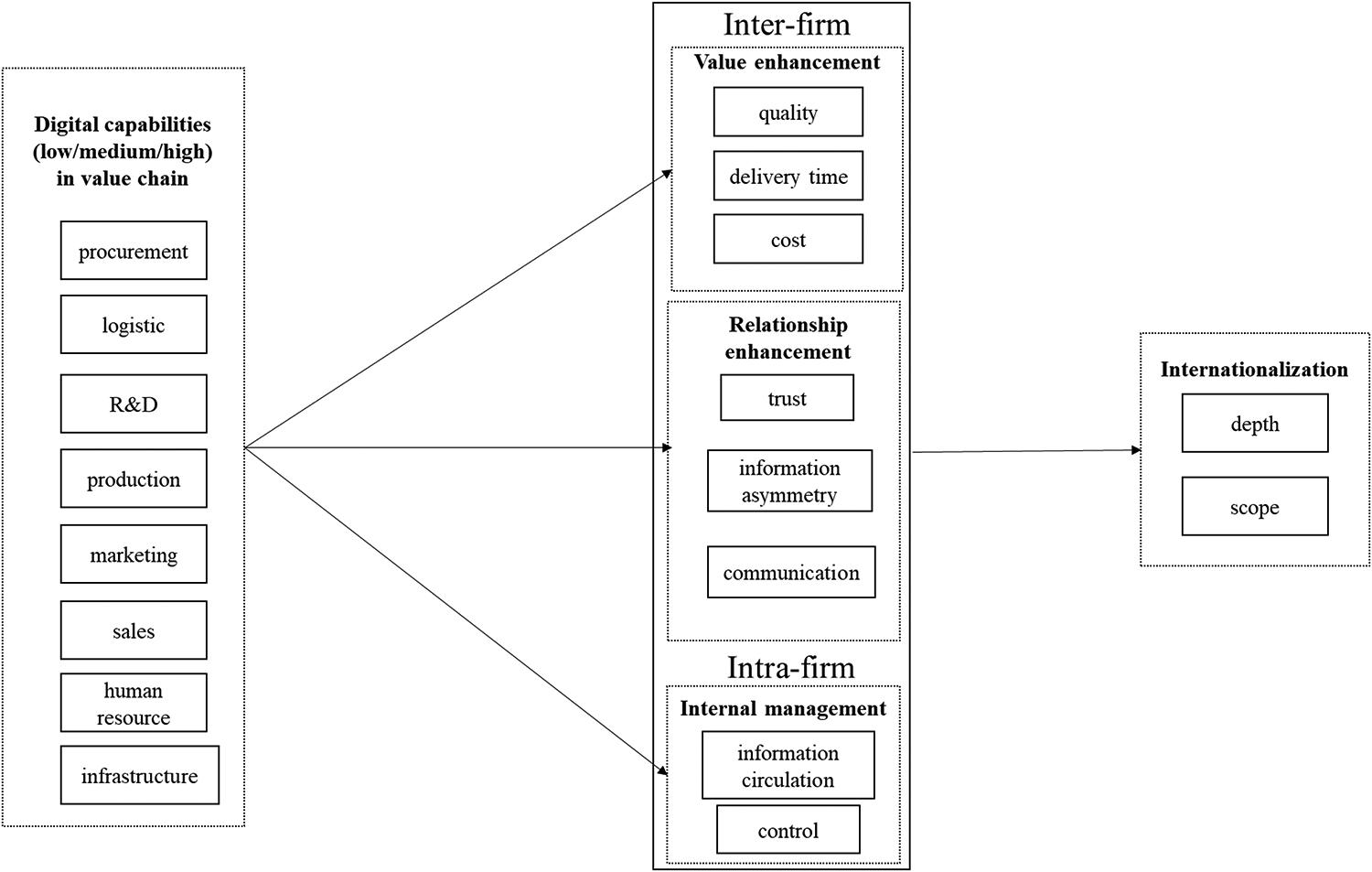
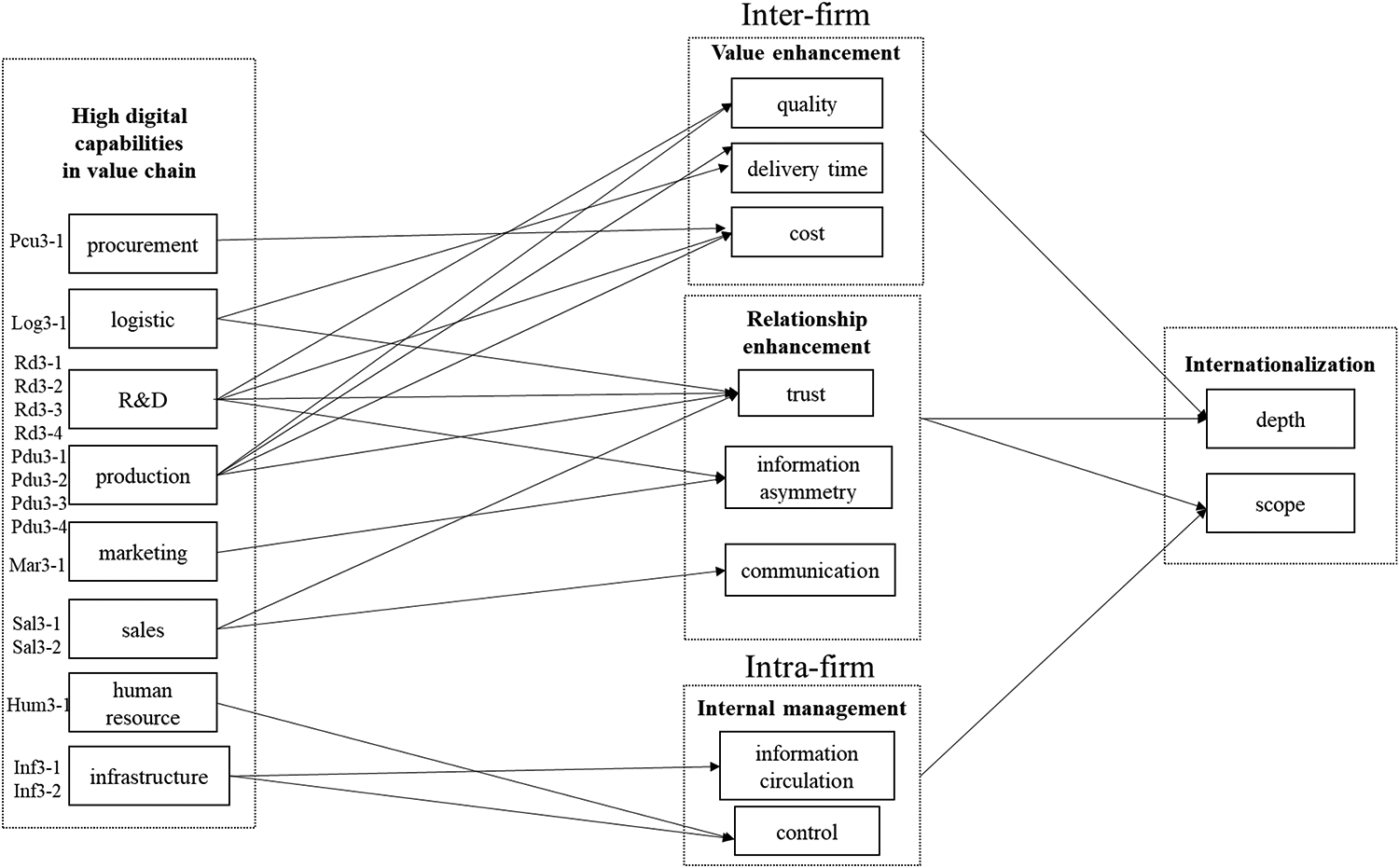
To synthesize the theoretical foundations and guide the empirical investigation, the study develops a conceptual framework that integrates Porter’s value chain activities with the Uppsala Internationalization Model (see Fig. 1). This framework conceptualizes digital capabilities not as firm-level abstractions but as activity-specific tools that shape both the depth and scope of SME internationalization. It highlights three central mechanisms – inter-firm value enhancement, inter-firm relationship enhancement, and intra-firm management enhancement – through which digital capabilities influence international outcomes. The model serves as a basis for our data collection, case comparison, and proposition development.
Conceptual framework

Figure 1 Long description
The diagram shows digital capabilities in the value chain, including procurement, logistics, research and development, production, marketing, sales, human resources and infrastructure. These capabilities influence inter-firm enhancements such as value enhancement (quality, delivery time, cost) and relationship enhancement (trust, information symmetry, communication). Intra-firm enhancements include internal management (efficiency, coordination, control). These enhancements contribute to internationalization, affecting depth and scope.
Methods
This study employs a qualitative multi-case research design to investigate how SMEs develop and deploy digital capabilities across value chain activities in support of internationalization. The research objective is to generate theory-informed, empirically grounded insights into the strategic and operational decisions underlying digital transformation in resource-constrained, internationally active firms. A qualitative approach is well suited to this goal, as it allows for in-depth exploration of complex, context-dependent phenomena, especially in areas where extant theory is limited or evolving (Dana & Dumez, Reference Dana and Dumez2015; Deterding & Waters, Reference Deterding and Waters2021).
To guide the inquiry, the study draws on two theoretical lenses: the Uppsala Internationalization Model (Johanson & Vahlne, Reference Johanson and Vahlne2015, Reference Vahlne and Johanson2017) and Porter’s Value Chain Framework (Reference Porter1985). The Uppsala model conceptualizes internationalization as an incremental, learning-based process, emphasizing how firms gradually build knowledge, reduce uncertainty, and deepen foreign market commitment over time. This perspective provides a temporal structure for analyzing the international expansion trajectories of SMEs and for understanding how digital tools are introduced at different stages. However, while the Uppsala model addresses when and why firms internationalize, it offers limited insight into how internal capabilities are configured to support internationalization. To address this limitation, the value chain framework disaggregates firm activities into primary and support functions, enabling a more granular examination of where digital capabilities are embedded within the firm. By integrating these two frameworks, the study investigates how the internationalization process is shaped by activity-specific digital capability deployment, and how SMEs selectively orchestrate these investments in line with their strategic and operational priorities.
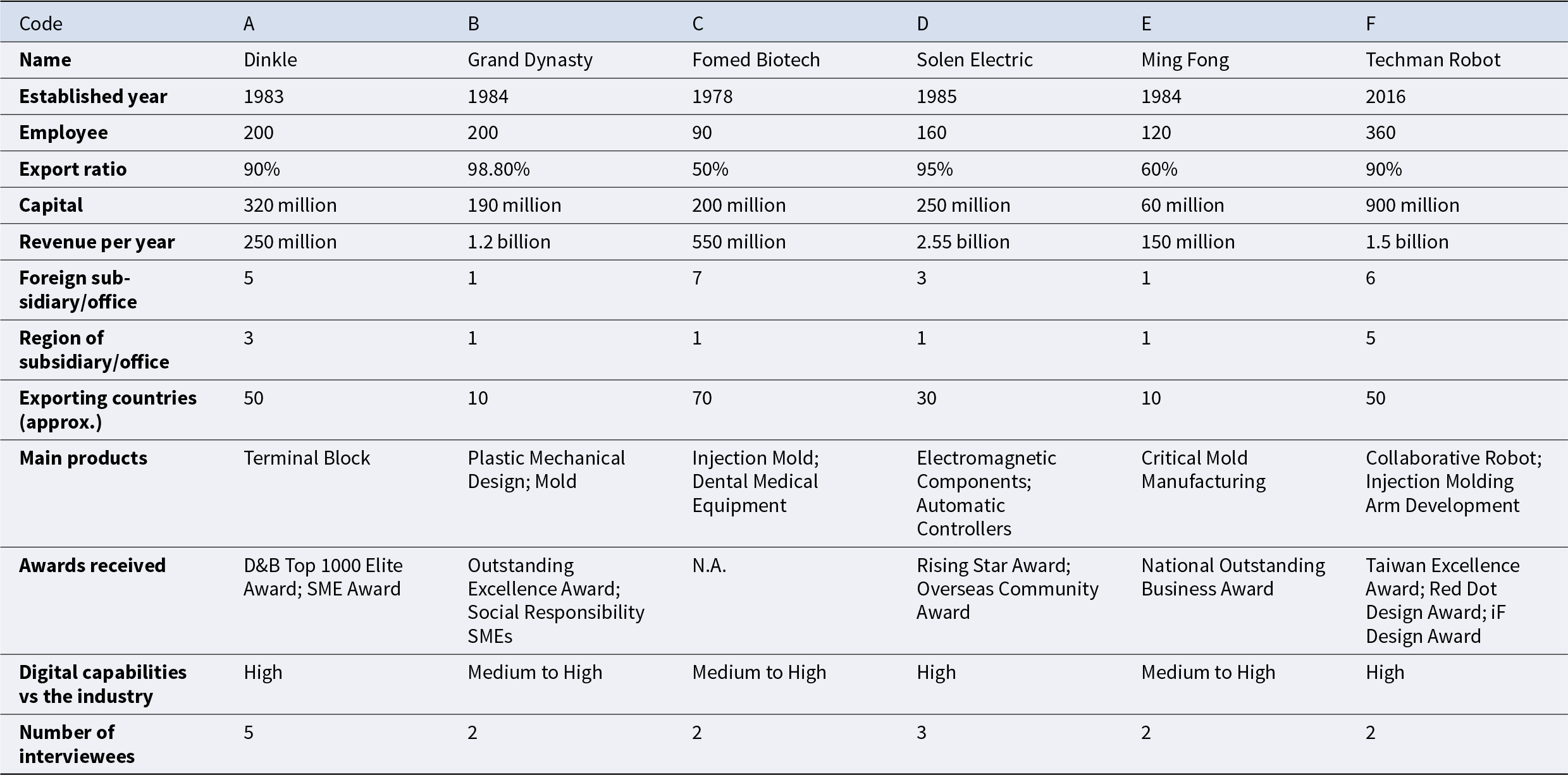
Case selection was guided by theoretical relevance and aimed to capture variation in digital maturity, internationalization stage, and industry context. Six Taiwanese manufacturing SMEs were selected using purposive sampling (Ames, Glenton, & Lewin, Reference Ames, Glenton and Lewin2019; Campbell et al., Reference Campbell, Greenwood, Prior, Shearer, Walkem, Young, Bywaters and Walker2020; Robinson, Reference Robinson2024) to reflect diversity across digital capability levels, sectoral demands, and internationalization experiences (see Table 1). Following Taiwan’s official SME classification, all firms included had fewer than 200 employees or registered capital below NT$100 million. Furthermore, to ensure alignment with the research objective, each firm had completed at least one substantive stage of internationalization, such as initiating direct exports, establishing foreign sales subsidiaries, or maintaining long-term export relationships. This criterion ensured that all firms could meaningfully reflect on the challenges and strategic decisions involved in deploying digital capabilities in international contexts. The focus on Taiwanese manufacturing SMEs is theoretically and empirically appropriate, as Taiwan represents a highly export-oriented economy dominated by SMEs that compete globally. These firms are deeply embedded in global value chains, operate under intense cost and quality pressures, and increasingly rely on digital tools to coordinate international operations, making Taiwan an ideal setting for examining digitally driven internationalization under constraint. The study focused on SMEs in the manufacturing sector, as these firms engage in a broad range of value chain activities – from product development and production to marketing and after-sales service – thus providing a suitable context for exploring intra-organizational capability deployment.
Summary of cases

Table 1 Long description
The table provides a summary of cases for six companies, detailing their establishment year, employee count, export ratio, capital, revenue, foreign subsidiaries, exporting countries, main products, awards, digital capabilities, and interviewees. Techman Robot, founded in 2016, leads in capital and revenue with 900 million and 1.5 billion respectively, and has a high export ratio of 90%. Dinkle and Solen Electric also have high export ratios, 90% and 95% respectively, and multiple foreign subsidiaries. Grand Dynasty has the highest export ratio at 98.80% but fewer subsidiaries. Fomed Biotech has the most exporting countries at 70, despite having the lowest employee count. Awards vary, with Techman Robot receiving multiple design accolades, while Fomed Biotech has none. Digital capabilities are generally high across the industry, with Techman Robot and Dinkle leading.
Drawing on Sezer, Thunberg, and Wernicke’s (Reference Sezer, Thunberg and Wernicke2021) classification, the firms were categorized as having low, medium, or high levels of digital capabilities. Firms classified as low relied on manual and analog systems (e.g., paper-based processes, standalone spreadsheets); medium-capability firms had implemented basic enterprise technologies (e.g., ERP, CRM, MES) but retained manual workarounds; and high-capability firms demonstrated full integration of advanced technologies, including AI, IoT, automated warehousing, and big data analytics. In addition, the 2022 PwC Taiwan SME Transformation Report was used to benchmark industry-specific digital expectations and ensure the classification was grounded in local standards. This approach enhanced the external validity of the digital maturity assessment while preserving conceptual consistency. Importantly, variation in digital capability levels across cases was not treated merely as a descriptive characteristic, but as a deliberate theoretical replication strategy (Eisenhardt, Reference Eisenhardt1989; Eisenhardt & Graebner, Reference Eisenhardt and Graebner2007). By comparing SMEs with low, medium, and high digital capabilities operating under similar institutional and internationalization conditions, the study enables systematic cross-case contrasts that reveal how different configurations of digital capabilities shape strategic choices and internationalization outcomes. This design allows recurring patterns to be identified across cases, thereby supporting the development of analytically generalizable theoretical propositions regarding the role of activity-specific digital capabilities in SME internationalization.
Data collection occurred between February and November 2023 and involved in-depth, semi-structured interviews with firm executives and functional managers. A total of 16 interviewees were conducted across the six firms, with two to five interviewees per firm depending on organizational complexity and availability of key informants. Interviews lasted between 90 and 120 minutes and were conducted face-to-face to facilitate trust, probe strategic reasoning, and gather rich contextual data. The interview protocol was organized into two sections: the first elicited the firm’s internationalization history, including motivations, entry modes, and market expansion; the second mapped digital capability adoption across value chain activities, such as marketing, logistics, operations, and customer service, in relation to internationalization stages.
To enhance the reliability and richness of the data, interviews were supplemented with multiple secondary sources, including firm websites, on-site observations, company brochures, online video interviews (e.g., YouTube), and trade publication coverage. All interviews were audio-recorded, transcribed verbatim, and anonymized. Data analysis followed the principles of thematic analysis (Braun & Clarke, Reference Braun and Clarke2006), combining deductive coding based on the theoretical framework (e.g., ‘digitalization in marketing’) with inductive identification of emergent themes (e.g., ‘trust-building through digital platforms’). Cross-case analysis proceeded through systematic comparison of cases grouped by digital maturity level, allowing the identification of similarities and contrasts in how digital capabilities were deployed across value chain activities and internationalization stages. Within-case analysis enabled the identification of firm-specific trajectories and digitalization patterns, while cross-case comparisons revealed how variations in digital capability and value chain configuration influenced internationalization pathways.
Throughout the research process, methodological rigor was reinforced through iterative coding, peer debriefing, and analytic memoing (Miles, Huberman, & Saldana, Reference Miles, Huberman and Saldana2014). Attention was paid to ensuring transparency in data interpretation, consistency in coding logic, and theoretical alignment with the study’s dual framework. By linking firm selection explicitly to both the Uppsala model (internationalization stage) and value chain logic (functional scope), the research design ensures that each case contributes directly to the study’s central question: how do SMEs build and apply digital capabilities across value activities to support international expansion?
Results
This study explores how SMEs in Taiwan integrate digital capabilities across value chain activities and how such capabilities influence the depth and scope of internationalization. Drawing upon a qualitative, multiple case study design, the findings are interpreted through the dual lens of Porter’s (Reference Porter1985) value chain framework and the Uppsala Internationalization Model (Johanson & Vahlne, Reference Vahlne and Johanson2017). Six Taiwanese SMEs across varying digital capabilities levels and internationalization stages serve as focal cases. Data were thematically analyzed to uncover how digital capabilities embedded in both primary and support value chain activities facilitate different dimensions of international growth. For clarity, the study defines three key outcome mechanisms through which digital capabilities influence SME internationalization. Inter-firm value enhancement refers to improvements in quality, cost, or delivery performance that benefit external stakeholders – particularly international customers and partners – by creating more reliable and competitive offerings. Inter-firm relationship enhancement captures the strengthening of trust, responsiveness, and communication effectiveness between the focal firm and its foreign partners, customers, or distributors. In contrast, intra-firm management enhancement reflects improvements within the firm itself – namely, better coordination, decision-making, and information flow across domestic and international units, which help firms manage complexity as they expand abroad. Table 2 serves as a logical roadmap, detailing the analytical journey from the firms’ data to our research findings, conclusions, and final propositions (also link to Figs. 2, 3, and 4). It illustrates the systematic process of our qualitative analysis.
Low digital capabilities in value chain

Figure 2 Long description
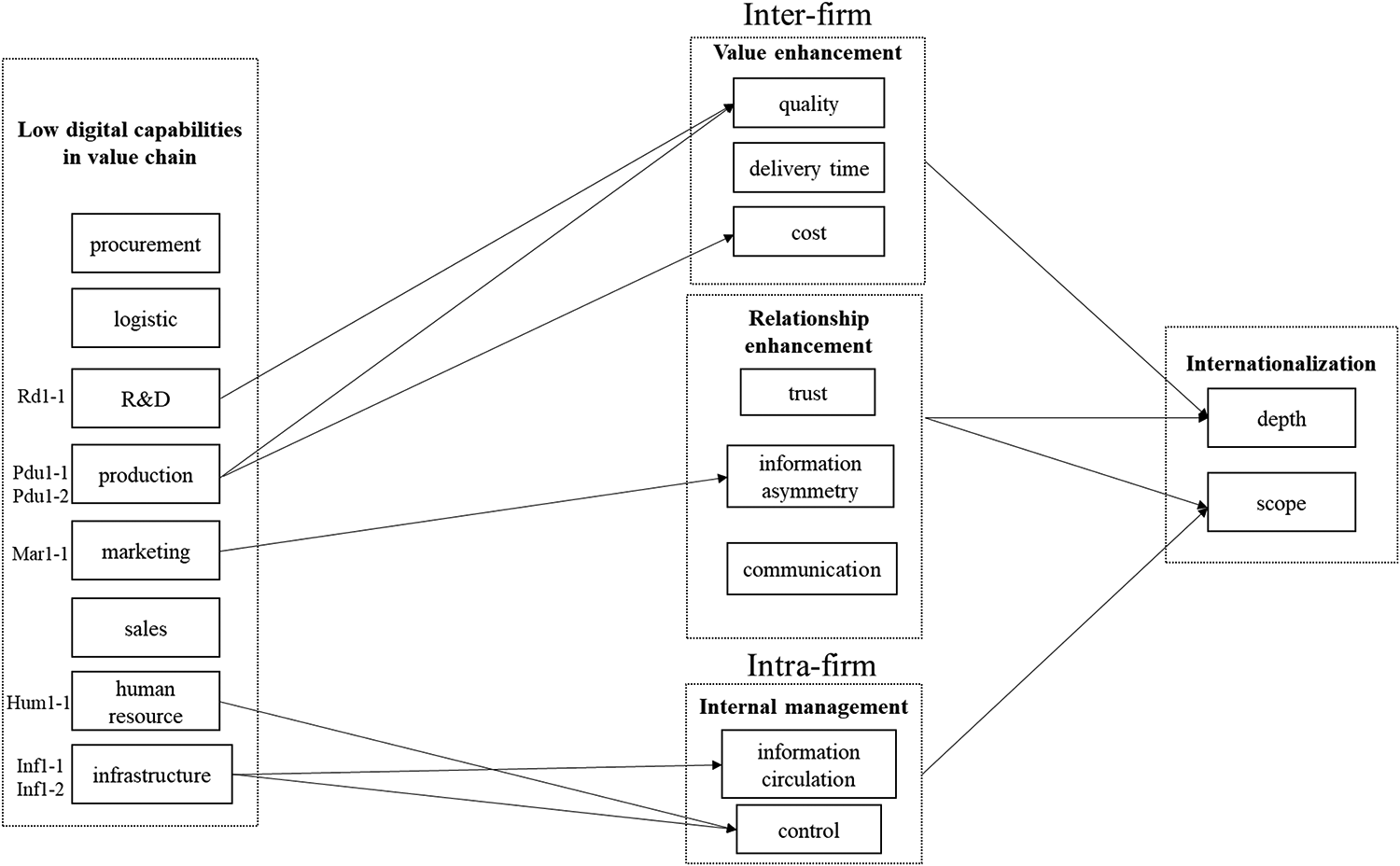
The diagram shows a flowchart illustrating the impact of low digital capabilities in the value chain on inter-firm and intra-firm enhancements, ultimately influencing internationalization. On the left, the value chain activities are listed: procurement, logistics, research and development, production, marketing, sales, human resources and infrastructure. Arrows connect these activities to two main enhancement categories: inter-firm and intra-firm. Inter-firm enhancements include value enhancement (quality, delivery time, cost) and relationship enhancement (trust, information asymmetry, communication). Intra-firm enhancements focus on internal management (information, coordination, control). These enhancements are linked to internationalization, affecting its depth and scope.
Medium digital capabilities in value chain

Figure 3 Long description
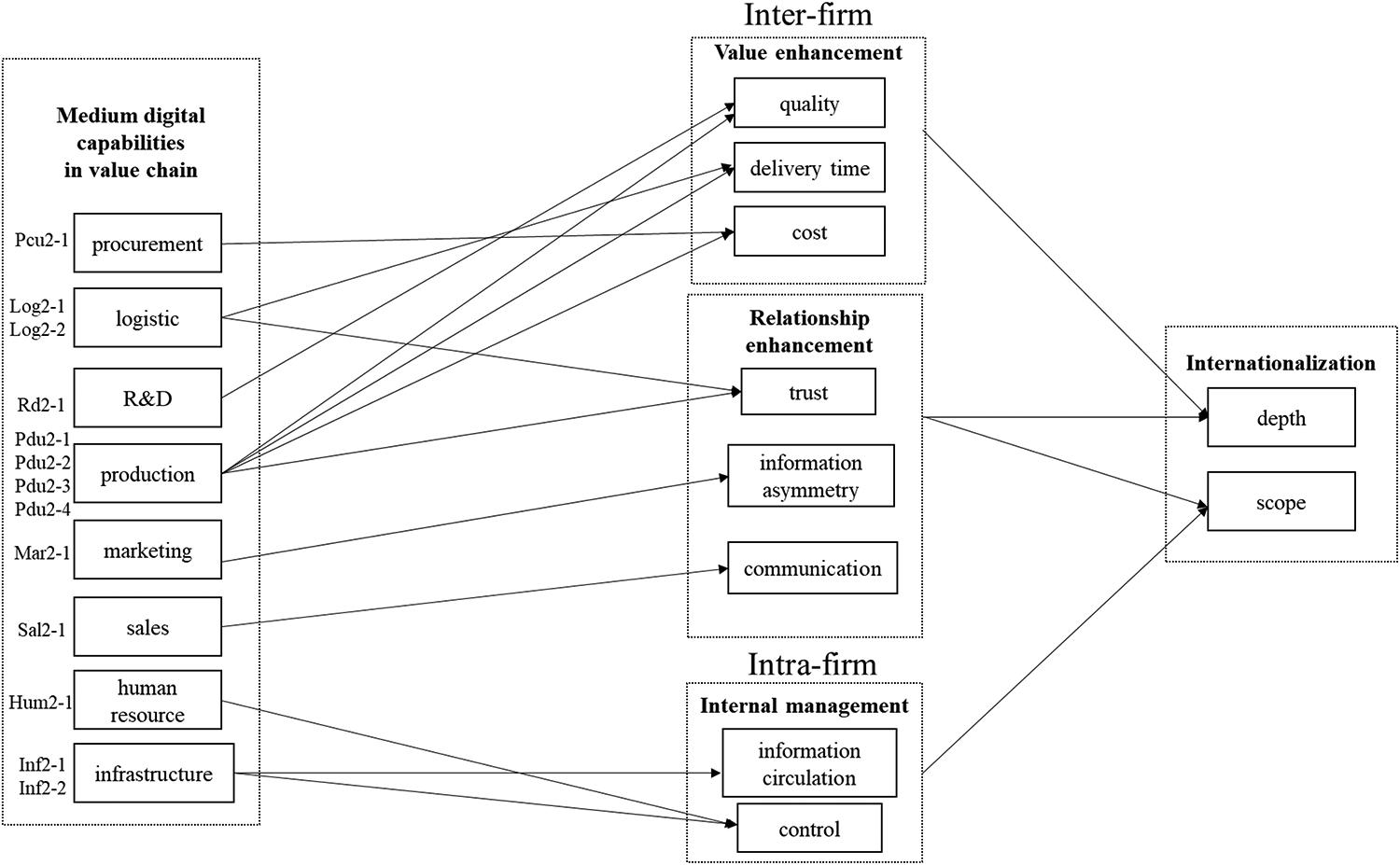
The diagram illustrates how medium digital capabilities in the value chain impact internationalization. It is divided into three main sections: Inter-firm, Intra-firm and Internationalization. The Inter-firm section includes value enhancement (quality, delivery time, cost) and relationship enhancement (trust, information asymmetry, communication). The Intra-firm section focuses on internal management (information coordination, control). Arrows connect these elements to internationalization, which is defined by depth and scope. Various activities like procurement, logistics, R and D, production, marketing, sales, human resources and infrastructure are linked to these enhancements, showing their influence on international growth.
High digital capabilities in value chain

Figure 4 Long description
A diagram illustrating how high digital capabilities in the value chain influence inter-firm and intra-firm enhancements, ultimately affecting internationalization. The left section lists value chain activities: procurement, logistics, research and development, production, marketing, sales, human resources and infrastructure. Arrows connect these activities to inter-firm enhancements (value and relationship) and intra-firm management. Inter-firm value enhancement includes quality, delivery time and cost, while relationship enhancement covers trust, information asymmetry and communication. Intra-firm management focuses on information circulation and control. These enhancements lead to internationalization, impacting depth and scope.
Summary of research propositions, conclusions, and findings

Table 2 Long description
The table compares the impact of enhancing digital capabilities in primary versus supporting value activities on internationalization. Key findings show that firms focusing on primary activities such as research and development and production can strengthen inter-firm relationships, leading to increased export ratios and international reputation. In contrast, enhancing digital capabilities in supporting activities like human resources and infrastructure improves intra-firm management, facilitating the establishment of subsidiaries and expanding export countries. Trends indicate that digital tools like ERP systems, AI, and CRM systems play a crucial role in these enhancements. The data suggests that while primary activities drive depth in internationalization, supporting activities expand the scope, highlighting the importance of a balanced approach. Interpretation should consider the specific needs and capabilities of small and medium-sized enterprises in different sectors.
Digital Capabilities for Inter-Firm Value Enhancement
Across cases, digital investments in procurement, logistics, and R&D consistently functioned as mechanisms for inter-firm value enhancement by improving delivery reliability, cost control, and responsiveness to foreign customer requirements, particularly among firms with medium to high digital maturity.
Procurement and logistics
In firms exhibiting medium to high digital maturity, procurement and logistics functions were digitalized through ERP systems, barcoding technologies, and visual dashboards. Real-time inventory tracking and AI-driven demand forecasting systems helped firms enhance responsiveness and reduce international shipment delays. For example, Firm A stated,
We implemented the ERP system to track the quality and delivery schedules of our suppliers, reducing errors in manual record-keeping. Simultaneously, we began accumulating data on procurement quantities and order details. The introduction of digital systems within the company has enhanced the efficiency of information transmission. Visual indicators now alert procurement personnel to material shortages, improving response times. With the accumulation of data from the digital system, we have been able to quickly establish benchmarks for finding alternative suppliers based on criteria such as specifications, unit prices, delivery times, and quality. Through online searches and comparisons, we swiftly provide comprehensive benchmark data to negotiating suppliers. This approach enabled us to identify a second supplier, facilitating cost and risk control. Additionally, customer satisfaction has increased, attracting new overseas clients.
Firm F stated,
We employ robotic arms and electric unmanned AGVs (Automated Guided Vehicle) to automate material handling in traditional factories, resulting in cost and time savings on labor. The cloud-based data system allows business personnel from various locations to easily access real-time inventory information. In summary, this enables us to precisely manage shipment times and delivery schedules, contributing to our excellent performance in the export sector.
These upgrades minimized errors, improved planning, and supported deeper coordination with global partners.
Conclusion 1-1: Enhancing digital capabilities in procurement and logistics enables small and medium-sized manufacturing firms to meet delivery times, cut costs, and provide clients with detailed information, anticipating a future increase in export volumes and establishment of foreign subsidiaries.
Research and development
Digital research & development (R&D) capabilities varied across the sample. High-performing firms integrated PLM platforms, predictive AI design, and 3D printing to speed up prototyping. For example, Firm A explained,
We use Product Lifecycle Management (PLM) to allow engineers to work from various locations, including Taipei, Kunshan, and Dongguan. This enhances communication and efficiency in the drafting process and makes it easier to adjust product designs. We can rapidly address customer feedback to align with their needs. When these overseas customers are satisfied with our products, they place larger orders next time.
Firm B stated,
We continuously invest in new technology for R&D, including AI to identify market characteristics of new products. This not only accelerates the R&D process but also increases the success rate of product sampling, leading to higher customer satisfaction. Many of our overseas orders come from referrals and recommendations by existing overseas clients.
Conclusion 1-2: Enhancing digital capabilities in research and development enables small and medium-sized manufacturing firms to quickly and accurately respond to host country market demands, leading to increased customer satisfaction, more export orders, and a higher export ratio.
Based on the above conclusions, it can be proposed that:
Proposition 1: Compared to support value activities, enhancing digital capabilities in primary activities (e.g., procurement, logistics, R&D) strengthens inter-firm value enhancement, improving the depth of internationalization.
Digital Capabilities for Inter-Firm Relationship Enhancement
Cross-case comparison reveals that digital capabilities embedded in production and customer-facing activities operate not only as efficiency tools but also as relational mechanisms that reduce information asymmetry, signal quality, and foster trust with overseas partners and customers.
Production
Firms implementing MES, AI-based quality control, and machine-learning diagnostics demonstrated higher precision and process transparency. Firm B shared,
By using MES for production scheduling, we’ve drastically reduced the time spent on manual inspections, significantly improving on-time delivery rates, and keeping the defect rate below 300ppm. Overseas customers highly value delivery times and quality. Our factory is progressing toward a paperless environment, allowing us to monitor production line status using tablet computers. Leveraging these digital systems ensures quality and on-time delivery, keeping our export ratio high.
Firm D also shared, ‘We enable customers to view the operational status of production lines and machines anytime, anywhere, effectively conveying information and fostering increased trust and confidence in our quality. Therefore, we can have a long-term and deeper cooperation’.
This transparency fostered trust and helped overcome entry barriers in reputation-sensitive markets.
Firm C stated,
We utilize AI to assess the quality of our products, enabling us to conduct 100,000 tests more efficiently. This ensures that we meet the demands of large customers and establish a reputation for excellence overseas in terms of product quality. When we join the foreign exhibition, we demonstrate our advanced AI machine. To see is to believe. Therefore, we can help the clients reduce the information asymmetry, leading to further sales in other countries.
Firm E stated, ‘We have our own 3D printing machine, primarily utilized for structural validation. Fitting our services to the specific needs of different customer types, we create solutions that align with their requirements, therefore building trust’.
Notably, Firms C and E reported stronger trust relationships with overseas clients due to transparent quality assurance.
Conclusion 2-1: Enhancing digital capabilities in production activities allows small and medium-sized manufacturing firms to convey exceptional capabilities and quality signals. This is beneficial for participating in overseas exhibitions, exploring unfamiliar markets, establishing trust and international reputation/credibility, reducing information asymmetry during internationalization, and increasing export ratio and foreign sales.
Conclusion 2-2: SMEs that enhance digital capabilities in production activities enable production line personnel and supervisors to hold immediate meetings without being constrained by location, remotely monitor production quality and status, and increase on-time delivery rates, thereby raising the export ratio.
Conclusion 2-3: Enhancing digital capabilities in production activities enables SMEs to directly integrate data with overseas major customers, increasing customer trust and consequently raising the export ratio.
Marketing
Multilingual websites, SEO optimization, and digital catalogs improved firms’ global visibility. Firm A stated,
We primarily deal in bulk products, which led us to participate in large-scale exhibitions worldwide and conduct frequent customer visit activities for unfamiliar market development. In the past, we used to present our factory and products with static photos or videos. In recent years, during physical exhibitions, we have incorporated AR and VR technologies to provide customers with a quick understanding of our factory and products. We have also established our official website, with over eight language options, offering online inquiries and electronic catalogs. We employ Google advertising and keyword ranking to target specific customer groups. Platforms like LinkedIn, Facebook, YouTube, LINE, and other social media help us expose our firm information and products, including sending introductory messages to potential customers. By allowing overseas customers to discover us through various channels and with the efforts of our sales team, we have received more overseas orders from different countries.
Firm B stated,
We focus on niche markets and provide one-stop solutions for plastic products tailored to customers worldwide. We maintain our official website with all content in English, offering online inquiries, electronic catalogs, and video introductions. By using these digital features to highlight our strengths, we make it easy for worldwide customers with specific needs to find us.
Firm E shared,
We placed heavy amounts of advertisement on searching engine and social media. We also made videos on our websites and YouTube. We have received more overseas orders from different countries than before. Fortunately, our products are also chosen by the gift of the Oscars and the Grammys. Then, we have sold more to foreign countries.
Conclusion 2-4: Compared to SME manufacturers focused on niche markets, bulk-product SME manufacturers with enhanced digital marketing capabilities and the use of multiple digital tools can reduce search costs for overseas customers, overcome information asymmetry, increase export ratios, and expand export countries.
Sales and after-sales services
CRM platforms, AI-based customer behavior tracking, and video consultations allowed firms to service customers remotely, improving client retention. For example, Firm A stated,
In 2017, we implemented a new CRM system that allowed us to accumulate and analyze customer data and set up automated processes with tracking and visit reminders. The information is shared in real-time among teams and departments, ensuring transparency on details such as ‘negotiations with customers’ and ‘past disputes.’ These improvements have increased customer satisfaction and, consequently, our export orders. We are currently developing an AI system that can identify potential customers and predict the probability of successful transactions based on email interactions. Therefore, we have increased the sales in different countries.
Firm B shared,
Our sales representatives can directly address customer issues through online channels, such as video calls, email, and online meetings. We also use video conferences to introduce products and confirm product details. Therefore, overseas customers can confidently continue placing orders with us.
Firm F also shared,
We address issues through digital means such as online, video, VR, etc., aiming for resolutions within four hours, eliminating the need for on-site maintenance personnel. In addition, our products come with an included software system package, making it user-friendly for customers to learn.
Conclusion 2-5: Enhancing digital capabilities in sales and after-sales service capabilities, including CRM systems, AI tools, and video conferencing, enables SME manufacturers to track transactions, anticipate needs, receive real-time feedback, and promptly resolve issues – resulting in higher customer satisfaction and trust, and ultimately increasing export ratios and international reach.
Based on the above conclusions, it can be proposed that:
Proposition 2-1: Enhancing digital capabilities in R&D and production strengthens inter-firm relationship enhancement, improving both the depth and scope of internationalization. Proposition 2-2: Firms with higher digital capabilities can strengthen inter-firm trust (team and organizational), improving internationalization outcomes.
Digital Capabilities for Intra-Firm Management Enhancement
At the intra-organizational level, support-activity digitalization emerged as a management mechanism that enables SMEs to coordinate dispersed operations, replicate routines across borders, and manage international complexity as geographic scope expanded.
Infrastructure
Digitalized infrastructure included ERP-integrated financial reporting, automated compliance tracking, and centralized cloud platforms. These tools enhanced back-end coordination and cross-site consistency. Firm C stated,
With tools such as ERP, CRM, electronic file records, etc., we have gained the confidence to establish subsidiaries. These systems allow for easier management, reduce the need for establishing routines from the very beginning, and facilitate the effortless replication of SOPs and processes. We can export to more countries than before.
Conclusion 3-1: SMEs strengthening digital capabilities in administrative processes can better execute internal monitoring and information flows, increasing the number of export countries and facilitating subsidiary establishment.
Human resource management
AI-assisted recruitment tools, virtual onboarding, and e-learning enabled global workforce development. Firm F used virtual simulators to train engineers in multiple countries. Firm B shared,
We use 1111 and 104 job portals to aid talent selection, and we arrange online interviews when needed to avoid missing suitable candidates due to location-specific interview processes. Before establishing a new foreign subsidiary firm, the Taipei head office assigns some employees to conduct online staff training for local personnel. Supervisors travel to the local site several times to confirm the effectiveness of training, reducing training costs. Through video conferencing, online meetings, and other digital tools, we effectively utilize human resources to establish new foreign subsidiary firms within the expected timeframe.
Firm D also shared, ‘We only need two Taiwanese top managers for each subsidiary because we can use ERP system and video conferencing to monitor and manage the human resources easily’.
Conclusion 3-2: Digital capabilities in HRM enable SMEs to efficiently recruit, standardize competencies, and overcome geographic constraints. This helps address labor shortages during internationalization and accelerates expansion.
Based on the above conclusions, it can be proposed that:
Proposition 3: Compared to primary activities, enhancing digital capabilities in support activities (e.g., HR, infrastructure) strengthens intra-firm management, improving the scope of internationalization.
Cross-case propositions
Drawing from the cross-case analysis of six SMEs with varying digital capabilities and internationalization trajectories, several analytically grounded and theoretically informed propositions emerge. These propositions capture the underlying patterns by which digital capabilities – when embedded in specific value chain activities – affect firms’ ability to deepen their international presence, expand into new markets, and manage cross-border operations. In particular, the analysis distinguishes the differential impact of digital investments in primary versus support activities, and how such deployments contribute to three mechanisms central to internationalization success: value enhancement, relationship enhancement, and intra-firm management improvement. Figures 2–4 visually synthesize these relationships and support the development of the following propositions. Consistent with Gutiérrez-Broncano et al. (Reference Gutiérrez-Broncano, Linuesa-Langreo, Rubio-Andrés and Sastre-Castillo2024), the findings suggest that SMEs engage in adaptive strategic behavior by selectively prioritizing digital investments across value chain activities, balancing innovation-oriented initiatives (e.g., digital R&D and production transparency) with efficiency-oriented systems (e.g., ERP, CRM, and logistics platforms). These patterns reflect adaptive hybrid strategies rather than uniform digital transformation trajectories, reinforcing the interpretation of the empirical results as strategically driven capability configurations.
Figure 2 presents a visual synthesis of SMEs with low digital capability, showing that digital deployment is limited and uneven across the value chain. Most digital activities are concentrated in isolated, operational-level functions such as basic logistics or offline inventory tracking. Although solid lines in the diagram indicate that digital tools do influence value enhancement, relationship building, or internal management, the actual effect is relatively weak compared to medium or high-capability firms. For instance, while some improvements in delivery or cost may be observed, firms lack integrated systems for trust-building, communication, or feedback. Their internal digital tools are insufficient to support dynamic coordination, limiting their ability to deepen international operations beyond entry-level exporting.
Figure 3 illustrates the digital deployment patterns of SMEs with medium-level digital capabilities. Compared to low-capability firms, these SMEs show a more deliberate use of digital tools across activities such as marketing, procurement, production, and after-sales service. Examples include CRM systems, barcode-based logistics tracking, and inventory visibility platforms. Solid lines in the figure indicate that digital capabilities have a noticeable influence on value enhancement, relationship development, and internal management – stronger than in low-capability firms, but still not as integrated or impactful as those seen in high-capability firms.
Figure 4 presents the value chain configuration of SMEs with high digital capability, highlighting a comprehensive and well-integrated deployment of digital tools across both primary and support activities. These firms apply advanced technologies – such as MES systems, AI-enabled CRM platforms, and digital R&D tools – in functions ranging from product development and production to marketing, logistics, and internal coordination. Solid lines in the figure indicate strong and clearly observable impacts on inter-firm value enhancement, relationship enhancement, and internal management.
Figures 2 to 4 synthesize the core empirical patterns observed across the six SME cases and translate them into an integrative framework that connects digital capability deployment with internationalization outcomes. These figures serve three purposes. First, they visually map how specific types of digital capabilities – distributed across primary and support value chain activities – link to different internationalization mechanisms. Second, they help distinguish the relative influence of digital investments on inter-firm value enhancement, inter-firm relationship enhancement, and intra-firm management enhancement, all of which mediate the relationship between digital transformation and international performance. Third, these visual models provide the conceptual foundation for the propositions developed in this study by illustrating how firms at different digital maturity levels navigate trade-offs in technology allocation, timing, and capability-building across the internationalization lifecycle. Together, these figures offer a more detailed and activity-specific theory of digital capability deployment in SMEs, advancing beyond generalized digital transformation models by emphasizing sequencing, embeddedness, and relational dynamics.
Discussion
While the findings reaffirm that digital capabilities play an enabling – rather than direct – role in SME internationalization, they also offer practical guidance on how SMEs can strategically prioritize digital investments in the face of limited resources. Importantly, these prioritization decisions reflect deliberate strategic choices aimed at aligning digital investments with firms’ competitive positioning and innovation orientation, rather than ad hoc operational adjustments. Rather than attempting a large-scale, enterprise-wide digital transformation, SMEs should focus first on value chain activities that yield immediate international benefits. For firms in the early stages of exporting, technologies that support market access and customer trust – such as multilingual websites, search engine optimization (SEO), and basic CRM systems – offer high returns with modest cost. These tools help firms build visibility, lower foreign customer search costs, and manage relationships across time zones.
As firms deepen international engagement, investing in production transparency and compliance tools, such as Manufacturing Execution Systems (MES) or AI-based defect detection, becomes critical – especially in reputation-sensitive sectors. Such investments serve not only operational efficiency goals but also reinforce competitive differentiation by signaling reliability, quality, and innovation capability to international customers. These technologies not only improve quality control but also serve as signals of reliability to overseas buyers. In later stages, firms expanding into multiple markets or establishing subsidiaries may benefit from ERP integration, cloud-based document repositories, and virtual onboarding platforms, which facilitate cross-border coordination and knowledge replication.
The findings also highlight the role of dynamic capabilities in mediating the digitalization-internationalization link. As firms encounter new market opportunities and external pressures, their ability to strategically reconfigure and leverage digital assets becomes crucial. This adaptive orchestration process illustrates how SMEs align innovation-driven digital initiatives with competitive strategy to enhance international performance, consistent with recent strategic management research (Rubio-Andrés et al., Reference Rubio-Andrés, Linuesa-Langreo, Gutiérrez-Broncano and Sastre-Castillo2024). The process of discerning which digital tools to prioritize (as discussed above) and how to implement them effectively is, in itself, a manifestation of dynamic capabilities such as sensing, seizing, and reconfiguring. The effective sequencing of digital investments, from basic marketing tools to complex ERP systems, is not a one-time decision but an ongoing process of adapting to both internal and external demands. These findings, therefore, demonstrate how SMEs use their dynamic capabilities to orchestrate limited digital resources, thereby enabling non-linear and accelerated internationalization pathways.
These findings point to the value of targeted support programs that reflect the staged nature of SME internationalization. Rather than promoting ‘digital transformation’ as a broad goal, agencies can design industry-specific roadmaps that identify which digital tools are most valuable at which stage of export development. Such stage-sensitive guidance can help SMEs align digital investments with both competitive strategy and innovation priorities, increasing the likelihood that digitalization translates into sustainable international performance. Financial subsidies, vendor matchmaking, and digital capability audits focused on CRM, MES, and cloud-based collaboration platforms could have especially high leverage for internationally oriented SMEs. In addition, creating public repositories of SME digitalization cases, toolkits, and sector benchmarks can help demystify digital investment decisions for smaller firms lacking internal IT strategy teams.
Theoretical Contributions
This study makes several theoretical contributions to the international business and digital transformation literatures by shifting the analytical focus from resource-rich multinational enterprises to the strategic realities of resource-constrained SMEs. By employing a multi-case qualitative analysis of six Taiwanese manufacturing firms, the study illuminates how SMEs deploy digital capabilities across distinct value chain activities to facilitate internationalization. The research advances the perspective of digital transformation, which posits that firms selectively digitalize specific activities – such as production, marketing, or after-sales services – based on their internationalization goals, market demands, and internal constraints, rather than conceptualizing it as a linear, firm-wide initiative. Successful internationalization thus depends not on the overall intensity of digital investment but on the strategic alignment of digital tools with value-creating activities.
The study achieves a more detailed understanding of this process by integrating three distinct but interrelated theoretical frameworks. First, the study extends internationalization theory by demonstrating how digital capabilities enable SMEs to pursue non-linear and accelerated internationalization pathways. While traditional models posit a sequential, incremental process, our findings reveal that through targeted digital tool deployment at the activity level, SMEs can acquire crucial market knowledge and build international commitment more rapidly and with lower initial resource outlays. This perspective highlights the ways in which traditional firms can digitally ‘leapfrog’ or adjust to conventional internationalization pathways. Second, the study contributes to the resource orchestration perspective by showing how SMEs configure, sequence, and leverage their limited digital capabilities. Unlike digital-native firms that scale through platform logics, traditional SMEs must strategically orchestrate their resources toward high-leverage activities. The findings reveal that resource prioritization is the key determinant of successful internationalization outcomes. Third, the research advances value chain literature by integrating digital capabilities with Porter’s value chain framework. This integration reveals that firms derive international benefits not from general digital maturity but from strategically aligned digitalization at key value nodes. This challenges the dominant binary logic in the literature that categorizes firms as either digitally ‘ready’ or ‘lagging’, by instead emphasizing that firms follow different digital transformation paths shaped by internal strategies, partner expectations, and sectoral demands. Ultimately, by challenging the simplified assumption that equates digital adoption with international success, this study provides a more detailed understanding of the digitalization–internationalization link. It further illustrates that SMEs’ ability to integrate innovation and adaptability through selective digital transformation constitutes a hybrid strategy that enhances resilience and competitiveness in international markets (Gutiérrez-Broncano et al., Reference Gutiérrez-Broncano, Linuesa-Langreo, Rubio-Andrés and Sastre-Castillo2024). It shows that improvements in product quality, delivery performance, relationship-building, and internal coordination serve as the crucial mediating mechanisms, demonstrating how digital capabilities function as activity-specific enablers rather than monolithic firm-wide assets.
In addition to advancing theory, this study provides practical guidance for SME leaders and policymakers. The findings show that digital investments should not be evenly distributed but prioritized by strategic value: early exporters benefit most from CRM systems, multilingual websites, and digital marketing tools, while more advanced firms gain from MES and ERP systems that improve operational transparency and coordination. Policymakers can further support SME global engagement by offering targeted subsidies and industry-specific digital toolkits that align with firms’ internationalization stages and sectoral needs.
Limitations and Future Research Directions
Several limitations of this study suggest clear avenues for future inquiry. While the qualitative design is well-suited to uncovering new mechanisms, the study acknowledges that it limits the generalizability of the findings. A potential source of bias is the reliance on self-reported data from firm executives, which may introduce subjectivity. Future research could mitigate this by triangulating data with external sources, such as firm performance metrics or objective data on technology adoption. Furthermore, the sample’s focus on Taiwanese manufacturing SMEs may not fully capture the dynamics of firms in other contexts. Cross-industry and cross-country studies – including service sectors or firms in developed markets – could deepen insights into how digitalization interacts with varying institutional and competitive environments.
To further enhance the impact of this work, the study has prioritized future research directions based on the potential to advance the field. A follow-up quantitative study is a high-priority direction for validating the propositions proposed in this research. Such a study could use a large, more diverse sample to validate the findings on how digital capabilities enable non-linear internationalization and to test the mediating mechanisms this study identified. Future research should also disentangle digital capability into two distinct layers: digital resource adoption (e.g., acquiring AI tools, cloud systems) and digital capability development (e.g., the organizational learning required for analytics interpretation and cross-border coordination). This distinction will provide more nuanced insights into organizational learning and performance outcomes. Finally, examining how emerging technologies such as blockchain, AI, and industrial IoT enable new forms of SME internationalization, particularly in decentralized or platform-based global ecosystems, presents another critical pathway for future inquiry.
Ultimately, this research encourages a shift away from one-size-fits-all digital transformation narratives. It underscores the importance of aligning digital capability development with firms’ value chain priorities and global strategic objectives, paving the way for more nuanced and context-sensitive theory in the field of digital internationalization.
Data availability statement
The data that support the findings of this study are available on request from the corresponding author, C.Y.A. The data are not publicly available due to privacy and ethical restrictions, as they contain sensitive information from private corporate interviews that could compromise the anonymity of the participating organizations and individuals.
Appendix 1. Interview Outline

Appendix 2. Summary of Digital Capability, Mechanisms, and Internationalization Outcomes

Yi-An Chen (cya@mail.ncyu.edu.tw) is currently an assistant professor in the Department of Technology Management at National Chiayi University. Her research focuses on strategic management, international business management, and digital transformation. Her academic work has been published in several SSCI journals, including Management and Organization Review, Journal of Services Marketing, and International Journal of Emerging Markets. She is also an active reviewer for SSCI journals, including Journal of Business Research, International Journal of Emerging Markets, and Journal of Knowledge Management.
Kuo-Feng Huang (kfhuang@nccu.edu.tw) is a distinguished professor in the Department of Business Administration at National Chengchi University. His research focuses on strategic management, international business management, innovation and entrepreneurship, and organizational management. His academic work has been published in SSCI journals, including International Business Review, Journal of Business Research, and Management International Review. He is an active reviewer for SSCI journals. He also leads numerous research projects funded by the National Science and Technology Council.