








1 Introduction
The motivation for this article came from the previous work [Reference Nie and ParentNP24], in which we produced canonical connected fundamental domains for the congruence subgroups. Let
$N>1$
 and let us concentrate on the heart of that work, the
$\Gamma _0(N)$
and let us concentrate on the heart of that work, the
$\Gamma _0(N)$
 case.
case.
The connected fundamental domain produces some natural cusps with their own widths, specified by a function W (see (1.1)). The cusps produced this way are not necessarily inequivalent to each other. It was one motivation of this article to classify these cusps by their equivalence classes and to reconcile the corresponding widths. The particular case of
$N=30$
 was worked out in [Reference Nie and ParentNP24, Example 3.2], and here we aim to study the case for a general N and to prove the corresponding identities.
From the author’s point of view, the advantage of a connected fundamental domain is the convenience it provides in understanding and getting a feel for the modular curve
$X_0(N)$
 . As opposed to a disconnected fundamental domain consisting of ideal geodesic triangles in
${\mathbb H}$
. As opposed to a disconnected fundamental domain consisting of ideal geodesic triangles in
${\mathbb H}$
 , the common edges for a connected one are already identified, giving a clearer picture. The remaining task is to specify how the boundary arcs are identified by elements of
$\Gamma _0(N)$
, the common edges for a connected one are already identified, giving a clearer picture. The remaining task is to specify how the boundary arcs are identified by elements of
$\Gamma _0(N)$
 . Another goal of this article is to write out the list of boundary arcs and the gluing patterns. This, a priori, seems a hopeless task for a general N, but the final result turns out to be rather neat. A key role is played by the geometry of the projective line
${\mathbb P}^1({\mathbb Z}/N)$
. Another goal of this article is to write out the list of boundary arcs and the gluing patterns. This, a priori, seems a hopeless task for a general N, but the final result turns out to be rather neat. A key role is played by the geometry of the projective line
${\mathbb P}^1({\mathbb Z}/N)$
 (see (2.3)).
After the motivation, let us describe these two results, about the cusps and boundaries of the connected fundamental domains, in more detail.
A key tool in our construction [Reference Nie and ParentNP24] is a function

where
${{\mathbb N}}={\mathbb Z}_{>0}$
 and
$({\mathbb Z}/N)^*$
and
$({\mathbb Z}/N)^*$
 is the group of units. The related function

is actually first studied and more fundamental in our work [Reference Nie and ParentNP24].
Let

be the generators of
$\Gamma (1)=SL_2({\mathbb Z})$
 . Let A be a set in
${\mathbb Z}$
. Let A be a set in
${\mathbb Z}$
 of consecutive residue class representatives for
${\mathbb Z}/N$
of consecutive residue class representatives for
${\mathbb Z}/N$
 , such as
$\{0,1,\dots , N-1\}$
, such as
$\{0,1,\dots , N-1\}$
 , or
, or

where
$ \left \lfloor {\cdot } \right \rfloor $
 is the usual floor function. For
$x\in {\mathbb Z} $
is the usual floor function. For
$x\in {\mathbb Z} $
 , we define
$\widetilde {x}$
, we define
$\widetilde {x}$
 to be the unique integer such that
$\widetilde {x}\equiv x \mod N$
to be the unique integer such that
$\widetilde {x}\equiv x \mod N$
 and
$-N_1\leq \widetilde {x}\leq N_2$
and
$-N_1\leq \widetilde {x}\leq N_2$
 .
.
The main result of [Reference Nie and ParentNP24] is that

is a set of right coset representatives for
$\Gamma _0(N)\backslash \Gamma (1)$
 , which gives a connected fundamental domain for
$\Gamma _0(N)$
, which gives a connected fundamental domain for
$\Gamma _0(N)$
 .
.
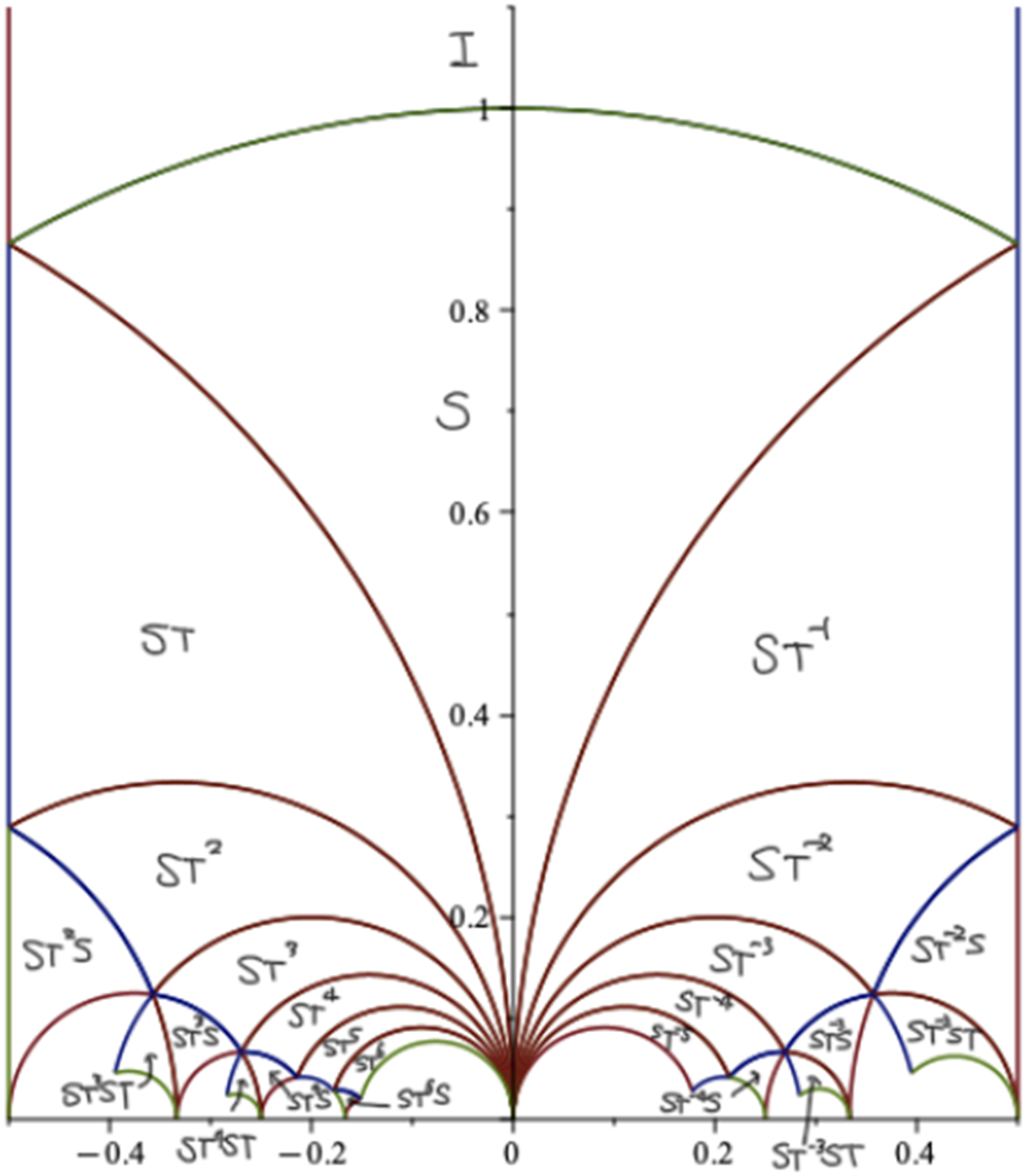
Figure 1 is the picture of the connected fundamental domain for
$\Gamma _0(12)$
 , where the labels are at the corresponding images of the standard fundamental domain

for
$\Gamma (1)$
 acting on the upper half plane
${\mathbb H}$
acting on the upper half plane
${\mathbb H}$
 .
.
Our connected fundamental domain for
$\Gamma _0(12)$
 .
.

Figure 1 Long description
A mathematical plot on a Cartesian coordinate system where the vertical axis represents imaginary values and the horizontal axis represents real values. The vertical axis is labeled with I at the top and has tick marks from 0 to 1. The horizontal axis ranges from negative 0.5 to 0.5.
At the top center, a large region is bounded by a green arc and labeled with the letter S. Below this, the space is divided into symmetric curved regions by red, blue, and green arcs that converge toward the horizontal axis.
On the left side, regions are labeled from top to bottom as S T, S T super 2, S T super 3 S, and S T super 4 S. Smaller regions near the bottom are labeled with S T super 3 S T and S T super 4 S T.
On the right side, the regions are labeled symmetrically as S T super minus 1, S T super minus 2, S T super minus 3, and S T super minus 4. Further down, labels include S T super minus 2 S, S T super minus 3 S, and S T super minus 3 S T.
All arcs meet at the origin 0 on the horizontal axis, creating a dense, fan-like structure of increasingly smaller geometric tiles.
The author finds the function W in (1.1) interesting and first establishes some identities for it.
Proposition 1.6 We have


$\Gamma _0(N)$
 acts on
${\mathbb P}^1({\mathbb Q})={\mathbb Q}\cup \infty $
acts on
${\mathbb P}^1({\mathbb Q})={\mathbb Q}\cup \infty $
 by Möbius transformations, and the quotient set is the set
$C_0(N)$
by Möbius transformations, and the quotient set is the set
$C_0(N)$
 of cusp classes of
$\Gamma _0(N)$
of cusp classes of
$\Gamma _0(N)$
 . The cusp class of
$s\in {\mathbb P}^1({\mathbb Q})$
. The cusp class of
$s\in {\mathbb P}^1({\mathbb Q})$
 is denoted by

An element
$s=a/c\in {\mathbb P}^1({\mathbb Q})$
 with
$a, c\in {\mathbb Z}$
with
$a, c\in {\mathbb Z}$
 and
$\gcd (a, c)=1$
and
$\gcd (a, c)=1$
 is called reduced. By convention,
$\infty =\pm 1/0$
is called reduced. By convention,
$\infty =\pm 1/0$
 . In this article, we will only work with reduced elements.
We use
$d|N$
 to denote that d is a positive integer divisor of N. Then

Proposition 1.11 Let
$N>1$
 . The number of cusp classes for
$\Gamma _0(N)$
. The number of cusp classes for
$\Gamma _0(N)$
 is
is

where
$\phi $
 is the Euler totient function. Furthermore, with

we have a bijection

where
$\pi _{d"}:{\mathbb Z}\to {\mathbb Z}/d"$
 is the natural homomorphism. The width is

This proposition can be verified using standard resources, such as [Reference Diamond and ShurmanDS05, Section 3.8], [Reference ShimuraShi71, Section 1.6], [Reference CremonaCre97, Section 2.2], and [Reference SteinSte07, Section 1.4]. We will not provide a detailed proof.
The representatives
$ST^i$
 in (1.4) produce the cusp

This in reduced form is
$0/1$
 and corresponds to
$d=1$
and corresponds to
$d=1$
 in (1.12). The width is
${\tilde d = d'/d" = N}$
in (1.12). The width is
${\tilde d = d'/d" = N}$
 , and this corresponds to the fact that i runs through the representatives for
${\mathbb Z}/N$
, and this corresponds to the fact that i runs through the representatives for
${\mathbb Z}/N$
 in (1.4). This is the trivial part of our identification goal for cusps.
On the other hand, the representatives
$ST^jST^m$
 in (1.4) produce the cusps

Here,
$\gcd (j, N)>1$
 , and
$0\leq m\leq M_j$
, and
$0\leq m\leq M_j$
 . So the cusp
$-1/j$
. So the cusp
$-1/j$
 has a natural width
$W_j$
has a natural width
$W_j$
 , in view of (1.2).
If we let j run through the residue class representatives
$A=\{0,-1,\dots ,-(N-1)\}$
 of
${\mathbb Z}/N$
of
${\mathbb Z}/N$
 , then

are natural cusps of
$\Gamma _0(N)$
 , produced by the work [Reference Nie and ParentNP24].
Now we achieve the goal of identifying these with the cusp classes in Proposition 1.11 and obtain the identity for widths.
By (1.12), we have

Going the other way, with
$d>1$
 ,
$d|N$
,
$d|N$
 , and
$b\in ({\mathbb Z}/d")^*$
, and
$b\in ({\mathbb Z}/d")^*$
 , for
$\chi ([1/j])= (d; b)$
, for
$\chi ([1/j])= (d; b)$
 , we need

where
$\pi ^{*d'}_{d"}: ({\mathbb Z}/d')^*\to ({\mathbb Z}/d")^*$
 is the natural homomorphism. Therefore, we have

where the notation k is abused to also denote its integer lift for
$\pi _{d'}: {\mathbb Z}\to {\mathbb Z}/d'$
 between 1 and
$d'$
between 1 and
$d'$
 .
.
We have the following result to relate the widths.
Theorem 1.16 Let
$N>1$
 ,
$d>1,$
,
$d>1,$
 and
$d|N$
and
$d|N$
 . Then the width of the cusp class for
$\Gamma _0(N)$
. Then the width of the cusp class for
$\Gamma _0(N)$
 represented by
$(d; b\in ({\mathbb Z}/d")^*)$
represented by
$(d; b\in ({\mathbb Z}/d")^*)$
 is the sum of the widths of all the
$1/j$
is the sum of the widths of all the
$1/j$
 such that
$\chi ([1/j])=(d;b)$
such that
$\chi ([1/j])=(d;b)$
 , that is,

Now to describe the boundary arcs of our fundamental domains, we consider the ideal geodesic triangle
$\overline D$
 , the closure of D in (1.5) in the upper half plane
${\mathbb H}$
, the closure of D in (1.5) in the upper half plane
${\mathbb H}$
 . We introduce the notation for its edges:

called the left, the right (from the viewpoint of the cusp
$\infty $
 ), and the base. Note that

Also,
$L, R,$
 and their images under elements of
$\Gamma (1)$
and their images under elements of
$\Gamma (1)$
 are all connected to cusps, while B and its images are not.
In this part, we use the symmetric choice (1.3) of residue classes, in agreement with [Reference Nie and ParentNP24].
Proposition 1.19 Let
$N>1$
 . The boundary of the connected fundamental domain given by (1.4) has the following arcs:
-
(1) $ST^{N_2}L,\ ST^{-N_1}R$
 ,
, -
(2) for $\gcd (i, N)=1$
,
$ST^i B$
, -
(3) for $\gcd (j, N)>1$
,-
(a) $ST^jSR$
, -
(b) $ST^jST^{M_j}L$
, -
(c) $ST^jST^{m}B$
, with
$1\leq m\leq M_j$
.
-


We use the natural terminology that two boundary arcs
$C_1$
 and
$C_2$
and
$C_2$
 are equivalent, written as

Theorem 1.21 We have the following gluing patterns for the boundary arcs of the connected fundamental domain for
$\Gamma _0(N)$
 :
:
-
(1) $ST^{N_2}L \sim ST^{-N_1}R$
. -
(2) For $\gcd (i, N)=1$
,
$ST^i B \sim ST^{\widetilde {-i^{-1}}} B$
. -
(3) For $\gcd (j, N)>1$
,-
(a) $ST^jST^{M_j}L\sim ST^{\widetilde {(1-jW_j)^{-1} j}} SR$
, and -
(b) for $1\leq m\leq M_j$
,
$ST^jST^{m}B\sim ST^{j'}ST^{m'}B,$
where
$(j',m')$
with
$\gcd (j',N)>1$
,
$1\le m'\le M_{j'}$
, is the unique such pair satisfying
-


Remark 1.23 The gluing patterns in Theorem 1.21 pair distinct boundary arcs, except possibly in case (2). In cases (1) and (3a), the two arcs are different arcs in the list of Proposition 1.19. For case (3b), suppose that the paired arc is the same one. Then
$(j,m)=(j',m')$
 , and (1.22) gives
$ j^2+(jm-1)^2\equiv 0 \mod N. $
, and (1.22) gives
$ j^2+(jm-1)^2\equiv 0 \mod N. $
 Reducing this congruence modulo
$\gcd (j,N)>1$
Reducing this congruence modulo
$\gcd (j,N)>1$
 , we get
$ 1\equiv 0 \mod \gcd (j, N), $
, we get
$ 1\equiv 0 \mod \gcd (j, N), $
 a contradiction. Thus, no self-pairing occurs in case (3b).
In case (2), a self-pairing occurs precisely when
$ \widetilde {-i^{-1}}=i, $
 or equivalently
$ i^2\equiv -1 \mod N. $
or equivalently
$ i^2\equiv -1 \mod N. $
 Then
$ST^iB$
Then
$ST^iB$
 is glued to itself with reversed orientation. The midpoint of
$ST^iB$
is glued to itself with reversed orientation. The midpoint of
$ST^iB$
 is fixed by the corresponding conjugate of S, and therefore descends to an elliptic point of order
$2$
is fixed by the corresponding conjugate of S, and therefore descends to an elliptic point of order
$2$
 , in accordance with the usual criterion for elliptic points of
$\Gamma _0(N)$
, in accordance with the usual criterion for elliptic points of
$\Gamma _0(N)$
 .
.
We also remark that the side-pairings in Theorem 1.21 all necessarily reverse the orientation of the boundary arcs, induced from the natural boundary orientation of
$L, R, B$
 from
$\overline D$
from
$\overline D$
 .
.
The boundary arcs of the fundamental domain for
$\Gamma _0(12)$
 in Figure 1, besides the two vertical rays
$\text {Re}z=\pm 1/2$
in Figure 1, besides the two vertical rays
$\text {Re}z=\pm 1/2$
 which are naturally identified by
$T\in \Gamma _0(12)$
which are naturally identified by
$T\in \Gamma _0(12)$
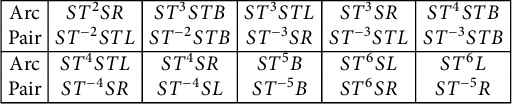
 , are listed below with equivalent pairs stacked, as an example of our Proposition 1.19 and Theorem 1.21.

Table 1 Long description
The table is organized into four rows and six columns.
Row 1 (Header Row):
- Column 1: Arc
- Column 2: S T super 3 S T L
- Column 3: S T super 3 S T B
- Column 4: S T super 3 S T L
- Column 5: S T super 4 S T L
- Column 6: S T super 4 S T B
Row 2:
- Column 1: Pair
- Column 2: S T super minus 2 S T L
- Column 3: S T super minus 2 S T B
- Column 4: S T super minus 3 S T B
- Column 5: S T super minus 3 S T L
- Column 6: S T super minus 3 S T B
Row 3:
- Column 1: Arc
- Column 2: S T super 4 S T L
- Column 3: S T super 4 S T B
- Column 4: S T super 5 B
- Column 5: S T super 6 S T L
- Column 6: S T super 6 B
Row 4:
- Column 1: Pair
- Column 2: S T super minus 4 S T B
- Column 3: S T super minus 4 S T L
- Column 4: S T super minus 5 B
- Column 5: S T super 5 S T L
- Column 6: S T super minus 5 S B
The gluing pattern in this case turns out to be particularly simple, and this means that the corresponding modular curve
$X_0(12)$
 has genus 0 by standard topological considerations. This is consistent with the general genus formula [Reference Diamond and ShurmanDS05, Theorem 3.1.1].
The article is organized as follows. In Section 2, we further study the function W and prove Proposition 1.6. In Section 3, we prove Theorem 1.16 about the cusps. These two proofs are combinatorial and very concrete. In Section 4, we prove Theorem 1.21 about the gluing patterns of the boundary arcs.
2 The function W
First, we give a more concrete formula for the function W (1.1). Let
$N=p_1^{r_1}\dots p_t^{r_t}$
 be its prime decomposition. Since
$p_i\,|\,N$
be its prime decomposition. Since
$p_i\,|\,N$
 , let
$\pi ^N_{p_i}: {\mathbb Z}/N\to {\mathbb Z}/p_i$
, let
$\pi ^N_{p_i}: {\mathbb Z}/N\to {\mathbb Z}/p_i$
 be the natural projection.
Proposition 2.1 Let
$j\in {\mathbb Z}/N$
 , and
$j_i= \pi ^N_{p_i}(j)$
, and
$j_i= \pi ^N_{p_i}(j)$
 for
$1\leq i\leq t$
for
$1\leq i\leq t$
 as above. For an index i, if
$j_i=0$
as above. For an index i, if
$j_i=0$
 , then disregard this index. For the others, let
$\ell _i$
, then disregard this index. For the others, let
$\ell _i$
 be the integer between 1 and
$p_i-1$
be the integer between 1 and
$p_i-1$
 representing
$j_i^{-1}\in ({\mathbb Z}/p_i)^*$
representing
$j_i^{-1}\in ({\mathbb Z}/p_i)^*$
 . Then

Proof An element
$x\in {\mathbb Z}/N$
 is a unit if
$p_i\nmid x$
is a unit if
$p_i\nmid x$
 for
$1\leq i\leq t$
for
$1\leq i\leq t$
 .
.
Now if
$p_i| j$
 , then any
$m\in {{\mathbb N}}$
, then any
$m\in {{\mathbb N}}$
 would make
$p_i\nmid mj-1$
would make
$p_i\nmid mj-1$
 .
.
If
$\pi ^N_{p_i}(j) \neq 0$
 , then we have its inverse
$\ell _i$
, then we have its inverse
$\ell _i$
 as above. Then

So m should avoid
$\ell _i + p_i{\mathbb Z}_{\geq 0}$
 for
$mj-1$
for
$mj-1$
 to be not divisible by
$p_i$
to be not divisible by
$p_i$
 . Putting these together, we get our result.
Remark 2.2 Therefore, we can design examples where
$W_j$
 for some j is as big as we wish. For example, in
${\mathbb Z}/6$
for some j is as big as we wish. For example, in
${\mathbb Z}/6$
 ,
$W_5 = 4$
,
$W_5 = 4$
 as we need to avoid

Now we go to the proof of the identities in Proposition 1.6. Our proof depends on our previous work [Reference Nie and ParentNP24], and we first introduce the projective line

where
$(a,b)\sim (a',b')$
 if there is
$u\in ({\mathbb Z}/N{\mathbb Z})^*$
if there is
$u\in ({\mathbb Z}/N{\mathbb Z})^*$
 , such that
$a=ua', b=ub'$
, such that
$a=ua', b=ub'$
 . We write the class of
$(a, b)$
. We write the class of
$(a, b)$
 by
$(a:b)$
by
$(a:b)$
 .
.
Proof of Proposition 1.6
In [Reference Nie and ParentNP24], we proved that each class
$(a:b)\in {\mathbb P}^1({\mathbb Z}/N)$
 (2.3) has a preferred element. That is, we have a bijection of sets

Since the cardinality of
${\mathbb P}^1({\mathbb Z}/N)$
 is well known to be
$\psi (N)$
is well known to be
$\psi (N)$
 , we see that (1.7) holds by (1.2) and (2.4).
Note that the affine part

has cardinality N, and its image under the map in (2.4) is

This establishes (1.8), since the cardinality of
${{\mathbb A}}^1$
 is clearly N.
Then (1.9) is the difference of these two.
Now we present another direct proof of (1.8), whose idea we will continue to use in a harder situation.
For definiteness, we choose the residue class representatives of
${\mathbb Z}/N$
 to be
to be

We list the integer representatives of the set
$({\mathbb Z}/N)^*$
 of units in order as

where
$n=\phi (N)$
 .
.
For
$1\leq i\leq n$
 , we define

We claim that

The reason is that by our setup,

Multiplying by
$u^{-1}_i$
 , we get

This, by definition (1.1), means that

Therefore,

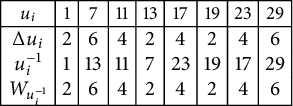
Example 2.7 For example, when
$N=30$
 , we have

Table 2 Long description
The table consists of a header row and three data rows across nine columns.
Header Row: The first cell is the variable u sub i. The following eight columns are labeled 1, 7, 11, 13, 17, 19, 23, and 29.
Row 1: The first cell is Delta u sub i. The corresponding values are 2, 6, 4, 2, 4, 2, 4, and 6.
Row 2: The first cell is u sub open parenthesis minus 1 close parenthesis sub i. The corresponding values are 1, 13, 11, 7, 23, 19, 17, and 29.
Row 3: The first cell is Delta open parenthesis u sub open parenthesis minus 1 close parenthesis sub i close parenthesis. The corresponding values are 2, 6, 4, 2, 4, 2, 4, and 6.
Here, the last row is computed by definition (1.1). For example,
$W_{13}=6$
 since
$6\cdot 13 -1=77\in ({\mathbb Z}/30)^*$
since
$6\cdot 13 -1=77\in ({\mathbb Z}/30)^*$
 is the first such instance. We proved in (2.6) that the second and the last rows are the same.
3 Cusps from the fundamental domains
Now we go on to prove the identity relating the widths of the cusps of our fundamental domains with the widths of the cusp classes.
Proof of Theorem 1.16
First, we show

where
$K_b$
 is from (1.15) with b an integer between 1 and
$d"-1$
is from (1.15) with b an integer between 1 and
$d"-1$
 representing the class in
$({\mathbb Z}/d")^*$
representing the class in
$({\mathbb Z}/d")^*$
 . We first show that all the elements are distinct in the set on the RHS. For
$ad\equiv a'd\mod d'$
. We first show that all the elements are distinct in the set on the RHS. For
$ad\equiv a'd\mod d'$
 , we need
$d'\,|\,(a-a')d$
, we need
$d'\,|\,(a-a')d$
 , so
, so

by
$d"=\gcd (d, d')$
 . Therefore, for our range of a, the elements are distinct. Also the number of such
$a_i$
. Therefore, for our range of a, the elements are distinct. Also the number of such
$a_i$
 is
$\frac {\phi (d')}{\phi (d")}$
is
$\frac {\phi (d')}{\phi (d")}$
 by considering the homomorphism
$\pi ^{*d'}_{d"}: ({\mathbb Z}/d')^*\to ({\mathbb Z}/d")^*$
by considering the homomorphism
$\pi ^{*d'}_{d"}: ({\mathbb Z}/d')^*\to ({\mathbb Z}/d")^*$
 .
.
Clearly, the RHS of (3.1) is contained in
$K_b$
 . Now since
$d"=\gcd (d, d')$
. Now since
$d"=\gcd (d, d')$
 , we also see that all elements in
$K_b$
, we also see that all elements in
$K_b$
 have the form

for some integers m,
$u,$
 and v, hence belonging to the RHS.
Then upon taking inverse, we have

The following part is a more elaborate version of our direct proof of (1.8). We let
$n=\frac {\phi (d')}{\phi (d")}$
 , and order the
$a_i$
, and order the
$a_i$
 in
$K_{b}$
in
$K_{b}$
 (3.1) as

For
$1\leq i\leq n$
 , we define

We claim that

where
$\pi _{d'}(b+a_i d)\in ({\mathbb Z}/d')^*$
 , and
$(b+a_i d)^{-1}$
, and
$(b+a_i d)^{-1}$
 is the integer between
$1$
is the integer between
$1$
 and
$d'-1$
and
$d'-1$
 representing its inverse in
${\mathbb Z}/d'$
representing its inverse in
${\mathbb Z}/d'$
 .
.
Note that for all
$m\in {{\mathbb N}}$
 ,
$m(b+a_i d)^{-1}d - 1\in ({\mathbb Z}/d)^*$
,
$m(b+a_i d)^{-1}d - 1\in ({\mathbb Z}/d)^*$
 , so we only need
$m(b+a_id)^{-1} d-1\in ({\mathbb Z}/d')^*$
, so we only need
$m(b+a_id)^{-1} d-1\in ({\mathbb Z}/d')^*$
 for it to be in
$({\mathbb Z}/N)^*$
for it to be in
$({\mathbb Z}/N)^*$
 . Therefore, by (1.1),

(Here, we are using a superscript to identify the modulus for which W (1.1) is defined. The default one is
$W=W^N$
 .)
.)
By our setup,

Multiplying by
$(b+a_i d)^{-1}$
 , we get

This, again by definition (1.1), means that

Therefore, from (3.2)–(3.4), we see that

This is (1.17), since
$b^{-1}$
 is arbitrary in
$({\mathbb Z}/d")^*$
is arbitrary in
$({\mathbb Z}/d")^*$
 .
.
Example 3.5 Let
$d=21, d'=90$
 . Then
$N=d\cdot d' = 1,890$
. Then
$N=d\cdot d' = 1,890$
 ,
$d"=\gcd (d, d') = 3$
,
$d"=\gcd (d, d') = 3$
 , and
$\tilde d = d'/d" = 30$
, and
$\tilde d = d'/d" = 30$
 . Let us consider
$b=1\in ({\mathbb Z}/d")^*$
. Let us consider
$b=1\in ({\mathbb Z}/d")^*$
 . So the cusp class in
$C_0(N)$
. So the cusp class in
$C_0(N)$
 with invariant under
$\chi $
with invariant under
$\chi $
 (1.12) as

has width
$\tilde d = 30$
 .
.
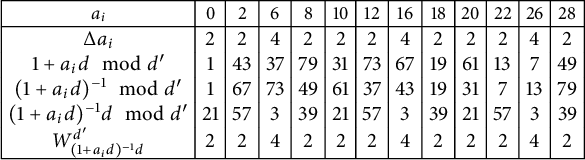
The natural cusps (1.15) from the fundamental domain are

with
$\phi (90)/\phi (3)=12$
 elements, where
$\pi ^{*d'}_{d"} : ({\mathbb Z}/90)^*\to ({\mathbb Z}/3)^*$
elements, where
$\pi ^{*d'}_{d"} : ({\mathbb Z}/90)^*\to ({\mathbb Z}/3)^*$
 is the natural projection. These elements are in our third row below, and we are counting them as
$(1+a_id)\mod d'$
is the natural projection. These elements are in our third row below, and we are counting them as
$(1+a_id)\mod d'$
 , with the
$a_i$
, with the
$a_i$
 increasing.

Table 3 Long description
The table consists of a header row and five data rows.
Header Row: The first cell is the variable a sub i. The subsequent columns are indexed as 0, 2, 6, 8, 10, 12, 16, 18, 20, 22, 26, and 28.
Row 1: Formula Delta a sub i. Values are 2, 2, 4, 2, 2, 2, 4, 2, 2, 2, 4, 2.
Row 2: Formula 1 plus a sub i d mod d prime. Values are 1, 43, 37, 79, 31, 73, 67, 19, 61, 13, 7, 49.
Row 3: Formula open parenthesis 1 plus a sub i d close parenthesis to the negative 1 power mod d prime. Values are 1, 67, 73, 49, 61, 37, 43, 19, 31, 7, 13, 79.
Row 4: Formula open parenthesis 1 plus a sub i d close parenthesis to the negative 1 power times d mod d prime. Values are 21, 57, 3, 39, 21, 57, 3, 39, 21, 57, 3, 39.
Row 5: Formula W sub open parenthesis 1 plus a sub i d close parenthesis to the negative 1 power times d to the d prime power. Values are 2, 2, 4, 2, 2, 2, 4, 2, 2, 2, 4, 2.
So in this example, the last row of
$W_{(1+a_id)^{-1}d}^{d'}$
 can be computed from the second last row by definition (1.1). Our result is that

as in the second row, so they add to
$\tilde d=30$
 .
.
4 Boundary identifications of the fundamental domains
Identifying the boundary arcs in our connected fundamental domain is relatively straightforward.
Proof of Proposition 1.19
This follows from our construction using the set
$\Theta $
 (1.4) of coset representatives. First, we have the
$ST^i D$
(1.4) of coset representatives. First, we have the
$ST^i D$
 connected to one other. At the ends for
$N_2$
connected to one other. At the ends for
$N_2$
 and
$-N_1$
and
$-N_1$
 , we have case (1).
For each
$ST^i D$
 with
$(i, N)=1$
with
$(i, N)=1$
 , we have case (2) of
$ST^i B$
, we have case (2) of
$ST^i B$
 .
.
For each
$(j, N)>1$
 , we further attach
$ST^j ST^m$
, we further attach
$ST^j ST^m$
 ,
$0\leq m\leq M_j$
,
$0\leq m\leq M_j$
 . Again, at the two ends of
$m=0$
. Again, at the two ends of
$m=0$
 and
$m=M_j$
and
$m=M_j$
 , we have cases (3.a) and (3.b). For
$1\leq m\leq M_j$
, we have cases (3.a) and (3.b). For
$1\leq m\leq M_j$
 , we have the images of the base as in case (3.c). Note that for
$m=0$
, we have the images of the base as in case (3.c). Note that for
$m=0$
 ,
$ST^jSB = ST^jB$
,
$ST^jSB = ST^jB$
 is identified in our connected fundamental domain already, and not a boundary arc.
See Figure 1 for an example.
Remark 4.1 This proposition contains all the cases of
$N>1$
 , including
$N=2, 3, 4$
, including
$N=2, 3, 4$
 . Also, when
$j=0$
. Also, when
$j=0$
 ,
$M_j=0$
,
$M_j=0$
 , so we are in cases (3.a) and (3.b), and the two boundary arcs are R and L.
Now, we introduce the following way of identifying the class of an element of
$\Gamma (1)$
 in the set
$\Gamma _0(N)\backslash \Gamma (1)$
in the set
$\Gamma _0(N)\backslash \Gamma (1)$
 of right cosets. From [Reference CremonaCre97, Section 2.2], we know that there is a bijection between
$\Gamma _0(N)\backslash \Gamma (1)$
of right cosets. From [Reference CremonaCre97, Section 2.2], we know that there is a bijection between
$\Gamma _0(N)\backslash \Gamma (1)$
 and
${\mathbb P}^1({\mathbb Z}/N)$
and
${\mathbb P}^1({\mathbb Z}/N)$
 , induced by the following map:

where we choose the notation
${{\mathcal R}}$
 for row.
Therefore, for
$\gamma _1, \gamma _2\in \Gamma (1)$
 ,
,

Then direct calculation gives, for
$x, y\in {\mathbb Z}$
 ,
,

Note that the right-hand sides are guaranteed to be in
${\mathbb P}^1({\mathbb Z}/N)$
 .
.
Proposition 4.5 Let
$\gamma _1, \gamma _2\in \Gamma (1)$
 . Using notation (1.20), we have


For (4.7), the nontrivial side-pairing is the one given by the second alternative, namely,
$[\gamma _1S]=[\gamma _2]$
 .
.
Proof By
$L=TR$
 (1.18), we see that
$\gamma _1 L\sim \gamma _2 R$
(1.18), we see that
$\gamma _1 L\sim \gamma _2 R$
 iff
$\exists g\in \Gamma _0(N)$
iff
$\exists g\in \Gamma _0(N)$
 such that

Since only
$\pm Id\in \Gamma (1)$
 map R to R, this is equivalent to

This proves (4.6).
Note that only
$\pm Id$
 and
$\pm S$
and
$\pm S$
 preserve B, so from
$\gamma _2^{-1} g^{-1} \gamma _1 B = B$
preserve B, so from
$\gamma _2^{-1} g^{-1} \gamma _1 B = B$
 , we see that

Therefore,

This proves (4.7).
Side-pairing of the fundamental domain reverses the orientation of the paired sides, so it only happens for the second alternative for (4.7).
With these preparations done, we proceed to the proof of our gluing patterns.
Proof of Theorem 1.21
We apply Proposition 4.5 and equations (4.3) and (4.4) throughout this proof.
For (1), we need to check

and this follows from

from (1.3).
For (2), we need to check

and this follows from

For (3.a), we need to check

and this follows from

Now note the elementary fact that

Only the
$\Longleftarrow $
 direction needs an explanation, and it can be proved by the existence of
$u, v$
direction needs an explanation, and it can be proved by the existence of
$u, v$
 such that
$au + bv = 1\in {\mathbb Z}/N$
such that
$au + bv = 1\in {\mathbb Z}/N$
 by (2.3). We then multiply it by c and d separately, obtaining

with
$cu+dv\in ({\mathbb Z}/N)^*$
 necessarily.
Then, for (3.b), we need to check

and this follows from

which by (4.8) is

the assumption (1.22).
Remark 4.9 In the case (3.b) of Theorem 1.21, we have

by
$1\leq m\leq M_j$
 and equations (1.1) and (1.2). The corresponding
$j'$
and equations (1.1) and (1.2). The corresponding
$j'$
 and
$m'$
and
$m'$
 can be found by applying to
$(jm-1: -j)$
can be found by applying to
$(jm-1: -j)$
 our algorithm in [Reference Nie and ParentNP24], which produces such representatives for all points in the hyperplane
$H := {\mathbb P}^1({\mathbb Z}/N)\backslash {{\mathbb A}}^1$
our algorithm in [Reference Nie and ParentNP24], which produces such representatives for all points in the hyperplane
$H := {\mathbb P}^1({\mathbb Z}/N)\backslash {{\mathbb A}}^1$
 (see (2.5)). Clearly,
$(jm-1: -j)\in H$
(see (2.5)). Clearly,
$(jm-1: -j)\in H$
 by (4.10). Specifically,

Remark 4.11 In the case (3.a) of Theorem 1.21, we can see, by (1.13), that the cusps of
$ST^jST^{M_j}$
 and
$ST^{\widetilde {(1-jW_j)^{-1} j}} S$
and
$ST^{\widetilde {(1-jW_j)^{-1} j}} S$
 are
are

By (1.14), their cusp classes are the same, since

where
$d=\gcd (j, N), d"=\gcd (d, N/d)$
 so
$d"|j$
so
$d"|j$
 .
.
Therefore, the gluing pattern (3.a) brings together by
$\Gamma _0(N)$
 the cusps of the same class, as expected. This is compatible with the cusp width identity in Theorem 1.16.
Acknowledgements
The author thanks an anonymous referee for thorough reading and helpful comments which improved the article.


 Open access

