


1. Introduction
The transition towards a circular economy has brought increasing attention to transparency, traceability, and sustainable product lifecycle management (European Commission, 2019). A central policy instrument in this context is the Digital Product Passport (DPP), which has been mandated by the European Union’s Ecodesign for Sustainable Products Regulation (ESPR) for a wide range of product categories in the coming years (European Commission, 2022). DPPs are intended to provide relevant information on recycling, repair, compliance, and sustainability, while also enabling digital services such as smart maintenance and digital twins (CIRPASS, 2023; Catena-X, 2022; VDMA, 2021).
This paper applies the concept of the DPP to complex industrial products with a particular focus on the automotive sector, where highly integrated product structures, safety-critical components, and regulatory pressure create unique challenges for DPP implementation. The automotive domain therefore serves as a representative case for assessing how the DPP approach can be transferred and operationalized in industries characterized by system complexity and strong interdependencies across components. However, a key challenge remains unresolved: at which structural level of a product should data be integrated into a DPP? While international standards such as ISO 9000:2025 and VDI 2221:2018 provide formal definitions of product, module, assembly, and part, practical application reveals frequent overlaps and ambiguities (DIN, 2025; VDI, 2018). For instance, an electric motor may be marketed as a standalone product, yet functions as a module within a vehicle. Similarly, a welded housing may represent an inseparable assembly or even be treated as a single part. These uncertainties raise the question of how the appropriate granularity of DPP integration can be defined in practice.
Previous research and industry initiatives have devoted significant attention to data structures, interoperability, and regulative compliance (CIRPASS, 2023; Catena-X, 2022). Yet little focus has been placed on the granularity issue, i.e. the mapping of product architectures into DPP documentation. Academic work in product development and systems engineering (e.g., Reference Albers, Scherer and BursacAlbers et al., 2015; Reference Göhlich, Bender, Fay and GerickeGöhlich, et al., 2021) underlines the complexity of distinguishing between system layers such as modules, assemblies, and parts, but their integration into DPP logic remains underexplored.
This paper addresses this gap by developing a decision-oriented framework that systematically specifies the level at which individual parts, assemblies, modules, or products should be integrated into the DPP. The framework is based on a qualitative, conceptual research design combining literature and standards analysis with illustrative case studies. By introducing a criteria catalogue and a structured decision model, the contribution of this study is both conceptual and practical, supporting industry implementation as well as ongoing European standardization debates.
To achieve this goal, the paper is guided by the following research question: Which criteria and structural distinctions are relevant in determining the level of integration for DPPs in complex industrial products? Sub-questions: (i) How can product architecture levels -individual part, assembly, module, and product- be consistently defined and operationalized to support DPP implementation? (ii) Which criteria influence the assignment of documentation depth across these levels (e.g., regulatory, safety, market, circularity, or repairability relevance)? (iii) How can these criteria be balanced to ensure traceability and compliance without disproportionate information and cost burdens?
2. Fundamentals and state of research
To establish a clear conceptual foundation for the subsequent analysis, this section introduces the fundamental terminology, structural distinctions, and normative principles that are relevant for the understanding and application of DPPs in the context of complex industrial products.
2.1. Definitions of terms and normative principles
In order to develop a consistent framework for DPPs, it is essential to establish clear definitions of the fundamental structural concepts used in product architecture. Terms such as product, module, assembly, and individual part constitute the conceptual foundation upon which systematic criteria for DPP integration can be derived. A precise and consistent terminology ensures that complex industrial structures can be represented in a transparent and traceable way, thereby enabling a structured assignment of information responsibilities across different levels. The term product, according to DIN EN ISO 9000:2025, is defined as the result of a process and may be either material or immaterial (DIN, 2025). Similarly, VDI 2221:2018 characterizes products as technical systems created to fulfil functions (VDI, 2018). Extending this perspective, VDI/VDID 2424:2023 defines a product in the context of industrial design more broadly as “any offered item and/or offered service, of material or immaterial nature, intended to satisfy user needs” (VDI & VDID, 2023). In industrial practice, however, the interpretation tends to be narrower: A product is commonly understood as an independent, functional, and marketable unit that is sold, distributed, or used as such. Examples include vehicles, machines, and consumer goods, but depending on the market context, even modules or parts such as engines and batteries can be treated as products, particularly in the spare parts business. In technology and according to VDI 2221:2018, a module refers to a functional, self-contained unit, often consisting of several assemblies and individual parts, which is designed as a largely independent, interchangeable block in the context of product design (Reference Albers, Scherer and BursacAlbers et al., 2015; VDI, 2018). Modules are often traded as spare parts and reused across product variants in platform or modular systems (Reference Albers, Scherer and BursacAlbers et al., 2015). An assembly can be defined as a structured combination of multiple individual parts and potentially sub-assemblies that together form a functional unit within the product or in a module (Reference Göhlich, Bender, Fay and GerickeGöhlich et al., 2021; VDI 2221:2018; VDI 2209:2009). According to VDI 2209:2009 assemblies are characterized by their complexity, expressed through the number and clarity of interfaces as well as the quantity of constituent elements. Assemblies can be further distinguished according to the type of joining technology used to combine individual parts. Separable assemblies are formed by detachable connections, such as screws or plugs, which allow disassembly or replacement during operation (DIN 8593:1980; VDI 2221:2018). Inseparable assemblies, by contrast, are created by permanent joining processes such as welding, glueing, or casting; as a rule, they cannot be separated without destruction (DIN 8593). In such cases, the originally distinct parts effectively merge into a new unit, which from a structural and documentation perspective is treated as one part or assembly. They are now connected to each other until the function is resolved or the scrapping process is completed.
An individual part can be defined as the smallest element of a product structure which can no longer be meaningfully (technically or economically) dismantled (DIN EN ISO 81346-1:2019; VDI 2221:2018). Individual parts may be manufactured internally or procured externally and include both standard parts and purchased parts. Examples range from a specially manufactured screw to an independent sensor. Within bill of materials and structural models, individual parts constitute the lowest entity, often referred to as component, element, fragment, or member. C-parts (e.g. screws, nuts, washers) are mass, small or standard parts with comparatively low value and risk, which are often only documented in summary (via batches, material classification, supplier coordination) for product identification and traceability (VDMA, 2017). Finally, the DPP itself is defined not in terms of physical architecture but as an electronic, counterfeit-proof, standardized data object that contains all relevant product information (Reference Chaudhuri, Wæhrens, Treiblmaier and JensenChaudhuri et al., 2024; Reference Neramballi, Milios, Sakao and MatschewskyNeramballi et al., 2024; Reference King, Timms and MountneyKing et al., 2023). Its objectives include improving sustainability (Reference Jensen, Kristensen, Adamsen, Christensen and WaehrenseJensen et al., 2023) (e.g., recycling, disassembly, reuse), enhancing transparency and traceability (e.g., Reference King, Timms and MountneyKing et al., 2023; Reference Serna-Guerrero, Ikonen, Kallela and HakanenSerna-Guerrero et al., 2022), supporting innovation in repair, service, and design, ensuring compliance with regulatory requirements, enabling digital services such as Digital Twins or Smart Maintenance, strengthening consumer rights, and preventing counterfeiting (CIRPASS, 2023; European Commission, 2022; VDMA, 2021). In regulatory terms, particular attention is currently placed on the ESPR, which mandates the introduction of DPPs for a wide range of product categories (European Commission, 2022). Importantly, the regulations also emphasize proportionality between costs and societal benefits. According to Regulation (EU) 2024/1781, the DPP does not have to be uniformly defined at the item level but should rather be specific to the item, batch, or product model, depending on factors such as the complexity of the value chain, the size and nature of the product, and its environmental or societal impacts (European Parliament and Council, 2024). This highlights the necessity of a case-by-case analysis for DPP granularity and underlines why a structured framework for determining the appropriate integration level is essential.
2.2. State of research and identified gap
In recent years, a growing number of initiatives and publications have addressed the concept of the DPP. Projects such as CIRPASS (2023), Catena-X (2022), and industry guidelines by the VDMA (2021, 2024) have made significant contributions to topics including technical implementation, data interoperability, and compliance with upcoming European regulation. These efforts primarily focus on the development of technical infrastructures, the specification of data formats, and the integration of DPPs into supply chain systems. Comparable research in other sectors, such as textiles, has examined DPP data structuring and stakeholder information needs to improve circularity and transparency (Reference Ospital, Masson, Beler and LegardeurOspital et al., 2022; Reference Ospital, Masson, Beler and LegardeurOspital et al., 2023). In particular, Reference Legardeur and OspitalLegardeur and Ospital (2024) propose a phased DPP deployment model for the European textile sector, ranging from a minimal and simplified DPP to an advanced and fully circular DPP by 2033. While this phased approach highlights the policy and maturity dimension of DPP introduction, the structural granularity of data within complex industrial products remains unaddressed. These approaches confirm the importance of consistent data models and stakeholder collaboration as prerequisites for effective DPP implementation. However, comparatively little research has addressed paid to the issue of granularity in DPP integration. Specifically, it remains unclear at which structural level of a product -be it individual part, assembly, module, or final product- data should be documented within or linked to the DPP. While standards such as ISO 9000:2025, VDI 2221:2018, and VDI/VDID 2424:2023 provide terminology and conceptual foundations for product architectures, they do not resolve how these structural levels should correspond to DPP documentation. The lack of a systematic framework addressing this aspect is increasingly recognized as an obstacle for both industry practice and standardization efforts. On the one hand, excessive data depth creates economic and administrative burdens, while on the other hand insufficient documentation compromises circularity, repairability, and compliance objectives. This study therefore seeks to close this gap by proposing a criteria-based decision framework.
2.3. Scope and problem discussion
The literature review demonstrates that the terms Product, Module, Assembly, Individual Part, C‑parts, and DPP -despite partly existing normative definitions- are applied inconsistently in practice and often remain open to interpretation. In particular, the following areas of tension and delimitation problems can be identified:
-
• Dual roles of objects: Certain parts can simultaneously act as Product and as Assembly. For example, an electric motor is considered a standalone Product in the spare parts market but represents an Assembly or Module within a vehicle context.
-
• Modules between independence and embeddedness: Modules may exist as independent Products while also functioning as integral subsystems. One example is a battery pack, which can be marketed as an individual Product yet also serve as a Module of an e‑bike.
-
• Fusion of Individual Parts: When Individual Parts are permanently joined by welding or bonding, a new, non‑separable unit emerges. It remains unclear whether such a unit should be regarded as a new Individual Part or as an Assembly.
-
• Nesting and Sub‑Assembly integration in the DPP: The question of how Individual Parts and (Sub-) Assemblies are incorporated into the DPP is still unresolved. Debates concern whether sub‑passes should merely be referenced, whether they must be fully integrated, and who is responsible for updating the DPP in the event of part replacement or modification.
These ambiguities are further reinforced by industry-specific practices, which vary considerably across sectors:
-
• In the automotive sector, components such as control units, batteries, or airbags are sometimes treated as independent Products, even though they function as Modules within the overall system.
-
• In electronics, printed circuit boards (PCBs) and electronic assemblies are typically classified as Modules.
-
• In mechanical and plant engineering, classification depends strongly on criteria such as value, function, and reparability. Thus, identical objects may be regarded either as collections of C-parts or as complete Sub-Assemblies.
This variation demonstrates that there is no consistent and generally applicable understanding of how different product structure levels should be defined in relation to the DPP. Against this background, the present study focuses on the automotive domain, which serves as the empirical context of the underlying research project. The automotive industry provides a highly relevant case, as it is characterized by particularly complex product architectures, safety-critical components, strong regulatory drivers (e.g., EU Battery Regulation, ESPR), and cross-industry platforms such as Catena-X. While the findings are conceptually transferable to other industries, the framework in this paper is primarily derived from the automotive sector.
2.4. Granularity and regulation
Current EU regulation mandates the introduction of DPPs for an increasing number of product groups, including batteries, textiles, and electronics as of 2025 and beyond under the ESPR. While standard applications will often be defined at the end-product level (e.g., washing machine, automobile), a bill-of-materials-based, cross-product referencing approach is recommended.
DPPs at component or module level are particularly relevant when items are sold separately, explicitly referenced in legislation, or critical for circularity and recycling. Practical initiatives such as CIRPASS, Catena-X, and the VDMA guidelines demonstrate that DPPs can be connected via sub-passes (“nesting” or “referencing”), yet a consistent methodology for doing so remains undeveloped.
Reference Petrik, Dzierzawa and WarthmannPetrik et al. (2025) propose a maturity model for DPPs focusing on organizational and process readiness (data scope, ingestion, integration). While this model assesses how companies progress in DPP implementation, the present study complements it by addressing structural granularity - the level at which information within the product architecture should be integrated. Thus, process maturity defines the ability to deliver data, whereas structural granularity determines the necessary depth of information.
2.5. DPP nesting, linking, data integration and security
While regulatory frameworks increasingly mandate the introduction of DPPs, the technical and organizational linkage between different product structure levels remains unresolved. In practice, the challenge concerns not only the integration of sub-passes but also data access, role-based rights, and platform interoperability. This section therefore outlines key aspects of nesting and layered data access as core mechanisms for DPP integration.
Nesting/Referencing: Components with their own DPPs are embedded as linked sub-passes within the DPP of the overall product. When a component is replaced, its DPP remains valid and can be updated to ensure lifecycle continuity.
Digital Layered Access: Access to DPP data follows user roles. End customers obtain environmental and recycling information; service personnel receive maintenance and repair documentation; manufacturers retain sensitive production data. Since the protection of intellectual property and trade secrets is critical, while open data are indispensable for circularity, role-based access models are recommended. Interoperable frameworks such as the Asset Administration Shell or Platform Industrie 4.0 already provide technical foundations. However, the threshold at which DPPs become necessary -and to what depth- remains largely undefined.
3. Methodology
To address the identified research gap, a structured but iterative methodological approach was adopted. Since the challenge of determining the suitable DPP granularity lies primarily in linking product architecture levels with information requirements, a qualitative and conceptual research design was chosen. The objective was to develop a decision-oriented framework that is both theoretically grounded and applicable in industrial practice. The framework was developed through several iteration rounds in interdisciplinary workshops, in which insights from literature and industrial experience were synthesised and refined. This process acted as an internal conceptual validation. A subsequent empirical validation through pilot studies is planned within the ongoing automotive research project.
The methodology consisted of five key steps:
-
1. Literature and standards review
Systematic analysis of definitions, standards, and white papers (ISO, VDI, DIN, VDMA, CIRPASS, Catena-X) to identify existing terminology and regulatory requirements.
-
2. Development of a reference product architecture
Based on norms and adapted to industrial practice, the architecture provides the structural backbone (Product, Module, Assembly, Individual Part, C-Parts) that serves as the anchor for DPP integration decisions.
-
3. Levels of DPP integration
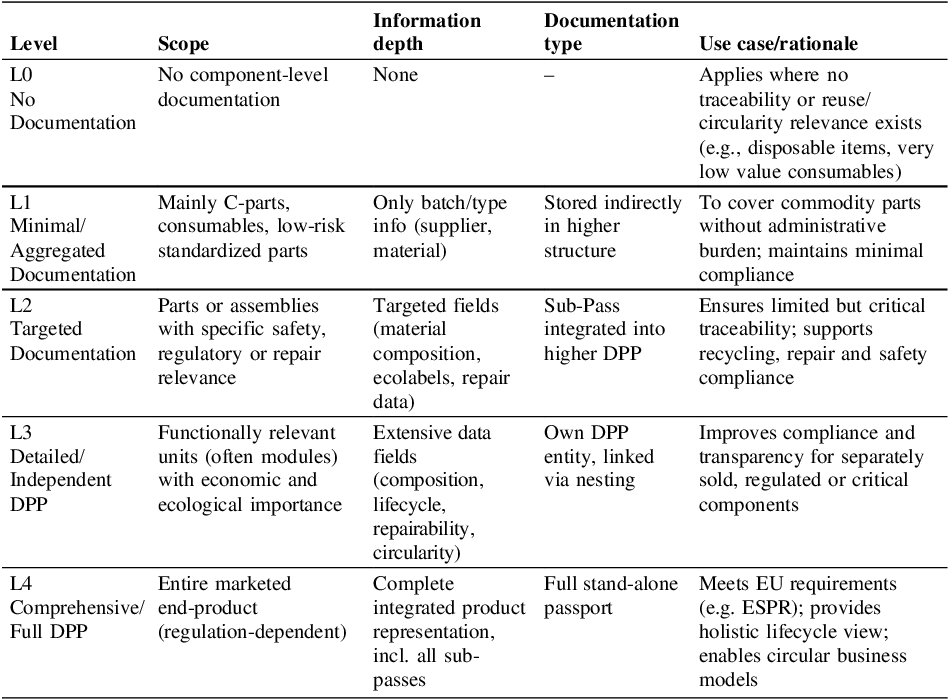
This framework originates from research conducted within the EU-funded project Digi4Circular, which investigates digital product data and circularity in the automotive sector. The conceptual structure of the framework was developed independently based on the identified research gap and on insights from standards, literature, and industrial requirements. Subsequently, the maturity model proposed by Reference Petrik, Dzierzawa and WarthmannPetrik et al. (2025) was identified as a suitable theoretical reference to further embed the framework. While their model focuses on process and organizational readiness for DPP adoption, this study applies the underlying maturity logic to structural information granularity, defining five levels of DPP integration (L0–L4). This alignment allows the framework to bridge process-related maturity thinking with product-architecture-based information depth.
-
4. Derivation of a criteria catalogue
Using insights from standards, practice, and sustainability literature, a set of seven criteria (market relevance, circularity, regulatory requirements, safety, feasibility, IP, access) was developed to guide the classification of structural elements.
-
5. Design of a decision framework
The criteria were operationalized into a decision logic combining knock-out and modifier criteria. Unlike conventional decision matrices, this approach avoids the dilution of critical factors (e.g. regulatory or safety obligations) and ensures minimum compliance.
4. Framework development and results
Building on the conceptual foundations defined in Section 2 and the methodological approach outlined in Section 3, this section presents the development of the proposed decision-oriented framework for DPP integration. The aim is to translate theoretical and regulatory insights into a practical tool for determining the appropriate depth of documentation. It introduces the reference Product Architecture as a structural baseline, defines the maturity-inspired DPP levels, and operationalizes the criteria in a decision framework illustrated by automotive examples.
4.1. Reference product architecture
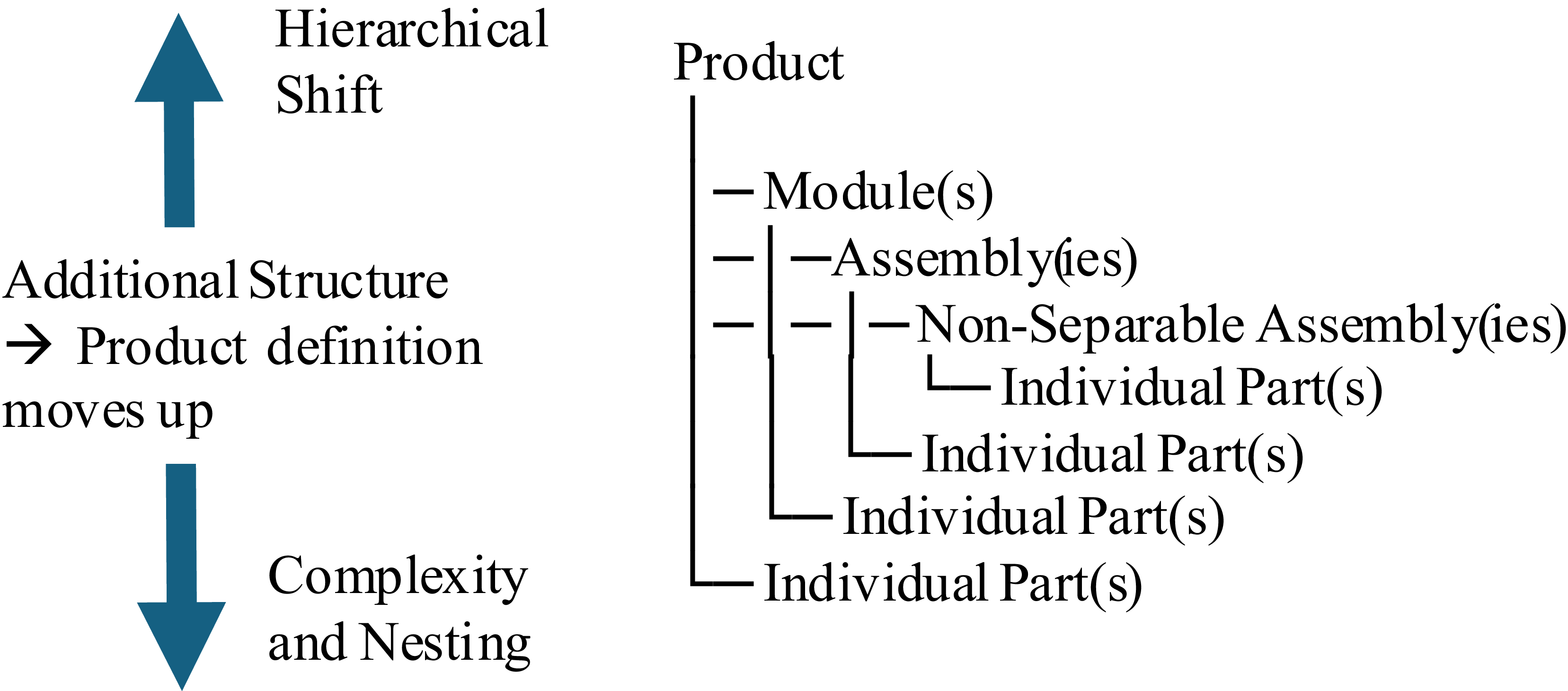
To ensure consistency and traceability in decision-making regarding the appropriate DPP level (based on the terminology introduced in Section 2.1), the following ‘Product Architecture’ model is proposed:
-
• Individual Part - Definition: No longer reasonably divisible.
-
• Non‑separable Assembly - Definition: Combination of Individual Parts joined by non‑reversible techniques (e.g., welding, bonding).
-
• Separable Assembly - Definition: Assembly unit formed by non‑permanent connections (e.g., screws, plugs) that can be disassembled again.
-
• Module - Definition: Functionally self‑contained unit, often marketed independently, which may consist of several Assemblies as well as Individual Parts.
-
• Product - Definition: Market‑ready, complete and usable unit delivered to the customer; composed of the hierarchical levels.
Illustrative product structure tree

From a process perspective, every architectural element may be a Product. Yet, once additional structure exists, the effective Product definition tends to move upward in the hierarchy, and the lower element is reclassified as a constituent subsystem or part. This differentiated model reflects the complexity, nesting, and ambiguities observed in practice and provides transparency for decisions on DPP integration.
4.2. Levels of DPP integration
While the product architecture provides the structural foundation (part, assembly, module, product), the Levels of DPP Integration define the granularity of information that must be documented, independent of structural level, which is shown in Table 1.
Levels of DPP Integration

4.3. Criteria catalogue for determining the level of DPP integration
To determine the appropriate depth of DPP integration, a systematic evaluation of each structural element is required. Not every part, assembly, or module warrants the same documentation level, and over-detailed information may create unnecessary costs without corresponding benefits. Conversely, insufficient documentation can undermine traceability, repairability, and compliance. Therefore, a criteria catalogue was derived from relevant standards (ISO 9000:2025, VDI 2221:2018, VDI/VDID 2424:2023), EU regulations (ESPR 2024), and industry initiatives (CIRPASS 2023; Catena-X 2022; VDMA 2023). These sources cover both mandatory conditions (e.g., regulatory or safety relevance) and situational modifiers (e.g., circularity, feasibility). Since these criteria may change over a product’s lifetime DPP granularity should remain adaptable to evolving conditions.
For each structural part level, a systematic evaluation is conducted:
Market relevance
- Can the element be sold, serviced, or traced independently?
→ If yes → higher-level documentation (L2-L3) may be appropriate.
Circularity relevance
- Does the element contain critical materials or ecological hotspots?
→ If yes → targeted or detailed documentation (L2-L3).
Regulatory requirements
- Is there a legal obligation to provide product- or material-specific data?
→ If yes → targeted, detailed or full documentation (L2-L4), depending on scope.
Safety and liability relevance
- Could failure trigger safety, functional, or recall risks?
→ If yes → targeted or higher-level documentation (L2-L3).
Economic feasibility
- Is maintaining individual data technically and economically reasonable?
→ If the associated costs are disproportionate and no regulatory requirement applies, aggregated data (L0/L1) shall be temporarily accepted or applied at the component level.
→ If regulatory, safety, or market KO criteria are triggered, feasibility only determines how the required level (e.g., L2/L3) is implemented, not if the level is lowered.
Possibility of Repair/Repairability
- Can the component be repaired, refurbished, or remanufactured on its own level?
→ If yes → documentation must be raised to at least L2 (Targeted). For safety-critical or complex components, repairability requires L3 (Detailed).
IP protection/confidentiality
- Is data protection required?
→ If yes → restrict fields in higher DPP levels (L2-L4) using controlled access.
Access and visibility
- Which stakeholders require which type of information?
→ Decide which information is visible in which DPP level (minimal vs. targeted vs. full).
4.4. Decision framework
The criteria outlined above provide a comprehensive basis for assessing the depth of DPP integration. However, their influence differs. Regulatory, safety, and market relevance act as knock-out (KO) criteria that directly define a minimum DPP level, while factors such as circularity, repairability, and IP protection serve as modifiers. Economic feasibility functions as a boundary condition: it supports a proportional level of effort but must not override environmental or regulatory obligations. It allows aggregated documentation for non-critical parts while maintaining mandatory compliance. The Decision Framework (Figure 1) operationalizes these relationships and assigns structural elements to the appropriate DPP levels (L0–L4):
Decision framework DPP

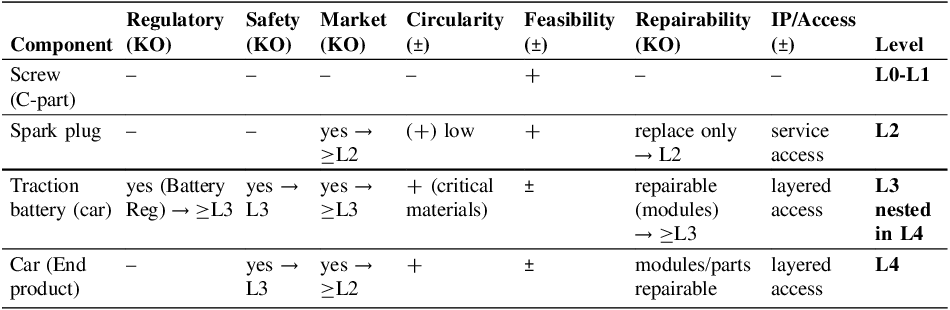
While the Decision Framework provides the underlying logic for assigning documentation levels, its applicability is best demonstrated through practical scenarios. To this end, the decision table summarizes typical case applications and their recommended integration levels. This Table 2 illustrates how different structural elements are classified in practice based on the defined criteria.
Decision table - case applications automotive

At present, only the EU Battery Regulation (Regulation (EU) 2023/1542) requires a DPP, applicable to batteries from 2027 onwards. Consequently, in the current regulatory framework the traction battery is treated as the “Product” (L3 Detailed Independent DPP) within the proposed architecture. However, once vehicles become subject to a full DPP under future delegated acts of the ESPR, the battery will be reclassified as a “Module” (Sub-Pass) within the overarching vehicle-level DPP (L4). This illustrates the dynamic nature of product hierarchy, in which architectural roles shift upward when a new top-level product category is regulated.
5. Discussion and limitations
The results of this study underline the need to differentiate the depth of DPP integration within industrial product structures. The developed criteria catalogue and decision framework show that DPP levels cannot be defined uniformly but must depend on market relevance, regulatory obligations, safety, and circularity considerations. This enables a risk-based allocation of documentation effort that balances transparency and traceability with proportionate administrative and economic costs. Compared to current practice -where DPPs are often discussed only at the end-product level- the proposed framework provides a more systematic approach. It translates conceptual definitions from ISO 9000 (2025) and VDI 2221 (2018) into practical decision logic reflecting separable versus inseparable assemblies and the differing roles of modules and parts. It thereby addresses industry-observed ambiguities, for instance when components like batteries or airbags act both as independent products and as modules within larger systems. Revisiting the research question, the study provides the following preliminary findings:
(i) Product architecture levels can be consistently defined through an extended hierarchy (product, module, assembly, part, C-part).
(ii) Criteria such as regulation, safety, market relevance, circularity, and repairability determine documentation granularity.
(iii) Balancing these criteria enables traceability and compliance while maintaining proportionality of effort.
The framework is conceptual and based on normative sources and illustrative cases; empirical validation through industrial pilots is still pending. As a design-oriented conceptual model, it does not yet account for the full diversity of industrial processes or data governance realities, and subjective interpretation may affect the assignment of DPP levels. Future research should test the decision logic with real product data to refine criteria weights and assess feasibility across sectors. Boundary cases such as software or hybrid systems remain difficult to represent within classical product structures. In addition, evolving regulatory frameworks under the ESPR may redefine both product classifications and data requirements, potentially necessitating continuous adaptation of the proposed approach. For standardization and policy, the framework offers a structured method for linking product architecture with DPP design decisions. It can support ongoing initiatives under the ESPR and related European standards. Overall, the proposed criteria catalogue and decision logic represent a promising conceptual basis for defining appropriate DPP integration levels. Their empirical validation will be crucial to making the DPP both effective for sustainability goals and feasible for industrial adoption.
6. Conclusion and outlook
This study has shown that the lack of conceptual clarity regarding product structure granularity constitutes a major obstacle to the effective and feasible implementation of DPPs. By synthesizing insights from standards, practice, and literature, the paper developed a differentiated product architecture, a criteria catalogue including knock-out and modifier criteria, and a decision tree that systematically assigns structural elements to five levels of DPP integration (L0-L4). The framework contributes both to academic discourse by addressing an unresolved research gap, and to industrial practice by offering a transparent, decision-oriented tool to guide integration depth.
In the context of the ongoing project, the next step will be the empirical validation of the framework through case studies and pilot implementations with industrial partners. Initial preparations have already been made, making it highly plausible that the decision logic will be applied and tested under real-world conditions in the automotive sector. This will make it possible to examine its applicability across complex product architectures, refine the criteria based on empirical findings, and support further alignment with standardization and regulatory work at the European level.
Acknowledgement
This research was supported by the European Union’s Horizon 2024 research and innovation program under grant agreement No 101177586, project Digi4circular.


 Open access

