
Skip to main content Accessibility help
×
  • Cited by 13
    • Show more authors
    • You may already have access via personal or institutional login
    • Select format
    • Publisher:
      Cambridge University Press
      Publication date:
      05 February 2013
      22 October 2012
      ISBN:
      9781139027670
      9780521514415
      9780521732987
      Dimensions:
      (228 x 152 mm)
      Weight & Pages:
      1.2kg, 788 Pages
      Dimensions:
      (228 x 152 mm)
      Weight & Pages:
      1kg, 788 Pages
    You may already have access via personal or institutional login
  • Selected: Digital
    Add to cart View cart Buy from Cambridge.org

    Book description

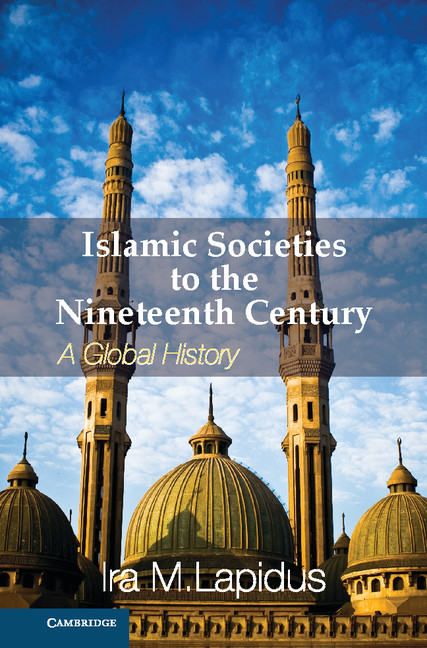
    First published in 1988, Ira Lapidus' A History of Islamic Societies has become a classic in the field, enlightening students, scholars, and others with a thirst for knowledge about one of the world's great civilizations. This book, based on fully revised and updated parts one and two of this monumental work,describes the transformations of Islamic societies from their beginning in the seventh century, through their diffusion across the globe, into the challenges of the nineteenth century. The story focuses on the organization of families and tribes, religious groups and states, showing how they were transformed by their interactions with other religious and political communities. The book concludes with the European commercial and imperial interventions that initiated a new set of transformations in the Islamic world, and the onset of the modern era. Organized in narrative sections for the history of each major region, with innovative, analytic summary introductions and conclusions, this book is a unique endeavour.

    Refine List

    Actions for selected content:

    Select all | Deselect all
    • View selected items
    • Export citations
    • Download PDF (zip)
    • Save to Kindle
    • Save to Dropbox
    • Save to Google Drive

    Save Search

    You can save your searches here and later view and run them again in "My saved searches".

    Please provide a title, maximum of 40 characters.
    ×

    Contents


    Page 1 of 3


    Page 1 of 3


    Bibliography
    Annotated Bibliography from A History of Islamic Societies, 2nd Edition
    Chapter 3. Arabia
    Hoyland, R., Arabia and the Arabs: From the Bronze Age to the Coming of Islam, London and New York, 2001; R. Hoyland, “Epigraphy and the Emergence of Arab Identity,” P. M. Sijpesteijn et al., eds., From al-Andalus to Khurasan, Leiden, 2007, pp. 219–242; J. W. Jandora, “The Rise of Mecca: Geopolitical Factors,” Muslim World, 85 (1995), pp. 333–344; M. J. Kister, Society and Religion from Jahiliyya to Islam, Aldershot, 1990; M. Lecker, Jews and Arabs in Pre- and Early Islamic Arabia, Aldershot and Brookfield, VT, 1998; M. Lecker, Muslims, Jews, and Pagans: Studies in Early Islamic Medina, Leiden, 1995; M. Lecker, People, Tribes and Society in Arabia Around the Time of Muhammad, Aldershot and Brookfield, VT, 2005; M. G. Morony, “The Late Sasanian Economic Impact on the Arabian Peninsula,” International Journal of Ancient Iranian Studies, 1 (2001–2), pp. 25–38; F. E. Peters, ed., The Arabs and Arabia on the Eve of Islam, Aldershot and Brookfield, VT, 1998; I. Shahid, “Islam and Oriens Christianus: Makka 610–622 AD,” E. Grypeou, M. Swanson, and D. Thomas, eds., The Encounter of Eastern Christianity with Early Islam, Leiden, 2006, pp. 9–33.
    Chapters 5 and 6. Introduction to the Arab-Muslim Empires; The Arab-Muslim Conquests and the Socioeconomic Bases of Empire
    Afsaruddin, A., The First Muslims: History and Memory, Oxford, 2008; H. Kennedy, The Great Arab Conquests, Philadelphia, 2007; M. G. Morony, “Social Elites in Iraq and Iran: After the Conquest,” J. Haldon and L. I. Conrad, eds., The Byzantine and Early Islamic Near East, Princeton, NJ, 2004, pp. 275–284; P. Sijpesteijn, “The Arab Conquest of Egypt and the Beginning of Muslim Rule,” R. S. Bagnall, ed., Byzantine Egypt, Cambridge, 2007, pp. 437–459; P. Sijpesteijn, “The Archival Mind in Early Islamic Egypt,” P. M. Sijpesteijn et al., eds., From al-Andalus to Khurasan, Leiden, 2007, pp. 163–186; R. Stroumsa, “Peoples and Identities in Nessana,” Dissertation, Duke University, 2008; C. Wickham, “The Mediterranean around 800: On the Brink of the Second Trade Cycle,” Dumbarton Oaks Papers, 58 (2004), pp. 161–174.
    Chapter 16. Shiʿi Islam
    Bar-Asher, M. M., Scripture and Exegesis in Early Imami Shiism, Leiden, 1999; H. Modarressi, Crisis and Consolidation in the Formative Period of Shiʿite Islam, Princeton, NJ, 1993; D. Stewart, Islamic Legal Orthodoxy: Twelver Shiite Responses to the Sunni Legal System, Salt Lake City, 1998; H. M. Tabatabaʾi, An Introduction to Shiʿi Law, London, 1984.
    Chapter 17. Muslim Urban Societies to the Tenth Century
    al-Raziq, A. ʿAbd, Le femme au temps des Mamlouks en Egypte, Textes Arabes et Etudes Islamique, 5, Caire, 1973; L. Brubaker and J. M. H. Smith, eds., Gender in the Early Medieval World: East and West, 300–900, Cambridge, 2004; D. Cortese and S. Calderini, Women and the Fatimids in the World of Islam, Edinburgh, 2006; N. M. El Cheikh, “Gender and Politics in the Harem of al-Muqtadir,” L. Brubaker and J. M. H. Smith, eds., Gender in the Early Medieval World: East and West, 300–900, Cambridge, 2004, pp. 146–161; N. M. El Cheikh,“Revisiting the Abbasid Harems,” Journal of Middle East Women's Studies, 1 (2005), pp. 1–19; G. R. G. Hambly, “Becoming Visible: Medieval Islamic Women in Historiography and History,” G. R. G. Hambly, ed., Women in the Medieval Islamic World: Power, Patronage, and Piety, New York, 1998, pp. 3–27; E. J. Hanne, “Women, Power, and the Eleventh and Twelfth Century Abbasid Court,” Hawwa: Journal of Women of the Middle East and Islamic World, 3 (2005), pp. 80–110; N. Keddie and B. Baron, eds., Women in Middle Eastern History, New Haven, CT, 1991; C. Melchert, “Whether to Keep Women out of the Mosque: A Survey of Medieval Islamic Law,” B. Michalak-Pikulska and A. Pikulski, eds., Authority, Privacy and Public Order in Islam, Leuven, 2006, pp. 59–69; Y. Rapoport, Marriage, Money and Divorce in Medieval Islamic Society, Cambridge, 2005; R. Roded, Women in Islamic Biographical Collections from Ibn Saʿd to Who's Who, Boulder, CO, 1994; M. Shatzmiller, “Women and Wage Labour in the Medieval Islamic West: Legal Issues in an Economic Context,” Journal of the Economic and Social History of the Orient, 40 (1997), pp. 174–206; D. A. Spellberg, Politics, Gender, and the Islamic Past: The Legacy of ʿAʾisha bint Abi Bakr, New York, 1994; M. Tillier, “Women before the Qāḍī under the Abbasids,” Islamic Law and Society, 16 (2009), pp. 280–301; U. Vermeulen, K. D. Hulster, and J. van Steenbergen, eds., Continuity and Change in the Realms of Islam: Studies in Honour of Professor Urbain Vermeulen, Leuven, 2008.
    Chapter 26. Islamic North Africa to the Thirteenth Century
    , J. Clancy-Smith, , ed., North Africa, Islam, and the Mediterranean World: From the Almoravids to the Algerian War, Portland, OR, 2001; E. Gottreich, Mellah of Marakesh: Jewish and Muslim Space in Morocco's Red City, Bloomington, IN, 2007; A. Hess, The Foreign Frontier: A History of the 16th Century Ibero-African Frontier, Chicago, 1978; H. Z. Hirschberg, A History of the Jews in North Africa, v. 1: From Antiquity to the Sixteenth Century, Leiden, 1974; A. Laroui, The History of the Maghrib: An Interpretive Essay, Princeton, NJ, 1977; S. G. Miller, A. Petruccioli, and M. Bertagnin, “The Mallah, the Third City of Fez,” S. G. Miller and M. Bertagnin, eds., The Architecture and Memory of the Minority Quarter in the Muslim Mediterranean City, Cambridge, MA, 2010, pp. 79–108; D. Robinson, Muslim Societies in African History, Cambridge, 2004; P. von Sivers, “Egypt and North Africa,” N. Levtzion and R. L. Pouwels, eds., The History of Islam in Africa, Athens, Oxford, and Cape Town, 2000, pp. 21–36.
    Chapter 32. The Postclassical Ottoman Empire: Decentralization, Commercialization, and Incorporation
    Abou-el-Haj, R. A., The 1703 Rebellion and the Structure of Ottoman Politics, Istanbul, 1984; K. Barkay, Empire of Difference: The Ottomans in Comparative Perspective, Cambridge and New York, 2008; J. Hathaway, “Problems of Periodization in Ottoman History: The Fifteenth through the Eighteenth Centuries,” Turkish Studies Association Bulletin, 20 (1996), pp. 25–31; K. Karpat, The Politicization of Islam: Reconstructing Identity, State, Faith, and Community in the Late Ottoman State, Oxford and New York, 2001; M. I. Kunt, The Sultan's Servants: The Transformation of the Ottoman Provincial Government 1550–1650, New York, 1983; D. Quataert, The Ottoman Empire, 1700–1922: New Approaches to European History, 2nd edition, Cambridge, 2005; A. Saltzman, “An Ancient Regime Revisited: Privatization and Political Economy in the 18th Century Ottoman Empire,” Politics and Society, 21 (1993), pp. 393–423; B. Tezcan, The Second Ottoman Empire: Political and Social Transformation in the Early Modern World, New York, 2010.
    Chapter 33. The Arab Provinces under Ottoman Rule
    Babir, K. K., Ottoman Rule in Damascus,1708–1758, Princeton, NJ, 1980; B. Doumani, Rediscovering Palestine: Merchants and Peasants in Jabal Nablus, 1700–1900, Berkeley, CA, 1995.
    Chapter 37. Inner Asia from the Mongol Conquests to the Nineteenth Century
    Caneld, R. C, ed., Turko-Persia in Historical Perspective, Cambridge, 1991; R. Crews, For Prophet and Tsar: Islam and Empire in Russia and Central Asia, Cambridge, MA, 2006; R. C. Foltz, Mughal India and Central Asia, Karachi and New York, 1998; A. Khalid, The Politics of Muslim Cultural Reform: Jadidism in Central Asia, Berkeley, CA, 1998.
    Chapter 38. Islamic Societies in Southeast Asia
    An excellent one-volume history is Ricklefs, M. C., A History of Modern Indonesia since c. 1300, Stanford, CA, 1993.
    A. Southeast Asia to the Eighteenth Century
    Andaya, B. W. and Hadler, J., “To Live as Brothers: Southeast Sumatra in the Seventeenth and Eighteenth Centuries,” Journal of Asian Studies, 57 (1998), pp. 269; K. N. Chaudhuri, Trade and Civilisation in the Indian Ocean: An Economic History from the Rise of Islam to 1750, Cambridge, 1985; J. Hadler, Muslims and Matriarchs: Cultural Resilience in Indonesia through Jihad and Colonialism, Ithaca, NY, 2008; J. Hadler, “Places like Home: Islam, Matriliny, and the History of Family in Minangkabau,” Dissertation, Cornell University, 2000; M. F. Laffan, “Finding Java: Muslim Nomenclature of Insular Southeast Asia from Srîvijaya to Snouck Hurgronje,” E. Tagliacozzo, Southeast Asia and the Middle East: Islam, Movement and the Longue Durée, Stanford, CA, 2009, pp. 17–64; V. Lieberman, Strange Parallels: Southeast Asia in Global Context, c. 800–1830, vol. 1: Integration on the Mainland, Cambridge, 2003; M. Pearson, The Indian Ocean, London and New York, 2003; A. Reid, Southeast Asia in the Early Modern Era: Trade, Power, and Belief, Ithaca, NY, and London, 1993.
    B. Modernization and Islamic Reform
    Adam, A. B., The Vernacular Press and the Emergence of Modern Indonesian Consciousness (1855–1913), Ithaca, NY, 1995; C. A. Bayly and D. H. A. Kolff, eds., Two Colonial Empires: Comparative Essays on the History of India and Indonesia in the Nineteenth Century, Dordrecht, Boston, and Lancaster, 1986; R. M. Feener, Muslim Legal Thought in Modern Indonesia, Cambridge, 2007; R. W. Hefner, ed., Making Modern Muslims: The Politics of Islamic Education in Southeast Asia, Honolulu, 2009; M. F. Laffan, Islamic Nationhood and Colonial Indonesia: The Umma below the Winds, London and New York, 2003; M. C. Ricklefs, “The Birth of the Abangan,” Bijdragen tot de Taal- Land- en Volkenkunde (BKI), 162 (2006), pp. 35–55; M. C. Ricklefs, Polarizing Javanese Society: Islamic and Other Visions (c. 1830–1930), Honolulu, 2007.
    C. International Networks
    Azra, A., The Origins of Islamic Reformism in Southeast Asia: Networks of Malay-Indonesian and Middle Eastern ʿUlama in the Seventeenth and Eighteenth Centuries, Honolulu, 2004; H. De Jonge and N. Kaptein, eds., Transcending Borders: Arabs, Politics, Trade and Islam in Southeast Asia, Leiden, 2002; U. Freitag and W. Clarence-Smith, eds., Hadhrami Traders, Scholars, and Statesmen in the Indian Ocean, 1750s–1960s, Leiden, New York, and Köln, 1997; E. Ho, The Graves of Tarim: Genealogy and Mobility across the Indian Ocean, Berkeley, CA, Los Angeles, and London, 2006.

    Metrics

    Altmetric attention score

    Full text views

    Total number of HTML views: 0
    Total number of PDF views: 0 *
    Loading metrics...

    Book summary page views

    Total views: 0 *
    Loading metrics...

    * Views captured on Cambridge Core between #date#. This data will be updated every 24 hours.

    Usage data cannot currently be displayed.

    Accessibility standard: Unknown

    Why this information is here

    This section outlines the accessibility features of this content - including support for screen readers, full keyboard navigation and high-contrast display options. This may not be relevant for you.

    Accessibility Information

    Accessibility compliance for the PDF of this book is currently unknown and may be updated in the future.
