




1. Introduction
There are likely three things that most of us make use of on a daily basis: clothes, a mobile phone, and cosmetics. The latter of the three – cosmetics – is often synonymous with makeup and beauty products; however, its actual definition is much broader and includes products used to clean, improve or change one's complexion, skin, hair, and teeth (Food & Drug Act, 2022). Various iterations of cosmetics can be found throughout human history, though at no point in time has the consumption of cosmetics been greater than in the 21st century. The cosmetic industry has seen almost continual growth and is estimated to exceed US$380 billion in 2027 (Statista, 2023b). With this growth comes increasing concerns related to the social and environmental impacts of cosmetics, highlighting the importance of sustainable practices and leading to the development of research in the field of cosmetics and sustainability. It is within this field of cosmetics and sustainability that this paper is rooted, with the aim of providing a systematic review of the extant literature over the past 30 years – from 1992 to 2022. Agenda 21 emphasized the role of science in sustainable development, and its development in 1992 can be identified as a crucial focal point for academic research regarding the sustainability of industries (UN, 1992a, para. 35). Furthermore, its emphasis on localized implementation provides valuable insights and lessons learned for advancing sustainability within specific industry contexts (UN, 1992b). Therefore, it serves as a foundational reference for academic inquiry into how sustainability research has advanced in a specific sector (Figure 1).
Annual year-over-year growth of the global cosmetics market from 2012 to 2022 (Statista, Reference Statista2023a).

With a sample size of 365 publications, this systematic review recognizes the evolution and development of research in the field of cosmetics and sustainability over the past 30 years by:
i) exploring trends related to the geographical location of research, research topics most studied, and journals of publication,
ii) classifying types of methodologies used in cosmetics and sustainability research, and
iii) exploring thematic bibliometric profiles (e.g. documenting keywords and their co-appearance in publications, most prolific authors in this field, etc.).
The primary goal of this systematic review is to comprehensively gather and interpret the existing body of knowledge concerning the sustainability of the cosmetic industry. It aims to establish a research agenda and offer managerial implications for both the academic community and industry practitioners operating within this domain. As noted by Bom et al. (Reference Bom, Jorge, Ribeiro and Marto2019), the sustainability of cosmetics represents a complex and multifaceted matter that necessitates an integrated evaluation encompassing the environmental, social, and economic dimensions. Consequently, this study adopts a holistic approach to examine the sustainability of the cosmetic industry, considering various dimensions. Notably, this review distinguishes itself from previous literature reviews that have focused on specific aspects relating to sustainable cosmetics. Rather than focusing on a specific aspect of sustainability, this review takes a holistic approach to documenting the research that has been conducted within the field of cosmetics and sustainability while providing an in-depth review of the least studied research category: stakeholder behavior.
2. Background
2.1 Cosmetic industry
The definition of the term ‘cosmetics’ has slight nuances from one country to another but largely includes products that are used on one or more parts of the body. For instance, the European regulation 2012 identifies cosmetics as ‘any substance or mixture intended to be placed in contact with the external parts of the human body or with the teeth and the mucous membranes of the oral cavity with a view exclusively or mainly to cleaning them, perfuming them, changing their appearance, protecting them, keeping them in good condition or correcting body odours’ (European Parliament & Council, Reference European Parliament2009, p. 59). While the United States Food and Drug Administration (FDA) takes a similar approach in its definition of cosmetics, it does not count anti-bacterial soap as a cosmetic product and categorizes antibacterial products as drugs. More specifically, section 321 of the United States Food, Drug, and Cosmetic ACT defines cosmetics as ‘articles intended to be rubbed, poured, sprinkled, or sprayed on, introduced into, or otherwise applied to the human body for cleansing, beautifying, promoting attractiveness, or altering the appearance’ (FD&C ACT, 2022). Meanwhile, in Canada, the Food and Drugs Act defines a cosmetic product as ‘any substance used to clean, improve or change the complexion, skin, hair, nails or teeth and further divides this into beauty preparation (make-up, perfume, skincare, nail polish) and grooming aids (soap, shampoo, shaving cream, deodorant)’ (Food & Drug Act, 2022, p. 2).
Due to the growth in population and lifestyle changes, the cosmetic industry is categorized as one of the fastest-growing industries on a global scale. Over the past decade, the global beauty market has grown by 3.78% a year on average (Statista, Reference Statista2023a). It is expected that the industry exceeds a market value of 380 billion USD in 2026 from 267.7 billion USD in 2021 (Statista, 2023b). This industry has demonstrated economic resilience by returning to its continued growth after the 2008 global financial crisis and the 2020 COVID pandemic.
2.2 Cosmetic industry and sustainability
Sustainability, both as a concept and a priority gained attention after the ‘Our Common Future’ report in 1987 that defined it as the ability to meet our needs without compromising future generations meeting their needs (Brundtland et al., Reference Brundtland1987). More recently, the United Nations' Sustainable Development Goals described sustainability as: ‘peace and prosperity for people and the planet, now and into the future’ (UN, 2015, p. 1). This definition takes into account the three pillars of sustainability – that is, trying to balance social, environmental, and economic issues (UN, 2015).
The cosmetic industry significantly impacts both the environment and society, with consequences expected to worsen as the industry grows. The cosmetic industry's environmental profile has been negatively impacted by deforestation, overexploitation of minerals, emissions of greenhouse gases from production to post-consumption, and the release of liquid and solid pollutants into the environment, leading to increasing concerns about its sustainability (Bom et al., Reference Bom, Jorge, Ribeiro and Marto2019; Cinelli et al., Reference Cinelli, Coltelli, Signori, Morganti and Lazzeri2019). For instance, the amount of cosmetic packaging produced and disposed of is approximately 120 billion units per year, mostly unrecyclable (Moore, Reference Moore2019). Socially, the industry's practices often involve unethical labor conditions, including exploitative labor in developing countries and adverse impact of cosmetics on human health. For instance, in 2016, the Dutch NGO SOMO and Terre des Hommes Netherlands published a report revealing that up to 20,000 child laborers were engaged in mica mining in Northeast India. It is estimated that these illegal mines account for 25% of the world's mica production (Ten Kate et al., Reference Ten Kate, Schipper, Kiezebrink and Remmers2016). The development of marketing strategies, such as the growing significance of social media in connecting and engaging potential customers, plays a persistent role in increasing cosmetics production and consumption, thus intensifying the impacts throughout the life cycle of cosmetic products.
While the issue of fast fashion has been a major concern in the fashion industry, the concept of ‘fast beauty’ is emerging as a reality, further burdening the sustainability profile of the cosmetic industry. Similar to fast fashion, which is described as ‘low-cost clothing collections based on current, high-cost luxury fashion trends’ (Joy et al., Reference Joy, Sherry, Venkatesh, Wang and Chan2012, p. 275), fast beauty can be described as a collection of low-cost cosmetics that is based on a vast amount of quick-turn-around products to entice ongoing consumption. Introducing limited edition products has been a marketing strategy in fast fashion to encourage customers to purchase a product for a ‘fear of missing out’ (Bläse et al., Reference Bläse, Filser, Kraus, Puumalainen and Moog2024) with similar initiatives now being practiced in the fast beauty industry. This may be one of the reasons behind the sizable increase in the consumption of makeup, often exceeding the amount one individual could consume in a given period. Similar to fast fashion (Bläse et al., Reference Bläse, Filser, Kraus, Puumalainen and Moog2024; Niinimäki et al., Reference Niinimäki, Peters, Dahlbo, Perry, Rissanen and Gwilt2020), the ever-increasing amount of production of beauty products, comes with a variety of environmental and social impacts, including greenhouse gas emissions, excessive use of non-renewable resources and energy, generation of waste, release of solid and liquid pollutants to the environment, and workers' exploitation.
The sustainability of the cosmetic industry has increasingly gained attention from scholars globally and led to an increasing number of publications in this field. Several of these studies have focused on reviewing publications in different areas related to the sustainability of cosmetics. Most of these articles focused on reviewing research on the development of specific ingredients and technologies applicable to the cosmetic industry (e.g. Liu et al., Reference Liu, Baffoe, Zhan, Zhang, Li and Zhang2019; Pangestuti et al., Reference Pangestuti, Shin and Kim2021; Santos et al., Reference Santos, Rodrigues, Sequeira, Pereira, Simoes, Costa, Peixoto, Costa and Veiga2019). For example, Pangestuti et al. (Reference Pangestuti, Shin and Kim2021) looked at the anti-photoaging and potential skin health benefits of seaweeds, while Santos et al. (Reference Santos, Rodrigues, Sequeira, Pereira, Simoes, Costa, Peixoto, Costa and Veiga2019) reviewed nanotechnological breakthroughs in the development of topical phytocompounds-based formulations. Other reviews have focused on circular economy and related topics, such as Lourenço-Lopes et al.'s (Reference Lourenço-Lopes, Fraga-Corral, Jimenez-Lopez, Pereira, Garcia-Oliveira, Carpena, Prieto and Simal-Gandara2020) review of the application of macroalgae metabolites and Panwar et al.'s (Reference Panwar, Saini, Panesar and Chopra2021) review of the utilization of citrus by-products in cosmetics to promote circularity. Green chemistry is a field that focuses on designing chemical products and processes to eliminate the use or generation of hazardous materials (EPA, 2022). Several publications, such as Jiang et al. (Reference Jiang, Ghosh and Charcosset2021), emphasized applying green chemistry to develop cosmetic ingredients. Some studies, such as Tkaczyk et al. (Reference Tkaczyk, Mitrowska and Posyniak2020) and Montesdeoca-Esponda et al. (Reference Montesdeoca-Esponda, Checchini, Del Bubba, Sosa-Ferrera and Santana-Rodriguez2018), focused on the environmental impacts of cosmetics. However, there are limited studies that have taken a holistic view of the cosmetic industry and its sustainability with regard to both social and environmental impact (Table 1).
Review articles with a holistic perspective on the sustainability of the cosmetic industry

It is important to take a holistic view of sustainability into account when exploring the extant research on cosmetics; however, to date, there are a very limited number of studies that have addressed this. For example, Bom et al. (Reference Bom, Jorge, Ribeiro and Marto2019) offered a pharmaceutical perspective by reviewing the different life cycle phases of cosmetic products and focusing on reviewing publications for common ingredients used in skincare products and their sustainable replacement. In addition, Liobikienė and Bernatonienė (Reference Liobikienė and Bernatonienė2017) focused on the concept of behavior and review the factors influencing consumer green cosmetic purchasing behavior. From a green chemistry perspective, Hitce et al. (Reference Hitce, Xu, Brossat, Frantz, Dublanchet, Philippe and Dalko-Csiba2018) reviewed how green chemistry can contribute to achieving sustainable development goals. On the other hand, Bilal et al. (Reference Bilal, Mehmood and Iqbal2020) focused on the environmental and social impact of toxic components in cosmetic products, and Fonseca-Santos et al. (Reference Fonseca-Santos, Corrêa and Chorilli2015) looked at sustainability, natural and organic cosmetics while considering consumer behavior and reviewed different regulatory aspects. Although these reviews provide a more holistic view compared to other reviews, they still provide information from available literature on specific topics or from a specific perspective within the larger umbrella of cosmetics and sustainability. Consequently, a thorough understanding of the state of the research and a comprehensive overview of the literature in the field of cosmetics and sustainability is lacking. Filling this knowledge gap can also contribute to the implementation gap in the industry and may impact acquiring adequate policies and strategies to promote sustainability of the industry. The aim of this paper is to conduct a comprehensive analysis in order to determine: (1) primary areas of research in the cosmetics and sustainability field and the research methodologies that have been applied, (2) identify the countries in which the research is being conducted along with the types of journals it is being published in and, (3) identify areas in which research has been lacking on this topic. It aims to create a common framework of knowledge in this field and identify research gaps.
3. Methodology
3.1 Data collection
We selected the approach of conducting a systematic review because it encompasses both quantitative and qualitative analyses, providing a comprehensive and methodically rigorous examination of the field of cosmetics and sustainability. While the review includes bibliometric elements, such as exploring trends related to geographical locations, research topics, and journals, classifying methodologies, and analyzing thematic bibliometric profiles, it also looks deeper by providing an in-depth analysis of publications on stakeholder behavior. This qualitative analysis goes beyond merely counting citations and publications, addressing the practical implications and real-world applications of the research (Linnenluecke et al., Reference Linnenluecke, Marrone and Singh2020).
This systematic literature review is based on a keyword search using Scopus and Web of Science, the reason for this being that they both are among the largest databases of peer-reviewed literature (Chadegani et al., Reference Chadegani, Salehi, Yunus, Farhadi, Fooladi, Farhadi and Ebrahim2013; Mongeon & Paul-Hus, Reference Mongeon and Paul-Hus2016). In addition, using these two databases ensures accuracy, as no single database includes all publications. This literature review took a funnel approach to conduct a systematic literature review on cosmetics-related academic publications. It started with a broader view and attempted to count all academic publications related to cosmetics available on each database. For this purpose, keywords of the central concept and synonyms for cosmetics were selected. Through a process of brainstorming and reviewing literature in the field, ‘cosmetic’, ‘cosmetics’, ‘beauty industry’, and ‘beauty product’ were selected to collect publications. To prevent getting search responses not related to the theme, only publications with these terms in their title, author keywords, or index keywords were selected.
By using these main keywords, 42,151 and 19,362 publications were found in the Scopus and Web of Science databases, respectively. The first publication identified is dated 1857 and focused on ‘arsenic as a cosmetic’ (Crawford, Reference Crawford1857). Later, a temporal range of the last 30 (1992–2022) years was selected to identify current research trends on this topic that were published after Agenda 21 action plan, where an emphasis on sustainable production and consumption was made.
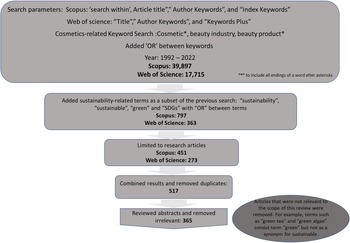
In the next step, the research was narrowed down to the field of sustainability to collect publications in the area of cosmetics and sustainability. The keywords of ‘sustainability’, ‘sustainable’, ‘green’, and ‘SDGs’ (Sustainable Development Goals) were used to narrow down and collect publications. To be able to collect publications from different countries, especially from ones that are pioneers in cosmetics development, no other language limitations were set. As a result, 451 and 273 research articles that were published in Scopus and Web of Science, respectively, were collected. Upon reviewing and reading the title and abstracts, duplicates and articles with the absenteeism of sustainability perspective were removed. This resulted in 365 publications for further investigation. The process of article selection is illustrated in Figure 2 and discussed in detail in the supplementary section.
Overview of how articles were funneled in the data collection process.

The 365 studies were selected for analysis to understand the most and least frequently researched areas. Later, a more in-depth review was conducted to explore the stakeholder behavior research in the sustainability and cosmetic field.
3.2 Data synthesis and analysis
Following the process of data collection, the next step was to analyze the articles by year, country, and journal type and study the different research methods used in the collected research articles. To facilitate the journal-wise analysis, the SCImago Journal Rank Indicator (SJR) was employed. This particular indicator is an index based on the SCOPUS database, which stands as the largest abstract and citation database of peer-reviewed literature (Yuen, Reference Yuen2018). On the other hand, according to Falagas et al. (Reference Falagas, Kouranos, Arencibia-Jorge and Karageorgopoulos2008), SJR covers more journal titles published from a broader variety of countries compared to other journal rank indicators of the Impact Factor (based on Web of Science data). Therefore, given the diverse origins and disciplines of publications in the field of cosmetics, the SJR indicator was employed to evaluate journals that have two or more publications in this review. Later, the articles were categorized based on the applied techniques and research tools employed, including experimental, analytical, survey/focus group research, conceptual, and descriptive groups. This classification was based on the methodology section of each article. Following this categorization, an in-depth analysis was conducted to examine the research theme and applied methodology.
3.3 Systematic literature network analysis
Systematic literature network analysis focused on identifying how scholars in previous publications have addressed different subject areas. This analysis was performed using VOSviewer software which is a tool that provides literature network mapping and develops professional graphical representations of bibliographic mapping based on quantitative measurements (Van Eck & Waltman, Reference Van Eck and Waltman2010). This software can analyze the network of a large number of publications, create maps, and provide the visualization of this analysis. VOSviewer software uses authors' and index keywords to identify the frequency of keyword occurrences and generate the co-occurrence network visualization. This paper conducts a co-occurrence network analysis to visualize the network among the most frequently used keywords in the 365 publications in the cosmetics and sustainability field.
Many terms are synonyms or might appear in various spelling formats. For example, the word ‘behaviour’ (behavior) appears in two different spelling formats, and a word like ‘human’ may have introduced as singular (human) or plural (humans) as a keyword. To have an efficient visualization, these keywords need to be cleaned up. A thesaurus file was used for data cleaning to merge synonyms and correct spellings.
3.4 Categorization based on research focus and in-depth review
To understand the research focus of the selected 365 research articles, a careful review of the titles and abstracts of these publications was made. As a result, the 365 articles were categorized into seven different groups based on their research focus: (1) process and technology; (2) ingredient and formulation; (3) social and environmental impact; (4) green chemistry; (5) business and management; (6) stakeholder behavior; and (7) others. Categorization has been made based on the main aim or field of each study. The research focus of some studies related to ‘process and technology’, ‘ingredient and formulation’, and ‘green chemistry’ could overlap. In such cases, to avoid double-counting, based on the purpose statement of each study, one category of research was selected. As a final step, the research articles in the least-studied category, ‘stakeholder behavior’, were selected for further in-depth review to look at what has been done, but also where the gaps lie. As the demand for sustainable products grows (Bom et al., Reference Bom, Jorge, Ribeiro and Marto2019), it is increasingly vital for businesses to understand the factors that influence consumers' choices in this market segment. Understanding stakeholder behavior can drive innovation and transparency, fostering trust and collaboration among all stakeholders while advancing environmental and social responsibility within the industry.
4. Results and discussion
The following subsections illustrate the analysis results of the annual production of articles, country-wise distribution, distribution of the articles in various journal outlets, and utilization of research methodology in the research articles.
4.1 Distribution of articles based on years (1992–2022)
During the past three decades since the declaration of Agenda 21, the number of research studies and academic articles related to cosmetics and sustainability has increased. The initial scholarly article addressing the intersection of cosmetics and sustainability did not emerge until the year 2001. Since that time, bibliographic analysis of research articles shows a drastically increased attention to the field from the academic community (Figure 3). More than 70% (259 articles) of the 365 articles reviewed were published in the last five years (2018–2022), with 2022 having the highest number of published articles (98). It is important to indicate that most studies have been in the fields of chemistry, medicine, pharmacology, and chemical engineering, recorded on Scopus and Web of Science.
Number of publications per year in the area of cosmetics and sustainability since UN Agenda 21.

4.2 Distribution of articles based on country
In the collection of the articles that were analyzed, the first author's affiliation country was considered the article's origin. The list of articles comprises publications from a total of 53 different countries. Italy, the world leader in producing perfumes and cosmetics (De Blasio et al., Reference De Blasio, Pavone and De Blasio2022), had the highest number of publications (40 articles) in the field. Following this, Brazil, with 35 articles, is a country under the group of emerging economy countries with a high number of publications. This country is among the largest cosmetic markets worldwide and ranks as the largest in Latin America (Statista, 2022). Additionally, Brazil has the advantage of having access to resources from the Amazon rainforest, which makes the country one of the main origins of natural ingredients for cosmetics products (Fonseca-Santos et al., Reference Fonseca-Santos, Corrêa and Chorilli2015). Spain has 30 published research articles in this field – more than the United States (25), India (25), and China (20). Portugal (19), France (16), and South Korea (16) are other notable countries with research in this field.
Although enhancing the sustainability of cosmetics is essential in reducing the negative impact of the cosmetic industry, research in this field is minimal in some countries. For instance, developed countries like Canada, Japan, and Australia only have three, two, and two articles in this field, respectively. The geographical distribution of the studies for countries with two or more publications is illustrated in Figure 4.
Number of publications per country in the area of cosmetics and sustainability since UN Agenda 21.

4.3 Distribution of articles based on journal
The selected articles were published in 219 different journal outlets. Out of these, 49 journals have two or more publications, and 170 journals have one article in this field. These journals are from a variety of countries and disciplines. The diversity of journal outlets publishing articles in the cosmetics and sustainability field highlights the importance of taking a multidisciplinary approach from a variety of countries to enhance the sustainability of cosmetics. Most of the papers were published in journals such as Sustainability, Molecules, Cosmetics, and International Journal of Cosmetic Science. Table 2 presents the journals that have published more than two articles in the field, accompanied by their corresponding SCImago Journal Rank (SJR) indicators.
Journals with more publications in the cosmetics and sustainability field

4.4 Distribution of research articles by methodology
In terms of research methodology, the most frequent methodology was experimental (59%), followed by analytical (22%), survey/focus group research (13%), conceptual (5%), and descriptive (1%) (Figure 5). The categorization made in this study is based on the techniques applied or tools that were used for research. When the research study involved an experiment and manipulated variables to test a hypothesis and determine a cause-and-effect relation, that study was considered experimental research. This review identified 215 experimental research articles in the cosmetics and sustainability field. In addition, the studies that focused on analyzing the data available from conducted studies and tried to conclude forming a cause-and-effect relationship are categorized as analytical studies. There are 81 studies among 365 articles in this category. Another category is defined as the survey/focus group research category, which consists of 47 articles. The articles that have studied the shared pattern of behaviors or actions of a group of people in a natural setting were categorized as survey/focus group research methodology (Creswell & Creswell, Reference Creswell and Creswell2017). The main difference between analytical and survey/focus group research lies in the fact that survey/focus group research is an approach that provides insights into human behavior. In contrast, the analytical method is generally positioned as an approach that analyzes a broad database from conducted studies in the research field (Charles & Gherman, Reference Charles, Gherman, Emrouznejad and Charles2019). The conceptual studies are focused on elaborating and introducing new frameworks or approaches in the field. This systematic literature review identified 19 articles with conceptual methodology. Additionally, few studies (three articles) were focused on describing the industry's status or particular substances. The methodology of these publications was categorized as descriptive methodology.
Distribution of methodologies used among publications.

4.5 Keywords co-occurrence network analysis
In this study, 365 articles related to sustainability and cosmetics retrieved from Scopus and Web of Science were imported into the VOSviewer tool. VOSviewer software is a bibliometric mapping tool that develops the publications network visualization and illustrates large bibliometric maps. This software also clusters and categorizes keywords that appear more often together. The software has been set to consider authors and index keywords that have occurred at least 10 times. Based on this criterion, 51 keywords were selected by the software for the analysis. As explained in Section 3.2, a thesaurus file was used for data cleaning to merge synonyms and correct spellings. In addition, the keywords ‘cosmetic’, ‘controlled study’, ‘article’, and ‘priority journal’ have been removed to have a clear border between clusters.
The VOSviewer generates a keyword map based on the keywords' occurrence illustrated in Figure 6. The size of nodes is evidence of the frequency of occurrence of a particular keyword. In addition, the distance between nodes demonstrates the relatedness and the number of times the keywords came together. Based on the data of this review and the introduced criterion, VOSviewer generates four clusters, each consisting of keywords that have appeared with each other in the literature.
Keyword co-occurrence network map for sustainability-related cosmetics literature from 1992 to 2022.

The VOSviewer software illustrates the co-occurrence map with different clusters in different colors (Figure 6). The largest cluster in red contains 15 items containing chemistry, green chemistry, extraction, and high-performance liquid. Some of the articles with keywords in this cluster are Villa et al. (Reference Villa, Baldassari, Gambaro, Mariani and Loupy2005), Parmar and Singh (Reference Parmar and Singh2018), and Khesina et al. (Reference Khesina, Iartsev, Revelsky and Buryak2021). Most publications with keywords in this cluster focus on the green chemistry approach and chemistry to promote environmental protection. This cluster is connected to the blue cluster through the ‘water pollutants’ keyword.
The second cluster shown in green contains 14 items, such as toxicity, antioxidant, antioxidant activity, and green extraction. The keyword toxicity has distance from other keywords in this cluster which is the evidence of a few simultaneous appearances with other keywords. However, this keyword is the main connection between this cluster and other clusters. Some of the studies covering the keywords in this cluster are Peyrot et al. (Reference Peyrot, Mention, Fournier, Brunissen, Couvreur, Balaguer and Allais2020), Huynh et al. (Reference Huynh, Garcia, Young, Szoboszlai, Liberatore and Baki2021), and Tong et al. (Reference Tong, Yi, Ran, Chen, Chen and Li2021).
The third cluster in blue has ten main keywords such as sustainable development, environmental sustainability, cosmetic industry, drug industry, and environmental impact. The publications with these keywords are related to cosmetic products and the cosmetic industry's environmental impact. Some of the publications covering these keywords are Sánchez-Bayo and Goka (Reference Sánchez-Bayo and Goka2006), Jos et al. (Reference Jos, Repetto, Rios, Del Peso, Salguero and Cameán2009), and Seoane et al. (Reference Seoane, Esperanza, Rioboo, Herrero and Cid2017).
The fourth and smallest cluster, illustrated in yellow, consists of eight keywords. Keywords of ‘behavior’, ‘purchase intention’, ‘circular economy’, ‘green cosmetics’, and ‘sustainability’. The distance between ‘sustainability’ and ‘behavior’ shows that although these terms are located in the same cluster, the number of simultaneous appearances in papers is not high. However, the keywords of ‘behavior’ and ‘green cosmetics’ have appeared more frequently in literature. Some of the studies covering the keywords in this cluster are Askadilla and Krisjanti (Reference Askadilla and Krisjanti2017), Singhal and Malik (Reference Singhal and Malik2018), and Gupta et al. (Reference Gupta, Tomar, Kaushal, Kadam, Rathore, Mehta and Ojasvi2021).
Overall, according to the results derived from VOSviewer, this analysis has identified four main clusters constructed based on keyword appearance. However, some keywords, such as ‘life cycle assessment’, ‘waste management’, ‘cosmetic waste’, ‘environmental awareness’, ‘disposal behavior’, ‘green marketing’, ‘post-consumption’, and ‘carbon footprint’, or their synonyms are not visible or have a minimal node on this map. This is evidence of the low frequency of these keywords appearing in the literature.
4.6 Research profiling
4.6.1 Categorization based on research focus
In addition to keyword co-occurrence analysis, it is important to identify the main focus areas in cosmetics and sustainability research. The keyword co-occurrence network provided a holistic view of keywords' utilization literature. However, an in-depth review of the literature is beneficial to understanding the main areas of research and identifying gaps. A careful review of the selected 365 studies identified seven major research areas in the field of cosmetics and sustainability (Figure 7). The categorization was made based on the primary research objective of the studies. The categories of ‘process and technology’ and ‘ingredient and formulation’ were the two with the highest number of studies. This result is in line with the previously discussed finding that most studies have been conducted in chemistry, chemical engineering, and pharmacology. The category of ‘Green chemistry’ is another group that consists of studies focusing on the green chemistry approach and its application. According to Anastas and Warner (Reference Anastas and Warner1998), Green chemistry is the ‘design of chemical products and processes to reduce or eliminate the use and generation of hazardous substances’. Additionally, studies that focus on the impact of cosmetics on humans or non-humans or the application of tools for impact assessment, such as life cycle assessment, were categorized into the group of ‘Environmental and social impact’. ‘Business and management’ and ‘Stakeholder behavior’ are other categories consisting of studies focusing on concepts related to business management and the behavior of different stakeholders, respectively. The ‘other’ category consists of publications focused on applying cosmetics substances in other industries.
Categorization of literature on cosmetics and sustainability published between 1992 and 2022.

Process and technology: The theme of ‘Process and technology’ is the theme that gained the highest interest of researchers, mainly from chemistry or chemical engineering disciplines. Publications in this category focus on process or technology development for cosmetics production. This category consists of 89 research articles from 25 different countries. Spain, with 15, and China, with nine articles, are the countries with the highest number of publications focused on processes and technology related to cosmetics and sustainability. Among 1201 keywords used in this category, the most frequently used keywords were cosmetic (53 times), green chemistry (16 times), extraction (14 times), parabens (11 times), and antioxidant (11 times). The number of authors as first or co-authors involved comes to 183 researchers. Some of the publications in this category are Becker et al. (Reference Becker, Böttcher, Katzer, Siems, Müller-Kuhrt and Bornscheuer2020), Mello et al. (Reference Mello, Ribeiro and Bicas2021), Michalkiewicz et al. (Reference Michalkiewicz, Jakubczyk and Skorupa2016), and Feng et al. (Reference Feng, Dai, Zhu, Ma, Yu, Zhu, Wang, Sun, Hongxia and Zhang2021).
Ingredient and formulation: The category of ‘Ingredient and formulation’ is the second-largest publication category in the field. The research articles in this group mainly study the cosmetic ingredient development or formulation of particular cosmetic products. The publications in this category are from 29 different countries from groups of developing and developed countries. Italy has the highest number of 14 articles, followed by the United States and Portugal, with each of them having seven publications in this field. There are 1323 keywords used in these publications, while only 240 are used twice or more. This is mainly due to the variety of ingredients and formulations that can be used in cosmetics production. The keywords ‘cosmetic’ (39 times), antioxidant (19 times), and ‘green chemistry’ (17 times) are the most frequently used keywords. There are 172 authors and co-authors involved in developing the articles in this category. These articles are focused on various areas such as natural ingredients (Atolani et al., Reference Atolani, Adamu, Oguntoye, Zubair, Fabiyi, Oyegoke, Adeyemi, Areh, Tarigha, Kambizi and Olatunji2020; Casas et al., Reference Casas, Conde, Ribeiro, Fernandes, Domínguez and Torres2020), formulation of cosmetic products (Baldisserotto et al., Reference Baldisserotto, Buso, Radice, Dissette, Lampronti, Gambari, Gambari, Manfredini and Vertuani2018; Drakontis & Amin, Reference Drakontis and Amin2020), and by-products as ingredients (Quina, Soares, & Quinta-Ferreira, Reference Quina, Soares and Quinta-Ferreira2017).
Green chemistry: ‘Green chemistry’ is a category of research theme consisting of 53 publications from 17 different countries. Italy (11 articles) and Spain (seven articles) are two southern European countries with the highest number of publications in this area of research. There are 843 keywords used in these research articles. The most frequently used keywords are ‘cosmetic’ (27 times), followed by ‘Antioxidant’ (10 times) and ‘Green chemistry’ (nine times). According to VOSviewer, there are only 136 keywords that are used two or more times. The publications are from 142 authors and co-authors, all with one publication in this category. Hanno et al. (Reference Hanno, Centini, Anselmi and Bibiani2015), Villa et al. (Reference Villa, Trucchi, Gambaro and Baldassari2008), Capela et al. (Reference Capela, Homem, Alves and Santos2016), and Franca and Ueno (Reference Franca and Ueno2020) are some of the articles in this category.
Environmental and social impact: The ‘Environmental and social impact’ category consists of 50 publications. These articles study the impact of cosmetics on humans or the natural environment. There are 20 different countries with articles in this category. Brazil and the US (six articles each) are the countries with the highest number of publications in this area of research. There are 1038 keywords used among these research articles. The most frequently used keywords are ‘cosmetic’ (31 times), followed by ‘sustainability’ (15 times), ‘human’ (12 times), ‘toxicity’ (nine times), and ‘environmental sustainability’ and ‘water pollutants’ (eight times each). According to VOSviewer, there are only 149 keywords that are used two or more times. The publications are from 126 authors and co-authors, all with one publication in this category.
There are 24 publications in this category that focus on the impacts of cosmetic products or the cosmetic industry on the natural environment. For instance, Sánchez-Bayo and Goka (Reference Sánchez-Bayo and Goka2006) look at the impact of antidandruff shampoo in experimental rice fields, Wieck et al. (Reference Wieck, Olsson and Kümmerer2016) discuss the possible underestimations of risks of emissions of biocides from households to wastewater, and Burns and Davies (Reference Burns and Davies2021) focus on ‘coral ecotoxicological data evaluation for the environmental safety assessment of ultraviolet filters’. In this category, 17 articles investigate the impact of cosmetics on humans from a sustainability perspective such as Mattioli et al. (Reference Mattioli, Giardini, Roselli and Desideri2016), Nizioł-Łukaszewska and Bujak (Reference Nizioł-Łukaszewska and Bujak2018), Farias et al. (Reference Farias, Stamford, Resende, Aguiar, Rufino, Luna and Sarubbo2019), and Oh and Kim (Reference Oh and Kim2020). Most of these articles are limited to the health aspect of social sustainability, while the social sustainability aspect is not limited to health. Some scholars, such as Bang and Park (Reference Bang and Park2021), consider other aspects of social sustainability. This study focuses on the necessity of training and education for women in the cosmetic industry in developing communities to achieve sustainable development goals. Although some studies consider other aspects of social sustainability, such as worker exploitation or issues related to unfair trade, the number is minimal. The result of keyword network analysis in Section 4.5 is also evidence of this matter. The keywords such as toxicity, human, and keywords related to substances with health concerns are visible on the map, while keywords such as education, fair trade, and worker safety are missing.
A limited number of studies focused on applying LCA to assess cosmetics impact (9 articles). LCA is a tool that has been developed to quantify and compare the environmental impacts of different products, processes, technologies, etc., to inform decision-making and development in various industries (Rebitzer et al., Reference Rebitzer, Ekvall, Frischknecht, Hunkeler, Norris, Rydberg, Schmidt, Suh, Weidema and Pennington2004). It aims to investigate the environmental impacts from a comprehensive and systematic view and introduce alternatives without burden shifting. Among the collected articles, some publications have applied LCA to assess the impact of cosmetic products. However, the number of these studies is very limited. Absenteeism of keywords of ‘life cycle assessment’ and ‘LCA’ in the VOSviewer result illustrated in Section 4.5 admits this case. Secchi et al. (Reference Secchi, Castellani, Collina, Mirabella and Sala2016) with LCA on a cosmetic product with bio-based ingredients, Glew and Lovett (Reference Glew and Lovett2014) with LCA on shea butter for cosmetic production, Civancik-Uslu et al. (Reference Civancik-Uslu, Puig, Voigt, Walter and Fullana-i-Palmer2019) with LCA on cosmetic packaging, and de Camargo et al. (Reference de Camargo, Forin, Macedo, Finkbeiner and Martínez-Blanco2019) with LCA on an organization, are some of the publications in this category.
Business and management: ‘Business and management’ has been the theme of interest in the academic and professional community, developing 46 articles among publications in the cosmetics and sustainability field. Most of the publications are from the country of Brazil, with 16 research articles, followed by Italy, with 4 publications in this group. Among 16 publications from Brazil, eight articles are related to the case of Natura & Co, the Brazilian cosmetic company. Among 335 keywords used in this category, the most frequently used keywords were sustainability (20 times), sustainable development (10 times), cosmetic industry (nine times), and cosmetic (eight times). The number of authors as first or co-authors involved comes to 94 researchers.
In articles analyzed in this research, several authors have focused on different concepts related to business and management, such as the sustainability of the supply chain (such as Borges & Herreros, Reference Borges and Herreros2011; Cassol & Sellitto, Reference Cassol and Sellitto2020; Pereira de Carvalho & Barbieri, Reference Pereira de Carvalho and Barbieri2012), Corporate Social Responsibility (CSR) and circular economy (such as Kolling et al., Reference Kolling, Ribeiro and de Medeiros2022; Fortunati et al., Reference Fortunati, Martiniello and Morea2020; Morea et al., Reference Morea, Fortunati and Martiniello2021).
Stakeholder behavior: Stakeholder behavior has been the focus of many researchers in different fields (de Gooyert, Reference de Gooyert, White, Kunc, Burger and Malpass2020). However, as observed in the co-occurrence analysis and research categorization sections, studies related to stakeholders' behavior are minimal. Among publications in the cosmetics and sustainability field, there are 40 publications with their research focused on stakeholder behavior. Within this category, there are a total of 27 distinct countries represented through articles. Malaysia emerges as the foremost contributor with five articles, followed by India with four articles. The remaining countries have published a modest range of scholarly outputs, ranging between one and three publications within this area of study. As observed, collaboration in research from developed countries in this area of research is very limited. The keywords employed as authors keywords or index keywords included ‘purchase intention’ and ‘green cosmetics’, with a frequency of 16 occurrences each. ‘Planned behavior’ (11 times) and ‘values’ (eight times) were the other keywords that were used frequently. ‘Purchase’ 16 times and ‘Consumption’ seven times of appearance are the types of behavior that appear in the keywords. However, other types of behavior, such as disposal, are missing. Jaini is the first author of two articles in this field, and Quoquab, Hussin, and Mohammad have appeared twice as first or co-authors of two publications (Jaini et al., Reference Jaini, Quoquab, Mohammad and Hussin2020a, Reference Jaini, Quoquab, Mohammad and Hussin2020b; Quoquab et al., Reference Quoquab, Jaini and Mohammad2020). Other authors have one publication in the field. Amberg and Fogarassy (Reference Amberg and Fogarassy2019) and Zahid et al. (Reference Zahid, Ali, Ahmad, Thurasamy and Amin2018) are some of the other articles in this group.
4.6.2 Research theme and research methodology analysis
The seven research categories consist of publications that have conducted different types of research methodology (Figure 8). Based on what was discussed in Section 4.4, experimental, analytical, survey/focus group research, conceptual, and descriptive were the primary methodologies conducted among selected articles. ‘Process and technology’, ‘Ingredient and formulation’, and ‘Green chemistry’ are the three categories of research with the highest utilization of experimental methodologies followed by analytical methodology. The publications in these categories are mostly focused on the development of ingredients, technologies, processes, or applications of green chemistry. These studies conducted experiments and manipulated variables to test a hypothesis and determine a cause-and-effect relation. The group of ‘Environmental and social impact’ has studies conducted with experimental and analytical methodologies followed by conceptual ones. The conceptual studies developed frameworks or strategies related to the impact of cosmetics. Finally, the group ‘Stakeholder behavior’ has most of its studies conducted with survey/focus group methodology, which is in line with the nature of the behavior concept. Generally, the experimental has been the methodology with the highest interest and application, and descriptive has gained the least interest among scholars in the field.
Research themes and distribution of research methodologies.

4.6.3 A deeper dive into research related to stakeholder behavior
Stakeholder behavior is the study category with the least number of studies (40) in the cosmetic and sustainability field. This section will provide a comprehensive review of the existing literature in this category. Several academic scholars have conducted research on behavior in the field of sustainability and the cosmetics industry, exploring behavior related to sustainability and cosmetics. Understanding stakeholder behavior in the context of sustainable cosmetics is vital for several reasons. As the demand for sustainable products continues to rise (Bom et al., Reference Bom, Jorge, Ribeiro and Marto2019), it becomes increasingly important for businesses to comprehend the factors influencing consumers' choices in this market segment. Additionally, this comprehensive understanding can drive innovation and transparency, fostering trust and collaboration among all stakeholders while promoting environmental and social responsibility within the industry. Sustainable cosmetics not only attempts to reduce the environmental impact, but also contributes to consumer well-being, making it crucial to explore how consumers engage with these products.
Existing literature predominantly focuses on consumer behavior concerning purchase intention or purchase behavior regarding sustainable cosmetics. While these research studies provide valuable insights into consumers' decision-making processes, notable gaps warrant further exploration. For instance, studies in this area often overlook other dimensions of consumer behavior, such as sustainable consumption behavior or post-consumption behavior, which are equally important in understanding the holistic consumer journey in the sustainable cosmetics industry. Identifying and addressing these gaps will contribute to a more comprehensive understanding of consumer behavior in this domain and inform effective marketing strategies and product development initiatives.
Moreover, the current literature predominantly emphasizes consumer behavior. It is important to note that individuals are subjected to the influence of ‘upstream influencers’ (i.e. policymakers and regulators) and ‘midstream influencers’ (i.e. retailers, supply chain actors) (Khaliq et al., Reference Khaliq, Sommariva, Buerck, Rakotondrazaka, Rakotoarisoa, Barrett and Mihelcic2021). Therefore, the behavior of other stakeholders can have a great impact on the sustainability of the industry. Understanding the roles and behaviors of stakeholders such as retailers, social media influencers, policymakers, and supply chain actors is crucial for developing holistic strategies that foster sustainability across the entire cosmetics industry value chain. By incorporating the perspectives and actions of all stakeholders, we can better address sustainability challenges and create more impactful interventions in the industry.
Factors influencing purchase: Consumer behavior in the realm of sustainable cosmetics is shaped by factors, reflecting the complex interplay between individual preferences, societal values, and external influences. Understanding the various elements that drive consumer decision-making is essential for businesses striving to navigate this dynamic market successfully. This section explores key factors discussed by academic publications in this category as being influential on consumer behavior, ranging from personal values and social norms to product performance, pricing strategies, celebrity endorsements, and the pervasive influence of social media. By looking into these aspects, we gain valuable insights into the multifaceted nature of consumer choices and the implications for marketing strategies and industry practices.
Knowledge, values, and norms: Consumer behavior toward sustainable cosmetics is influenced by a multitude of factors, including personal values, societal norms, environmental awareness, and health concerns. Researchers have extensively explored these dimensions to understand their impact on consumer purchasing decisions in this domain. For instance, Kim and Seock (Reference Kim and Seock2009) have investigated the impact of health and environmental awareness on students in the southwestern US, informing how consciousness about health and environmental issues prompts consumers to seek out sustainable cosmetic alternatives. Similarly, Graciano et al. (Reference Graciano, Gularte, Lermen and de Barcellos2022) conducted a study in Brazil and suggested that health and environmental preservation demands cannot be ignored. Furthermore, research by Sharma et al. (Reference Sharma, Trivedi and Deka2021) underscores the significance of awareness in influencing consumer behavior. By examining consumers' knowledge and understanding of environmental and health-related issues associated with cosmetic products, Sharma et al. discussed how awareness levels impact consumers' decision-making processes. Similarly, Jaini et al. (Reference Jaini, Quoquab, Mohammad and Hussin2020a, Reference Jaini, Quoquab, Mohammad and Hussin2020b) have explored the role of values in shaping consumer behavior. Moreover, studies such as Askadilla and Krisjanti (Reference Askadilla and Krisjanti2017) and Shimul et al. (Reference Shimul, Cheah and Khan2022) have investigated the influence of beliefs and subjective norms on behavior, respectively. These investigations reveal how individuals' beliefs and subjective norms influence their attitudes toward and adoption of sustainable cosmetics. On the other hand, several scholars examined the relations between demographics and their impact on dependent variables influencing sustainable purchase intention. For instance, Khan and Salim (Reference Khan and Salim2021) looked at Saudi females' buying behavior toward sustainable cosmetics, and Akter and Islam (Reference Akter and Islam2020) investigated the impact of demographic factors on purchase intention among females in Sweden. Some studies examined the role of the demographic factor of gender as a moderator of values and assessed the purchase behavior of male customers (Ali et al., Reference Ali, Usama Javed, Ali and Zahid2023; Quoquab et al., Reference Quoquab, Jaini and Mohammad2020). Furthermore, several others, such as Hieu et al. (Reference Hieu, Pham and Huy2021), whose study focused on beliefs and norms within the context of Generation Z, provided insights into the unique factors driving purchasing decisions based on the factor of age. These studies highlight how consumers' values, such as environmental consciousness and ethical considerations, drive their preference for sustainable cosmetic products.
Sustainable operation and trust: Various studies have investigated the impact of organizations' practices and consumer trust on purchase behavior. For instance, Nguyen et al. (Reference Nguyen, Nguyen and Vo2019) and Al-Haddad et al. (Reference Al-Haddad, Awad, Albate, Almashhadani and Dirani2020) examined factors impacting repurchase decisions or brand loyalty in Vietnam and Jordan, respectively. Similarly, Grădinaru et al. (Reference Grădinaru, Obadă, Grădinaru and Dabija2022) explored the relationship between brand attachment and adherence to triple bottom line principles, illuminating its influence on consumers' propensity to purchase green cosmetics. Lavuri et al. (Reference Lavuri, Jabbour, Grebinevych and Roubaud2022) investigated the role of trust and attitude in shaping consumers' purchasing intention in India with implications for sustainable development. Additionally, Ha et al. (Reference Ha, Lim and Lee2021) investigated the impact of sustainable management practices within companies on consumer behavior, offering insights into how such practices affect consumers' decisions regarding green cosmetic purchases. Through these studies, a comprehensive understanding emerges of the factors driving consumers' loyalty and purchase behavior in the context of sustainable cosmetics.
Norms, celebrity endorsement, and social media: The influence of celebrities and social media on consumer behavior in the sustainable and cosmetics field has also gained attention from researchers. Through various methodologies, these studies investigate the extent to which endorsements by celebrities and exposure on social media platforms shape consumers' perceptions and purchasing behavior regarding sustainable cosmetic products.
Several scholars have also examined norms and social influence. Grădinaru et al. (Reference Grădinaru, Obadă, Grădinaru and Dabija2022), Jaini et al. (Reference Jaini, Quoquab, Mohammad and Hussin2020a, Reference Jaini, Quoquab, Mohammad and Hussin2020b), and Tengli and Srinivasan (Reference Tengli and Srinivasan2022) focused on the impact of word-of-mouth on purchase behavior. Pop et al. (Reference Pop, Săplăcan and Alt2020) investigated the impact of social media, and Lili et al. (Reference Lili, Al Mamun, Hayat, Salamah, Yang and Ali2022) examined the influence of celebrity attractiveness and trustfulness on purchase intention among young Chinese customers. Furthermore, Zahid et al. (Reference Zahid, Ali, Ahmad, Thurasamy and Amin2018) looked at the impact of publicity on social media on purchase behavior in the Pakistani context and discussed while publicity is a contributor to positive behavior regarding sustainable products, a customer also looks for the benefits they gain from a green product as an individual. The authors suggested that marketers should not forget about the individuals' concerns and should also highlight the benefits of the products for the customers, along with sustainability-related concerns for effective marketing of the products. These studies focused on the role of interpersonal communication and social influence in shaping consumer choices.
Barriers: While numerous studies analyze the influence of various factors on purchase intention or behavior, several also investigate barriers to sustainable cosmetic purchases and the disparity between attitude and behavior. Singhal and Malik (Reference Singhal and Malik2018) delved into this gap, exploring how demographic factors may impact the correlation between attitudes and behaviors. Their findings indicated that while variables like education and age do not affect attitudes, income level significantly influences behavior, resulting in a negative correlation between attitude and behavior. The author proposed potential variations in these findings across different cultural contexts. Additionally, studies such as Lin et al. (Reference Lin, Yang, Hanifah and Iqbal2018) and Sajinčič et al. (Reference Sajinčič, Gordobil, Simmons and Sandak2021) identified factors such as lack of knowledge, market confusion, product efficacy, sensory attributes, and perceived value for money as barriers to sustainable product purchase. Conversely, Sadiq et al. (Reference Sadiq, Adil and Paul2021) examined cultural perspectives, discussing barriers beyond cost, such as tradition and image.
Theoretical frameworks: The theory of planned behavior (TPB) holds a prominent position in the literature concerning consumer behavior in the context of sustainability and cosmetics. This framework focuses on the impact of attitudes, subjective norms, and perceived behavioral control on individuals' intentions and behaviors (Ajzen, Reference Ajzen, Kuhl and Beckmann1985). This theory was developed on the basis of the theory of reasoned action (Yzer, Reference Yzer and Rössler2017) and have been used by many scholars to study behavior (Becker-Leifhold, Reference Becker-Leifhold2018; Godin & Kok, Reference Godin and Kok1996; Khan et al., Reference Khan, Ahmed, Najmi and Younus2019; Saricam & Okur, Reference Saricam, Okur and Muthu2019). Similarly, scholars have extensively applied TPB to understand consumers' attitudes and intentions toward purchasing in regard to sustainable cosmetics. By analyzing these factors, researchers aimed to explain consumers' decision-making processes in adopting sustainable cosmetic products. Studies such as Pop et al. (Reference Pop, Săplăcan and Alt2020), Askadilla and Krisjanti (Reference Askadilla and Krisjanti2017), Akter and Islam (Reference Akter and Islam2020), Ali et al. (Reference Ali, Usama Javed, Ali and Zahid2023), Delistavrou and Tilikidou (Reference Delistavrou and Tilikidou2022), Tengli and Srinivasan (Reference Tengli and Srinivasan2022) are some of the publications in this category that have chosen the TPB as their foundation.
In addition to the TPB, several other theoretical frameworks have been employed to study consumer behavior in the domain of sustainable cosmetics. Among these, the theory of norm activation is notable for its emphasis on self-expectations regarding prosocial behavior (e.g. Munerah et al., Reference Munerah, Koay and Thambiah2021). Norm theory used by Hieu et al. (Reference Hieu, Pham and Huy2021), dual factor theory used by Lavuri et al. (Reference Lavuri, Jabbour, Grebinevych and Roubaud2022) to study the impact of trust and attitude, innovation resistance theory used by Sadiq et al. (Reference Sadiq, Adil and Paul2021) to study the barriers to sustainable cosmetic purchases are some of the other theoretical foundations in this category.
Methodological approaches
Survey and focus group studies: Surveys and focus groups have been the commonly employed methodologies in research on sustainable cosmetics consumer behavior due to their ability to gather quantitative and qualitative data, respectively. Surveys allow for the collection of large-scale data from a diverse sample, providing statistical insights into consumer preferences and behaviors. On the other hand, focus groups facilitate in-depth exploration of attitudes, perceptions, and motivations behind consumer choices, offering rich qualitative insights (Creswell & Creswell, Reference Creswell and Creswell2017). However, surveys may suffer from response biases and lack of detailed exploration, while focus groups may be influenced by group dynamics and limited generalizability.
Research on sustainable cosmetics consumer behavior spans various geographical locations, reflecting the global interest in sustainable products. Several studies such as Jaini et al. (Reference Jaini, Quoquab, Mohammad and Hussin2020a, Reference Jaini, Quoquab, Mohammad and Hussin2020b) and Quoquab et al. (Reference Quoquab, Jaini and Mohammad2020) in Malaysia, Askadilla and Krisjanti (Reference Askadilla and Krisjanti2017) in Indonesia, Shimul et al. (Reference Shimul, Cheah and Khan2022) in South Africa, Khan and Salim (Reference Khan and Salim2021) in Saudi Arabia, Akter and Islam (Reference Akter and Islam2020) in Sweden, and Hieu et al. (Reference Hieu, Pham and Huy2021) in Vietnam have examined the influence of cultural norms and personal values on purchase behavior. While some countries like Malaysia and Indonesia have been prominent in research on this topic, there is a noticeable gap in studies from regions like Africa and many parts of North and South America and Europe.
Insights from studies conducted in specific geographical locations are crucial for informing global marketing strategies and policy development. Factors such as culture and geographical conditions, including climate, profoundly influence consumer needs and perceptions regarding sustainable cosmetics. For example, cultural dimensions like femininity, as Hofstede outlined (Hofstede, Reference Hofstede2011), can shape values and preferences in cosmetics. Magano et al. (Reference Magano, Au-Yong-Oliveira, Ferreira and Leite2022) conducted a study on ethical buyer behavior in Portugal, emphasizing that the result is from a country with a high femininity culture and may differ in other cultural contexts. Similarly, Graciano et al. (Reference Graciano, Gularte, Lermen and de Barcellos2022) emphasized that results from the study on ‘consumer values in the Brazilian market for ethical cosmetics’ may vary across different cultures. Moreover, diverse ethnicities may exhibit distinct values, practices, or beauty perceptions within a single country. Additionally, varying climate conditions influence consumer needs and preferences in cosmetics. Recognizing regions with limited research can prompt future investigations, ensuring a comprehensive understanding of sustainable cosmetics consumer behavior across diverse cultural landscapes.
Research on age demographics in sustainable cosmetics consumer behavior has explored various age categories, including young adults and middle-aged individuals. For instance, studies like Grădinaru et al. (Reference Grădinaru, Obadă, Grădinaru and Dabija2022), which focused on ages 18–50, and Magano et al. (Reference Magano, Au-Yong-Oliveira, Ferreira and Leite2022), targeting individuals above 18, aimed to gather data from a broader population of legal age to understand their attitudes and behaviors. Conversely, research by Limbu et al. (Reference Limbu, Pham and Nguyen2022), Kim and Seock (Reference Kim and Seock2009), and Hieu et al. (Reference Hieu, Pham and Huy2021) investigated the cosmetics purchase behavior among younger populations still above 18 years old. However, there remains a notable gap in the literature concerning the behavior of teenagers, who are also significant consumers of cosmetics, especially fast beauty, and represent a key target market. Despite their consumption patterns and potential influence on purchasing decisions within their age group and beyond, research on teenage consumers' attitudes and behaviors toward sustainable cosmetics remains limited. Future studies should aim to address this gap by investigating the unique characteristics and preferences of teenage consumers in relation to sustainable cosmetics.
5. Discussion
Stakeholder behavior within the sustainable cosmetics industry remains a relatively understudied area, despite its significance in shaping industry dynamics. While many studies focus on consumer behavior, there is a notable gap in studies examining the behaviors of other key stakeholders, including retailers, social media influencers, policymakers, and supply chain actors. Understanding the roles and behaviors of these stakeholders is imperative for developing comprehensive strategies that foster sustainability throughout the cosmetics industry value chain. Moreover, while existing literature predominantly focuses on purchase behavior, there is a need for broader exploration encompassing dimensions such as sustainable consumption behavior and post-consumption behavior. By addressing these gaps, researchers can provide invaluable insights that inform effective marketing strategies, product development initiatives, and policy interventions aimed at promoting sustainability within the cosmetics industry.
Furthermore, research in specific geographical locations has illuminated the diverse cultural contexts and environmental conditions that influence consumer preferences and perceptions regarding sustainable cosmetics. Cultural dimensions significantly shape values and preferences in cosmetics. Additionally, varying climate conditions impact consumer needs and preferences, underscoring the importance of considering geographical factors in market strategies and product development efforts. Recognizing regions with limited research can prompt future investigations, ensuring a comprehensive understanding of sustainable cosmetics consumer behavior across diverse cultural landscapes.
Moreover, while research on age demographics has explored consumers in various age groups, there remains a notable gap concerning the behavior of teenage consumers. Despite their significant consumption patterns and potential influence on purchasing decisions, especially within their age group and beyond, research on teenage consumers' attitudes and behaviors toward sustainable cosmetics remains limited. Addressing this gap represents an important avenue for future research, as it holds implications for engaging and shaping the preferences of a key target market segment.
In summary, a holistic understanding of stakeholder behavior, including consumers and other key actors, coupled with insights from diverse geographical contexts and age demographics, is essential for advancing sustainability goals within the cosmetics industry. By addressing these research gaps and fostering interdisciplinary collaboration, researchers can contribute to the development of strategies and interventions that promote sustainable practices and drive positive change in the industry.
6. Research gap and future research agenda
The results of the systematic review of 365 articles and in-depth review of stakeholder behavior-focused articles have identified research gaps in the field of sustainability and cosmetics. The findings of this review serve as a foundation for future research agendas, aiming to advance knowledge in these areas. The following are the research gaps identified:
• Apart from Italy, Spain, the United States, France, South Korea, United Kingdom, the number of studies conducted in developed countries is minimal. Developed countries with access to resources need to invest more in research and development to improve the sustainability of the cosmetic industry. Studies performed in Canada (3 articles), Norway (2 articles), Japan (2 articles), Australia (2 articles), Denmark (1 article), Netherlands (1 article), and Iceland (1 article) are limited and require scholars' attention.
Similarly, although there is more effort from some developing countries, such as Brazil, India, and China, the studies from other developing countries are so little or even missing from the chart. Considering the growth in the global cosmetic industry, social and environmental impacts of cosmetics, and trends in international trade, attention from the academic community from both developed and developing countries is required to eliminate the impact. It is important to acknowledge that this issue transcends geographical boundaries and demands a collaborative effort on a global scale for effective resolution.
Chemistry, chemical engineering, pharmacy, and pharmacology are the disciplines with the highest number of research in sustainability and cosmetics. The effort from these disciplines has resulted in studies in ‘Ingredient and formulation’, ‘Process and technology’, ‘Green chemistry’, and some of the studies in the ‘Social and environmental impact’ groups. However, the number of studies in social science fields is very minimal. This systematic literature review observed a concerning lack of attention from social scientists and policy researchers toward the sustainability of the cosmetic industry, indicating a critical need for increased focus and research in this area. A holistic socio-economic perspective (considering chemical science, engineering perspective, and social changes) needs to be developed within the field of cosmetics and sustainability research.
• The category of stakeholder behavior has the lowest number of research publications compared to other categories. However, the behavior of all stakeholders has a vital role in promoting the sustainability of the cosmetic industry. Understanding the interrelationship between stakeholders and how they behave is important in designing policies, products, and strategies. Furthermore, it is important to note that the way people behave changes over time due to factors such as immigration trends, information flow, and technological inventions. Therefore, continuous investigation of stakeholder behavior is vital in improving the sustainability of the industry.
Currently, the highest number of behavior research is from Malaysia, and other developed or developing countries have minimum research in this field. In addition, countries such as Canada, Germany, the US, and the UK are accepting immigrant countries and are experiencing culture and social change even faster. Despite this fact, scholars' attention to the behavior of stakeholders in different stages of the product life cycle in the cosmetic industry is limited and highlights the opportunity for future research.
Additionally, cross-cultural studies are required to understand stakeholders' behavior after immigration. Understanding the connection between individuals' cultural backgrounds and how it impacts their current behaviors is beneficial in developing policies and strategies and designing products to enhance the sustainability of the industry.
While many studies focus on consumer behavior, there is a notable gap in research examining the behaviors of other key stakeholders, including retailers, social media influencers, policymakers, and supply chain actors. Understanding the roles and behaviors of these stakeholders is imperative for developing comprehensive strategies that foster sustainability throughout the cosmetics industry value chain. Retailers, for instance, can influence sustainable purchasing decisions through their sourcing and marketing practices, while social media influencers can shape consumer attitudes and behaviors toward sustainable products. Policymakers play a crucial role in establishing regulations and incentives that promote sustainability, and supply chain actors are essential in ensuring the sustainable production and distribution of cosmetics.
Moreover, while existing literature predominantly focuses on purchase behavior, there is a need for broader exploration encompassing dimensions such as sustainable consumption behavior and post-consumption behavior. Sustainable consumption behavior includes not only the choice of products but also how consumers use and dispose of these products. Post-consumption behavior, such as recycling and the disposal of cosmetic packaging, is critical for reducing environmental impact. Expanding research to include these areas will provide a more holistic understanding of how sustainability can be integrated at every stage of the product lifecycle, ultimately leading to more effective and comprehensive sustainability strategies in the cosmetics industry.
• This study identified a smaller number of studies of publications in the area of cosmetics and sustainability with the application of the LCA tool. Considering the variety of ingredients, technologies, strategies, and different life cycle stages from sourcing to waste management, the lack of application of LCA is evident. The researchers, practitioners, and policymakers are strongly recommended to apply LCA in the process of product and strategy development and decision-making process. Additionally, this tool can provide information to assist environmentally informed decisions in the process of procurement and consumption choices.
• There are opportunities for a deep literature review of publications grouped in the same theme category. Most review articles focused on particular ingredients, technologies, or processes. For example, Bom et al. (Reference Bom, Jorge, Ribeiro and Marto2019) offer a pharmaceutical perspective focusing on reviewing publications for common ingredients used in skincare products and their sustainable replacement. Future works should review a wider range of publications focused on cosmetics ingredients or technology development. On the other hand, Bilal et al. (Reference Bilal, Mehmood and Iqbal2020) focused on the social impact and adverse consequences of cosmetic products. However, this review is limited to the health side of social sustainability. Therefore, there is an opportunity for a literature review considering all aspects of cosmetics' social sustainability, from health to fair trade and human rights. In addition, there is a clear opportunity for researchers to deeply review publications with an application of LCA. This attempt will identify the research gaps in the application of LCA in the field and introduce opportunities.
7. Concluding remarks
To achieve the research objectives, we analyzed 365 publications in cosmetics and sustainability, searching Web of Science, and Scopus, databases for research articles with selected keywords in the title and keywords published between 1992 and 2022. For this Systematic Literature Review, articles resulting from the database search were read, analyzed, and classified into categories related to methodological procedures, context, and research areas.
The result showed an increasing trend in the number of publications during the last three decades, with a sharper increase during the last five years. This review identified that Italy has the largest number of research articles, and Brazil has the largest number of articles among emerging economies. Sustainability has the highest number of publications in this area. However, the selected articles are published in 219 different journals from various disciplines and countries.
Through VOSviewer keyword visualization, the most frequently used keywords were identified, and the chance for their simultaneous appearance was analyzed. The result is useful for researchers and academics to understand the chance of co-appearance of keywords and determine keywords with more or less interest for research in the field.
For the research profiling development, articles were reviewed and categorized into seven research focus categories and each category was systematically analyzed with the purpose of identifying the characteristics of the scholarly works including their research approach, the themes that emerged, and global contribution in this research domain. This systematic review focused on understanding how research has evolved over the past 30 years. By exploring trends related to research topics, locations, and journals, it demonstrates a clear focus on the evolution and development of the field. The comprehensive analysis of trends, methodologies, and stakeholder behavior suggests a broader inquiry into the current state and direction of research in cosmetics and sustainability. This combination of bibliometric analysis and systematic review elements provides a richer and more nuanced picture of the field than a purely bibliometric review, synthesizing knowledge to inform future research and practice.
This systematic literature review identified gaps in recognizing the disciplines with less interest in cosmetics research areas, techniques with minimum work, and countries with the least research in the field. This article is recommended to researchers and academics interested in cosmetics and sustainability areas and practitioners in cosmetic corporations who intend to foster the corporation's sustainability to determine the areas with existing knowledge and opportunities for future research.
Finally, his study has limitations. The review used the databases of Scopus and Web of Science, and other databases are not covered. Additionally, this systematic review only focused on the general articles. Other peer-reviewed publications, such as conference papers, book chapters, and notes that may offer an important contribution, are not considered for this review. Another limitation is the slight difference between definitions of cosmetics in different regions or countries. It may result in minor differences in products under research in different countries.
Supplementary material
The supplementary material for this article can be found at https://doi.org/10.1017/sus.2025.5.
Author contributions
H. A. was the primary researcher for this paper, including research design, data collation, and analysis; H. A. wrote the article, including the creation of the figures and tables. J. L. and K. H. advised on the conceptualization of this paper, contributed methodological insights and clarifications, and edited the paper.
Funding statement
None.
Competing interests
None.
Research transparency and reproducibility
All data are available in the manuscript, supplementary materials, or by contacting the corresponding author (J. L.).




 Open access

