




Introduction
Congenital heart surgery in neonates is life-saving but resource-intensive. Use of a dedicated paediatric cardiac ICU can reduce this burden. Reference Johnson, Wilkes and Menon1,Reference Triedman and Newburger2 Nasr and colleagues found that 41% of children with CHD requiring cardiac surgery in the first year of life also needed at least one non-cardiac procedure prior to five years of age. Reference Sulkowski, Cooper and McConnell3,Reference Nasr, França, Nathan, DiNardo, Faraoni and McManus4 Because this burden is significant, our aims are twofold: 1. To set expectations for families of neonates undergoing cardiac surgery and 2. To set expectations for paediatricians, cardiologists, and Heart Center staff about the burden and the need for planning efficient, safe staffing. In a congenital cardiac surgery programme with a dedicated paediatric cardiac critical care unit, we present non-cardiac procedure usage during the first year of life among neonates requiring cardiac surgery.
Materials and methods
We conducted a retrospective descriptive study of patients in our programme since inception from September 1, 2018, to November 3, 2025. We included all neonatal patients who required cardiac surgery (and corresponding STAT category) and who have turned one year old within the study period. We excluded those who died during the first year of life. Cardiac anaesthetics were those assigned a STAT category level. Non-cardiac anaesthetics were any anaesthetic episode comprising peripherally inserted central catheter, cardiac catheterisation, CT angiography, gastrostomy tube, MRI, intubation, invasive line placement, fluoroscopy, circumcision, pericardiocentesis, chest tube placement, neurological surgery, orthopaedic surgery, peritoneal drain placement, or other. Local institutional review board approval was obtained (IRB#00007763). Data cleaning and descriptive statistics were performed using R version 4.5.2 (Vienna, Austria) and packages tidvyerse and ggplot2. 5–Reference Wickham7 Categorical data were tabulated, and histograms were used to show the frequency of noted events.
Results
Of the 405 individuals who underwent cardiac surgery as neonates, 314 met inclusion criteria; 91 were excluded. Exclusion reasons were not yet one year of age during the study period (66/91), non-index or non-cardiac procedures (10/91), or deceased before age one or discharge (15/91). The remaining cohort comprised 314 distinct children. Details of participant flow are in Figure 1.
Consolidated standards of reporting of observational trials diagram of participant flow through the study.

Demographics of this cohort are shown in Table 1, stratified by complexity score of their neonatal cardiac operation.
Demographics of the study population at neonatal cardiac surgery

Table 1 provides basic demographic information of study participants. KG= kilograms; STAT= society of thoracic surgeons-European association for cardio-thoracic surgery score category.
Of the 314 study participants, 237 underwent at least 1 non-cardiac anaesthetic during the first year of life. Of these participants, the median number of anaesthetics during the first year of life was 2 (IQR 1–4). There were 77 participants who underwent neonatal cardiac surgery and no other anaesthetics during the first year of life. Freedom from non-cardiac anaesthetics during the first year of life was most encountered in participants who underwent repair of coarctation of the aorta via thoracotomy, totally anomalous pulmonary venous return, aortic arch hypoplasia with or without ventricular septal defect and transposition of great arteries with any of an intact ventricular septum, ventricular septal defect or left ventricular outflow tract obstruction.
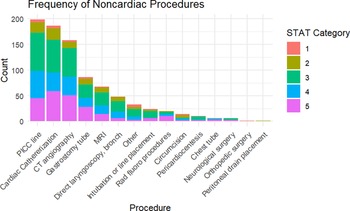
The most common non-cardiac procedures were peripherally inserted central catheter placement, cardiac catheterisation, and CT with angiography. Figure 2 shows non-cardiac procedures in order of decreasing frequency.
Frequency of non-cardiac procedures.

Figure 2 is a bar graph of non-cardiac procedures arranged by frequency. Peripherally inserted central catheter placement is the most common procedure. Cardiac catheterisations include elective evaluations prior to cardiac surgery (e.g., PAI/VS) or routine follow-up (e.g., s/p OHT) and interventions (e.g., BAS). PICC – peripherally inserted central catheter, CT – computer tomography, bronch – bronchoscopy, PA/IVS – pulmonary atresia with intact ventricular septum, OHT – orthotopic heart transplant, STAT – Society of Thoracic Surgeons-European Association Surgical Complexity Score.
The duration of time between neonatal cardiac surgery and the next (non-cardiac) anaesthetic varied by the STAT category of cardiac surgery. Neonates who underwent STAT 1 operations had a mean duration until their immediate next anaesthetic of 42.38 days, while STAT 2 was 16.47, STAT 3 was 21.54, STAT 4 was 47.1 and STAT 5 was 11.53 days. The duration of time between non-cardiac anaesthetics is qualitatively shown in Figure 3.
Timeline of non-cardiac anaesthetics for each study participant.

Figure 3 shows individual timelines for each neonate’s birth (blue), cardiac surgery (red), and non-cardiac anaesthetics (green). Each horizontal line represents an individual newborn. Events are plotted relative to day 0 (cardiac surgery). Grey connecting lines link sequential events for each neonate, illustrating the interval between birth, non-cardiac anaesthetics, and cardiac surgery.
Non-cardiac anaesthetics trended with the complexity class of the corresponding neonatal cardiac surgery for that participant. Frequency of burden of non-cardiac anaesthetics was defined as low (0–1 non-cardiac anaesthetics during the first year of life); medium; Reference Triedman and Newburger2,Reference Sulkowski, Cooper and McConnell3 and high (4 or more). Participants who underwent STAT 1 category cardiac surgeries never required high utilisation of non-cardiac anaesthetics in their first year of life, and 82% (259/314) of participants required 4 or fewer non-cardiac anaesthetics. The burden of non-cardiac anaesthetics during the first year of life stratified by STAT category of cardiac surgery is defined in Figure 4.
Burden of non-cardiac anaesthetics in infants after having neonatal cardiac surgery.

Figure 4 is a bar graph that shows the burden of anaesthetics for non-cardiac procedures during the first year of life stratified by STAT category. The highest burden of non-cardiac anaesthetics, greater than or equal to 4 in the first year of life, represented by yellow, occurs in infants who underwent STAT 5 neonatal cardiac surgeries. Frequencies of high-use non-cardiac anaesthetics for each STAT category were STAT 1 0/48 (0%), STAT 2 4/57 (7%), STAT 3 28/92 (30%), STAT 4 17/78 (22%), and STAT 5 23/39 (59%).
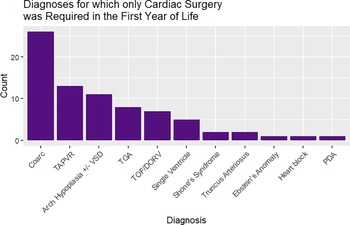
Finally, 77/314 participants underwent neonatal cardiac surgery and no others in the first year of life. These are sorted by frequency of diagnosis in Figure 5.
Diagnoses for which a participant required cardiac surgery as a neonate, and no other surgical procedures during the first year of life.

Figure 5 is a bar chart of cardiac diagnoses of participants who were repaired as neonates. None needed additional non-cardiac anaesthetics in their first year of life. Coarc – coarctation of the aorta; TAPVR – totally anomalous pulmonary venous return; Arch Hypoplasia – aortic arch hypoplasia with ventricular septal defect; TGA – transposition of great arteries; TOF/DORV – tetralogy of Fallot or double outlet right ventricle; PDA – patent ductus arteriosus.
Discussion
We found that the neonates undergoing congenital heart surgery undergo, on average, 2 non-cardiac anaesthetics in their first year of life, with a range of 0–16 non-cardiac anaesthetics. Here, we aim to capture the procedural and anaesthetic burden of this population.
In our cohort of 314 CHD neonates undergoing 862 procedures, 131/314 (42%) neonates had at least one anaesthetic for a non-cardiac procedure prior to neonatal congenital heart surgery, with the typical neonate undergoing 2.75 procedures (not including cardiac surgery) in the first year of life. These findings emphasise the importance of preoperative stabilisation, interventional diagnostic evaluation, and vascular access in this unique population. The procedural burden was concentrated among higher-complexity cases, given that STAT 5 category patients were associated with the most frequent use of anaesthetics for non-cardiac procedures.
Interestingly, 77/314 (27%) of neonates did not require any non-cardiac procedures in the first year of life (Figure 5). This result not only highlights the heterogeneity in the care needs of this population but also reflects that there was a subset of patients receiving cardiac surgeries with minimal need for additional procedures. Common cardiac diagnoses for which no other non-cardiac anaesthetic was needed included coarctation of the aorta, totally anomalous pulmonary venous connection, aortic arch hypoplasia with ventricular septal defect, and transposition of great arteries with an intact ventricular septum, ventricular septal defect, or left ventricular outflow tract obstruction.
Johnson and colleagues examined the perioperative course of neonates undergoing congenital heart surgery using the paediatric hospital information system database. Reference Johnson, Wilkes and Menon1 These investigators stratified total hospital cost by admission location (NICU, PICU, or CICU). They collected data on charge capture for imaging and other procedures but did not include it in their cost data because of a lack of availability of charge-to-cost ratios for each hospital. Nonetheless, they found that the median hospital cost was $110,240 dollars. This monetary cost is substantial and could be essentially additive to the qualitative family life burden cost of these same children undergoing non-cardiac anaesthetics.
The limitations of our study include those of any retrospective study, but also that expected or planned non-cardiac anaesthetics were not separated. For example, any neonate who underwent stage 1 palliation likely had a non-cardiac procedure in the first year of life to plan stage 2, e.g., cardiac catheterisation or CT. Selection bias may have occurred in the case when the participant’s primary team provided sedation for an imaging procedure; therefore, no anaesthetic record of the event is available. In our practice, this situation is rare. In addition, our data may not have captured each time multiple procedures were performed under the same anaesthetic.
Summary
We present the burden of non-cardiac anaesthetics in the first year of life for those who have undergone neonatal cardiac surgery at a quaternary heart centre. We hope this data could be used for staffing allocations and family and care team expectations and planning for resource or staffing allocations in this resource-intensive group.
Acknowledgements
The authors would like to thank the team at the Texas Center for Pediatric and Congenital Heart Disease (TCPCHD).
Financial support
This study was conducted without funding.
Competing interests
The authors have no conflicts of interest to disclose.
Ethical standard
The authors have each materially contributed to the aspects of this work. They have read and approve of the final version.





 Open access

