

Since the late nineteenth century, blast furnace steelmaking had dominated the steelmaking process. This method involved melting iron ore with coal in blast furnaces to produce pig iron, which was then refined in open-hearth furnaces (OHF) or Bessemer converters. The complexity of the process, which also included facilities for the preparation of raw materials and the subsequent transformation of steel into final products, involved significant fixed capital investment. From the 1960s onwards, several innovations defined a new technological paradigm, markedly increasing the installation costs of integrated plants. One such innovation was the widespread adoption of basic oxygen furnaces (BOF), which rapidly replaced traditional OHF and Bessemer converters. BOF excelled in terms of steel quality and refining speed. Unlike OHF, BOF predominantly utilized pig iron, necessitating the installation of larger blast furnaces to boost production. Additionally, the adoption of continuous or semi-continuous wide strip mills facilitated mass production of hot-rolled strip, the primary semi-product for flat product manufacturing, further amplifying production scale. These innovations precipitated a notable surge in the optimal size of integrated plants, escalating from 1–2.5 million metric tons (t) in the 1950s to 6–7 million in the 1970s.Footnote 1
As large steelmaking groups embarked on establishing these colossal steelworks, smaller steel mills known as minimills began to emerge in the sector. Based on electric arc furnaces (EAF), these plants introduced an alternative technological paradigm to blast furnace steelmaking. In this paradigm, scrap replaced pig iron as the primary raw material, with electricity supplanting coal and other fossil fuels. Since the early 1970s, the proliferation of electric steel plants and their capacity to compete with large integrated plants in specific market niches garnered the attention of various researchers, particularly in the US. The US case’s significance to researchers is unsurprising, given that a study by Unece identified thirty-seven operational minimills in the US during the early 1970s. This stood in stark contrast to Western Europe, where the number of minimills was relatively low, with four in West Germany, two in Austria and Switzerland combined, and none in France. Italy and Spain represented the exceptions, as they had twenty-two and seven minimills, respectively.Footnote 2
The definition of a minimill and its origins predominantly stem from the history and features of production units based in the US. Following Barnett and Schorsch, a minimill is a steel plant that produces common steel by melting down scrap in EAF, with the resulting molten steel often continuously cast into semifinished products. The same authors point out that its production is dedicated to low-value commodities such as wire rods, reinforcing bars (rebar), and merchant-quality bars for local or regional markets. Scholars widely concur that the inception of minimills can be traced back to the 1960s when integrated mills ceased the production of these less profitable products, thereby creating an opportunity for non-integrated companies to enter and dominate this segment of the market.Footnote 3
The proliferation of minimills led to an increased share of electric furnaces in total steel output. In the US, EAF production grew from 13.8 million t in 1965 to 28.7 million t in 1974, accounting for 10% of total steel production in the former year and 20% in the latter. A similar trend is observed in Japan, where production by electric furnaces increased from 4.5 million t in 1960 to 20.9 million t in 1974, representing 18% of total steel output. In the European Coal and Steel Community (ECSC), EAF steel production exceeded 25 million t in 1974, equivalent to 16% of total output. However, this production was concentrated in three countries: the UK (5.3 million t), West Germany (5.7 million t), and Italy (9.9 million t). In the latter, electric furnaces accounted for 41.4% of total steel output, compared with only 11% in West Germany. Among the rest of the Western European countries, Spain was the main producer of steel by electric furnaces with 4 million t, constituting 36% of total output, followed by Sweden (2.5 million t) and Norway (0.5 million t).Footnote 4
The significant presence of electric furnaces in Spain and Italy can be attributed to the early adoption of EAF for producing common steels, particularly notable in Italy. By 1950, approximately 40% of steel production in Italy was carried out using electric furnaces. Similarly, in Spain, EAF steelmaking experienced rapid growth in the 1950s, accounting for 20% of total production by 1959.Footnote 5 However, this does not necessarily indicate that the minimill phenomenon developed more extensively or earlier in these Mediterranean countries compared with the US. Most of their EAF steel originated from small non-integrated steel mills, which, according to the abovementioned Unece report, cannot be categorized as minimills:
Mini steel plants should not be confused with ordinary small plants which still exist in many countries under special economic conditions and which also produce a limited range of steel products in relatively small quantities. These plants can be semi or fully integrated plants even with small blast furnaces, open-hearth furnaces, or electric furnaces, and small blooming mills, but they are, under normal conditions, not competitive with large modern plants.Footnote 6
Indeed, many of the steel mills in Spain and Italy that used electric furnaces in the 1950s would align with this description. However, during the subsequent decades of the 1960s and 1970s, several of these mills underwent significant modernization efforts and expanded their production capacities, effectively transitioning into minimills.
Studying the adoption of the minimill model in Italy and Spain in the 1950s–1980s is crucial to understanding how a technology previously considered residual and inefficient has gained an increasingly important role with implications for the present day.Footnote 7 We cannot forget that EAF produced 43.3% of European Union (EU) steel in 2022.Footnote 8 Furthermore, this production process represents one of the fundamental tools identified by EU institutions and producers in their concerted efforts to align the steel industry with criteria of environmental sustainability.Footnote 9 Regarding this latter point, recent studies demonstrate the importance of adopting the historical-critical method to investigate green entrepreneurship, whose roots can be traced back to the nineteenth century.Footnote 10
The success of the minimill model remains relatively unexplored, as research has predominantly focused on large integrated steel mills.Footnote 11 There are detailed studies on its developments during the challenging circumstances faced by the steel industry in the 1970s and 1980s, as well as investigations into technological and geographical issues of producers known as Bresciani.Footnote 12 However, there is still a gap in comparative research explaining the reasons behind Italian and Spanish leadership in this production segment from 1950 to 1990. This paper aims to address this gap by explaining the factors that contributed to the proliferation of small independent steel mills in Italy and Spain and their subsequent evolution into minimills. Conducting a joint analysis of these two countries is particularly intriguing, as it allows us to assess whether common elements existed that led them to converge toward a similar production structure by the 1970s, one that notably diverged from that of the main steelmaking powers of the ECSC. Moreover, it enables us to understand which factors allowed minimills to establish themselves as a new model even during the years of the steel crisis and beyond. The study offers new insights into the rise of these small and medium-sized steel companies, confirming the importance of endogenous factors and clearly demonstrating the relevance of exogenous ones. Specifically, it provides new evidence on the flexibility and ability of minimills to invest in technological and market niches while revealing the significant role played by national governments and European institutions.
The institutional framework within which minimills emerged differed significantly between the two countries, particularly due to their paths in the European integration process. Italy was among the founding members of the ECSC in 1951, whereas Spain did not join the European Communities until 1986, which had significant implications for access to raw materials and the European common market. Despite these institutional disparities, both countries responded similarly to the steel shortage of the 1950s, resulting in the emergence of numerous small producers. Subsequently, from the 1960s onwards, to remain viable, these small and medium-sized enterprises developed an alternative model to the blast furnace steelmaking employed by large groups, capitalizing on the opportunities presented by EAF and continuous casting.
To carry out the investigation, the study uses two main sets of primary sources: (1) archival documents and (2) records and studies produced by authoritative subjects at the time of the events reconstructed and analyzed. The former are from international and national archives, i.e., the Historical Archives of the European Union (HAEU), and archive of Unesid (the Spanish steel business association). Among the latter, there are industry analyses, reports, and statistical bulletins elaborated by national and international bodies (Delegación Oficial del Estado en las Industrias Siderúrgicas, Unece), the research departments of European institutions (ECSC, Eurostat), acknowledged business associations (Assider, Federel, Unesid), and a then leading EAF company (Falck). These primary sources were particularly useful for obtaining data and information on the development of the steel industry, especially regarding the spread of electric furnaces and minimill technology among businesses.
The article is divided into three sections. The first section analyzes the proliferation of electric steel plants in Spain and Italy in the 1940s and 1950s. The second explains how some of these small steel plants were transformed into minimills. The last section explains why the number of minimills continued to increase in the 1970s despite the severe crisis in the sector and how they were able to resiliently face the restructuring process of the 1980s. The paper ends with some brief conclusions.
The Proliferation of Electric Steel Plants after World War II
Italy’s resource endowment was not favorable for the development of the steel industry: lacks in coal, and iron ore reserves—primarily located on the island of Elba—impeded the development of a large-scale integrated steelmaking industry. The limited mineral reserves and dependence on external coal supply led Italian steelmakers to adopt processes that allowed for the substitution of pig iron obtained from blast furnaces with scrap, either partially (in the case of OHF) or completely (in the case of EAF). Although there was a clear predominance of the former on the eve of World War II, electric furnaces already played a prominent role, accounting for 27% of steel production.Footnote 13
The preference for OHF and EAF clearly influenced the structure of the sector. There were three main types of plants: (1) coastal integrated steel plants using OHF, (2) non-integrated plants characterized by the adoption of both OHF and EAF, and (3) small plants equipped only with EAF producing steel from scrap. Overall, production was scattered among diversely oriented production units, and integrated mills had never been competitive.Footnote 14 Troubles faced by the main steel group, Ilva, and other steel companies prompted their rescue by Iri, a state holding company, in 1934. In 1937, Iri decided to group these assets into a new holding company, Finsider, which produced 72% of Italian pig iron and 27.5% of Italian steel at the time of its establishment.Footnote 15
World War II caused serious damage to Italian steel plants. Finsider’s plants suffered the most damage and required a significant financial commitment for their reconstruction. Until 1948, all efforts focused on restoring damaged facilities. Subsequently, the so-called Sinigaglia Plan took place. After the wartime seizure, dismantling, and transfer to Germany of the large integrated steel plant in Cornigliano, Italy made strategic investments for rebuilding it and relaunching integrated steelmaking.Footnote 16 However, in the early postwar period, reduction in steel production from large plants coincided with a growing demand generated by the reconstruction. In this context, old and new private businesses—mostly based in the Northern part of the country—obtained significant profits by taking advantage of the opportunities offered by the construction industry and the abundance of war remnants, end-of-life rails, and scraps from major industry players.Footnote 17 With the chance of sourcing low-cost raw materials and cheap labor and making excellent profits due to high prices, an increasing number of firms adopted outdated rolling mill systems and dedicated themselves to the production of rebars.Footnote 18
During the 1950s, a further notable surge in construction activity took place. Driven by both economic expansion and concerted efforts from private and public sectors, this surge involved both housing and infrastructures.Footnote 19 Together with rising incomes, the gradual relaxation of rent controls, the Tupini Law of 1949 (offering tax incentives and state subsidies for public housing), and the Aldisio Law of 1950 (authorizing financial institutions to provide preferential-rate loans for housing development) were pivotal in fostering private investments.Footnote 20 In 1949, the Italian parliament launched the Ina-Casa Plan to address unemployment and provide affordable housing. In 14 years, this led to the construction of 1,920,000 living units, equivalent to 355 residential dwellings, costing 936 billion lire.Footnote 21 Additionally, in 1956, the construction of the longest Italian highway—the well-known Autostrada del Sole—started, symbolizing the substantial investments Italy was undertaking to bolster its logistical infrastructure.Footnote 22 Amidst this, the Bresciani, small to medium-sized steel manufacturers primarily based in the province of Brescia, seized the opportunities provided by the growing demand for reinforcing bars.Footnote 23
In these dynamics, EAF played a crucial role in the production of both pig iron and steel. Although the use of electric furnaces for pig iron production was not new—162,500 t had been produced in 1940, accounting for 15.7% of domestic pig iron—their output increased rapidly after the war. In 1952, when blast furnaces had not yet reached prewar production levels, there were thirty-nine electric furnaces dedicated to pig iron production, mostly located in the northwestern part of the country (Aosta, Lombardy, and Piedmont), producing 281,000 t, equivalent to 25.5% of the national production.Footnote 24 The production of iron through electric furnaces, primarily to supply OHF in non-integral factories, had some significant advantages. Firstly, it allowed the use of domestic minerals, particularly from Elba Island and the Bergamo region, along with iron sands from the Mediterranean and pyrite ash from sulfuric acid production. Secondly, coal consumption was markedly lower at 450 kilograms per metric ton of steel, compared with the 900 kilograms required in blast furnaces. However, its production had the drawback of being profitable only during the 5 or 6 months of the year when hydroelectric production increased and electricity costs were lower.Footnote 25 Consequently, pig iron production via EAF surpassed its prewar peak in 1948 and, bolstered further by the demand of the Korean War, it grew until the mid-1950s. However, thereafter, it declined as Finsider’s modernized blast furnaces started their production.Footnote 26
Even more significant was the use of EAF for steel production from scrap. By 1953, there were 236 electric furnaces in operation; most of them were in Lombardy (98) and Piedmont (67), regions that accounted for 77.4% of EAF steel production. Electric furnaces were mainly responsible for the increase in steel production in the early postwar years. In 1952, their production reached 1.54 million t, nearly doubling the previous peak of 0.8 million t reached in 1941, while open-hearth furnaces remained below their prewar peak achieved in 1929. As a result, electric furnaces accounted for 43% of Italian steel production, compared with 51% of OHF and 6% of Bessemer process.Footnote 27
In the 1950s, the intervention of the ECSC in the scrap market fostered the development of EAF steelmaking. Considering Italy’s need to import scrap from non-ECSC countries, where its price was higher, and the overall excess of demand for this raw material in Western Europe, ECSC member states made a specific agreement. In 1953, under the supervision of the High Authority, they created both a compensation system for imported scrap through an equalization fund, and a consumers association entrusted with two primary tasks: (1) negotiating conditions and prices of scrap imports from third countries and (2) managing the abovementioned fund. Two years later, the High Authority also introduced a maximum price of $36 per metric ton of scrap. These measures significantly contained the prices of imported scrap in Italy, sharing the costs among the member countries.Footnote 28
These favorable circumstances alone are not enough to explain the preference of small and medium-sized enterprises for EAF over OHF. A report prepared by the ECSC in the mid-1950s showed that the differences in production costs between the two processes were not significant—only 4.5% in favor of electric furnaces. Moreover, this difference could vary significantly depending on scrap prices and electricity costs. The major advantage of electric steel plants laid in their lower installation costs. For an electric steel plant with a production capacity of 150,000 t, these costs amounted to 7,666 lire per metric ton, a figure that nearly doubled to 13,333 lire for an OHF steel mill of the same capacity.Footnote 29 Thus, while the state-owned group Finsider invested in coastal integrated mills with open-hearth furnaces, private steel mills, with much more limited financial resources, expanded in inland regions, relying primarily on electric furnaces.Footnote 30
This peculiar Italian production model corresponded to an equally peculiar business structure, characterized by a strong presence of small and medium-sized enterprises in the sector. According to Balconi, the shortage of steel in Italy immediately after World War II was “the historical accident which unleashed the massive entry of minimills into an industry already settled as a closed oligopoly.”Footnote 31 This massive entry of new producers mainly occurred in the early postwar period, as by the early 1950s, the business structure that would define the decade had already been established.
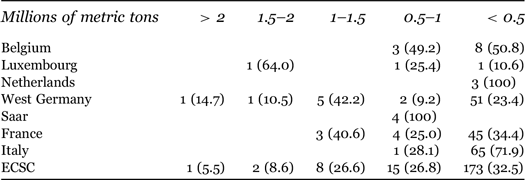
Table 1 presents the distribution of steel production among Italian companies compared with the rest of the ECSC countries. While the average steel production of ECSC steel companies was around 220,000 t per year, in Italy, it was 65,000 t. In terms of production capacity, only Ilva exceeded half a million metric tons (993,000 t), while the other 65 Italian producers had a capacity of less than half a million of metric tons each. Among these, only four state-owned companies (Cogne, Dalmine, Terni, and Siac) and three private businesses (Falck, Fiat, and Breda) surpassed 100,000 t per year. Overall, scattered production among a great number of very small firms was the dominant feature of the sector. However, a distinction should be made between companies that produced between 30,000 and 100,000 t per year and the others. Although the former had some electric furnaces, they obtained most of their steel from OHF. However, out of the forty-eight companies with an output of less than 30,000 t, forty-four exclusively produced steel by EAF. In addition to those included in Table 1, there were seventy other small businesses; most of them were re-rollers based in Lombardy, which mainly produced commercial iron and rebars.Footnote 32
Size of Steel-Producing Undertakings in 1952 (Number of Companies and Percentage of Total Steel Production).

Sources: Haute Autorité, Ordre de grandeur des entreprises productrices d’acier de la Communaté, 17/03/1953, HAEU, CEAB8-110; Falck, Sintesi 1952, 2–3.
After the recovery of prewar output levels, the strong growth of the 1950s—crude steel production increased from 2.36 million t in 1950 to 8.46 million t in 1960—was the result of production capacity expansion by existing companies rather than the entry of new producers.Footnote 33 In contrast to the mass production model of large companies, small and medium-sized enterprises opted for fabbricazioni speciali (specialized manufacturing) to adapt to a highly heterogeneous demand characterized by small batches, a wide variety of products, and specific requirements regarding materials and sizes. Many of the steel mills focused on this type of production joined the business association called Isa. Despite being highly diversified, the 30 steel mills affiliated to Isa shared some features worth highlighting. These were non-integrated plants, although some produced small quantities of pig iron using electric furnaces. The majority exclusively produced steel by EAF and had hot rolling facilities. While each production unit had a wide range of products, there was a clear production specialization. Out of the 531,835 t of final products manufactured in 1959, 350,999 t were long products, and 114,947 t were wire rods. It is also important to note the concentration of these businesses in northern Italy, particularly in Lombardy. Alongside these small steel mills, there was a significant number of very small rerolling mills, which were mainly concentrated in the province of Brescia. In 1959, forty-three of these firms associated with Isa produced 500,000 t of rolled products, primarily rebars.Footnote 34
In Spain, the economic landscape of the 1940s posed significant challenges for the steel industry’s development. Following the conclusion of the Spanish Civil War (1936–1939), difficulties in importing machinery and raw materials, particularly coke and scrap, hindered the recovery of prewar production levels. While such obstacles were widespread across European economies during World War II, Spain faced prolonged difficulties until the early 1950s, as the country was excluded from the European Recovery Program. Consequently, the production peak achieved in 1929 was not regained until 1954. This recovery was possible because, since the early 1950s, the end of Spain’s diplomatic isolation resulted in gradual improvements in trade relations and access to private and institutional credits from the US, which enabled a steady supply of steel raw materials. Additionally, significant economic growth driven by the industrial sector led to a surge in demand for steel.Footnote 35
Due to the inability to import machinery throughout the 1930s and 1940s, Spanish steel facilities remained severely outdated and lacked the necessary production capacity to meet the escalating demand. The scarcity of steel emerged as a primary impediment to the country’s industrial development. In response to this challenge, the government intervened by establishing an organization to regulate the distribution of steel products, implementing quotas for consuming industries, fixing prices, managing the distribution of steel raw materials, and establishing a state-owned steel company, Ensidesa. Concurrently, private integrated companies initiated expansion and modernization projects. However, the chronic shortage of foreign exchange constrained the ability to import crucial production elements. Until the late 1950s, these elements could only be procured through US loans. These challenges also delayed the start of production at Ensidesa’s integrated plant, established in 1950. Despite receiving favorable treatment from the government, it did not commence steel production until 1958.Footnote 36
Combined with the robust growth experienced by the industrial sector, the slow progression of expansion plans within the integrated steel industry resulted in significant unmet demand, prompting the emergence of numerous small steel mills. In the early 1940s, Spain had only thirty-four steel producers, with Altos Hornos de Vizcaya alone contributing 61% of the country’s steel production through its two integrated plants. The remaining 17% was shared among the 4 other integrated mills, while 19% came from 11 non-integrated mills, and the rest originated from eighteen steel foundries. Open-hearth furnaces dominated steel production, accounting for 66% of the total output, followed distantly by the Bessemer process (26%) and electric furnaces (8%). About half of the EAF output consisted of special steel, mainly produced by three companies. The remaining primarily stemmed from small steel foundries with an annual output of no more than 4,000 t.Footnote 37
The challenging environment in which the steel industry operated until the mid-1950s prompted significant alterations in its production structure. As in Italy, electric furnaces managed to surpass prewar production levels much earlier than other steelmaking processes. Their peak production of 50,000 t, achieved in 1930, was exceeded in the early 1940s. Starting from the following decade, EAF steel production witnessed substantial growth, reaching 173,329 t in 1954, while the combined production of OHF and Bessemer processes remained below prewar levels. However, unlike Italy, the surge in production was primarily driven by new market entrants.Footnote 38
According to a Ministry of Industry report, there were 120 steel producers in Spain in 1957, with over half of them lacking rolling mills, typically being of modest size. Only seven were integrated mills, and forty-one were non-integrated steel mills with rolling facilities, including those that later adopted the minimill model in the subsequent decade. These establishments collectively operated eighty electric furnaces, with an annual production capacity of 427,000 t, averaging just over 5,000 t per furnace. While five of these companies exclusively used OHF or Bessemer processes, thirty relied solely on electric furnaces. Among the latter, twenty-one were established after the Spanish Civil War, and six, although existing earlier, were not recorded as steel producers in the early 1940s. These EAF plants were typically quite small, with most having only one or two furnaces and only eight possessing three or more. Consequently, their production capacity was limited, with none exceeding 100,000 t per year, and only four surpassing 20,000 t per year. Their primary products included merchant bars and wire rods, although some also manufactured flat products, primarily strips and thin sheets.Footnote 39 Over time, their production increasingly focused on common steels. Until the early 1950s, over half of the Spanish EAF output comprised special steel products; by 1961, this category represented only 165,000 t out of over 400,000 t produced by electric furnaces. Notably, these commodities were manufactured in fifty mills, of which only five exceeded 5,000 t. This lack of specialization in Spanish EAF steel mills is evident from their mixed use of furnaces for both special and common steels.Footnote 40
The proliferation of electric furnaces in Spain during the 1940s and 1950s might appear surprising, given that both the geographical and institutional landscapes were less favorable compared with the Italian scenario, particularly concerning the procurement of raw materials and electrical energy. Due to the lack of domestic production, the country had to import graphite electrodes for the furnaces, faced frequent electrical restrictions until the mid-1950s, and heavily relied on imported scrap owing to its industrial underdevelopment. Restrictions on scrap exports imposed by Western European countries made the US the primary supplier to the Spanish steel industry, accounting for 76% of imports in 1958. Naturally, transportation costs influenced the final cost of this input, resulting in its price being much higher in Spain compared with Italy, which also benefited from the maximum price policy set by the ECSC. Consequently, Spanish producers were paying $76 per metric ton at the end of the 1950s, compared with $30–40 per metric ton in the ECSC.Footnote 41
The rapid adoption of electric furnaces for producing common steel cannot be attributed to any competitive advantage but rather to the challenges faced by integrated steelmakers in expanding their production capacity and meeting the escalating demand for steel. This scenario favored the emergence of numerous small steel producers. State intervention in distribution and pricing not only failed to address the steel shortage but also fostered a lucrative black market, enticing new entrants into the sector.Footnote 42 Given their substantial number and equipment (small furnaces of less than 5 metric tons operating intermittently), it was likely more challenging for government agencies to control the actual production of these companies. These new steelmakers tended to establish themselves in areas with a high concentration of metallurgical and mechanical industries, where it was easier to find substantial unmet demand and obtain scrap outside official channels. In 1957, among the thirty operating EAF steel mills, fifteen were in the Basque Country, five in Madrid, and three in Barcelona.Footnote 43
From Small Steel Plants to Minimills
From 1960 to 1973, Italy strengthened its position as one of the largest European steel producers: crude steel production grew from 8.5 million to 21 million metric tons, and its share of production within the ECSC increased from 11.6% to 17%.Footnote 44 Even more significant was the growth of steel production in Spain, where crude steel production increased from 1.9 million to 10.8 million t in the same period: an annual growth rate of 14.2%.Footnote 45
In the 1960s, Italy carried out one of the most extensive investment campaigns among ECSC members. Finsider had its production capacity significantly expanded through the construction and subsequent doubling of the Taranto plant.Footnote 46 Overall, the investments made by the state-owned group resulted in an increase in steel production through the integrated route from 3.53 million in 1960 to 8.57 million t in 1970, and in pig iron production from 2.39 million to 8.11 million t.Footnote 47
In the 1960s, private businesses, which mainly relied on EAF, achieved significant improvements too. Scrap price represented a significant fostering factor. On December 1, 1958, the ECSC launched a sort of supervised freedom phase. While maintaining the export ban, it introduced price freedom and liquidated the equalization fund within a year. During this period consumption stabilized around 32–35 million t, while the availability of raw materials grew from 10 to 14 million t. In this context, scrap price remained stable in the ECSC, about $30 per metric ton lower than that of pig iron. Due to its specialization in OHF and EAF, Italy represented the largest importer within the Community (90% of the total).Footnote 48 Meanwhile, the price of imported scrap decreased significantly, going from a maximum of $80 per metric ton in 1957 to values around $40 per metric ton in the following decade. As a matter of fact, in the 1960s, Linz–Donawitz (LD) converters began to replace open-hearth furnaces, allowing for a much higher pig iron content in the charge. This ensured a greater supply of scrap for electric furnaces, which could then produce steel at very competitive costs.Footnote 49 In this favorable context, the production capacity of Italian EAF increased from 3.4 million t in 1960 to 9.6 million t in 1972.Footnote 50
Northern inland regions played a crucial role in this expansion, especially Lombardy. In 1970, Lombardy produced 56% of the Italian steel obtained from electric furnaces, followed by Piedmont with 17%.Footnote 51 Most of Lombardy’s companies were concentrated in the province of Brescia, where EAF production capacity grew by a remarkable eight times—from 465,000 to 3.75 million t—between 1959 and 1970. The capacity to roll long products increased by about five times, from 765,000 to 3.77 million t. Approximately 85% of these were light profiles, especially rebars.Footnote 52 The introduction of continuous casting and the installation of increasingly modern rolling mills allowed the so-called Bresciani to establish themselves as the main producers of concrete reinforcing bars in Europe. Furthermore, this modernization of facilities enabled these businesses to approach the minimill model, capable of steel production at reduced costs, space requirements, and fixed capital investments.Footnote 53
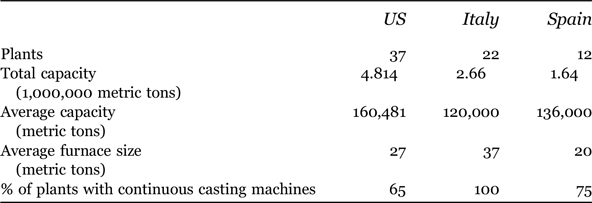
According to the abovementioned report by Unece, Italy was the country that had the second largest number of minimills (twenty-two) behind the US (thirty-seven). Although the list of businesses included in the report is incomplete, it provides sufficient information to understand the main characteristics of Italian minimills in the early 1970s.Footnote 54 As shown in Table 2, these were small-sized companies compared with US minimills. They had an average capacity of 120,000 t compared with 160,481 t on the part of their North American counterparts. This difference mainly depended on the fact that, while US minimills used to have several furnaces, Italian ones typically had a single furnace, albeit larger in size.Footnote 55 Furthermore, while only 65% of US plants operated with continuous casting machines, all Italian plants had been introducing them since the mid-1960s.
Main Features of Minimills in the Early 1970s

Sources: Unece, The steel market, 72–86; Unesid, La Acción Concertada.
Regarding the type of products, there were no differences compared with US minimills. All Italian minimills were dedicated to the production of rebar and light sections. The main difference between US and Italian plants laid in their spatial distribution. While US minimills showed a lower degree of concentration than integrated steelmaking, eleven out of the twenty-two Italian companies were based in the province of Brescia. Five minimills were in Piedmont, and the others were scattered throughout the rest of the country. Initially, most of Bresciani were specialized in rerolling, but in the 1960s, they enlarged their facilities by investing in EAF and continuous casting.Footnote 56
By effectively eradicating inherent bottlenecks within the steelmaking cycle, such as the manual labor-intensive process of ingot stripping, continuous casting facilitated the direct derivation of products from liquid steel without process interruptions and fostered additional advancements in rolling systems. The introduction of curved continuous casting plants was particularly significant for the minimill model. The first continuous casters were of the vertical type, posing a significant disadvantage for small companies, as they necessitated high buildings, approximately 30 meters tall. The adoption of the curved continuous casting process, despite requiring a more costly and intricate installation, offered a crucial advantage for minimills that could use existing buildings. However, its application was limited to the production of long semi-finished products (billets and blooms) owing to quality issues in slab production. In definitive, it gave small firms the opportunity to compact the steel production cycle and provide larger quantities of long products, although initially at the lower end of the value-added range.Footnote 57
Italy positioned itself as a significant reference point in the adoption of this process innovation owing to the entrepreneurial spirit of Bresciani, who were in search of new tools to streamline their simple and quickly amortizable plants. Establishing partnerships with key plant manufacturers, they successfully experimented and rapidly spread curved continuous casting within what was then perceived as a genuine business community characterized by territorial proximity dynamics. The pioneering companies to introduce this innovation were Riva and Ori Martin, in collaboration with Danieli and Concast, respectively.Footnote 58
The story of Emilio Riva is particularly significant. Despite not being native to the province of Brescia, he was closely tied to the Bresciani, as he supplied them with scrap and traded their rebar. In 1954, he established his own steel mill in Caronno Petrusella, in the province of Varese, to supply customers with ingots. In 1957, he expanded his operation by introducing a Tagliaferri EAF with a capacity significantly higher than the average. By 1964, Riva started pioneering efforts to introduce continuous casting, using Danieli’s experimental machines. This endeavor necessitated substantial financial risk and commitment, with Riva shouldering a portion of the associated costs. Remarkably, by June of the same year, the experimental endeavors bore promising results. Drawing from these foundational achievements, Riva succeeded in expanding his ventures, thereby laying the groundwork for a formidable steel group. After the restructuring initiatives of the 1980s, this group assumed a hegemonic position within the Italian steel industry by acquiring significant integrated facilities previously under state control.Footnote 59
In the case of the Spanish steel industry, the increase in production of the 1960s coincided with a shift in economic policies that had been developing since the end of the Civil War. National economic planning, inspired by French dirigisme, replaced strong state interventionism.Footnote 60 The Concerted Actions emerged as the primary mechanism to incentivize private enterprises to align with state economic objectives. The overarching aim was to stimulate investments in key sectors, with a particular focus on the steel industry due to the country’s enduring steel shortage since the war’s conclusion. In exchange for committing to contribute toward achieving the sectoral objectives delineated in the Development Plans, companies participating in the Concerted Actions could access various benefits. These included tax incentives, flexibility in amortization, forced land expropriation for new investments, and, notably, access to official credit, which could cover up to 70% of the committed investment.
The first Concerted Action for the steel sector began in August 1964 and lasted until 1973. Previously, the state outlined general objectives for the sector in the National Steel Program, while also assigning specific objectives for each of the three subsectors of the Spanish steel industry: integrated steelworks, special steel producers, and non-integrated steel mills. The latter category comprised companies without blast furnaces dedicated to the manufacture of common steels and their subsequent rolling. Although the objectives assigned to the non-integrated steel mills aimed at expanding production capacity, the primary goal was to achieve a significant reduction in production costs.Footnote 61
Following the publication of the guidelines for the Concerted Action, thirty-four companies applied to participate, including two integrated steel mills, twelve special steel producers, and twenty non-integrated steel mills. While some applications were rejected for failing to meet the required criteria, others withdrew voluntarily. Ultimately, eighteen companies benefited from the Concerted Action, comprising two integrated steel mills, five special steel producers, and ten non-integrated companies; together, the latter two groups represented just over half of the total production of the non-integrated steel industry. Upon selection, the government assigned specific objectives to each company, primarily focused on increasing productive capacity, along with outlining the benefits they would receive in return. The primary benefit was official credit to finance committed investments. Thanks to this support, non-integrated companies were able to finance 54% of the investments made between 1964 and 1973, effectively doubling the value of their fixed assets.Footnote 62
These investments enabled companies to expand and modernize their facilities. Some replaced obsolete open-hearth furnaces with electric ones, while others upgraded their electric steelworks with state-of-the-art, higher-capacity furnaces. Consequently, the production capacity of these companies surged from 0.58 million metric tons in 1964 to 1.7 million metric tons in 1973. Furthermore, the adoption of continuous casting technology was widespread among these companies, with a total installation of eight new continuous casting machines. This strategic move resulted in a remarkable spike in productivity, escalating from 53.5 metric tons of steel per worker in 1964 to 144 metric tons in 1972.Footnote 63
Once the Concerted Action was concluded, the average production capacity of the Spanish minimills slightly exceeded that of their Italian counterparts (Table 2). Although the average size of the furnaces was smaller, Spanish minimills normally had three or more furnaces, combining modern furnaces weighing more than 25 t with smaller ones. At the end of 1973, 75% of Spanish minimills were equipped with continuous casting facilities, a proportion lower than that of the Italian steel industry but higher than that of the US. Spanish minimills generally showed a lower degree of specialization compared with their Italian or American counterparts, covering within their production portfolio not only light profiles but also structural profiles, wire rod, welded tubes, casting, and forging. This strategic diversification aimed to meet a varied demand that had minimal appeal for Spanish integrated plants increasingly focused on the manufacture of flat products.
There were notable disparities between Italian and Spanish minimills concerning their spatial distribution and historical evolution. Spanish minimills, although not as concentrated as their Italian counterparts, tended to be situated in areas with a significant presence of metallurgical companies. Specifically, five plants were in the Basque Country, three in Barcelona, two in Madrid, one in Zaragoza, and one in El Ferrol. Almost all these facilities commenced operations as steel mills, with half established prior to the Spanish Civil War and the remaining half between 1939 and 1956. By the mid-1950s, all of them had transitioned into steel mills equipped with rolling facilities. Nine exclusively used EAF, one combined this process with small converters, and the remaining two solely relied on OHF.Footnote 64
In short, the Concerted Action enabled a small number of existing small steel plants in the early 1960s to expand their operations by introducing larger furnaces, continuous casting machines, and enhancements in rolling mills. These upgrades allowed these companies to triple their production capacity and significantly enhance productivity. Production surged from 580,000 t in 1964 to 1.67 million in 1974, while productivity rose from 53.5 to 144 t per worker, approaching the productivity levels of integrated Spanish companies (170 t per worker).Footnote 65
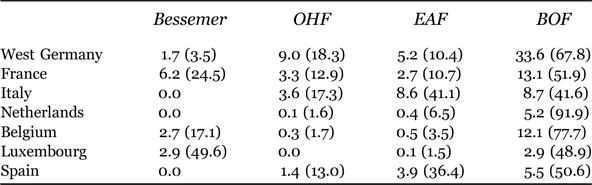
The transformation of several small steel plants into minimills represented a positive aspect of non-integrated steelmaking development in Spain and Italy during the 1960s. However, the extensive adoption of EAF also resulted in significant structural imbalances within the sector. By 1973, the proportion of steel produced by electric furnaces in Spain and Italy far exceeded that of the rest of the ECSC (Table 3).Footnote 66 This disparity stemmed from the predominant use of electric furnaces in the two Mediterranean countries for producing common steel, while other ECSC members primarily employed EAF for special steels. The prominent role of minimills in common steel production led to an excessive focus on manufacturing long products. Steel produced by electric furnaces lacked the necessary quality to manufacture flat products, such as tinplate or sheets for automobiles and white goods, necessitating the use of hot-rolled coils. These coils could only be obtained from integrated plants equipped with BOF.Footnote 67 Consequently, despite a substantial coil deficit in Spain and Italy in the early 1970s, minimills were unable to meet this demand and were compelled to orient their production toward long products, primarily for the construction sector. Italian rebar production surged from 1.26 million t in 1962 to 3.45 million t in 1973, making it the largest in Europe, surpassing Germany (2.21 million t) and France (1.28 million t). Since the early 1970s, increasing exports became an inevitable strategy, as production far exceeded domestic demand. In 1972, exports absorbed 20% of Italian rebar production, with approximately half directed to non-ECSC countries.Footnote 68
Crude Steel Production by Process in Million Metric Tons in 1973 (Percentage of Total Production)

Note: Bessemer includes Thomas Steel
Sources: Eurostat, Siderurgia. Annuario (1974), 26–27; Unesid, La industria siderúrgica en 1973, 15.
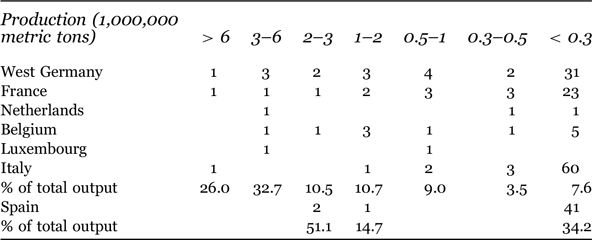
In Spain, the launch of the Concerted Action facilities led to a rapid increase in light profile production, which soared from 1.24 million t in 1969 to 2.13 million t in 1973, exceeding domestic demand. Roughly 17–19% of production had to be exported, a situation exacerbated by the presence of numerous small steel plants and rerolling mills with limited individual production capacity but significant overall capacity. In 1970, 162 electric furnaces were operational, with a production capacity of 3.66 million t, with 90 having a capacity of less than 10 t. Regarding rolled products, there were 171 merchant mills in the country, with half specializing in round bar production and boasting a combined capacity of 3.875 million t.Footnote 69 According to the committee responsible for preparing the Third Economic and Social Development Plan, these productions required urgent restructuring aimed at dismantling the most obsolete and least profitable facilities. In 1971, companies with production below 300,000 t accounted for only 7.6% of the ECSC’s total production, while their contribution reached 34% in Spain (Table 4). Only the three integrated companies had a production capacity exceeding 300,000 t.Footnote 70 The weight of small and medium-sized enterprises was also substantial in Italy, with 30% of crude steel being produced by sixty companies with a capacity of less than 300,000 t per year. Only Falck, Fiat, Breda, and state-owned enterprises exceeded that capacity. Among others, seventeen companies had a production capacity between 100,000 and 250,000 t per year, while twenty-one produced between 50,000 and 100,000 t per year. Italian minimills and non-integrated companies that still utilized OHF for steel production were included in these two groups. Additionally, there were numerous small steel plants with rolling facilities, alongside approximately sixty rerolling mills, all of which were relatively modest in size.Footnote 71
Size of Steel-Producing Undertakings in the ECSC and Spain in 1971 (Number of Companies and Percentage of Total Steel Production)

Note: The data for Spain correspond to the forty-four steel mills with rolling facilities that were members of Unesid in 1970. The census of the Sindicato Nacional del Metal included a total of fifty companies of this type on the same date
Sources: Eurostat, Siderurgia. Annuario (1974), Appendix II-8, 296–297; Comisaría del Plan de Desarrollo Económico y Social, Industrias básicas de metales, 138–141; Unesid, La Acción Concertada, 21.
The Resilience of Minimills: Thriving amidst Crisis, 1974-1990
The steel industry underwent serious troubles during the 1970s crisis due to a decrease in demand and drop in prices, as well as increased costs for energy, wages, and raw materials. In Western Europe, these problems coincided with the culmination of great modernization and enlargement plans of steel production facilities, which resulted in surplus production capacity and financial problems for large steel-making companies. To address these challenges, European governments invested significant public resources into the financial recovery and restructuring of the sector from the mid-1970s. At the same time, increasing competition from Asian producers reduced export opportunities of large European producers, pushing them to increase their pressure on the ECSC market, especially the Italian one.Footnote 72
In this context, Finsider embarked on the expansion of the Taranto steelworks, which represented the culmination of 25 years of growth. From 1970 to 1976, the group’s production capacity of steel and pig iron increased significantly. This growth was coupled with that of private producers, which primarily relied on EAF and the minimill model. Italy became a reference point in this specific segment of the steel industry.Footnote 73
Despite the crisis, the development of Italian minimills did not stop in the 1970s. In the first half of the decade, they mainly invested in the installation of new production capacity; in the second half, they focused on the modernization of existing plants.Footnote 74 The proliferation of the minimill model fostered a swifter and more profound technological revitalization compared with the developments observed in the leading steel-producing European nations and the US. By 1974, OHF contributed merely 15% to the overall steel production in Italy, while this figure rose to 24.4% in the US. Within the ECSC, approximately 22% of steel was derived from outdated technologies, including Bessemer converters, with notable disparities among key producers: France, 30%; Germany, 20%; and the UK, 28%.Footnote 75 In 1980, only three open-hearth furnaces were still active in Italy. Meanwhile, continuous casting spread rapidly: Italy became the second ECSC member (behind Denmark) with the highest ratio of continuous casting production to crude steel production. These investments contributed to consolidating the minimill model in the country as the number of firms that adopted it doubled in less than a decade (Table 5). Almost all the plants were in the northern regions, as only two were south of the Po River. There was a significant concentration in Lombardy, where half of the minimills were based; most of them (fifteen) were in the province of Brescia.Footnote 76
Comparison of Italian Minimills in 1971 and 1980

Sources: Unece, The steel market, 81–86; Assider, Repertorio.
Once again, the supply conditions of inputs remained favorable for the development of EAF steelmaking until the late 1970s. After 15 years of tariff freeze and concessions favoring energy-intensive industries due to pressure from public opinion on Enel, the state-owned enterprise holding a monopoly over the Italian electricity sector, electricity rates experienced an increase in 1974. However, this was notably lower than the significant surge in energy commodity prices observed between 1959 and 1973, and Italian minimills could continue to enjoy similar or lower tariffs than those typically borne by other EAF steelmakers in the ECSC.Footnote 77 Furthermore, the flexibility of scrap price represented a significant advantage during the recession of those years. In that period, steel product prices were decreasing, but so were the prices of the raw material, allowing minimills to maintain fair margins.Footnote 78 In this scenario, unlike the state-owned Finsider, which was entangled in massive investments made in the previous years and decisions driven by political agendas,Footnote 79 Italian EAF steel producers were able to uphold commendable levels of competitiveness by adhering to market logic and sustaining cooperative relationships amongst themselves. As in the 1950s and 1960s, subcontracting relationships continued, with larger businesses handling major orders and leaving smaller ones to companies with smaller plants in exchange for a commission.Footnote 80
After experiencing significant growth for several years, steel demand stagnated from 1973 onwards, with a brief upturn observed in 1979 and 1980. Despite this, the expansion of production capacity led to a surge in supply, particularly in the production of rebars, which increased from 2.6 million t in 1971 to 3.6 million t in 1974 and 4.6 million t in 1979. The domestic market could not absorb this growth, prompting Italian steel producers to export larger quantities of long products to maintain a reasonable utilization rate of their facilities. Regarding merchant bars, exports rose from 20% of production in 1973 to 25% in 1974–1977 and peaked at 33% in 1978–1979.Footnote 81 Following the oil shock, steel consumption in developing countries increased significantly, concentrating more on building construction, public works, and infrastructure than on the mechanical industry. On this basis, despite the growing competition from the spread of the minimill model in the Far East and Latin America, the Bresciani continued to achieve excellent results by exporting rebar and other long steel products. In addition to their success in the countries of the European Communities (EC), they also acquired the Middle East as an important new market (Figure 1).Footnote 82
Production and exports of rebars in Italy, 1962–1982 (1,000 metric tons).
(Sources: Eurostat, Iron and steel yearbook [1974–1987]; Eurostat, Iron and steel 1952–1982 [1983], 53–54.)

Starting in 1978, amid a period of widespread distress in the global steel industry, the situation began to grow increasingly challenging for Italian minimills as well. The crisis deepened at the onset of the 1980s with the second oil shock. This downturn was driven by several factors. The supply of scrap became increasingly scarce, and electricity rates in Italy grew much more rapidly than abroad, nearly doubling between 1979 and 1982. Production capacity was weakened, dropping from 9 to 7 million t, impacted by labor disputes and a reduction in workable hours imposed by new labor agreements. Meanwhile, new markets in the Middle East became less receptive due to the Iran–Iraq war and the civil war in Lebanon. Last but not least, the flexibility of the Bresciani was significantly curtailed by measures of the Commission of the EC. Between 1977 and 1980, companies were required to comply with minimum prices for rebar and other rolled products and to reduce production. However, these measures were based on outdated companies and failed to account for either the actual decline in prices or the shrinking demand. In other words, while these policies protected integrated cycle companies, they allowed those from third countries to penetrate the European market and proved detrimental for the Bresciani, which could have produced at lower costs and captured new market shares.Footnote 83
On October 30, 1980, the Council of the EC declared an official crisis in the steel industry; in the next 8 years, European institutions introduced a series of measures that pursued three main goals. First, measures were introduced to limit price competition and allow companies to survive while investing in their competitiveness. These included mandatory production and delivery quotas, minimum price requirements, and protective measures against imports from non-member countries. Second, European institutions aimed to increase their direct involvement in funding workforce retraining through their budget. Third, regulations were put in place to prevent member states from freely supporting their companies in ways that could trigger a competitive race between countries and undermine fair market conditions. To control this, strict criteria were established for any state aid, the most important of which required companies to reduce production capacity according to the schedule and targets set by the Commission.Footnote 84
In 1983, under the framework of the so-called aid codes, the Commission developed a community-wide plan for plant closures, aiming for a total reduction of 29.8 million t of hot rolling capacity. By 1986, member states had surpassed this target, achieving closures amounting to 33.1 million t, in return for 36.4 billion European Currency Unit (ECU) in aid, 60% of which was used to cover losses.Footnote 85 In Italy, Finsider had to endure cuts totaling 4.6 million t while receiving aid amounting to 10,943 million ECU. The Italian state-owned group, which accounted for 12% of the total capacity among member countries, contributed 15% of the overall adjustment while receiving 30% of the total aid granted between 1980 and 1985. In contrast, Italian private producers were required to close facilities, net of any expansions, amounting to 2.4 million t, or 8% of the total, in exchange for aid of 1,125 million ECU, which was 3% of the total. Ultimately, their net closures were even higher, reaching 2.7 million t of production capacity.Footnote 86
Italian minimills were particularly affected by Italian Laws No. 46 of February 17, 1982, and No. 193 of May 31, 1984. Backed by a gentlemen’s agreement among producers that excluded state-owned companies, the first law enabled the disbursement of 484 billion lire in financial support for the dismantling of plants specializing in the production of semi-finished and rolled products in both common and special steels.Footnote 87 The second law funded further reductions in production capacity, reinvestment in other sectors, and the reimbursement of 10% of the interest on loans taken out. Although it did not limit contributions exclusively to private companies, it provided 767 billion lire: 427 billion for closures, 242 billion for productive reconversion, and 98 billion for interest payments. Overall, the two Italian laws facilitated gross cuts of 6.7 million t in hot rolling capacity among private producers and, along with smaller laws from 1986 and 1987, secured them around 1,400 billion lire.Footnote 88
According to a contemporaneous secondary source, between 1980 and 1985, in the province of Brescia—the heartland of minimills—jobs in the steel sector were reduced by 4,271 positions (from 11,429 to 7,178), and twenty plants permanently closed: thirteen rolling mills, three steelworks, and four minimills. Although the estimates vary, production capacity fell by 1.5 million t for steel and 1.7 million t for rolled products, in exchange for a total disbursement of 297 billion lire.Footnote 89
After reducing excess capacity and securing state aid, Italian minimills began to achieve strong results again in the second half of the 1980s. They renewed and maintained their competitiveness by simultaneously pursuing several strategies: innovating processes through numerous incremental improvements and ladle refining; diversifying into higher value-added products, including special steels; and concentrating production in their most efficient plants and facilities. These efforts led to increased productivity, reduced costs, and new profit opportunities. Building on this foundation, the leading Italian minimills, such as Riva and Lucchini, drove a new wave of production expansion and, in the context of ongoing privatization, acquired plants from Finsider. By 1989, entrepreneurs with experience in minimills had entered the integrated steelmaking sector, managing 47% of Italy’s crude steel and rolled steel production.Footnote 90
Primarily due to government support, the Spanish non-integrated steel industry also underwent significant expansion. In March 1974, before the effects of the international crisis impacted the steel industry, the government initiated a new Concerted Action for the non-integrated steel sector. This initiative aimed not only to expand production capacity but also to modernize facilities and restructure the sector by grouping companies specializing in similar product ranges. Each group was required to establish a company to coordinate production planning and the joint distribution of products. There were five groups consisting of twenty-nine steel producers: two specialized in common steel and three in special steels. Their combined production totaled 2.32 million t, with a planned increase to 5 million t by 1978 through intended investments.Footnote 91
Although the objectives of the Concerted Action were not fully achieved, it did lead to a significant increase in the average size of minimills during the 1970s. Of those listed in Table 6, thirteen had production capacities ranging from 50,000 to 150,000 t, three ranged from 150,000 to 300,000 t, and eight exceeded 300,000 t. These minimills faced minimal competition in light sections, accounting for 92.2% of the production capacity for round bars and 100% for merchant bars and light sections.Footnote 92
Comparison of Spanish Minimills in 1973 and 1980

Sources: For 1973, see Table 2. For 1980, Navarro, Crisis, 160.
The implementation of the Concerted Action coincided with the most severe and prolonged crisis in the history of the Spanish steel industry. When the structural nature of the crisis became evident by mid-1977, the government sought to persuade companies to halt or suspend their investment plans. However, many projects were already in progress and could not be stopped without causing significant damage to the companies. As a result, the production capacity of the non-integrated steel industry, including special steel producers, continued to expand. New electric furnaces, continuous casters, and rolling mills were introduced, increasing production capacity from 5.3 million t in 1974 to 7.865 million t by 1979.Footnote 93
This modernization and expansion of facilities occurred alongside a sharp decline in demand for light sections during the 1970s (Figure 2). In response to this downturn, Spanish minimills, aided by export tax incentives, increasingly targeted international markets. Between 1979 and 1985, exports outpaced domestic sales, absorbing 70% of total production by 1985. Despite this high export volume, rolling mills were only operating at 57% capacity. As a result, Unesid petitioned the government to include non-integrated enterprises in its restructuring programs to address the problem of overcapacity. Although these programs mainly targeted integrated steelmakers, efforts were extended to the minimills as well.Footnote 94
Production, apparent consumption, and exports of light sections in Spain (1,000 metric tons). (Sources: Unesid, La siderurgia Española en 1974–88, statistical appendices.)

In March 1982, the government launched an aid program to encourage the temporary (minimum of 3 years) or permanent closure of electric furnaces and rolling mills used to produce bars and light sections. However, the initiative had poor results. With only seven companies participating, it resulted in a reduction of steel production capacity by just 0.56 million t between 1982 and 1984. Meanwhile, firms that did not receive public aid actually increased their production capacity by 0.916 million t during the same period.Footnote 95
The lack of cooperation among companies and disagreements with the government hindered the effective restructuring of the minimill sector. Real improvements only began when the Commission intervened following Spain’s integration into the EC in January 1986. During negotiations for the Accession Treaty, the Spanish government secured an exception from the Commission, allowing it to extend public aid for the steel industry’s restructuring until the end of 1988. This exception was granted despite an ECSC rule prohibiting such aid starting in 1986. In return, Spain had to reduce its hot-rolling capacity by 4.05 million metric tons—out of a total of 22 million metric tons—by December 31, 1988. The overcapacity problem was especially severe in the minimill sector, where production capacity stood at 15.4 million t, but only 7 million t were being produced annually. To address this, the government introduced a new subsidy program for the permanent closure of non-integrated facilities, including electric furnaces and long-product rolling mills. These closures mainly affected companies producing ordinary steel, cutting steelmaking capacity by 1.97 million t and rolling capacity by 3.41 million t.Footnote 96
The special steels subsector also underwent significant changes. In addition to cuts in production capacity—338,000 t in steelmaking and 386,000 t in rolling—it was subject to a comprehensive restructuring. Numerous companies were rescued and merged into a new entity, Acenor, which was nationalized in 1988.Footnote 97
Upon the completion of the steel industry restructuring in the mid-1990s, the dominance of minimills had solidified, with electric furnace production accounting for 63% of crude steel production, compared with 37% from oxygen converters. Moreover, specialization in long products persisted, notably in concrete reinforcing bars, where Spain ranked as the second-largest producer among the ECSC-12, trailing only Italy.Footnote 98 Furthermore, the restructuring not only entailed a reduction in excess production capacity and the financial reorganization of companies but also triggered a process of corporate consolidation. Within a decade, the landscape shifted from numerous companies, typically owning a single steel mill, to the emergence of large conglomerates with multiple production units, facilitated by mergers and acquisitions. In the realm of common steels, this consolidation was spearheaded by private groups, resulting in a decrease from thirty-three companies in 1980 to four conglomerates with multiple steelworks and four independent producers by 1988. Similarly, in the specialty steels sector, a comparable consolidation occurred, albeit driven by the government. The fourteen companies existing in the early 1980s had dwindled by the early 1990s to two corporate groups, one public (Sidenor) and one private (Acerinox), along with two independent enterprises.Footnote 99
Conclusions
In the postwar period, both Spain and Italy faced severe steel shortages, leading to the emergence of numerous small companies specialized in steel production through electric furnaces or the rerolling of scrap metal. These businesses capitalized on the opportunity to generate substantial profits by fulfilling a significant unmet demand. In contrast to the substantial investments required for integrated steel manufacturing, which involved higher costs and longer execution times, establishing a small electric furnace or rolling mill for producing light profiles was relatively easy and cost-effective.
Italian EAF steel producers leveraged opportunities during the reconstruction and national economic miracle, particularly in the construction sector. They formed key partnerships with machinery producers, leading the adoption of the minimill model. State intervention and European integration further facilitated their development. State intervention took the form of incentives on the side of the demand and in the supply of low-cost electricity. The ECSC granted access to affordable scrap despite scarcity. For Italian small and medium-sized enterprises, the minimill model was the sole viable option to modernize and expand their facilities, as they could not afford the significant capital investment required for blast furnace steelmaking, which was exclusively adopted by state-owned companies.
In Spain, strong state intervention facilitated the establishment of small producers, which could readily bypass official distribution channels and profit from a lucrative black market. During the 1960s, some of these small firms expanded their production capacity by installing larger furnaces and implementing continuous casting. The state played a crucial role in transitioning from small steel plants to minimills through Concerted Action initiatives. These initiatives provided financial support, with the first one commencing in the mid-1960s and the second, which accelerated the transformation process, beginning in 1973 despite the prevailing steel crisis.
The widespread adoption of the minimill model in non-integrated steel manufacturing led to the prevalence of EAF over BOF by 1980, with electric steel plants accounting for roughly half of the steel production in Italy and Spain. This trend marked a significant difference from the major steel-producing countries, which primarily relied on basic oxygen furnaces in large integrated plants. For instance, in Japan, only 25% of steel was obtained from electric furnaces, while 75% came from BOF. Similarly, in the US, the figures stood at 27% and 61%, respectively, and within ECSC, they were 24% and 74%. There were several countries (Denmark, Norway, Portugal, and Sweden) where EAF production exceeded that of BOF, but apart from Sweden, their annual production of crude steel did not exceed 1 million t, in contrast to Spain’s over 12 million t and Italy’s 26.5 million t.Footnote 100
The economic crisis of the 1970s similarly affected the minimill sectors in Italy and Spain. Despite a decline in domestic demand starting in 1974, the number of minimills and their production capacity continued to grow as steelmakers successfully exported to foreign markets until the onset of the second oil crisis. In 1980, the Commission of the EC introduced a restructuring policy to address overcapacity. Under the “aid codes,” the Italian government incentivized the closure of plants through public subsidies, resulting in the removal of 2.7 million t of hot rolling capacity from private producers. Spain implemented similar measures starting in 1982, though these initially proved less effective owing to limited cooperation among firms. It was only following Spain’s accession to the EC in 1986 that more substantial reductions were achieved, with 2.3 million t of steel production capacity and 3.8 million t of hot rolling capacity being cut. In both countries, this restructuring process led to the consolidation of the minimill sector, primarily through mergers and acquisitions that resulted in the formation of several large groups.
During the period under investigation, it was not possible to manufacture quality flat products via EAF technology. Consequently, unlike the situation in major steel-producing countries, where steel production was dominated by large integrated plants primarily oriented toward flat products, Italy and Spain developed a strong specialization in the production of long products, especially light sections. While countries such as Japan, the US, and those within the ECSC allocated between 30 and 40% of their total finished rolled products to long products by 1990, the proportions were significantly higher in Spain and Italy (58%). Most of these long products were concrete reinforcing bars, which constituted the primary output of minimills. Notably, in 1990, Italy emerged as the foremost manufacturer of these rebars, producing 5.3 million t, representing 39% of such production within the ECSC-12—surpassing even the US, which produced 4.8 million t. Although less dominant than Italy, Spain also boasted a substantial production of rebars in 1990, amounting to 2.2 million t, surpassing the output of the other ECSC countries.Footnote 101
While steel production from minimills is generally associated with significantly lower energy intensity and reduced CO2 emissions in comparison to integrated steel mills, coupled with their contribution to the circular economy through the utilization of scrap instead of iron ore as the primary material input, one might anticipate environmental considerations to have played a pivotal role in their rapid adoption in Spain and Italy. However, such an assumption would be inaccurate. As demonstrated by the study, the widespread adoption of this model by small and medium-sized enterprises primarily resulted from economic incentives, including lower installation costs and increased operational flexibility to respond to demand fluctuations. Notably, technological shifts within the steel industry only began aligning with environmental considerations in the late 1990s, coinciding with the European Union’s commitment to assuming a leading role in implementing the Kyoto Protocol.Footnote 102
Professors Díaz-Morlán and Sáez-García have published several articles about the Spanish and European steel industry. Currently, they are working on the history of the European steel industry since World War II.
Professor Semeraro has a Ph.D. in Economics and Management from the University of Verona (Italy), and he has been a visiting scholar at the University of Alicante (Spain). His research focuses on economic resilience and church finance.


 Open access

