


Introduction
The year 2021 was marked by the continuation of the standstill in attempts to overcome the division of the island as well as the impact of the Covid-19 pandemic.
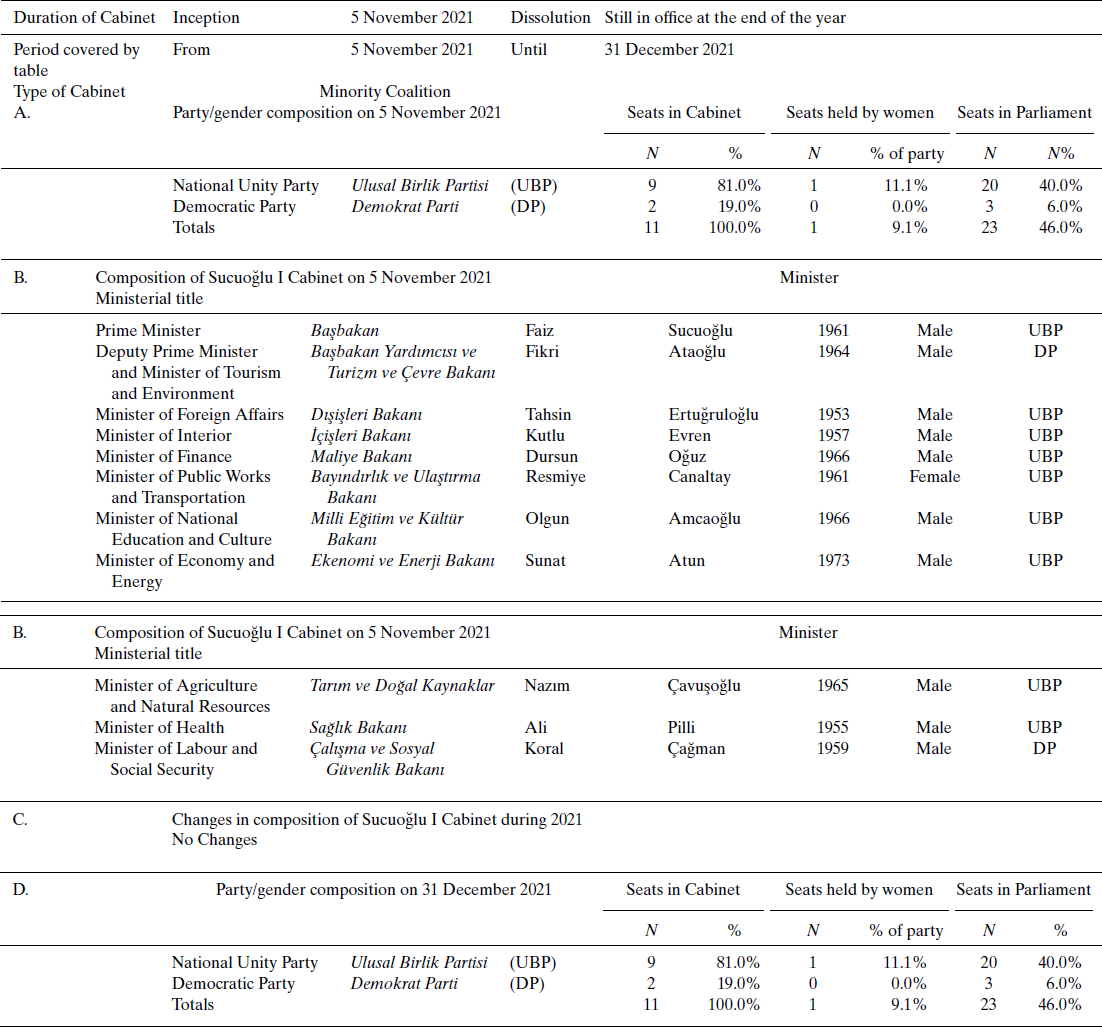
The Turkish Cypriot-dominated Northern part of CyprusFootnote 1 continued to suffer from political and economic instability in 2021, being strongly affected by the high inflation rates in Turkey. After only one year in office, the ruling coalition collapsed in November. Faiz Sucuoğlu (National Unity Party/Ulusal Birlik Partisi – UBP) became Prime Minister after forming an interim minority government with the Democratic Party/Demokrat Parti (DP).
Parliamentary elections in May led to significant losses of the large parties in the Greek Cypriot-dominated Republic of Cyprus, but no substantial change in the power distribution within Parliament. In June, there was a small-scale governmental reshuffle in the south.
Both sides of the divide registered high numbers of Covid-19 cases with the tourist sector – one of the main sources of income – being hard hit. The south of the island was able to deal with the economic impact much better with the help of government subsidies than the north, which was unable to tap into international markets or the European Union (EU) for additional funds.
Election report
Parliamentary elections
Republic of Cyprus
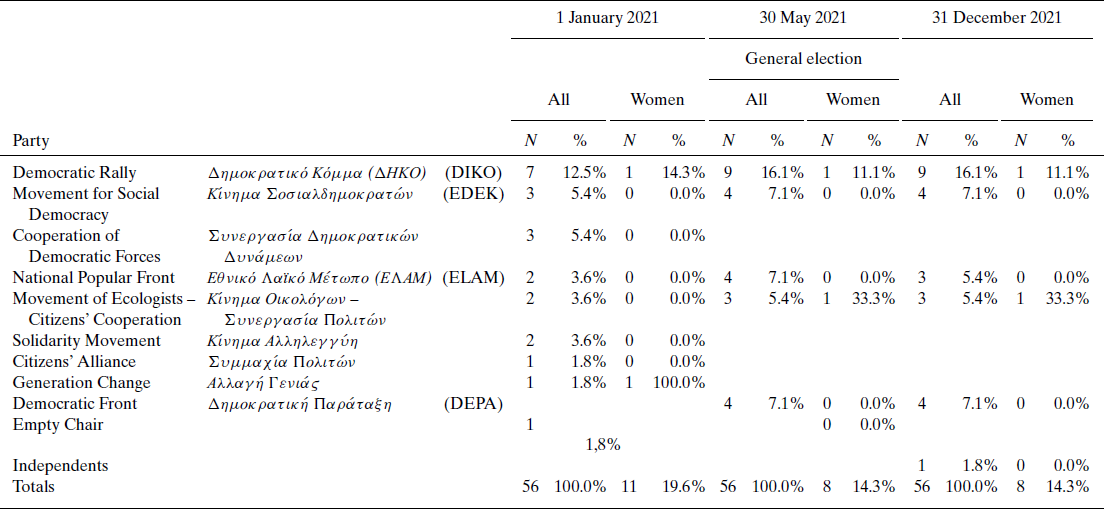
In May, Greek Cypriots went to the polls to elect the new House of Representatives. The elections were marked by large-scale abstention, the losses of the three leading parties and the continuation of the electoral gains of the right-wing xenophobic party National Popular Front/Ethniko Laiko Metopo (ELAM). The ruling conservative party Democratic Rally/Dimokratikos Synagermos (DISY) retained its position as the largest party in the Cypriot Parliament. However, it saw its number of seats reduced, as did the other large party, opposition and left-wing Progressive Party of the Working People/Anorthotiko Komma Ergazomenou Laou (AKEL). The three largest parties in the south, DISY, AKEL and centre-right Democratic Party/Dimokratiko Komma (DIKO), together lost about 35,000 votes, but this did not translate in significant losses of seats in the 56-member Parliament, with DISY and AKEL losing one seat each, while DIKO retained its nine seats. The Socialist Social Democrat Movement/Kinima Sosialdimokraton (EDEK) made slight gains. However, the small gains of EDEK need to be put in perspective, given its electoral alliance with the Citizen's Alliance/Symmachía Politón (SYPOL) indicating losses for both parties in the election. After the elections, the Citizens’ Alliance did not return as a separate party. Far-right ELAM continued its series of electoral successes, almost doubling its support base since the last elections in 2016. The newly established Democratic Front/Dimokratiki Parataxi (DIPA), which split from DIKO, also made it into Parliament. The Solidarity Movement/Kinima Allilengyi (KA) failed to pass the 3.6 per cent threshold and did not return to the House. Only eight women gained one of the 56 seats in Parliament, translating to a female representation of 14 per cent, down from 17 per cent in 2016.
On June 10, DISY MP Annita Demetriou was elected House President. She is the first woman in the history of the Republic of Cyprus to hold this position. She was elected with the votes of DISY, the newly established DIPA and far right ELAM.
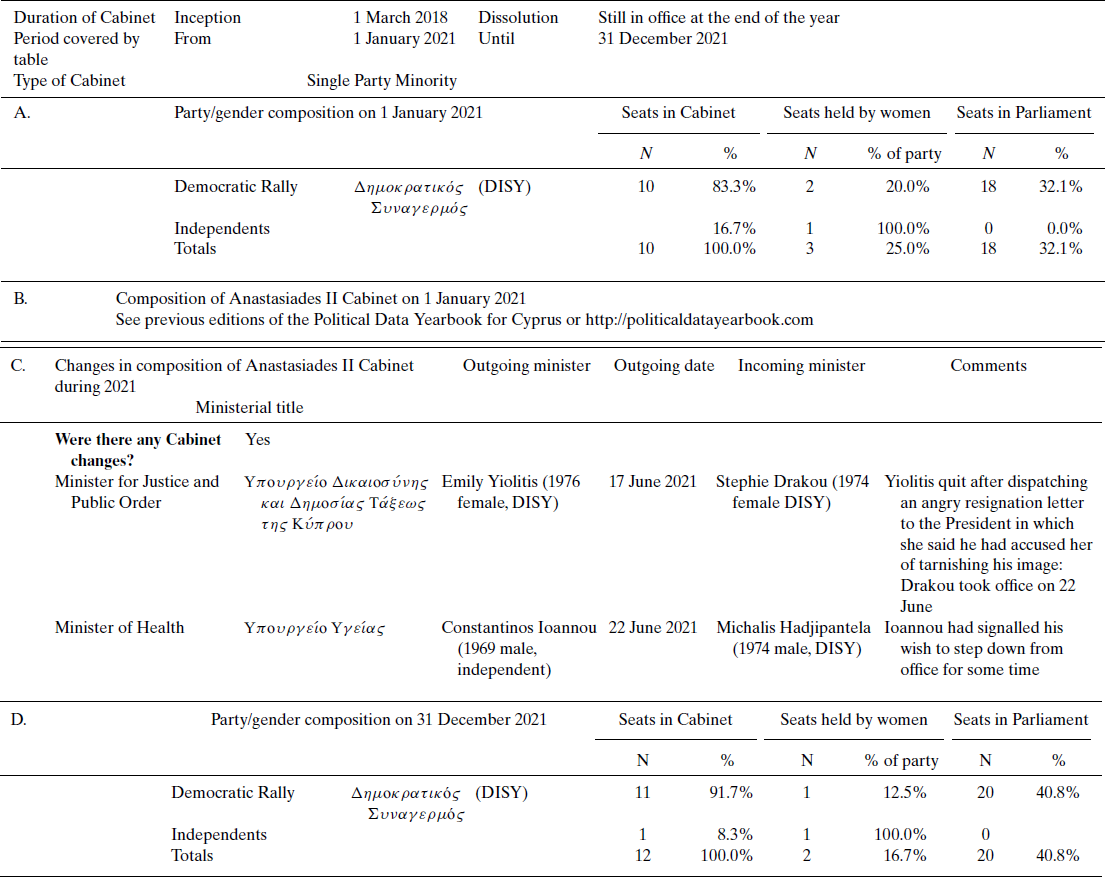
For data on the parliamentary elections and the composition of Parliament, see Tables 1 and 2.
Elections to the House of Representatives (Βουλή των Αντιπροσώπων) in Cyprus in May 2021

Notes: Three DIKO parliamentarians left DIKO and formed the Cooperation of Democratic Forces (Συνεργασία Δημοκρατικών Δυνάμεων) on 28 July 2020. They later joined forces with the centrist Democratic Front (Δημοκρατική Παράταξη) under a common electoral platform for the parliamentary elections in 2021. The Democratic Front was set up by former DIKO leader Marios Garoyian after his split from the party in 2018 and had not been represented in Parliament before the elections in May.
Citizen's Alliance Συμμαχία Πολιτών (SYPOL) had won 6.0% at the last elections and held three seats. It had formed a common electoral platform with EDEK (6.2% and 3 seats in 2016) for the 2021 elections and later merged with the party. The result of EDEK could therefore also be listed as –5.5% and –2 seats, if seen as a joined performance.
Solidarity Movement (Κίνημα Αλληλεγγύη), which had won 5.2% and held three seats, did not manage to win any seats in the 2021 elections.
Source: Parliamentary Elections 2021 Official Results, http://www.elections.gov.cy/moi/elections/elections21.nsf/home2021/home2021?openform, accessed on 15 August 2022.
Party and gender composition of the House of Representatives (Βουλή των Αντιπροσώπων) in Cyprus in 2021

Notes: See Table 1 about the Cooperation of Democratic Forces’ (Συνεργασία Δημοκρατικών Δυνάμεων) seats.
When Eleni Theocharous was elected in 2016, she preferred to hold her MEP seat, so her seat was taken by the second on the party ticket. This was contested before the courts, which ruled that this replacement was not covered by the law, so the MP left his seat. Later, Parliament amended the law to allow the replacement to take the seat. However, this was again contested before the courts, which found that the law amendment could not have retrospective effects. Therefore, he had to vacate his seat again; the seat remained empty until the elections in May 2021. This is the reason why the table displays an empty chair.
On 7 October 2021, Andreas Themistocleous became independent after he was expelled from ELAM because of constant inappropriate behaviour in Parliament.
Sources: http://www.elections.gov.cy/moi/elections/elections21.nsf/home2021/home2021?openform, accessed on 12 August 2022; http://www.parliament.cy/el/composition/members-of-the-house, accessed on 12 August 2022.
Cabinet report
Republic of Cyprus
In June, a small-scale government reshuffle took place. On 17 June the Minister for Health and Justice, Emily Yiolitis, resigned amidst reports that presented her as the weakest member of the Cabinet and a candidate for change in an imminent reshuffle. Yiolitis was replaced by lawyer Stephanie Drakou, a former insurance superintendent. Health Minister Constantinos Ioannou had already expressed his intention to step down after three years in office. On 1 July his position was taken over by the chartered accountant Michalis Hadjipantelas. Marios Pelekanos (DISY) took over the position of government spokesperson from Kyriacos Koushios who was reportedly nearing retirement.
Trnc
On 18 January, the National Unity Party (UBP) MP (Trikomo) Önder Sennaroğlu was elected as the new Speaker of Parliament, while Republican Turkish Party/Cumhuriyetçi Türk Partisi (CTP) MP (Morphou) Armağan Candan, who also ran unopposed, was elected as Deputy Parliamentary Speaker.
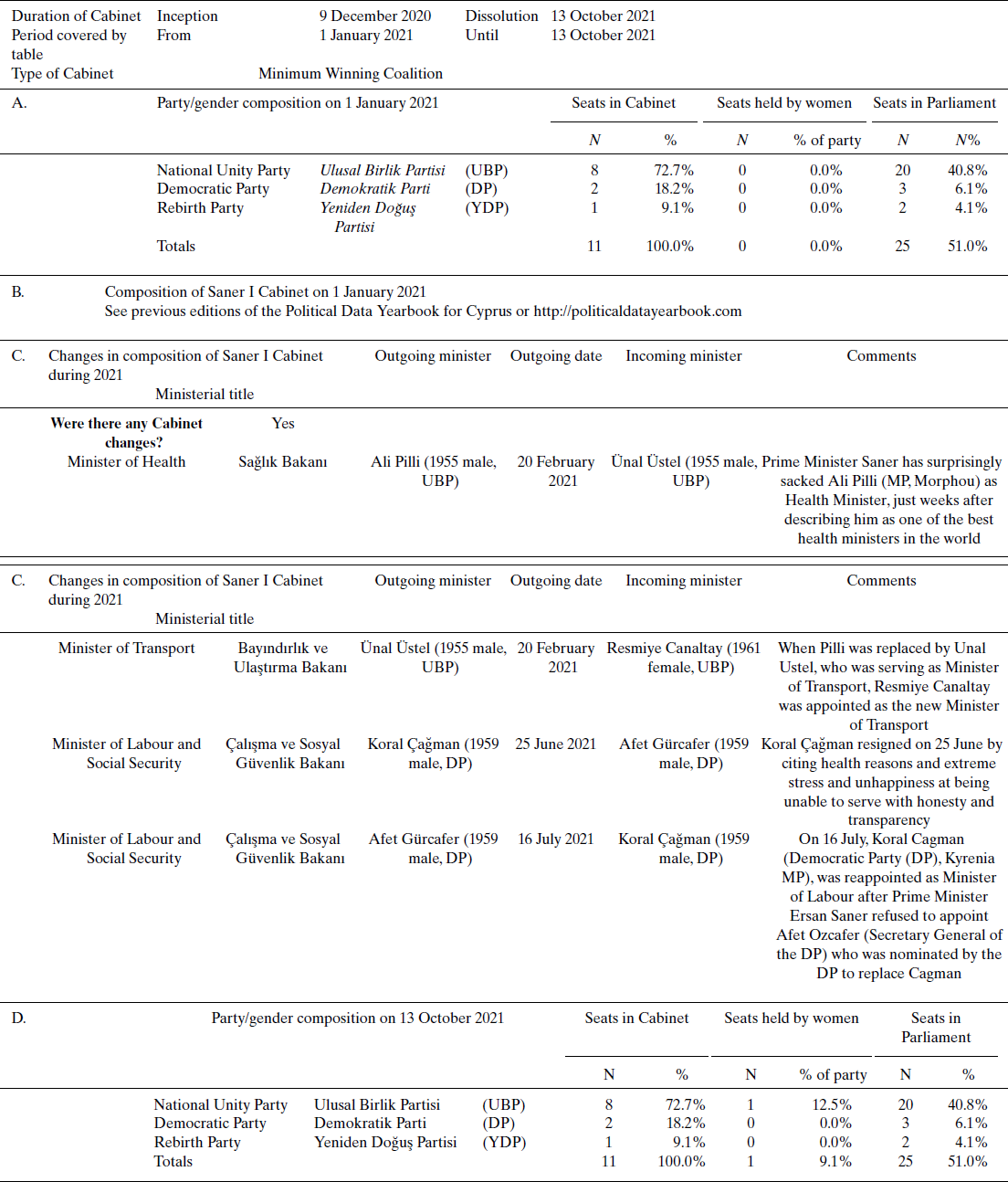
On 20 February, a surprise Cabinet reshuffle took place when Health Minister Ali Pilli (MP, Morphou) was replaced by Ünal Ustel (MP, Kyrenia), who was serving as Minister of Transport. Resmiye Canaltay (MP, Famagusta) was appointed as the new Minister of Transport.
On 13 April, the former Minister of Labour, Şerife Ünverdi, and her then private secretary Aytaç Çaluda (MP, Lefke), whose immunity against prosecution was lifted by Parliament in 2018, was indicted for ‘misconduct in public office’. The defendants denied the allegations. The court imposed a travel ban on both defendants pending the outcome of their trial ‘in order to prevent them from fleeing the country’.
On 25 June, Koral Çağman (Democratic Party (DP), Kyrenia MP) resigned from his post as Minister of Labour. However, on 16 July, he was reappointed to the role by Prime Minister Ersan Saner, who refused to appoint Afet Özcafer (Secretary General of the DP), the person nominated by the DP to replace Çağman.
On 13 October, the Prime Minister and leader of the National Unity Party (UBP), Ersan Saner, handed in the resignation of the UBP-DP-Rebirth Party/Yeniden Doğuş Partisi (YDP) coalition government. On 5 November, a minority coalition government was established under the leadership of Faiz Sucuoğlu, also from UBP, and it passed a vote of confidence on 19 December 2020 by relying on the backing of MPs who resigned from the People's Party/Halkın Partisi (HP) and Rebirth Party (YDP) a year earlier.
The Parliamentary Advisory Committee on 8 November announced that an agreement had been reached among the political parties to hold early elections on 23 January 2022. This was unanimously approved at the General Assembly of the Parliament later in the month, and the election schedule and restrictions came into effect as of 26 November. On 29 November, the Higher Electoral Council announced the new distribution of MPs across constituencies, according to which while Kyrenia would have 11 seats (one seat up), Morphou (Guzelyurt) would have three seats (one seat down).
For data on Cabinet composition, see Tables 3–5.
Cabinet composition of Anastasiades II in Cyprus in 2021

Notes: In Political Data Yearbook (2021), the number of independent Cabinet members at the end of 2020 was wrongly stated as one.
Cabinet composition of Saner I in Northern Cyprus in 2021

Cabinet composition of Sucuoğlu I in Northern Cyprus in 2021

Political party report
Republic of Cyprus
On 26 April, former leader of EDEK, Vassos Lyssarides, died at the age of 100. He had been a central figure in Cypriot politics ever since the independence of the island in 1960.
On 4 June, Andros Kyprianou announced his decision to step down as the leader of AKEL. Kyprianou claimed that he had taken this decision months before the parliamentary elections in May, where his party had performed poorly. He had been the leader of the party since 2009. He was succeeded on 4 July by Stephanos Stephanou. From the 105 members of the central committee of the party, Stephanou received 74 votes (71.6 per cent), clearly defeating the other candidate, Giorgos Loukaides, who received 29 votes (28.1 per cent), with on absentee and one blank vote cast.
In June, Citizen's Alliance President Yiorgos Lillikas announced his intention to leave politics while his party started procedures to merge with EDEK. The official reason given was to unite the forces that opposed a bizonal, bicommunal federal solution to the Cyprus problem.
On 22 December 22, DISY leader Averoff Neophytou announced his candidacy for the 2023 presidential elections in the Republic. The move was widely seen to be an attempt to undercut the presidential ambitions of the popular Foreign Minister and DISY member Nikos Christodoulides. President Anastasiades had stated publicly that he would not be running for a third term.
Trnc
On 10 April, the party assembly of the senior coalition partner National Unity Party (UBP) elected Oğuzhan Hasipoğlu (MP, Famagusta) as its new secretary general by beating his opponent Özdemir Berova (MP, Kyrenia).
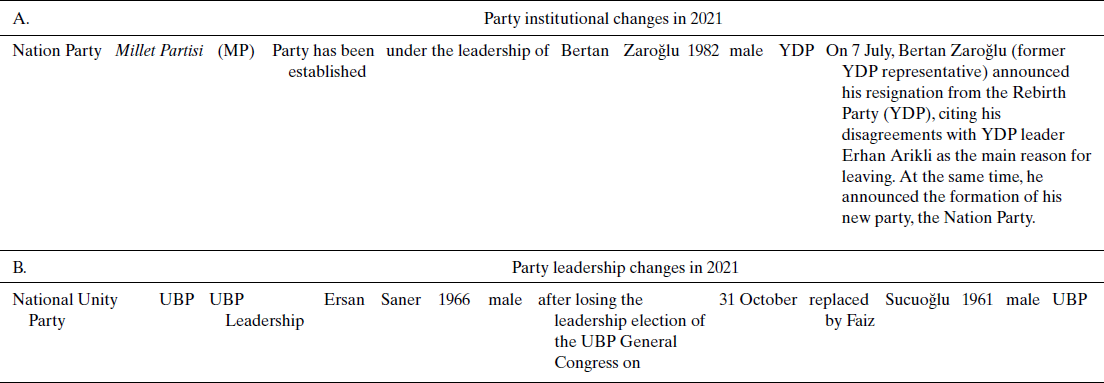
On 11 April, the junior coalition partner Rebirth Party (YDP) leader Erhan Arıklı (MP, Famagusta) was re-elected at the party congress, beating his rival Bertan Zaroğlu (MP, Nicosia). On 6 July, Zaroğlu, together with 2011 party members, resigned from the YDP, and subsequently, on 16 July, he announced the formation of his new party, the Nation Party/Millet Partisi (MP).
On 19 October, a video showing Prime Minister Saner engaging in online sex with a woman was circulated via social media, ahead of the UBP's 22th congress. On 26 October, Saner announced his withdrawal from the leadership election. Eventually, Faiz Sucuoğlu emerged victorious from the party congress, beating his rivals Hasan Taçoy and Zorlu Töre.
For data on party changes, see Table 6.
Changes in political parties in Northern Cyprus in 2021

Source: Authors’ own elaboration.
Institutional change report
Republic of Cyprus
On 9 July, Anastasia Anthouli was sworn in as the first Junior Minister of Social Welfare. She had served as a coordinator of the minister's office under two health ministers and played a key role in implementing the public national health scheme (GESY) as well as in the government's efforts to fight Covid-19. The creation of another junior ministry was part of the government's efforts to reform and upgrade the social services of the Republic.
Issues in national politics
Republic of Cyprus
Cyprus issue
Most of 2021 was characterized by a standstill and uncertainty in the Cyprus question, which has prevailed since the collapse of the last round of talks aimed at reunification of the island at an international conference in Crans Montana, Switzerland, in July 2017. A more confrontational Turkish foreign policy towards Greece and Cyprus since 2019 had also led to the election of a hardliner, Ersin Tatar, in the internationally not recognized TRNC in October 2020 after massive interventions by Turkey in his favour. Supported by Ankara, Tatar demanded the equal recognition of Turkish Cypriot sovereignty, and therefore a two-state solution, as a prerequisite for the resumption of negotiations, effectively ending any prospect for substantial talks. Encouraged by the hardening of the Turkish positions, the Greek Cypriot side became more reconciliatory, unequivocally returning to the internally supported framework of a bicommunal, bizonal solution, abandoning a period of confusing signals about the framework for a solution that had seriously undermined the credibility of the commitment of Greek Cypriot President Nicos Anastasiades to a solution of the Cyprus problem. Tellingly, a failed attempt by United Nations Secretary General António Guterres to reach a common ground for the resumption of negotiations at an informal five-party summit (both Cypriot communities, the Guarantor powers of Greece, Turkey and the UK, plus the EU as an observer) in Geneva remained the most significant constructive move in the Cyprus question in 2021.
In October 2020, the Turkish side escalated the situation by unilaterally opening parts of the fence of the ghost town of Varosha, under the administration of the TRNC. Varosha, a Greek Cypriot-populated suburb of Famagusta, had remained uninhabited since 1974 and was administered by the Turkish army, serving as a bargaining chip in the negotiations for a solution to the Cyprus problem. UN resolutions demand the handover of the territory to the UN and the return of its rightful inhabitants. In the context of the opening of Varosha, the Turkish side indicated that it would accept the return of Greek Cypriot property owners if their claims were found valid by the internationally recognized Immovable Property Committee in the north. The international community condemned the opening since the territory will be administered by the authorities in the north. At the time of writing, about 3.5 per cent of the territory has been opened, but none of the inhabitants has returned yet.
Apart from the opening of Varosha, the confrontation about the hydrocarbon exploration and exploitation off the coast of the island remained the most dynamic and dangerous aspect of the Cyprus problem. In 2019, in response to the unilateral exploration activities of the Greek Cypriots and the regional cooperation of the Republic of Cyprus with Israel, Egypt and Greece on hydrocarbons, Turkey escalated the situation, claiming that its rights and the rights of Turkish Cypriots were being ignored. First, Ankara started to drill in areas claimed by the Republic of Cyprus as its exclusive economic zone (EEZ) with the approval of the Turkish Cypriot authorities. Then Ankara signed an agreement with the government of Libya over the delineation of their respective EEZs and threatened to start drilling in areas claimed by Greece as its own EEZ. In 2021, the issue remained unresolved, but tensions decreased. Appraisal drillings at the end of 2021 were not answered by Turkish activities in the EEZ claimed by the Republic of Cyprus.
Covid-19 pandemic
The Covid-19 pandemic hit Cyprus in March 2020 but was initially managed very well on both sides of the divide. As collateral of the pandemic, the crossings between the two sides were closed or only opened sporadically for 16 months. Crossings and contacts between both communities became easier in June 2021, when the checkpoints were reopened. They remained open even though the pandemic reached unprecedented numbers on both sides of the divide by the end of 2021. In the south, the number of people diagnosed with Covid-19 increased from 22,651 in 2020 to 166,828 cases in 2021. Deaths related to the pandemic rose during the same period, from 125 to 638. In 2020, the situation in the north had been considerably better ‘thanks’ to the isolation of the Turkish Cypriots and the stricter measures initially imposed by the authorities in the north. But by the time 2021 came to a close, the north had caught up and the situation had converged to similarly high numbers in comparison with population size. The number of people diagnosed with Covid-19 in the north increased within one year, from 1532 in 2020 to 35,011, while the number of deaths attributed to the virus grew from seven to 138.
In August, the Republic of Cyprus signed an agreement with the European Commission in the context of the EU Recovery and Resilience Plan, which was aimed at mitigating the economic and social impact of the coronavirus pandemic and supporting the green and digital transitions of EU countries. The plan provides for €1.2 billion in grants and €0.2 billion in loans for the Republic of Cyprus, which the government intends to spend on reforming the public service, combatting corruption, upgrading the courts as well as environmentally sustainable development.
Trnc
The quickly deteriorating economic circumstances caused by the Covid-19 epidemic, accompanied by the excessive depreciation of Turkish lira and the rise in prices of all kinds of products, worsened the standard of living in the north. The 12-month inflation reached 26.86 per cent in December 2021, according to the State Planning Organization.Footnote 2 Low wages and unemployment added to economic problems that created social unrest, which was evident in continuous strikes, protests and demonstrations organized throughout the year.
On 22 December 22, the new minimum wage, which will enter into force from 1 January onwards, was set as 7000 TL (€515) gross and 6090 TL (€449) net per month. Nevertheless, the Minimum Wage Determination Commission, making its decision in the absence of the representatives of the employers’ side, raised protests that the new amount was decided in the context of the upcoming elections and to win votes for the National Unity Party (UBP).
Relations with Turkey
On 10 February, Turkey's Vice President Fuat Oktay came to the north for a two-day official visit, during which four agreements on e-state, transportation, education and municipalities were signed between Turkey and the north. Subsequently, on 3 March, the two sides signed the 2021 Turkey–TRNC Economic and Financial Cooperation agreement in Ankara. The investment-oriented economic and monetary cooperation agreement envisaged that Turkey will allocate 2.5 billion TL (€255 million) to the north. Nevertheless, unions, organizations and some political parties gathered under the umbrella of the ‘This Country is Ours’ platform raised significant concerns that this protocol would hand over authority to Ankara.
During a visit of Turkey's Foreign Minister Mevlüt Çavuşoğlu on 1 July, where he gave a joint news conference together with Turkish Cypriot leader Ersin Tatar, they flatly rejected a new round of informal talks on Cyprus and the idea of the appointment of a new Special Representative for Cyprus by the UN. They reiterated their determination on the issue of sovereign equality and the registration of equal status, which was put on the table by the Turkish side at the 5+1 informal Geneva meeting.
Turkey's President Recep Tayyip Erdoğan and a high-level delegation visited the north to attend a military parade that took place in celebration of the 46th anniversary of the 20 July military intervention. During his visit, Erdoğan addressed the Turkish Cypriot Parliament, where he reiterated Ankara's position for a two-state solution and announced the construction of a new presidential office and Parliament building for the north. The main opposition Republican Turkish Party (CTP) and the Social Democratic Party (TDP) boycotted Erdoğan's speech over Ankara's interference in the North's internal politics. In return, the Turkish embassy did not invite representatives of both parties, as well as the former presidents Mustafa Akinci and Mehmet Ali Talat, to the 29 October reception to mark the anniversary of the founding of the Turkish Republic.
Freedoms of press and expression
Reportedly, pressure directed against the freedoms of the press and expression in the North has been mounted in an attempt to silence critical voices. In January, Basın-Sen (Turkish Cypriot Press Workers’ Union) announced that it had filed a defamation lawsuit against Tatar accusing him of publicly bullying and shaming Turkish Cypriot journalist and co-founder of the bicommunal organization UniteCyprusNow (UCN), Esra Aygın.
On 22 January 22, the chief prosecutor's office in Ankara summoned Turkish Cypriot journalist and writer Ayşemden Akın, who currently lives in Cyprus, to testify following a complaint filed by the Turkish Foreign Ministry. On 10 October, after Akıncı’s communication consultant Ali Bizden and researcher Dr Ahmet Cavit An, Ali Kişmir, a journalist and head of Basin-Sen (Press Workers Trade Union), was also denied entry to Turkey and was deported.
The 15 April decision of the Turkish Cypriot Constitutional Court banning Quran lessons organized by the Department of Religious Affairs (affiliated with Evkaf Administration) at mosques caused controversy. Erdoğan, along with other Turkish officials including his Vice President, criticized the decision, saying, ‘the head of the Constitutional Court should learn secularism’. Noting that ‘North Cyprus is not France,’ Erdoğan added to warn that ‘they have to adopt the practices in Turkey […] otherwise, the steps we will take will be different’. On 19 April, Turkish Cypriot lawyers staged a demonstration to protest against Erdoğan's remarks.


 Open access

