


Introduction
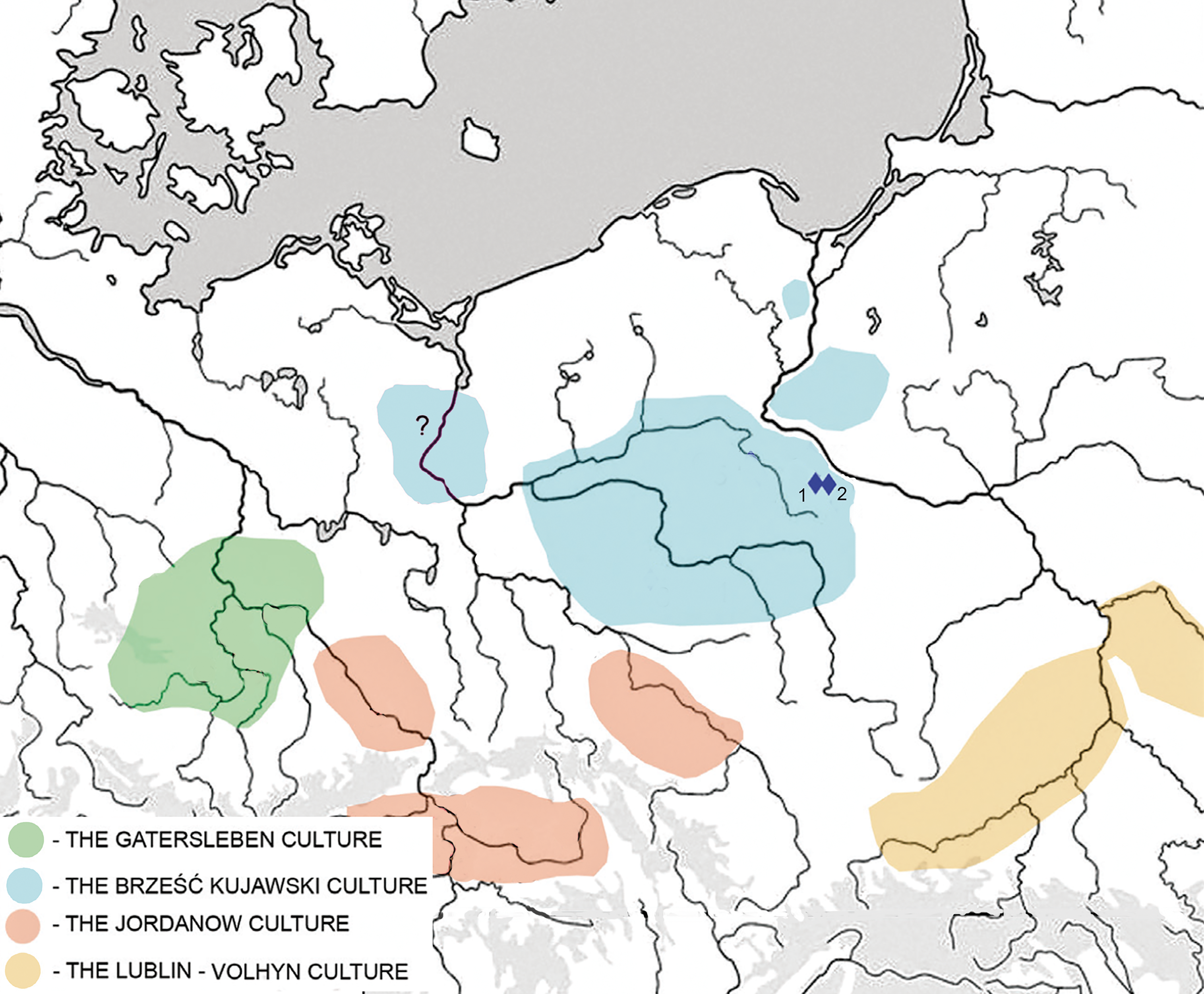
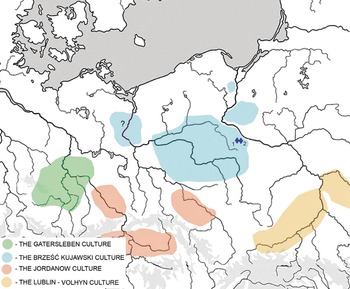
The Brześć Kujawski Culture (4350–4000 bce, hereinafter BKC) marks the conclusion of the Danubian Neolithic period in the Polish Lowlands, which lasted approximately 1500 years. The initial settlers were pioneer colonists of the Linearbandkeramik (c. 5500 bce, hereinafter LBK), who established a permanent settlement network characterized by long, rectangular houses. However, around 5050 bce, their community disintegrated, leading to a near-total depopulation of the Lowlands. By approximately 4800 bce, new groups of migrants began arriving from several regions connected to the Lowlands via three rivers: the Elbe, Oder and Vistula (e.g. Czerniak et al. Reference Czerniak, Bayliss and Goslar2024). These migrants, along with the population that survived the collapse of the LBK and individuals from the hunter-gatherer groups still residing in the area, formed a cultural mosaic known as the Late Band Pottery Culture (hereinafter LBPC). This period was distinguished by more dispersed and short-term settlements, characterized by semi-dugouts and lightly constructed houses, with only sporadic use of longhouses (Czerniak & Pyzel Reference Czerniak, Pyzel, Gleser and Hofmann2019). Around 4350 bce, these communities underwent a transformation resulting in the formation of the BKC. About 100 years earlier, large, long-inhabited settlements began to collapse in the Carpathian Basin, and a several-hundred-year period of highly dispersed settlements followed, with the establishment of formal cemeteries separated from settlements (Parkinson et al. Reference Parkinson, Yerkes and Gyucha2002). At the same time complex and dense settlement network emerged in the Lowlands, the nodal (central) points of which were settlements such as Brześć Kujawski, densely built up with long trapezoidal houses that served three functions at the same time: a place of residence, a cemetery and a ceremonial centre. In this article, we interpret this transformation as an ethnic change, wherein the adoption of a standardized form of the longhouse played a pivotal role. The BKC communities settled in areas with soils of the highest agricultural value, creating settlement enclaves of varying sizes, the largest of which were located in Kuyavia, the Pałuki region, and Chełmno Land (Fig. 1).
Extent of the Brześć Kujawski culture and surrounding ‘late Lengyel’ cultures. (1) Osłonki, site 1; (2) Brześć Kujawski, site 4.
The aim of this article is to analyse the formation process of the BKC using the framework of processes that Di Hu (Reference Hu2013) and Barbara Voss (Reference Voss2015) describe as ethnogenetic, referring to the phenomena of creating a new ethnic identity. Concurrently, we employ the concept of the ethnographic landscape to describe the material and contextual environment in which this process occurred. This concept is borrowed from John Robb (Reference Robb, Whittle and Bickle2014), who defined various identities as potential matter, the reconfiguration of which, through combination, elimination and innovation, created new communities and identities adapted to prevailing economic, demographic and political conditions. This additional concept enriches the understanding of the ethnogenesis process as a dynamic phenomenon, simultaneously rooted in the regional past. In the proposed approach, the outcome of the ethnogenesis process was not a uniform ethnic identity, but a continually diversified ethnographic landscape. This landscape comprised both widely recognized community emblems (in the case of the BKC, longhouses built on a trapezoidal plan served this role) and less prominent, not always consciously acknowledged differences that were remnants of the past. To understand the formation process of the BKC better, we will attempt to analyse it from these two perspectives.
The conceptual framework of ethnogenesis adopted here views it not only as a continuous aspect of social variability—where collective and individual identities are constantly reshaped—but also as a process marked by critical junctures. These moments, traceable in the archaeological record, signify times when a population redefines its internal boundaries and introduces new ethnic emblems distinguishing ‘us’ from ‘others’. In the case of the BKC, the adoption of the longhouse may represent such a turning point, acting both as a catalyst and a symbol of emerging identity. Concurrent developments—settlement agglomeration, occupation of optimal zones, population movements and new territorial divisions—appear more as consequences of this ethnogenesis than as its causes. The outcome is a radically transformed settlement landscape, dominated by trapezoidal longhouses that structured villages, hamlets and dispersed farmsteads.
In this article, we will conduct a comparative analysis of two central settlements: Osłonki 1 and Brześć Kujawski 4, which are located only 8 km apart and separated by the easily traversable Zgłowiączka River. Additionally, we will consider the surrounding satellite settlements that, together with these central sites, form settlement microregions (Fig. 2). Through this approach, we intend to delve deeper into the changes experienced by the earlier ethnographic landscape of the Lowlands and uncover the processes of creating new networks of social connections driven by interregional migrations, copper exchange and the assimilation of hunter-gatherer groups.
Map showing locations of the BKC sites at Brześć Kujawski 4 and Osłonki 1 together with other BKC sites in their microregions.

The selection of the two most renowned central settlements of the BKC, located at Osłonki and Brześć Kujawski, is justified by their extensive documentation and the general availability of research findings in publications (Bogucki & Grygiel Reference Bogucki, Grygiel and Bogucki1993; Reference Bogucki and Grygiel2022; Grygiel Reference Grygiel2008; Grygiel & Bogucki Reference Grygiel and Bogucki1981; Reference Grygiel and Bogucki1997). The new questions we posed have uncovered previously unnoticed or overlooked phenomena. Beneath the apparent unification—evident in identical longhouses, similar burial practices, and the style of ceramic products and body ornaments—significant differences emerge, ranging from settlement layouts and the placement of new houses to the use of copper ornaments.
Why does archaeology need the concept of ethnicity?
The reintroduction of the longhouse in the North European Plain—the central theme of this article—can be interpreted in various ways. Here, it is presented as an innovation that, within a specific ‘ethnographic landscape’, functioned as an ethnic emblem, triggering a sequence of events with both ethnogenetic and socio-demographic consequences.
The problem is posed in this way because we intend to interpret a sequence of events in which a group that began to construct longhouses simultaneously changed the manner in which many other things were done. In essence, we ask why groups that began building longhouses in various locations within a specific region simultaneously altered many other aspects of their practices, while still adhering to patterns shared with other longhouse-building communities of the same region and period.
We interpret the longhouse as a pivotal innovation that initiated a cascade of subsequent changes—an interpretation that may contain a degree of subjectivity. Yet the connection between this architectural form and broader transformations in material culture is well attested, both through comparative analyses of longhouse assemblages (e.g. Czerniak Reference Czerniak1994; Grygiel Reference Grygiel2008) and radiocarbon modelling of directly related contexts (Czerniak et al. Reference Czerniak, Marciniak and Bronk Ramsey2016; Więcaszek & Czerniak Reference Więcaszek and Czerniak2025). It is therefore plausible to argue that the introduction of longhouses was intrinsically linked to a radical transformation of material culture, definable at the classificatory level as a new archaeological culture. We interpret this process as ethnogenetic—the formation of a collective identity grounded in notions of fictive kinship—following the conceptual frameworks of ethnicity proposed by Siân Jones (Reference Jones1997) as well as by more recent contributions (Hu Reference Hu2013; Voss Reference Voss2015).
We contend that applying the concept of ethnicity to the interpretation of material culture transformations offers the most effective means of understanding the complex social and historical contexts in which cultural change occurred. Admittedly, this approach leads us onto one of the most challenging terrains of archaeological inquiry. The pitfalls, methodological complexities and potential of an ethnic perspective were comprehensively examined by Jones (Reference Jones1997, with an extensive bibliography) and little has changed since, as the topic has largely been avoided.
We wish to dispel any suspicion that, by adopting an approach inspired by the culture-historical tradition, we risk reviving long-discredited associations between archaeological cultures and ethnic or even biological identities. Such concerns have been voiced, among others, by Stephen Shennan in his discussion of aDNA studies and Neolithization. While acknowledging the value of the culture-historical perspective in ‘writing the history of human identities’, Shennan (Reference Shennan2024) advocates linking ‘archaeological (and genetic) patterns’ to ‘the history of population growth, decline, and interaction’ explicitly rejecting analyses framed in terms of ‘ethnic groups’. This position, however, narrows the potential of genuinely historical research (cf. Gosden Reference Gosden2000) and overlooks the fact that ‘the history of human identities’ necessarily includes the histories of ethnicity—a distinct and enduring dimension of the human past.
Indeed, new ethnic groups are constantly emerging before our very eyes, often at the cost of bloodshed at their inception. For this reason, it is crucial to re-examine the nature of ethnicity and the contributions archaeology can make to this discussion. Ethnogenetic models can expand—and even transform—our understanding of cultural change, unlike evolutionary models, which focus mainly on ‘the history of population growth and decline’. The BKC exemplifies this: demographic shifts and settlement agglomeration may have resulted from the introduction of longhouses, a seemingly incidental innovation that unexpectedly became an emblem of a new identity. To summarize, while we accept Shennan’s definition of archaeological culture as a ‘useful shorthand for broad patterns of material culture variation’ (Shennan Reference Shennan2000; Reference Shennan2024), we reject his view that archaeologists can ‘write the history of human identities’ without considering ethnicity and its implications.
Ethnic identity differs from other forms of collective identity—such as those based on gender, age, status, or membership in sodalities—particularly because it becomes salient in interactions with groups of different ethnicity. It is therefore unsurprising that the topic has received renewed attention alongside the recognition of migration as a major factor in Neolithization processes, revealed through aDNA and stable isotope studies (e.g. Cummings et al. Reference Cummings, Hofmann, Bjørnevad-Ahlqvist and Iversen2022; Thomas Reference Thomas, Hofmann, Cummings, Bjørnevad-Ahlqvist and Iversen2025, limiting the citation to the voices of representatives of British archaeology, which most strongly denied Neolithic migrations).
Ethnos is experienced through comparisons of material culture and expressed as a collective sense of fictive kinship, generating solidarity and cooperation. It represents a universal emotional condition that arises in encounters with ‘others’, prompting reflection on self-identity. Hence, it is difficult to accept the view that ethnicity emerged only in modern, particularly postcolonial societies (Jones Reference Jones1997, 103). Communities involved in Neolithization undoubtedly faced confrontations of ethnic identity. In the BKC, ethnogenesis may not have produced a wholly new ethnos but rather revitalized, consolidated or modified older identities through the reconfiguration of key symbols and narratives. Numerically, it was dominated by individuals rooted in the Danubian Neolithic tradition, while those from hunter-gatherer backgrounds of the Lowlands formed a distinct minority. The role of new ideas associated with copper and the interaction networks generated by its exchange, however, remains open to interpretation.
The ethnogenetic approach does not equate each archaeological culture with a new ethnos; rather, it serves as an analytical tool for probing the ‘black box’ of cultural change. It enables a fuller understanding of these processes by revealing the coexistence of groups with distinct ethnic identities. Hence, concerns that this perspective might invite politically motivated misuse of biological, cultural, or ethnic indicators are unfounded. Fears of reverting to outdated models of cultural genesis or the continuity/discontinuity dichotomy—so contentious in Kossinna’s era—overlook the methodological advances and cumulative experience that archaeology has gained over the past century.
In our view, conceiving ethnogenesis as an ongoing process of creating and recreating, sustaining and transforming group identities—through the manipulation of changing symbols and with attention to habitus and the agency of things—not only enriches the interpretive strategies available for understanding shifting patterns in material culture but also holds potential for broader social resonance. Viewing ethnicity not as a monolithic, genetically inscribed entity but as a historical process shaped by the dynamic interplay of diverse identities and their symbols offers a far more productive framework for interpreting the (pre)history of human communities than excluding ethnicity from archaeological discourse.
Methods and materials
The formation of the BKC process may be examined from two complementary perspectives. The first is a global perspective, grounded in the observation of recurrent traits within assemblages that fulfil the criteria of the BKC. The second is a local perspective, focused on the analysis of neighbouring settlements whose inhabitants undoubtedly engaged in quotidian interaction.
From a global perspective, scholars must grapple with the diffuse, heterogeneous and often ambiguous spatial distributions of traits, while avoiding overdetermined assumptions concerning the relationship between archaeological cultures and cultural or ethnic communities understood as populations sharing a sense of common descent (e.g. Jones Reference Jones1997). A safeguard against equating archaeological cultures with ethnic groups is to conceptualize the functioning and extent of an archaeological culture as the outcome of interactional spheres (e.g. Caldwell Reference Caldwell1964; Hayden & Schulting Reference Hayden and Schulting1997) and/or communities of practice (e.g. Wenger Reference Wenger2000). Another approach is the concept of the ethnographic landscape (Robb Reference Robb, Whittle and Bickle2014). However, such proposals are as much attempts to provide new explanations for the phenomenon of the archaeological culture as they are strategies for replacing this very concept and thereby excluding it from archaeological discourse. In this study, we draw on these conceptual tools, while arguing for the retention of the term ‘archaeological culture’, which—whether accepted or not—remains the most effective descriptor of material record reflecting former cultural identities (Shennan Reference Shennan2024).
The second perspective—examining similarities and differences in the material culture of neighbouring villages—helps to bypass some conceptual challenges of the global approach by focusing on the local dynamics of ethnogenetic processes. This does not, however, exempt us from the need to deal with the BKC idea, because at some point it will be necessary to determine whether a given assemblage belongs to it or not. Moreover, the concept’s applicability within a specific spatial framework determines the relevance of the interpretative model proposed here. The local perspective thus offers clear advantages, chiefly enabling a more nuanced interpretation of ethnicity formation that acknowledges the complexity of its genealogical trajectories.
John Robb (Reference Robb, Whittle and Bickle2014) defines the ethnographic landscape as the premise that individuals construct their lives starting from an existing ethnographic landscape—a specific cultural repertoire characterized by a particular genealogy that influences historical trajectories. This landscape facilitates mutual understanding or creates challenges in understanding neighbours. In other words, the ‘ethnographic landscape’ is a potential entity encompassing diverse identities, whose reconfiguration through combination, elimination, and innovation fosters the creation of new communities and identities suited to prevailing economic, demographic and political conditions.
This process, referred to as ethnogenesis by Hu (Reference Hu2013) and Voss (Reference Voss2015), does not result in a uniform, all-encompassing ethnic identity. Instead, it produces an ethnographic landscape characterized by both widely recognizable community emblems and less conspicuous, often subconscious differences that reflect distinct genealogies (separate communities of practice).
Thus, the ethnographic landscape serves as both a locally reconfigured repository of tradition and as arena for interactions within a specific spatial scope, shaped by networks of various types of contacts among individuals and groups employing similar identity emblems.
Longhouses were a characteristic product of the BKC, possessing a long and complex genealogy and symbolism. Analysing the plans of the BKC settlements, which universally adhered to a consistent pattern of longhouse development, and considering the absence of longhouses in the preceding centuries, it becomes evident that these structures defined a new identity for their inhabitants. Longhouses had significant exhibition value, elevating them above other material culture products of the time to serve as emblems of group integration. They were essential for mutual recognition, communication and the establishment of close relationships necessary for cohabitation within settlement agglomerations. However, it is important to note that the BKC, with its distinctive longhouses, vanished from the ethnographic landscape of the Lowlands after nearly four centuries. This underscores the emblematic nature of longhouses while also highlighting that symbols have a specific expiration date.
In other words, ethnicity is a dynamic process that influences the differentiation of a given population, providing the potential for both disintegration and integration, or even transformation into a new ethnic identity, depending on prevailing conditions. Voss (Reference Voss2015) elaborates on this process, arguing that ethnicity is an ambiguous concept but can be understood as an ‘awareness of difference’. This awareness is negotiated through external debates about the distinctions between ‘us’ and ‘them’ and internal disputes concerning a community’s self-definition. Ethnicities typically refer to ideologies, shared and divergent histories, ancestors and traditions. Thus, ethnicity is associated with attempts to ‘appropriate the past’ and is something people actively construct rather than inherently possess. Ethnicities are produced and maintained by combining symbols and practices inherited from various predecessors and sources with new practices and symbols that arise in specific circumstances. Regarding the latter, Hu (Reference Hu2013) suggests that factors contributing to the emergence and formation of new ethnic identities include significant demographic changes such as aggregation, disaggregation, mergers, displacements and migrations.
We lack convincing evidence that the formation of the BKC identity was preceded by demographic growth and/or an increase in intergroup aggression. The construction of increasingly large and solid houses only in the classical phase of the BKC (Grygiel Reference Grygiel2008) demonstrates that demographic growth occurred after the introduction of longhouses and was certainly secondary to the emergence of both the longhouse and the settlement agglomeration. Rather, it was the innovation of the longhouse that prompted population movements, aggregation and, in the longer term, demographic growth. She argues that ethnicity must be proven, not presumed.
Voss (Reference Voss2015) cautions that alterations in material, symbolic, spatial and discursive practices alone do not constitute sufficient evidence of ethnogenesis. She posits that ethnicity should be demonstrated rather than presumed. This proposition is challenging to implement in archaeology, which is constrained by limited opportunities for multifaceted verification. Therefore, we do not advocate the view that the ethnogenetic process that occurred led to the emergence of an entirely new ethnic group. Even a change as radical as that of the BKC could have involved a renewal of the old identity of the Danubian Neolithic through consolidation around new symbols and narratives. From this perspective, it is most likely that the BKC ‘began’ with the construction of trapezoidal longhouses, as they had the greatest potential to serve as an emblem expressing the idea of a new community and a force of attraction for its creation. This approach justifies the marginalization of stereotypical criteria of cultural and chronological divisions, such as changes in the style of pottery (e.g. Grygiel Reference Grygiel2008).
Longhouses allow us to perceive an additional context characteristic of ethnogenesis, described by Voss (Reference Voss2015) as an attempt to ‘appropriate the past’. The integration of longhouses into BKC social life can be seen as a return to the monumental residential structures of the LBK. At the time of the BKC’s formation, longhouses had not been constructed in the Lowlands for seven centuries. However, there were ruins of monumental LBK houses visible as elongated mounds of clay, stimulating imagination and memory as remnants of former grandeur. Evidence that these were recognized by the BKC as ancestral house ruins is the BKC house built precisely on the plan of the LBK house at the Bożejewice 22/23 site (Fig. 3). Several other examples exist of BKC houses that, in their location, reference LBK houses identically to the relations between successive BKC houses, which we will revisit below. A similar significance is attributed to the burial of a BKC member adjacent to the longest LBK house in Ludwinowo 7 (Pyzel Reference Pyzel2019). A separate issue concerns how these houses were visualized. There is no doubt that the traces provided an impression of the monumental scale of the buildings, but they conveyed nothing about their construction. Most likely, the visualization reflected contemporary knowledge of what a longhouse looked like. They probably inferred the construction by drawing inspiration from SBK houses, while interpreting it—due to the local context rather than formal similarities—as representing an older heritage (i.e. LBK) relative to the SBK.
Bożejewice, site 22/23. (A–B) aerial view of the site during excavations (photograph: L. Czerniak); (C) Plan of the BKC house, which was built on the plan of the LBK house. (1) post-holes of the LBK house; (2) LBK house and borrow pits; (3) BKC house and cellar pit (after Czerniak Reference Czerniak, Chłodnicki and Krzyżaniak1998).

In this article, we compare two neighbouring central settlements of the BKC, assuming that the proximity of these villages will enable a deeper understanding of the dual nature of the ethnogenesis process: the emergence of similarities and the persistence of profound differences. On the one hand, there were the similarities forged through everyday interactions, which reinforced a sense of (fictive) kinship (Emberling Reference Emberling1997) and solidarity grounded in a shared ethnic identity; on the other hand, there was the presence of differences that expressed (typically unconsciously, as part of the habitus; cf. Bentley Reference Bentley1987)—the legacy of the past. Through examining the latter, we aim to delve deeper into the transformations that the earlier ethnographic landscape of the Lowlands underwent and to elucidate the processes of forming new social networks based on interregional migrations, the exchange of goods and the assimilation of hunter-gatherer groups.
Brześć Kujawski 4 was investigated between 1933 and 1936 by Konrad Jażdżewski (Reference Jażdżewski1938). In 1976, research was resumed by Ryszard Grygiel and Peter Bogucki and continued until 1988 (Grygiel Reference Grygiel2008). In total, approximately 2 hectares of the site were excavated (around 80 per cent of the entire settlement), documenting approximately 50 longhouses and 55 graves (Grygiel Reference Grygiel2008). Osłonki 1 was explored by Grygiel and Bogucki from 1989 to 1999. Approximately 1.5 hectares (about 70 per cent of the entire settlement) were uncovered, with 30 houses and 80 graves containing 92 burials documented (Bogucki & Grygiel Reference Bogucki, Grygiel and Bogucki1993; Reference Bogucki and Grygiel2022; Grygiel & Bogucki Reference Grygiel and Bogucki1981; Reference Grygiel and Bogucki1997; summary: Grygiel Reference Grygiel2008).
In comparative analysis, precise dating of settlements is crucial to ensure that differences are not attributable to temporal changes. In this instance, only the dating of the Osłonki settlement yields satisfactory results. Based on Bayesian chronological modelling of radiocarbon dates for 17 burials, the date range for this settlement was established as 4385–4260 bce to 4220–3990 bce with a probability of 95.4 per cent (Budd et al. Reference Budd, Bogucki and Lillie2020). This result aligns closely with the general dating of the BKC in the Lowlands proposed by Czerniak et al. (Reference Czerniak, Marciniak and Bronk Ramsey2016; see also Więcaszek & Czerniak Reference Więcaszek and Czerniak2025) within the timeframe of 4350–4000 bce, which is adopted in this paper.
The chronology of the settlement in Brześć Kujawski has not yet been examined using the AMS method, resulting in the availability of dates with significant errors. This poses a problem, as Grygiel (Reference Grygiel2008) based not only the chronology of the settlement in Brześć Kujawski on these dates, but also the entire BKC, for which he proposes a timeframe of 4700/4600–4000 bce. This was understandable at the time, given the absence of AMS dates from Osłonki. However, Grygiel, as a co-author of the 2020 publication (Budd et al. Reference Budd, Bogucki and Lillie2020), had the opportunity to revise his previous dating of Brześć Kujawski and the BKC, particularly in light of the publication that significantly corrected this dating (Czerniak et al. Reference Czerniak, Marciniak and Bronk Ramsey2016). This is especially pertinent since in his earlier publication (Grygiel Reference Grygiel2008), he explicitly acknowledged the synchronous functioning of both settlements discussed here.
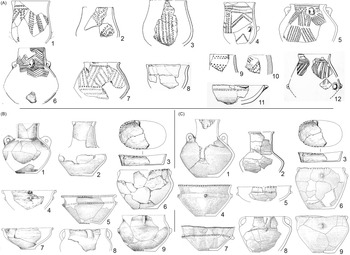
Grygiel (Reference Grygiel2008) conducted a comparative analysis of both settlements, presenting data through two extensive diagrams illustrating the occurrence of identical forms of ceramic vessels. Although these diagrams do not constitute a quantitative and statistical analysis, they convincingly demonstrate the convergence of ceramic styles, suggesting that both settlements likely functioned concurrently (Fig. 4). While synchronizing settlements based on typo-chronological analysis of ceramics is not a perfect method, it is acceptable when no other options are available, particularly when comparing groups living in close proximity and likely maintaining frequent contact, including marital exchanges.
(A) Selection of ceramic vessels representative of LBPC in Kuyavia (different sites, based on Czerniak Reference Czerniak1994); (B) selection of ceramic vessels from the Osłonki 1 site characteristic of the BKC (based on Grygiel Reference Grygiel2008); (C) selection of ceramic vessels from the Brześć Kujawski site 4 characteristic of BKC (based on Grygiel Reference Grygiel2008). Different scales.

Also noteworthy is the incomplete presentation of the plans for both sites. In the case of Brześć Kujawski, the published plan of the settlement includes houses and graves but omits pits and clay pit complexes surrounding houses and communal spaces. This omission creates the impression that numerous clay pits around houses were characteristic only of Osłonki. However, subsequent research at this site, particularly the uncovering of houses 56 and 56a, revealed similar features (Grygiel Reference Grygiel2008). This pattern is consistent with findings from many other BKC settlements, leading to the exclusion of clay pits from the list of distinguishing features between the compared settlements.
For Osłonki, an additional issue is the incomplete determination of the course of the ditch and palisade, which affects their functional interpretation. Grygiel (Reference Grygiel2008) suggests that these structures may have surrounded Osłonki only where natural barriers such as lakes and marshes did not provide protection. Consequently, it is assumed that the ditch and palisade served defensive purposes, supporting theories of intergroup conflicts. However, it is also possible that these features had a ritual function, intended to impart a ceremonial character to the settlement, akin to the rondel structures from the Stroke Band Pottery Culture (hereinafter SBK) period. Supporting this hypothesis is the potential existence of a ditch in the northern part of the settlement, separating it from the lake, as indicated on the site’s contour plan (Grygiel Reference Grygiel2008, 479, fig. 403).
BKC: a new ethnicity
In the period preceding the BKC (4800–4350 bce), the Lowlands were inhabited by communities of the LBPC, a local equivalent of the SBK (Czerniak Reference Czerniak, Gleser and Becker2012). The population of the LBPC was sufficiently large to suggest that the emergence of the BKC was a result of local cultural transformation, potentially supported by minor migrations from the south. It is thus highly probable that this radical cultural change was not due to an influx of a new population but rather a transformation in ethnicity.
In examining these changes, we will focus on comparing the most distinctive and visually prominent products of the LBPC and BKC, such as house forms, ceramic tableware styles, and elements of clothing. The most apparent change is in ceramic style (Fig. 4), where rich punctured ornamentation gave way to ceramics almost entirely devoid of decoration. This distinct change may indicate a deliberate break in continuity.
A more nuanced argument is required to understand the emergence of longhouses with foundation ditches on a trapezoidal plan in the BKC. Their close resemblance to SBK houses from the Czech Republic and Saxony is evident and clearly indicates the source of these architectural patterns. However, in the Lowlands, typical SBK houses associated with rondels were recorded 300 km west of Kuyavia (Czerniak et al. Reference Czerniak, Matuszewska and Dziewanowski2021). Elsewhere in the Lowlands, we find two small houses with lightweight post structures that have little in common with BKC houses, as well as primarily semi-dugouts, which can be considered the basic form of residential buildings in the period preceding the BKC (Czerniak & Pyzel Reference Czerniak and Pyzel2016). In summary, the ancestors of the BKC formed their ideas about longhouse architecture based on SBK houses, but they themselves constructed simpler structures, more suited to life in mobile single farmsteads. Against this backdrop, the BKC settlement agglomerations, encompassing many hectares of buildings in the form of substantial longhouses, represent a truly radical transformation.
The third component of the new ethnicity consisted of clothing elements that served to emphasize gender identity, including aspects of maturity. For women, these included richly decorated armlets made from animal ribs, while for men, T-axes crafted from antlers were prominent. The armlets were the only completely original clothing element within the BKC, as necklaces made from animal teeth and hip belts made from shells were popular among women throughout the Danube region. T-shaped antler axes, while having a more universal history, found a particularly prominent role in the BKC (Czerniak & Pyzel Reference Czerniak, Pyzel, Gleser and Hofmann2019).
In summary, during the mid-forty-fourth century bce, the LBPC communities of the Lowlands, and especially Kuyavia, where these processes were most intense, underwent a radical transformation in the most visible elements of everyday culture: tableware, housing forms and clothing elements expressing gender. These changes coincided with a lifestyle shift towards long-term residence in relatively large settlement clusters. This new factor created pressure to integrate groups that had previously lived independently.
Emblems of a new identity
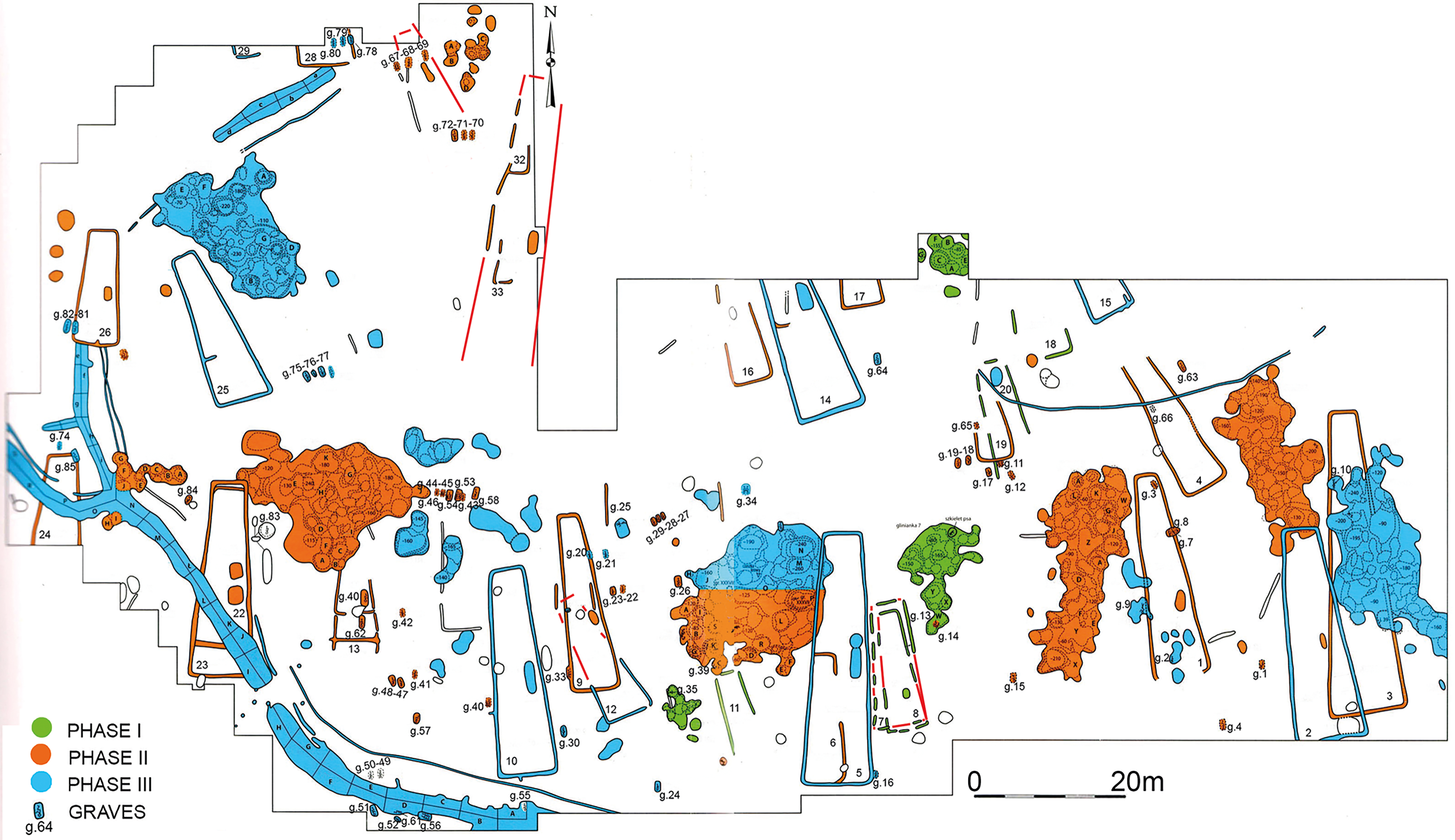
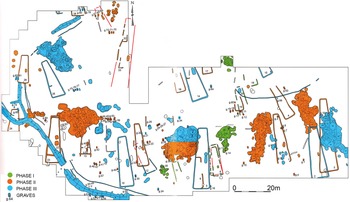
The transformation of the most visually exposed components of material culture—houses, tableware and clothing—as emblems of a new ethnic identity appears quite evident. The village, the most visible element of the Neolithic landscape both externally and internally, was characterized by monumental longhouses on a trapezoidal plan, with a unified orientation along the northwest–southeast axis and a distinctive spatial arrangement in clusters (Fig. 5). These houses facilitated the recognition of ‘our own’ from a distance and reinforced the sense of security. Compared to the LBPC period, one can even speak of a demonstration of presence: a clear intention to assert the occupation of a given area.
Osłonki, site 1. Schematic settlement plan with BKC houses and graves, divided into three main phases (modified after Grygiel Reference Grygiel2008, fig. 404).
The distinct change in ceramic style can be interpreted both radically, as a break with the tradition of direct ancestors, and moderately, as a submission to the broader trend of using vessels with minimal decoration, a trend that had a wide reach in Europe, appearing as early as around 4500 bce in the Carpathian Basin (e.g. Regenye et al. Reference Regenye, Bánffy and Demjá2020). For example, the highly popular BKC bowls with sharp profiles and small amphorae have close analogies in the pottery of the Lengyel culture. The primary sense of unification, as with the houses, was the emphasis on similarities, easily noticeable in everyday interactions between neighbours and during communal celebrations. The fact that this style remained relatively unchanged for nearly four centuries seems to confirm the emblematic value of tableware in relation to self-identification.
The clothing of the Danube communities is known solely from the grave goods. However, there is a significant disparity in the number of graves examined between the LBPC and BKC periods. The LBPC period is represented by only a few graves, primarily equipped with pottery. Nonetheless, we are aware of two male graves that indicate men were distinguished from women not only by the different positioning of the bodies, but also by grave goods such as stone axes and pendants made of boar tusks (Rzepecki et al. Reference Rzepecki2016). During the BKC period, men began to use T-shaped axes made from deer antlers, necklaces made of animal teeth, and copper bracelets instead of stone axes. Conversely, women adorned themselves with necklaces made of animal teeth, hip belts made of shells, armlets made from ribs and necklaces and diadems containing copper elements (Czerniak & Pyzel Reference Czerniak, Pyzel, Gleser and Hofmann2019). This change is evident in the increased number of items, including typically Chalcolithic objects made of copper and calcite. Armlets made from ribs with distinctive decoration and T-shaped antler axes were strong local markers with potential connections to the hunter-gatherer environment. Of course, there were many more similarities within the BKC, such as burial rites, economy, flint tool production and cuisine. However, these features are either difficult to describe in sufficient detail or were never prominent enough to become a clear component of the ethnographic landscape.
An example is the phenomenon of house succession, which we discuss in more detail later. In the BKC settlements, new houses were constructed in specific spatial relationships to old houses. However, the latter were dismantled during the construction of new houses: thus, the fact that a new house was built directly next to an old one or on the plan of the old one could only be observed during construction or as a result of archaeological excavations. Consequently, to an outside observer, BKC villages appeared the same.
Comparative analysis of the two settlements: hidden differences
Layout of buildings
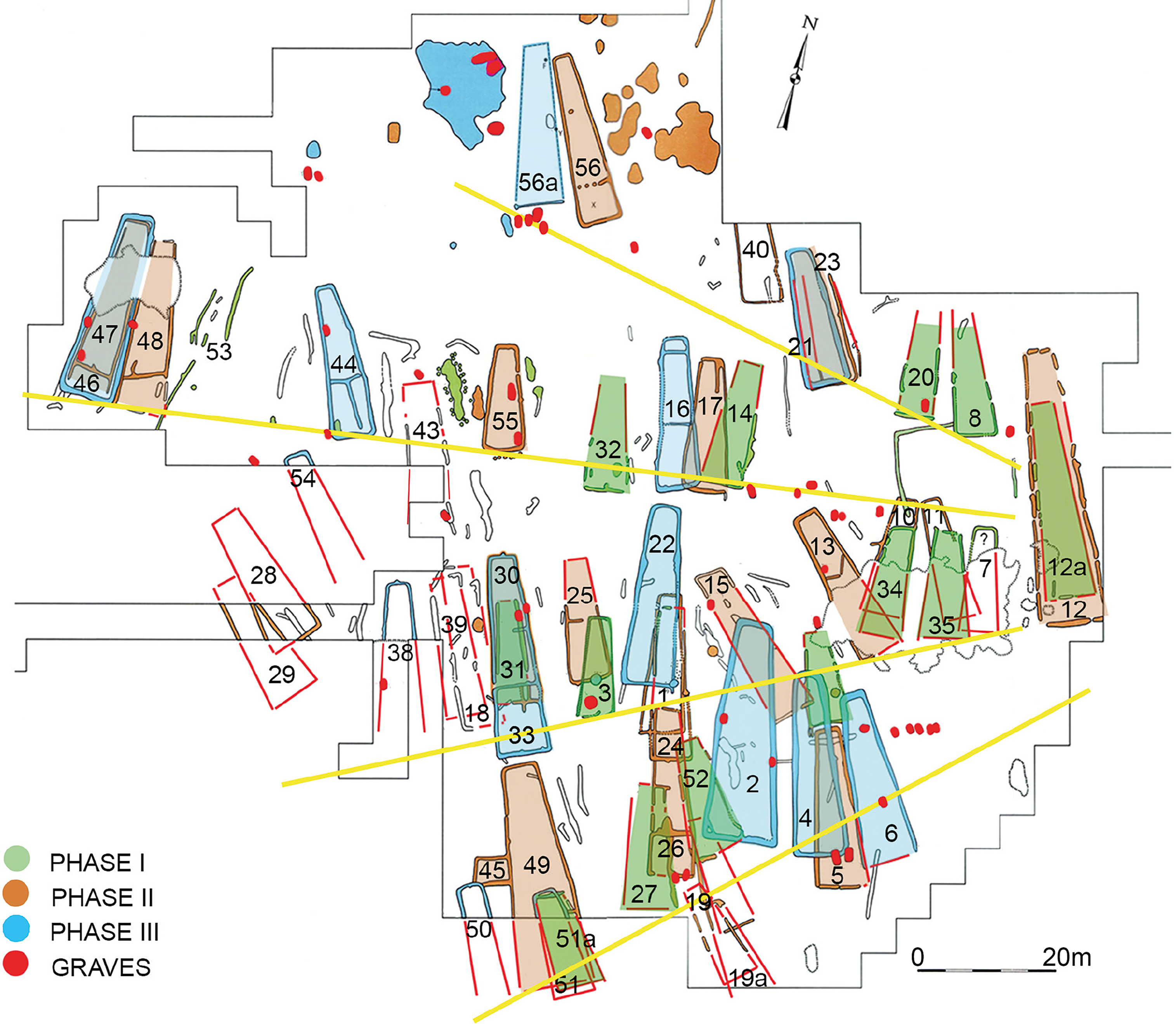
At first glance, both villages appear identical, especially in the earlier period, before the ditch and palisade were constructed in Osłonki. This impression arises from the form of the houses and their characteristic arrangement in clusters separated by clay pit complexes. However, when viewing the plans of both settlements from an appropriate height and considering both the houses built earlier and those abandoned, not just those in use at a given time, distinct patterns emerge. The houses in Brześć Kuj. 4 form rows radiating from house no. 12, located at the eastern end of the settlement. The significance of this house is underscored by its large size and the presence of a farmstead surrounded by a solid fence, with posts set in a foundation ditch (Fig. 6, based on Grygiel Reference Grygiel2008 and Czerniak & Pyzel Reference Czerniak, Pyzel, Gleser and Hofmann2019, 69, fig. 3).
Brześć Kujawski, site 4. Schematic settlement plan with BKC houses and graves, divided into three main phases (modified after Grygiel Reference Grygiel2008, fig. 7). Yellow lines indicate a possible radial building arrangement (after Czerniak & Pyzel Reference Czerniak, Pyzel, Gleser and Hofmann2019).
The presence of a ditch and palisade in Osłonki should be interpreted differently, as their construction necessitated collective effort and prior consensus, while simultaneously serving as an outward signal emphasizing the unity, individuality and uniqueness of a particular community. Furthermore, if the ditch held ceremonial significance, it also reflected the community’s political ambitions. When examining the aforementioned differences through the lens of social organization, it can be suggested that the development of Brześć—compact and organized in a radial layout centred around a single house—indicates a more consolidated community with a higher level of control and a lower level of competition compared to Osłonki. This topic will be revisited in the next paragraph.
Interpersonal violence
An analysis of burials at both sites revealed traces of violence, often healed. In Brześć Kujawski, 5.6 per cent of the deceased exhibited such traces, whereas in Osłonki, it was as high as 23.9 per cent (Lorkiewicz Reference Lorkiewicz, Schulting and Fibiger2012b). In both instances, the injuries were almost exclusively sustained by men. A challenging question is whether these findings represent the effects of external attacks, which more severely impacted the inhabitants of Osłonki, or whether they reflect systemic intra-group aggression occurring in both villages with varying intensity, indicating differing levels of social control. The discoverers of Osłonki lean towards the first interpretation, linking the more intense traces of violence with the presence of a moat and palisade as defensive structures (Grygiel Reference Grygiel2008). However, the ditch was not particularly wide (1.5–2.5 m), relatively shallow (0.7 to 1.5 m deep) and had a gentle cross-section, suggesting it did not pose a significant barrier to potential attackers. Furthermore, associating potentially defensive structures with traces of violence is speculative, as there is no evidence to suggest that injuries or deaths were singular events prompting the construction of the ditch and palisade. These structures might also have served ritual purposes, akin to rondels, which functioned as ceremonial centres in the Lowlands during the period 4800–4500 bce (Czerniak et al. Reference Czerniak, Bayliss and Goslar2024). Although rondels had solely ceremonial functions and lacked interior constructions, it is important to note that the central settlements of the BKC, beyond their residential and economic roles, also fulfilled ceremonial functions related to burial and communal feasting. Thus, the ditch and palisade might have elevated Osłonki’s status symbolically as a regional ceremonial centre.
While the concept of external aggression is not dismissed, it remains perplexing why the inhabitants of nearby Brześć and larger satellite settlements, such as Miechowice, did not perceive a similar threat, refraining from building fortifications and experiencing much lower levels of violence. Therefore, we propose that the phenomenon of violence should be examined through the lens of intra-group relations, organization and social control. This perspective is supported by bio-archaeological analyses, which increasingly yield similar observations, particularly in contexts where intra-group aggression, driven by tensions and inadequate social control, is more plausible than external assault (Larsen et al. Reference Larsen, Knüsel and Haddow2019). In our view, the differences in the frequency of aggression traces between Brześć and Osłonki reflect varying degrees of social control, which are also evident in the spatial organization of the buildings in both villages.
House succession system
Within the compared villages, two distinct patterns of new house location in relation to already abandoned houses can be observed. The first pattern, predominant in Brześć Kujawski, involved constructing a new house partially, or entirely, on the footprint of an older one (Fig. 6). At least 40 out of 50 houses at this site form such sequences, sometimes extending over long periods (Grygiel Reference Grygiel2008). This approach resembles the building system used in tells, albeit without the accumulation of building material. In the Lowlands, this system was undoubtedly innovative, whereas in Lesser Poland, it was employed, albeit infrequently, as early as the LBK and Malice culture (unpublished observations from the authors’ research).
The second pattern, dominant in Osłonki, involved constructing a new house parallel to the older one, occasionally with a slight shift of the front wall towards the northwest (Fig. 5). This pattern was already prevalent in LBK settlements across many regions (e.g. Rück Reference Rück, Hofmann and Bickle2009). However, in Osłonki, we also observe 13 instances of overlapping houses. The sequences formed in this latter manner are less developed than in Brześć, creating two-phase systems and occurring among houses located in the centre of the settlement, where space for expansion was limited. Therefore, this does not necessarily indicate a divergence in the traditions of the inhabitants of Osłonki or the creation of new patterns.
Use of copper
The BKC represents the northernmost enclave in Europe characterized by the intensive use of copper as early as the second half of the fifth millennium bce (Czerniak & Pyzel Reference Czerniak, Pyzel, Gleser and Hofmann2019). In Brześć Kujawski, 18 out of 55 deceased individuals (33 per cent) were buried with copper objects, while in Osłonki, 22 out of 92 (24 per cent) were similarly equipped. The 9 per cent difference, despite the significantly larger number of graves examined in Osłonki, may seem coincidental. However, it aligns with data on the higher import of southern flint raw materials in Brześć Kujawski, thereby increasing the significance of this observation.
There is also a noticeable difference in the types of copper objects used in both settlements. In Osłonki, copper was primarily used to create head ornaments and necklaces composed of multiple beads and copper plates, whereas in Brześć, binocular pendants and bracelets (also made of copper tape) were preferred (Bogucki Reference Bogucki, Gleser and Hofmann2019). Additionally, as Grygiel (Reference Grygiel2008) reports, a difference was found in the composition of the copper from which the objects at both sites were made. In Osłonki, the copper was very pure, with small admixtures of other elements, such as arsenic and bismuth (below 0.3 per cent) and antimony (below 0.6 per cent). In Brześć Kujawski, copper objects exhibited a more diverse composition and a slightly higher content of impurities (occasionally exceeding 1 per cent and reaching up to 2 per cent). This may suggest separate sources of copper supply. However, the issue of copper use is more complex, as we will show in the subsequent analysis.
Analyses of δ15N and δ13C isotopic content were conducted on 30 individuals buried in Osłonki to assess dietary patterns. The results indicated that individuals possessing even a single copper bead had access to higher-quality food compared to those without copper (Budd et al. Reference Budd, Bogucki and Lillie2020). The association between dietary differences and copper possession, even at minimal levels, suggests that copper served as a distinguishing marker of individual identity, potentially due to involvement in an exclusive interregional exchange network.
Anthropological data offer insights into the social identities of individuals engaged in copper exchange. Lorkiewicz (Reference Lorkiewicz2012a) notes that indicators of prolonged physical labour—such as short stature, enamel hypoplasia, cribra orbitalia and low age at death—were twice as prevalent among those with copper than without. In Osłonki, 41 per cent of individuals with copper exhibited these markers compared to 20 per cent without, whereas in Brześć Kujawski, the figures were 67 per cent with copper and 30 per cent without. These observations, combined with dietary studies, suggest a high correlation between distinct diets, signs of strenuous labour, and copper possession. In a given context, the variation in daily effort can be explained by occupational specialization, most likely related to animal husbandry on the one hand and intensive land cultivation on the other. This may be confirmed by differences in diet, assuming that land cultivation required greater effort. The most far-reaching conclusions are suggested by the correlation with copper possession, assuming this was a result of the inclusion of migrants from the loess uplands (Lesser Poland, Silesia and Carpathian Basin).
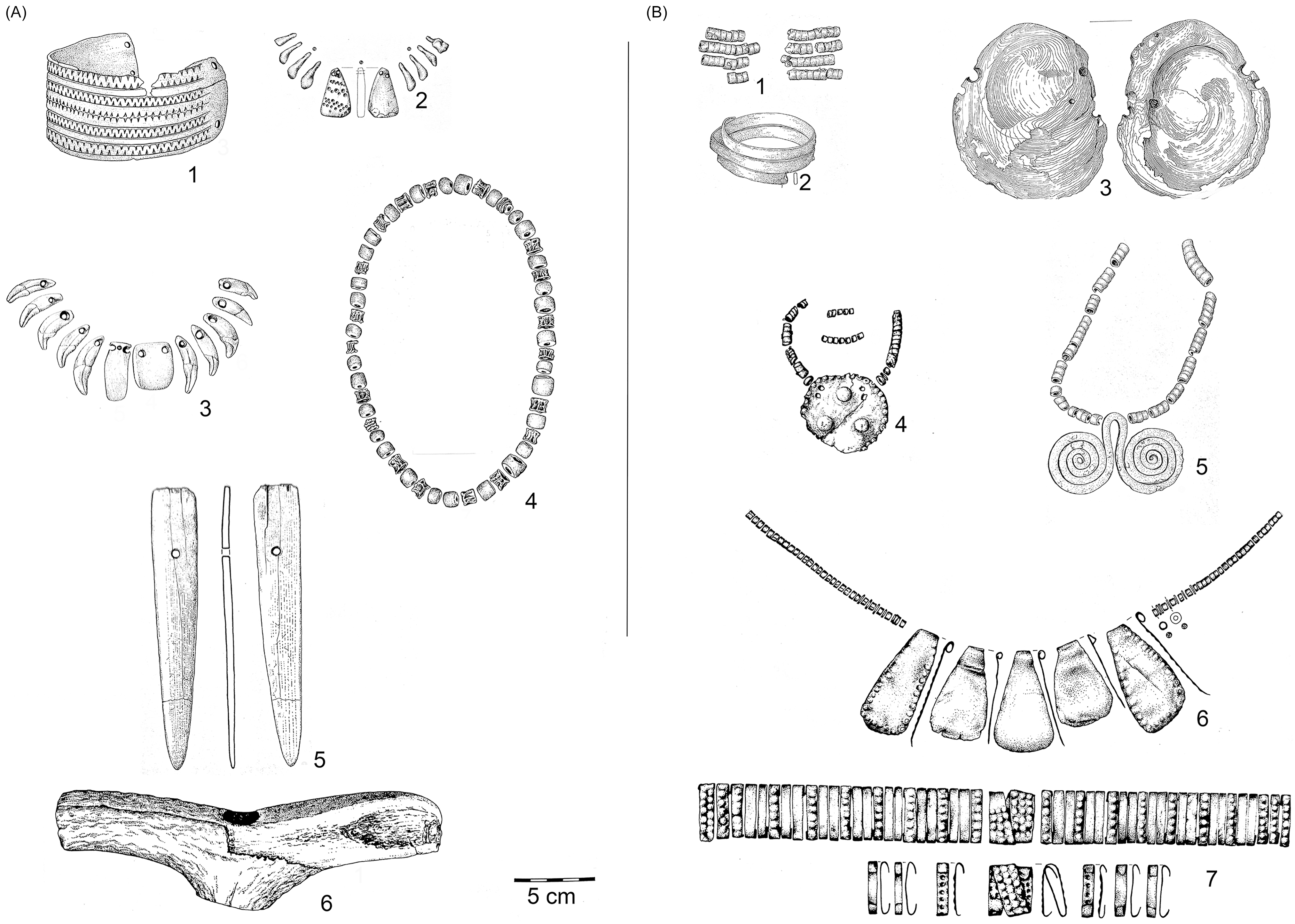
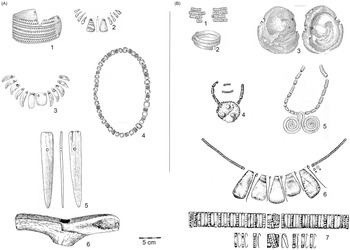
To address the use of copper ornaments by individuals with distinct social positions, we categorized grave goods into poor, average and rich, acknowledging that this categorization may not directly correlate with social status. Poor graves (approximately 60 per cent of all graves) were those without equipment or containing a single item made of common materials (e.g.,a single shell bead). Average graves included everyday objects like ceramic vessels or flint tools. Rich graves contained items divided into two groups: firstly, objects signifying gender identity (and perhaps social status) made of local materials (male: T-shaped antler axes, bone dagger blades, certain necklaces; female: shell hip belts, animal tooth necklaces, rib armlets), and secondly, ornaments of exotic materials such as Spondylus shells, calcite and particularly copper, which expressed origin, gender identity, and, maybe a social role (Fig. 7). Among these, we identified simple copper-bead offerings and more elaborate items like copper-tape bracelets (male graves), diadems composed of numerous copper beads (female), or complex necklaces (both genders).
Examples of grave goods from rich graves. A: tools and ornaments made of local materials (after Grygiel Reference Grygiel2008, fig. 81, 97, 769, 792). B: ornaments made of exotic materials (3 Spondylus shell; 1–2, 4–7 copper) (after Grygiel Reference Grygiel2008, fig. 90, 92, 96, 97, 771).
Considering previous observations, we hypothesize that analysing the co-occurrence of objects from both groups can elucidate the relationships between these identities. Generally, there is only partial overlap between the two groups, revealing significant site-specific differences. In Osłonki, only three out of nine graves with rich local material offerings contained copper ornaments (33 per cent), whereas in Brześć Kujawski, this proportion was four out of six (66 per cent). From the perspective of graves with complex copper ornaments, in Osłonki, four out of nine also contained rich local material objects while in Brześć Kujawski, 10 out of 11 graves with rich copper ornaments also had rich local material equipment.
In summary, the analysis of rich graves confirms the partial distinctiveness of both identities even among individuals of high social standing, where one might expect a higher influx of prestigious objects. Simultaneously, the analysis highlights a greater integration level among Brześć Kujawski inhabitants, where 10 out of 11 individuals with rich copper ornaments also used emblematic gender-specific local material objects.
Funeral practices
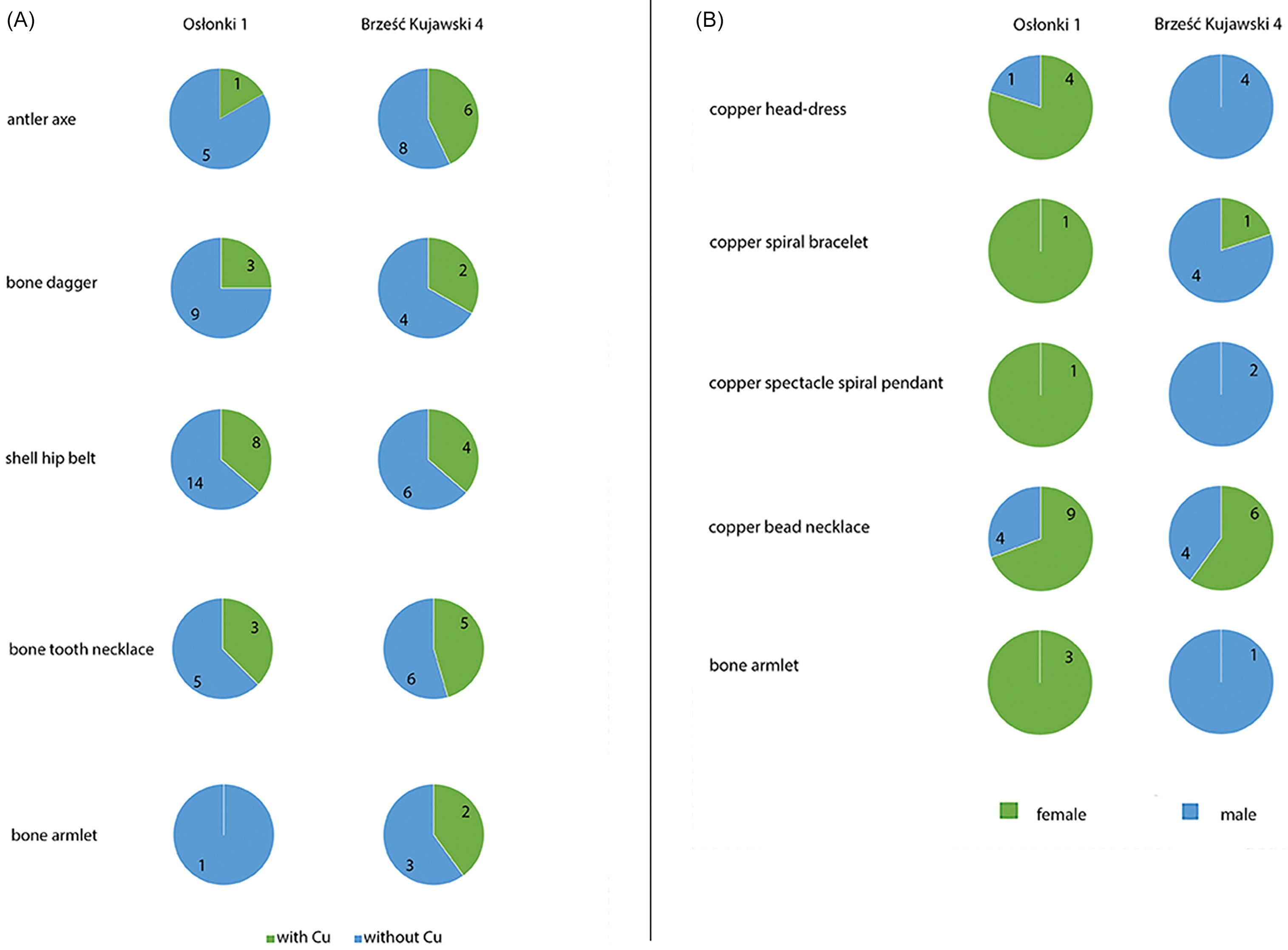
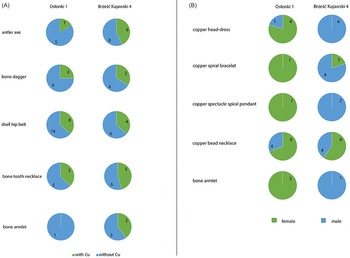
The BKC communities interred their deceased within the settlements, typically in individual graves, with the body positioned in a contracted manner on their side: men were placed on the right side, and women on the left. Only 40 per cent of these burials included grave goods, which were gender-specific (Czerniak & Pyzel Reference Czerniak, Pyzel, Gleser and Hofmann2019). Regarding the classification of graves into poor, average and rich, in Osłonki, the ‘wealthier’ graves were predominantly located in communal spaces, suggesting the significance of these individuals within the village community, and near the southern corners of houses, with a preference for the southeast. In contrast, in Brześć Kujawski, such graves were primarily located in the southeast corners. Furthermore, it is observed that in Brześć Kujawski, only individuals buried with copper were placed in the southeast corners of houses, with one exception, whereas in Osłonki, there were deviations, including individuals with much poorer or no grave goods. Additional differences pertain to the correlation of grave goods with the gender of the deceased. In Brześć Kujawski, ceramic vessels were found exclusively in women’s graves, while in Osłonki, they appeared in both men’s and women’s graves with roughly equal frequency. Differences in grave goods between genders also manifested in the use of certain ornament categories, including copper (Fig. 8). For instance, in Brześć Kujawski, men more frequently used copper ornaments than women. Additionally, the only armlets made of animal ribs discovered in this settlement were found in a male burial. The sole exception to the gender-specific division of copper ornaments was necklaces made of copper beads, which were also commonly found in women’s graves. Conversely, in Osłonki, where significantly more copper ornaments were placed in women’s graves, only women’s burials were equipped with armlets made of animal ribs, similar to other BKC settlements.
Comparison of the grave goods in Osłonki and Brześć Kuj. (A) the frequency of occurrence of copper with other goods typical of rich graves; (B) the frequency of selected types of ornaments depending on the gender of the deceased.
Supply of flint raw material
In the BKC, the primary flint raw material was locally sourced Baltic erratic flint. Additionally, raw materials imported from the Lesser Poland region were present, though their relatively small quantity suggests the intensity of interregional contacts rather than a demand for higher-quality materials. The difference between the settlements under comparison is noteworthy. In Brześć Kujawski, the proportion of imported flint is 10 per cent (144 flint tools), while in Osłonki, it is 5 per cent (93 flint tools) (Papiernik Reference Papiernik2008). This difference is statistically significant and pertains to large collections of tools (approximately 1,462 flint tools in Brześć Kujawski and 1,782 in Osłonki). The disparities become even more pronounced when analysing individual objects, indicating that the use of imported raw materials (similar to copper) was not evenly distributed across the entire population. In Brześć Kujawski, there are objects where the content of imported raw material reached as high as 40 per cent, whereas in Osłonki, only two objects contained slightly more than 10 per cent (Grygiel Reference Grygiel2008).
The use of imported raw materials had a long-standing tradition in Kuyavia, with their share during the LBK period averaging 50–60 per cent and, in some objects, reaching 100 per cent. However, in the LBPC (in the first half of the fifth millennium bce), the significance of imported materials clearly diminished, though the extent of this decline varied considerably depending on the site (Kabaciński Reference Kabaciński2010). It is plausible that these differences were related to the direction of interregional contacts maintained by specific groups, which might reflect their region of origin. Imported raw materials reached the Lowlands from Lesser Poland, whereas in Lower Silesia, even during the late LBK period, there was a transition to the use of local ‘Baltic’ raw materials (Wojciechowski Reference Wojciechowski1988). Consequently, it can be suggested that the inhabitants of Brześć maintained stronger ties with the Lesser Poland area than those of Osłonki. It should also be noted that over time, the amount of imported flint decreased in Brześć, possibly indicating a weakening of interregional contacts.
Consumption of wild animal meat
In Brześć Kujawski, the percentage of wild animal consumption is as high as 37.34 per cent, while in Osłonki it is only 5.5 per cent. However, the data from Brześć should be approached with caution, as only materials from excavations in the 1970s and 1980s were examined. An additional adjustment is warranted due to the fact that the indicator of wild animal share (dominated by deer at 16.4 per cent and roe deer at 7.7 per cent) was elevated by the presence of beaver (12.6 per cent), resulting from the discovery of five nearly complete but dismembered beaver skeletons in object 820. In Osłonki, all bone materials were examined, with deer comprising 2.49 per cent and roe deer 2.12 per cent. In total, even when excluding the overestimated share of beaver, the difference between Brześć and Osłonki remains substantial, at 24.1 per cent versus 5.5 per cent (Bogucki Reference Bogucki2008).
The interpretation of these differences can proceed in two directions. Firstly, one might view the case from Brześć as representative of only a few houses located on the outskirts of the settlement, expressing the distinct identity of a small group among the village inhabitants. Similar observations have been made at the LBK site in Cuiry-lès-Chaudardes, where not only did the consumption of wild animals occur in a distinctly separate area, but this group also expressed its distinctiveness from the rest of the village by inhabiting much smaller houses (Gomart et al. Reference Gomart, Hachem, Hamon, Giligny and Ilett2015). A comparable example, also concerning the LBK, is cited by Cziesla (Reference Cziesla, Schier, Orschiedt, Stäuble and Liebermann2020) based on research at sites in Dresden-Cotta and Dresden Ekcwressel, where the proportions of wild animal bones exceeded 30 per cent. Generally, in the world of Balkan-Danubian farmers, the consumption of wild animal meat was typically avoided, but exceptions were made for specific individuals and groups with a distinct identity (cf. Marciniak Reference Marciniak2005). Russell (Reference Russell, Ivanova, Athanassov, Petrova, Takorova and Stockhammer2018) describes this phenomenon as an expression of taboo, with roots tracing back to Çatalhöyük, where wild animal meat was also consumed in exceptional situations and places.
The second line of interpretation would require generalizing the observations from Brześć to the entire settlement and then contextualizing them within broader changes that involved rejecting the taboo on eating wild animals, particularly cervids, which were accorded a status similar to that previously held by cattle. This process can be observed from the beginning of the fifth millennium in the Balkans (cf. the cemetery in Durankulak, where deer antlers and axes made of antlers were deposited in graves: Todorova Reference Todorova2002) and in the Carpathian Basin (Tóth Reference Tóth, Choyke and O’Connor2013). From the perspective of the BKC, a particularly interesting difference arose between the Lengyel culture (LgK) and the SBK. Namely, during ceremonies held at the rondels in the LgK, deer were consumed (similar observations pertain to the Polgár culture and the ceremonial tell/rondel in Polgár-Csőszhalom: Raczky et al. Reference Raczky, Anders, Sebők, Csippán and Tóth2015), while on the rondels of the SBK, cattle were consumed (cf. Řídký et al. Reference Řídký, Květina and Limburský2019). These differences suggest stronger ties of the inhabitants of Brześć with traditions that emerged, among other places, in the early LgK in the Carpathian Basin. On the other hand, the inhabitants of Osłonki appear more conservative in this comparison, more closely aligned with the local traditions of the LBK and SBK.
Although both interpretations are plausible, we consider the second more convincing. The parts of the Brześć Kujawski settlement from which elevated amounts of wild animal remains have been found do not indicate isolation or a distinct status. This allows the interpretation to be generalized to the entire site.
Discussion
Archaeological interpretations of material culture differences inevitably engage with questions of identity, particularly ethnic identity, while confronting the broader challenge of understanding archaeological culture. This unavoidably revives concerns about associations that archaeology has sought to distance itself from over the past century. The main issues surrounding this have been discussed in above and need not be reiterated here.
In comparing the material culture of two BKC villages, we began by examining the ethnogenetic process of the BKC, as this phenomenon cannot be understood solely through identities based on social roles. The first aspect of this analysis concerns its temporal dimension. The transition from the LBPC to the BKC is usually presented as a direct succession, with the latest stroked pottery assemblages and the earliest BKC ceramics both dated to around 4350 bce. It is therefore plausible that groups adhering to the LBPC tradition coexisted briefly with those adopting the new BKC style. However, all known instances of LBPC and BKC features within the same site yield older radiocarbon dates for the former (Czerniak et al. Reference Czerniak, Marciniak and Bronk Ramsey2016). This suggests that new villages emerged from the merging of groups with related identities, while more conservative communities remained separate—whether by choice or exclusion.
Understanding ethnogenesis requires identifying the factors that catalysed the transformation of collective identity. Particular attention should be given to settlement agglomeration, local relocations and the formation of new territorial divisions—processes commonly recognized as drivers of ethnogenetic change (Hu Reference Hu2013). The settlement densification in Kuyavia and the rise of large central sites such as Brześć Kujawski and Osłonki clearly distinguish the BKC pattern from that of the LBPC.
What, however, triggered the process of agglomeration? There is no evidence that it was preceded by demographic pressure or increased intergroup aggression. The emergence of larger, more substantial houses only in the classical phase of the BKC (Grygiel Reference Grygiel2008) indicates that population growth occurred several generations after the introduction of longhouses and was therefore secondary to settlement agglomeration.
We therefore propose that the force attracting inhabitants to central settlements, around which other settlement processes coalesced, was the ethnogenetic process itself, centred on the longhouse. The longhouse was not only the most visible innovation distinguishing the community but also its symbol, as shown by commemorative rituals and the new historical narratives of ethnogenesis that linked newly built houses to those of ancestors.
Agglomeration, provided other conditions such as the availability of appropriate technologies and resources were met, offered numerous social benefits that justified the effort involved: a sense of security, neighbourly assistance, enhanced opportunities for marital exchange and the capacity to manifest prestige. Simultaneously cohabitation generated higher levels of conflict among individual households, primarily due to competition for access to more prestigious locations for building homes and the possibility of accessing the best fields and pastures. The mitigation of these conflicts was facilitated by various communal ceremonies, such as festivals that involved collective feasting, dancing, singing and storytelling.
Another potential source of conflict may have been the ethnic differences present in the population before the formation of the BKC identity, which emerged in contexts of social tension. The BKC ethnogenesis could have been collectively valorized as a rediscovery of a shared identity tracing back to longhouse-building ancestors. Yet this process did not erase enduring stereotypes that differentiated groups and impeded integration. In this study, we examine these differences through the distinctions between the settlements at Brześć Kujawski and Osłonki.
The LBPC population was not homogeneous, as evidenced by ceramics displaying features of various post-LBK cultural groups, such as the Rössen, SBK and Lengyel (Czerniak Reference Czerniak, Gleser and Becker2012). This diversity reflected the geography of the North European Plain, where northbound routes followed the Elbe, Oder and Vistula rivers, each originating in regions inhabited by these groups. Although all belong to the Danubian Neolithic and post-LBK traditions, they exhibited notable differences. On the European Plain, where these routes converged, the principal axis of contact was latitudinal, promoting the mixing of diverse influences, yet the differences remained perceptible. Consequently, small, dispersed LBPC groups retained earlier identities, creating a complex ethnographic landscape that underwent radical transformation only in the formative phase of the BKC.
In reality, the landscape was even more complex. During and after the formation of the BKC, small groups of migrants from Danubian Neolithic cultures along the upper Elbe, Oder and Vistula rivers continued to arrive in the North European Plain, particularly Kuyavia. They likely introduced new ceramic styles, copper objects and other exotic materials, as well as knowledge of rural organization and innovations related, among other things, to copper exchange.
Secondly, the tradition of marital exchange with hunter-gatherer groups on the Lowland, initiated during the LBPC, continued, as shown by aDNA analyses and exchanged artefacts. We assume that the relatively few groups maintaining such relations may have been perceived by the wider community as ‘different’. Graves from the studied villages contain individuals with haplogroups U5a and U5b, such as O38 and N42 from Osłonki (Fernandes et al. Reference Fernandes, Strapagiel and Borówka2018; Lorkiewicz et al. Reference Lorkiewicz, Płoszaj and Jędrychowska-Dańska2015) and N22 from Brześć Kujawski 3. Individual N22 carries the full set of WHG genes, while N42 has two-thirds, indicating varying degrees of hunter-gatherer genetic integration into the BKC community (Fernandes et al. Reference Fernandes, Strapagiel and Borówka2018).
Unfortunately, aDNA studies for the BKC remain limited, covering only 20 individuals (11: Lorkiewicz et al. Reference Lorkiewicz, Płoszaj and Jędrychowska-Dańska2015; 9: Fernandes et al. Reference Fernandes, Strapagiel and Borówka2018). Aside from those with hunter-gatherer haplogroups (WHG component), the remaining individuals predominantly carry the same genetic component found in Anatolian and LBK early Neolithic farmers.
Social change further diversified the BKC community by creating relationships independent of the new ethnic identity. New status symbols emerged—copper and other exotic materials, weapons and ornaments, and varied funerary practices, reflecting differences of gender and age, as well as prestige from participation in exchange networks.
Comparison of the two neighbouring central settlements shows that the inhabitants of Osłonki and Brześć Kujawski maintained close contacts. General similarities confirm participation in the same ethnogenetic process, while specific evidence—such as identical rib armlets fragments used as necklaces in pit 773 at Brześć Kujawski, site 3, and grave 28 at Osłonki, site 1—highlights direct connections. Yet the settlements also exhibited profound differences, discussed above. Taken together, these demonstrate that the ethnogenetic process did not erase all distinctions stemming from the genealogies of individual groups. They also suggest that the process of ethnogenesis ultimately unfolded within the groups cohabiting individual settlement clusters, which could thus collectively perceive their distinctiveness in relation to the inhabitants of other settlements. In sum, the example of Osłonki and Brześć Kujawski illustrates that the social relations, connections, and boundaries characteristic of the phenomenon of ethnicity (BKC) were not static, but fluid and constantly evolving.
Acknowledgements
We are grateful to the Editorial Board and the anonymous Reviewers for their constructive comments, which greatly improved the final version of this paper.




 Open access

