


Introduction
Various tools have been developed in mental healthcare that allow users of mental health services (henceforth: service users) to determine in advance which treatments they prefer or reject in a future mental health crisis during which their decision-making capacity is assessed as lacking (Lasalvia et al. Reference Lasalvia, Patuzzo, Braun and Henderson2023; Henderson and Braun Reference Henderson, Braun, Helmchen, Sartorius and Gather2025). Psychiatric advance directives (PADs) and joint crisis plans (JCPs) are prominent examples of such tools and have been the subject of intensive research in recent decades (Henderson et al. Reference Henderson, Swanson, Szmukler, Thornicroft and Zinkler2008; Nicaise et al. Reference Nicaise, Lorant and Dubois2013; Murray and Wortzel Reference Murray and Wortzel2019; Lasalvia et al. Reference Lasalvia, Patuzzo, Braun and Henderson2023; Henderson and Braun Reference Henderson, Braun, Helmchen, Sartorius and Gather2025). Legislation supporting PADs or comparable instruments exists in a number of jurisdictions (Gloeckler et al. Reference Gloeckler, Scholten, Weller, Keene, Pathare, Pillutla, Andorno and Biller-Andorno2025). The transferability of the respective studies to other contexts is often limited, as the terminology and legal status of these instruments vary substantially between different jurisdictions (Henderson and Braun Reference Henderson, Braun, Helmchen, Sartorius and Gather2025).
Advance directives [Patientenverfügungen] have been governed in Germany by Section 1827 (previously Section 1901a) of the Civil Code [Bürgerliches Gesetzbuch, BGB] since 2009 and represent legally binding documents with respect to both physical and mental health, provided that the legal requirements are met. These requirements include that the advance directive must be made in writing, clearly state the treatment preferences or refusals, and be created by a person of legal age with decision-making capacity. The document must be sufficiently specific to guide healthcare providers in relevant situations where the individual is no longer able to consent (Wiesing et al. Reference Wiesing, Jox, Hessler and Borasio2010).
PADs [Psychiatrische Patientenverfügungen] are tailored to the context of psychiatric treatment. They are legally binding in Germany even in the event of involuntary commitment, which means that if a valid PAD applies, involuntary treatment may only be carried out if it aligns with the preferences outlined in the service user’s PAD (Sec 1832 para 2 no 3 BGB) (Henking and Scholten Reference Henking, Scholten, Kong, Coggon, Cooper, Dunn and Keene2023). Service users can draft PADs with or without the support of other persons. From now on, we use the term PAD to describe PADs created by service users without the structured support from other persons. Facilitated PADs (F-PADs) are created by service users with support from an independent person, for example, a peer support worker, a researcher, or an independent advocate. JCPs, by contrast, are documents jointly created by service users and mental health professionals and represent an agreement between them. JCPs [Behandlungsvereinbarungen] have a long tradition in Germany, going back to the first JCP template developed in the psychiatric hospital in Bielefeld-Bethel in the 1990s (Kühlmeyer and Borbé Reference Kühlmeyer, Borbé, Coors, Jox and in der Schmitten2015; Brandtner Reference Brandtner and Vollmann2017). Although a JCP is an agreement between a specific mental healthcare institution and a service user, elements of a JCP containing preferences around treatment are legally considered as having the status of a legally binding PAD that is also binding outside the institution, provided that the general legal requirements for advance directives under German law are fulfilled. The mental health law of the German state of North Rhine-Westphalia, one of the few states with explicit legal provisions on JCPs, explicitly ensures the legal recognition of JCPs by requiring mental health professionals to offer and promote them to service users (Sec 2 para 2 PsychKG NRW). In this study, we use the term JCP to translate the German “Behandlungsvereinbarung.” A standardized national form for JCPs in Germany does not exist.
International studies show that service users highly endorse PADs, F-PADs, and JCPs and regard them as tools to increase their autonomy and involvement in care (Braun et al. Reference Braun, Gaillard, Vollmann, Gather and Scholten2023). Furthermore, these instruments have proven to be effective in reducing coercion and compulsory admissions in mental healthcare (de Jong et al. Reference de Jong, Kamperman, Oorschot, Priebe, Bramer, van de Sande, Van Gool and Mulder2016; Bone et al. Reference Bone, McCloud, Scott, Machin, Markham, Persaud, Johnson and Lloyd-Evans2019; Molyneaux et al. Reference Molyneaux, Turner, Candy, Landau, Johnson and Lloyd-Evans2019; Barbui et al. Reference Barbui, Purgato, Abdulmalik, Caldas-de-Almeida, Eaton, Gureje, Hanlon, Nosè, Ostuzzi, Saraceno, Saxena, Tedeschi and Thornicroft2021; Tinland et al. Reference Tinland, Loubière, Mougeot, Jouet, Pontier, Baumstarck, Loundou, Franck, Lançon, Auquier and Group2022). Despite these associated benefits, the implementation rates of PADs, F-PADs, and JCPs still remain low internationally (Gaillard et al. Reference Gaillard, Braun, Vollmann, Gather and Scholten2023; Lasalvia et al. Reference Lasalvia, Patuzzo, Braun and Henderson2023). This has also been demonstrated regarding Germany (Borbé et al. Reference Borbé, Jaeger, Borbé and Steinert2012; Radenbach et al. Reference Radenbach, Falkai, Weber-Reich and Simon2014; Weide et al. Reference Weide, Vrinssen, Karasch, Blumenröder, Staninska, Engemann, Banger, Grümmer, Marggraf, Muysers, Rinckens, Scherbaum, Supprian, Tönnesen-Schlack, Mennicken, Zielasek and Gouzoulis-Mayfrank2023).
Surveys among psychiatrists and other mental health professionals in Germany show that professionals generally support PADs and JCPs and see them as an opportunity for improved collaboration with service users (Grätz and Brieger Reference Grätz and Brieger2012; Gieselmann et al. Reference Gieselmann, Simon, Vollmann and Schöne-Seifert2018). These studies also show that professionals have certain concerns, for example, about service users creating PADs without prior counseling. Given that PADs and JCPs are legally binding in Germany, these instruments actually carry the risk of leading to ethically challenging situations in which an advance refusal of treatment results in a deterioration in health and the respective person can neither be treated appropriately nor discharged (Gather et al. Reference Gather, Henking, Juckel and Vollmann2016; Müller et al. Reference Müller, Gather, Gouzoulis-Mayfrank, Henking, Koller, Saß, Steinert and Pollmächer2024; Gieselmann et al. Reference Gieselmann, Werning, Potthoff, Vollmann, Gather and Scholten2025).
Against this background, this qualitative-empirical study aimed to examine mental health professionals’ views on PADs and JCPs, identify challenges in their application in clinical practice, and derive recommendations for their implementation.
Methods
We employed a qualitative design grounded in symbolic interactionism, aiming to understand the subjective experiences and perspectives of mental health professionals regarding PADs and JCPs in Germany (Flick et al. Reference Flick, von Kardorff, Steinke, Flick, von Kardorff and Steinke2004). Our analysis was guided by qualitative content analysis (Kuckartz Reference Kuckartz2014), which allowed us to systematically categorize themes while remaining open to emergent patterns from the data. The study was also informed by principles from medical ethics and psychiatric care frameworks, which shaped our interpretation of ethical and practical issues raised by participants. Our research team comprised individuals with diverse professional backgrounds including medical ethics, peer support work, philosophy, psychiatry, and sociology. One team member has lived experience as a user of psychiatric services and has used a JCP, which enriched our reflexive approach and understanding of the data. The team included both men and women. The study is reported according to the Standards for Reporting Qualitative Research (O’Brien et al. Reference O’Brien, Harris, Beckman, Reed and Cook2014). The study was approved by the Research Ethics Committee of the Medical Faculty of the Ruhr University Bochum (Reg. No. 18-6583-BR). All participants were informed both orally and in writing and gave their written informed consent prior to their participation.
Data collection
Our inclusion criteria were being a mental health professional and having experience with PADs or JCPs in Germany. The study participants were recruited via e-mail. We sent an information flyer to psychiatric hospitals with proven expertise in the use of PADs or JCPs and distributed the flyer via an interdisciplinary working group on ethics in psychiatry in Germany. We used purposeful sampling to ensure a diverse range of professional backgrounds and experiences relevant to the study topic. We recruited 14 participants in total, including four psychiatrists, four nurses, three psychologists, two social workers, and one peer support worker, to get a wide variety of perspectives. Nine of the participants were men and five were women. The participants were aged between 38 and 63 years old. They worked in different psychiatric hospitals in the German states of Baden-Wurttemberg, Hamburg, Hesse, Lower Saxony, and North Rhine-Westphalia. Sampling was stopped once no new themes or perspectives emerged from the interviews, indicating that data saturation had been reached.
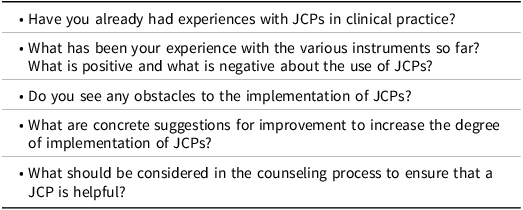
We conducted semi-structured interviews between May 2019 and February 2020. A.G., A.W., and J.G. carried out the interviews in offices in psychiatric hospitals where mental health professionals worked. The interviews lasted between 22 and 77 minutes, with a mean length of 50 minutes. We used an interview guide developed by A.G., A.W., and J.G. based on themes from the available literature. The interview guide included questions about (1) prior experiences with and views on PADs or JCPs, (2) ethical challenges that arise in the application of PADs or JCPs in clinical practice, and (3) implementation suggestions. While the study originally aimed to explore experiences with both PADs and JCPs, the participants’ responses in the first and third sections predominantly focused on JCPs. This emphasis reflects the greater familiarity and experience of the participants with JCPs compared to PADs. Therefore, we focus on JCPs in this article and address results from the first and third sections of the interview guide. Results from the second section are presented in a separate article (Gieselmann et al. Reference Gieselmann, Werning, Potthoff, Vollmann, Gather and Scholten2025). Table 1 lists our guiding interview questions for this article.
Guiding questions

All interviews were audio-recorded and transcribed verbatim. We pseudonymized the transcripts and translated the interview quotes cited into English after the analysis had been concluded. The translations were carried out by researchers from our team, and the final manuscript, including all quotes, was reviewed by a native English speaker to ensure accuracy and clarity.
Analysis
We followed qualitative content analysis according to Kuckartz (Reference Kuckartz2014) for the analysis. After reading all the transcripts, A.G. and A.W. developed a coding frame to cover the most relevant subjects and themes. They then coded the transcripts independently using the software MAXQDA 18. The same unit of text could be included in more than one category. The coding frame was refined during the coding process with emergent themes. S.P., M.S., and J.G. engaged in reflective discussion throughout the process, and disagreements were resolved until the descriptive categories were formulated. To enhance the trustworthiness and rigor of our study, we used investigator triangulation by involving multiple researchers with diverse backgrounds in coding the data. Furthermore, reflective discussions among team members took place regularly to critically examine our assumptions and interpretations.
Results
All participants had experience with offering support and facilitating the process of drafting a JCP. We developed several subcategories describing mental health professionals’ experiences with and views of JCPs during the analysis. We subsumed these under the three main categories defined by the interview guide, namely: (1) opportunities of JCPs, (2) challenges of JCPs, and (3) suggestions for implementation.
Opportunities of JCPs
Strengthening the therapeutic relationship and building trust
Strengthening the therapeutic relationship and building trust were recognized as the most important opportunities of JCPs. The main reason given for this was that service users feel appreciated if the clinical team takes the time to talk with them about their needs in a future crisis. Furthermore, participants argued that drafting a JCP helps the service user to experience the mental health professionals more as people than as members of an institution. One participant noted:
One can talk about situations where people reach their limits. […] If someone [from the clinical team] says: “I am afraid when you scream,” then that person is showing themself to be a human being. I think this is a great opportunity to experience this as a patient, that he or she is dealing with a human being rather than an institution. (Participant 3)
Participants also highlighted that it is important for building trust to act on what has been agreed on in the JCP at a later point in time. As one participant explained, “Because we are working with trust in psychiatry, we are flouting the trust if we agree on something that we don’t adhere to later” (Participant 9).
Promoting self-determination and participation
Participants identified the topic of self-determination and participation as important. As one participant explained, JCPs can empower service users to advocate for their own preferences: “I definitely think that JCPs can help patients to defend their own interests” (Participant 5). Many participants reported that JCPs promote self-determination because they create the opportunity for discussion in a non-acute state when service users are generally more able to advocate for themselves. Importantly, participants acknowledged that while many users can and do speak up during crises, they often feel less believed and listened to in such situations. Thus, the JCP process aims to ensure that the service users’ preferences are documented and respected even during times when self-advocacy may be more challenging. In such situations, the exchange between mental health professionals and service users could be held on an equal footing, which was considered crucial.
Fostering therapeutic progress
Participants expressed that creating a JCP is valuable for service users from a therapeutic perspective. They reported that it is helpful to see service users in a non-acute state: “I thought it was helpful to speak to the patient when they are not in an acute crisis. To learn something about how the patient experiences and evaluates the crisis in hindsight” (Participant 5). By discussing the crisis in retrospect, professionals gain important insights into how the patient interprets their symptoms, including how medication and other treatments may have influenced their experience. Participants also believed that JCPs offer a chance for service users to talk about difficult subjects, such as negative experiences in previous hospitalizations, fears about future crises, or their experiences with medication, and that creating a JCP can be helpful for service users to understand their condition better and recognize symptoms early on. Moreover, participants stated that JCPs can often expedite treatment because the wishes of service users are known immediately in a crisis.
Reducing coercion
Participants also reported that JCPs can help reduce coercion. They argued that, in a crisis, service users would often remember what they had agreed to before in a JCP, as a result of which involuntary measures were not necessary. Furthermore, a JCP can enable mental health professionals to offer service users the treatment that service users themselves think works best for them in a crisis. Participants thought that having specific information about the preferences of individual service users helped them to de-escalate and prevent coercion. One participant stated:
I find that really valuable, because we often can’t see it from the outside. Of course, you have certain ideas, if you have seen and treated that patient before, then you know about that. But if you have seen someone maybe only once, then these things are very good to know. Knowing more about what is going on inside. Then I find it important information if a patient says, “this is helping me then.” (Participant 12)
Enhancing the attitudes of mental health professionals
Participants also reported that JCPs lead to a positive change in attitudes of mental health professionals and that their implementation is often associated with a shift in professional values. One participant reflected on how the introduction of JCPs had contributed to changes in the field over time: “If one, if I look back on 40 years of working in psychiatry, then I think a lot of things have changed, and JCPs certainly played a role there” (Participant 7). Participants argued that using JCPs contributes to a change in attitude toward more respect for patient autonomy and more interest in shared decision-making.
Challenges of JCPs
Limited resources
Participants reported practical difficulties with JCPs. They stated that drafting JCPs takes a lot of time, up to several hours. Furthermore, they reported that it is sometimes challenging to organize the discussion and documentation of the JCP given that several individuals (i.e. at a minimum, the service user and the treating mental health professionals) must be available at the same place and time. Participants also reported that institutional factors and factors related to staff attitudes and professional culture may hinder the use of JCPs. They referred, for example, to a general lack of staff in mental healthcare institutions in Germany, which leads, in turn, to a lack of time resources among available staff and hence hampers the implementation of JCPs. Furthermore, it was argued that the time invested in drafting JCPs is not covered by health insurance and hence cannot be reimbursed, and, thus, there is little incentive for hospitals to implement JCPs.
Insufficient knowledge and interest among service users
Participants discussed reasons for the infrequent uptake and use of JCPs. One reason given was that many service users are not aware of JCPs and some may not be interested in using them. Participants reported that a lack of interest among service users may be linked to a general refusal to think further about one’s mental health condition. As one participant explained, some service users are skeptical about the process:
There are some who are generally sceptical towards us and who think “This was so bad here, I just want to get out of here.” Or, there are patients who say “I don’t want to think about this topic of psychosis anymore. It’s over and I don’t want to speak about it anymore.” (Participant 10)
Some participants assumed it might be stigmatizing for service users to create a JCP because it would give them a label of being a “psychiatric patient” who is likely to come back to hospital.
Uncertainty and skepticism among mental health professionals
Participants reported that some mental health professionals do not know enough about JCPs and, for example, would not know what to do exactly when a person is in a crisis and has a JCP. Participants talked about situations, for instance, in which they were unsure about whether the JCP is binding. Furthermore, participants reported that JCPs are sometimes not created because mental health professionals are skeptical about their usefulness. One participant described:
I have counted how long it took, until between three and five people actually came together, to actually draft it. And that is incredibly difficult, and that is not because there is so much to do, but rather that some people don’t consider it to be that important. (Participant 3)
Infrequent updating of JCPs
Participants expressed the concern that JCPs are not updated frequently enough and that this poses a problem in clinical practice, as outdated documents may no longer reflect the service user’s current wishes or their clinical situation. Furthermore, updating was described from one participant as a process that takes a lot of time:
That is actually a very big problem that one has to keep the things up to date. When I read our JCPs sometimes, that were written in 1998 or 2002, I think that everything has changed. The whole life situation no longer fits, the contact details are no longer correct, and actually, one would have to update that, but that takes a lot of effort. (Participant 7)
Suggestions for implementation
Involving and informing mental health professionals
Many participants emphasized the importance of systematically involving and informing professionals at the organization level in mental healthcare institutions. It was highlighted that hospital managers should promote the use of JCPs and inform their staff about the potential benefits of JCPs and their legal obligations when a JCP is available in a crisis situation, for example, by organizing staff training on this topic in their institutions. Participants suggested involving peer support workers in this training. Furthermore, it was stated that every mental health professional should have the opportunity to be involved in the completion of a JCP to see the value of these instruments for themselves.
Appointing a JCP coordinator
Participants stated that it is important to designate one specific person who is responsible for organizing JCPs within a mental healthcare institution. This person should organize meetings when a JCP is completed, remind staff of their importance, and serve as a point of contact for issues and questions. Without such a role, participants felt that JCPs are often overlooked in clinical practice. One participant pointed out the difficulties when there is no designated role for this responsibility:
I know from other hospitals that find that really difficult, that they often don’t think about it in everyday clinical practice. And I think it is important to convince co-workers and have someone whose task it is to remind everyone, to keep up with it and who checks with everyone on the wards. That is a responsibility, that there is someone who identifies with it. (Participant 14)
Informing service users
Participants considered it important to inform service users about the possibility of completing a JCP as many service users are not aware of this possibility. In this context, participants deemed it necessary to determine which service users exactly are regarded as the target group for JCPs. One participant said:
I think it is decisive that the hospitals decide for themselves which patients are offered to complete advance statements. Because to wait until a patient comes and says: “I would like to have this,” that is not going to happen. I think handing out a flyer with information, that also won’t do it, but rather that someone says: We offer it to each patient who has been here more than twice in the last year, and we explain it to him just before he or she is discharged. (Participant 13).
Participants argued for a standardized institutional policy in the respective mental healthcare institution to ensure that specific service users with frequent admissions or acute conditions are consistently informed about the option to complete a JCP. This could involve clear criteria for offering JCPs.
Organizing the process of creating, storing, and updating JCPs
Participants pointed out that organizing the process of JCP completion well is important for a successful implementation. This includes agreeing among the mental health professionals on a point in time when creating a JCP is useful. Most participants had the opinion that a JCP should be completed several weeks after a hospitalization, when the service user is no longer in an acute mental health crisis but still remembers the last hospitalization.
Regarding the availability of a JCP in clinical practice, participants considered it important to find appropriate technical solutions and configure clinical information systems so that a JCP is immediately accessible in a crisis situation. Some participants reported that their mental healthcare institution had already implemented an adequate technical solution.
Furthermore, participants suggested introducing a mechanism for regular JCP updates. Many participants considered updating a JCP after 3 years as a good point in time.
Creating a JCP in a positive and supporting atmosphere
Participants considered a positive atmosphere during the JCP drafting process to be very important. They pointed out that it is often helpful for service users to involve family members or other persons of trust when the JCP is drafted. Furthermore, participants stated that trust is particularly crucial when creating a JCP, as it allows for open discussions, enabling service users to share their preferences about future treatment. They regarded JCPs as an opportunity to have a frank discussion and negotiate on equal terms, instead of being in a situation in which mental health professionals make decisions on behalf of the service users. Professionals also considered it helpful to draft JCPs in a positive language: rather than describing things that were unhelpful in the past, JCPs should give instructions about what could be helpful in a future crisis.
Ensuring that valid JCPs are honored
Participants stressed the importance of ensuring that a JCP is respected at a later stage. One participant emphasized the need for consistency:
And then, when the patient comes back and the JCP applies, then one really has to act on it. One has to act on it consistently, during the whole course of treatment. Otherwise, we lose this basis, this basis of trust, which I think is so valuable. (Participant 9)
In this context, they also considered it crucial to assess the service user’s decision-making capacity at the time when the JCP is drafted, as this is a prerequisite for ensuring the validity of the JCP and its future application. Furthermore, they pointed out the relevance of good documentation, including precise instructions in a JCP.
Discussion
We identified various opportunities and challenges of JCPs in our qualitative-empirical study with mental health professionals who had all had previous experience with JCPs in psychiatric hospitals in Germany. A better understanding of the opportunities and challenges from this perspective is important because the involvement of mental health professionals is necessary for the creation of JCPs and hence an important prerequisite for their implementation in clinical practice.
Many of the opportunities identified are already known from interviews and surveys of mental health professionals in Germany and other jurisdictions (Henderson et al. Reference Henderson, Flood, Leese, Thornicroft, Sutherby and Szmukler2009; Wilder et al. Reference Wilder, Swanson, Bonnie, Wanchek, McLaughlin and Richardson2013; Gieselmann et al. Reference Gieselmann, Simon, Vollmann and Schöne-Seifert2018). They also correspond well with opportunities reported by service users, including an improvement of the therapeutic relationship, an increase in autonomy, therapeutic benefits, and a reduction of coercion (Braun et al. Reference Braun, Gaillard, Vollmann, Gather and Scholten2023). In line with this, a recently published randomized controlled multicenter study on JCPs in Germany showed that, compared to crisis cards (i.e. concise, patient-held documents summarizing key crisis management preferences and contact information), JCPs were superior from the perspective of service users in terms of active involvement in treatment, increased trust in the treatment team and positive influence on the recovery process (Rixe et al. Reference Rixe, Neumann, Möller, Macdonald, Wrona, Bender, Schormann, Juckel and Driessen2023). The positive experiences reported in our study also align with evidence from clinical trials, which have shown reduced rates of involuntary admission (de Jong et al. Reference de Jong, Kamperman, Oorschot, Priebe, Bramer, van de Sande, Van Gool and Mulder2016; Bone et al. Reference Bone, McCloud, Scott, Machin, Markham, Persaud, Johnson and Lloyd-Evans2019; Molyneaux et al. Reference Molyneaux, Turner, Candy, Landau, Johnson and Lloyd-Evans2019; Barbui et al. Reference Barbui, Purgato, Abdulmalik, Caldas-de-Almeida, Eaton, Gureje, Hanlon, Nosè, Ostuzzi, Saraceno, Saxena, Tedeschi and Thornicroft2021; Tinland et al. Reference Tinland, Loubière, Mougeot, Jouet, Pontier, Baumstarck, Loundou, Franck, Lançon, Auquier and Group2022) and improvements in therapeutic relationships (Swanson et al. Reference Swanson, Swartz, Elbogen, Van Dorn, Ferron, Wagner, McCauley and Kim2006; Thornicroft et al. Reference Thornicroft, Farrelly, Szmukler, Birchwood, Waheed, Flach, Barrett, Byford, Henderson, Sutherby, Lester, Rose, Dunn, Leese and Marshall2013).
The challenges identified in our study are mainly organizational or resource-related and do not fundamentally affect the concept of JCPs. Comparable challenges have already been described in earlier studies (Shields et al. Reference Shields, Pathare, van Zelst, Dijkkamp, Narasimhan and Bunders2013; Lasalvia et al. Reference Lasalvia, Patuzzo, Braun and Henderson2023; Henderson and Braun Reference Henderson, Braun, Helmchen, Sartorius and Gather2025). One frequently mentioned issue was the limited accessibility of JCPs in acute situations. Recent studies have highlighted the potential of integrating PADs into patient-accessible electronic health records (Schwarz et al. Reference Schwarz, Meyer-Diedrich, Scholten, Stephenson, Torous, Wurster and Blease2025), which may offer a promising solution to improve implementation in clinical practice.
One specific challenge mentioned by our participants was that the clinical time spent drafting JCPs is often not directly reimbursed. It is important to acknowledge this challenge but also explore possible workarounds. For example, mental health professionals might integrate JCP drafting into regular therapy sessions, which are reimbursed.
It may be surprising that no more fundamental concerns have been expressed in our study, given that JCPs in Germany are legally binding even in the case of involuntary commitments. Generally, clinicians have expressed concerns about PADs being used to refuse all treatment, containing inappropriate requests, or lacking clarity. Further concerns include changes of mind after completing a PAD, potential safety risks when service users use PADs to refuse all treatment or to make inappropriate treatment requests, questions regarding service users’ capacity to draft PADs, poor-quality or incomplete PAD content, the risk of violence arising from adherence to treatment refusals documented in PADs, and potential liability issues (Atkinson et al. Reference Atkinson, Garner, Stuart and Patrick2003; Farrelly et al. Reference Farrelly, Lester, Rose, Birchwood, Marshall, Waheed, Henderson, Szmukler and Thornicroft2016; Morrissey Reference Morrissey2015; Shields et al. Reference Shields, Pathare, van der Ham and Bunders2014; Thom et al. Reference Thom, O.’Brien and Tellez2015; van Dorn et al. Reference Van Dorn, Swartz, Elbogen, Swanson, Kim, Ferron, McDaniel and Scheyett2006; Wilder et al. Reference Wilder, Swanson, Bonnie, Wanchek, McLaughlin and Richardson2013). More serious challenges with PADs are often associated with situations in which service users refuse medically indicated treatments entirely. Therefore, the use of JCPs might be one reason for the high level of acceptability in our study, as refusal of treatment is less likely to occur with JCPs given that they are developed collaboratively between service users and mental health professionals. This joint process typically ensures that treatment preferences are realistic, clinically appropriate, and reflect a shared understanding of possible crisis scenarios. Consequently, many of the concerns raised in relation to PADs may be less relevant for JCPs (Gieselmann et al. Reference Gieselmann, Simon, Vollmann and Schöne-Seifert2018). A recent survey of mental health professionals in Switzerland showed that psychiatrists’ tendency to take a more critical view was mainly due to concerns about the negative consequences of refusing treatment that they consider necessary and appropriate (Hotzy et al. Reference Hotzy, Cattapan, Orosz, Dietrich, Steinegger, Jaeger, Theodoridou and Bridler2020). However, studies with service users show that such general refusals of psychiatric treatment are rare across various types of PADs and that the contents of advance statements are usually compatible with psychiatric standards of care (Gaillard et al. Reference Gaillard, Braun, Vollmann, Gather and Scholten2023; Morrissey Reference Morrissey2015; Srebnik and Russo Reference Srebnik and Russo2007).
It is important to note, however, that some service users prefer PADs that are created entirely by themselves, without the involvement of mental health professionals (Braun et al. Reference Braun, Gaillard, Vollmann, Gather and Scholten2023). Such PADs place a stronger emphasis on personal autonomy rather than representing a jointly developed plan based on shared decision-making. While JCPs can, and often do, promote self-determination, the concepts of self-determination and shared decision-making differ in important ways. From a self-determination perspective, treatment refusals are valid expressions of autonomy, even when they raise concerns among clinicians. This underscores a tension between the shared decision-making focus of JCPs and the autonomy-centered orientation of PADs.
Previous research consistently shows that users benefit from assistance in drafting their advance statements (Braun et al. Reference Braun, Gaillard, Vollmann, Gather and Scholten2023). While our study focuses on JCPs facilitated by mental health professionals, it is important to acknowledge a middle ground involving third-party facilitators, such as peer support workers. Studies suggest that PADs facilitated by peer support workers are rated as high quality and are not more likely to include refusals of care compared to PADs facilitated by clinicians (Belden et al. Reference Belden, Gilbert, Easter, Swartz and Swanson2022; Easter et al. Reference Easter, Swanson, Robertson, Moser and Swartz2017; Ruchlewska et al. Reference Ruchlewska, Wierdsma, Kamperman, van der Gaag, Smulders, Roosenschoon and Mulder2014). PADs facilitated by peer support workers also show the most promising results in relation to the reduction of the rates of involuntary hospital admission (Tinland et al. Reference Tinland, Loubière, Mougeot, Jouet, Pontier, Baumstarck, Loundou, Franck, Lançon, Auquier and Group2022). Furthermore, such an approach may also mitigate typical issues related to clinician availability and time constraints (Ruchlewska et al. Reference Ruchlewska, Wierdsma, Kamperman, van der Gaag, Smulders, Roosenschoon and Mulder2014).
Regarding improving the implementation of JCPs in clinical practice, mental health professionals proposed various organizational and practical measures in our study that have already been recommended elsewhere in the literature (Nicaise et al. Reference Nicaise, Lorant and Dubois2013; Henderson and Braun Reference Henderson, Braun, Helmchen, Sartorius and Gather2025). We agree with Lasalvia et al. (Reference Lasalvia, Patuzzo, Braun and Henderson2023) that further efforts should focus on implementation to increase the number of completed JCPs in clinical practice.
Strength and limitations
This is, to the best of our knowledge, the first qualitative study to systematically examine mental health professionals’ experiences with and views on JCPs in a jurisdiction in which JCPs are legally binding in mental healthcare. A strength of this study is that it combines the perspectives of mental health professionals with different professional backgrounds. Furthermore, we conducted the study in different geographical areas across Germany to avoid the results representing only local practices.
One potential limitation concerns the generalizability and transferability of the findings, as the legal framework for JCPs in Germany is unique and may not be directly comparable to other healthcare systems. Furthermore, the study only captures the perspectives of mental health professionals. Triangulating these findings with the views of service users from the same institutions could have provided a more comprehensive understanding of how JCPs are experienced and implemented in practice. Additionally, we only discussed JCPs in the interviews, and PADs and other forms of advance statements were not covered. Consequently, it was not possible to compare participants’ views on these different instruments.
Conclusion
Mental health professionals described a variety of opportunities for JCPs to enhance service user autonomy and improve care for people with mental health conditions who experience periods of diminished mental capacity. The challenges identified in our study are mainly organizational or practical challenges that can be addressed by implementation measures.
Funding statement
This work was supported by the German Federal Ministry of Education and Research (SALUS, grant number 01GP1792).
Competing interests
The authors declare none.
Ethical standards
The authors assert that all procedures contributing to this work comply with the ethical standards of the relevant national and institutional committee on human experimentation and with the Helsinki Declaration of 1975, as revised in 2024. The study protocol was approved by the Research Ethics Committee of the Medical Faculty of the Ruhr University Bochum (Reg. No. 18-6583-BR).

 Open access

