


INTRODUCTION
Other than vaccination … we think that a complete system of notification of the disease accompanied by an immediate hospital isolation of the persons attacked, together with, if possible, isolation for 16 days of those who had been in immediate contact with them, could not but be of very high value in diminishing the prevalence of smallpox.
(Royal Commission, 1897) [1]The Metropolitan Asylums Board (MAB) was established in London under an Act of 1867 to care for paupers and the mentally infirm [Reference Ayers2]. The Board was also responsible for dealing with infectious diseases among the poor, notably smallpox.
The newly established MAB had already begun acquiring land for hospital building at Hampstead, Homerton and Stockwell (all recently become suburbs of London) when, late in 1870, the advent of the biggest smallpox epidemic of Queen Victoria's reign forced it rapidly to improvise accommodation for cases of smallpox. Leading medical opinion had reached the conclusion that if outbreaks were to be contained public vaccination must be supplemented by the ‘seclusion’ of as many acute cases as possible [Reference Simpson3]; and during the next quarter of a century the MAB gradually assumed responsibility for the care in isolation of all cases of smallpox other than those among the affluent.
To appreciate the magnitude of the MAB's task a brief description of late Victorian London is necessary. Between 1870 and 1900 its population grew from about three to five million, and its suburbs greatly expanded [Reference White4]. The 1870s were a period of economic depression, and urban poverty and overcrowding were exacerbated by the influx of people off the land from elsewhere in the British Isles and the rest of Europe. Although infant vaccination had been compulsory in England since 1853 there was ‘uniquely inadequate operational administration of the vaccination laws in London’ [Reference Mooney5]. Anti-vaccination sentiment and the mobility of the population meant that a large minority of infants escaped inoculation. Moreover, revaccination, which might have reinforced individual and herd immunity, was unfunded and mostly neglected so that smallpox had become a disease of adults as well as of unvaccinated children [Reference Hardy6].
Smallpox was hardly endemic, but there were continual introductions of it from the Port of London into the East End, and from 1863 London experienced some serious outbreaks, roughly at 10-year intervals. This culminated in the pan-European epidemic of 1901–1903. In response the MAB, in common with local authorities in other British cities, adopted a policy of ‘stamping out’, i.e. early identification and removal of cases into isolation [Reference Simpson3], together with emergency vaccination of contacts. By 1897 the Royal Commission on Vaccination's Report could assert that ‘every case of smallpox in the kingdom which has been detected has been isolated in a hospital of some kind’ [1]. However, to the extent that this was true, it was only in the face of continued opposition from those who lived close by hospitals, based on fear of so-called hospital influence.
This paper sets out the measures that the MAB devised to rid London of epidemic smallpox, describes the lay opposition to its policy and sets out the differences of professional opinion about aerial transmission of smallpox. The MAB's determined action and liberal spending managed to rid London of epidemic smallpox after 1903, but the debate about aerial spread continued and precautions against it long remained in place. Fear of airborne transmission continues to be a factor in contingency planning for serious infectious diseases.
The opposition to the MAB
The MAB managers were first challenged over smallpox when they erected tents and huts at Hampstead to accommodate patients during the epidemic of 1870–1873. Local residents resented cases of smallpox being brought from the ‘rookeries’ of inner London and the East End to MAB hospitals in more salubrious parts of the metropolis. The allegations of secondary cases of smallpox ascribable to the proximity of MAB hospitals there and elsewhere soon persuaded the Board to plan more secure hospitals, and in 1874 it began buying additional land and establishing new hospitals there behind walls and fences in order to prevent illicit contact between patients and their relatives and friends. The first of these permanent hospitals were built on the sites already acquired at Stockwell and Homerton, but others quickly followed, on a former market garden at Deptford and on a seven-acre plot at Fulham just north of what is now the ground of Chelsea Football Club (Fig. 1).
Map of smallpox hospitals in Victorian London. Significant public provision of smallpox beds in London began with the removal in 1846 of a hospital at Battle Bridge (the site of Kings Cross station) to Highgate. There a ‘London Smallpox Hospital’ was built where Whittington Hospital now is. From 1867 the Metropolitan Asylums Board (MAB) assumed responsibility for providing care for pauper smallpox patients, which it did first at Hampstead (1870) and then in permanent hospitals built during the 1870s at Homerton, Fulham, Stockwell and Deptford. In 1884 the MAB moved its smallpox beds to ‘river hospitals’, first the ‘Dreadnought’ at Greenwich then, within the year, to three ships moored on the Long Reach (just upstream of the present M25 crossing). The 1901–1903 smallpox epidemic led to extensive building nearby on the Dartford marshes (Long Reach and Orchard hospitals, and then the 985-bedded Joyce Green Hospital, opened in 1903). To access the river hospitals the MAB built wharves at Rotherhithe, Blackwall and Fulham, and used steamboat ambulances to convey patients to the Long Reach.
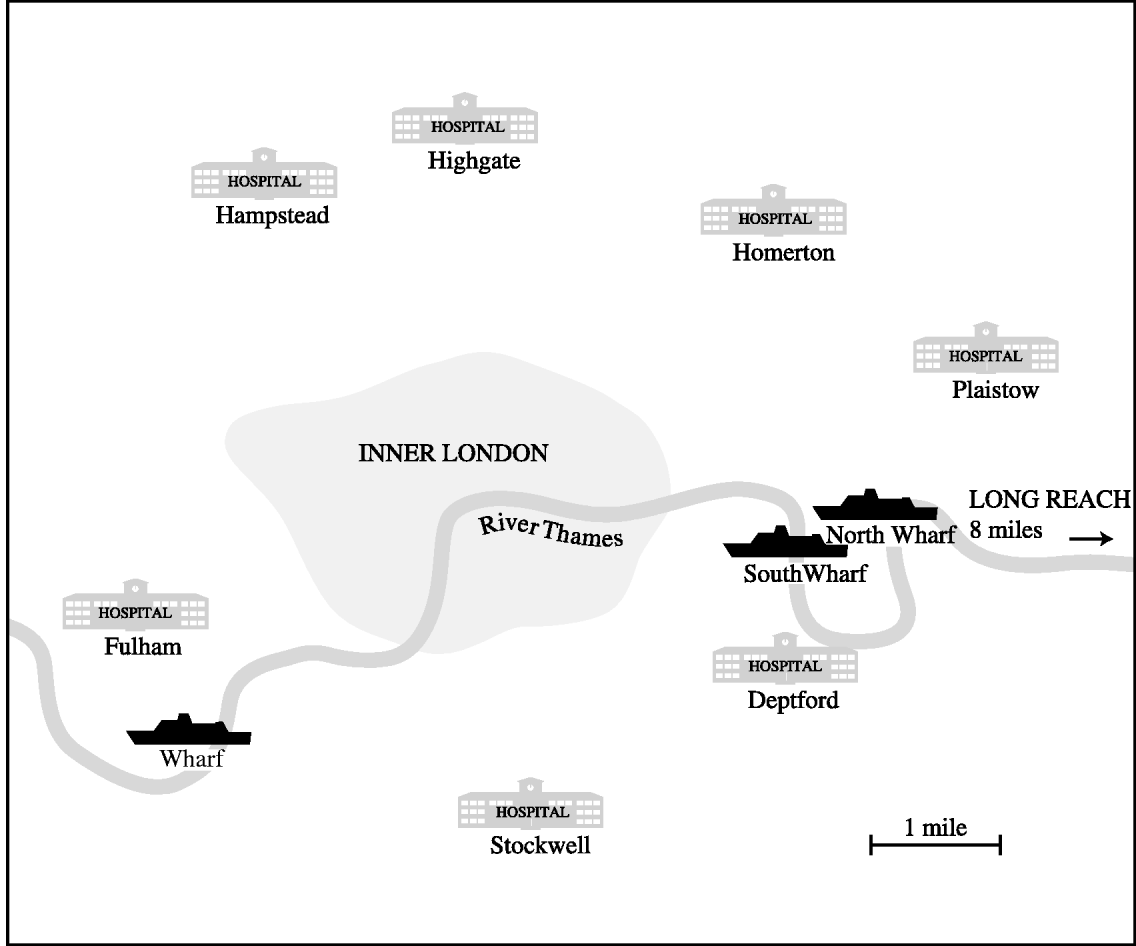
Although well intentioned and practical, these measures failed to allay popular disquiet and, for example, the 300-bedded hospital at Fulham was the object of complaint almost as soon as it opened in February 1877. Nearly 150 acutely ill smallpox patients were being treated there in June 1877, and 140 in December 1877, and just as many in December 1880. By 1881 the renewed clamour from the neighbouring parishes of Fulham, Kensington and Chelsea had persuaded the Local Government Board (LGB) to send in one of its medical inspectors, W. H. Power. He investigated the possibility that Fulham Hospital was spreading smallpox in its vicinity [Reference Power7].
The idea of aerial transmission takes wing
Dr Power began by inquiring into the period January to March 1881. He described smallpox as being ‘rife’ in London's East End, and many of the cases had been brought to Fulham Hospital. While there had only been 11 cases of smallpox in the adjoining parishes of Kensington, Chelsea and Fulham in the 4 weeks before 22 January 1881, 64 acute cases had been admitted to Fulham Hospital. Within a fortnight there were 62 new cases of smallpox among the residents of the three parishes, of whom 32 lived within a one-mile radius of the hospital; 23 of them denied exposure to smallpox or ‘any sort of communication with the hospital or with persons connected with it’. Had they therefore been infected by aerial convection from the hospital?
When Power looked back to 1877 he also found a raised incidence of smallpox around Fulham Hospital. In a ‘special area’ within one mile of it, smallpox incidence had never been less than double, and during one fortnight six times that in other parts of the three parishes. Power was ‘reluctant’ to entertain the idea that local inhabitants (all of whom lived more than 66 yards from the boundary of the new hospital) were at risk from airborne spread of smallpox; but eventually he felt ‘compelled’ to report that there might be an aerial hospital influence. However, proof required that direct contacts and external exposures to smallpox should first be excluded.
Power therefore inquired into the conduct of the resident hospital staff and the activities and possible contacts of each of the acute cases of smallpox arising in the community. He found that any laxity that there might have been about the movements of hospital staff in 1877 had been corrected by 1880. By then, too, journeys to and from the hospital along its one access road were rigorously controlled so that there was no discoverable contact between the local population and the hospital (which was staffed by preference with people not drawn locally). Nevertheless, in each epidemic period there was an excessive incidence of smallpox in the neighbourhood of Fulham Hospital, and Power also noted that:
• the percentage of houses invaded fell as the distance from the hospital increased;
• houses along the chief line of communication with the hospital had not suffered more;
• the excess of local cases was most marked when admissions of acute cases were beginning to increase rapidly and was in an almost constant ratio to the amount of smallpox-related activity in the hospital;
• the excess of local smallpox cases did not show itself when the hospital was being used for convalescents only;
• within Fulham hospital, smallpox sometimes spread to other wards ‘under circumstances that almost forbid belief in infection conveyance by personal means’.
Dr Power then turned his attention to the local weather observations during January 1881, at the start of an intense episode of apparently aerial transmission [Reference Power8]. There had been ‘still, sometimes foggy, weather, with occasional light rain, from nearly all points of the compass’. Aerial smallpox transmission aided by stagnant air, Power concluded, was the explanation for the phenomenon of hospital influence. It was consistent with that that the density of smallpox cases around Fulham hospital fell away proportionally to distance. Power also observed that the circumstances at Fulham had ‘a broad resemblance to those of other London smallpox hospitals … the lessons to be learnt … will probably not be without applications to smallpox hospitals in other parts of the country’.
There was never to be professional agreement about what exactly those lessons were, and the Medical Officer of Health for the three parishes, Dr Dudfield, in his evidence to the Royal ‘Hospital’ Commission hastily set up in December 1881 to consider the issue of smallpox hospitals, offered a different perspective to Power's. Power's evidence emphasized the ‘influence’ of hospitals such as the one at Fulham [9]; Dudfield, however, testified that:
in my judgement the long continuance of smallpox in London, apart from the question of vaccination, is largely due (1) to the concealment of cases (2) to non-isolation and especially to exposure to mild cases and infected clothing (3) to delay in removal of cases to hospital and (4) generally to want of solidarity in sanitary administration … Every other large centre of population has but one sanitary authority.
In other words the smallpox hospitals reflected the problem but were not at its root.
Nevertheless, Power's conclusions lent scientific credibility to householders' complaints and they unleashed a national controversy that affected both the MAB hospitals and the intra-urban smallpox hospitals in cities such as Liverpool, Glasgow and Nottingham. The 1881 Royal Commission, adopting Power's conclusions, reported that ‘construction and management of hospitals should take account both of personal communication and atmospheric dissemination’; and the consequences of this recommendation, it can be argued, continued to be felt right up to the final case of smallpox, nursed in an isolation hospital outside Birmingham in 1978.
The MAB changes tack
Confronted with a senior health official's findings as well as continuing lay allegations of hospital influence, the MAB decided that from 1884 it should no longer treat smallpox in its intra-urban hospitals. Instead it resorted to hospital ships. At first it leased from the Admiralty the Dreadnought, a seamen's hospital ship moored at Greenwich. Then, in deference to immediate local objections, it acquired three other retired craft, the Endymion, Atlas and Castilia, and moored them together on the Long Reach of the Thames Estuary, further from human habitation [Reference Burne10].
For the next two decades smallpox patients were taken from MAB wharves at Rotherhithe, Blackwall and Fulham to these hospital ships. A medical officer reviewed the cases at the wharf and confirmed ones were put on steam ambulance boats and taken to the Long Reach. This triage became very effective; of the 8811 patients embarked at South Wharf, Rotherhithe, in 1901–1902, for example, only 11 were inappropriately sent downstream [Reference Wanklyn11].
Although the acute cases of smallpox were treated on the hospital ships, convalescent ones were taken ashore, early on to tents erected at Gore Farm and in the grounds of the Darenth Asylum, later to the ‘Long Reach’ and ‘Orchard’ Hospitals. These were hutted pavilions built on the Dartford marshes and reached from the ships by a pier and tramway. In 1901 the MAB began construction nearby of a permanent 985-bedded hospital, Joyce Green, to which the tramway was extended.
The doctors debate aerial transmission
In 1885 Dr Power inspected three more hospitals, in the growing suburb of Plaistow, East London. He found a two- to tenfold excess of cases of smallpox within three quarters of a mile of the hospitals, the excess being most marked at the beginning of an outbreak in March 1884 [Reference Moir12, Reference Power13]. Power again invoked his theory of aerial convection, but this flushed out the professional dissent that had first been voiced at the 1881 Royal Commission. It came from those who favoured more mundane explanations for hospital influence, involving either direct contact with hospital patients or the introduction of smallpox into the neighbourhood from other sources.
Another rebuttal had been in Dr Edward Seaton's 1882 paper, read to the Epidemiological Society of London, on ‘The influence of smallpox hospitals’ [Reference Seaton14]. In Nottingham, where Seaton was Medical Officer of Health, a cluster of smallpox cases had arisen in 1881 to the east of the city's smallpox hospital, and it was supposed that the infection had been carried from the hospital on the prevailing westerly wind. The distribution of the cases on a map seemed to bear that idea out, but careful inquiry established that the cluster had arisen from three separate foci at which the appearance of single acute cases had been followed by infection of several contacts. Seaton argued that cases of smallpox introduced into the community, or clandestine social contacts with hospital patients, could explain the emergence of smallpox in the vicinity of a hospital. Others cynically suggested that there was a reluctance to acknowledge or disclose known instances of direct exposure to hospital cases as these reflected badly on the administrative staff.
Dr John McVail, on the other hand, read a paper to the Epidemiological Society in 1894 which supported Power's thesis [Reference Mooney5]. He recalled that a century previously the American physician Benjamin Waterhouse had observed that smallpox seemed to cross the Charles River, more than 500 yards beyond the limit of the city of Boston as it then was. Waterhouse had consequently isolated his cases of smallpox on an island 2–3 miles beyond Boston. Moreover, McVail was so impressed by Power's description of the occurrence of smallpox in rings of decreasing intensity around Fulham Hospital that he visited there seeking further evidence. He contrasted an outbreak in a Kensington street where for at least half of the cases personal contact with smallpox was known to have occurred, with the 1881 Fulham outbreak where the cases had been ‘dotted around the special area’ within a mile of the hospital and gave no history of contact. In addition, McVail reviewed the evidence on the transmission of smallpox being presented to the Royal Commission on Vaccination that sat between 1889 and 1897 [1]. Smallpox, he concluded, might be conveyed atmospherically for ‘a distance measurable by quarters of miles, and that whether or not this was so, the only remedy is the removal of such institutions [i.e. smallpox hospitals] to a distance from populous places’. The implication was that every city's hospital was a threat to its population whenever it admitted a case of smallpox.
By 1895, Power's concept of concentric zones of intensity of infection around smallpox hospitals had also been accepted in Government circles. Dr Thorne Thorne, Medical Officer to the LGB, issued advice on the selection of sites for smallpox hospitals. (His post was equivalent to that of the present Chief Medical Officer for England, and was one that Power himself later held.) Thorne's advice implied a risk of distant aerial transmission:
A local authority should not contemplate the creation of a smallpox hospital where … within a quarter of a mile of it as a centre there was another hospital, a workhouse, and a population of more than 150 people. Secondly, it should not have within half a mile a population of more than 500 whether within an institution or a dwelling house [16].
Meanwhile, as the contemporary Royal Commission Report on Vaccination noted:
endeavours made with more or less vigour to isolate cases of the disease by admitting to a hospital … led to danger of spreading the disease if considerable numbers of smallpox patients are aggregated in hospitals situated in populated neighbourhoods [1].
Did smallpox cross the Thames Estuary?
Within months of the hospital ships having been moored on the Long Reach in 1885 allegations of escapes of infection began to be made there [Reference Burne17]; and when during a local outbreak of smallpox between 1893 and 1895 Dr Thresh, Medical Officer of Health for the county of Essex, learnt of an excess of cases in the village of Purfleet on the opposite bank of the estuary from where the ships were moored, he drew the same conclusion. Thresh accused the MAB of failing to prevent direct communication between its ships and the Essex shore, although this form of contact ‘save probably the surreptitious visit of a man to his sweetheart … was denied by all parties concerned’ [Reference Thresh18]. Rumours of such contacts long persisted; a memoir published in 1935 records that the ships' engineer and others ‘used to take a boat late at night and row to a public house in Purfleet where they played cards’ [Reference Newsholme19].
In 1901, Dr Thresh reiterated his concern. Between August 1901 and April 1902 117 out of the 938 smallpox cases in Essex had occurred in one parish, West Thurrock, which included Purfleet [Reference Thresh18]. Again an LGB inspector, Dr G. S. Buchanan, was called in. Buchanan reported that the attack rate in Purfleet was 86·6/1000, several times higher than anywhere else in Essex, and the rate in South Purfleet (opposite the hospital ships) was much higher than in West Purfleet. The prevailing southwest-to-west wind came from the direction of the ships and Buchanan concluded that
smallpox prevalence in Purfleet was set going, and … re-inforced, by infection aerially conveyed from the MAB hospital ships, just over half a mile away across the water … all the results point to some central continuous focus of infection corresponding exactly in position with the smallpox ships [20].
As far as Dr Thresh was concerned, the smallpox cases should be removed from the Long Reach to a yet more remote area and housed in ‘properly constructed and equipped marquees … an area like that of Canvey Island would serve for London’ (Canvey Island is much further down the Thames Estuary and was then virtually uninhabited).
The professional debate intensifies
The 1901–1903 epidemic raised fresh allegations of hospital influence in London and other cities. Even where the acute cases of smallpox were isolated on floating hospitals, as they were at Southampton, Bristol and Newcastle as well as London, there was talk of aerial convection of infection. This re-enlivened the professional debate and in December 1904 led to weeks of argument at, and correspondence to, the Epidemiological Society of London. The exchanges there were for the most part courteous, but there was no meeting of minds between the ‘aerialists’ and their opponents. It was only the unexpected disappearance of epidemic smallpox from Britain after that year that allowed the dispute to be shelved, still unresolved.
The record of the debate occupies 115 pages in the Epidemiological Society's Transactions [Reference Buchanan21]. It comprises a long opening review of the evidence for distant airborne transmission of smallpox by Dr Buchanan, followed by arguments for and against. The aerialists weighed in with observations exemplifying hospital influence. In Liverpool, for instance, Dr Reece (who like Power and Buchanan was an LGB inspector) had recently found it around all three hospitals where smallpox cases had been admitted [22]. However, the local Medical Officer of Health, Dr Hope, rejected Reece's conclusion of aerial convection, protesting that there was a similar, apparently concentric, distribution of smallpox cases around the Netherfield Road Hospital which had been empty throughout the epidemic. Other speakers were also unconvinced of aerial transmission, recognizing that administrative failures might permit escapes of infection. At Stockwell Hospital, where a railway line bounded and so cut off the area south of the site, Dr Newsholme observed that no excess of cases of smallpox had occurred in that area; ‘agnostics’ like him argued that the burden of proof lay with the aerialists and not with their opponents. Others denied distant aerial convection outright contending that where human movements in and out of a smallpox hospital were strictly controlled no influence was seen. The Edinburgh physician C. B. Ker claimed to have long supervised an urban smallpox hospital without ever encountering hospital influence. Under his regime each smallpox nurse had to serve an unbroken 6-week internship.
Another expedient to avoid escapes of infection was to apply oil to contaminated surfaces, patients' bodies included. In Manchester, Dr Niven attributed that city's freedom from hospital influence to twice daily applications of 2·5% carbolic oil to the bodies of smallpox patients to prevent aerial spread. However, Dr Sweeting recalled that carbolic oil had been similarly used between 1881 and 1885 at Fulham Hospital, the very place where the aerialists' theory had its origin.
A satisfactory level of vaccination in the local community could also, of course, be a factor suppressing hospital influence. Dr McVail suggested that it was adequate vaccination and revaccination of the Edinburgh population that had ensured that the City Hospital did not exercise an influence. Where, however, community vaccination was less adequate, as in London, smallpox cases must be removed to an isolated site. With respect to the outbreaks on the Essex shore of the Thames Estuary, it was pointed out that introductions of smallpox from the East End of London by dock labourers using ‘road, rail and river’ were as likely a source of smallpox as aerial convection across the Thames from the hospital ships on Long Reach. It was recognized that much smallpox in the London area originated in the docks, and Purfleet was directly linked to them by railway.
All in all, the Epidemiological Society debate was inconclusive. While distant aerial spread was always a possibility, ‘the operations of human intercourse are often untraceable’ as Professor Kenwood observed.
A precautionary principle prevails
In the aftermath of the 1901–1903 epidemic decisions were taken nationwide to expand local isolation facilities for smallpox cases, and it has been estimated that eventually there were over 300 such hospitals in Britain [Reference Richardson23]. The MAB's arrangements were a case in point. It dispensed with the hospital ships in 1904 (they were inconvenient, a fire and collision hazard, and a danger for delirious patients), but it retained the hutted Long Reach and Orchard smallpox hospitals and had just opened Joyce Green Hospital. It therefore had 1400 smallpox beds at its disposal and could expect to be able to remove every diagnosed case of smallpox from the metropolis and accommodate them at this (then) remote site a dozen miles from the city. It was an early application of the precautionary principle.
A decade later, though, and the scale of the provision was beginning to be questioned. Had there perhaps been an overreaction to the 1901–1903 epidemic? When the medical superintendent of the Dartford smallpox hospitals, T. F. Ricketts, reported to the MAB Board in 1913 he remarked that only single cases had been admitted since 1904, and recommended that 600 of the beds at his disposal should be used for other fevers. In his opinion the vigilance of the two Port of London quarantine officers appointed to inspect incoming vessels had made his smallpox beds largely superfluous [Reference Ricketts24].
Second thoughts about maintaining so many dedicated beds were perhaps reinforced by the publication in 1912 of a monograph dismissing the concept of distant aerial transmission [Reference Collie25]. The author, Alexander Collie, had retired from a long career in fever medicine begun during the 1870–1873 smallpox epidemic. He had been medical superintendent both of the Hampstead and Homerton hospitals and the MAB's hospital ships. To summarize Dr Collie's data: he had treated 15 000 cases of smallpox between 1871 and 1885 in hospitals where, in adjoining wards, there had in all been 13 000 other fever cases. Only 65 cases of smallpox had arisen among the latter, and 31 of them had had previous external contact with cases of smallpox. The remaining 34 cases Collie attributed mainly to contact with the more than 100 000 visitors he estimated that the 13 000 patients had received, rather than to exposure to smallpox cases held elsewhere within the hospital. Collie believed that aerial transmission was unusual even over the short distances (less than 60 feet) that had separated the smallpox from the other wards at Homerton Hospital. If not there would have been far more cross infection in the hospital, he argued. In contrast to McVail's conclusion that aerial transmission of smallpox could be measured in quarters of miles Collie concluded: ‘instances of distal aerial dissemination are rare, reduced for example to the case of a nurse slipping out now and then without changing her uniform’.
Time further eroded the aerialists' theory and with it the implied necessity for doctors to dispatch cases of smallpox to special isolation hospitals – journeys which, after all, were not in the best interests of acutely ill patients. On the other hand public attitudes to serious epidemic disease were becoming less fatalistic and national and local authorities more averse to the risk of cross infection. Following a multifocal British outbreak in 1962 with over 50 cases and high mortality, a Department of Health memorandum reiterated the need for sequestered smallpox hospitals kept constantly ready solely to accept cases: ‘When the diagnosis of smallpox appears to be clinically definite the patient should be removed at once to a hospital designated for the reception of smallpox’ [26]. Only in the 1970s did these smallpox hospitals face closure, and this was due to imminent global eradication, not a more robust attitude to the possibility of aerial transmission.
DISCUSSION
Power's concept of long-distance aerial transmission of smallpox set off a controversy that will now never be resolved. In the late Victorian era LGB officials and some other public health doctors were strongly attracted to the idea, although experienced clinical colleagues remained sceptical or were opposed to it. Underlying the controversy can be discerned an anxiety about who might be held responsible for apparent escapes of smallpox from hospitals. If not airborne these escapes must, as Dr Buchanan pointed out at the 1904 debate, be evidence of ‘gross maladministration, a staff incompetent or improperly supervised, patients getting out of hospital grounds inadequately enclosed’; but was it, as another discussant pointedly asked, ‘the best way to secure efficient administration of smallpox hospitals to allow those in charge of them to plead aerial convection?’
In spite of the evidence of such a phenomenon for Q fever [Reference Tissot-Dupont27] and foot-and-mouth disease [Reference Gloster and Alexandersen28], the success of local ‘ring’ vaccination during the final phase of the global eradication programme was eventually to argue against the idea of distant airborne spread of smallpox. In the semi-chaotic circumstances of the epidemics in Victorian London it is hard to avoid the conclusion that hospital ‘influence’ was largely due to the mobility of the metropolitan population and its associated terrestrial contacts with undiscovered cases of smallpox. Hidden and undiagnosed vaccine-modified cases of smallpox, ambulant in the community, must have been potent sources of infection, although this does not in itself of course exclude the possibility of distant aerial transmission [Reference Christie29].
Dr Power had referred in his 1881 Fulham report to lessons to be learnt and, in retrospect, one lesson may be that when precautionary measures involving building programmes are introduced, there should be flexibility so that if they prove ill-suited other functions can be served. The MAB's first permanent smallpox hospitals possessed that flexibility, but the following generation of smallpox hospitals, erected around the turn of the century outside London and other towns and cities countrywide, were underused monuments to the fear of hospital influence. Even with the prevailing low infant vaccination rates, vigilance at ports, prompt notification and emergency vaccination of contacts were, after 1903, enough to prevent significant outbreaks of smallpox. To deal with the ensuing sporadic cases and small clusters of smallpox there was no need for so many remote hospitals, and their rationale was, in any case, doubtful. The closest most of them got to fulfilling their original purpose was to isolate cases of variola minor during the smouldering outbreaks of that comparatively trivial affliction in the 1920s and 1930s [Reference Gordon30].
The debate about aerial transmission of smallpox raises a topical question: how to provide secure care for any future serious emergent infection that might have an epidemic potential as great or greater than smallpox? The degree of transmissibility is obviously crucial; for example in 2002–2003 the disruptive impact of SARS on the hospitals that admitted cases in Asia and Canada was mitigated by its limited capacity for airborne spread [Reference Maunder31]. The transmission of influenza, by contrast, is still poorly understood [Reference Brankston32], and the numbers of cases of avian influenza in a human-adapted form might quickly overwhelm present facilities for isolation. Could district general hospitals then be swiftly transformed into centres that both provided patient care and served a rapid containment function? In Britain could the other hospital activities be abandoned and clinical staff assigned to provide that epidemic care? Would it be possible, as was necessary in Victorian London, to contrive other temporary accommodation where cases could be removed and treated in isolation?
Although the cost to the MAB of contingency planning for smallpox was multiplied by a probably exaggerated belief in aerial transmission, the progressively effective identification, removal and isolation of cases towards the end of the Victorian era ridded London, as it did other British cities, of smallpox. Current planning for epidemics needs to take careful account of the potential modes and intensity of transmission of any foreseeable emergent infection, and the possible need to isolate large numbers of patients, even though such preparations may be expensive and rarely drawn upon. Late Victorian and Edwardian London bore the contingency costs of isolating epidemic disease and benefited from doing so; as an expedient for controlling future epidemics such arrangements may still have a part to play.
DECLARATION OF INTEREST
None.



