

Over the last few years, a number of ‘memory laws’ have been adopted across Europe and beyond. Prescribing certain interpretations of historical events or processes, memory laws are a major instrument of the politics of memory pursued by states and supra-national institutions. Some memory laws incentivise certain narratives about the past, while others criminalise them. An overview of various attempts to govern memory via legislation reveals that most energy has been invested in criminalising Holocaust denial. Relevant legal regulations are in force in as many as 22 (mostly European) countries, including Poland, where Holocaust denial was criminalised in 1998. Twenty years later, the juridification of Holocaust memories in Poland entered a new stage. A law adopted by the Polish parliament on 26 January 2018 criminalised assertions regarding Polish complicity in the extermination of the Jews:
Whoever publicly and contrary to the facts attributes to the Polish Nation or to the Polish State responsibility or co-responsibility for the Nazi crimes committed by the German Third Reich […] shall be liable to a fine or deprivation of liberty for up to 3 years. (Act of 26 January 2018)
The so-called Polish Holocaust Law (the Law) immediately became a subject of intense public and professional debates in Poland and beyond (Sawka Reference Sawka2018). Under international pressure, the legislation was amended on 27 June 2018. As a result, offences committed against the ‘good name’ of Poland are no longer subject to criminal law and can only be reported to civil courts.
Scholars discussing various ramifications of the Law mainly focus on its legal and logical shortcomings, the damaging impact on historical research, and the destructive consequences for Polish–Jewish relations (Belavusau and Wójcik Reference Belavusau and Wójcik2018; Gliszczyńska-Grabias and Kozłowski Reference Gliszczyńska-Grabias and Kozłowski2018; Peters Reference Peters2018; Hackmann Reference Hackmann2018; Bucholc and Komornik Reference Bucholc and Komornik2019). Its effects on the rise of antisemitism in Poland have also been well documented (Babińska et al. Reference Babińska, Bilewicz, Bulska, Haska and Winiewski2018; Pankowski Reference Pankowski2018). Less attention has been paid to the socio-cultural foundations of the short-lived legislation and its expected socio-political benefits. By taking a closer look at these dimensions of the Law, this article shows how popular images of the past resonate into political uses of history in contemporary Poland. In more general terms, this article considers the Law as a case in point for mnemonic populism. Following the most consensual definitions of populism as a form of politics based on a moral dichotomy between the pure people and the corrupt elite, in which the former are considered to be the only legitimate source of political power (Müller Reference Müller2016; Mudde and Kaltwasser Reference Mudde and Kaltwasser2017; Kaltwasser et al. Reference Kaltwasser, Taggart, Espejo and Ostiguy2017), I understand mnemonic populism as poll-driven, manifestly moralistic and above all anti-pluralist imaginings of the past. By exploring the political motives behind the Law and tracing its afterlife, this article argues for the necessity to study mechanisms of populist politics regarding collective memory – a task that can only be achieved by combining memory and populism studies.
The Holocaust in Polish Memory
On the eve of the Second World War, 3.3 million Jews lived in Poland – more than in any other European country. After the war’s end, approximately 380,000 Jews remained alive.
As shown by Michael C. Steinlauf (Reference Steinlauf1997), a French-born son of Polish–Jewish Holocaust survivors, raised and educated in the United States, the master narrative of the Holocaust, already established in Poland in the early post-war period, revolved around two motives: Polish solidarity with the Jews, and the parallel between Polish and Jewish suffering under Nazi occupation. For instance, a law adopted by the Polish parliament in 1947 epitomised Auschwitz as a site of the ‘martyrdom of the Polish Nation and other Nations’ (Act of 2 July 1947). According to Steinlauf, this duality tended ‘to blur, though not yet abolish, the distinction between the fate of Poles and Jews’ (Steinlauf Reference Steinlauf1997, 71).
A crucial change occurred in Poland around the mid-1960s when West German and Zionist forces allegedly launched a conspiracy defaming Poles as eternal antisemites who had welcomed the Holocaust. To counter this campaign, the communist establishment set out to promote stories about Poles helping and rescuing their Jewish neighbours. Drawing on inaccuracies, exaggerations and lies, this interpretation of the Holocaust invigorated popular images of the Jews as being passive during the war and ungrateful to the Poles, if not even anti-Polish (Irwin-Zarecka Reference Irwin-Zarecka1989).
Remarkably, the ethno-nationalisation of the collective memory of the Second World War in Poland was not limited to political and popular representations of the past. It also shaped professional historiography. Whereas Poland’s wartime history was subject to serious conflicts between historians in People’s Poland and those in exile on one hand, and between mainstream Polish historians and those publishing in the underground on the other, there was a striking consensus across these different historiographical milieus regarding Polish–Jewish relations. The agreement was built on two assumptions. As is known, helping and hiding Jews in Nazi-occupied Poland was punishable with capital punishment. Therefore, in most historical accounts, Polish helpers appeared as heroes, and the indifference of others was represented as a result of their survival instinct. Plausible at first glance, this understanding of Poles’ wartime behaviour ignored the fact that other activities punishable with capital punishment, such as black marketeering, were flourishing in the Nazi-occupied territories. No less widespread in the Polish historiography was the belief that Jews in Soviet-occupied Poland had collaborated with the Soviets on a mass scale, therefore provoking hatred, and in some cases revenge on their Polish neighbours. Extending rare instances of the Jewish–Soviet cooperation to the attitudes of the entire Jewish population in the Soviet-occupied territories, this Old-Testament-like interpretation of anti-Jewish violence committed by Poles disregarded the long shadow of rampant antisemitism in pre-war Poland. Both assumptions corresponded to popular Polish images of wartime relations between Poles and Jews.
The first attempts to challenge the collective memory of the Holocaust in Poland were undertaken during the 1980s, when left-wing activists and Catholic intelligentsia began calling upon their compatriots for a critical reassessment of Polish–Jewish relations (Peters Reference Peters2016, 317–426). The most heated debate was sparked off by the essay ‘The Poor Poles look at the Ghetto’ written by literary scholar Jan Błoński for the Catholic weekly Tygodnik Powszechny in early 1987. Asking a number of uncomfortable questions on the indifference and moral turpitude of Poles during the Holocaust, Błoński argued the following:
Everybody who is concerned with the Polish–Jewish past must ask these questions, regardless of what the answer might be. But we—consciously or unconsciously—do not want to confront these questions. We tend to dismiss them as impossible and unacceptable. After all, we did not stand by the side of the murderers. After all, we were next in line for the gas chambers. After all, even if not in the best way possible, we did live together with the Jews; if our relations were less than perfect, they themselves were also not entirely without blame. So do we have to remind ourselves of this all the time? What will others think of us? What about our self-respect? What about the ‘good name’ of our society? This concern about the ‘good name’ is ever-present in private and, even more so, in public discussion. (Błoński Reference Błoński and Polonsky1990, 42–43)
Błoński concluded that ‘participation and shared responsibility are not the same thing. One can share the responsibility for the crime without taking part in it. Our responsibility is for holding back, for insufficient effort to resist’ (Błoński Reference Błoński and Polonsky1990, 46). Jerzy Turowicz, then editor-in-chief of Tygodnik Powszechny, recalled that reaction to Błoński’s essay ‘was greater than anything known in the course of the 42 years during which I have edited that paper’ (Polonsky Reference Polonsky and Polonsky1988, 215). Most readers’ letters were negative. One letter came from a former resistance fighter, prominent lawyer and opposition activist, Władysław Siła-Nowicki, who wrote:
I am proud of my nation’s stance in every respect during the period of occupation and in this include the attitude towards the tragedy of the Jewish nation. Obviously, the attitudes towards the Jews during that period do not give us a particular reason to be proud, but neither are they any grounds for shame, and even less for ignominy. Simply, we would have done relatively little more than we actually did. (Siła-Nowicki Reference Siła-Nowicki and Polonsky1990, 62)
Instead of challenging the well-established beliefs about Polish–Jewish wartime relations, Błoński’s essay revealed how strong the overlap between political, professional and popular memories of the Holocaust in late socialist Poland actually was.
After 1989, some intellectuals, scholars and artists went much further than Błoński by exploring the various ways in which Poles had been involved in the Holocaust. Initially, the focus was on Poles denouncing Jews. Later, instances of Poles collaborating with Nazis came to light. Yet, the real breakthrough occurred in 2000 when the Polish-American historian Jan T. Gross published an essay entitled Neighbours about several hundred Jews burned alive by their Polish neighbours in a barn in the Polish village of Jedwabne in July 1941 (Gross Reference Gross2001). The debate that exploded around Neighbours lasted for several months and is rightly considered the most important public struggle regarding Poland’s contemporary history.Footnote 1 Although there is clear evidence of this and other anti-Jewish crimes committed by Poles during the Second World War (Machcewicz and Persak Reference Machcewicz and Persak2002), Jedwabne continues to divide Polish society because the knowledge of it does not fit into the traditional Polish self-perception of being innocent victims of foreign oppression (Tokarska-Bakir Reference Tokarska-Bakir and Polonsky2004).
Mnemonic Populism
The concern about Polish innocence is of paramount importance to understanding the logic behind the Polish Holocaust Law (the Law) of 2018. According to official accounts, the aim of the legislation was to criminalise usage of the phrase ‘Polish death camps’ sometimes occurring in the public space to describe Auschwitz and other extermination camps established by Nazis in occupied Poland. Interestingly, attempts at controlling usage of the misleading expression had already existed for ten years. In 2008, the Polish Ministry of Foreign Affairs began to systematically intervene against any mention of the phrase ‘Polish death camps’ in various world languages. In the following years, over 1200 such interventions had been registered, with most proving successful (No measures 2018). Furthermore, according to a law adopted in April 2016, the Institute of National Remembrance, being the most powerful broker of history in Poland, was tasked with, among other things, ‘the prevention of the spread of knowledge and publications, both at home and abroad, that include historical content that is false, injurious, or slanderous to the Republic of Poland or the Polish Nation’ (Act of 29 April 2016). Eventually, the Polish legal system included provisions that can be used to penalise ‘offenses against honour’ of individuals and groups of people, as well as public insults of ‘the nation or the Republic of Poland’ (Art. 133 and 212). Therefore, it was unnecessary to adopt new Holocaust-related legislation protecting Poland’s ‘good name’.
However, the rationale behind the Law was not of legal but of political nature. More specifically, the Law is part of a political strategy that is boosted by and contributes to imaginings of the past that are poll-driven, manifestly moralistic and above all anti-pluralist, i.e. mnemonic populism. At its core, the mnemonic populism pursued in contemporary Poland regarding the Holocaust suggests that Poles helped Jews on a mass scale and those who did not were not Poles. As this article shows, this distorted view on the past corresponds to the popular images of Polish–Jewish relations during the war, provides its promoters with a powerful source of moral legitimacy and undermines the credibility of their critics.
There are several sociological surveys showing that the interpretation of history promoted by the Law mirrors the beliefs of a large majority of Polish society. For instance, in 1992, 78% of respondents claimed that during the Second World War, Poles ‘helped the Jews as much as they could’ and 12% believed Poles ‘could have done more’. The debate about Jedwabne partially corrected this view. In 2008, 43% of respondents claimed that ‘many Poles helped to rescue Jews, but few persecuted them’ (Sułek Reference Sułek, Tych and Adamczyk-Garbowska2014, 1029). These beliefs are backed by two other tenets of the Polish self-perception. According to a 2006 survey, 53% of respondents were convinced that Poles should be more proud of their history than other nations, and 62% claimed that Poles suffered in the past more than other nations (TNS OBOP 2018). What remains remarkably constant in Polish victimhood beliefs is the comparison with Jewish suffering. Shared by approximately half of the Polish population, the idea that during the Second World War Jewish people suffered the same as the Poles (Figure 1) confirms the special status of Jews in the Polish collective imagination as an unmatched Significant Other (Kugelmass Reference Kugelmass1995).
The dynamics of victimhood competition in Poland: perceptions of Jewish and Polish victimhood during Nazi occupation (Winiewski and Bilewicz Reference Winiewski, Bilewicz, Guesnet and Jones2014, 209).

At the same time, the Law can be considered a response to the debate about Jedwabne. As mentioned earlier, although the crime has been thoroughly documented, the willingness to accept the historical evidence continues to divide Polish society (Sułek Reference Sułek2011; Krzemiński Reference Krzemiński2015). Therefore, it is not surprising that attitudes toward Jedwabne quickly became a powerful source of moral legitimacy and political capital. On 10 June 2001, one month before then president Aleksander Kwaśniewski, former member of the post-communist Democratic Left Alliance (Sojusz Lewicy Demokratycznej, SLD), expressed an apology for the massacre, his adversary from the post-Solidarity Law and Justice party (Prawo i Sprawiedliwość, PiS), Jarosław Kaczyński, stated at an electoral campaign launch that the enemies of Poland ‘are trying to slander us, make us into Hitler’s associates’ (Bikont Reference Bikont2012, 274).Footnote 2 Thunderous applause confirmed Kaczyński’s intuition that his party, rising rapidly in the polls at that time, could receive even greater support by exploiting the story of Jedwabne. In the following years, Jan T. Gross, whose essay launched the debate about the crime and whose subsequent books concern other instances of anti-Jewish violence committed by Poles during and after the Second World War, became a public enemy of PiS and its allies (Forecki Reference Forecki2013; Dobrosielski Reference Dobrosielski2017). It is an open secret that legislation adopted in 2006 under the first PiS government (2005–2007), in order to protect the ‘good name’ of Poland, was in fact a weapon against Gross (Kamiński Reference Kamiński2010). Although the law proved to be unconstitutional and is no longer in force, the phrase ‘Jedwabne lie’ (kłamstwo jedwabieńskie) has not disappeared from public discourse, the campaign against Gross has continued and his critics have styled themselves as the ultimate defenders of Polish identity (Janicka Reference Janicka2018).
In more general terms, the moralistic approach to history shaping the Law was the result of long-term conservative thinking about the objectives of the state-sponsored politics of memory that had developed in opposition to the concept of critical patriotism (patriotyzm krytyczny). Advanced in the early 1980s by the dissident intellectual Jan Józef Lipski (Reference Lipski1981), and taken up in the 1990s by liberal historians and journalists, this understanding of history calls for a critical inquiry into the darkest chapters of Polish xenophobia. Its advocates argue that the aim of the politics of memory should be to promote critical reflection about the past. For conservative academics and activists, critical patriotism is identical with what they call a ‘pedagogy of shame’ (pedagogika wstydu) and, as such, a major point of negative reference. As one of the conservative thinkers metaphorically stated: ‘A cool bath makes your blood run faster, but if you stay in too long you can suffer from hypothermia’ (Merta Reference Merta2005). Accordingly, the conservative milieu posited a politics of memory that would strengthen the feeling of national pride. Over the last 20 years, the opposition between liberal and conservative approaches to memory politics has energised intense debate on the role of the Polish state as a shaper of collective memory.
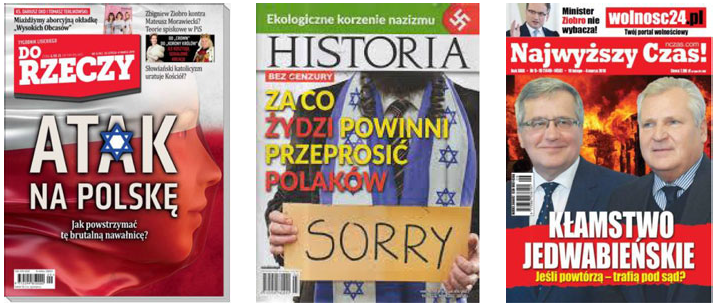
What has changed since the second electoral victory of the PiS Party in late 2015 is the ideological zeal of the conservative milieu (Figure 2). The leaders and supporters of the winning party do not consider their memory politics as one of the two opposing strategies, but as the only acceptable imaginings of the past. Their anti-pluralist approach is based on the dogmatic assumption that Poland must ‘get up off its knees’. As Jan Żaryn, the leading militant historian in the ranks of PiS, shortly after the elections, stated: ‘Now is the time to initiate the long-delayed counter-revolution aimed at altering the historical consciousness of the contemporary world’ (Żaryn Reference Żaryn2015). Therefore, it is safe to assume that the real aim of the Law of 2018 was not to criminalise usage of the phrase ‘Polish death camps’, but to convince Poles that Kaczyński’s party is the only defender of Poland’s innocence.
Covers of right-wing Polish magazines issued during the debate of the Polish Holocaust Law in late February 2018. (Left) The weekly Do Rzeczy (no. 9) diagnosed an ‘Attack on Poland’ and asked ‘How to stop this brutal storm?’ (Centre) The monthly Historia bez cenzury (no. 3) focused on ‘What should the Jews apologize to the Poles for’. (Right) The weekly Najwyższy Czas! (no. 9) featured the former Polish presidents Bronisław Komorowski and Aleksander Kwaśniewski against the background of a barn on fire asking ‘The Jedwabne lie – will they be charged if they do it again?’
Creating Memory Comfort Zones by Other Means
Formally, the Law was a failure because it had to be amended only five months after its adoption. Practically, however, mnemonic populism regarding Holocaust memories has continued by other means. Its major aim is to silence the so-called New Polish School of the Holocaust History, which documents the involvement of Poles in the extermination of Jews.
Established in 2003 at the Polish Academy of Sciences in Warsaw, the Polish Centre for Holocaust Research has produced an impressive body of innovative studies dealing with the history of the Second World War in Poland. Most of the studies have been highly appreciated by the international academic community and largely ignored by the Polish readership. Public awareness of the research output produced by the New Polish School of the Holocaust History increased significantly in early 2018, when the results of the collaborative book Night without an End (Dalej jest noc) were presented. In a number of micro-historical studies, the Warsaw scholars systematically explored what happened during the so-called third phase of the Holocaust (1942–1945). Their analysis revealed that at least 60% of the Jews who had managed to survive the deadliest phase of the Holocaust were denounced or killed by their Christian neighbours (Engelking and Grabowski Reference Engelking, Grabowski, Engelking and Grabowski2018, 21–22, 29–37). Extended to the entire country, these findings from nine Polish districts would mean that Poles were responsible for the death of approximately 200,000 Jews. In other words, as Jan T. Gross provocatively stated, during the Second World War Poles killed more Jews than they killed Germans (Gross Reference Gross2018, 194–196). Was it a coincidence that the Polish Holocaust Law was passed a couple of weeks before the public release of Night without an End?
In any case, the leaders and supporters of PiS launched a campaign defaming scholars from the Polish Centre for Holocaust Research – especially Barbara Engelking and Jan Grabowski – before their book was published and accompanied the debate about it with a combination of discursive and disciplining practices. For instance, the Prime Minister did not prolong the tenure of Engelking as chairwoman of the International Council of the Auschwitz-Birkenau State Museum, the Minister of Culture cut funding for the Centre’s journal, and the Polish League Against Defamation has intensified its attacks against Grabowski (MS 2018; Mrozek Reference Mrozek2018; Leszczyński Reference Leszczyński2018). Historians and journalists supporting the government publicly libelled Night without an End as ‘scientific humbug’ (naukowa mistyfikacja) accusing its authors of what they call ‘racism of sources’ (rasizm źródłowy), i.e. the privileging of Jewish over Polish testimonies (Gontarczyk Reference Gontarczyk2019a; Gontarczyk Reference Gontarczyk2019b). Right-wing activists did the same during public events,and the Institute of National Remembrance, meanwhile transformed into an agency implementing the state-sponsored politics of memory, commissioned a number of extended critical ‘reviews’ of Night without an End in Polish and other languages (Lyon-Caen Reference Lyon-Caen2019; Domański Reference Domański2019). Although it is difficult to say whether these counter-measures were part of a coordinated action or an accidental accumulation of spontaneous activities, taken together, they show how ruthless the defenders of Poland’s innocence can be.
What is more alarming, however, is the gradual establishment of a parallel scientific community working in the mode of mnemonic populism. Since the publication of Jan T. Gross’ Neighbours in 2000, it and every other of his essays were followed by a counter-book written or published by the Polish-American historian Marek Jan Chodakiewicz, who has often been confronted with the charge of antisemitism (Michlic and Melchior Reference Michlic, Melchior, Michlic and Himka2013, 433). Furthermore, the growing scholarly interest in the various ways in which Poles were involved in the Holocaust has triggered an increasing number of publications dealing with the Polish Righteous among Nations (Forecki Reference Forecki2018, 255–360). For the last couple of years, however, the relationship between (scholarly) arguments and (partisan) counter-arguments has been undergoing a process of institutionalisation. Opened in 2016, the Chapel of Memory of Rescuers (popularly called ‘Polish Yad Vashem’) in Toruń, and the Ulma-Family Museum of Poles Who Saved Jews in the Second World War in the village of Markowa, places Poland, a country which already has three such museums, as the world leader in museums devoted to the Righteous (Grabowski and Libionka Reference Grabowski and Libionka2017; Wóycicka Reference Wóycicka2019). In addition, the Minister of Culture founded the Warsaw Ghetto Museum – a decision that many observers consider to be an attempt to take control of the POLIN Museum of the History of Polish Jews; and the Institute of National Remembrance is about to publish the first issue of the journal Polish-Jewish Studies, on whose editorial board the absence of international scholars, those from the Polish Center for Holocaust Research, the POLIN Museum, and the main Polish centres for Jewish studies affiliated with universities in Warsaw, Cracow and Wrocław, is striking (Croitoru Reference Croitoru2019; Instytut 2019). To judge by what has already been said and done, there is little doubt that the overall message promoted by these newly established institutions will solidify the narrative of Polish innocence and self-sacrifice in helping Jews during the war.
Whereas the Polish Holocaust Law had to be modified under international pressure, continuation of mnemonic populism by other means can hardly be controlled from within because it consists of a variety of means and measures that are usually less explosive and therefore less visible than legal regulations. Furthermore, mnemonic populists can and do easily functionalise any foreign intervention in their agenda for their own cause. Eventually, their views on Polish–Jewish relations in general, and the Holocaust in particular, will be so well embedded in the Polish collective memory that any foreign criticism runs the risk of being interpreted as an attack against Poland as a whole. The struggle for preserving the value of historical research, defending history against moralistic flaws, and recovering a pluralist debate on the interpretation of the past might prove to be the biggest challenge for the culture of remembrance in post-1989 Poland. To reflect upon substantial differences between the politics of memory and mnemonic populism can be the first step in the right direction.
The transformation of the politics of memory into mnemonic populism in Poland is an issue of European concern. As is known, the attitude of the European Union regarding the Holocaust draws from the moral command of ‘never again’. Since the 1990s, a set of norms, rules and beliefs has been established at the European level in order to protect this mnemonic consensus. The Europeanization of Holocaust memory has been gradually incorporated in the countries of post-communist Eastern Europe (Kucia Reference Kucia2016). The whitewashing of the Holocaust memory in Poland, along with the state-supported history-cleansing in Hungary, and memory laws protecting the ‘good name’ of the national heroes in Lithuania (2010) and Latvia (2014), who happened to be involved in the persecution of Jews, could therefore be easily seen as a form of post-accession hooliganism (Braham Reference Braham, Braham and Kovács2016; Kovács Reference Kovács2016; Pető Reference Pető2019). However, the examples of Gauland, Salvini and Strache show that political attempts at rewriting the history of the Holocaust are not limited to Europe’s East (Echikson Reference Echikson2019). In this regard, mnemonic populism appears to be significantly more than a purely ‘academic’ preoccupation: to properly understand its functioning might also be a way to defend Europe’s moral integrity.
About the Author
Kornelia Kończal is a post-doctoral researcher at the Faculty of History and the Arts at Ludwig Maximilian University of Munich, Germany. Her research interests include the social history of post-1945 Europe, the transnational history of social sciences and humanities, and the politics of memory in contemporary Poland. She is currently preparing a book on the reconstruction of the post-German territories in Poland and Czechoslovakia after the Second World War.


 Open access

