




Introduction
In rice cultivation in tropical Asia and Africa, fertilizer costs amount to 30% of the total production cost (Pampolino et al., Reference Pampolino, Manguiat, Ramanathan, Gines, Tan, Chi, Rajendran and Buresh2007). Judicious use of fertilizers, particularly nitrogen (N), in fields to meet the requirements of rice is essential for high productivity (Tillman et al., Reference Tillman, Cassman, Matson, Naylor and Polasky2002). To introduce intensive nutrient management during the Green Revolution (Pingali, Reference Pingali2012), most government agencies adopted blanket recommendations based on a single prescription with fixed fertilizer application rates for large areas (Dobermann and White, Reference Dobermann and White1999). Consequently, farmers in countries such as the Philippines, Indonesia, Bangladesh, and Vietnam became accustomed to applying high amounts of fertilizer (>100 kg N ha−1) to achieve the high yields promised by modern input-responsive rice (Banayo et al., Reference Banayo, Haefele, Desamero and Kato2018b). However, this typically resulted in overuse of fertilizer without increasing yield beyond a certain point (Tillman et al., Reference Tillman, Cassman, Matson, Naylor and Polasky2002).
During the last two decades, there has been growing recognition of the need to further improve nutrient management by increasing fertilizer-use efficiency (yield increase in response to fertilizer/amount of fertilizer applied) in tropical Asia (Dobermann et al., Reference Dobermann, Witt, Dawe, Gines, Nagarajan, Satawathananont, Son, Tan, Wang, Chien, Thoa, Phung, Stalin, Muthukrishnan, Ravi, Babu, Chatuporn, Kongchum, Sun, Fu, Simbahan and Adviento2002). This trend recognizes that the response of crop yield to management depends on the local growth environment, and that blanket agricultural guidelines are not always effective (Peng et al., Reference Peng, Buresh, Huang, Zhong, Zou, Yang, Wang, Liu, Hu, Tang, Cui, Zhang and Dobermann2010). Site-specific nutrient management (SSNM) was developed for tropical lowland rice to optimize nutrient management by accounting for the quantitative relationship between nutrient supply and crop demand in each field (Dobermann et al., Reference Dobermann, Witt, Abdulrachman, Gines, Nagarajan, Son, Tan, Wang, Chien, Thoa, Phung, Stalin, Muthukrishnan, Ravi, Babu, Simbahan, Adviento and Bartolome2003). Recently, a Web-based SSNM tool was developed and is now being widely used in the Philippines and India (Buresh et al., Reference Buresh, Castillo, Dela Torre, Laureles, Samson, Sinohin and Guerra2019; Sharma et al., Reference Sharma, Rout, Khanda, Triphati, Shahid, Nayak, Satpathy, Banik, Iftikar, Parida, Kumar, Mishra, Castillo, Velasco and Buresh2019). The tool uses 20–25 multiple-choice questions to guide fertilizer choices, and proved useful for smallholder farmers who lack access to soil testing services (Banayo et al., Reference Banayo, Haefele, Desamero and Kato2018b).
A number of on-farm studies confirmed that farmer income increased when nutrient management was performed by researchers following SSNM rather than by farmers in China, India, the Philippines, and Vietnam (Hu et al., Reference Hu, Cao, Huang, Peng, Huang, Zhong, Zou, Yang and Buresh2007; Pampolino et al., Reference Pampolino, Manguiat, Ramanathan, Gines, Tan, Chi, Rajendran and Buresh2007; Wang et al., Reference Wang, Zhang, Witt and Buresh2007). Nevertheless, an impact assessment of nutrient management in the Philippines showed that only 45% of farmers aware of SSNM were willing to follow it (Malasa et al., Reference Malasa, Mataia, Fermin and Desamero2015), despite the lower production cost and higher rice yield than in farmer management. This suggests that researcher-driven approaches, which often do not account for farmer perspectives on crop management, do not encourage adoption by all of the target farmers who could benefit. For example, farmers who have no knowledge of SSNM apply excess fertilizer at the beginning of the growing season, and their reasons for this behavior were unclear to researchers (Banayo et al., Reference Banayo, Bueno, Haefele, Desamero and Kato2018a).
Changes in agricultural extension practices have also occurred during recent decades. The importance of farmer-participatory research has been increasingly recognized, including activities such as participatory varietal selection in plant breeding (Burman et al., Reference Burman, Maji, Singh, Mandal, Sarangi, Bandyopadhyay, Bal, Sharma, Krishnamurthy, Singh, Reyes, Villanueva, Paris, Singh, Haefele and Ismail2018) and offering farmer field schools (i.e., on-farm training in agronomy) (David and Asamoah, Reference David and Asamoah2011). The farmer field school was first proposed during the 1980s, with the goal of promoting active learning about crop health by farmers (Van den Berg and Jiggins, Reference Van den Berg and Jiggins2007). This season-long activity became the main approach used in agricultural extension (David and Asamoah, Reference David and Asamoah2011; Tripp et al., Reference Tripp, Wijeratne and Piyadasa2005; Van den Berg and Jiggins, Reference Van den Berg and Jiggins2007). Previous studies of these field schools suggested that farmers often adjust crop management ad hoc in response to the growing conditions by observing factors such as plant color and stature (Tripp et al., Reference Tripp, Wijeratne and Piyadasa2005; Van den Berg and Jiggins, Reference Van den Berg and Jiggins2007), but scientific evidence for this belief was not provided.
On the other hand, the SSNM concept adopted by researchers encourages a field-specific regime that is determined before the cultivation season starts. It is natural that farmers will not follow researcher recommendations if the resulting crop growth is not acceptable. Here, we hypothesized that farmers took into account crop growth indicators such as the canopy appearance in their nutrient management decisions, which differs from the SSNM approach promoted by researchers. If this is true, then any change in the canopy structure caused by increased planting density (i.e., a more crowded canopy) or the use of mature seedlings instead of young seedlings (i.e., earlier canopy closure achieved by bigger seedlings) should affect the fertilizer application rates chosen by farmers. These differences in agronomic management practices would not affect the fertilizer recommendations under SSNM (Buresh et al., Reference Buresh, Castillo, Dela Torre, Laureles, Samson, Sinohin and Guerra2019). In addition, it remains unknown how farmers adjust nutrient management to account for the risk of drought under rainfed (non-irrigated) rice cultivation. Although agricultural extension for rice management is conducted in tropical Asia and Africa every year, there has been no attempt to identify the growth criteria that farmer use in nutrient management. Understanding these criteria is critical to improving the adoption of SSNM guidelines in the tropics.
Our overall goal was to develop guidelines for more efficient nutrient management in tropical lowland rice by incorporating farmer perspectives on plant development. Our specific objectives were to examine the effect of the rice canopy’s appearance on farmer decisions about fertilizer application rates and to suggest standards for the growth of tropical lowland rice in the form of numerical targets for various growth parameters at key growth stages to help farmers attain their target yield level.
Materials and Methods
Set-up of the on-farm experiments
On-farm experiments were conducted in Victoria, Tarlac Province, the Philippines (15°56′N, 120°66′E), during the wet seasons (from June to October) of 2014, 2015, and 2016. The study area has a tropical monsoon climate with a wet season from June to October and a dry season from November to May. The mean daily temperature and total rainfall during the experiments, recorded by an automatic weather station installed at the site, were 27.1 °C and 1384 mm in 2014, 27.6 °C and 1436 mm in 2015, and 27.6 °C and 1346 mm in 2016. Serious drought, which we judged from the change in soil color and development of deep soil cracks (Ohno et al., Reference Ohno, Banayo, Bueno, Kashiwagi, Nakashima, Iwama, Corales, Garcia and Kato2018), did not occur during the cultivation period in any year. The soil at the sites was a loam with 21% clay, 32% sand, and 47% silt, with the following chemical characteristics: 1.18 ± 0.16 g N kg−1, 12.4 ± 1.7 g C kg−1, 12.1 ± 2.6 mg kg−1 available P (Olsen), 0.35 ± 0.06 cmol exchangeable K kg−1, 16.2 ± 3.0 cmol kg−1 cation exchange capacity, and pH (H2O) 6.7 ± 0.1. The rice cultivar ‘Rc222’ (popular among farmers) was grown. All the necessary work for the experiment was merged with the activities of farmer field schools organized by the local government. In each year, a different set of 30 farmers participated in the experiments. Participating farmers were interviewed prior to the trial; the timings of their fertilizer applications were usually the same as those of researcher recommendations (see below).
We set up trials under two water regimes (irrigated and rainfed), with a distance of 100 m between the two trials. Treatments were laid out in a randomized complete block design with four replicates for each regime. Plot size was 50 m2 (5 × 10 m). Each water regime had two factors: the planting treatment, which included combinations of two seedling ages (18 and 30 days) and two planting densities (20 × 20 cm and 15 × 15 cm), and the nutrient management treatment, researcher management (RM), and farmer management (FM). We established a 1-m border around each plot to minimize the flow of fertilizer between adjacent plots. Irrigation was applied for land preparation (harrowing and soil puddling) and during transplanting under both regimes, and two or three seedlings were transplanted per hill on 22 July 2014, 29 July 2015, and 12 July 2016. In the irrigated regime, a water depth of 2–3 cm was maintained until a few days before harvest, when the field was drained. In the rainfed regime, flush irrigation was applied if the field had no standing water at the time of fertilizer application. Under RM, fertilizer application regimes were developed using a Web-based tool, Rice Crop Manager (https://phapps.irri.org/ph/rcm/). Under FM, participating farmers decided the regime (see below), but applied fertilizer at the same times as under RM: at 0 days after transplanting (DAT), 21 DAT (mid-tillering stage), and 35 DAT (panicle initiation). Weeds were controlled weekly by hand.
Measurements
Under FM, participating farmers cautiously chose the rates and types of chemical fertilizers for each plot at each of the three fertilizer application times; the rates were converted into N–P2O5–K2O format. To eliminate the effect of cost on farmer decisions, we provided ample amounts of all types of popular fertilizers (urea, ammonium sulfate, potassium chloride, compound NPK, ammonium phosphate) to the farmers at no cost. The rates and types of fertilizers under RM were kept secret from farmers to avoid biasing their nutrient requirement decisions. After application, we interviewed farmers to learn the reasons for their decision in each plot.
To quantify crop growth at the times of the post-transplanting fertilizer application (21 and 35 DAT), farmers who were participating in the farmer field school measured plant height, leaf color, and tiller number in eight hills in each plot. The leaf color of the uppermost fully expanded leaves, which reflects the leaf’s N nutrition status, was determined against leaf color chart, which ranks color on a scale of 1–6 (Yang et al., Reference Yang, Peng, Huang, Sanico, Buresh and Witt2003). We measured the normalized-difference vegetation index (NDVI), which reflects the canopy cover during the vegetative stage (Tagarakis et al., Reference Tagarakis, Ketterings, Lyons and Godwin2017), at five positions in each plot with a GreenSeeker handheld sensor (HCS 100, Trimble Ltd., Sunnyvale, CA, USA).
At physiological maturity, grain yield was determined from a 5-m2 area in each plot and expressed at a water content of 0.14 g H2O g−1 grain. In addition, we collected 12 hills and counted the panicle number. The panicles were detached from the straw and threshed by hand, and filled and unfilled grainsh were separated by flotation in tap water. After oven-drying at 80 °C for 72 h, we measured the dry weights of filled and unfilled grains, rachides, and straw. We then calculated the number of spikelets per panicle, grain-filling percentage (100 × filled spikelets/total spikelets), and 1000-grain weight.
Data analysis
Analysis of variance (ANOVA) was conducted for each water regime using a generalized linear model. Nutrient management and planting method were regarded as fixed effects, the replicate was treated as a random effect, and the effects of nutrient management, planting method, and their interaction were assessed. When the ANOVA result was significant at p < 0.05, we compared pairs of values using Fisher’s least significant difference test. To test our hypothesis that farmers took into account the canopy appearance in their nutrient management decisions, we performed multiple linear regression to dissect the effects of the relevant growth parameters (NDVI, leaf color, tillers m−2, and plant height) on the N application rates under FM at 21 and 35 DAT. All analyses were performed in STAR v. 2.0.1, a freeware implemented in the R package (http://bbi.irri.org).
Results
Farmer decisions on fertilizer application under different planting treatments
Fertilizer application regimes differed among the planting treatments under FM but were fixed for all treatments under RM in each water regime (Table 1). In 2014, farmers applied an average of 155–30–51 kg ha−1 of N–P2O5–K2O in the irrigated regime and 233–39–43 kg ha−1 in the rainfed regime; these N rates were 42–162% higher than the RM recommendation. Farmers applied the most N at 0 DAT to the plots with mature seedlings at high density in the irrigated regime, and to the plots with mature seedlings at low density in the rainfed regime. The rates of N topdressing in the irrigated regime also varied under FM, with values ranging from 41 to 161 kg N ha−1 at 21 DAT and from 17 to 49 kg N ha−1 at 35 DAT, with less variation in P2O5 and K2O. The corresponding ranges in the rainfed regime were 60–113 kg N ha−1 at 21 DAT and 17–84 kg N ha−1 at 35 DAT.
Fertilizer application rates at each growth stage in the wet seasons of 2014, 2015, and 2016
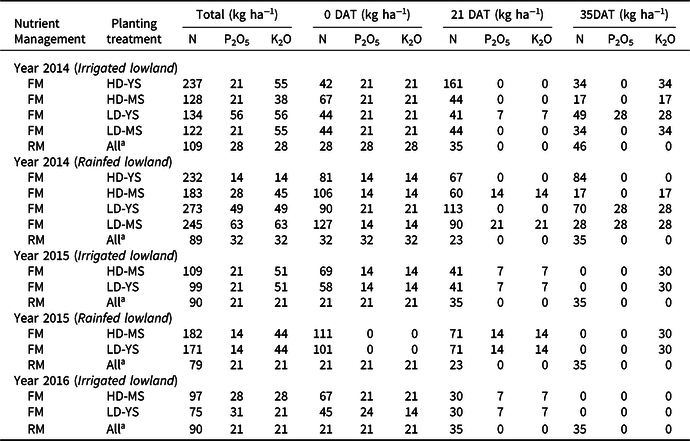
FM, farmer management; RM, researcher management; DAT, days after transplanting; HD, high planting density (15 × 15 cm); LD, low planting density (20 × 20 cm); YS, use of young seedlings (18 days old); MS, use of mature seedlings (30 days old).
a fertilizer application rates was fixed for all the planting treatments in researcher management.
Farmer decisions on the basal fertilizer application in 2015 and 2016 were similar to those in 2014, but the amounts of P and K fertilizers topdressed at 35 DAT were much less than those in 2015 and comparable to those in 2016 (Table 1). Farmers judged that more N was needed at 0 DAT in the rainfed regime than in the irrigated regime in 2015, and that mature seedlings planted at a higher density required a higher basal N application than young seedlings planted at a lower density. Planting treatments did not change the N topdressing rates at 21 and 35 DAT under FM in 2015 and 2016.
Crop growth characteristics in relation to farmer nutrient management
Tables 2 and 3 present the growth data from the 2014 growing season at 21 and 35 DAT, respectively. We found significant differences in growth parameters among the planting treatments and between FM and RM. At 21 DAT (mid-tillering stage), FM had higher NDVI, tiller number, and plant height than RM in the irrigated regime, and higher NDVI, leaf color score, and tiller number than RM in the rainfed regime (Table 2). Under FM, planting of young seedlings at high density in the irrigated regime resulted in lower leaf color score and plant height than in other treatments, and at low density in the rainfed regime resulted in lower tiller number.
Normalized difference vegetation index (NDVI), leaf color score, number of tillers, and plant height in rice fields at mid-tillering stage (21 days after transplanting) during the wet season of 2014
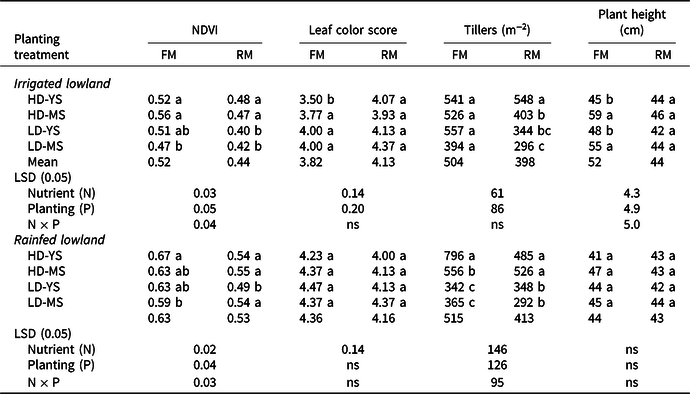
FM, farmer management; RM, researcher management; HD, high planting density (15 × 15 cm); LD, low planting density (20 × 20 cm); YS, use of young seedlings (18 days old); MS, use of mature seedlings (30 days old), LSD, least-significant difference.
Within a column, means followed by different letters are significantly different at p < 0.05.
Normalized difference vegetation index (NDVI), leaf color score, number of tillers, and plant height in rice fields at panicle initiation stage (35 days after transplanting) during the wet season of 2014
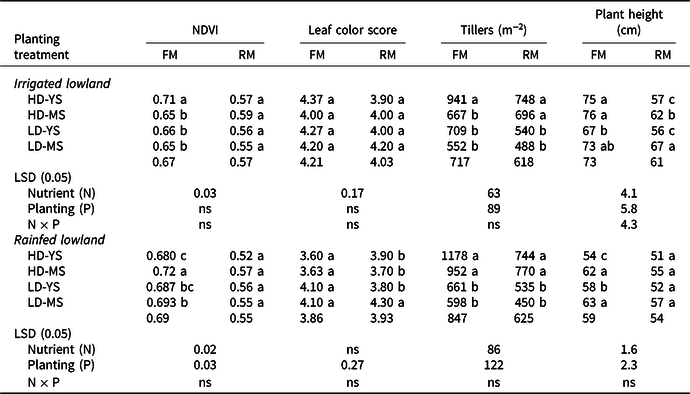
FM, farmer management; RM, researcher management; HD, high planting density (15 × 15 cm); LD, low planting density (20 × 20 cm); YS, use of young seedlings (18 days old); MS, use of mature seedlings (30 days old); LSD, least-significant difference.
Within a column, means followed by different letters are significantly different at p < 0.05.
At 35 DAT (around panicle initiation), in the irrigated regime, FM had higher NDVI, leaf color score, tiller number, and plant height than RM, and in the rainfed regime had higher NDVI, tiller number, and plant height than RM (Table 3). Under FM in the irrigated regime, planting of young seedlings at low density resulted in lower plant height than in the other treatments, and at high density resulted in higher NDVI and tiller number than in the other treatments. Under FM in the rainfed regime, planting of young seedlings resulted in lower NDVI and plant height than planting of mature seedlings, but a higher tiller number and lower leaf color score at high density than at low density. Trends in the crop growth response to nutrient management in the irrigated regime were similar in 2016: FM had higher NDVI and plant height than RM at both 21 and 35 DAT (Table S1), but planting treatments differed significantly only in tiller number.
Under FM, crop growth characteristics associated with the rates of N application differed between growth stages and water regimes in 2014 (Table 4). In the irrigated regime, N rates chosen by farmers were significantly associated with leaf color score and plant height at both 21 and 35 DAT. In the rainfed regime, they were significantly associated with tiller number at 21 DAT, but with NDVI and plant height at 35 DAT. As in 2014, tiller number did not apparently affect N rates under FM in the irrigated regime in 2016 (Tables 1, S1).
Multiple linear regression of the growth parameters at each timing of fertilizer application in farmer management in the wet season of 2014
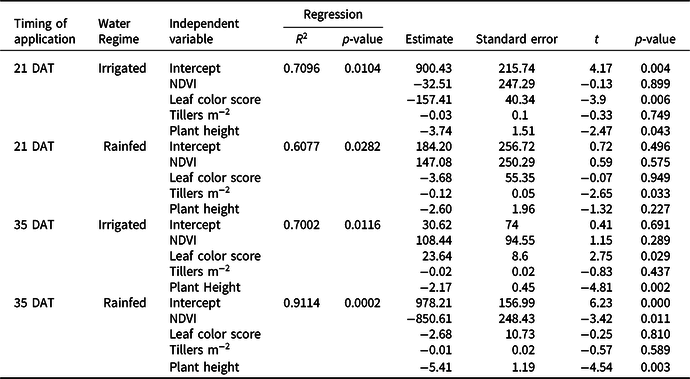
DAT, days after transplanting; NDVI, normalized difference vegetation index.
Grain yield in farmer management vs. researcher management
Although the RM plots received less fertilizer than the FM plots, their grain yields were not reduced in either water regime in the 3 years (Table 5). The effect of the planting treatments on grain yield was not significant except in the rainfed regime in 2014. The interaction between nutrient management and planting treatment was significant only in the irrigated regime in 2014 and 2016. Owing to ample and frequent rainfall events, grain yield in the rainfed regime was generally similar to that in the irrigated regime.
Grain yield in different planting treatments and nutrient management regimes in the wet seasons of 2014, 2015, and 2016

FM, farmer management; RM, researcher management; DAT, days after transplanting; HD, high planting density (15 × 15 cm); LD, low planting density (20 × 20 cm); YS, use of young seedlings (18 days old); MS, use of mature seedlings (30 days old); NDVI, normalized difference vegetation index; LSD, least-significant difference.
Within a column, means followed by different letters are significantly different at p < 0.05.
† data not available.
Both nutrient management and the planting treatments affected each yield component more often than they affected yield (Table S2). FM produced significantly more panicles than RM, and the higher planting density resulted in a significantly higher panicle number in the rainfed regime in 2014, similar to the treatment effects on tiller number at 21 and 35 DAT (Tables 2 and 3). Under FM, 53% of tillers at 35 DAT produced panicles, but 63% under RM. Spikelets m−2 was correlated with grain yield under RM (Figure 1a), but yield did not increase with increasing panicle number (data not shown). Panicles m−2 was correlated with spikelets m−2 (Figure 1b), and tillers m−2 at 35 DAT was correlated with panicles m−2 (Figure 1c).
Relationship of grain yield and yield components in research management in the wet seasons of 2014 and 2016 (n = 32). DAT, days after transplanting. **significant at p < 0.01.

Discussion
A number of researchers have discussed efficient nutrient management for tropical rice farmers (Buresh et al., Reference Buresh, Castillo, Dela Torre, Laureles, Samson, Sinohin and Guerra2019; Sharma et al., Reference Sharma, Rout, Khanda, Triphati, Shahid, Nayak, Satpathy, Banik, Iftikar, Parida, Kumar, Mishra, Castillo, Velasco and Buresh2019). However, the slow progress in farmer adoption of management regimes recommended by researchers indicates that improving researcher understanding of farmer perceptions of crop growth will be essential for the success of agricultural extension activities (Burman et al., Reference Burman, Maji, Singh, Mandal, Sarangi, Bandyopadhyay, Bal, Sharma, Krishnamurthy, Singh, Reyes, Villanueva, Paris, Singh, Haefele and Ismail2018). To the best of our knowledge, our study is the first to show that farmers in the tropics have their own criteria for rice growth under nutrient management. Interestingly, the researcher recommendation did not achieve this ideal growth for farmers (Table S1).
At the crop establishment stage, farmers judged that 57–429% more N was needed than the researcher recommendation (Table 1). On the other hand, farmers judged similar basal inputs for P and K to the researcher recommendations, with no difference among the planting treatments in most cases. The overdose of N during crop establishment under FM (75–273 kg N ha−1) agrees with previous on-farm studies on tropical lowland rice (Banayo et al., Reference Banayo, Haefele, Desamero and Kato2018b; Hu et al., Reference Hu, Cao, Huang, Peng, Huang, Zhong, Zou, Yang and Buresh2007; Wade et al., Reference Wade, George, Ladha, Singh, Bhuiyan and Pandey1998). Banayo et al. (Reference Banayo, Haefele, Desamero and Kato2018b) showed total N inputs by farmers ranged from 55 to 310 kg N ha−1 in rainfed lowlands in the Philippines. Planting treatments here were designed to reveal the management goals of the farmers. Competition for N between seedlings should become stronger as the seedling size and the planting density increase (Pasuquin et al., Reference Pasuquin, Lafarge and Tubana2008). The planting of mature seedlings at high density increased farmer inputs in both water regimes (Table 1), suggesting that farmers were more concerned about an N deficiency for individual seedlings during establishment than about the canopy volume. It is also possible that farmers have learned from experience that early tillering is suppressed when they plant mature seedlings (Pasuquin et al., Reference Pasuquin, Lafarge and Tubana2008), and they may have aimed at promoting tillering by applying excess N at transplanting.
Even after establishment, rice canopy development was altered by the different planting densities and the use of seedlings with different ages (Tables 2 and 3), and this affected farmer management. We found that leaf color and plant height were the major determinants of farmer decisions on N topdressing at the mid-tillering stage and at panicle initiation in the irrigated regime (Table 4). Leaf color is closely associated with crop N nutrition (Alam et al., Reference Alam, Ladha, Foyjunnessa, Rahman, Khan, Rashid, Khan and Buresh2006; Peng et al., Reference Peng, Garcia, Laza, Sanico, Visperas and Cassman1996). Both plant height and tiller number before heading stage are correlated with aboveground biomass in lowland rice (Wollenweber et al., Reference Wollenweber, Porter and Lubberstedt2005). However, tiller number did not appear to affect farmer decisions about N management in the irrigated regime. The reasons for this are unclear, although it is likely that the semi-dwarf rice that the farmers grew had sufficient tillers to meet their needs.
Farmer perception of the risk of drought in the rainfed regime was reflected in their decision to supply high N inputs at transplanting (Table 1). Farmers may want to confirm that the applied N was dissolved and reserved in the soil while there was standing water after transplanting (Banayo et al., Reference Banayo, Haefele, Desamero and Kato2018b; Dobermann et al., Reference Dobermann, Witt, Dawe, Gines, Nagarajan, Satawathananont, Son, Tan, Wang, Chien, Thoa, Phung, Stalin, Muthukrishnan, Ravi, Babu, Chatuporn, Kongchum, Sun, Fu, Simbahan and Adviento2002; Wade et al., Reference Wade, Amarante, Olea, Harnpichitvitaya, Naklang, Wihardjaka, Sengar, Mazid, Singh and McLaren1999). Owing to the risk of drought, farmers were more concerned about profuse tillering than about plant elongation and leaf color at the mid-tillering stage, but about canopy cover (i.e., NDVI) and plant elongation at panicle initiation (Table 4), maybe because drought hurts tiller emergence more than plant elongation and leaf nutrition in rice (Fukai et al., Reference Fukai, Pantuwan, Jongdee and Cooper1999).
Farmer management was aimed at adjusting their crops to achieve ideal growth based on their beliefs about the optimal plant morphology at a given stage, and consequently N rates were higher under FM than under RM. Nevertheless, grain yield under FM was not significantly higher than that under RM in all 3 years, as reported previously (Banayo et al., Reference Banayo, Haefele, Desamero and Kato2018b; Pampolino et al., Reference Pampolino, Manguiat, Ramanathan, Gines, Tan, Chi, Rajendran and Buresh2007; Wang et al., Reference Wang, Zhang, Witt and Buresh2007). This result indicates that FM based on farmer interpretation of the nutrient requirements of rice did not use N as efficiently as should be achieved by SSNM. FM greatly increased NDVI, tiller number, and plant height at both growth stages in all years and in both water regimes, except for plant height at 21 DAT in the rainfed regime in 2014 (Tables 2 and 3, S1). However, the increase in these growth parameters reduced the percentages of productive tillers (53 vs. 63%) and filled grains (Table S3), which represents a trade-off between vegetative and reproductive growth (Peng et al., Reference Peng, Buresh, Huang, Zhong, Zou, Yang, Wang, Liu, Hu, Tang, Cui, Zhang and Dobermann2010).
As discussed above, we found fundamental differences in the nutrient management philosophy between farmers and researchers. In the development of SSNM guidelines, researchers did not consider the importance of crop diagnosis for farmers (Buresh et al., Reference Buresh, Castillo, Dela Torre, Laureles, Samson, Sinohin and Guerra2019; Sharma et al., Reference Sharma, Rout, Khanda, Triphati, Shahid, Nayak, Satpathy, Banik, Iftikar, Parida, Kumar, Mishra, Castillo, Velasco and Buresh2019). However, knowledge transfer requires close communication between researchers and farmers, which means that researchers must learn to consider farmer perspectives (Burman et al., Reference Burman, Maji, Singh, Mandal, Sarangi, Bandyopadhyay, Bal, Sharma, Krishnamurthy, Singh, Reyes, Villanueva, Paris, Singh, Haefele and Ismail2018). We suggest that one way to improve farmer adoption of RM recommendations would be to provide the information farmers are most concerned about, which relates to achieving standard growth characteristics at the key phenological stages as a result of efficient nutrient management. Defining desirable cultivar-specific growth characteristics will require a large dataset (Peng et al., Reference Peng, Garcia, Laza, Sanico, Visperas and Cassman1996). However, from the present results, we can suggest a preliminary guideline for further improvement in future research. In the absence of serious drought, the target yield (i.e., the on-farm attainable yield; Stuart et al., Reference Stuart, Pame, Silva, Dikitanan, Rutsaert, Malabayabas, Lampayan, Radanielson and Singleton2016) for the popular cultivar Rc222 can be set at around 5.0 t ha−1 in the wet season in the target region (Laborte et al., Reference Laborte, Paguirigan, Moya, Nelson, Sparks and Gregorio2015). This target was mostly achieved under RM (Table 5). To achieve the target yield under RM, only 28 000 spikelets m−2 and 400 panicles m−2 were sufficient in the absence of serious drought (Figure 1). Large amounts of fertilizer were applied under FM to attain up to 1100 tillers m−2 at 35 DAT (Table 3), but 620 tillers m−2 at 35 DAT were enough to achieve 400 panicles m−2 (Figure 1).
Monitoring of crop conditions (health, stress symptoms, and growth) to let farmers ‘feed the crop as needed’ is a key goal in agronomy (Peng et al., Reference Peng, Buresh, Huang, Zhong, Zou, Yang, Wang, Liu, Hu, Tang, Cui, Zhang and Dobermann2010). Since farmers have their own benchmarks for growth parameters such as canopy cover, leaf greenness, tillering, and plant height, SSNM should also provide the desired values of these traits for close communication between researchers and farmers. That would help farmers better understand their own crops, and would thus be a more ‘user-friendly’ approach than merely providing a predetermined recommendation on fertilizer application. Besides, researchers could potentially improve their understanding of the rice crop and SSNM by learning from the wisdom of the farmers (Sharma et al., Reference Sharma, Rout, Khanda, Triphati, Shahid, Nayak, Satpathy, Banik, Iftikar, Parida, Kumar, Mishra, Castillo, Velasco and Buresh2019).
Conclusions
Our results reveal a communication gap between farmers and researchers in participatory research on tropical lowland rice. On-farm trials showed that the concepts that underlie farmer nutrient management differ from those that underlie researcher recommendations. Farmers have their own standard growth targets that have not been incorporated in researcher recommendations. We found that plant height and leaf greenness were the major determinants for farmer decisions about N management. To account for the risk of drought under rainfed conditions, farmers were more concerned about tillering than about plant elongation and leaf color in the early growing season, but considered canopy cover and plant elongation more important at later stages. These growth parameters should be considered as key words and phrases when researchers communicate with farmers in agricultural extension programs.
Supplementary material
To view supplementary material for this article, please visit https://doi.org/10.1017/S0014479720000265
Acknowledgements
We are grateful for financial support from the Bureau of Agricultural Research under the Department of Agriculture, the Philippines (DA-BAR), the International Fund for Agricultural Development (IFAD) for the Consortium for Unfavorable Rice Environments (CURE), and the Consultative Group on International Agricultural Research (CGIAR) for the RICE-CRP.


 Open access

