

Many countries have indigenous or national minorities who were exposed to harsh assimilation and discrimination policies and who continue to be disadvantaged. Such disadvantages range from lower life expectancy (Cooke et al. Reference Cooke, Mitrou, Lawrence, Guimond and Beavon2007) to higher incarceration rates (Shepherd et al. Reference Shepherd, Spivak, Ashford, Williams, Trounson and Paradies2020). Recent years have seen renewed interest in documenting and addressing the consequences of these policies, including through truth and reconciliation commissions (TRCs). TRCs are lauded by policymakers as tools to address systematic abuses and violence, including civil war, apartheid, colonialism, or minority abuse (Dancy and Thoms Reference Dancy and Thoms2022; Skaar Reference Skaar2018). Knowing the truth about past abuses is expected to bring ‘acceptance, tolerance, and reconciliation’ (Gibson Reference Gibson2004, 201) and help people leave the past behind and build a common future (ibid.). Yet systematic evidence on the individual-level causal effects of implementing truth-seeking mechanisms remains limited (Bunselmeyer and Schulz Reference Bunselmeyer and Schulz2020), and what exists tends to focus more on victim-survivors than on the population at large (David Reference David2017).
We provide the first causal estimates of TRCs on reconciliatory attitudes, examining the impact of the release of the Norwegian TRC report on 1 June 2023. The Norwegian TRC is part of a larger international trend of addressing historical wrongdoings and their repercussions (Skaar Reference Skaar2023), including the 2023 Voice Referendum in Australia (Gavin Reference Gavin2023), ongoing TRCs in Finland and Sweden (Ochs Reference Ochs2023), and the pending creation of a Truth and Healing Commission in the United States (Parks Reference Parks2023). These processes have been initiated in stable democracies without any recent political system transitions and address centuries of injustice perpetrated by those in power against indigenous populations. Although these contexts differ from the transitional societies for which TRCs were developed, the enduring marginalization of indigenous groups is not unique to any one political setting. TRCs in Guatemala (Viaene Reference Viaene2010), Nepal (Sajjad Reference Sajjad2016), and Peru (Laplante and Theidon Reference Laplante and Theidon2007) have demonstrated that victimization during armed conflict often follows earlier cleavages, disproportionately targeting groups already marginalized and repressed. Therefore, findings based on the Norwegian TRC could be relevant for a range of different contexts.
The commission’s mandate was to investigate the Norwegian assimilation policy against Sámi and other national minorities (see Online Appendix A and The Truth and Reconciliation Commission, n.d., for details). Assimilation occurred in parallel with nation-building beginning in the ninth century, but became institutionalized and legalized from the 1850s onward, and several laws made expressing a minority identity difficult. Children were also forcibly taken from their families to stay in boarding schools meant to assimilate them into Norwegian culture. Assimilation policies were gradually lifted starting in the 1950s, with a new law in 1959 allowing the Sámi language in schools and increasing attention towards protecting and supporting national minorities and their cultures and languages (Nordlie Reference Nordlie2023). The consequences of these assimilation policies are still present, however, for example, as negative attitudes and stereotypical beliefs (Dawson et al. Reference Dawson, Broderstad, Sanden, Einen, Nystuen, Strømme, Brekke, Vinsand and Bøgh-Olsen2022), and rights to traditional land and resource areas remain contentious. In addition to documenting atrocities, the TRC report proposes providing more resources to promote reconciliation and minority languages and cultures.
To examine responses to the Norwegian TRC, we rely on a pre-registered public opinion survey with more than 3,000 respondents (see Online Appendix H). We timed the launch of the survey so that we could leverage the public release of the Norwegian TRC’s report to construct a treatment group that was interviewed after the release and a control group that was interviewed before the release. Our quasi-experimental design ensured that respondents interviewed before or after the release were similar on observed covariates, thus allowing causal inference.
We find some support for the view that documenting past injustices is important for understanding and can improve majority-minority relations, which reflects the underlying logic of TRCs, but in line with our reasoning below, this is the case only for respondents in municipalities with a small presence of national minorities. Thus, the results suggest that current conflicts influence how past injustices are interpreted. Illustrating the limitations of TRCs, we do not find any effects on support for minority rights or on prejudice. Future research should investigate whether sustained salience over time may prove more effective in shifting attitudes toward national minorities.
TRCs and Reconciliation
In his seminal article on the South African TRC process, Gibson (Reference Gibson2004) finds more reconciled attitudes, understood as increased intergroup understanding and rejection of stereotypes, among those who support the truth and reconciliation process. However, the causal link remains ambiguous, as those with more reconciled attitudes could also be more prone to accepting the truth about historical injustice (see also David Reference David2017).
The literature outlines three main goals or expected effects of TRC processes: closure for victims and survivors, a common understanding of the past, and reconciliation. In this paper, we focus on the latter two goals, as a shared understanding of past abuses is typically portrayed as a precondition for reconciliation (for example, Gibson Reference Gibson2004; Skaar Reference Skaar2018). While evaluating the full impact of a TRC may require a long-term perspective (Backer Reference Backer2010; Brahm Reference Brahm2007), especially given indirect effects through the enactment of the commission’s recommendations, we also expect immediate effects after its release. Single events are capable of moving attitudes: Balcells et al. (Reference Balcells, Palanza and Voytas2021), for example, find that randomized visits to a transitional justice museum in Chile increased support for transitional justice policies. Similarly, a number of studies relying on survey experiments suggest that relatively simple treatments may have immediate, significant effects on a range of different attitudes (Hainmueller et al. Reference Hainmueller, Hangartner and Yamamoto2015). For example, a simple online perspective-taking game was found to reduce ethnic prejudices (Simonovits et al. Reference Simonovits, Kézdi and Kardos2018).
In line with, for example, Gibson (Reference Gibson2004) and Balcells et al. (Reference Balcells, Palanza and Voytas2021), we focus on reconciliatory attitudes among the majority population, which we see as one (but not the only) aspect of reconciliation. We posit that the release of a TRC report can reduce negative stereotypes and inspire greater sympathy with the victim group, which might cause a positive shift in how citizens prioritize minority rights when they make political trade-offs. While the Norwegian TRC did not receive much news coverage during its writing process, it received extensive coverage in the immediate days after its release, with a particular focus on stories of child removal from Sámi families and mistreatment in boarding schools (Skogerbø et al. Reference Skogerbø, McCallum and Dreher2025, 11–12). The TRC report and its media coverage provided citizens with a clear signal of elite positions on historical events, which in Zaller’s (Reference Zaller1992) famous top-down model of public opinion can change reported attitudes if the information flow is sufficiently strong and consistent. We argue that this information flow might have been sufficiently strong to shape opinion, as the release was covered in major news channels, and we find a massive increase in the share of respondents who had heard about the TRC after its release (Figure A1). Moreover, the information flow was one-sided in the sense that few objections were raised against the portrayal of the historical injustices.
However, there are reasons to be sceptical of potential effects. One reason is that attitudes toward minorities are hard to change (Kalla and Broockman Reference Kalla and Broockman2018; Paluck, Green and Green Reference Paluck, Green and Green2019). This is particularly true if the release of a TRC brings up new issues that divide the political elite, as such divides can easily extend to the public (Druckman, Peterson and Slothuus Reference Druckman, Peterson and Slothuus2013; Zaller Reference Zaller1992), potentially creating a backlash. While the atrocities of Norway’s historical injustices are uncontested in the public debate, Sámi rights to land remain a contentious issue. The prime example is a 2021 decision by the Norwegian Supreme Court, according to which the construction of a large wind turbine complex violated the human rights of reindeer herders in the Fosen area (‘the Fosen case’; Online Appendix B). The lack of government action in response to the decision has been interpreted by some as a continuation of historical injustices against the very group that the TRC was intended to support. Some Sámi politicians describe the Fosen case as a case of modern assimilation and have stated publicly that reconciliation will be difficult with ongoing human rights violations (NRK 2023). Indeed, on 2 June 2023, one day after the TRC report release, activists initiated demonstrations (for the second time that year) against the government’s inaction. The demonstrations were independent of the TRC report release, timed instead to mark the 600-day anniversary of the court decision, but they heightened the salience of contentious minority rights. Demonstrators blocked the entrances to various ministries, which led to massive news coverage of the events and the issues (Skogerbø et al. Reference Skogerbø, McCallum and Dreher2025, 11). This unanticipated turn of events, where modern Sámi rights were thrust into the spotlight at exactly the moment that the record of their historical discrimination was being shared with the public, offered a rare opportunity to study the intersection of TRCs with relevant current events, rather than simply the unmitigated effects of a TRC report’s release (as our study was originally intended to do, see pre-analysis plan).
In light of this empirical context and following Zaller (Reference Zaller1992), we propose that current events will influence the interpretation of historical events: in regions with a large presence of national minorities – where the issue of Sámi rights is contested – the elite signal from the TRC release might be blocked by low sympathy with national minorities due to ongoing political debates. In regions where minorities are less present, the signal will meet fewer objections, and therefore be more likely to be accepted and promote attitude formation. Here, the current injustices might reinforce the signal from the TRC, especially since the demonstrations were peaceful and not condemned by the press, which points in the direction of positive effects (Wasow Reference Wasow2020).
Empirical Strategy
To identify the effects of the report release and the demonstrations, we rely on a pre-registered public opinion survey (Online Appendix H) timed to leverage the public release of the TRC report as a quasi-experimental treatment. The survey and pre-analysis plan (PAP) were designed around the release of the report, as we could not foresee the protests; once they occurred, we shifted our analysis accordingly. The Fosen case already featured in our survey questions, because previous demonstrations and news coverage had already highlighted this issue as an ongoing contestation of Sámi rights. In light of the demonstrations that coincided with the TRC report’s release, the significance of these existing survey questions changed.
We fielded a survey in two rounds: the first, from 15 to 30 May 2023, included 1,552 native Norwegian respondents, and the second, from 2 to 15 June 2023, included 1,410 respondents.Footnote 1 We classify those invited to participate before the TRC report’s release as a control group for the respondents invited to participate after its release. Those interviewed after the release are further divided into two groups: those who completed the survey before the demonstrations started, that is, before noon on 2 June 2023 (n=574), and those interviewed after the demonstrations started, that is, after noon on 2 June (n=836). We separately compare the two treated groups to the control group. The first comparison gives us the effect of TRC release, while the second gives us the joint effect of the TRC release and the demonstrations. The data collection was similar on both sides of the release and the demonstrations, which means that the groups should be similar on pre-determined variables. We verify this expectation in Table A4.
To examine heterogeneity across municipalities with smaller and larger shares of national minorities, we use a stratified design, oversampling respondents from 139 municipalities with a larger share of national minorities (see Dawson et al. Reference Dawson, Broderstad, Sanden, Einen, Nystuen, Strømme, Brekke, Vinsand and Bøgh-Olsen2022 and Online Appendix C). To avoid a lengthy questionnaire while also covering views on all national minorities in the TRC report, respondents were randomized to receive questions about one minority (Sámi, Kven/Norwegian Finns, or Forest Finns): 70 per cent of the respondents were randomized to the most visible national minority, the Sámi, while the rest were assigned equally to the other groups.
We study five dependent variables (see Online Appendix D for question wordings and variable construction details).Footnote 2 Two outcomes capture support for minority rights. The first is views on the case of the wind turbines on the Fosen peninsula (Fosen injustice), where respondents who agreed that ‘the Fosen case shows that indigenous people’s rights are still being overridden by society at large’ are coded as 1, while those who agreed that ‘[t]he Fosen case shows that protection of indigenous people’s rights has gone too far and at the expense of important societal considerations’ or answered ‘Don’t know’ are coded as 0. The second minority rights outcome is an index based on four questions about views on the rights of the national minorities (Minority rights), scaled from 0 (no supportive answers) to 1 (all supportive answers).
Two questions probe support for the logic behind TRCs and what they can achieve, asking respondents to choose between two opposing statements. One statement in each pair suggests that TRCs improve majority-minority relations, while the opposing statements assert that they create divisions. The questions are combined into an index where 1 indicates choosing a pro-TRC statement for both questions, 0.5 is given for one pro-TRC statement, and 0 otherwise (TRC support). In addition, we study views on the importance of learning about national minorities’ culture and history (Learn about minorities), which is equal to 1 for respondents who explicitly support the need to know more, 0 otherwise.
Finally, we combine nine questions into an additive prejudice index (Prejudice; Dawson et al. Reference Dawson, Broderstad, Sanden, Einen, Nystuen, Strømme, Brekke, Vinsand and Bøgh-Olsen2022). The index includes items on group approval, dislikes, and impressions, and is scaled from 0 (no prejudice) to 1 (prejudice on all questions).
The survey further includes a conjoint experiment (Hainmueller et al. Reference Hainmueller, Hopkins and Yamamoto2014) to measure willingness to prioritize national minority rights over other political issues. We include the experiment because policy changes are more likely to follow preference changes if voters prioritize minority rights in a choice setting. An added advantage is that the conjoint experiment reduces concerns about social desirability bias (Horiuchi et al. Reference Horiuchi, Markovich and Yamamoto2022). Our conjoint experiment asks respondents to consider parties that present policies on six topics, one of them being national minority rights. We can then study whether vote choice for a party running on a pro-minority rights platform is higher in the treatment groups.
We estimate treatment effects on these outcomes using linear regression models with indicators representing one of the two post-release groups. In all models, we include fixed effects for oversampled municipalities and random assignment to questions about Sámi, Kven/Norwegian Finns, or Forest Finns. We assess whether the effect depends on the local presence of national minorities or group assignment by including interaction terms between these fixed effects and the treatment indicators.
Results
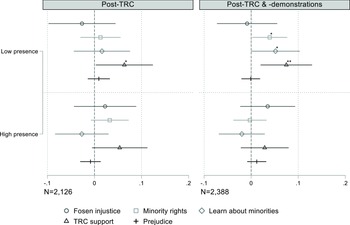
Figure 1 presents the first set of results (see also Table A1). The first panel compares responses from those interviewed before the TRC release (the control group) to those interviewed after the release (first treatment), but before the demonstrations started (second treatment). Here, the effect of being interviewed after the release is negligible on four outcomes: the coefficients are small and statistically insignificant. The exception is TRC support, which is 0.06 probability units higher in the treatment group, an estimate that is statistically significant and non-trivial relative to the mean of 0.56 on TRC support. Thus, support for learning about past injustices and the belief that doing so can improve intergroup relations increases, but this effect does not spill over to prejudice or policy preferences on minority rights, attitudes typically harder to move.
Estimated marginal effects of TRC release and demonstrations after OLS regressions
Post-TRC equal to 1 if interviewed after the release of the report, Post-TRC and demonstrations equal to 1 if interviewed after the outbreak of demonstrations, ** p<0.01; *p<0.05.

The second panel compares the control group to respondents who were interviewed after the outbreak of the demonstrations. As evident, estimates are very similar for the two treatment groups. Thus, the demonstrations did not move the estimates, which is either because the demonstrations were not perceived as providing new information on the outcomes we study or because, despite the national news coverage (Skogerbø et al. Reference Skogerbø, McCallum and Dreher2025), respondents were unaware of the events.
Table A6 provides an additional analysis of the effects of the report’s release. In this analysis, we use the Post-TRC indicator as an instrumental variable for whether the respondents had heard about the TRC. The release led to a large increase in the share who had heard about the report, and since the groups who responded before and after the release are similar (Table A4), we can estimate the effect of knowing about the TRC on the outcomes. This analysis shows that those who had heard about the TRC because of the report are about 14 percentage points more likely to believe that TRCs are a positive tool to improve majority-minority relations.
Next, we examine whether the effects depend upon whether respondents live in a municipality with a large presence of minorities and on randomized assignment to a minority group. We examine this by including interaction terms with treatment groups (Table A2). In these regression models, the main coefficient for the treatment group is the effect of being interviewed after the release for respondents in low-presence areas that were assigned to the Sámi minority group. The interaction terms indicate to what extent this difference is smaller or larger in high-presence areas or for those assigned to the other national minorities. Figure 2 presents heterogeneity estimates for low- and high-presence areas, while the results for minority group assignment are presented in Figure A2.
Estimated marginal effects of TRC release and demonstrations after OLS regressions
Post-TRC equal to 1 if interviewed after the release of the report, Post-TRC & demonstrations equal to 1 if interviewed after the outbreak of demonstrations, ** p<0.01; * p<0.05.

We draw two additional conclusions from this analysis. First and most importantly, the positive effects on outcomes measuring the importance of learning about and understanding the past are larger in low-presence areas (Figure 2). While not all interactions are statistically significant, three out of four have non-negligible point estimates in the same direction. Second, we see some indication that the post-treatment effects on support for minority rights are larger for those assigned to the smaller minorities (Figure A2). This does not seem to be due to backlash from the demonstrations, but rather due to lower support for these groups’ rights in the control group, as evident by the large negative coefficients for being assigned the Kven/Finns group (Table A2). For prejudice, there is no effect of the release in either group. One plausible interpretation of this is that the impact of the TRC is larger among people who did not have strong prior opinions or knowledge about reconciliation and national minorities. In other words, the release of the TRC was more effective in attitude formation (among people with fluid or no prior opinions) than in attitude change, which is consistent with our Zaller (Reference Zaller1992)-inspired reasoning.
Finally, we examine the effects in the conjoint experiment. Considering the small effects on support for minority rights in Figures 1 and 2, we might not expect voters to be more likely to prioritize minority rights after the release of the report. However, conjoint estimates are also driven by preference intensity, so even though effects are small in Figures 1 and 2, support for pro-minority party platforms could still increase. This is not what we find. Figure A3 presents marginal means (MM) (Leeper et al. Reference Leeper, Hobolt and Tilley2020) of support for the different policy positions among those interviewed before and after the treatments. The higher the MM, the more likely a party with the respective policy position is to be chosen. The estimates at the top show that support for the rights of indigenous people is quite strong in all groups, with no apparent difference between them. Combining the two treatment groups does not change this conclusion. This is also true if we restrict the analysis to respondents in either high- or low-presence areas (see Figures A4 and A5).
Conclusion
Three implications of our results stand out. First, although TRCs may have important effects on conflict healing in extreme situations, like post-apartheid (Gibson Reference Gibson2004) or post-authoritarianism (Dancy and Thoms Reference Dancy and Thoms2022), our results suggest that they have limited effects on public opinion in less extreme cases. We study short-term effects, however, and if the salience of the report remains high, positive effects could appear over time. Gradually, the effect of the TRC on reconciliation will also be formed by how the commission’s recommendations are followed up on. For example, establishing the proposed national centre on Norwegianization and discrimination may contribute to reconciliation in the same way as the transitional justice museum in Chile (Balcells et al. Reference Balcells, Palanza and Voytas2021).
Second, our results show that present conflicts over minority rights shape how past events are perceived. While the TRC and the demonstrations increased support for the importance of understanding the past in areas with a limited presence of minorities, this did not happen in municipalities with a high share of minorities, where the issue is more polarizing. In line with Zaller (Reference Zaller1992), this suggests that TRCs may help shape attitudes among those without strong prior views but fail to change existing attitudes.
Third, we find no reduction in prejudice. This contrasts with recent work from the United States, where survey experiments find that knowledge about historical, systemic discrimination reduces prejudice (Burns and Granz Reference Burns and Granz2022). Achieving similar effects in the field seems much harder. Stronger interventions are more likely to shift attitudes, but such interventions could potentially also harm participants (Cilliers et al. Reference Cilliers, Dube and Siddiqi2016).
Policy makers promoting reconciliation should be aware of the limitations of TRCs in shifting opinions. While silencing victims – the opposite of truth commissions’ mandate – is normatively dubious (David Reference David2017), launching a TRC report is only a first step. Research from Latin America finds that only around half of all TRC recommendations get implemented (Skaar et al. Reference Skaar, Rudling, Måseidvåg Selvik, Wiebelhaus-Brahm and García-Godos2025). Thus, sustained efforts are required to ensure that the issue becomes and remains salient, and that stated goals on reconciliation – in the Norwegian, as well as the Finnish, Swedish, and other TRCs on the enduring marginalization of indigenous groups – can be realized. Future research is needed to see whether the implementation of TRC recommendations, as well as sustained salience over time, may be more fruitful in achieving reconciliation.
Supplementary material
To view supplementary materials for this article, please visit https://doi.org/10.1017/S0007123425100537.
Data availability statement
Replication data for this article can be found in Harvard Dataverse at: https://doi.org/10.7910/DVN/DDIVVK.
Acknowledgments
This paper has benefited from comments from Anders Todal Jenssen, Paul Meiners, Kim Mannemar Sønderskov and participants at the 2023 CEPDISC conference in Aarhus, Denmark, the 2024 Norwegian Political Science Conference, and seminars at NTNU. We thank Kate Thulin of Thulin English for providing language support.
Financial support
Research grant no. 300896 (Norwegian Research Council) and funding from the Norwegian University of Science and Technology (NTNU) are acknowledged.
Competing interests
The authors declare none.
Ethical standards
The survey passes the Norwegian Agency for Shared Services in Education and Research (Sikt) criterion for anonymous data collection. The authors affirm that this article adheres to APSA’s Principles and Guidance on Human Subject Research.



 Open access

