
Skip to main content Accessibility help
×
  • Cited by 32
    • Show more authors
    • You may already have access via personal or institutional login
    • Select format
    • Publisher:
      Cambridge University Press
      Publication date:
      28 September 2020
      01 October 2020
      ISBN:
      9781108884839
      9781108839686
      9781108813563
      Dimensions:
      (228 x 152 mm)
      Weight & Pages:
      0.71kg, 386 Pages
      Dimensions:
      (229 x 152 mm)
      Weight & Pages:
      0.517kg, 386 Pages
    You may already have access via personal or institutional login
  • Selected: Digital
    Add to cart View cart Buy from Cambridge.org

    Book description

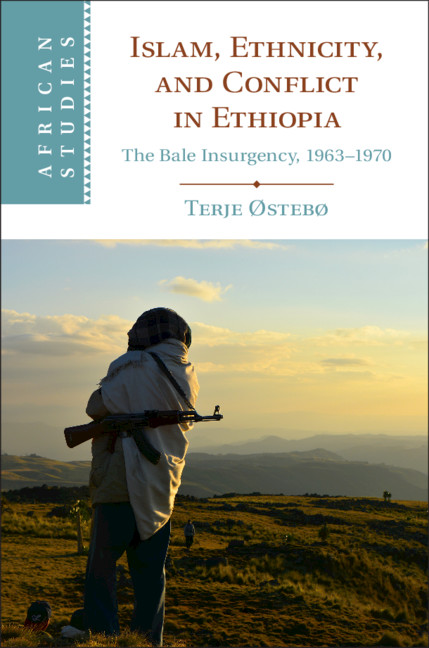
    Focusing on the role of religion and ethnicity in times of conflict, Terje Østebø investigates the Muslim-dominated insurgency against the Ethiopian state in the 1960s, shedding new light on this understudied case in order to contribute to a deeper understanding of religion, inter-religious relations, ethnicity, and ethno-nationalism in the Horn of Africa. Islam, Ethnicity and Conflict in Ethiopia develops new theoretical perspectives on the interrelations between ethnic and religious identities, considering ethnic and religious groups as mutually exclusive categories by applying the term peoplehood as an analytical tool, one that allows for more flexible perspectives. Exploring the interplay of imagination and lived, affective reality, and inspired by the 'materiality turn' in cultural- and religious studies, Østebø argues for an integrated approach which recognizes and explores embodiment and emplacement as intrinsic to formations of ethnic and religious identities.

    Reviews

    ‘Resisting a single-cause explanation, Ostebo’s critical analysis of the rebellion that swept the Bale province of Ethiopia from 1963-1970 contextualizes the rebellion at the interface of two connected processes; Bale’s culture and recent history as a frontier-province, and the dominant political processes and administrative practices through which the Ethiopian state was expanded and consolidated. In doing so, Ostebo underscores the centrality of previously over looked mutual exclusions between Bale’s Muslim and Christian communities.’

    Teferi Abate Adem - Yale University, Connecticut

    ‘Grounded in decades of research among Oromo Muslims, this book reveals the intricate interplay of religion, ethnicity, and rule in Ethiopia. Tracking Oromo’s fraught relations with the state through oral histories, obscure archives, and scholarly sources, Ostebo’s richly nuanced analysis deepens understandings of Islam and conflict in Ethiopia and beyond.’

    Victoria Bernal - University of California, Irvine

    ‘This gripping book is set in one of the darkest periods of Soviet history, the last years of Stalin. Using declassified materials Slaveski vividly shows how remaking Ukraine after the German occupation and the Red Army’s defeat of the Wehrmacht was accompanied by corruption, violence and for many destitution. The result, as his brilliant analysis demonstrates, was incessant conflict between central and local authorities. The legacy of the chaotic post-war years is both an historical and contemporary phenomenon. This book is an invaluable contribution to understanding modern Ukraine.’

    John Barber - University of Cambridge

    ‘This fascinating story of ordinary people fighting back successfully against Stalinist officialdom is an example of how scholars can draw larger implications from local studies. Filip Slaveski’s important book offers a fresh approach to Stalinist economy and society. It changes our understanding of Soviet history after World War II by restoring agency to the lowly villagers and revealing the social tensions missed by previous historians.’

    Serhy Yekelchyk - University of Victoria

    'This book vividly demonstrates how the combination of historiographic and anthropological approaches can help to better understand Ethiopia’s past and present.’

    Ulf Engel Source: Connections

    ‘Østebø presents an important study that goes beyond old exclusivist conceptual binaries in examining the relations between religion and ethnicity. The book is a valuable addition to the library of studies working to understand the nature of identity and conflict in the modern and contemporary world.’

    John O. Voll Source: Journal of Interdisciplinary History

    ‘… a highly informative book. It demonstrates both the importance of a multifaceted and materialist religious and ethnic analysis of conflict for the contemporary through the case study of the Bale Insurgency and provides a salient tool by which to examine the fluid nature of peoplehood and the sense of belonging that such an understanding is able to generate. Because of this, Østebø’s work is sure to provide an influential theoretical basis by which other like studies on religion, ethnicity, and conflict can be undertaken and performed.’

    Marcus Timothy Haworth Source: Reading Religion

    Refine List

    Actions for selected content:

    Select all | Deselect all
    • View selected items
    • Export citations
    • Download PDF (zip)
    • Save to Kindle
    • Save to Dropbox
    • Save to Google Drive

    Save Search

    You can save your searches here and later view and run them again in "My saved searches".

    Please provide a title, maximum of 40 characters.
    ×

    Contents

    Metrics

    Altmetric attention score

    Full text views

    Total number of HTML views: 0
    Total number of PDF views: 0 *
    Loading metrics...

    Book summary page views

    Total views: 0 *
    Loading metrics...

    * Views captured on Cambridge Core between #date#. This data will be updated every 24 hours.

    Usage data cannot currently be displayed.

    Accessibility standard: Unknown

    Why this information is here

    This section outlines the accessibility features of this content - including support for screen readers, full keyboard navigation and high-contrast display options. This may not be relevant for you.

    Accessibility Information

    Accessibility compliance for the PDF of this book is currently unknown and may be updated in the future.
