

Introduction
In this chapter, we analyze the transnational and domestic conflict configurations on the demand side, that is, among citizens of the European member states. As we argued in the introduction, similar to coming-together federations, the conflict structure in the EU is dominated by the territorial dimension. This dimension produces two lines of conflict: a vertical one, focused on the powers of the polity center vis-à-vis those of the member states, and a horizontal one, revolving around the specific interests of these member states. But the European integration process does not only pit countries against the European center and against each other, it also pits citizens with diverging views of this process against each other within each country. Viewed from the perspective of the general public, we can analyze the extent to which citizens from different countries are divided between themselves and how they are divided among themselves within each country. We shall first analyze the transnational conflicts between citizens from different countries and then focus on the conflicts between citizens within countries.
We expect the transnational conflicts between citizens from different member states to be closely related to the country-specific experiences in the refugee crisis and in the years following the crisis. By contrast, we expect the within-country conflicts among citizens to be rooted in a broader divide between cosmopolitans and communitarians, which is based on structural developments that go beyond the experience of the refugee crisis. In terms of horizontal transnational conflicts, we first resort to our categorization of the variety of EU member states at the onset of the crisis that we introduced in Chapter 2 and have used throughout the book. We expect the perspective of the general public to be shaped by the type of states they are living in: frontline, transit, open destination, closed destination, or bystander states. The criteria underlying this typology such as the countries’ policy heritage, their geographical location on general migration trajectories in Europe, and their immediate crisis experience are expected to have shaped the citizens’ experiences during the crisis and their preferences for policy in the aftermath of the crisis. We do not study how each of these different aspects have affected public opinion but instead assume that they are reflected in the differences observed between country types. Second, beyond the general country types, we especially expect the policy positions adopted by the policymakers during the crisis to have shaped the citizens’ policy preferences, as it is well known that policymakers and their parties are opinion-forming actors of great importance (Zaller Reference Zaun1992; Druckman, Peterson, and Slothuus Reference Druckman, Peterson and Slothuus2013; Slothuus and Bisgaard Reference Statham and Trenz2021). We expect the citizens of frontline states to oppose the citizens of transit, destination, and bystander states because the former countries would benefit most from a reform of asylum policy designed to increase transnational burden sharing. At the same time, we also expect the citizens of the Visegrad 4 (V4) countries – Poland, Hungary, the Czech Republic, and Slovakia – to be the most divergent from those in frontline states, since they have been most mobilized by policymakers against policies designed to increase transnational burden sharing during the refugee crisis. Given the great impact of the mobilization of the V4 on the populations in eastern Europe, it is likely that the citizens of other eastern European bystander states will share the positions of the citizens in the V4 countries.
Turning to the within-country conflicts, we have argued in Chapter 2 that the European integration process can be viewed as part and parcel of a larger process of globalization that restructures national politics in terms of a new structuring conflict (or cleavage) that opposes cosmopolitans-universalists and nationalists-communitarians. The new structuring conflict raises fundamental issues of rule and belonging and taps into various sources of conflicts about national identity, sovereignty, and solidarity. The emerging divide concerns above all conflicts about the influx of migrants, competing supranational sources of authority, and international economic competition. Scholars have used different labels to refer to this new structuring conflict – from GAL-TAN (Hooghe, Marks, and Wilson Reference Hooghe, Marks and Wilson2002), independence-integration (Bartolini Reference Bartolini2005b), integration-demarcation (Kriesi et al. Reference Kriesi2008), universalism-communitarianism (Bornschier Reference Bornschier2010), cosmopolitanism-communitarianism (Zürn and Wilde Reference Zürn and de Wilde2016), and cosmopolitanism-parochialism (De Vries Reference De Vries2017) to the transnational cleavage (Hooghe and Marks Reference Hooghe and Marks2018) and the cleavage between sovereignism and Europeanism (Fabbrini Reference Fabbrini2019: 62f). However, what they all emphasize is that the new divide constitutes a break with the period of “permissive consensus” and that conflicts over Europe have been transferred from the backrooms of political decision-making to the public sphere. At the same time, the new conflict leads to a renaissance of nationalism (and a desolidarization process between nation-states) and a politicization of national political, economic, and cultural boundaries.
These authors agree that the new divide is above all articulated based on two types of issues – immigration and European integration – and that it mainly concerns cultural-political, not economic, aspects of these issues. For multiple reasons – programmatic constraints, internal divisions, incumbency, and so forth – the mobilization potential created by this new conflict has been neglected and avoided (depoliticized) by the mainstream parties (De Vries and van de Wardt Reference De Vries, van de Wardt, Oppermann and Viehrig2011; Green-Pedersen Reference Green-Pedersen and Krogstrup2012; Hooghe and Marks Reference Hooghe, Marks, Jones, Menon and Weatherill2018; Netjes and Binnema Reference Nickell2007; Sitter Reference Skodo2001; Steenbergen and Scott Reference Teigen and Karlsen2004). Consequently, voters turned to new parties with distinctive profiles for their articulation. Over the past decades, it was first the cosmopolitan side that mobilized. In the aftermath of the “cultural revolution” in the 1960s and 1970s, radical left and green parties mobilized the social-cultural segments of the new middle class in the name of cultural liberalism, environmental protection, and multiculturalism. The cultural revolution also transformed the social democratic parties, which, in the process, have become essentially middle-class parties in almost all countries of western Europe (e.g., Gingrich and Häusermann Reference Golby, Feaver and Dropp2015; Kitschelt Reference Klaus, Lévay, Rzeplińska, Scheinost, Kury and Redo1994).
In a second wave of mobilization starting in the 1980s and 1990s, it has been mainly the parties of the radical right that have mobilized the heterogeneous set of the losers of globalization (Kriesi et al. Reference Kriesi2008) and their concerns about immigration and European integration. These parties were mainly newly rising challengers, but in some countries such as Austria and Switzerland, they consisted of transformed established center right parties. These parties all endorse a xenophobic form of nationalism that can be called nativist (Mudde Reference Mudde2007), claiming that states should be inhabited exclusively by members of the native group (the “nation”). Accordingly, the vote for these parties has been shown to be above all an anti-immigration vote (Oesch Reference Ortiz, Myers, Walls and Diaz2008) and, to some extent, a vote against Europe (Schulte-Cloos Reference Schuster2018; Werts, Scheepers, and Lubbers Reference Whitaker and Martin2013) and against the cultural liberalism of the left that has increasingly shaped Western societies (Ignazi Reference Indridason and Kristinsson2003; Inglehart and Norris Reference Jones2016).
The green parties on the one hand and the radical right parties on the other hand mainly rose in northwestern Europe. They have become established forces in the national party systems of their respective countries, even if, for various reasons, the radical right broke through in some of them belatedly. In southern Europe, up to the most recent past, with the exception of the Italian Lega Nord (Betz Reference Betz1993), radical right parties have not been able to gain a foothold. The impact of the new conflict has been more limited in the countries of southern Europe – for reasons that have to do with their political legacy (long-lasting authoritarian regimes and strong communist parties, i.e., a strong “old” left), with their having been emigration countries until more recently, and with the fact that the return to Europe after the authoritarian period was perceived as a return to Western civilization (Diez Medrano Reference Diez Medrano2003). However, under the impact of the combined economic and political crises that shook southern Europe in the more recent past (Hutter and Kriesi Reference Hutter and Kriesi2019a), new parties of the radical left (but hardly any green parties) have surged in Greece, Spain, and (to a more limited extent) Portugal. More recently, parties of the radical right also rose in Italy (Lega) and Spain (Vox). In central–eastern Europe, both types of radical parties have so far been rather weak or transient, due to the communist heritage and the low level of institutionalization of the party system. Instead, in this part of Europe, we have witnessed a radicalization of mainstream parties – of the center right (e.g., in Hungary [Fidesz], Poland [PiS], and the Czech Republic [ODS]) and the center left (e.g., in Romania [PSD]) – which have defended positions previously adopted by the radical right in western Europe.
At the domestic level, we expect that the conflicts are indeed shaped by attitudes about immigration and European integration and that these attitudes are most clearly articulated by the parties taking a nationalist position (the radical right and the conservative-nationalist right in some countries) on the one hand and those taking a cosmopolitan position (the Greens and the radical left) on the other hand. Overall, we shall show that domestic conflicts are more polarizing than transnational conflicts, which is to suggest that the potential for further transnational conflicts is, indeed, quite large. In general, the opponents to immigration are crucial for making asylum policy: If they dominate in some member states, they can induce their governments to legitimately block transnational burden sharing. In line with this argument, we shall see that the more restrictive policies are more likely to be supported than policies that aim at transnational burden sharing.
Measurement
This chapter uses data collected as part of an original cross-national survey fielded in sixteen EU member states in June and July 2021, covering all five types of states we are interested in.Footnote 1 The national samples were obtained using a quota design based on gender, age, area of residence, and education and consist of around 800 respondents per country, amounting to a total of 13,095 respondents. The survey’s larger scope was the study of attitudes related to the multiple crises that have hit the EU since 2008 (such as the financial and sovereign debt crisis, Brexit, and Covid-19) and within this scope, the survey included a section focusing specifically on the refugee crisis. This section consisted of multiple items ranging from attitudes toward migrants and immigration more generally, to performance evaluations of the national governments and the EU in the refugee crisis, to evaluations of specific policies proposed or adopted during the refugee crisis. Additionally, the survey included a host of general political attitudes, enabling our in-depth analysis of the conflict configurations surrounding policies in the refugee crisis. The timing of the survey in the aftermath of the refugee crisis also provides us with two advantages. First, it allows us to compare all the policies that have been proposed or adopted during the different phases of the crisis. Second, rather than measuring agreement with these policies at the peak of the crisis, when respondents might be biased in favor of one policy or another due to contingent considerations, asking them about their evaluations of policies in the aftermath of the crisis allows for a more considered assessment of these policies. In what follows, we describe the items used in detail, as well as the measures employed for systematically comparing conflict configurations between and within countries.
To measure attitudes toward policies, we include a series of six items tapping into agreement with all major types of policies that have been proposed or adopted at the EU level but also policies adopted by member states. The EU policies taken into consideration are (1) the relocation quota, requiring countries to accommodate a share of refugees; (2) relocation compensation, requiring countries to pay compensation to other countries that accommodate refugees; (3) external bordering through EBCG, investing in reinforcing external borders by reinforcing the border and coast guard; (4) Dublin regulation, requiring refugees to be accommodated by the country through which they first entered Europe and in which they were first registered; and (5) externalization, pursuing deals with third countries (such as Turkey and Libya) via financial and other incentives. To this we add as sixth category concerning international policies of member states: (6) internal border control, reinforcing countries’ internal borders by improving border surveillance, building fences, or pushing back migrants by force.
For measuring immigration attitudes, we use a series of eight items tapping into views about the impact of immigrants in several areas (economy, culture, criminality, overall quality of life) and into the degree to which each country should allow various groups of people to come and live there (same race/ethnic group, different race/ethnic group, poorer countries outside Europe, poorer countries inside Europe). This combination of items for measuring immigration attitudes has already been applied in a cross-national setting in the framework of various waves of the European Social Survey (ESS). As the items are all related conceptually and load onto a single factor with Eigenvalue of higher than 1, we combine them into a single index of pro- and anti-immigration attitudes. Beyond immigration attitudes, we also expect party allegiance to be an important driver of within-country conflicts on policy. For measuring party allegiances, we use a standard vote recall question and recode parties in our sixteen countries into eight different party families: radical left, green, social democrats, liberal, conservative-Christian-democratic, radical right, other, and nonvoters. Finally, we also include Euroscepticism, which is measured by a question on whether European integration has gone too far or should be pushed forward.
We examine descriptively the conflict configurations in four different ways. First, we present the kernel-smoothed distributions of the policy-specific attitudes in the different countries and domestic groups. Second, we estimate levels of policy polarization across different groups in terms of country types, pro-/anti-immigration attitudes, party family, and Euroscepticism and focus the bulk of our analysis on summary polarization measures across these groups. The polarization measure we use is based on the Kolmogorov–Smirnov (KS) statistic (see Marsaglia, Tsang, and Wang Reference Martin and Vanberg2003; Siegel Reference Sigelman and Buell1956: 127–136), which quantifies the distance between the empirical distribution functions of two samples. Our choice of the KS statistic is guided by three arguments: First, since we cannot assume a specific shape (e.g., normal) of the distributions of policy agreement across the different groups, this statistic offers a distribution-free alternative to other, parametric measures of distance (e.g., Bhattacharyya distance); second, the KS statistic can be used as a metric, which means it is symmetric (distance between distribution A and B is the same as distance between distribution B and A) and has a finite range from 0 to 1, with higher values indicating larger distances between the compared distributions; and third, the statistic detects a wider range of differences between two distributions than simply comparing summary statistics such as the mean or the median.
Finally, we attempt to reduce the complex conflict configurations by relying on multidimensional scaling (MDS) procedures. These procedures are designed to place the different entities (in our case, member states, as well as social groups defined by their immigration attitudes and partisanship) in a low-dimensional (typically two-dimensional) space. The distances between the entities in the resulting space reproduce their policy distances as closely as possible. The substantive meaning of the spatial dimensions lies in the eyes of the beholder; one relies on the raw data to come up with an interpretation of the dimensions, but of course this is more art than statistics. Finally, we also use ordinary regression analysis to show how the two types of conflicts relate to each other.
Transnational Conflict Configurations
Transnational Polarization
To explore the horizontal line of conflict between member states among the citizens, we start by looking at the distribution of support in our main country types in order to examine the direction of the attitudes toward selected policies (Figure 13.1). Generally, regardless of policy type, we notice that the public in frontline and transit states differs the most from the public in other states in terms of policy support. With respect to relocation (Figure 13.1a), in frontline states, the attitude distribution is heavily skewed in favor of the relocation quota, which is unsurprising because relocation policies would alleviate their immediate burden. By contrast, in transit states, the public is most opposed to the relocation quota, as these states are neither immediately affected by the problem pressure nor ultimate destinations of the migrant flows. The distribution of support is very similar in destination states, of both the closed and open kind, and in bystander states, with respondents being somewhat more positive toward the policy but with a large neutral share of respondents. With regard to the Dublin regulation (Figure 13.1b), again unsurprisingly, respondents in frontline states are the ones most opposed to it, followed by those in the transit states. By contrast, those in the bystander and destination states are rather neutral. Finally, Figures 13.1c and 13.1d indicate that external bordering via the reinforcement of the EBCG and externalization via deals with third countries are the least polarizing policies on the demand side, with similar distributions across all country types that are all heavily skewed toward neutral-positive attitudes. Transit states are the only ones that slightly diverge in the sense that they have an even higher share of positive attitudes toward these policies than other country types do.
Policy-specific distribution of support, by country type.
Relocation quota;
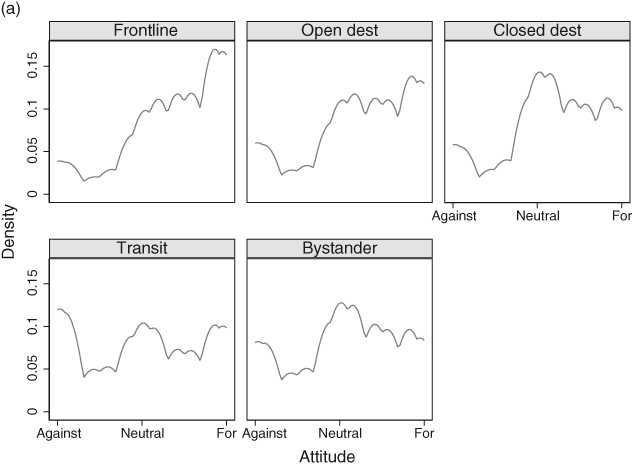
Dublin regulation;
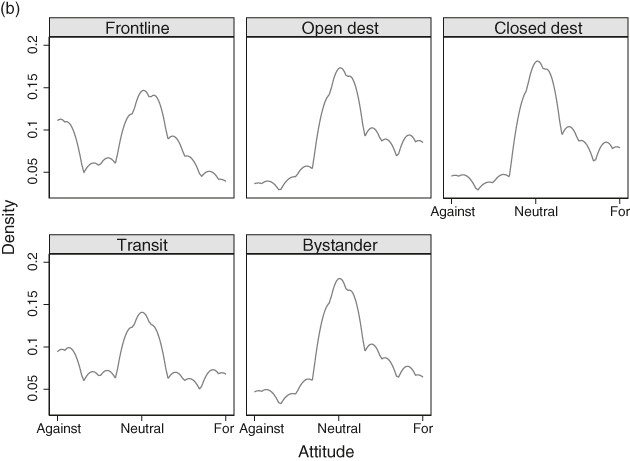
EBCG;
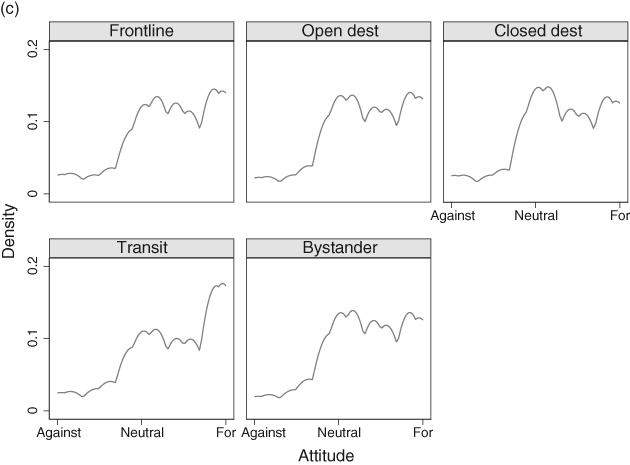
externalization
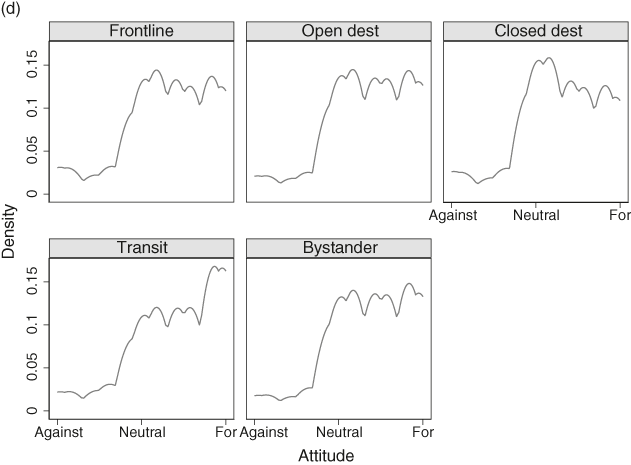
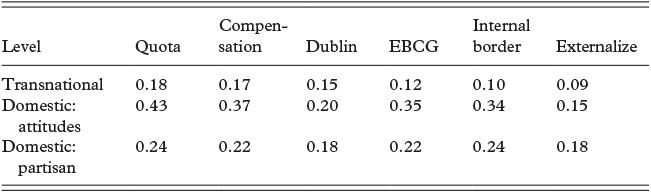
To further explore the transnational line of conflict between member states on the demand side, we construct measures of polarization between countries by policy type for each country in our dataset. This allows us to analyze the contentiousness of policies more systematically but also to observe patterns that might go beyond our general five country types by looking at each country individually and identifying potential coalitions. Table 13.1 presents the average KS distance between the distribution of policy support of each country versus the other fifteen countries in the dataset. Higher values indicate countries that are most dissimilar to the other countries when it comes to a particular policy.
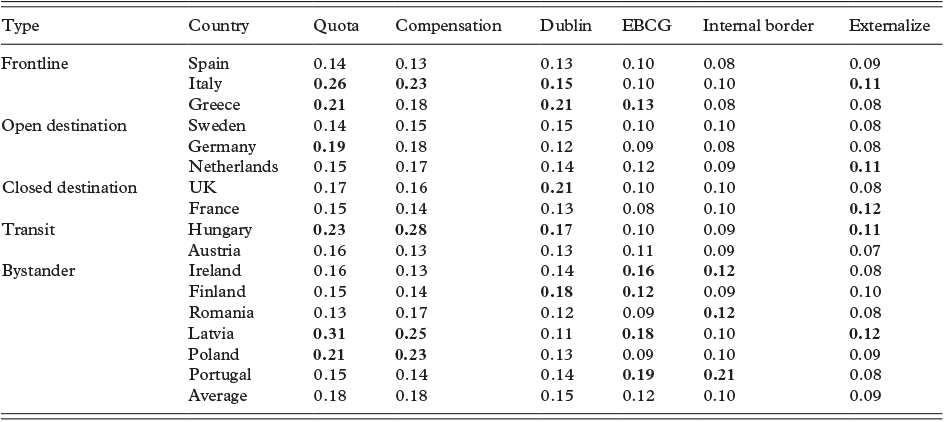
a The KS distances in the dataset represent averages over the fifteen distances between each selected country and the other fifteen countries. Values in bold represent county average KS distances higher than the overall average KS distance for a particular policy.
Indeed, in line with the visual insights from Figure 13.1, the relocation policies (quota and compensation) have been the most contested between member states, followed closely by the Dublin regulation. By contrast, internal bordering and externalization appear to be the least divisive issues between member states at the demand level. This difference in the divisiveness of policies on the demand side closely follows the patterns on the supply side and the actual policy outcomes of these proposals. While internal burden sharing based on quota and compensation proposals had failed, with countries being highly divided on the issue, externalization based on deals with third countries (such as the EU–Turkey agreement was eventually (one of) the arguably successful policies. Therefore, the EU-Turkey episode, which dominated most of the peak phase of the crisis and was the single most politicized policy decision taken during this crisis (see Chapter 4), left a positive legacy among the public – most likely due to its successful implementation: In the aftermath of the crisis, externalization to third countries appears as the least polarizing option on the demand side.
Beyond these general patterns, countries also diverge according to their type and centrality in the crisis. While the distance measure used here does not tell us the direction of the country-specific deviations (for or against the policy) from the mean, we can interpret these deviations based on the insights from Figure 13.1. With regard to relocation, we see that several frontline states (Italy and Greece), bystander states (Latvia and Poland), and transit states (Hungary) appear to be most polarized. As is already apparent from Figure 13.1, it is above all citizens in Italy and Greece, as the most affected frontline states, who favor these policies because they would reduce their immediate burden, whereas bystander and transit countries are the most opposed to these policies. Going beyond our country types, we see more specifically that not all transit and bystander states are polarized to the same degree. Together with Latvia, Hungary and Poland stand out the most. This indicates that the pattern observed at the level of decision-makers during the crisis, when the resistance of the Visegrad group (V4) was formed against relocation, persists among the citizen public in the aftermath of the crisis.
Among the destination states, public opinion in Germany is the most transnationally polarized with respect to relocation, even if to a lesser extent than public opinion in Latvia, Poland, and Hungary. This is unsurprising, given the centrality of Germany in the relocation debate. With regard to the Dublin regulation, the countries whose positions stand out the most are Greece and the UK, the former suffering directly from its dysfunctionality, whereas the latter, a geographically insulated, closed destination state, benefited most from shifting the burden to any other state along the migration routes. Finally, with regard to internal and external bordering (EBCG) and externalization, we see smaller deviations, with most countries having similar distributions in terms of agreement with these policies, with the exception of some bystander states (in particular Portugal), which seem to deviate the most when it comes to agreement with these issues.
In Figure 13.2, we examine the transnational conflict configuration via multidimensional scaling in a bidimensional space determined by attitudes toward relocation (x-axis) and attitudes toward border control (y-axis). This representation of the transnational conflict configurations confirms that the relocation policy is structuring the space the most. We have less variation among the member states on the border control dimension and hardly any with regard to externalization. The horizontal alignment of member states in terms of relocation shows three clusters of countries. On the left-hand side, opposed to relocation, we have members of the Visegrad group – Hungary and Poland (joined by Latvia) – as the most vocal opponents of relocation, whereas on the right-hand pro-relocation side, we have the two frontline states most heavily hit by the crisis – Italy and Greece.
Transnational conflict configuration according to citizens’ policy positions in the refugee crisis: MDS solution
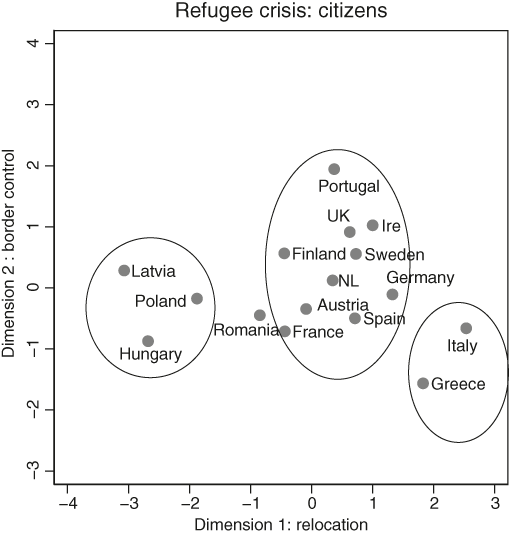
All in all, our analysis of transnational conflict reveals that most of these conflicts on the demand side are being structured around the relocation debate (involving either quotas or compensation), while other policies involving external or internal bordering or externalization are comparatively less polarizing at the transnational level. Patterns on the supply-side level are mirrored by the perspective of the general public even in the aftermath of the crisis, being clearly structured around country types and coalitions with frontline states and the Visegrad group at opposing poles of the debate.
Domestic Conflict Configurations: Immigration Attitudes and Partisan Support
We study the domestic conflict configurations from two perspectives. On the one hand, we focus on the configurations defined by immigration-related attitudes, and on the other hand, we analyze the conflicts between party families. The configurations between groups with pro- and anti-immigration attitudes define the political potentials for mobilization by the political parties. These conflicts between attitudinal groups remain latent as long as they are not mobilized by political actors. Among possible political actors, we study only parties. However, parties are among the key actors when it comes to the mobilization of immigration-related attitudes. The divisions between attitudinal groups is expected to be larger than the corresponding polarization between parties, as parties offer bundles of issue positions, and immigration is only one of many relevant issues.
Distribution of Immigration Attitudes
For our study of the refugee crisis, it is above all immigration-related attitudes that can be expected to determine the policy-specific substantive demands. Consistent with earlier work, these attitudes vary considerably across countries as well as across time, which allows for context-specific politicization of the underlying structural conflict between cosmopolitans and communitarians in each of the different member states. We shall first consider the policy-specific conflict configurations in the sixteen countries based on the immigration attitudes, before presenting the respective conflict configurations based on the partisan preferences of the voters in the different member states.
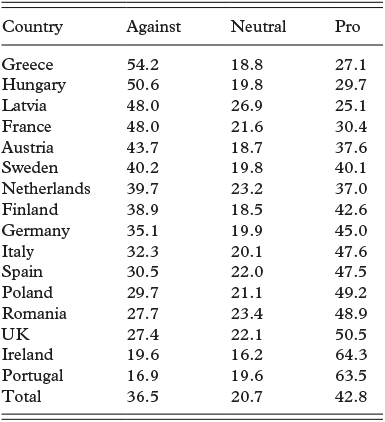
Based on our factor for immigration-related attitudes, we have created three categories of citizens: those opposing immigration, those having a rather neutral attitude with respect to immigration, and those favoring immigration.Footnote 2 Table 13.2 presents the immigration attitudes by member states, which are ordered from the country most opposed to immigration to the country most favorable to immigration. These distributions reflect the situation in summer 2021. Overall, there is a slight plurality of 42.8 percent of citizens favoring immigration, compared to 36.5 percent opposing it. However, the countries differ considerably in this respect. There are a number of countries where pro-immigration groups constitute a minority, while a plurality of the citizens oppose immigration. Importantly, the rank order of the countries in Table 13.2 does not align well with the different types of states we have distinguished throughout this study based on their experience during the refugee crisis. Thus, among the member states most opposed to immigration we find an eastern European bystander state (Latvia), a frontline state (Greece), a transit state (Hungary), and a destination state (France). Among the countries most favorable to immigration are four bystander states from different geographical regions of Europe (Ireland, Portugal, Romania, and Poland) as well as the UK, a restrictive destination state.
We have also created a factor for immigration attitudes that is directly comparable to the factor that we obtain based on ESS data. The ESS data cover the period 2002–2018 for most of our sixteen countries, allowing us to compare the current immigration attitudes to attitudes reaching back to 2002. Figure 13.3 presents the development of immigration attitudes over time. In this figure, the countries have been grouped according to their over-time patterns. The first graph includes three open destination states (Germany, the Netherlands, and Sweden), a closed destination state (France), and a bystander state (Finland). The support for immigration has varied across these five countries in the past, but in all these countries, it has collapsed in the past few years. The collapse occurred after 2018, that is, at a moment when the refugee crisis was already a past memory. The collapse was most striking in Sweden, which used to be by far the country most favorable to immigration. By summer 2021, the support for immigration in Sweden had converged with the support in Germany, Finland, and the Netherlands below the mid-point of the scale. Table 13.3 shows that the collapse in Sweden occurred across the political spectrum, even if the radical left proved to be somewhat more resistant to the general movement against immigration than the rest of the parties. At the same time, the share of the radical right, the party most opposed to immigration, has more than doubled in Sweden.
Development of immigration attitudes over time, mean factor scores by country
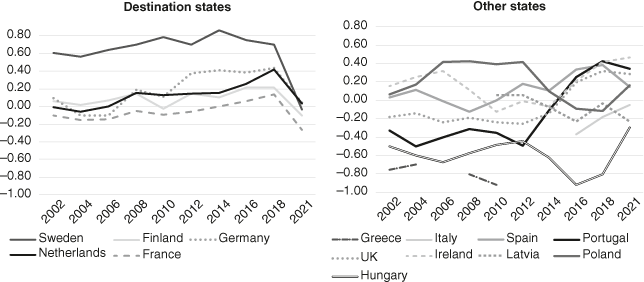
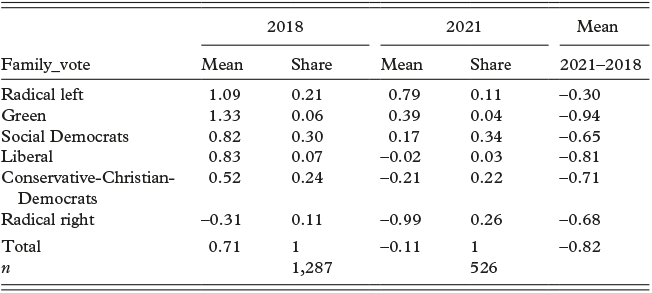
The second graph in Figure 13.3 shows the countries where the support for immigration has been rather stable or has improved more recently, albeit from very different levels. This is a mixed group of countries that includes bystander states (Ireland, Poland, and Portugal), frontline states (Greece and Italy), a transit state (Hungary), and a closed destination state (the UK) but not a single open destination state. In two of these countries (Hungary and Italy), support for immigration reached a low point in 2016, at the height of the refugee crisis, from which it recovered in the more recent past. The contrasting developments in the two sets of countries led to a convergence of immigration attitudes in the countries under study: The standard deviation of the country means fell from 0.37 in 2018 to 0.30 in 2021.Footnote 3
To account for these contrasting developments, we have calculated the correlation between the share of the citizens in a given country that considers immigration one of the most important problems facing their country and/or the EU and the level of immigration attitudes in 2021: This correlation is negative and substantial (–0.71), which means that the greater the salience of immigration in a given country in 2021, the lower the support for immigration. The refugee crisis has been most salient in open destination and transit states.
Asked which crisis before the Covid-19 pandemic had been the greatest threat for the survival of the European Union – the refugee, financial, poverty/unemployment, or Brexit crisis – 41 percent of the citizens in open destination and 43 percent of those in transit states mentioned the refugee crisis, compared to only 21 percent in frontline states, 28 percent in restrictive destination states, and 30 percent in bystander states. Since the refugee crisis, the salience of immigration issues has, if anything, increased once again. Not only roughly one third (32 percent) considered the refugee crisis as the most threatening crisis retrospectively, but by summer 2021, almost half (47 percent) of the citizens in our sixteen countries considered immigration as one of the most important problems facing their country and/or the EU. The salience of immigration had increased in all countries except Sweden and Germany (the two most important destination countries in the crisis); Austria and Hungary (the transit states); and Poland (a member of the V4), where it had already been very high previously.
Policy Support by Immigration Attitude
Table 13.4 presents the domestic policy–specific polarization between pro- and anti-immigration groups. The policies are arranged from left to right as in the previous table. As can be seen, similar to the transnational level, the relocation quota (and the related compensatory measures) are the most polarized policies. External and internal border control measures are also highly polarized, while the Dublin regulation and even more so externalization are less polarized among attitudinal groups. Compared to the conflict configurations between countries, the level of polarization is, however, generally considerably higher between the attitudinal potentials within the member states. This means that the latent conflict potential has not been fully mobilized in transnational conflicts. As we shall see, even at the domestic level, this potential has not been fully mobilized.
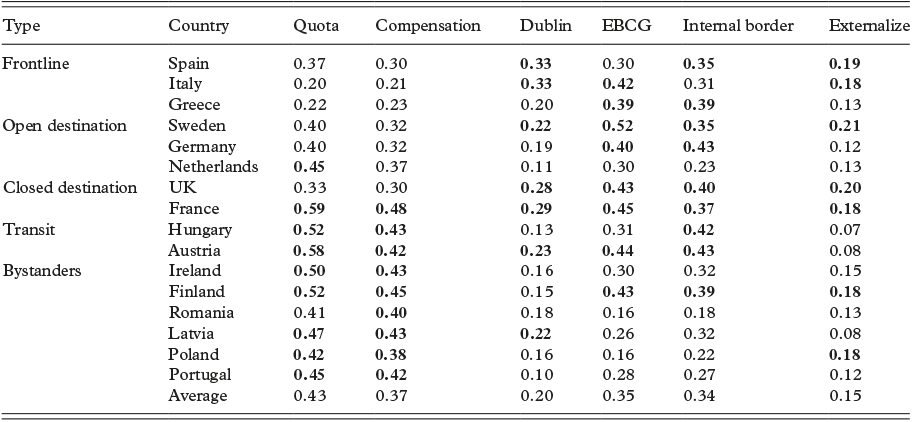
a The KS distances in the dataset represent distances between the pro-immigration and the anti-immigration group within each selected country. Values in bold represent county KS distances higher than the overall average KS distance for a particular policy.
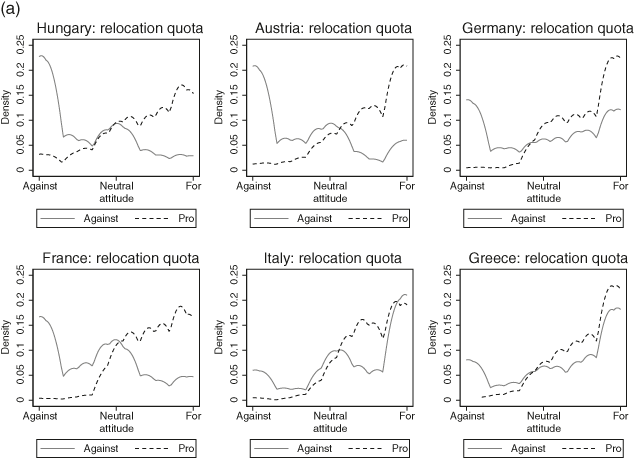
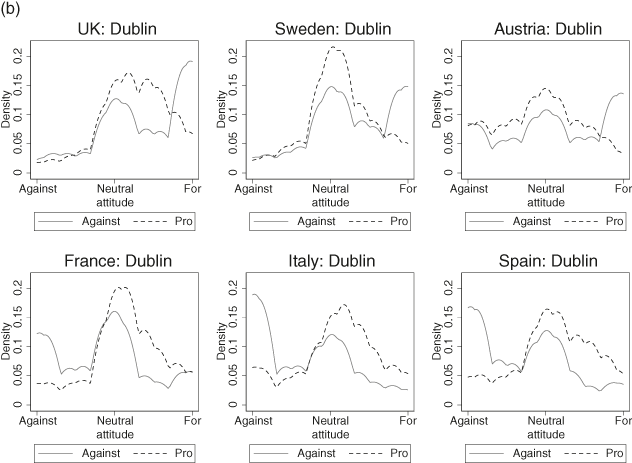
Looking at country differences, there is a strong possibility of conflict between pro- and anti-immigration groups with respect to relocation quotas in some countries. Thus, polarization between attitudinal groups is highest in France, a restrictive destination state, and in the transit and bystander states. It is somewhat lower in the open destination states and much lower in the frontline states of Greece and Italy. As is illustrated by Figure 13.4a for some selected countries, pro-immigration groups are generally in favor of relocation quotas, which means that domestic polarization is high where anti-immigration groups oppose such quotas. With the exception of frontline states like Greece and Italy, this is the case in all types of countries. Citizens who are in favor of immigration see quotas as a possible measure to accommodate refugees in an equitable way. Citizens who are opposed to immigration do not wish to adopt policies, such as relocation quotas, that allow refugees to stay in Europe. The anti-immigration citizens in frontline states are an exception, most likely because their countries would benefit from relocation schemes.
Policy support by immigration attitudes.
Relocation quota: support;
Dublin regulation;
external border control;
internal border control;
externalization
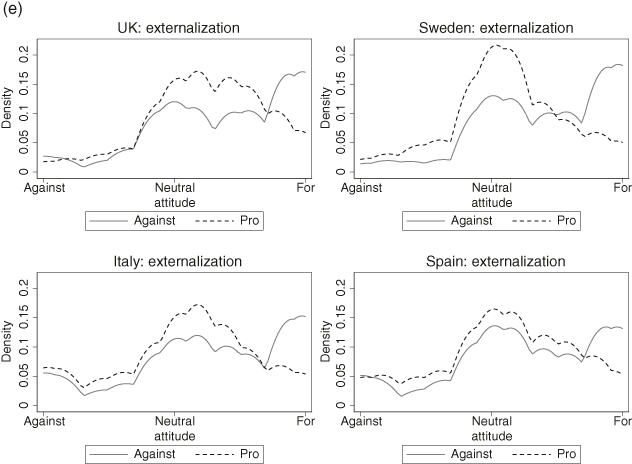
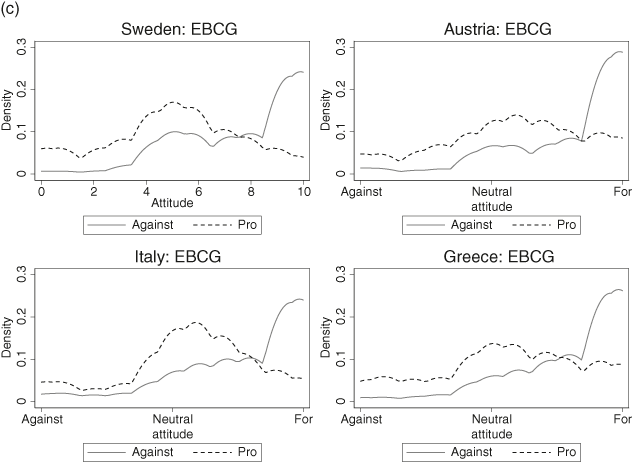
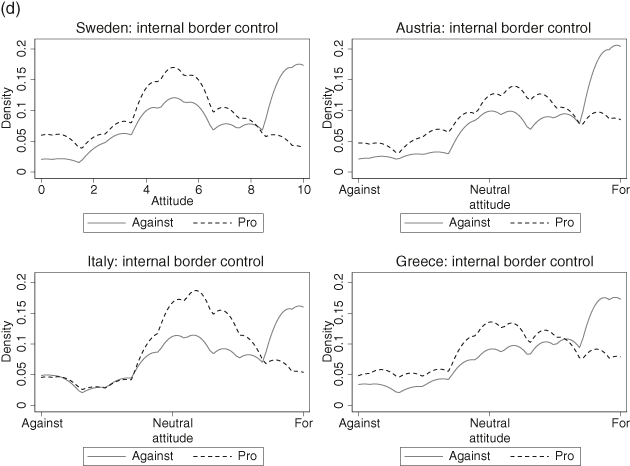
With regard to the Dublin regulation (Figure 13.4b), the positions of the pro-immigration groups are not quite clear: Large parts of these groups take a neutral position in all types of countries. Even the opponents of immigration are somewhat uncertain about this regulation, but clear-cut minorities among them support it in destination and transit states (the UK, Sweden, and Austria are examples) where the regulation is intended to keep refugees out, and oppose it in frontline states (Spain and Italy) where the regulation is intended to keep refugees in the country, and in France (whose opponents to immigration behave in this case like opponents in frontline states). By contrast, with regard to border control measures, the position of pro-immigration groups is not so clear, while they are generally supported by opponents of immigration, as is illustrated by Figures 13.4c and 13.4d. Externalization (Figure 13.4e), finally, is generally supported by both groups, but to a somewhat greater extent by the opponents to immigration, especially in destination states like the UK and Sweden.
Overall, this analysis clarifies that it is the opponents to immigration who could be decisive for the policy options in the EU member states. They oppose relocation quotas and, in frontline states, the Dublin regulation, which creates potential obstacles for these solutions. Given that they constitute large minorities or even a plurality in many countries – above all in transit states; in Latvia, Greece, and France; but also in open destination states like Sweden and the Netherlands – the governments of the respective member states are legitimately opposing these policy proposals. By contrast, the opponents to immigration are much more favorably disposed to externalization and internal and external border controls. While the pro-immigration groups are not as supportive of the latter policies, they are not clearly opposed to them, which makes this type of solution potentially more consensual.
In addition to immigration attitudes, we have also analyzed the political potential of Euroscepticism (not shown here due to space considerations). The twin issues – immigration and European integration – solicit similar conflict configurations in the member states, which is why we do not pursue the European integration attitudes any further here.
Policy Support by Party Family
Chapter 6 has shown that partisan conflicts are the most likely venue for the articulation of conflicts about refugee-related policy episodes in member states. Table 13.5 presents the overall polarization between voters from different party families with respect to the six policies in comparison to transnational polarization and domestic polarization by attitudes. As expected, attitudinal groups are more polarized than are political parties. In particular, the partisan conflicts are more attenuated with regard to relocation, but also with regard to border control. In contrast, there are few differences between attitudinal and partisan polarization concerning the Dublin regulation and externalization. However, even if they are less polarized than the attitudinal groups, note that policy-specific partisan conflicts are still a lot more polarized than the corresponding transnational conflicts, which confirms the critical role of domestic opposition to EU policy proposals.
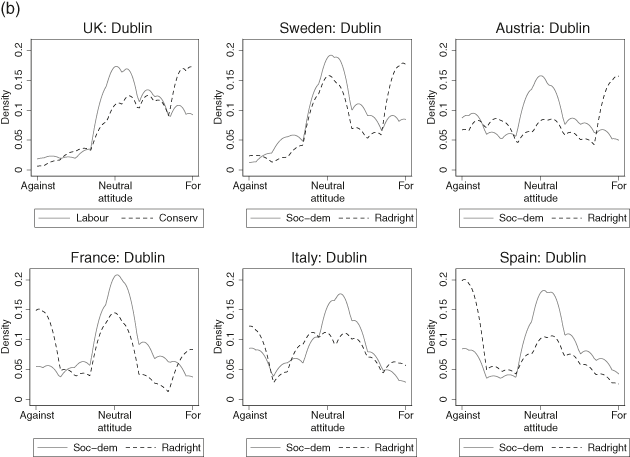
Considering the country differences in detail, with respect to relocation quotas, the partisan conflict remains intense between the left and the right in all countries except frontline states. This is shown in Figure 13.5a, where we present the distribution of policy-specific attitudes for the center left (social democrats) and the radical right (or the national-conservative right in countries without a significant radical right) for some selected countries. There is also a reduced but still important conflict with respect to border control (not shown). The radical right is embracing border control internally and externally, while the center left is not adopting clear-cut positions in this regard. Greece is exceptional to the extent that, in this country, not only the radical right but also the center left is in favor of the reinforcement of the external borders, while it is the radical left (Syriza) that opposes this measure to some extent. By contrast, with respect to the Dublin regulation and externalization, we do not find any attenuation of partisan conflicts compared to attitudinal polarization. In line with the previous results, the left is uncertain about this regulation, while the radical right tends to embrace it in destination and transit states but oppose it in frontline states (Figure 13.5b). Externalization, which was the least contested between attitudinal groups, turns out to be more contested between parties than between attitudinal groups in closed destination states, transit states, and Poland (not shown). In destination states, the right is somewhat more in favor of externalization than the left is. By contrast, in frontline states, there is hardly any difference between the two opposing sides, as they both tend to support externalization to the same extent.
Policy support by party family.
Relocation quota;
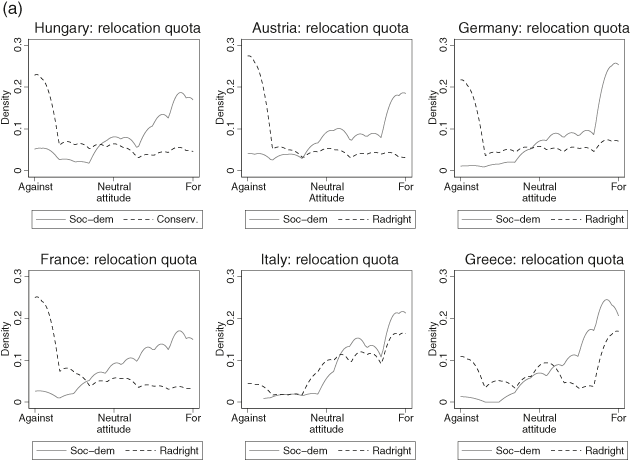
Dublin regulation
Overall, we can conclude that domestic partisan polarization between the left and right, while less pronounced than attitudinal polarization, is still very intense. Moreover, there are fewer differences between the policy domains in terms of partisan polarization than in terms of attitudinal polarization. Finally, partisan polarization is particularly pronounced in the closed destination states.
Transnational and Domestic Policy-Specific Conflict Configurations Combined
In this section, we analyze the joint configuration of the transnational and domestic conflicts by way of regression. Figure 13.6 presents the corresponding results in graphical form. For each policy, there are three types of effects – attitudinal effects, party family effects (with a specific effect for Fidesz and PiS), and country effects. The bigger an effect parameter in this graph, the more closely the corresponding aspect is associated with the conflict about a given policy. All effects are the net effects, controlling for the effects of the other aspects. Thus, the attitudinal effects represent the remaining effects of the immigration attitudes that have not been mobilized by the domestic parties. The country effects represent the levels of policy support in the different countries that are not attributable to immigration attitudes and to partisan conflicts in the respective countries but correspond to the aggregate policy position of the country’s citizens irrespective of these aspects. Greece, a key frontline state, is the reference category for the country effects, which means that the country effects indicate to what extent the population in a given country differs from the Greeks. Except for the immigration attitude, all variables are dummies, which means that the effects correspond to the impact on the 0 to 10 scale of the policy assessment. The immigration attitude has also been rescaled to the 0 to 1 range, which means that the effects shown correspond to the maximum effect of these attitudes.
Transnational and domestic conflict configurations according to citizens’ policy positions in the refugee crisis: OLS regression coefficients
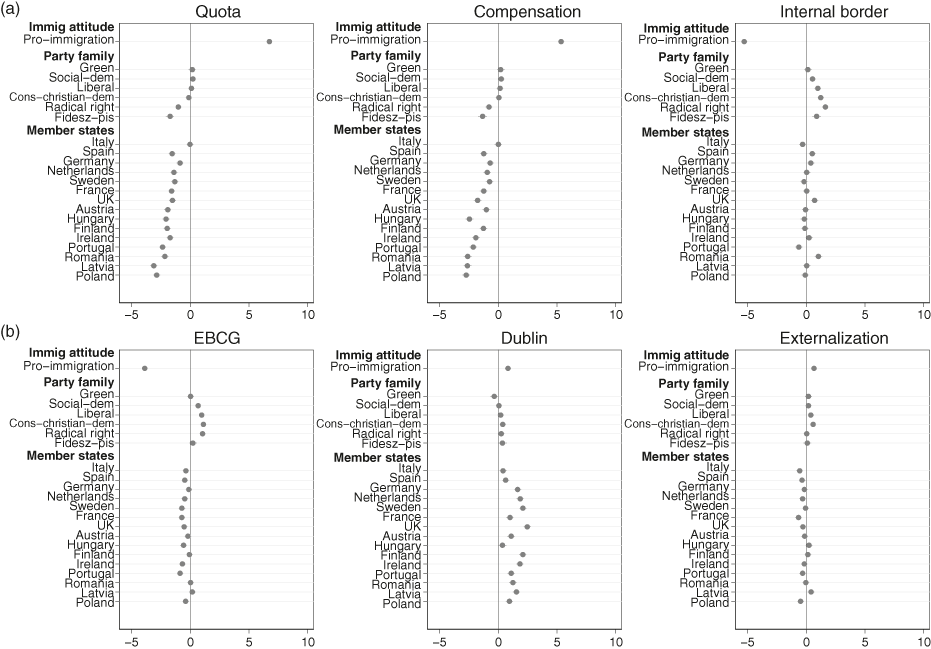
Let us first consider the relocation quotas and the corresponding compensation proposals: Here, all three factors strongly contribute to the conflict. The pattern of results is very similar for the two types of proposals. First, the attitudinal conflict is the main driver of these attitudes, even if we control for partisan and country effects. People who support immigration are in favor of quotas, and people who oppose immigration are against them. The very strong effect of immigration attitudes implies that the partisan mobilization here has been weak, and this issue could become much more politicized in the future. This is to suggest that, given the widespread opposition to immigration across Europe, further pursuing policies involving quotas and related proposals is likely to be met with widespread contestation. In partisan terms, with the exception of the radical right, there are few differences between party families with respect to quotas. It is the radical right that gives political voice to the opposition to quotas. The only exceptions to this pattern occur in Hungary and Poland, where Fidesz and PiS, officially two conservative parties, are even more opposed to quotas than is the radical right. In terms of between-country differences, Italy and Greece are the two nations that really stand out. Italy and Greece have – by far – the highest support for quotas. This is not simply a frontline country effect, as support for quotas is significantly lower in Spain.
Internal border controls and the reinforcement of external borders (EBCG) are also strongly associated with immigration attitudes, but these policies are preferred by immigration opponents. Accordingly, parties on the right are more supportive of such policies than are parties on the left. For these policies, however, Fidesz and PiS do not stick out as much as they did for quotas and compensations. There are hardly any country differences with regard to internal border controls, except that the British and the Romanians perceive them in a somewhat more positive light than the other Europeans do, and the Portuguese are somewhat more critical in this respect. Country differences are also more contained in terms of reinforcing external borders, but populations of destination and bystander states tend to be slightly more critical of such policies than Greeks, Italians, and Germans are.
In contrast to the four previous policies, assessments of the Dublin regulation are hardly associated with immigration attitudes in general. Partisan differences are also generally rather small. With regard to this policy, country differences dominate. All countries, even Spain, are more in favor of this regulation than are the Hungarians and the citizens of the two frontline states most hit by the crisis. Finally, as we have already seen, externalization is least structured by the three effects we are considering here. It is slightly more favored by people holding pro-immigration attitudes. Liberal and conservative parties are somewhat more supportive of such policies, and there are no systematic country patterns.
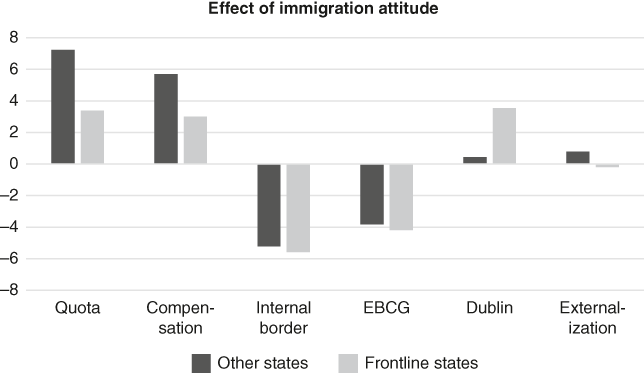
We have run separate regressions with an interaction term to account for possible different effects of immigration attitudes in frontline states. Figure 13.7 presents these differences for the six policy proposals. Two results stand out. On the one hand, the effect of immigration attitudes on the policy assessment is clearly reduced in the frontline states for quotas and compensatory measures because, as we have seen, even those who oppose immigration are also rather in favor of quotas. On the other hand, while immigration attitudes have no effect on the assessment of the Dublin regulation in most countries, this regulation is clearly more accepted by people holding pro-immigration attitudes in frontline states.
The effect of immigration attitudes on the six policy positions in frontline states and other states
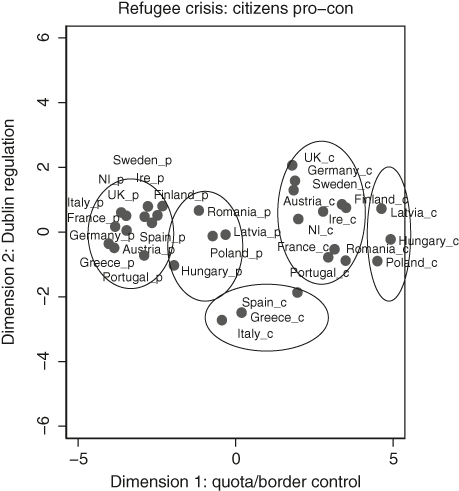
Next, we present the joint distribution of conflict configurations based on multidimensional scaling (MDS). While the regression approach analyzes the configurations policy by policy, MDS techniques allow for a configurational analysis that takes into account all the policies at the same time. We first present the combination based on immigration attitudes (Figure 13.8) before turning to the combination based on partisan conflicts (Figure 13.9). The configuration based on attitudes has a dominant horizontal dimension representing the major policies that have been adopted during the crisis – relocation quota and internal and external border control measures, and a secondary vertical dimension representing above all the failed Dublin regulation. The most consensual policy – externalization – hardly contributes to the structuring of the joint space, nor does the Dublin regulation contribute to the structuring of the joint space with party families.
Transnational and domestic conflict configurations according to citizens’ policy positions (p = pro/c = contra immigration) in the refugee crisis and immigration attitudes: MDS solution
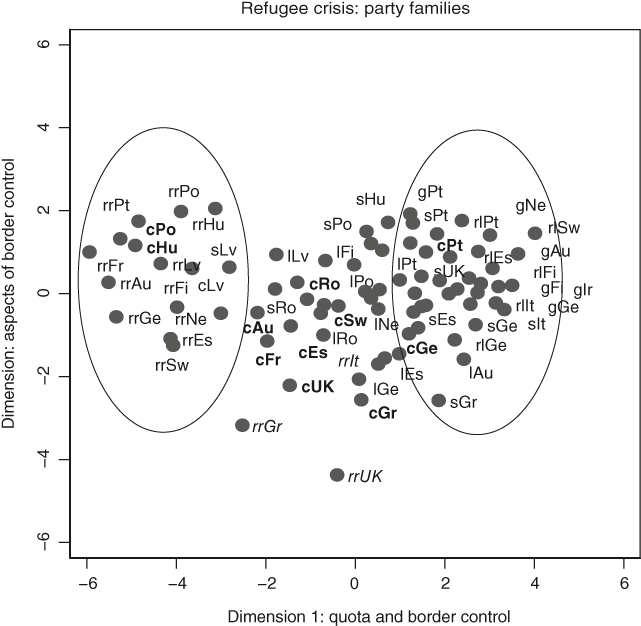
Transnational and domestic conflict configurations according to citizens’ policy positions in the refugee crisis and party families: MDS solutiona
aNot all parties are labeled so as to avoid cluttering: rr = radical right, c = conservative/Christian-democrats, l = liberals, g = greens, s = social democrats, rl = radical left; conservative/Christian-democrats in bold, deviant radical right parties in italic.
As we have seen, supporters of immigration tend to be in favor of quotas and against border controls, while opponents of immigration tend to be against quotas and in favor of border controls. The attitudinal divide clearly trumps the divide between member states, which again documents that the potential for further politicization has not yet been fully exploited by the political forces in Europe. The divide between member states is secondary to the attitudinal divide, which is reflected by the fact that each attitudinal camp is further divided into two groups of countries, with the eastern European supporters and opponents of immigration forming separate groups that are less favorable to the major policies than are western and southern Europeans. On the vertical dimension of the attitudinal space, which mostly represents the Dublin regulation, the opponents to immigration from the southern European frontline states form a separate cluster: They take a middling position on the main dimension, mainly because they are less opposed to relocation quotas than are opponents of immigration in other countries. At the same time, they are the group that is most opposed to the Dublin regulation. By contrast, those who oppose immigration in destination states like the UK, Germany, or Sweden are the groups most in favor of this regulation. Note that the second dimension does not contribute much to the structuring of the space in terms of immigration attitudes.
As for the combination of conflicts between partisan families with transnational conflicts, the dominant horizontal dimension is the same as in the previous graph, but the vertical dimension is not so much related to the Dublin regulation. Instead, it refers to aspects of border control that do not always go together with positions on quotas in some countries. On the horizontal dimension, in most of the countries, the radical right is opposed to the left (radical left, greens, and social democrats). Importantly, the radical right also includes the conservative parties in Hungary (Fidesz) and Poland (PiS). The conservative parties are marked in bold in the graph in order to show that they are spread considerably across the horizontal axis. While most of them are located in the middle of the space, with the Austrian conservatives closest to the cluster of the radical opponents of burden sharing, note that the German CDU as well as the Portuguese conservatives (together with some liberal parties) are part of the left cluster that favors burden sharing. As we already saw in Chapter 4 and as we shall see in the following chapter, the conservative/Christian-democratic parties have reacted quite differently to the refugee crisis in the different countries, which is reflected in their voters’ policy positions – as we can see here. On the other hand, the radical right in the two frontline states (Greece and Italy) is not part of the radical opponent cluster; rather, it is situated in the middle of the space, given that it is also rather favorable to quota schemes. On the vertical dimension, there are party families in some countries that differ with respect to the positions on border control – some oppose some aspects of border controls, while others generally support border controls. In the group opposing border controls, we find Portuguese parties across the entire spectrum and center left and center right parties from eastern Europe, while the group supporting border controls includes mainly right-wing parties from the frontline states and the UK but also the center left party from Greece and the German liberals.
Conclusion
In terms of transnational conflicts, we have found the expected opposition between the frontline states (Greece and Italy) on the one hand and the V4 countries (augmented by eastern European bystander states) on the other hand. The contrasting stance of the policymakers from these countries during the refugee crisis is reflected in their voters’ positions. Citizens from western European destination, transit, and bystander states generally take more moderate positions on the main dimension of conflict, which is defined by relocation policies. At the domestic level, we found the expected opposition between nationalists and cosmopolitans, which is politically articulated by the radical right and some nationalist-conservative parties on the one side and by the left and some parties of the mainstream right on the other side. We found that the same dimension structures the debate at the national and at the EU level. The domestic polarization appears to be more intense than the transnational one, especially in terms of immigration attitudes. When analyzing the combined transnational and domestic conflict configuration, this is reflected in the greater structuring capacity of domestic conflicts. Transnational conflicts appear as secondary to the domestic attitudinal conflicts, where they form a subdivision of the two attitudinal camps, and they are also secondary to the domestic partisan conflicts, where they divide the partisan camps with regard to some aspects of the border control policies. The transnational conflicts are ultimately rooted in the domestic conflict structure of the member states, where the opponents of immigration constitute the critical factor. In some key countries, they make up a plurality or even a majority of the population, which is mobilized by radical right and nationalist-conservative parties, depending on the country.
The implications for European policymakers in the domain of asylum policy are quite clear. The conflict potentials of immigration policies have not yet been fully mobilized. They are very large and have markedly increased in the destination states of northwestern Europe over the past few years. This means that policymakers are facing very strong constraints in terms of what is possible in this policy domain. As long as the critical underlying attitudinal potentials are not fully mobilized and as long as the parties mobilizing the opponents to immigration do not constitute the dominant coalition partner in government, joint solutions at the European level remain possible even in the most contested policy domains. However, when opponents to immigration become dominant in a given country and the parties mobilizing them become the dominant coalition partner or the exclusive governing party, as has been the case in Hungary and Poland (and other eastern European countries), the respective member states can legitimately prevent joint solutions, even if such solutions are supported by most of the other member states and, above all, by the frontline states. Given this state of affairs, relocation schemes do not appear to be a politically feasible option at the moment we collected our survey data (June-July 2021). The Dublin regulation benefits from the fact that even voters in the frontline states do not seem to be aware of what this policy exactly implies. However, voters in frontline states are well aware that their burden is not sufficiently shared by the other member states. Finally, the more restrictive policies of border control and externalization receive more support. Externalization policies are least contested.
Introduction
In this chapter, we examine the electoral repercussions of the refugee crisis. At a first level, we study in depth the effects of the refugee crisis on political conflict across our selected countries, namely the ways in which the salience of the immigration issue has increased and restructured European politics. Moreover, we wish to gain further insight into the drivers of changing patterns of politicization. If, as we assume, immigration became a more salient topic electorally after the refugee crisis, we aim to identify the parties that spearheaded this change in our set of countries.
Finally, we want to qualitatively examine the possible associations between the trends we observe in salience and polarization, of immigration on the supply side with the corresponding trends in electoral terms. We would like to check, at least qualitatively, whether there is a relationship between the electoral performance of parties and their changing positions and prioritization of immigration during the electoral campaigns following the refugee crisis. While we understand that the latter is a much more multifaceted phenomenon, which requires further analysis, we shall show that there are some interesting patterns, particularly on the right of the political spectrum, linking the politicization of immigration and electoral outcomes.
Party-System Dynamics after the Refugee Crisis
Our main questions are related to the previous chapters but focusing on a different temporal and spatial dimension. In this chapter, we aim to understand who politicizes immigration during election campaigns, rather than at the time of policymaking, and shed some light on who avoids the issue and what the political dynamics in each country are. We already concluded in Chapter 4 that the policy politicization dynamics vary per country and party-system, and here we want to analyze whether and to what degree this also applies to election campaigns. We expect that in such campaigns, too, existing party-system configurations and the parties’ strategies in each country should be crucial for the electoral repercussions of the refugee crisis.
Our first focus is on issue salience as an indicator of how much parties focus on immigration compared to other issues and how big a part of the electoral “space” this issue occupies. This is linked to theories of issue ownership (Bélanger and Meguid Reference Baumgartner and Jones2008; van der Brug Reference van der Brug2004; Budge and Farlie Reference Budge and Farlie1983; Green and Hobolt Reference Green-Pedersen2008; Petrocik Reference Pierson1996), which stress that parties strategically emphasize issues on which they possess either a credible reputation or a record of competence and past alignment with voter preferences. Each party in each election must decide whether to further stress a given issue, maintain its issue-specific discourse from the last election, or avoid the issue altogether (Green‐Pedersen and Mortensen Reference Green-Pedersen and Otjes2015; Sigelman and Buell Reference Simon2004). We expect the party’s strategy to generally depend on patterns of issue ownership and past record. On the issue of immigration, conservatives and even more so radical right parties tend to be more engaged and recognized as competent and aligned with public preferences (Dennison and Goodwin Reference Dennison and Goodwin2015; Pardos-Prado, Lancee, and Sagarzazu Reference Pérez2014); hence, we expect them to be the parties emphasizing this issue. By contrast, social-democratic and leftist parties are expected to generally avoid the issue, as it is not one of their core strengths with the electorate. Finally, we have no expectations for green and liberal parties: On the one hand, their typically cosmopolitan outlook might lure them to the issue, while on the other hand, like more traditional left-wing parties, they might be inclined to avoid taking potentially unpopular positions.
Additionally, we expect that the refugee crisis has not affected only the salience of immigration on an electoral and partisan level, but also the positioning of parties on the issue. Immigration rose to prominence in recent decades in European political discourse (Kriesi et al. Reference Kriesi2012), and there is an ongoing question as to what the response to “issue entrepreneurs” (De Vries and Hobolt Reference De Vries and Hobolt2020), that is, parties of the radical right that rose on the back of this and other cultural issues, should be from the side of mainstream parties. Meguid (Reference Mérand2005b) notes that mainstream parties are faced with a choice to either adopt an “adversarial” stance, that is, increase their distance on the issue relative to the radical right’s position, or an “accommodative” stance, that is, decrease that distance and potentially also co-opt radical right parties in government. Bale (Reference Angelescu and Trauner2003) suggests the accommodative tactic is far more frequent for conservative parties. It is convenient for them, even if they may lose votes, since it allows the size of a government coalition that is more favorable for their agenda to expand. Empirically, Alfonso and Fonseca (Reference Alfonso and Fonseca2012) indeed find that conservative parties tend to converge toward an anti-immigration stance, irrespective of the existence or pressure of radical right parties, as the issue has potential electoral yields for them, a finding corroborated by Green-Pedersen and Krogstrup (Reference Green‐Pedersen and Mortensen2008) and Pardos-Prado et al. (Reference Pardos-Prado2015). Abou-Chadi (Reference Abou-Chadi2016) provides a more nuanced picture, showing that conservative parties tend to adopt more radical positions under pressure from the radical right, as they both compete for attracting disenchanted voters of the left with a more culturally conservative stance on immigration.
Our study expands the current literature by zooming in on a period during which some of the assumptions held by contemporary scholars have been challenged. First, assumptions that the radical right parties could be contained as a junior coalition partner with a few policy concessions have been put into question. Indeed, in a number of key European countries, such as France, Italy, Austria, and Sweden, radical right parties have mushroomed to such a degree that they are directly threatening or have already outflanked the conservative parties. Secondarily, with immigration increasingly coming under the spotlight in the aftermath of the refugee crisis and, as shown in Chapter 4, having become the core concern of a majority of European voters at least temporarily, the potential losses to the far right might multiply and threaten substantially the mainstream parties not only on the left but also on the right. We posit therefore that mainstream parties, and particularly conservative ones, are likely to converge toward an anti-immigration consensus, moving their positions on the issue toward more radical stances, especially in cases where the radical right had already had a significant presence before the refugee crisis.
Operationalization of Key Measures
For the study of the shifts in the parties’ issue salience and positioning and their electoral repercussions, we utilize our core-sentence dataset, which was introduced in Chapter 3 (Hadj Abdou, Bale, and Geddes Reference Hadj-Abdou, Bale and Geddes2022; Hutter, Kriesi, and Hutter Reference Ignazi2019; Kleinnijenhuis, de Ridder, and Rietberg Reference Kolb1997), which records the claims and discourses of parties as depicted in the written press during electoral campaigns. Regarding the type of metrics we produce from the database, we propose to study shifts in salience by three key measures: party-system or systemic salience of immigration, interparty salience in immigration discourse, and intraparty salience of immigration.
To clarify, the first metric, that is, the systemic indicator, measures the total number of sentences dedicated to immigration, for or against, in one national electoral campaign as a share of the total number of sentences in the respective campaign. Simply put, the systemic indicator measures how salient the issue of immigration was during a campaign, providing us with a raw metric to compare demand-side salience, which was already examined in Chapter 4, and supply-side salience in the elections before and after the refugee crisis.
The second metric, interparty salience, is one component of issue ownership. While we typically use the share of a party’s sentences on a given issue over the total number of its sentences addressing various issues, we also want to examine salience and issue ownership from a relative perspective. Thus, the interparty metric measures the share of all the sentences addressed to the issue of immigration by a given party, compared to the corresponding shares of the other parties or party families. Rather straightforwardly, we assume that the higher a party’s share of the sentences revolving around immigration, the higher the probability that it is attempting to “own” the issue and/or render it salient.
However, this relative share does not capture all aspects of the salience of immigration for a given party. Especially due to the fact that we use the written press as a source, which tends to prioritize mainstream parties, this measure might distort how voters perceive parties and electoral campaigns, particularly now that social media have become an important source of accessing news. Therefore, we also use the standard metric of salience and issue ownership, that is, a metric that detects how the parties frame themselves, by measuring the sentences involving immigration within a party’s discourse, a measure we call the intraparty salience of immigration. That is, in this case, we ask how much of their electoral campaign parties spend on the issue of immigration compared to other issues, hopefully providing us with an indication of how closely parties are associated with this issue in a given campaign. We think the two measures of inter- and intraparty salience are complementary; the former provides a snapshot of the relative weight of each party in the campaign for a given issue, while the latter takes into account the various means that might be used to acquire an image of a party’s priorities and focuses more closely on the salience of an issue for the party itself.
With regard to positioning, the operationalization is more straightforward. We measure each party or party family’s position as the average position they have on the issue, aggregating the positions for all sentences to result in an average value ranging from –1 to 1. We also weigh the aggregated positions by each party’s overall salience in the campaign, to avoid skewing the results too much in favor of extreme, but fringe parties that do not appear frequently in the public sphere. We then represent this visually as a diagram, placing the parties on an anti-/pro-immigration axis.
In terms of positioning, we also differentiate party families based on their shift in position. We have already noted that we mostly distinguish between “accommodative” and “adversarial” stances, but overall, the change in a party’s positioning before and after the refugee crisis can be characterized in four ways. Accommodation refers to the assumption of an anti-immigration stance, moving further toward the radical right’s opposition to immigration. An adversarial stance, to the contrary, is attributed to a party that becomes more pro-immigration during and after the refugee crisis. In addition to those two basic types, there is also the possibility of no discernible movement, that is a fixed pro- or anti-immigration position for a party that hardly budged during the crisis. The final possibility is one of avoidance of the issue, and this is assigned to parties that barely talk about it. While avoiding the issue before and after the crisis is formally equivalent to “no movement,” we keep those two outcomes separate, as we feel that maintaining a distinct positive or negative attitude toward migration is different from not having a position on migration at all.
Furthermore, we also briefly differentiate between the systemic outcomes for each party-system, depending on the relative and absolute movement of the parties’ positions on the issue of immigration. Here, there are four main outcomes: convergence, in which the parties abandon extreme positions and converge in their relative positions towards each other; divergence, in which the parties’ relative positions grow more distant; stability, when their relative and absolute positions remain the same; and, finally, drift, when their relative positions do not change, but their absolute positions do, but move in the same direction.
We proceed by splitting parties into party families. For the categorization of parties into party families, we rely on the Parlgov database (Döring and Manow Reference Döring and Manow2021) but merge Christian-democrat and conservative parties into a unified “conservative” category. In the countries we study, there are six main party families present, namely the radical right, the conservatives, the liberals, the greens, the social democrats, and the radical left. Additionally, there is a leftover “others” category, which includes the Movimento 5 Stelle and some fringe parties in Austria and Hungary. We should also note here that we limit our study to seven of the eight countries included in most of our chapters, as we unfortunately have no electoral campaign data for Sweden.
Salience and Party-System Dynamics of Immigration in Electoral Campaigns
Before we delve into the supply side on the issue of immigration, we would like to remind the reader that the parties that raised the issue were responding to a surge in demand as well. As we have already mentioned in the previous chapters, the refugee crisis was an event that caught the attention of the European public. Immigration was perceived as one of the most important problems for European voters as the refugee crisis deepened, but its salience varied between the types of countries. As presented in Figure 4.5, in the open destination and transit countries – Germany, Sweden, Hungary, and Austria – the issue rose sharply in salience in the minds of the public. By contrast, in the other four countries, our frontline and closed destination countries – Italy, Greece, the UK, and France – the public salience of the issue presented some different patterns, with either less steep increases or even no increases at all, as in the case of France.
A main question we want to address is whether these demand-side patterns are aligned with supply-side changes. More specifically, we examine three aspects of the supply side: first, whether the salience of immigration rose in electoral campaigns in line with demand-side patterns; second, how this relationship was affected by the timing of the elections, that is, by how close to the actual refugee crisis they were held; and third, whether this was any different for the frontline and closed destination countries that did not exhibit the same kind of rise in salience of immigration.
A first way to approach these questions is to measure the systemic salience of immigration in electoral campaigns. In line with previous research on the topic, we notice in all countries upward trends in the overall electoral salience of immigration after the refugee crisis, which is broadly in line with what we witnessed on the demand side, as shown in Figure 14.1.
The salience of immigration, measured as a share of immigration issues over total issues
Note: The dotted lines are the mean electoral campaign salience of immigration for the seven countries, and the upper line is the second standard deviation. For Sweden, we have no core-sentence data. The vertical line signifies the time of the peak of the refugee crisis (August 2015).

In Germany in particular and in Austria and Hungary to a lesser degree, the election immediately after the refugee crisis was characterized by an increasing party focus on the issue of immigration. In Hungary and Austria, the share of issues that concerned immigration jumped from a precrisis average of approximately 5 percent to, respectively, 9 and 12 percent of all campaign issues, while in Germany, the effect was even greater, with immigration rising from 3 percent precrisis to 18 percent in the election that immediately followed, in October 2017.Footnote 1 Overall, this trend is in line with the demand-side surge in concerns about immigration that was witnessed in those countries around that time.
The other country presenting a noticeable rise was Italy. The gradual climb of immigration as an important concern of Italians between the elections of 2013 and 2018 was matched with a rise in supply-side salience. By contrast, in the UK, a rise in the salience of immigration is barely noticeable, but any movement is complicated due to the way this issue was embedded in the wider Brexit discourse in any case.
There are two countries in which migration does not rise in salience at all. In Greece, in the aftermath of the refugee crisis, despite the country being at the forefront of the refugee exodus, the salience of the issue remained low, below the EU average, as people were still not ranking immigration as one of their top concerns, and parties did not prioritize the issue in the campaign discourse. Additionally, while the first election occurred exactly one month after the most massive refugee wave, in September 2015, the electorate and parties were too preoccupied with the economic state of affairs, while the next election was held four years later, in 2019, quite far timewise from the peak of the refugee crisis. Finally, France is the country that defies the general trend, with the salience of the issue diminishing in the election right after the refugee crisis. Temporal distance cannot explain the trend here, as it was the first country, apart from Greece, to actually hold elections after the crisis. Instead, we should probably perceive this as being in accordance with the relative stability of the French demand side, as the issue gained traction with neither parties nor voters postcrisis. As we shall see, even the Front National, the party one would expect to raise the banner of anti-immigration, did not allocate the bulk of its time to the issue.
While salience is one key metric of a possible increase in the interest in immigration, due to the refugee crisis, we cannot solely rely on it. It could be the case that salience has remained the same, but the average position of parties has shifted or polarization, that is, the distance between the parties’ positions on the issue, has increased, as immigration became a more conflictual issue due to the refugee crisis. In any given election, the number of issues parties are called to opine on are plentiful, and their salience in the press might not be entirely indicative of political conflict; thus, positions need to be taken into account. In Figure 14.2, we present the average position of each party-system over time, for each election, on the issue of immigration.
Average weighted position of each party-system across time
Note: The weights correspond to our salience metric presented above, as each party was weighed by its presence in the public sphere to avoid depicting an average position skewed by smaller fringe parties. Average position can vary from –1 to 1, with negative values signifying more consistent anti-immigration stances. Again, the dotted lines represent the mean, zero, and the values at 2 standard deviations away from the mean.

The results in Figure 14.2 provide a mixed image of the relationship between salience and average position. The average weighted position varies considerably from country to country and from election to election. The observations occupy almost the entire range of possible values, even if there is a strong cluster of cases with slightly negative values. Thus, the overall average is negative, at –0.31, with 75 percent of the observations being negative. With regard to its trend, there are again contradictory tendencies. In Greece and France, the average position tilted very slightly toward a favorable view on immigration after the refugee crisis, albeit in an environment of very low salience. The same was true in Hungary for the most recent election but starting from an already very negative value, for an issue that was additionally almost nonexistent in previous campaigns. In Germany and Italy, where the issue was more salient, the trend is in reverse, with the average position returning closer to the mean after it had drifted upward before the refugee crisis. It should also be noted from the figure that certain countries tend to oscillate more, like Germany and Greece, while for others, the average position tends to be more stable over time, fixed at low negative values, forming an established anti-immigration consensus in the party-system, as is the case for Austria, Hungary, and Italy.
While there is this impression of relative stability on average position for most countries, we should not be entirely certain that this meant the status quo was maintained after the refugee crisis. Instead, we should perceive the results of Figure 14.2 as a bridge, in order to discuss the different pathways of individual parties that can produce an outcome of relative aggregate stability. These indicators are strongly subject to composition effects: Stable average positions can be a product of parties not changing their position, but, as we noted, they could also be a product of convergence, that is, left-wing parties moving slightly toward anti-immigration positions (an “accommodative stance”), with right-wing parties concurrently moving toward more pro-immigration positions. The same may apply to the value of the average position itself, which in most country gravitates toward zero and mostly lies in the low negative values. This could be a product of either parties assuming juxtaposed positions or of a party-system convergence toward a median position. Studying the patterns of behavior of particular party families and parties more closely will help us differentiate between these cases.
We should note, however, before concluding this section that the variables we use that might explain policy are not really associated with phenomena on the supply side of politics. The proximity to the refugee crisis, which we theorized as a potential driver of politicization, seems to merely have a loose relationship with salience. There are some cases where proximity seems to correlate well with immigration salience (high salience, close proximity in Germany 2017 – low salience, lack of proximity in Greece 2019), but in general, there are several important cases (Greece 2015, France 2017, and Italy or Hungary 2018) that are not in line with expectations. Our other variables, such as country type and problem pressure, do not show much association with supply-side patterns either. The two frontline states (Italy and Greece) exhibit completely diverse behaviors, while closed destination states like France and the UK also differ greatly from one another.
Decomposing Interparty Salience
We therefore turn toward the core of what we want to examine in this chapter, that is, the political supply of individual parties in each system, another version of political pressure, and how that might have affected the reconfiguration of party-systems. We already saw that political pressure, in terms of public salience and radical right polling percentages, differed a lot depending on the context of each country (Chapter 4) and that different types of policies were politicized to varying degrees (Chapter 5). But did any of these policy debates reverberate in the electoral campaigns that mostly occurred a few years after the refugee crisis had reached its peak? Was there a shift of existing parties on the issue of immigration, or did smaller parties that focused on immigration, positively or negatively, mushroom compared to their past trajectory? Which parties tried to “own” the issue? We already saw that in certain countries, the issue gained salience and the average position moved, albeit slightly. We now aim to understand who the drivers of those shifts were, their characteristics, and how they differed from one country to another.
Perhaps the most surprising lack of legacy of the refugee crisis is that it did not lead to the creation of new parties that focus specifically on immigration, even in countries where the radical right was weak or absent. The closest example to such a new party would be the Alternative for Germany (AfD), which pivoted hard toward immigration issues in the 2017 German elections. However, while the party was a new addition to Germany’s parliament, it was not a new addition to its political system, as it had narrowly missed the electoral threshold of 5 percent in the previous elections, albeit with a completely different agenda, focusing on Euroscepticism (Bremer and Schulte-Cloos Reference Bremer, Schulte-Cloos, Kriesi and Hutter2019b). In substantive terms, the AfD had pivoted so hard toward anti-immigration in the wake of the refugee crisis that the party’s public image had changed considerably since the previous election. Apart from that, the only additions to the party-systems of our seven-country sample are either fringe parties in central and eastern Europe (Hungary and Austria) or the newly emerging La République en Marche (ReM) in France, the party of President Macron, which was, however, the product of a politician who had already served in the upper echelons of the French Republic as a minister of the economy and industry. Despite the lack of new parties, it is worth examining where the rise in salience in five out of seven countries came from. As we saw (Figure 14.1), apart from Greece and France, immigration became clearly more salient in electoral campaigns after the crisis in four of our countries, and marginally in the UK.
We can take a first glimpse of who politicized immigration in Figure 14.3, which presents what we call the interparty salience on the issue of immigration, that is, the shares of core sentences that correspond to each party family in each country per election on the issue of immigration. Figure 14.3 should be read in conjunction with Figure 14.1, showing the overall electoral salience of immigration as an issue. From the combination of the two graphs, some interesting patterns emerge, indicating both the past path of immigration politicization and developments after the refugee crisis.
Interparty salience for each party family on immigration issues per election, 2002–2020

In general, in all of the countries, there are three party families involved in the discussion around immigration, the outcomes being different permutations of interactions between them – the social democrats (or the radical left in Greece, which has effectively replaced them), the conservatives, and the radical right. Given that the conservatives are highly present in electoral campaigns in all countries, as shown in Figure 14.3, there are three different combinations that emerge: a first scenario where the conservatives are the sole party engaged in the issue, as in Hungary (see also Chapter 4); a second scenario where conflict occurs mainly between two party families, usually the two mainstream right and left ones; and finally, a triparty engagement scenario, which pits all three families against each other. As we see in Figure 14.3, the presence of the other party families is sporadic in the immigration discourse and virtually inexistent for all countries after the refugee crisis. Liberals and greens do not frequently raise the issue in the public sphere, either because they do not prioritize the issue or the media do not cover them extensively with regard to immigration.
The first type of configuration occurs only in Hungary. The immigration issue, especially after the refugee crisis, was dominated by Fidesz, Orbán’s party. The privileged access of Orbán’s party to the media and his prioritization of immigration as a flagship issue are starkly portrayed in Figure 14.3 and also discussed in Chapter 4, as Orbán’s party captured approximately 80 percent of all immigration-related themes. The duality evidenced in previous elections, as the issue was shared between Jobbik and Fidesz, completely vanished in the 2018 elections, as Fidesz became the sole owner of the issue of immigration.
In Greece and Germany, two parties engaged in conflict around immigration: the CDU-CSU coalition, that is, the conservatives and the social democrats in Germany, and Syriza, a radical left/social democrat hybrid, and New Democracy in Greece. In both countries, the radical right was boycotted by the press. In Germany, there is a taboo on talking about the radical right, and the relatively new AfD was shunned by the press. In Greece, meanwhile, there was a blanket ban on Golden Dawn coverage after 2013 and the party’s involvement in the murder of a Greek antifascist singer, as the party’s leadership was under trial. As the radical right disappeared from the spotlight, the conservatives could afford to abandon their accommodative strategy and focus less on the matter, resulting in the very low salience of the issue in Greece. This is a common puzzle for our book, that is, how there was so little salience for the issue in the epicenter of the crisis, but now we have enough evidence to understand the reasons: Apart from the focus on economic issues under the bailout, the party-system dynamics changed due to the disappearance of the radical right from the public spotlight.Footnote 2
In the other countries, after the refugee crisis, all three party families competed on the issue to a certain extent. On the one end, we find Austria and the UK, where the issue is almost entirely owned by the right bloc and the main actors are the mainstream and radical right, while on the other end there are France and Italy, where the conflict is mainly between the social democrats and the radical right, with the conservatives receding from the spotlight, at the time that the latter’s electoral fortunes waned considerably.
Decomposing Intraparty Salience of Immigration
Apart from the interparty salience, we also measure how emblematic the issue of immigration was for parties, as an indication of how much the voters identified them with the issue, that is, as another component of issue ownership. Figure 14.4 presents the intraparty (family) salience of immigration, that is, the share of core sentences of each party family on the issue of immigration.
Share of core sentences of each party that refer to immigration, 2002–2019
Note: We have included only party families with at least ten actions in this graph so as to now present parties whose results might have been based on a very low and possibly nonrepresentative sample of sentences. Thus, some party families are missing in each country, and in Hungary, two elections are missing because no party family passed the threshold in 2010 and 2014.

The Hungarian and Austrian cases stick out, as in both countries, in the elections after the refugee crisis, the conservatives dramatically increased their preoccupation with immigration during the electoral campaign and, coupled with the share of sentences they produced on the issue, can be reliably identified as the issue owners. By contrast, there are three cases in which the conservatives appear to provide scant attention to the issue of immigration, namely the UK, Greece, and France. As noted already, this outcome is, however, due to the different contextual characteristics and party strategies available to each party in those countries. Whereas in Greece, as we noted, the accommodation of the radical right ended because there was a blanket ban on Golden Dawn coverage, in the case of the UK, it should be remembered that immigration could not be entirely separated from the Brexit issue, which was what dominated the attention of media and the Conservatives’ headquarters. While the party did not spend much of its time stressing its immigration position, it did spend most of its time on delivering Brexit, an issue that was closely linked to immigration control, at least in the minds of many right-wing voters that the party needed to regain from UKIP. In France, finally, the issue simply did not feature in the campaign, which revolved mostly around Europe and economic issues, leaving no space left for the issue to Marine Le Pen’s party. Thus, we could say that in Greece and the UK, the conservatives continued to be the issue owners, while in France, the radical right owned immigration. But in all cases, it should be remembered that the issue was not salient.
In Italy, a similar trend occurred, and even if the conservatives did not disappear, Figures 14.3 and 14.4 paint a clear picture of the issue as a battlefield mainly between the nationalists of the radical right, consisting of the Lega and Fratelli d’Italia, and the social democrats and social liberals of the Partito Democratico. Those two parties therefore constituted the main poles and issue owners of each position in Italy, outflanking Berlusconi’s declining party.
Finally, the most striking case is Germany, where Figure 14.4 somewhat corrects Figure 14.3. Whereas the AfD occupied a very small part of the discourse on immigration, as shown in Figure 14.3, given that the party did not feature prominently in the public sphere, it nevertheless barely spoke of anything else, as almost 60 percent of its core sentences contained references to immigration (see Figure 14.4). As such, intraparty salience indicates that voters in Germany, who also have recourse to social media and sources of information other than the mainstream written press, sense that the AfD actually is the issue owner.
Beyond the type of competition on the issue, we wanted to examine the drivers of the rise in salience, wherever they existed, after the refugee crisis. It is now evident that there are differing patterns in this matter, too. However, in most cases where we witnessed a rise in the electoral salience of immigration, the social democrats and left parties clearly avoided immigration issues, apart from maybe Italy and the UK. Even in the latter countries, though, the share of sentences of those parties compared to other parties decreased (see Figure 14.3). The same is true for Greece, albeit from a much higher level. Only in France was this countered, as the PS greatly increased the salience of immigration in its discourse,Footnote 3 even if the electoral results afterward might have vindicated the more silent stance of its peer parties elsewhere.
In all the countries included in the study, the combined share of the conservatives and radical right increased to a certain extent. But this is where trends diverge: In Hungary, Austria, and the UK, we witnessed the displacement of the radical right by the conservatives in the public discourse about immigration after the refugee crisis. In these cases, the share of immigration-related utterances was reduced for the radical right, with the center right dominating the discourse to varying degrees in each of these countries. Hungary was the most extreme, in line with the estimates provided by Bíró-Nagy (Reference Bíró-Nagy2022), but the trend was similar in all three countries. The same applied to Greece, even if marginally, with the caveat that the radical right was not present in the press there and that the salience of the issue, as well as the share of the conservatives, was low to begin with. Meanwhile, in France and Italy, the opposite happened: Both metrics point to the radical right as the main standard-bearer of immigration issues and in fact, in both countries, the relative gap between the radical right and conservatives in interparty salience increased in favor of the radical right.
Decomposing Issue Position
Apart from salience, parties also compete on positioning on the issue of immigration. Whereas issue ownership can give us an indication of the potential winners and losers of the issue’s uneven emergence, parties also need to occupy a distinct position on the issue to effectively convert their issue ownership into electoral gains (Abou-Chadi Reference Abou-Chadi2016). In Figure 14.5, we see the average position of each of the party families on the immigration issue for each election. Figure 14.5 demonstrates some overall expected results. In general, the parties are aligned according to our theoretical expectations, that is, the right and radical right are positioned toward the anti-immigration side, while greens, liberals, social democrats, and the radical left are leaning toward the pro-immigration side, with Italy, Germany, and FranceFootnote 4 being the most characteristic cases.
Average party family positions on immigration per election, 2002–2019
Note: Again, we have included only party families with at least ten actions for this graph, as to now show positions that might have been erroneous due to a low sample of sentences. Positions toward the left of the figure lean more toward an anti-immigration direction, while positions toward the right are more pro-immigration.

Some conclusions can still be drawn, however, even if most parties’ behavior is as expected. While our previous discussion highlighted the reasons immigration did not become a very salient issue in Greece, Figure 14.5 indicates its latent structuring potential, as the mainstream party families are completely polarized on the issue, a configuration remaining stable throughout the years, with the conservatives adopting an extreme anti-immigration stance and the radical left (Syriza) an extreme pro-immigration position.
For Hungary, which we have also marked as a case of political reshuffle after the refugee crisis, we note again that Fidesz not only raised the attention it paid to immigration but effectively outflanked the radical right Jobbik’s position on the issue, taking the most extreme anti-immigration stance toward an issue that became much more salient in that election compared to the one before the refugee crisis. Hungary’s high polarization occurs mainly because of Orbán’s juxtaposition to a host of centrist and leftist parties, which take him on with a distinct pro-immigration stance. As such, much like Greece’s setting, Hungary’s distinct juxtaposition of party families is a product of two mainstream party families, maintaining almost opposite positions on the issue, at a much higher level of salience, however.
The same applies for Austria and the UK. In the former, conservative prime minister Kurz also adopted a position equivalent to the one of the FPÖ, in a country where all the competitors of the radical right turned more anti-immigration (a case of drift), compared to the previous election, which explains the large drop in average position for Austria seen in Figure 14.2. By essentially standing still in a shifting landscape, the Austrian radical right may have lost its luster as the main anti-immigration pole. In the UK, too, the Conservatives, who anyway always held a distinctly extreme anti-immigration position, competed closely with the radical right party on the issue, during a time when the Labour party had become, under the Corbyn leadership after 2015, more liberal on immigration. As we saw, the conservatives did not dedicate a significant amount of their campaign to the issue, only enough so that they would make their position distinct and equally salient to UKIP’s. The British pattern of party-system dynamics, therefore, unlike Austria’s, is one in which the parties started diverging from each other after Corbyn was elected, as the Conservatives moved further to the right, and Labour moved further to the left. Rather than a pattern of drift that would result in a lower average position, as in the case of Austria, the pattern in the UK was one of divergence, resulting in a similar average position due to diverging relative positions.
Overall, Figures 14.3–14.5, even though they point to different party-system equilibria, indicate the existence of three countries, namely Austria, Hungary, and the UK,Footnote 5 all with a distinct legacy of closure, where the common theme is that of the conservatives prioritizing the immigration issue after the refugee crisis; adopting or maintaining extreme positions on the issue; and effectively competing with the radical right, depriving it of breathing air.
Unlike those countries, the French and German political landscapes were highly polarized by the radical right’s extreme position, forcefully assuming the mantle of the anti-immigration party owning the issue, with the conservatives diverging from their radical right counterparts. While in France the systemic polarization remained stable during the refugee crisis, in Germany, the addition of the AfD led to a pattern of divergence. Finally, Italy was a case of relative systemic stability, as the average position of each party family hardly moved in the 2018 elections, right after the refugee crisis, as, similarly to Greece, polarization along the left–right axis continued after the crisis.
Following the theoretical framework we introduced previously, inspired by Meguid (Reference Mérand2005b), Table 14.1 summarizes the patterns of positional movement and issue ownership we have explored so far. Each party essentially has three choices: (1) accommodate the radical right’s position, moving closer to it; (2) oppose it by moving further away from it; or (3) stay put or, as noted, altogether avoid the issue. Some of the cases are ambivalent, as the Greek conservatives and all UK mainstream parties can be categorized as cases of avoidance rather than accommodation, but due to those parties’ monopolization of the anti-immigration position, we label their tactics as accommodative, even if at a very low level of salience. Additionally, we note in the last column the owner of the anti-immigration position in each country. While there were parties that arguably might have owned the issue from a pro-immigration or moderate position, such as Syriza in Greece or the CDU in Germany, due to their much higher interparty salience compared to other parties, we mainly focus on who owns the anti-immigration position because this is likely the most effective electoral strategy in this context.
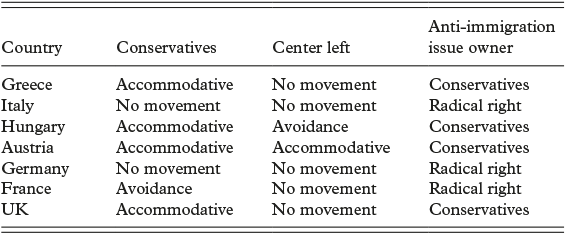
Electoral Outcomes and Party Dynamics
Table 14.2 summarizes the electoral fortunes of each party family in the election immediately after the refugee crisis. While we cannot draw any rigorous conclusions from the association between the electoral trends and the patterns we noted above, it is worth commenting on the possible links between those strategies and the electoral fortunes of parties.
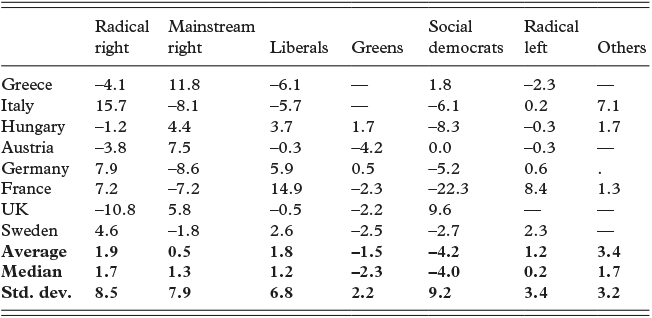
Who are the winners and losers of the elections after the refugee crisis? We see that this depends heavily on the context: In Italy, Germany, France, and Sweden, the radical right made noticeable electoral inroads, whereas the conservatives suffered. By contrast, in Greece, Hungary, Austria, and the UK, the conservatives increased their vote share, whereas the radical right performed poorly. What is common in all the countries, apart from the UK, is that the mainstream left-wing party, no matter its strategy, fared poorly compared to the previous election.Footnote 6 Only the radicalized Labour party under Corbyn improved its electoral performance, albeit not by a wide enough margin to allow it to win first place and form a government.
In general, the mainstream left and the greens to a lesser extent were the consistent electoral losers during the refugee crisis, almost irrespective of the stance they held. Their losses ranged from 2 to 22 percent. While it is evidently simplistic to attribute those losses to their stance on the immigration position, given the long-term trend of the center left’s decline and the internal turmoil in the extreme case of France, it is clear that the refugee crisis at least did not help them at all with improving their electoral performance.
For the right block, we can see that a zero-sum gain game occurred: Wherever the conservatives were reinforced, the radical right lost and vice versa. We can speculate that there is a tighter association between positioning and ownership of the issue and their electoral performance for this political block. In all four cases where the conservatives emphasized the issue and adopted an accommodative strategy toward the radical right, they were rewarded. A consistent winning strategy of the conservatives emerges particularly from AustriaFootnote 7 and Hungary, where the respective parties chose to compete and engage with the issue (Figure 14.3), render it salient and make it an identifying feature of their campaign (Figure 14.4), and assume a distinct and clear position (Figure 14.5) that ended with a clear electoral victory. This is in contrast to the recent work or Abou-Chadi et al. (Reference Abou-Chadi2022), which posits that a rise in the salience of immigration, even when accompanied by accommodative tactics by conservative parties, could not be expected to lead to improved electoral performances for the radical right. This does not seem to be the case when we look at the aggregate fortunes of parties in our sample. More in line with Bíró-Nagy (Reference Bíró-Nagy2022), we find that conservative parties that emphasized immigration did well, even if several confounding factors – such as press boycotts in Greece, suppressed press freedom in Hungary, and radical right scandals in Austria – might have also contributed to this outcome.
There are two more cases in which the conservatives improved their electoral performance: Greece in 2019 and the UK in 2017, where both parties adopted part of their peers’ strategy in Austria and Hungary. As is evident in Figures 14.3 and 14.5, while the UK and Greek conservative parties held a distinct position and increased their relative share in the immigration discourse, neither of them raised the issue to their main preoccupation, but in fact stressed it very little compared to other issues, as shown in Figure 14.4. Additionally, both parties did not really pursue an accommodative strategy, as they already held a fairly extreme position in past elections. However, in both countries, there are mitigating circumstances, as the specificities of the arrest and trial of Golden Dawn in Greece and the Brexit debate in the UK led to a particularistic political competition in which the radical right was absent in the former and superseded in the latter.
Therefore, those conservative parties that had the most consistent anti-immigration profile, prioritized the issue, and did not waver on their position gained the most, while mainstream parties of the right that followed an adversarial, avoidance, or no-movement strategy did not fare equally well, with France and Italy being the most catastrophic examples for the conservatives.
The Italian case is a paradigmatic one in which the electoral result did not bode well for the conservatives, as they saw their vote percentages plummet and those of the radical right increase. In both France and Italy, the radical right parties essentially supplanted their mainstream counterparts as the main right-wing parties. Again, though, these are only loose associations, given that there are many more factors at work, such as the internal issues among the Italian conservatives and their unique quality of being tied up so closely with the personality of Berlusconi and their decline in association with the evolution of Berlusconi’s judicial and other problems.
Still, the Italian case remains instructive, as perhaps the most straightforward one: Immigration was an issue that rose in importance consistently in recent years, both on the demand side (Figure 4.5) and the supply side (Figure 14.1), and after the refugee crisis, an anti-immigration consensus emerged (Figure 14.2). The radical right became the party family that acquired the lion’s share of attention on the issue (Figure 14.3), dedicated more time to this issue than any other party family (Figure 14.4) and expressed the most distinct anti-immigration position, even if still close to the centre of the Italian party-system on the issue (Figure 14.5). Its electoral rise (Table 14.2), and especially its continuing ascent in the polls, after the elections of 2018 can be construed as being associated with all these trends, given the evidence provided here about its stance regarding immigration. In essence, the Lega and FdI followed a strategy similar to their “mainstream” right-wing peers in Hungary and Austria and reaped the benefits accordingly.
France almost resembled this case, but it lacked the critical element of the FN becoming identified more closely with the migration issue. Unlike the conservatives in Hungary and Austria and the Italian Lega, the FN, either by choice or because it was forced to follow the other parties’ agenda, spent much more of its time with questions on the economy and Europe, which proved to be a less advantageous issue domain for the party than immigration. As can be seen in Figures 14.1, France was the only country where the issue of immigration declined in significance after the refugee crisis. This was because the mainstream and centrist parties did not refer to itFootnote 8 but also because the FN did not do so either (Figure 14.3). Instead, it waged a rear-guard war on the merits of the Euro currency, which pitted it against its main competitor, Emmanuel Macron. Perhaps this was a deliberate choice because the party felt that immigration was not gaining as much traction with the French public (Figure 4.5), but it was nevertheless a unique choice when compared to most of its peers elsewhere in Europe.
Finally, the German case also shows the perils of the rising salience of immigration for ambivalent center right parties. While the German CDU did make an effort to speak more about migration (Figure 14.3), it did so while being much more on the defensive about it compared to its Austrian peers, for example. Whereas Kurz had provided his credentials to the Austrian audience, initiating continuous efforts to shut down immigration routes and talking incessantly about the issue, the German CDU, under Merkel, had to bear with the legacy of “we can do it,” as well as a much more permissive immigration policy than part of its electorate was apparently willing to put up with. As shown in Figures 14.4 and 14.5, the German CDU was not only much closer to centrist/leftist parties on immigration than the AfD, but, unlike its Austrian peers, it also failed or simply could not credibly make this its flagship issue. Moreover, the AfD essentially became identified as the immigration party, despite its low relative salience on the issue, as more than 60 percent of its total discourse concerned immigration. While its presence in the media was not extensive, whoever detected the party’s presence anywhere probably saw it in association with immigration. As with the other parties that succeeded on this issue, the three crucial factors of adopting a distinct position, remaining on message, and stressing it as much as possible were present and accomplished.
The Legacy of the Refugee Crisis
As the refugee crisis fades from memory, it has left some important and lasting marks on the European political landscape. The impact of this crisis was not a wholesale transformation of party-systems in some countries, as happened during the Eurozone crisis (Kriesi and Hutter Reference Kriesi, Hutter and Bojar2019), but it is in line with our characterization of this crisis as one that was cumulative and expected, much like an avalanche: Unlike the Eurozone crisis, which caught several actors by surprise or forced them to adopt untenable and unpopular positions, the refugee crisis allowed much more room for strategic choices by parties, who could see the potential political impact of the issue and either shield against it or try to exploit it, more or less successfully, depending on the case.
The refugee crisis, especially compared to the Eurozone crisis, had different effects. Mainstream actors in most countries could not only weather the storm but also profit from it. Unlike the Eurozone crisis, which essentially doomed the mainstream parties of the afflicted countries, the refugee crisis had an effect that varied according to the electoral and political strategies each party adopted. It is also noteworthy that the political developments in each country were obviously affected by the respective policies (e.g., the “we can do it” policy or the hardliner stance of Orbán), but overall, they do not present any pattern regarding the type of countries we have identified so far in terms of destination, frontline, and so on. Nor do they correlate too closely with problem pressure or temporal proximity of the elections to the crisis. Whereas in the Eurozone crisis the degree of party-system transformation tended to follow the economic impact of the situation, in this case, the relationship between outcomes and causes was much looser. As we saw, party-systems followed completely different patterns of politicization of the refugee crisis, with some going through a homogeneous drift of positions, while others witnessed convergence or divergence of positions. What this renders salient is the strategic element of the refugee crisis, as party leadership during the time of the crisis and existing party-system conflict constellations and paths were much more crucial for the eventual outcomes.
As such, it was not necessarily a crisis of profound transformation, but a crisis of opportunity, as various actors mobilized to profit from the increased salience attributed to the immigration issue by the mainstream media and European electorates. The most salient pattern is one of drift: first, a drift of the attention paid to immigration, as more parties, particularly on the right-wing part of the political spectrum, rushed to capitalize on the issue and prioritized it in their campaign discourse and second, a drift toward the right, as shown in Table 14.2. Unmistakeably, after the refugee crisis in all of the seven countries examined here but one (the UK), the first election after the refugee crisis was accompanied by a noticeable increase in the combined percentages of conservative and radical right parties, as well as a simultaneous drop in the combined left and liberal/centrist vote.Footnote 9
As we saw, however, the drivers of the politicization and those who reaped benefits from this drift were not necessarily the same in every country but were instead the parties that were ready and able to seize the opportunity. Table 14.2 almost presents a picture of stability, notwithstanding the continuing decline of the social democratic parties, but this conceals differing patterns depending on the set of countries. More specifically, we identified a group of countries, particularly Hungary and Austria, but also Greece and the UK, where the conservative parties displaced the radical right, both in terms of politicizing the issue, in the sense of rendering it salient and assuming a distinct position and in the first two cases, in terms both of identifying with it and of electoral gains.
On the other hand, there were other countries, like Italy and Germany (and, we might add, Sweden), where the radical right made advances at the expense of the conservatives, capitalizing on the latter’s diluted position and record on immigration and, especially in the cases of Italy and France, also on the overall decline and turmoil in the ranks of the conservative parties. Overall, the discourse shifted toward the right as, where they were successful, mainstream parties adopted positions toward the extreme end of the anti-immigration spectrum, and in cases in which they were not successful, they were hit hard by the radical right’s advances. However, in the end, notwithstanding the family that they belonged to, there was a commonality among all countries: Right-wing actors that were persistent on their anti-immigration message and “owned” the issue enjoyed electoral gains at the expense of their proximate party families and the left.
This volume set out to study the policymaking and politics in the EU multilevel polity during the 2015–16 refugee crisis. We asked how policymakers in the EU and its member states tried to come to terms with the crisis situation they faced in 2015–16 and how they dealt with the fall-out of the crisis in its aftermath. The refugee crisis of 2015–16 was not the first crisis of its kind, but it still hit the EU and its member states unprepared and led to internal strife and an incoherent and eventually unsustainable policy response. The puzzle we are trying to elucidate in our study of the refugee crisis is why key decision-makers like the German chancellor came to be trapped in a desperate situation at the peak of the crisis, and why she and her fellow heads of government, together with the EU authorities proved to be unable to come to reform the Common European Asylum System (CEAS). The answer to this puzzle is important because the EU’s resilience, or at least the resilience of one of its main pillars, the commitment to free movement, was put to a heavy test by the refugee crisis and, retrospectively (in summer 2021), this crisis was considered to have been the “most serious threat to the survival of the European Union” in the decade before the arrival of the Covid-19 pandemic by the European public overall and by the public in the destination states of northwestern Europe in particular.
For answering our key puzzle, we embedded the policymaking in the refugee crisis in a broader theoretical framework, the “polity approach” to European integration (Ferrera et al. Reference Ferrera, Kriesi and Schelkle2022), which treats the EU as a compound polity composed of nation-states. As we set out in the introduction, this approach distinguishes three key long-term macro-processes – the three B’s of polity formation: boundary building (bounding), center formation (binding), and system maintenance (bonding). Over the period of centuries, the combination of these three processes led to the consolidation of the European nation-states, each of which is the idiosyncratic product of the varying conditions of state formation across the continent. The process of European integration has shifted the three types of processes to the supranational level, adding an additional layer of polity formation to the level of the nation-states. The addition of the supranational layer to the system of European nation-states constitutes a unique form of polity formation with highly uncertain outcomes.
At the core of the emerging compound polity lies a fundamental tension between the integration process, which is predicated upon the removal of boundaries among the preexisting system of states, and the national, democratic, and welfare features of the states, which are predicated upon their continued control over redistributive capacities, cultural symbols, and political authority (Bartolini Reference Bartolini2005: 368, 375). In the refugee crisis, the tension between the integration process and the destructuring of the national polities became particularly critical, given that it put into question the internal and external boundaries of the compound polity. The combination of the lack of a joint policy on border control, outdated asylum policies, the adoption of unilateral national policies to deal with the crisis, and the member states’ resistance to share the common burden meant that what should have been a routine policy problem challenged the bounding, the binding, and ultimately the bonding of the EU member states, putting into evidence the fundamental tensions in the EU’s architecture.
The challenge of the refugee crisis focused on bounding, but it had important implications for binding and bonding, for which bounding is a precondition. The outcome of the crisis was, in Schimmelfennig’s (Reference Schulte-Cloos2021) terms, a form of “defensive integration,” that is, a combination of measures of mainly internal rebordering (the resurrection of barriers between member states or their exit from common policies or the EU altogether) with external rebordering (the creation and guarding of “joint” external EU borders). “Defensive integration” can be characterized as a limited, minimum common denominator solution to the refugee crisis (see Jones, Daniel Kelemen, and Meunier Reference Jones, Kelemen and Meunier2021; Lavenex Reference Lavenex2018; Biermann et al. Reference Biermann, Guérin, Jagdhuber, Rittberger and Weiss2017). The goal of our study was to trace the policymaking processes that account for this outcome. In our view, the basic tension at the core of the EU polity shaped the policymaking at both levels of the compound polity and limited its capacity to take far-reaching decisions. As we have argued, this tension was exacerbated in the asylum policy domain, since it rendered issues concerning national sovereignty highly salient and mobilized political forces defending the national sovereignty of the member states, in line with the postfunctionalist notion of “constraining dissensus” (Hooghe and Marks Reference Hooghe, Marks, Jones, Menon and Weatherill2009). Based on our analysis of the refugee crisis and contrary to some received wisdom, we do not see any contradiction between the failing-forward approach and the postfunctionalist approach. Rather, we see them as complementary and contributing to the understanding of the outcome of this particular crisis (see Ferrara and Kriesi Reference Ferrara and Kriesi2021).
For the analysis of how policymakers reacted to the challenge of the refugee crisis domestically and internationally, we took as our starting point two sets of factors – the policy-specific institutional context, that is, the policy heritage and the institutionalized decision mode, and the crisis situation defined in terms of problem pressure and political pressure. Our results show that policymaking in the crisis was to a large extent, although by no means exclusively, a response to the specific situation the member states and the EU faced in late summer 2015 – a situation characterized by a combination of limited EU policy-specific competences and an asymmetrical distribution of crisis pressures. The low capacity and lack of policy resources of EU institutions in asylum policy made crisis resolution highly dependent on decision-making in intergovernmental fora. At the same time, the uneven distribution of policy capacities and crisis pressures among the EU member states resulted in a highly politicized mixture of conflicts both at the transnational and the national level, which constrained the potential for intergovernmental agreement, coordination, and joint action and resulted in minimum common denominator solutions. We contend that in a different crisis situation, policymaking would have taken a different course, the policy outcome would have been less constrained, and supranational institutions would have been likely to have played a more important role – in line with more neofunctionalist or federalist accounts (see Ferrara and Kriesi Reference Ferrara and Kriesi2021).
By applying a combination of tools from comparative politics and policy analysis to the study of policymaking in the EU polity, we showed how, in the absence of generally accepted rules, EU policymaking in the refugee crisis developed in an uncoordinated, ad hoc way that served to poison transnational relationships among member states beyond the narrow confines of asylum policy and led to the formation of transnational coalitions, which are likely to haunt EU policymaking far beyond the refugee crisis. By distinguishing between five types of member states, based on the way they were affected by the crisis, and by systematically analyzing the domestic and international (trans- and supranational) conflicts triggered by the resulting configuration of member states, our approach provides a comprehensive account of the crisis. In particular, we analyzed the reciprocal relationship between domestic and international conflicts in the two-level game of EU policymaking: On the one hand, we documented the multiple ways in which international conflicts spilled over into domestic policymaking, where they exacerbated partisan conflicts articulating the transnational cleavage. On the other hand, we showed how domestic partisan conflicts and unilateral national reactions to the crisis spilled over into the intergovernmental and supranational arena, where they exacerbated transnational and vertical conflicts between member states and the EU.
With regard to crisis outcomes, our results underscore continuity. In spite of the pressure exerted by the crisis, the EU and its member states proved unable to reform the defective asylum policy. Instead, they reinforced the external borders and externalized the problem solution to third countries, which provided some respite. By relying on “defensive integration,” they have been buying time. The dysfunctional common asylum system has been left untouched. Continuity also prevails with regard to the conflict potentials of migration and asylum policies, which continue to be large and have even markedly increased during the crisis. The incapacity to reform the common asylum policy risks the reactivation of these potentials at any moment in time. Importantly, the political parties on the right that are ready to mobilize these potentials have been reinforced by the general drift toward the right resulting from the refugee crisis.
Compared to previous accounts, our approach has the advantage of tying the individual pieces together within one and the same theoretical and empirical framework by systematically linking policymaking at the two levels of the EU polity and by consistently focusing on the prevailing conflict configurations at each level individually and at both levels jointly. In this concluding chapter, we summarize our theoretical and methodological contribution and provide some further detail on our main findings. We conclude with an afterthought regarding the new refugee crisis that hit the EU as a result of the war in Ukraine.
Our Approach to Studying the Refugee Crisis
Our theoretical approach to studying the refugee crisis is based on the perspective of the EU as a compound polity of nation-states involving interdependent vertical relations between member states and the EU authorities, as well as transnational relations between the member states themselves. The two-level structure invites political structuring at both the supranational level of the EU and the national level of the member states and produces two lines of international conflicts. The vertical conflict line opposes the polity’s center – the EU – to the member states, whereas the horizontal conflict revolves around the specific interests of the member states and involves conflicts between and within member states. These conflicts do not occur in a vacuum. Thus, the fundamental tension between the integration process and the destructuring of the national polities becomes particularly critical in crisis situations. We highlighted two sets of factors for the explanation of the policy outcome – the policy-specific institutional context within the compound polity (the policy domain–specific competence distribution and the institutionalized decision-making procedures governing the crisis interventions) and the characteristics of the crisis situation (the crisis-specific distribution of problem and political pressures). Our core argument is that the asymmetric distribution of crisis pressures across member states combined with the limited competence of the EU agencies in the asylum policy domain and the demanding consensus requirements goes a long way toward explaining the outcome of crisis policymaking in this case. The main focus of our volume lies in the investigation of the kind of conflicts that were triggered by this particular combination of factors, the way these conflicts were politicized, and how they influenced the policy output and political outcomes of the crisis.
To analyze the conflicts within the refugee crisis, we relied on three key concepts: political structuring, politicization, and conflict intensity. Political structuring refers to the structural preconditions that allow the expression of voice, which include both the nature of the EU polity and the specifics of the crisis situation. Politicization corresponds to the expansion of the scope of conflict in terms of issue salience and the polarization of the actors’ issue-specific positions within these structural preconditions, and conflict intensity bears on the specific types of actions undertaken by the actors to defend their positions in the policymaking process during the crisis.
In operational terms, to measure these concepts and explore the relation between them, we employed an ambitious empirical approach. The central tool of analysis upon which our study is based uses policy process analysis (PPA), a method that builds on political claims analysis (PCA) (Koopmans and Statham Reference Koopmans and Statham1999) and that we developed further for the purposes of this study. This method relies on the systematic coding of media data for capturing the policymaking and politics surrounding policy debates. We applied this method to individual policy episodes within selected countries and the EU. For each episode, PPA captures indicators related to the actors involved in the policy debate, the forms of action they engage in, the arena where the actions take place, the issues addressed, and the frames used to address them. PPA allows for the measurement of our key concepts of politicization and conflict intensity both statically and over time. At the same time, PPA supplies detailed qualitative data, which allowed us to illustrate the systematic quantitative results with narrative accounts of our episodes.
In democracies, policymaking is not only playing out in the public, it is also constrained by public opinion and the public debate. In the EU, public opinion is still a mainly national opinion, and the public debate is still a mainly national debate. To the extent that they focus on the same policy episodes at the EU level, the national debates are Europeanized, but the debate about a EU-level episode may also be domesticated as a result of the specific incidence of the episode on a given member state (see Chapter 12). The domesticated debate on European episodes and the domestic debate on national episodes, in turn, may be consequential for EU policymaking. Whatever the status of the public constraint – nationally specific or Europeanized – the exclusive focus on the supply side of policymaking of PPA neglects features related more specifically to the demand side of public opinion and vote intentions. Therefore, we complemented our PPA dataset with a variety of original datasets involving different methods of data collection depending on the elements of the crisis on which we zoom in. At various points across our study, we employed core-sentence analysis (CSA) for studying political competition dynamics in election campaigns, survey data for capturing public opinion on migration, and speech analysis for studying rhetorical devices employed by key center right and far right actors during the crisis.
The Crisis Context and the Unfolding of Policy Episodes
Our first set of insights relates to the characteristics of the policy-specific institutional context and its impact on the subsequent unfolding of the policy episodes. In the first place, policymaking is embedded in the domain-specific policy legacies: As argued by historical institutionalism, past policies create a situation of path dependence that limits the available choices for policymakers in the crisis situation. From this point of view, it is important that the refugee crisis of 2015–16 was not the first refugee crisis in Europe. Other such crises have preceded this one and have shaped the policy heritage at both the EU and the national level, which in turn was what the decision-makers relied upon when the problem pressure and the political pressure kept mounting during the summer and early fall of 2015. As Geddes (Reference Geddes2021) argues, policymakers’ past experiences with crises in the migration domain generally shape their representations of what is normal about migration. Perceptions of normality, in turn, define what they know how to do and what they think they are expected to do next.
Crucially, in the asylum policy domain, responsibility is shared between the EU and the member states. In asylum policy, the mixture of interdependence and independence of the member states imposes reciprocal constraints on the decision-makers at each level of the EU polity. The limited competence of the EU in this domain posed a great challenge for policymaking in the crisis, a challenge that was enhanced by the diversity of the domain-specific policy legacies in the member states. As a result of the lack of harmonization of minimum standards between member states and of the deficient capacity of some national asylum systems, the entire CEAS rested on what has been called an organized hypocrisy (Krasner Reference Krasner1999; Lavenex Reference Lavenex2018; van Middelaar Reference van Middelaar2019: 103ff).
Second, the characteristics of the crisis situation proved to be decisive for the policymaking in the various episodes. Thus, the problem structure of this crisis implied a high degree of urgency but only a limited degree of uncertainty. The refugee movements were predictable, but little was done to prevent escalation. The core of the CEAS, the Dublin and Schengen regulations, proved unsuited to channel the inflows. The EU Commission was, indeed, preparing for the advent of the crisis, but when it arrived in full force in September 2015, it still hit the member states unprepared and required responses under conditions of high urgency. It was the external shock of mass displacements that created the urgency for the decision-makers at the national and EU levels. This shock came to a head in the summer and fall of 2015. Crucially as well, the shock was asymmetrical: While some member states hardly experienced any problem pressure at all during the crisis, it was the least prepared among them (such as Greece and Hungary) that were hit particularly hard. The asymmetrical distribution of problem-solving capacity and problem pressure across member states, combined with the independence that member states have retained in asylum policymaking, made joint responses particularly difficult.
The variation of the policy heritage combined with the variable problem and political pressure exerted by the crisis created a complex configuration of transnational interests, aligning EU countries into four types: frontline states (Greece and Italy), transit states (Austria and Hungary), open destination states (Germany and Sweden), and closed destination states (France and the UK), as well as a residual category of bystander states that have hardly been affected by the crisis at all (Chapter 4). This typology guided our analysis, although we are conscious of the fact that even within the same type, the crisis experience varied to a considerable extent. Thus, among the frontline states, Greece experienced a sudden and explosive shock of inflow, while Italy faced small but reoccurring shocks, which had already started before the refugee crisis of 2015–16 and continued during 2017 and 2018. In spite of such variations, the interests of the states of a given type more or less aligned during the crisis. However, interests also converged across some types. Thus, the most important adversarial coalition that was forged in the crisis, the Visegrad 4 coalition, was composed of a transit state (Hungary) and three bystander states (Poland, the Czech Republic, and Slovakia), which shared a common opposition to relocation schemes.
Political pressure added to the predicament of a number of key member states. This type of pressure is indicated by the salience of the migration issue in public opinion and by the presence of a radical right challenger party. In terms of the salience of the issue in public opinion, political pressure was added to the problem pressure in precisely those member states where the latter was greatest. In addition, in the two transit states (Austria and Hungary), the government came under pressure from the radical right, which had already been strong before the crisis, whereas in the two open destination states (Germany and Sweden), the originally weak radical right achieved an electoral breakthrough at the time the crisis hit. Under the cumulation of problem and political pressure, open destination and transit states became major protagonists in the management of the crisis. The combined pressure became particularly important in the case of Germany – because of its size and influence, which enabled it to take the lead in common initiatives. Confirming the public goods literature (Thielemann Reference Thies2018: 69), Germany came to shoulder a disproportionate part of the common burden, since it had potentially more to lose (in absolute terms) from the nonprovision of the public good in terms of stability and security, and since it was also able to unilaterally make a significant contribution to the provision of the good.
Biermann et al. (Reference Biermann, Guérin, Jagdhuber, Rittberger and Weiss2017) acknowledge the asymmetrical nature of this crisis, but they distinguish between only two types of member states – those affected by the crisis and those unaffected by it. This simple dichotomy does not do justice to the complexity of the interest configuration among the member states during the crisis. In the short run, the transit and open destination states shared a common interest in stopping the inflow at the external borders, which aligned them with the frontline states but placed them in opposition to the restrictive destination and the bystander states, which were not directly affected by the inflow. However, with regard to the accommodation of asylum seekers, the position of the transit states was more ambiguous, since they clearly benefited from the secondary movements of the refugees within the EU. Moreover, the interests of the frontline and destination states were not fully aligned with each other either: If they shared a common interest in the short run, they were on opposing ends with regard to the reform of the CEAS. Together with the other member states, open destination states were in favor of restoring the Dublin regulation, which attributes responsibility for accommodating incoming refugees to the frontline states. By contrast, the priority of the frontline states was to reform the CEAS such that they would no longer have to assume the entire responsibility for accommodating the inflow of new arrivals. Table 15.1 summarizes the crisis situation in the eight member states of our study and also provides some information about conflict structures and politicization – to which we now turn.
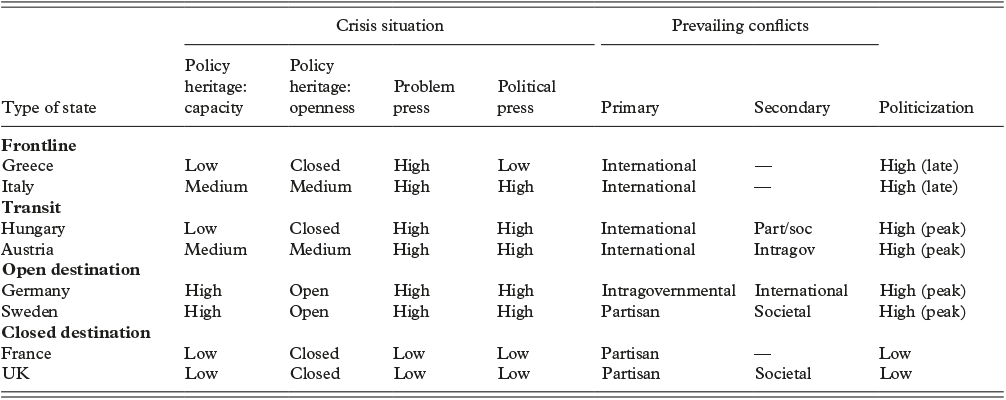
Actors and Their Conflict Structures
Given the crisis situation, we identified the configurations of actors who attempted to deal with the crisis and the conflict structures between them at both levels of the EU polity. Member state governments proved to be the pivotal actors in the two-level game of policymaking at both levels of this polity. In line with expectations, it is executive decision-making led by representatives of member state governments that prevailed in the policymaking episodes during the refugee crisis. At the EU level, international conflicts involving members states and their key executives (with a dominant role played by Germany and its chancellor) predominated (Chapter 7), while at the domestic level, governments faced essentially four types of conflicts: international, partisan, societal (represented above all by NGOs defending humanitarian rights), and intragovernmental conflicts – with the first two being more common than the latter two (Chapter 6).
In line with our theoretical framework, international conflicts include both vertical oppositions between member states and the EU (supranational conflicts) and horizontal ones between various groups of member states (transnational conflicts) or between member states and third countries (externalization conflicts). As the crisis progressed at the EU level, these conflicts coalesced into two camps that express the emerging integration–demarcation cleavage – the EU core coalition (including destination and frontline states in addition to EU actors in their quest for burden sharing) and the sovereignty coalition (including transit and bystander states preventing any form of burden sharing or policy reform). The reduction of the complex interest structure among member states to such a simple, binary configuration is a result of the onslaught of the sovereignty coalition, which succeeded in sidelining all other conflicts between member states. In addition to this major dimension of conflict, a secondary dimension also contributes to the structuration of conflict at the EU level – a humanitarian–realist dimension opposing a coalition of civil society actors, international organizations (UNHCR), and domestic opposition parties (demanding a more humanitarian policy approach) to the executive-dominated realism of the member states and the EU authorities.
At the domestic level, the parallel presence of the four types of conflict lines constitutes perhaps the most important feature of the refugee crisis. In contrast to the EU-level conflicts that largely unfolded between member states and EU institutions, the domestic debates revealed a much more complex reality with a diverse set of actors involved. Throughout the refugee crisis, governments were trapped in a two-level game, with their bargaining power in the European arena conditioned by the type and the intensity of conflict they faced from domestic stakeholders. However, the prevalence of the four conflict types varied according to the type of member state. International conflicts prevailed in frontline states, which were mainly concerned with border controls during the crisis. International conflicts about border control were also characteristic for transit states in the first two periods of the crisis but lost importance in these states during the third period, when the governments of the transit states turned to primarily domestic issues: Hungary’s government started to exploit the refugee issue for its own political purposes, which gave rise to partisan and societal conflicts, and the Austrian government turned to retrenchment of asylum rules, which involved intragovernmental conflicts. In both types of destination states, international conflicts were of lesser importance. Even if, in these states, too, the most decisive measures concerned border controls – keeping the borders open (in Germany) or closing them down (in the other three), the episodes were mostly dealing with the retrenchment of asylum rules. Accordingly, intragovernmental conflicts prevailed in Germany, partisan conflicts in France, and partisan conflicts in combination with societal conflicts in Sweden and the UK.
At the domestic level, international conflicts result from the interdependence of the member states and their embedding into the framework of the common EU asylum policy. They arose in border controls episodes in which national governments opposed EU actors, the governments of other member states and of third countries, and/or other supranational institutions such as the UN over what were usually unilaterally rebordering measures. Such conflicts stand out from the rest, with more than double the level of politicization and support behind governments. Thus, the involvement of international actors seems to simultaneously lead to higher levels of politicization and to higher levels of government support as it draws in a broader group of participants but at the same time tends to mute criticism from domestic opponents.
Among the domestic opponents, mainstream opposition parties emerged as the most important adversaries of national governments, although on occasion they were joined by challenger parties from the radical left and especially from the radical right. Surprisingly, during the refugee crisis, the radical right has not played a unique role in articulating the integration–demarcation cleavage at the domestic level. When further zooming in on partisan conflicts between the national governments and the opposition, but also within the government itself (Chapter 8), we focused on two critical aspects of government composition – fragmentation and ideology. Unsurprisingly, as governments in the member states covered by our study range from monolithic single-party governments (the Fidesz government in Hungary and the Mitsotakis government in Greece) to grand coalitions (in Germany and Austria), fragmentation was closely associated with intragovernmental conflicts. Some of these coalitions were further fragmented on ideological grounds, as we have witnessed in the case of the M5S–Lega coalition in Italy. However, overall, the ideological makeup of the government was only weakly related to the intensity of the partisan conflict and did not play a crucial role in determining its substantive content. In substantive terms, it is rather the ideological orientation of the partisan opposition that turned out to be decisive. When the opposition comes from the radical right – and to a lesser extent, from the center right – it tends to be justified with security–sovereignty–identitarian arguments, while opposition from the center left tends to be justified with humanitarian–solidaristic–democratic arguments.
In order to better understand how they justify their opposition to the reception (accommodation) of refugees, we analyzed in more detail the arguments and frames used by right-wing actors during the refugee crisis. As we have pointed out in Chapter 9, the opponents to immigration have to deal with the challenge of humanitarian arguments in favor of the protection of refugees. To come to terms with this challenge, anti-immigration actors, predominantly from the right, are complementing their rhetoric with frames that correspond to Hirschman’s (Reference Hix and Hoyland1991) rhetoric of reaction. They argue that the aid provided to refugees is bringing about perverse outcomes; resulting in more human tragedy than it averts; and that, concurrently, it places our societies in grave jeopardy due to the social changes brought about by the refugee inflow. Analyzing the discourse employed by radical and mainstream right parties, our results underline that, apart from a common focus on security frames (with the exception of the British Conservatives), there is virtually no convergence of their rhetoric in a transnational radical right discourse. However, even if they do not deploy a common rhetorical and framing template, they share a common pool of arguments, from which they liberally borrow a wide array of frames and themes, depending on their country’s context, the political competition, and the issues that were dominant when the crisis was introduced in their respective countries. The result is a sort of kaleidoscope through which different patterns and permutations of arguments and frames present themselves as each party sees fit, depending on its strategic calculus and the country’s status quo.
Dynamics of Policymaking across Polity Levels
Regarding the general unfolding of the policy episodes (Chapter 5), it proved to be useful to distinguish between three periods – the precrisis period, which started in early 2013 with the initiation of the first episode in our set and lasted until August 2015, when the crisis situation became acute; the peak period, lasting from September 2015 until the adoption of the EU–Turkey agreement in March 2016; and the postpeak period, which extended over several years from April 2016 up to the spring of 2020. The politicization of the crisis reached its apex during the peak period, at both levels. For the EU, politicization is single peaked at the time of the EU–Turkey agreement; for the member states, there are two peaks, one at the moment the crisis exploded in September 2015 and another at the time of the adoption of the EU–Turkey agreement. More limited peaks follow in the third phase at the level of the member states.
The overall level of politicization is a direct response to problem and political pressures in the crisis situation. However, if we go to the level of the individual member states, the association between pressure and politicization at the peak of the crisis turns out to be close only in the two open destination states and in one of the transit states (Austria), and only for two of the three indicators for pressure. The reason is that policy episodes were politicized not only by pressure in the crisis situation but also by factors endogenous to politics, which became increasingly important as the crisis progressed. Among these factors we noted the anticipating reactions of policymakers, the strategies of political entrepreneurs (especially important in Germany, Italy, and Hungary) designed to create a crisis situation where there was none (anymore) for political purposes, key triggering events such as terrorist attacks (important in both Germany and France), the legislative cycle (as in the strategies of the new ministers of the interior, Salvini and Seehofer, and in one of the three late episodes in Greece), and in general the endogenous dynamics of policy reactions to the crisis once they have been set in motion. In the special case of Hungary, three of the five episodes occurred after the crisis peaked and problem pressure ceased to exist. These episodes all refer to measures that the Fidesz government under Viktor Orbán introduced in its attempt to outbid its radical right competitor as a defender of the national cause.
Our detailed analysis of support for government policies by elite actors, broadly understood (including governments, opposition parties, civil society organizations, and international actors), shows variation over the course of the episodes. The results indicate that far from the elite closing ranks behind government proposals as the “rally-around-the-flag” perspective would lead us to expect, elite groups appear to have distanced themselves from the government initiatives in response to mounting problem pressure (Chapter 10). Depending on the context, elite groups used the strategic opportunity offered by mounting problem pressure to signal opposition to the governments’ proposals and, in response to the pressure exerted by the growing strength of the radical right, to step up dissent. The elite response proved to be particularly critical during the first two phases of the crisis, in destination states, and in episodes related to asylum policies (rather than border controls). In terms of endogenous effects, the analysis of elite support confirms that elite groups engaged in strategic behavior in reaction to other parts of the elite. While dissenters within governments were responsive only to partisan opposition actors, the behavioral calculus among opposition, civil society, and international actors was more complex. In one way or another and to different degrees, the governments’ opponents systematically responded to each other’s expressed level of support for the government’s initiatives, albeit sometimes with substantial lags. Though the government, by virtue of its central role in the policy process, was, indeed, the main originator or target of conflict, other actors hardly acted in isolation and followed in each other’s footsteps when attacking the government’s policies.
We analyzed in detail the dynamics of cross-level episodes (around half of all the episodes), which are characterized by the expansion of conflict beyond the national political space, that is, by a particularly high intensity of politicization, and which demonstrate the interdependence of the two levels of policymaking in the EU polity (Chapter 11). Border closures and the relocation issue gave rise to a large number of such episodes, which all result from the spillover effects created by unilateral actions on the part of some member state or by inaction on the part of the EU within the EU policy framework. Such episodes refer to both top-down and bottom-up cross-level interventions in conflicts originating either at the international or the domestic level. Top-down interventions involve both regulations and capacity building, and they occur in conflicts about the (lack of) implementation of EU policies in individual member states or in conflicts arising from (“deviating”) domestic policies violating EU policy. Bottom-up interventions involve unilateral policy measures on the part of individual member states to substitute for EU policy that has not been forthcoming and subsequent attempts to “upload” this policy to the EU level. In addition, they include unilateral measures designed to signal to the EU and other member states the domestic incapacity to implement EU policy or unilateral appeals for support/mediation in some domestic/bilateral policy conflict.
We have illustrated the great variety of cross-level dynamics with the four member states that played a particularly prominent role during the crisis. Greece served to illustrate both “top down” EU interventions to increase the domestic capacity of a “foot-dragging” frontline state to deal with the crisis (in the Hotspot episode) and “bottom-up” demands of a frontline state for support by the EU (in the border conflict with Turkey). The case of Italy, our second frontline state, focused on “bottom-up” (“self-help”) efforts to substitute unilaterally for EU policy (Mare Nostrum and the EU–Libya agreement) and subsequent attempts to upload the unilateral measures to the EU, but it also featured episodes of top-down interventions by the EU to come to terms with externalities created by Italian policy for its neighbors (in the border conflicts with France and Austria and the conflicts created by the Port Closures). In contrast to the Greek case, the Italian examples show how factors endogenous to domestic policymaking are creating international conflicts and cross-level interactions. The Hungarian case served to illustrate unilateral “self-help” actions (the Fence Building and the Legal Border Barrier Amendment) substituting for EU policies, as well as conflicts endogenously created in domestic politics, which led to top-down interventions attempting to punish “deviating” policies (the Civil Law and the “Stop Soros” legislation) and to bottom-up “signaling” of the incapacity (“our hands are tied”) to implement EU policy (the quota referendum). The German episode (the CDU-CSU Conflict), finally, illustrated the appeal of a member state to the EU for help in resolving a domestic conflict and showed how domestic policymaking can trigger symbolic gestures of EU policymaking in support of a member state government.
Among the great variety of cross-levels episodes, the most important for our study is the EU–Turkey Deal due to its intense salience, centrality, and consequences (Chapter 12). In order to show how an EU policymaking episode is domesticated in national policymaking, we coded this episode at both the EU level based on international sources and in four of our eight member states – Germany, Greece, Hungary, and the UK – based on the national press. Our results indicate that the very same agreement had very different implications in terms of conflict and domestic policymaking in different countries. At the EU level, the dominant conflict line in the EU–Turkey episode opposed the EU/its member states and Turkey. While the episode was hardly noticed in the UK at all, this conflict structure also emerges from the German and the Hungarian debates. In Germany, the agreement allowed Chancellor Merkel to escape from the trap of her open-doors policy. In Greece, by contrast, this conflict appeared much weaker, despite the episode’s great salience in this frontline state. The Greek debate was far less conflictive and polarized than the debates in the other countries. While the Greeks covered this episode a lot, they did so in overwhelmingly positive or neutral terms. Moreover, as the agreement faded from the attention of the German public once it had been concluded, in Greece, it had an ambivalent and lingering character: It successfully stopped the inflow of refugees, but it left many refugees stranded within Greek borders, whom Greece could only provide for with EU support.
The Political Outcomes of the Crisis
We have argued that the characteristics of the crisis situation in combination with the policy-specific institutional context generate distinct patterns of policymaking in the EU. This implies that we cannot easily generalize from one crisis to another. In the refugee crisis, the low capacity and lack of resources of supranational institutions in the asylum policy domain made crisis resolution highly dependent on intergovernmental decision-making. At the same time, the potential for agreement in intergovernmental negotiations was constrained by the asymmetrical distribution of crisis pressures among member states. The combination of asymmetrical incidence and joint competence between EU and member states proved to be particularly critical for joint solutions. As pointed out by Ferrara and Kriesi (Reference Ferrara and Kriesi2021: 13) and as documented throughout this volume, such a setting renders joint policymaking initiatives and collective action solutions difficult and, instead, leads to unilateral reactions on the part of member states, the spillover effects of which unleash and exacerbate transnational conflicts and give rise to a complex web of cross-level interactions to come to terms with these conflicts. As a result of these difficulties, the EU has found only stop-gap solutions to the refugee crisis and still tries to reform its dysfunctional common asylum policy.
Hardly any integration steps resulted from the crisis with respect to the reform of the rules for a common asylum policy (Börzel and Risse Reference Börzel and Risse2018). Instead, the crisis led to the extension of essentially intergovernmental protectionist policies limiting access to the CEAS (Lavenex Reference Lavenex2018). Externalization and reinforcement of the external borders temporarily stopped the inflow of refugees. The EU–Turkey agreement was the key measure to bring the flow of refugees into the EU to a temporary stop. As Lavenex (Reference Lavenex2018) has pointed out, however, the externalization of the policy to Turkey and Libya, countries that are not or not fully party to the Geneva Convention, amounted to the circumvention of EU standards. Moreover, the non-legally-binding EU–Turkey “statement” eschews fundamental principles of accountability and of the rule of law. The “statement” was an informal deal concluded by the EU member states in their capacity as independent legal subjects. This has been “failing forward” in the direction of “defensive integration” – a combination of reinforcing external and internal borders.
This policy response did not stray very far from the well-known policy heritage in the asylum policy domain. EU asylum policymaking remained prone to continuity rather than change (Ripoll Servent and Zaun Reference Zincone, Zincone, Penninx and Borkert2020), and the same can be said of national policymaking. Despite crises often acting as “windows of opportunity,” the breakdown of the EU’s asylum system in the 2015–16 crisis triggered the same kind of response as in past crises – namely, a shift of responsibility outward and a reinforcement of external border control at the EU level (Guiraudon Reference Guiraudon2018). At the national level, it led to the reintroduction of border controls at the domestic borders and to the further retrenchment of asylum policy across the member states. In general, the measures introduced during the crisis were consistent with an approach at the national and EU levels that can be traced back for more than two decades (Geddes, Hadj Abdou, and Brumat Reference Genschel and Jachtenfuchs2020). In this policy domain, the EU seems to be stuck in a “sub-optimal equilibrium” (see Hix and Hoyland Reference Hobolt and Tilley2022: 363).
In fall 2020, five years after the peak of the refugee crisis, the new Commission under President Ursula von der Leyen presented a New Pact on Migration and Asylum, a comprehensive proposal for the reform of the EU’s migration and asylum policy designed to provide for a long-term solution fully grounded in European values and international law. The proposed pact proved to be deficient, however, and at the time of this writing (September 2022), none of its provisions has been implemented yet. Crucially, the key proposal for a “Regulation of asylum and migration management” left the core principles of Dublin III unchanged. In particular, the responsibility of the country of first entry into the EU still remained in place. Unsurprisingly, the ministers of the interior of the southern European frontline states heavily criticized this unchanged distribution of responsibilities, and critics like ECRE (2021: 6) pointed out that “it is inherently paradoxical to maintain a system which generates unfairness that has to be corrected through solidarity mechanisms.”
In June 2022, twenty-one months after the launching of the new pact and in the midst of a new refugee crisis linked to the war in Ukraine (see below), the European Commission announced that member states had agreed to start implementing a voluntary mechanism offering relocations, financial support, and other measures for member states in need.Footnote 1 The French presidency claimed that this “Solidarity Declaration” was a first step in the gradual implementation of the New Pact on Migration and Asylum. According to the Commission, this declaration was to provide a voluntary, simple, and predictable solidarity mechanism designed to support the member states most affected in the Mediterranean as well as other member states under pressure, including states on the western Atlantic route. This declaration, however, was no more than a declaration of intent, and of very limited scope, indeed: It promised to relocate only 10,000 asylum seekers per year, and only a dozen member states declared their willingness to accommodate them. Hungary, Poland, Austria, and the Baltic states continued to reject any kind of solidarity mechanism.Footnote 2
Meanwhile, the pressure exerted by asylum seekers on the European borders had temporarily decreased because of the Covid pandemic. In 2020, the number of first applications for asylum in Europe was as low as it had not been since 2013. At the same time, the refugee issue largely disappeared from public attention, which was now fully focused on the pandemic and its consequences. But the lull proved to be only temporary. In 2021, the pressure returned once again as the border crossings on the Balkan route increased, as did crossings on the Mediterranean route. Rescue ships like the Geo Barents, the Sea-Watch 3, the Ocean Viking, and the Italian coast guard continued to rescue hundreds of migrants in distress at sea.Footnote 3 The situation continued to be in flux, far from a state of equilibrium.
In addition, a series of incidents revealed Europe’s continued vulnerability to the weaponization of migration flows by third countries. Thus, in May 2021, the Moroccan authorities, in reaction to what they perceived as a lack of Spanish support on the issue of Western Sahara, opened the gates at the border with Spain’s North African enclave Ceuta, letting pass some 8,000 refugees of mostly Moroccan origin. The influx, the biggest in recent Spanish history, created a political crisis in Spain. Even more seriously, in summer 2021, Belorussian dictator Alexander Lukashenko used asylum seekers from Middle Eastern war zones to put pressure on the EU in reaction to the sanctions the EU had imposed on Belarus following his fraudulent 2020 reelection. Lukashenko’s first target was Lithuania, followed by Poland. In this most blatant example of coercive diplomacy, Lukashenko used displaced people as a weapon against the EU in an attempt to exploit its deep transnational divisions and public fears of uncontrolled immigration.Footnote 4 However, he miscalculated: Lithuania and Poland both built fences at their respective borders with Belorussia and manned the borders to defend the fences. Thus, in the thinly populated border area between Poland and Belorussia, 15,000 Polish border guards, police officers, and soldiers ended up facing the thousands of migrants from the Middle East who, instigated by Belorussian officials, tried to break through the fences.Footnote 5 Whereas the EU Commission had once chided its member state governments for building fences at its external borders, it now supported the fence building with enhanced sanctions against Belorussia. The EU’s resolve eventually induced the Belorussian dictator to back down, and many of the Middle Eastern asylum seekers returned to their home countries.
Finally, while the EU expected Turkey to stand by its commitments and to deliver on all elements of the agreement,Footnote 6 the fragility of the agreement was demonstrated by the events in spring 2020, when Turkey unilaterally tried to break it by inciting refugees to cross the Greek border – an episode that we have analyzed in detail in Chapter 11. After the passage of the Covid-19 crisis, in spring 2022, President Erdogan increased the pressure on the Greek border once again, threatening Greece with an invasion of asylum seekers.Footnote 7 In reaction to this increased pressure, the Greek border guards had prevented no fewer than 154,000 people from crossing the river Evros at the Turkish–Greek border during the first eight months of 2022.
In the absence of a sustainable policy to resolve the problem pressure, the refugee crisis did nothing to solve the underlying conflicts between and within member states. The uncoordinated, ad hoc way in which EU policymaking developed during the refugee crisis served to poison transnational relationships among member states beyond the narrow confines of asylum policy and led to the formation of transnational coalitions, which are likely to haunt EU policymaking far beyond the refugee crisis. Thus, the key adversarial coalition that took shape during the refugee crisis – the sovereignty coalition of the Visegrad 4 countries – reappeared and solidified in the subsequent rule-of-law and Covid-19 crises. The seeds for the conflicts in the later crisis were sown in the refugee crisis, and in that sense, the policy failures in the refugee crisis created a latent potential for a polity crisis of the EU. In fact, the transnational conflicts that characterized policymaking during the refugee crisis were exploited by the respective governments in Hungary and Poland to transform their political regimes into illiberal democracies, which created the subsequent rule-of-law crisis (Bohle, Greskovits, and Naczyk Reference Bohle, Greskovits and Naczyk2023).
The refugee crisis also exacerbated the existing conflict lines in public opinion (Chapter 13). As our analysis of public opinion in the aftermath of the crisis showed, the policy-specific conflicts in the public are above all structured by the relocation debate and by the Dublin Reform, while the prevailing policies involving external or internal bordering or externalization are comparatively consensual. At the transnational level, the opposition between the frontline and destination states on the one hand and the V4 countries on the other is mirrored in public opinion. At the domestic level, we find the expected opposition between nationalists and cosmopolitans that is politically articulated by the radical right and some nationalist-conservative parties on the one side and by the left and some parties of the mainstream right on the other side. Comparing the two levels, our results show that conflicts surrounding asylum policy are more intense at the domestic level between supporters and opponents of migration than between various types of countries. Generally, our results suggest that the conflict potentials of immigration policies, rather than being fully mobilized or alleviated, are still large and have markedly increased over the past few years, especially in the destination states of northwestern Europe. The large opposition to immigration in some member states is bound to constrain the options available to policymakers as it is likely to constitute a major obstacle to joint solutions.
The refugee crisis also had electoral repercussions (Chapter 14). While it did not give rise to a wholescale transformation of party-systems in any country, as was the case in the Eurozone crisis, the refugee crisis did make room for various actors that were able to profit from the increased salience of the immigration issue. In contrast to the Eurozone crisis, which caught several actors by surprise or forced them to adopt untenable and unpopular positions, the refugee crisis with its cumulative and expected nature allowed much more room for strategic choices by parties that were able to anticipate the potential political impact of the crisis and react strategically to the country-specific crisis situation. The most salient pattern of transformation our results underline is one of drift toward the right more generally, as more parties on this side of the spectrum rushed to capitalize on the issue and prioritized it in their campaign discourse. Even if this pattern of drift enhances the impression of stability, the transformation of the party system is still apparent in some countries, as right-wing actors who persisted in their anti-immigration message enjoyed electoral gains at the expense of their proximate competitors and of the left. In some countries, such as Hungary, Austria, the UK, and Greece, nationalist conservative parties displaced the radical right, while in others, such as Italy, Germany, France, and Sweden, the radical right increased its vote share at the expense of the mainstream right.
The drift to the nationalist-conservative right as well as the exacerbation of the domestic conflict between nationalists and cosmopolitans and of the transnational conflicts between a sovereignty coalition and a core coalition bent on further integration suggests that the refugee crisis has undermined the solidarity between member states in the EU. Far from contributing to further bonding, the way this crisis has been managed by the EU and its member states has left the core issues unresolved and rendered future problem-solving more difficult.
An Afterthought
If the 2015–16 refugee crisis was not the first one, it will not be the last one either. On February 24, 2022, Russia attacked Ukraine, which triggered the greatest refugee inflow into the EU ever. Until the end of May 2023, more than 8 million refugees from Ukraine had been recorded across Europe.Footnote 8 Faced with the enormous number of inflowing refugees, the EU reacted very rapidly: On March 2, the Commission proposed the activation of the Temporary Protection Directive granting temporary protection to all those fleeing the war, meaning that the Ukrainian refugees were to be given residence permits and to have access to education and to the labor market.Footnote 9 On March 4, the Council activated this proposal.Footnote 10 This was the first time the Temporary Protection Directive, which had been adopted in 2001, was activated.Footnote 11 By the end of May 2023, of the 8 million refugees who had fled from Ukraine to Europe, a large number had returned to Ukraine, 1.4 million had stayed in Poland, and 3 million had moved on to other European countries – 1 million of them to Germany.
Compared to these numbers, the previous waves of refugees seeking protection in the EU pale to a considerable extent. Thus, at the end of 2019, the EU had hosted some 2.6 million refugees, equivalent to 0.6 percent of its population.Footnote 12 Still, the earlier inflows of refugees into Europe led to a much greater politization, that is, greater salience and polarization, and deeper political conflicts between and within EU member states than the much more massive inflow of Ukrainian refugees. Following Moise, Dennison, and Kriesi (Reference Moravcsik2023), we can explain the different reaction of Europeans to Ukrainian refugees with the extraordinary event of having a war on their doorstep, which fundamentally shaped their perspectives on refugees fleeing that war. Europeans are less likely to be aware of the exact circumstances of refugees from the Middle East and Africa. In turn, the fact that Europeans are much more accepting of Ukrainian refugees than they were of Syrian refugees and they currently are of refugees from Afghanistan or Somalia is likely to constitute an important reason why elites have managed to stay united in their strong support for refugees in the Ukrainian case.
We believe that it would be helpful to start the debate about a joint solution to the asylum conundrum with the recognition of the restricted proportion and the partially temporary nature of the overall problem. It would also be helpful to remind ourselves of the disproportionate political consequences of a failure to come to terms with this problem. As we have seen in our account of the refugee crisis, the potential for exploitation by political elites of the issues linked to refugees and asylum seekers is huge and is actually shamelessly used by political entrepreneurs from the right in various member states. Given the importance of the integration–demarcation conflict in the European party systems, the maintenance of the European asylum system in spite of its obvious inadequacy during the crisis constitutes a latent time bomb that might explode at any moment if inflows of unwanted groups of asylum seekers increase again and the issue becomes once again more salient.
Given this state of affairs, the search for a solution should not be left to the experts of the policy domain but should become the responsibility of the chief executives at the EU level and in member state governments. The goal is to regain control over the flows of refugees and asylum seekers in Europe in a sustainable way. Proposals to this purpose, outside of the box of the specialists of justice and home affairs, do exist (e.g., Koopmans Reference Koopmans and Statham2023). To be sure, given the deep conflicts between and within member states, a joint solution will not be easy to find, but if, in a sufficiently large number of member states, the moderates on both sides of the domestic political divide are able to jump over their respective shadows, a political compromise may be possible.


 Open access