


Whether in the US, Britain, or on the European continent, the idea that Muslims represent a civilisational threat to the West because of an intrinsic ultra-conservatism, which includes a violent hatred of gay people, is so widespread that it is seen as a truism.
Moustafa Bayoumi (The Guardian, 7 August 2017)Introduction
A staple in the playbook of illiberal actors has long been the politics of fear (Wodak Reference Wodak2015). This has often been most explicitly demonstrated by those opposed to immigration who have engendered public anxieties about ethnic out-groups. Whether presented as a danger to the economic welfare and job security of the majority ethnic in-group or as a threat to the hegemonic cultural way of life, illiberal actors engage in the careful and calculated curation of threat narratives to drive up support for their anti-immigrant and nativist policy positions or electoral platforms (Berntzen Reference Berntzen2019; Betz and Meret Reference Betz and Meret2009; Mudde Reference Mudde2019; Wodak Reference Wodak2015). These narratives, frequently devoid of any empirical foundation,Footnote 1 are often based on racially coded prejudices (Konitzer et al. Reference Konitzer2019) as well as ethnic (Lu and Nicholson-Crotty Reference Lu and Nicholson-Crotty2010) and religious (Fernández-Reino, Di Stasio, and Veit Reference Fernández-Reino, Di Stasio and Veit2022; van Oosten Reference van Oosten2022) stereotypes that demonize out-groups.
In liberal Western democracies, the demonization and rejection of ethnic out-groups have focused largely on Muslims (Berntzen Reference Berntzen2019; Fernández-Reino, Di Stasio, and Veit Reference Fernández-Reino, Di Stasio and Veit2022; Lajervardi, Reference Lajervardi2020; Storm, Sobolewska, and Ford Reference Storm, Sobolewska and Ford2017). Traditionally, nativists in Western democracies have relied on narratives related to ethnic nationalism to legitimize their rejection of Muslims. As countries have become more diverse and socially tolerant, however, ethnically motivated rationales are less likely to enjoy public support as explicit ethnic intolerance is less socially acceptable (Blinder, Ford, and Ivarsflaten Reference Blinder, Ford and Ivarsflaten2013). As a result, illiberal actors in the West have increasingly turned to civic nationalism (Halikiopoulou, Mock, and Vasilopoulou Reference Halikiopoulou, Mock and Vasilopoulou2013; Lægaard Reference Lægaard2007) as a means of demonizing ethnic out-groups and legitimizing their anti-immigration platforms.
In those countries where socially liberal values – such as women’s rights (Farris Reference Farris2017) or equal recognition and protections for LGBTQ+ individuals (Akkerman Reference Akkerman2005; Dudink Reference Dudink2017; El-Tayeb Reference El-Tayeb2011) – have become nationalized (Lægaard Reference Lægaard2007) and normalized (Ayoub Reference Ayoub2014; Ayoub Reference Ayoub2015), those seeking to reject Muslims have increasingly turned to present Islam as an inimical threat to these ‘Western’ liberal values (Puar Reference Puar2007; Puar Reference Puar2013). This is most explicitly demonstrated in the case of elite-level homonationalist rhetoric, which portrays Islam as incompatible with the allegedly ‘Western’ tolerance of LGBTQ+ rights. Similarly, this narrative often finds resonance among individuals who, aiming to enhance the self-esteem of their national in-groups, differentiate themselves from out-groups and justify their prejudices (Hilton and Von Hippel Reference Hilton and Von Hippel1996) by projecting stereotypical attitudes onto Muslims that contrast with those seen as inherent to Western societies (van Oosten Reference van Oosten2022).Footnote 2 As demonstrated elsewhere, increasingly liberalized views towards LGBTQ+ rights among nativist actors are often instrumental and strategically adopted to socially differentiate the West from Muslims, who nativists portray as inherently homophobic rather than being a sign of genuine liberalism (Turnbull-Dugarte & López Ortega, Reference Turnbull-Dugarte and López Ortega2024).
The efficacy of these homonationalist civic nationalism frames, which present a tension between LGBTQ+ inclusion and ethnic exclusion, depends, however, on the prevalence of the stereotypical view of Muslims as a homophobic threat among voters. What remains unclear is whether the oxymoronic and contentious binary between Islam and the liberal tolerance of the LGBTQ+ community that homonationalist actors propagate is indeed shared by citizens. In this article, we empirically answer this question and report the results of an original double-list experiment fielded among a representative sample of respondents from four diverse liberal democracies: Germany, the Netherlands, the UK, and the USA.
Across all four countries in our experiment, we find robust evidence that citizens do indeed agree with statements that express the stereotypical views of Muslims as threatening to LGBTQ+ individuals. Relying on a rich and comprehensive catalogue of subgroup analyses and robustness tests, including a multiverse analysis (Simonsohn, Simmons, and Nelson Reference Simonsohn, Simmons and Nelson2020) of diverse specifications of measuring treatment effects and a machine-learning approach to test for treatment effect heterogeneity (Wager and Athey Reference Wager and Athey2018), we also demonstrate that agreement with the view of Muslims as an illiberal ‘homophobic bogeyman’ (Bayoumi Reference Bayoumi2017) is largely ubiquitous. Rather than being the reserve of right-wing nativists, perceiving Muslims as a threat to the LGBTQ+ community is observed universally across a diverse catalogue of strata.
The contribution we advance in this article is singular and empirical: the stereotypical belief that Muslims are inherently homophobic remains widespread in contemporary liberal Western democracies. The implications of this empirical finding, however, are numerous and far-reaching.
First, the results speak to the remaining limitations in the social inclusion of diverse populations in liberal democracies. The ubiquitous nature of the stereotype that Muslims are inherently homophobic is likely to present a significant barrier to advancing the social inclusion of Muslims. If the majority of individuals perceive the group as harboring views that are at odds with the societal mainstream in the West, then this will likely contribute to the perpetuation of prejudicial, discriminatory, Islamophobic biases.
Second, our experimental findings speak to a growing literature that sheds light on the continued persistence of illiberal attitudes in many democratic societies. Like the sobering findings from Dancygier (Reference Dancygier2023) on the widespread tolerance of migrant-related hate crimes and the work on the group-based support for democratic norm violations and conditional support for democracy (Graham and Svolik Reference Graham and Svolik2020; Simonovits, McCoy and Littvay Reference Simonovits, McCoy and Littvay2022), our results demonstrate that, in many ways, illiberal views and behaviours remain commonplace in western democracies.
Third, the results speak to the potential efficacy of homonationalism as an electoral strategy for far-right parties (Hunklinger and Ajanović Reference Hunklinger and Ajanović2022; Spierings Reference Spierings2021). Given citizens share the imagined stereotype advanced by far-right parties,Footnote 3 the rhetorical strategy of demonizing Muslims in the name of protecting sexual or gender minorities that these parties currently exercise may indeed prove to be an effective wedge issue that these parties can use to attract a new constituency of voters beyond their conventional, illiberal electoral base. As a majority of citizens endorse the view that Muslims are a threat to the LGBTQ+ community, they may view illiberal parties as a legitimate (and aesthetically liberal) alternative in their electoral consideration set. While our empirical focus in this article is on the LGBTQ+ community, there is a clear theoretical argument for us to expect similar prejudicial Muslims-as-threat stereotypes to be observed in other adjacent cases, such as those related to gender equality (Akkerman Reference Akkerman2005; de Lange and Mügge Reference de Lange and Mügge2015).
Data and Method: A Double-List Experiment
To assess whether individuals harbor the view that Muslims present an inimical threat towards the LGBTQ+ community, we fielded an original double-list experiment in Germany, the Netherlands, the UK, and the USA (Turnbull-Dugarte, López Ortega, and Hunklinger Reference Turnbull-Dugarte, López Ortega and Hunklinger2024).Footnote 4 We adopted this cross-national design and selected these four countries to maximize external validity given that Germany, the Netherlands, the UK, and the USA vary substantively on a number of relevant contextual variables including, among other factors, the proportion of the Muslim population, the saliency of immigration (Dennison and Geddes Reference Dennison and Geddes2019), and the electoral success of far-right political actors that leverage selectively-liberal homonationalist rhetoric (Hunklinger and Ajanović Reference Hunklinger and Ajanović2022; Murib Reference Murib2018; Spierings Reference Spierings2021; Turnbull-Dugarte & López Ortega, Reference Turnbull-Dugarte and López Ortega2024).
Our identification strategy leverages a double-list (also known as dual-list) experiment. As well-documented (Blinder, Ford, and Ivarsflaten Reference Blinder, Ford and Ivarsflaten2013; Kuklinski, Cobb, and Gilens Reference Kuklinski, Cobb and Gilens1997) prejudicial attitudes against Muslims and other racial groups are often hidden and, as a result, relying on self-reported expressions regarding the belief that Muslims are an inimical threat to Western values, such as tolerance towards LGBTQ+ persons, is likely to result in unreliable measures tainted by sensitivity bias.Footnote 5 List experiments, or the item-count technique, are uniquely placed to answer our research question given that the list experiment approach allows for the identification of population-level estimates of sensitive information while significantly minimizing this sensitivity bias. Rather than directly soliciting an endorsement of belief on an individual sensitive issue – in this case, if Muslims are perceived to be a threat towards LGBTQ+ – the list experiment approach invites respondents to report the total number of statements or items they agree with within a given list. Such an approach allows respondents to indicate their beliefs (more) truthfully than they may have done had they been asked about their beliefs directly. By randomly assigning respondents to lists that vary with regard to the presence (treatment) or absence (control) of the sensitive item of interest, one can observe how the inclusion of the sensitive item among those in the treatment condition alters the total count and, as a result, one can identify the proportion of the population who share that belief.
We detail our list experimental design in Table 1. Following advancing developments in the design of list experiments (Diaz, Reference Diaz2024; Glynn Reference Glynn2013), we apply the double-list experiment model – originally advanced by (Droitcour et al. Reference Droitcour, Biemer, Groves, Lyberg, Mathiowetz and Sudman1991) – with applications in assessing the prevalence of transphobia in the workplace (Aksoy, Carpenter, and Sansone Reference Aksoy, Carpenter and Sansone2024) and support for anti-immigrant organizations (Alvarez et al. Reference Alvarez2019). Essentially, the double-list experimental approach is equivalent to running two sequential list experiments which allows the researcher to significantly increase statistical power and, as a result, reduce the varianceFootnote 6 introduced in the list experiment design. Maximizing power is important given that, as detailed by Blair, Coppock, and Moor (Reference Blair, Coppock and Moor2020), most standard list experiments are significantly underpowered. In addition to randomizing exposure to the long-list (treatment) condition, the double-list design also randomizes under which baseline (List) individuals receive treatment. In other words, some respondents are exposed to treatment in List A and control in List B, whereas others are exposed to treatment in List B and control in List A.
Table 1. Double-list experimental design

a Those list items anticipated to be answered in the affirmative.
Group order randomised. No emphasis in original for Muslims.
As displayed in Table 1, List A and List B include a different catalogue of four non-key items. As recommended by Glynn (Reference Glynn2013), we include an equal baseline proportion (0.5) of negatively correlated items that respondents will agree and disagree upon to limit the potential for ceiling and floor effects. In our case, the baselines include a strategically selected balance of two (of four) values that we anticipate respondents will, on average, view as inimical to LGBTQ+ individuals – for example, Christians and Far-right parties (List A); Football hooligans and School bullies (List B) – in addition to two items that we do not anticipate to be perceived as threatening. Note that the order of items within a list, including the sensitive item, is also subject to randomization. This design matches the fixed-randomized variant in Diaz, Reference Diaz2024) four-point typology of variations in double-list experiment designs.
Whether an individual respondent $i$
believes that Muslims present a threat to persons who identify as LGBTQ+
$i$
believes that Muslims present a threat to persons who identify as LGBTQ+ $({S_i})$
is not observed via the item-count technique. Indeed, the fact that expressing such sensitive beliefs is not observed provides the item-count technique with its unparalleled value: it facilitates the identification of potentially socially undesirable preferences without introducing sensitivity bias that may result in preference falsification. Although unobservable, the proportion of the population who express the sensitive belief can, however, be estimated via the difference-in-means estimator for the double-list experiment, as illustrated in Equation 1.Footnote
7
$({S_i})$
is not observed via the item-count technique. Indeed, the fact that expressing such sensitive beliefs is not observed provides the item-count technique with its unparalleled value: it facilitates the identification of potentially socially undesirable preferences without introducing sensitivity bias that may result in preference falsification. Although unobservable, the proportion of the population who express the sensitive belief can, however, be estimated via the difference-in-means estimator for the double-list experiment, as illustrated in Equation 1.Footnote
7
 $$\small{E({S_i} = 1) = \left[ {\left\{ {{{\sum\nolimits_n^{i = 1} {Y_i^{ListA}{T_i}} } \over {\sum\nolimits_n^{i = 1} {{T_i}} }} - {{\sum\nolimits_n^{i = 1} {Y_i^{ListA}(1 - {T_i})} } \over {\sum\nolimits_n^{i = 1} {(1 - {T_i})} }}} \right\} + \left\{ {{{\sum\nolimits_n^{i = 1} {Y_i^{ListB}(1 - {T_i})} } \over {\sum\nolimits_n^{i = 1} {(1 - {T_i})} }} - {{\sum\nolimits_n^{i = 1} {Y_i^{ListB}{T_i}} \mathop \sum \limits_{}^{} } \over {\sum\nolimits_n^{i = 1} {{T_i}} }}} \right\}} \right]/2}$$
Comparing the mean difference in total item-counts ${Y_i}$
between those individuals in the long-list (treatment) condition
${Y_i}$
between those individuals in the long-list (treatment) condition ${T_i}(1)$
and those in the short-list (control) condition
${T_i}(1)$
and those in the short-list (control) condition ${T_i}(0)$
, the average treatment effect (ATE) provides an unbiased estimate of the proportion of the population who view Muslims as threatening to LGBTQ+ persons:
${T_i}(0)$
, the average treatment effect (ATE) provides an unbiased estimate of the proportion of the population who view Muslims as threatening to LGBTQ+ persons: $E({S_i})$
. In the case of the double-list approach,
$E({S_i})$
. In the case of the double-list approach, $E({S_i})$
is computed by averaging over the difference in means between allocation to treatment and control in each of the two Lists. In the Netherlands, Germany, and the UK respondents could opt for an item-count between 1 and 5 items. In the USA, we expanded the item count to include the option of reporting zero items.
$E({S_i})$
is computed by averaging over the difference in means between allocation to treatment and control in each of the two Lists. In the Netherlands, Germany, and the UK respondents could opt for an item-count between 1 and 5 items. In the USA, we expanded the item count to include the option of reporting zero items.
Experimental Findings
Across all four countries – including the US where respondents could identify zero items as threatening – the modal number of items that respondents listed in the control condition was two (of four). As desired by our design (Glynn Reference Glynn2013), this modal response corresponds to a baseline probability of a non-key item being counted close to 0.5. The modal number of counted items among those assigned to the treatment condition is one item greater at 3 (of five). In real terms, when Muslims were randomly included as one of the social groups, respondents were asked to consider in the list, the modal count of social groups considered to be threatening towards the LGBTQ+ community was higher.
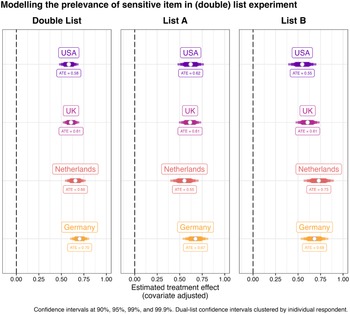
In Fig. 1 we report the average treatment effect (ATE) of assignment to the treatment list among all observations (double-list), as well as in each of the alternative lists separately.Footnote
8
Given the nested nature of observations in the double-list estimation – recall that an individual respondent produces one observation per list – standard errors in the double-list models are clustered by the individual respondent. As summarized in Equation 1, our estimand of interest – the ATE – indicates the prevalence of the sensitive preference, $E({S_i})$
. The estimates reported in Fig. 1 are covariate-adjusted and are the result of ordinary least square (OLS) regression models that control for respondents’ gender, age, education, sexuality, left-right ideology, and levels of self-reported affect towards Muslims and LGBTQ+ individuals. All covariates were recorded pre-treatment. Models with un-adjusted treatment effects, as well as a multiverse analysis of alternative specifications (Simonsohn, Simmons, and Nelson Reference Simonsohn, Simmons and Nelson2020), are reported in Appendix H. These specification curves demonstrate that the estimated treatment effects we report are constant across a diverse multiverse of different covariate-adjusted model specifications.
$E({S_i})$
. The estimates reported in Fig. 1 are covariate-adjusted and are the result of ordinary least square (OLS) regression models that control for respondents’ gender, age, education, sexuality, left-right ideology, and levels of self-reported affect towards Muslims and LGBTQ+ individuals. All covariates were recorded pre-treatment. Models with un-adjusted treatment effects, as well as a multiverse analysis of alternative specifications (Simonsohn, Simmons, and Nelson Reference Simonsohn, Simmons and Nelson2020), are reported in Appendix H. These specification curves demonstrate that the estimated treatment effects we report are constant across a diverse multiverse of different covariate-adjusted model specifications.

Figure 1. Treatment effect.
Across all of the four countries considered in our double-list experiment, we find large, substantively meaningful, and robust significant effects of allocation to treatment. As signalled by the distribution of the item counts reported in Table A.10, respondents report a significantly higher number of item counts when exposed to treatment. Substantively, this higher item count signals that, on average, when individuals are prompted to consider those groups that may be threatening towards LGBTQ+ people, they do endorse the view that Muslims fall into this category. These results suggest that, when prompted, citizens share a view that is congruent with the homonationalist narrative espoused by far-right actors.
The prevalence of this endorsement is remarkably constant in all four cases and is largest in continental Europe, amounting to 70 per cent in Germany and 66 per cent in the Netherlands. Notably, of the four countries we consider in this experiment, Germany and the Netherlands are the two countries where homonationalist arguments have enjoyed a longer pedigree (Akkerman Reference Akkerman2005; Dudink Reference Dudink2017) and where far-right actors have been more explicit in their efforts at instrumentally tokenizing LGBTQ+ protections to legitimize their rejection of ethnic others (Hunklinger and Ajanović Reference Hunklinger and Ajanović2022; Spierings Reference Spierings2021). In these two countries, our experimental manipulation demonstrates that two-thirds of citizens are likely to endorse the stereotypical view of Muslims as an illiberal threat towards LGBTQ+ persons.
In addition to seeking to legitimize their nativist policy position and de-radicalize their image, far-right parties have often been engaging in instrumental tolerance of LGB (but not TQ+) individuals as a means of recruiting sexual minority voters to their cause (Hunklinger and Ajanović Reference Hunklinger and Ajanović2022; Spierings Reference Spierings2021) without much success (Turnbull-Dugarte Reference Turnbull-Dugarte2022). This campaign strategy is based on the assumption that LGBTQ+ individuals are more likely to view ethnic out-groups (in most cases Muslims or individuals from majority-Islamic countries) as threatening. We know that, against such assumptions, LGBTQ+ individuals are more inclined to harbor more liberal preferences towards immigration and globalization (Turnbull-Dugarte Reference Turnbull-Dugarte2021), but are they any more (or less) likely vis-à-vis cis-heterosexuals to agree that Muslims are a threat to the welfare of their group? Should LGBT+ individuals be more likely to perceive Muslims as threatening to their welfare, this would indicate an increased potential for electoral homonationalism among queer voters (Hunklinger and Ajanović Reference Hunklinger and Ajanović2022). Should, however, LGBT+ individuals be less likely to perceive Muslims as threatening to their welfare, this would indicate more limited potential for electoral homonationalism among the same electoral constituency.
In Fig. 2 we report the conditional average treatment effect (CATE) among LGBT+ and non-LGBT+ respondents. This estimand is the product of a multiplicative interaction between treatment allocation and LGBT+ identity (full regression output, predicted outcomes and differences in the CATE are reported in Table A.15 and Figure A.3). As demonstrated in Fig. 2, conditioning on LGBT+ identity does not produce any significant variation in the effect of treatment. In essence what these effects tell us is that – despite LGBT+ individuals being more positively predisposed towards liberal immigration policies (Turnbull-Dugarte Reference Turnbull-Dugarte2021) and racial diversity (Horowitz and Gomez Reference Horowitz and Gomez2018) – LGBTQ+ respondents are equally prone, vis-à-vis their cis-heterosexual peers, to agree that Islam is a threat to their group welfare.

Figure 2. Subgroup analysis: LGBT+ vs. non-LGBT+ respondents.
In Appendix F we revisit the potential for subgroup variation via an exploratory analysis of the conditional ATEs by testing for moderating effects based on ideological (left-right) preferences as well as levels of affect towards Muslims or LGBT+ individuals. The results of these exploratory analyses demonstrate that the presence of significant treatment effects is not limited to right-wing respondents or those with nativist or homophobic biases (the usual suspects) but, rather, is observed across the full distribution of these theoretical moderators.
Robustness and Threats to Inference
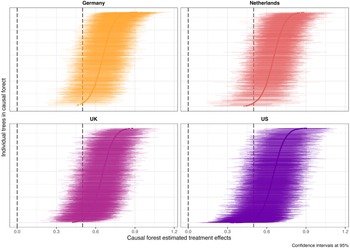
As a means of demonstrating the robustness of the estimated treatment effects, we complement our primary analysis, multiverse specification curves (Simonsohn, Simmons, and Nelson Reference Simonsohn, Simmons and Nelson2020) and theoretically relevant subgroup analyses with the inclusion of a robust causal forest approach to identifying heterogeneous treatment effects. Causal forests leverage a machine learning algorithm – generalized random forests (Athey, Tibshirani, and Wager Reference Athey, Tibshirani and Wager2019) – to assess treatment heterogeneity as a function of individual respondents’ covariate values (Wager and Athey Reference Wager and Athey2018). We estimate conditional average treatment effects across combinations of respondent-level gender, age, sexuality, education, ideology (left-right) placement, affect towards Muslims, and affect towards LGBTQ+ persons. The results of the causal forest approach, visualized in Fig. 3, demonstrate that there are no covariate combinations that result in insignificant treatment effects across the individual country studies. Substantively, the results of this causal random forest approach signal that the prevalence of the stereotype is stable across a diverse universe of strata, and among a majority of these strata the prevalence of the stereotype (indicated by the point-estimate of each tree) is in excess of 50 per cent.

Figure 3. Assessing treatment heterogeneity via causal random forest.
Beyond the need for randomization, the validity of the double-list experiment’s identification strategy is supported by three additional assumptions: (i) respondents do not misreport (no liars) agreeing with the key item, (ii) respondent item counts are not influenced by ceiling effects; and (iii) respondent item counts of non-key items are not modified by, and are independent of, the presence of the key item. We assess the sensitivity of our conclusions to relaxations of the no liars assumption, replicating Li’s (Reference Abramitzky2019) approach, by estimating upper-level bounds for the prevalence of untruthful respondents. This sensitivity test (see Appendix G.1) demonstrates that our substantive findings are not tempered by the accommodation of violations in the no-liars assumption. We are also confident that there is no violation of the ceiling effect assumption. Our design – which listed negatively correlated non-key items that would result in a baseline probability of being counted at 0.5 (Glynn Reference Glynn2013) – resulted in a median number of two (of four) item counts in the control condition and three (of five) item-counts in the treatment condition (Table A.10).
To rule out the potential of design effects, we follow the recommendation of Blair and Imai (Reference Blair and Imai2012) and assess whether the proportion of responses to non-key items is conditioned by the presence of the key item. In other words: did respondents change their beliefs on the threat of other social groups when exposed to Muslims as a social group on the list? In each of our country case studies, we reject the presence of design effects (see Appendix G.2). Diaz, Reference Diaz2024) recommends that in addition to conventional design effects, the double-list experiment has the added assumption of no ‘carry-over’ effects. Carry-over effects occur when respondents, after exposure to the first list (List A), moderate (by means of inflating or deflating) their responses to non-key items in the subsequent experiment (List B). To test for the presence of carry-over effects, we estimate the difference-in-difference (DiD) between the treatment allocation and the list order (see Appendix G.3). We find no evidence of carry-over effects between lists in Germany, the UK, and the US. In the case of the Netherlands, however, we do observe the potential for a small inflation effect (DiD of 0.23); although this DiD is not significantly distinct from zero at conventional thresholds (p < 0.05), it is at the 90 per cent threshold. Our interpretation is that this variation is likely a product of random noise rather than indicating the presence of genuine inflation effects, given the absence of a theoretical motivation for inflation in the Netherlands and not elsewhere.
Discussion
In this article, we leverage an original double-list experiment from four different Western democracies to measure the prevalence of stereotypical views of Muslims as threatening to LGBTQ+ persons. We show that endorsements of the view that Muslims are homophobic and incompatible with ‘Western’ liberalism and tolerance are widespread. As we argue elsewhere (Turnbull-Dugarte & López Ortega, Reference Turnbull-Dugarte and López Ortega2024), the demonization of Muslims as an inimical threat to the liberal values of the ‘West’ is not limited to LGBTQ+ inclusion but is commonplace in frames around gender equality and women’s rights (Akkerman and Hagelund Reference Akkerman and Hagelund2007; de Lange and Mügge Reference de Lange and Mügge2015; Farris Reference Farris2017; Spierings and Zaslove Reference Spierings and Zaslove2015). Future work would be well-placed to assess if such perceptions are also widespread among the population of Western democracies and, in particular, whether this is a view endorsed by women themselves.
The ubiquitous nature of this stereotype should not be ignored. The prevalence of the view that Muslims are threatening to LGBTQ+ persons is not limited to only to the ‘usual suspects’, such as those with underlying nativist preferences or negatively predisposed towards Muslims in particular but, rather, is causally identified across a diverse range of citizens including those who identify ideologically with the liberal-left or report support and positive affect towards Muslims. Assessing whether LGBTQ+ citizens themselves agree with the stereotype about the alleged threat of Muslims to a greater or lesser extent than their cis-heterosexual peers, we find no evidence of heterogeneous prevalence between the two subgroups. While far-right parties may present Muslims as a threat to the LGBTQ+ community, endorsements of this view among those individuals who, allegedly, would be subjected to this threat are not significantly distinct from the rest of the population.
These findings should serve as a sobering warning to the challenge presented by far-right parties. Leveraging the defence of LGBTQ+ inclusive liberal values to legitimize anti-immigrant policy positions and electoral platforms is likely a viable vote-winning strategy for these parties, given that these views are endorsed by the vast majority of citizens. This widespread agreement facilitates the creation of anti-Muslim coalitions between political groups that would normally be at odds, mirroring the dynamics observed with anti-LGBTQ+ coalitions (Corrales and Kiryk Reference Corrales and Kiryk2022). Indicative evidence suggests that far-right actors’ anti-Islamic tropes play a role in perpetuating these stereotypes, given, as we show, that their prevalence is greatest in those countries (Germany and Netherlands) where homonationalist strategies have enjoyed a greater pedigree. While our empirical approach allows us to causally identify the prevalence of this stereotype in the population, we cannot speak to how the trope of Muslims as an ‘illiberal bogeyman’ forms in individuals’ minds, whether citizens view the threat to be particularly large, or whether they agree that the threat pertains to other liberal values or social groups. As we discuss throughout the article, the latter is particularly relevant given the extent of femonationalist rhetoric (Farris Reference Farris2017), but whether citizens endorse this view remains an empirical question. Future work would be well-placed to assess how homonationalist and femonationalist stereotypes may be corrected and how the far-right’s demonization of Muslims via the tokenization of LGBTQ+ protections and women’s rights may be challenged.
Supplementary material
The supplementary material for this article can be found at https://doi.org/10.1017/S0007123424000437.
Data availability statement
Replication data for this article can be found in Harvard Dataverse at: https://doi.org/10.7910/DVN/CXHUNT.
Acknowledgements
An earlier iteration of this article benefited from feedback provided by participants at the 2023 Annual Elections, Public Opinion, and Parties (EPOP) Conference hosted at the University of Southampton. We are also indebted to Rob Ford and Rune Stubarger for their critical comments. Finally, we thank the four anonymous BJPS reviewers and editors for their detailed reading of the article and the constructive recommendations made during the revision process.
Financial support
This research was funded by the British Academy/Leverhulme Trust (Grant No. SRG22/220985).
Competing interests
None.
Ethical standards
Ethical approval was provided for the project by the Faculty of Social Science Ethical Review Board at the University of Southampton (Certificate No. ERGO80620).





 Open access

