


Impact statement
Rangeland ecosystems are one of the largest providers of agro-ecological services in the southwestern United States (US); thus, the financial and ecological security of the region depends upon the ability to predict and manage dynamic rangeland resources. Here, we present a first assessment of the US Department of Agriculture’s (USDA) “Grass-Cast Southwest,” which is a forecasting tool for US rangeland aboveground net primary productivity (ANPP). Specifically, we evaluated the spring (April–May) and summer (June–September) growing season ANPP forecasts from 2020 to 2022. Our results show that ANPP forecasts in early April were relatively close to the observation-based ANPP estimates in late May for all years evaluated (R = 0.6–0.9). The relatively high predictability of spring rangeland productivity in this region is likely because it is strongly driven by antecedent winter/early spring precipitation. Conversely, the first summer forecasts produced in June did not consistently predict the final observation-based ANPP estimates in late August (R = −0.5 to 0.7), likely because summer rangeland productivity in this region is highly dependent on variable, less predictable precipitation from the North American Monsoon (NAM). As a way forward, we show that antecedent El Niño Southern Oscillation (ENSO) indices could be used to improve Grass-Cast Southwest performance for both the spring and summer growing seasons. Our assessment of Grass-Cast Southwest across multiple growing seasons highlights key strengths and challenges of modeling rangeland productivity in semiarid ecosystems that are driven by such seasonally distinct (e.g., winter/early spring versus summer monsoonal precipitation) and increasingly variable precipitation inputs.
Introduction
Rangelands cover large expanses of the Southwest United States (US), including roughly 81% of federal lands in Arizona and New Mexico (Williams et al., Reference Williams, Funk and Shukla2023), and provide critical ecosystem services, such as sustaining and native wildlife and livestock, biodiversity, carbon sequestration, water cycling and cultural resources (Havstad et al., Reference Havstad, Peters, Skaggs, Brown, Bestelmeyer, Fredrickson, Herrick and Wright2007; Sala et al., Reference Sala, Yahdjian, Havstad, Aguiar and Briske2017). Recently, increases in drought frequency and intensity have significantly degraded rangeland vegetation productivity across the region (Zhang et al., Reference Zhang, Biederman, Dannenberg, Yan, Reed and Smith2021; Williams et al., Reference Williams, Cook and Smerdon2022, Reference Williams, Funk and Shukla2023). For instance, during a drought event in 2020, over 50% of the region’s rangelands were rated as in poor or very poor condition (NOAA National Centers for Environmental Information, 2020; Dannenberg et al., Reference Dannenberg, Yan, Barnes, Smith, Johnston, Scott, Biederman, Knowles, Wang, Duman, Litvak, Kimball, Williams and Zhang2022). In recent years, data availability has increased rapidly to assist with land management decision support in the Southwest, including the National Oceanic and Atmospheric Administration (NOAA) Climate Prediction Center (CPC), the US Drought Monitor (USDM), Vegetation Drought Response Index (VegDRI) and the Rangeland Analysis Platform (RAP) (Jones et al., Reference Jones, Naugle, Twidwell, Uden, Maestas and Allred2020). NOAA CPC precipitation forecasts are particularly important in providing 3-month temperature and precipitation outlooks that can help inform rangeland stocking rates (Peck et al., Reference Peck, Derner, Parton, Hartman and Fuchs2019). While these data provide advancements for seasonal climatic forecasts, assessment of drought conditions, and historical productivity values, none combine these elements to provide short-term forecasts of rangeland productivity.
In the Great Plains, the US Department of Agriculture’s (USDA) Grass-Cast Great Plains rangeland productivity forecast tool fills this information gap by combining historical weather data, rangeland biomass data from field studies, satellite observations of the normalized difference vegetation index (NDVI) from multiple platforms and the DayCent ecosystem process model to provide predicted rangeland aboveground net primary productivity (ANPP) estimates for the summer growing season (Hartman et al., Reference Hartman, Parton, Derner, Schulte, Smith, Peck, Day, Del Grosso, Lutz, Fuchs, Chen and Gao2020). Similarly, the Australian Rangeland Assessment System, known as Aussie GRASS, uses weather data and satellite imagery to forecast monthly grassland ANPP at the continental scale (Carter et al., Reference Carter, Hall, Brook, McKeon, Day, Paull, Hammer, Nicholls and Mitchell2000). These ecosystem modeling approaches provide a framework for region-specific models that have the potential to be adapted across other rangeland-dominated regions of the world.
The Southwest geographic region of the US poses complex challenges for generating accurate rangeland ANPP forecasts. The climate of the Southwest is strongly influenced by the North American Monsoon (NAM) (Adams and Comrie, Reference Adams and Comrie1997) and the El Niño Southern Oscillation (ENSO) (Cane, Reference Cane2005). The NAM typically impacts regional summer (July through September) precipitation and thus drives a distinct summer growing season that generally accounts for a majority of the annual rangeland ANPP across the region. Alternatively, the ENSO has a dominant regional influence on winter precipitation: El Niño events tend to reduce, whereas La Niña events tend to increase winter precipitation. Winter precipitation is a critical determinant of spring soil moisture, which in turn drives a distinct spring growing season that can account for a significant portion of rangeland annual ANPP in years with relatively wet winters. Together NAM and ENSO strongly influence the two distinct growing seasons in the Southwest: the spring growing season driven by ENSO-influenced winter precipitation and the summer growing season driven primarily by NAM-influenced summer precipitation (Biederman et al., Reference Biederman, Scott, Bell, Bowling, Dore, Garatuza-Payan, Kolb, Krishnan, Krofcheck, Litvak, Maurer, Meyers, Oechel, Papuga, Ponce-Campos, Rodriguez, Smith, Vargas, Watts, Yepez and Goulden2017).
Climate change is increasing intra- and inter-annual variability for the Southwest, including an increase in both wet and dry extreme events (IPCC, Reference Shukla, Skea, Buendia, Masson-Delmotte, Pörtner, Roberts, Zhai, Slade, Connors, Diemen, Ferrat, Haughey, Luz, Neogi, Pathak, Petzold, Pereira, Vyas, Huntley, Kissick, Belkacemi and Malley2019; Zhang et al., Reference Zhang, Biederman, Dannenberg, Yan, Reed and Smith2021; Dannenberg et al., Reference Dannenberg, Yan, Barnes, Smith, Johnston, Scott, Biederman, Knowles, Wang, Duman, Litvak, Kimball, Williams and Zhang2022). Precipitation events in both the summer and winter are becoming less frequent and more intense (IPCC, Reference Shukla, Skea, Buendia, Masson-Delmotte, Pörtner, Roberts, Zhai, Slade, Connors, Diemen, Ferrat, Haughey, Luz, Neogi, Pathak, Petzold, Pereira, Vyas, Huntley, Kissick, Belkacemi and Malley2019; Zhang et al., Reference Zhang, Biederman, Dannenberg, Yan, Reed and Smith2021). Simultaneously, mean maximum and minimum air temperatures are increasing and heatwaves are becoming more frequent and intense (IPCC, Reference Shukla, Skea, Buendia, Masson-Delmotte, Pörtner, Roberts, Zhai, Slade, Connors, Diemen, Ferrat, Haughey, Luz, Neogi, Pathak, Petzold, Pereira, Vyas, Huntley, Kissick, Belkacemi and Malley2019; Zhang et al., Reference Zhang, Biederman, Dannenberg, Yan, Reed and Smith2021). These changes create challenges for adaptive rangeland management, as rangeland aboveground net primary productivity (ANPP) is highly sensitive to weather extremes (Dannenberg et al., Reference Dannenberg, Yan, Barnes, Smith, Johnston, Scott, Biederman, Knowles, Wang, Duman, Litvak, Kimball, Williams and Zhang2022; Feldman et al., Reference Feldman, Konings, Gentine, Cattry, Wang, Smith, Biederman, Chatterjee, Joiner and Poulter2024; Smith MD, Wilkins, et al., Reference Smith, Wilkins, Holdrege, Wilfahrt, Collins, Knapp, Sala, Dukes, Phillips, Yahdjian, Gherardi, Ohlert, Beier, Fraser, Jentsch, Loik, Maestre, Power, Yu, Felton, Munson, Luo, Abdoli, Abedi, Alados, Alberti, Alon, An, Anacker, Anderson, Auge, Bachle, Bahalkeh, Bahn, Batbaatar, Bauerle, Beard, Behn, Beil, Biancari, Blindow, Bondaruk, Borer, Bork, Bruschetti, Byrne, Cahill, Calvo DA, Carbognani, Cardoni, Carlyle, Castillo-Garcia, Chang, Chieppa, Cianciaruso, Cohen, Cordeiro, Cusack, Dahlke, Daleo, D’Antonio, Dietterich, S. Doherty, Dubbert, Ebeling, Eisenhauer, Fischer, TGW, Gebauer, Gozalo, Greenville, Guidoni-Martins, Hannusch, Vatsø Haugum, Hautier, Hefting, HAL, Hoss, Ingrisch, Iribarne, Isbell, Johnson, Jordan, Kelly, Kimmel, Kreyling, Kröel-Dulay, Kröpfl, Kübert, Kulmatiski, Lamb, Larsen, Larson, Lawson, Leder, Linstädter, Liu, Liu, Lodge, Longo, Loydi, Luan, Curtis Lubbe, Macfarlane, Mackie-Haas, Malyshev, Maturano-Ruiz, Merchant, Metcalfe, Mori, Mudongo, Newman, Nielsen, Nimmo, Niu, Nobre, O’Connor, Ogaya, Oñatibia, Orbán, Osborne, Otfinowski, Pärtel, Penuelas, Peri, Peter, Petraglia, Picon-Cochard, Pillar, Piñeiro-Guerra, Ploughe, Plowes, Portales-Reyes, Prober, Pueyo, Reed, Ritchie, Rodríguez, Rogers, Roscher, Sánchez, Santos, Cecilia Scarfó, Seabloom, Shi, Souza, Stampfli, Standish, Sternberg, Sun, Sünnemann, Tedder, Thorvaldsen, Tian, Tielbörger, Valdecantos, van den Brink, Vandvik, Vankoughnett, Guri Velle, Wang, Wang, Wardle, Werner, Wei, Wiehl, Williams, Wolf, Zeiter, Zhang, Zhu, Zong and Zuo2024; Hoover and Smith, Reference Hoover and Smith2025). Rangeland managers increasingly need early information to make science-informed decisions in the face of this increased variability in forage productivity. The Grass-Cast rangeland production tool from the Great Plains was recently expanded to the Southwest and, due to the variable importance of both winter and summer monsoon precipitation across the Southwest, is providing both a spring and summer rangeland productivity forecast to fill this critical information gap.
Here, we present a first-time evaluation of the USDA Grass-Cast ANPP forecasts for the southwest region of the United States (hereafter Grass-Cast Southwest). We first evaluated the seasonal variability in Grass-Cast Southwest ANPP estimates for both the spring and summer growing season using independent estimates of the normalized difference vegetation index (NDVI) for the years 2000–2020. We then evaluated Grass-Cast forecast accuracy between the years 2020 and 2022 by comparing all Grass-Cast biweekly forecasts for below-normal, near-normal and above-normal precipitation scenarios for spring (April–May) and summer (June–August) seasons to the end-of-season observation-based ANPP estimates. Importantly, our study years included both extreme wet and dry spring and summer growing seasons, providing the opportunity to assess the impact of climate extremes on Grass-Cast Southwest forecast performance. We hypothesized that forecasting spring productivity will be more feasible than summer productivity, as antecedent winter precipitation is the primary driver of spring productivity. In contrast, we predicted that forecasting summer productivity would be more challenging due to the unpredictable influence of the NAM on summer precipitation patterns. Finally, we explore pathways to improve the Grass-Cast Southwest forecast by analyzing the relationship between ANPP and the ENSO index over the full 1980–2020 period as a potential path toward improved seasonal rangeland productivity forecasts for the Southwest geographic region.
Methods
Grass-Cast Southwest ANPP forecasts are processed every 2 weeks for the spring and summer growing seasons. The spring growing season forecast begins the first week of April and extends through the end of May. The release of the first spring forecast corresponds roughly with the first pulse of growth after winter rains. The summer growing season forecast begins the first week of June and extends through the end of September. The release of the first summer forecast occurs in early June, prior to monsoonal rains that start near the beginning of July, and is completed near the end of September. Over the first 3 years of the Grass-Cast Southwest forecast, data availability varied slightly, with the exact dates shown in Supplementary Table S1.
The Grass-Cast Southwest ANPP forecasts use the DayCent ecosystem model (Parton et al., Reference Parton, Hartman, Ojima and Schimel1998; Del Grosso et al., Reference Del Grosso, Schimel, Ojima, Hartman, Parton, Brenner, Mosier, Hansen, Shaffer and Ma2001, Reference Del Grosso, Parton, Keough, Reyes-Fox, Ahuja and Ma2015) by incorporating historical weather information, available from the Applied Climate Information System (ACIS) Web Services (http://data.rcc-acis.org/), up until the forecast date for every 10-km × 10-km area (Hartman et al., Reference Hartman, Parton, Derner, Schulte, Smith, Peck, Day, Del Grosso, Lutz, Fuchs, Chen and Gao2020). To account for uncertainties in seasonal weather forecasts, different weather scenarios are constructed by dividing the prior 36 years of precipitation data into the 12 driest, 12 intermediate and 12 wettest years, which is the same approach used by Hartman et al. (Reference Hartman, Parton, Derner, Schulte, Smith, Peck, Day, Del Grosso, Lutz, Fuchs, Chen and Gao2020) for Grass-Cast Great Plains.
Grass-Cast forecasts of ANPP combine pixel-specific data with historical county-level information. During the production of a forecast, Grass-Cast Southwest uses daily simulated actual evapotranspiration (AET) estimates from the DayCent model to calculate an integrated seasonal AET (iAET) and the integrated seasonal precipitation (iPPT) for the 36 model scenarios for each pixel. iAET or iPPT is converted to an integrated seasonal NDVI (iNDVI) based on the stronger correlation in the historical county-level relationship between iAET or iPPT and iNDVI for the county that contains the pixel. For spring forecasts, Grass-Cast Southwest accumulates iAET and iPPT from January 1 to May 31. For summer forecasts, these variables are accumulated from June 1 to August 31. Thus, each value of iAET or iPPT reflects actual weather from the beginning of the accumulation period to the day prior to the forecast. Seasonal ANPP is estimated using an established relationship between iNDVI and field-based estimates of ANPP (Supplementary Figure S1). For each 2-week seasonal forecast at each pixel, three distinct ANPP means are computed – ANPPbelow-normal, ANPPnear-normal and ANPPabove-normal – based on the 12 driest (the below-normal scenario), 12 intermediate (the near-normal scenario) and 12 wettest (the above-normal scenario) model scenarios. More details about the major steps of the Grass-Cast Southwest workflow are described below.
The DayCent model
The DayCent model is a process-based ecosystem model designed to examine the intricate relationships between water, carbon and nitrogen dynamics within diverse ecosystems like grasslands, forests and savannas. By integrating data inputs such as climate records, soil characteristics, vegetation properties and land management practices, the model offers a comprehensive depiction of ecological processes and their responses to varying environmental conditions (Parton et al., Reference Parton, Hartman, Ojima and Schimel1998; Del Grosso et al., Reference Del Grosso, Schimel, Ojima, Hartman, Parton, Brenner, Mosier, Hansen, Shaffer and Ma2001, Reference Del Grosso, Parton, Keough, Reyes-Fox, Ahuja and Ma2015).
Central to the DayCent model is its Land Surface Hydrology Sub-model, which characterizes the movement of water through the ecosystem. This includes accounting for inputs like precipitation and snowmelt and assessing their distribution among plant interception, litter evaporation, soil water flow, surface runoff and soil evaporation. A key output is the computation of iAET and iPPT which are the main input to the Grass-Cast model for the Great Plains and Southwest (Parton et al., Reference Parton, Hartman, Ojima and Schimel1998; Del Grosso et al., Reference Del Grosso, Schimel, Ojima, Hartman, Parton, Brenner, Mosier, Hansen, Shaffer and Ma2001, Reference Del Grosso, Parton, Keough, Reyes-Fox, Ahuja and Ma2015; Hartman et al., Reference Hartman, Parton, Derner, Schulte, Smith, Peck, Day, Del Grosso, Lutz, Fuchs, Chen and Gao2020).
Integrated normalized difference vegetation index (iNDVI)
County-level observations of NDVI from 1982 to 2015 for spring (April–May) and summer (June–September) were derived from bimonthly observations from the Global Inventory Modeling and Mapping Studies (GIMMS) NDVI3g dataset (Zhu et al., Reference Zhu, Bi, Pan, Ganguly, Anav, Xu, Samanta, Piao, Nemani and Myneni2013). Snow- and cloud-affected pixels were removed by excluding those classified as having poor (QA = 0) or moderate (QA = 1) quality in the QA layer. To accurately isolate rangelands, pixels identified as barren, forest, or crop areas were excluded using MOderate Resolution Imaging Spectroradiometer (MODIS) land cover data based on the methods described in Hartman et al. (Reference Hartman, Parton, Derner, Schulte, Smith, Peck, Day, Del Grosso, Lutz, Fuchs, Chen and Gao2020).
Integrated NDVI (iNDVI) was calculated by combining biweekly pixel-level AVHRR NDVI3g values (NDVIobs,season), recorded between April and May for spring and between June and September for summer. To calculate these integrated values, a pixel-specific base NDVI value (NDVIbase) that represents the NDVI at the start of the growing season was subtracted from each biweekly (NDVIobs,bi) (Equation 1).
 $$ {iNDVI}_{obs, season}=\sum \limits_{bi=1}^n\left(\frac{NDVI_{obs, bi}-{NDVI}_{base}}{n}\right) $$
where iNDVIobs,season represents each season’s observable integrated mean NDVI, NDVIobs,bi represents the bimonthly NDVI observation and NDVIbase represents the mean of NDVI values in January. Calculations of the iNDVIobs,season were made by averaging over all bi-monthly NDVI observations from the first (bi = 1) to the last (bi = n) bi-monthly in the season. iNDVIobs,season is a mean rather than a summation so that the magnitude of its spring and summer values is independent of the number of bi-monthly values in the season.
The total amount of precipitation (PPT) and AET from both the spring and summer seasons from each pixel (iAETseason or iPPTseason) was calculated by summing the daily PPT or AET values simulated by DayCent for each date in each specific season and year.
 $$ {iAET}_{season, yr}=\sum \limits_{day=1}^n\left({AET}_{day}\right) $$
 $$ {iPPT}_{season, yr}=\sum \limits_{day=1}^n\left({PPT}_{day}\right) $$
To develop the historic county-level relationships between NDVIobs,season and these water-related variables, a county mean of iAETseason and iPPTseason was computed for each year that NDVIobs,season was available (1982–2015). Linear regressions were developed for iAETseason versus NDVIobs,season (to determine slope and intercept, m county_AET_season and b county_AET_season) and iPPTseason versus NDVIobs,season (to determine slope and intercept, m county_PPT,season and b county_PPT_season).
To generate the Grass-Cast Southwest forecast, pixel-specific values of iAETseason derived from DayCent as well as iPPTseason and iNDVIobs, season for the 36 years were used to predict seasonal iNDVI for the pixel using one of the two equations below for each pixel and for each weather scenario (i):
 $$ {iNDVI}_{\mathit{pred,}\ \mathit{season,}i}={\displaystyle \begin{array}{l}{m}_{county\_ AET\_ season}\ast {iAET}_{\mathit{season,}i}\\ {}+\hskip2px {b}_{county\_ AET\_ season}\end{array}} $$
 $$ {iNDVI}_{\mathit{pred,}\ \mathit{season,}i}={\displaystyle \begin{array}{l}{m}_{county\_ PPT\_ season}\ast {iPPT}_{\mathit{season,}i}\\ {}+\hskip2px {b}_{county\_ PPT\_ season}\end{array}} $$
For the spring forecast, equation 3a is used in all counties. For the summer forecast, either equation 3a or 3b is used depending on which water-related variable (AET or PPT) had the strongest relationship to county-level NDVIobs,season.
Aboveground net primary productivity (ANPP)
A linear regression between field-based estimates of annual ANPP and iNDVI was used as a key empirical relationship within the Grass-Cast SW modeling framework (Supplementary Figure S1). This empirical relationship was developed using three available Southwest US field sites. All field-based ANPP estimates were based on end-of-growing-season grass-dominated biomass clippings from a standard quadrant deployed within a representative area over the time period 2000–2018 (76 total site years). The three Southwest field sites that were used included: 11 site years of ANPP estimates collected from 2000 to 2010 at the Highland Major Land Resource Area (MLRA), New Mexico (Torell et al., Reference Torell, McDaniel, Brown and Torell2018); 44 site years of ANPP estimates collected from 2000 to 2010 at the Jornada Experimental Range (Jornada), New Mexico (Torell et al., Reference Torell, McDaniel, Brown and Torell2018); and 21 site years of ANPP estimates collected from 2009 to 2018 at the Santa Rita Experimental Range, Arizona (Dorich et al., Reference Dorich, Derner, Torell, Volesky, Brennan, Archer, Blair, Knapp, Nippert and Hartnett2021). We used these estimates to derive the following linear equation (Equation 4):
 $$ {ANPP}_{pred, season}=98.84\ast {iNDVI}_{pred, season}+5.0 $$
where ANPPpred,season (g biomass m−2) and iNDVIpred,season represent the seasonal estimates of ANPP and iNDVI, respectively. In the actual analysis between iNDVI and ANPP, the slope of the linear relations was estimated to be 98.84 and the intercept was estimated to be −12.91 (Supplementary Figures S1–S2). We increased the intercept to 5.0 in order to prevent negative predictions of ANPP when iNDVI was near zero. This equation applies to both the spring and summer ANPP predictions.
ANPP estimates were converted to seasonal anomalies using the long-term mean ANPP (ANPPmean, g biomass m−2) spanning from 1984 to 2019 for each pixel. The 36-year average ANPP for each pixel was calculated using equation 3a or 3b and the iNDVI to ANPP regression (Equation 4):
 $$ {ANPP}_{mean}=\frac{\sum \limits_{Yr=1984}^{2019}98.84\ast {iNDVI}_{pred,i}+5.0}{36} $$
Accuracy assessments and statistical analysis
To assess the accuracy of Grass-Cast Southwest’s ANPP estimates, we used independent estimates of NDVI (MOD13QA2 V006) from MODIS for the years 2000–2020. The MODIS NDVI data were accompanied by a pixel reliability layer which was used to filter out lower quality data based on the methods described in Hartman et al. (Reference Hartman, Parton, Derner, Schulte, Smith, Peck, Day, Del Grosso, Lutz, Fuchs, Chen and Gao2020). We compared spring and summer ANPP estimates to spring and summer MODIS iNDVI estimates to evaluate the ability of the model to capture spatiotemporal variability in rangeland productivity.
To evaluate forecast accuracy between the years 2020 and 2022, we compared all Grass-Cast Southwest forecasts for below-normal, near-normal and above-normal rainfall scenarios for spring (April–May) and summer (June–August) to the end-of-season forecast. We treat the end-of-season forecast as the final observed ANPP since it is based fully on known weather observations. We used a linear model to estimate the correlation coefficient (R), standard deviation (SD) and root mean square difference (RMSD) for each forecast date. We further disaggregated the focal region into three subregions characterized by prevailing precipitation seasons: winter, summer and transitional (Supplementary Figure S3). This subdivision was established by computing the ratio of summer (June–August) to winter precipitation (January–May) based on long-term monthly precipitation totals from 1950 to 2020. Index values from 0 to 0.8 corresponded to areas with a dominant winter precipitation pattern, 0.8–1.2 indicated a transitional region and 1.2–3.0 represented regions dominated by summer precipitation.
We finally analyzed how end-of-season Grass-Cast Southwest ANPP estimates related to seasonal ENSO indices for the spring and summer growing seasons. The ENSO index utilized represents 3-month average sea surface temperatures anomalies in the NINO-3 region such that positive (negative) anomalies indicate an El Niño (La Niña) event, respectively. We used 3-month ENSO temporal means to smooth out the noise from shorter term weather variations and focus more on the underlying, slowly evolving ENSO climate pattern. We used a linear model to test the significance of the seasonal ANPP versus ENSO index for the full focal region from 1980 to 2020. All statistical analyses were carried out using R v.4.4.2.
Results
Grass-Cast Southwest ANPP estimates 2000–2020
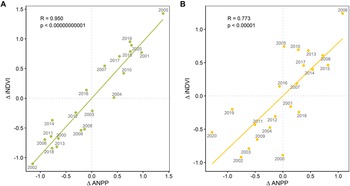
Grass-Cast Southwest ANPP estimates were closely correlated with integrated NDVI (iNDVI) over the 2000–2020 time period (Figure 1). ANPP estimates for the spring growing season were more closely correlated with spring iNDVI (R = 0.95) than were summer ANPP estimates and summer iNDVI (R = 0.77). The slope of the relationship for the spring growing season was 0.94, indicating a similar range in spring ANPP estimates and iNDVI values; whereas the slope of the summer relationship was 0.75, due to a slight under-estimation of the summer ANPP range. We additionally show that iNDVI is a good predictor of regional ANPP by synthesizing data from three Southwest field sites: the Highland MLRA, New Mexico (Torell et al., Reference Torell, McDaniel, Brown and Torell2018); the Jornada Experimental Range (Jornada), New Mexico (Torell et al., Reference Torell, McDaniel, Brown and Torell2018); and the Santa Rita Experimental Range, Arizona (Dorich et al., Reference Dorich, Derner, Torell, Volesky, Brennan, Archer, Blair, Knapp, Nippert and Hartnett2021). At these sites, iNDVI was better correlated with field-based ANPP (R = 0.71) compared to mean annual precipitation (R = 0.32) (Supplementary Figure S2). These findings indicate that the Grass-Cast Southwest modeling framework is more effective than simply climate proxies in accurately reproducing estimates of ANPP across the region.
Comparison of the Grass-Cast Southwest aboveground net primary productivity (ANPP; Z-scores) to independent moderate resolution imaging spectroradiometer (MODIS) integrated NDVI (iNDVI; Z-scores) for the spring (A) and summer (B) forecast periods. The spring season corresponds to the April–May period, whereas the summer period corresponds to the June–September period. The comparison spans the full 2001–2020 MODIS record with individual years labeled on the plot. Relationships between these variables for both seasons were statistically significant.

Grass-Cast Southwest ANPP forecasts 2020–2022
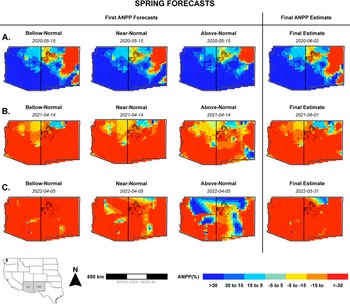
Grass-Cast Southwest forecasts of peak ANPP for the spring season were relatively accurate (R values ranged from 0.6 to 0.9) in predicting actual ANPP as estimated by Grass-Cast Southwest at the end of the growing season for the 2020–2022 growing seasons (Figures 2, 4; Supplementary Table S2). In spring 2020, the first forecast in May correctly anticipated the end-of-season anomaly of above-average ANPP in southern Arizona and below-average ANPP anomaly in northeastern New Mexico (Figures 2, 4). Above-average ANPP in spring 2020 was associated with above-average precipitation in winter 2020 (Supplementary Figure S4).
Grass-Cast Southwest spring aboveground net primary productivity (ANPP) forecast maps for 2020 (A), 2021 (B) and 2022 (C). The first three columns show the first spring ANPP forecast for the below-normal (first column), near-normal (second column) and above-normal (third column) scenarios. The fourth column shows the final fully observation-based ANPP estimate for the spring growing season. All maps were normalized to represent the percentage change in ANPP relative to the 36-year average (1982–2019). Inset map shows the location of the focus states, Arizona (AZ) and New Mexico (NM), in the broader western United States.

In spring 2021 and spring 2022, the first Grass-Cast Southwest forecasts were released in April (Supplementary Table S1). For both years, these early forecasts correctly anticipated the end-of-season anomaly of below-average ANPP across the region. Spring 2021 ANPP estimates from each biweekly forecast exhibited high correlation with low RMSE across all model scenarios (Figure 4), and correlation values increased from 0.6 to 0.9 as the spring season progressed in 2022 (Figure 4). Below-average ANPP in spring 2021 and 2022 was closely associated with below-average winter precipitation in both years (Supplementary Figure S4). Grass-Cast Southwest forecast performance did not differ across areas dominated by winter precipitation versus summer precipitation (Supplementary Figures S5).
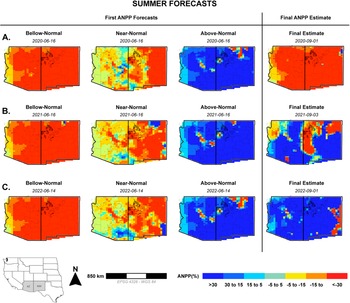
First Grass-Cast Southwest forecasts for the summer 2020–2022 years were relatively inaccurate in capturing ANPP estimated at the end of the growing season (R values ranged from −0.5 to 0.7) (Figures 3, 4; Supplementary Table S2). The first summer ANPP forecasts associated with the near-average model scenario exhibited relatively little variation (+15% to −15%) across the 3 years (Figure 3). The Grass-Cast Southwest scenario with below-average precipitation was significantly better at capturing the end-of-season negative ANPP anomaly in 2020 (Figures 3, 4). The biweekly summer updates in 2020 did not converge on a relatively accurate forecast until the August forecast date, after most of NAM precipitation had been received (Figure 4, Supplementary Figure S4). Summer 2021 ANPP estimates from each biweekly Grass-Cast Southwest updated forecast exhibited negative correlation and high RMSE until the August forecast (Figure 4). Summer 2022 ANPP estimates from each biweekly update exhibited a slightly less negative correlation and high RMSE up until the August forecast (Figure 4). Grass-Cast Southwest forecast performance in summer did not differ among areas dominated by winter precipitation versus summer precipitation (Supplementary Figure S6).
Grass-Cast Southwest summer aboveground net primary productivity (ANPP) forecast maps for 2020 (A), 2021 (B) and 2022 (C). The first three columns show the first summer ANPP forecast for the below-normal (first column), near-normal (second column) and above-normal (third column) scenarios. The fourth column shows the final fully observation-based ANPP estimate for the summer growing season. All maps were normalized to represent the percentage change in ANPP relative to the 36-year average (1982–2019). Inset map shows the location of the focus states, Arizona (AZ) and New Mexico (NM), in the broader western United States.

An evaluation of the seasonal ANPP forecasts for the spring (A, C, E) and summer (B, D, F) growing seasons from 2020 to 2022. Each subplot shows the correlation coefficient (black axis), standard deviation (blue axis; g m−2) and centered root mean square difference (green axis; g m−2) for all forecast dates of the above-normal (gold), near-normal (teal) and below-normal (purple) forecast scenarios compared to the final fully observation-based seasonal aboveground net primary productivity (ANPP) estimate. In general, spring ANPP forecasts are associated with higher correlation coefficients and lower RMS difference relative to the summer ANPP forecasts.

Grass-Cast Southwest ANPP estimates and their relationship with ENSO
We assessed the relationship between spring and summer ANPP and ENSO indices for all 3-month time periods and report here the most significant relationships. For Grass-Cast Southwest spring ANPP estimates, we found a highly significant positive relationship (R = 0.57) with the 3-month ENSO index for the January to March time period (ENSOJFM) (Figure 5; Supplementary Table S3). For Grass-Cast Southwest summer ANPP estimates, we found a significant negative relationship (r = −0.36) with the 3-month ENSO index for March–May (ENSOMAM). For a more complete assessment of the relationship between summer and spring ANPP and ENSO across additional 3-month ENSO time periods, see Supplementary Table S3.
Linear relationships between Grass-Cast Southwest ANPP anomalies and the ENSO index from 1980 to 2020. Spring Grass-Cast Southwest ANPP anomalies (A) were found to be most closely correlated with the January, February and March (JFM) ENSO index, whereas summer Grass-Cast Southwest ANPP anomalies (B) were found to be most closely correlated with the March, April and May (MAM) ENSO index. Orange shading highlights El Niño events, while blue shading highlights La Niña events.

Discussion
The Grass-Cast Southwest rangeland productivity forecast framework combines historical data on weather and rangeland productivity with a correlation between 36 years of satellite-derived NDVI and modeled season-long meteorological data to provide bimonthly forecasts of ANPP for rangelands across New Mexico and Arizona. Consistent with prior findings of Grass-Cast Great Plains (Chen et al., Reference Chen, Parton, Hartman, Del Grosso, Smith, Knapp, Lutz, Derner, Tucker, Ojima, Volesky, Stephenson, Schacht and Gao2019; Hartman et al., Reference Hartman, Parton, Derner, Schulte, Smith, Peck, Day, Del Grosso, Lutz, Fuchs, Chen and Gao2020), Grass-Cast Southwest ANPP estimates were strongly correlated with independent observations of MODIS iNDVI for both the spring and summer growing seasons (Figure 1). This result, in addition to the linear relationship between observed ANPP and iNDVI (Supplementary Figures S1–S2), suggests that our modeling framework with DayCent is generally effective in capturing seasonal aboveground ANPP dynamics for areas of the Southwest region that vary significantly in temperature and in precipitation timing and amount. That said, the spring iNDVI and ANPP relationship was stronger (R = 0.95) relative to the summer (R = 0.77), indicating potential seasonal hysteresis in the relationship (Smith et al., Reference Smith, Dannenberg, Yan, Herrmann, Barnes, Barron-Gafford, Biederman, Ferrenberg, Fox, Hudson, Knowles, MacBean, Moore, Nagler, Reed, Rutherford, Scott, Wang and Yang2019; Wang et al., Reference Wang, Biederman, Knowles, Scott, Turner, Dannenberg, Köhler, Frankenberg, Litvak, Flerchinger, Law, Kwon, Reed, Parton, Barron-Gafford and Smith2022). Additional research into proxies, such as solar-induced fluorescence, that are more directly associated with rangeland photosynthesis dynamics could potentially further improve our modeling framework (Smith et al., Reference Smith, Biederman, Scott, Moore, He, Kimball, Yan, Hudson, Barnes, MacBean, Fox and Litvak2018; Wang et al., Reference Wang, Biederman, Knowles, Scott, Turner, Dannenberg, Köhler, Frankenberg, Litvak, Flerchinger, Law, Kwon, Reed, Parton, Barron-Gafford and Smith2022; Zhang et al., Reference Zhang, Fang, Smith, Wang, Gentine, Scott, Migliavacca, Jeong, Litvak and Zhou2023).
Focusing on our evaluation of Grass-Cast Southwest rangeland forecast skill, our results indicate differential utility of the seasonal forecasts, consistent with our hypotheses for this region. Overall, we demonstrate that rangeland managers can use Grass-Cast Southwest forecasts to proactively anticipate spring forage resources, especially with prior wet winters (Zaied et al., Reference Zaied, Geli, Sawalhah, Holechek, Cibils and Gard2020). Conversely, Grass-Cast Southwest forecasts for summer forage resources lack the same robustness due to the highly variable and unpredictable nature of precipitation amounts associated with the NAM (Prein et al., Reference Prein, Towler, Ge, Llewellyn, Baker, Tighi and Barrett2022).
Spring forecasts of ANPP compared well to the fully observational-based final spring ANPP estimate, even during extreme wet years and dry years (R = 0.6–0.9) (Figures 2, 4; Supplementary Table S2). For instance, during the extreme wet spring of 2020, Grass-Cast Southwest successfully predicted ANPP anomalies of more than 30% for much of Arizona and parts of New Mexico across all three modeling scenarios (below, average, above). Similarly, during the dry springs of 2021 and 2022, Grass-Gast Southwest successfully predicted negative ANPP anomalies across Arizona and New Mexico for all three model scenarios. Consistent with our hypothesis, we posit that this is a result of our modeling framework using DayCent, which incorporates weather and iNDVI observations up to the point of each biweekly forecast. This approach works well for the spring growing season because ANPP is largely driven by antecedent winter precipitation (Supplementary Figure S4) (Biederman et al., Reference Biederman, Scott, Bell, Bowling, Dore, Garatuza-Payan, Kolb, Krishnan, Krofcheck, Litvak, Maurer, Meyers, Oechel, Papuga, Ponce-Campos, Rodriguez, Smith, Vargas, Watts, Yepez and Goulden2017; Zaied et al., Reference Zaied, Geli, Sawalhah, Holechek, Cibils and Gard2020). These findings are similar to what has been previously observed for Grass-Cast rangeland productivity forecasts for the Great Plains region, a region with a single growing season that is largely driven by antecedent winter and spring precipitation (Chen et al., Reference Chen, Parton, Hartman, Del Grosso, Smith, Knapp, Lutz, Derner, Tucker, Ojima, Volesky, Stephenson, Schacht and Gao2019; Hartman et al., Reference Hartman, Parton, Derner, Schulte, Smith, Peck, Day, Del Grosso, Lutz, Fuchs, Chen and Gao2020).
Grass-Cast Southwest summer forecasts of ANPP were less correlated with the ANPP estimates at the end of the growing season (R = −0.5 to 0.7) (Figures 3, 4; Supplementary Table S2) than spring forecast. For instance, across years, the below-average precipitation scenario shows < −30%, the average scenario shows between −5% and 5%, and the above scenario shows >30% ANPP anomalies for both Arizona and New Mexico. Thus, these first forecasts are unconstrained and generally capture the full range of possibilities for the Southwest region. As a result, rangeland managers, without knowledge of the likelihood of each scenario, are left with little useful information to aid their decision-making. In all years, the Grass-Cast Southwest forecast scenarios did not begin to converge on the final ANPP estimate with low RMSE until mid-August (Figure 4), after most of the NAM precipitation had already been received (Supplementary Figure S4). Thus, under the current Grass-Cast Southwest productivity forecasts, summer biweekly forecasts are not very useful until after NAM precipitation has occurred, making it more of a rangeland real-time monitoring system and less of a rangeland forecasting system for the summer growing season. These findings were anticipated and are consistent with our hypothesis that summer rangeland productivity forecasts will be more challenging due to the reliance of our forecasting framework on antecedent precipitation and the highly variable NAM.
These findings highlight a few ways toward improved Grass-Cast Southwest ANPP forecasts for the summer growing season. First, we could incorporate existing weather forecasting systems to help constrain DayCent model predictions of rangeland ANPP. However, this option is currently limited by very low seasonal weather forecast accuracy for the Southwest region (Krishnamurti et al., Reference Krishnamurti, Stefanova, Chakraborty, Kumar, Cocke, Bachiochi and Mackey2002; Li and Robertson, Reference Li and Robertson2015; Slater et al., Reference Slater, Villarini and Bradley2019). For instance, seasonal weather forecasts from the North America Multi-Model Ensemble project were found to have no significant skill in predicting summer NAM precipitation in the Southwest (Slater et al., Reference Slater, Villarini and Bradley2019). We note that there have been promising developments using synoptic-scale weather patterns that could yield more accurate forecasts in the near-term (Prein et al., Reference Prein, Towler, Ge, Llewellyn, Baker, Tighi and Barrett2022). Alternatively, a more practical way forward could be to leverage the relatively more predictable relationships between the NAM and ENSO (Gutzler and Preston, Reference Gutzler and Preston1997; Higgins et al., Reference Higgins, Mo and Yao1998), which we could then use to highlight which of the three scenarios (below, average, above) is most likely in a given year.
ANPP in our focal states of the Southwest was found to be significantly correlated to the ENSO for both the spring and summer forecast periods (Figure 5; Supplementary Table S3). For the spring growing season, the relationship between ANPP and the ENSO is due to the well-known influence of ENSO on winter precipitation for the Southwest region (Gutzler et al., Reference Gutzler, Kann and Thornbrugh2002; Brown and Comrie, Reference Brown and Comrie2004). For the summer growing season, our findings are consistent with previous research that has found an inverse relationship between NAM and the ENSO such that wet winters tend to be followed by dry monsoon seasons and vice versa in the Southwest (Gutzler and Preston, Reference Gutzler and Preston1997; Higgins et al., Reference Higgins, Mo and Yao1998). These findings suggest that the utility of Grass-Cast Southwest could be increased by using ENSO indices to inform users of Grass-Cast Southwest about the most likely summer precipitation scenario (below, average, above) to assist in adaptively managing animal demand to forage availability (Derner and Augustine, Reference Derner and Augustine2016). For instance, the positive ENSO index of 2019 was associated with above normal winter precipitation, which drove above normal spring ANPP (Figure 5, Supplementary Figure S4). The correspondence between a positive ENSO index and wet winters could further be used to indicate a higher likelihood of a relatively dry 2020 summer monsoon, and the selection of the below-normal forecast as the most likely scenario. This would add significant predictive power since the below-normal scenario had a correlation coefficient of over 0.90 starting from the first forecast in June of 2020 (Figures 3, 4). Granted, there are several outlier years, such as 2010, in which the ENSO index was positive and the ANPP anomaly was positive that complicate this framework. While this is a promising addition to the Grass-Cast Southwest workflow, additional research is needed to better understand the relationship between the ENSO and NAM (Brunelle, Reference Brunelle2022), including the consideration of the different types of ENSO events (Dannenberg et al., Reference Dannenberg, Smith, Zhang, Song, Huntzinger and Moore2021) and interactions with other reoccurring climate patterns such as the Pacific Decadal Oscillation (Gutzler et al., Reference Gutzler, Kann and Thornbrugh2002; Chen et al., Reference Chen, Parton, Del Grosso, Hartman, Day, Tucker, Derner, Knapp, Smith, Ojima and Gao2017; Maher et al., Reference Maher, Kay and Capotondi2022).
Conclusions
The financial and ecological security of the US Southwest’s vast rangelands depend on an ability to manage resources in a dynamic world. Rangeland systems – a substantial provider of agro-ecological services in the United States – are particularly reliant on climate to meet the demands of livestock and wildlife health (Sloat et al. Reference Sloat, Gerber, Samberg, Smith, Herrero, Ferreira, Godde and West2018, Biederman et al., Reference Biederman, Scott, Bell, Bowling, Dore, Garatuza-Payan, Kolb, Krishnan, Krofcheck, Litvak, Maurer, Meyers, Oechel, Papuga, Ponce-Campos, Rodriguez, Smith, Vargas, Watts, Yepez and Goulden2017). This is because forage availability on rangelands is strongly linked to fluctuations in key weather constraints, such as precipitation amount and timing, which change dramatically throughout the season and among years. Recent changes in precipitation regimes across much of the continental United States (e.g., droughts) have added challenges for land managers in predicting the availability and location of critical resources (Cook et al. Reference Cook, Ault and Smerdon2015). Our primary objective was to evaluate the Grass-Cast seasonal rangeland productivity forecast for two core states of the Southwest geographic region of the United States. Our analysis revealed that the initial Grass-Cast Southwest forecasts for the spring growing season, issued in April, demonstrated high accuracy across all assessed years and model scenarios. Therefore, spring forecasts from Grass-Cast Southwest can support rangeland managers and other decision-makers in proactively anticipating spring forage resources. For instance, higher (lower) livestock stocking rates could be planned in above-average (below-average) spring biomass productivity years to more efficiently and sustainably use available rangeland resources (Peck et al., Reference Peck, Derner, Parton, Hartman and Fuchs2019). On the contrary, the initial forecast for the summer period, generated in June, exhibited significantly lower accuracy, only converging toward an accurate estimate of the end-of-season ANPP around mid-August. This disparity arises from the fact that summer rangeland productivity in this part of the Southwest hinges on the NAM precipitation, which is highly variable and provides difficulties for Grass-Cast Southwest forecasts. We highlight a promising route to improve Grass-Cast Southwest summer ANPP forecasts by better integrating observed significant interactions between NAM and ENSO, which could be used to identifying which Grass-Cast scenario (below-normal, near-normal, or above-normal precipitation) might be more likely for a given year. The continuous refinement of ecological models like Grass-Cast Southwest can help foster sustainable utilization of rangeland resources in the Southwest.
Open peer review
For open peer review materials, please visit http://doi.org/10.1017/dry.2025.10013.
Supplementary material
The supplementary material for this article can be found at http://doi.org/10.1017/dry.2025.10013.
Data availability statement
The 2020–2022 Grass-Cast Southwest ANPP forecasts analyzed in this manuscript are available in the Grass-Cast archive (https://grasscast.unl.edu/Archive.aspx#). All data and code required to fully reproduce this analysis are available in a public GitHub repository (https://github.com/e1000ioa/Grass-Cast_2023).
Acknowledgments
This research was supported by funds from US Department of Agriculture Grass-Cast (58-3050-9-013), with additional contributions from the NASA Carbon Cycle Science program (80NSSC23K0109) and US Geological Survey Community for Data Integration program (G19AC00424). Any use of firm, product, or trade names is for descriptive purposes only and does not imply endorsement by the US Government. USDA is an equal opportunity employer.
Author contribution
E.A.-C. and W.K.S. designed the study. E.A.-C performed the analysis. M.D.H., W.J.P. and D.K.S. generated the Grass-Cast Southwest model output. E.A.-C and W.K.S. wrote the paper with the inputs from all co-authors. All coauthors provided methodological suggestions and contributed to the interpretation of the results.


 Open access


Comments
June 3, 2025
I am pleased to submit an original research article entitled, “An evaluation of Grass-Cast Southwest, a seasonal rangeland productivity forecast tool for the southwestern United States,” for consideration for publication in Cambridge Prisms: Drylands.
In this manuscript, we present a first assessment of the US Department of Agriculture’s (USDA) “Grass-Cast Southwest”, which is a forecasting tool for US rangeland aboveground net primary productivity (ANPP). Specifically, we evaluated the spring (April to May) and summer (June to September) growing season ANPP forecasts from 2020 to 2022. Our assessment of Grass-Cast Southwest across multiple growing seasons is of relevance to the global dryland research community in that it highlights key strengths and challenges of modeling rangeland productivity in semiarid ecosystems that are driven by such seasonally distinct (e.g., winter / early spring vs. summer monsoonal precipitation) and increasingly variable precipitation inputs.
I have read and understand the journal policies and requirements. The manuscript is roughly 4,500 words and has 5 display items, and is not under consideration for publication elsewhere. I also confirm that the author team has no conflicts of interest to disclose. Thank you for your time and consideration and I look forward to hearing from you.
Sincerely,
William K. Smith (on behalf of all authors)
Associate Professor,
School of Natural Resources and the Enviorment,
The University of Arizona
Tucson, AZ 85721
Email: wksmith@arizona.edu
Phon: 970-449-2949