

Crucial to being a good steward is compassionate, ethical care of archaeological collections.Footnote 1 Collections professionals overseeing NAGPRA compliance navigate the middle ground between planning for long-term curation and collections management and simultaneously considering the possibility of repatriation. The laws and regulations that guide these efforts leave room for interpretation, leaving it up to institutionsFootnote 2 to fill in the gaps with policies and procedures and to identify best practices without compromising ethical principles. One important area of consideration is tied to the management of associated records that document human remains (hereafter referred to as Ancestors) and cultural items, as defined by the Native American Graves Protection and Repatriation Act of 1990 (NAGPRA). As of May 2025, there is currently no language codified in law or regulation of which the authors are aware that prohibits or outlines restrictions pertaining to the digitization and subsequent digital curation of these records, especially in cases where an institution maintains control of the records after repatriation.
During the NAGPRA process, an institution is tasked with using the “information available”Footnote 3 to evaluate cultural affiliation, draft summaries, prepare itemized lists, and initiate consultation. Associated records play a crucial role in this work. These records can include everything from field reports, site forms, photographs, maps, or human skeletal data forms, to provenance records such as donor files, catalog records, and loan forms. These records often contain sensitive information, such as locational data of archaeological sites, and descriptions or images of funerary objects, sensitive objects, or Ancestral remains that could cause harm if made accessible. Moreover, as the repatriation process progresses, additional records are created to document the process, such as consultation records, itemized lists and inventories, summaries, and repatriation or disposition statements. The regulations explicitly and repeatedly call for federal agencies and museums to “protect sensitive information from disclosure to the general public to the extent consistent with applicable law” (NAGPRA regulations; §10.7[c](5), §10.9[g], etc.). Privacy concerns must be considered alongside the principles of access, use, and preservation, including before, during, and after the digitization of these records (Council of Nova Scotia Archives 2024; McCurdy Reference McCurdy2023; Note Reference Note2018; Suina and Chosa Reference Suina, Chosa, Suina and Carnell2020). This is a foundational theme of the CARE Principles for Indigenous Data Governance, which specifically address the ethical use of data, especially data derived from the cultural heritage of Indigenous peoples and descendant communities. “CARE” stands for Collective benefit, Authority to control, Responsibility, and Ethics (Carroll et al. Reference Carroll, Garba, Figueroa-Rodríguez, Holbrook, Lovett, Materechera and Parsons2020, Reference Carroll, Herczog, Hudson, Russell and Stall2021). Therefore, institutions should consider developing a policy for digitizing and curating NAGPRA-related records with intention. Furthermore, the development of policy and decision-making must include consultation with, and the informed consent of, the affected parties—those individuals, communities, or cultures whose data are contained within those records.
NAGPRA, both the Act and the regulations, requires consultation throughout the process. The NAGPRA regulations in particular “require deference to the Native American traditional knowledge of lineal descendants, Indian Tribes, and Native Hawaiian organizations” (§10.1[a](3)). Although the regulations do not specifically address associated records relating to repatriations, it is good practice to include the topic of long-term care (or return) of the associated records in your discussions with interested parties when considering the repatriation of Ancestors and cultural items. Those records will be maintained long-term or in perpetuity by the institution if they are not returned with the Ancestors and cultural items. The requests of culturally affiliated Tribal Nations should be carefully considered in this process and accommodated to the maximum degree possible.
Institutions will find it easier to accommodate these requests if they already have policies in place concerning the creation, management, access, and use of records. While some records may be returned, it is likely that the institution will still have a wide range of records related to repatriation to manage, be they closed, restricted, or open, analog or digital.
Moving toward Digital
Preservation and retention practices for archaeological records have evolved over the last several decades (for context, see Clarke Reference Clarke2015; Demas Reference Demas2002; Kintigh and Altschul Reference Kintigh and Altschul2010; Nicholson et al. Reference Nicholson, Fernandez and Irwin2021). For example, many records generated from the mid 1990s to the present are “born digital”—meaning they were created in digital form—and the process of creating digital surrogates for analog records is routine (Rivers Cofield et al. Reference Rivers Cofield, Terry Childs and Majewski2024).Footnote 4 Moreover, the widespread implementation of both FAIR (Findable, Accessible, Interoperable, and Reusable) and CARE principles has drawn pointed attention to the significance of digital data—how they can be used, how they should be preserved, and who should have authority over them. (See Nicholson et al. [Reference Nicholson, Kansa, Gupta and Fernandez2023] for a discussion of FAIR.)
In light of the 2024 revised NAGPRA regulations and the move toward born-digital and digitization of analog records, new strategies should be considered that protect sensitive data commonly found among NAGPRA-related associated records. For better or worse, the common perspective is that digitization is a solution to the potential loss of data when analog records decay or the cost of maintenance is prohibitive. The reality is that digitization is simply one step in a larger digital curation plan. A variety of factors affect the decision to digitize, including the possibility of recovering lost or damaged data, taking steps to prevent data loss, making records findable and accessible, restricting discovery, and respecting Indigenous data sovereignty and the sensitivity of certain types of record. Before digitization occurs, we suggest that institutions carefully consider the inherent privacy concerns from a context informed by NAGPRA repatriation and create a policy guiding how this strategy would be used by institutions prior to implementation. We offer our suggestions for how to implement this in a considered manner.
Step by Step
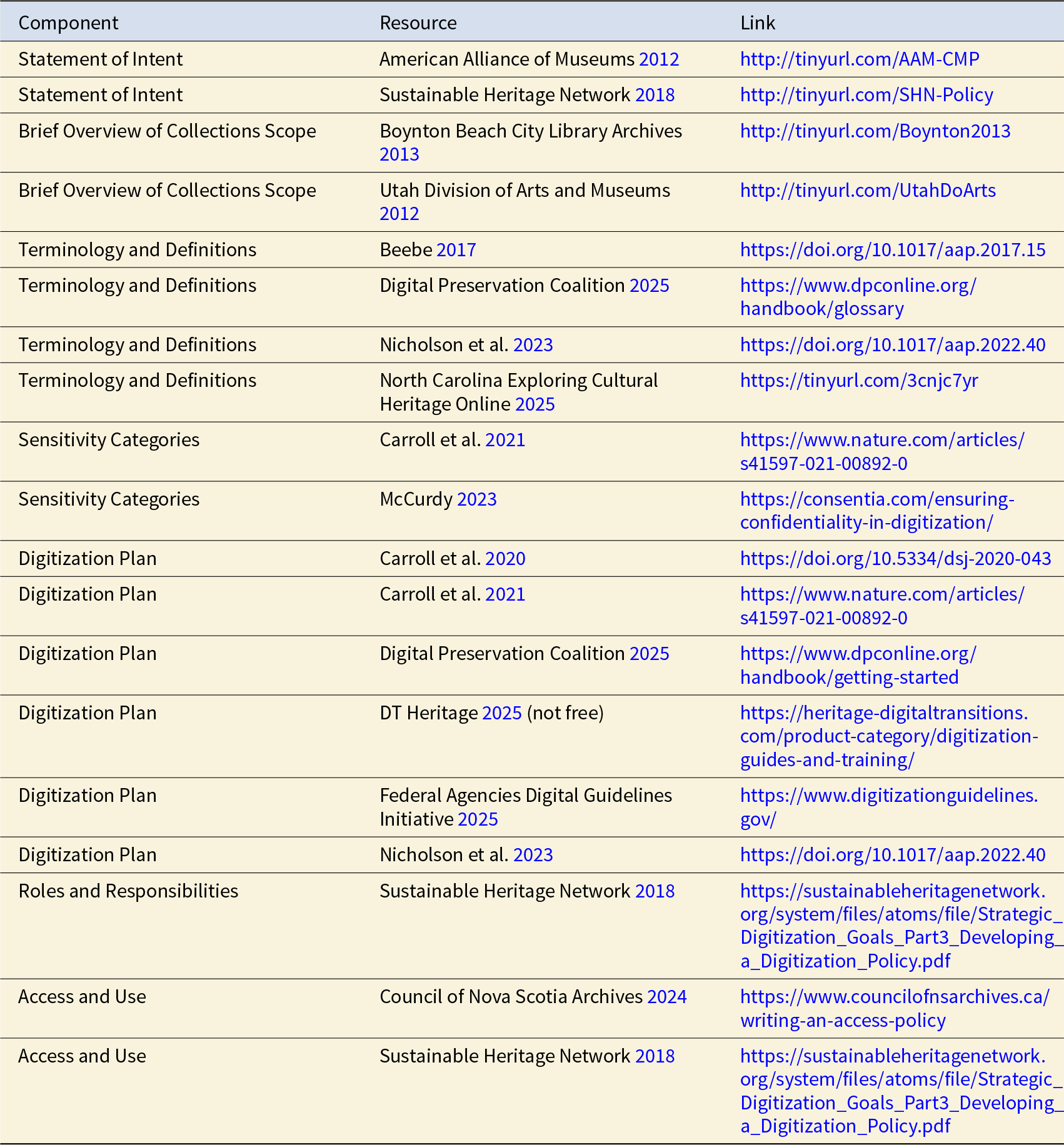
The steps below are separated into two sections: first, the steps you need to take prior to the drafting of your digitization policy; and second, the components that we recommend including in the policy itself (Table 1). We have also included additional citations intended to further delve into the technical nuances of the recommended policy components (Table 2).
Considerations and Components.

Additional Resources.
Pre-draft Considerations
Determine Authority to Digitize Collections
The first step is to determine an institution’s authority to make decisions about digitization. This begins by understanding the institution’s obligations under NAGPRA and conferring with the entity with management responsibility (possession or control, in NAGPRA terminology) for the records. NAGPRA explicitly defines, and draws a distinction between, custody and possession or control.Footnote 5 An institution that has custody, but not possession or control, must coordinate with the institution with possession or control prior to making collections management decisions that are not already codified in their curation agreement, or a similar document. A digitization policy, like any other policy developed by your institution, should specifically outline which collections fall under its authority and which do not. Associated records that are under the authority of another institution should be addressed in any policy on a case-by-case basis but always in consultation with the institution with management authority.
Obtain Management Approval/Support
Identify the individual(s) who need to approve this effort and ensure that they support the creation of a digitization policy. This is also the time to pinpoint who will review and approve a policy. Engage or establish any appropriate committees who can provide multiple perspectives on the draft document. For example, if your institution has a NAGPRA committee or review board, coordinate with them to ensure that they are informed throughout the process as it pertains to records from sites with NAGPRA components. They may also be actively consulting with Tribal Nations and need to be aware of what efforts are taking place within the collections. If there is no committee or review board, then make sure your direct supervisor is supportive. We also highly recommend that you consult with Tribal Nations, descendant communities, or other groups on your policy as early as possible. Finally, consider funding needs, if any, for drafting the policy and for future digitization efforts.
Identify Roles, Responsibilities, Resources, and Your Schedule for Policy Development
Identify your schedule for completing the drafting of your policy and determine who will be responsible for the individual components. You may want to divide the labor based on existing expertise—if someone already knows about metadata or digitization software, for example, or if another person works in public education, maybe they are the best individuals to develop those sections of the policy. You might also divide labor among the review steps: one person might take the initial draft, another review and edit a second draft, and a third do quality control prior to final approval. Regardless of the division of labor, it is important to ensure that these tasks are assigned ahead of time and that a schedule for completion is associated with them. This could be anything from student labor to grants (departmental, institutional, private, federal), to institutional line-item funding. Understanding the resources available will help you make decisions about the volume of digitization you can handle.
Assign Sensitivity Levels to Collections/Documents
The next step is to define the parameters that shape the sensitivity levels of individual records. Several excellent examples of this in practice include the Digital Archaeological Record (tDAR) and Mukurtu.org, a free, open-source collaborative platform for sharing digital cultural heritage where sensitivity levels are arranged around building a community and setting community protocols. Additionally, the Society for American Archivists (the “other” SAA) endorses the Protocols for Native American Archival Materials, a First Archivist Circle document, which can be accessed via the SAA’s website.
In many cases, digitized records are more readily findable than analog records, making them more prone to requests for access. It is recommended that institutions establish a four-level system for categorization to enable staff to make informed decisions when these requests arise:
Level I: Closed or sealed records. Examples include records requested by one or more Tribal Nations to be “closed” to all except members of that community, such as records documenting the private details of a religious ceremony. These records will not be digitized.
Level II: Highly sensitive information. It should not be shared without the informed consent of connected or affected communities. Examples of this category: skeletal data records, information about cultural practices, photographs of interments or human remains, archaeological site data, and any information deemed sensitive during consultation with Tribal Nations. Some records may be determined accessible within the parameters of specific protocols.
Level III: Possibly sensitive information. This includes all records that are not “nonsensitive” (see below), have not been identified as highly sensitive or closed, or that have not been previously consulted upon. The institution should carefully review any requests for access and consult with connected or affected communities. Examples of this category: records concerning potentially “nonfunerary” areas at sites that contain interments and collections that have not been previously consulted upon but are not currently known to contain Ancestors or cultural items subject to NAGPRA.
Level IV: Information considered nonsensitive at this time. Examples include records (field notes, journals, etc.) from collections that have already been summarized and made available to Tribes for review under NAGPRA Section 6 (but with site locations redacted), and records previously reviewed for sensitivity by culturally affiliated or connected Tribal Nations and/or communities.
Components of a Policy
Statement of Intent
An institution’s mission and goals can change in response to a variety of factors. For instance, when NAGPRA was first enacted, institutions were required to complete tasks (inventories and summaries, for example) that had not previously been part of their collections management strategies. With the recent revisions to the regulations, more changes may be required in institutional policy or procedures. Regardless, it is useful to identify the intent of drafting the policy at the beginning of the document. Each time you return to your policy, reflect on whether the intent or mission you are working toward has changed, and whether you need a policy update to reflect those changes. One example of a statement of intent could be “To facilitate public access to records determined through consultation to be nonsensitive.” It could also be “To make records documenting historical cultural practices findable and accessible to contemporary Native practitioners.” Your institution’s mission and goals will inform your intent.
Brief Overview of Collections Scope
Your institution may be responsible for various types of collections (archaeological, ethnographic, archival, etc.) or collections for which you have custody but not possession or control under NAGPRA. A digitization policy should discuss the records associated with all collections, whether there is a known NAGPRA component, and whether you currently have the authority (or means) to digitize the records. We suggest that you also include the volume of the records under discussion (linear feet, cubic feet, etc.). When you discuss your digitization plan you will identify what will or will not be digitized and why, as well as your timeline for completing that work. A policy outlines an institution’s approach and perspective on a specific topic; if you are saying that certain collections are not eligible for digitization, you should be able to refer to those collections in your collections scope. For example, “Collection A contains Native American Ancestors and associated funerary objects from two mounds, as well as pottery and faunal remains from a nearby hearth. The associated records include skeletal data forms, field reports, and photographs of individual interments.” Listing this collection in your initial scope allows you to refence it for both your sensitivity categories and in your digitization plan. Do not make assumptions about whether you will be able to digitize certain associated records. Let the institution with possession or control and the culturally affiliated Tribal Nation(s) make those decisions in consultation.
Terminology and Definitions
Your policy may be read, used, or shared by a variety of people at and outside of your institution, so including a list of terms and their definitions is important. This will allow anyone reading your policy to “speak the same language” and ensure consistency in the application of your process and protocols. There are many resources available that collate the various terms you might find useful, though if you have never digitized before, you may wonder which terms will be needed, or useful. (What is a checksum, anyway?) Defining terms directly from a reference guide into your policy may not be helpful, because it is through context that these terms have meaning. Ideally, you will define these terms in your own words in your policy, so that they contain the nuances specific to your institution or project. The best way to start building this section is to think about the reasons you might want to digitize, then review the terms tied to those actions. So, for example, if you think digitization will be useful to help you restrict access to certain images, you may want to include terms like “copyright,” “licensing,” or “intellectual control.” It is okay to amend any section later, and it is also certain that your first project will give you greater insight into the needs of your policy than anything else can.
Sensitivity Categories
The best time to create your sensitivity categories is prior to drafting your policy. For any records pertaining to NAGPRA, you should consult with Tribal Nations with potential cultural affiliation on these categories, the types of records or information that should be covered by each, and the types of users appropriate to the level (if any). When you draft this component of your policy, be sure to not only discuss the overarching categories but also how the records discussed in your collections scope fit into the individual categories. As the revised regulations make clear, federal agencies and museums have a “duty of care” to Ancestors and cultural items in their custody or in their possession or control. While not explicitly stated in the regulations, it seems clear that the duty of care should extend beyond Ancestors and their belongings to their descendants and their communities. Institutions have a duty to minimize harm in whatever way possible; supporting Indigenous data sovereignty through consultation on records management is a minimum standard that should be adopted.
This section should expand on the standard categories to include the types of control that will be enforced: for example, will you be implementing password control? Will certain types of information (site locations, descriptions of Ancestors or funerary objects) be redacted? Will you implement labeling policies to alert users to types of sensitive content? Whatever you decide, these are appropriate terms to add to your terminology in your policy.
Digitization Plan
This is the decisional section of your policy. What, specifically, will and will you not digitize? You can do this in two possible ways: (1) you can refer to your scope of collections and decide for each one, treating this section as a workplan; or (2) you can more broadly discuss here the exact types of record that may be digitized, per the results of your consultation. If you are deciding collection by collection, this should be done by a predetermined individual or position, per your established Roles and Responsibilities (see below). Once you have an idea of the “what,” you need to move to the “how.” The logistics of digitization should be described here as well. What technology will you use? How will you structure your metadata? How will you establish a system to back up your files? What about file security? Some of the most important decisions you will make here may seem the simplest: something like how you name your files and folders can have a significant impact on the usability (and findability!) of the data later.
Roles and Responsibilities
Define what roles will need to be filled, and who should fill them. While it is fine to associate an individual with a role, ensure that you also associate a job description with role completion, to account for individuals leaving their positions. You will need to outline the responsibility for completing each individual component of the policy, in addition to any associated responsibilities from your planning stages, and a decision-making authority. Consider who works with different document classifications, especially sensitive and closed materials. Consultation may have provided you some insight into who should be permitted to do so, and this should be factored in as you assign these roles.
Access and Use
Whether records are digitized or not, it is important to delineate who should be able to access them, how they may do so, and what parameters will guide their use (publication, research, etc.). You will need to define the categories of people (researchers, Tribal Nations/communities, descendant communities, students, institutional staff, etc.) and decide whether they have conditional or unconditional access, what the conditions might be (unlimited, limited, within certain dates, certain records only, etc.), and how they are able to use the data they collect. Decisions about access and use should consider any sensitivity of the records and whether consultation has ever occurred for the sites included within the collection(s).
Timeline and Review
Are you planning on continuously digitizing your collections? This would mean you are beginning at a determined time and then moving through collections until all items identified to be digitized are complete. Any new records received would join the queue. You also may decide to digitize in a staggered manner, due to time, funding, or other reasons. In this scenario you might do two collections in 2026, two collections in 2027, etc. You also may have a minimum or maximum of records per year, which could be related to student labor, interns, or grants. Sometimes you may digitize only on a case-by-case basis, such as when certain types of record come in, or when reference is requested: “We will digitize all topographical maps associated with sites x, y, and z,” for example.
Establish a date for your policy to be reviewed. A five-year timeline is common, but in the early days of your policy, especially when you are first navigating identifying your sensitivity levels and are potentially involved in active consultation with Tribal Nations, you may want to review every two or three years. It is also important to outline who will be reviewing, and whether your regular review will continue to include consultation. We recommend that it does include consultation each time, to ensure that all sensitive materials are identified and categorized to the best of your ability. This timeline can be a simple table at the end of your policy.
Conclusion
The digitization of records may or may not be a viable step for your institution, particularly if your volume of records is heavily weighted toward those deemed sensitive by consulting Tribal Nations or other descendant communities. A number of factors must be considered prior to crafting a policy that would guide this process, including the privacy of the records and of any communities or individuals who might be affected by access to, or use of, them; the long-term research utility of any data; the authority of your institution to digitize the records; and the plan for allowing and facilitating access, among other details. Regardless of the final decision made by your institution—to digitize or not to digitize—this decision should be codified in a policy that ensures that all employees, visitors, concerned parties and communities, et cetera, understand exactly what the institution will and will not do as far as records management is concerned.
Once your institution decides to take on the task of drafting a digitization policy, or a records management policy that includes a digitization clause, they have a responsibility to ensure that the digital records are carefully curated, just as any physical records collections would be, and that the data contained in those digitized records are protected to the maximum extent possible by law when they contain sensitive information, as required by the NAGPRA regulations. Digitization may appear to be an easy solution to a variety of problems—records decay, access and use, storage—but it is important to remember that a digital record requires just as much care and maintenance as an analog record and brings with it additional considerations as far as sensitivity and sovereignty are concerned. Institutions should weigh their decision carefully and in consultation with connected communities.
Acknowledgments
The authors are grateful to the peer reviewers who read this in all its iterations, and for their thoughtful and considered comments and edits, which strengthened this article enormously. We also thank the editors of this special issue for including this article and for supporting the ongoing role of repatriation and return within the discipline. We acknowledge that the data we discuss in this article are solely the intellectual, spiritual, and cultural property of the Indigenous peoples and communities from whom they originate.
Funding Statement
This research received no specific grant funding from any funding agency or commercial or not-for-profit sectors.
Data Availability Statement
No original data were used.
Competing Interests
The authors declare none.


 Open access

