


Asylum periodicals’ external circulation gave patients a chance to communicate with the outside world, advocate for themselves, and resist their marginalisation in public discussions on madness. Through the publications, those labelled as insane constructed a unique identity in the margins that was shaped by two equally powerful forces. On the one hand, patients’ self-representation across titles resisted and counteracted prejudiced cultural discourses, emphasising patients’ humanity, reason, and similarity to those not living in asylums. On the other, it was a source of empowerment, as patients also expressed a sense of pride in their resilience in the face of adversity and ability to form a supportive, compassionate community. Asylum periodicals gave them opportunities to exclude the ‘sane’ as morally inferior due to their prejudice and lack of understanding, criticising, or mocking society in turn. As Vicky Long argues in her discussion of the Morningside Mirror of the Royal Edinburgh Asylum: ‘Contributors frequently held up the Mirror as a mirror on sanity and insanity, reflecting commonly held beliefs about madness, only in reverse.’1
The dual process of resisting and reciprocating exclusion was complicated, especially since asylum periodicals accommodated a multiplicity of voices of patients and staff whose agendas diverged and occasionally clashed. Excelsior, the publication of the James Murray Royal Asylum in Perth, Scotland, perfectly conveys the complex and often inconsistent process of identification of ‘us’ and ‘them’, accompanied by the equally ambiguous construction of a cross-institutional and international ‘we’. Despite the editorial control of the physician superintendent, Dr William Lauder Lindsay, the periodical openly fought against the marginalisation and misrepresentation of mental patients. Its campaign against prejudice was at times inconsistent and contradictory, but it was nevertheless the publication where an idea of patients’ consciousness as a distinct community with a distinct literary culture was first crystallised. Despite tensions and antagonism behind the scenes, Excelsior was a space where the clashing voices of different actors could be reconciled and united around the common goal of representing the asylum and its inhabitants before the outside world. Demonstrating a keen interest in patients’ writing, the periodical emphasised the existence of a distinct tradition of ‘lunatic literature’ and sought to forge a group identity of mental patients as valuable members of society who were unjustly rejected, scorned, and pitied.
Insider/Outsider: Resisting Exclusion and Excluding the Sane
The permeability of asylum walls, which my discussion has highlighted so far, had significant implications for patients’ sense of identity. As asylum periodicals joined the flow of print across institutional walls, they offered not only insight into asylum life but also opportunities for patients to speak back to society. They allowed the mad to challenge ideas of madness by employing a complex rhetoric, occasionally leveraging their disadvantaged situation to regain their voice. As Reiss has pointed out, patients were ‘in some senses rhetorically liberated by their own civil death’, which ‘allowed on occasion for a more dangerous, even perverse, play of ideas’.2 While I have repeatedly shown that the stay in an asylum could be a temporary phase or a stepping stone in some patients’ lives, rather than a final ‘civil death’, institutionalisation could indeed serve as a rhetorical tool for social and political criticism. Contributors often treated their status as ‘lunatics’ as a source of expertise that allowed them to suggest social reform and to question the sanity of prominent figures entangled in public scandals and disputes of the day.
Asylum periodicals occasionally represent the experience of institutionalisation as a source of expertise and authority, reserved for those who had suffered from mental illness or had direct observations on asylum operations. John Reid Adam’s first article for the Morningside Mirror, after entering the Royal Edinburgh Asylum, was a reflection on the benefits of amusements in asylums. In it, he drew on ‘the ample experience which the writer has had as a patient in lunatic asylums, (having been nearly five years in the Glasgow, and more than one in the Hanwell Institution)’.3 While refraining from ‘advanc[ing] opinions, on any subject, unless he has some personal experience of the matter’, he referred to his long career as a patient in different mental institutions as a source of invaluable knowledge that allowed him to make proposals about the future development of asylums.4 A similar remark appears in an article in the Meteor about the literary clubs in the Alabama Insane Hospital, which ends with the author’s advice to asylum superintendents: ‘Our experience with these modest literary ventures justifies us, we think, in recommending similar essays to the officers of other institutions for the insane.’5 Asylum periodicals were therefore platforms where patients could present their first-hand observations to the wider world and even to the medical community. In this way, the insane could claim authority on matters of their treatment and demand to be perceived as collaborators with valuable insight into their condition.
Similar attempts to earn approval and demonstrate worthiness can be detected in asylum periodicals’ communication with the literary world and employment of literary conventions. For instance, an editorial piece in the fifth issue of the Morningside Mirror states that:
while utterly disclaiming all vain-glorious feelings founded on any humble merit of its own, we do not altogether deny a feeling of complacency combined with a moderate degree of inward gratification on observing the interest with which the revolving period of publication was generally expected, and the welcome with which its appearance was hailed within the walls of our territory. We may also have some reason to be proud of the manner in which the work has been noticed by a few more august and serious friends out of doors who, free from the influences of partiality that may exist among ourselves, have kindly recognized and encouraged our feeble attempts.6
In this statement, the humility topos is not only put into its conventional use of earning the reader’s sympathy. It also seeks to emphasise the author’s moral uprightness and sanity, and consequently, the literary value of the Mirror. It is a performance of self-moderation, displaying exaggerated composure and resistance to extreme emotions despite the success of the publication, which is simultaneously underlined.7 As publications such as the Athenaeum, Tait’s Edinburgh Magazine, and Chambers’s Journal saluted the publication, the article expresses satisfaction with the validation coming from established, respected titles. It shows the Mirror’s aspiration to be admitted to the literary clique of ‘serious’ periodicals and be treated as an equal, a ‘friend’.8
However, the article is far from servile in its tone. A footnote in its beginning draws attention to the employment of the editorial ‘we’ throughout the piece:
Although it must be a matter of indifference to our readers, yet from the circumstances under which our little periodical is published, and in order to prevent any misapprehension on the subject, we think it proper to mention that in here adopting the style editorial we must be understood as speaking in a manifold character [emphasis in original], and also to intimate the probability that if not more numerous, we may at least be composed of ‘two single gentlemen roll’d into one’.9
The first editorial article in the Mirror bears two signatures, ‘J. F. R.’ and ‘G. P.’, indicating that it was run by two patients, with the encouragement of the physicians.10 The editors’ engagement with the trope of the editorial ‘we’ in this footnote demonstrates both their acknowledgement of their disadvantaged position and their attempt to subvert prejudice. The clarification that they use the plural purposefully, not only following literary convention but also reflecting the reality of there being two editors, does not only mock readers’ doubts about the authors’ sanity. It also ridicules the literary convention of the editorial ‘we’ itself, drawing attention to the ‘madness’ of the single editor who speaks of themself in plural. The editorial duo of the Mirror is thus represented as saner than the sane.
Furthermore, the image of the ‘two single gentlemen roll’d into one’ is a reference to a satirical verse by George Colman, the Younger. In the original piece, a man takes lodgings in London, suffers horrible fevers at night, and finds out that his bed is over the oven of his host, who happens to also be a baker.11 The poem concludes: ‘For one man may die where another makes bread.’12 It is possible to read the reference to this piece as a hidden attack on the asylum, where patients could be confined until their death, while physicians made money. The bitterness in the remark about readers’ lack of interest in what the editors had to say in the footnote suggests that the authors’ scorn could also be directed to society’s general neglect and interest in profit over the well-being of its members. The footnote’s resentful mockery towards the sane readers within and beyond the institution makes the fake modesty in the main text seem more forced. Humility itself was thus a weapon. Through an exaggerated performance of self-annihilation, the patients defended their value as producers of literature and challenged the world of the sane.
Instead of proving patients’ worth or feigning humility to hide their frustration, other contributors to asylum periodicals employed a less diplomatic tone and attacked the injustice and hypocrisy they perceived. A piece in the Asylum Journal of the Vermont Asylum expressed indignation with the dismissive attitudes patients faced: ‘Some people imagine that every idea, opinion and expression of an Inmate of an Insane Hospital is necessarily devoid of reason or sense, and therefore unworthy the serious consideration of the sane world.’13 The author then narrates an anecdote about a well-prepared, eloquent reform advocate who presented his report to a city council:
[The report] was read, listened to attentively, and seriously for some time, until some one [sic] hinted that the author was a patient in the Lunatic Asylum. This announcement immediately changed the opinions of the venerable members, and they discovered false premises, followed by erroneous inferences, verbose pomposity and extravagance of style, where, before, all was simple, unaffected, true and important …. [It] is quite probable that with all his deficiencies, he was better qualified to sit in an alderman’s chair, than many of his learned and sane judges.14
The dramatic change of the listeners’ opinion caused by the disclosure of the speaker’s status as a mental patient exposes the society of the sane as foolish, superficial, and swayed by prejudice. The insane speaker, on the other hand, is portrayed as a victim of injustice, who is not only equally but more capable to bear the responsibilities of power.
Similar sentiments and challenges to authority are expressed in other titles. James Buchanan’s Gartnavel Gazette also used insanity as a weapon against the supposedly sane world. Discussing an account of the growing political tensions prior to the Crimean War published in the Times, the editor proposed that
the whole of this war panic might have been prevented, by quietly sending his Supreme Highness [Emperor Nicholas I] to rusticate during the Summer months in our Establishment at Gartnavel; besides, we then might have enjoyed the extreme felicity of having a truly illustrious contributor to the pages of the Gazette [emphasis in original].15
Despite the humorously teasing tone, the author’s frustration with his own condition and the obscurity that accompanied it can be detected in the emphasised phrase. In its issue for July 1876, the Meteor remarks that figures of authority often exchanged accusations of each other’s moral corruption and mental or intellectual deficiency: ‘We are continually hearing Congressmen, editors and others, calling each other thieves, idiots and imbeciles. Funny, isn’t it?’16 In the nineteenth-century ‘mixed economy of welfare’, as Stef Eastoe terms it, people labelled as lunatics, idiots, or imbeciles often found themselves living together in asylums.17 Thus, the origin of the periodical invests this innocently ironic question with a lot of power. The statement that precedes it becomes a satirical comment on a world run by insane and immoral people. Implied in this excerpt is another question: if the whole world was mad, why did some lose their liberty and rights, while others kept them?
This question was repeatedly echoed in the pages of asylum periodicals, and the absence of a clear answer inspired new creative strategies for seeking satisfaction. An article by ‘Ralph Remmington’ titled ‘A Crazy Man’s Common Sense’ and published in the Opal of the New York State Lunatic Asylum begins thus:
Out in the world you cannot understand us. It is no use. Our sphere is not in the world. It does no good to blow our trumpets, display our colors, and harangue outside people. … We are an isolated class; what we say is for ourselves, not for you, to toss about as a pretext of bigoted fight.18
Eannace interprets the article as an indicator of ‘a creeping despair that underlies [most] of these [patients’] writings’ towards the end of the Opal’s run.19 However, defiance and even a hint of pride are also detectable in this seeming acceptance of marginalisation and become clearer, as the article unfolds:
If you are sane people, then be led by sane leaders; those who will lead you to think and act things rational. If any of us presume to chatter uncouth craziness in the world, your duty demands you, for the sake of Commonweal, to prevent us talking thus injuriously to society, by placing us in some fitting enclosure of lunacy; your bounden duty behoves you to isolate us, to place us as a class by ourselves …. The crazy have no right of public freedom of speech; and the sane ought not even to listen and much less in the least be actuated by the harangues of insanity …. What rectitude of sentiment or action is that which allows the mad man Orr, the Angel Gabriel, to run his random career of injury?
Here ‘Ralph Remmington’ cleverly uses his unprivileged position as a madman to launch an attack against John Sayers Orr, an anti-Catholic street preacher who inspired several near riots in America in the mid-1850s.20 Reiss’s interpretation of the article as ‘a bitter kind of defence against having one’s ideas pathologised’ also threatens to push the main point of his writing to the side, by arguing that the subtext is the real message.21
In the article, ‘Ralph Remmington’ performs an impossible, yet effective, argument. While risking to undermine his own message, he publicly embraces his marginalised position and renounces his and his fellow sufferers’ right to speak in order to advocate the silencing of an influential political figure. At the same time, his opening words constitute a symbolic gesture of enclosure, accentuating patients’ bonding over their exclusion by the ‘inappreciative [sic] world’ of the sane.22 As the accusation contained in this quote suggests, however, both gestures, of self-annihilation and of exclusion, are performative. The author proclaims exclusivity of his discourse to attract the attention and sympathy precisely of external readers. His apparent humility is barely hiding his conviction that he, the crazy man, speaks common sense to the sane who are failing to perform their ‘duty’ – an idea introduced in the very title of the article. An aspiration to extract himself from the world of the insane can be seen in this gesture. It is also possible to interpret his argument against Orr as a rebellion against the perceived injustice of being locked away, while individuals that truly endangered social order are allowed to walk freely and cause disruption. The argument is thus torn by a two-way pull between denial of access and invitation to conversation. Ultimately, ‘Ralph Remmington’ was bound to be heard, even if not listened to: enclosed in the Opal, his message reached hundreds of readers.
Even when circulation was restricted, as was the case of the Gartnavel Gazette, there is no reason to believe that contributors and editors did not have a ‘sane’ implied reader in mind. This duality of purpose subjected patients’ identity to the influence of two diametrically opposed forces: resisting exclusion and excluding in turn. The argument of the article by ‘Ralph Remmington’ is a perfect example of how these conflicting pulls were manifested in patients’ writing, but they operated in more pervasive ways too. The use of anonymity, for instance, was also a way to restrict outsiders’ access to the asylum community. While contributors’ identity was likely known within the institution, anonymity aimed to keep external readers at a distance. Obscure references to members of the institutional population, referred to only with their initial(s) or pseudonyms, also made the publications impenetrable to people outside the asylum. At the same time, addresses to internal readers such as ‘brothers and sisters of Asylumia’ and references to ‘our community’ reinforced patients’ sense of belonging to a group sharing the same physical, social, and, with the establishment of asylum periodicals, literary space.23
While forging ‘a community separate from that of the “sane” world beyond the confines of the hospital’, as Turner puts it, asylum periodicals also challenged and rejected that separation.24 They tried to bridge the gap between the ‘sane’ and the ‘insane’ by emphasising patients’ humanity and literary ability and interrogating the sanity of the world at large. They challenged prejudices by displaying, as the Scotsman judged of the Morningside Mirror, ‘more sense and less silliness than many a periodical presumed to be the product of “sane” contributors’.25 Though cast outside society in the cultural imagination, the insane repeatedly sought their way back into public discourse through asylum periodicals, renegotiating their powerlessness and finding rhetorical force in their voicelessness.
Excelsior’s Physician-Editor and Mission
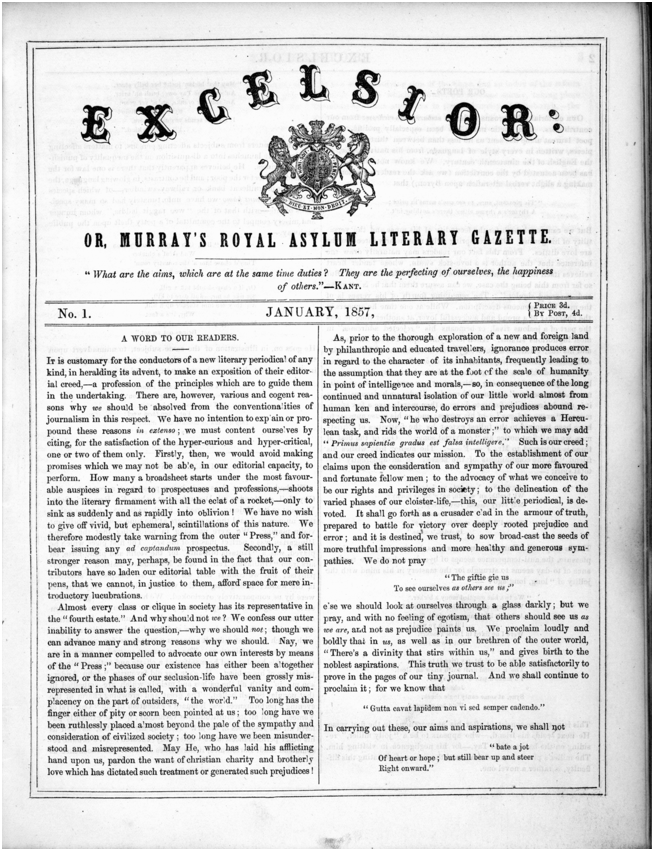
Excelsior, or the Literary Gazette of the Murray Royal Asylum (1857–1878) was an asylum periodical dedicated to fighting misconceptions about madness ‘by making the sane and insane better acquainted with each other, for … their mutual benefit’ (see Figure 7.1).26 The publication was committed to fighting prejudice and representing the insane more accurately. Though it received regular contributions from patients, however, the periodical was edited single-handedly by the superintendent, Dr William Lauder Lindsay, and was thus shaped by his views and aims. Despite evidence of the physician’s best intentions, this asylum periodical too was defined by tensions and contradictions, and its approach to achieving its goals was far from consistent.
Front page of the first issue of Excelsior: or, Murray’s Royal Asylum Literary Gazette, dated January 1857.
The James Murray Royal Institution for the Insane opened its doors on the outskirts of Perth on 1 July 1827. The founder, whose name it bears, was a local philanthropist whose family had various connections to the trade of treating insanity. The directors of the institution strove to keep it reserved for paying patients.27 The policy was likely at least partly motivated by concerns about the financial state of the institution, as well as the threat of overcrowding. A statement by Dr Lindsay suggests that the decision to admit only paying patients, was driven by an aspiration to offer better, more individualised care: ‘[the asylum,] from its limited size, is compelled to select its cases, and treat them very much en famille [italics in original]’.28 The Murray Royal was therefore a rather special institution whose population consisted predominantly of middle- and upper-class patients.
Having begun his medical career as an assistant physician to William A. F. Browne at the Crichton Royal Asylum in Dumfries in 1853–1854, Dr Lindsay was keen to develop the recreational programme of the Murray Royal to that level. From the start of his superintendency in 1854, he advocated the therapeutic value of occupation and amusement. In the first annual report, he declared that: ‘The introduction of Recreations among the insane can no longer be regarded as an experiment; their success has been fully established by the experience of the best asylums in this country, on the continent, and in America.’29 Having specialised in botany and especially lichens during his medical studies, Lindsay advocated especially the therapeutic effects of studying natural history and applied his views in practice by establishing a museum in the Murray Royal Asylum in 1855, a year after his appointment. He later reflected on the project, arguing that engaging with natural history ‘conduce[s] directly to the recovery or maintenance of Health, both of mind and body [emphasis in original], by leading to a large amount of open-air exercise with a specific and worthy object in view’.30 The healing process involved ‘the substitution of new and healthy grooves of thought [emphasis in original] for those which are old and morbid; and the revivification of both mind and body, which are the acknowledged result of such substitution when it has been accomplished’.31 Lindsay’s convictions in the health-restoring potential of recreation informed his practice not only as an alienist but also as a naturalist. In the introduction to his Popular History of British Lichens (1856), he portrayed a democratic vision of scientific practice, motivated by potential health benefits. He advocated the utility of natural history for ‘the educated of all classes of our community’ by emphasising the health benefits of the scientific study of the natural world.32 First in his list of social groups that would benefit most from such activity is ‘the invalid from our large towns, whose delicate mental and physical organization have suffered wreck in the too eager or engrossing pursuit of wealth or fame’.33 The author further advocates ‘the well-acknowledged influence over the human mind of gently-exciting studies as moral medicines of the most soothing, and intellectual food of the most nourishing, kind’. He assures his readers that ‘were he [the patient] to subject himself to such a course of mental and physical hygiene, we place his physician and all the potency of the materia medica [italics in original] at defiance’.34 As a form of recreation, the work of the naturalist was thus a superior instrument of recovery and general well-being.
Dr Lindsay’s motivations for launching a periodical, therapeutic or otherwise, are less well-documented, though writing could be seen as similar recreational activity that could stimulate ‘new and healthy grooves of thought’. Having witnessed the operation of the New Moon in the Crichton Royal Asylum, Lindsay was eager to launch a periodical in his own institution. In his report for the year 1854–1855, he lamented that ‘our limited community cannot vie with the larger sister Asylums of Scotland by supporting an Asylum periodical, otherwise the lucubrations of the inmates might occasionally fill a goodly broad sheet’.35 His idea lay dormant for a year, likely due to the limited number of potential contributors but also potentially due to a lack of support from the directors, with whom he had frequent disagreements.36
An event in October 1856, however, pushed the physician to mobilise his resources and carry out his plans for a publication. An article in Chambers’s Journal, titled ‘What Lunatic Asylums Really Are’, reviewed Lindsay’s latest report and showcased the various recreational activities offered in the Perth institution in order to ‘dispel the remnants of prejudice on [the subject of treatment in asylums]’.37 In the pursuit of that goal, however, the author of the review downplayed the uniqueness of the Murray, arguing that the entertainments mentioned were ‘a specimen of the practice at the first-class institutions everywhere’.38 On top of that, the last paragraph shifted the readers’ attention to another establishment: ‘In the Edinburgh Lunatic Asylum, one additional amusement strikes us as worthy of special notice – this is the preparation among the patients themselves of a monthly sheet of light literature, under the name of Morningside Mirror’.39 The article likely motivated Dr Lindsay to keep up with the other Royal Asylums of Scotland by overcoming whatever resistance he faced from the directors and launching his own publication. The first issue of Excelsior appeared in January 1857, only two months after this review.
Originally printed by Robert Whittet, a local printer in Perth, Excelsior was published irregularly between 1857 and 1878 under the editorship of the physician superintendent himself.40 In the first year, three issues of four pages each appeared. The price was 3d or 4d by post, and the periodical assured its readers that: ‘The profits are devoted to multiply the means of instructing and amusing the inmates of the Asylum.’41 In the second and third years, issues were published only in January and July, and from 1860 to 1864 publication became more irregular: two or three issues were occasionally merged into a single, larger number, with the price adjusted accordingly. Afterwards, it became an annual publication that appeared in January and consisted of one to three issues published together.
Excelsior itself reveals that the irregular publication was purposeful:
We prefer this [mode of publication] to any deviation from the original plan of ‘Excelsior’, which plan was that it should be an occasional or irregular publication …. The result of similar efforts elsewhere has shown that too much may be promised (in the form of too frequent an issue, and too ambitious a literary style,) and too little performed, inasmuch as the grand finale may be a sudden and total stoppage of publication [emphases in original]!42
Here and elsewhere, Dr Lindsay demonstrated great care in how he managed his periodical. Aware of his own limited resources and the challenges that other similar projects faced, he tried to manage readers’ expectations and reduce the time pressure on the publication. This approach resonated with Dr Lindsay’s views that the use of work in asylums should be driven predominantly by therapeutic and not economic interests.43 As profit was a secondary motivation, Excelsior was run at a more leisurely pace.
These circumstances could explain the superintendent’s function in the project not only as the official editor of Excelsior but as a major contributor. Exploring staff involvement in Under the Dome, Turner argues that it was ‘a pragmatic response to the transitory nature of most inmates’ hospitalisations’.44 Likewise, Lindsay’s concerns that the relatively small population of the Murray made it hard to gather enough contributions suggest that necessity was one of the reasons for his substantial participation. He fulfilled his duties willingly, though: nowhere in Excelsior is there a complaint of not having enough material or an urgent call for contributions. On the contrary, Lindsay explained that the practice of publishing multiple numbers all at once was necessitated precisely due to the abundance of submissions.45 The irregular mode of publication could have thus been chosen to offer Lindsay sufficient time to write and edit the magazine.
Excelsior was a publication heavily invested in pursuing the interests of the institution and the physician superintendent. Indeed, at least half of each issue was dedicated to news about the asylum, accounts of concerts, lectures, and other events, and reflections on the treatment of insanity. The last two issues, published in January 1877 and January 1878, were entirely written by the superintendent, and in 1878 they appeared as a separate publication under his name and the title General History of the Murray Royal Institution for the Insane.46 Beyond narrating the history of the institution and its recreational therapeutics, the volume serves as an index of the Excelsior numbers that reported on different entertainments. The final article, tellingly titled ‘Farewell’, reveals Dr Lindsay’s intentions to discontinue the periodical, declaring that it ‘has fulfilled the Mission with which it charged itself 21 years ago’.47 Bound together, the two issues constitute not only the official completion of Dr Lindsay’s literary project but a pamphlet promoting the institution and highlighting, for the last time, his contributions to the management of the institution. Excelsior can thus be read as a testimony to Lindsay’s work as an alienist.48
But what was his legacy and what was the mission that Excelsior managed to achieve? In ‘Farewell’ Dr Lindsay offers a list of eight completed objectives accompanied by references to articles from earlier issues of Excelsior to serve as evidence of the successful completion of each goal. The first two points relate to promoting the Murray Royal Asylum by providing an account of its history and the therapeutic recreations offered to its patients. Another goal of Excelsior is to keep track of ‘current events illustrative of the Natural History of Insanity or of the condition of the Insane in other countries’. Articles mentioned here relate to famous mad people in history and fiction, as well as the development of ‘lunatic literature’ (especially periodical publishing) in other institutions. The third and the fourth indicate an interest in the inmates as subjects of medical enquiry: ‘to supply samples of the peculiar (morbid) views of individual residents of a literary turn of mind – of their Delusions, as described by themselves – in ipsissimis verbis’ and ‘to submit characteristic illustrations of some of the peculiarities of Habit – some of the Eccentricities of behaviour – of members of our community’. Numbers five, six, and eight, however, show that Excelsior also aimed to represent patients as subjects who could gaze back at the world and express valuable opinions: ‘to offer to Inmates with the requisite ability and inclination a medium for the publication of their criticisms on men and things – local or general’; ‘to place our columns at the command of “correspondents” – invalids in other Hospitals – sometimes far distant – for the publication of their valued communications’; and ‘to give short accounts of the literary (published) contributions of mental Invalids in other places’.49 The easy flow of the list does not create a sense of a rift between these and the previous goals, suggesting that through Excelsior patients were both examined and listened to. It is likely that the privilege of being heard was reserved for convalescing and more highly functioning patients, while the writings of those in greater mental distress were more suitable for medical enquiry. Either way, the list of objectives is reflective of the plurality of perspectives Excelsior represented. The summary of its purposes shows that the periodical was more than a single physician’s attempt to record his own achievements and promote his institution. It manifests Dr Lindsay’s interest in what his patients and the inmates in other institutions had to say. It also suggests that his curiosity was not merely professional but driven by his desire to offer patients a platform for self-expression.
What makes Excelsior exceptional among other asylum periodicals is its militant activism against the misrepresentation and stigma of mental illness. The cause that the publication set to fight for was forcefully outlined in the opening article of the first issue:
Almost every class or clique in society has its representative in the ‘fourth estate.’ And why should not we [emphasis in original]? … We are in a manner compelled to advocate our own interests by means of the ‘Press;’ because our existence has either been altogether ignored, or the phases of our secluded life have been grossly misrepresented in what is called, with a wonderful vanity and complacency on the part of outsiders, ‘the world.’ Too long has the finger either of pity or scorn been pointed at us; too long have we been misunderstood and misrepresented.50
Compared to the sincere or feigned humility with which other asylum periodicals addressed their readers, Excelsior stands out with its boldly phrased charge against prevailing prejudice. Surely, the confident rhetoric was due to the position of the editor, who, unlike patient-founders of other asylum periodicals, was the most powerful person in the institution. Together, Dr Lindsay and the patient-contributors could speak freely of society’s unjust portrayal and treatment of the mad.
The intentions expressed in the first issue were pursued in various ways throughout the publication’s run. Like other asylum periodicals, Excelsior also sought to represent the Murray Royal Asylum as a busy hub of cultural and social activity. For that purpose, it included a ‘Chronicle’ (or ‘Events’) rubric at the back of every issue that recorded the events that had taken place between its numbers. It also frequently featured more detailed accounts of the celebrations, theatrical and musical performances, and lectures organised in the institution. Excelsior also engaged with public discussions about madness and discussed instances of misrepresentation. One article from 1868, for example, scorned Perth’s local community’s tendency to believe depictions of the insane in the press, under titles such as ‘Horrors of Private Asylums’, ‘Shocking Treatment of a Lunatic’, and ‘Vagaries of the Insane’.51 ‘Instead of making themselves personally acquainted with us’, the author says, ‘they prefer to feed their imaginations with ideas derived from such sensational articles; which, when not the grossest exaggerations, or pure fictions, represent exceptional features of social life’.52 In this account, the sensationalism of the 1860s was a major obstacle to Excelsior’s mission of correcting misconceptions about insanity. Though the article refers to the sane in third-person plural, the anonymous author, likely a patient, spoke to external readers too. This is hence yet another example of the simultaneous reciprocation of exclusion and longing for connection. Drawing a clear line between ‘us’ and ‘them’, the article nevertheless urged ‘outsiders’ to overcome their fears and prejudice and get to know their neighbours.
However, Excelsior’s treatment of sensationalism is not uniform. The opening article of the same issue, bearing the title ‘Insanity in Fiction and in Fact’, offers a different take on the cultural representations of madness. Reflecting on the proliferation of sensation fiction at the time, the author enumerates some of the most recent additions to the genre, among which Charles Reade’s Hard Cash (1863), Mary Elizabeth Braddon’s Lady Audley’s Secret (1863), and William Gilbert’s Dr Austin’s Guests (1866), and argues that:
The uninitiated reader may naturally suppose the pictures contained in these Novels … to be the terrible exaggerations of a poet’s or novelist’s license …. In certain respects some of them are undoubtedly exaggerations; but in certain others – in their limning, for instance, of the protean hues of delusion, or the infinitude of bizarreries of conduct and speech in the Insane, – they cannot be stranger than the truth itself.53
From the tone of speaking and the reference to ‘the Insane’ here, it can be inferred that the author of the article was a physician (potentially Dr Lindsay). The argument here allows the neutralisation of the harsh attacks on mental institutions, by dismissing it as a sensation-driven exaggeration. At the same time, the editor praises the more positive depictions of asylums. He commends their authors’ knowledge of ‘Psychological Medicine’ and ‘Lunacy practice’, while finding the depictions of patients and their suffering across all literature to be unproblematic.54
The development of the article, however, complicates its interpretation as a physician’s attempt to defend the project of psychiatry at the expense of patients. In his discussion of insanity ‘in fact’, Lindsay turns to travel writing that refers to mental institutions in Turkey and Greece. He argues that British asylums ‘have reached a comparative perfection [emphasis in original]’, though ‘much remains to be done – especially in educating the public in sounder, more liberal, and more enlightened views on Insanity and its proper treatment’.55 The article ends with a lengthy list of famous insane people throughout history and a recommendation for the New Moon, where curious readers could find ‘several contributions to the list of eminent individuals, who have been insane or eccentric at some period in their lives’.56 Though neglecting the errors in the depictions of the insane, Lindsay thus perceived the proliferation of sensation literature in the 1860s as a positive trend. He saw it as an opportunity to promote public engagement with insanity as a widespread social problem and advertise well-governed mental institutions as its best solution. Consequently, he continued to keep track of accounts in the press and fictional works dealing with madness, as well as autobiographies of sufferers, for the rest of Excelsior’s run.57 The recommendation of the New Moon also demonstrates the physician’s faith in asylum periodicals’ potential to enlighten and educate the public.
In addition to the lists of works addressing madness, Excelsior also reviewed or reprinted the literary works of current or former patients in the Murray Royal and other institutions. For instance, a notice of Alexander Smart’s poetry collection Songs of Labour and Domestic Life and a reprint of one of his poems appeared in the issue of January 1861.58 Informing readers that ‘the Library Committee ordered a copy of the [collection] for our Institution Library’, the author urged them to ‘Go and do thou likewise!’59 Excelsior was interested in the writing of mental patients abroad too. When one of the assistant physicians visited the Bicêtre Hospital in Paris, he heard the patients sing a song the lyrics of which had been written by one of the inmates there. He sent the text to be printed in Excelsior.60 These instances suggest that Dr Lindsay’s intentions for the periodical cannot be reduced to self-promotion and advertisement of his own institution. Excelsior displays his keen interest in what patients across institutions had to say.
One of Excelsior’s main rhetorical strategies of advocating the value of patients’ voices consisted of reminding readers that insanity could befall anyone. Reviewing a book by a former patient at the Glasgow Royal Asylum (James Frame), an article addressed the condescension and pity that tainted the public reception of biographies and autobiographies of insane people. The reviewer observed that:
Some value has also been attached by the sane to biographies of certain of the insane. Who can read the history of the lives of Robert Hall or Edward Irving, of Cowper or Swift, or Chatterton, without an absorbing interest. But it is an interest of a peculiar kind; there is a pity mingled with a certain amount of loathing and condesension [sic]. … We look at mad divines and mad poets, somewhat as schoolboys gazing through the bars of a menagerie.
We are not sure, however, that autobiographies of the insane have in the public mind any value at all, though they may here and there excite a small amount of compassionate interest …. Such an estimate of this class of autobiographies we regard as a most unfortunate, unjust, and mistaken one.61
Sensitive to society’s judgmental gaze directed at insanity, even when its victims were prominent social figures, the author launched a defence of the writing of current and former patients. To the insane, it argued, it could offer hope and guidance how to persevere through their illness, and it could prepare the sane for a potential unexpected onset of insanity in the future. The author cautioned his readers that no one was immune to mental illness, so genuine care, understanding, and solidarity should displace pity and contempt. This warning to the sane was expressed often in Excelsior. As one of the regular patient-contributors, put it, ‘there are none [emphasis in original] who do not, at some time, or in some respects, come short of the standard of perfect sanity’.62 Eroding the division between the sane and the insane, Excelsior sought to change public perceptions of the mad and encourage compassionate interest in their writing and lives.
Though Dr Lindsay’s writing dominated the periodical, he left room in Excelsior for the voices of those whom he tried to represent, though sometimes the motivations of that inclusion did not align with patients’ interests. The periodical seems to have been open to works that would have been rejected by other asylum periodicals. While the Asylum Journal accepted patients’ writing ‘on all subjects except those of their hallucinations’, Excelsior included such writing, though the purposes and effects of this editorial permissiveness were not unproblematic.63 An example of such a contribution is ‘Nature Delineated’, a front-page article written by patient Thomas Lindsay and signed with his initials. The piece narrates the author’s discovery of ‘eternal life’ and the subsequent salvation of the world from destruction, including the following reflection: ‘All nature is war. It is fighting for food. It lives by mutual trespasses. It lives by perspirations from “eternal nature,” the source of good and evil; and by its safety valve, eternal life, every moment a breath – both these my own discoveries.’64 Thomas Lindsay’s case notes indicate that the article was a selection of ‘his long dissertations on the “all pervading principles of nature”’ and that he was ‘proud of his literary abilities, & [thought] he can write for his bread’.65 However, his published work is introduced with an editorial remark emphasising that the patient’s writing was not chosen for its literary merits:
There is talent in every stage of cultivation or sterility, eccentricity or errancy …. To possess a substantial Psychological value, ‘Excelsior’ must therefore record, so far as possible, every phase of our conceptions and actions – thoughts, words, and deeds. Provided a contribution offered us is with propriety printable, we do not refuse insertion on the score of the novel or heterodox character of the views which it may contain …. Be it observed, however, that though literary merit and psychological interest may combine to give value to one class of articles, in other cases, the contributions of least literary power will be found of greatest psychological value. To the paper on ‘Nature Delineated’ we not only give place – and a prominent place – with pleasure; but we would draw attention to its great interest as a contribution to psychology and psychopathy.66
Considering this comment and the patient’s literary aspirations, the Meteor’s criticism of Dr Lindsay’s policy of exposing patients’ minds before the public gaze (discussed in Chapter 5) seems justified. It is difficult to reconcile the attitude expressed here with the aforementioned concerns with the public’s condescension towards the insane. By highlighting the psychological over the literary value of the patient’s writing, the editor’s introduction perpetuates the Othering of madness, encouraging readers to continue examining mad writing ‘as schoolboys gazing through the bars of a menagerie’.67
It is hardly surprising that in the following year, Thomas Lindsay refused to write more. The reason mentioned in the case notes is, however, not obviously connected to indignation with the way his writing was framed: ‘He will not put his cogitations in writing upon any considerations, [answering?] that Dr L. Lindsay cheated him out of the profits of his contributions to Excelsior.’68 Though there is no evidence that any of the contributors to Excelsior were monetarily rewarded, his insistence on being treated as a professional writer worthy of payment for his efforts asserted the importance of his writing and demanded that he was treated as a full-fledged literary producer. Thomas Lindsay’s refusal to write restored the full value of his writing, though only symbolically. The whole episode suggests that Excelsior’s campaign for better representation of the insane was occasionally inconsistent, as different voices and perspectives clashed or subverted each other. Like other titles I have discussed, the Murray publication was thus characterised by tensions that could disrupt the collaborative process of its production, as well as by conflict, contradiction, and ambiguity in its pages.
The Patient-Contributors of Excelsior and ‘Lunatic Literature’
Despite its inconsistencies, Excelsior did not fail to represent patients’ views, as some patient-contributors were potentially emboldened to speak up about discrimination, stigma, and marginalisation by the superintendent’s outspokenness about these matters. The stories of some of the periodical’s regular contributors show that Excelsior was a joint attempt of patients and staff to overcome interpersonal tensions and represent themselves as individuals and a collective. Through the publication, patients could find empowerment and opportunity to publicly assert their worth as literary producers and valuable members of the asylum community. Finally, Excelsior’s engagement with the term ‘lunatic literature’ and its encyclopaedic interest in the writings of the insane made it the first manifestation of a cross-institutional community united not only by the shared experiences but also by a literary tradition.
A key figure in the history of Excelsior was William Gilbert Christie (‘W. G. C.’), admitted in 1838 at the age of twenty-nine and remaining there until his death in 1885.69 Between 1859 and 1876, he was responsible for maintaining the ‘Chronicle’ column, but his initials also appear regularly under reports on trips and recreational activities in the asylum and acknowledgements of donations of money and additions to the museum and the library of the institution.70 His initials are found among the names of the benefactors too.71 The reprints of theatrical programmes in Excelsior show that he was involved in most productions, and in the 1860s he was the stage manager of the asylum.72 His detailed case notes reveal that, beyond his involvement in the cultural activities, his good mathematical skills earned him the position of bookkeeper.73 He also served as general assistant to the Housekeeper, Miss Shearer, helping her run the evening classes for other patients.74 His participation in the management of the institution suggests that even the unsigned accounts and lists of events and classes in the first issues of Excelsior were likely his production. His responsible role in the periodical and the life of the asylum is reflected in the incorporation of the title ‘Registrar’ in his signature from 1864 onwards.
The case notes strongly suggest that, despite Christie’s prominent place in the operation of the institution, he was far from the staff’s or the patients’ favourite. According to his records, ‘his predominant & characteristic feature is vanity & he presumes on his usefulness & the liberty & indulgence he is in consequence thereof allowed by becoming very officious & frequently impertinent & overbearing. He is much given to mendacity, prevarication & exaggeration’.75 Christie enjoyed being the centre of attention and had a demonstrable ‘penchant’ for Miss Shearer, which was accordingly pointed out as the sole reason for his interest in helping her out.76 The case notes also mention that, ‘when his vanity is in any way wounded or when his plans or wishes are thwarted[,] he feigns serious illness’.77 As a result, he often caused trouble for the staff, and his fellow inmates grew ‘quite worn of his practices & look[ed] on with the utmost indifference’.78 Christie is thus represented as manipulative, abusive of the privileges he was granted, and irritating to most of the inhabitants.
None of these sentiments were articulated in Excelsior, where Christie’s importance to institutional life is repeatedly displayed, both through the continuous inclusion of his contributions and through open expressions of appreciation. In 1873, the periodical included a piece dedicated to his achievements and valuable work for the Murray, and in the article titled ‘Farewell’, Dr Lindsay expressed his ‘lasting gratitude’ to ‘W. G. C.’, referring to him as ‘our staunchest of all good friends’ and mentioning him first in the acknowledgements.79 It is hard to tell how the physician truly felt about his patient. Perhaps prioritising Excelsior over interpersonal frictions, Dr Lindsay nevertheless had to rely on Christie’s involvement and allowed his voice and presence to assume an honourable space in the periodical.
The case of Rev Mark Wilks William James is another example of the compromise that drove Excelsior. James was transferred to the Murray Royal from a private asylum in September 1862. Upon arrival, he expressed ‘a wish to obey all the rules of the institution, even in small matters’ and seemed happy to socialise with other inmates.80 However, he soon appeared paranoid and started assaulting both fellow patients and attendants. His notes state that he did not participate in the dances often, ‘partly on account of his aversion to certain patients’.81 Christie is named as a source of annoyance and a target of James’s animosity and eventually suffered an attack by the Reverend.82 Subsequently, on 4 May 1864, James was moved to Elmhill House Asylum (an addition to the Aberdeen Royal Asylum), ‘much to his own gratification & equally so to our [the institution’s] own’.83
James was nevertheless involved in the communal and literary activities of the institution, with Dr Lindsay’s encouragement and support. Within a few months of his admission, he served as chaplain, taught the Bible Class, compiled the library catalogue of the asylum, and was engaged in writing.84 His first piece appeared in Excelsior in January 1863. It was an account of a zoological exhibition at the asylum museum that had taken place in November and had attracted not only inmates and staff but local families from Perth.85 In the case notes, Dr Lindsay described the piece as ‘very good’, noting, however, that such ‘mental work does not always improve his excitability – if too severe’.86 James’s description was prefaced by Dr Lindsay’s own general reflections on the museum and its ‘conversazione’, which introduced the patient-contributor ‘to tell his tale in his own way’.87 Admitting his own lack of in-depth knowledge of zoology and natural history, the Reverend disclosed that: ‘it is at the request of those whom he would not willingly disoblige [emphasis in original], that he has been bold enough to supply an article, relating to a department of science which is nearly, if not quite, new to him’.88 Despite the author’s humility, the article filled five columns of Excelsior with detailed description of the specimens, their origins, and classifications. It demonstrates knowledge acquired through engagement with natural history, as prescribed by Dr Lindsay. And while writing his impressions down was not consistently soothing to the patient, the article shows the physician’s role in encouraging patients to contribute both as fellow naturalists and as joint authors.
James’s signature appeared after the leading pieces in all three issues of Excelsior that were published during his stay, and his writings continued to be published in the periodical years after his transfer to Elmhill House.89 For instance, his account of an excursion to the farm providing milk to the asylum that took place in July 1863 appeared in the issue for January 1865.90 The inclusion of such an out-of-date piece indicates a lack of fresh patients’ writing deemed suitable for publication. However, the prioritisation of James’s works during his stay and the preservation and later publication of his pieces show that patients’ disruptive behaviour did not necessarily limit expression. The articles also show that potentially troublesome patients like James, whom another physician described as ‘the most dangerous man in Britain’, were given comparatively unusual liberty of leaving the Murray and engaging with recreational and educational activities.91
James’s significance to Excelsior, however, lies in his contribution to one of the periodical’s objectives, namely, to provide a platform for patients’ ‘criticisms on men and things – local or general’.92 The physician himself pointed out the articles produced by ‘M. W. J.’ as examples of this function of the gazette.93 James’s ‘Motley’s Reflections on the Magazines’ was published nearly two years after his transfer. Dated ‘Elmhill, February, 1865’, the contribution reveals that, despite the antagonism between the patient and the staff evident from the case books, he continued to write for Excelsior from his new residence. The article occupied the first two pages of the issue of January 1866 and was intended as a preface to a series of reviews ‘of the professedly sane Magazines of the period’.94 James’s justification of his future project carves out a space for discussion and criticism of ‘sane’ culture in the periodical that both draws a clear line between the asylum and the world and subverts the distinction between madness and sanity:
People in the outer world … might be amused by seeing what sort of opinions are formed of those humbugs, who pretend to be in their right minds, by us, who of course make no pretension of the kind: – those at least of a psychological turn might be curious to observe in what respects our ideas and opinions correspond with, or differ from theirs, on the same subjects …; and readers within Institutions of this sort [emphasis in original], having a literature of their own, might be pleased to see among its contents some kind of review attempted by one of themselves, of those well-known Magazines, which are continually circulating through their sitting-rooms, halls, and galleries.95
This statement demonstrates much more than patients’ active and continuous engagement with contemporary periodicals – a fact already evident from the catalogue of the asylum library, which included both local and national titles such as the Perth Courier, the Scotsman, Chambers’s Journal, Good Words, Athenaeum, and London Illustrated News.96 Like the contention that there is no perfect sanity, James’s suggestion that the periodical press in general was dominated by the writing of ‘humbugs, who pretend to be in their right minds’ seeks to shorten the distance between the worlds of the mad and the sane. At the same time, the notion of patients ‘having a literature of their own’ sets the writings of the mad apart, demonstrating the formation of a community conscious of its own literary tradition.
The simultaneous seeking of distinction and reunion is observable throughout the article, as the author adopts a purposefully ambiguous, ironic tone to deliver his message. At one point he asks:
‘What is the chaff to the wheat?’ Some of our readers perhaps may feel disposed to invert the proverb, and ask, ‘What is the wheat to the chaff?’ [emphasis in original] in a sense analogous to the mad prince’s remark upon Falstaff’s tavern-bill, ‘But one poor half-penny worth of bread to all this monstrous quantity of sack!’ But one poor half-penny worth of sense, – they might say, – to all this monstrous quantity of chaff! Such a charge, we confess, we may not disavow; but … we would just venture, with submission, to hint the possibility, that in all this ‘monstrous quantity’ of chaff, a grain or two of good wheat may be found, to reward the kindly reader’s patience; and that even in our most nonsensical rigmarole, some faint traces of meaning, and glimmerings of sense may be discernible by the diligent and astute investigator.97
Here, the distinction between the chaff and the wheat, a biblical metaphor for God’s judgement, is employed in a commentary on the assessment of literary value and its relation to sanity.98 Through the initial question, its inversion, and then its answer through the slightly misquoted words of Prince Hal in Shakespeare’s Henry IV, Part One, the article defends mad writing from neglect, arguing that among the vast quantities of rambling, there is some sense, wisdom, and potential literary merit.99 Towards the end of the passage, James adopts a meek and humble tone to advocate the value of patients’ literary contributions and attempt to win sane readers by flattering their kindness and enticing them to give his own and other insane literary productions a chance.
Similarly to other instances of patients’ writing already discussed, the humility of this article is carefully performed and ironic. The ‘submission’ with which the author begs the reader for tolerance and patience is subverted by James’s demonstration of wit, learnedness, and fluent engagement with literary culture. The reference to Henry IV is accompanied by the following footnote: ‘As we quote from memory, not having Shakspeare [sic] with us to refer to, it is possible the quotation may not be verbally accurate; we believe the sense [emphasis in original] of the great Dramatist is correctly given.’100 The presence of this footnote indicates a degree of perfectionism, of aspiration to show that any errors in the text are a result of limited resources rather than ignorance or carelessness. The emphasis on capturing the ‘sense’ of the words furthers the author’s argument that his writing, the production of an alleged madman and the material expression of his mind, is nevertheless capable of capturing and conveying valid views.
The boundaries of sanity are further challenged through the reference to Prince Hal as ‘the mad prince’ in the main text.101 Equating the character’s youthful unruliness to madness subverts the very meaning of insanity. In the play, his behaviour undergoes a dramatic change: he is a rowdy young man who eventually redeems himself. The prince explains his debauchery as intended to make his eventual transformation more impressive:
Whether James took Prince Hal’s words at face value, or considered his change genuine, is difficult to establish, but either way the reference to the character’s behaviour as madness has implications for the reading of the article.103 At the very least, it suggests that madness is transitory and can be suddenly reversed. If Hal’s transformation is interpreted as staged, however, the author recasts his madness as a performance too, suggesting that in fact he is sane and capable of producing meaningful and valuable work. He himself is a kernel of wheat in the chaff of madness in the asylum. And just like Prince Hal’s ‘madness’ is an instrument of manipulation, in the process of performing madness, the author of the article gains an advantage through his deceit, finding empowerment in his status as an alleged madman.
The critique James intends to produce in the proposed series of articles is laboriously described as:
literary and scientific, of words and ideas, perhaps too prolific, erudite, explanatory, and exegetical, prosy and pious, … quizzical, rather than metaphysical, by no means empirical, slightly satirical …, befittingly national, lucidly rational, for progressive improvement and pro-educational, but not upon any account sensational [emphasis in original].104
The playfully indulgent demonstration of the author’s wit, knowledge, and eloquence here turns a mocking eye to the seriousness and gravity that society attributes to the judgement of texts. However, references to science, empiricism, self-improvement, and rationality make James’s article a critique of the very activity of judgment – of texts, the world and other human beings. The emphasis on sensationalism or rather on the pledge to refrain from it constitutes an ironic promise of compassion. The madman’s criticism of the sane and their periodicals will be morally superior to the prejudiced distortions of judgement he himself has experienced. Or, perhaps, it will not. Towards the close of the article, the author states that ‘it is our wish to be sportive and if possible, amusing, without being cynical or unreasonably severe; while, as a sort of compensation for the want of personal liberty, we claim the fool’s privilege of a pretty extensive latitude of animadversion and freedom of expression’.105 While morally superior in his aspirations for compassion in judgement, the reviewer will attempt to avenge himself and his fellow sufferers, transforming his madness and loss of freedom into licence to speak critically of the sane world.
By launching a series of reviews of ‘sane’ titles, the author reverses the direction of the gaze, just like he reverses his question about the wheat and the chaff. He aims his criticism at society and its press, while advocating the value of his and his fellow patients’ writing. A sequel to these reflections was never published, and it is unclear what happened with James in and beyond Elmhill House. Even as a stand-alone piece, however, the article is a bold attack on the unfair judgement of the mad and their writing. Through the literary allusions, the footnote, and the complex play with language and different texts, the author adopts a strategy similar to Joseph Alexander Goree’s in the Meteor, discussed earlier in the book: he presents himself as a man of culture and high education, hoping to prove his sanity by enacting Enlightenment ideals that connected taste with reason. His article also shows the formation of a cross-institutional insane community conscious of its own distinguishable and valuable literary culture – at the very least, it demonstrates Excelsior’s attempt to construct it.
One of the most notable aspects of the periodical of the Murray Royal is its engagement with the term ‘lunatic literature’.106 In the press at the time, similarly phrased references to the writings of the insane (such as ‘literature of madness’) were in wide circulation.107 However, Excelsior treated ‘lunatic literature’ as a distinct genre that deserved to be explored and engaged with. The inclusion of delusional writing and reprints and reviews of current or former patients’ poetry and published books were all part of this project, but its most significant manifestation were the lists and reviews of other asylum publications. Excelsior was by no means unique in its interest in other publications. Turner has shown that the ‘New Moon actively engage[d] with similar patient publications, reporting on titles as the editorial team is made aware of them, and attempting to construct a network of journal exchange’.108 Indeed, the New Moon warmly welcomed Excelsior with a poem written for its launch.109 In Chapter 2, I have shown that asylum periodicals were interested in each other, and editors were eager to welcome new titles like their own whenever they were aware of such. While Turner interprets that phenomenon on the pages of the New Moon as a way of ‘promoting the literary culture of Crichton and furthering the reach of its journal’, the case of Excelsior suggests that these exchanges and the practice of mutual reviewing achieved more than that.110 They cultivated a sense of an existing ‘mad’ literary subculture with its own history and tradition.
While mentions of other periodicals in the New Moon tended to be rather brief, in the 1860s–1870s, Excelsior pursued an encyclopaedic project which comprised of producing lengthy reviews and lists of other titles that belonged to what the periodical explicitly called ‘lunatic literature’.111 In January 1866, it offered a general overview of treatment in asylums, paying special attention to the spread of periodical publishing in mental institutions.112 Another article, published seven years later, enumerated asylum periodicals published in other British asylums, including the New Moon, the Morningside Mirror, the York Star, and the relatively recently launched Loose Leaves of the private asylum in Church Stretton in Shropshire, England.113 The following number offered a much more comprehensive discussion of asylum periodicals. The opening article, titled ‘Lunatic Literature in America’, discussed in detail in the Meteor of the Alabama Insane Hospital and the Friend of the Pennsylvania State Hospital for the Insane in Harrisburg. It also mentioned titles that had ceased publication: after contacting Dr Mackintosh of the Glasgow Royal Asylum, the author had found out about its internally circulated newspapers, the Chronicles of the Monastery and the Gartnavel Gazette.114 The ease of access to information demonstrated in these articles suggests that their author was none other than the superintendent. Excelsior’s bibliographic project culminated in Lindsay’s ‘Farewell’ article in the last issue, which presented an annotated list of all titles known to date.115 By keeping track of asylum periodicals, Excelsior reinforced a sense of an existing literary tradition to which it itself belonged.
The physician’s agenda or means of achieving the goals that Excelsior set out to pursue did not always match the patient’s desires or even interests, but the periodical of the Murray Royal Institution nevertheless stands out with its active engagement with the representation of the insane. The superintendent’s seemingly permissive policy of inclusion of disruptive inmates’ contributions, even after their departure shows his dedication to Excelsior and the compromises he had to make as an editor. Perhaps it even indicates the physician’s genuine recognition of the importance of showcasing patients’ work to promote reform in the cultural perceptions of madness and the institutions that contained it. His consistent interest in ‘lunatic literature’ demonstrated in the reviews of publications by current and former patients of his and other asylums aligns with patients’ own approach to addressing their marginalisation. Excelsior’s embracing of the term ‘lunatic literature’ is yet another manifestation of the distinction of mad writing as unique and exclusive and the simultaneous reconciliatory emphasis on its value, importance, and equality to the productions of the sane.

 Open access