1.1 Introduction
Submarines have, for centuries, occupied a position of fascination, fear and imagination. The early submarine was conceived of by inventor Leonardo da Vinci, whose sketches envisaged a boat able to submerge and attack enemy vessels.Footnote 1 English mathematician William Bourne drew up plans for such a vehicle in 1578 and, over the following decades, early patents were filed and designs began to take shape. In 1775, the submarine acquired its first military purpose. George Washington provided the funds for the construction of the three-metre-long Turtle, which was designed to affix explosive charges to British ships during the American Revolutionary War. It achieved little success. In 1864, the H. L. Hunley, a submarine of the US Confederacy, made the first successful military attack on a vessel, sinking the Union’s Housatonic warship. The US Navy Submarine Force was founded in 1900, with the British Royal Navy Submarine Service forming soon after. By the time World War I (WWI) commenced, all major powers and a smaller number of other States had an active submarine service.Footnote 2 Submarines began to be powered by diesel-electric engines, making them viable instruments of war. As the US Ambassador to the United Kingdom observed in 1917: ‘The submarine is the most formidable thing the war has produced – by far – and it gives the German the only earthly chance he has to win.’Footnote 3
During WWI and World War II (WWII), submarines were indispensable in the war effort. The German U-boat force wreaked havoc on its enemies, and Japanese midget submarines were used in attacks on Pearl Harbor and Sydney Harbour. Nuclear-powered submarines commenced operation shortly after WWII, with the USS Nautilus entering into service in 1955. Since that time, submarine technology and weaponry have advanced significantly, with submarines now serving as among the most expensive, significant and powerful pieces of military technology.
Submarines have also occupied important places in public consciousness. From the legends of Alexander the Great’s explorations of the ocean floor using antediluvian submersibles, the futuristic submarine Nautilus in Jules Verne’s science fiction classic Twenty Thousand Leagues Under the Sea,Footnote 4 to the more recent Hunt for Red OctoberFootnote 5 and Das Boot,Footnote 6 depictions of submarines are well known and indicate an ‘unending fascination with underwater seafare’.Footnote 7 In 2023, the world was engrossed by the disappearance of the Titan submersible near the wreck of the Titanic, drawing new attention to the use of submarines for private scientific and leisure purposes.Footnote 8
In contemporary settings, the recent Australia-United Kingdom-United States (AUKUS) alliance, which will see Australia make the first acquisition of nuclear submarines by a non-nuclear power,Footnote 9 has sent a ripple through Indo-Pacific geopolitical fault lines. The ongoing use of submarines as an instrument of war has been made apparent by the use of submarine-launched missiles by Russia in the Russo-Ukrainian War,Footnote 10 and in tests by North Korea.Footnote 11 While submarine warfare has been rather limited since the end of WWII,Footnote 12 an increasingly diverse number of States have prioritised the capacity to undertake both submarine warfare and anti-submarine warfare in their national defence strategies, evidenced through the proliferation of increasingly powerful and expensive submarines.
A distinct current trend is that military submarines are now operated by a growing and ever more diverse group of States.Footnote 13 In particular, it is notable that military submarines are increasingly concentrated in the Asia-Pacific region, as opposed to the past and present great powers and a select few other highly advanced economies.Footnote 14 This phenomenon is said to be as a result of economic growth in the region and, as such, can be considered a ‘catching up’ of the region.Footnote 15 Further, Wong estimates that there will be more than 250 submarines operating in the Asia-Pacific by 2030, which raises ‘the spectre of unintended escalation of issues rising from unplanned encounters at sea for submarine operators’.Footnote 16 There is a clear ‘pattern of proliferation’ in the region, not only of submarine platforms but also for anti-submarine warfare capabilities.Footnote 17 The impetus for these States acquiring submarines is diverse; for the larger economies, it is to preserve sea lines of communication and trade/energy security; for smaller economies, the impetus may lie in submarines’ ‘utility for covert surveillance and intelligence collection rather than war-fighting purposes’.Footnote 18 The extent to which this regional proliferation, as well as submarine proliferation more broadly, is cause for concern has, however, been debated.Footnote 19
Clearly, States recognise the critical security functions of intelligence gathering, surveillance, reconnaissance and power projection of submarines during both times of peace and war, as well as their other non-militaristic State functions in scientific research, environmental monitoring and surveying. New uses and applications for submarines are constantly being identified, particularly through their growing acquisition by non-State actors, and submarines increasingly support commercial operations at sea as well as scientific and recreational activities. Private uses of submarines have also extended to less peaceful uses, such as international drug smuggling. The role of submarines is further being enhanced through the development of autonomous or remote-controlled underwater craft, turning what was once science fiction into our new reality. In turn, it is becoming increasingly apparent that each of these unique purposes may point to the operation of different international laws.
The renewed focus on submarines, the further development of submarine technology and their progressively myriad uses, including by non-State actors, inspire inquiry as to the international legal regime applicable to submarines. An initial response may be that the law of the sea, as set out in the United Nations Convention on the Law of the Sea (UNCLOS)Footnote 20 and other rules of international law (especially those adopted within the International Maritime Organization (IMO)), applies to submarines as it does to any other vessel operating on the surface. The law of the sea is a critical starting point, as the evolution of rules relating to passage in particular has responded to developments in both submarine technology and the use of these vessels by State actors. An appreciation of the origin of these rules helps to clarify their content; yet it also raises questions as to whether the existing law of the sea remains fit for purpose in view of further developments in submarine technologies and uses, including the increasing use of underwater vehicles by non-State actors, who lack the entitlement to sovereign immunity afforded to States.
The very nature of submarines as underwater vehicles prompts a closer scrutiny of the existing rules. A rapid reveal shows that the legal frame for submarines is much more complex than it may seem at first blush. Other areas of international law that are implicated include international nuclear law, international marine environmental law, law of armed conflict and law on the use of force, transnational criminal law, laws relating to navigational safety, the law of salvage and international cultural heritage law. While the law of the sea is a significant context for the regulation of submarine activities, State and non-State uses of submarines also engage distinct subdisciplines of international law and, of course, core rules of international law relating to State responsibility, sources of international law, jurisdiction, immunities and the law of treaties, especially treaty interpretation. It is readily apparent that submarines are not a single legal issue, nor can they properly be folded into the treatment of all other ships at sea in all instances. Instead, the operation of submarines raises distinct and varied legal questions for consideration, which this book seeks to explore and answer.
A key aim of this book is to bring together all the international law rules that apply to the operation of different types of submarines. The military utility of submarines has seemingly allowed for submarines to be overlooked or excluded from explicit regulation in international law. Yet the deployment of submarines carries a variety of risks, including for the submariners on board, the safe operation of surface ships, the peaceful pursuit of other maritime activities, the protection of the marine environment and in international and national security relationships. In light of the lack of explicit focus on submarines typically afforded in existing international law, this book also seeks to indicate a path forwards to respond to ambiguities, gaps and inconsistencies that emerge from the current law. The general inclusion of submarines, along with other marine vessels, will be sufficient in some instances, but certainly not all. Our analysis draws out the specific rules, as well as regulatory gaps and weaknesses, and aims to show why lawyers and policymakers need to focus more on submarines in international law.
In this chapter, we first consider how ‘submarine’ may be defined for legal purposes in Section 1.2 below. It is readily apparent that submarines are predominantly associated with the navies and defence structures of States and a critical consideration in any legal examination of submarine operations is the sovereign immunity enjoyed by these military submarines. Section 1.3 provides an initial explanation of the relevance of sovereign immunity to the topic, which features throughout the book. To facilitate the book’s international legal analysis, Section 1.4 then details a legal taxonomy of submarines. Most notably, we consider how differences in the identity of the operator of a submarine, the nature of its propulsion and the technology equipped to it may implicate different international laws. Following this taxonomy, we introduce in Section 1.5 the international laws applicable to submarines, which will be further detailed in the remainder of the book. The concluding sections of the chapter provide an overview of the book, its contents and further explain its goals.
1.2 Defining the Submarine
It is first necessary to define, with some level of precision, the modern submarine. This task is not an abstract one; it is required to identify the vehicles with which international law is concerned. Definitional clarity is not only critical to drawing the metes and bounds of the applicable international legal regime, but, from an epistemological view, it focusses attention on the diversity of vehicles constituting the contemporary submarine extending beyond the large vehicles used for military purposes with which the term ‘submarine’ is most frequently associated.Footnote 21
A key definitional challenge exists in distinguishing between ‘submarines’ and ‘submersibles’. This difficulty is not a new one.Footnote 22 In the literature and in public media, these terms are often used interchangeably and inconsistently. In the law of the United States, a ‘semi-submersible vessel’ is defined as ‘any watercraft constructed or adapted to be capable of operating with most of its hull and bulk under the surface of the water, including both manned and unmanned watercraft’, while a ‘submersible vessel’ is a ‘vessel capable of operating completely below the surface of the water, including both manned and unmanned watercraft’.Footnote 23 The latter definition would appear to include what has come to be recognised as the modern submarine, though, in practice, submarines are rarely referred to as submersibles. The term ‘submersible’ typically refers to smaller underwater vehicles, such as bathyscapes, which are not generally capable of travelling long distances or otherwise undertaking autonomous activity independent of a support vessel. This latter understanding of submersibles is sometimes used in this book. The distinction between submarines and submersibles finds support in the dictionary definitions of the terms, which distinguish between the two categories of vessel by defining submarines as ‘a vessel, esp. a warship, capable of operating under water’, whereas submersibles are ‘small submarine[s]’, such as those used in ‘underwater exploration [and] drilling’, which are ‘capable of operating underwater for short periods’ and are ‘not independently powered, instead relying on batteries that have to be recharged by a support vessel’.Footnote 24
For the purposes of this book, we generally adopt an expansive approach to the use of the term ‘submarine’, such as to include vehicles capable of submersion regardless of size, level of autonomy, tonnage, weapons system, form of propulsion or status of ownership (i.e., operated by a State or by a private organisation). We use the ‘broad term “submarine” to designate all vessels capable of navigating totally submerged’.Footnote 25 As such, the midget submarines of WWI and WWII, small maritime autonomous vehicles and research vessels, and the modern, large nuclear-powered cruise missile submarine fall under the same umbrella. While the diverse characteristics of these vehicles may implicate the application of different international laws, the capacity for submersion is crucial and renders each vehicle a ‘submarine’ with which international law is concerned.
A further issue of nomenclature also warrants clarification. Submarines are sometimes referred to as ‘boats’, rather than as ‘ships’ or ‘vessels’. Traditional wisdom separates ‘boats’ and ‘ships’ by referring to the former as a smaller watercraft capable of being carried by another vessel and the latter as larger vessels. The reference to submarines as ‘boats’ is somewhat quaint, as many of them are substantially larger than modern surface warships. The reasoning for this quirk of definition is historical, with the classification of submarines as ‘boats’ coming from a time when submarines were significantly smaller and needed support from a ‘mother ship’. Complicating matters further, the names of submarines in the United States are prefixed with ‘USS’, or ‘United States Ship’.Footnote 26 This expression is not merely a convention in English. Most famously, German submarines are known in English as ‘U-boats’, an abbreviation of the German Unterseeboot (or ‘undersea boat’). Other examples can be found in Dutch (Onderzeeboot), Swedish (Undervattensbåt) and Russian (podvodnaya lodka). In this book, however, we generally refer to submarines, rather than boats, but emphasise that there is a vast diversity in the types of vehicles constituting the modern submarine, their varied operators and myriad usages and whether they are warships or not (as discussed in Section 1.3).
1.3 Sovereign Immunity and Submarines
A hallmark of submarines has been their military use; from the time of their initial development, submarines were considered as a vital component to a State’s naval power. To this day, submarines are predominantly counted as vessels within a State’s naval fleet. In Section 1.4, we set out a legal taxonomy of submarines to demonstrate that submarines comprise more than just warships. Yet throughout this book, in seeking to articulate which international laws apply to submarines, their primary use as warships also brings to the fore their sovereign immune status. Sovereign immunity has implications for the application and enforcement of international law,Footnote 27 and hence has core relevance for this study. In this section, we seek to explain when submarines enjoy sovereign immunity and provide a preliminary indication of the scope of that immunity. Part II of the book addresses the relevance of sovereign immune status for some submarines in relation to the each of the legal regimes considered.
UNCLOS recognises two categories of sovereign immune vessel. First, Article 95 of UNCLOS provides ‘complete immunity from the jurisdiction of any State other than the flag State’ to ‘[w]arships on the high seas’. Article 29 of UNCLOS defines ‘warship’ as ‘a ship belonging to the armed forces of a State bearing the external marks distinguishing such ships of its nationality, under the command of an officer duly commissioned by the government of the State and whose name appears in the appropriate service list or its equivalent, and manned by a crew which is under regular armed forces discipline’.Footnote 28 This definition is broadly equivalent to that provided for previously in Article 8(2) of the 1958 Convention on the High Seas,Footnote 29 and is largely accepted to reflect customary international law.Footnote 30 Importantly, while the term ‘warship’ may more readily conjure images of surface vessels, there is little debate that it extends to encapsulate submarines.Footnote 31 The history of the negotiation of Article 95 of UNCLOS, and the distinction between warships and other ships in earlier instruments of international law (including the 1856 Declaration Respecting Maritime Law,Footnote 32 and Hague Convention (VII) relating to the Conversion of Merchant Ships into WarshipsFootnote 33) suggest that the intention behind the definition of ‘warship’ was not to exclude certain types of military vessel capable of exercising belligerent rights (such as submarines), but rather was part of ‘an effort to outlaw privateering’ and to ‘limit certain belligerent activities to state ships’.Footnote 34 To this end, private fishing and other mercantile vessels that participate in military activities, such as the Chinese ‘maritime militia’, are not entitled to the sovereign immunity of the State.Footnote 35 There is, however, debate as to whether underwater maritime autonomous vehicles (UMAVs) constitute a warship within the meaning of Article 95,Footnote 36 and we address this question further in Chapter 14.
Second, Article 96 of UNCLOS affords sovereign immunity to ships on the high seas that are ‘owned or operated by a State and used only on government non-commercial service’. UNCLOS does not define the vessels that fall within the scope of Article 96, but examples can be taken from the commentary to Article 16(2) of the United Nations Convention on Jurisdictional Immunities of States and Their Property: ‘police patrol boats, custom inspection boats, hospital ships, oceanographic ships, training vessels and dredgers, owned and operated by a State and used or intended for use in government non-commercial service’.Footnote 37 This position was earlier reflected in Article 3 of the 1926 Brussels Convention, which excluded certain State-owned vessels (and their cargoes) from being subject to seizure, arrest or detention by legal processes when operated for non-commercial services.Footnote 38 More recently, the 1999 Convention on Arrest of Ships excludes from its scope any warship, naval auxiliary or other ships owned or operated by a State and used only for government non-commercial service.Footnote 39 The effect of Article 96 is to extend the grant of sovereign immunity to these types of vessels.
A question of immunity may arise in relation to submersibles that are tethered to or operated from a warship, and whether those craft share the immunity (as well as other rights and duties) of the parent ship. It may be possible to argue that as an extension of a warship, that the associated vessel enjoys the same immunity.Footnote 40 Doubts on this position may arise, however, when the vehicle or submarine in question is operating long distances from the parent warship.Footnote 41 Rather than consider any connection to another vessel, Kraska has argued, in his examination of maritime autonomous vehicles, that what is dispositive is not whether a vehicle is classed as a ship or not (or seemingly a warship or not), but whether it is State property.Footnote 42 Even if it is accepted that State property enjoys immunity, there may still be a question as to the scope of that immunity,Footnote 43 and whether it is commensurate with the sovereign immunity enjoyed by warships or a lesser status such as functional immunity, which aligns more with the immunity accorded to State agents.Footnote 44 The ‘complete’ sovereign immunity enjoyed by warships is the same as that enjoyed by government vessels operated on non-commercial service.Footnote 45
The unifying factor among Article 95 and Article 96 vessels is that both are operated by States and are not used for ordinary mercantile purposes. UNCLOS thus clearly excludes ‘government ships operated for commercial purposes’ from the scope of sovereign immunity afforded by the Convention,Footnote 46 subjecting them to the same legal regime concerning civil and criminal jurisdiction as merchant vessels when operating in the territorial sea.Footnote 47 The distinction between these vessels and those entitled to sovereign immunity ‘turns on the nature of the ship’s use, not the extent of the state ownership or possession’.Footnote 48 The exclusion of government vessels operated for commercial purposes from the scope of sovereign immunity has a long history,Footnote 49 and was expressed in Article 1 of the 1926 Brussels Convention.Footnote 50 In relation to submarines, those that are used for commercial exploration and exploitation, or are privately owned, do not enjoy sovereign immunity.
While reference in Articles 95 and 96 of UNCLOS is made to immunities on the high seas, sovereign immunity is also applicable in the exclusive economic zone (EEZ) by virtue of the operation of Article 58(2).Footnote 51 The sovereign immunity of warships and other government vessels operated on non-commercial service also applies in the territorial sea, but is subject to two limited exceptions.Footnote 52 First, a coastal State may request a warship failing to comply with its laws concerning innocent passage to leave its territorial sea.Footnote 53 Second, where a sovereign immune vessel causes loss or damage to a coastal State resulting from its non-compliance with the laws and regulations of that coastal State under UNCLOS, the flag State bears international responsibility.Footnote 54 Warships enjoy sovereign immunity in the ports and internal waters of other countries under general international law.Footnote 55
The effect of Articles 95 and 96 of UNCLOS is that States have no jurisdiction to interfere with the operations of other States’ sovereign immune vessels, which are unable to be arrested, detained, boarded or subjected to the coercive measures otherwise within the competencies of a coastal State.Footnote 56 Whether States may assert prescriptive jurisdiction over sovereign immune vessels when those vessels are within a coastal State’s maritime zones, as opposed to immunity applying to both prescriptive and enforcement jurisdiction, has been a matter of debate.Footnote 57 Article 236 of UNCLOS, which is discussed further in Chapter 12, has the effect of preventing the application of rules concerning the protection and preservation of the marine environment to sovereign immune vessels. It could be argued that the explicit exclusion of prescriptive jurisdiction in this provision of UNCLOS by implication suggests that prescriptive jurisdiction otherwise exists in relation to sovereign immune vessels. In this vein, Oxman has argued that immunity from enforcement jurisdiction ‘does not excuse a warship’ from respecting other provisions of the Convention, including rules relating to innocent passage in the territorial sea, nor may they ignore the rights of other users.Footnote 58 However, even if a coastal State’s law applies, it is not able to enforce those laws against a sovereign immune vessel. It is typically the exercise of enforcement jurisdiction that produces the most tension between States.Footnote 59
Submarines that are classified as warships or government vessels on non-commercial service thus enjoy sovereign immunity throughout ocean areas. Their sovereign immunity does not necessarily preclude the application of international law, as the flag State may still be found internationally responsible for the conduct of its submarines.Footnote 60 Instead, States are precluded from the exercise of enforcement jurisdiction (such as arrest or detention of the vessel and its crew) over sovereign-immune, foreign-flagged submarines.
1.4 Legal Taxonomy of Contemporary Submarines
To situate the discussion in this book, this section creates a typology of submarines presently known to be in operation based on the way that they are treated by international law. As discussed immediately above, whether a submarine is entitled to sovereign immunity is of paramount importance for determining the applicable legal regime. The availability of sovereign immunity thus provides a first key marker of distinction in categorising submarines in international law. We further distinguish between submarines depending on their form of power, as international law has specific rules for nuclear energy. Another legal distinction must be made depending on whether there is an operator aboard the submarine or it is remote-controlled or autonomous. The discussion in this section thus elaborates on a legal taxonomy of submarines that informs their regulation.
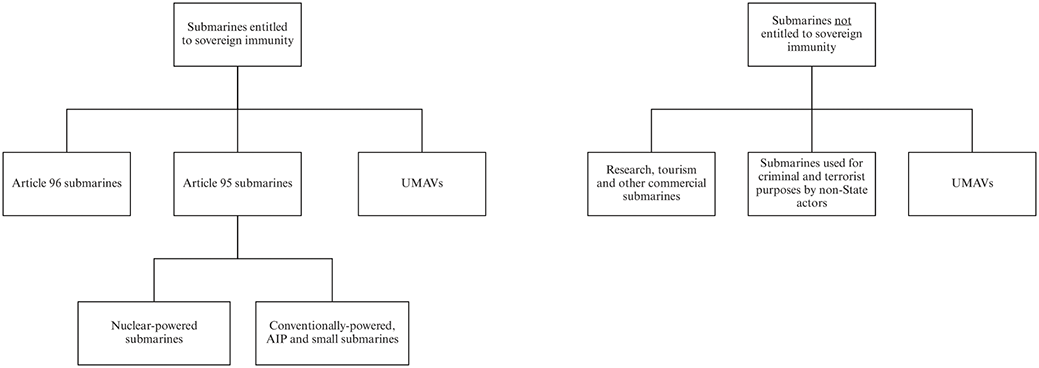
Considering the critical importance of the status of submarines as sovereign immune vessels (or not), our legal taxonomy initially divides contemporary submarines into two categories: submarines entitled to sovereign immunity (typically referred to as ‘military submarines’ in this book) and submarines not entitled to sovereign immunity. The former category can be divided into three second-level categories: warships entitled to immunity under Article 95; other vessels in government non-commercial service entitled to immunity under Article 96; and UMAVs. UMAVs are separated out into their own second-level category as they could be entitled to immunity under either Article 95 or Article 96 of UNCLOS.Footnote 61 Article 95 submarines can be further taxonomised by their mode of propulsion. In particular, a nuclear-powered submarine attracts the operation of an additional set of international laws compared to conventionally powered submarines. The submarines not entitled to sovereign immunity can be further divided into commercial submarines and UMAVs, both of which may be operated by State and non-State actors, as well as submarines used for criminal purposes by non-State actors such as narco-submarines. This taxonomy is reflected in Figure 1.1 below.
Legal taxonomy of submarines.
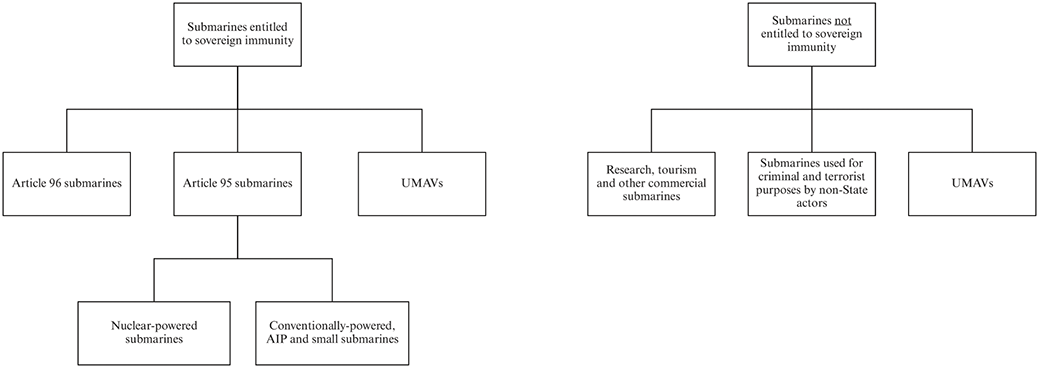
Figure 1.1 Long description
At the first level of the figure, submarines are divided depending on whether they are entitled to sovereign immunity or not. At the second level, sovereign immune submarines are divided between warships (Article 95) or not (Article 96) and underwater maritime autonomous vehicles (UMAVs). Non-sovereign immune submarines are divided between submarines used for commercial purposes, for criminal purposes and as UMAVs. At the third level, only warship submarines are further divided as between nuclear or conventionally powered submarines.
The task of taxonomising the contemporary submarine is constrained by the fact that details as to the characteristics and design of submarines, their ownership and their operational status are not always available. Secrecy often exists around submarines operated for military purposes, and certainly in respect of submarines operated for criminal purposes, of which little information is known unless they are captured or salvaged. Further, little information exists regarding submarines in private ownership as there is no requirement in international law – and often not in domestic law – for such submarines to be subject to central registration. For instance, a submarine may change ownership many times in a year, it may be put in storage and then made re-operational multiple times in a year, or research vessels may be used periodically by States and at other times by non-governmental organisations. These changes in status implicate the operation of different international laws. Further, the pace of technical advancement means that often what is known about certain submarines, or future plans for the development of submarines, may become inaccurate over time.
In addition to providing a basic mechanism for determining how submarines are treated in international law, this section also provides a brief introduction to the different types of submarines presently in operation and their contemporary relevance.
1.4.1 Warships
The first category in this legal taxonomy of submarines is warships, which we include within the label of ‘military submarines’. The submarines in this category are highly diverse, from the Russian Typhoon-class nuclear-powered ballistic missile submarines – the largest submarines ever constructedFootnote 62 – to the relatively tiny midget submarines of the Yugo- and Yono- classes operated by North Korea. In addition to the obvious characteristics of size and weight, the submarines in this category vary significantly according to their weapons systems (cruise and ballistic missiles carrying conventional and nuclear payloads, as well as torpedoes) and their mode of power (diesel-electric and/or air-independent propulsion (‘conventionally powered’), and nuclear).
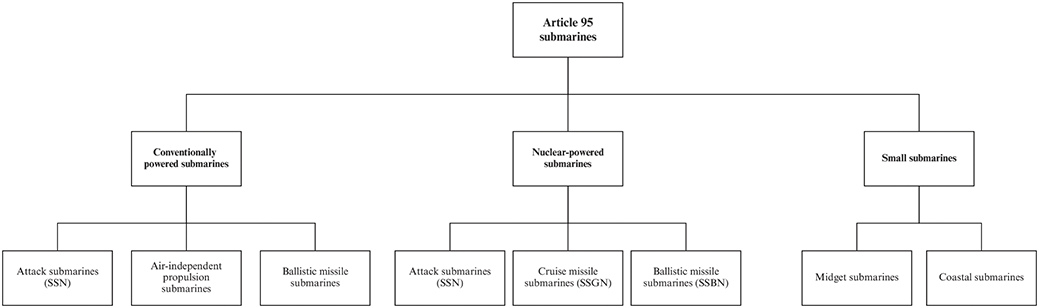
The submarines constituting warships can be further broken down as reflected in Figure 1.2 below. This further division of sovereign immune submarines generally does not bear on the application of international law, with one key exception. Nuclear-powered submarines are subject to different treatment in international law owing to their mode of propulsion. Submarines carrying nuclear weapons are subject to a broadly similar regime as nuclear-powered submarines, though the type of weaponry carried by a submarine may not always be publicly known.
Types of submarines considered as warships.
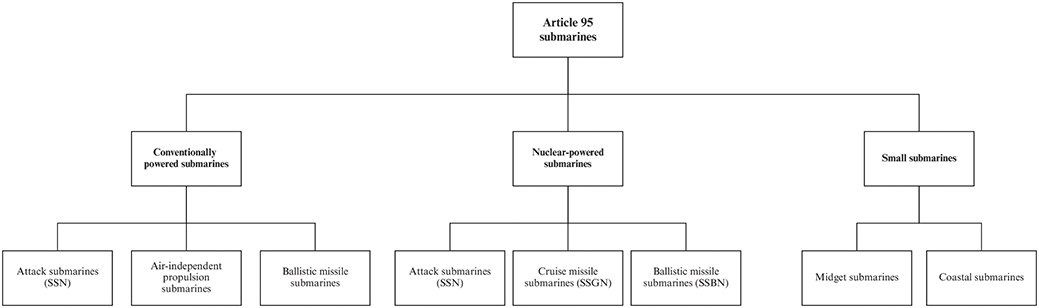
Figure 1.2 Long description
The first level of the figure has Article 95 submarines, which is then divided between conventionally-powered, nuclear-powered and small submarines. The final level divides conventionally-powered submarines between attack submarines, air-independent propulsion submarines and ballistic missile submarines. Nuclear-powered submarines are divided between attack submarines, cruise missile submarines and ballistic missile submarines. Small submarines are divided between midget submarines and coastal submarines.
1.4.1.1 Conventionally Powered Submarines
The most prominent form of military submarine is conventionally powered submarines, also known as diesel-powered or diesel-electric submarines. The defining characteristic of this class of submarines is their diesel engine, which requires air for the process of combustion to take place. As such, these vehicles are required to ‘snort’ or ‘snorkel’, a process in which their ‘snort masts’ are raised above the surface to take in air and expel exhaust fumes, powering the diesel-electric engines.Footnote 63 The requirement that the submarine surface in order to charge its batteries serves as a significant strategic flaw; the inability to sustain extended periods below the isothermal layer of the ocean and the requirement to snort makes these submarines more vulnerable to detection and, accordingly, attack from belligerents.Footnote 64
Conventionally powered submarines have been the backbone of contemporary submarine forces for a century. As Reader and Potter observed:
Even in today’s age of underwater nuclear power the majority of the world’s submarines still use diesel engines as their main source of mechanical power, as they have done since the turn of the century. The diesel-electric submarine propulsion system has changed little in concept since the start of the Great War of 1914–1919.Footnote 65
The significant advantages of conventionally powered submarines help to explain their persistence. In comparison to nuclear-powered submarines, conventionally powered submarines are cheaper, quieter, smaller, easier to train crews on, and often are more manoeuvrable in combat.Footnote 66 Each of these factors lead to ‘improved target-identification-and-attack cycle and ultimately increased mission flexibility, mobility, endurance, reach, and lethality’.Footnote 67 As such, despite their limitations of short range, lower speeds and being air-dependent, these submarines have been described as ‘one of the best means for a weaker naval power to defend itself from seaborne invasion by a stronger power … [;] they are among the most, if not the most, asymmetric of traditional platforms’.Footnote 68
Within the subset of conventionally powered submarines are two further types of vessel. First, those powered by air-independent propulsion (AIP). These submarines can operate without the need to snort as the oxygen required to complete the process of combustion is stored on board in liquid form. Their engines can operate while the submarine is submerged, leading them to be referred to as the ‘poor man’s nuclear submarine’.Footnote 69 As a result, ‘[r]ather than being constrained by battery life, the endurance of an AIP-enabled submarine is limited by its stores of pressurized liquid oxygen’,Footnote 70 leading to an extension of their submerged endurance from days to weeks.Footnote 71 The result is a submarine that maintains the substantial advantages of traditional conventionally powered submarines, while significantly alleviating the strategic burden caused by the requirement to have access to air.Footnote 72 This different form of propulsion is not, however, legally significant.
Second, conventionally powered submarines have generally not been armed with nuclear weapons. However, North Korea has developed submarine-launched nuclear ballistic missiles, which have been test fired using the State’s sole, experimental conventionally powered submarine capable of firing such missiles.Footnote 73 Israel’s conventionally powered Dolphin-class submarines are also speculated to be capable of launching nuclear weapons.Footnote 74 However, little is known about these submarines and the weapons they are suspected to carry, consistent with Israel’s policy of deliberate ambiguity concerning nuclear weapons. These vessels are subject to the regime applicable to nuclear-powered submarines, which is outlined below, on account of the fact that they carry ultrahazardous material (and, where necessary, are referred to in this book as nuclear-armed submarines).
In sum, the persistent use of conventionally powered submarines and their acquisition by an increasingly diverse number of States demonstrates the ongoing relevance and use of submarines as warships. Conventionally powered submarines are exceptionally powerful naval weapons; ‘classic “asymmetric” threats that could wreak havoc on a technically superior … naval force’.Footnote 75 The increasing use of AIP and further innovation in submarine propulsion technology, and a developing ability to carry more dangerous weaponry, indicate an ongoing focus on conventionally powered submarines. It is anticipated that these military submarines are likely to remain among the most numerous class of submarine into the future.
1.4.1.2 Nuclear Submarines
Described as the ‘apex predator’ of the maritime domain,Footnote 76 nuclear-powered submarines are exceptionally powerful and highly sought after. We use the term ‘nuclear submarine’ to refer to both nuclear-powered submarines and submarines carrying nuclear weapons. A submarine may be nuclear-powered but carry conventional weapons, and as mentioned above, conventionally powered submarines may be nuclear-armed. The key point for the purposes of our analysis is that these submarines carry ultrahazardous nuclear material. Where the distinction between a nuclear-powered submarine and a submarine carrying nuclear weapons is legally material, we will differentiate the two.
The military submarines within this category differ in significant respects as to their size, displacement and crew. The submarines in this class can be further separated into third-level categories based on their weaponry: attack submarines (SSN), ballistic missile-carrying (SSBN) and cruise missile-carrying (SSGN).Footnote 77 SSNs are much like conventionally powered attack submarines, save for their form of propulsion. Their purpose largely replicates that of conventionally powered attack submarines, but with the unique added benefits of longevity of submersion and increased speed and range arising from nuclear-powered propulsion.Footnote 78
Both SSGNs and SSBNs are powerful, armed vehicles. As Lieber and Press note, cruise and ballistic missile ‘submarines could fire their missiles from near the enemy’s shore and so give the enemy’s leaders almost no time to respond’.Footnote 79 Further, as Watson observes, these submarines provide ‘a significant deterrent advantage over land-based missiles or aircraft systems because of [their] mobility and … ability to avoid detection in vast ocean patrol areas, thus remaining invulnerable to a surprise attack’.Footnote 80 The primary point of distinction between these two submarines is the type of weapon they launch. SSGNs are equipped with cruise missiles, which are propelled by jet engines, remain low in the atmosphere and are self-guided.Footnote 81 They are generally not nuclear-armed, and a number of US SSGNs were previously SSBNs but were converted to comply with international law concerning non-proliferation,Footnote 82 in particular the START II Treaty between the United States and the former USSR.Footnote 83 On the other hand, SSBNs are armed with ballistic missiles, which are rocket-powered when initially launched and then follow an unpowered trajectory, reaching greater heights than cruise missiles.Footnote 84 Contemporary examples include the US Ohio-class, the UK Vanguard-class, the French Triomphant-class and the Russian Borei-class. Unlike SSGNs and SSNs, the purpose of SSBNs is not to engage in sea denial or control per se, but rather to ‘remain hidden at sea with their nuclear-armed submarine-launched ballistic missiles … perform[ing] a singular mission of strategic nuclear deterrence’.Footnote 85 As vehicles armed with nuclear weapons, they are subject to international law concerning nuclear non-proliferation. Each vessel in this class is also subject to the strict requirements of the nuclear non-proliferation regime in respect of nuclear power, including regulation by the International Atomic Energy Agency (IAEA).
The number of States currently operating nuclear-powered submarines is small; six States operate nuclear-powered submarines: China, France, Russia, the United Kingdom, the United States and India. The first five States are ‘nuclear-weapon States Party’ to the Treaty on the Non-Proliferation of Nuclear Weapons (NPT),Footnote 86 whereas India is not a party to the NPT but does possess nuclear weapons. As to the concentration of these submarines among the nuclear-weapon States party to the NPT, Moltz has observed, ‘part of the reason for the race to the sea among new nuclear powers may be the international demonstration effect. The most advanced navies in the world (US, French, and British) now operate only nuclear-powered submarines, sending a potent signal to other states that nuclear power is better’.Footnote 87
Von Hippel argues that there are two reasons that only a select few States operate nuclear submarines: cost and mission.Footnote 88 First, as to cost, not only are nuclear-powered submarines expensive to construct vis-à-vis conventionally powered submarines, but they are also dependent on costly domestic nuclear industries. Second, as to mission, nuclear submarines ‘enhanc[e] a maritime power’s blue-water and power-projection capabilities’Footnote 89 due to their ability to remain, in theory, submerged permanently. ‘Blue-water capability’ or a ‘blue-water navy’ refers to the operation of naval forces in the oceanic waters farthest from land, (i.e., beyond areas of national jurisdiction and into the high seas) such that the navy is ‘oceangoing, capable of more than purely littoral operations’.Footnote 90 Not all States need or wish to have this mission capability.
To these factors, one may further add that the development of nuclear submarines is a legally fraught exercise. The provision of highly enriched uranium from a nuclear-weapon State party to the NPT to another State, or the generation of highly enriched uranium by an NPT State party, implicates the operation of international legal obligations under the NPT, requiring that State to seek approvals through the IAEA due to the nuclear proliferation risk involved.Footnote 91 As Yu and French note, ‘many SSNs use highly enriched uranium …, which can be used to provide the fissile material for a nuclear weapon’.Footnote 92 These implications, which have become apparent through the development of AUKUS,Footnote 93 are significant and further demonstrate how the law relating to submarines is necessarily entwined with and dependent on a number of other areas of international law, including nuclear non-proliferation law.
In addition to the States currently operating nuclear-powered submarines, there are several States that have ambitions, whether likely or not, to operate such vehicles. Australia and Brazil appear likely to operate SSNs in the medium term. In 2021 and 2025, Australia, the United Kingdom and the United States entered into agreements through which the latter two States agreed to provide Australia with the necessary designs and technical know-how to acquire and operate nuclear-powered submarines.Footnote 94 The States are presently cooperating with the IAEA with respect to the implications of the provision to Australia of highly enriched weapons-grade uranium on their obligations under international non-proliferation law, and the first submarine is expected to be launched in the 2030s.Footnote 95 For its part, Brazil has harboured ambitions of developing its own indigenous nuclear-powered submarines since the 1970s, with its Submarine Development Program (known as PROSUB) seeking to fulfil the State’s goal of possessing a ‘large submarine naval force, composed of both conventional and nuclear-powered submarines’.Footnote 96 These ambitions have been repeatedly beset by difficulties in the process of production and design, as well as in the enrichment of uranium to the necessary levels.Footnote 97 Neither Australia nor Brazil has the intention to arm their nuclear-powered submarines with nuclear weapons, though the possession by these States of what is likely to be weapons-grade uraniumFootnote 98 has raised significant concern from the civil society sector and other States in relation to non-proliferation and the NPT.Footnote 99 As this book went to press, US President Trump approved South Korea’s development of nuclear-powered submarines in US shipyards. Other States, including Canada and Iran have, at various times, expressed a desire to operate nuclear-powered submarines,Footnote 100 but those ambitions do not appear to be, at least at present, viable.
1.4.1.3 Coastal Submarines and Midget Submarines
Beyond conventionally powered and nuclear submarines, there are several other types of submarine operated by States that are entitled to sovereign immunity and are otherwise not subject to a different legal regime. Most notable are the two categories of ‘small’ or ‘mini’ submarine: midget submarines and coastal submarines. These submarines are not only the smallest in terms of displacement and size, but also in raw number and number of State users. Categorisation is difficult but some sources suggest that midget submarines are those submarines with a displacement of under 100 tons,Footnote 101 while others suggest that 150 tonsFootnote 102 or 250 tons is a more appropriate marker.Footnote 103 Other definitions focus on the number of crew as one of the defining features of the midget submarine, namely that they only carry one or two crew.Footnote 104 Such a definition becomes somewhat antiquated when one considers that contemporary midget submarines generally accommodate up to eight personnel.Footnote 105
Though they are no longer as pervasive as they once were, midget submarines remain a versatile element of modern military operations.Footnote 106 North Korea continues to operate Yugo- and Yono- class midget submarines,Footnote 107 and Iran operates the Ghadir/Qadir-class submarine.Footnote 108 Pakistan,Footnote 109 ThailandFootnote 110 and IndiaFootnote 111 are in the stages of developing their own indigenous midget submarines, while Indonesia is actively considering their acquisition.Footnote 112 Commentators have suggested that a new generation of midget submarines could be valuable in future conflicts in the South China Sea.Footnote 113
For the purposes of this taxonomy, it suffices to say that midget submarines specialise in surprise attacks and reconnaissance missions, are small in size and with limited crew, and generally work with a parent ship or parent submarine such that they do not have the accommodations or technical capacity to undertake extended independent seafaring. Due to their size, they are conventionally powered.Footnote 114 It is important to define the midget submarine not just by reference to its size but instead by its purpose. Otherwise, the definition would encapsulate the large majority of commercially-operated submersibles, which are, generally speaking, as small in size as the modern military midget submarine. The term ‘midget submarines’ refers only to the State-owned and operated craft with military missions so as to capture the sovereign immunity to which these submarines are entitled.
‘Coastal’ submarines are generally larger than midget submarines but smaller than the deep ocean going military submarines.Footnote 115 They include the German-built Type 209, which is operated by a number of States particularly in South America and Asia; the concept Andrasta-class;Footnote 116 the Iranian Fateh-class,Footnote 117 which has the more limited purpose of operating in the littoral, shallow waters of the Persian Gulf;Footnote 118 and the North Korean Sang-O-classFootnote 119 and forthcoming Sang-O II class.Footnote 120 It has been suggested that the ‘coastal submarine’ term ‘does not describe just any small submarine; it identifies a specific type of boat designed to operate in coastal shallows, follow the contours of the seabed, and slip into harbors covertly to deliver weapons or combat swimmers’.Footnote 121 As a matter of international law, the size of the coastal submarine vis-à-vis other military submarines is unlikely to be of consequence. As with ‘midget’ submarines, their status as sovereign immune vessels (due to being warships or otherwise State-owned and operated for non-commercial purposes) is the legally significant distinction.
1.4.2 Other Sovereign Immune Submarines
Submarines operated by a State for government and non-commercial purposes are entitled to immunity under Article 96 of UNCLOS. The types of submarines within this category include (but are not limited to) those used for government research purposes (such as for cartographic mapping and surveying); submarines operated by coastguards, domestic police forces, customs authorities and other government bodies; and training submarines. Some submarines may be entitled to immunity under Articles 95 and 96 because the operation of a submarine may serve both a militaristic purpose meeting the requirements of the warship definition and also have other purposes (particularly in relation to surveying and cartographic research, which submarines necessarily undertake as part of their process of navigation). The type of crewing of the vessel may be quite different; a ‘warship’ has uniformed, commissioned officers and crew whereas other government vessels have (or may include) civilian officers and crew. The essential point, however, is that these submarines must not be operated for commercial or mercantile purposes such as the exploitation of the natural resources of the continental shelf.
The most prominent form of submarine that would be covered by sovereign immunity as stipulated in Article 96 is the research submarine. Critical for the purposes of our taxonomy is whether these vessels are government-owned and operated for non-commercial purposes and the specific activities being undertaken. The regulation of research submarines is examined in connection with the rights and duties exercised by States in the EEZ in Chapter 8.
1.4.3 Underwater Maritime Autonomous Vehicles
The label of ‘maritime autonomous vehicles’ is a ‘catch-all term for a variety of vehicles that operate on the surface of, below and above the ocean autonomously (with no human intervention) or varying levels of remote control’.Footnote 122 UMAVs may be launched not only from submarines, but also from surface vessels, as well as from land installations and bases on the coast. UMAVs may be tethered to a vessel or operate separately; the key feature of legal relevance is the lack of a master and crew on board the UMAV.
The international legal regime applicable to UMAVs is impacted by two key factors. First, to the extent the UMAV is a vessel (as opposed to equipment or a maritime autonomous system) operated by a State for militaristic or other non-commercial purposes, it is likely to be entitled to the immunities afforded under either Article 95 or Article 96 of UNCLOS. However, there is a live question as to whether any UMAV is a ‘vessel’ or ‘ship’ or not. This question is an important one as different international law rights and obligations accrue depending on this characterisation. Second, whether a UMAV can be classified as a ‘warship’ or not in light of the definition under Article 29 of UNCLOS, which assumes a commanding officer and crew aboard the vessel, has been questioned. We examine these debates in Chapter 14.
1.4.4 Submarines Not Entitled to Sovereign Immunity
While submarines used for military purposes are undoubtedly the most prominent type of submarine, there are a significant number of submarines in non-military service, operated both by States (including through their militaries) and by non-State actors for varied, non-governmental, purposes. These submarines are not entitled to sovereign immunity. As will be discussed in later chapters, there was some anticipation of private or commercial use of submarines and allowance was made for this in early law. However, such sustained commercial use has not yet eventuated.
These submarines remain the concern of international law, even if they are not sovereign immune vessels, and can be further divided by their purpose. Without attempting to create an exhaustive list, these sub-categories include narco-submarines and other submarines used for criminal purposes, research submarines, tourist submarines and other submarines owned by high net-worth individuals for leisure purposes. UMAVs that are privately owned or operated for non-governmental purposes also fall within this branch of the taxonomy.
1.4.4.1 Narco-Submarines
Submarines used for the transport of drugs are commonly referred to as narco-submarines and are examined in Chapter 13. These non-government submarines have been and continue to be used by criminal groups and sub-State actors for the transportation of drugs,Footnote 123 causing ‘considerable alarm’.Footnote 124 Early (possibly the first) narco-submarines were designed and constructed by the Revolutionary Armed Forces of Colombia (FARC) in the 1990s with the purpose of transporting cocaine to the United States.Footnote 125 These initial narco-submarines were constructed out of fibreglass and wood; today, narco-submarines can be fully submergible and self-propelled with diesel engines. As Olson and others observe:
The use of what are essentially mini-submarines is a relatively new phenomenon dating to the late 1990s when a clandestine factory for the first subs was discovered in rural Colombia. Today’s semi-submersibles are 45 to 82 feet in length and are made of fiberglass or steel. They have a range of 2,000 miles and can carry up to seven metric tons of cocaine. US officials estimate that over 60 submarines move over 300 metric tons of cocaine per year. Most of the subs leave Colombia’s and Ecuador’s Pacific Coastlines.Footnote 126
These submarines have been used to considerable success; the US Drug Enforcement Administration has estimated that 30 per cent of drugs imported to the United States by sea are transported by narco-submarines originating from South and Central America.Footnote 127 Such submarines have also been used for smuggling operations into Europe and West Africa.Footnote 128
There is no consistent definition of narco-submarines as they are defined not by their size or by their characteristics, but rather by their purpose. They may, though, be distinguished as self-propelled semi-submersibles (SPSS) and low-profile vehicles (LPVs), and fully submersible vehicles.Footnote 129 The former are ‘designed to escape detection by riding low in the water. They do not fully submerge’.Footnote 130 Only an estimated 14 per cent of such vessels are detected,Footnote 131 and, in the event of detection, the vehicles are often intentionally scuttled leaving the detecting navy or coast guard to rescue the smugglers while the evidence sinks to the seabed. Due to their inability to fully submerge, the extent to which such vehicles may qualify as a submarine in international law may be contested.
Rarer are the narco-submarines capable of full submersion. Over time, narco-submarines have become increasingly sophisticated both in terms of their design and the technologies carried on board.Footnote 132 Plans for the use of fully submersible vessels for smuggling purposes are not new; Colombian cartels reportedly attempted to purchase submarines from the Soviet Union but were rebuffed.Footnote 133 Since that time, cartels have developed submarines of their own. The first known such vehicle was seized by Ecuadorian authorities in July 2010; it has been described as the ‘true narco sub’.Footnote 134 An additional submarine was discovered near the Cucurrupi River in Colombia in 2020,Footnote 135 and, for the first time in 2022, a fully submersible narco-submarine was interdicted at sea (as opposed to during the process of construction) sailing on the Arauca River between Colombia and Venezuela.Footnote 136 In sum, these submarines are technically advanced and do not enjoy any sovereign immunity from seizure or prosecution because of their non-governmental status. Their international legal regulation falls within transnational criminal law, as well as potentially being subject to national laws seeking to prevent and deter illicit drug trafficking.
1.4.4.2 Submarines Operated by Rebels and Terrorist Groups
The development of submarines by cartels for drug smuggling purposes has led to commentary as to the potential possession of submarines by rebels and terrorist groups for other nefarious purposes, apart from drug smuggling. Stanislawski has observed, ‘the discovery of a partially constructed Russian submarine by the Colombian police in 2000 … demonstrates the possibility for a terrorist organisation to acquire such a weapons platform to use in an attack’.Footnote 137 The 2005 Convention for the Suppression of Unlawful Acts against the Safety of Maritime Navigation (2005 SUA Convention) addresses ‘a vessel of any type whatsoever not permanently attached to the sea-bed, including …, submersibles’ and may thus include a submarine in its definition of ‘vessel’.Footnote 138 This treaty identifies a range of criminal offences to be incorporated into national law so as to prevent and suppress violent acts involving these submarines.Footnote 139
A number of hypothetical examples as to how such vehicles could be used have arisen in the literature. For instance, as Rojas-Sanchez, Rivera-Paez and Afanador observe, ‘[w]hile narco-submarines pose a significant international security threat today, this increases exponentially if they are combined with a harm agent … A submersible equipped with a dirty bomb could potentially reach the harbour of a major city undetected, with catastrophic results’.Footnote 140 Further, as Ramirez argues, ‘[a] terrorist group such as FARC could feasibly collaborate with Al Qaeda or Hezbollah and equip narco submarines with added technical features that would enable terrorist organizations to launch destructive attacks … carrying biological and chemical weapons … [and] transport[ing] terrorist operatives to target locations’.Footnote 141 These actions would likely fall within the scope of offences in the 2005 SUA Convention and that agreement is discussed in Chapter 13.
However, the operation of such submarines by non-State actors is, to date, relatively rare. Murphy notes that the Moro Islamic Liberation Front – a now defunct insurgency group that operated in the Southern Philippines – ‘made enquiries about buying a mini-submarine from North Korea’, and that the Tamil Tigers (Liberation Tigers of Tamil Eelam or LTTE) attempted to acquire submarines from North Korea and South Africa.Footnote 142 Such attempts failed, after which the Tamil Tigers built mini-submarines of their own to deposit ‘martyrs in strategically and commercially significant harbors’.Footnote 143 A five-metre long LTTE vessel capable of remaining submerged for 6 hours at speeds of 5 knots was discovered by authorities, which may ‘very well have served as the blueprint for the more advanced versions that the Sea Tigers subsequently retained’.Footnote 144 In reality, the likelihood of terrorist organisations operating submarines appears low considering the substantial know-how and cost involved in acquiring and constructing such vehicles. The key exception may be for those terrorist organisations that are well-funded or otherwise ‘heavily state sponsored’,Footnote 145 in which case questions of attributability may arise as to whether the submarine in question is, in fact, a submarine of the State operated on non-commercial service and therefore entitled to sovereign immunity.
1.4.4.3 Research Submarines
The use of government-owned or leased submarines for research has been a core function for nearly a century, both for naval forces as well as private organisations. Significant technical advances resulted in a proliferation of bathyscape-style submersibles operated by both States and research organisations leading to a number of significant scientific discoveries.Footnote 146 These finds included, inter alia, the identification of new species of underwater flora and fauna, proof of the existence of hydrothermal vents and the conduct of hydrothermal field research, as well as the recovery of significant items from wrecks and the capturing of film for both scientific and documentary purposes.Footnote 147 However, these vehicles have largely been submersibles rather than submarines, incapable of extended independent operation without the assistance of a command vessel. Over time, these submarines have become increasingly complex and technologically advanced.Footnote 148 Universities and other scientific research and exploration organisations, both independent and State-affiliated, have procured such vehicles to conduct research on the world’s oceans. These include autonomous vessels, such as NASA’s Orpheus and Nereus.Footnote 149 The Woods Hole Oceanographic Institution in the United States operated a number of submersibles, most notably the Alvin and the Deepsea Challenger, in addition to UMAVS, which, with the assistance of a support ship, can dive to the deepest depths of the ocean. The People’s Liberation Army Navy and various Chinese research institutes and universities operate submersibles.Footnote 150 The legal regulation of these submarines will depend on the nature and location of their activities.Footnote 151
It has been suggested that government funding for oceanic research has been reduced in recent years; consequently ‘[i]nnovative creativity has emerged from private organizations, large and small, the most visible being wealthy patrons excited by the potential of ocean exploration and new deep sea research … These efforts will expand and mature … as various private/government partnership formulas are considered’.Footnote 152 The application of the law of the sea and its rules relating to marine scientific research will be the most apt for the regulation of these submarines. These activities are examined in Chapter 8.
1.4.4.4 Leisure Submarines
Since at least the 1980s, hobbyists and private researchers have constructed submersibles – highly diverse in nature – with the intention of satisfying curiosity, collecting data and exploring the oceans.Footnote 153 Advances in technology have made the production of submersibles for use by tourists and independent explorers, usually those of ultra-high net worth, more feasible. Separating these vehicles into their own category, independent from those vehicles used for research purposes, may be problematic as often their purposes are, at least to some extent, similar and intertwined. For instance, submersibles operated by individuals and organisations for private tourism and exploration purposes have resulted in public scientific discovery.Footnote 154 Indeed, is difficult to separate out the full range of private purposes from research purposes as the act of submersion can, in itself, contribute to research.Footnote 155 In addition, submarines otherwise in private use have been chartered for research purposes, including by States and State-affiliated institutions.Footnote 156 Government engagement may complicate any determination of whether the submarine is entitled to the sovereign immunity of the State.Footnote 157 In addition, the multiple purposes served by these vehicles may impact the jurisdiction of the coastal State in respect of the regulation of these submarines. While tourist journeys likely fall within the freedom of navigation, coastal States have the exclusive authority to conduct and regulate the conduct of marine scientific research within their EEZ.Footnote 158 The allocation of State authority over these different submarine activities in the EEZ is addressed in Chapter 8. International laws pertaining to navigational safety may also be apposite for leisure submarines and are discussed in Chapter 11.
The publicly available information concerning these submersibles is relatively scarce. Unlike submarines operated by States, there is comparatively less public exposure as to the specifications, ownership and operation of these private submersibles. Nearly all submarines within this class are made-to-order and are procured from private manufacturers, often with little governmental oversight or registration requirements due to the relative novelty of the private operation of submersibles; there is no reliable method to track the number of submersibles that may be in private operation. Kohnen estimates that, as at July 2020, seventy-eight crewed underwater vehicles had been constructed and thirty-eight were in operation, of which the majority were privately owned.Footnote 159 Another estimate, calculated in 2013, suggested there were ninety-six active submersibles, which included ‘all submersibles involved in tourism, research, commercial work, security, and leisure’.Footnote 160 A 2022 report observed that well-established Dutch recreational submersible manufacturer, U-Boat Worx, had sold forty submersibles with an additional fifteen on order, with a cost of US$2.5 million to US$3.5 million.Footnote 161 The capable depth of these submersibles ranges from just below the ocean’s surface to the Challenger Deep.Footnote 162 There are substantial differences in the number of crew they are able to accommodate, their technical capacity, design and endurance.
1.4.4.5 Underwater Maritime Autonomous Vehicles
Non-State actors have begun using UMAVs for smuggling purposes and these underwater craft may further be deployed to support transnational criminal activity or terrorism.Footnote 163 Further, remotely operated UMAVs (ROVs) are used extensively by offshore oil, gas and renewables industries ‘for observation, control and maintenance of infrastructure in locations otherwise unavailable to marine scientists’;Footnote 164 often industry assists the academy by providing data obtained from its more extensive collection of UMAVs for use in scientific research.Footnote 165 As at 2014, the International Marine Contractors Association estimated that there were some 550 work class ROVs in operation in industry.Footnote 166 These UMAVs for private research would not be protected by sovereign immunity and hence UMAVs fall under both limbs of our legal taxonomy set out above in Figure 1.1.
1.5 International Laws Regulating Submarines
In this chapter, we have so far highlighted the diversity in the types of submarines in contemporary use; their purposes, functions, owners and modus operandi. In devising the legal taxonomy above, we come to a better understanding of how defining the submarine is a relatively vexed topic, and how changes in one element of the submarine (e.g., its owner, mode of propulsion, purpose) can implicate the operation of distinct, and not always complementary, legal regimes, with different consequences and obligations. Yet there are situations when the relevant international law is decidedly unclear. Accordingly, both submarines and the legal regime governing their operation are of significant contemporary relevance and are a topic worthy of sustained academic study. This section briefly introduces the different international legal regimes that may be applicable to submarines, and which are discussed in greater detail in later chapters.
1.5.1 International Legal Framework for Submarines
As noted at the outset, the key starting point for discussing submarines in international law is UNCLOS, which has 171 parties and is often described as a ‘constitution for the oceans’.Footnote 167 This treaty, which was opened for signature on 10 December 1982, establishes a comprehensive legal regime for the use of the ocean, inclusive of the water column, the suprajacent airspace and the seabed and subsoil. Its provisions regulate the activities of vessels in ocean spaces and are applicable to, inter alia, vessels operated by States Parties, as well as commercial vessels flagged to those States. Among other things, UNCLOS sets out the regimes applicable to the maritime zones of the coastal State, including the continental shelf and EEZ, and the rights and obligations of States therein,Footnote 168 the rights of passage of vessels through the territorial sea, archipelagic waters and straits used for international navigation,Footnote 169 the immunities of warships and ships on government service,Footnote 170 the freedom of the high seas and the qualifications thereto,Footnote 171 obligations to protect and preserve the marine environment,Footnote 172 how marine scientific research is to be conductedFootnote 173 and establishes a compulsory dispute settlement system.Footnote 174 Core constitutional aspects of UNCLOS, such as the establishment of the different maritime zones and the allocation of rights and duties within those zones, are accepted as customary international law.Footnote 175 Out of its 320 provisions and nine Annexes, only one article refers explicitly to submarines.Footnote 176 Nonetheless, UNCLOS provides the general framework for the regulation of submarines and is the most important piece of international law governing their use and activities.
In addition to UNCLOS, a range of other international laws regulate maritime activities and potentially apply to the use of submarines. Key international instruments related to navigational safety include the Convention on the International Regulations for Preventing Collisions at Sea (COLREGs),Footnote 177 and the International Convention for the Safety of Life at Sea (SOLAS Convention).Footnote 178 The safety of navigation, especially in the context of nuclear submarines, also prompts consideration of international nuclear law, including the NPT and other instruments of the international legal regime relating to nuclear disarmament as well as nuclear liability. If submarines do sink then regard may be had to international instruments relating to shipwrecks, such as the Nairobi International Convention on the Removal of Wrecks,Footnote 179 as well as those relating to the preservation of underwater cultural heritage, such as the Convention on the Protection of Underwater Cultural Heritage.Footnote 180 Further of interest in the regulation of submarines are rules seeking to protect the marine environment and are drawn from international environmental law.Footnote 181
The roles of military submarines during times of peace as well as during armed conflicts require consideration of international instruments relating to the law on the use of force and international humanitarian law, such as the London Protocol on Submarine Warfare,Footnote 182 the Geneva ConventionsFootnote 183 and the Hague Conventions of 1899 and 1907,Footnote 184 and manuals addressing the law of naval warfare.Footnote 185 For submarines implicated in criminal activity, we can have regard to instruments such as the 2005 SUA Convention;Footnote 186 and the 1988 Vienna Drugs Convention.Footnote 187 Other than formal international instruments, the use of submarines implicates different rules of customary international law. These laws include, for instance, rules on State responsibility, jurisdiction and sovereign immunities.
From this discussion, it becomes readily apparent that the use of submarines is regulated by a wide variety of different international laws. Yet these laws are most typically silent as to the exact roles, responsibilities and obligations attaching to the use of submarines. Determining what instruments are applicable, and which to obey and in what circumstances, is not always evident. As set out earlier in this chapter, a primary purpose of this book to draw together these disparate and sometimes ambiguous international legal regimes to clarify the international law applicable to submarines or otherwise identify what gaps in the law may need to be resolved.
1.5.2 Outline of the Book and Scope
This book is divided in two parts. In the first Part, we take a historico-legal approach to the study of submarines, highlighting the relevance of legal history to the development and current understandings of the modern legal regime. Understanding the historical context of our contemporary laws provides us with an opportunity to assess how we might move forward.Footnote 188 Materna, for example, has relied on approaches to the early regulation of submarines as a rationale for allowing legal change in defining warships with the development of maritime autonomous vehicles.Footnote 189 Moreover, the historical lens facilitates ‘reflection as to the origins, aims and objectives of international law’ of submarines,Footnote 190 enabling a better understanding of how to read contemporary laws that commonly fail to explicitly acknowledge submarines as an object of regulation. Our approach is thus not only to narrate the historical evolution of international law as it relates to submarines, but also to set out the legal outputs of these developments.Footnote 191 The focus of Part I is on international law concerning submarines and its sources, but inevitably the political, technological, cultural and strategic dimensions inform the legal positions and developments. We are by no means comprehensive in engaging with these differing contexts but seek to acknowledge in Part I that the legal developments must be situated within broader societal dynamics existing at various times. Consistent with the overarching aim of the book, we are endeavouring to highlight what international law has said, implicitly or explicitly, about the regulation of submarines.
Considering the role and development of submarines since WWI to the present day, we investigate in Part I how submarine developments contributed to the development of international laws regulating their maritime operations. Chapter 2 examines the role of submarines in WWI and the individual and collective efforts of States to ban, limit, or regulate their use, and the extent to which early international legal instruments relating to neutrality and maritime warfare regulated the new technologies and strategies of submarines adequately or at all. Chapter 3 traces developments relating to the legal regulation of submarines from the post-war settlement at Versailles to the Codification Conference at the Hague in 1930. While the Conference failed to adopt a treaty on the territorial sea, it did produce a set of draft articles that would significantly influence the subsequent development of both the 1958 treaties on the law of the sea,Footnote 192 and, by way of these instruments, UNCLOS. Chapter 4 examines developments in the use and regulation of submarines during the second Sino-Japanese War and WWII, considering how States understood and sought to respond to developments in the use of submarines – as blockade runners, intelligence gatherers and as the subject of anti-submarine warfare – both in their practice and through the law at this time. Chapter 5 examines the post–WWII settlements, the 1958 conventions on the law of the sea and the Cold War nuclear deterrence era. During this period, nuclear submarines were developed and made operational, the acquisition and technical development of submarines increased rapidly and the modern submarine as we now know it came into existence. This chapter traces the influence of all these developments on the 1958 law of the sea conventions. Chapter 6 concludes Part I, situating the negotiation of UNCLOS in historical context. It considers how the contemporary usages of submarines factored into the development of international law concerning the passage of warships, intelligence gathering and nuclear proliferation. Part I concludes by linking the historical discussion to the contemporary setting that introduced the book, situating the reader for the analysis of current international law in relation to submarines that follows in Part II.
With an awareness of the historical development of the international law of submarines and the role of submarines in developing international law, Part II focuses in on submarines in modern international law. In this Part, we clarify the legal regime presently applying to submarines and further consider how the diverse usages, operators and modus operandi of submarines are impacted by different international laws. Chapter 7 examines the laws applying to the passage of submarines in the territorial sea, international straits and archipelagic waters. Chapter 8 considers the international laws governing activities of submarines in the EEZ, clarifying the scope of navigational rights in this maritime zone, particularly in relation to military exercises and intelligence gathering. Chapter 9 is concerned with determining when submarine operations may violate the international law prohibition on the threat or use of force and what consequences may emerge in relation to the law on the use of force (jus ad bellum). Chapter 10 addresses the current international laws governing submarine warfare, focusing on the modern law of neutrality and relevant rules of international humanitarian law. Chapter 11 draws out the relevant international laws that may be applicable in light of accidents or collisions involving submarines, including the law of salvage and underwater cultural heritage law that may apply in relation to sunken submarines. Chapter 12 assesses how international environmental law applies in relation to submarines, most particularly with regards to implications arising from the deployment of nuclear submarines and questions concerning noise pollution. Chapter 13 considers the use of submersibles and submarines by private actors to perpetrate different crimes, predominantly smuggling offences. ‘Narco-submarines’ are a particular focus of this Chapter. Chapter 14 addresses the legal implications of UMAVs, focusing on the legal differences that emerge when a craft operates underwater and is uncrewed. As Chapter 14 examines the international laws concerned with the most recent submarine technology, this chapter also concludes Part II by taking stock of future directions for the international law of submarines. The book thus ends with issues for decision-makers to consider in the future, including in relation to adjustments to national operational rules and changes to State practice, and potential amendments or additions needed in international law.
This book does not focus on the strategic significance of submarines, although their role is critical in international relations more broadly and more specifically in security strategies,Footnote 193 and nuclear deterrence.Footnote 194 Instead, we are foremost concerned with the elucidation of the international laws that apply to submarine operations. The military importance of submarines has no doubt influenced the way that different laws have developed, as is especially apparent in our discussion in Part I, and the strategic significance of submarines colours the policy choices that may be needed in deciding on the interpretation and application of international law. That significance should not, however, exclude submarines from explicit regulation under international law.
Given the strategic significance and predominant military character of submarines, State efforts to counter submarines through anti-submarine warfare and in enhancing ocean transparency are also notable developments in ocean governance. We have occasionally referred to the impact of anti-submarine warfare (ASW) on international law, and it is clear that developments in ASW will also hold implications for international law regimes. For example, States foresee deploying ‘subullites’ across the ocean floor, which will then provide monitoring of vessels, including other submarines, passing above.Footnote 195 That prompts questions as to what the deployment of these subullites would mean for the regime of the continental shelf or the deep seabed, exclusive coastal State jurisdiction over artificial structures and installations in the EEZ, and for the protection of the marine environment. ASW tactics during armed conflict will also be governed by international humanitarian law. Nonetheless, to contain the book within a manageable scope, we have largely placed ASW beyond our consideration of the international law of submarines.
1.5.3 Aims of the Book
As noted above, a central purpose of this book is to bring together all the international law rules that apply to the operation of different types of submarines. In doing so, we are dealing with an object that by its nature seeks to avoid detection. The very secrecy of submarines, because of their submerged operations, not only increases their military utility but also the perceived threat that they may pose in different settings. Yet law generally is interested in detecting problems, elucidating the issues and regulating to reduce perceived risks. Like the submarines themselves, the international law of submarines is submerged across a broad field of international law and it is therefore necessary to look below the surface to elicit the relevant rules. The chapters in Part II especially seek to articulate what laws currently apply to submarines, as well as show where there are areas of disagreement and where it may be legally problematic that there is not more attention applied to the specific situation of submarines.
While we have thus sought to bring to light specific areas of international law pertaining to submarine operations (such as international humanitarian law or the law of the sea), there are some rules of international law that cut across all these areas. Notably, and as discussed in an early section in this chapter, rules concerning sovereign immunity hold consequences for how some rules are applied and certainly for how they may (or may not be) enforced. Equally, the characterisation of some submarines as ‘nuclear submarines’, because they are nuclear-powered or armed with nuclear weapons, cuts across a number of different legal regimes. There are consequences for nuclear disarmament and proliferation, as well as for nuclear safeguards and liability regimes. We have addressed these dimensions across different chapters rather than in one chapter. While we have sought to show in various instances that there are specific rules applicable to nuclear submarines, it remains important to grasp that this source of power or weaponry does not preclude the ongoing application of other (non-nuclear) rules of international law.
The predominant function of the submarine as a military machine as well as its role in geopolitical strategy have undoubtedly facilitated the obfuscation of international laws addressing submarines. As one of the authors has previously commented, ‘[a] hallmark of the law of the sea has been the preference to treat security concerns implicitly rather than explicitly’.Footnote 196 Yet there should be a valid position that international law is better served when there is an explicit articulation of rules, and greater stability and accountability are achieved when there is a clear and shared understanding of what rights and responsibilities exist in any given scenario. A more precise account of submarines in international law should thereby promote greater transparency in inter-State relations as well as enhance peaceful coexistence. Kraska has acknowledged in relation to the legal regime governing military operations that ‘some of the concepts and provisions in the regime are aging; others are rather opaque’.Footnote 197 He continues: ‘Uncertainty in the regime and inconsistency in its application push the door ajar to disagreement and heightened tension’.Footnote 198 So much holds true in relation to submarines in particular.
Without a more singular focus on submarines in international law, the international legal system perpetuates so-called grey-zone tactics and fosters international disputes through both deliberate ambiguity and legal avoidance. Our book is intended as a clarion call to fix the legal ambiguities, fill gaps in the law and better articulate what international laws apply in the operations of submarines. There is an undoubted place for a precise articulation of rules, and it is then the policy decision as to whether those rules will be followed or not, or whether actions to change or develop the law should otherwise be pursued.
Beyond the articulation of international laws regulating submarine operations, the examination in the book reflects more broadly the greater challenge for the discipline in setting out rules that may ostensibly restrict policy choices that otherwise promote strategic and security interests. The questions that need to be asked ultimately reflect larger concerns about the interface between law and security, what priority is accorded to power in managing inter-State relations, as well as the role of the rule of law in the international legal system and in governing international relations. In seeking to articulate further and better what international laws regulate submarines, our contribution also aims to shift inter-State dialogue further towards not just a ‘rules-based order’ but a law-based order in ocean governance.