





Introduction
In an era increasingly shaped by overlapping humanitarian crises, ranging from natural disasters to armed conflict, individual generosity has emerged as a critical pillar of global response. Charities Aid Foundation (CAF, 2024) reports a marked expansion in worldwide philanthropic engagement over the past two decades, with nearly 2 million donors contributing to approximately 40,000 humanitarian initiatives across more than 170 countries, while around 73% of the global adult population participates regularly in charitable activities. Large-scale shocks, such as the 2010 Haiti earthquake and the 2023 Gaza escalation, have repeatedly triggered surges in private giving, and the United Nations Office for the Coordination of Humanitarian Affairs (UN OCHA, 2023) notes that emergency humanitarian financing frequently exceeds USD 1 billion annually, supporting both immediate relief operations and longer-term recovery processes. As humanitarian crises become more frequent, complex, and resource-intensive, understanding what motivates individuals to support emergency relief has become increasingly important for both scholars and humanitarian practitioners.
Indonesia has become a global leader in philanthropy, topping the CAF World Giving Index from 2017 to 2024 with over 80% of citizens donating and more than 60% volunteering regularly (CAF, 2024). Beyond financial contributions, Indonesians actively engage in disaster relief by deploying search-and-rescue teams, field hospitals, medical supplies, and skilled personnel to events such as Typhoon Haiyan (2013), the Nepal earthquake (2015), and the Turkey–Syria earthquakes (2023). Community-driven mobilization—through mosques, village committees, student and professional associations, and civic groups—is coordinated by institutions including the National Zakat Agency (Badan Amil Zakat Nasional, BAZNAS), Quick Response Action (Aksi Cepat Tanggap, ACT), Medical Emergency Rescue Committee (MER-C), and Indonesian Red Cross Society (Palang Merah Indonesia, PMI) (Latief, Reference Latief2012).
Within Indonesia, Aceh stands out as a model of exceptional generosity. Known as the “Verandah of Mecca,” Aceh’s culture is deeply rooted in Islamic principles, reinforced by Sharia policies such as Qanun No. 11/2018 on Sharia Financial Institutions (Majid et al., Reference Majid, Kamal and Agustina2023). Humanitarian engagement is coordinated across mosque congregations, student organizations, Non-Governmental Organizations (NGOs), and media outlets. Drawing on collective memories of the 2004 Indian Ocean tsunami and past international aid, Acehnese per capita contributions—both domestic and cross-border—consistently exceed national averages, highlighting the province as a hub of community-driven humanitarian action. This tradition of collective philanthropy has deep historical roots, exemplified by public donations that raised substantial amounts of gold and cash to finance Indonesia’s first two national aircraft, Seulawah RI-001 and RI-002, during the independence period (Nadia, Reference Nadia2022).
Prior research on donation intentions in both developing (Buenconsejo et al., Reference Buenconsejo, Krauss, Abdul Kadir, Suryani, Aruta, Kittiteerasack and Yu2024; Owusu-Ansah & Moyo, Reference Owusu-Ansah and Moyo2025; Veludo-de-Oliveira et al., Reference Veludo-de-Oliveira, Alhaidari, Yani-de-Soriano and Yousafzai2017; Xu et al., Reference Xu, He, Li, Duan and Li2023) and developed contexts (Kim, Reference Kim2025; Millán et al., Reference Millán, Retamosa and Carranza2024; Neumayr & Handy, Reference Neumayr and Handy2019; Tremblay-Boire & Prakash, Reference Tremblay-Boire and Prakash2017; Wiepking, Reference Wiepking2007; Yaacob, Reference Yaacob2019) has largely examined values, socioeconomic status, or organizational reputation in isolation. In Indonesia, Hati and Idris (Reference Hati and Idris2014) and Huda et al. (Reference Huda, Trianto and Masrizal, & Maskuroh2025) have addressed religiosity, trust, and attitudes, yet most studies examine these factors separately and rarely consider how religiosity moderates the relationships between values, institutional trust, and humanitarian donation intention in crisis-driven and faith-based contexts. This gap is particularly salient in Aceh—the only Indonesian province formally implementing Sharia law—where Islamic teachings are deeply institutionalized, and philanthropy is strongly guided by religious obligations.
This study makes three novel contributions. First, it develops an integrated value-based framework that unites values, socioeconomic status, religiosity, and organizational credibility. Second, it applies this framework to Aceh, a uniquely Islamic context globally recognized as the most generous province in Indonesia. Third, it demonstrates the moderating role of religiosity in aligning values, trust, and socioeconomic realities, thereby offering a nuanced understanding of prosocial behavior and actionable insights for religiously sensitive, trust-based fundraising strategies.
Accordingly, this study addresses the following research question: How do socioeconomic resources, altruistic, social, and emotional values and humanitarian agency reputation jointly shape humanitarian donation intentions in Aceh, and how does religiosity condition these relationships in a Sharia-governed Muslim context?
Literature review
Humanitarian donation intention: Theoretical foundations
Humanitarian donation intention is the deliberate choice to provide aid in times of crisis, assessed through willingness, confidence, and commitment (Yaacob, Reference Yaacob2019). Humanitarian donation refers specifically to voluntary contributions aimed at alleviating human suffering arising from disasters, armed conflict, forced displacement, and extreme humanitarian emergencies, rather than routine charitable or religious giving. Unlike regular philanthropy, humanitarian giving is typically triggered by urgency, moral shock, and perceived human suffering, which makes emotional, moral, and trust-based mechanisms especially salient in shaping donor intentions. The Theory of Planned Behavior (TPB) explains intention through attitudes, norms, perceived control, and moral duty (Ajzen, Reference Ajzen1991). The Norm Activation and Value–Belief–Norm (NAM/VBN) models stress responsibility in driving prosocial acts (Schwartz, Reference Schwartz and Berkowitz1977). Altruism theory views compassion as the main motive (Andreoni, Reference Andreoni1990), while Social Exchange and Reciprocity emphasize balancing benefits, costs, and obligations (Homans, Reference Homans1958). Self-Determination and the Fogg Model highlight value congruence, psychological needs, and contextual cues (Fogg, Reference Fogg2009). Meanwhile, warm-glow motives and institutional trust, reinforced by transparency and accountability, sustain long-term giving (Farwell et al., Reference Farwell, Shier and Handy2019; Tremblay-Boire & Prakash, Reference Tremblay-Boire and Prakash2017; Wu & Dai, Reference Wu and Dai2025).
Together, these perspectives converge on a common explanatory mechanism. TPB explains how personal values and social expectations shape attitudes toward giving and intention, while socioeconomic position reflects perceived behavioral control over one’s ability to donate. NAM/VBN explains how altruistic and emotional responses to humanitarian suffering activate moral obligations. Warm-glow theory captures the intrinsic emotional rewards of giving, whereas signaling and trust theory explains why organizational reputation reduces uncertainty and transforms motivation into action. In a religious context, religiosity strengthens all these mechanisms by moralizing attitudes, amplifying social norms, and legitimizing institutional trust.
Determinants of humanitarian donation intention
Charitable giving is influenced by multiple factors, including situational cues, perceived impact, cost–benefit trade-offs, altruism, organizational trust, social and emotional value, religiosity, and peer influence (Bekkers & Wiepking, Reference Bekkers and Wiepking2011; Owusu-Ansah & Moyo, Reference Owusu-Ansah and Moyo2025). A VOLUNTAS meta-review identifies three particularly powerful levers—identifiable beneficiaries, visible contributions, and clear impact—aligning with emotional value, social value, and organizational reputation (Saeri et al., Reference Saeri, Slattery, Lee, Houlden, Farr, Gelber and Grundy2023). Donor confidence is also reinforced by accreditation, accountability, and transparency (Farwell et al., Reference Farwell, Shier and Handy2019; Kim, Reference Kim2025; Tremblay-Boire & Prakash, Reference Tremblay-Boire and Prakash2017). Building on this, the study examines five antecedents—socioeconomic position, altruistic, social, and emotional values and organizational reputation—while testing religiosity as a moderator. In Aceh, where Islamic law is embedded in culture (Feener, Reference Feener2013), religiosity is a pivotal contextual force.
Recent empirical studies consistently confirm that religiosity, value orientation, and institutional trust remain central drivers of humanitarian and charitable giving across diverse cultural contexts (Buenconsejo et al., Reference Buenconsejo, Krauss, Abdul Kadir, Suryani, Aruta, Kittiteerasack and Yu2024; Huda et al., Reference Huda, Trianto and Masrizal, & Maskuroh2025; Kim, Reference Kim2025; Millán et al., Reference Millán, Retamosa and Carranza2024; Saeri et al., Reference Saeri, Slattery, Lee, Houlden, Farr, Gelber and Grundy2023).
These determinants correspond directly to the theoretical mechanisms of TPB (attitudes, norms, and perceived control), NAM/VBN (moral obligation), warm-glow theory (emotional rewards), and signaling theory (institutional trust), which together structure the empirical model.
Socioeconomic position
Socioeconomic position (SEP)—typically measured by income, education, and occupation—affects donation intention through giving capacity and access to solicitation networks. In TPB and resource-based views, greater resources enhance perceived control and enable giving (Bekkers & Wiepking, Reference Bekkers and Wiepking2011). Income is especially influential: wealthier households donate more in absolute terms (Auten & Rudney, Reference Auten and Rudney1990; Wiepking, Reference Wiepking2021), while income and education jointly predict giving frequency and amount (Neumayr & Handy, Reference Neumayr and Handy2019). Research often uses income as a capacity proxy (Kashif & De Run, Reference Kashif and De Run2015), and it consistently emerges as a core predictor of donor intention (Robson & Hart, Reference Robson and Hart2021). SEP can thus be seen as the sufficiency of basic needs—income, housing, food, clothing, healthcare, and education (Howe et al., Reference Howe, Hargreaves, Ploubidis, De Stavola and Huttly2011). Within TPB, socioeconomic position reflects perceived behavioral control over one’s ability to donate.
Based on this, the first hypothesis is proposed:
H1. Socioeconomic position positively influences humanitarian donation intention.
Altruistic value
Altruistic value (ALV) denotes self-transcendent concern for others’ welfare. In NAM/VBN theories, recognizing need and accepting responsibility activate moral norms (Schwartz, Reference Schwartz and Berkowitz1977), consistent with empathy and warm-glow motivations (Andreoni, Reference Andreoni1990). In humanitarian settings, where private returns are minimal, ALV is expected to strongly shape intention. It is operationalized as intrinsic satisfaction and moral duty to help, encompassing enjoyment and readiness to assist (Chell & Mortimer, Reference Chell and Mortimer2014). Evidence also shows that highlighting impact and identifiable beneficiaries channels ALV into giving (Saeri et al., Reference Saeri, Slattery, Lee, Houlden, Farr, Gelber and Grundy2023). Within NAM/VBN, altruistic value represents the activation of moral norms in response to humanitarian need.
Based on these insights, we propose the second hypothesis:
H2. Altruistic value positively influences humanitarian donation intention.
Social value
Social value reflects the reputational benefits of giving—social approval, positive image, and group acceptance—aligned with Social Identity Theory and TPB’s subjective norms (Ajzen, Reference Ajzen1991). Charitable acts signal prosocial identity and enhance personal standing (Sweeney & Soutar, Reference Sweeney and Soutar2001). Donation visibility, through recognition, peer influence, or accreditation, further amplifies giving by reinforcing social and informational cues (Saeri et al., Reference Saeri, Slattery, Lee, Houlden, Farr, Gelber and Grundy2023). Within TPB and social identity theory, social value captures subjective norms and reputational motivations that encourage giving.
Based on this rationale, the third hypothesis is proposed:
H3. Social value positively influences humanitarian donation intention.
Emotional value
Emotional value encompasses empathy, compassion, and moral elevation triggered by vivid depictions of need. Dual-process perspectives show that affect often precedes deliberation in giving. Identifiable victims heighten emotional response and responsibility, boosting donation intentions (Hou et al., Reference Hou, Zhang and King2017), while compassion fade or psychic numbing reduces sensitivity as victim numbers increase, underscoring the role of emotionally vivid appeals (Västfjäll et al., Reference Västfjäll, Slovic, Burns, Erlandsson, Koppel, Asutay and Tinghög2016). Anticipated emotions also influence giving choices (Yaacob, Reference Yaacob2019). From a warm-glow perspective, emotional value represents the intrinsic psychological rewards associated with humanitarian giving.
Based on these insights, the fourth hypothesis is proposed:
H4. Emotional value positively influences humanitarian donation intention.
Organizational reputation
Organizational reputation reflects perceptions of competence, integrity, benevolence, and transparency, reducing donor risk. It is a holistic appraisal covering financial stability, service quality, value alignment, leadership, and societal influence (Hou et al., Reference Hou, Zhang and King2017). Trust grows when nonprofits are seen as honest, capable, and public-oriented (Sargeant et al., Reference Sargeant, Ford and Hudson2008). In line with signaling theory, accreditation, third-party ratings, and visible accountability serve as credible quality cues (Wu & Dai, Reference Wu and Dai2025), while transparency reinforces legitimacy (Farwell et al., Reference Farwell, Shier and Handy2019). Such signals consistently predict greater donor trust and willingness to give (Peng et al., Reference Peng, Kim and Deat2019; Tremblay-Boire & Prakash, Reference Tremblay-Boire and Prakash2017). Within signaling and trust theory, organizational reputation functions as a credibility signal that reduces donor uncertainty.
Based on this rationale, the study proposes the fifth hypothesis:
H5. Organizational reputation positively influences humanitarian donation intention.
Religiosity as a moderator in Islamic settings
In Aceh, where Islam is predominant and Sharia is enforced, religiosity is a key contextual factor. It reflects practicing faith through duties, good deeds, and avoidance of prohibitions, oriented toward divine approval, including acts “for God’s sake,” spiritual closeness, seeking blessings, adherence to Prophetic guidance, and hope for reward in the Hereafter (Abdullah & Majid, Reference Abdullah and Majid2003; Yaacob, Reference Yaacob2019). Religiosity in Islam is tied to peace, mercy, and social reconciliation (islāh), linking charitable giving to social welfare, alleviating deprivation, and repairing communal rifts (rahmatan lil-ʿālamīn; Qur’an 21:107). The Qur’an associates giving with righteousness (2:177), promises multiplied returns (2:261), and specifies zakat recipients by humanitarian need (9:60), while zakat, sadaqah, and waqf institutionalize these principles (Hughes & Siddiqui, Reference Hughes and Siddiqui2024). Empirical studies show religiosity strengthens prosocial norms, moral duty, and trust in faith-based organizations, influencing donation intention and reinforcing the connection between attitudes and giving motivation (Buenconsejo et al., Reference Buenconsejo, Krauss, Abdul Kadir, Suryani, Aruta, Kittiteerasack and Yu2024; Min Teah et al., Reference Min Teah, Lwin and Cheah2014). Sharia-compliant funds and fatwa-endorsed mechanisms operationalize these principles, enhancing perceived duty, efficacy, and trust. Thus, religiosity not only motivates humanitarian giving directly but also conditions how values, emotions, and institutional trust are translated into donation intentions.
Accordingly, the study proposes the final hypotheses:
H6. Religiosity positively influences humanitarian donation intention.
H6a. Religiosity strengthens the relationship between socioeconomic position and humanitarian donation intention.
H6b. Religiosity strengthens the relationship between altruistic value and humanitarian donation intention.
H6c. Religiosity strengthens the relationship between social value and humanitarian donation intention.
H6d. Religiosity strengthens the relationship between emotional value and humanitarian donation intention.
H6e. Religiosity strengthens the relationship between organizational reputation and humanitarian donation intention.
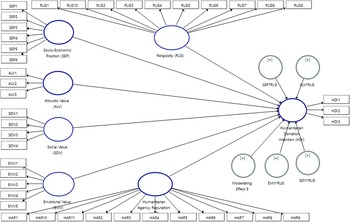
Drawing on the TPB, NAM/VBN, warm-glow theory, and signaling and trust theory, together with insights from the reviewed literature, this study specifies the PLS-SEM model shown in Figure 1, which includes both the structural relationships and the measurement model with observed indicators for empirical testing.
PLS-SEM model of humanitarian donation intention with religiosity as a moderator. Ovals denote latent constructs, rectangles denote observed indicators, and arrows show both direct effects and interaction terms (RLG × predictors).

Fig. 1. Long description
The structural equation model is organized as follows.
* Predictor Latent Constructs (Left and Top): Five blue ovals represent independent variables.
- Socio-Economic Position (S E P) at the top left is linked to six indicators (S E P 1 to S E P 6).
- Altruistic Value (A L V) is linked to three indicators (A L V 1 to A L V 3).
- Social Value (S O V) is linked to four indicators (S O V 1 to S O V 4).
- Emotional Value (E M V) at the bottom left is linked to five indicators (E M V 1 to E M V 5).
- Religiosity (R L G) at the top center is linked to ten indicators (R L G 1 to R L G 10).
- Humanitarian Agency Reputation (H A R) at the bottom center is linked to eleven indicators (H A R 1 to H A R 11).
* Interaction Terms (Center-Right): Five grey circles containing a plus sign represent moderating effects pointing toward the target construct. These are labeled S E P asterisk R L G, A L V asterisk R L G, Moderating Effect 5, E M V asterisk R L G, and S O V asterisk R L G.
* Target Construct (Right): A blue oval labeled Humanitarian Donation Intention (H D I) receives arrows from all predictor constructs and all interaction terms. It is linked to three observed indicators: H D I 1, H D I 2, and H D I 3.
Research methods
Population and sample
The study took place in Aceh Province, Indonesia, a region with strong traditions of religious and community-based generosity (Nadia, Reference Nadia2022), while Indonesia as a whole has ranked first in the World Giving Index for seven consecutive years (CAF, 2024). The target population was adult residents (18+) of Banda Aceh, a city of 262,960 people in 2024, including 169,310 adults (64.39%) (Statistics Indonesia [BPS], 2024). As the provincial capital attracting residents from all 23 districts, Banda Aceh offers a representative setting of Aceh’s population and its Sharia-based context.
The age cut-off of 18 follows the Supreme Court’s 2011 National Congress and Indonesia’s Marriage Law No. 1/1974 (amended by Law No. 16/2019), defining adulthood as sufficient maturity and financial autonomy for independent giving (Latifiani, Reference Latifiani2025). Using Slovin’s formula with a 0.05 margin of error, a sample of 400 respondents (0.24% of the adult population) was obtained. This exceeds the Partial Least Square-Structural Equation Modeling (PLS-SEM) requirement of 5–10 cases per indicator (Hair et al., Reference Hair, Hult, Ringle, Sarstedt, Danks and Ray2021); with seven variables and 42 indicators needing 210–420 cases, the sample size ensures reliable generalization.
Stratified random sampling was applied within an eligible population of adult residents who had previously made at least one humanitarian donation, using age groups as strata. Within each age stratum, respondents were selected through a field-based random approach. Trained enumerators conducted face-to-face surveys in public locations with high and diverse foot traffic, including mosques, markets, universities, government offices, and residential neighborhoods across Banda Aceh. Every fifth adult encountered who met the eligibility criterion (aged 18 years or above and having previously made at least one humanitarian donation) was invited to participate. If a person declined or did not meet the criterion, the next eligible individual was approached. This procedure ensured proportional representation of age groups while preserving random selection within each stratum.
Ethical approval was obtained from the Ethics Committee for Economic and Business Research, Faculty of Economics and Business, Universitas Syiah Kuala (Approval No. 0108/UN11.1.1.ETK/KEP.07.03/2024, 7 March 2024). The study complied with the Ethical Guidelines of the Ministry of Education, Culture, Research, and Technology of Indonesia and the Declaration of Helsinki. All participants were informed about the study objectives and procedures, provided written informed consent, and were assured of anonymity, confidentiality, and the right to withdraw at any time without consequence.
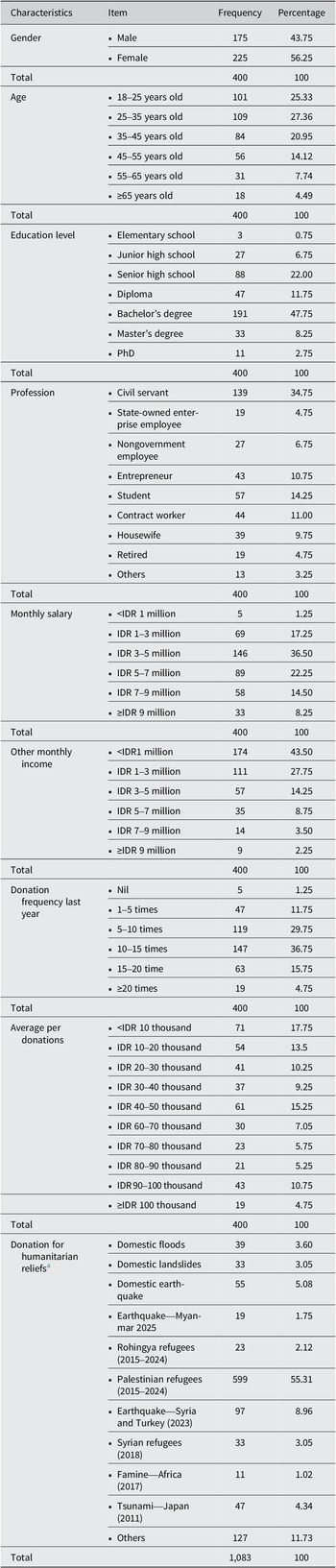
As a result, respondent profiles (Table 1) indicate predominance of younger and early middle-aged adults: 25–35 years (27.36%), 18–25 years (25.33%), 35–45 years (20.95%), 45–55 years (14.12%), 55–65 years (7.74%), and ≥ 65 years (4.49%). Females slightly outnumbered males (56.25% vs. 43.75%). Educational attainment was high, with 47.75% holding bachelor’s degrees, 22% senior high school, 11.75% diplomas, and 8.75% postgraduate degrees.
Respondent profiles

Table 1. Long description
The table consists of four columns: Characteristics, Item, Frequency, and Percentage. Key data points include:
* Gender: 43.75 percent Male (175) and 56.25 percent Female (225).
* Age: The largest group is 25 to 35 years old at 27.36 percent (109), followed by 18 to 25 years old at 25.33 percent (101).
* Education level: Nearly half of respondents hold a Bachelor's degree (47.75 percent, 191).
* Profession: Civil servants are the most common at 34.75 percent (139).
* Monthly salary: The most frequent range is I D R 3 to 5 million (36.50 percent, 146).
* Other monthly income: 43.50 percent (174) earn less than I D R 1 million in additional income.
* Donation frequency last year: The highest frequency is 10 to 15 times (36.75 percent, 147).
* Average per donation: The most common amount is less than I D R 10 thousand (17.75 percent, 71).
* Donation for humanitarian reliefs: Palestinian refugees (2015 to 2024) received the highest engagement with 55.31 percent (599 selections), followed by Earthquake in Syria and Turkey (2023) at 8.96 percent (97). Note that for this category, respondents could select multiple answers, totaling 1,083 responses.
a Respondents may select more than one answer.
Source: Authors’ processing of primary data (2025).
Civil servants form the largest occupational group (34.75%), followed by students (14.25%), contract workers (11%), entrepreneurs (10.75%), and housewives (9.75%). The dominant monthly income is IDR 3–5 million (36.50%), with additional income typically under IDR 1 million (43.50%). Donation patterns show a strong culture of giving: most respondents donate 10–15 times per year (36.75%), usually less than IDR 10 thousand per occasion (17.75%). Humanitarian aid is directed mainly to Palestinian refugees (55.31%), with smaller shares to the 2023 Syria–Turkey earthquake (8.96%), domestic earthquakes (5.08%), the Japan tsunami (4.34%), domestic floods (3.60%), and Rohingya refugees (2.12%).
Operationalized variables
Key constructs were adapted from established measures. Humanitarian Donation Intention (HDI) captures willingness, confidence, and commitment to give (Yaacob, Reference Yaacob2019). Socioeconomic position (SEP) reflects resources and capacity to meet basic needs (Howe et al., Reference Howe, Hargreaves, Ploubidis, De Stavola and Huttly2011). Altruistic Value (ALV) denotes moral satisfaction from helping (Chell & Mortimer, Reference Chell and Mortimer2014), while Social Value (SOV) and Emotional Value (EMV) assess recognition and emotional rewards (Sweeney & Soutar, Reference Sweeney and Soutar2001). Humanitarian Agency Reputation (HAR) evaluates transparency, service quality, and leadership credibility (Michel & Rieunier, Reference Michel and Rieunier2012; Sargeant et al., Reference Sargeant, Ford and Hudson2008). Religiosity (RLG) measures religious commitment, spiritual closeness, and belief in divine rewards (Abdullah & Majid, Reference Abdullah and Majid2003; Yaacob, Reference Yaacob2019).
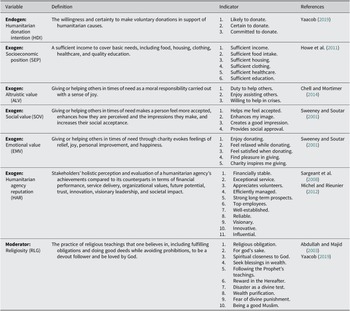
All variables were assessed using five-point Likert-type scales (1 = Strongly Disagree to 5 = Strongly Agree) tailored to the Indonesian sociocultural setting. Detailed operational definitions and measurement items are provided in Table 2.
Operationalized variables

Table 2. Long description
The table consists of seven rows and four columns.
1. Endogen: Humanitarian donation intention (H D I). Definition: Willingness and certainty to make voluntary donations. Indicators: 1. Likely to donate, 2. Certain to donate, 3. Committed to donate. Reference: Yaacob (2019).
2. Exogen: Socioeconomic position (S E P). Definition: Sufficient income for basic needs. Indicators: 1. Sufficient income, 2. Sufficient food intake, 3. Sufficient housing, 4. Sufficient clothing, 5. Sufficient healthcare, 6. Sufficient education. Reference: Howe et al. (2011).
3. Exogen: Altruistic value (A L V). Definition: Helping others as a moral responsibility with joy. Indicators: 1. Duty to help others, 2. Enjoy assisting others, 3. Willing to help in crises. Reference: Chell and Mortimer (2014).
4. Exogen: Social value (S O V). Definition: Helping others to feel accepted and enhance social image. Indicators: 1. Helps me feel accepted, 2. Enhances my image, 3. Creates a good impression, 4. Provides social approval. Reference: Sweeney and Soutar (2001).
5. Exogen: Emotional value (E M V). Definition: Charity evoking relief, joy, and happiness. Indicators: 1. Enjoy donating, 2. Feel relaxed, 3. Feel satisfied, 4. Find pleasure in giving, 5. Charity inspires me. Reference: Sweeney and Soutar (2001).
6. Exogen: Humanitarian agency reputation (H A R). Definition: Stakeholders’ perception of agency achievements and trust. Indicators: 1. Financially stable, 2. Exceptional service, 3. Appreciates volunteers, 4. Efficiently managed, 5. Strong prospects, 6. Top employees, 7. Well-established, 8. Reliable, 9. Visionary, 10. Innovative, 11. Influential. References: Sargeant et al. (2008) and Michel and Rieunier (2012).
7. Moderator: Religiosity (R L G). Definition: Practice of religious teachings and good deeds. Indicators: 1. Religious obligation, 2. For God's sake, 3. Spiritual closeness, 4. Seek blessings, 5. Following Prophet's teachings, 6. Reward in Hereafter, 7. Disaster as divine test, 8. Wealth purification, 9. Fear of punishment, 10. Being a good Muslim. References: Abdullah and Majid (2003) and Yaacob (2019).
Source: Adapted from relevant previous studies (2025).
PLS-SEM model specification and estimation
This study investigates the effects of socioeconomic position (SEP), altruistic value (ALV), social value (SOV), emotional value (EMV), and humanitarian agency reputation (HAR) on humanitarian donation intention (HDI), with religiosity (RLG) as a moderating variable, using PLS-SEM. This method was chosen for its predictive strength, ability to handle complex reflective and formative models, robustness in moderation analysis, suitability for nonnormal data and moderate sample sizes, and its capacity to assess measurement and structural models simultaneously (Hair et al., Reference Hair, Hult, Ringle, Sarstedt, Danks and Ray2021).
To test the hypothesized relationships, Model 1 was estimated using the following SEM equation:

Model 2 was specified to test religiosity (RLG) as a moderator of the effects of SEP, ALV, SOV, EMV, and HAR on HDI:

where βii is the estimated regressors, μii is the estimated moderators, and εi is the structured error term.
In line with Partial Least Squares Structural Equation Modeling (PLS-SEM) procedures (Hair et al., Reference Hair, Hult, Ringle, Sarstedt, Danks and Ray2021), the analysis began with the evaluation of the measurement model. Indicator reliability was assessed using outer loadings, with values above 0.70 indicating adequate reliability. Internal consistency reliability was evaluated using Composite Reliability (CR) and Cronbach’s alpha, with values of 0.70 or higher considered acceptable (Hair et al., Reference Hair, Hult, Ringle, Sarstedt, Danks and Ray2021).
Convergent validity was established when the Average Variance Extracted (AVE) for each construct exceeded 0.50, indicating that the construct explained more than half of the variance of its indicators (Anderson & Gerbing, Reference Anderson and Gerbing1988). Discriminant validity was assessed using the Heterotrait–Monotrait (HTMT) ratio, ensuring that all HTMT values were below the recommended thresholds, indicating adequate construct distinctiveness (Hair et al., Reference Hair, Hult, Ringle, Sarstedt, Danks and Ray2021). Multicollinearity among indicators was evaluated using the Variance Inflation Factor (VIF), with values below the recommended cutoff indicating no serious collinearity problems (Hair et al., Reference Hair, Hult, Ringle, Sarstedt, Danks and Ray2021). Because PLS-SEM is a variance-based and prediction-oriented approach, data normality and covariance-based goodness-of-fit indices are not required.
After the measurement model satisfied all reliability and validity criteria, the structural model was evaluated using R 2 (the coefficient of determination indicating the proportion of variance in the endogenous construct explained by the predictors), Q 2 (the Stone–Geisser predictive relevance measure assessing out-of-sample prediction), f 2 (the effect size indicating the relative impact of each exogenous construct on the endogenous variable), and bootstrapped path coefficients to test the direct and moderating relationships specified in the research model (Hair et al., Reference Hair, Hult, Ringle, Sarstedt, Danks and Ray2021).
Findings and discussion
An overview of Aceh’s humanitarian relief efforts
Aceh, a special-autonomy province at the northern tip of Sumatra, is widely recognized for its strong traditions of religious and community-based generosity (Nadia, Reference Nadia2022), within Indonesia, which has ranked as the world’s most generous country for seven consecutive years in the World Giving Index (CAF, 2024). Bordered by the Malacca Strait and the Indian Ocean, it has a population of approximately 5.48 million, representing about 2% of Indonesia’s total population (Statistics Indonesia (Badan Pusat Statistik), 2024). Aceh’s traditions of giving draw from ukhuwah Islamiyah (Islamic brotherhood), ukhuwah wathaniyah (national brotherhood), ukhuwah insaniyah (universal human brotherhood) (Qur’an 10:13), and gotong royong (mutual cooperation), with roots linked to the Aceh Sultanate’s 16th-century ties to the Ottoman Empire (Reid, Reference Reid2005). The 2004 Indian Ocean tsunami, which claimed over 167,000 lives and displaced nearly half a million in Aceh, triggered a record humanitarian response exceeding USD 7 billion (World Bank, 2005) and transformed Aceh from an aid recipient into a consistent donor (Masyrafah & McKeon, Reference Masyrafah and McKeon2008).
Since then, Aceh has actively contributed to humanitarian crises at home and abroad, including Japan’s 2011 Tōhoku earthquake, Typhoon Haiyan (2013), the 2015 Gorkha earthquake, and Cyclone Pam. Its international aid peaked in 2023, providing IDR 1 billion—37% of Indonesia’s national pledge—for Türkiye and Syria, along with about 140 tons of relief, while continuing support for Palestine, Morocco, and Gaza (Ministry of Foreign Affairs of the Republic of Indonesia, 2025). Ongoing engagement in 2024–2025 highlights Aceh’s dual role as donor and recipient, reflecting its unique status as Indonesia’s only Sharia-governed province and reinforcing the nation’s global reputation for generosity and civic solidarity.
PLS-SEM measurement model: Humanitarian donation intentions
Before estimating the structural relationships, the measurement model was evaluated in accordance with PLS-SEM standards (Hair et al., Reference Hair, Hult, Ringle, Sarstedt, Danks and Ray2021). The assessment focused on indicator reliability, internal consistency reliability, convergent validity, discriminant validity, and collinearity to ensure the quality of all latent constructs (Tables 3–5).
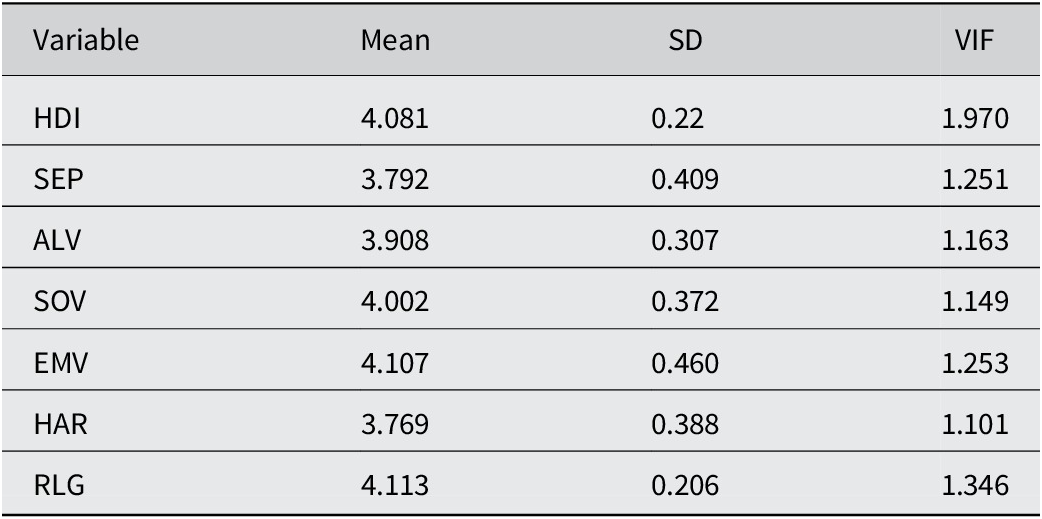
Descriptive statistics

Table 3. Long description
The table consists of four columns: Variable, Mean, S D (Standard Deviation), and V I F (Variance Inflation Factor). The data for each variable is as follows:
* H D I: Mean 4.081, S D 0.22, V I F 1.970.
* S E P: Mean 3.792, S D 0.409, V I F 1.251.
* A L V: Mean 3.908, S D 0.307, V I F 1.163.
* S O V: Mean 4.002, S D 0.372, V I F 1.149.
* E M V: Mean 4.107, S D 0.460, V I F 1.253.
* H A R: Mean 3.769, S D 0.388, V I F 1.101.
* R L G: Mean 4.113, S D 0.206, V I F 1.346.
The source is noted as the authors’ processing of primary data from 2025.
Source: Authors’ processing of primary data (2025).
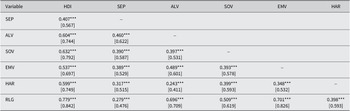
Correlation coefficient and HTMT ratio

Table 4. Long description
The table presents correlation coefficients with significance levels and H T M T ratios in square brackets for the following variables: H D I, S E P, A L V, S O V, E M V, H A R, and R L G. All reported correlations are significant at p < 0.01.
* S E P and H D I: 0.407 [0.567].
* A L V: with H D I is 0.604 [0.744]; with S E P is 0.460 [0.622].
* S O V: with H D I is 0.632 [0.792]; with S E P is 0.390 [0.587]; with A L V is 0.397 [0.531].
* E M V: with H D I is 0.537 [0.697]; with S E P is 0.389 [0.529]; with A L V is 0.489 [0.601]; with S O V is 0.393 [0.578].
* H A R: with H D I is 0.599 [0.749]; with S E P is 0.317 [0.515]; with A L V is 0.243 [0.411]; with S O V is 0.399 [0.593]; with E M V is 0.348 [0.532].
* R L G: with H D I is 0.779 [0.842]; with S E P is 0.279 [0.476]; with A L V is 0.696 [0.709]; with S O V is 0.509 [0.619]; with E M V is 0.701 [0.826]; with H A R is 0.398 [0.593].
***p < 0.01. The values presented in square brackets represent the HTMT ratios.
Source: Authors’ processing of primary data (2025).
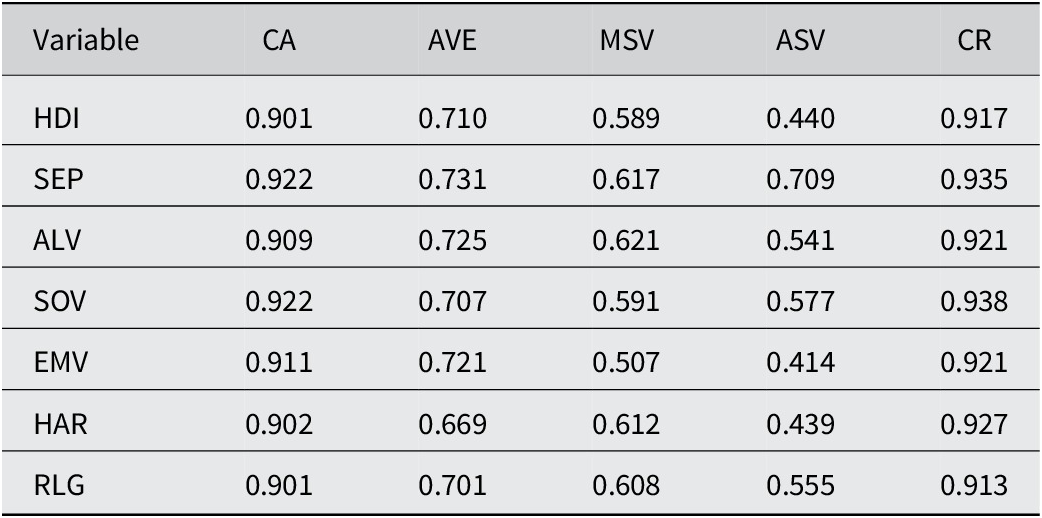
Convergent, validity, and reliability tests

Table 5. Long description
The table consists of six columns: Variable, C A, A V E, M S V, A S V, and C R.
* H D I: C A 0.901, A V E 0.710, M S V 0.589, A S V 0.440, C R 0.917.
* S E P: C A 0.922, A V E 0.731, M S V 0.617, A S V 0.709, C R 0.935.
* A L V: C A 0.909, A V E 0.725, M S V 0.621, A S V 0.541, C R 0.921.
* S O V: C A 0.922, A V E 0.707, M S V 0.591, A S V 0.577, C R 0.938.
* E M V: C A 0.911, A V E 0.721, M S V 0.507, A S V 0.414, C R 0.921.
* H A R: C A 0.902, A V E 0.669, M S V 0.612, A S V 0.439, C R 0.927.
* R L G: C A 0.901, A V E 0.701, M S V 0.608, A S V 0.555, C R 0.913.
Source: Authors’ processing of primary data (2025).
Indicator reliability was assessed using outer loadings, with values above 0.70 indicating adequate measurement quality. Internal consistency reliability was evaluated using CR, while AVE was used to establish convergent validity, with values exceeding 0.50 confirming that each construct explained more than half of the variance in its indicators. Discriminant validity was examined using the HTMT criterion, ensuring that all values were below the recommended thresholds, which confirms that the constructs are empirically distinct. VIF values were also inspected to assess multicollinearity, with all values well below the recommended threshold, indicating that collinearity did not bias the model estimates (Hair et al., Reference Hair, Hult, Ringle, Sarstedt, Danks and Ray2021). These results demonstrate that the measurement model satisfies all reliability and validity requirements for PLS-SEM and is suitable for subsequent structural model estimation.
Table 3 reports the descriptive statistics and collinearity diagnostics for all constructs. Mean values indicate generally high levels of humanitarian donation intention, religiosity, and value orientations among respondents. Standard deviations (SD) show sufficient variability across constructs. VIF ranges from 1.101 to 1.970, well below the conservative threshold of 3.3, indicating that multicollinearity is not a concern in the structural model (Hair et al., Reference Hair, Hult, Ringle, Sarstedt, Danks and Ray2021).
Table 4 reports the Pearson correlations and HTMT ratios among the latent constructs. All HTMT values range from 0.411 to 0.842, which are below the conservative threshold of 0.90, indicating satisfactory discriminant validity between all constructs (Hair et al., Reference Hair, Hult, Ringle, Sarstedt, Danks and Ray2021; Henseler et al., Reference Henseler, Ringle and Sarstedt2015). Pearson correlations show that humanitarian donation intention is positively and significantly associated with all explanatory variables, providing preliminary support for the hypothesized relationships that are further tested in the structural model.
All indicators exhibited satisfactory outer loadings above 0.70, confirming adequate indicator reliability. As shown in Table 5, all constructs exhibit strong internal consistency, with Cronbach’s Alpha (CA) values ranging from 0.901 to 0.922 and CR values between 0.913 and 0.938, exceeding the recommended threshold of 0.70 (Hair et al., Reference Hair, Hult, Ringle, Sarstedt, Danks and Ray2021; Nunnally, Reference Nunnally1978). Convergent validity is confirmed, as all AVE values range from 0.669 to 0.731 and exceed the minimum criterion of 0.50. Discriminant validity is also supported because, for all constructs, average variance extracted values are higher than both the Maximum Shared Variance (MSV) and the Average Shared Variance (AVE) (Anderson & Gerbing, Reference Anderson and Gerbing1988). Furthermore, HTMT ratios (Table 4) are all below the 0.90 threshold, providing additional evidence of discriminant validity (Hair et al., Reference Hair, Hult, Ringle, Sarstedt, Danks and Ray2021; Henseler et al., Reference Henseler, Ringle and Sarstedt2015). Together, these results indicate that the measurement model demonstrates satisfactory reliability, convergent validity, and discriminant validity.
After establishing the reliability and validity of the measurement model, the study proceeded to evaluate the structural model using PLS-SEM to test the direct and moderating hypotheses (Tables 6 and 7).
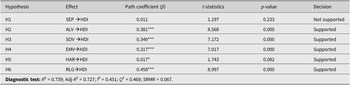
Hypothesis testing: Determinants of humanitarian donation intention

Table 6. Long description
The table contains six columns: Hypothesis, Effect, Path coefficient (beta), t-statistics, p-value, and Decision.
* H 1: S E P to H D I. Path coefficient 0.011, t-statistic 1.197, p-value 0.233. Decision: Not supported.
* H 2: A L V to H D I. Path coefficient 0.381 (significant at p < 0.01), t-statistic 8.568, p-value 0.000. Decision: Supported.
* H 3: S O V to H D I. Path coefficient 0.349 (significant at p < 0.01), t-statistic 7.172, p-value 0.000. Decision: Supported.
* H 4: E M V to H D I. Path coefficient 0.317 (significant at p < 0.01), t-statistic 7.017, p-value 0.000. Decision: Supported.
* H 5: H A R to H D I. Path coefficient 0.017 (significant at p < 0.10), t-statistic 1.743, p-value 0.082. Decision: Supported.
* H 6: R L G to H D I. Path coefficient 0.458 (significant at p < 0.01), t-statistic 8.997, p-value 0.000. Decision: Supported.
Diagnostic tests at the bottom of the table: R-squared = 0.739; Adjusted R-squared = 0.727; f-squared = 0.431; Q-squared = 0.469; S R M R = 0.067.
***p < 0.01, *p < 0.10. f 2 = effect size; Q 2 = predictive relevance; SRMR = standardized root mean square residual.
Source: Authors’ processing of primary data (2025).
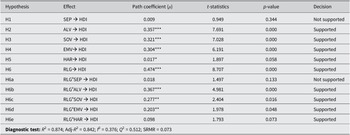
Hypothesis testing: Moderating effect

Table 7. Long description
The table contains six columns: Hypothesis, Effect, Path coefficient (mu), t-statistics, p-value, and Decision.
* H 1: S E P yields H D I; Path 0.009; t 0.949; p 0.344; Not supported.
* H 2: A L V yields H D I; Path 0.357; t 7.691; p 0.000; Supported.
* H 3: S O V yields H D I; Path 0.321; t 7.028; p 0.000; Supported.
* H 4: E M V yields H D I; Path 0.304; t 6.191; p 0.000; Supported.
* H 5: H A R yields H D I; Path 0.017; t 1.897; p 0.058; Supported.
* H 6: R L G yields H D I; Path 0.474; t 8.707; p 0.000; Supported.
* H 6 a: R L G super x S E P yields H D I; Path 0.018; t 1.497; p 0.133; Not supported.
* H 6 b: R L G super x A L V yields H D I; Path 0.367; t 4.981; p 0.000; Supported.
* H 6 c: R L G super x S O V yields H D I; Path 0.277; t 2.404; p 0.016; Supported.
* H 6 d: R L G super x E M V yields H D I; Path 0.203; t 1.978; p 0.048; Supported.
* H 6 e: R L G super x H A R yields H D I; Path 0.098; t 1.793; p 0.073; Supported.
Diagnostic tests at the bottom: R-squared = 0.874; Adjusted R-squared = 0.842; f-squared = 0.376; Q-squared = 0.512; S R M R = 0.073. Significance levels are indicated by asterisks: one for p < 0.10, two for p < 0.05, and three for p < 0.01.
*p < 0.10, **p < 0.05, ***p < 0.01.
Source: Authors’ processing of primary data (2025).
Determinants of humanitarian donation intentions
Table 6 shows the effects of SEP, ALV, SOV, EMV, HAR, and RLG on HDI among 400 Banda Aceh respondents. SEP was insignificant (β = 0.011, p > 0.10), indicating that humanitarian giving in Aceh is not primarily driven by material capacity but by normative and religious motivations. This finding supports theories emphasizing values, norms, and religiosity in prosocial behavior (Ajzen, Reference Ajzen1991; Bekkers & Wiepking, Reference Bekkers and Wiepking2011) and is consistent with the TPB, which predicts that attitudes and moral norms can outweigh perceived behavioral control in shaping intention. It also aligns with Islamic teaching that intention (niyyah) is itself rewarded (Sahih al-Bukhārī, Hadith 6491; Sahih Muslim, Hadith 131). Prior studies confirm that religiosity, trust, and organizational credibility outweigh financial status in predicting donations (Hati & Idris, Reference Hati and Idris2014; Huda et al., Reference Huda, Trianto and Masrizal, & Maskuroh2025), especially in faith-based and humanitarian contexts.
Among the significant value-based predictors, ALV showed the strongest influence on HDI (β = 0.381, p < 0.01), confirming that moralized concern for others is the primary engine of humanitarian giving in Aceh. Individuals with strong altruistic tendencies view charitable giving as a moral duty rooted in empathy and social responsibility (Penner et al., Reference Penner, Dovidio, Piliavin and Schroeder2005), consistent with Schwartz’s (Reference Schwartz and Berkowitz1977) NAM/VBN theory, which posits that perceived need and responsibility activate personal moral norms that directly shape helping behavior. Altruism drives humanitarian donations by framing giving as a moral duty (Andreoni, Reference Andreoni1990), particularly in contexts where beneficiaries are distant and personal material returns are absent. It also yields intrinsic rewards, such as emotional fulfillment, which reinforce generosity, reflecting the warm-glow mechanism through which helping becomes psychologically rewarding. Additionally, altruistic values foster swift responses in crises, making altruism a key intrinsic motivator of prosocial action (Bekkers & Wiepking, Reference Bekkers and Wiepking2011), which explains why humanitarian appeals grounded in suffering and moral urgency are especially effective.
SOV (β = 0.349, p < 0.01) and EMV (β = 0.317, p < 0.01) were also significant predictors, demonstrating that both social norms and emotional rewards play central roles in shaping humanitarian donation intention. SOV reflects reputational benefits, social approval, and a sense of belonging derived from charitable acts, corresponding to the subjective norm component of the TPB and to social identity processes in prosocial behavior. In Aceh’s collectivist culture, deeply rooted in ukhuwah Islamiyah (Islamic brotherhood) and ta’awun (mutual cooperation)—locally expressed through gotong royong—giving is perceived as both a personal and communal responsibility (Suarni et al., Reference Suarni, Nufiar, Miskahuddin, Aulia, Rusdi and Zakia2024), so donating signals moral membership and social legitimacy within the community. The philanthropic behavior of the Acehnese community embodies the Qur’an 10:13 principles, highlighting Islamic (ukhuwah Islamiyah), national (ukhuwah wathaniyah), and universal human brotherhood (ukhuwah insaniyah), which elevates charitable acts from private choices to socially expected moral conduct. Psychologically, acts of charity generate a “warm-glow” effect, reinforcing positive emotions and a sense of moral fulfilment (Andreoni, Reference Andreoni1990), social recognition, and moral credibility (Bekkers & Wiepking, Reference Bekkers and Wiepking2011), thereby linking emotional reward with social approval. EMV captures affective benefits, including acknowledgment, enhanced self-image, and relief from personal emotional burdens (Veludo-de-Oliveira et al., Reference Veludo-de-Oliveira, Alhaidari, Yani-de-Soriano and Yousafzai2017), which in Aceh are intensified by shared memories of vulnerability following the 2004 tsunami and prolonged conflict (Samuels, Reference Samuels2013; Telford et al., Reference Telford, Cosgrave and Houghton2006).
HAR had a modest positive effect on HDI (β = 0.017, p < 0.10), indicating that organizational reputation functions primarily as a credibility filter rather than as a primary motivational driver. Donor trust is enhanced by financial soundness, competent management, professionalism, innovation, and institutional reliability, reducing uncertainty and encouraging contributions (Ghani et al., Reference Ghani, Alias, Alazemi and Kamis2024), which is consistent with signaling theory, where reputational cues help donors infer organizational quality and integrity. In Aceh, the reputation of Aceh Islamic Treasury (Baitul Mal Aceh) fosters donor trust, allowing religious and emotional motivations to translate into actual intention, whereas the 2022 license revocation of ACT Foundation by the Ministry of Social Affairs demonstrates how reputational decline can rapidly erode public confidence and reduce contributions (Ministry of Social Affairs of the Republic of Indonesia, 2022), illustrating the fragility of trust-based fundraising in humanitarian settings.
RLG was the strongest determinant of HDI (β = 0.458, p < 0.01), consistent with prior research linking faith to donation (Buenconsejo et al., Reference Buenconsejo, Krauss, Abdul Kadir, Suryani, Aruta, Kittiteerasack and Yu2024; Usman et al., Reference Usman, Mulia, Chairy and Widowati2022), confirming that religiosity operates as a central motivational structure in humanitarian giving. Islamic teachings frame charitable giving as both a moral obligation and a source of spiritual reward (Al Imran 3:92, 3:134; Al Baqarah 2:261), motivated by duty (Al-Baqarah 2:110), acts performed for God’s sake (Al-Anfal 8:60), spiritual closeness to Allah, and the pursuit of blessings (Al-Baqarah 2:272), which embeds donation within a sacred moral economy rather than a purely discretionary choice. This is reinforced by the Prophet’s guidance on empathy and moral responsibility (Sahih al-Bukhari, Hadith 112 & 6465; Sunan al-Tirmidhi, Hadith 604; Sahih Muslim, Hadith 45), which transforms generosity into a religiously sanctioned expression of faith.
In Aceh, humanitarian giving is shaped more by altruism, social bonds, and emotional values than by wealth or organizational reputation, but these drivers are unified and intensified by religiosity. Religiosity is the strongest driver, reflecting deep moral, spiritual, and cultural traditions, and it provides the normative glue that connects values, emotions, and institutional trust into coherent donation intention. Together, these factors show how ethics, community, and faith intertwine to sustain generosity in the region, offering a theoretical explanation for why Aceh’s humanitarian engagement remains resilient even across income groups.
Determinants of humanitarian donation intentions: The moderating role of religiosity
To deepen the analysis, the study examined the extent to which RLG moderates the relationships between the identified determinants and HDI, as summarized in Table 7, allowing us to test whether religiosity changes how socioeconomic resources, values, emotions, and organizational reputation are translated into humanitarian donation intentions. From a theoretical perspective, moderation by religiosity is expected because religious commitment strengthens moral norms, amplifies emotional responses, and legitimizes institutional trust, thereby conditioning the effectiveness of other motivational drivers.
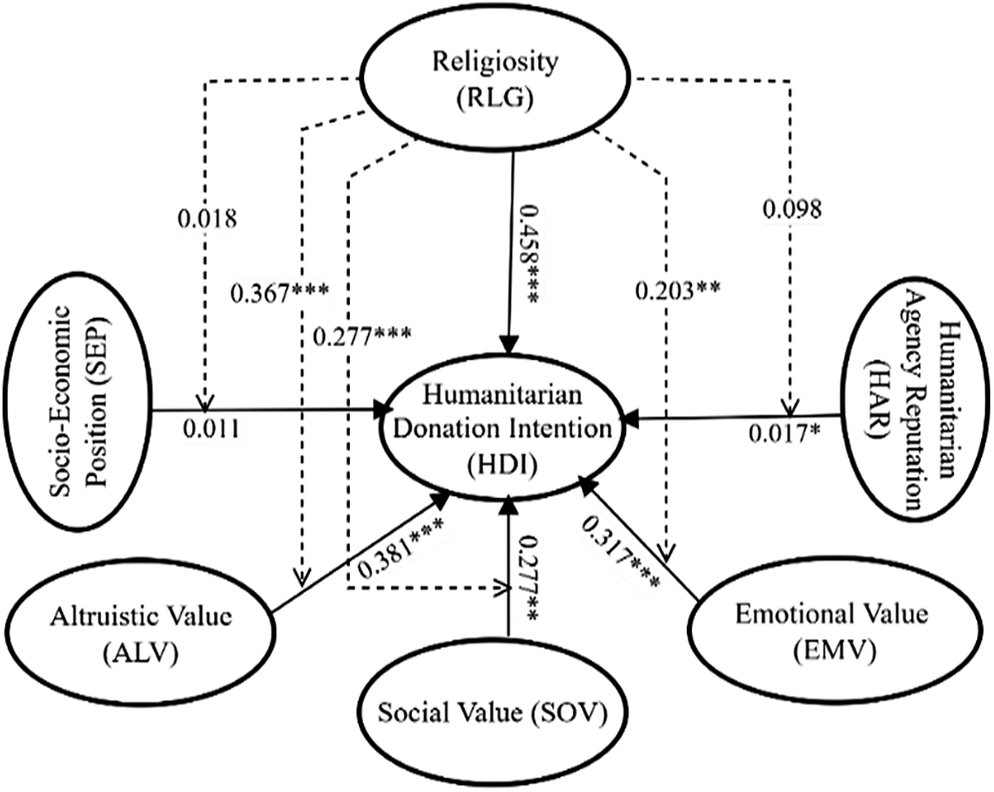
The overall pattern of direct and moderating effects reported in Tables 6 and 7 is summarized graphically in Figure 2.
Visual summary of the PLS-SEM results. Solid lines indicate direct effects; dashed lines indicate moderating (interaction) effects. ***p < 0.01, **p < 0.05, *p < 0.10.

Fig. 2. Long description
The diagram centers on the outcome variable Humanitarian Donation Intention H D I.
Direct effects shown by solid arrows pointing to H D I include
- Religiosity R L G at the top with a path coefficient of 0.458***.
- Socio-Economic Position S E P on the left with a path coefficient of 0.011.
- Altruistic Value A L V at the bottom-left with a path coefficient of 0.381***.
- Social Value S O V at the bottom with a path coefficient of 0.277**.
- Emotional Value E M V at the bottom-right with a path coefficient of 0.317***.
- Humanitarian Agency Reputation H A R on the right with a path coefficient of 0.017*.
Moderating effects shown by dashed arrows originating from Religiosity R L G include
- A path to the S E P to H D I relationship with a value of 0.018.
- A path to the A L V to H D I relationship with a value of 0.367***.
- A path to the S O V to H D I relationship with a value of 0.277***.
- A path to the E M V to H D I relationship with a value of 0.203**.
- A path to the H A R to H D I relationship with a value of 0.098.
Significance levels are indicated by asterisks where *** p < 0.01, ** p < 0.05, and * p < 0.10.
As shown in Table 7 and summarized in Figure 2, RLG does not significantly moderate SEP (μ = 0.018, p > 0.10), indicating that religiosity does not alter the effect of financial capacity on donation intention, yet it amplifies the effects of ALV (μ = 0.367, p < 0.01), SOV (μ = 0.277, p < 0.05), and EMV (μ = 0.203, p < 0.05), while exerting a smaller positive influence on HAR (μ = 0.098, p < 0.10). This pattern suggests that religiosity operates primarily as a moral and emotional amplifier rather than as an economic moderator.
These findings are consistent with prior research suggesting that religiosity strengthens moral identity, norm salience, and affective responsiveness, thereby translating values into firmer behavioral commitments (Buenconsejo et al., Reference Buenconsejo, Krauss, Abdul Kadir, Suryani, Aruta, Kittiteerasack and Yu2024; Min Teah et al., Reference Min Teah, Lwin and Cheah2014), a mechanism that is theoretically consistent with both the NAM/VBN model and the TPB. This moderating role is also emphasized in Islamic teachings, including Qur’anic injunctions (Hughes & Siddiqui, Reference Hughes and Siddiqui2024), which frame generosity as a religiously sanctioned obligation rather than a discretionary act.
Islamic teachings consistently highlight charitable giving as both a spiritual duty and moral obligation, thereby embedding generosity within a normative religious framework rather than a purely voluntary act. The Qur’an affirms that true piety is achieved through generosity (Al Imran 3:92; 3:134) and promises multiplied rewards for giving (Al Baqarah 2:261), which aligns with theoretical perspectives that link moral obligation and anticipated reward to prosocial motivation. Giving is further seen as wealth purification (At-Taubah 9:103), protection from divine punishment (Al-Anfal 8:36), and a source of blessings and eternal reward (Al-Baqarah 2:272), making charity a core expression of Islamic faith (Al-Baqarah 2:43) and reinforcing the internalization of moral norms emphasized in the NAM/VBN theory. Similarly, Prophetic teachings emphasize compassion and responsibility, including feeding the hungry (Sahih al-Bukhari, Hadith 112), giving charity promptly (Al-Tirmidhi, Hadith 589), and wishing for others what one wishes for oneself (Sahih al-Bukhari & Muslim, Hadith 45), which translate religious doctrine into everyday prosocial expectations.
In Aceh, religiosity is institutionalized through Sharia law and formalized giving via Baitul Mal Aceh, making charitable acts morally binding, socially reinforced, and spiritually rewarded (BAZNAS, 2024; Fauzia, Reference Fauzia2017), thereby transforming individual donation decisions into part of a legally and morally structured public system. Empirical studies show that faith and spiritual motives outweigh economic considerations in shaping giving (Helms & Thornton, Reference Helms and Thornton2012), which is consistent with the weak role of socioeconomic position observed in the present study. Local customs—where hukôm ngon adat lagee zat ngon sifeut (law and custom are inseparable like substance and nature)—align closely with Islamic values (Feener, Reference Feener2013), creating a cultural environment in which religious and social norms mutually reinforce prosocial behavior. In Aceh, charitable giving is shaped less by socioeconomic standing than by Islamic values—ukhuwah Islamiyah, ukhuwah wathaniyah, ukhuwah insaniyah (Qur’an 10:13), ta’awun, and gotong royong—that promote generosity across all groups (Darnela, Reference Darnela2021), explaining why donation intentions remain high even among lower income households.
The results highlight the determinants of donation intentions in Aceh, with religiosity as moderator, demonstrating that humanitarian giving is structured by a combination of values, emotions, institutional trust, and religious commitment. The models showed strong explanatory power, with adjusted R 2 = 0.727 (Model 1) and 0.842 (Model 2), indicating high variance explained (Hair et al., Reference Hair, Hult, Ringle, Sarstedt, Danks and Ray2021), which is notable for behavioral research on voluntary giving. Predictive relevance was supported by Q 2 statistics (Henseler et al., Reference Henseler, Ringle and Sarstedt2015), and all f 2 values exceeded 0.02, confirming meaningful effects (Hair et al., Reference Hair, Hult, Ringle, Sarstedt, Danks and Ray2021), suggesting that both direct and moderating relationships are substantively important rather than merely statistically significant. Overall, the models were robust and valid, enabling reliable assessment of direct and moderating influences on giving, and providing empirical support for the integrated TPB–NAM/VBN–warm-glow–signaling framework proposed in this study.
Conclusions
This study examined the determinants of humanitarian donation intention in Aceh, with particular emphasis on religiosity as both a direct driver and a moderating force. From 400 survey responses analyzed with PLS-SEM, the results show that giving is influenced more by religiosity than by wealth. Religiosity emerged as the strongest direct predictor and significantly conditioned altruistic, social, and emotional values, indicating that it functions not only as a motivation but also as a mechanism that translates moral and emotional values into stronger behavioral intentions. Thus, charitable giving in Aceh reflects not only prosocial choice but also faith, moral duty, and the pursuit of divine reward.
In Aceh, charitable giving stems less from economic status than from Islamic values—ukhuwah Islamiyah, ukhuwah wathaniyah, and ukhuwah insaniyah (Qur’an 10:13)—and traditional norms such as gotong royong (Darnela, Reference Darnela2021). As a result, philanthropy reflects religious identity and moral obligation more than material capacity, making socioeconomic differences less influential.
The findings carry important theoretical implications. They extend value-based philanthropy models by demonstrating how religiosity conditions the translation of values into donation intention, thereby providing empirical support for integrating religious commitment into TPB- and NAM/VBN-based models of humanitarian giving. This supports broader evidence that faith continues to shape prosocial behavior even in increasingly secularized societies.
From a practical perspective, humanitarian organizations can enhance fundraising effectiveness by segmenting donors according to religiosity and value orientation, framing appeals using Islamic concepts such as zakat and sadaqah, and strengthening organizational reputation through audited reporting and transparent disclosure of fund use. These actions follow directly from the significant effects of values, religiosity, and organizational reputation identified in the PLS-SEM results and highlight the central role of trust and religious alignment in donor engagement. At the policy level, the findings suggest that integrating religiosity into philanthropic governance, as practiced in Aceh’s Sharia-based system, can improve the sustainability and effectiveness of humanitarian aid in disaster-prone regions.
Despite its contributions, the study is limited by its focus on Aceh and its cross-sectional design, which restricts generalizability and causal inference. Future research should employ longitudinal or experimental designs, compare regions with varying levels of religiosity, and examine additional moderators such as institutional trust or perceived aid effectiveness to better understand how religiosity interacts with institutional and contextual factors.
Data availability statement
Primary data were collected by distributing questionnaires online via Google Forms. The data are available from the author upon reasonable request.
Author contribution
Prof. Dr. M.S.A.M. led the study design, data collection, analysis, and manuscript preparation. Dr. R.N. contributed to the literature review, data processing, and manuscript editing. Dr. M.A. supported design refinement, data interpretation, and the literature review. Prof. Dr. Y.Y. helped refine and enrich the discussion. Dr. M.N. assisted with the literature review and manuscript drafting, while Prof. Dr. H.H. contributed to the discussion, policy implications, and manuscript finalization.
Funding statement
This study was funded by the Institute of Research and Community Services (Lembaga Penelitian dan Pengabdian kepada Masyarakat, LPPM), Universitas Syiah Kuala (USK), Indonesia, through the Professor Grant Scheme (Grant No. 42/UN11.2.1/PT.01.03/PNBP/2021).
Competing interests
None declared.
Ethical standard
All procedures adhered to established ethical guidelines, and informed consent was obtained from all participants.
Ethics approval and consent to participate
All procedures adhered to established ethical guidelines for social and humanities research, and written informed consent was obtained from all adult participants.
Use of artificial intelligence (AI) tools
The authors made limited use of artificial intelligence applications exclusively for linguistic refinement, such as improving grammar, style, and readability. These tools were not employed in the stages of data collection, analysis, or interpretation of results. All theoretical development, empirical design, and substantive conclusions remain the sole responsibility of the authors. Every AI-assisted suggestion was carefully reviewed and validated by the authors to ensure accuracy, originality, and compliance with academic integrity standards.

 Open access

