

IntroductionFootnote 1
In this article we publish the first known inscription from Hatra which combines Greek with the local dialect of Aramaic. Only six fragmentary lines in Greek and one in HatranFootnote 2 Aramaic have survived, and the interpretation which is put forward in what follows must remain a hypothesis. However, as the first document from the city itself which incorporates both languages, it deserves special attention and ought to be discussed in its wider context. Analysis of this new inscription also allows us to throw further light on the development of religious life in Hatra.
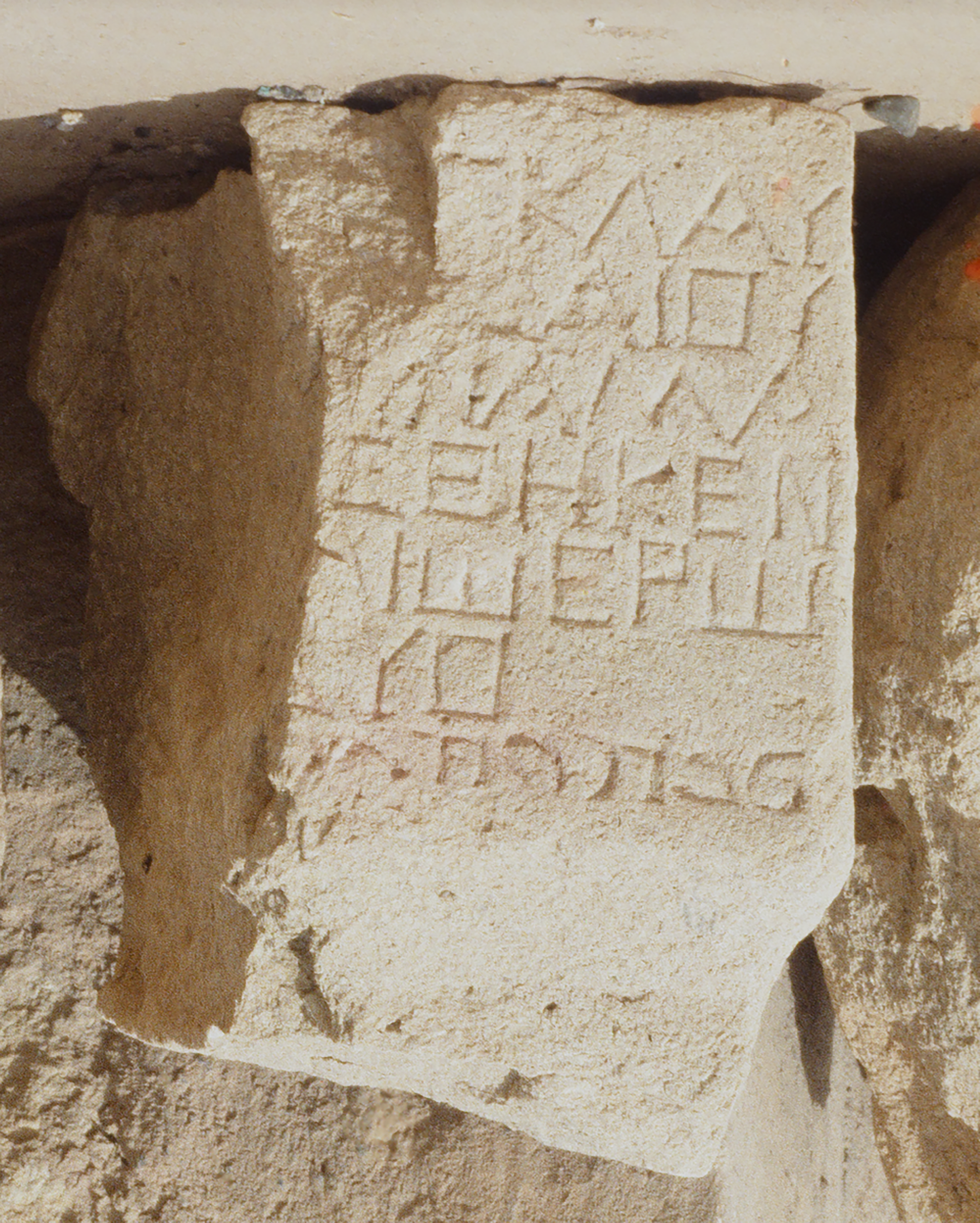
In 1993, members of the Missione Archeologica Italiana a Hatra (MAIH) had the chance to photograph, among other materials, a fragmentary stone block bearing a Greek–Hatran Aramaic inscription that is, to our knowledge, the only bilingual document ever discovered in Hatra (Fig. 1). Thus far, the object has remained unpublished and largely unnoticed.Footnote 3 The expedition worked in those years (1987–1996, with a few interruptions) in the northern part of the settlement, investigating a private residential complex (Building A) and the adjacent north–south street (North Street). In addition to the excavations, extensive surveys and study of the ruins were conducted, with a focus on architectural materials and decoration.Footnote 4 Analysis of the archives of the MAIH, which preserves a large amount of documentation not only of the investigations carried out by that team but also of the site and the history of its research more broadly (see below), served as the base for recent work on the small objects from the Italian excavations,Footnote 5 on the layout of the city and its territory,Footnote 6 and on the Aramaic graffiti,Footnote 7 and has now also brought this item to our attention. The latter appears as a fragmentary block in yellow limestone, a local lithotype employed in both architecture and sculpture, on which seven incomplete lines are inscribed. The block is damaged on at least three sides (top, left side, and bottom), although the fracture on the top does not seem to interfere with the text itself, as there is enough space to be confident that there are no lines missing at the beginning of the Greek section.
Detail of archival photograph portraying the bilingual inscription from Hatra (photo courtesy MAIH)
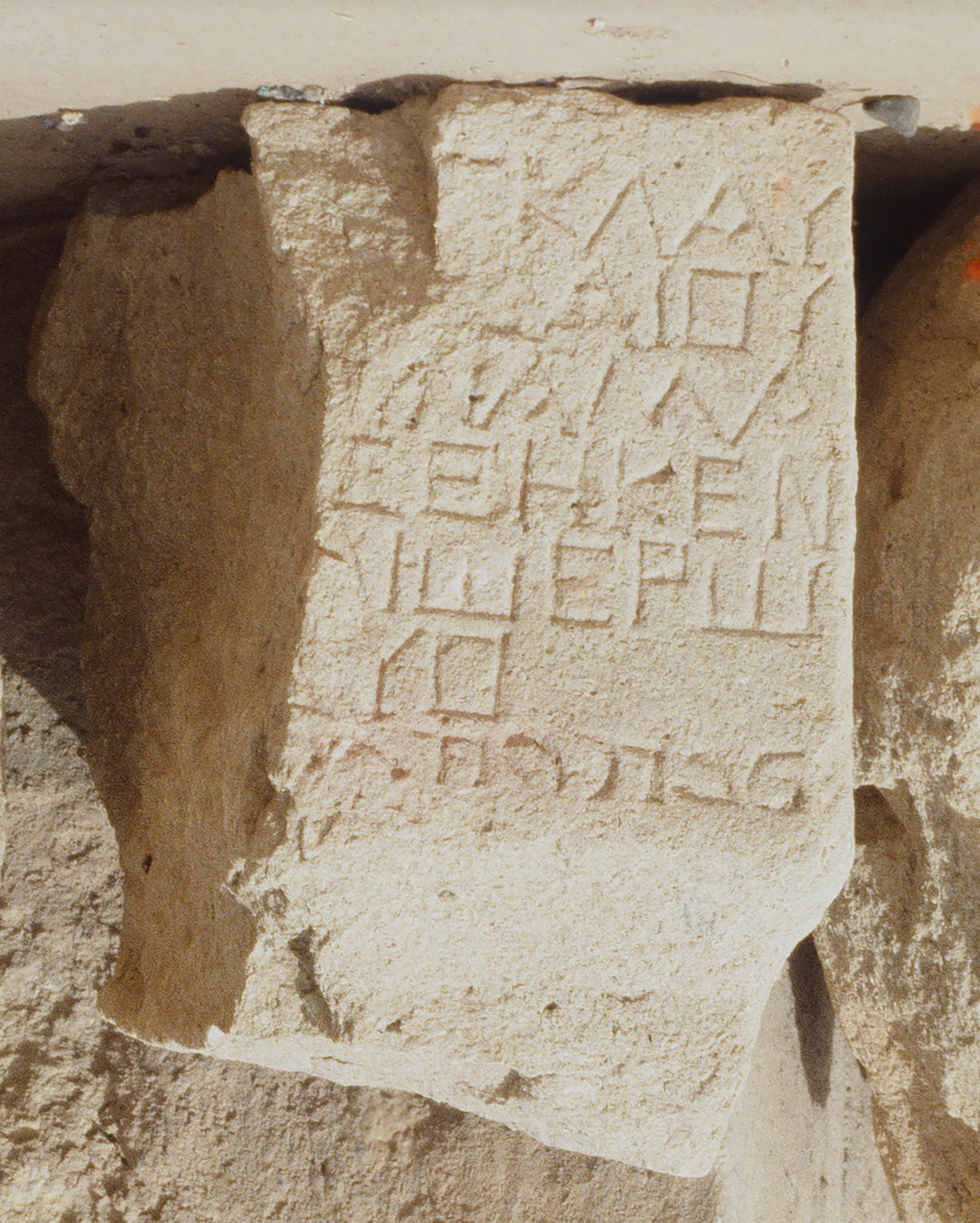
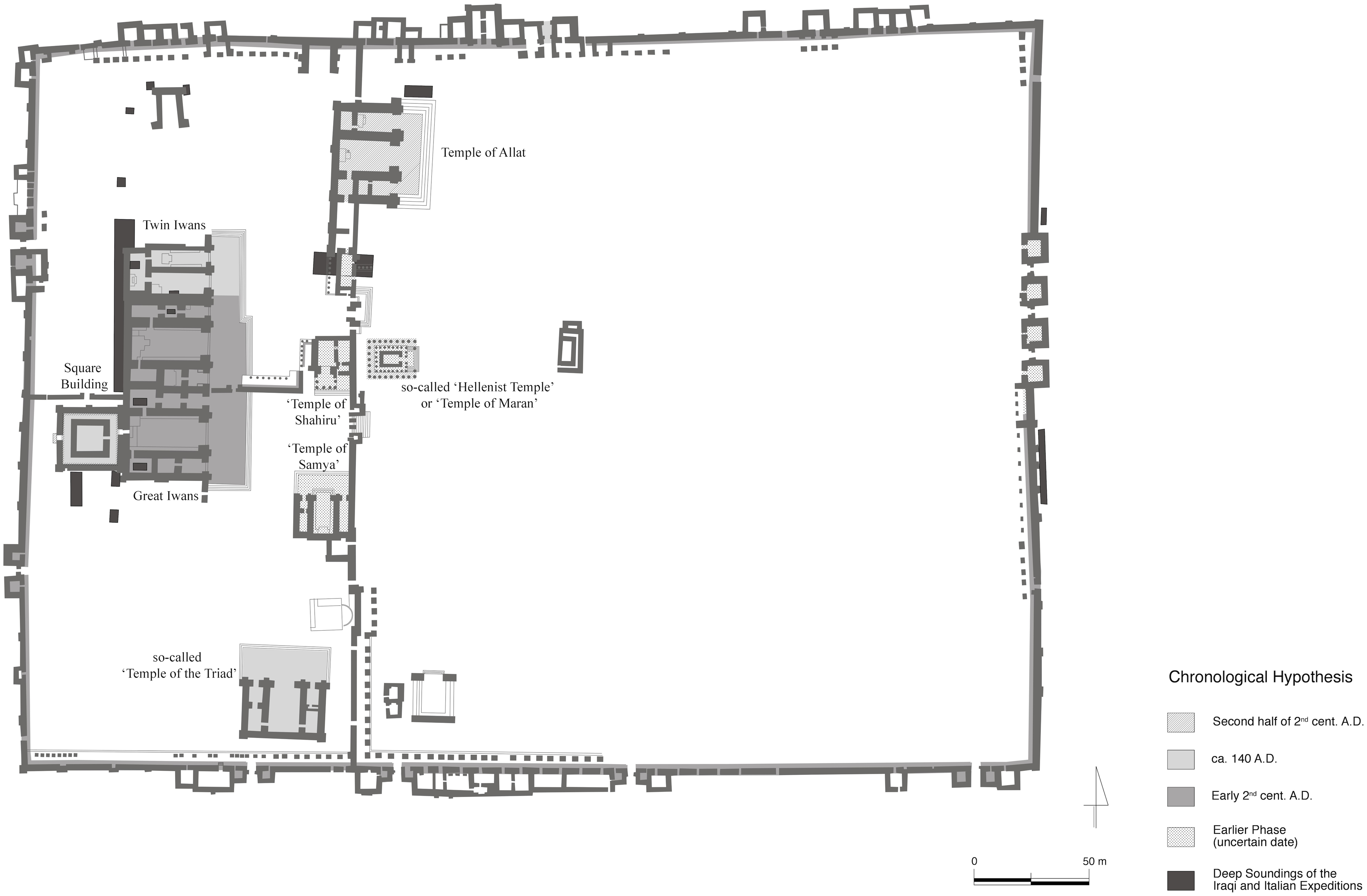
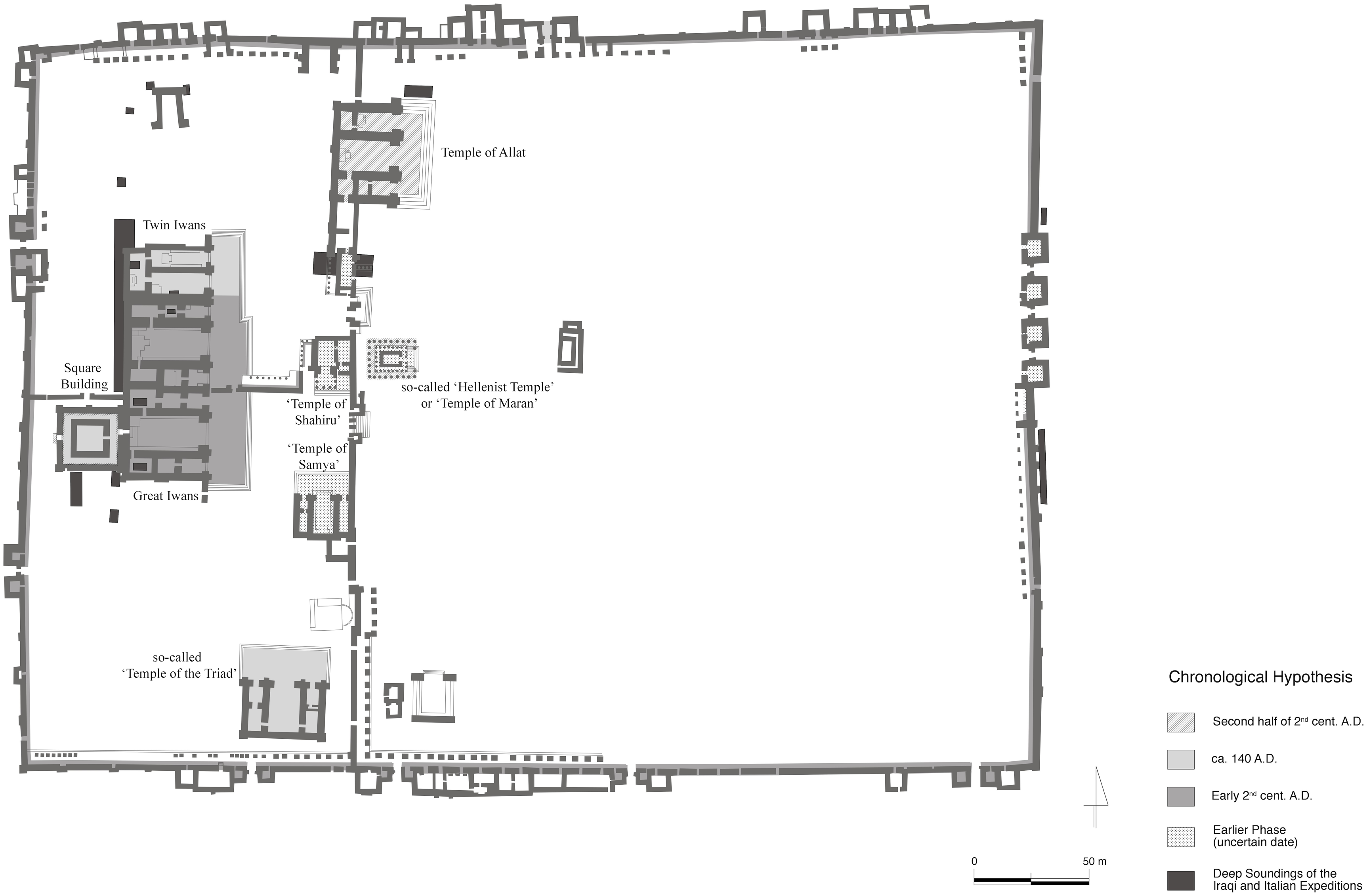
The only document in the archive portraying this artefact, a colour slide that was subsequently digitised, reveals that at the time when the picture was taken the object was lying, together with other sculptural fragments, on the floor of the courtyard of one of the modern storerooms built in the large eastern forecourt of the main sanctuary (the so-called Great Temenos).Footnote 8 As for its material features, considering its dimensions in relation to those of the other objects in the original photograph, the block seems to be approximately 40–50 cm high and looks quite thick, with its back being either broken or not worked. Its shape and thickness suggest that it might originally have been part of the wall surface, so that the text would have been carved directly on the wall, perhaps occupying the surface of more than one block.Footnote 9 As an alternative, our block might be the remains of an inscribed altar or a plinth supporting a statue, even though the aspect of its back and its thickness, similar to the other relief fragments in the picture, make this interpretation less probable. Unfortunately, no label or other indication preserving an inventory number or declaring its original findspot was detected on the artefact, so it is impossible to determine its provenance with certainty, based on the archival documentation at our disposal. The only clue in this sense may be the presence in the background of the original photograph (not included in the detail published here) of one of the fragments belonging to a large frieze found in the Temple of ʾAllāt. Built by king Sanatruq I and his son Abdsamya in the second half of the second century A.D., that temple is a majestic building featuring two smaller iwans flanking a larger central one. It is located in the northern part of the Great Temenos, against the north–south wall separating the western area that hosts the majority of the temples from the large eastern forecourt (Fig. 2). The fragment from the frieze to the right of the bilingual block (not visible on the detail published here) depicts a crouching camel and a standing figure holding a spear, probably belonging to two separate fragmentary scenes.Footnote 10 Another large item to the left, whose figurative side is not clearly visible in the archival photograph, is most likely another fragment belonging to the same frieze. Therefore, due to its proximity to these objects from the Temple of ʾAllāt, and since materials with the same provenance were normally stored in the same area, it is plausible that the bilingual inscription was found at the same location.Footnote 11 Based on our documentation, we were unfortunately unable to determine its current whereabouts and establish whether the block survived the destruction which has accompanied the political conflicts of the past decades.
General plan of the Great Temenos at Hatra; different shades highlight main phases of the sanctuary (courtesy MAIH)
The archive of the MAIH, in which the slide documenting the Greek–Hatran Aramaic inscription is preserved, was gradually created since the very beginning of the investigation of the site in 1986.Footnote 12 In the course of their excavations, members of the Italian team also conducted field surveys of areas previously excavated by the Directorate General of Antiquities of Iraq (now the State Board of Antiquities and Heritage, SBAH), producing documentation which is extremely useful as it witnesses the state of the ruins years after they were exposed for the first time and often before extensive reconstructions in the 1990s obliterated much of the evidence dated to the Middle Ages, especially in the Great Temenos.Footnote 13 The archive was further enriched by the acquisition of copies of files and photographs stored in the Iraqi museums (mostly in the Iraq Museum in Baghdad), thanks to a fruitful collaboration with the local authorities. All these files were later digitised and are now kept in the archive of the expedition in Turin. The amount of data in this archive is therefore considerable and very heterogeneous, incorporating diverse types of documents compiled over a long time span – approximately fifty years from the beginning of the large-scale activities led by the Directorate General of Antiquities until 2003 – using a wide range of techniques and pursuing different aims.
It goes without saying that not all the archaeological materials were documented by the MAIH with the same accuracy, so the documentation is sometimes inevitably partial. Due to their sheer number, for instance, many of the blocks and fragments belonging to architectural elements and sculptures that were lying on the ground in the Great Temenos or were deposited in the storerooms on the site were only quickly photographed, as was the case of the block recording the Greek–Hatran Aramaic inscription. Nevertheless, the content of the archive of the MAIH is even more precious when one considers the vicissitudes of the past two decades. As a matter of fact, if the circumstances of the American-led invasion of the country in 2003 did not cause much damage to the site, the events that took place in 2014–2015 had a far more dramatic impact. From the end of 2014, Hatra was occupied and used as a training camp by the Islamic State (ISIS), which a few months later released photographs and videos documenting the destruction of many Hatrene artefacts in the Mosul Museum and at the site itself. After its liberation in 2017, new conservation projects have gradually resumed activities at Hatra.Footnote 14 The study of this archival material is therefore extremely significant, not only to retrieve information that is otherwise lost or inaccessible to the scholarly community, but in the broader perspective of promoting access to cultural heritage that has suffered severe damage or has been dispersed as a result of political conflicts.
Greek Section
[ ] ̣ΚΛΑΥ
[ ]Δ̣ΑΙΟΥ
[ ] ̣Α̣?ΑΛΛΑ
[ ]EΘΗΚEΝ
5 [ ]ΛΙΩEΡΩ
[ ]Δ̣ΥΟ
While the inscription is certainly incomplete on the left side, the number of lines of the Greek section seems clear from the blank space above the first line and from the fact that the last line in Greek is followed, with no interruption, by the only surviving line in Aramaic. The right side of the block is intact, and the text seems complete, although it cannot be ruled out that it was originally carved on several blocks (see above). That the text is complete on the right side can be also deduced from the coincidence between the end of the syllables and the end of lines, and the fact that especially in l. 4 the last two letters are engraved thinner, in order to fit into the remaining space. Furthermore, it is certain that the last word of the Greek section is the last word visible in l. 6, as it is followed by a clear blank space. The first stroke visible in l. 1 could be the upper horizontal stroke of a rectangular sigma, which would fit very well with the end of a personal name in the nominative, although there is no visible trace of the expected lower stroke. Before ΑΛΛΑ in l. 3 there is a vertical stroke that does not seem to be a letter, and just before it, a possible alpha preceded by a horizontal stroke that could be part of a rectangular epsilon, but which is very unsure.
The letters are made with a deep, firm stroke and are fairly regular. They have small apexes at the ends, although not regularly; alpha with broken horizontal stroke; square cursive omega with the central stroke as high as the other two; omicron, rho, epsilon, and theta also square; upsilon with a high foot. Square letters, tending towards the rectangle, are frequent especially in the Greek inscriptions of Syria and Mesopotamia (although very rare at Palmyra), where they are attested from the beginning of the first to the third century A.D.Footnote 15
The reading that seems most likely to us is the following:
[c. 5]ς̣? Κλαύ(διος)
[c. 5]δ̣αίου
[τῇ? θ]ϵ̣ᾷ? Ἀλλά-
[θῃ? ἀν]έθηκϵν
5 [καὶ Ἡ]λ̣ίῳ Ἔρω-
[τας] δ̣ύο.
[PN] Klau(dios) son of [ ]daios dedicated [to the goddess?] Alla[th] [and to He]lios two Ero[tes].
The verb ἀνατίθημι (‘set up, erect, dedicate’) appears in Greek inscriptions usually referring to a cultic dedication, and mostly, as here, in the aorist form, in this case in the third person singular: ἀνέθηκϵν. This verb form makes it very possible that the last word of l. 3 is part of the name of the goddess ʾAllāt, which in the inscription would be in the dative case. There are only two attested forms for the dative of this theonym, rarely used in Greek. One of them appears in the inscription Ἀλλάθῃ τ[ῇ καὶ Ἀ]ρτέμιδ[ι ....]ϛτ from Palmyra (SEG 28. 1337, 6 B.C.).Footnote 16 The form Ἀλλᾶθ (possibly the transcription of the undeclined theonym) is used in an inscription from Corduba, Hispania (IGEP 369, A.D. 218–222), where the goddess is identified with Athena and, interestingly, she is also a member of a divine triad formed by Helios, Kypris (Aphrodite), and Athena ʾAllāt (Ἡλίῳ μϵγάλῳ Φρην Ἐλαγαβάλῳ καὶ Κυπ̣[ρίᾳ] Χ̣αρι Ναζαίᾳ καὶ [Ἀ]θηνᾷ Ἀλλᾶθ Λ[…]). Taking into account the syllabic division at the end of l. 3 and the remaining lines, it would be logical to think here of a dative form, Ἀλλάθῃ, assimilated to the Greek grammar as in the above-mentioned inscription from Palmyra. The restitution of the theonym of Helios in l. 5 is also very probable, since the Sun god is considered the main deity of Hatra (see below), celebrated in the city under the Semitic theonym of šmš (Hatran Aramaic Šmeš, Akkadian Šamaš).Footnote 17
The supplement Ἔρωτας in ll. 5–6 is based on the fact that it is practically the only reasonable option in light of the preceding letters and of the last word of the inscription (though see below for the possibility of a personal name). The dedication of Erotes to Aphrodite is attested at some locations in the Greek East, where the goddess is almost always identified with eastern deities, such as Thea Syria, Atargatis, Astarte, or Isis.Footnote 18 Of particular interest are the testimonies from Delos, where the presence of eastern divinities in Hellenistic times is well known, and the island also played an important role in the assimilation, adaptation, and diffusion of these cults in the Graeco-Roman world. The goddess Atargatis had a sanctuary there, where statuettes of Eros have been found.Footnote 19 In addition to the evidence from Delos, the dedication of Erotes in Greek epigraphy is attested, without further information, in Laodicea on the Lykos in Phrygia (IK Laodikeia 71, post A.D. 212).Footnote 20 Another dedication of statues of Erotes to Aphrodite, in this case an indigenous Aphrodite Daitis, is made together with bronze lamps in Ephesos by initiates of the goddess (IK Ephesos 1202, third century A.D.).Footnote 21 Moreover, in the sanctuary of Jupiter Dolichenus at Dura-Europos, the goddess Aphrodite is named together with her Erotes in a chant of invocation to Dionysos (SEG 17. 772, c. A.D. 225–250). The presence of Aphrodite in this city is attested by representations in several media, especially in statuettes and terracotta figurines, whose relative popularity can probably be explained by the relationship of the Greek goddess with the local Near Eastern female deities.Footnote 22 Moreover, there is a record of at least one statue from Dura-Europos where a nude Aphrodite is accompanied by two Erotes holding a drapery that is pulled behind the figure.Footnote 23
Although the evidence presented does not directly support the dedication of Erotes to ʾAllāt nor the identification of ʾAllāt with Aphrodite, it is clear that the latter was often assimilated or associated with some of the main eastern goddesses.Footnote 24 This is indeed further confirmed by the dedications Ἁγνῇ Ἀϕροδίτῃ Ἀταργάτι (IDelos 2266) and Ἀ]σ̣τάρ̣[τηι] [Παλαιστινῆι Ο]ὐ̣ρ̣[α]νία̣[ι] Ἀ[ϕρ]οδίτηι (IDelos 1719, c. 100 B.C.; cf. IDelos 2305) at Delos and in other parts of the Greek world.Footnote 25 In Syrian Berytos, a dedication is made Θϵᾷ Ἀταργάτϵι [σ]τ̣α̣(τιῶνος) Γϵράνων Ἀρτέμιδι Φωσϕόρῳ, and, in the same inscription but by a different dedicant, Veneri Heliopolitanae et Deae Syri(a)e Geraneae sta(tionis) Deanae (SEG 14. 824, shortly before A.D. 105/6).Footnote 26 The syncretistic and henotheistic phenomenon is especially known in the case of Isis, whose aretalogy in Narmouthis (IMEG 175, ll. 18–24; first century B.C.?) expresses very well how different communities used to call the same deity by different names: “the Syrians call you Astarte Artemis Nanaia” (l. 18),Footnote 27 “the Greeks Hera of the big throne or Aphrodite, and good Hestia, and Rheia and Demeter” (ll. 21–22).Footnote 28 The syncretism between goddesses in general, and more specifically between Aphrodite and Dea Syria, Atargatis, and Astarte, makes it very plausible that a Greek or a Hellenised inhabitant of the Near East could recognise Aphrodite in ʾAllāt and dedicate Erotes to her. Although ʾAllāt was probably mainly identified with Athena in Palmyra and, judging from the inscription in Corduba, in the area of Emesa as well, her identification with Artemis is also very likely (see above), and with Aphrodite would be no surprise, especially since Herodotus (1.131) mentions that the Assyrians called the goddess Mylitta and the Arabs Alilat (καλέουσι δὲ Ἀσσύριοι τὴν Ἀϕροδίτην Μύλιττα, Ἀράβιοι δὲ Ἀλιλάτ).Footnote 29 This relationship between Aphrodite and ʾAllāt might also explain, with a better argument than simply Graeco-Roman artistic influence, the presence of this goddess in Hatrene iconography. While other sites in Mesopotamia and Syria show a thriving, millennia-long production of nude figurines that continued into Hellenistic and Parthian times – mainly in terracotta and stone – nude and semi-nude figures in Hatra are exceedingly rare. These depictions, which can be related to the iconography of Aphrodite and her circle, seem to depend mainly on western models of the ‘Hellenistic Aphrodite’, as already proposed by Downey.Footnote 30 The identity of these figures, however, is far from clear, and unfortunately none of them can be directly linked to ʾAllāt. All the sculptures of a nude ‘Aphrodite’,Footnote 31 either free-standing statues or elements of the figurative architectural decoration, are mostly found in the area of the Great Temenos. Representations of half-draped female figures, on the other hand, are even rarer and come from either the small templesFootnote 32 or the residential complexes.Footnote 33 These clusters seem to reflect a selective distribution of religious imagery, with representations of nude figures only deemed appropriate in the central sanctuary.
The dedication of two Erotes could imply that two images (perhaps stone or bronze statuettes?) of Eros were erected on a console or a plinth not far from the inscription. This hypothesis cannot be confirmed due to the lack of information on the original findspot of the block, but it ought to be stressed that it was not uncommon in antiquity to commemorate a donation or dedication made elsewhere (see below) and that, therefore, the two Erotes are not necessarily to be located in Hatra. All that is known about the dedicant of these Erotes (if the reading is correct) is that his name is Klaudios, followed by a Greek or local Semitic patronymic. If the restitution of ll. 4–6 is correct, some four to five letters are missing from the left-hand side of the inscription in the first two lines, which would allow a patronymic such as Posidaios, Arridaios, or Spoudaios (or others with this same ending so frequent in Greek onomastics), or a patronymic of Semitic origin such as Zabdaios. Since the first word of the inscription is lost, it cannot be known if the name conforms to the Greek system with the name followed by the patronymic in the genitive (in this case Klaudios would be a Roman loan, frequent in the Roman empire due to the spread of Roman culture), and preceded by a generic name; or to the Roman system with praenomen (lost), nomen (Klaudios), and filiation, but without cognomen. The absence of the cognomen (whether as third or second name), which is attested for instance in Hellenistic Delos, would be possible in the East perhaps by the beginning of contacts with the Romans (cf. for example Μᾶρκος Κλαύδιος, dedicant of an inscribed relief of Helios in the area of Palmyra or Emesa: IGLS XVII 1. 376; A.D. 30/1), but probably not in the second century A.D.Footnote 34 A dating for the dedicant to the first century A.D. on the basis of his nomenclature would not be incompatible with the palaeography of both the Greek and the Aramaic sections, which, however, would also accord well with a date in the second century or even the beginning of the third century A.D. The hypothetical provenance of the block from the Temple of ʾAllāt in Hatra, which was built in the second half of the second century A.D., favours a later date, but the uncertainty regarding its original findspot makes its provenance from another religious building in the city at least possible. Another strong argument for dating the inscription to the late second or even third century A.D. would be the relationship between the Sun god and ʾAllāt, as this is also visible in iconography (see below).
Alternative readings of the Greek section, however, cannot be ruled out. For instance, instead of ΑΛΛΑ in l. 3 one could read ΑΜΑ. There are numerous anthroponyms with this beginning (Ἀμάραντος, Ἀμάτοκος, Ἄμαμος, Ἄμασις, Ἄμανδος, Ἀμαλέκ, etc.), several of them of Arabic, Aramaic, or even Egyptian origin, and they could be equivalent here to the cognomen of the dedicant. In this case, another word should be counted between the patronymic and the cognomen. More difficult to fit into the reading would be the preposition ἅμα ‘together with’, which often appears in dedications to indicate that the dedicant has made his offering together with somebody else (his son, father, etc.). If the name of the goddess ʾAllāt does not appear in l. 3, the Erotes would only have been dedicated to the god Helios (a theonym also supplied in its most identifying part), which may not be impossible but is of course more difficult to explain.
Finally, we cannot disregard completely the possibility that we are dealing with a Greek honorific inscription. Although the form ἀνέθηκϵ is typical of cultic dedications, it would not be totally out of place in funerary inscriptions or dedications of honorific statues. In this case, l. 5 would be formed by the end of an anthroponym in the dative and the beginning of its patronymic in the genitive (Ἔρωτος, Ἐρωτικοῦ, Ἐρωτιανοῦ, etc.), and the name of the two objects that Klaudios, perhaps together with someone else (l. 3), dedicated to this person, would appear before δύο. However, if that were the case, considerably more than three to five letters would be missing on the left.
[---]. Κλαυ
[---]δ̣αίου
[---]…AMA
[---ἀν]έθηκϵν
5 [---]λ̣ίῳ Ἔρω-
[---] δ̣ύο.
[PN] Klau(dios) son of [e.g. Arri]daio, [together with ---?/ cognomen?] dedicated [to PN]lios, son of Ero[---] two [statues/figures/enclosures?].
It is obvious that this reading creates more problems than solutions and we believe that the first interpretation presented (of a religious dedication) approximates more accurately the original status of the text. Furthermore, as will be shown, it also fits much better into the Hatrene context.Footnote 35
Aramaic Section
1) ˹l˺ṭb dk⟨;y⟩;r q[lwdys] Footnote 36
1) ˹For˺ good may be remembered K[laudios]
The letters featured in the Aramaic text fit into the typologies singled out for Hatran Aramaic script, in the broader sense, known to date.Footnote 37 The shapes of graphemes b and ṭ might point to a date in the second half of the second century A.D., but the quality of the picture and the paucity of evidence do not allow firmly grounded hypotheses.Footnote 38
Before discussing the proposed reconstruction of the only surviving line of the Hatran Aramaic text, it is worth recalling that, even though parallel attestations of the same formula may provide textual evidence of its occurrence in the Middle Aramaic corpus (see below), it is nevertheless compulsory to carefully consider at least two caveats. We are referring to ‘misconstruction’ and ‘over-reading.Footnote 39 ‘Misconstruction’ is the situation where “various readings are possible given the graphs, but that the reading chosen is not possible (or likely) given the context, grammar, or other non-graphic considerations”.Footnote 40 This is less likely in the case of our text, whereas ‘over-reading’, i.e., “a proposed reading cannot be made out […] because of illegibility, or missing or blurred graphs”,Footnote 41 might happen in an inscription like the one under investigation. It must thus be stressed here that the reading of the Hatran Aramaic section of this inscription relies heavily upon the interpretation of the Greek one.
As indicated in the transliteration and translation, the sentence in what was probably the first – and possibly the only – line in Hatran Aramaic reads: “for good may be remembered Klaudios”. As a matter of fact, dkyr, the passive participle masculine singular pǝʿal (absolute state) from the root dkr (“to remember”), is written without the y, which is regularly used in Hatran Aramaic.Footnote 42 The utterance attested here is known from the Hatran Aramaic epigraphic corpus, where it usually displays the sequence lṭb + dkyr + proper name.Footnote 43 The space on the block at the end of the line would allow for the carving of letters spelling the name qlwdys (Claudius, filtered through Greek into Klaudios). As in Palmyrenean and Syriac, one would have here the correspondence between Greek κ and Aramaic q, albeit in some Greek names found in Hatran Aramaic inscriptions one may also come across the correspondence Greek κ = Aramaic k.Footnote 44 The Latin name Claudius spelled in Aramaic as qlwdys is documented in a Latin-Palmyrenean Aramaic inscription from Rome.Footnote 45
In order to better understand the identity of the dedicant and the context in which this dedication took place, we next briefly review the historical context of the city and the general framework of Aramaic-Greek bilingualism in the region. This allows us to contextualise our text against the linguistic situation in Hatra and discuss what new insights it offers into the development of local religious life.
The Local Context
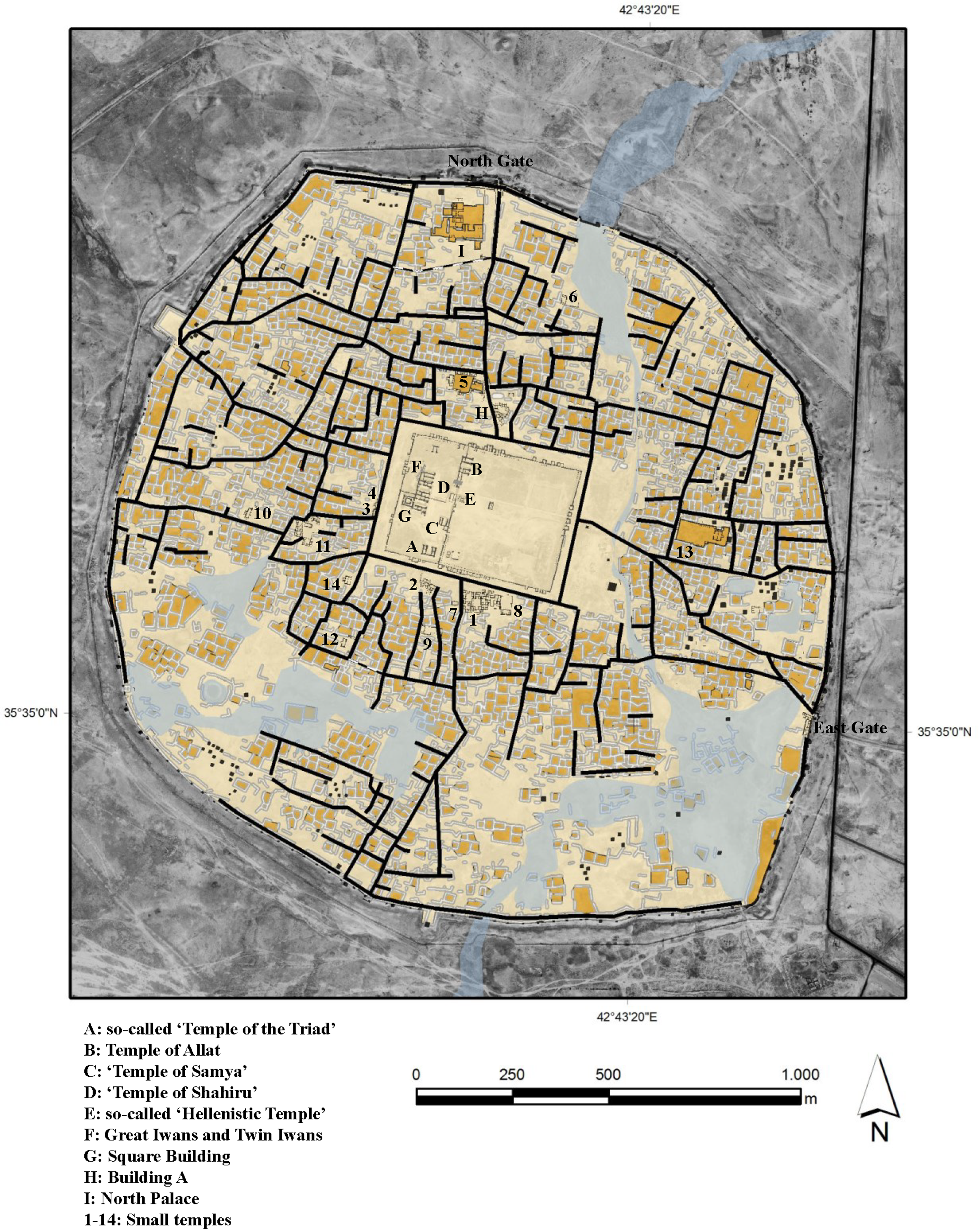
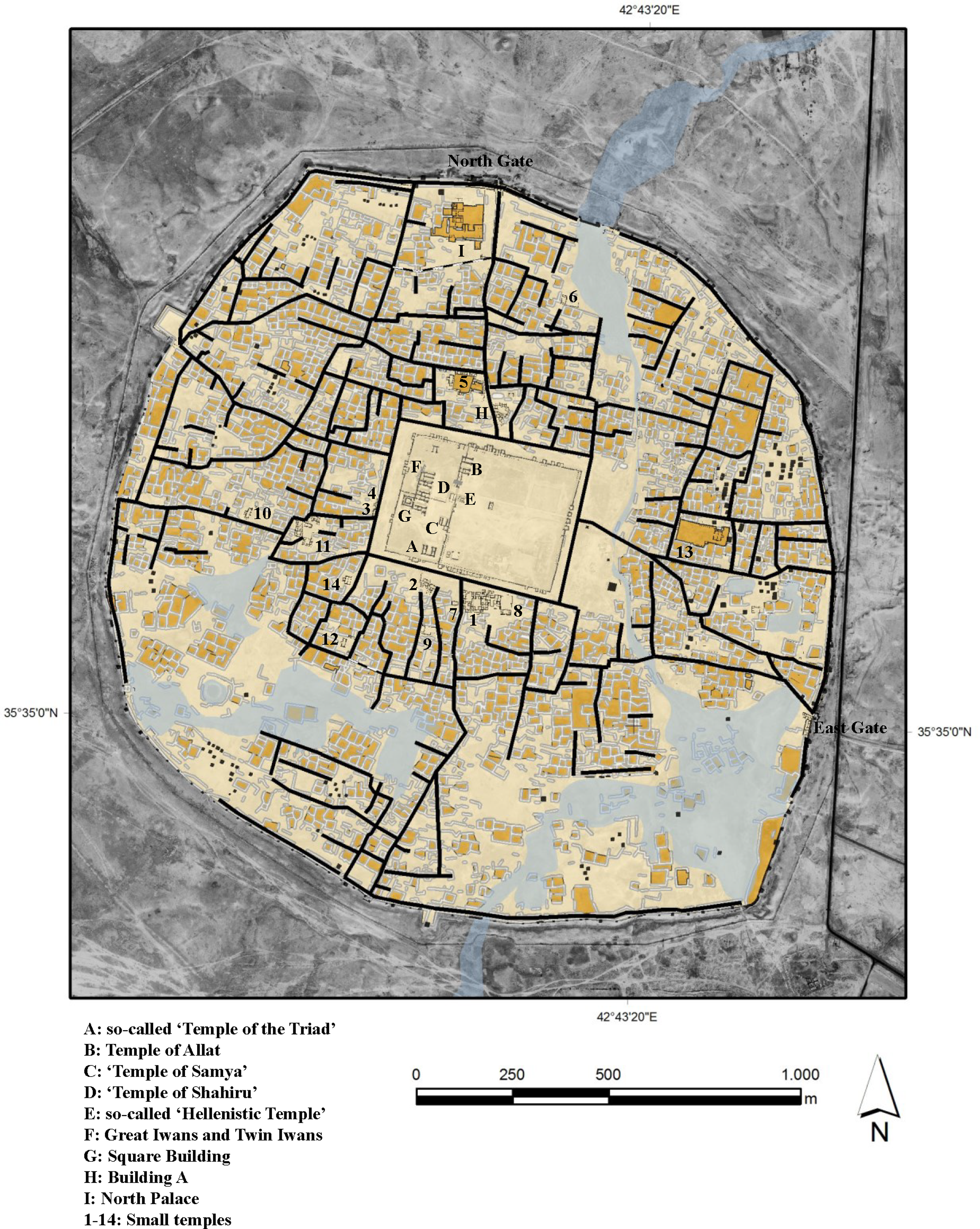
Hatra is a large archaeological settlement (c. 300 hectares) (Fig. 3) located in the Iraqi Jazirah, approximately 80 km southwest of present-day Mosul. The site is famous for the breathtaking buildings of its main sanctuary dedicated to the Sun god (according to classical literature, see below) and the sheer number of magnificent sculptures, which represent the largest cluster of such artworks from the area of the Arsacid Empire.Footnote 46 If there is scanty evidence for the initial phases of the settlement between the fifth and the first centuries B.C., we know more of its history starting from the first century A.D., thanks to the wealth of archaeological data and to a large corpus of Aramaic texts.Footnote 47 Situated in the Arsacid orbit in the first century A.D., Hatra played important military, religious, and commercial roles in the region. Being located within a network of routes connecting Ctesiphon and the Arab Gulf with Northern Mesopotamia, it increased in importance especially from the second half of the second century A.D., when it served as the prosperous capital of a kingdom on the western outskirts of the Parthian Empire. Its rulers were invested with the title of king (mlkʾ) and controlled a vast area between Parthia and Rome that was mainly inhabited by Arab tribes. In the course of the second century, Hatra was unsuccessfully besieged by the Roman emperors Trajan (A.D. 117) and Septimius Severus (A.D. 197 and 199).Footnote 48 These attempts made it clear that the Romans were eager to conquer a wealthy city like Hatra, placed in a strategic position for the control of the eastern Jazirah.
Map of Hatra showing main features of the settlement and buildings investigated (elaborated from Foietta 2018, fig. 122)
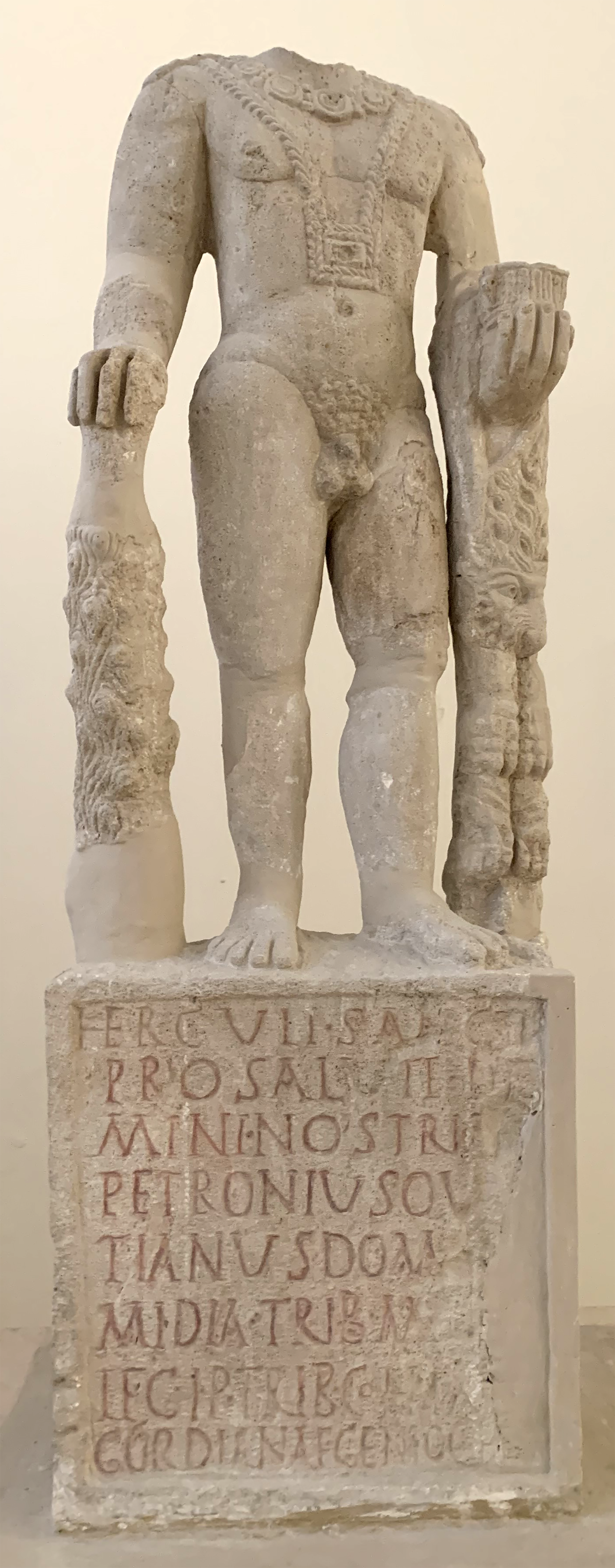
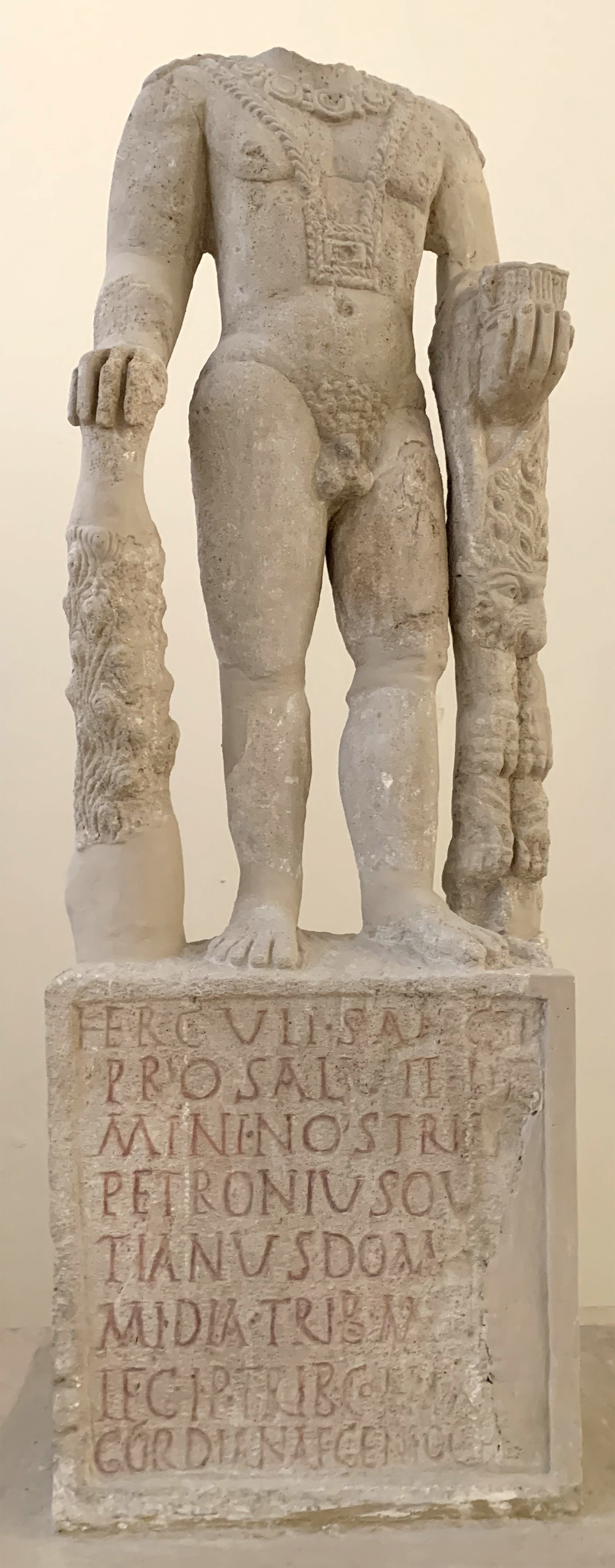
The nature of the relations with Rome changed after the defeat of the last Parthian king by the Sasanian Ardashir I in A.D. 224. A Roman garrison was possibly stationed in the city in the years between A.D. 235 and 238, as is suggested by three Latin inscriptions – on an altar and on two bases of statues respectively – found in the antechamber of Temple IX.Footnote 49 These texts, which are also the only documents in Latin from Hatra, are particularly interesting as they shed some light on the linguistic diversity in the settlement during the first half of the third century A.D. Two of them record dedications made by Q. Petronius Quintianus, tribunus militum of Legio I Parthica and tribunus cohortis IX Maurorum Gordiana, who was probably in charge of the military detachment, and link the religious activities conducted by an outsider to Hatra with some of the main local cults. According to the first inscription (no. 80), the military commander dedicated a statue “to the invincible Sun god” (Deo Soli Invicto), “which he had vowed to the cult of the place” (votum religioni loci posuit).Footnote 50 The second inscription (no. 81), still accompanied by a splendid statue of a naked Heracles figure decorated with typically Hatrene jewellery (Fig. 4), was set up by Quintianus “to the Sacred Hercules” (Herculi sancto), “the patron deity of the cohort” (Genio cohortis).Footnote 51 The Heracles figure, never explicitly identified by his Greek name, was one of the most widely worshipped gods in the city; his identification with the ancient Near Eastern deity Nergal may frequently have been implied but was on no occasion made unambiguous.Footnote 52
Statue of Heracles from Temple IX, Iraq Museum, Baghdad; Latin inscription no. 81 is carved and rubricated on the base (photo courtesy MAIH)
The presence of Roman soldiers has been interpreted as proof of a new alliance formed to face the approaching threat of the Sasanian armies.Footnote 53 Regarding the place where they were stationed, the North Palace appears as the strongest option. The palace, a complex of impressive dimensions located in proximity to the North Gate, probably incorporated both residential and military facilities, although very little is currently known about its foundation, function, and inhabitants. Archaeological research there has brought to light traces that can be tentatively linked to the accommodation of Roman personnel. These include a mural painting depicting Aphrodite at her bath; a small group of Greek graffiti in the adjacent rooms, including one addressing “the Lady of the women” (ἡ κυρία τῶν γυναικῶν) and most likely referring to the Aphrodite in the painting; and structures and materials that were employed in bathing facilities.Footnote 54 On the other hand, the presence of Latin inscriptions in a small sanctuary that was probably only frequented by the local community has led to the hypothesis that the Roman soldiers were stationed (perhaps billeted?) in a dwelling close to Temple IX.Footnote 55 This theory remains to be confirmed by archaeological excavations, and it must be stressed that defining what constitutes evidence for the billeting or occupation by Roman soldiers and personnel outside proper military facilities, i.e. inside private houses, is no easy task to undertake, especially at Hatra due to the very scarce information available on the few residential areas excavated up to now.Footnote 56 The understanding of the Roman presence in the city is perhaps further complicated by the fact that there is no evidence that Hatra was ever conquered by the Roman army, nor that it properly came to form part of the Roman Empire. It is thus very difficult to evaluate the conditions of this Roman presence and how it might have affected the political, social, and cultural life of the city before it was captured by the Sasanians in A.D. 240/1.
Taking into account the evidence from the North Palace, it might be tempting to link the bilingual text to the Roman presence in Hatra as well, especially when one considers that Greek was the most widely written language in the Roman Near East and that all these texts testify for a linguistic diversity that can hardly be deduced from the remaining epigraphic corpus. No matter how appealing this may be, however, the information at our disposal makes this hypothesis too far-fetched for now.
Linguistic considerations and bilingualism
The Greek section on our block, especially in its cultic interpretation, seems to follow a very common formulation in any part of the Greek world. Although it is more common to find the verb at the end, after the mention of the dedicated object, and although it is not very usual that the names of the dedicatees appear separated by the verb, the first particularity is abundantly attestedFootnote 57 and the second is not exceptional.Footnote 58 However, the Greek section does not follow the normal structure of the cultic and honorific inscriptions in the Aramaic corpus of Hatra, thus showing no signs of linguistic interference. The Aramaic text, on the other hand, completes the inscription with a variant of the remembrance formula that usually appears in cultic inscriptions. This is a sub-type of the well-known longer sequence dkyr + lṭb + personal name + qdm + divine name (“May be remembered for good PN in front of DN”), which occurs in Nabataean Aramaic,Footnote 59 Jewish Aramaic, Old Syriac (in the last decade more properly known also as ‘Edessean Aramaic’),Footnote 60 Palmyrenean Aramaic, and Hatran Aramaic, thus covering the whole geographical and chronological continuum of Middle Aramaic.Footnote 61 This formula, which is both commemorative and religious in the Aramaic inscriptions, is translated into Greek in the East as μνησθῇ, accompanied by the name of the commemorated person (and expanded throughout the Mediterranean also as a Christian formula).Footnote 62 Its presence here, either because the dedicant was himself familiar with the formula or because he commissioned its inclusion to a native of Hatra, clearly adapts the text to the local epigraphic habit. In this way, even if the message in Greek probably could not be understood by the majority of the population, the Aramaic section would have at least allowed the local reader to identify the name of the dedicant and recognise a specific epigraphic type.
This bilingual inscription from Hatra hence denotes a case of codeswitching carried out by a Greek from the East or a Hellenised and Romanised eastern native, who is either bilingual Greek-Aramaic, with a sufficient knowledge of both languages that allows him to switch not only language but also linguistic cultural code, or a Greek speaker who wanted his dedication to address the local Aramaic-speaking community. His desire to adapt to the customs of the place is evident in his decision to make a donation to some of the main gods of the city, keeping the indigenous name of the goddess ʾAllāt and using the Greek name of the Sun god. The name Helios was very widespread in the Greek-speaking world from the end of the Hellenistic period onwards, being used to identify an eastern deity or an ancient Greek divinity assimilated to the Sun god.Footnote 63 And it was even more widespread in the East since Elagabalus’ attempts to impose his indigenous solar cult on the Empire. It is probably no coincidence that the new Capitoline triad formed by Sol, Caelestis Urania, and Venus was seen by someone from Emesa as the triad of Helios Megas Phren Elagabalos, Kypria Chari Nazaia, and Athena ʾAllāt, to whom he made a dedication in Corduba in A.D. 218–222 (see above, IGEP 369), just after the emperor’s decision. The text concerns another instance of an association between ʾAllāt (explicitly identified, as is common at Palmyra, with Athena) and an eastern Sun god, in this case the main deity from Emesa on the Orontes. The third divine name, listed in between the other two, seems to be one of Aphrodite’s best known cultic epithets, and the appearance here of the goddess born on the island of Cyprus calls to mind the fact that the bilingual inscription from Hatra mentions the dedication of two Erotes. If our Klaudios was a Greek speaker from the Roman East and he was in the city around the same time, he might have been influenced by this new solar cult. Perhaps he saw in ʾAllāt some of the features of both Aphrodite and Athena and decided to use her indigenous name to address the goddess according to local customs.
The position of Greek in the first place corroborates the Greek or strongly Hellenised cultural background of the dedicant. The question here is who in Hatra would be competent enough in Greek to read the inscription. No doubt there would be Greek speakers in the Roman army that was probably stationed there in the 230s A.D. (see above), but this dedication seeks instead the attention of the indigenous population, the authors of the large number of texts written in Hatran Aramaic. Be that as it may, it is clear that our Greek-Hatran Aramaic bilingual text is not at all what one would define as a ‘proper bilingual’, since neither of the two languages aims at translating the other one, nor at simply transferring its content across. Instead, both languages communicate and reach out to readers conveying complementary information, and they are structured according to different cultural, social, and religious practices. The Greek and Hatran Aramaic sections are, however, unified as a single message, being carved one above the other on the same stone surface, so that, even if some observers could not read one of the two languages, they would interact with both at the same time. As further confirmation of this, it is what survives of the Greek section that provides us with interesting details that shed further light on the development of some religious aspects in the city. We come back to this in detail below, but next zoom out towards a broader contextualisation of bilingualism in the Near East.
Questions concerning Aramaic-Greek bilingualism and/or diglossia in the area, from the Hellenistic period to Late Antiquity (third century B.C.–seventh century A.D.), have been variously addressed over the last twenty years and the scarce material yielded by the Hatrene context cannot change the picture or support a detailed reconstruction of the linguistic situation in Hatra during its existence as a political, economic, religious, and tribal centre of the Jazirah.Footnote 64 We share the careful caveats of Taylor, when he writes:
“Written texts inevitably raise questions associated not only with diglossia, such as the reasons for the choice of language and of register within the chosen language, but also with literacy, such as the motivation for writing or inscribing a text; the identity and status of the writers or engravers; the degree to which their language skills are typical of the surrounding population; the extent to which literacy reflects fluency within a language. Written texts have only a limited ability to indicate phonic interference, and – given that inscriptions are often short and follow conventional models, whereas longer literary texts are usually subject to a range of canons prescribing acceptable orthography, morphology, and syntax –, they need not reflect actual speech habits or usage and they only rarely impart significant information about grammatical interference.”Footnote 65
On the other end, as far as Greek-Aramaic relationships are concerned, one must always carefully consider, especially in the region extending to the East of the Euphrates river, that “as it often happens in multilingual situations, people living in variegated linguistic realities are not equally compelled to learn another of the surrounding languages”.Footnote 66 The paucity of evidence for the use of written Greek from Hatra, especially when compared with the situation at sites in the Nabataean realm and at Palmyra, is significant and might also be partly due to the fact that the site is still to be excavated extensively. Nevertheless, a first datum may be accounted for: in the main sanctuary, the Great Temenos (i.e., at the very heart of Hatra), at the city gates, and in the small temples within the settlement, no traces of written Greek have to our knowledge come to light in duly executed excavations. This datum does not necessarily mean that the use of the language was unique or exceptional, but it further supports the hypothesis that Greek was not common in the epigraphy at the site. The impact of Greek on the local context is even harder to grasp if one looks at the situation in the Jazirah area more broadly, where it is “difficult to establish whether local varieties of Aramaic in Mesopotamia, especially at Assur, Hatra and their surroundings, were spoken alongside other languages. Greek seems to be less present and restricted to a couple of lexemes concerning economics and Hellenistic architecture with no syntactic interference in Aramaic.”Footnote 67 Aramaic and Greek in Hatra might have had a similar relationship as the one that Edessean Aramaic and Greek had in the same period (first–third century A.D.) in Osrhoene. The influence of Greek on the local Edessean Aramaic seems to be rather insignificant, especially if compared to the massive, later spread of Greek loanwords and traits in Classical Syriac literature.Footnote 68 Classical Syriac in its turn does actually show this tendency in different percentages, with texts related to Christological debate more affected by the process of hybridisation with Greek, while others (e.g., historical and devotional texts) remain less involved in this dynamic. The idea that the group of Aramaic varieties east of the Euphrates “was less impacted by Greek” has found new support in a recent study of the relationship between Greek and Syriac.Footnote 69 The situation seems to be confirmed by the percentage of Greek words that entered Hatran Aramaic. As Contini and Pagano phrased it:
“The number of Greek loanwords (14, including 3 Latin) is vastly inferior to the 75 (including 19 Latin) counted by Brock […] in Palmyrene; this is only natural, in consideration not only of the larger textual corpus available for Palmyrene, but above all of the longer and more pervasive presence of Hellenistic culture and Roman administration in the Palmyrene area compared with the Hatrene.”Footnote 70
In the latest survey of the 376 personal names featured in Hatran inscriptions, only seven of Greek origin have been singled out, mostly with strong cultural connotations (ṭwkrws Τϵῦκρος, slwk/slkw Σέλϵυκος, nqndrs Νίκανδρος, ʾlkṣdrws ᾿Αλέξανδρος, nmsys Νέμϵσις, dyns Δϵῖνις, dmywn Δαμίων), accounting for 2,1% of the entire onomastic corpus.Footnote 71 Prior to our bilingual, qlwdys Klaudios is not attested.
Considerations on the Linguistic Situation at Hatra
The epigraphy of Hatra is dominated by over six hundred inscriptions written in the local Aramaic dialect.Footnote 72 To these are joined three Latin inscriptions,Footnote 73 three unpublished Greek graffiti from the North Palace,Footnote 74 and the identification in Palmyrenean Aramaic of the goddess ʾAllāt and her worshipper on a stele sculpted in Palmyrene style (to which some Hatran Aramaic graffiti were added).Footnote 75 The linguistic situation in the city invites us, therefore, to view it against the background of the situation elsewhere in the Roman Near East (or, with Richard Fowler, the “Parthian Near West”Footnote 76 ).
Both Aramaic and Greek are attested as administrative languages in Mesopotamia, the former at least since the Persian period, the latter (more limited, compared to the regions west of the Euphrates) following Alexander’s conquests. For the first few centuries of the modern era, the corpus from Hatra, alongside that from nearby Assur, is in fact our best case-study. To what degree the Roman legions and auxiliary units contributed to the further spread of Greek east of the Euphrates is a subject that deserves further investigation.Footnote 77 Our single bilingual from Hatra notably stands in sharp contrast to the pervasive bilingualism in the public epigraphy of Palmyra. Most of the honorary inscriptions set up along the colonnades and in the agora of the oasis city combined Greek with Palmyrenean Aramaic, a phenomenon which Palmyrene migrants also carried with them to the Euphrates settlement of Dura-Europos.Footnote 78 In and around North Mesopotamia, however, Greek-Aramaic bilinguals are only encountered sporadically. From the Tigris, at the confluence with the Bohtan River, comes an altar with a bilingual inscription, in Greek and Aramaic (with its North Mesopotamian script similar to that of Hatran Aramaic), spread over two of its four sides. It was set up by a Roman veteran “for Zeus Olympios, the Lord of the Gods” (Διὶ Ὀλυμπίῳ Μαρη[α]λλη, the latter a transcription of the Aramaic title of the deity) and enough is preserved of the heavily damaged Aramaic counterpart to recognise the same divine nomenclature (mrlhʾ).Footnote 79 At Al Mas‘udiyah in Syria, on the left bank of the Euphrates, the image of the reclining river god on a mosaic was identified not only in Greek, as “king river Euphrates” (βασιλϵὺς ποταμὸς Eὐϕράτης), but also in Syriac (prt mlk, “king Euphrates”).Footnote 80
Although to our knowledge a solitary example in the epigraphy of Hatra, our bilingual does not constitute the first known inscription written in both Greek and Hatran Aramaic, as two bilinguals are known from Dura-Europos. In contrast to the one from Hatra itself, where the single line in Aramaic seems to have been added to the longer Greek dedication in order to add some local flavour, in both bilinguals from Dura-Europos the Greek and Hatran Aramaic counterparts appear to render the same message. It is now known that the first text from Dura, discovered by Franz Cumont in 1922 in a domestic dwelling during the first proper excavations at the Euphrates stronghold, simply presents the names of the divine members of the Hatrene triad: Our Lord (Māran), Our Lady (Mārtan), and the Son of Our Lords (Bar-Mārēn).Footnote 81 However, the relevant graffiti were not immediately recognised for what they constitute and were initially thought to represent two individual groups of names (four similar ones in Greek, and three similar ones in an Aramaic script that puzzled scholars at the time). The reading of the Aramaic was done for Cumont by Giorgio Levi Della Vida, who thought the three names all started with an Aleph. In the margin of his own copy of Fouilles de Doura-Europos, now kept in the archives of the Academia Belgica in Rome, Cumont later pasted a cutting from a letter written to him about this inscription by René Dussaud, who preferred to read Mem instead of Aleph, adding a sentence saying “même observation de Lidzbarski”.Footnote 82 But it would take until 1953 for it to be first realised, by André Caquot, that together with its Greek counterpart the graffito formed a bilingual mention in Hatran Aramaic and Greek of the triad of Hatra. The Aramaic should thus read mrn wmrt(n) wbrmryn, “Our Lord, Our Lady and the Son of Our Lords”, which is supported by the Greek graffito next to it – even if the precise reading and interpretation of the latter remains confused: Μαρϵινος (twice), Μαρινος υἱός and, possibly, Μαρ[θαν δέ]σπο[ινα].Footnote 83
The interpretation of this first Durene text as a Hatran Aramaic-Greek inscription is also supported by the later finds at Dura-Europos of one further bilingual and two very brief texts that were in Hatran Aramaic only.Footnote 84 The second bilingual from Dura, erected in the temple of Atargatis, recorded a gift of money to the Sun god Šmeš (Šamaš)/Helios (lšmš ’lh’/θϵῷ Ἡλίῳ).Footnote 85 Whereas the triad of Māran, Mārtan and Bar-Mārēn is omnipresent in the epigraphy of Hatra itself, it is the Sun god who is named in classical literature as Hatra’s protector and a source of the city’s riches. Cassius Dio, writing in the early third century A.D., states that Hatra was consecrated to the Sun (68.31.2: τοῦ Ἡλίου ᾧπέρ που καὶ ἀνάκϵιται), who helped to protect the city when it was under siege from the Romans, and later in his work referred to the many votive offerings dedicated to the Sun (76.12.1-2: δόξα τϵ γὰρ τοῦ χωρίου ὡς καὶ πάμπολλα τά τϵ ἄλλα χρήματα καὶ τὰ τοῦ Ἡλίου ἀναθήματα ἔχοντος μϵγάλη ἦν, “for the place enjoyed great fame, containing as it did vast sums of money and a great number of offerings to the Sun god”). Regular financial gifts to the great temple complex at Hatra are known from epigraphy,Footnote 86 but it cannot be proven (although it remains plausible) that the bilingual at Dura-Europos is a record of precisely such a gift to the sanctuary in the dedicant’s hometown. The choice of the temple of Atargatis as a location to set up the inscription probably does not mean too much: after all, Dura-Europos did not appear to have its own temple dedicated to the cult of the Sun, and it is clear from the available evidence that multiple deities received worship in most of the shrines in the town.Footnote 87 In any case, similar to the bilingual from Dura which records the names of the members of the triad, the Durene bilingual recording a gift to Šmeš (Šamaš)/Helios concerns one of the most important Hatrene deities. The status of the Sun god in Hatra itself is further exemplified by the fact that Hatra’s best known coinage (showing a bust with sun rays) contains the legend “Hatra (i.e. ‘sacred enclosure’) of the Sun” (ḥṭrʾ dšmš), and by the placement of a radiate bust on the lintel above the door leading from the South Great Iwan to the Square Temple directly behind it.Footnote 88 Even if they are not very informative for the sociolinguistic relationship between the Hatran Aramaic and Greek,Footnote 89 the bilingual texts from Dura-Europos therefore offer some clear examples of Greek counterparts for the main deities of the Hatrene pantheon.
Considerations on Hatrene religion
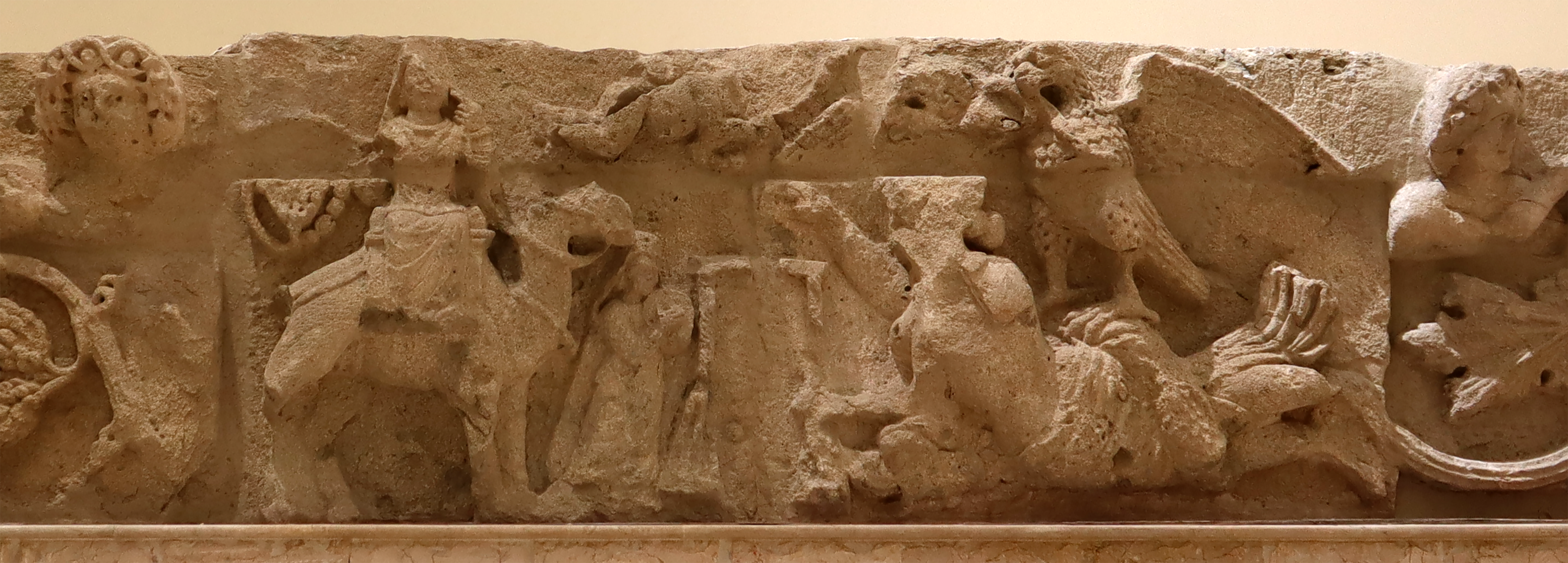
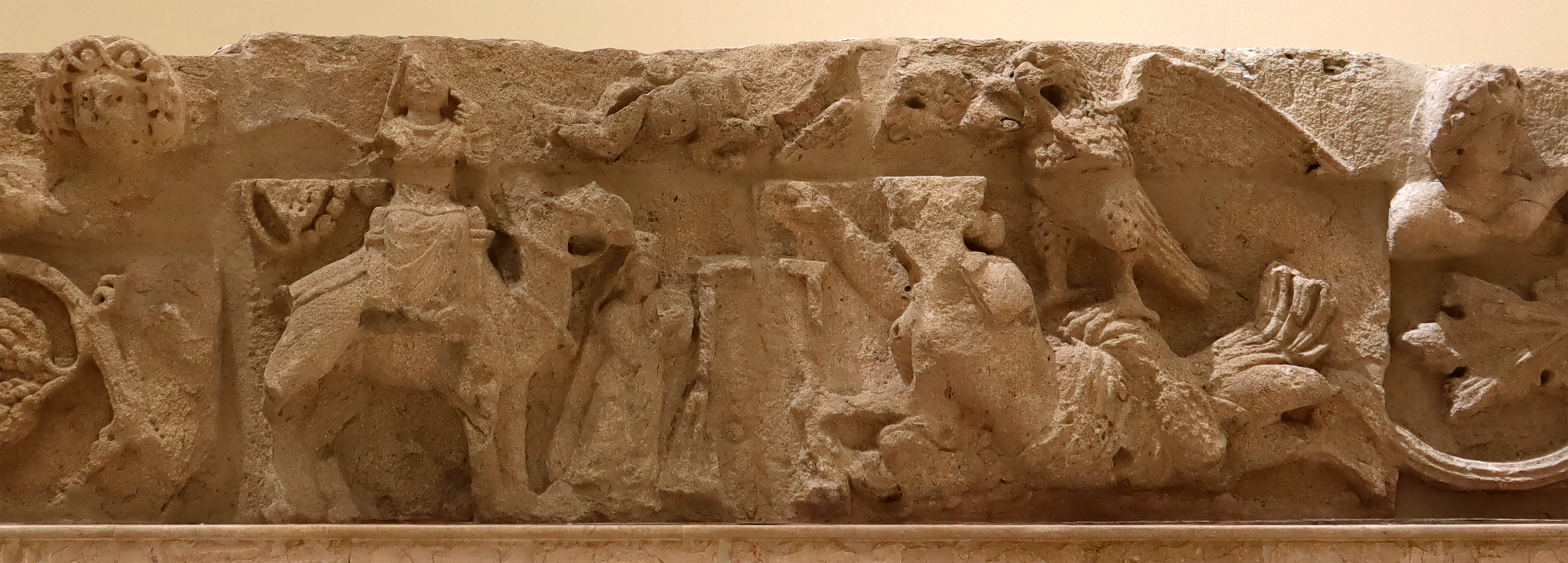
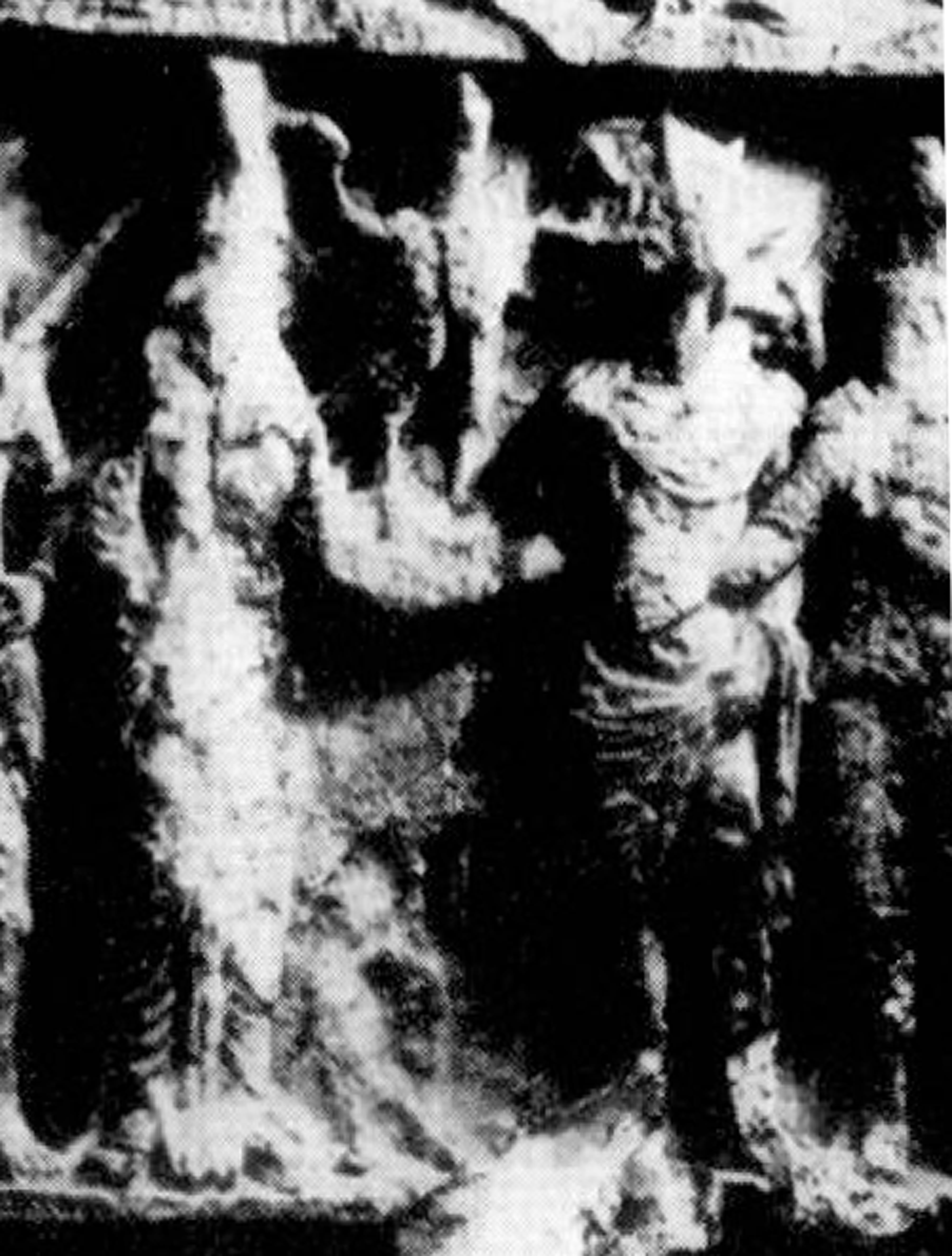
Turning our attention now to the content of the bilingual from Hatra, the first puzzling element is the possibility that the text commemorates the dedications of two Erotes to ʾAllāt and Helios, which does not have any parallels in the local epigraphic corpus. The lack of epigraphic attestations of Erotes, however, does not correspond to a lack of figurative examples in a variety of media. Classical iconography was used widely at Hatra in the depiction of various inhabitants of the local divine world, notably the significant Heracles figure but also less integrated deities such as Dionysus (in the shape of a beautifully crafted bronze mask) and the victory goddess Nike. Similarly, a closer look at Hatrene art reveals that figures of Eros were represented in free-standing sculptures, architectural decorations, objects in stone and bronze, and paintings. These figures, winged or apterous alike, appear in Hatra both isolated and accompanied by similar figures or by other deities, making it very difficult to decipher their role in the local religious landscape. At least two free-standing statues, a marble one from the so-called Hellenistic Temple in the Great Temenos (an import from the Roman East dated to the Antonine period)Footnote 90 and a small-scale bronze sculpture from the area of the North Gate,Footnote 91 depict Eros as an individual character – and perhaps as the recipient of a cult? – while the images from architectural decoration instead seem to treat this figure as a decorative motif and find their models in Graeco-Roman cartoons.Footnote 92 On the other hand, the painting discovered at the North Palace (see above) makes the link with an Aphrodite-looking goddess explicit.Footnote 93 Most pertinent to our case is the putto whose torso and legs are visible (head and wings are broken off) on the frieze showing the arrival of ʾAllāt in the city (Fig. 5).Footnote 94 The putto (in the attitude of Eros) precedes the goddess sitting on a dromedary’s back and holds in his hands an object whose original shape (wreath? torch? palm branch?) is no longer recognisable due to the poor preservation of the relief in this spot. According to Invernizzi, the role of Eros in the investiture scene is that of a messenger; hence, he should not be directly linked to ʾAllāt nor to Athena or Nemesis (thought to be the main western deities assimilated to ʾAllāt in Hatra), but rather identified with Hesperos or Kairos.Footnote 95 However, the association of the Eros figure with the goddess ʾAllāt on the one hand and with the sphere of love and marriage on the other, which would support an interpretation of the scene in relation to wedding festivities, should perhaps not be entirely disregarded.
Detail from scene depicting the arrival of ʾAllāt in the musical scene frieze from the temple of the goddess, Iraq Museum Baghdad (photo courtesy MAIH)
Our proposed reading of the inscription links the goddess ʾAllāt with the Sun god. Throughout Hatran epigraphy, pride of place goes to Māran and the triad, followed by Šmeš (Šamaš), Nergōl, ʾAllāt, and, less frequently, other deities. The prominence of the goddess ʾAllāt in the local pantheon is confirmed by her recurrent association with the city’s triad in remembrance texts (see H 52, H 74–75, H 82, H 151, H 1117), including both lapidary inscriptions and graffiti. As an example of such a sequence, she is mentioned in H 52 together with the triad and the Standards, following the common format: qdm mrn wmrtn wbrmryn wʾlt wsmytʾ “in front of Our Lord, Our Lady, the Son of Our Lords, ʾAllāt, and the Standards”. It ought to be stressed that these are the only texts recording the name of the goddess, apart from the inscriptions commemorating the construction of her temple by King Sanatruq and his son (H 367–369) and those mentioning her name on the friezes from the same temple (H 384) and from Temple XIII (H 411b). Moreover, H 74 is the only instance where both ʾAllāt and Šmeš (Šamaš) appear together, although in two distinctive sequences of invoked divinities.
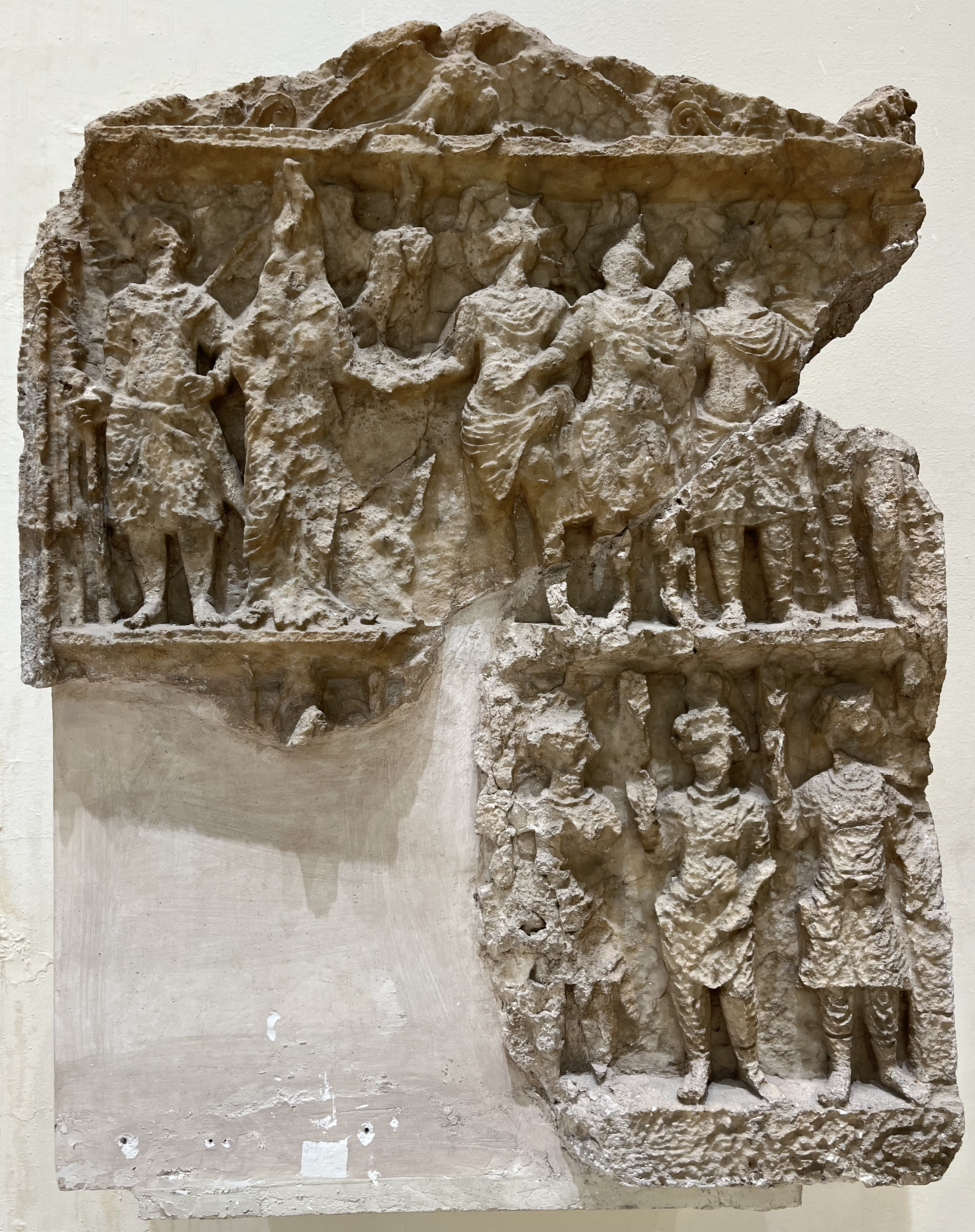
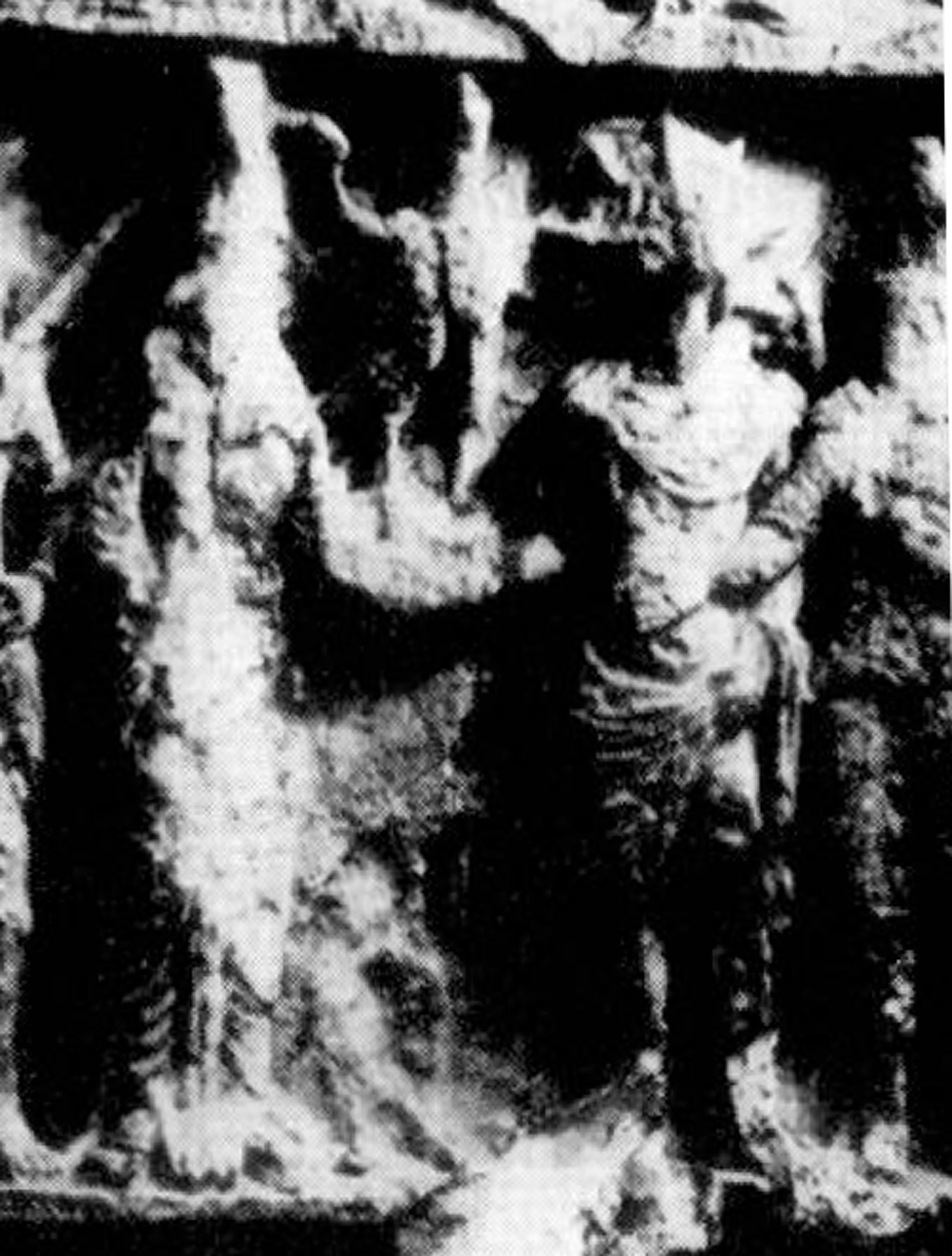
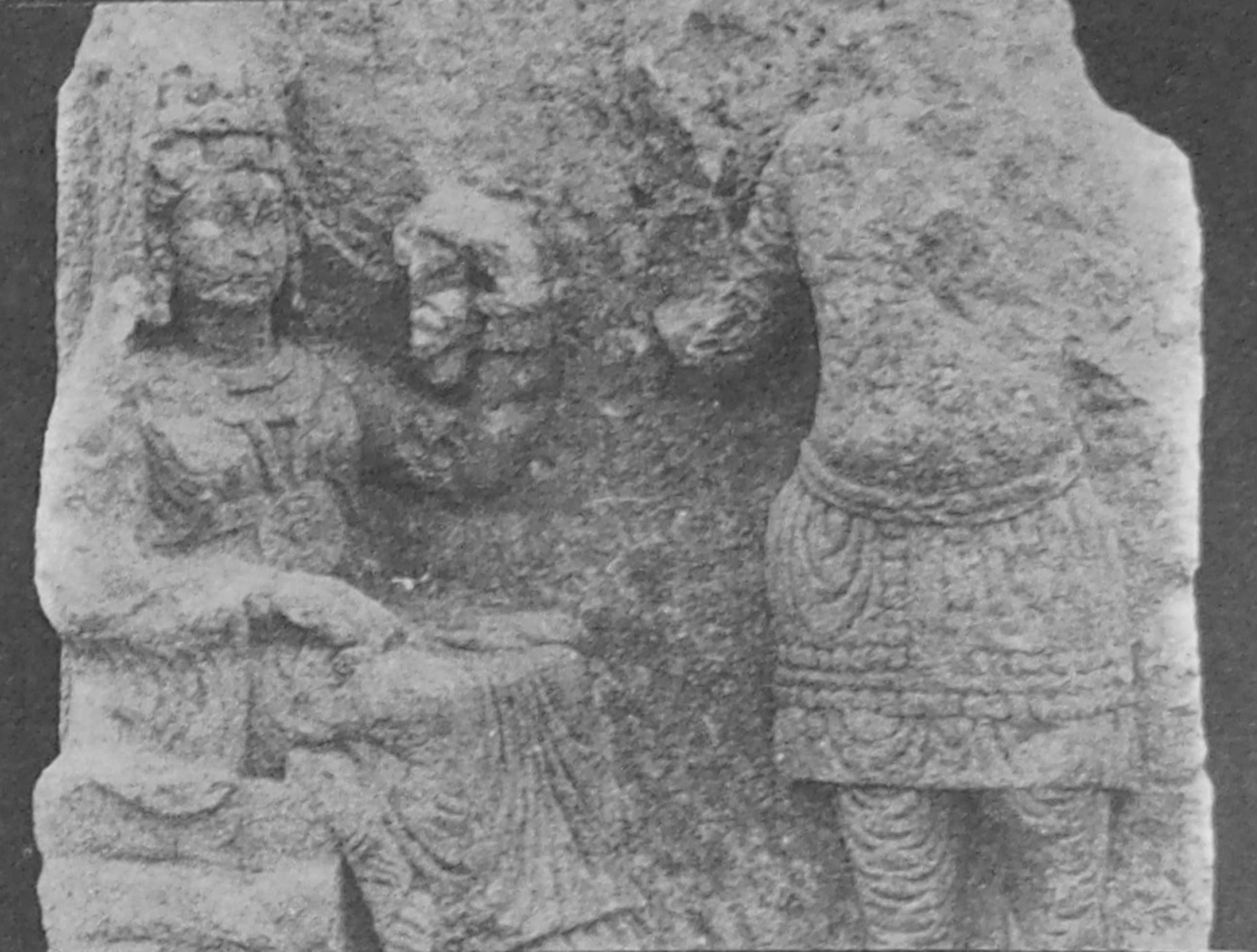
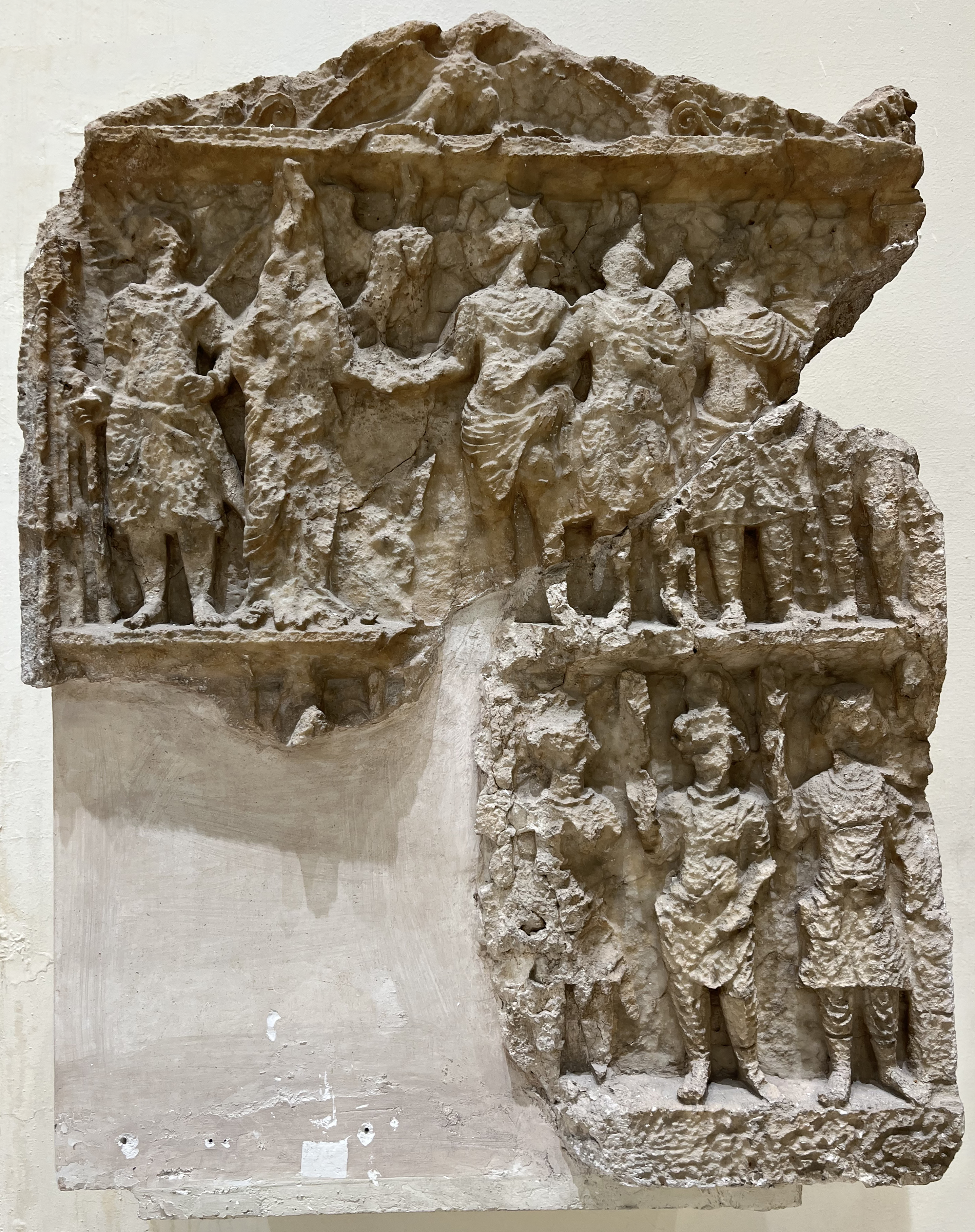
A further analysis of this duo, however, points in an interesting direction. Instead of being the result of a simple selection of two of the most relevant deities in the local pantheon, their association in the bilingual inscription seems to be far more meaningful when contextualised in the religious landscape from the second half of the second century A.D. To begin with, the concurrent epigraphic presence of ʾAllāt and the Sun god evokes two reliefs from Hatra. The first relief, found in Temple VIIIb, is topped by a triangular pediment occupied by an eagle with outstretched wings and showing a full row of gods on the top level and a row of worshippers standing on the level below, of which only the right half is preserved (Fig. 6).Footnote 96 The central scene appears to be the union (epitomised by the holding of hands, with another eagle flying above it) between a male figure with a solar crown, who is likely a representation of the Sun god (locally identified as Šmeš/Šamaš), and a female figure. The relief is too damaged to be certain, but since the female figure seems to wear a tall headgear not too dissimilar from the one worn by ʾAllāt in the reliefs from her temple,Footnote 97 it is a plausible suggestion that the goddess engaged in the hand-holding ceremony with the Sun god is indeed ʾAllāt.Footnote 98 If this is correct, it would be an illustration of a sacred marriage between the two deities, and as such an unequivocal symbol of integration of the goddess ʾAllāt, who was officially brought to the city by the new royal house (who built her a great temple), within the local divine world as represented and headed by the Sun god. Others present at the occasion include the naked Heracles figure (on the right), two radiate figures flanking the dexiōsis scene,Footnote 99 and, according to a new hypothesis put forward by Dirven, also the king.Footnote 100 If she is right, this would be another instance (in addition to the better known ‘investiture of ʾAllāt’ reliefs) of the royal house joining forces with the local divine world (represented by the Sun god) in welcoming the goddess ʾAllāt into Hatra.Footnote 101 The presence of the eagle(s), as the representative of both the Sun and the king, only makes this stronger.Footnote 102 Another interesting element of this stele is the presence of a small figure, now unfortunately badly weathered, between the hand-holding couple, which, judging from the photograph published by Downey, seems to resemble a winged Eros leaning against the goddess’ legs (Fig. 7).Footnote 103
Stele from Temple VIIIb, Iraq Museum Baghdad (photo courtesy MAIH)
Detail of hand-shaking couple in middle of the upper register, with a winged figure between them (Downey Reference Downey1968: 106)
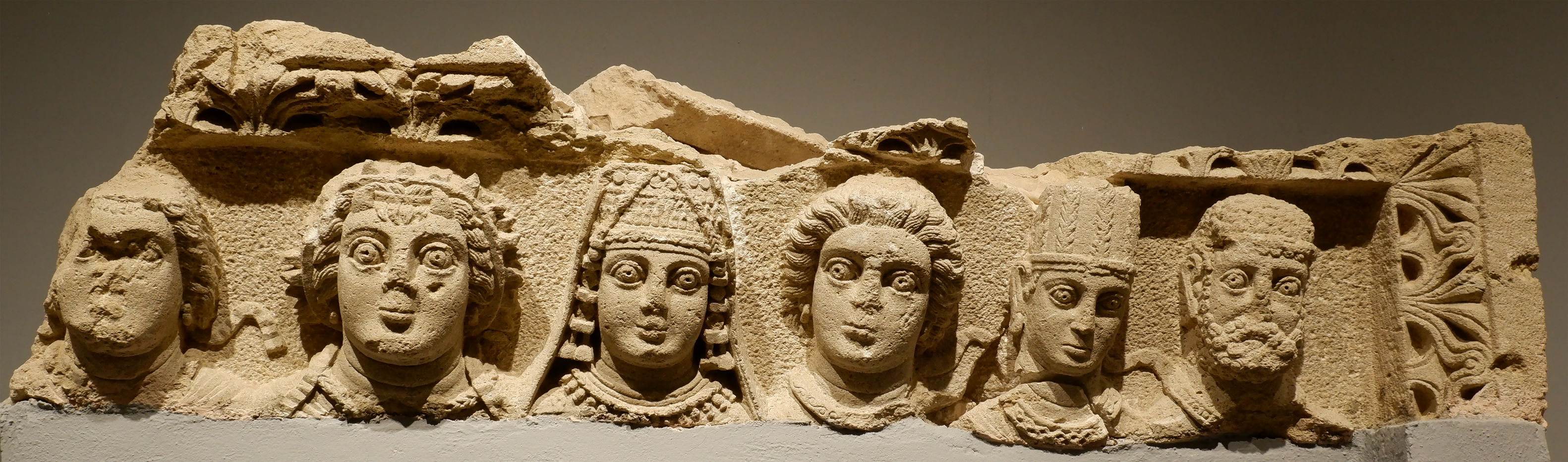
In the second relief, ʾAllāt and the Sun god are believed to be depicted alongside each other on a lintel from the Temple of ʾAllāt, now in the Slemani Museum, Sulaymaniyah (Fig. 8).Footnote 104 The busts of six figures are preserved, including (again) a Heracles figure on the right, a male figure with his head shaven and wearing cylindrical headgear (second from right), and a young man (third from right). The second bust from the left, a male figure wearing a radiate crown and with small horns protruding from his forehead, must be the Sun god Šmeš (Šamaš), and the female next to him (centre), with her elaborately decorated tall headgear, reminds the viewer of other images of the goddess ʾAllāt from her temple. The image on the far left is too damaged to be analysed properly.Footnote 105
Door lintel from Temple of ʾAllāt representing busts of six deities, Slemani Museum Sulaymaniyah (photo courtesy Jacopo Bruno)
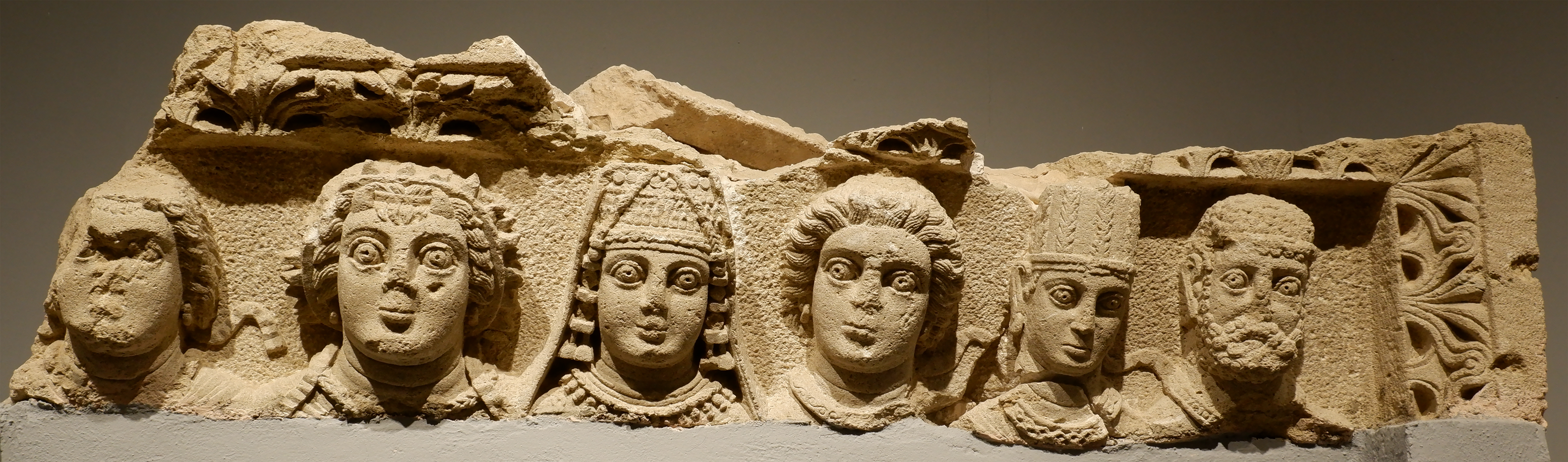
The link between ʾAllāt and the Sun god appears to be further reinforced in the goddess’ own temple, in the architectural decoration of the lintel of the south door in the central iwan. The upper part of the lintel is decorated with three pairs of confronted fish (which possibly imply an assimilation of some features of Atargatis by ʾAllāt),Footnote 106 each separated by a small rosette, while the lower face of the same lintel displays two Nikai on either side of an eagle with spread wings, holding a ring in its beak.Footnote 107 The concurring presence of these figurative elements can be confidently interpreted as the association of ʾAllāt and Šmeš (Šamaš) through the juxtaposition of their respective animal symbols. A small alabaster stele representing ʾAllāt riding a dromedary, her head topped by a large eagle with outstretched wings was also found in the area of the Temple of ʾAllāt and seems to suggest the same bond between the two deities.Footnote 108
A different type of association of a female deity with the Sun god emerges in a statue from the East Gate, which likely portrays Lord Nasru in his role as high priest (ʾpklʾ rbʾ) of the Sun god, holding the large statue of a bejewelled eagle. The figure is standing, barefoot, and wears a knee-length tunic with long sleeves and a himation wrapped diagonally around the body, in the typical attire of the priests at Hatra. The tunic is adorned by two vertical bands bordered by pearls, where on the top right side of the chest is the figure of a nude Aphrodite leaning against a pillar and surrounded by vine scrolls.Footnote 109 In other words, one of the few representations of a nude Aphrodite in Hatra (see above) is depicted on the tunic of one of the local sovereigns in his role as high priest, according to what must be considered a conscious and specific selection of imagery.Footnote 110 Stylistically, the statue has been dated by al-Salihi to the reign of Nasru or more broadly to the first half of the second century A.D. However, due to its similarity to other statues of the royal family from the second half of the second century, especially those in the Square Temple,Footnote 111 it might be more likely that this statue was instead commissioned later, perhaps to honour the memory of an illustrious ancestor such as Lord Nasru, father of King Sanatruq I, and that it therefore reflects a different religious landscape.Footnote 112 The possibility that the image of Aphrodite on the tunic of this statue might have some relation to the newly gained importance of ʾAllāt in the city’s pantheon is intriguing, as a connection between Aphrodite and ʾAllāt would accord well with the dedication of Erotes to ʾAllāt and Helios in our bilingual text.
As was noted at the beginning, other items visible on the original photograph, from which we publish a detail, strongly suggest that the inscription comes from the Temple of ʾAllāt, which King Sanatruq I and his son, the crown prince, built for the goddess. The divine names appear only in the Greek lines of our text, and it may be highly relevant that whereas the Sun god is rendered with the Greek Helios, similar to what Fergus Millar called “the explicit syncretism of Greek and Semitic deities”Footnote 113 so characteristic of Palmyrene bilingualism, ʾAllāt is not identified with a Greek counterpart but has kept her indigenous name also in the Greek section. Elsewhere in the Near East, notably at Palmyra,Footnote 114 ʾAllāt was commonly identified with Athena – both in epigraphy and in sculpture. The Athena figure does also appear at Hatra,Footnote 115 suggesting that the iconography of the Greek goddess was widely known in the city and that for this reason an explicit identification should always be considered a possibility. In the case of our bilingual inscription, however, the appearance form of ʾAllāt is very much that of a non-Athena, as it is also on the sculptures from the Temple of ʾAllāt itself (both the reliefs of the goddess’ ‘investiture’ and the above discussed lintel) and on the dexiōsis relief from Temple VIIIb. This ʾAllāt, therefore, ought to count as a different manifestation of the goddess from the ʾAllāt who was portrayed with helmet, shield, spear, and aegis. Whether the ʾAllāt who was identified with Athena was present at Hatra prior to the installation by the royal house of their own, new version of the goddess, can of course not be ascertained.Footnote 116 As was already known from the ‘investiture reliefs’, and is supported both by our interpretation of the other sculptures discussed above and by the bilingual inscription, the new Hatrene dynasty conjured up the impression that it ought to be credited with bringing the goddess into the city. Like the bilingual inscription, the lintel from ʾAllāt’s newly built sanctuary and the dexiōsis relief partnered the goddess with the Sun god, who was emblematic for the religious life of Hatra.
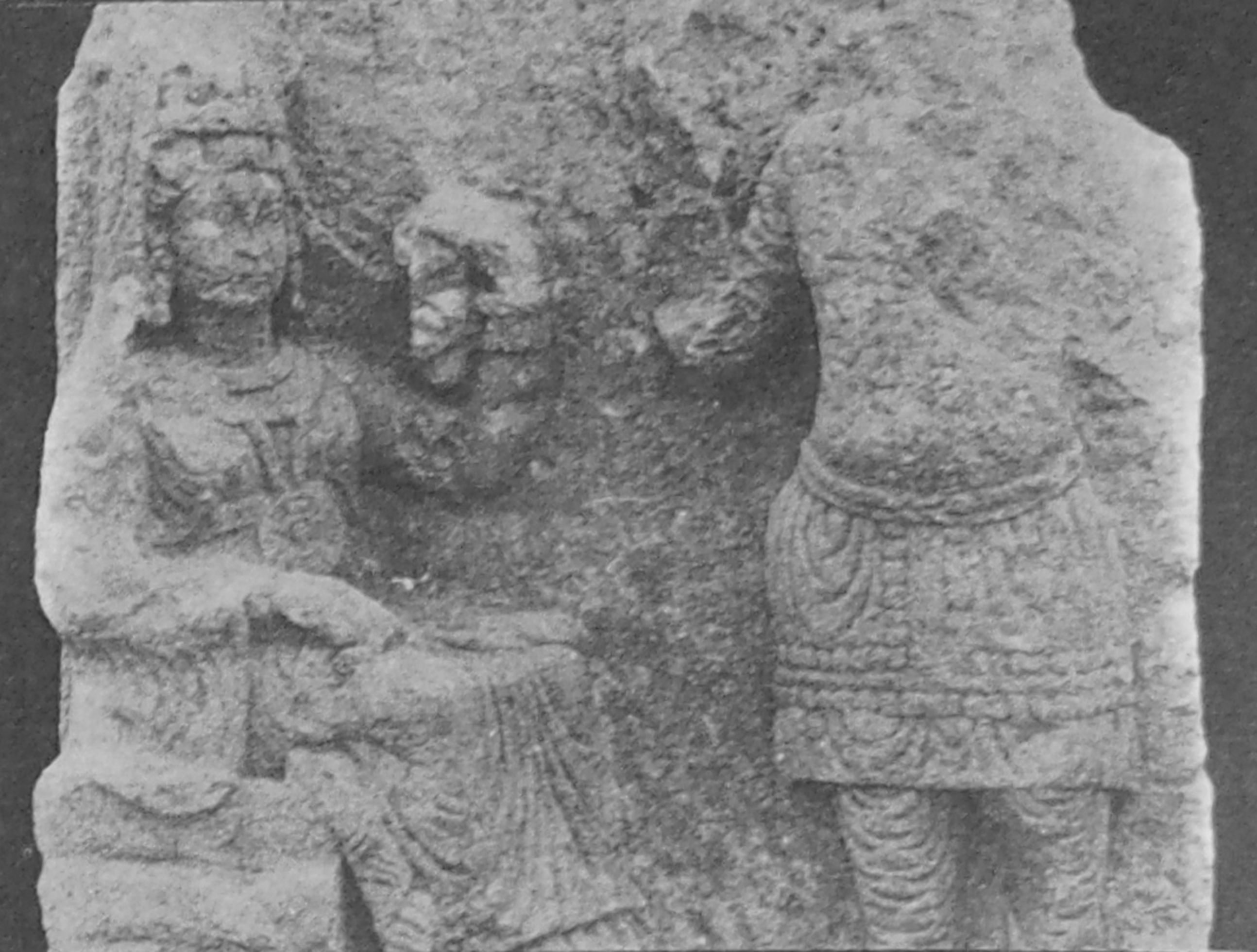
This situation leads to the suggestion that Sanatruq I and his family employed the Sun god Šmeš (Šamaš) as a kind of ‘shorthand’ for Hatrene religion, rather than the triad. Even if there is at least one inscription that shows that the Sun god and Māran the Lord were (or at least could be) perceived as distinct divine entities (H 74), scholars have often pushed for an identification of the two deities, and it is plausible that at least for some worshippers they were interchangeable (see H 107 and H 280).Footnote 117 Perhaps the same could be postulated about Mārtan the Lady and ʾAllāt, as a relief of Mārtan (identified as such by the accompanying Hatran inscription, H 1004a) from the North Gate (Fig. 9) looks similar to the imagery of ʾAllāt.Footnote 118 But in any case, the association of goddess and god, in epigraphy and in sculpture, confirms that ʾAllāt came to join the Sun god at the heart of Hatra’s formal cultic life.
Detail of relief representing Abdsamya approaching the seated figure of Mārtan, from the North Gate (al-Salihi Reference al-Salihi1980: 173, fig. 25)
The details of the identity of our dedicant Klaudios, as well as the reason why he was in the city – he could well have been a citizen, a member of the Roman garrison, or simply a visitor travelling in North Mesopotamia – remain inscrutable based on the current evidence, but it is clear that he wanted to devote his pious act to the most reputed deities of the local pantheon. This first inscription from Hatra itself combining Greek with Hatran Aramaic thus opens a chink, narrow but nevertheless important, into the problem of the use of written Greek in the city and its surroundings, while providing a more detailed picture of the linguistic and religious situation in the region.
Abbreviations
AÉ = 1888-. Année épigraphique. Paris: Presses universitaires de France.
Aphrodisias = Reynolds, J., C. Roueché and G. Bodard. 2007. Inscriptions of Aphrodisias. http://insaph.kcl.ac.uk/iaph2007.
IDelos = 1926-. Inscriptions de Délos. Paris: De Boccard.
IG = 1873-. Inscriptiones Graecae. Berlin: Berlin-Brandenburgische Akademie der Wissenschaften.
IGBulg. = Mihailov, G. 1956-64, Inscriptiones Graecae in Bulgaria repertae. Sofia: In Aedibus typographicis Academiae litterarum Bulgaricae.
IGEP = de Hoz, M.-P. 2014. Inscripciones griegas de España y Portugal. Madrid: Real Academia de la Historia.
IGLS = 1929-. Inscriptions grecques et latines de la Syrie. Paris: Paul Geuthner.
IK Ephesos = Wankel, H., Ch. Börker, R. Merkelbach, H. Engelmann, D. Knibbe, R. Meric, S. Sahin and J. Nollé. 1979-84. Die Inschriften von Ephesos (IGSK 11-17). Bonn: Habelt.
IK Laodikeia = Corsten, Th. 1997. Die Inschriften von Laodikeia am Lykos (IGSK 49). Bonn: Habelt.
IK Mylasa = Blümel, W. 1987-88, Die Inschriften von Mylasa (IGSK 34-35). Bonn: Habelt.
IMEG = Bernand, É. 1969. Inscriptions métriques de l’Égypte gréco-romaine. Recherches sur la poésie épigrammatique des Grecs en Égypte. Paris: Les Belles Lettres.
SEG = 1923-. Supplementum Epigraphicum Graecum. Amsterdam: J. C. Gieben, Leiden: Brill.
TAM = 1901-. Tituli Asiae Minoris. Wien: In Aedibus Alfredi Hoelderi.

 Open access

