

1. Introduction
The argument that formalizing rural land rights contributes to the socio-economic growth of, and tenure security for, the poor in the Global South (De Soto, Reference De Soto2000) has been critically examined in light of the relational character of rights in the political, pluri-legal, socio-cultural, and other contexts of African countries and communities (Sjaastad and Cousins, Reference Sjaastad and Cousins2009, for an integrative review of existing literature). The literature includes not only supportive evidence and recommendations for the positive effects of formalization on agricultural productivity (Mbudzya, Gido, and Owuor, Reference Mbudzya, Gido and Owuor2022), gender empowerment, and other areas, but also scepticism regarding this argument (Place, Reference Place2009; Narh et al., Reference Narh, Lambini, Sabbi, Pham and Nguyen2016; Andersson Djurfeldt, Reference Andersson Djurfeldt2020). Toulmin (Reference Toulmin2009, p. 15) observes that, “While land registration is often proposed as a means of resolving disputes, the introduction of central registration systems may actually exacerbate them.” Decentralizing the land registration regime in the opposite direction creates another problem. It complicates the land dispute resolution process and increases political conflict at the grassroots (Kobusingye, Van Leeuwen, and Van Dijk, Reference Kobusingye, Van Leeuwen and Van Dijk2016). Others argue that formalization itself is the wrong prescription. Bromley (Reference Bromley2009, p. 26) states, “They are poor not because they are not owners. They are poor because flawed economic policies have not provided them with gainful employment in agriculture or some non-farm activity.” Meinzen-Dick and Mwangi (Reference Meinzen-Dick and Mwangi2009, p. 38) argue that, “Formalization of property rights has historically led to a cutting of the web of overlapping interests, creating more exclusive forms of ownership of the resource.” The simplistic registration of full ownership for a single person is not appropriate in such social circumstances. Rather, “lesser forms of rights, such as rights of occupancy and use, are possible and may provide adequate security” (Toulmin, Reference Toulmin2009, p. 15).
Considering the socio-historical contexts of a local farming community, this study discusses how the Îgembe peopleFootnote 1 of the Central Highlands of Kenya experience land formalization and maintain their rights to land resources. In the context of the Îgembe communities, some argue that formalization through land registration and the issuance of title deeds is necessary for the growth and development of the local economy (Kenya, 2001). On the other hand, Krueger (Reference Krueger2016, p. 428) argues that the Îgembe people accept formalization because many rural residents think of “land ownership as a way to protect themselves against communal outsiders and elites who might otherwise grab” their lands (see also Glazier, Reference Glazier1985, pp. 6–7 for a case study of the Mbeere of Kenya). Krueger (Reference Krueger2016, p. 434) examines the roles of the Îgembe’s indigenous institutions, such as the Njûriîncheke council of elders, in the administration of land justice. He concludes that decentralizing the land justice regime is not always a problem, as “the right conditions can facilitate multiple resource managers over the same resource and encourage sustainability.” Although formalization, which clarifies exclusive private ownership, has increased land disputes, the Îgembe people, acknowledging the advantages and disadvantages of land formalization and using those different institutions, show their courage, morals, and virtues for land justice.
The historical developments in Athîrû Gaiti, an Îgembe community and my research setting, since the late 1980s, reflect the unique socio-economic circumstances of the region. These circumstances differ from what researchers know about the colonial and post-colonial experiences of land formalization and privatization in other agriculturally rich regions of Kenya. Large-scale land appropriation or land injustice by political elites was not as severe in Îgembe villages as in other parts of the Central Highlands of Kenya. However, such practices were not entirely absent in Athîrû Gaiti and neighbouring communities. As the political dynamics at the grassroots level operate, people have always felt the need to protect their land rights. They have used state laws and institutions, as well as indigenous knowledge systems, to assert their rights and protect their livelihoods.
This study adopts a novel perspective on the time factor in the transitional process of land justice. This perspective highlights the nuances of people’s land justice experiences by examining the intertwining of historical events, such as the development of land laws and policies in Kenya, and the socio-economic history of the Îgembe communities. It also considers the time experiences of local individuals in their pursuit of land justice. Ishida (Reference Ishida2024) shows that Îgembe people are willing to be patient in their search for the truth in all disputes, including land disputes, when they cannot reach a conclusion even after deliberation. They wait because they believe that problems that are difficult to resolve immediately will eventually reach a final solution. Dispute resolution forums do not always provide immediate solutions or “justice in a rationalist manner” (Kokal and de Souza, Reference Kokal and de Souza2023, p. 129). Instead, they offer spaces, including deep-experienced space, both transitional and safe, for the weak in Kokal and de Souza’s sense.
Whether disputes are settled or resolved, it is the very process(es) of tackling the injustice that stimulates a sense of justice. When justice is understood as an ongoing process, dispute settlement forums and processes then become the transitional space that facilitate the continuation of this process; and are not specifically “granters of justice”, as a rationalist understanding of justice would offer. (Kokal and de Souza, Reference Kokal and de Souza2023, p. 130)
Kokal and de Souza’s focus on, or concept of, “space(s)” offers new insights into the possibility of justice as an ongoing process. The Îgembe people in my anthropological study appreciate the benefit of waiting in the process of justice seeking. They transform time into another transitional space through the temporality of waiting.
Land dispute resolution through the indigenous means of nthenge and kîthiri oaths, as described in the first half of this study, relies on the idea that waiting can facilitate the possibilities of justice in the future. In contrast, the pursuit of land justice through the state judicial system, described in the second half of this study, focuses on protecting land resources that are essential to village life. At first glance, this approach appears to differ from the ordeal-based method because it seems to occur in situations of extreme urgency, where waiting is not an option. However, the three case studies show that the parties who managed to defend their land rights, despite many challenges, addressed their own land issues for decades. They tried to update their concerns and interests in the context of changing inter-party relations, generational changes, and transitions in their surrounding social environment. Over time, they sought transitional and safe spaces for justice (Kokal and de Souza, Reference Kokal and de Souza2023).
2. Land formalization and injustice
Kenya introduced Africans to the formal and official system of private land tenure before other African states in the 1950s (Meinzen-Dick and Mwangi, Reference Meinzen-Dick and Mwangi2009, p. 38; Tsuda, Reference Tsuda and Takeuchi2017, p. 231). Previous studies note that the Registered Land Ordinance, enacted in 1962 after a series of legal reforms and renamed the Registered Land Act after independence, remains the foundation of land law until the land reforms during the 2010s (McAuslan, Reference McAuslan2013, p. 20; Tsuda, Reference Tsuda and Takeuchi2015, pp. 40–1). Initially, it appears that the land policies and laws introduced in the late colonial period helped African farmers regain their rights to land resources from white settlers by establishing private land ownership. However, this reform allowed African political elites to accumulate land properties at the expense of local farmers, who did not achieve land justice (McAuslan, Reference McAuslan2013, p. 49). Conflicts of interest over land, combined with political rivalries among elites, caused large-scale violence throughout the country in the 1990s and 2000s. After the 2007–2008 “post-election violence,” the government passed a new constitution in 2010 to rebuild the nation. This constitution established a series of land laws and policies to address “historical land injustice.” Tsuda (Reference Tsuda and Takeuchi2017) points out that the new land laws and policies to achieve land justice have lacked substance and sometimes serve only political purposes.
McAuslan (Reference McAuslan2013) compares two potential approaches to land law reform in East Africa: the traditional approach, which is based on the conventional rights paradigm, and the transformative approach, which seeks to remove or reduce injustice in post-colonial land tenure systems. Transformation refers to changes in land law that have the explicit and deliberate aim of addressing past social and economic injustice. It also aims to create a system of land law designed to ensure that those previously maltreated or unfairly discriminated against by the land laws are given at least an equal opportunity, and preferably a favourable position, in a new land law regime (McAuslan, Reference McAuslan2013, p. 11). The traditional approach leaves “the underlying injustice, particularly distributional injustice, untouched” (McAuslan, Reference McAuslan2013, p. 12). The land adjudication and registration programme, which began in the 1950s, aimed to individualize land ownership and promote the economic use of land by African farmers. Although this programme appeared transformative because it recognized African private ownership, it was based on the appropriation of the same traditional approach to African communities (McAuslan, Reference McAuslan2013, p. 13).
People in the Athîrû Gaiti community have experienced different forms of injustice in both colonial and post-colonial contexts. Many people today remember injustices from the past, including numerous acts of tyranny and brutality by some colonial and post-colonial administrative chiefs. The government appointed these chiefs from among local individuals. According to the historical memory of village people, they or their ancestors stood up against the misdeeds of these local administrators. People remember that they have judged injustices not only through protest (kûoma),Footnote 2 which resulted in the removal of such administrative chiefs, but also through curses (kûruma), which resulted in misfortunes such as death and mental disorder affecting the sons of those chiefs. Although stories exist about despotic chiefs appropriating people’s land and other properties, people have recognized that incidents of “large-scale” land grabbing by certain individuals occurred during the land adjudication and registration process since 1989. Before this period, exclusive ideas of land rights had not yet penetrated the population.
People remember that administrators and certain individuals from the Mîchûbû and Ratanya age-classes in the local community grabbed their land. Many from the Mîchûbû age-class, circumcised after 1933, and those from the Ratanya age-class, circumcised after 1948, had worked in colonial towns and farms for years. Through this experience, they understood the political and economic values of land ownership. They also held strong political influence as elders in the period before and after 1989.
3. Land adjudication in Athîrû Gaiti, 1989–2015Footnote 3
The Îgembe people of the Athîrû Gaiti community experienced an important turning point in the late 1980s. The commencement of land registration in 1989 created a sense of exclusive rights over land properties among them. During the same period, the collapse of the coffee industry as a major source of cash income led them to search for new sources of income and land use. In other words, changes since the late 1980s can be attributed to external factors, such as the introduction of state laws and policies regarding land use and tenure, and the decrease in international prices of the cash crop. Nevertheless, the Îgembe people coped with these changes in their indigenous ways, which were regenerated and consolidated in these historical processes. First, they addressed increasing conflicts over property rights using indigenous social institutions. Second, their indigenous crop, mîraa,Footnote 4 grew into an international cash crop that became an alternative to coffee. However, the revival of these two indigenous means was temporary and entered a new phase in the 2000s and 2010s. Land adjudication and registration developed in stages throughout the 2000s, and the international export of mîraa lost its European destinations during the mid-2010s. In their traditional age system, the circumcision of the Bwantai age-class began in 1989. Their junior Gîchûnge followed in 1998 and Kîramunya in 2013 (see Table 1). The local people describe and remember the events that mark the turning point in time and characterize their respective eras, relating them to the history of these age-classes (Goldsmith, Reference Goldsmith1995, pp. 100–1; Lamont, Reference Lamont2005, p. 341; Ishida, Reference Ishida2024, p. 33).
Member-recruitment years of age-classes; schematic and historical (Ishida, Reference Ishida2024, p. 45)
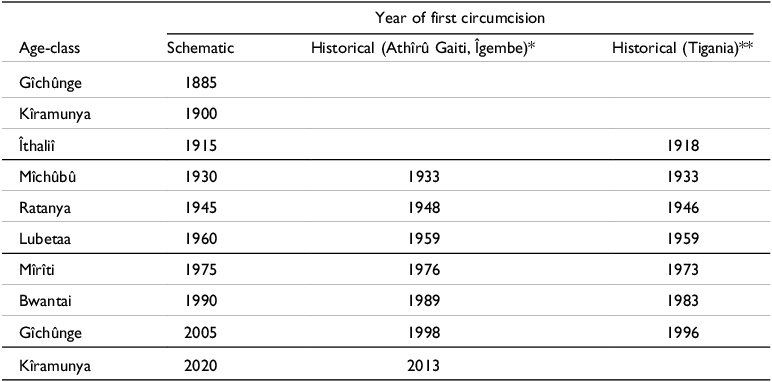
Note: * As per my fieldwork.
** As per Lamont (Lamont, Reference Lamont2005, pp. 108, 205) for the Tigania, another Kîmîîrû-speaking people/sub-group.
In 1966, the Îgembe Southeast Division, then known as Athîrû Gaiti (Thaichû) Sublocation, along with the other Îgembe divisions, became an adjudication section under the Land Consolidation Act. The programme involved “replanning the proprietary land units within a given area and redistributing them in units of economic size and shape” (Kenya, 1966, p. 7). During the process called “fragment gathering,” authorities merged small holdings scattered over a wide area to create single farms with straightened boundaries. This process required the relocation of farm families within the neighbourhood. Sometimes, landowners had to give up their ancestral holdings and cultivate a consolidated farm in another area (Bernard, Reference Bernard1972, pp. 141–3).
Undoubtedly, the new land ownership system caused an overall change in local agronomy. It replaced traditional circuit cultivation of scattered farm holdings with farming in single consolidated plots. This generalization applies only to areas where fragment gathering occurred in the 1950s and 1960s. The government actually reversed its land administration policy soon after the publication of the Report of the Mission on Land Consolidation and Registration (Kenya, 1966). An official announcement issued on 28 June 1967 stated: “Adjudication work will not be started in a new area until the problem of fragmentation in that area has been studied and a decision taken as to the need, if any, for consolidation.”Footnote 5
Although authorities formulated land tenure reform in 1966, they did not initiate it in Athîrû Gaiti due to staff shortages. Reform only began in 1989, when officials again declared the area an adjudication section under the Land Adjudication Act (Cap 284). They then divided Athîrû Gaiti into the Upper and Lower Athîrû Gaiti adjudication sections. Shortly before this division, public hearings took place to decide whether to accept Cap 284 to sustain circuit cultivation, or Cap 283 to facilitate fragment gathering. Authorities eventually applied Cap 284. As a result, the present system of land tenure in Îgembe Southeast differs greatly from areas where Cap 283 was implemented (Ishida, Reference Ishida2024, pp. 30–1).
Land tenure reform was, and remains, a challenging proposition, even under Cap 284. When adjudication started in the Îgembe Southeast in 1989, demarcation officers were stationed in every adjudication section. They registered all plots and inscribed land boundary maps. After this process, each plot received a reference number, which both the owner and the office shared. This legitimized land ownership until title deeds or other legal documents were issued. The people of the Upper Athîrû Gaiti adjudication section did not begin to receive deeds to their land properties until 2015 (Ishida, Reference Ishida2024, p. 31).
Clan representatives first demarcated the then semi-cultivated areas in the Thaichû plainFootnote 6 between the early 1980s and 2000s. They subsequently allocated these lands to highlanders, and applicants’ clan affiliations informed these decisions. However, in the Îgembe Southeast, non-agnatic members were not entirely excluded from receiving a share of land, as certain conditions made outsiders eligible. This type of property transfer may be described as a gift and is distinct from inheritance or purchase. In the Îgembe Southeast, the agnatic clans Athimba, Amwari, and Amunjû, among a few others, claimed mbûrago (ancestral land) on the Plain. They were allowed to distribute properties to their agnatic members, as well as to allied clans of îchiaro.Footnote 7
From the initiation of land reform in 1989 until the end of the 1990s, land boundary disputes increased between various clans. The clans settled these disputes using an indigenous method, the nthenge oath (kûringa nthenge). However, since the early 2000s, I observed that most boundary disputes occurred between individuals or between “families,” which include an individual, their siblings, and children. In such cases, the indigenous method used was the kîthiri oath. Drawing on my fieldwork research and interviews in the Athîrû Gaiti community since 2001, the following sections describe cases of these two ordeal-based methods.
4. The nthenge oath performed in 1983 (Case 1)
The nthenge oath, known as kûringa nthenge (to strike a he-goat), is used to settle only large-scale land disputes between clans. When a clan claims a piece of land that another clan cultivates, the representative of the claimant clan brings a he-goat for the oath administration. All the goat’s orifices—its mouth, eyes, ears, and anus—are stitched. The representative then kills the goat with a knife while uttering curse words. The body of the mutilated goat is burnt to ashes, and its remains are placed in a small pot, which is then secretly hidden. The opposing clan is then permitted to occupy the land continuously. However, if the latter experiences a series of subsequent misfortunes, their occupation of the plot is declared unlawful (see also Rimita, Reference Rimita1988, p. 74). People believe that intra-clan claims should not be settled by this method because not only the perjurer and their family, but the entire clan, will be affected (Lambert, Reference Lambert1956, p. 127).
On 9 September 2005, I interviewed Matî M’Mauta about his experience with the nthenge oath. The oath was administered to resolve a land dispute between two neighbouring families. M’Aluma, who belonged to the Îthaliî age-classFootnote 8 from the Bwethaa clan, claimed that the land occupied by Matî’s family from the Amurîndi clan was his. Matî recalled that the complainant provided the he-goat. On the day of the ordeal, Matî’s brother carried the nthenge, or sacrificial he-goat, on his back. Kathongo, one of M’Aluma’s sons, stabbed and cut the sacrificial animal with a knife. After this, Kathongo hid the dead body of the nthenge. The Athîrû Gaiti community widely recognizes this case as a representative precedent of the nthenge oath. The Njûriîncheke council of elders approved and supervised the process, and the district commissioner at the time authorized it. The following is Matî’s recollection of the event:
The oath was performed in 1983. A small new-born goat was used for the purpose; it was beaten to death. We did not bring the nthenge, but the other party did. No misfortune has occurred since then. The elders heard the case at the disputed land at night. Administration officers were also present. After they found both parties could not agree, nthenge oath was performed the following morning from 9:00 am to 10:00 am. That night we did not sleep, though both parties built their respective shelters in which to sleep and to prepare themselves for the oath. The nthenge oath was recognised by the district commissioner and the Njûriîncheke council of elders. The shamba, where our present homestead is located, is not very big (of about 10 acre), but it is quite developed. The other party was claiming our land without any reason. We had been staying there since several years. There are a lot of relevant documents that prove our ownership. The nthenge oath is a serious matter. Our nthenge oath in 1983 was strong. Karundu’s (an elder from the Amunjû clan) case of nthenge oath (in 1992 against Katherû from the Athimba) was not so effective, because their performance was not recognised by the government. My father died because of age, while many young people of the other side died, though I do not know the reason. When we performed the oath, many people came from different villages to observe. Nine members of our family are still alive, while only one from the other side is alive, Kathongo. Because both parties are from the Bwethaa clan, many people were against the performance of this oath. After performing the oath, the two parties are not supposed to intermarry. In our case, my father called my sisters to come back, since they were married to the other party. However, my sisters refused to come back and continued staying there.
This story mentions, “Because both parties are from the Bwethaa clan, many people were against the performance of this oath.” In an interview, Matî explained that his grandfather was a circumciser of Kamba origin. He migrated from the Kamba region to the Thaichû plains, and then to the Bwethaa clan territory,Footnote 9 where he received a share of land. Descendants of the second and third generations were being socially assimilated and absorbed into the Bwethaa clan. Some argued that, because of their historical experiences, the nthenge oaths should not be performed between those belonging to the Bwethaa clan. However, the strong biological determinism inherent among the Îgembe (Ishida, Reference Ishida2024, p. 167) did not remove or obliterate their original social attributes. A Kamba family belonging to the Amurîndi clan had been allowed to intermarry with the Bwethaa clan. Matî’s father decided that, although the two parties had common interests through circumcision and intermarriage, the biological fact that they did not belong to the same clan did not preclude the choice of the nthenge oath as a means of resolving land disputes. Matî argued that his family was formally granted land in Bwethaa in recognition of his grandfather’s significant contribution to the Bwethaa agnates as a circumciser. The Îgembe believe that such oral history is strong evidence of the minority migrants’ legitimate claim to their land properties, which the original owners or host community cannot overturn.
5. An unsuccessful call of the kîthiri oath since 1993 (Case 2)
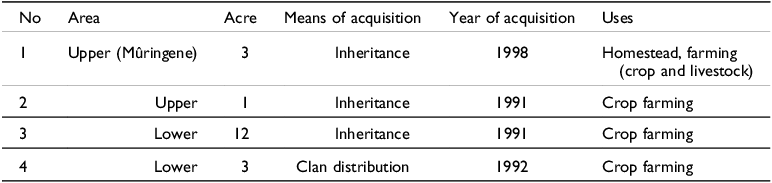
KîthiaFootnote 10 of the Mîrîti age-class, one of the key figures in my ethnography (Ishida, Reference Ishida2024), worked as secretary of the Athimba clan in Mûringene village from 2001 to 2014. He was elected as the clan chairman on 14 August 2014 (Ishida, Reference Ishida2024, pp. 203–4). When I interviewed him about his land holdings in 2003 and 2012, he stated that he had two holdings on the upper land, totalling 4 acres, and another two on the lower land, totalling 15 acres, as shown in Table 2. The first piece of land, 3 acres in Mûringene village, was and still is used for his homestead, farming a variety of food crops, cash crops, and maintaining livestock. He has used the second piece of land, 1 acre, for farming both subsistence and cash crops. The third and fourth pieces of land on the lower land were originally used specifically for the cultivation of food crops. Now, he also uses this land to cultivate mîraa.
Kîthia’s land holdings

The Athimba clan, to which Kîthia belongs, is one of the dominant clans that claim to have ancestral land (mbûrago) in the lower area. Kîthia’s father, M’Birithia of the Mîchûbû age-class, was once a chairman of the clan. Kîthia received a large tract of land through inheritance in the 1990s and intra-clan distribution in 1992. He recognized that a dispute had existed over about 5 acres of land since 1993 between his father and his neighbour Daniel, who was also of the Mîchûbû age-class and belonged to another dominant clan, the Amwari. M’Birithia and Daniel each occupied one of the two adjacent land parcels, with Daniel claiming that M’Birithia’s land was his own. The second land parcel, which Kîthia inherited from his father, was part of the disputed land.
Kîthia kept a set of documents related to this land dispute. Among these, a handwritten document from the Land Committee of the Upper Athîrû Gaiti Adjudication Section (Document 1) shows that the Committee held a hearing on 17 June 1993. Daniel acted as the plaintiff, while Kîthia and Felix were the defendants.Footnote 11 Daniel argued that the land Kîthia and Felix were cultivating illegally was his ancestral land. He used the history of inheritance to explain that it was now time for his sons, the seventh generation from the first ancestor, to inherit the land. Daniel stated that he was prepared to take the kîthiri oathFootnote 12 if the final decision favoured the defendants. The defendants, on the other hand, argued that the land Daniel and his sons were farming on was their ancestral land. They explained that they had inherited it from Atalala (first generation), to Baithili (second generation), to Mwitari (third generation), to Kamanja (fourth generation), and to M’Birithia (fifth generation). Kîthia and Felix, as the sixth generation, inherited the land from M’Birithia. The defendants were also ready to perform the kîthiri oath, as the plaintiff wished. After hearing arguments from both sides, the Land Committee concluded that the kîthiri oath should be implemented within 21 days.
A handwritten letter dated 23 August 1993 (second document) from the Land Committee to the chief of the Athîrû Gaiti Location states that the Land Committee has permitted the plaintiff and defendants to perform the kîthiri oath. The letter intends to seek final approval from the chief to settle the dispute using this traditional method.
A typewritten document dated 3 September 1993, prepared by defendants Kîthia and Felix (third document), modified the testimony recorded in the first document. They described the process of inheritance from the first generation to Kîthia and Felix as the seventh generation. They added one generation between the first ancestor and the current owners. As a result, the defendants, as well as the plaintiff, claimed that the current generation that would eventually use the land was seventh in line. The defendants then submitted this typewritten document as supporting evidence to the Njûriîncheke council, which had jurisdiction over the kîthiri oath.
According to a handwritten document dated 25 October 1993 (fourth document) prepared by the Njûriîncheke council, and a handwritten document dated 21 April 1995 (fifth document), the council did not administer the kîthiri oath in its Athîrû Gaiti office on 25 October 1993 or in its district headquarters on 18 November 1994. The elders decided this after they learned that the plaintiff and the defendants were related by marriage, as Kîthia’s wife was from the Amwari clan. They concluded that a kîthiri oath should not be conducted between them. However, the defendants continued to demand that the kîthiri oath be implemented. As a result, the council scheduled the oath for 21 April 1995 at its headquarters. The plaintiff did not attend, so the council cancelled the implementation.
Throughout the Njûriîncheke hearings, Kîthia and his father, M’Birithia, stated that their Athimba ancestors buried a nthenge in the land because of issues that existed a long time ago. They argued that this historical fact exemplifies their ownership. In this story, the nthenge referred to the corpse of a person who was killed during a circumcision festival and buried by his clan agnates as a curse against the killer. It is customary that the nthenge must always be buried in one’s own land. Kîthia remembered that some elders from the Njûriîncheke council recognized the story as evidence of their ownership.
Eventually, the kîthiri oath was not administered. In my interview with him in August 2024, Kîthia quoted a phrase from a song sung during the nthenge oath: “Ntitûma thiiri naa nthii ya kîûjûûjû (I won’t make peace while there’s an issue over ancestral land).” The song continues, “I won’t make peace even if you marry our daughter. You will carry the he-goat!” Kîthia remembered that people sang the same song when another nthenge oath was administered in 1992 between Katherû of Athimba and Karundu of Amunjû over more than 30 acres of land in the Thaichû Plain.
The nthenge and kîthiri oaths have been used in land cases under the authority of the Njûriîncheke council among the Îgembe communities. People say that these two methods will invariably lead to dangerous consequences for the party that continues to occupy the land illegally with false statements. The other party should “temporarily” vacate the land and wait for a future resolution. However, I have never witnessed a case where the former acknowledged their injustice and surrendered the land to the latter. As noted above, people speak of the unfortunate end of despotic administrators and those who outwit villagers to monopolize large tracts of land. However, at least within the Athîrû Gaiti community, there is no precedent of land grabbers returning land, and different interpretations of their unfortunate consequences exist. One of my key informants from the community, who is recognized and invited as an advisor on many occasions, said that if a “grabber” admits his unlawfulness, he would not have to vacate the entire land. The other party is liable to share a part of the land with him for peaceful coexistence.
Ishida (Reference Ishida2024, pp. 180–1, 210–1) described the outcome of a dispute in which a man admitted his wrongdoing and confessed after 20 years. The case did not concern land, but mainly livestock that he had acquired as homicide compensation items. While people have tried curse or ordeal-based approaches for various purposes, there appears to be a significant difference in attitudes and decision-making between disputes over replaceable properties and those over irreplaceable properties, such as land.
While Cases 1 and 2 involve disputes over 10 and 5 acres of land, respectively, the three land disputes described in the following section (Cases 3, 4, and 5) concern 1 acre or even smaller parcels of land. Unlike the previous cases, the parties in these cases use the state system of justice to fight for their rights, rather than relying on curse or ordeal-based approaches. Matî M’Mauta, who participates in the nthenge oath mentioned above (Case 1), emerges victorious in one of these cases.
6. Court decisions on land disputes in Athîrû Gaiti
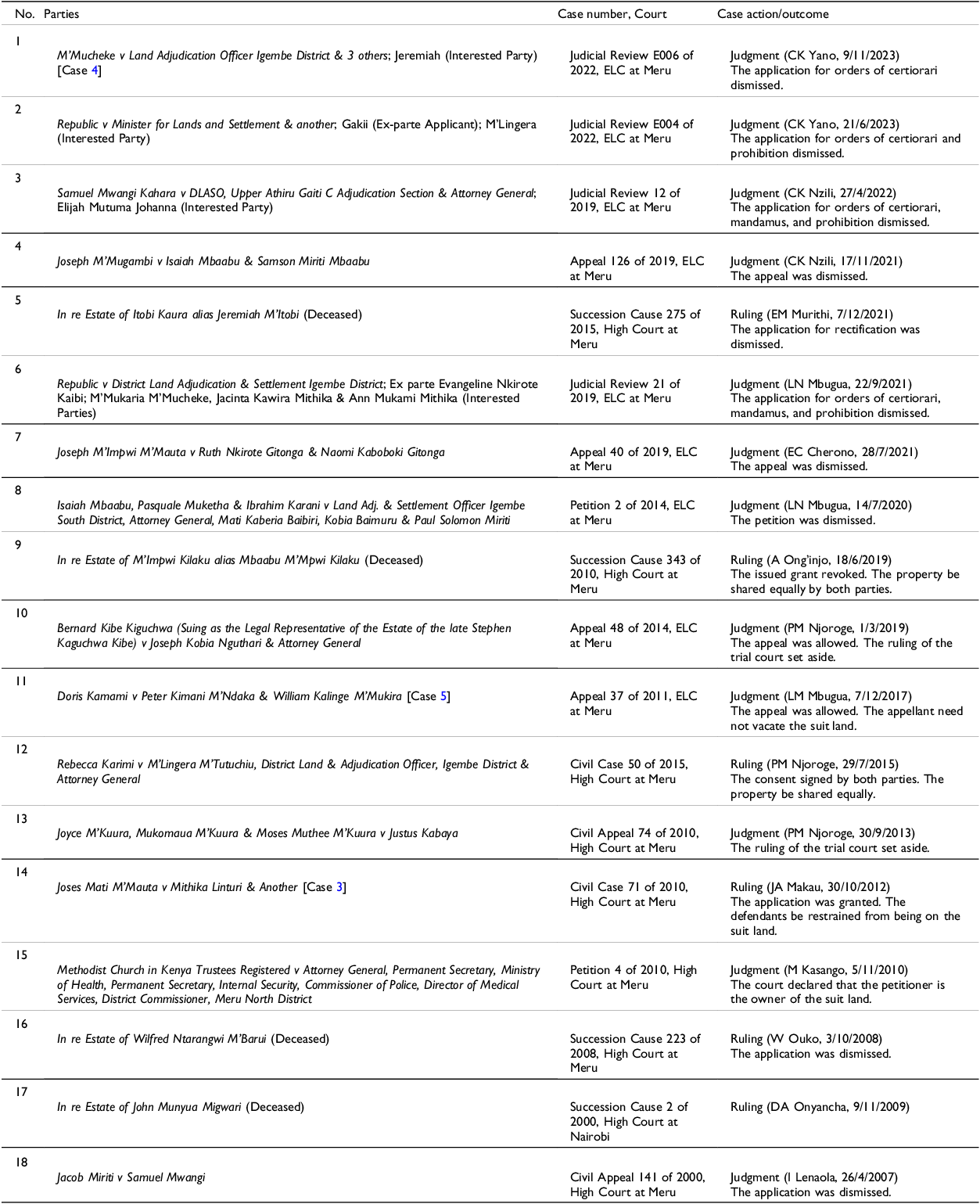
The Kenya Law website allows users to search for case laws. I searched for case laws on 2 February 2024 using “Athîrû Gaiti” as the keyword. This search produced 35 files. Nine files concern criminal cases. The remaining 26 files record 19 civil cases. Some cases include two rulings or files. One civil case involves a claim for damages caused by a traffic accident. The other 18 cases concern the use of and title to land. The High Court or Environment and Land Court heard these 18 cases (see Table 3). The case law database does not contain decisions from the lower courts and local forums.
The 18 court cases from the Athîrû Gaiti community and their decisions by the High Court or the Environment and Land Court at Meru

Source: Case Search at the Kenya Law website (https://kenyalaw.org/caselaw/)
List created by the author.
This section describes and analyses 3 cases from the 18 land disputes. I selected the three cases in which I personally knew the parties who won, as well as their social background, and I was able to interview them directly.
The winner of the first case (Case 3, see No. 14 in Table 3), Matî M’Mauta, who also appears in Case 1, becomes socio-economically prominent after the nthenge. He owns his private vehicle and has once been nominated as a councillor of the local government. However, his origins are marked by a historical otherness. In Case 3, he is forced to fight against the local administration and the village majority. The background of this case includes political and religious conflicts in the village, which this paper will discuss only briefly.
The winner of the second case (Case 4, see No. 1 in Table 3), Thadeuas Mûtura, belongs to the Lubetta age-class and holds a leadership position in the local Methodist church. He is known for his sociable personality. His family had a history of jointly using land with their neighbour owing to the good relations between the two for generations. Subsequently, after the formalization of property rights in 1989, Thadeuas Mûtura could not avoid a land dispute with his neighbour. He did not make any concessions to his own land rights, although he did not want to distress his neighbour.
The third case winner (Case 5, see No. 11 in Table 3), Doris Kamami, is a woman born in the early 1970s. She grew up with a single mother and now lives as a divorced wife and single mother. Her then husband’s father originally gave the land she defended to the couple during their early matrimonial days. Later, she suddenly learned that her now missing husband had sold the land without her consent. She fought her way through the courts with the help of others, including the local administration. She lost the case in the District Magistrate Court. However, with her lawyer’s advice, she immediately appealed and won the case in the High Court. This case is important as an example of a socio-economically vulnerable woman achieving land justice in the pluralistic legal systems of Kenya.
Unless otherwise noted, the following summary of the three cases is based on the texts of court decisions obtained from the case search on the Kenya Law website.
Case 3: Joses Matî M’Mauta v Chief Michael Mûrûngî & others
This dispute concerns a land parcel at the centre of the Kîraone market. Joses, the plaintiff, argues that the Athimba clan gave him the plot in 1975. Since then, he has made developments there as the lawful owner by building permanent single-storey business and residential premises. He states that on 21 February 2010, the defendants arrested him on false allegations and entered the parcel. They hung a national flag around the fence and destroyed his properties while he was in police custody. The defendants counterclaim that the Athimba clan denied the gift, annexing a letter from the clan, and that the parcel was taken from land owned by the community. They argue that the parcel belongs to the community, as it is in the Kîraone sacred shrine where clan members have met since time immemorial. The court finds that the plaintiff has made up a prima facie case with probability of success and that the court is obliged to apply oxygen principles under Section 1A and 1B of the Civil Procedure Act for substantive justice rather than for technicality. Thus, the court determines that the defendants be restrained, either by themselves or their servants, from being on the plot.
Case 4: Francis M’Mûkiri M’Mûcheke v Land Adjudication Officer Îgembe District & three others; Thadeuas Mûtura Jeremiah (Interested Party)
On 9 November 2023, the Environment and Land Court at Meru dismissed an application for orders of “certiorari quashing the decisions” of the Land Adjudication Officer of Îgembe District dated 5 December 2014 and of the Minister for Lands and Settlement dated 27 January 2022. The applicant, Francis M’Mûkiri M’Mûcheke, filed a notice of motion on 20 July 2022, and the judicial review proceedings began. The court found that the respondents did not file any responses. The interested party, Thadeuas Mûtura Jeremiah, opposed the claim through a reply affidavit dated 21 November 2022.
Francis, the ex-parte applicant, argued that he owns a land parcel in the Lower Athîrû Gaiti “A” Adjudication Section and that he has occupied this land since 1974. Francis stated that the divisional branch office of the Njûriîncheke council of elders in Athîrû Gaiti heard his claim on 29 March and 12 April 2014 and determined that the land belongs to him. However, the first and second respondents, the Land Adjudication Officer and the Minister of Land and Settlement, respectively, ignored this decision and used a different, competing report from the council’s district headquarter office in Maua. The second respondent made an incorrect decision in favour of Thadeuas, the interested party, by considering “extraneous factors that were not relevant” to the dispute. They alleged that the Tharaka-Îgembe conflict in 1998 displaced rightful landowners. Francis included several supporting documents, such as the judgment of the Njûriîncheke council in Athîrû Gaiti dated 12 April 2014.
According to Francis, a local land adjudication committee heard the first dispute between him and Thadeuas in 1991 and referred it to the Njûriîncheke council of elders for the kîthiri oath. The parties did not take any legal actions from 1991 to 2012. In 2012, preparations for the adjudication register at the District Land Adjudication and Settlement Office (DLASO) started. Thadeuas, the interested party, filed an objection that year. Francis argued that DLASO approved the objection without involving the land committee, which he claimed breached the provisions of Section 20 of the Land Adjudication Act. He also argued that Mûlindo, “the initial owner” from the Amunjû clan, gave him the same land. Francis further stated that Thadeuas refused to participate in the kîthiri oath “to establish the truth of the case.”
On the other hand, Thadeuas argued that the DLASO’s “decision was most aptly made” according to Section 26 of the Land Adjudication Act. He stated that the involvement of the land committees was required only in “the earlier stages of recording interests in land and demarcation.” He consulted the Maua headquarter office of the Njûriîncheke council “to enhance transparency,” and the law did not require him to sit down with the Adjudication Committee or the Arbitration Board. He also argued that the Maua head office of the council was both impartial, in contrast with, and superior to the local branch office in Athîrû Gaiti, where Francis was a member. Furthermore, Francis’s argument that he acquired the land from Mûlindo contradicted Thadeuas’s testimony before the Njûriîncheke council in Athîrû Gaiti, as stated in a letter Francis submitted as evidence.Footnote 13
Considering the pleadings, legal and statutory authorities, and written submissions, the Environment and Land Court at Meru determined that the court was not able to review the decision of the DLASO in the light of procedural irregularities,Footnote 14 and dismissed the application.
Case 5: Doris Kamami v Peter Kimani M’Ndaka & another [2017]
The trial court ordered Doris Kamami, the appellant, to vacate the suit land in favour of Peter Kimani, the first respondent. She counterclaimed that the land was registered in her name and that the land adjudication officer had lawfully cancelled the transfer of the suit land made by her husband, William Kalung’e, the second respondent. She argued that the judgment of the trial court was not supported by the court’s finding that it was unconscionable for her to sell her family land to Peter, the first respondent. The appeal court concluded that the trial magistrate’s evaluation and analysis of the evidence presented before him was plainly wrong, as he had recognized that the alleged sale of land by William was a breach of trust to his wife, Doris. As anything validating such breach, including the sale agreement, should be declared illegal, null, and void, the court found merit in this appeal.
The three parties—Matî, Thadeuas, and Doris—who defended their land state in their respective interviews that their lawyers’ professional advice is indispensable. In Case 4, Thadeuas tried to proceed pro se when he was initially forced to be involved as a defendant. However, when he discovered the difficulty of the technical legal language, he decided to ask his lawyer to represent him in the proceedings. In Case 5, Doris lost the case in the District Magistrate Court, but was able to appeal immediately and win the case in the High Court, thanks to the confidence and advice of her lawyer.
I believe that Matî, the winner of Case 3, used the courts for several reasons. First, he was familiar with the difficulties of land disputes against neighbours, as he had experienced the nthenge oath in 1983. Second, he had a certain legal knowledge and financial strength because of his work experience as a councillor of the local government. Third, he was forced to struggle alone in the community, as discussed below. In contrast, neither Thadeuas nor Doris had the same socio-economic capacity and background as Matî. Thadeuas was a defendant in both the original Njûriîncheke proceedings and the later court proceedings. Doris chose to fight the trial through her own initiative, with advice from her neighbours and lawyer. Despite these differences, Thadeuas and Doris each raised over 200,000 KES in legal costs through their own efforts. Thadeuas raised funds from the sale of a piece of land, and Doris used income from her mîraa business and withdrawals from a women’s self-help savings group.
The primary similarity among the three parties is that none of them possesses unconditionally strong social statuses, even though the state judiciary recognizes them as winners. Each party has its own weaknesses, but they proceed through the process without any compromise. I perceive them as showing strength and courage to defend what is rightfully theirs.
While some may perceive Matî as a political and economic strongman, within the Athîrû Gaiti community, he was unassisted and vulnerable. This was not due to his otherness, whether achieved through political-economic prominence or ascribed through his Kamba origin. Instead, the nature and context of his land disputes resembled the Kîraone dispensary incident (see No. 15 in Table 3), which occurred around the same time. Matî argued that the two incidents were completely unrelated. The people of the Athîrû Gaiti community took forceful action. They argued that the ownership of the dispensary should be in their hands, not the Methodist hospital. The land plot that Matî, a committed Methodist, defended through the court case was adjacent to the dispensary premises. Both lands had been granted by M’Birithia of the Athimba Clan, who was the biological father of Kîthia in Case 2.
Originally, when I analysed the origin of Doris’s children’s names (Ishida, Reference Ishida2024, pp. 186–7), I placed too much emphasis on her socially vulnerable attributes. It is also necessary to discuss her name again in the context of this study because, after marriage, she added her husband’s name to her own on the identity card. Her name remains unchanged to this day (Ishida, Reference Ishida2024, p. 186). The identity card served as legal proof of her marital relationship with himFootnote 15 as the basis for her matrimonial right to the land his father had granted them. Although she has separated from her husband, she defended herself throughout the trial by asserting her rights as a wife. After the High Court victory in December 2017, the land title deed issued in October 2019 was in her name. Regarding Thadeuas (Case 4), I was first surprised to learn that he had fought the case, as I had only seen him as a sociable and good-natured man.
Most importantly, the existence of plural or decentralized dispute resolution mechanisms contributes to the realization of land justice for the parties. The victories of the three parties show that even if one loses in one forum, they can still win on appeal in another. The winner of Case 3, Matî, was largely isolated within the Athîrû Gaiti community. Few people could openly support Matî, as his former guardian, M’Birithia of the Athimba Clan, was already deceased. The Athimba Clan itself had serious internal conflicts over its handling of the Kîraone dispensary case. Therefore, he could not win at the grassroots level. The winner of Case 4, Thadeuas, faced defeat before the Athîrû Gaiti branch of the Njûriîncheke, but the district headquarters and state judiciary vindicated him. Doris in Case 5 lost her case in the District Magistrate Court, but she won in the High Court.
7. Conclusion
In the greater Îgembe region, land registration began in some areas in 1966. However, in other areas, including Athîrû Gaiti, it did not begin until 1989. The Land Consolidation Act applied in the former areas required the consolidation of several dispersed arable lands. This process fundamentally changed the traditional land tenure system. In contrast, the Land Adjudication Act applied in the latter areas and did not require such consolidation. In Athîrû Gaiti, land registration began in 1989 and proceeded under the Land Adjudication Act. Regardless of whether the process required consolidation, land registration reinforced a sense of exclusive rights to land. It also created a fear among people that their neighbours might take their land, which resulted in land disputes.
This study examined how members of the Athîrû Gaiti community experience the complexities of land formalization and the transitional processes of land justice, and how indigenous and state mechanisms work together to mitigate such issues. Members of the community have experienced land injustice in colonial and post-colonial state and local socio-historical contexts. They navigate the complexities of land disputes using both indigenous knowledge and state laws. This study presents several case studies to show these processes. These cases show the pluri-legal nature of land disputes, where traditional practices intersect with formal legal mechanisms.
I argue that success in land disputes often results from a combination of personal courage or strength and the use of both indigenous and formal legal frameworks. Matî, Thadeuas, and Doris are not individuals who unilaterally overwhelm others. They show their true strength by defending their rights to the land without compromise. They use a variety of resources to defend their land rights. For example, they seek advice from neighbours and local administrators, use their knowledge of oral history about the origin of their land ownership, invoke legal reasoning regarding matrimonial rights, and consult lawyers. They also win in the context of the state judiciary.
The three individuals, however, do not view this as a final settlement. They recognize that their adversaries have their own reasons for claiming the land in question, and that their adversaries believe peace will not occur until their rights are realized. Although the two parties must interact as neighbours in their daily lives, they cannot compromise on land rights and justice, as land is an essential basis for their socio-economic survival. For these reasons, disputes over irreplaceable land properties are much more difficult to resolve peacefully than disputes over other properties, such as livestock. The Îgembe recognize the benefits of waiting in conflict resolution and give the highest priority to securing a transitional and safe space for the provision of justice. While Ishida (Reference Ishida2024, pp. 210–1) observes how intra-communal conflicts are addressed over about 20 years, understanding the social processes of land justice will require a longer-term perspective that extends beyond 20 years.
Acknowledgements
I thank the people of Athîrû Gaiti, my source community, for kindly sharing their time, experience, and knowledge. I also thank Yuka Kaneko and the two anonymous reviewers for their constructive criticism and valuable comments. I am grateful to the National Museums of Kenya, the National Commission for Science, Technology and Innovation, Tokyo Metropolitan University, and the JSPS Research Station, Nairobi, for facilitating my research in Kenya.
Funding
This work was supported by JSPS Grant-in-Aid for Scientific Research (KAKENHI).
Competing interests
The author has no conflicts of interest to declare.


 Open access

