


1. Introduction
Manufacturing companies have recently faced increasing demands for customized products, leading to greater product and process complexity. The issue of assembly complexity has received considerable attention throughout the years. Many studies have shown that assembly complexity has a direct effect on the occurrence of product defects and thus on quality costs (Reference Favi and GermaniFavi & Germani, 2012; Reference Genta, Galetto and FranceschiniGenta et al., 2018; Reference HinckleyHinckley, 1994; Reference Rodriguez-Toro, Tate, Jared and SwiftRodriguez-Toro et al., 2003; Reference ShibataShibata, 2002; Reference Su, Liu and WhitneySu et al., 2010; Reference Verna, Genta, Galetto and FranceschiniVerna et al., 2022; Reference Verna, Genta, Galetto and FranceschiniVerna et al., 2023). Assembly complexity is a broad concept encompassing a set of product, process, and environmental factors that may affect how difficult it is to complete an assembly process. A definition was provided by Reference Samy and ElMaraghySamy and ElMaraghy (2010), who described it as “the degree to which the individual parts/subassemblies contain physical attributes that cause difficulties during the handling and insertion processes in manual or automatic assembly.” Complexity therefore affects both the physical and cognitive effort required from the operator during assembly.
Over the years, numerous attempts have been made to define objective and quantifiable measures of complexity. Researchers have approached assembly complexity from different perspectives (Reference Alkan, Vera, Ahmad and HarrisonAlkan et al., 2018; Reference Efthymiou, Mourtzis, Pagoropoulos, Papakostas and ChryssolourisEfthymiou et al., 2016; Reference ElMaraghy, ElMaraghy, Tomiyama and MonostoriElMaraghy et al., 2012). Some focus on physical, geometrical, and structural characteristics of products, while others adopt a broader view that includes process-related and systemic factors. These diverse approaches reflect the multidimensional nature of complexity in manufacturing. As the number of product variants increases, so too does the complexity of internal production and logistics processes (Reference FischerKeuper & Schomann, 2008). According to DIN 199, a variant is defined as a product that has a similar form and/or function to the existing product and shares with it a high proportion of identical components or assemblies (DIN Deutsches Institut für Normung e. V., 2024). Due to internal and external influences on production systems, a fundamental variety of variants is often unavoidable, leading to variant-related costs that arise across factory systems (Reference Hingst, Nyhuis, Kim, von Cieminski and RomeroHingst & Nyhuis, 2022). These costs rarely occur precisely where they are caused: 50 – 80% of variant-driven costs arise in production and logistics (Reference FischerFischer, 2008). Moreover, companies often struggle to distinguish between value-adding and value-destroying variants at an early stage (Reference FischerKeuper & Schomann, 2008). A comprehensive understanding of variant-related costs and their effects is essential for factory planners in order to take targeted measures (Reference BiedermannBiedermann, 2016). Variety-induced complexity, driven by the number of product variants offered, has become a central challenge in manufacturing. Increasing product variety typically leads to greater component diversity and more differentiated manufacturing processes (Reference Salvador, Forza and RungtusanathamSalvador et al., 2002; Reference Salvador, Rungtusanatham and ForzaSalvador et al., 2004). Product variety contributes to the structural complexity of manufacturing and logistics systems and is intertwined with the interdependencies of their elements, including process and supplier diversity (Reference Chryssolouris, Efthymiou, Papakostas, Mourtzis and PagoropoulosChryssolouris et al., 2013). Plant managers, in particular, observe the impact of product complexity on process complexity through more demanding production planning and scheduling (Reference Chryssolouris, Efthymiou, Papakostas, Mourtzis and PagoropoulosChryssolouris et al., 2013). It is essential to analyze all existing methods to obtain an overview of the numerous developed approaches, since this makes it possible to identify the existing gap that contributes to undetected complexity and related costs in variant-rich production. With that in mind, this study addresses the following research question: Which methods exist for assessing assembly complexity that support the production planning process and reduce complexity-induced cost in production?
The objective of this paper is threefold:
-
1. Identification: Provide a structured overview of existing methods and research approaches for evaluating assembly complexity and related costs within manufacturing contexts.
-
2. Analysis: Classify these methods based on their methodological orientation, application area, and considered complexity factors.
-
3. Evaluation: Identify the need for further research in the development of complexity assessment methods, particularly in planning-related applications.
2. Research method
To answer the above research question, it is necessary to apply a comprehensive approach combining a systematic literature review (SLR) with snowballing method and a structured summary according to the considered factors.
Both steps are described in more detail below.
2.1. Systematic literature review process
The search for literature (Figure 1) was performed in two databases - Scopus and Web of Science (WoS) - in August 2025, with a first iteration based on a systematic search string that includes a filtering based on PRISMA (Reference Chryssolouris, Efthymiou, Papakostas, Mourtzis and PagoropoulosMoher, D. et al., 2009) and a second iteration analyzing the cross-references of publications found through the search string in the first iteration.
Search string and screening process results

Figure 1 Long description
A flowchart illustrating the search string and screening process for publications on assembly complexity. The process begins with a search string combining product variety, method, reduction, production, complexity, and cost using OR-linked synonyms and AND operators. The first iteration involves searching databases WoS and Scopus, yielding 190 and 638 results respectively, totaling 49 results after merging. Title screening reduces this to 53 publications. After removing duplicates, 42 publications remain. Abstract screening further narrows the list to 22 publications. Full-body screening results in 35 publications considered for final analysis.
Web of Science:
TS=((“product variety” OR “product family” OR “product variant” OR variet* OR variant*) AND (“method” OR “framework” OR “model” OR “strategy” OR “approach” OR “technique”) AND (“reduction” OR “management” OR “control” OR “planning”) AND (“production” OR “manufacturing” OR “fabrication” OR “assembly”) AND complexit* AND (“cost” OR “expense” OR “price”))
Scopus:
TITLE-ABS-KEY ((“product variety” OR “product family” OR “product variant” OR “variety*” OR “*variety” OR “variant*” OR “*variant”) AND (“method” OR “framework” OR “model” OR “strategy” OR “approach” OR “technique”) AND (“reduction” OR “management” OR “control” OR “planning”) AND (“production” OR “manufacturing” OR “fabrication” OR “assembly”) AND (“complexity*” OR “*complexit”) AND (“cost” OR “expense” OR “price”))
2.2. Classification elements of methodologies
A wide range of methods has been developed to assess assembly complexity in manufacturing, but these methods differ significantly in their approach, target domain, and aims, as well as the complexity factors they address. To support the analysis and answer the research question, each identified complexity assessment method is classified using a structured overview table. This table is designed to highlight key dimensions that allow for a consistent and transparent comparison across diverse approaches. Specifically, the classification is based on three core dimensions:
-
a) First, the approach refers to the general perspective from which complexity is assessed. It distinguishes whether the method focuses on the product itself (product-centered), on the informational structure and diversity that must be managed during the assembly process (information-centered), or on the broader production system and its dynamics (system-centered).
-
b) Second, the target domain and aim describe the context in which the method is applied and its intended purpose. This includes the industrial or operational setting (e.g., assembly planning, product design, layout optimization) and the specific goal of the method, such as reducing complexity, predicting defects, or supporting decision-making.
-
c) Third, the classification also considers the main complexity factor categories and their associated attributes. Categories represent overarching dimensions: These serve as structural frameworks for organizing the specific attributes considered to quantify complexity, ranging from physical properties (e.g., size, weight, symmetry) and connection types to informational indicators (e.g., entropy, uncertainty) and human-related factors (e.g., mental workload, ergonomic strain).
Together, these three dimensions provide a comprehensive and consistent structure for analyzing the landscape of complexity assessment methods. This structure should provide a clear understanding of how different approaches conceptualize and operationalize complexity, and the aim is to form the basis for identifying methodological patterns, strengths, and areas for future development.
3. Structured overview of the assembly complexity assessment methods
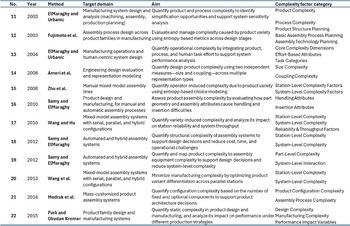
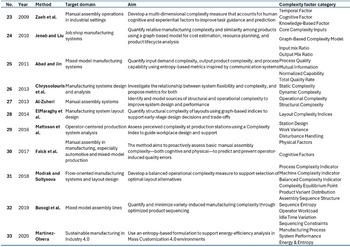
To provide a transparent comparison of existing complexity assessment methods, this section presents a structured overview of the three approaches: product-centered, information-centered, and system-centered. Each approach is summarized in detail through dedicated overview tables (see Table 1, Table 2, and Table 3), highlighting the target domain, aim, and key complexity assessment categories.
To enhance readability and provide a consolidated overview, the tables are followed by a more detailed synthesis of the complexity factor attributes. These attributes are grouped according to the overarching categories presented in the tables above. While the tables primarily indicate the categorical structure, the subsequent section elaborates on the specific attributes assigned to each category.
3.1. Product-centered approaches
Structured overview of product-centered complexity assessment approaches

3.2. Information-centered approaches
Structured overview of information-centered complexity assessment approaches

3.3. System-centered approaches
Structured overview of system-centered complexity assessment approaches

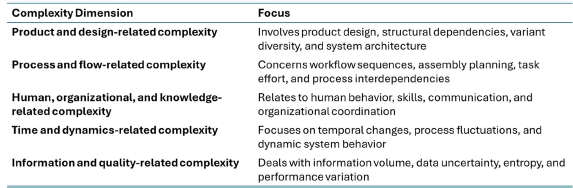
By compiling all identified main complexity factors and grouping them according to their similarity, the aim was to detect recurring patterns. These in turn serve as the basis for deriving overarching complexity dimensions that allow the major addressed complexity factors to be systematically characterized. It can be observed that the following five dimensions can be used to group the main complexity factors considered for the assessment of assembly complexity:
Dimensions to group the main complexity factors

Product-centered approaches for assessing assembly complexity commonly structure models along four main factors (sorted by frequency): product and design-related complexity, process and flow-related complexity, information and quality-related complexity, and human, organizational, and knowledge-related complexity. These categories address physical part characteristics (e.g., size, weight, symmetry), connection properties (e.g., visibility, orientation, fastening types), and system-level architectural aspects (e.g., degree of interconnectivity, centrality, graph energy).
The underlying assessment attributes show substantial overlap. Frequently used dimensions include physical features, handling aspects, connection technologies, and topological indicators.
In terms of application, three primary contexts are evident: assembly planning, quality prediction, and system architecture analysis. Methods are used to evaluate assembly sequences, forecast defects, and assess cyber-physical structures. The assessment frameworks link product design parameters to quality and efficiency metrics.
Information-centered approaches for assessing assembly complexity typically apply a multidimensional framework that distinguishes between the following main complexity factors (sorted by frequency): process and flow-related complexity, product and design-related complexity, and information and quality-related complexity. These categories address the variety and information density of product features and variants, process resources and workflows, execution-related effort, system architecture and modularity, and the degree of uncertainty or choice within configurations.
Recurring attributes include quantitative indicators (e.g., number of parts, variants, operations), diversity measures (e.g., modularity, uniqueness), and entropy-based metrics that capture information content and uncertainty. Physical and cognitive effort is also frequently considered, as are coupling and decomposability. The combination of quantitative and qualitative dimensions enables a comprehensive evaluation of structural and procedural complexity.
Application contexts span assembly and product design, production systems, human-machine interaction, and hybrid or automated systems. Across these domains, the methods aim to support early-stage complexity reduction, bottleneck identification, ergonomic assessment, and system configuration. The overarching objective is to improve quality, efficiency, robustness, or flexibility through informed complexity management. If this is not achieved, the cost implications include rework, delays, and resource inefficiencies.
System-centered approaches for assessing assembly complexity also build on a multidimensional framework that addresses the following main complexity factors (sorted by frequency): process and flow-related complexity, product and design-related complexity, and human, organizational, and knowledge-related complexity. These categories address layout and routing structures, task variability and ergonomic load, mental demands and decision pressure, temporal dynamics such as sequencing and throughput, and entropy-based measures of uncertainty and variant diversity.
Frequently used attributes include connection structures (e.g., nodes, loops, decision points), cognitive load indicators (e.g., information volume, distraction potential), ergonomic factors (e.g., posture, reachability) and temporal metrics (e.g., reaction time, waiting periods). These attributes enable a holistic evaluation of system behavior across structural, cognitive, and dynamic dimensions.
Application contexts include assembly planning, workstation design, production system layout, mixed-model manufacturing, and smart factory environments. The methods support assessments of workload, error susceptibility, material flow, variant-induced complexity, and real-time responsiveness. The overarching aim is to enhance quality, efficiency, flexibility, and robustness through system-level complexity awareness. If this is not achieved, the cost implications include rework, delays, and resource inefficiencies.
4. Discussion
The structured overview of the different approaches provides insight into their methodological evaluation, with each contributing to the scientific understanding of complexity in manufacturing. This overview also highlights specific implications for current research and opportunities for future method development.
Product-centered approaches: Current research increasingly converges on a standardized tripartite structure (physical part+connections+topology), which facilitates comparability and modular integration into digital tools. As shown in Table 1, new approaches aim to focus on measurable, graph-based indicators and avoid relying on expert opinions. This shift allows complexity to be assessed early in the design phase and supports integration into digital twins. Future methods should build on this modularity to support variant management, platform design, and reconfigurable assembly systems. Cross-domain generalizability remains a key challenge, requiring context-independent complexity definitions and adaptive weighting mechanisms. Moreover, using learning-based systems could help predict further issues and guide preventive actions more effectively.
Information-centered approaches: The scientific foundation of information-centered models is well established, with entropy, diversity, and effort serving as core complexity assessment factors. These models rely on mathematics and are increasingly embedded in digital engineering environments. Future research should focus on enhancing domain-independent applicability through standardized entropy formulations and modular frameworks. Real-time, data-driven complexity evaluation, leveraging live production and design data, represents a critical development path. Additionally, complexity metrics should be directly linked to cost indicators such as rework, delays, and resource efficiency. This is required to increase practical relevance, enable trade-off analyses, and promote strategic optimization of product portfolios and production systems.
System-centered approaches: System-centered models reflect a mature understanding of complexity as a multidimensional and dynamic phenomenon. The integration of structural, cognitive, ergonomic, and temporal dimensions allows for holistic system evaluation. Entropy-based measures are widely used to quantify uncertainty and sequence variability, while human-machine interaction and responsiveness are increasingly considered. Future methods should support adaptive, context-sensitive modeling based on real-time data and learning algorithms. The explicit coupling of complexity metrics with KPIs, such as energy efficiency, error rates, and throughput, will be essential for performance-driven system and cost optimization. Visual decision-support tools (e.g., radar plots, heatmaps) can further enhance interpretability and operational relevance.
5. Summary
This study provides a structured overview and comparative analysis of existing methodologies for assessing assembly complexity in manufacturing contexts. Through a systematic literature review and targeted summary, the paper identifies and organizes a broad spectrum of approaches that differ in their conceptual orientation, application domains, and complexity dimensions. The classification framework developed in this work is based on four core elements: methodological perspective (product-, information-, or system-centered), application context and aim, overarching complexity categories, and specific assessment attributes.
By applying this framework, the study reveals distinct methodological patterns and highlights the diversity of complexity sources considered across the literature. Product-centered approaches emphasize physical and structural product features; information-centered approaches focus on entropy, diversity, and decision effort; and system-centered approaches incorporate dynamic, ergonomic, and cognitive dimensions of production systems. The structured overview enables a clearer understanding of how complexity is conceptualized and operationalized in different contexts.
The results demonstrate that while numerous methods exist, they are often fragmented and lack a unified classification logic. This hampers comparability and practical applicability, especially in early planning phases where complexity-related costs remain largely undetected. The developed classification scheme addresses this gap by offering a transparent structure for currently existing methods and evaluation.
Overall, the paper contributes to the scientific discourse by consolidating existing knowledge, identifying methodological gaps, and providing a foundation for future research.



 Open access

