

Introduction
The year began with pomp and circumstances. Her Majesty Queen Margrethe II abdicated on 14 January, 52 years after inheriting the throne from her father, and left it for King Frederik X. Denmark is a constitutional monarchy, where the formal head of state, the Danish monarch, retains only ceremonial functions. However, generational changes involve some modernization, for example, purveyors to the king of Denmark, as well as to the royal Danish court, are discontinued with the new monarch. In contrast to the comparatively limited number of political initiatives undertaken by the government in 2023, the year 2024 witnessed increased activity, but the government's electoral struggles sustained. There was only one election, namely, to the European Parliament (EP).
Election report
The campaign leading up to the Danish election to the EP on 9 June 2024 lacked focus and, as usual, little attention was granted to this election. It was hard for the electorate to identify clear differences across the parties and primary candidates.
Some of the main issues discussed were climate, democracy (backlash against liberal democracy), and the labor market, in particular in relation to the “Danish model,” where pay and working conditions are jointly decided by the employee and employer organizations, and in particular, social dumping. Also, the portfolio of Margrethe Vestager, the outgoing Danish EU Commissioner, was discussed during the campaign. Defense was also a prominent issue in light of Russia's invasion in Ukraine.
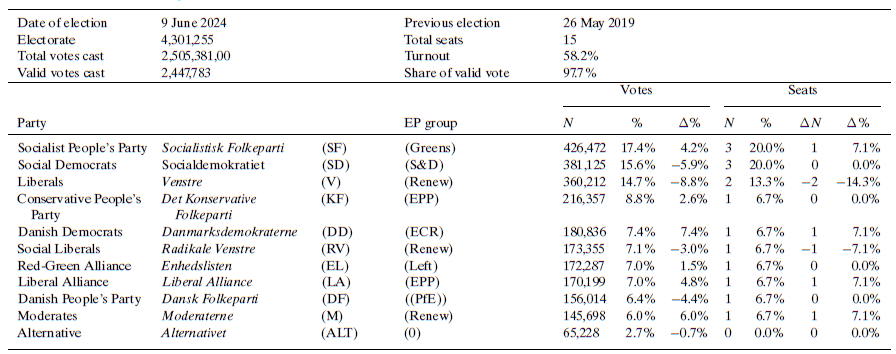
Turning to the results (Table 1), the largest party at the Danish EP election was the Green Left, commanding 17.4 per cent of the votes and adding one seat, as they also did in 2019. Hence, they gained momentum over these elections and totaled three seats out of 15. The Social Democrats held on to their three seats, while the Liberals were back to two seats from four seats in 2019. The Social Liberals also lost the “extra” seat they had gained in 2019. The Conservatives and the Danish People's Party both kept their single seats as did the Red-Green Alliance, which acquired their seat for the first time in 2019. Both the Liberal Alliance, the Danish Democrats, and the Moderates are represented for the first time in the EP. Only the first had stood for EP election before.

Note: Denmark elected 14 in 2019 and 15 in 2024.
Source: KMD (2025).
Given its nature as a second-order election, the EP election result was not devastating for the government, which overall lost only one seat. However, the nature of the government coalition implies that the aggregate result is seen as less important than the result of each of its constituent parties.
The 15 seats Denmark has in the EP are rather fragmented. Ten out of the 11 parties represented in the Folketinget have EP representation, seven of these with only one seat. The Green Left belong to the Greens group in the EP, and the Social Democrats to the Progressive Alliance of Socialists and Democrats. The two Liberals, the Moderate and the Social Liberal, all belong to the Renew Europe Group, while the Conservative and the Liberal Alliance representatives sit with the European People's Party. The representatives from the Danish People's Party, the Red-Green Alliance, and the Danish Democrats belong to, respectively, Patriots for Europe, the Left, and the European Conservatives and Reformists. In sum, representation is a little less split at the EP than in the Folketinget but still spreads across seven EP party groups.
Turnout (58 per cent) was high in comparison with many other member-states. For the first six EP elections, turnout was around half the electorate but has since increased. The highest turnout was in 2019, when two-thirds of the electorate turned out.
Cabinet report
The Danish government, Mette Frederiksen II, formed in 2022, is a Social-Democratic-led majority coalition with the Liberals, as well as the Moderates, a newly formed party led by the former Liberal chair and Prime Minister Lars Løkke Rasmussen. This is an uncommon government in the sense that it spreads across the traditional center-left and center-right blocs, including the two dominant and traditionally opposing parties: Social Democrats and Liberals.
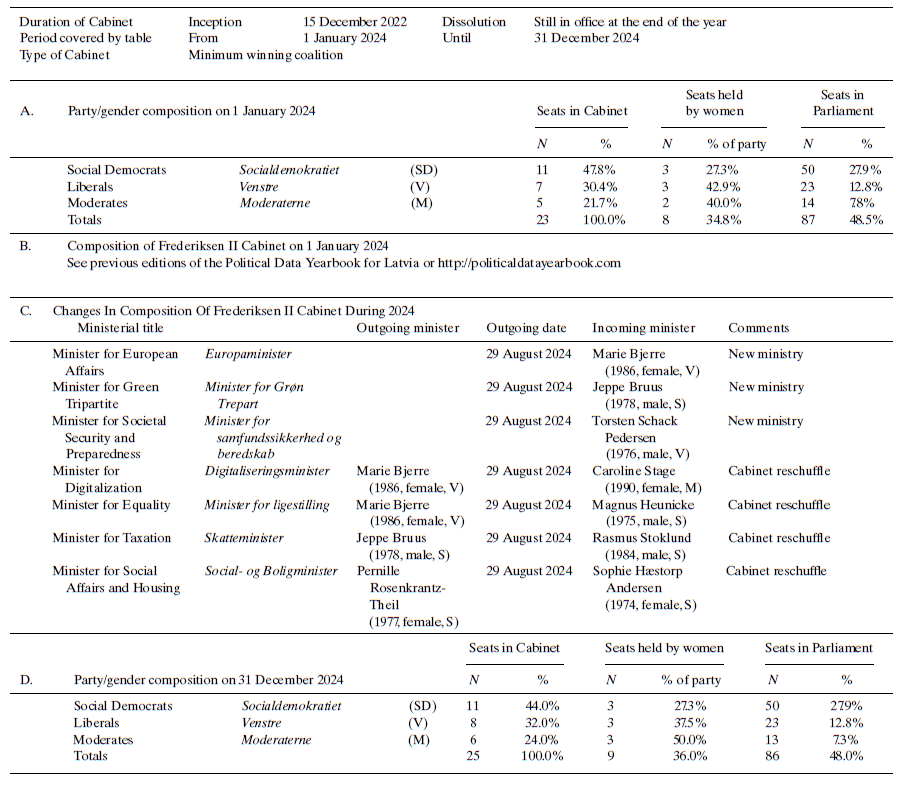
The Cabinet composition changed once in 2024 (Table 2). Three new ministries were created. The Europe Minister took over a portion of the duties previously assigned to the Ministry for Foreign Affairs. It was created to prioritize and prepare the Danish EU chairmanship in 2025 but also to oversee with the provision of support for Ukraine. This office was assumed by Marie Bjerre (Liberals), who was until then Minister for Digitalization and Minister for Equality. A new Ministry of Societal Security and Preparedness was created to take care of a number of tasks previously spread across different sectors, such as security policy, climate change, cyberattacks, espionage attacks, and environmental harmful incidents. This ministry was taken over by Torsten Schack Pedersen (male, 1976), until then the Liberal spokesperson. The third new ministry was devoted to the implementation of the “Green Tripartite” (see below), and this assignment was given to Social Democrat Jeppe Bruus, who left the Ministry of Taxation.

Note: The total number of seats in Parliament (179) includes the four north Atlantic seats, three of which support the government.
Source: Statsministeriet (2025).
In place of Marie Bjerre, Caroline Stage (Moderates, female, 1990) took over as Minister for Digitalization. She came from a position within the Moderates’ party organization and as a special advisor to Lars Løkke Rasmussen and is a former municipal council member in Copenhagen for the Liberals. In place of Jeppe Bruus, Rasmus Stoklund (SD, male, 1984) took over as Minister for Taxation. The Ministry for Equality, which has been tossed around to different ministers over time, was assigned to Magnus Heunicke, who became both Minister for the Environment and Minister for Equality. The Ministry for Equality is frequently assigned to a minister holding another, often mismatching, portfolio; hence, it tends to be regarded as a less important appended department.
Furthermore, the Mayor of Copenhagen, Social Democrat Sophie Hæstorp Andersen (female, 1974) took over as Minister for Social Affairs and Housing from Pernille Rosenkrantz-Theil. To some extent, they were meant to swap places, but as the latter was not elected to the Copenhagen municipality, she concentrated on running the campaign to become mayor after the municipal elections in November 2025. Hæstorp Andersen had not been a strong Mayor (Mogensen Reference Mogensen2023), for example, the municipal's 2023 budget excluded the Social Democrats (Københavns Kommune 2022), and the Social Democrats feared they might be losing the post at the 2025 elections. Rosenkrantz-Theil is a former Red-Green Alliance spokesperson with a strong Copenhagen brand. Hence, she could appear to be a stronger candidate in Copenhagen, where the center-left parties are strong. At the 2021 municipal election, the Red-Green Alliance got 25 per cent of the votes, the Social Democrats 17 per cent and the Green Left 11 per cent. With support for the Green Left increasing, the Social Democrats rightfully feared they may lose the keys to the Mayor's office.
By the end of the year, on the government's second birthday, its 2022 electoral majority had shrunk to a third of the electorate (DR 2024). In particular, the Green Left and Liberal Alliance had made electoral gains in the opinion polls.
Parliament report
Seven MPs were replaced in 2024 (Folketinget 2025a). The reasons for this change vary a lot. The Conservative party chair, Søren Pape Poulsen (male, 1971), died unexpectedly at a party event in March 2024. Jacob Mark (male, 1991) was a young, prominent, possibly future leader of the Green Left, who left politics after a period of severe stress.
Three MPs moved their political offices from Copenhagen to Brussels: Two MPs were elected to the EP, namely, Henrik Dahl from the Liberal Alliance, and Niels Flemming Hansen from the Conservatives. Dan Jørgensen, Social Democrat, replaced Margrethe Vestager as Danish EU Commissioner, with the portfolio of Energy and Housing.
One of the founders of the Red-Green Alliance in 1989, Jette Gottlieb (female, 1948), resigned after a long life in politics, handing the baton in due time for her replacement (Enhedslisten 2024).
Finally, Annette Lind (female, 1969) left Parliament to become Denmark's first politically appointed diplomat when taking up the job as Consul General in Flensburg to ensure and promote Danish interests. Minister of Foreign Affairs, Lars Løkke Rasmussen, has several times since 2009, when he was Liberal Prime Minister, tried to appoint a diplomat outside of the ranks of the foreign service's diplomats (Nielsen Reference Nielsen2024). However, it was not until 2024, that it was accepted.
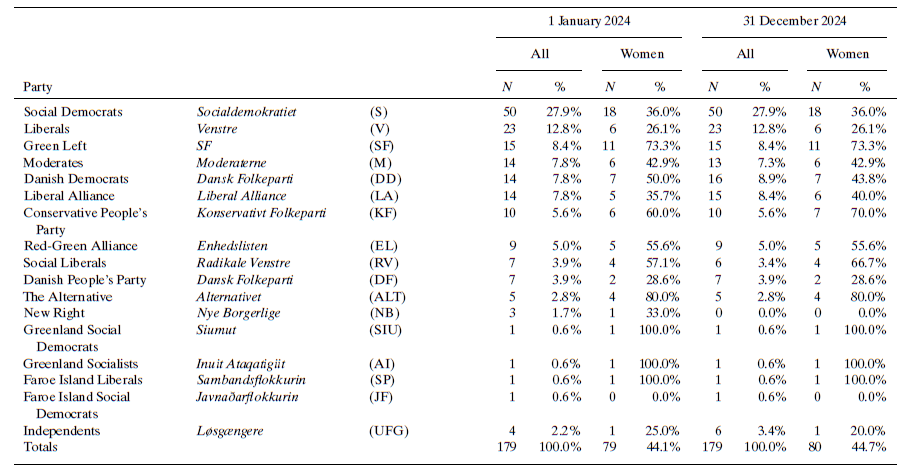
As a result of these seven replacements, the share of women in Parliament rose slightly (Table 3).

Note: This table is, like the Political Data Yearbook for 2023, based on all 179 seats in the Danish Parliament.
Source: Folketinget (2025b).
Some MPs shifted parties—one from the Liberals to the Danish Democrats, another from the Social Liberals to the Liberals, and the Danish Democrats also gained an independent (formerly New Right). Details can be found in Table 3.
By the end of 2024, six MPs sat as independents (Folketinget 2025c), all from newer parties. In addition to those having left their party in 2023 (Kosiara-Pedersen Reference Kosiara-Pedersen2023), New Right dissolved their parliamentary group in January 2024, and one of the co-founders of the Moderates left the party in disagreement with how work environment issues were handled by the party organization (Mauricio Reference Mauricio2024)—see Political Party Report. In addition to those six MPs, two former New Right MPs sat as independents from 2023 and January 2024 (for six days), but they eventually found new parties.
The Kingdom of Denmark consists of Denmark, Greenland, and the Faroe Islands. The latter two have their own Parliaments but also two seats each in the Parliament (Folketinget). These MPs often choose to stay out of any parliamentary business that does not concern their areas. Depending on the seat distribution, this may create different “internal” and “external” majorities. However, Greenland is increasingly on the (international) political agenda, with Greenlandic independence becoming more prominent for some people. Aki-Matilda Høegh-Dam, representing Siumut (Social Democrats), had made her mark in the Danish Parliament with a speech in Greenlandic in 2023 after which funding for translation services was made available. However, at the opening debate of 2024, she insisted on speaking Greenlandic without providing translation, prompting the parliamentary leadership to terminate the question-and-answer session (Folketinget 2025d).
Political party report
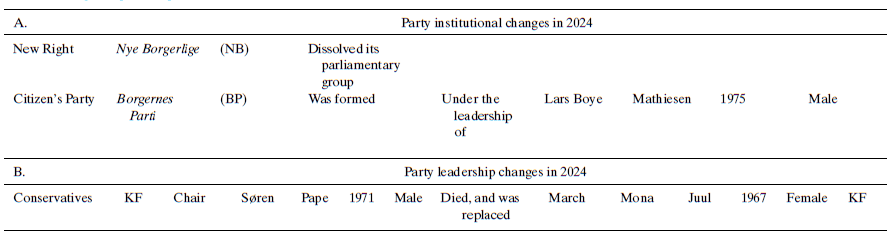
The Conservative party chair, Søren Pape Poulsen (male, 1971), died unexpectedly at a party event in March 2024. The Conservatives had been in an electoral crisis since 2023 (Skærbæk & Larsen Reference Skærbæk and Larsen2024), with no successor in place. The baton ended in the hands of the relatively inexperienced Mona Juul (female, 1967), who is a successful businesswoman and MP since 2019.
The New Right parliamentary group dissolved itself in January 2024 after much internal trouble in 2023 (Kosiara-Pedersen Reference Kosiara-Pedersen2023). Party founder Pernille Vermund moved to the Liberal Alliance. However, the membership chose to keep the organization afloat and, in April, elected Martin Henriksen, former MP from the Danish People's Party, as Party Chair. Without parliamentary representation, the party's eligibility to stand in the next election is contingent upon collecting voter declarations equivalent to 1/175 of eligible votes from the preceding election.
Having briefly chaired and subsequently been expelled from the New Right party in 2023, Lars Boye Mathiesen had, by the end of 2024, collected sufficient electoral signatures to be eligible to stand for election with his new party, the Citizens’ Party (Borgernes Parti). The Citizens’ Party's registration was formally approved in mid-January 2025.
While the Red-Green Alliance has not historically exhibited the same degree of fractionalization as other radical left parties (Bischoff & Kosiara-Pedersen Reference Bischoff, Kosiara-Pedersen, Escalona, Keith and March2023), the resurgence of the Israel–Palestine conflict ignited internal disagreement in the fall. According to the leadership, the internal fraction Red Left (Rødt Venstre) challenged intra-party decision-making procedures and cast doubts on the party's stance on human rights and opposition to DFLP's attack on Israel in October 2023 (Enhedslisten 2025). After an extraordinary annual meeting of the Red-Green Alliance in December 2024, Red Left was deemed detrimental to the party, and statute changes were made to facilitate expelling Red-Green Alliance members.
Changes in political parties are documented in Table 4.

Source: Garde-Strandberg and Hansen (Reference Garde-Strandberg and Hansen2024).
Institutional change report
No changes to the constitution, basic institutional framework, electoral law, or other major changes to the rules of the game occurred in 2024.
Issues in national politics
During the government formation process in 2022, one of the arguments for forming a cross-the-aisle new type of government was that there were major issues that needed to be handled with major reforms, and there would be more leeway for that with this kind of government majority. While little happened in 2023 (Kosiara-Pedersen Reference Kosiara-Pedersen2023), 2024 saw many political initiatives.
Not surprisingly, given the international situation, the defense agreement established in 2023 underwent revisions, with several new agreements struck in 2024 with the purpose of strengthening Danish defense and security. This involved a strengthening of both military capacities, conscription/military service, and human resources initiatives supporting a better working environment for military personnel. A major change in the conscription was increased number of targets and longer service, as well as the inclusion of women. While women previously had the option of voluntary military service, they will now be conscribed as their male counterparts.
After committee work involving various interest organizations, in November, the government made a “Green Tripartite” deal to support climate initiatives, in particular regarding agriculture. The main focus was on stopping the washing out of fertilizers in streams, rivers, and further into the sea, reducing emissions with a carbon tax, and growing and sustaining more forests. This was a major agreement that inflicted expenses on a profession and trade that had been seen as a major brand of Denmark over the years. Denmark's strong agricultural base is reflected in the significant export share of commodities such as butter and bacon, as well as the widespread presence of endless fields of cultivated land apparent during train travel.
In addition to these, the government also made deals or reforms on other issues such as policies on elderly people, disabled people, health, and education.
Turning to an overall assessment of the current state of the Danish economy, it was in a healthy state. In 2024, GDP had risen by 3.6 per cent, in particular, due to the industry output, where the pharmaceutical industry, particularly Novo Nordisk, plays a prominent role. The gross value added of this sector increased by 30 per cent (Danmarks Statistik 2025). The Finance Minister had, at several points in the governing period, encountered unexpected surpluses, allowing more leeway for governmental political initiatives.
In sum, while 2023 was a slow year in Danish politics, 2024 proved much more eventful, possibly warming up to some real drama in 2025.

 Open access

