

Introduction and background
Whether national genebanks should be treated, developed and funded as separate, independent, almost stand-alone entities or as components of a larger global system has been the undercurrent of work and policy debates for a half century. The related and more basic question facing these genebanks today is whether they are fit for purpose, either as isolated nation-centric facilities or as part of a greater global system.
In the modern era, collecting crop diversity for the purpose of introduction, research and/or breeding dates at least to the 1920s or perhaps the previous decade with N.I. Vavilov’s efforts in the Soviet Union. The U.S. established collections in the 1940s. As scientists began to realize that landraces were disappearing and as plant breeders became more interested in using them in improvement programmes, talk turned to collection and conservation and gravitated toward a global approach. In their classic Genetic Resources in Plants, Frankel and Bennett (Reference Frankel and Bennett1970) took note, advocating establishment of both an international genebank and regional genebanks if technical efficiency and ‘unrestricted international access’ could be guaranteed, twin concerns that are still with us.
Meeting in the 1960s and 70s, an FAO Panel of Experts conceptualized a system of base collections sited regionally for long-term conservation, and active ‘working’ collections to supply breeders (Pistorius Reference Pistorius1997). In 1972, the Stockholm Conference on the Environment called on countries to ‘organize and equip national or regional conservation centres’ for the conservation of ‘primitive varieties of traditional pre-scientific agriculture (recognized as genetic treasuries for plant improvement)’ (United Nations 1972), thus linking conservation, utilization and a system or network of genebanks, catalyzing a flurry of international activities.
In that same year, an international conference of experts in Beltsville, MD, proposed the creation of nine regional facilities in centres of diversity in addition to crop-specific facilities to accomplish the job of conserving the diversity of about 50 prioritized crops (CGIAR Technical Advisory Committee (TAC) 1972) (Ford-Lloyd and Jackson Reference Ford-Lloyd and Jackson1986). By the mid-1970s, there were about five long-term conservation facilities (Fowler and Hodgkin Reference Fowler and Hodgkin2004).
‘Conservation had to be carried out’, observed J.T. Williams, the first Executive Secretary of the International Board for Plant Genetic Resources ‘…and the board began the task of encouraging and assisting countries in the construction of genebanks to handle major crops’ (Williams Reference Williams1983) as the regional approach had proved ‘not wholly acceptable’ (Williams Reference Williams, Holden and Williams1984). By the mid-1980s, there were more than 50 long-term facilities holding more than 2 million accessions. About then an estimated 35% of stored accessions of 37 crops were unique. The rest were duplicates (Fowler and Cooper Reference Fowler and Cooper1998). By 1996, the number of genebanks (broadly defined) had grown to 1,308, including international (CGIAR), regional, national and other organizational facilities (Fowler and Cooper Reference Fowler and Cooper1998). Some 76 were counted as providing ‘long-term’ storage and they were holding 6.2 million accessions. During this period, the CGIAR was only collecting 1–5 thousand samples per year and yet total genebank accessions grew by 4 million (Fowler and Cooper, Reference Fowler and Cooper1998). At present, 137 countries now have genebanks. When the second FAO assessment was drafted in 2010, 7.4 million accessions were in genebanks, of which about 2 million were estimated to be unique (Fu Reference Fu2017). National genebanks held 6.6 million of these, with 45% being held in just seven countries (FAO 2010). In its chapter on Ex Situ Conservation, the third assessment published in 2025 notes the existence of 852 national genebanks in 116 countries and an accession count of 5.9 million in medium to long-term facilities, which the third report describes as a 9% increase over figures in the second (FAO 2025).
Fluid definitions and different reporting methods confound precise comparisons over the years, both about what constitutes a long-term genebank and how accession numbers are counted, but one thing is clear: the current number of genebank facilities far exceeds the proposal the Beltsville expert group made a half-century ago. What happened? Were they wrong? Had they drastically underestimated by hundreds the number of genebanks needed to conserve crop diversity or have we collectively – for non-scientific political reasons – veered away from what is necessary and needed?
Also clear is that the huge increase in the number of accessions now held by genebanks far exceeds the number of samples collected over the years. Indeed, with the arrival of the Convention on Biological Diversity (CBD) and the unfortunate notion that crop diversity is not a common heritage of mankind but instead is a matter of national sovereignty, collecting in the field by anyone other than a national of the country virtually came to a halt (Falcon and Fowler Reference Falcon and Fowler2002) and yet the number of samples held in genebanks continued to rise substantially. In a sense, genebanks have been collecting from each other – and especially from the CGIAR – for decades. This is the only explanation for the dramatic increase in total accessions held. Most of the increase in conserved accessions was of major crops, the diversity of which had already mostly been collected and conserved according to three estimates made between the mid-1980s and mid-1990s (Fowler and Hodgkin Reference Fowler and Hodgkin2004).
Though all national genebanks share some common features – for instance, none operate with a secure multi-year budget – there is great variability in size and operation. An early 2000s study found that the top 10% of genebanks were those holding 7,438 accessions, and the top 25% were those with 2,325 or more. This lower level was the approximate size of the Cameroon, Trinidad and Tobago and Libya collections. 75% of genebanks had fewer accessions than these (Fowler and Hodgkin Reference Fowler and Hodgkin2004). The following commentary will pertain particularly to the ‘bottom’ 90% of genebanks.
The conditions under which many of these national genebanks house collections are poor, and capacity is limited. Many would be incapable, for instance, of providing the data or implementing the ten metrics recently suggested as mandatory for good management (Van Hintum et al. Reference Van Hintum, Bartha, Niggli, Avagyan, Vogl, Achathaler, Holubec, Papouskova, Ferrari, Rossi and Simon2025).
In the mid-1990s, when the first comprehensive global assessment of the state of the world’s plant genetic resources was undertaken by FAO, many countries self-reported that they needed to regenerate more than half their entire collection (Fowler and Cooper Reference Fowler and Cooper1998). Some countries reported the need to regenerate 100% of their collections (Fowler and Cooper Reference Fowler and Cooper1998). Keep in mind that the need to multiply accessions is typically a reflection of the need for adequate seed stocks to supply user requests, whereas the need to regenerate is indicative of a decline in viability of samples. Given the longevity of samples – particularly of most widely held cereals which can be banked for hundreds or even thousands of years under proper storage conditions (Pritchard and Dickie Reference Pritchard, Dickie, Smith, Dickie, Linington, Pritchard and Probert2003) – high levels of regeneration usually indicate substandard conservation and almost surely the loss of genetic diversity (Fowler and Cooper Reference Fowler and Cooper1998).
Was the proliferation in the number of genebanks necessary to accomplish the conservation of collected samples? Of course not. Earlier, experts had proposed fewer than ten facilities to do the job. Certainly, the conservation function could have been discharged without almost all countries constructing genebanks in addition to having those of the CGIAR.
During my time overseeing the FAO process leading to the first Report on the State of the World’s Plant Genetic Resources for Food and Agriculture and its associated Global Plan of Action in the 1990s, as well as my tenure as Executive Director of the Global Crop Diversity Trust, I had occasion to visit many genebanks. A few brought smiles to my face, but more than a few did not. In the latter, I encountered collections held in stifling heat sometimes for many weeks due to equipment failure. I visited one genebank where staff had valiantly cannibalized equipment from two cold storage rooms to keep the third and last one operating. One country’s maize collection was kept in a pad-locked freezer. The key could not be found. I visited a genebank where accessions with fewer than 500 seeds were kept in boxes in the corridor because, according to the manager, more seeds were required to meet international standards for long-term conservation. (I suggested he move those boxes into the cold room quickly.) In another tropical country genebank, a seed dryer unit with its door opened was placed in the long-term storage room and turned on full blast to remove humidity when the cooling unit failed. As you might expect, it was incredibly hot in that room. I kept a file on my computer entitled ‘genebank horror stories’ to document the many ways that collections were being degraded and lost, mostly attributable to inadequate funding, poor equipment and lack of staffing, but also sadly, to lack of knowledge and mismanagement. There are hundreds of genebanks in the world. How many properly equipped facilities are there? And how many competent and qualified genebank managers do you suppose there are? Also hundreds?
If many, mostly smaller, national genebanks are falling short of fulfilling their role of conserving diversity, are they at least succeeding in providing access and promoting utilization. Here, the answer is even clearer – no.
Multiple factors limit availability and use. Regeneration needs have already been cited. One could add that many smaller genebanks have not screened their collections and lack characterization and other data that would potentially make their accessions attractive to users. They don’t have on-line databases that would even make their collections visible to potential users. They also lack the capacity to supply clean, healthy seed or planting materials in a timely fashion. And in most cases, the number of crops conserved far exceeds the number for which there are breeding programmes meaning that there is no domestic demand for much of the collection or for information about it.
The most serious impediment to international access and use, however, is political and purposeful. Historically, many developing countries have felt aggrieved by the South-North transfer of genetic resources – crop and medicinal in particular – which they perceived as enriching the North instead of or at the expense of the South (Fowler and Mooney, Reference Fowler and Mooney1996). They sought redress through the CBD and the International Treaty. The CBD asserted national sovereignty over biodiversity and took a distinctly bilateral approach to access and compensation. The International Treaty mandated access, but instead of having compensation directed to a country of origin, it took a collective approach; money would flow into a benefit-sharing fund to which proposals would be submitted. As one prominent negotiator famously put it, the countries receiving funds would use them to ‘buy whiskey’ if they felt like it. The Treaty was seen not just as a means for solving genetic resources problems but for addressing much larger development problems and long-standing inequities. This remains a heavier burden than the instrument of the Treaty can bear. And, with financial benefits to provider countries detached from their provision of access, there was no apparent self-interest in giving access other than for the common good. Resulting restrictions on access restricted benefits to everyone, fuelling tension, mistrust and frustration.
A sort of politicized arithmetic took over. Suppose your country sends five samples to another, and that country sends three to you. Most people will have just performed arithmetic in their minds. Do they add or subtract? In this example, if you gave five and got three in return, are you ‘down’ by two? Or realizing that you still have your five, do you realize you now have eight and are thus ‘up’ by three? The answer has long revealed political leanings, but not necessarily biological reality. For many countries, a zero-sum attitude prevailed.
In a 2013 article published in Genetic Resources and Crop Evolution (Bjørnstad et al. Reference Bjørnstad, Tekle and Göransson2013), plant scientist Åsmund Bjørnstad of the Norwegian University of Life Sciences reported that he requested a modest number of seed samples of landraces that originated or were collected within country from the 122 countries that were Contracting Parties to the International Treaty on Plant Genetic Resources for Food and Agriculture. As noted, under the terms of that Treaty to which all Parties are legally bound, ‘facilitated access’ is legally mandated. Professor Bjørnstad received seed from just 44. Fifty-four countries never bothered to respond. Bjørnstad concluded that facilitated access is ‘not straightforward’. Some countries, including major collection holders such as India and Ethiopia, are famous within the genetic resources community for not providing access. This issue has been raised bilaterally with both through diplomatic channels, with no results.
Given that the benefit-sharing (i.e., revenue-producing) provisions of the International Treaty are triggered by access through a Standard Material Transfer Agreement (which some Parties still don’t employ), failure to provide access completely eliminates benefits – both financial and those accruing from actual use in plant breeding. The predictable failure to meet expectations that the International Treaty might be a major funder for sorely under-funded national genebanks has, as just noted, led to multi-decadal tension and animosity within the Governing Body of the Treaty and to new ‘benefit-sharing’ proposals that potential users such as seed companies will find so onerous as to eliminate use even if heretofore recalcitrant genebanks started to provide access. If countries wish to restrict access, providing it only to domestic users, presumably, they cannot and should not expect international funding for such an exclusively domestic purpose. Countries have the prerogative of denying access, but not under international law if they are Parties to the Treaty.
Access is important for all countries and crops due to the high level of interdependence for genetic resources and the inability of any country to be totally self-provisioning for all needed breeding resources into the future (Palacios Reference Palacios1998; Khoury et al. Reference Khoury2016). Both developed and developing countries have made miscalculations in the Governing Body of the International Treaty. Developed countries have failed to appreciate how important food security is to the maintenance of peace and stability in the world and the positive role that genetic resources could play. Developing countries have consistently overestimated their leverage by overestimating the economic and marketplace value of the genetic resources they have and could potentially provide to developed countries. They have also underestimated the need their own agricultural systems will have for genetic resources from other non-compliant developing countries.
Besides ensuring that developing countries can obtain germplasm from other developing countries, there is one more reason for wanting the Treaty’s ‘facilitated access’ provision to work. It provides developing country genebanks with options. If long-term conservation is tenuous or impossible for budgetary reasons, accessions could be conserved by others at others’ cost with assurances that the providing country would have guaranteed access both under the terms of the Treaty and a separate agreement between the genebanks. This would enable countries (particularly under-resourced ones) to manage their collections rationally, efficiently and economically.
Denial of access is most deleterious in the case of minor indigenous crops – especially those predominantly of interest to developing countries. There are multiple reasons for this. Individual national collections of these crops are small and no country can aspire to launching a serious plant improvement programme based solely on its own small collection. There are a few plant breeders working on these crops; no country, for instance, has even a single breeder for each of the prioritized ‘opportunity crops’ promoted by the African Union, FAO, the U.S. State Department, IFAD, CGIAR and the African Orphan Crops Consortium (CIMMYT 2024). Sharing of genetic resources for such crops will be important for building nutrition security in Africa.
The climate is also changing, of course, and while much of the diversity of major crops may have already been collected, the diversity of the ‘opportunity crops’ and the small accession numbers scattered about in various genebanks may be insufficient to facilitate future adaptation tomorrow. Substantial diversity of such crops is still found on-farm and only on-farm, and often on a single farm, and thus is an endangered resource. This indicates not only the desirability of supporting certain on-farm efforts but a pressing need to collect and conserve such diversity before it is lost to agricultural modernization or replacement by new cultivars as it has been in the past (Harlan and Martini Reference Harlan and Martini1936; Harlan Reference Harlan1972, Reference Harlan1975). Replacement was the chief historic cause of genetic erosion as reported by countries to FAO in the 1990s (Fowler and Cooper Reference Fowler and Cooper1998). It also indicates a need – a necessity – to share this germplasm if conservation is to be robust and improvement work is to proceed with these crops. While such diversity is acknowledged and appreciated by the International Treaty, most of these crops and the diversity within them are not included in the Treaty’s Annex I, which lists crops for which ‘facilitated access’ is legally required. Countries’ antipathy to sharing germplasm, small collection sizes and lack of inclusion in Annex I will make it doubly difficult to assemble resources for breeding programmes in developing countries. Without such efforts, developing countries will fail to realize the opportunities and benefits these crops offer.
The debate within the Governing Body over access and benefit-sharing (as well as over the composition of Annex I) is in part fuelled by delegates who are employed within some of those poorly funded genetic resource programmes that do not provide access according to the Bjørnstad study. These individuals are not the problem, however. The problem lies in the aforementioned history dating to colonial times as well as in the structure of the existing international ‘system’ in which an unnecessarily large number of genebanks were established without a national or international plan for on-going budgetary support and without the wherewithal or commitment to getting accessions into the hands of users and thus providing a service that might be valued and supported by a national government or others. Goals and incentives were not and are still not aligned.
Meanwhile, in many smaller national genebanks, the number of crop species being held substantially exceeds the number for which there is an active in-country breeding programme (Fowler and Hodgkin Reference Fowler and Hodgkin2004). Conservation without use is a cost, not a benefit. Absent plans to start such a programme or to provide access, the genebank becomes a hospice with little hope for proper financing and operation. A more comprehensive assessment and critique of current ex situ conservation efforts than is appropriate here was offered by Engels and Ebert (Reference Engels and Ebert2021) and before that by Fowler and Hodgkin (Reference Fowler and Hodgkin2004).
There is a danger that the on-going debate in the Governing Body of the International Treaty may lead not to the desired funding for national genebanks but to further undesirable restrictions on access and indirectly to even less support for conservation and use. If most developing countries are unwilling to provide access under the Treaty’s current Standard Material Transfer Agreement, and if proposed revisions to it are considered even more onerous by potential users, one can only expect access from national genebanks to decline and further undermine any remaining arguments for financial support from international sources. This would be a tragic outcome.
Globally, there are several dozen reasonably well-functioning genebanks offering reliable long-term storage. Most of these are in the CGIAR system, in a handful of developed countries, and a few large developing countries. With some notable exceptions, these genebanks provide access, with the CGIAR accounting for the bulk under the International Treaty. This commentary has primarily focused on the numerous national genebanks that are smaller, and that arguably are not fit for purpose – either for reliable conservation or for access. For them, the system is not working.
Towards a global system for all
The elements of an effective global system – including national genebanks of all sizes and types – are in place but not completely functional. Here they are:
The International Treaty on Plant Genetic Resources for Food and Agriculture.
The Treaty contains sensible articles on conservation, information sharing, multilateral cooperation and promotion of use, as well as acknowledgement that access to PGRFA is itself a benefit. While the Treaty’s provisions cover all plant genetic resources for food and agriculture, there is a legally binding commitment for ‘facilitated access’ to a subset of some 35 crops and crop complexes (including several vegetatively propagated crops – it is not just a ‘seed treaty’) and 29 forages. There is, however, no functional enforcement mechanism, no uniform culture of adherence and no recent history of collaboration towards the common goals of the Treaty. It remains a framework and a forum, both of which are needed, but trust and common purpose will have to be built. They could be restored by resurrecting the 1996 Global Plan of Action agreed to by 150 countries. The original strategy at FAO was for:
1. The FAO Report on the State of the World’s Plant Genetic Resources to stand as the ‘problem statement’,
2. Implementation of the costed Global Plan of Action to be the solution, and
3. The International Treaty and its benefit-sharing mechanism are to be the structure and means for financing the Global Plan of Action.
In light of the last two lost decades of debate within the Governing Body, could anyone argue that sticking to the original strategy would have led to a worse outcome – poorer conservation, less access, reduced ‘benefits’?
The Global Crop Diversity Trust
The Governing Body of the International Treaty has recognized the Crop Trust as an ‘essential element’ of its own funding strategy. In collaboration with the Governing Body, the Crop Trust drafted and adopted a Fund Disbursement Strategy (Crop Trust 2009) to guide support generated sustainably by income from investments in its endowment fund. This strategy, still in force, draws heavily upon the first Global Plan of Action in which countries agreed to, as the Strategy notes:
…develop an ‘efficient goal-oriented, economically efficient and sustainable system of ex situ conservation’ and to ‘develop and strengthen cooperation among national programmes and international institutions to sustain ex situ collections’. This call is reiterated in the International Treaty, which requires Contracting Parties to ‘cooperate to promote the development of an efficient and sustainable system of ex situ conservation’ (Crop Trust 2009).
The Fund Disbursement Strategy paints a clear picture of what such a global system would resemble, and which national (or other) collections would receive funding from the Crop Trust for international, global system purposes as opposed to purely national objectives. Support would go to:
• conserve unique materials available under the terms of the International Treaty,
• collections effectively managed and distributed internationally, and
• facilities where it would be cost-effective to upgrade them and conserve the material at the standard offered by reference collections
Genebanks meeting those criteria are eligible for consideration for funding. Otherwise, the Crop Trust might consider helping genebanks safety duplicate their unique accessions in another facility offering storage conditions that meet international standards or in the Seed Vault or both.
While all genebanks, national and otherwise, large and small, need and want additional funding, it is clear that a rational, efficient, effective and economically sustainable global system cannot be supported through an entitlement programme in which any facility declaring itself a genebank can expect funding for conserving anything, regardless of whether the material is already conserved properly or more economically elsewhere. Genebanks that refuse to provide facilitated international access, of which there are many, may want or even demand international funding through the Crop Trust and/or the International Treaty, but acceding to this pressure will erode trust and seriously undermine the ability of the Treaty and Crop Trust to raise the funds those genebanks want. Ultimately, it’s a losing strategy.
The provision of long-term, essentially ‘in perpetuity’ grants by the Crop Trust to eligible genebanks facilitates long-term planning, rational use of resources and better conservation services, including development of information and data about accessions and provision of materials to users. This is a benefit to all, even those who are not direct recipients of funding.
The Crop Trust’s endowment, while significant, is insufficient to accomplish its mission fully. The endowment goal needs to be met. Much depends on the Crop Trust staying true to the blueprint outlined in its Fund Disbursement Strategy, which presents a vision for a rational, efficient and effective system, that is one that donors can embrace, and one that serves all interests. If it does, the Crop Trust offers the best value for money in securing crop diversity and advancing the goals of the International Treaty. By knitting together the different elements of a global system and financially supporting the essential and most cost-effective of these, the Crop Trust provides a high return on investment, much higher than unorganized, non-prioritized bilateral support or that given through the International Treaty’s politicized benefit-sharing programme, which could increase impact by adopting the framework of the Crop Trust’s Financial Disbursement Strategy.
In recent years, the Crop Trust has taken a creative approach to supporting conservation and promoting creative ways of putting more diversity into the hands of plant breeders as well as farmers. The Norwegian-funded BOLD project and its offspring, the BOLDER project which focuses primarily on non-staple ‘opportunity crops’, represent an effort to realize the benefits of crop diversity through provision of materials, experimentation and use on the farm by farmers.
The Svalbard Global Seed Vault
As of January 2026, the Seed Vault housed duplicate copies of 1,378,000 accessions representing 1,238 genera and 6,521 species. These came from 131 depositors. The Seed Vault provides this safety duplication service free of charge. Seeds remain the physical property of the depositor and can only be accessed by that depositor, which would typically occur when the depositor has lost its accessions.
If earlier estimates of the number of unique samples held by genebanks were correct within an order of magnitude, then it can be said that the Seed Vault holds the major portion of the existing ex situ-held crop diversity, certainly of the major crops. The possibility of storing duplicate copies of accessions in Svalbard is particularly important for the security of collections held by smaller genebanks, which are inordinately affected by budget cuts, equipment failures and other dangers. It is therefore a key component of the de facto global system for conserving plant genetic resources for food and agriculture.
Not all national genebanks have made use of this service despite the obvious benefits and despite the 1996 Global Plan of Action, the International Treaty and the FAO all calling for countries to safely duplicate their collections. In this regard, China, Ethiopia, India, Iran, Japan and Russia stand out. While there is no specific legal requirement that they duplicate their collections in Svalbard, their failure to do so undermines global conservation efforts upon which all nations depend and is inconsistent with the spirit of the International Treaty.
If these three elements – the International Treaty, the Crop Trust and the Seed Vault – function as intended, national genebanks of all sizes and of all means can be assured that unique germplasm will be safely and effectively conserved and freely available to all bona fide users. In hindsight, demanding more of the Treaty has stalled progress and undercut achievement of the Treaty’s most basic goals for 25 years.
The role and future of national genebanks
This still leaves one big question unaddressed. What is the role of the 90% of the world’s genebanks, including the dozens of smaller, poorly funded national genebanks that will not under any conceivable scenario receive the funding they would like to and would need to have from international mechanisms to operate at international standards?
Currently, many of these genebanks are objectively failing to meet both traditional goals of genebanks – conservation and promotion of utilization through provision of materials. A genebank that cannot meet international standards for conservation and yet refuses to share its materials with others who can or refuses to safely duplicate in Svalbard has created a threat to any unique germplasm it might hold. This in itself is not just a violation of the access provisions of the International Treaty but also of Article 5, which mandates that contracting parties ‘cooperate to promote the development of an efficient and sustainable system of ex situ conservation’ and that they ‘take steps to minimize or, if possible, eliminate threats to plant genetic resources for food and agriculture’.
While most attention is focused on the conservation function of national genebanks, it is important to realize that conservation without utilization can only be considered a luxury and a cost, not an economic benefit to the country paying the bills. When countries fail to underwrite even minimal genebank budgets, the lack of utilization of the collections and the lack of visible benefits must be an explanatory factor for this failure. In such a situation, no international purpose is being served and thus the onus logically falls on the national government to support this work. But why would it? This is the dilemma faced by many small national genebanks. Unless they can show value, a return on investment, they cannot make the argument for national funding.
The solution lies not in more decades of protracted Treaty negotiations and cajoling, but in reorienting such genebanks to focus less on dubious long-term conservation and more on use, particularly of those crop species important to the country’s farmers and to strengthening national food and nutrition security. This alternative model would turn these facilities into knowledge centres and hubs for distribution of appropriate germplasm directly to farmers for experimental purposes as well as to professional plant breeders. Genebanks might assess current constraints to production, acquire potentially useful germplasm from commercial sources and other genebanks, screen their own collections for useful material and send out accessions or small composite mixtures of landraces and commercial cultivars to farmers for their testing, selection, possible adaptation or introgression, saving and multiplication. Such a pivot might even attract international philanthropic and development funding.
This proposal makes several critical but not unreasonable assumptions, including that many farmers in developing countries are not currently being served by a seed system that can offer improved seed for all crops (particularly minor ones) and that infusions of diversity made properly could help address adaptation and production challenges.
There is precedent for this approach (Fowler Reference Fowler1994). The United States is a centre of origin/diversity of a few crops, and yet prior to the advent of modern plant breeding in the 20th century, rich and diverse farming systems spread westward from the Atlantic coast. Crops encountered myriad environments, climates and soil conditions. Through countless small experiments, farmers found which crops and which landraces, mixtures and varieties worked.
The raw material for these experiments came from casual introductions by immigrants, as well as enslaved people, but also significantly from the government itself. Through the U.S. Patent and Trademark Office, which viewed agriculture as an ‘inventive art’ and was the precursor to the U.S. Department of Agriculture, seeds and planting materials were collected in large quantities, brought to the U.S., multiplied and then sent out through the postal system to farmers. Booklets providing more information about each sample than a modern genebank often has were made available to farmers. Orders could be placed. But, absent an order, farmers got free seeds anyway. Seeds were mailed directly to them. Additionally, postmasters received boxes and were asked to distribute the packets to the best farmers. Packets were also distributed through farming ‘societies’ founded to promote agriculture.
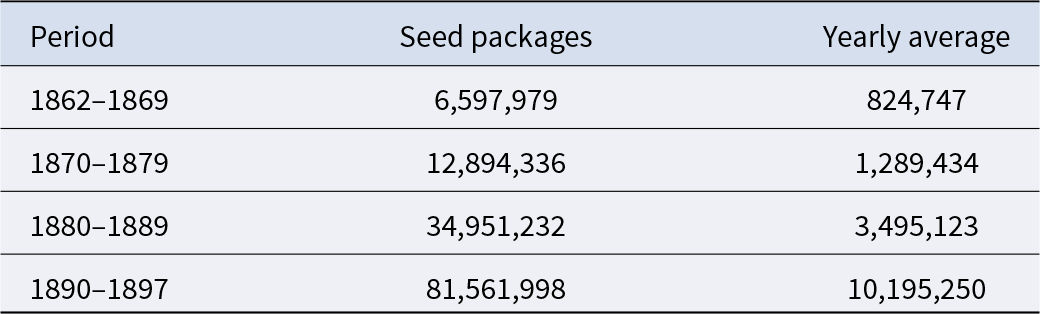
At the height of this ‘free seed’ programme, millions of seed packets were being distributed, as shown in Table 1.
Seed Distribution by U.S. Government (Klose Reference Klose1950; Fowler Reference Fowler1994)

Table 1 Long description
The table reports U.S. government seed distribution by multi-year period, listing total seed packages distributed and the average number distributed per year. In 1862–1869, about 6,597,979 packages were distributed, averaging about 824,747 per year. In 1870–1879, totals increased to about 12,894,336, averaging about 1,289,434 per year. In 1880–1889, distribution rose further to about 34,951,232, averaging about 3,495,123 per year. The highest values occur in 1890–1897, with about 81,561,998 packages and an average of about 10,195,250 per year. Overall, both totals and yearly averages increase each period, indicating rapid growth over time. Period lengths differ, so comparisons should rely mainly on the yearly averages rather than totals.
The programme, established prior to there even being a Department of Agriculture, distributed seed of many different crops – staple grains, legumes, vegetables and even planting material of some non-seed crops. Because each package contained multiple seed packets, the actual number of samples distributed was much higher than the numbers above indicate. The seed packets contained only a small amount of seed, enough for the farmer to trial but not enough to plant a field or do harm if the experiment failed. As the Commissioner of Patents noted in 1854, by distributing small rather than large packages of seeds:
The opportunity of experimenting can be placed within the reach of several hundred times as many persons than would be if distributed by the bushel. A small amount will, in most instances, test the adaptation of the grain to any particular soil and climate as effectually as would be done in a larger quantity (Mason Reference Mason1855).
Farmers experimented and saved seed of anything they liked for replanting. They became seed sources for neighbours. Some early commercial seed companies had their start this way.
The U.S. government was effectively distributing diversity and giving farmers the means for selection and adaptation. At the same time, the flourishing agricultural press was providing encouragement and advice about seed selection/breeding and saving. All these efforts amounted to one of the largest agricultural experiments, tests and development programmes in history. The USDA Bureau of Plant Industry estimated that the total value of annual production (early 1900s) derived from some of the individual introductions was in the tens of millions of dollars, with nominal collection/acquisition costs (Galloway Reference Galloway1912).
While the programme was undertaken in those days by a relatively prosperous country, it was still the pre-Mendel 1800s. It was not initiated with a particularly large budget or infrastructure. Indeed, at one point, the official charged with overseeing it, the Commissioner of Patents, had to step in. He later sought reimbursement for the personal funds he had expended to finance the programme (Fowler Reference Fowler1994). It did benefit, however, from an agricultural press, from agricultural societies, from the national desire for territorial expansion on the continent and thus for adapted crops, and from the intangible enthusiasm for experimentation and adaptation amongst farmers.
Today, our ‘global system’ for the conservation and use of plant genetic resources lacks a realistic and compelling strategy for how most genebanks – particularly those in smaller developing countries – can contribute significantly and sustainably to agricultural development.
Would an updated, more sophisticated system of diversity distribution than that employed in the U.S. almost 2 hundred years ago work today, particularly in those places and for those crops for which there is currently inadequate formal sector or commercial involvement? Given the easy scalability of such an effort, would it be feasible today for a developing country to start small and try such a strategy? Theoretically, more diversity could be assembled and screened for appropriateness today than in the U.S. of the 1800s. Could national genebanks – principally those in developing countries with underdeveloped seed systems – coordinate this process and get seeds and planting materials to their farmers at scale? Could larger national genebanks and CGIAR Centers assist in modelling which accessions might provide useful adaptive traits and supplying that germplasm to these repurposed national genebanks? Would farmers again embrace experimentation?
Absent a system for crop improvement – particularly of non-staple crops – farmers in a rapidly climate-changing world – in Africa, for instance – will be left with only the diversity they have in their fields today without recourse to that in their or other national genebanks. This is hardly ideal. If agriculture is to adapt to climate change, how we manage plant genetic resources must change.
For some, the ideal world might be one in which every country has a world-class genebank and plenty of money for multiplication and regeneration and for research and development of improved varieties. That ideal is debatable. What isn’t debatable is whether the instrument of the Treaty or funding from the private sector or voluntary contributions from developed countries can bear such a burden and the billions it would cost. It can’t. They can’t.
From both a conservation and utilization perspective, an achievable ideal world would be one in which:
• The International Treaty is functioning properly: countries are collaborating to collect, conserve and manage the totality of crop diversity in a cost-efficient and effective manner, are providing facilitated access to germplasm, and are promoting its use, all of which they have formally agreed to do on multiple occasions. As the Treaty covers all of plant genetic resources for food and agriculture, its access provisions should not be limited to a subset. The Treaty would have a non-political mechanism for funding high-priority elements of an efficient global system along the lines elaborated in the Global Plan of Action.
• The Global Crop Diversity Trust has sufficient resources to cover on-going conservation costs for the international community in a rational manner for unique germplasm and the organization plays a vital role in knitting together a workable global system as envisaged in some detail in the Crop Trust’s Fund Disbursement Strategy endorsed by the Governing Body of the International Treaty (Crop Trust 2009).
• The Svalbard Global Seed Vault continues to provide free safety back-up services; it effectively puts an end to the loss of genebank accessions.
In this world – which with political will, foresight and alacrity is within grasp – countries could rationalize and protect collections through collaborative arrangements, save money and turn their attention and resources to utilization and to serving farmers across the broad spectrum of crops that a healthy agricultural system requires.
To accomplish this, the Treaty’s Governing Body will need to restrict its ambitions to securing the financial resources necessary for implementing genetic resource programmes for the common global good and in a manner that is efficient and effective – in essence to achieving the vision set out by the Treaty itself, the Global Plan of Action and the Fund Disbursement Strategy of the Crop Trust. This is ambitious enough. Why would countries want or realistically expect more especially when aiming for more has accomplished so little for so long and with such collateral damage to both conservation and utilization?
The transition suggested here would be facilitated by increasing flows of financial resources into the Treaty’s benefit-sharing fund, which will occur naturally as access is increased and more of the materials in the multilateral system are used. Alternatively, entirely different funding mechanisms not linked to access could be considered. But there should be no illusions – the Treaty must be judged on what it accomplishes with plant genetic resources and the benefits that accrue to agricultural systems and farmers, not on the basis of budgets, arbitrary funding levels and such expectations. The transition would get off to a good start by having the International Treaty prioritize development of a rational global system, including, very importantly, providing support for smaller national genebanks, making a rational, value-added shift to focusing on use.
If the Treaty cannot move to resolve the issues that have long bedevilled it, the Treaty will ultimately collapse. It will be every country for itself. Everyone will lose. In the inimitable words of Ambassador Fernando Gerbasi who chaired the negotiations for the Treaty in the 1990s, it will be ‘jungle time’ (FAO 2007). There must be a better way.
Given all the changes that have taken place in the last 50 years, and in light of our experience with conservation, access and finances, it is time for genebanks as well as for the Governing Body of the International Treaty to reexamine their purposes and adjust their policies and activities accordingly. A better and increasingly interdependent world awaits.

 Open access

