

As the bicentennial celebrations for independence in 2021 neared, the president of Mexico requested an apology from the King of Spain, Phillip VI, citing the sixteenth-century abuses committed against the indigenous populations during the conquest of Mexico.Footnote 1 The Spanish government summarily rejected the idea, leading to a pause in diplomatic relations between the two countries at the time.Footnote 2 Yet, the impasse did not stop the president of Venezuela from joining-in the effort and creating a national commission to unearth the “truth about European colonialism” and seek justice and economic reparations.Footnote 3
At the core of both cases is the idea that the 300-year colonial experience in Spanish America – roughly from the sixteenth to the nineteenth century – is somewhat responsible for current inequities and lagging economic performance in the region.Footnote 4 Particularly salient are the onerous fiscal demands; the trade restrictive policies; the vast mineral extraction; and the creation of racial hierarchies, to name a few. Clearly, this explanation still resonates with voters, as shown by Pedro Castillo’s presidency, aimed to redress the “deep Peru” from centuries of neglect. It is also reflected in the people’s anger in Chile,Footnote 5 where more than 400 public monuments associated with its colonial past were destroyed during the massive protests of 2019–2020. But how can this be the case?
After all, until very recently, the economic fortunes of the colonizer (Spain) and the colonized were not very different. In 1960, Mexico and Spain had practically the same GDP per capita, both below that of Chile in the same year.Footnote 6 Yet today Spain’s GDP per capita doubles that of Chile and triples that of Mexico. Is this divergence even attributable to colonialism? Unlike more recent cases of decolonization in Africa and Asia, most Spanish American countries have ruled themselves for more than 200 years now – certainly enough time to scrape and reverse the most noxious colonial policies – why would they still matter?
While some legacies of Spanish rule are clear and indisputable – language, architecture, religion, and cultural traits – others are less so. Particularly at the local level – at or below the level of current municipalitiesFootnote 7 – it is unclear that colonial policies 200 years ago can help explain today’s variation in the distribution and quality of public services and infrastructure, ethnic and authoritarian enclaves, or overall differences in governance, for example. This book shows a way in which it does – once we factor-in the administrative organization and personnel policies of the Spanish Empire.
Unlike other colonial Empires in the Americas – Portuguese, British, French, or Dutch – the Spanish one was by far the largest and most sophisticated one as of 1700 (Burkholder Reference Acemoglu, García-Jimeno and Robinson2018).Footnote 8 It also had large distributional consequences where in place: Administrative decisions determined the trade monopoly rights of certain ports; the tax-rates to be levied across its territories; the political status of cities and provinces within the administrative hierarchy; as well as the legal standing of indigenous communities. All of which came both with political rights, fiscal obligations, and economic opportunities.Footnote 9
Yet, this highly developed administrative apparatus came with a cost: As areas at the core of the Empire became more exposed to Spanish administrative pathologies. Namely, to the eighteenth century practice of office-selling – the exchange of colonial offices for money – and to its noxious consequences in the short and long run. It is not coincidental that where more intensely practiced, office-selling and its ensuing venality led to a host of local-level distortions today: ethnic segregation, authoritarian enclaves, limited representation, and recurrent violent conflict, factors that underpin the region’s spatial inequalities.
Indeed, this book shows that rule by certain types of colonial officials – venal ones – led to differences in local governance at the time, even among otherwise similar areas. Because postcolonial states only partially erased these differences (if at all), these early administrative roots contributed to glaring regional inequalities today. As any observer can attest, Spanish America exhibits the whole gamut of development: Cities and municipalities with living standards of high-income countries coexisting with areas where the population lives in abject poverty. While frequently attributed to general “historical reasons,” this book is an in-depth study of which and how they got us here.
In a sense, the answers here vindicate the Presidents of Mexico and Venezuela’s claims of abuses suffered the indigenous population in colonial times. Yet, it also shows that the most enduring, intractable, and economically costly legacies of colonialism are often the ones less publicly discussed – the economic geography inherited, the limits to political representation, or the unequal provision of public goods. Legacies these presidents have not erased, even from their positions of power.
However, to understand the role played by the particular Spanish administrative organization and its policies, one must go back to the late seventeenth century. A time of institutional consolidation and projection of royal power as the challenges from settlers and fears of demographic collapse in the Americas start to recede.
1.1 Office-Selling in Spanish America
The starting point of this book is the 1670 decision by the King of Spain, Charles II, to systematically sell high-ranking government positions in its American Empire. This decision was unprecedented in that it drastically expanded the set of offices normally sold by the Crown. Since at least the reign of Phillip II (1556–98), the Spanish Crown had only sold minor posts that carried no judicial or executive powers such as seats in local councils (regidores), notary posts, or municipal ensigns. Charles’ decision opened up the most important positions in the colonial government – in charge of ruling the local population, administering justice, and collecting taxes – for purchase.
The main justification for sales was the need for revenue due to Spain’s military conflicts.Footnote 10 In fact, in 1670, the Crown had just lost the War of Devolution and was about to enter the six-year Franco-Dutch War. Fifty-one of the following eighty years would be spent in one conflict or another, a drain to the royal coffers. The lack of funds was so dire that at the time of Charles’ II death in 1700, the royal household did not have enough money to pay for his funeral (Swart Reference Swart1949: 38). Yet, unlike liquidity crises of the previous centuries, the Crown was much more reluctant to contract foreign debt to meet its needs, even under favorable loan conditions (i.e., interest rates). Instead, it relied on more ad hoc remedies such as office-selling.Footnote 11 Sales would remain officially in place throughout the next eighty years: The last thirty years of the Habsburgs’ reign and the first fifty years of the Bourbon reign (until 1751), albeit with some interruptions.
Key to the durability of office-selling was its success in raising revenue for the Crown due to the ample supply of offices in Spanish America and the high demand for them. As the most extensive and administratively sophisticated bureaucracy in the Americas (Burkholder Reference Acemoglu, García-Jimeno and Robinson2018, xvi), it had a large number of positions potentially for sale each year. The offices sold also carried high political, economic, and social values at the time, which, together with the vast distances and communication challenges within the empire – effectively decentralizing governance – meant that officials were de facto autonomous and faced minimal oversight. Demand for certain offices was so high that individuals even bought them decades in advance (futuras), which they then used as financial instruments or to settle debts in the secondary market – a true testament of its value.
A second factor behind the longevity of office-selling was that the seller (the Crown) did not fully internalize the negative consequences caused by the sales, therefore making them more prevalent than optimal. Although the Crown openly worried about the suitability and motivation of many of the purchasers, it could pass through many of its costly consequences to the colonial population while still reaping the benefits, at least in the short term. For example, if unsuitable officials caused discontent and rebellions overseas, the local treasury and population bore the cost of squashing the uprising, not directly the Crown. It also viewed office-selling as a way for the colonies to bear some of the enormous expenses needed to defend them from foreign attacks. Thereby justifying them.Footnote 12
In all, the ample supply, high demand, and relatively few (short-term) consequences made office-selling an attractive way for the Crown to smooth its consumption when money ran out.
Sales would only end in 1751, a time of more balanced budgets and peace in Spain. Yet, by then, more than 2,600 positions had been sold throughout the Empire: primarily provincialFootnote 13 ruling positions (corregimientos and alcaldías mayoresFootnote 14) but also seats in the top judicial governing councils (audiencias) in the Americas, treasury posts (cajas), and key military-governor positions in strategic areas (gobernaciones). Moreover, despite officially stopping, many purchasers would remain in their posts for years (and decades) to come – until the backlog of sold appointments cleared or those with lifetime appointments perished.
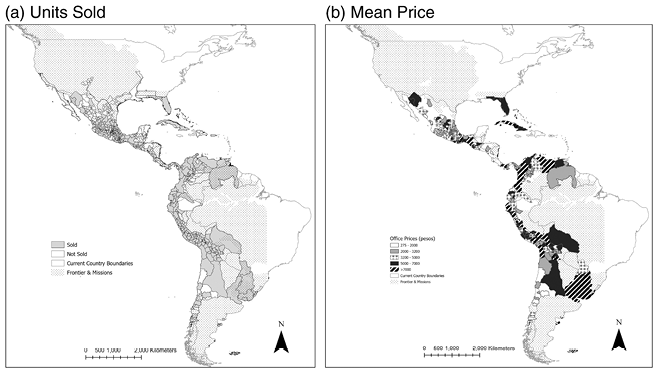
To illustrate the geographic dimension of office-selling at the time, Figure 1.1 maps the territorial organization of two administrative layers of the Empire as of 1700: that of gobernaciones together with that of corregimientos and alcaldías mayores. Panel (a) presents the jurisdictional borders of these units and whether sold between 1670 and 1751, while panel (b) displays the average prices they fetched throughout the period under study.
The first notable feature of Figure 1.1 is the vast territorial extension of the Spanish Empire ca. 1700. Counting frontier territories (fronteras) – areas nominally in the Empire but not yet conquered and directly ruled by the Crown – it extended from Alaska to Patagonia. But even if only considering the territory ruled directly by royal officials (solid lines in panel a), it still encompassed parts of what today is the United States (La Florida, Alta California, and Nuevo México to central Chile – north of the Biobío river.

Figure 1.1 Gobiernos, corregimientos, and alcaldías mayores sold (1670–1751).
The second significant feature is the geographic reach of office-selling: from north Mexico to southern Chile, the sale of corregimientos, alcaldías, and gobernaciones touched every corner of the areas directly administered by the Crown. Very few units would be spared, mainly those sparsely populated or with high geopolitical value to the Crown along coastal areas and frontiers.
In terms of prices, panel (b) depicts the high degree of variation in the monetary value positions fetched over time. With prices determined by their type and (or) location. On average, a buyer of a corregimiento or alcladia mayor position paid to the Crown around 4,000 pesos de a ocho, equivalent to 16,000 days of labor (forty-four years) at the daily wage an indigenous person received at the time (two reales),Footnote 15 a non-negligible amount.Footnote 16 Yet, many positions actually exceeded the average. As shown, the price paid to serve as Gobernador of Buenos Aires, Cartagena, or Havana was well above 7,000 pesos. This was also the case of some corregimientos in Peru and Bolivia and some alcaldías in Mexico and Guatemala. Elsewhere, such as the current territories of Ecuador, Colombia, and Chile, prices were not as exorbitant but still sizeable.
The policy of office-selling – its origin, functioning, and ultimately its consequences – is the subject of this book. What motivated individuals to purchase these officials? What was the logic of the Crown to engage in sales? How did this policy affect the governance of the Spanish Empire? More importantly, how did it contribute to the quality of local governance and spatial economic inequality observed in the region today? Through the analysis of individual buyers’ traits and provincial administrative records spanning three centuries, I trace the local consequences of this practice in Spanish America. But first, why would this policy “matter” in the first place?
1.2 Does Office-Selling Lead to Venality?
In principle, exchanging appointments for money need not lead to any tangible changes in the quality, incentives, and performance of the Spanish colonial officials in the Americas. In fact, compared to other forms of appointing officials at the time, such as those by “favorites”, office-selling was superior according to Montesquieu, a contemporaneous of the practice in France (Montesquieu [1748] Reference Montesquieu2001). Similarly, for Jeremy Bentham, also familiar with it, officials who purchased their positions would take better care of them, provided they were compensated with salaries (and not fees).Footnote 17 If anything, office-selling represented a more “modern” notion of merit, not bounded by the idea that the nobility were the most deserving class to hold offices. Rather privileging more instrumental and utilitarian views of public administration (Rosenmüller Reference Rosenmüller2016).
Even recent works find that the exchange of appointments for money need not be socially inefficient, particularly in two scenarios (see Weaver Reference Weaver2021; Banerjee et al. Reference Banerjee, Hanna, Mullainathan, Gibbons and Roberts2013). The first case is if there are few (if any) opportunities for self-dealing – and the office in question has a fixed wage, in-line with Bentham (Reference Bentham1825). The second case is if the ability to pay for the position (wealth) is correlated with desirable traits to perform in office, such as ability or education. For example, in nineteenth-century Qing-China, there were little differences among individuals who entered office via purchase or via examination (Zhang Reference Zhang2013). In these circumstances, the exchange of money for appointments may not lead to worse performance than usual.
Yet, these conditions were exactly the opposite in Spanish America. First, positions often had high profit potential, allowing for greater appropriation of economic surplus from the population. Historians estimate that a provincial position of corregidor or alcalde could net between 60,000 and 150,000 pesos, depending on the ability of the official in question. Second, unlike nineteenth-century China, where purchasers and nonpurchasers did not differ significantly, I show that office-buyers in Spanish America had lower social status and career connections to the Crown than those who were appointed. Therefore, less in need to maintain the Crown’s favor, perform in office and/or limit their appropriation of economic surplus. This is not to say that officials prior to sales were paragons of good governance. Rather, that the introduction of office-selling worsened existing structural weakness and increased opportunities for self-dealing at the time.
Evidence of the change in the quality of the colonial administration comes from various sources. Already in the 1740s the Crown was aware of a scathing report on the state of the colonies, known as the Secret News (noticias secretas). In them, two undercover Spanish officials described the colonial government as rife with “abuses, excesses, graft, corruption, mismanagement, and cruelty,” a view the authors gathered from their years long undercover mission throughout what is now Ecuador and Peru (Juan and Ulloa Reference Juan, de Ulloa and John1978 [1749]: 25). While the report is not limited to colonial officials – it also decries the activities of landowners, priests, and social elites – the report singled out the role of office-selling in undermining the colonial administration.
The exploitative practices of these corregidores and alcaldes continued even after office-selling ended in 1751. Letters from the Bishop of Arequipa (southern Peru) to the King in the 1770s decried exactly the same abuses as those in the noticias secretas thirty years earlier. Similar worries appear in high-level correspondence between the Crown and royal inspectors of what is now Mexico (José de Gálvez) and Peru (José Antonio Areche). This correspondence revolved around the extreme concern over the extent of graft and exploitation in the colonial administration, which endangered the Crown’s hold of this territory.Footnote 18 Finally, anonymous documents circulating in the 1770s highlight many of the same practices that made purchasing offices attractive decades earlier as seen in its strong correlation with office prices (see Chapter 2).Footnote 19 Parallel to this high-level discussion, there was also visible discontent among the population, evident from the proliferation of pasquines, a form of anonymous satirical political manifestos, in which the public spoke frequently of the prevailing corruption among colonial officials.
The deterioration in the colonial administration is also visible quantitatively. Analysis of a wealth of primary data collected from archival sources reveals that office-selling led to a drastic reduction in the traits associated with good governance. In particular, it led to an influx of “unconnected” officials by social status or profession to serve in the most productive and profitable positions across the Empire. Prior to 1670, appointments were limited to those of a particular social background, namely, those of aristocratic origin and connected to the Crown. With sales, a more diverse set of aspirants – outside the classes connected to the Crown by social origin (nobility) or in their career prospects (military) – entered the colonial administration. Being outside of the closest circles of the Crown did not mean they were inherently dishonest. Yet, it did mean that their performance in office would be less constrained by social and reputational costs than if their careers or fortune depended on the Crown’s favor.
Second, in addition to bringing about a new class of socially unconnected officials, sales made it easier for them to enter the positions that most favored their skills and connections for profit (sorting). For example, those with merchant connections could bid for positions overseeing ports – and benefit from contraband – or bid for positions that could sell goods to the indigenous population. Before office-selling, interested candidates would have to wait for their desired position to vacate, make sure no one else was vying for the post, and hope the Crown indeed favored them (and no one else). Buying a specific position ensured that positions would better match buyers’ skills, interests, and networks.
Finally, office-selling also changed the incentives of individuals to profit from their position. This was the chief concern of many jurists and advisors to the King, such as the Council of Indies, who openly worried that the exchange of positions for money was akin to sanctioning profiteering from office. The transactional nature of these appointments also made it more difficult to dismiss or remove officials, even in the face of known malfeasance, because it would require refunding their purchase money, which a cash-strapped Crown was always reluctant to do.Footnote 20
In sum, this class of officials – bent on recouping their investment, unconstrained by social or reputation costs, undeterred by potential sanctions, and selectively occupying positions that best maximize their profits – epitomizes what I call venality in the colonial administration. While office-selling per se was not corruption at the time, and need not lead to “worse” officials, in Spanish America it did. What started as a policy to raise revenue in Madrid had turned into venality in the Americas.
1.3 The Consequences of Venality
What were the consequences of this new class of officials? The most visible one was the increase in the number of uprisings targeting colonial authorities, particularly where office-selling had been more intense. The frequency and intensity of these rebellions effectively spelled the end of the last 200 years of Pax Hispannica in the Americas. While the immediate causes of rebellion always varied,Footnote 21 uprisings were more likely precisely where venal officials ruled: Fuses were shorter and responses more violent in these locations vis-à-vis others. For example, Chapter 6 shows that historical exposure to venality exacerbated subsistence crises created by drought or El Niño/a weather patterns throughout the eighteenth century in Mexico, Peru, and Bolivia.
In addition to violent uprisings, more venal officials exacerbated the displacement of the indigenous populations away from majority-Spanish and mestizoFootnote 22 settlements, changing the economic geography in the region. Already in the 1770s, the displacement of the indigenous population away from areas they had previously inhabited is evident, particularly where venality was stronger. The political and economic consequences of this segregation will be wide-ranging: from hindering state formation by exacerbating regional heterogeneity,Footnote 23 to limiting market access and political representation for indigenous populations, to worsening spatial inequality today.
Attempts to reform the administration, such as stopping the sale of offices in 1751, had limited effects at the local level. By then, practices over the previous eighty years – such as overtaxing, labor coercion, and surplus appropriation – were entrenched. In some cases, these practices actually became law. For example, the reviled repartimientoFootnote 24 – a commercial monopoly managed by colonial officials – reached its peak as an illicit (but profitable) activity during the office-selling period, but was eventually legalized due to its effectiveness in procuring revenue for officials and merchants alike. In other cases, networks of interests helped keep these activities in place, particularly in the absence of wage increases, clear career paths as well as “venal” holdovers in other parts of the administration. Finally, the news of large profits developed in the last decades continued to help appointees sort into the positions that best matched their thirst for riches.
The dire situation led to a series of administrative reforms from the 1780s onward – known as the Bourbon Reforms – to improve governance in the colonies, particularly in the fiscal realm. Despite increasing overall tax collection (Chiovelli et al. Reference Chiovelli, Fergusson, Martínez, Torres and Caicedo2024), the reforms could not undo the local practices associated with the previous period. For example, at the level of corregimientos and alcaldías, they renamed the officials and units into subdelegaciones without changing many of the underlying incentives of those responsible for collecting taxes and administrating justice.Footnote 25 In other cases (i.e., Guatemala, Ecuador), the reforms were never implemented and alcaldes and corregidores continued to be appointed from Madrid until the nineteenth century.
With independence in the first quarter of the nineteenth century, the new states proved unable or unwilling to abolish many of the existing colonial policies. To start, the roughly first fifty years of independent life were spent in conflict over the organization of the new states such that few (if any) policies were consistently pursued. Moreover, even after the conflict ended, nominally “liberal” governments came to rely on the same policy instruments and practices of the regime they were supposedly vanquishing (colonial), particularly in territories with a stronger venal administration. Examples include the continuation of colonial taxes and labor coercion practices in Bolivia, Ecuador, and Guatemala; the further spatial segregation of the indigenous population in almost all countries; and the delayed formation of new politically representative bodies (municipios) in countries such as Peru and Mexico. Even though colonial officials had been long gone, the economic geography, labor and fiscal policies, and political underrepresentation they left behind remained.
Today, provinces that saw their governance particularly deteriorate in the eighteenth century exhibit lower living standards in the form of childhood stunting and low birthweight. In Mexico, areas with high colonial venality are also more likely to serve as enclaves of subnational authoritarianism. Across Peru, Bolivia, Guatemala, and Mexico, indigenous geographic segregation has not only remained but also in some cases worsened from its nineteenth-century version. Finally, across all countries, areas with a venal past exhibit lower provision of public goods in the form of schools and basic public services. These differences are visible even among areas that are similar in every other aspect but were part of different colonial jurisdictions in the past.
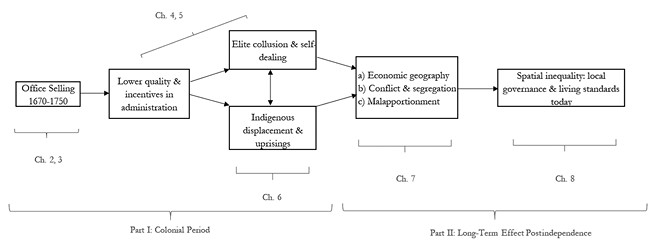
Figure 1.2 visually summarizes this chain of events: from a late seventeenth-century policy to supplement expenses in Madrid to current spatial inequalities in Spanish America. In the short term, office-selling – combined with the preexisting jurisdictions and local characteristics – undermined local governance in two ways. First, by facilitating elite collusion across administrative layers and, second, by reducing indigenous economic surplus – leading to more uprisings and displacement. These changes to the economic geography, propensity to conflict, and political representation in colonial times then persisted until today through a combination of political (malapportionment) and economic mechanisms (regional heterogeneity), to name a few.
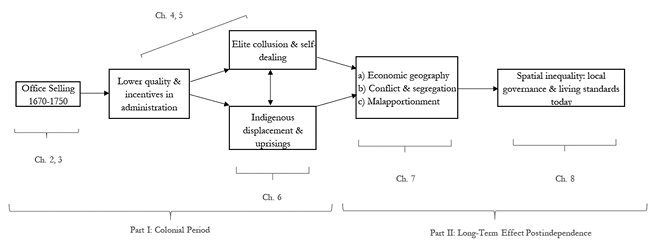
Figure 1.2 The short- and long-run effects of office-selling
1.4 Alternative Explanations
The main alternative accounts to explain local differences in governance are that they are instead the result of more recent events – or that even if colonial, unrelated to administrative venality. For example, the nineteenth century is often regarded as the critical juncture that shaped the state-building trajectories of former Spanish American countries (e.g., Centeno Reference Centeno2002; López-Alves Reference López-Alves2000; Soifer Reference Soifer2016; Saylor Reference Saylor2014; Kurtz Reference Kurtz2013; Mazzuca Reference Mazzuca2021). It is also possible that these differences instead emerged from the region’s transition to democracy in the late twentieth century. For example, subnational inequalities may arise due to the level of subnational political competition (Alves Reference Alves2015; Chibber and Nooruddin Reference Chhibber and Nooruddin2004), civic engagement (Cleary Reference Cleary2007), and national-level technocratic autonomy (Otero-Bahamón Reference Otero-Bahamón2016), to name a few.
Moreover, even if these patterns do have colonial origins, they need not be attributed to more or less exposure to venality. They could instead reflect the production conditions colonizers encountered upon their arrival, such as the disease environment, population levels, or factor endowments (mineral or agricultural), which in turn influenced existing institutions and the prevailing political economy (Acemoglu, Johnson, and Robinson Reference Acemoglu, Johnson and Robinson2001, Reference Acemoglu, Johnson and Robinson2002; Engerman and Sokoloff Reference Engerman, Sokoloff and Haber1997; Mahoney Reference Mahoney2010). I discuss each possibility in turn.
1.4.1 Postindependence Divergence?
The period immediately after independence in the nineteenth centuryFootnote 26 is often seen as formative for the long-term economic and political trajectories of Spanish American countries. As the time of the first truly national and independent state-building projects across the region, its success (or failure) was key to unleashing economic growth and political stability among these new states.
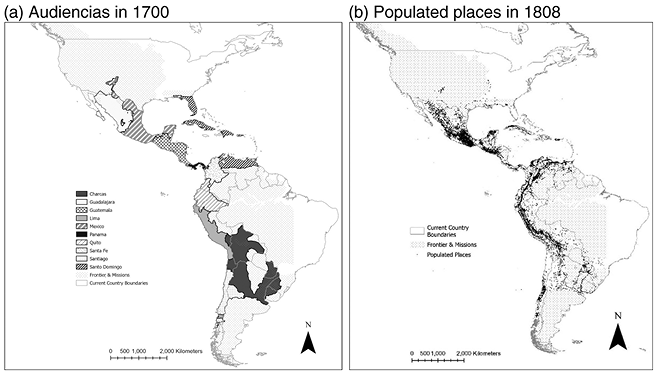
Certainly, the postindependence period was one of change. Viceroys fled, colonial audiencias dissolved, and wars against Spain were fought and won. New national borders were drawn (sometimes more than once), and new institutions, foundational myths, and heroes emerged, replacing the old colonial regime. From a pure territorial perspective, the Spanish colonial organization seems inconsequential relative to the new configurations that emerged. For example, the system of audiencias depicted in panel (a) of Figure 1.3 only vaguely resembles the country borders we observe today. Some countries rose from fragmented audiencias (e.g., Central America), while others unified what used to be more than one audiencia (e.g., Mexico, Peru).
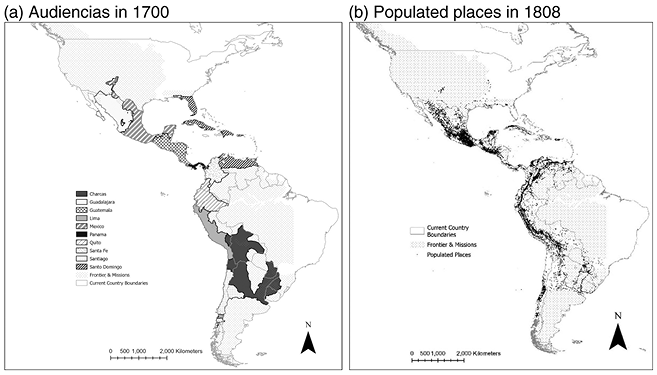
Figure 1.3 Audiencias and population prior to independence.
Yet, a pure focus on the territorial aspect of state formation could underestimate the administrative legacies of the Spanish Empire. In fact, a comparison of where most of the population was located at the eve of independence in 1808 (panel b) vis-à-vis current borders supports the idea of high degrees of population persistence. In other words, while borders shifted widely in Spanish America throughout the nineteenth century, populations barely changed the political unit that ruled them prior to independence.Footnote 27 I estimate that 75 to 80 percent of the population of Spanish America in 1808 would be ruled from the same capital it did in colonial times. Moreover, in many cases, the new independent governments would rule from the same building as the viceroys and the audiencias had done in the past (i.e., Palacio Nacional in Mexico). Borders shifted more than population did.
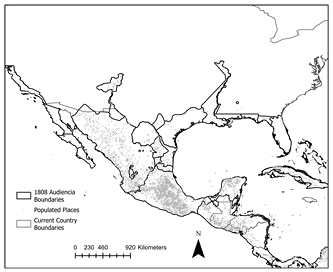
This is clearly appreciated in Figure 1.4 for the case of Mexico. Despite the new Mexican state unifying what was previously two audiencias and several gobernaciones depicted by the solid lines (e.g., Yucatán, Nuevo León) as well as losing half of its territory to the United States by 1850, the overwhelming majority of the population that existed in 1808 (81 percent to be exact) would have still been ruled by Mexico City.
In sum, notwithstanding the novelty of the territorial configuration, these states’ population – along with its practices, customs, social structure, and collective memories – was not new. In fact, massive migratory movements of the nineteenth century had transformative effects in Argentina, Uruguay, Brazil, and to some extent Chile, but would largely bypass the core of the Spanish administrative empire.
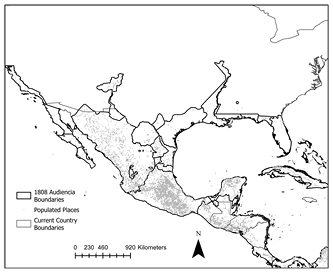
Figure 1.4 Population persistence versus territorial shifts: Mexico 1808 and today
Note: Each gray dot represents a populated place or settlement from Stangl (Reference Stangl2019b), which as of 1808 would be concentrated in central Mexico.
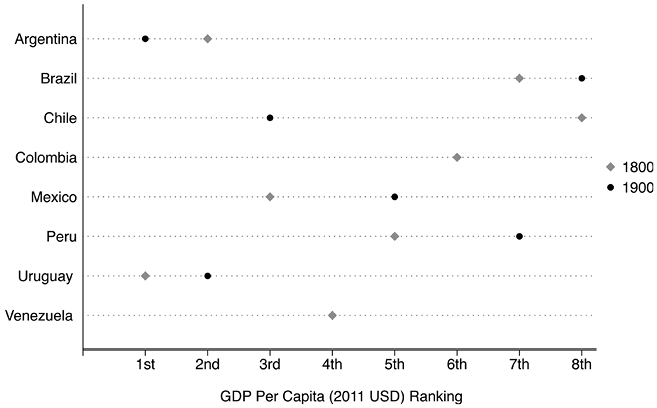
In addition to population persistence, the nineteenth century also witnessed a remarkable degree of stability in GDP rankings among them. As shown in Figure 1.5, at the end of the colonial era in 1800, countries already at the top of the income distribution (Argentina and Uruguay) or clearly at the bottom (Brazil,Footnote 28 Colombia, and Peru) were roughly in the same position 100 years later (1900), with the only exception of Chile. As noted, Mexico, Brazil, and Peru hovered around the same position throughout the century – “pushed” around in the rankings by Chile’s ascent – while Colombia and Venezuela remained in exactly the same spot.Footnote 29 This lack of dramatic reversals in economic development – already noted by Mahoney (Reference Mahoney2010) – suggests either a stability in the structural causes of long-run development after independence or changes in a way that did not alter the countries’ relative incomes. It also supports the idea of looking at the colonial era as the critical historical moment for understanding the region’s subsequent economic performance (Mahoney Reference Mahoney2010).

Figure 1.5 Country-level rankings of GDP per capita in 1800 and 1900 (selected countries)
Together, the stability of economic performance rankings and that of population suggest less change in this era than commonly thought. Particularly for the territories at the imperial administrative core and more exposed to office-selling. In fact, the most compelling accounts of successful nineteenth-century state transformation come from countries that the Spanish direct administration barely “touched” – Chile, Uruguay, Costa Rica, Argentina, or Paraguay. One contribution of this book is thus to show that this is not coincidental: Certain subnational legacies – economic geography, ethnic segregation, political representation, and conflict – can help us understand why some countries did not change rankings after independence.
1.4.2 Factor Endowments, Institutions … and Venality?
Yet, even if one agrees that many of the inequities we observe today originated in the colonial era, they need not be related to the practice of office-selling or to the administrative organization of the Spanish Empire. Instead, the initial conditions colonizers encountered upon their arrival clearly shaped the type and quality of the institutions they brought about (Acemoglu and Robinson Reference Acemoglu, Johnson and Robinson2001; Engerman and Sokoloff Reference Engerman, Sokoloff and Haber1997; Mahoney Reference Mahoney2010). For instance, a consistent finding in the literature is that countries with high levels of precolonial indigenous populations tend to have lower GDP per capita today (Acemoglu and Robinson Reference Acemoglu, Johnson and Robinson2002). This is attributed to institutions designed to exploit indigenous labor, perpetuating inequality and stifling long-term growth.
1.4.2.1 Subnational Institutions and Development
While this argument aligns well with cross-country aggregate patterns, this is less so within-country in the Americas. As first shown by Maloney and Valencia (Reference Maloney and Caicedo2016), subnationally, fortunes tend to persist rather than reverse. That is, some areas, despite having the “wrong” endowments in colonial times, remain some of the richest areas of their respective countries. Two somewhat extreme cases illustrate this point. The first is that of Mexico City, the former capital of the Aztec Empire, which has an average GDP per capita of 47,924 PPP dollars, far above the country’s one of 20,634 in 2018.Footnote 30 Similarly, the region of Cusco, Peru – capital of the Inca Empire and later the seat of the Cuzco audienciaFootnote 31 – exhibits the highest GDP per capita among the areas with the highest precolonial population density. Why are they not the poorest today?
The book provides three complementary reasons. The first is the ability of certain administrative policies to “blunt” the effect of factor endowments.Footnote 32 As said earlier, administrative decisions in colonial times had large distributional effects, ranging from which and whether territorial units would be granted the ability to form a representative body (cabildo), the exclusivity of their rights to trade (royal ports), or the rights to communal land (pueblos). Álvarez-Villa and Guardado (Reference Álvarez-Villa and Guardado2020) show that the administrative designation of “royal ports” in colonial Mexico has led to higher levels of trade and local development in the long run than would have been predicted based on their disease environment, population levels, or geographic advantages. Similar findings emerge from China, documenting how changes in the administrative status of certain provinces promoted greater urbanization and population growth than would have been expected by location fundamentals alone (Bai and Jia 2020).
Second, beyond the cases of Cuzco and Mexico City, the variation in subnational development experiences observed today far exceeds the variation in the initial endowments found by colonizers. While some studies find broad differences in historical institutions driven by geographic and population endowments (Bruhn and Gallego Reference Bruhn and Gallego2012), other works find that the barriers to productivity in the Americas operate at a much more local level. For example, by shaping the provision of public goods and the security of property rights across municipalities (Acemoglu and Dell Reference Acemoglu and Dell2010: 187). Thus suggesting that for the same endowments encountered by sixteenth-century colonizers, we may expect different economic performance today.
This book argues that administrative features of the Spanish Empire – such as the mechanisms for selecting and appointing colonial officials, and the characteristics of the latter – played a significant but often overlooked role in local economic productivity differences. In the case of office-selling, it is true that certain endowments might have helped attract certain types of officials. Yet, which endowments led to more or less returns to colonial officials was not obvious ex-ante. Provinces with similar levels of indigenous population, but with different levels of social organization or bellicosity, would lead to different development outcomes today, depending on the type of officials that ruled them. In fact, Chapter 8 illustrates this phenomenon by showing how areas sharing similar initial conditions (endowments) but facing different jurisdictions and personnel in colonial times have divergent economic and political outcomes today.
Finally, and third, this book points to the importance of personnel policy in shaping the quality and incentives of colonial officials and their performance in office. For example, social and personal connections of members of the audiencias in the Americas with the Crown actually improved the formers’ performance in office (Salgado Reference Salgado2021). Evidence from the nineteenth-century British Empire also shows that personnel policies (patronage) reduced the long-term fiscal development of the territories more exposed to it vis-à-vis those where merit criteria prevailed (Xu Reference Xu2018; Reference Xu2019). To the best of my knowledge, this is the first study to systematically link the sales of these positions across the Spanish Empire with the long-run economic trajectories of the places they ruled.Footnote 33
1.4.3 Connecting the Spanish Colonial Administration and Development
Altogether, this book is a region-wide study of the short- and long-term effects of office-selling for local development. Most existing work on Spanish venality focuses on the Crown’s motivations to sell positions (Parry Reference Parry1953; Lejonagoitia Reference Lejonagoitia2015; Sanz Tapia Reference Sanz Tapia2009), on how office-selling changed the composition and quality of audiencias (Burkholder and Chandler Reference Burkholder and Chandler1977; Phelan Reference Phelan1960), or on how it led to the inefficient management of the royal treasury (Andrien Reference Andrien1982) and corregimientos in Peru and Bolivia (Moreno Cebrian Reference Moreno Cebrian1977). Yet, much less is known about how these effects changed the individual characteristics and incentives of colonial bureaucrats, particularly across a broader set of positions.
Part of the reason behind the gap in the literature is the dearth of data. The secrecy inherent to corrupt activities of colonial officials, and the “fragmentary and impressionistic” nature of the available evidence (Andrien Reference Andrien1984: 1), have made it difficult to characterize systematically. Moreover, until recently, there has been a lack of information on the organization of the Spanish Empire, including basic data such as its territorial organization, particularly at the subnational level.Footnote 34 Furthermore, when studies do examine the empire’s administrative organization and policies, by collecting data on the identities and characteristics of those in power, the focus has generally been on the higher levels of the administration (viceroys, audiencias), thus overlooking lower-ranked officials, such as those in direct contact with the colonial population (corregidores, alcaldes mayores).
Finally, much attention has been drawn to the Crown’s policies of the last thirty years of colonial rule, known as the Bourbon Reforms. These reforms, successful in raising revenue, also led to discontent among certain sectors of colonial society, namely the criollo elites, key for the subsequent push for independence (Garfias and Sellars Reference Garfias and Sellars2022). However, the success (or failure) of these policies have little correlation with postindependence outcomes at the local level. As noted by Soifer (Reference Soifer2015) and Chiovelli et al. (Reference Chiovelli, Fergusson, Martínez, Torres and Caicedo2024), territories that were most successful in increasing revenue for the Crown during the Bourbon Reforms tend to exhibit some of the lowest levels of fiscal capacity today. Why? A missing factor could be the regions’ historical exposure to venality. If areas with greater revenue collection also had greater exposure to venality, it would explain the short-term increase in collection but overall worse long-term governance.
This book thus revolves around the empirical question of whether and how office-selling-turned-venality shaped the economic trajectory of countries in the region. Evidence from outside Spanish America provides some clues. In France, the excessive reliance on office-selling in the seventeenth century likely had negative consequences for economic activity by diverting productive resources to the bureaucracy (Swart Reference Swart1949: 14)Footnote 35 and limiting its fiscal options to deal with crises (Root Reference Root1994: 19). Office-selling also contributed to a culture where security in public sector employment is still highly esteemed (Doyle Reference Doyle1984: 831), potentially at the expense of the private sector. In China, reliance on nineteenth-century office-selling reduced the incentives to implement much-needed reforms to the bureaucracy and the system of public finance (Kaske Reference Kaske2008: 299, 300). In the case of Spanish America, whether this policy had any discernible impact (or not) is an open empirical question.
1.5 Roadmap
The rest of the book unfolds chronologically, with Part I examining the origins and consequences of office-selling throughout the colonial period. Namely, how office-selling led to venality in the colonial administration. Part II then traces the consequences of venal officials throughout the postindependence period until the present. While each chapter is organized around a set of empirical claims, they also provide a building block to the overarching argument of the relationship between venality, governance, and long-term development in Spanish America.
Part I opens with a brief description of the territorial and administrative organization of the Spanish Empire in the Americas (Chapter 2). Chapter 3 then explores why the Crown sold key positions of judicial, fiscal, legislative, and economic significance in the Americas, challenging existing accounts. Chapter 4 provides quantitative evidence of how office-selling changed the profile of colonial officials – by facilitating the entry of officials with different traits from those of appointed officials (selection) – likely for the purposes of self-enrichment at the expense of the local (mainly indigenous) population. A first consequence of this change in the quality of the administration is evident in the collusive behavior between high-level audiencia members and lower-level ones, documented in Chapter 5. In terms of the welfare of the population, Chapter 6 traces how exposure to venality increased the number and intensity of violent uprisings as well as the displacement of the indigenous population. Altogether, Chapters 2 to 6 document the short- and medium-term consequences of office-selling on local governance in Spanish America.
Part II then explores how these effects play out after independence in the nineteenth century. Building on previous findings, Chapter 7 uses evidence from postindependent Peru, Bolivia, Guatemala, Ecuador, and Mexico to show the different mechanisms through which early eighteenth-century venality lived on: by reinforcing geographic segregation, limiting political representation, and recreating forms of labor coercion and taxation from colonial times. Chapter 8 then shows that the combined effect of these policies contributed to the glaring levels of spatial inequality through the presence of ethnic enclaves, subnational authoritarianism, and underprovision of public goods that characterize the region today.