





I’m going to write fire until it comes out of my mouth, my eyes, my nose holes. I’m going to go out like a fucking meteor.
Audre Lorde, A Burst of Light Footnote 1
“Unfortunately, there is a cancer.” … The most heinous thing about that sentence is not the presence of cancer but the absence of me—for I, Barbara, do not enter into it even as a location, a geographical reference point. Where I once was—not a commanding presence perhaps, but nonetheless a standard assemblage of flesh and words and gesture—“There is a cancer.” I have been replaced by it, is the surgeon’s implication. This is what I am now, medically speaking. …The career of a breast cancer patient has been pretty well mapped out in advance for me.
Barbara Ehrenreich, Welcome to Cancerland Footnote 2
Over the last four decades, feminist cultural studies, science, technology, and society studies (STS), disability/crip studies, and the onco-humanities have engaged questions about embodiment, agency, and the biopolitics of cancer knowledge.Footnote 3 Across this literature, both “choreography” and relatedly, “pedagogy” have emerged as generative analytics: ways of naming how people move and are orchestrated in relation to illness, to medicine, to the state, and to one another, and of tracing how knowledges travel, collide, and transform as they pass through bodies, institutions, and publics.Footnote 4
Choreography understood as an analytic tool foregrounds power, rhythm, discourse, and relations in a dynamic mode of seeing and documenting clinical settings; a lens that allows non-reductive readings. As Cussins argues, ontology does not pre-exist practice but rather is produced through coordinated action where meanings are multiple, contingent, and enacted.Footnote 5 Consideration of the cancer clinic as always-already a pedagogical setting specifically treats knowledge archeo-genealogically; that is, as multiple, complex, and embedded in knowledge ecologies that constitute local “assemblages of intelligibility” over time, and across communities. It asks what and who counts as knowledge and knowledgeable, and as worthy of locating, remembering, unsettling and/or contributing to, utilizing, and sharing.Footnote 6
Following Treichler’s influential characterization of HIV/AIDS as an “epidemic of signification,” I approach cancer as simultaneously biomedical and discursive: a site through which meanings, identities, authorities, and practices of knowledge are produced, circulated, and contested.Footnote 7 The onco-humanities thus represent an empirico-theoretical, sociocultural approach to the study of cancer as coextensive with (1) the study of knowledge, and (2) the treatment of knowledge and its uneven mobilities within and across divides as located within complex bio- and necropolitical systems of knowledge.Footnote 8 Onco-humanities is, then, also apt for scholarship that aims to hold together theory and lived experience; the work of analysis must keep step with, and sometimes deliberately break step from, what institutional cancer regimens require of bodies and communities.
This article aims to contribute to onco-humanities scholarship by centering choreography as a critical hinge between cancer experiences, biomedical knowledge and practices, and pedagogy.Footnote 9 I situate the discussion within what we are referring to in this themed issue of Public Humanities as cancer’s “dirty margins”: not only to gesture toward the oncological image of treatment failure—residual cells at the edge of excision—but also the social and epistemic spaces where marginalized lives proceed improvisatorially, in the absence of the option of a cure, where recognition is uneven, and where the labor of inventing tactical choreographies that shape and pulsate living with advanced cancer is continuous rather than episodic. Tactical choreography is typically a term used in cinematography to refer to the organization of combat scenes. However, it is interesting to me as I work through language that might capture cancer’s underground knowledge economy, that a Ukrainian dance company has created a project entitled, “Tactical Choreography for the Military” so as to train civilians, artfully and improvisatorially under conditions of great duress, “to be able to trust the body more and rely on its resources in critical situations.”Footnote 10
Queer pedagogy provides a crucial theoretical grounding for this article’s argument. In a foundational essay that inaugurated this construct, my colleague and I reframed pedagogy as a queer praxis that might interrupt the reproduction of normativity and interfere with the transmission of content.Footnote 11 Education, in this view, is not the neutral delivery of information; queer pedagogy enacts a performative rearrangement of relations—an invitation to new alignments and to disidentification with inherited scripts.Footnote 12 That insight travels powerfully into cancer studies. If we understand experiences of living with advanced cancer as a set of rehearsed and improvised moves by which people reorganize time, feeling, work, and relation, then survivorship is pedagogical; it teaches, in situ, how to live otherwise.Footnote 13 Queer pedagogy might, then, be understood as choreography’s companion; it supplies concepts and practices with which to unlearn, or reframe from below, the linear cancer narratives that conflate cure with success and recurrence with failure, and with which to value forms of knowing that arise from embodied endurance within those conditions of evident failure that arise in the face of cancer’s dirty margins.Footnote 14
Autobiographical works, performances, and cultural accounts through which marginalized people narrate cancer through pathography—pathos (dis/ease) + graphe (writing)—form a crucial archive of cancer’s dirty margins and provide an indelibly queer onco-pedagogy.Footnote 15 In “White Glasses,” Eve Sedgwick specifically names a politics of visibility and pedagogical interventions organized in relation to death and dying, pharmaceutical capitalism, and state violences that originated with AIDS/HIV, as constitutive of the basis for her publicness as a writer in relation to her own breast cancer.Footnote 16 In a similar vein, Jackie Stacey, author of Teratologies, one of the first post-structural, feminist pieces of autobiographical writing about cancer, notes in a dialogue (“Writing about Illness”) with Lochlann Jain, that, “If the contours of this terrain were unexpected for both of us as we reluctantly traveled across them, then the kind of writing we produced in response seems to share an ambition to offer readers both critical purchase and affective connection.”Footnote 17
Whereas cancer memoirs produced in the shadow of queer theory treat meaning as inherently discursive, the previous generation of health empowerment was more literal and communicatively frank, while critically shedding light on the problematics of state-sanctioned biomedical knowledge. Our Bodies, Ourselves (1973) is the paradigmatic case for a first generation of health pedagogy, where the purpose of writing about health was to break the hegemony of medical expertise and give marginalized folks access to the capacity to know their bodies and have a say.Footnote 18
In queer autobiographical accounts of cancer, bio-experiential knowledge becomes entangled with biomedical knowledge as both interrogate and explore the textures of fatigue, fear, and endurance take on analytic force; and narrative itself becomes an instrument for diagnosing, exhibiting, and altering structural conditions that exceed the clinic’s frame.Footnote 19 Pathography, in this sense, is not simply testimony; it is method. It is a way of moving knowledge that refuses the closure of cure and the tidy recuperation of “resilience” as a private virtue.Footnote 20
Finally, the questions posed here, alongside the analysis of two depictions of cancer separated in time by sixty-six years, engage us to rethink biopolitics in a way that keeps close to praxis zones.Footnote 21 Bryson and Stacey’s account of “cancer knowledge in the plural” has shown how biomedical discourse choreographs subjects into responsibilized self-management while simultaneously demanding narratives of optimism and heroic compliance.Footnote 22 Queer, crip, and feminist interventions resist these scripts by inventing other steps: practices of refusal, collective pacing, and improvisation that embrace failure and foreground interdependence over autonomy.Footnote 23 Throughout this essay, I argue that the tactical choreography of knowledge—how knowledge is muddied, taught, traded, archived, despoiled, revised, and embodied at cancer’s margins—is not deployed here as metaphor but as method; it might enable us to describe how cancer survivorship and pedagogy braid together in practice and to design research, teaching, and care that move differently.Footnote 24
1. Pedagogical notes from the field: Cancer then, 1959
Cancer Education came into its own in the 1950s as a site for the development of extensive materials designed to produce an informed and compliant cancer patient.Footnote 25 In 1959, NBC, in cooperation with the Educational Television and Radio Center and the American Cancer Society (ACS), broadcast live a series of six half-hour educational television programs, under the overall title of “Tactic,” intended for a mass audience.Footnote 26 Despite the historical significance of Tactic, other than a kinescope recording of the first episode, which is only available for in-person viewing at the Paley Center for Media, the remaining episodes are broadly considered to be “lost.”Footnote 27 Several short excerpts can be viewed online.Footnote 28 I am apparently the only known person to have playable copies of five of the six episodes of Tactic (beyond what is perhaps buried in the archives of the American Cancer Society).Footnote 29 Since readers of this article cannot themselves view the first episode, I will, here, make use of excerpts from a transcript of the first episode of Tactic, rather than refer to time-coded segments of a viewable recording.Footnote 30
The first episode, broadcast May 2nd, 1959, entitled “75,000 Chances to Live,” is hosted by American radio and television personality Ben Grauer. The inaugural Tactic episode starts with a biomedical overview of cancer by Dr. Charles Cameron, then Medical and Scientific Director of the American Cancer Society. Dr. Cameron is asked to “review the medical facts, based on exhaustive studies by the American Cancer Society.” Dr. Cameron juxtaposes a lynchpin statistic—the annual number of US-based cancer deaths (75,000)—with a paternalist and bombastic exposition concerning those educable attitudinal deficiencies responsible for cancer’s harsh death toll—a toll framed as “needless deaths.” As he puts it, “75,000 Americans will die needlessly of cancer, simply because they will not seek effective treatment.” These bad attitudes include “arrogance, procrastination, vanity, shame, fatalism, quackery, avoidance and ignorance.” Dr. Cameron’s summation of “medical science” to date is that: “There are only two ways to cure cancer: surgery and irradiation.” The explanatory hinge of the American Cancer Society’s educative program is its mobilization of a claim that was science fiction at the time—and persists as such today—the idea that cancer is definitively “curable.”Footnote 31
Dr. Cameron’s educational spiel sets up the viewer to be interested in fear as “a single common denominator” that structures people’s attitudinal deficiencies regarding cancer. This provides a segue to a 10-minute “impromptu drama” directed by phenomenally influential filmmaker Alfred Hitchcock, who is introduced on the show as a “fear” expert. Hitchcock’s pedagogical drama features then Broadway actors William Shatner (of Star Trek fame) as a doctor and Diana van der Vlis as a breast cancer patient. As Tactic host, Ben Grauer succinctly notes, the pedagogical intent of Tactic’s experiments with various media, including film and dance, is to save lives by “exposing and correcting” the ordinary person’s bad attitudes.
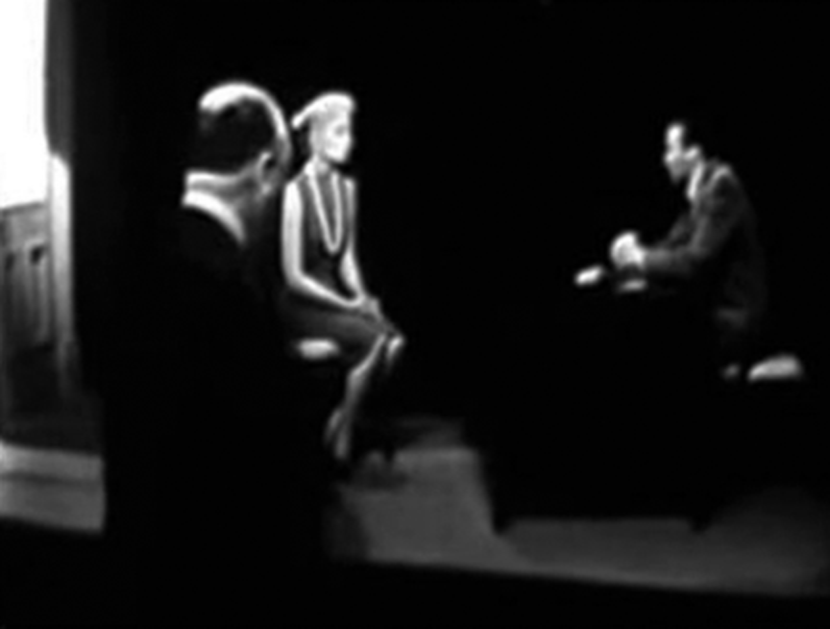
Hitchcock choreographs a 10-minute “impromptu drama” with William Shatner as a doctor who reassures a twenty-four-year-old model (Diane van der Lis) diagnosed with breast cancer that her fears of permanent “disfigurement” after mastectomy surgery are “irrational.”Footnote 32
Whereas Hitchcock’s skit is framed as improvisatory, it is anything but. Hitchcock has designed a set for the actors, which includes a door, two chairs, a desk, and a paper knife (Figure 1).Footnote 33 According to the authors of Hitchcock Lost & Found: The Forgotten Films, “Hitchcock was walking through a prewritten script.”Footnote 34 And as it turns out, so too were the doctor (William Shatner) and the patient (Diana van der Vlis) in this carefully choreographed scenario. As Hitchcock notes with some gravity, “This is not a pure improvisation, but we will proceed as though it were.”
Tactic (Reference Tactic1959): Hitchcock’s set.

The brief enactment of cancer health decision-making starts with the doctor seated behind his desk. After entering and being instructed by the doctor to seat herself, the doctor informs the patient, “Miss Kane, you require immediate surgery. You have cancer. It means we have to operate to remove the breast.” Whereupon the patient speaks back, protesting that, “That’s ridiculous. There must be some other way.” It is notable that at this point, Hitchcock intervenes as Director (Figure 2), and reorients the power dynamics by asking the patient to assume a paralyzed, mute stance with the following instructions,
Diana, you’ve just been handed the most startling news of your life. You have cancer. Now, anyone who has faced this moment knows that this is a serious, frightening time. Play this as if you are tongue-tied for a moment. You see? Charlie, take a tight close-up of her face. We want to see her reaction to this news.Footnote 35
Tactic (Reference Tactic1959): Hitchcock’s directorial choreography.

Suitably muted by direction, the close-up requested by Hitchcock removes from the equation any agency that a speaking role might have conferred to the patient. Despite that, Hitchcock briefs the actor playing the role of patient by saying that she is “consulting” with the doctor, and tells the actor playing the role of doctor that he is being asked to “help her to make certain personal decisions.” It is very clear that, as the scene unfolds, all directorial interventions have the sole purpose of producing an appropriately silenced and compliant patient.
It is notable that many of the apparently scientific claims made by the doctor in this enactment are not based on research and reiterate claims made earlier in the broadcast, to the effect that cancer can be “cured,” such as when the doctor tells the patient (echoing precisely, Dr. Cameron), “There are only two ways to cure cancer. Surgery and irradiation.” Surgery and radiation significantly improve outcomes in earlier-stage cancers. However, at that time, as now, there is no cure for cancer.Footnote 36
In the final minutes of the drama, the doctor gets up from behind the desk and sits next to the patient, leaning in close while they move into a harried dialogue about the psychological impact of mastectomy surgery—here represented in terms of the devastating impact of “disfigurement”—on the patient’s attractiveness as a woman soon to be married. Hitchcock, at this point, makes one final directorial intervention aimed at ratcheting up the threat level in the doctor’s office (Figure 3). Hitchcock interrupts the doctor’s easy breezy stream of marital advice and asks him to pick up the “letter opener” (unlike a letter opener, a “paper knife” actually has a long, broad blade). “Doctor, I’d like to do something here. As you talk, pick it up and toy with it. Go on, please.” As the doctor toys with the menacing paper knife, the patient quickly moves to de-escalate the dramatic tension by asking when the surgery would take place, concluding with her final words, “Thank you, doctor. I’ll see you tomorrow.”
Tactic (Reference Tactic1959): Hitchcock choreographs the doctor’s use of the paper knife.

It is noteworthy that none of the American Cancer Society’s claims concerning a putative link between what was known in the 50s as the “William Halsted Radical mastectomy” and curative breast cancer outcomes, from the time of Tactic, were based on scientific evidence. Whereas disfigurement has long plagued both medical and everyday discourse about the aesthetic impact of mastectomy, in fact, radical mastectomy resulted in severe problems of chronic pain and mobility related to the removal of the breast, pectoral muscles, and the axillary lymph nodes.Footnote 37 As Ellen Leopold has so carefully documented,
Physicians realized early on that women had to be educated to accept treatment for breast cancer. They had to become patients, to demonstrate, by their willing submission to treatment, their absolute faith in the therapeutic value of surgery. The American Society for the Control of Cancer, the precursor to the American Cancer Society, was set up by physicians to achieve just this transformation.Footnote 38
2. Pedagogical notes from the field: Cancer now, 2025–2026
Whereas Tactic was produced the year that I was born (1959), we might, in the present time, be lulled into ventriloquizing a straightforward discourse of progressive improvement concerning cancer treatment. Cancer treatment today in North America is intended to be delivered within the scope of patient-informed decision making, or goal-concordant care. At present, cancer patients are assumed to arrive in the clinic as knowledgeable agents; members of the care team, buoyed by the present-day widespread availability of scientific knowledge about cancer and, relatedly, sophisticated treatments, such as precision genetic oncology.Footnote 39
In January 2025, I was diagnosed with stage IV EGFR oncogenic-driven lung cancer—a genetic, never-smoker’s lung cancer. In Canada, as elsewhere, lung cancer accounts for more deaths than breast, colorectal, and prostate cancers combined (25%). Yet paradoxically, it remains the most underfunded of the high-prevalence cancers across research, pharmacological trials, and clinical treatment design (6%).Footnote 40
There is broad consensus within the multidisciplinary lung-cancer research community that clinical care, research infrastructures, and patient communities alike are saturated with the deleterious effects of stigma—stigma linked to smoking and attendant blame, and moral judgment.Footnote 41 This persists despite the fact that the fastest-growing group of lung-cancer patients globally, the majority of whom are Asian and/or women, is diagnosed with EGFR—a genetically driven, never-smoker disease.
It was immediately clear to me that the lung cancer clinical setting into which I was abruptly catapulted was shaped by stigma and shame; in many ways, reminiscent of Goffman’s unmanageable “spoiled identities” authored in the time of Tactic.Footnote 42 These affective registers were already familiar to me as a queer and non-binary person; they recall the dynamics that structured first-wave AIDS/HIV communities, where illness was routinely understood as fault, and care was filtered through abject neglect, moral judgment, and state violence.Footnote 43
My response to being required to function in an always-already broken and judgmental clinic setting—where I was abruptly handed a death sentence—was to deploy onco-humanities documentation practices that might be characterized as a methodology of tactical choreography, or what de Certeau calls, the “tactics of the powerless.”Footnote 44 This is not my first refuge, as a minoritized scholar, in core humanities scholarly practices: documentation, archival research, epistemic translation, tactical reading, affective mapping, witnessing, and collective knowledge production.Footnote 45
Autobiographical experience rendered into pathography—often dismissed as anecdotal evidence—is approached here not as confession but as epistemic intervention. What emerges is not a linear illness narrative but a Benjaminian constellation: a charged configuration of documentary fragments, images, and traces of resistance, assembled over the course of 12 months, at cancer’s dirty margins.Footnote 46 In these arrested juxtapositions—fieldnotes, clinical reports, correspondence, hauntological traces summoned from an archive of feelings—the past and the present enter into a critical relation.Footnote 47 The clinic’s necropolitical temporality, which organizes life through prognosis and anticipatory death, is momentarily suspended. Knowledge appears not as forward-moving survival statistics but in flashes.
These flashes constitute tactical choreographies: patterned movements across institutional thresholds; minor gestures that interrupt the state’s quiet allocation of livability and disposability. At cancer’s dirty margins, documentation becomes refusal within a regime that exacts patient silence as the price of care. Constellated fragments do not simply record experience; they expose and disrupt the temporal logics of state violence that would render certain bodies already lost.Footnote 48
When I was diagnosed (January 2025) with advanced lung cancer, I was completely asymptomatic; an uncanny state in which I remain today, a year later. The lung cancer was identified in the lower lobe of my left lung by an astute radiologist, incidentally to a Cardiac CT (Figure 4). I encountered a multi-tiered wild ride of the Canadian public healthcare system. In the span of 3 weeks, I was processed by the cancer healthcare triage system as, initially, a high-priority case involving an operable, small tumor with no evidence of spread. I met with an extraordinarily kind and skilled surgeon, and a date was set for “curative surgery”: lobectomy. As Surgeon A exclaimed in a rousing send-off, “Mary, we save lives here every day. We’re here for you!.”Footnote 49
Chest CT: Mary’s left lung (January 2025).

Figure 4. long description
At the center, the left lung parenchyma appears as a dark region with visible branching airway and vascular structures. Moving outward, the peripheral lung fields show fewer markings and increased homogeneity. The outermost boundary is defined by the pleura, adjacent to the rib contours seen as bright arcs along the right edge. The diaphragm forms the lower border, with soft tissue and bone structures surrounding the lung. No obvious masses or consolidations are present. The spatial distribution of markings is denser centrally and sparser toward the periphery.
Walking into the Provincial Cancer Centre (PCC) for the multitude of tests that followed in the interval between diagnosis and surgery (booked for January 26), I was keenly aware that I had walked those same corridors as a queer and non-binary breast cancer patient in 2007, and then as a researcher. The “Cancer’s Margins” project that I led was funded by the first Canadian federal grant awarded for a nationwide study of sexual and gender minority cancer patients’ experiences of cancer, treatment, knowledge-seeking, and support services.Footnote 50 Following Cancer’s Margins, my research team was invited to design and support the implementation of a significant program of professional development for the PCC, focused on health equity and an intersectional understanding of the significance of sexual and gender minority cancer patients and their families.
2.1 Archival artifacts: Fieldnotes on the day of pre-surgical tests at the Provincial Cancer Centre (PCC: January 22, 2025)
Describing my experience of waiting at the PCC Day Surgery clinic for a biopsy.
Mary’s Journal: I am sitting in the PCC Day Surgery area, with a university friend/colleague, anxiously waiting for a pre-surgical Endoscopic Bronchial Biopsy. I am booked for lobectomy surgery at week’s end (Figure 5). There is a mural all around us, covered with buoyant images of Respirologist A, who is carrying out the biopsy procedure today. Just as we were enthusiastically discussing his achievements with the nursing staff, Respirologist A bounds into the waiting area.
Chalkboard in Mary’s kitchen.

 Respirologist A: “Congratulations Dr. Bryson!!! The results of the PET scan just arrived. You are cleared for surgery. There’s no distant spread.”
My colleague texts my partner immediately to share the amazing news.
This news was short-lived. As I realized a few days later, it appears Respirologist A’s enthusiastic proclamation was based on the content from only the first page of a two-page PET scan report.
2.2 Archival artifacts: Field note about a phone call from Provincial Cancer Centre (PCC) Respirologist A, 2 days before lobectomy surgery (January 24, 2025)
On the devastating experience of being transitioned from “Curative” to “Palliative” treatment in a single phone call.
Mary’s Journal: I am looking at the cheery, heart-covered blanket that I had just bought that day, to take with me to the hospital where lobectomy surgery is scheduled two days hence (Figure 6), along with a fresh, comfy pillow and a soft, flannel-lined toque.
Mary’s comforting props to stage the surgery scene at week’s end.

I am setting the scene with props.
The phone rings.
It’s Provincial Cancer Centre Respirologist A.
Respirologist A: “There was a mistake with the PET scan report. You have advanced cancer, which is inoperable. Your surgery is canceled. You will hear from an oncologist.”
Respirologist A hangs up abruptly, without pausing for any comment or question from me.
Click.
In that astonishingly brief phone call, I moved from believing I might die of something other than lung cancer to being repositioned among the incurables. In a single administrative utterance, I was rendered terminal—not only clinically, but socially—folded into what might be understood as a population of the living dead. I emailed Respirologist A that same day to ask how such a “mistake” could have been made. I received no reply. A cursory Google search produced a five-year overall survival rate of 13 percent. As minoritized patients so often do, I began to interrogate myself, wondering which aspects of my visibly queer life had been read as culpable, which forms of difference had been silently converted into blame. How had I moved so abruptly from being “saved” to being governed as incurable?
That call from the Provincial Cancer Centre did more than interrupt care; it enacted a form of biopolitical triage. Cut off from active treatment and offered only the promise of a future oncologist’s call, I was consigned to a regime of deferred attention. In response, I turned to research to make sense of what I understood as an assuredly terminal diagnosis. Publicly available educational and professional materials on non-small-cell lung cancer on the (then, as now, outdated) Provincial Cancer Centre website described my condition as warranting care provided solely with “palliative intent.”Footnote 51 Surgery and radiation were reserved for stages I–III disease, where intervention might still be undertaken with “curative intent.” This binary did not simply organize treatment options; it governed temporal possibility, sharply distinguishing lives oriented toward futurity from those administratively positioned as nearing their end.
What proved most striking was not the obsolescence of PCC materials, but their persistence. An article published this month (January 2026) by leading Canadian lung oncologists reproduces this same curative–palliative divide, even while acknowledging that third-generation drugs such as EGFR tyrosine kinase inhibitors (such as Osimertinib/Tagrisso) now operate across both domains.Footnote 52 The classificatory infrastructure remains intact, even as the science outpaces it.
Entry into patient-run knowledge spaces, including the “Tagrisso (Osimertinib) Patients & Caregivers” Facebook community, made visible alternative epistemic economies: counterpublics inhabited by myriad “patient bricoleurs” in which patients exchange research-based information, discuss strategic timing, and assist with risk calculations; forms of evidence-based care largely absent from clinical encounters.Footnote 53
Two invaluable pieces of knowledge, and related academic, peer-reviewed publications and recorded conference talks shared by my new colleagues in the Facebook “Tagrisso” community proved decisive. First, a liquid biopsy could establish a baseline measure of circulating tumor DNA, enabling an assessment of initial tumor burden and also longitudinal monitoring rather than episodic crisis response.Footnote 54 Second, that Stage IV, oncogenic-driven lung cancer cases characterized by low tumor burden and limited metastatic spread—cases like mine—were eligible in very particular clinical settings for ablative radiation or even lobectomy.Footnote 55 What appeared clinically foreclosed was reopened through patient-led epistemic labor. Back to the future, indeed.
Oncologist A’s office called. I assembled a seriously queer support team, and off we went to the first PCC oncology appointment, armed with knowledge about Osimertinib (Tagrisso), oligometastatic disease, and the value of a liquid biopsy. Within a matter of days, I started daily Tagrisso. The Provincial Cancer Centre operates in an extraordinarily obdurate species of technological, communicational void that is strangely out of touch with other major cancer centers. There is no online portal to check appointments, read reports, or communicate with the cancer “care team.” PCC care providers do not use email to communicate with patients. Notices of appointments randomly show up in one’s mailbox (Figure 7). Or someone from the PCC calls. My relationship with Oncologist A assumed an unlikely, but transiently satisfying, epistolary shape. I recast myself as scrivener and my oncologist as an important pen pal—attentive, constrained, and unable to reply directly (Figure 8).
PCC appointment slips that arrive in Mary’s mailbox.

Example of a postcard sent by Mary to Oncologist A.

I write letters and postcards knowing that silence is not refusal, but a rule; a listener behind glass. This is not the PCC Dead Letter Office.Footnote 56 My letters produce inestimably valuable results over time as my oncologist ofttimes adapts standard PCC practices in response to requests articulated in my correspondence, such as to schedule imaging prior to appointments, check the fracture risk of bone metastases, or to arrange regular liquid biopsy tests.
By March, immersed in hundreds of peer-reviewed oncology articles, I began to chart my way through the literature on low tumor burden, Stage IV EGFR lung cancer. The resulting Comparative Treatment Timeline sketch (Figure 9) that I created functioned as a tactical tool, allowing me to think through the potential impact of Local Consolidation Therapy (LCT: surgery and radiation). LCT, while not curative, has been shown in clinical trials to lengthen the time of Progression Free Disease.Footnote 57
Mary’s Comparative Treatment Timeline sketch.

Figure 9. long description
At the top, handwritten notes state the goal to maintain and extend progression-free survival by reducing resistant clones, referencing L C T, S A B R, and surgery, with literature citations (2024 Antonoff, 2020 Palma S A B R-COMET trial). Below, survival durations are listed: 30 to 50 months for L C T, 18 to 24 months for E G F R exon 19 with Tagr., and 6 months to 1 year for T P 53. A horizontal timeline spans from December to two years, marked with months and years. Key events are annotated: December/January C T/P E T chest, January 28 Guardant and Tagrisso, May 1 repeat Guardant, P E T scan, chest C T. Blue arrows indicate 3-month and 1-year intervals. Notes below the timeline specify oligometastatic status requires documentation of stability, with criteria: no brain or liver metastases, low tumor burden, all but one bone metastasis required. Progression-free survival is distinguished from overall survival with arrows and text.
Buoyed by this knowledge about a broader option for treatments than what was shared by the PCC team, I set out to determine where I might locate surgeons with experience carrying out surgery with Stage IV lung cancer patients, as well as consulting with additional oncologists within PCC.
2.3 Archival artifacts: Provider reports and fieldnotes from Spring, 2025, when I shared my Comparative Treatment Timeline sketch (Figure 9) in consultations with two out-of-province surgeons and a Provincial Cancer Center oncologist
On my experience of sharing my understanding of surgical treatment for Stage 4 EGFR lung cancer with two surgeons.
Surgeon B, WA, US: General Hospital, Report, March 23rd
It’s not unreasonable to consider lobectomy if she has stability of disease or evidence of response to systemic therapy. I would offer her a lobectomy for local control of her lung cancer.
Surgeon C, Quebec, CA: General Hospital, Office Visit Fieldnote. April 21st
How did you figure all this out so quickly? You know more about this cancer than most doctors I work with.
The consequences proved to be quite dire for me, as a Stage IV EGFR lung cancer patient, to have the audacity to share research and knowledge translation, including my Comparative Treatment Timeline sketch (Figure 9), with a PCC oncologist I consulted for a second opinion.
Oncologist B, PCC, Office Visit Fieldnote, April 22nd
And if you showed me a stick figure that you drew in the sand with your finger, would you expect me to take that seriously as well?”
Oncologist B, PCC, Report, April 22nd
We acknowledged with her that she is in a difficult situation. Her cancer diagnosis has taken away a lot of her control over her body. She is seeking some control back with her researching efforts. We discussed that surgery is not first-line treatment in metastatic lung adenocarcinoma. This decision comes down to whether she believes that the surgery would provide her mental and psychological comfort.
Against all odds, on May 16th, I underwent robotic lobectomy surgery, which, contrary to the animated admonishments by Oncologist B about “quality of life” and “worsening of physical health after lobectomy,” went smoothly and unremarkably. The few items I brought to the hospital included the heart-covered blanket, fresh pillow, and soft toque assembled as props for the scene of my first scheduled, then cancelled, lobectomy (Figure 6).
Although I provided a surgical report and subsequent pathology and genetic analysis to PCC, the surgery was never mentioned in PCC appointments. It was December 2025, before the surgery appeared as a relevant aspect of my Oncologic History, in post-lobectomy PCC oncology reports. A few months later, I underwent ablative radiation to the only one of my original bone metastases that was still lighting up on PET scans. Notably, there has been absolutely no negative impact of surgery, nor of radiation, on my physical health.
A follow-up liquid biopsy (Figure 10, December 2025) showed that levels of circulating tumor DNA have dropped to “undetectable.” A recent Chest CT (Figure 11, December 2025) showed: “No evidence of disease recurrence … Nor any other abnormalities or new osseous lesions.” At PCC, there is a coordinated silence on the matter of how I accessed surgery as a Stage IV patient. This is something of which we cannot speak. My very pleasant PCC oncologist noted in a report that: “For Mary, information is power and more suffering comes from lack of knowledge about her current situation.”Footnote 58 How interesting that in 2026, a lung cancer health professional would feel the need to invent a psychological explanation for the desire to access knowledge that might significantly increase my time as an asymptomatic well person.
Mary’s pre- and post-lobectomy surgery liquid biopsy results.

Figure 11. long description
The x-axis spans from JAN-28-2025 on the left to NOV-20-2025 on the right. The y-axis is labeled highest variant allele fraction. A green and blue area rises to a peak at 1.6 percent above JAN-28-2025, then both areas taper downward, reaching not detected at NOV-20-2025. The graph visually demonstrates a decrease in variant allele fraction over time, with the highest value at the start and no detectable variant at the end.
Mary’s L and R lungs post-lobectomy.

I remain acutely aware that the treatments I accessed by means of the underground patient knowledge economy, and then procured, were never intended as curative. But nor were they aptly characterized as palliative. As a December report by Oncologist A notes: “Mary is aware it is more a question of when, than whether her disease will progress.” In tactically finding, designing, and then inventing anew, as a patient-activist-scholar, an evidence-based path, I was enabled by the crowd to identify, then passionately enflesh, a middle ground between curative<>palliative so as to stake out and occupy a somewhat livable place in that forbidden zone. The zone of the incurable. The crossing. For a time. As Audre Lorde wrote, “I carry tattooed upon my heart a list of names of women who did not survive, and there is always a space for one more, my own. That is to remind me that even survival is only part of the task. The other part is teaching.”Footnote 59
3. The work of knowing otherwise at cancer’s dirty margins
Across the analysis of Tactic as a historical media artifact, and the contemporary archive of my own lung cancer treatment landscape and its ruins, I have argued that clinical cancer settings function as a pedagogical apparatus through which uncertainty, failure, affect, and futurity are governed. Read together, these materials reveal choreography as a structuring logic that organizes bodies and knowledges while appearing natural, benevolent, or merely informational. In Tactic, choreography takes the form of scripted reassurance, managed silence, and televisual optimism that situates cancer as a problem to be endured correctly. In the contemporary cancer clinic in the Global North, these pedagogical logics persist in more diffuse form, now routed through discourses of patient-informed decision-making and precision oncology that presume patients’ epistemic readiness while intensifying their responsibility for interpretation, compliance, and emotional regulation. What unites these sites is not a shared content but a shared mode of governance; the pedagogical management of cancer as an affective, necropolitical, and economic problem.
Against this backdrop, pathography has been mobilized not as personal testimony but as a method—as a way of producing a cartography of presence that registers what institutional records cannot hold. The patient-authored archive assembled here documents the labor of waiting, researching, translating, and enduring that accrues in the gaps between clinical encounters and official narratives. When placed in dialogue with mid-century public cancer pedagogy, these materials make visible how governance operates pedagogically, not only through protocols and policies but through demands for optimism, coherence, and silence. Pathography interrupts these demands by insisting on lived temporalities that exceed curative–palliative binaries and by making present forms of life that are otherwise rendered administratively invisible.Footnote 60 The work of thinking in this space of the otherwise, constellates an abundance of questions, which Paul Preciado has so eloquently described as follows:
But what does it mean to speak for those who have been refused access to reason and knowledge … With what voice can we speak? … To speak is to invent the language of the crossing, to project one’s voice into an interstellar expedition: to translate our difference into the language of the norm; while we continue, in secret, to practice a strange lingo that the law does not understand.Footnote 61
The concept of tactical choreographies names the practices through which patients inhabit, reroute, and sometimes refuse these pedagogical demands. Such refusals are rarely spectacular; they emerge instead through re-sequencing time, documenting what should not require documentation, and holding open provisional middle grounds that institutions are structured to deny. These practices are choreographic insofar as they involve learned, improvised movements within constraint, and pedagogical insofar as they generate knowledge about how to live otherwise under conditions of institutional invisibility and state violence.Footnote 62 By tracing these choreographies across historical and contemporary sites of cancer education, this article advances choreography not as metaphor but as method—one that allows health humanities to better apprehend how cancer knowledge is governed, contested, and re-made from the margins, where survivorship becomes inseparable from pedagogy itself.
There is a persistent need for pathographies from many locations at cancer’s margins—Black, Indigenous, and other racialized communities; folks who identify as trans or non-binary or disabled—accompanied by institutional commitments to pay sufficient attention to those accounts such that they might alter practice. This is not a call for more “voices” as decoration; it is a call to redesign the floor plan.Footnote 63 Without structural change, a demand for stories risks extracting labor while leaving the choreography of care untouched. Future research must therefore pair narrative archives with policy and design: build processes that guarantee protected time for appointments, redesign benefits to respect non-linear capacity, and co-create clinical curricula in which pathographic knowledge is taught as expertise, not as anecdote.
Research and teaching could deepen their attention to narrative ethics and witnessing. Pathographies address audiences who are sometimes reluctant or ill-prepared to receive them. A pedagogy for those audiences is part of the ethical work. It includes teaching how to listen without translating every story into inspiration; how to attend to what is withheld as carefully as to what is offered; and how to keep company without annexing another’s experience to one’s own moral improvement. It also includes attention to the archive: how to preserve, circulate, and cite pathographies without appropriating them. To think archival practice choreographically is to ask what tempo a story needs, what intervals of rest it requires between readings, or what permissions organize its movement. Our collective labor might be to attend to those, subaltern, fleeting, and imperiled chronicles of the crossing authored by cancer’s revenants; haunted tales that appear and disappear. These are accounts that some amongst us cannot not tell and that we cannot refuse to hear. As poet and essayist Anne Boyer presciently observes in her award-winning and profound cancer pathography, “The Undying,”
Knowing is something other for anyone but the expert class, accusable and doubted. … It is an account of that which we must witness but which we cannot allow our eyes to see, of that which we must understand but cannot stand to think about, and of that which we know we must write down but find unbearable to read.Footnote 64
Author contribution
Conceptualization, Data curation, Formal analysis, Funding acquisition, Investigation, Methodology, Project administration, Writing - original draft, Writing - review & editing: M.K.B.
Conflict of interests
The author declares no competing interests.


 Open access

