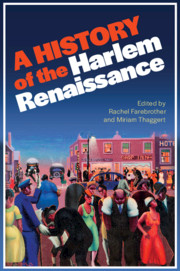


In the popular imagination, the Harlem Renaissance is closely associated with the Jazz Age, with rent parties, clubs, cabarets, jazz, and blues. Langston Hughes did much to cement such views of the period, announcing in his autobiography The Big Sea (1940) that “it was the period when the Negro was in vogue,” a spectacular cultural boom that came to a sudden halt with the onset of the Depression.1 In fact, the Harlem Renaissance, or New Negro Movement, was characterized by remarkable diversity that cannot be limited to a linear narrative of boom and bust, and more fiction by black authors was published in the 1930s than in the 1920s.2 The unprecedented flowering of black cultural production in visual art, literature, dance, and music from the late 1910s to the 1930s encompassed jazz and blues poetry by Sterling A. Brown and Langston Hughes, Zora Neale Hurston’s lyrical renderings of folk culture in the South, George Schuyler’s unusual blending of satire and science fiction in Black No More (1931), militant editorials in the Messenger, and modernist cover designs by such artists as Aaron Douglas and Laura Wheeler Waring.
From the outset, participants in the cultural awakening debated whether they were part of a movement and what that movement should be called; they also questioned the location, scope, and political implications of what some writers and intellectuals named the “Negro renaissance.” Alain Locke’s The New Negro (1925), a landmark anthology that brought together some of the most significant cultural figures of the era, including Countee Cullen, Rudolph Fisher, Zora Neale Hurston, Helene Johnson, Jean Toomer, Eric Walrond, and the artist Aaron Douglas, secured its canonical status by reinforcing the cultural nationalist agenda of the Harlem Renaissance. Locke sought to document a generational shift from white-authored representations that supplied a “mere external view [that is] … about the Negro rather than of him” toward “self-portraiture,” “self-expression and the forces and motives of self-determination.”3 Framing the anthology with a dedication to “the Younger Generation” and the score and lyrics of a line from a spiritual, “O, rise, shine for Thy Light is a’ com-ing,” Locke implied that his portrait of African American culture – which encompassed poetry, prose, drama, artwork, critical essays, art criticism, anthropology, folklore, and sociology – heralded a new era. For Houston A. Baker, Jr., the volume was “perhaps our first national book, offering not only a description of streams of tendency in our collective lives but also an actual construction within its pages of the sounds, songs, images, and signs of a nation.”4
Locke’s cultural nationalism chimed with James Weldon Johnson’s famous statement in his preface to The Book of American Negro Poetry (1922) that the “final measure of the greatness of all peoples is the amount and standard of the literature and art they have produced,”5 but plenty of their contemporaries were skeptical of such boosterism. Hubert Harrison, St. Crucian émigré and renowned Harlem radical, dismissed the idea of a “Negro Literary Renaissance” as the invention of “Greenwich Village neurotics” who exploited the vogue for black cultural expression “not for the black brothers’ profit but for their own” and remained “blissfully ignorant of the stream of literary and artistic products which have flowed uninterruptedly from Negro writers from 1850 to the present.”6 In his 1926 essay “The Negro-Art Hokum,” the novelist and journalist George Schuyler went so far as to condemn the very idea of “Negro art” for, as Darryl Dickson-Carr puts it, “unwittingly buying into the same racialist thinking as the Ku Klux Klan.”7 As well as courting controversy by calling the African American “merely a lampblacked Anglo-Saxon,” Schuyler saw little evidence of a cultural renaissance: “Eager apostles from Greenwich Village, Harlem, and environs proclaimed a great renaissance of Negro art just around the corner waiting to be ushered on the scene. … Skeptics patiently waited. They still wait.”8 Younger artists, who rejected racial propaganda in favor of defiant self-expression and established new, if short-lived, magazines such as Fire!! (1926) and Harlem (1928), often deployed the term “New Negro” in quizzical, not wholly flattering terms. In her August 1926 “The Ebony Flute” column for Opportunity magazine, Gwendolyn Bennett even noted that Rudolph Fisher fêted his newborn son as “the new Negro.”9
Notwithstanding such skepticism and sly, self-deprecating humor, the Harlem Renaissance was characterized by innovation and experimentation across a variety of disciplines and genres – in visual culture, magazines, poetry, drama, children’s literature, music, and dance. It was shaped, in often quite complex ways, by the Great Migration, the Red Summer (the name given to the anti-black violence of 1919), the emergence of Boasian anthropology, the Great War, and the Depression. These forces gave rise to some of the best known and most widely studied African American literature to emerge in the twentieth century, including Zora Neale Hurston’s Their Eyes Were Watching God (1937), Nella Larsen’s Passing (1929), Jean Toomer’s Cane (1923), and Langston Hughes’s poetry. The fragmentation and warping of familiar genres that is so distinctive of Cane, for instance, stems, at least in part, from what Kobena Mercer has called “an understanding of African American identity as something that has itself been ‘collaged’ by the vicissitudes of modern history.”10 Take, for example, the startling, surreal description of “eddying,” “swirling” blood overwhelming the “whitewashed”11 order of “Seventh Street” in Washington, DC. Toomer’s disorientating imagery at once captures the galvanizing impact of black migrants from the South upon modern urban culture12 and recalls the Washington, DC “race riot” of 1919, in which African Americans resisted violent state repression, prompting leftwing newspapers like the Crusader and the Messenger to speculate on “the potential for revolutionary action in the display of black militancy.”13
The literature, artwork, and music that emerged from the Harlem Renaissance or New Negro movement has occupied a central position in African American literary studies. As Cheryl A. Wall has explained, the first period courses in African American literature in the USA focused on the Harlem Renaissance at a time (the early 1970s) when “the very idea of a ‘period’ course in black literature seemed anomalous.”14 The reasons for this abiding fascination are complex, but many of the significant developments or “turns” in the field (relating to debates about the politics of representation, vernacular theories of black literature, black radicalism, transnationalism, feminism, and performance studies) have been developed through close analysis of Harlem Renaissance cultural expression. To take just one example, the vernacular-centered literary criticism pioneered by Henry Louis Gates, Jr. and Houston Baker, Jr. in the 1980s cast figures like Hurston and Hughes as exemplars of larger patterns and preoccupations within African American literature. In The Signifying Monkey: A Theory of African-American Literary Criticism (1988), for instance, Hurston’s Their Eyes Were Watching God is showcased as a prime example of “the speakerly text,” a term developed to describe a long tradition of black writers exploring the creative and political “possibilities of representation of the speaking black voice in writing.”15
Essays such as W. E. B. Du Bois’s “Criteria of Negro Art,” Langston Hughes’s “The Negro Artist and the Racial Mountain,” and George Schuyler’s “The Negro-Art Hokum” – which make respective cases for art as propaganda, the cultural distinctiveness of black American art, and the absence of any fundamental differences between black and white American art – lay bare some of the key disagreements that continue to animate debates about the politics of representation. Marita Bonner’s 1925 Crisis essay “On Being Young – a Woman – and Colored,” with its eloquent insistence that any examination of the relationship between art and politics must attend to questions of sexuality and gender, anticipates critical approaches developed by pioneering black feminists, including Barbara Christian, Akasha (Gloria) Hull, Deborah E. McDowell, Claudia Tate, and Cheryl A. Wall, from the 1970s. Indeed, an enduring tendency to sideline Bonner and other black women writers in critical accounts of Harlem Renaissance debates about “art or propaganda” signals the continuing salience of the black feminist project of “engendering the Harlem Renaissance [by] undoing perimeters that exclude women and their writing.”16
This sense of debate – of revising and remaking a renaissance – is also evident in a long critical tradition of questioning the terminology, location, and time period of the movement. Sterling A. Brown was famously hostile to the term “Harlem Renaissance” because he viewed Harlem as “the show-window, the cashier’s till” for a broader “New Negro movement [that] had temporal roots in the past and spatial roots elsewhere in America.”17 His criticism of a tendency to conflate the New Negro Renaissance with Harlem at the expense of more nuanced understanding of a cultural movement that extended from major urban centers like Washington, DC, Chicago, and New York to the urban and rural South, and the rural Midwest became a familiar refrain as critics discussed the merits of such terms as the Harlem Renaissance and the New Negro Renaissance. In 2013, Davarian Baldwin and Minkah Makalani’s Escape From New York: The New Negro Renaissance Beyond Harlem situated black modernist literature and visual arts “within a much broader field of political resistance and cultural revolution that extended far beyond Harlem”18 to Mexico City, Chicago, Havana, Kingston, Berlin, Colón, Paris, and London. In that collection, analysis of the New Negro movement as part of broader global political and cultural currents was developed in tandem with an examination of political, cultural, and intellectual aspects of the movement that have been obscured because of limiting assumptions about class, gender, and time period.
As Andrew Fearnley reminds us, the “‘Harlem Renaissance’ was neither a term nor a concept used by those who lived and wrote during the years it is now said to describe.”19 Most writers, artists, musicians, and performers conceived of the era in terms of aesthetic choices, political alignments, and generational differences. Reference to the Harlem Renaissance became more prevalent as historical notions of cultural periodization took hold in the academy from the 1940s, but it was institutionalized in academic scholarship in the 1970s, against the backdrop of the establishment of Black Studies programs across the USA.20 It was in this context, according to Arnold Rampersad, that Nathan Huggins’s landmark book Harlem Renaissance (1971) “virtually invented a sub-field in American and African-American intellectual history.”21 Later, David Levering Lewis’s best-selling cultural history When Harlem Was in Vogue (1981) popularized a particular version of the Harlem Renaissance, “which has tended to emphasize U.S.-bound themes of cultural nationalism, civil rights protest, and uplift in the literary culture of the ‘Harlem Renaissance.’”22
These influential monographs must be read alongside the writings of prominent black feminist scholars whose path-breaking research helped to redefine the period. In a 2001 retrospective on the Harlem Renaissance and how gender impacted the scholarly reconstruction of the period, Cheryl A. Wall surveys the scant engagement with women writers in the tomes by Nathan Huggins and David Levering Lewis, and the new critical frameworks developed by black feminist scholars to interpret writers like Zora Neale Hurston and Nella Larsen. In so doing, she demonstrates that “feminist interventions have changed our sense of what the Harlem Renaissance was.”23 Arguably, there is no other period in African American literary history that has benefitted so richly from the black feminist study of women writers in the 1970s and 1980s. After years of critical neglect, Jessie Fauset, Zora Neale Hurston, and Nella Larsen now occupy a central place in the canon. In the wake of this transformative scholarship, Hurston became so pivotal to black feminist writing in the 1980s and early 1990s that Ann duCille went so far as to coin the term “Hurstonism” to describe a cultural phenomenon that itself provoked critical commentary from Hazel Carby and Michele Wallace, among others.24 In an ironic echo of the dismissive reviews of Hurston’s fiction by Sterling A. Brown and Richard Wright in the 1930s, Carby turned to politics to explain Hurston’s popularity, claiming that “representation of African-American culture as primarily rural and oral” facilitated a retreat from engagement with racism and structural inequality in late twentieth-century US society.25
Since the 1920s, retrospective accounts of the Harlem Renaissance have continued to debate the terminology, focus, and political and cultural impact of the movement. Langston Hughes’s description of the Harlem Renaissance in The Big Sea as a “vogue” – propelled into motion by the “pre-Charleston kick” of the popular musical Shuffle Along before it “spread to books, African sculpture, music, and dancing”26 – sought to take stock of the movement with the benefit of hindsight. Looking back at the 1920s from the perspective of 1940, when social protest fiction by the likes of Richard Wright was in the ascendant, Hughes presented the Harlem Renaissance as somewhat superficial because it neither disrupted the de facto segregation of New York nor impinged upon the lives of working-class American Americans. “The ordinary Negroes hadn’t heard of the Negro Renaissance,” he famously wrote. “And if they had, it hadn’t raised their wages any.”27 In fiction, Wallace Thurman’s Infants of the Spring (1932), a roman à clef about a whole household of aspiring artists, singers, and writers from the younger generation, tells a rather pessimistic story of failed promise, decadence, and untapped potential, which culminates in the suicide of the most talented artist of the group, the queer painter Paul Arbian. Presenting his suicide as a kind of performance piece, Paul has decorated the “dingy calcimined wall” of his bathroom with a group of his portraits and “carpeted the floor with sheets of paper” from his unfinished novel before slitting his wrists.28 Sadly, this attempt to garner publicity for his work is doomed because the manuscript has turned into an illegible, “sodden mass” (186). A “gruesome yet fascinating spectacle” (185), Paul’s suicide accords with Thurman’s broader critique of the destructive impact of the “white light of publicity” upon black artists (128).
The twenty-first century has witnessed a series of remarkable “discoveries” of previously unpublished or lost works by significant figures, which capture the shifting parameters of Harlem Renaissance studies, its endless capacity to make and remake itself. The list of newly found material includes Zora Neale Hurston’s Barracoon (composed in 1927 and 1931, and published in 2018), Claude McKay’s Amiable with Big Teeth (written in the late 1930s and published in 2017), and Romance in Marseille (“buried in the archive,” according to its publisher, and published in 2020), Edward Christopher Williams’s The Letters of Davy Carr (published anonymously in the Messenger in 1926 and republished in 2004 under the title When Washington was in Vogue), and several Langston Hughes poems written on the flyleaf of the 1929 An Anthology of Revolutionary Poetry (published in Poetry in 2009). These posthumously published texts underline how conceptions of the Harlem Renaissance have been shaped and reshaped by an urgent project of recovering and honoring a lost, neglected archive, but they also embody what William J. Maxwell has seen as a “transtemporal turn” that is attuned to the cultural and political possibilities of “various models of elongated renaissance time.”29
In this spirit, the Harlem Renaissance – which was perhaps the first time when it was possible to discern the “emergence of an African-American literary and artistic field as such, with many competing positions and new forms of institutional support”30 – has continued to inspire artists, filmmakers, and writers across the twentieth and into the twenty-first century. In an essay on “Richard Bruce Nugent and the Queer Memory of Harlem,” Dorothea Löbberman concentrates on “queer moments of ‘touch’ between the early and late twentieth century,” analyzing Nugent’s novel Gentleman Jigger, which was begun in the 1920s, but published only in 2008, and the “queer temporalities” of films about the Harlem Renaissance, such as Isaac Julien’s Looking for Langston (1989) and Brother to Brother (2004), directed by Rodney Evans.31 This kind of creative reinterpretation of the Harlem Renaissance, which overlays diverse referents and historical moments to disrupt linear chronology, is not limited to narratives about queer Harlem. Racial passing narratives of the 1920s have inspired diverse creative responses from Heidi Durrow’s subtle revision of Larsen’s Passing in her novel about interracial girlhood, The Girl who Fell From the Sky (2010), to the inventive amalgamation of the genres of the passing novel and detective fiction in Mat Johnson’s and Warren Pleece’s graphic novel Inconegro (2008) to the narrative hints of Passing in Karla F. C. Holloway’s mystery tale A Death in Harlem (2019). LaShonda Katrice Barnett’s historical novel Jam on the Vine (2015) has explored the transnational dimensions of the New Negro movement in a manner that resonates with contemporary debates about black masculinity, the New Jim Crow, and mass incarceration.
Creative re-imaginings of the Harlem Renaissance initiate a complex process of re-reading, which demands engagement with the specific historical and cultural contexts from which New Negro culture emerged and a fluid, capacious critical framework for analyzing its reception, revision, and reinterpretation. The enduring potency of Harlem Renaissance literature – the protean qualities that prompt contemporary poets such as Evie Shockley to draw upon black feminist modernist writers like Anne Spencer to disrupt narratives of progress32 underscores the extent to which formulations of the New Negro were characterized by fluidity and dynamism from the outset.
Even those writers associated with the more conservative wing of the Harlem Renaissance placed considerable stress upon the inner diversity and dynamism of black culture as they defined the contours of a cultural renaissance. In the past few decades, Alain Locke has quite rightly been taken to task for scant engagement with “the material foundations of racism,”33 which included a studied refusal to acknowledge Harlem’s position as a transnational hub for black militancy and radicalism that flourished in the wake of the October Revolution of 1917 and the Red Summer of 1919.34 Yet Locke’s careful curation of the “ripening forces as culled from the first fruits of the Negro Renaissance”35 in The New Negro entailed insistent emphasis upon diversity. For Locke, Harlem – a transcultural black capital galvanized by the migration of black southerners to New York, the relocation of downtown black New Yorkers into what “is – or promises at least to be – a race capital,”36 and immigration from across the black diaspora, most notably the Caribbean37 – symbolized a broader process of cultural reconfiguration: “what began in terms of segregation becomes more and more, as its elements mix and react, the laboratory of a great race-welding.”38 This famous statement is typical of Locke’s glancing engagement with segregation and racism, but it also encapsulates his characterization of the New Negro as a figure in transition, in process, and in the making. In retrospective discussions of the 1920s, Locke consistently defended what he saw as the guiding philosophy of the New Negro movement: fluid, dynamic cultural representations that resisted what James Weldon Johnson called the “fixing effects”39 of US racial ideologies based upon segregation and separation.
Over and again, Locke identified fluidity and expansiveness as foundational concepts: “The most deliberate aspect of the New Negro formulation – and it is to be hoped, its crowning wisdom – was just this repudiation of any and all one-formula solutions of the race question.”40 Taking issue with blanket dismissals of the New Negro movement as politically quietist, he asserted that the “indefiniteness” of the figure was “due to a deliberate decision not to define the ‘New Negro’ dogmatically.”41 Looking beyond Locke, a stress upon dynamism and cultural complexity emerges as a cardinal principle in Harlem Renaissance expression more broadly. In her landmark essay for Nancy Cunard’s Negro (1934) anthology, “Characteristics of Negro Expression,” for instance, Zora Neale Hurston hailed improvisation and assemblage as guiding principles of black cultural expression. Hurston’s essay, which examines drama, dialect, the jook, dancing, and folklore, argues that African American culture comprises “segments” that do not quite cohere: “There is always rhythm,” she writes, “but it is the rhythm of segments. Each unit has a rhythm of its own, but when the whole is assembled it is lacking in symmetry.”42
Notwithstanding such capaciousness, there is sometimes a tendency to be somewhat dismissive of the field of Harlem Renaissance studies. Perhaps this is because, when compared to other fields of African American literature, the stakes of the debate that animated both the Harlem Renaissance and its subsequent scholarly analysis were not life and death as is the case for other period studies of African American literature. The Harlem Renaissance debated not freedom or incarceration, mortality and memory, but rather “art or propaganda.” Yet there is something troubling about dismissing Harlem Renaissance studies – whether one calls it that or the more “serious” name of the New Negro movement. The period was the first in African American literary history in which artists and writers boldly claimed and exhibited, collectively, a self-confidence in their representation of blackness that would not be replicated until, arguably, the Black Arts Movement of the late 1960s and 1970s. Hughes’s statement, in “The Negro Artist and the Racial Mountain,” that the younger artists “stand on top of the mountain, free within ourselves”43 – an image that is suggestive of the liberatory possibilities of self-expression – prefigures Black Arts Movement scholar Stephen Henderson’s recognition that poets such as Amiri Baraka and Larry Neal value “the process of self-definition made clearer and sharper” because it could be “raised to the level of revolutionary thought.”44
For all the emphasis upon failure in early scholarship, the Harlem Renaissance has been, to some extent, a victim of its own success. As Cherene Sherrard-Johnson notes, the Harlem Renaissance is a powerful “brand” that “continues simultaneously to conjoin utopia and lament.”45 Even so, the romanticized story of the Harlem Renaissance (and the ensuing suspicion of the field that has followed in its wake) has left its imprint on critical interpretations of the period. For one thing, the assumption that publication was an easy feat for the black writer was not correct, as Langston Hughes reminds us: “All of us know that the gay and sparkling life of the so-called Negro Renaissance of the ’20s was not so gay and sparkling beneath the surface as it looked.”46 Langston Hughes was one of the few Harlem Renaissance writers who managed to make a living as a writer, and the economic precariousness of his position is on full display in The Big Sea, which is animated by a sustained preoccupation with the various ways that a lack of money curtailed artistic experimentation.47 Such precarity was even more acute for black women writers and artists. The writer, artist, educator, and activist Gwendolyn Bennett, for instance, faced considerable constraints upon her ambitions as an artist, including family demands, economic uncertainty, FBI surveillance, and the debilitating effects of what Jessie Fauset, in a 1922 essay entitled “Some Notes on Color,” called “the teasing uncertainty” generated by racism.48 Fauset’s poignant observations about how “the puzzling, tangling, nerve-wracking consciousness of color envelops and swathes us”49 resonate with Bennett’s anxious letters to Langston Hughes about her artistic ambitions when she was studying in Paris in the mid-1920s, and her determined efforts, in “The Ebony Flute” column for Opportunity (1926–1928), to foster a collaborative, nurturing artistic community by way of “literary chit-chat and artistic what-not.”50 More broadly, in spite of the popular fascination with “the gay 20s,” many of the now canonical books of the period – including Larsen’s Quicksand and Passing, and Thurman’s The Blacker the Berry and Infants of the Spring – are populated with characters suffering from trauma, depression, and melancholy. Another paradox is that the most humorous writer of the period, Rudolph Fisher, was until recently one of the least studied.
The scope of scholarship on the Harlem Renaissance has been transformed by the insights of transnationalism and diaspora studies, queer theory, performance theory, feminisms, leftist criticism, and periodical studies, among others, and each generation has re-made the field in line with its own preoccupations. Such reassessments have prompted some critics to jettison the familiar but contested moniker the “Harlem Renaissance” because of its cultural nationalist and exceptionalist connotations.51 For all of the debate about terminology, there is a durable utility to this particular phrase. As Sherrard-Johnson notes, the Harlem Renaissance remains useful as “a field-defining term,” “not only because of its currency in academic and popular culture, but because of its suppleness.”52 A History of the Harlem Renaissance aims to expand the boundaries of the subject further in ways that reflect developments in contemporary scholarship: by examining the significance of the eclecticism and variety of Harlem Renaissance expression in literature, visual culture, popular culture, music, dance, and politics; by going beyond well-known genres to explore genre fiction, film, children’s literature, the roman à clef, the bildungsroman, biography, and the short story; by revising conventional assumptions about the period, such as location, time period, and terminology; and by attending to tensions and fissures that animate New Negro culture and politics, especially with reference to gender and sexuality. Substantial attention is also paid to the performative aspects of the period (such as dance and music) and the art and aesthetic practices of the movement. Taken as a whole, the volume provides new accounts, interpretations, and critical approaches, which attend to the diversity of the period, its distinctive mix of the militant, the satirical, the lyrical, and the modern. Given the range and scope of black expression in the Harlem Renaissance period, and its multiple cultural and political legacies, the volume could hardly aim for comprehensiveness. Instead, it seeks to capture in its dynamics some of the ways in which contemporary critics participate in a long tradition of revising, re-reading, and remaking the Harlem Renaissance.
A central aim of A History of the Harlem Renaissance is to reconsider the significance of genre and form to Harlem Renaissance cultural expression. In its attention to magazines, letters, sculpture, fine art, dance, the essay, the manifesto, children’s literature, the roman à clef, the Bildungsroman, the magazine, drama, book jacket designs and illustrations, and newspaper advertisements, the History seeks to at once encapsulate and analyze the eclecticism of Harlem Renaissance cultural expression. Early scholarship on the Harlem Renaissance tended to privilege fiction and vernacular poetry over other genres, but more recent criticism has been attuned to the political, social, and aesthetic significance of writers’ and artists’ formal choices. Much of this scholarship has explored the dynamic interplay between word and image, especially in collaborative illustrated anthologies and magazines, including Opportunity, The Crisis, Fire!!, and The New Negro.53 This focus on the visual culture of the period has emerged alongside a growing interest in the politics of genre in black Atlantic literature.54
Inspired by these new interpretative foci, the volume is animated by a concerted effort to remap and reconsider conventional ideas about the New Negro movement and to enrich the study of African American, US, and black diasporic literatures by offering diverse approaches and readings. This commitment to various critical approaches also characterizes the treatment of specific authors and topics, which are explored across the whole collection from multiple critical perspectives, including gender theory, queer theory, transnationalism and diaspora studies, and performance theory. Although some chapters are devoted to a single author or topic, individual works or authors are often examined from more than one angle, an approach that takes it cue from James Weldon Johnson’s insistence, in Black Manhattan (1930), that multiple perspectives are fine “so long as one view is not taken to be the whole picture.”55
The volume is divided into four sections that spotlight how a project of remaking and reinterpretation animates both New Negro cultural expression and the contributors’ readings of the New Negro Renaissance. The first section, “Re-reading the New Negro” provides a variety of interpretative lenses through which to reassess the Harlem Renaissance. Daniel G. Williams takes aim at an enduring tendency to view nationalism as an ideology based on notions of purity and segregation, addressing cultural nationalism and cosmopolitanism in works by Duke Ellington, Jean Toomer, and Zora Neale Hurston. Clare Corbould details how New Negro poets explored the topic of enslavement, creating in the process a new archive of enslaved people’s experiences and narratives. Kathleen Pfeiffer examines the complex ways in which interracial friendships shaped some Harlem Renaissance literature, with a particular focus on Jean Toomer and Waldo Frank, and Nella Larsen and Carl Van Vechten. Mark Whalan assesses the Bildungsroman as an important site for African American authors to consider the Jim Crow logics of what childhood and maturation meant in the USA. In the final chapter of this section, Caroline Goeser turns her attention to visual artists such as Aaron Douglas, Gwendolyn Bennett, and Richard Bruce Nugent, who worked alongside writers, cultural leaders, editors, and publishers to radically re-picture Black American identity – to make the modern Black.
The second section, “Experimenting with the New Negro,” explores various kinds of innovation in New Negro writing and its cultural afterlives, with a particular focus on black women writers who have tended to occupy a marginal position in debates about the avant-garde. Sonya Posmentier tracks the lasting influence of Harlem Renaissance writers on Gwendolyn Brooks’s poetry, tracing in Brooks’s work the development of a tradition of black migratory poetics: poetry that formally and imaginatively enacts human transnational movement. Sinéad Moynihan focuses on romans à clef of the Harlem Renaissance. She argues that Wallace Thurman’s Infants of the Spring (1932) and Richard Bruce Nugent’s Gentleman Jigger (2008), read together, foreground the tensions between originality and derivativeness, individual “genius” and collaboration that were being negotiated more broadly in modernist art of the period. Fionnghuala Sweeney interprets Eslanda Goode Robeson’s Paul Robeson, Negro (1930) as a rare instance of modernist biography, one in which the politics of manhood sits center stage. She situates the narrative as a pioneering act of authorship that engages with broader debates about the politics of art – by constructing Paul Robeson as an exemplary masculine subject – while also introducing a shadow narrative that lays bare the hidden costs of such gendered formulations of black cultural and political leadership. Through analysis of poetry by Angelina Weld Grimké, Gwendolyn Bennett, and Mae V. Cowdery, Maureen Honey contends that the erotic lyric or erotically charged pastoral verse largely defined for New Negro women poets what it meant to be a modern (and modernist) writer. Finally, Katharine Capshaw explores the variety of literature available to young people during the Harlem Renaissance, focusing on periodicals, community theater, black-owned publications, and mainstream publishing houses with an interracial audience. Texts embraced a new vision of African American children as sophisticated, capable, knowledgeable, and courageous; because literacy rates for young people often outmatched those of adults, children were imagined as cultural leaders who would help reinvent the black community.
The third section, “Remapping the New Negro,” intervenes in critical debates about the significance of place in Harlem Renaissance culture, juxtaposing analyses that explore the movement in relation to the transnational, the national, and the local. It begins with James Smethurst’s examination of the interplay between black political and cultural activists in Britain and the USA during the New Negro era and the creation of black internationalist networks as a subset of what he calls the Black Bolshevik Renaissance. Jak Peake turns to Harlem, noting that New York in this period was part of a Caribbean network that is both represented, and partially downplayed, in New Negro writing and historiography. He analyzes a rarely discussed Caribbean backstory to the symposium on Negro art that W. E. B. Du Bois ran in The Crisis through much of 1926. Noelle Morrissette interprets James Weldon Johnson’s God’s Trombones (1927) as an endeavor to draw upon “symbols from within” African American folk and vernacular forms, and also from within the nation’s regions, to advance a national African American culture. Turning from the national and the regional to the local, Jonathan Munby argues that Rudolph Fisher – who was unique among Harlem Renaissance writers in making Harlem itself the exclusive focus of his writing – demonstrated keen powers of social observation in revealing how class, regional, phenotypical, and generational distinctions defined Harlem.
The final section, “Performing the New Negro,” reaches beyond literature to examine the performative aspects of the period (such as dance and film) and the visual art and aesthetic practices of the movement. There is a particular focus upon interartistic texts and the productive creative tensions generated by the interplay of different aesthetic modes and techniques. Mariel Rodney examines Hurston’s early plays, arguing that they are a testing ground for the theories about culture she would later develop in her novels and essays. Hannah Durkin offers another revisionist reading of Hurston, exploring Hurston’s film footage of the US South in counterpoint to her first ethnography Mules and Men (1935) to elucidate some of the connections between Hurston’s anthropological and creative work. Andrew Warnes examines the literary portrayal of music to illuminate the term “orinphrasis,” or the description of sound or music in narrative or poems. Rachel Farebrother studies the literary representation of dancers, particularly child dancers, in Harlem Renaissance fiction and visual culture, arguing that this focus can help explore anxieties about generational conflict, gender, sexuality, tradition, and urban life. Wendy Martin’s chapter provides an overview of the role of jazz during the period, noting the musical genre’s beginnings in African music patterns and its migration to unexpected areas such as Chicago and California. Shane Vogel details Alain Locke’s contributions to value theory and its relationship to the overall cultural project of the Harlem Renaissance. Vogel argues that Locke viewed the New Negro Renaissance and the transvaluation of black art – that is, the re-estimation of its value according to new principles of judgment – as one moment in a deeper and ongoing axiological transformation. To do so, the essay looks at Locke’s writings on African American spirituals and his “cultural retrospectives” of the 1930s and 1940s (annual reviews that took stock of the year’s work in black themes) as exemplary instances of such transvaluation. In these writings, Locke continually revised the significance and boundaries of the Harlem Renaissance.
The volume closes with an afterword by one of the leading scholars of the study of the Harlem Renaissance, Deborah McDowell, whose research has been instrumental in shaping the field. Using her sharp feminist eye, McDowell assesses the chapters in the volume and examines what, collectively, they portend for the future of Harlem Renaissance or New Negro studies.
As we approach nearly a hundred years of reading about the New Negro, we need to understand how new interpretations of the New Negro movement can be woven and threaded with, or challenge, the other, more familiar versions of the Jazz Age to anticipate what a new century augurs for the study of “the New Negro.” Perhaps we should view the term “renaissance” not as a limiting description of the period of black creativity but in its more literal meaning of revival or re-birth. For the New Negro Renaissance, to combine the terms by which the period is best known, is in fact still being renewed and re-read. The twenty chapters that follow capture something of the excitement of this contemporary revision. The New Negro Renaissance or New Negro Movement or Harlem Renaissance has lived up to its name: it is continually being re-born, re-made, and revisited.
