





1. Introduction
Criticism is a social action that has generally been considered as a face-threatening act in (im)politeness research (Brown & Levinson Reference Brown and Levinson1987). Given its potential threat to hearers, speakers use various on- and off-record strategies for expressing criticism, such as negative evaluations, corrections, irony, tautologies, rhetorical questions, etc., depending on the interpersonal relationship between interlocutors (Brown & Levinson Reference Brown and Levinson1987: 213–226). Researchers focusing on criticism in institutional contexts such as workplace settings have systematically identified this speech act as sensitive, dispreferred and face-threatening (Haugh & Chang Reference Haugh and Chang2019). In contrast, little empirical evidence can be found for recipients’ responses to criticism, as existing studies mainly address the dynamics and the construction of responses to criticism (e.g. Nguyen Reference Nguyen2005; Don & Izadi Reference Don and Izadi2013). In the present study, we aim to extend empirical research on criticism and replies to criticism in workplace contexts by addressing their production in French using an experimental task (Discourse Completion Task). This investigation will allow us to: (I) provide further empirical evidence on this under-researched topic in French; (II) analyse the most frequent combination of speech acts as ways to criticize and reply to criticism in French; (III) illustrate the role of specific upgrading and downgrading, external and internal modifiers of criticism. More generally, our study provides complementary data to corpus-based empirical research dealing with criticism in a workplace context.
The analysis presented in this article complements a quantitative analysis performed on the same dataset (Bersier et al. Reference Bersier, Mazzarella and Zufferey2025). By using experimental scenarios, we created a variety of settings in which conflictual situations occurred during informal workplace interactions. The quantitative analysis demonstrated that variables at the core of politeness theory, such as the notions of power and distance, have a joint influence on how criticisms are produced. We observed that people produce more direct criticisms when they are in a hierarchically superior position and when the addressee is a distant rather than a close collaborator. In addition, we observed that women (but not men) become more direct with age. However, none of these factors was predictive of the replies to criticism, which seemed to be rooted in the situational context and the personality of participants. Drawing upon these findings, our quantitative analysis enabled us to pinpoint important general tendencies characterizing the production of criticism in French in a workplace context. In coding the data resulting from the elicitation task to perform a quantitative analysis, only coarse-grained categorizations could be made, such as binary distinctions between direct and indirect acts. Yet, in the elicitation data, participants used many fine-grained strategies to fulfil their interactional goals. In this article, we use the over 1600 elicited criticisms and replies to criticisms produced by the participants in our experiments to illustrate these strategies and shed complementary light on the face-threatening speech act of criticizing.
Complementing a quantitative analysis with qualitative observations has many advantages. First, the most prototypical realization patterns of the act of criticizing and replying to criticism can be analysed, as well as the internal and external upgrading and downgrading modifications (as they are called in the CCSARPFootnote 1 by Blum Kulka & Olshtain Reference Blum-Kulka and Olshtain1984) at play when expressing both speech acts. Second, favoring a more in-depth analysis of specific occurrences allowed us to focus on the complex interplay among various contextual factors that may influence the stylistic features of these acts. These factors include the interactional aims, the interpersonal relationship and the construction of the intervention, all of which were considered in assessing the illocutionary force of an intervention. Third, a qualitative perspective illustrates the more general role of context in the production of these speech acts. We were therefore able to show which situations lead to distinct strategies for criticizing and replying to criticism.
2. Defining and Empirically Analysing Criticism
Criticisms can often not be reliably distinguished from complaints, as they are often performed using very similar linguistic strategies (see Nguyen Reference Nguyen2005; Decock and Spiessens Reference Decock and Spiessens2017). In recent literature, the necessity to separate them has been questioned (Meinl Reference Meinl2010). In line with previous research (Drew Reference Drew1998), Rodriguez (Reference Rodriguez2022a: 69) used the term “troubles-talk” to designate “troubles-related social actions” including speech acts such as criticism, complaint, reproach, blaming and accusation. Despite similar linguistic forms, Pillet-Shore (Reference Pillet-Shore2016) and Haugh and Chang (Reference Haugh and Chang2019) insist on the necessity to disentangle the action of complaining from the action of criticizing from a theoretical perspective. This distinction should help analysts to be more productive when discussing both notions, but also interactional participants, who (must) have some reliable ways of recognizing an utterance as either a criticism or a complaint, especially in institutionalized contexts where such a distinction can avoid misunderstandings (Pillet-Shore Reference Pillet-Shore2016). In order to maintain a distinction between these acts, we define the notion of criticism as “a negative evaluation of a person or an act for which he or she is deemed responsible” (Tracy et al. Reference Tracy, Van Dusen and Robinson1987: 87), whereas the notion of complaint is defined as a way to “express suffering or discontentedness as a result of experiencing some trouble” (Pillet Shore 2016: 54). Even though both definitions encompass a form of negative evaluation, this distinction seems to be justified from an empirical perspective. Indeed, empirical studies (Pillet-Shore Reference Pillet-Shore2016; Haugh & Chang Reference Haugh and Chang2019) have reported that one can criticize without complaining while complaining always implies a degree of criticism. In our data analysis, given the intrinsic nature of empirical data and the coding scheme used (see section 3), we may have considered as criticisms some occurrences that other researchers using distinct coding schemes may have categorized as complaints.
As some researchers do not distinguish speech acts of complaining and criticizing, and given that relevant work was conducted on complaints with respect to the present study, we include in this section relevant literature including both notions. Previous quantitative research has shown that the production of criticisms and complaints is particularly impacted by power relations and social distance. Tracy and Eisenberg (Reference Tracy and Eisenberg1990) found that English-speaking participants in a superior role prioritized message clarity over politeness when delivering direct criticism, yet men showed more concern for politeness than women when they were in a subordinate role. In their study of complaints involving French and German-speaking participants, Kraft and Geluykens (Reference Kraft and Geluykens2002) found that social distance shapes the use of mitigation strategies in complaints. The higher the social distance, the more often downgrading external and internal strategies were used to soften the impact of a complaint.
Qualitative analyses on complaining have been conducted in the private sphere (Rodriguez Reference Rodriguez2022b), healthcare settings (Ruusuvuori and Lindfors Reference Ruusuvuori and Lindfors2009), digital communication (Vásquez Reference Vásquez2011), and work environments (Vöge Reference Vöge2010; Ruusuvuori Reference Ruusuvuori, Asmuß, Henttonen and Ravaja2019). Vöge (Reference Vöge2010) and Ruusuvuori (Reference Ruusuvuori, Asmuß, Henttonen and Ravaja2019) concentrated on the complaining activity in the workplace. Both studies shed light on the parameters influencing the entry into a complaint, being either facilitated by the institutional identity of one speaker or by the facial expressions and laughter accompanying a complaint. Most empirical research on criticizing also relies on qualitative data, predominantly in institutionalized contexts. Asmuß (Reference Asmuß2008), Copland (Reference Copland2011), and Scheuer (Reference Scheuer2014) focused on appraisal interviews, where supervisors and experts give feedback on work performance. Their findings suggest that the acceptance of criticisms is linked to the way supervisors initiate them and how employees orient toward them. Moreover, Copland (Reference Copland2011) demonstrated that criticisms are considered contextually as “reasonable” given the generic conventions (feedback requires the evaluation of behaviour) surrounding this activity. Another important avenue for qualitative research on criticizing is the academic context (Itakura and Tsui Reference Itakura and Tsui2011; Diani Reference Diani2017). In parent-teacher interviews, Pillet-Shore (Reference Pillet-Shore2016) found that criticisms were formulated meticulously, but teachers had to design their criticism so that they appeared as student-negative evaluations and were distinguished from complaints by parents. Lastly, Pino (Reference Pino2016) focused on staff-patient interactions. Similar to the academic context, Pino’s findings suggest that in healthcare settings, professionals choose indirect ways of criticizing by means of anecdotes, etc.
Finally, other studies have combined qualitative and quantitative approaches. For example, Meinl (Reference Meinl2010) and Decock and Spiessens (Reference Decock and Spiessens2017) focused on the expression of complaints in digital communication cross-culturally. In the field of computer-mediated communication (CMC), Meinl (Reference Meinl2010) used naturally occurring data of eBay traders. Her findings demonstrated a greater directness in CMC compared to spoken discourse. In their corpus of business computer-mediated communication (CMC) complaints issued from a Belgian multinational, Decock and Spiessens (Reference Decock and Spiessens2017) reported different results from Meinl (Reference Meinl2010) on the linguistic (in)directness scale, with more indirect complaining strategies consisting mainly of a prototypical formulation in the form of an expression of dissatisfaction followed by a request for repair. These diverging results may be explained by the fact that customers’ complaints in Decock and Spiessens’ study were expressed with a clear goal (the repair or compensation for an expectation that was not met). In contrast, eBay users are anonymous and do not expect any repair or compensation, which increases their degree of directness and their use of upgrading strategies. Using DCT measurements for analysing the speech act of complaint, Olshtain and Weinbach (Reference Olshtain, Weinbach, Verschueren and Bertuccelli-Papi1987) and Chen et al. (Reference Chen, Chen and Chang2011) pointed out that complaints mainly co-occur with other speech acts such as requests, warnings or threats.
In short, empirical studies using a quantitative approach for analysing the speech acts of complaint and criticism revealed that relational factors (power relation and social distance) and individual factors (gender, age) mainly impact the production of these acts, while their perception appears to be impacted by their semantic content and their linguistic (in)directness. Qualitative studies illustrated how the setting in which the act is performed impacts both its production and perception. Regarding the combination of quantitative and qualitative methods, results pointed out that complaints and criticisms mostly co-occur with other speech acts, as a larger “speech act set” (Murphy and Neu Reference Murphy, Neu, Gass and Neu1996). This is a point we will also investigate in this article.
3. Source of Data for the Qualitative Analysis of Criticism
The present study focuses on data gathered using a Discourse Completion Task (DCT) in French with 80 participants recruited through the online platform Prolific (Prolific, Oxford, UK 2022). Among these, 40 participants continued short scenarios in which they had to produce criticisms, while 40 participants had to reply to criticisms formulated in the scenarios. Participants included 51 men, 26 women and 3 non-binary individuals, ranging from 19 to 67 years old (M = 33.15; SD = 15.20). All participants were native French speakers residing in France and came from diverse work environments. Participants were compensated for their participation, which lasted about 45 minutes. There was no time limit imposed, and all participants provided informed consent before starting the experiment.
Data gathered by means of a DCT allowed us to identify a wide range of linguistic strategies used in workplace interactions. However, this instrument is also limited, as the data resulting from a written DCT lack some key features of face-to-face interactions and appear to provide shorter and more formal utterances, given the written nature of the task and the limited space available for the missing utterance (Jucker & Staley Reference Jucker, Staley, Culpeper, Haugh and Kádár2017). In addition, as Golato (Reference Golato2003) pointed out, this method elicits responses corresponding to what people think they would say in a given situation rather than what they actually say. Nonetheless, a DCT can still be considered as an effective elicitation tool complementing data gathered in natural contexts. The present DCT also enabled the identification of the various ways in which people express criticism and replies to criticism in French. This large amount of data gives the analyst the opportunity to observe many instances of the phenomenon under investigation.
The scenarios used in the DCT represented typical conflictual situations at work. To avoid potential effects of speaker gender, all characters (addressee and addresser) were presented in our scenarios as males. Participants read 20 scenarios, designed to manipulate two variables: power (hierarchical or equal) and distance (close or distant), resulting in four conditions (e.g., low power and close relation) with five scenarios for each condition. The scenarios are illustrated in (1) for the production of criticism and in (2) for replies to criticism in the English translation. The full list of scenarios is available on OSF.
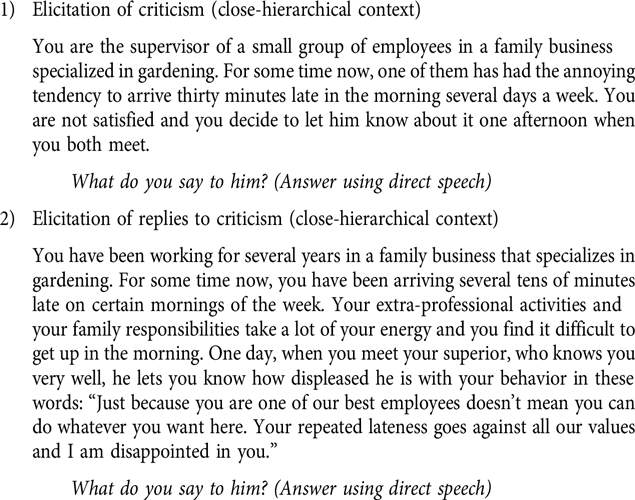
In the scenarios eliciting criticism, both the power relation and social distance were manipulated. Power was manipulated by instructing participants to imagine themselves either as a superior criticizing a subordinate (high power) or as a colleague criticizing another colleague (equal power). Social distance was manipulated by changing the proximity between the two characters (close/distant), specified by the size of the company and/or the frequency of contacts between them. In the scenarios eliciting replies to criticism, participants were asked to reply either from the perspective of a subordinate replying to a (close/distant) superior (low power) or a colleague replying to another (close/distant) colleague (equal power). Participants responded at the end of each scenario following the prompt “What do you say to him?” within a limit of 280 characters. We used this limit based on the data gathered in a pilot study. Although this limit allowed participants to appropriately express their criticisms in terms of content and length, we cannot exclude that it may have impacted their responses one way or another. Scenarios were presented one at a time in a randomized order.
To assess the type of criticism expressed by participants, the first author annotated the data using a version of Nguyen’s (Reference Nguyen2005) coding scheme (available on OSF).Footnote 2 We proceeded that way, as the coding system was meticulously discussed among all authors, as were all the examples included in this study. Ambiguous cases were furthermore discussed and resolved with the last author. We will present below examples of the different categories we annotated. Responses from participants are directly quoted which includes non-normative language uses. In the first phase of annotation, criticisms were categorized as either direct or indirect. A criticism was coded as direct when the speaker “was explicitly pointing out the problem with the hearer’s choice, actions, work, or products” (Nguyen Reference Nguyen2005: 111), as shown in example (3) from our data:

A criticism was coded as indirect when the speaker “implies problems with the hearer’s choice, actions, work, or products through requests, suggestions, or advice that contained a linguistic marker of criticism” (Nguyen Reference Nguyen2005: 111), as illustrated in (4):

In the next phase of annotation, direct criticisms were further coded based on whether they included downgrading external modifiers in the form of positive politeness (use of one or more Face Flattering Acts (FFAs) or request for repair) or if they were presented without any modifiers, as in (5).

Finally, we annotated whether direct criticisms including downgrading external modifiers were either accompanied by positive politeness (FFAs) (6) or requests for repair (7).
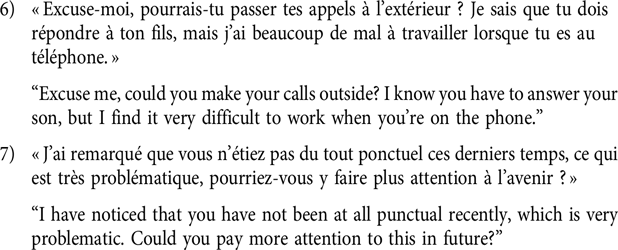
Positive politeness was defined as the use of one or more Face Flattering Acts (FFAs, see Kerbrat-Orecchioni Reference Kerbrat-Orecchioni2016), which can be seen as external acts (e.g., apologies, thanks) intended to mitigate criticism. Requests for repair referred to indirect criticism in the form of requests, suggestions, advice for change and other directives without a linguistic marker of criticism but excluded imperatives due to their high level of imposition on the hearer.
In (7), the repair request was coded as an external act, which aimed at mitigating the direct criticism by reducing its face-threatening potential. This approach diverges from other works on complaints in different contexts (Chen et al. Reference Chen, Chen and Chang2011; Decock and Spiessens Reference Decock and Spiessens2017), but is in line with recent empirical evidence by Ruytenbeek et al. (Reference Ruytenbeek, Decock and Depraetere2023b). It can be justified by the specific benefits (for both speaker and hearer) of such directives in the workplace: they address dissatisfaction by emphasizing the steps needed to achieve a satisfactory resolution, thereby strengthening the long-term relationship between speaker and hearer.
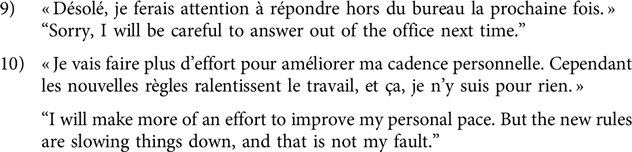
In the data eliciting replies to criticism, responses were also coded using Nguyen’s (Reference Nguyen2005) scheme, which involved classifying responses as either agreement with or rejection of the criticism. A response was coded as an agreement when acceptance was expressed as in (8):

We further distinguished between total agreement (9) where the addressee endorses the whole responsibility for the criticism, and partial agreement (10) indicating the addressee’s acceptance with one part of the criticism (the central point of criticism) while refuting another part of it.
Finally, we examined whether rejections were accompanied by external modifiers such as positive politeness or request for repair (11) or formulated without these modifiers (12). Detailed information on the coding scheme for responses to criticism can also be found on OSF.


Based on these annotations, we observed that our investigation was successful in eliciting criticisms and replies to criticisms, given that only 36 occurrences out of 1600 (4.5%) in both experiments did not contain the expected speech acts.
4. Combining Speech Acts as a Strategy to Criticize and Reply to Criticism
Several empirical studies of speech acts dealing with complaints (Olshtain and Weinbach Reference Olshtain, Weinbach, Verschueren and Bertuccelli-Papi1987; Murphy and Neu Reference Murphy, Neu, Gass and Neu1996; Chen et al. Reference Chen, Chen and Chang2011; Vásquez Reference Vásquez2011; Depraetere et al. Reference Depraetere, Decock and Ruytenbeek2021) have pointed out that they rarely occur in isolation and are mostly the product of several acts. By using the concept of speech act set, Murphy and Neu (Reference Murphy, Neu, Gass and Neu1996: 221) suggested that “a combination of individual speech acts […], when produced together, comprise a complete speech act”. This observation was particularly relevant to the analysis of our data. We observed that 473 out of 569 (83%) direct criticisms produced were surrounded by external acts, in the form of a request for repair or positive politeness expressed by means of thanking, complimenting, apologizing, etc. Similarly, in replies to criticism, 29 occurrences out of 244 (12%) responses containing a rejection of the criticism were surrounded by external modifiers in the form of positive politeness, while 270 out of 555 (49%) agreements with the criticism contained at least one external mitigation form (FFAs or request for repair). These findings thus seem to indicate that the combination of acts is a central aspect of the production of criticisms. In contrast, replies to criticisms are not so reliant on this strategy, even though discrepancies can be observed between rejections and agreements, as the latter is more often expressed through combined strategies.
However, these observations need to be taken with caution given that our annotation was not primarily guided by an in-depth analysis of the speech act set theory. As a result, the annotation of distinct speech acts was only carried out when occurrences contained a form of positive politeness or a request for repair. Other speech acts such as justifications and openings were not annotated and may have increased even more the percentage of occurrences affected by the simultaneous production of several speech acts in a row. To illustrate the combination of acts found in our data, let us consider (13).

Example (13) contains a criticism expressed about the cleanliness of the kitchen space. A male participant was asked to formulate this act from the perspective of a colleague to another distant colleague. This example shows several discursive functions for the acts expressed. Firstly, the criticism aims at identifying the problem (i.e. the dirtiness of the kitchen) for which the speaker gives a negative evaluation, repeated twice (“sale” [dirty] and “en désordre” [messy]). In addition, the participant directly attributes responsibility for this problem to the hearer via the personal pronoun “tu” [you]. Both characteristics represent a very typical example of direct formulations of criticism. But the criticism also fulfills another discursive function: it acts as a justification for the meeting between interlocutors and legitimates the interaction. In the second utterance, it appears that the direct criticism is followed by a prototypical act of request (“Pourrais-tu…” [could you]) using a conditional, which aims at closing the intervention and could be seen as an attempt to resolve the unpleasant situation by a request for repair, which underlines the fact that a single direct criticism may not be sufficient to solve the problem. This request can also be considered as a way of mitigating the direct criticism addressed to the hearer, in other words, as a face-saving strategy, by giving more importance to the expected change, thus placing more emphasis on the repair than the actual situation. This combination of criticism and request in one intervention was very widespread in our data and is in line with previous empirical studies of complaints (Chen et al. Reference Chen, Chen and Chang2011; Vásquez Reference Vásquez2011; Decock and Spiessens Reference Decock and Spiessens2017). From a pragma-discursive perspective, both acts appear to complement each other. To obtain a change of behaviour, the strategy is to first point out the problem by means of a negative evaluation and then move on to a conventional request for repair (without any linguistic marker of criticism).
Another common formulation is the presentation of a request containing a marker of criticism (indirect criticism) after the identification of the problem. This pattern is illustrated in (14) and was produced for the same conflictual situation as (13) (dirtiness of the kitchen) from the perspective of a colleague to another distant colleague.

By combining a negative evaluation (direct criticism) with a request containing a marker of criticism (“plus”), participants aim at overcoming such an unpleasant state and achieve a satisfactory resolution of the situation. What nevertheless differs in our categorization from other studies on complaints (Chen et al. Reference Chen, Chen and Chang2011; Vásquez Reference Vásquez2011; Decock & Spiessens Reference Decock and Spiessens2017) is that we do not consider requests for repair as belonging to criticizing strategies, but rather as a “supportive move” (Blum-Kulka & Olshtain Reference Blum-Kulka and Olshtain1984) to downgrade the criticism. Other studies that did not report this function (Vásquez Reference Vásquez2011; Depraetere et al. Reference Depraetere, Decock and Ruytenbeek2021) were focusing on digital and b2c (business-to-consumer) contexts, in which the interpersonal relationship is not of primary concern for customers when expressing their complaints. In contrast, the interpersonal relationships found in workplace environments and b2b (business-to-business) contexts take place in a long-term perspective. Hence, the identification of this particular function for request for repair seems to be context-dependent and orients toward Locher’s (Reference Locher2004) and Locher and Watts’ (Reference Locher and Watts2005) definitions of (im)politeness (see section 5 on threats for further details).
As for replies to criticism, (15) illustrates the response of a female participant replying from the position of a colleague to another close colleague to a criticism about her taking too much storage space in the office.

The main act of this intervention (i.e. the agreement with the criticism) is preceded by an act of apology introducing her purpose and followed by a justification. Interestingly, there is no clear typological distinction between these three acts, since the act of agreement (offer of repair) is introduced by the adverb “mais” and simply follows the others. Indeed, this occurrence is characterized by an absence of any full stops in the whole intervention, showing how participants seem to embed distinct speech acts to convey their illocutionary act.
5. Threats as a Particular Upgrading Strategy for Criticism
Threats are likely to occur in contexts when a power asymmetry exists between interlocutors. Hence, Vanderveken (Reference Vanderveken1990) argues that a threat could be considered as a power-dependent act. Empirical evidence (Harris Reference Harris1984; Culpeper Reference Culpeper1996) has confirmed that people in a position of power use threats significantly more often than others. Moreover, Limberg (Reference Limberg2009) points out that the success of a threat depends on many factors, including the status and the power of the threatener, the likelihood that the threat will be fulfilled and the way it is linguistically communicated. This latest factor raises the question of whether threats can be perceived as inherently impolite. Following Limberg’s view (2009), we argue that most threats attack different face wants of the speaker and the addressee. However, the identification of such an act as a phenomenon of impoliteness is always hearer-oriented and grounded in their reception. Other researchers such as O’Driscoll (Reference O’Driscoll2007: 248) defend a more restrictive view by claiming that “even when an FTA does occur, its origin can be found neither in a particular speech act nor in the purely formal-linguistic properties of its realization”. This claim is based on the definition of (im)politeness by Locher (Reference Locher2004) and Locher and Watts (Reference Locher and Watts2005) who argue that a threat can only turn into a face-threatening act through its use in a particular context. In sum, researchers highlighted the various roles played by context for the perception of threats. As a result, it should always be taken into account by the analyst.
In the present investigation, we aimed to look at (I) the proportion of threats in our empirical data, (II) the combination of speech acts at play when threatening, and (III) the factors leading people to choose one type of expression. Threats were found in 91 out of 800 responses (11%) of elicited criticisms. Our observations also confirm the role of power, given that 64 out of 91 responses (70%) containing a threat were expressed in scenarios where a relationship of power was at play, while only 28 out of 91 responses (30%) were observed in an equal relationship. Another relevant aspect reinforcing the predominant role of speaker status concerns the content of the threats. In a hierarchical relationship, threats concerned the addressee’s future (threat to fire the person) and the future of the relationship between interlocutors, while threats from a colleague-to-colleague perspective concerned more trivial topics (threat to use the speaker’s desk if s/he continues to take the whole shelf, etc.). Finally, the linguistic realization of threats was characterized by the recurrent use of conditionals. These “conditional threats” that Limberg (Reference Limberg2009: 1378) described as “if-then” structures, can be seen as an objective criterion to identify this speech act (Tedeschi Reference Tedeschi and Swingle1970). These types of threats are illustrated in (16) and (17).


Example 16 illustrates a female participant expressing a criticism from the position of a distant superior to a collaborator about his lack of progress in learning German. The intervention is built up in three distinct parts following a clear logic. First, the participant opens her speaking turn with an utterance aiming at justifying the reason for their meeting (“il y a un problème avec l’allemand”). By explicitly mentioning that German is the source of the problem, she introduces the topic of the superior’s criticism. The second part is the formulation of the (direct) criticism by means of a negative evaluation of the hearer’s behaviour, which also clearly states the cause of the problem (lack of effort). Then, the speaker moves on to a second criticism by mentioning some negative consequence of the addressee’s behaviour (“tu ne seras pas prêt pour prendre ton poste”). Third, the speaker ends the intervention by using a typical conditional threat (“Si tu ne parles pas la langue, on sera obligé de confier le poste à quelqu’un d’autre”). According to Tedeschi (Reference Tedeschi and Swingle1970: 159), this discourse structure contains two parts: (1) the speaker’s injunction made against the addressee “If you (don’t) do X”; with X being the action requested by the speaker and (2) the prediction, that is, the mention of negative consequences that the speaker will inflict upon the addressee if they fail to comply with the requested action. By ending the speaking turn with this threat, we observe in this occurrence a gradual rise of the pragmatic intention of the speaker: identification of a problem < turning the problem into a criticism < expressing another even stronger criticism < ending the turn with a threat. This example thus illustrates how distinct face-threatening speech acts are likely to be hierarchized within a single speaking turn, when dealing with a conflictual situation in a work environment.
Example 17 shows a male participant expressing a criticism from the perspective of a colleague speaking to another distant colleague. Unlike (16), this occurrence only contains two parts: (1) the formulation of an indirect criticism by means of a request for repair (“Il serait raisonnable que tu réduises le nombre de tes pauses si l’on veut boucler le cahier des charges dans les temps”) and (2) the expression of the threat (“ou sinon nous aurons tous les deux des ennuis”), which closes the speaking turn. By considering the “if-then” structure described for (16) in this utterance, it appears that the request for change (i.e., reduce the number of breaks) formulated by the speaker corresponds to his injunction to reach the goal of meeting the company specifications. As for the second part, the prediction of the negative consequences is introduced by the coordinating connective “ou” [or] and the adverb “sinon” [else]. This occurrence differs from the previous one for two reasons. First, the canonical “if-then” structure is replaced by a discursive segment without any negation form and formulated in terms of what the speaker must accomplish to avoid potential negative consequences. Second, the use of the pronouns “on” and “nous” [we] instead of “tu” [you] renders this intervention different from the first one. Given that the speaker includes himself twice in this utterance, this intervention shows the impact of the criticized behaviour for both interlocutors facing the same negative consequences, reinforced by the use of first-person plural pronouns.
6. Downgrading vs. Upgrading Internal Strategies: The Use of Pronouns
When complaining about or criticizing the hearer’s actions or choices, the speaker attributes the responsibility to the addressee for failing to fulfill their expectations. As Trosborg pointed out (Reference Trosborg1995: 322), the use of (personal) pronouns is in this respect of great importance, given that they can either strengthen or soften the illocutionary force of the speech act and the intended face-threat. First, pronouns can be considered as internal upgraders when there is an explicit mention of the hearer’s responsibility, for example, when expressing a negative evaluation of their behaviour by using the second person (singular or plural) pronoun, as illustrated in (18):

This example illustrates a conflictual situation in which a female participant expresses her dissatisfaction about the cleanliness of the kitchen space through a combined strategy of direct criticism followed by a request for repair in the imperative form. To strengthen her words, she makes a specific use of personal pronouns “tu” and “toi” [you]. In the first utterance, the two “tu” are used for distinct purposes. While the first one serves to make the addressee aware of the problem, the second one directly attributes full responsibility to the hearer. Regarding the second utterance, the use of “toi” aims to indicate the disagreement of the speaker with the behaviour of the addressee by specifying that he is the only person acting in this way, thus upgrading considerably the content of the message and the risk of face-threat.
On the other hand, pronouns can be categorized as a downgrading internal strategy in several cases when first- (singular and plural), and third-person pronouns (singular, impersonal) are used, as well as when their use is avoided. According to the (in)directness scale of Decock and Depraetere (Reference Decock and Depraetere2018) about complaints, by avoiding any explicit mention of the addressee in an utterance, the directness of the speech act (set) is reduced. In our dataset, the avoidance of pronouns or the use of third person pronouns represent a very common way of downgrading a speech act (set). To illustrate these distinct downgrading pronominal strategies, let us start with the use of first-person pronouns demonstrating the involvement of the speaker when formulating a criticism or a complaint (Meinl Reference Meinl2010). This attitude sheds light on the solidarity and the shared responsibility between interlocutors, as in (19).

In this example, a female participant expresses a criticism from the perspective of a close superior about the excessive frankness of an employee with his clients. This occurrence reveals a particular use of first-person plural pronouns: mitigation of the speech act set. Two first-person pronouns in the plural form (“nous” [we]) are employed in the second and third utterances. The first use concerns the formulation of the direct criticism (“nous ne pouvons pas dépasser”) and aims to soften the expression of the problem by including the speaker in the criticism. The effect achieved is a feeling of solidarity, serving as a reminder that both interlocutors are equally bound by the rules. Finally, this occurrence is concluded by a request for repair. Interestingly, while expressing this request with a second-person pronoun, the speaker then employs a first-person plural pronoun (“nous ne pouvons pas continuer comme ça”) to close her justification for repair, which aims again at demonstrating shared interests. Although the speaker does not accept the behaviour criticized, some support is shown to the addressee in a face-saving perspective.
Finally, using third person pronouns or no pronoun also represent strategies to mitigate the intended face-threat on the hearer, as illustrated in (20).

In this example, a female participant shows her dissatisfaction from the perspective of a distant superior about the work speed of a collaborator. This direct criticism is followed by a request for information and a request for repair. We observe that no use of the second-person pronoun is made in this example. Instead, the speaker employs the determiner “les” [the plural] for characterizing the performances of the addressee in the first utterance, thus avoiding the more face-threatening second-person pronoun. Then, the participant substitutes again the second-person pronominalization in the next utterance with the impersonal form “Y a-t-il” [Is there]. This formulation again seeks to reduce as much as possible the potential face-threat to the addressee. Finally, the prototypical use of the request “il faudrait” [it should] with an impersonal form continues the avoidance of any direct reference to the addressee, thus reducing the intended face-threat of the request. This particular attention drawn on the face-saving potential of pronouns needs still to be considered along with other downgrading strategies such as downgraders (“il faudrait” [it should]), downtoners (“ne semblaient pas” [seemed not]) and understaters (“si possible” [if possible], “de potentielles solutions” [potential solutions]) (Trosborg Reference Trosborg1995) to obtain the expected perlocutionary effects on the addressee. Participants also used definite articles or avoided pronouns in their replies to criticism, as illustrated in (21):

This reply was formulated by a male participant from the position of a close colleague answering a criticism about him taking too much storage space in the office. In this occurrence, the speaker starts with an act of apology followed by a justification and concludes with a request for repair. With respect to the use of pronouns, we observe two distinct but complementary patterns: (1) the recurrence of first-person pronouns (“je” [I]) employed three times in the occurrence and (2) the avoidance of any pronoun designating the addressee. When explaining his difficulty to find a convenient storage space in the office, the speaker employs a definite article (“l’emplacement” [the space]) to mention the addressee’s personal space instead of using “ton emplacement” [your space”]. Second, he closes the utterance by saying “cela ne dérangerait pas” [it would not be a problem] and avoids the use of “te dérangerait” [bother you]. By choosing this specific use of pronouns, it appears that the speaker seeks to centre his illocutionary act on himself rather than on the addressee. Interactionally, the distancing of the speaker from his words through personal pronouns is an internal downgrading strategy that aligns with Brown and Levinson’s (Reference Brown and Levinson1987) view of politeness. More precisely, the concept of “negative face”, which encompasses the material, physical or psychological territory of a person, provides a satisfactory explanation for why the participant made these choices of pronouns. Mentioning “ton emplacement” [your space] would refer to the personal and private territory of the addressee. In this respect, it would provide proof of the conscious violation of the personal territory, thus acknowledging the face-threat. These examples indicate that third-person pronouns or lack of pronouns can be considered an effective internal downgrading strategy when dealing with conflictual situations about personal territory.
7. Discussion and Conclusion
In the present study, we investigated the way French-speaking participants express criticisms and responses to criticisms in the context of the workplace. Elicitation data obtained from a Discourse Completion Task (DCT) enabled us to conduct a qualitative analysis of three particularly salient linguistic phenomena in our dataset: (I) the combination of speech acts as ways to criticize and reply to criticism, (II) threats as an upgrading strategy for criticism and (III) pronouns as an upgrading or downgrading internal strategy. Focusing on the combination of speech acts to criticize and reply to criticism enabled us to look at a widespread phenomenon in other empirical studies. We investigated this in our dataset by shedding light on the type of combination, the function of specific combinations and their representation in our dataset. Second, we sought to look at whether and how threats were used as an upgrading strategy in a workplace context, and under which conditions participants used them. Third, we observed that participants employed a variety of pronouns with distinct functions depending on the conflictual situation at play. We have illustrated how these internal strategies may modify the illocutionary force of criticism contextually.
We focused first on the combination of speech acts. In line with the concept of speech act set as well as with previous empirical evidence (Murphy et al. Reference Murphy, Neu, Gass and Neu1996; Tanck Reference Tanck2004; Chen et al. Reference Chen, Chen and Chang2011), we confirmed that the vast majority of responses formulated by participants did not occur in isolation, but spanned over several speech acts. Direct criticisms (83%) were mainly surrounded by external downgrading modifiers in the form of positive politeness (thanking, apologizing, complimenting) and requests for repair. This proportion was considerably lower for the responses to criticisms, with only 49% agreements and 12% rejections of criticism being surrounded by a form of positive politeness. This discrepancy thus underlines the benefit of considering criticism and replies to criticism together to shed more light on similarities and differences between them. It is equally important to perform an in-depth annotation of other speech acts contained in the elicited data, as well as other internal and external downgrading and upgrading strategies. For instance, we were able to illustrate how direct criticisms often appeared with requests for repair, while direct and indirect criticisms frequently appeared alongside threats. For the former, the frequent combination of an expression of dissatisfaction and a request for repair was in line with previous empirical evidence (Chen et al. Reference Chen, Chen and Chang2011; Decock and Spiessens Reference Decock and Spiessens2017) revealing some cross-cultural similarities between French, American English, and German ways of complaining and criticizing in the contexts investigated. Decock and Spiessens (Reference Decock and Spiessens2017) even argued that this strategy was the prototypical way of complaining in their empirical study on German-speaking and French-speaking customers in a b2b context. However, our results were gathered in a different context and differ from theirs in two crucial aspects: (I) the position of the requests for repair and (II) their function. Our data demonstrated that criticisms were not systematically followed by a request for repair and not typographically separated from the rest of the criticism, as it could also be preceded by the request for repair. These various positions and the absence of a typographic separation are factors that may reduce the potential face-threatening aspect of requests for repair.
What is more, the interactional aims are very different in a workplace context compared to b2c or private contexts. As a result, requests for repair closing an intervention often illustrate the willingness of the speaker to provide the hearer with a solution to resolve the conflictual situation. Hence, whereas requests for repair can be categorized as face-threatening acts according to Brown and Levinson (Reference Brown and Levinson1987), we treated them as a downgrading external strategy when they surrounded direct criticisms. This observation is in line with recent experimental evidence by Ruytenbeek et al. (Reference Ruytenbeek, Decock and Depraetere2023b), who showed that complaints containing a request for repair in a preparatory interrogative form were assessed as more polite than complaints expressed without any request at all. These complementary findings suggest that French speakers find the combination [criticism + request for repair] and [complaint + request for repair] to be particularly appropriate to convey their dissatisfaction in these experimental contexts. We also observed another particularly frequent pattern in the replies to criticism: the combination of apologizing and request for repair as a speech act set. Formulating both speech acts simultaneously enabled participants to demonstrate their alignment with the criticized behaviour and thus their full agreement with the speaker.
In this qualitative investigation, we focused on another common speech act in daily communication: threats. We first found out that threats occurred in 11% of the responses of participants (91 occurrences). In other words, threats appear to be a strategy that speakers used to upgrade the illocutionary force of their criticism by conveying manipulative content and potentially face-threatening meaning contextually. Then, we observed that when combined with criticisms, threats were almost always inserted at the end of the speaking turn. This shows the hierarchical character of these occurrences with a gradual rise of the pragmatic intention of the speakers toward the end of their intervention. That is, speakers are likely to start with the identification of a problem engaging the hearer’s responsibility (less face-threatening contextually) and end their intervention by uttering a threat (most face-threatening contextually). This pattern gives even more strength to the coercive and manipulative dimension of threats (Limberg Reference Limberg2009). We also questioned whether the manipulative component of threats made them power-dependent acts (Vanderveken Reference Vanderveken1990). Results from our data support this claim, given that 70% of the responses containing a threat were expressed in scenarios in which a relationship of power was at play. From a broader perspective, these results are in line with empirical evidence on the speech act of threat (see Harris Reference Harris1984; Culpeper Reference Culpeper1996; but see Limberg Reference Limberg2009 for a divergent result on responses to threats) and seem to suggest that French speakers may favor the expression of threats to reinforce their criticisms when they are in a powerful position.
A third dimension of our empirical investigation targeted the use of pronouns in the formulation of criticism and replies to criticism in French. We showed how pronouns were impacted by the interpersonal relationships at play and the interactional aims of the workplace context (common goal, resolution of conflict, etc.). Similarly to threats, pronouns can take an upgrading function. We illustrated this specific role of pronouns in occurrences where participants directly attributed the responsibility for the criticized behaviour to the hearer by means of second-person pronouns. In this respect, using simultaneously several second-person pronouns in the same intervention enabled participants to insist on this individual responsibility. As shown in previous research (Simmons et al. Reference Simmons, Chambless and Gordon2008; Holtgraves Reference Holtgraves2022), it may further reveal negative emotional states of the speaker, such as anger. On the other hand, we also illustrated cases when pronouns functioned as a downgrading internal strategy in line with the work of Stewart (Reference Stewart1995) and Kerbrat-Orecchioni (Reference Kerbrat-Orecchioni2005). First-person, third-person, or even lack of pronouns can contribute to downgrade a speech act set, either individually or in combination with another pronominalized form. For instance, we were able to show how first-person pronouns can downgrade the illocutionary force of the criticism by shedding light on the shared solidarity between the speaker and the addressee. Regarding the other types of pronouns, it appears that their avoidance serves to reduce the potentially face-threatening value of the criticism, following Brown and Levinson’s (Reference Brown and Levinson1987) theory of politeness. Indeed, by avoiding any incursion on the private and personal territory, speakers could demonstrate that they recognized the addressee’s territory as such and avoided any violation of their personal space. In a nutshell, by complementing the quantitative analysis of an elicitation task with a qualitative approach, we were able to analyse more fine-grained strategies of criticizing and replying to criticism, thus revealing the many internal and external downgrading and upgrading strategies surrounding these acts.
Yet, we also stressed that data collected by means of a DCT suffers from several limitations that may have impacted our findings. In spite of these limitations, a DCT can still be considered as an effective elicitation tool complementing data gathered in natural contexts. Replicating this investigation in a more natural context would, for instance, include a setting in which a superior conducts an annual interview with an employee or scheduled meetings between colleagues. In their empirical studies dealing with criticizing and complaining in the workplace, Asmuß (Reference Asmuß2008) and Ruusuvuori (Reference Ruusuvuori, Asmuß, Henttonen and Ravaja2019) showed how the acts of criticizing and complaining were a co-constructed strategy between managers and employees. For the present study, this complementary methodology would shed some light on the construction of the speaker’s criticizing strategy from a more interactional perspective. Combining these perspectives would in turn provide a deeper understanding of the crucial speech act of criticizing and broaden our perspective on its various realizations.
Data availability statement
The data that support the findings of this study are openly available in OSF repository at https://osf.io/guak5/?view_only=686834aa47a84684981286cf4f5374e6
Acknowledgments
We would like to thank the two anonymous reviewers and the handling editor for their valuable comments and suggestions.
Declaration of competing interest
The authors report there are no competing interests to declare.

 Open access

