1 Introduction
The contemporary elite football match represents one of the most significant settings for the performance and dissemination of popular music in modern society. Week after week, music resonates through stadiums worldwide, exposing millions of spectators to – and engaging them in – the production of music within these settings. For example, during the 2024/2025 season, a total of 50,279,944 spectators attended 1,446 league matches across four major European national leagues – the Premier League (England), the Bundesliga (Germany), La Liga (Spain), and Serie A (Italy) – corresponding to an average of 34,772 spectators per match. Additional large audiences are exposed to music from the matches through broadcasting; for example, during the 2024/2025 season, the Premier League was broadcast in 189 of the 193 UN member states, reaching 906 million households worldwide, with an estimated 1.9 billion people following the league and engaging with it at least weekly through the media (Premier League, 2025).
Obviously, popular music remains supplementary to the main occasion of the football match. Yet, attending a match entails far more than the game itself. As has long been established in the study of modern sports, “the game itself, while central to the occasion, is only part of the total event” (Kutcher, Reference Kutcher1983, p. 38), and “music is one of the primary phenomena associated with a sports event” (Snyder, Reference Snyder1993, p. 168). This is particularly true of contemporary elite football, where music typically permeates the entire match-day experience, including periods before, after, and between the two halves. Illustratively, attending a football match has even been described as “a huge collective stereophonic musical event” (Nyman in Redhead, Reference Redhead1997, p. 71).
Further acknowledgments of the significance of music in football settings emphasize that “the auditory is a crucial element of any sporting experience” (Powis & Carter, Reference Powis, Carter and Bull2019, p. 391) and that “the embodied experiences of sounds, and of hearing and listening are central to the experience of football” (Woodward & Goldblatt, Reference Woodward and Goldblatt2011, p. 3). However, despite this recognition, there remains a scarcity of research examining how and why music matters specifically within the context of football. This Element responds to that gap by addressing the fundamental question: How and why do popular music and football interact in the setting of contemporary elite matches in national leagues? In doing so, it primarily targets students and scholars in musicology, while also offering secondary relevance for those engaged in sound studies and sports studies. At the same time, it invites a broader readership interested in how popular music operates culturally – beyond its capacity to entertain, edify, or purify – and in how football spectatorship is sonically and affectively charged through musical practices. The following sections first outline the relations between popular music and football and then specify the theoretical and empirical approach adopted in this Element.
1.1 Popular Music and Football
Popular music and football can be seen to compare, connect, and interact. As regards comparison, both football and popular music – here approached, somewhat simplified, as the music distributed to most people most of the time in everyday life – have long been performed by both amateurs and professionals. Based on differences in competences, practitioners of both popular music and football can be positioned in a “performance pyramid, where millions of amateurs form the base, while the elite virtuosos make up the ‘international elite’” (Krebs, Reference Krebs2001, p. 41; see also Tolleneer, Reference Tolleneer1986, p. 230). Additionally, professional performances have long been cherished by spectators physically copresent at matches and concerts. Consequently, popular music artists, bands, styles, and genres as well as football players, styles of play, clubs, and teams have attracted a substantial following including not only casually interested observers but also enthusiastic supporters or “fans” – a term originally designating sports (i.e., baseball) spectators in the United States from the 1890s (Brown, Reference Brown2017, p. 10) but now applicable to a variety of human interests and activities of which popular music and football are among the globally most proliferating. Football and popular music can both act to demarcate – unite and divide – groups of people, by encouraging strong, shared display of emotion and by creating long lasting collective memories. Consequently, both can play a powerful role in the performance, contention, and maintenance of identity while, thereby, also being highly susceptible to processes of commercialization and branding. Therefore, popular music and football can generally be seen as far-reaching “popular cultures,” defined as “shifting sets of social and cultural relations, meanings and texts which in varying ways emerge as contemporary forms of pleasure, leisure, style and identity, and which are linked to personal and expressive politics, aesthetic address and cultural economy” (Rowe, Reference Rowe1995, p. 8).
Obviously, media – defined as “technologies that are able regularly and reliably to transmit or preserve meanings across space and time” (Couldry, Reference Couldry2020, p. 4; italics in original) – play a critical role in the proliferation of both popular music and football. However, the roles of specific media differ in notable ways. For instance, it seems plausible to suggest that while the consumption of popular music largely depends on recordings, where the time of production precedes the time of distribution and reception (e.g., via streaming platforms), the consumption of football primarily relies on live televised broadcasts, where production, distribution, and reception occur simultaneously (see also Rowe, Reference Rowe and Shimpach2020, p. 203). Indicatively, “television’s recording of sport has a short shelf-life: there is a ‘zone of liveness’, after which the liveness effect will have expired” (Crisell, Reference Crisell2006, p. 99). By contrast, technologies for music consumption enable what might be termed accompanying consumption, as listening to popular music often coincides with other activities; indeed, music can become “a sound decorum for everyday life” (Tolleneer, Reference Tolleneer1986, p. 231). More broadly, just as popular music and media are deeply interwoven, football clubs themselves increasingly operate as media organizations, utilizing platforms such as television channels and social media to promote their brand and engage with supporters.
In terms of performance, both football and popular music typically involve comparable processes – such as bodily control and technique, artistry, cooperation, object handling, precision, timing, tempo, and rhythm – all of which are continuously shaped by developments in technology. Although some of these processes might also apply if popular music is compared to other sports, it is telling that references to musical styles and genres have emerged to describe different styles of play especially within the context of football – examples include “samba football” (Siregar, Reference Siregar2021) and “heavy metal football” (Griffiths, Reference Griffiths2022). Certainly, there are also substantial differences. For example, whereas matches are played regularly (e.g., tournaments) and unfolds in “set time” in designated, permanent home-team settings (stadiums), concerts are usually performed more intermittently (e.g., tours) and unfold in what approximates “symbolic time” (Schechner, Reference Schechner1988, p. 8) often in settings not always and primarily designed for concerts (e.g., football stadiums and parks). Moreover, although aspects of competition evidently transpire in the context of popular music – see, for example, the television series The X-Factor, and the pervasiveness of lists and rankings to indicate the current sales and popularity of music – contrary to the typical setup of concerts, a match includes two opposed teams engaged in a competition where the outcome is uncertain from the outset – the subsequent certainty is, of course, a key factor in shortening the shelf life of televised football. Accordingly, the attending spectators differ when comparing the two settings. Although spectators at both matches and concerts can interact with the performance – for example, they can assume “a playful freedom” (Kennedy, Reference Kennedy2009, p. 278) by being able, among other things, to explicitly express their appraisal of the performance and the performers – at matches, spectators are usually separated in sections including two groups of team supporters. Consequently, if it is reasonable to claim that spectators at both matches and concerts can “negotiate a relationship to other unknown spectators” (Kennedy, Reference Kennedy2009, p. 279), at matches this “negotiation” includes processes of not only inclusion and alliance but also of, for example, exclusion and rivalry, which rarely transpire among spectators at concerts. The build environment of the football stadium arguably plays a role in shaping these processes, as match spectators are normally facing each other within eye- and earshot, whereas spectators at concerts are typically positioned to face in the same direction toward a stage.
In addressing their connections, it is important to begin by emphasizing that popular music and football are not inherently linked. For example, the rules of football do not require the implementation of music, as it is the case in other sports such as rhythmic gymnastics, synchronized swimming, dressage, and figure skating (see, e.g., Harman, Garbato, & Forberg, Reference Harman, Garbato, Forberg, Bateman and Bale2009). Furthermore, even though music can be seen to play a role for performers when they, for example, use privatized music to concentrate while arriving before a match or use collectivized music as a team energy boost in the changing room before entering the field, such uses of music are not reserved for football performers (see, e.g., Karageorghis, Reference Karageorghis2017, p. 151 ff.). Music is thus not a defining feature of football, and football is obviously not a defining feature of popular music. For example, (a) football rarely features at concerts outside explicitly football-related contexts. An exception occurred at an AC/DC concert in Glasgow in 1978, when, during the encore, the band members appeared wearing the Scottish national football kit – apparently as “a nod to the locale” and the band’s heritage (Apter, Reference Apter2018, p. 189). Although described as “utterly uninterested in sports” (Wall, Reference Wall2012, p. 14), video footage shows guitarist Angus Young kicking an inflated football from the stage (YouTube, 2025). Nonetheless, there are several ways in which popular music and football intersect, including instances of musical artists who are football supporters and footballers who are music enthusiasts. For example, former Real Madrid players Cristiano Ronaldo and Sergio Ramos were reportedly devotees of music produced by Nadir Khayat (RedOne) – whose collaborations include artists such as Enrique Iglesias, Lady Gaga, and Jennifer Lopez – and Khayat himself has expressed admiration for both the players and Real Madrid (Stutz, Reference Stutz2014). As this Element will also demonstrate, football supporters regularly – and, it seems, almost inherently – emerge as musical performers.
Additionally, the aforementioned processes of commercialization and branding have increasingly converged, resulting in numerous forms of cross-pollination. As a consequence, the consumption of football today almost inevitably entails the consumption of popular music – if not the other way around. Indeed, music in sports contexts might be considered as a way of “‘commodifying’ both sport and music” (Snyder, Reference Snyder1993, p. 178; see also McLeod, Reference McLeod2011, pp. 77–88). Illustratively, music industry agents sponsor, promote, and announce football in various ways. For an example of musical sponsoring, in 2022, the music streaming service Spotify became sponsor for the Spanish club FC Barcelona. The partnership included a new name for the stadium, “Spotify Camp Nou,” as well as more alternating initiatives such as the designing of shirts including the logo of specific musical artists accompanied by the distribution of related match day music playlists (Dixon, Reference Dixon2022). As a further illustration, Wojtaszyn (Reference Wojtaszyn and Endong2025) describes the case of how the music distribution entrepreneur Michael Kölmer and his company Kinowelt became a sponsor for the German club Union Berlin in the late 1990s. Concurrently, musical artists have actively supported the club by participating in charity concerts and producing songs about and for the club – exemplified most notably by the club anthem Eisern Union (1998) by Nina Hagen.
Popular music is also extensively used to promote specific tournaments. A case in point is the song Waka Waka (This Time for Africa) that was released on 7 May 2010 right before the FIFA World Cup in South Africa. Subsequently, the song was performed by Shakira at both the opening and closing ceremony in the following months. Another prominent example is the official UEFA Champions League Anthem – composed by Tony Britten in 1992, based on Händel’s anthem Zadok the Priest from 1727 – which is broadcasted in stadium settings before the start of every match in the tournament. As this music is also used at the beginning and end of the televised broadcasts, the case additionally exemplifies how music is extensively used in mediated settings to help announce, stimulate recognition, and characterize broadcasters’ football programming (for further examples of the use of music for football and sports programming, see, e.g., Graakjær, Reference Graakjær, Michelsen, Krogh, Have and Nielsen2018, Reference Graakjær2021a; King, Reference King2004, MacLean, Reference MacLean, Bateman and Bale2009). The case incidentally illustrates that the significance of media to both popular music and football is oftentimes established and propelled by a connection between the two. Consequently, if television and sports indeed constitute a “dream marriage” (Real, Reference Real and Billings2014), then music routinely enters the picture, turning it into a prosperous “polyamorous relationship.”
Whereas the aforementioned examples of connections can be seen to illustrate processes of “musicalization of football” (as coined by Redhead, Reference Redhead1997), in many instances they correspondingly illustrate a sort of “footballization of music.” The previously mentioned songs by Shakira and Nina Hagen provide recent illustrations, but examples of how titles and/or the lyrics of songs have been influenced by football emerge from the advent of modern football in the late 1800s (Leue, Reference Leue2023, p. 14 ff.). Beyond titles and lyrics that explicitly reference football, musical structure and form may also evoke or mirror the dynamics and character of the game itself (Long & Spracklen, Reference Long and Spracklen2021), made possible by the comparable processes that link popular music and football. Moreover, recorded spectator sounds from football have been incorporated into music tracks, and several footballers have appeared as musical performers. For instance, Cristiano Ronaldo and Sergio Ramos are not only devotees of RedOne’s productions but also feature as performers on a song produced by RedOne for Real Madrid (see Section 2). For a comprehensive curation of examples of such “footballized music,” the website 45football.com offers a collection of more than 1,000 tracks from around the world.
In addition to being (partially) comparable and connected, popular music and football also interact in various ways. In this context, interaction refers to the process by which popular music and football concurrently emerge and relate in specific settings of matches. Whereas the perspective of connection highlights how popular music and football may share conjoint, “built-in” features – such as “music in/at football” and “football in music” – the perspective of interaction focuses on how the two unfold dynamically within specific settings. Moreover, while connections are arguably most often explored from meso- or macro-analytical perspectives – focusing on industrial, structural, economic, or political aspects – interactions call for a micro-level exploration of how music is situated and gains significance through its relation to football and the people involved in its production, distribution, and reception. Inspired by Goffman’s (Reference Goffman1983) perspective, the present approach focuses not on the “institutional order” but on the “interaction order” – that is, the interactional patterns of popular music and football as they can be discerned through the analytical observation and listening of specific matches.
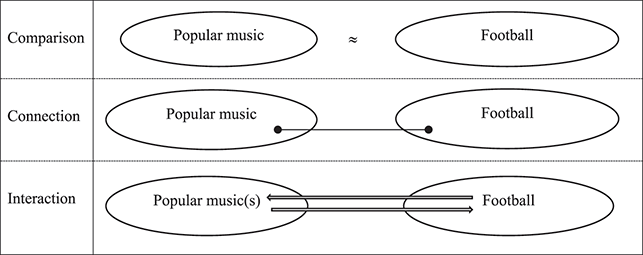
Figure 1 illustrates the three main ways to approach the relations between popular music and football. The dotted lines are meant to indicate that the three ways are not mutually exclusive, and they are here presented separately for instructional purposes. As the possible plural form “music(s)” suggest, interactions include a focus on the possible appearances of multiple types and collections of music in the given setting. Consequently, in addition to the relations between music and football, the present exploration identifies interactions – some of which shall be shown to be highly conflicting – within and between different types of music.
Illustration of three approaches to the relations between popular music and football.
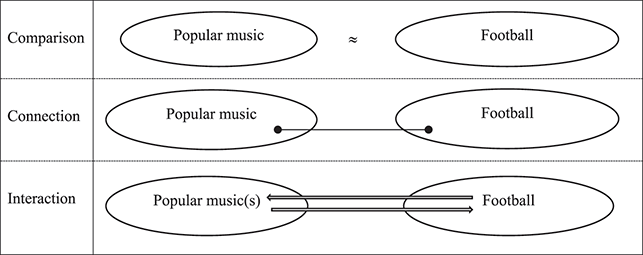
Figure 1 Long description
Popular music and football may be approached as sharing certain comparable characteristics (depicted in the upper row, Comparison), as being occasionally mutually constitutive (depicted in the middle row, Connection), and as developing concurrently in ways that render them mutually influential (depicted in the lower row, Interaction).
1.2 Approach and Materials
When bearing in mind the sheer pervasiveness and exposure of music at football, the available scholarly interests and literatures are not overwhelming. For example, in the context of musicology, music at football has typically been addressed only sporadically (see, e.g., Cohen, Reference Cohen2012, p. 597; Hesmondhalgh, Reference Hesmondhalgh2013, p. 105; Middleton, Reference Middleton1990, pp. 17–18). From a musicological perspective, it remains reasonable to assert that “sports music is a vast topic in need of research” (Tagg & Clarida, Reference Tagg and Clarida2003, p. 606, italics in original), even though the authors do not explicitly define what is meant by the term “sports music.” However, it is no longer appropriate to assert that “there has been almost no scholarly work that addresses the significance of their [music and sport] relationship” (McLeod, Reference McLeod2011, p. 3; see similar suggestions in Snyder, Reference Snyder1993, p. 168, and Laing & Linehan, Reference Laing and Linehan2013, p. 307).
In addition to McLeod’s (Reference McLeod2011) own contribution – focused broadly on “bonds between popular music, sports, and related politics … of identity and identity politics in general” (p. 4) – at least three substantial contributions have emerged. One of them is an anthology which suggests presenting “the first broad work of scholarship that brings sport and music together” (Bateman & Bale, Reference Bateman and Bale2009, p. 1), while the other two are more recent special issues of the journal Sport in Society (Bateman, Reference Bateman2014; Long & Spracklen, Reference Long and Spracklen2021). Generally, these contributions include interdisciplinary collections of works mainly positioned within sports studies with a predominant interest for issues pertaining to the construction of identity. However, besides few initiatives – such as Long and Spracklen’s (Reference Long and Spracklen2021) offering which do not exclusively deal with “intersectionality in the sociological sense of intersecting identities” and which highlight the significance of how “sport and music intersect and interact” (p. 2) – contributions have rarely adopted the perspective of musicology to focus on how different forms of popular music interact with the specificities of a given sport and how this interaction has significance from the perspective of the attending spectators in the physical setting of the sport in question. In reassessing the case once made, that “juxtapositions between sport and music have become so conspicuous that, paradoxically, we might fail to notice them, or at least to perceive their significance” (Bateman, Reference Bateman2014, p. 296), this Element aims to advance the understanding of aspects of their significance. In doing so, I build upon my previous work (Graakjær, Reference Graakjær2023), which examined the significance of spectator sounds – including nonmusical forms – by comparing their occurrence within the stadium environment to their representation in televised broadcasts. In contrast, this Element focuses exclusively on music in the stadium environment, encompassing not only spectator-produced music but also other types of music present at matches.
Motivated by a discrepancy between, on the one hand, the extensive performance and distribution of popular music at football and, on the other hand, the relative scarcity of scholarly attention to this music, this Element offers insights into its structure (i.e., the kinds of music that appear), distribution (i.e., when and where it appears), and significance (i.e., the functions it serves) within football contexts. The Element demonstrates how contemporary elite football matches provide a particularly fertile – and at times conflicting – setting for the (re)production of musical significance and patterns of musicking (see further) in everyday life. In doing so, it contributes to a broader understanding of popular music use and consumption in modern life, while emphasizing the importance of interaction in exploring these processes.
By way of introduction, popular music at football is approached through a twofold typology. First, sounds are distinguished according to their origin, identifying three principal sound creators: football performers, spectators, and organizers. Second, sounds are differentiated based on textual qualities, and, following common conventions (though not always aligning precisely with identical definitions), three main types can be identified:
Music: Sounds characterized by defined rhythms, harmonics, and/or melodies.
Vocal sound: Sounds produced by the human vocal tract including talk and interjections.
Object sound: Sounds produced by the motion and interaction of physical objects including human bodily parts other than the vocal tract.
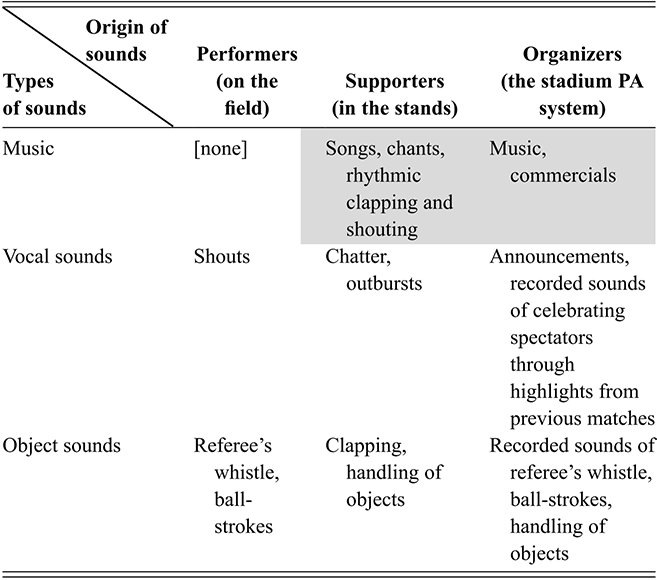
Table 1 illustrates an overview of how the two perspectives combine to produce a total of nine different categories of sound at football. The categories of interest in this Element are “supporter music” and “organizer music” (see the two highlighted boxes in Table 1).
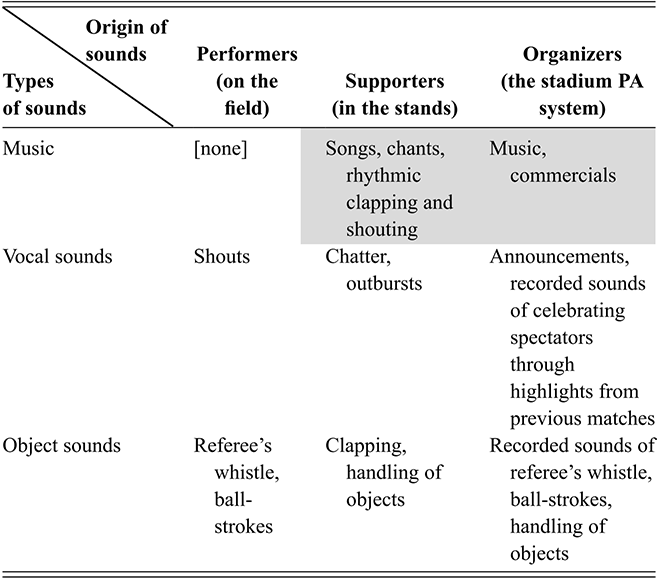
Table 1 Long description
By pairing the three originators with the three types of sound, Table 1 comprises nine distinct sound categories at contemporary elite football matches. Of these, one category – music originating from the performers – is very rare and does not emerge in the case matches. By contrast, music originating from supporters and organizers is widespread, and these two sound categories therefore constitute the focus of this Element. The remaining six categories, specified in the lower two rows and comprising vocal sounds and object sounds originating from performers, supporters, and organizers, are not subjected to further inquiry in this Element.
The Element’s theoretical approach is mainly inspired by Small (Reference Small1998) and Jakobson (Reference Jakobson and Sebeok1960). Accordingly, the Element focuses on various types of popular music as observable “texts” and hence explores the potentials and actualizations of the music’s significance in the stadium settings. The Element also considers how the significance of the music is realized, insofar as it is observable – for example, when spectators can be observed to sing along. However, it is beyond the scope of the Element to include an examination of how the music is produced and prepared prior to its appearance in the stadium setting and how the observed musical practices have emerged historically. Also, further empirical examinations of spectators’ reasoning and experiences are also excluded from the scope of this Element.
From Small (Reference Small1998), the Element is inspired by the suggestion to approach music as something somebody “does” under certain circumstances. Small notably offers the concept of “musicking” to stress that “to music is to take part, in any capacity, in a musical performance, whether by performing, by listening, by rehearsing, by providing material for performance (what is called composition), or by dancing” (Small, Reference Small1998, p. 9). Incidentally, although Small does not consider musicking in stadium settings – rather, a preferred example is “a symphony concert as it might take place in a concert hall anywhere in the industrialized world” (Small, Reference Small1998, p. 14) – Small provides several observations of examples of musicking of which two are particularly relevant for the focus of this Element. Small thus offers an example which approximates what shall be identified as supporter music – that is, “In a big stadium, fifty thousand voices cheer and fifty thousand pairs of hands applaud” – as well as an example approximating the subtype of what shall be identified as organizer music: “In a supermarket, loudspeakers fill the big space with anodyne melodies that envelope customers, checkout clerks, shelf assistants and managers, uniting them in their common purpose of buying and selling” (Small, Reference Small1998, p. 1). Clearly, both organizer music and spectator music exemplify the relevance of asking not merely “What is the nature or the meaning of this work of music?” but additionally (and perhaps more interestingly) “What does it mean when this performance (of this work) takes place at this time, in this place, with these participants?” (Small, Reference Small1998, p. 10; italics in original) – a question which clearly aligns with the present interest for interactions rather than merely connections. Moreover, this emphasis highlights that the Element is concerned primarily with exploring the functions of music, rather than cataloguing or characterizing individual musical works. Notably, the present approach requires attention not only to the circumstances of “this performance” and “this work.” Accordingly, when examining the interactions “between the people who are taking part, in whatever capacity, in the performance,” the analysis necessarily encompasses both “mono-musical interactions” – that is, interactions among sounds conventionally regarded as carrying musical meaning (Small, Reference Small1998, p. 13) – and what may be termed “multi-musical interactions,” involving different, and occasionally overlapping, works and performances.
The Element’s approach is further inspired by Small (Reference Small1998) by being descriptive rather than prescriptive or normative. For example, it has been normatively argued that “there is a general consensus that the quality of popular music associated with sport has not always been of the highest quality” (McGuiness, Reference McGuinness, Bateman and Bale2009, p. 190), and music distributed by PA systems at sports has been described as an “auditory assault” (Powis & Carter, Reference Powis, Carter and Bull2019, p. 395) with the potential effect of spectators being “battered into submission” (Goldblatt, Reference Goldblatt2015, p. 66). However, it is not the aim of this Element to evaluate the “quality” of music from a normative perspective, or to investigate claims of a “general consensus.” Consequently, the Element does not systematically examine popular music at football from a historical standpoint in order to support or challenge existing assertions of deteriorating trends, such as the claim that “the atmosphere once created in stadiums has been muted” (McGuiness, Reference McGuinness, Bateman and Bale2009, p. 190). This is not to suggest that football and popular music always form a smoothly functioning “marriage” or “polyamorous relationship.” For instance, the production of music in stadium settings has occasionally been reported to interfere with football by damaging the playing surface (see, e.g., Gogarty, Reference Gogarty2023), and concurrent sports and music events can create nuisances for both spectators and local residents. Moreover, as this Element will demonstrate, different types of popular music at football often interact in ways that are conflicting.
From Jakobson (Reference Jakobson and Sebeok1960), the Element adopts the semiotic perspective of communicative factors and functions to help explore the music’s significance. Jakobson’s perspective is here adopted as a general outline – or a “cursory description” (Jakobson, Reference Jakobson and Sebeok1960, p. 357) – that arguably remains a powerful framework for discussing and understanding all kinds of texts (Danesi, Reference Danesi2020, p. 103). Encouragingly, the approach has been widely employed and elaborated within studies on music and sound (e.g., Middleton, Reference Middleton1990, pp. 241–242), although it has thus far only marginally influenced research on popular music at football (see, for example, the discussion of the phatic function in Back, Reference Back, Bull and Back2003; see also Graakjær, Reference Graakjær2023; Khodadadi & Gründel, Reference Khodadadi and Gründel2006). Jakobson specifies six “constitutive factors” that are “inalienably involved” in any act of communication: namely, the addresser, the context, the message, the contact, the code, and the addressee (Jakobson, Reference Jakobson and Sebeok1960, p. 353). Each of these six factors is then shown to correlate with a function – that is, the emotive, referential, poetic, phatic, poetic, metalingual, and conative functions, respectively – which specifies what the act of communication serves to do. Typically, any act of communication involves multiple functions, which often embody a hierarchical order. Consequently, such acts “must be investigated in all the variety of its functions” (Jakobson, Reference Jakobson and Sebeok1960, p. 353).
The context of popular music at football requires an extension of Jakobson’s (Reference Jakobson and Sebeok1960) framework, which primarily emphasizes the poetic function of verbal communication from a single addresser to an addressee. Consequently, given that the “common dyadic model of speaker-hearer specifies sometimes too many, sometimes too few, sometimes the wrong participants” (Hymes in Goffman, Reference Goffman and Goffman1981, p. 144), Jakobson’s (Reference Jakobson and Sebeok1960) framework – providing, for the present purposes, “too few,” if not precisely “the wrong” participants – is here supplemented by Goffman’s (Reference Goffman and Goffman1981) concept of “footing.” Footing refers to “the alignment we take up to ourselves and the others present as expressed in the way we manage the production or reception of an utterance” (Goffman, Reference Goffman and Goffman1981, p. 128), and it enables a more nuanced exploration of the participation framework constituted by all individuals gathered at a football match. Although Goffman does not specifically address music or football, his perspective is useful for identifying the football event as a “social situation,” defined as “the full physical arena in which persons present are in sight and sound of each other” (Reference Goffman and Goffman1981, p. 136). Furthermore, he acknowledges that “live witnesses are coparticipants in a social occasion, responsive to all the mutual stimulation that that provides” (Reference Goffman and Goffman1981, p. 138).
Empirically, this Element draws on my own observations of a selection of contemporary elite football matches in national leagues. The specific matches referred to throughout the Element are:
AaB vs. Brøndby (2–1) at Aalborg Stadion (September 1, 2013). Superliga, Denmark.
Viborg vs. AaB (0–2) at Viborg Stadium (April 16, 2014). Superliga, Denmark.
Tottenham Hotspur vs. Leicester City (1–1) at White Hart Lane (October 29, 2016). Premier League, England.
Tottenham Hotspur vs. Liverpool (4–1) at Wembley Stadium (October 22, 2017). Premier League, England.
Tottenham Hotspur vs. Chelsea (0–2) at Tottenham Hotspur Stadium (December 22, 2019). Premier League, England.
Real Madrid vs. Villarreal (2–3) the Spanish La Liga at Santiago Bernabéu (April 8, 2023). La Liga, Spain.
Tottenham vs. West Ham (4–1) at Tottenham Hotspur Stadium (October 19, 2024). Premier League, England.
Bayern Munich vs. Heidenheim (4–2) at Allianz Arena (December 8, 2024). Bundesliga, Germany.
Throughout the Element, these matches are referred to as the “case matches,” and they allow for the observation of significant types and functions of popular music including both similarities and differences when compared. This selection, however, should not be regarded as exhaustive of music at football. For example, partly for reasons of convenience, the case matches are all drawn from (Western) Europe. Although national leagues account for the majority of elite football matches, this selection does not permit observations of international tournaments or finals, where the use of music may differ. What is of relevance to this Element is the cases’ capacity to help illuminate distinctive types and functions of music rather than to catalogue specific works of music at football. Accordingly, the case matches are proposed as an interesting and appropriate lens (inspired by Elliott, Reference Elliott and Elliott2017, p. 6) through which to examine popular music at football more broadly. To gather insights into the functions of music, I adopt the position of a “minimally participating observer” (Bryman, Reference Bryman2016, pp. 433ff) at all matches. From my seat in one of the home team sections – though not in the areas with the most engaged and active supporters – I observed the music, recording my impressions through jotted field notes and audio recordings, from approximately an hour and a half before kickoff to half an hour after the final whistle.
From this point, the Element is organized into two main sections. The first section focuses on “organizer music,” initially examining its different types, followed by an analysis of its communicative functions. The second section correspondingly addresses “supporter music.” Finally, the Element considers how organizer music and supporter music interact.
2 Organizer Music
This section explores types and functions of organizer music at football. The term “organizer music” is motivated by the observation that the music is officiated and distributed by the stadium officials, and hence the organizer appears as the addresser. Throughout the case materials, all examples of organizer music are distributed through the stadium’s PA system – therefore, the music could alternatively be coined “PA music,” as this term has been suggested by Laing and Linehan (Reference Laing and Linehan2013, p. 315). However, the role of the organizer as addresser is critical for examining the functions of this type of music – granting that implications of the mediated distribution are, of course, also relevant to consider. Principally, organizer music includes music that is not distributed by the stadium PA system. Obviously, before PA systems became firmly established across various settings during the 1920s (Laing & Linehan, Reference Laing and Linehan2013, p. 312; see also Devine, Reference Devine2013), organizers could, and would, arrange for the distribution of music through live performances. For example, marching bands including brass instruments were particularly popular and appropriate because they had the potential to be loud enough to reach every corner of the stadium (Laing & Linehan, Reference Laing and Linehan2013, p. 312; see also Nannestad, Reference Nannestad and Bateman2015). Such examples of live performances seem rare at contemporary elite football matches in national leagues, and, as implied, they do not emerge at the case matches.
2.1 Musical Types
Inspired by the concept of “production format” as introduced by Goffman (Reference Goffman and Goffman1981), the organizer arguably represents an “animator” by representing a sort of “talking machine” – or a sound system – “engaged in acoustic activity and utterance production” (p. 144). However, as the distributed music is for the most part originally produced by someone else, the organizers do not qualify as an “author,” defined as “someone who has selected the sentiments that are being expressed and the words in which they are encoded” (Goffman, Reference Goffman and Goffman1981, p. 144). Rather, organizers are redistributing – not unlike “reading aloud” (ibid.) – already existing musical structures. From the perspective of “principal” – that is, “someone whose position is established by the words that are spoken, someone whose believes have been told, someone who is committed to what the words say” (Goffman, Reference Goffman and Goffman1981, pp. 144–145) – the position of the organizer differs somewhat depending on the subtype in question, and I shall return to this issue next.
As noted earlier, the PA system plays a critical role in positioning spectators as addressees. Certainly, “sight is organizationally very important too” (Goffman, Reference Goffman and Goffman1981, p. 129), and screens are positioned in all case match stadiums to ensure that every spectator has visual access – a design feature that has become integral to football stadiums since the 1980s. However, unlike PA-distributed music, which is practically unavoidable unless masked by personal earphones, spectators’ exposure to screened visuals depends on their focused attention. Similarly, organizers’ continuous visual monitoring of spectators via security cameras throughout the stadium is discrete and does not “address” or capture spectators’ attention. Incidentally, at the match between Tottenham and Chelsea, the operation of CCTV became conspicuous after the event, when images and footage were used by officials – including professional lip readers – to investigate an alleged incident of racist abuse by a group of spectators.
Whereas the organizers do not establish sustained and distinct “eye-contact” with the spectators, the deployment of the PA system establishes a consistent “ear-contact.” The stadiums thus include numerous, inconspicuously placed, yet sonically inescapable loudspeakers typically positioned hanging from the roof and “facing” toward the spectator stands. The positions of the loudspeakers have the effect of directing and distributing the organizer music equally to all spectators in the stadium stands, and the spectators fulfill the role of the “ratified” – that is, the intended and “official” – addressees (Goffman, Reference Goffman and Goffman1981, p. 131). This impression is further strengthened by the occasional verbal address of the stadium speaker through the stadium PA system which invariably addresses the spectators and not the players or the stadium staff. For example, the alleged racist abuse is addressed via the PA system on three occasions during the second half of the match: “Racist behaviour from spectators is interfering with the game, please remember that racism has no place in football.” While spectators clearly constitute the primary addressees of music distributed via the PA system, not all spectators appear equally ratified. Moreover, in terms of the “process of auditing” (Goffman, Reference Goffman and Goffman1981, p. 131), spectators appear to adopt fluctuating modes of listening that are shaped by the specific subtype of organizer music being presented. Before examining these variable listening modes, the subtypes and general characteristics of organizer music will be introduced.
Besides the distinct exception of the subtype of “goal music” (to which I return next), the distribution of organizer music is restricted to periods of time before, in between, and after the actual football match. Whereas in-match incidents will be shown to be only occasionally accompanied by organizer music at football, in periods “outside” the actual match, music is practically ever-present. From the analytical perspective of diataxsis, which focuses on “the extensional ordering of events of durations exceeding that of the extended present” (Tagg, Reference Tagg2013, p. 385), musical expressions thus succeed one another in a way that produces only few and short-lasting moments or “auditory lacunes” without music. Also, examples of organizer music do not overlap. Consequently, at any given time outside the actual match, there is one and only one musical expression being distributed. Finally, with a single notable exception, all instances of organizer music in the case matches occur in the form of recorded music.
When viewed from the perspective of “parameters of musical expressions” (Tagg, Reference Tagg2013, p. 263ff), the structure of organizer music embodies both common and distinguishing features. Generally, across the case matches, the tempo (as determined by beats per minute) and the surface rate (as determined by notes or impulses per minute) of most musical expressions are relatively high. Moreover, apart from the occasional auditorily backgrounded music to accompany stadium speak or video films on display on the stadium screens (e.g., including highlights from previous matches), the loudness of the music makes it necessary to raise one’s voice to conduct a conversation with neighboring spectators. The sounds from fellow spectators are thus practically drowned out, though occasional “glimpses” of supporter music (to be explored in Section 3) can emerge depending on one’s observational “point-of-audition” within the stadium setting.
However, the musical expressions differ with respect to their duration, and they range from so-called (Tagg, Reference Tagg2013, p. 281) micro- and meso-durations – roughly defined as ranging from a few to several seconds – to mega-durations, roughly defined as a few minutes. In terms of instrumentation, some musical expressions include lyrics, while others are purely instrumental. Regarding volume, most organizer music is relatively loud, though some tracks are soft and positioned in the auditory background alongside organizer-distributed vocal sounds or speech. This latter perspective aligns with the analytical concept of syncrisis, which focuses on the “arrangement of structural elements inside the extended present” (Tagg, Reference Tagg2013, p. 417). Beyond these structural elements, organizer music also varies in relation to whether it forms part of audiovisual content displayed on stadium screens. Another distinguishing feature is the music’s potential connection to incidents occurring within the stadium environment, independent of the screen content.
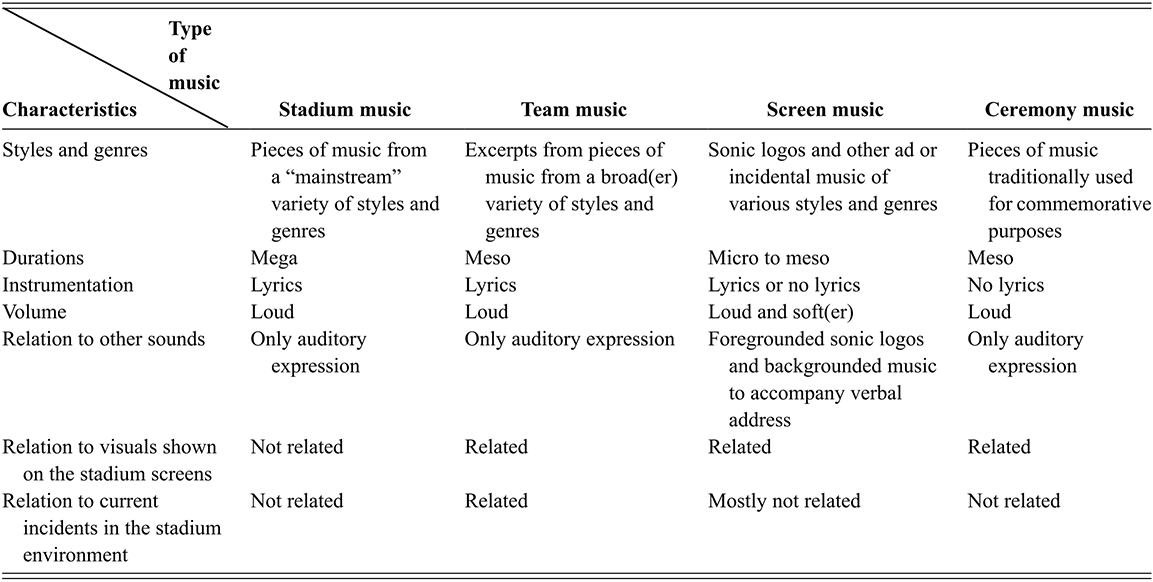
In observing these differences, organizer music can be roughly divided into different types as illustrated in Table 2.
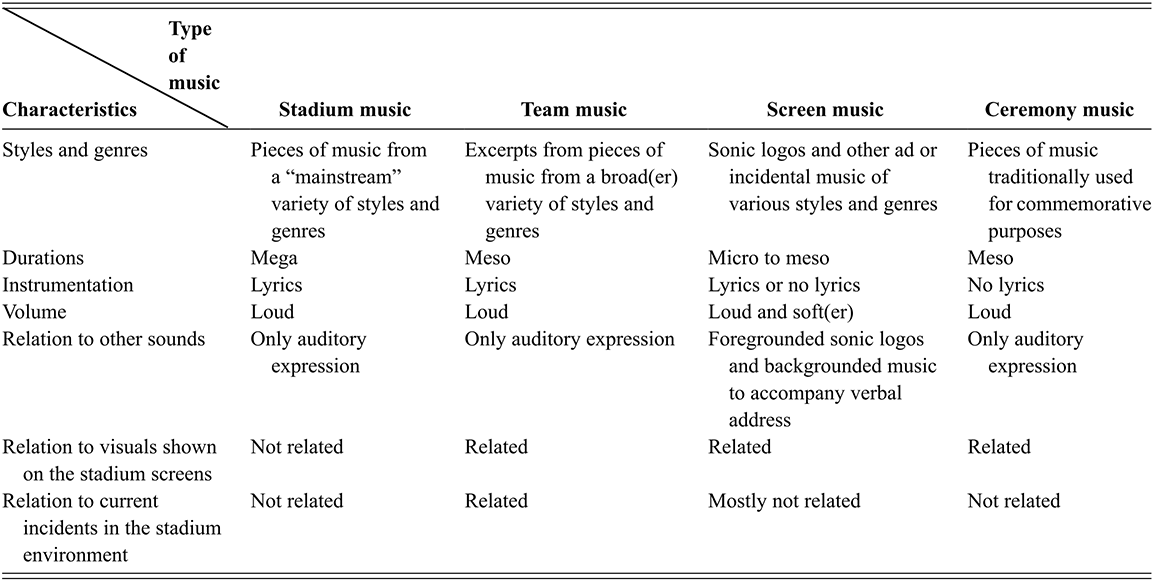
Table 2 Long description
Table 2 comprises a series of musical characteristics – listed in the leftmost column and including styles and genres, duration, instrumentation, etc. – which are specified across rows in order to identify commonalities and differences among the four main types of organizer music
The naming of the four types is inspired by the predominant role they each play in the stadium setting at football matches. “Stadium music” is meant to indicate that this music embodies a sort of “sonic architecture” from the perspective of the attending spectators. Accordingly, the music can be heard as part of the design of the stadium, and it basically coproduces a sense of “being there” in the stadium on the day of the match. “Team music” refers to a more restricted and directed type of music use, which is closely associated with specific match incidents pertaining to the fortunes of the home team at the given match. “Screen music” originates from the audiovisual contents distributed by the screens, and the music appears generally to fulfill functions similar to those of televised commercial content (see, e.g., Graakjær, Reference Graakjær2015). While these three types of music are present at all case matches and thus arguably represent the predominant forms of organizer music at contemporary elite football matches in national leagues, “ceremony music” occurs only infrequently, typically for commemorative purposes. An example transpires at the match between Tottenham and Leicester, where spectators remain silent as a trumpeter performs a rendition of The Last Post as part of the Remembrance Day ceremony held by all EPL clubs at matches in the week leading up to November 11 – the date of the armistice of the First World War – to commemorate members of the armed forces who have died in the line of duty. As already indicated, the four types do not transpire in equal measure. Throughout the period of observation, although regularly and momentarily replaced by screen and team music, stadium music accounts for the majority of the distributed music, while ceremony music is rare and absent in most cases. For the present purposes, stadium music and team music are the most relevant to consider in further detail.
Stadium music encompasses commercially available works, such as streamable products, which are typically distributed in their entirety. Occasionally, however, the playback of stadium music is faded out or abruptly suspended to make way for other music through the stadium PA. This is particularly noticeable at the match between Bayern Munich and Heidenheim, where stadium music is interrupted several times. For instance, approximately 35 minutes before kickoff, the distribution of ZZ Top’s Gimme All Your Lovin’ (1983) is suddenly discontinued to allow for the introduction of a piece of team music (see further discussion). Although the trajectory and reception of musical works are difficult to trace and predict in the contemporary cultural context (see, e.g., Tota, Reference Tota2001), it is reasonable to assume that these tracks were generally not produced specifically for performance in the stadium setting of a football match, let alone for matches involving particular teams. Accordingly, these works can be expected to appear in a variety of contexts outside football, such as on the radio or in retail environments. Although the potential meanings of specific works are rarely unambiguously determinable (for a discussion, see Moore, Reference Moore2012), nothing in the lyrics of these tracks explicitly associates them with football. Notably, the lyrics tend to employ vague and unnamed pronouns and referents to people, times, and places. For example, at the match between Bayern Munich and Heidenheim, the stadium music includes the distribution of Red Hot Chili Peppers Can’t Stop (2002), Muse’ Starlight (2006), ZZ Top’s Gimme All Your Lovin’ (1983), and a recent remix (the specific identity of which I was unable to identify) of Laura Branigan’s Self Control (1984). Occasionally, the music embodies what could be termed “seasonal distinctiveness” as when, for example, Mariah Carey’s All I Want For Christmas Is You (1994) and José Felicianos’ Feliz Navidad (1970) are distributed before the match between Bayern Munich and Heidenheim which takes place in the lead-up to Christmas. However, in addition to having no apparent relation to football or the included teams, these examples have no distinct relation to events in the stadium setting, and consequently, they do not embody what could be termed “situational distinctiveness.” Moreover, the music is unrelated to the content displayed on the stadium screens, which during PA-distributed music typically present music-unrelated material such as statistics, team line-ups, and advertisements for club merchandise.
The examples presented thus far highlight a trend in the characteristics that further define stadium music. As already hinted at when having qualified organizer music as generally marked by a relatively high tempo and surface rate, stadium music gravitates toward embodying pulsating and animated musical expressions. Inspired by the suggestion that the distributed music can be compared to “the most anodyne local radio: a musical mix of golden oldies and contemporary pop” (Goldblatt, Reference Goldblatt2015, p. 66; see also Sterne, Reference Sterne, Quiñones, Kassabian and Boschi2013, p. 124), the tracks could be considered to qualify as “adult contemporary,” that is, “melodic pop and rock music from the last decade,” “contemporary popular music by today’s top recording artists,” and “recent hits from the last decade or so” (Warren, Reference Warren2005, p. 39). Thereby, the music selection resembles the contents of mainstream radio programming (se also Graakjær, Reference Graakjær, Michelsen, Krogh, Have and Nielsen2018). Although this characterization of the included music is neither highly detailed nor specific, it nonetheless indicates the types of music that are generally excluded – for example, classical music, children’s songs, ballads, techno, country, and jazz. Based on these features, stadium music observed at the case matches is generally not explicitly related to football or sport. Illustratively, each track appears substitutable, in the sense that it could be replaced by another piece of the same type without diminishing its significance or altering the functions it serves.
Team music refers to music deployed by the organizers to accompany specific team-related incidents. While team music transpires in various forms throughout all the case matches – representing matches in national leagues where a home team is challenged by an away team – related types of music use can be found in matches throughout international tournaments. However, in international settings, the music is influenced predominantly by specific tournament regulations, and next I shall identify examples of how the uses and functions of what might be termed “tournament music” differ from team music. In contrast to stadium music, team music displays clear “situational distinctiveness,” as it is distributed at specific moments to accompany particular team- and match-related events across games. I suggest describing this relation as a case of “close coupling” between music and incident – that is, the music is paired exclusively and temporally coinciding a specific team-related incident. By comparison, stadium music exemplifies cases of “no coupling” (further types of coupling will be illustrated in Section 3). Although the use of team music has evolved over time, its deployment is sufficiently consistent to constitute a recognizable and expected component of attending home matches. Across the case matches, three subtypes of team music can be distinguished, each named according to the primary incident it serves to accompany: the players’ entrance immediately before the match, the scoring of a home-team goal during the match, and the moments following confirmation of a home-team victory.
“Entrance music” refers to music used to announce and accompany the entrance of the players on the pitch. Across all case matches, entrance music is deployed when the players of both teams walk on to the pitch and line up for presentation in the minutes leading up to the match kickoff. For example, at AaB, an excerpt of Tina Turner’s The Best (1989) is distributed to welcome and accompany the players on the pitch, whereas at Tottenham, an excerpt from John Williams’ Duel of the Fates (1999) from Star Wars Episode 1: The Phantom Menace (1999) is used for the same purposes. Incidentally, the latter example illustrates how the use of team music is only relatively consistent, as the organizers have recently opted for an alternative type of entrance music performed by a trumpeter rendering Oh, When the Saints Go Marchin’ In. This choice was possibly inspired by the aforementioned trumpet performances of “ceremony music” on Remembrance Days, as well as by the hymn’s commemorative associations. The hymn itself is an uncredited, undated, and originally orally transmitted spiritual that likely originated as a nineteenth-century Protestant hymn and continues to convey themes of revelation and redemption (CBS News, 2013). Among the most popular early recordings of the song is the version by trumpeter and vocalist Louis Armstrong. Across the case matches, this example also constitutes the only instance of live music being distributed through the stadium’s PA system. For example, at the match between Tottenham and West Ham, a single miked-up trumpeter intonates, through the stadium’s PA system, a relatively slow-paced rendition of the melody to accompany the final preparations before kickoff. Notably, this performance represents an exception to the general tendency for organizer music to be fast-paced and characterized by a high surface rate. Shortly after the trumpeter’s intonation begins, most spectators join in singing, thereby activating the lyrics Oh, When the Spurs Go Marchin’ In. The trumpeter then gradually fades out and eventually ceases playing, leaving the spectators to carry the melody on their own.
Whereas entrance music appears at all case matches immediately before kickoff, it also occurs at other moments during some of the matches. For example, at Tottenham, a rendition of McNamara’s Band (originally 1889, created by Shamus O’Connor and John Stamford) accompanies the players’ re-entrance to the pitch leading up to the beginning of the second half. At the match between Bayern Munich and Heidenheim, the use of entrance music is most prevalent among the case matches, and here several additional examples of entrances are accompanied by designated pieces of music. A distinct example, which does not transpire at the other case matches, is the musical accompaniment of the home team players as they enter the pitch to warm up. For example, at approximately 35 minutes before kick of time, the chorus from Stern des Südens (Star of the South) – created by Willy Astor und Stephan Lehmann and premiered at home matches at Bayern Munich in 1998 (Blöchl, 2017) – emerges to accompany the entrance of the Bayern Munich players. This example illustrates the previously mentioned abrupt discontinuance – occurring mid-chorus – of ZZ Top’s Gimme All Your Lovin’ (1983), which is subsequently resumed as the players begin to warm up after having waved appreciatively to the spectators.
“Goal music” refers to music deployed to accompany the moment of celebration right after the scoring of a goal by the home team. Obviously, home team goals are not scored in every match, and even when they are, goal music is not necessarily deployed in all instances. For example, when observing the celebration of the four home team goals scored at the match between Tottenham and West Ham, there is no organizer music accompanying the subsequent celebrations. In contrast, the celebration of the four home team goals scored at the match between Bayern Munich and Heidenheim is accompanied by goal music in the form of an excerpt from Offenbach’s Infernal Galop (a part of the opera Orpheus in the Underworld, first performed in 1858). Goal music is also deployed at the match between Real Madrid and Villarreal, where a part of the song Hala Madrid y Nada Más (translated as Hail Madrid and Nothing Else) emerges immediately after the scoring of the two home team goals. This example also illustrates that excerpts from the same piece of music can serve as different types of team music, as this song is likewise deployed as entrance music at this particular case match. In contrast to the preexisting status of the music used at the Bayern Munich match, the goal music at Real Madrid represents an original composition produced specifically for the club. Initially commissioned by Real Madrid president Florentino Pérez, the song was created by RedOne – mentioned earlier in this Element as a Real Madrid supporter – and produced and released in 2014 featuring the vocals of the then players and manager (Mandis, Reference Mandis2016, p. 117). Beyond its function at Real Madrid home matches, the song was also released commercially as a self-contained product and achieved notable success, topping the iTunes charts in Spain and several other countries in 2014.
“Victory music” refers to music deployed by the organizer to accompany the moments following the ending of the match when realizing that the home team has won. Obviously, this subtype of team music occurs only when the home team secures a victory, and, accordingly, does not appear at the two case matches in which Tottenham did not win against Leicester and Chelsea, respectively. At these matches, stadium music, as described previously, emerges right after the match has ended. An example of the distribution of victory music transpires at the match between Aalborg and Brøndby, once it has been confirmed that AaB has secured victory. At this point, Queen’s Another One Bites the Dust (1980) accompanies the celebrations. Another example illustrates the occasional use of original music created specifically for the given team. At the match between Tottenham and West Ham, immediately after the referee’s final whistle, the chorus from Dave and Chase’s (1981) Glory, Glory, Tottenham Hotspur is distributed to indicate the home team victory. The origin of the song is interesting in light of the interactions between organizer music and supporter music. The song, based on the American Civil War The Battle of the Republic, was thus first appropriated by the Tottenham supporters in 1961 during a European Cup match against the Polish team Górnik Zabrze. Following the first leg match the Tottenham team was characterized as “no angels” by members of the Polish press due to what was considered a rough playing style. Subsequently, for the second leg home match, some of the spectators would wear angel costumes, display banners with spirited slogans, and sing the chorus “Glory, Glory, Hallelujah” as Tottenham defeated Górnik Zabrze 8–1. The recorded version by Dave and Chase – released as the B-side to the single Ossie’s Dream produced for the 1981 Cup Final – features the substitution of the original chorus’ Hallelujah with Tottenham Hotspur. This reworking mirrors what supporters had reportedly been doing themselves early on, as suggested by Finn (Reference Finn1963, p. 181).
The match between Tottenham and West Ham further illustrates how the victory music might include a selection of tracks. For example, within 10 minutes of the ending of the match, the organizer also distributes the track Freed from Desire (1996) by Gala as well as ABBA’s Gimme! Gimme! Gimme! (A Man After Midnight) (1979). While the former seems to have developed into a tradition including a specific dance performed by both players and groups of spectators, the latter is specifically inspired by the appearance of the Swedish player Dejan Kulusevski who joined the club in 2022. Prior to the arrival of Kulusevski, this particular piece of music does not appear to have been used consistently at Tottenham matches. The song was first embraced by supporters to provide the melody for a song to pay tribute to the player, including the lyrics “Gimme, Gimme, Gimme a Ginger From Sweden,” including a playful reference to the color of his hair.
2.2 Musical Functions
From an analytical perspective concerned with what organizer music does within the football stadium setting, the communicative functions of team music appear generally more explicit and pronounced than those of stadium music. This does not, of course, imply that stadium music is nonfunctional or irrelevant. The following section therefore specifies key aspects of the communicative functions of stadium music.
As regards the referential function, although it is in “numerous messages … the leading task” (Jakobson, Reference Jakobson and Sebeok1960, p. 353), it does not appear to be a particularly pronounced feature of stadium music. Accordingly, because of the general ambiguity of what stadium music “is about,” the music does not clearly include a “a set … towards the referent, an orientation toward the context” or “someone or something spoken of” (Jakobson, Reference Jakobson and Sebeok1960, pp. 353, 355). Also, the music has no explicit relation or reference to incidents in the stadium setting. Indicatively, during my observations, the spectators do not generally pay much attention to or “use” the stadium music in any noticeable way. For instance, no spectators appear to be singing along, dancing, or listening attentively; rather, most seem engaged in interpersonal conversation and/or focused on their smartphones. Drawing on a standard distinction, the spectators seem predominantly engaged in the “physiological phenomenon” of hearing the music rather than in the “psychological act” of listening to it (Barthes, Reference Barthes1976/1985, p. 245). Although what is here termed stadium music might formally qualify as “foreground music” – for instance, as “existing recordings” arranged “in a programme or flow of some sort,” in contrast to “background music,” which consists of “syrupy or jazzed-down versions of already popular songs” (Sterne, Reference Sterne, Quiñones, Kassabian and Boschi2013, p. 124) – from the perspective of the spectators, it nonetheless seems to occupy a background position.
However, the previously mentioned interruption of stadium music may suggest that, while spectators are not attentively listening, their engagement with the music nonetheless exceeds mere hearing. Given the ever-present possibility that the music will be interrupted to introduce a more significant piece of (team) music, the distribution of stadium music might invite spectators to adopt a kind of “standby listening” or “listening-in-readiness” – that is, “an intermediate kind of listening, in which the attention is in readiness to receive significant information, but where the focus of one’s attention is probably directed elsewhere” (Truax, Reference Truax2001, p. 22). In this mode, spectators remain constantly prepared to direct their attention toward possible developments related to the match (for a similar function of interrupted tracks in radio programming, see Graakjær, Reference Graakjær, Michelsen, Krogh, Have and Nielsen2018). From this perspective, although stadium music does not itself serve a referential function, it arguably assumes an indirect referential role, since its interruption is motivated by and thereby refers to match incidents. Correspondingly, when the music continues uninterrupted, it implicitly communicates that “nothing noteworthy is happening.”
The stadium music’s prompting of “standby listening” also involves a contact or “phatic” function, which serves “to establish, to prolong, or to discontinue communication, to check whether the channel works (‘Hello, do you hear me?’), to attract the attention of the interlocutor, or to confirm his continued attention (‘Are you listening?’)” (Jakobson, Reference Jakobson and Sebeok1960, p. 356). From this perspective, stadium music serves to establish and sustain contact in the sense that its distribution toward attendees signals the organizers’ acknowledgment of the spectators’ presence – conveying, in effect, a message along the lines of “we are here, and we are attending to you while nothing noteworthy is happening.” When music is used for this purpose – as opposed to other sounds or no sounds at all – it also implies a “poetic” or aesthetic function which is focused not on what is being communicated but on how an act of communication is structured and performed: “The set (Einstellung) toward the message as such, focus on the message for its own sake, is the poetic function of language” (Jakobson, Reference Jakobson and Sebeok1960, p. 356; italics in original). Given that aesthetics deal with the experience of objects or settings “which provide the consumer with an element of beauty, or which are emotionally and/or spiritually moving” (Charters, Reference Charters2006, p. 239), the music also serves an embellishing and noise masking function.
With regard to the emotive function – which is focused on the addresser and serving to “produce an impression of a certain emotion whether true or feigned” (Jakobson, Reference Jakobson and Sebeok1960, p. 354) – stadium music helps establish an impression of a positive and lively setting. The music may not clearly include a “direct expression of the speaker’s attitude toward what he is speaking about” (Jakobson, Reference Jakobson and Sebeok1960, p. 354). As indicated previously, in addition to the generally unspecific references of the lyrics, the music is not “authored” by the organizers. Yet, as the music is ultimately officiated by the organizers, they act as “principals” in the sense of endorsing and being committed to the general “atmosphere” of liveliness potentially conveyed and co-produced by the music. That is, if “atmosphere” is “what relates objective factors and constellations of the environment with my bodily feeling in that environment” (Böhme, Reference Böhme2017, p. 1), then the music can be seen as an environmental, constellational factor that holds the potential to embellish the environment and influence the general mood of the spectators – indeed, it may be understood to assist in “the creation of an environmental ‘feel’” (Sterne, Reference Sterne, Quiñones, Kassabian and Boschi2013, p. 126). Thereby, the music qualifies as an example of what has been described as music “that has no immediate relationship to sport” and which is “purely incidental there purely to embellish the sport event” (Long & Spracklen, Reference Long and Spracklen2021, p. 4).
Accordingly, with regard to the conative function – denoting an “orientation towards the addressee” and finding “its purest grammatical expression in the vocative and imperative” (Jakobson, Reference Jakobson and Sebeok1960, p. 355) – the music arguably serves as an environmental cue that encourages spectators to gravitate toward certain moods and behaviors. More generally, the music appears to establish conditions for unfocused interaction among spectators – that is, a form of interaction concerned “largely with the management of sheer and mere copresence” (Goffman, Reference Goffman1963, p. 24), characterized by the absence of a clear purpose and only loosely prescribed participant rules and roles. While having no direct relation to specific incidents within the stadium environment, the music may thus not only stimulate unfocused interaction but also direct the attention of spectators toward various other activities – for example, the consumption of food and drinks from the stadium’s numerous stands. Although the music is not outwardly “used” by the attendees, it is thus likely that the music can generally serve to heighten the energy level among spectators and stimulate consumption. The role of stadium music to position the spectators as “consumers” is indeed indirect, but the process is furthered by the organizers’ occasional distribution of commercials including screen music. For example, at the match between Bayern Munich and Heidenheim, Coca-Cola commercials are distributed via the mega screens including the brand sound of a five-note sonic logo (Graakjær, Reference Graakjær, Deaville, Tan and Rodman2021b) to promote the beverage readily available from the stadium stands. The commercials, including the sonic logo which the spectators are likely to be familiar with from outside the stadium setting, directly addresses and positions the spectators as consumers, and it sets the stage for spectators to orient themselves toward consumption inside the stadium.
As stadium music contributes to addressing attendees as consumers, it performs a function comparable to that of music in shops and malls – though, in the stadium setting, the music is not necessarily or self-evidently “anodyne,” as implied by the earlier quotation. In shops and malls, where music accompanies the primary activity of consumption, the choice of music typically varies according to factors such as the goods on offer and the intended customer groups; moreover, distinct kinds of music may be distributed in different areas to help “sectionize” the retail environment (see, e.g., Graakjær, Reference Graakjær2012). By contrast, in the stadium setting, where music is distributed uniformly to all spectators and bears no explicit reference to football, it functions to “level out” distinctions among attendees and to cultivate a shared social identity among them as “attendees” and “consumers,” rather than as home- or away-team “supporters” – a term here denoting individuals particularly engaged in supporting a specific team (see further in Section 3). Generally, the music contributes to this effect by comprising an inclusive, mainstream selection of tracks that arguably alienates very few listeners, thereby enabling the organizers to create a universally welcoming environment and to appeal to the broadest possible audience demographic.
Whereas stadium music can thus be profiled from the perspective of most of the communicative functions proposed by Jacobson (Reference Jakobson and Sebeok1960), the stadium music has not been observed to include a metalingual function, that is, “whenever the addresser and/or the addressee need to check up whether they use the same code, speech is focused on the code: it performs a metalingual (i.e., glossing) function” (Jakobson, Reference Jakobson and Sebeok1960, p. 356). However, Jakobson further specifies the metalingual function by offering a distinction between two levels of language – that is, “‘Object language’ speaking of objects and ‘metalanguage’ speaking of language” (Jakobson, Reference Jakobson and Sebeok1960, p. 356). Inspired by this distinction, it might be argued that the previously mentioned stadium speaker address at the match between Tottenham and Chelsea incidentally entails a metalingual function, insofar as it involves “speech about language.” While the verbal address itself does not constitute music, it refers to an alleged racist chant by Tottenham supporters directed at the black Chelsea player Antonio Rüdiger – an example to which I shall return in Section 3.
Focusing now on team music, as mentioned earlier, its communicative functions appear more pronounced than those of stadium music. Most significantly, the “situational distinctiveness” of team music embodies a more obvious referential function, as the use of music refers to and is deliberately coupled with specific team-related incidents in the stadium setting. The music aligns with either something that is taking place (entrance music), to something that has just occurred (goal music), or the outcome of what has unfolded over the preceding period of play (victory music). For instance, at the match between Bayern Munich and Heidenheim, the music accompanies the entrance of the home team players, thereby informing even visually inattentive spectators that something of immediate relevance to the forthcoming match is happening. Similarly, a referential function is evident when the goal music at the same match alerts momentarily absent spectators (e.g., those visiting a food stand or restroom) that a goal has just been scored. This latter example further illustrates that – particularly in the case of preexisting music – the referential capacity of the track depends on its relatively consistent use, through which a meaningful association between the music and the specific match incident is established.
Like the preexisting stadium music, the preexisting examples of team music generally contain no explicit reference to the team, football, or sport. However, unlike stadium music, an association with the team is established through the music’s situational distinctiveness within and across home matches. Furthermore, since team music is deployed at particularly salient moments – and is therefore arguably listened to and used by spectators to a greater extent than stadium music – preexisting team music engages more directly and expressively with the signifying potentials of the musical material itself. The “situational distinctiveness” of team music thus actualizes aspects of its potentials for signification, shaped by features such as the style, genre, lyrics and prior circulation of the piece in question. By adopting preexisting music, the organizers can thus stimulate a certain reading or interpretation of the often, as previously mentioned, unnamed and imprecise designation of pronouns. For example, when Tina Turner’s The Best (1989) is used as entrance music, home-team spectators are invited to “fill in” the pronouns and imagine that You’re – that is, AaB as a team, its individual players, and/or fellow supporters – Simply (that is, unquestionably and without doubt) The Best (the finest and greatest), Better Than All the Rest (surpassing all competitors). Similarly, when Queen’s Another One Bites the Dust (1980) is played as victory music, it suggests that an anonymous, inferior opponent – one among many – has now been defeated or has “fallen,” evoking an analogy between a match and military combat. These examples indicate that team music does more than create moods; it actively stimulates the production of meanings, which appears not to be a predominant function of stadium music.
From the perspective of the emotive function and the related issue of production format, some team music – while also being “animated” by organizers – can be regarded as “authored” by affiliates of the organizing body, unlike most stadium music. For instance, the distribution of the previously mentioned Hala Madrid y Nada Más exemplifies the organizer’s re-animation of a piece originally commissioned by Real Madrid’s president Florentino Pérez, composed by Nadir Khayat (RedOne), an alleged Real Madrid supporter, and performed by players and coaches – thus involving staff members and partners. Whether authored by organizer affiliates or not, the relatively consistent and meticulous deployment of team music to accompany specific team-related incidents creates the impression that organizers commit themselves to what the music “speaks about” or has “come to be seen as speaking about” (to paraphrase Jakobson). By taking responsibility in this way, organizers assume the role of “principal” to a greater extent than is the case with stadium music.
This more discernible “principality” of organizers also points to further characteristics of team music from the perspective of the emotive function. Because it is deployed exclusively to celebrate favorable incidents for the home team, team music is inherently partisan. For example, the case matches do not include music accompanying goals scored by the away team – neither to mark their supporters’ celebration nor to reflect the home supporters’ displeasure. A particularly striking instance occurs in the match between Real Madrid and Villarreal, where each of the three away-team goals is followed by an almost “deafening silence,” understood here as the absence of expected sounds. Not only is organizer music withheld after each goal, but – unlike practices observed in other case matches – the stadium announcer remains silent, ignoring the goals entirely. In an environment where only a few, barely audible, away supporters celebrate, this silence becomes exceptional within the case matches, yet typical of La Liga fixtures (see Section 3).
It is primarily the partisan quality of team music that distinguishes it from tournament music, mentioned at the beginning of this section. Tournament music is deployed to promote the tournament itself rather than the participating teams. For example, the Champions League anthem, introduced earlier in this Element, is used as entrance music at all Champions League matches, regardless of venue or participating teams. Similarly, goal music can serve to promote a tournament, as illustrated by the use of excerpts – slightly modified (see Dean, Reference Dean2021, p. 14) – from The White Stripes’ Seven Nation Army (2003) at the UEFA European Championship since 2008 (McCarter, Reference McCarter2018). In this context, the music is played whenever a goal is scored by any team. Incidentally, this particular piece has appeared in numerous other football settings, including as goal music for specific teams and as entrance music at the FIFA World Cup 2018 (Karr, Reference Karr2018).
The distinct and partisan nature of team music further suggests that this practice can be understood as a form of sound branding – defined broadly as the strategic use of sound to establish a long-term association between the sound and an organization or its products, thereby differentiating the organization by shaping consumer perceptions through specific emotions, cognitions, and conations. In the stadium setting, this process relies primarily on the situational distinctiveness of the music. Although team music often spans a wide range of styles and genres and occasionally includes compositions produced specifically for the team – as exemplified by the entrance music at Real Madrid and Bayern Munich – the branding effect does not depend on musical distinctiveness. Numerous examples involve preexisting tracks whose previous distributions are not uniquely tied to a particular team, such as Tina Turner’s The Best and Queen’s Another One Bites the Dust.
At football, the process of sound branding is potentially highly advantageous. Compared to commercial settings such as retail environments and advertising (see Graakjær, Reference Graakjær2015), the stadium setting offers a unique opportunity: team music accompanies moments of exceptional joy, marked by spectators’ intense emotions and collective elation. By deploying team music at these peak experiences, organizers effectively “tap into” these emotions, encouraging spectators to associate them not only with the specific incidents but also with the broader experience of watching this particular team in this specific setting. In doing so, organizers can strengthen and intensify spectators’ brand awareness of the hosting club and its identity. Concurrently, this process can also subject the music itself to a form of sports or football branding, as it becomes available to a wider audience and infused with new layers of signification related to football, the team, and the associated favorable emotions, cognitions, and conations. Consequently, original music created specifically for football contexts may proliferate as a self-contained product in the market – examples include the aforementioned Hala Madrid y Nada Más and Stern des Südens. Similarly, the familiarity and commercial popularity of preexisting music can be amplified through its use in football settings. For instance, The Baha Men’s Who Let the Dogs Out has been described as “likely the most conspicuous example of the confluence of sports and music marketing to date” (McLeod, Reference McLeod2011, p. 82), as its initial popularity in sporting venues is believed to have influenced its subsequent success on music charts. However, this claim is complicated by the fact that the song’s origins remain contested, with evidence suggesting that significant parts of it may have emerged among sports supporters as early as the mid-1980s (see, e.g., Berube, Reference Berube2020).
At the same time, the process of sound branding may also entail adverse consequences. Although this is not inevitable – and generally less problematic in cultural contexts where the trajectories of musical pieces are expectedly heterogeneous – the organizer’s use of preexisting music can be perceived by spectators as an unwelcome attempt to “colonize” or “hijack” the signifying potential of specific pieces. This perception may even lead to a sense of lost personal connection to the music among some spectators. Moreover, the frequent use of the same music in other football contexts can diminish its exclusivity as a brand element. The extensive deployment of Seven Nation Army provides a clear example, as do the aforementioned uses of The Best and Another One Bites the Dust. While this potential drawback is not unique to sports – indeed, the use of preexisting music has long been a point of contention in music and marketing more broadly (Graakjær, Reference Graakjær2015, p. 27ff) – football introduces an additional complication related to the specific ways in which music (preexisting or original) is employed during matches, a matter that involves the conative function.
From the perspective of the conative function, team music – unlike the predominantly unfocused interaction stimulated by stadium music – create conditions for a more focused interaction among home-team supporters. This interaction is characterized by a central purpose and more firmly prescribed participant roles and norms (Goffman, Reference Goffman1963). Specifically, a key function of team music is to summon and guide spectators’ attention toward team- and match-related incidents. This also involves aspects of the phatic function, as the music serves to establish contact with the addresser. For example, it can operate as a kind of “breaking news” announcement, signaling: “Listen up, right now, and see who is entering the pitch.” Team music thus possesses the capacity to interrupt – as literally occurred at the Bayern Munich case match – and to activate a process of “standby listening,” urging what might correspondingly be termed “on-duty listening” or “listening-in-search” (Truax, Reference Truax2001, p. 21), focused on identifying the source and purpose of the musical cue. While team music summons spectators’ visual attention, it also animates and encourages home-team supporters to engage in active sound production. Because the music is partisan – deployed exclusively to celebrate favorable incidents from the home team’s perspective – it most clearly caters to home supporters. Unlike the generally inclusive and behaviorally unspecific appeal of stadium music, team music offers a more behaviorally specific and exclusionary appeal. Consequently, home-team supporters are positioned as ratified addressees, whereas away-team supporters become unratified addressees or bystanders who merely overhear – and must “endure” – the celebratory music of the home team.
The organizer’s encouragement for supporters to engage in sound production introduces the previously announced complication, as at least two potential responses can occur. On the one hand, the music functions as a resource that spectators draw upon and enjoy when expressing their (e)motions. The case matches provide numerous examples of this, where a significant number of spectators actively participate in sound production aligned with the organizer’s music. For instance, during the match between Bayern Munich and Heidenheim, after each home-team goal, the sounds of celebration are largely dictated and shaped by the organizer’s music – illustrated clearly by spectators’ steady clapping in synchrony with its rhythm. Similarly, the entrance music at the Real Madrid–Villarreal match attracts a massive following of singing spectators, while at the Tottenham–West Ham match, participation extends beyond singing along to the trumpeter’s entrance music: supporters also join in singing and dancing to victory tracks such as Glory, Glory Tottenham Hotspur and Gala’s Freed from Desire. Incidentally, the trumpeter’s rendition of Oh, When the Saints Go Marchin’ In illustrates how organizers’ use of music can “turn over the speaking role” to supporters, exemplifying Goffman’s observation that audience actions may be recommended for “current execution” (Reference Goffman and Goffman1981, pp. 133, 138). Whereas team music generally sets the scene for experiencing certain sentiments, moods, and meanings, it also quite literally “sets the tone” for supporters’ intonation – the melody being established by the trumpeter in the key of C major, which deviates slightly from the predominant key of spectators’ self-determined intonation (typically B major; see Graakjær, Reference Graakjær2023).
The examples presented here generally illustrate how musical expressions can serve a conative function through “‘imperative’ rhythms, which set bodies moving in specific ways” (Middleton, Reference Middleton1990, p. 242). Yet, sonic prompting also carries the risk of being perceived by supporters as an unwelcome or intrusive attempt to engage and activate them. In addition, the music is often amplified to such a degree that it drowns out spectators’ own sound production, making it difficult for them to hear and enjoy each other or to make themselves heard. Whether organizer music in such situations is experienced as a welcomed resource or, conversely, as a disempowering “acoustic assault” depends on the setting and on varying attitudes, expectations, and sonic practices among supporters – the singing of whom will be explored in the following section.
2.3 Summary
In summary, this section has identified different types of organizer music, two of which have been examined in greater detail. Both organizer and team music share the characteristic of being recorded, with one notable exception: the introduction of a live-performing trumpeter at the Tottenham–West Ham match. Furthermore, both types are distributed through the stadium’s PA system, making them audible – and potentially listenable – to all present. However, the two types differ in several respects. Table 3 outlines some of the most significant differences that have emerged throughout this section, offering a more refined characterization compared to the initial, more general overview presented in Table 2, which served to distinguish the two main categories of organizer music.
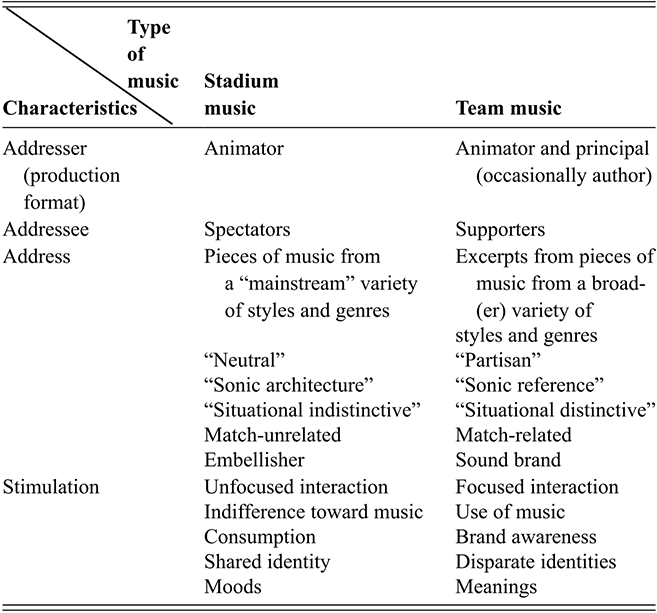
Table 3 Long description
Table 3 identifies differences between the two subtypes of organizer music – stadium music and team music – by comparing their communicative characteristics. These characteristics are listed in the leftmost column and include aspects relating to the sender (see Addresser), the identification of recipients (see Addressee), the specification of the music’s forms and functions (see Address), and an outline of the activites, behaviours, and understandings that the music may be considered to foster.
3 Supporter Music
Supporter music is defined here simply as music produced by supporters, understood as groups of individuals particularly engaged in supporting a specific team through sound production. This form of music emerges most prominently during the two halves of the match, when the otherwise dominant organizer music is absent or limited to occasional “goal music” (as introduced in Section 2). In contrast to organizer music, which is distributed via the stadium PA system and equally available to all spectators, supporter music is characterized by a more diverse and localized distribution. Although supporter music is often performed collectively in unison, it rarely represents a unified contribution by all attendees acting as a single, cohesive addresser. Because the sounds do not travel with equal intensity across the stadium, supporter music is not equally available to all spectators. For instance, when I identify Heidenheim supporters singing to celebrate their team’s entrance during the PA system’s distribution of Red Hot Chili Peppers’ Can’t Stop at the Bayern Munich match, this is largely due to my proximity to the adjacent section; most other spectators are unlikely to notice this singing. Conversely, at the Tottenham–Chelsea match, a specific case of allegedly racist chanting (introduced in Section 2) emerges among a group of Tottenham supporters located too far away to be observed from my point of audition. While numerous examples of singing go unnoticed by most spectators, this particular instance attracted attention both during the match – first from Chelsea player Antonio Rüdiger, apparently subjected to the chanting, and subsequently from the stadium announcer – and after the match, when it was investigated and widely discussed (Cable, Kilvington, & Mottershead, Reference Cable, Kilvington and Mottershead2022).
Given the large scale of the football pitch and the positioning of spectators around it, supporter music is inevitably experienced as originating from different directions and distances, with sound travel occasionally producing acoustic delays over longer spans. In contrast to the fixed volume and continuous, “back-to-back” distribution of tracks characteristic of organizer music, supporter music appears more dynamic, shaped by overlapping expressions that ebb and flow throughout the match – though this varies by setting and supporter activity. Accordingly, because its distribution is influenced by distance, direction, and reverberation, supporter music offers spectators both “a sense of place” – reflecting the stadium’s size and architecture – and “a sense of being placed,” as each listener occupies a unique point of audition within the stadium.
3.1 Musical Types
The production of supporter music is predominantly based on the human, unmediated voice – most commonly through singing and shouting, and, more occasionally, clapping. Some case matches also exemplify the use of drums and megaphones, often operated by a capo acting as a kind of choir leader among the supporters. However, these instrumental practices generally accompany vocal activity and rarely occur without concurrent singing or rhythmic chanting. Of course, spectators produce a range of sounds that do not qualify as “music.” While such expressions significantly influence the experience of football (Graakjær, Reference Graakjær2023), the focus here remains on musical expressions.
Singing can be broadly characterized as the human voicing of a tonal sequence or melody with a distinct rhythmic profile, pitch contour, and tonal vocabulary or mode (Tagg, Reference Tagg2014, p. 179). Further elaborating on melodic characteristics, two main types can be distinguished: chants and songs. A defining feature of the song is exemplified by the recurrent performance of Oh, When the Spurs Go Marchin’ In at the Tottenham case matches. Songs typically represent lengthier melodic sequences that extend beyond a single lungful of air and generally form rounded expressions, concluding on the reference tone of the mode (the tonic), thereby creating a sense of closure. Songs often comprise several melodic motifs, whereas a chant consists of only one melodic motif – defined here as the smallest melodic unit possessing self-contained musical distinctiveness. Chants are relatively short, performable within a single breath, and while they present a coherent and distinct sequence of notes, their structure is often musically open, ending on a tone other than the main reference tone of the mode.
In addition to its brevity, this structural openness makes the chant particularly suited for “reiteration,” understood as the “consecutive recurrence(s) of a very similar or identical motif” (Tagg, Reference Tagg2014, p. 194). Consequently, although a chant embodies a short melodic structure, the practice of chanting typically extends over a much longer duration. These characteristics are exemplified by the supporters’ repeated performance of Come on You Spurs, which occurs on several occasions at the Tottenham case matches. Chants often gravitate toward rhythmic shouting, as illustrated by the recurrent Come on AaB at the AaB–Brøndby match, consisting of four rhythmically distinct impulses without a clear melody or reference tone. Similarly, the alleged racist expression performed by Tottenham supporters would likely qualify as a chant, although it was not formally categorized as such during the subsequent investigation of the incident. Appallingly, racist chants have long been documented in football, most notably in the form of “monkey chanting,” characterized by rhythmic shouting of “Ough, Ough, Ough” to imitate the sounds of monkeys and apes. However, football also features several chants that may sound similar without any racist intent. Examples include collective rhythmic booing (e.g., to express disapproval), the chant “cheat, cheat, cheat” (to accuse a player of lacking integrity), and the specific Spurs chant Who Who Who Let the Yids Out, which celebrates the supposed Jewish heritage of the club’s support (see further discussion).
It is widely accepted among scholars that supporters’ singing at football gained prominence in England during the 1960s. English supporters’ vocal practices have reportedly influenced sound production in other contexts, possibly facilitated by the early broadcasting of matches from England (see Morris, Reference Morris1981; Graakjær, Reference Graakjær2023). However, other regions appear to have developed alternative practices, as suggested by Morris (Reference Morris1981), who observes that “continental and South American matches are played out to an almost non-stop deafening roar of massed drummers and hooters in the crowd” (p. 315). Illustratively, at the Tottenham case matches, no drums are observed inside the stadium during play. By contrast, drums play an integral role in supporter music at the Bayern Munich–Heidenheim and AaB–Brøndby matches. Possibly related to the absence of drumming, rhythmic clapping appears only sporadically at the Tottenham case matches – although a rare example occurs in the form of a repeated structure: Yid Army, [clap], [clap]. By contrast, rhythmic clapping is widespread at the other case matches, where the so-called “football rhythm” – allegedly inspired by the opening of Hold Tight (1966) by Dave Dee, Dozy, Beaky, Mick & Tich (Kopiez & Brink, Reference Kopiez and Brink1999, p. 71 ff.; see also Morris, Reference Morris1981) – emerges as a prevalent feature.
As indicated by the reference to Hold Tight, the basic distinction between preexisting and original music (introduced in Section 2) is also relevant when considering the origins of specific examples of supporter music. Although the precise origin and subsequent circulation of such music cannot always be unambiguously determined, preexisting music appears to predominate in football contexts. Generally, the circulation of music among football supporters resembles processes characteristic of folk music, where musical expressions are transmitted primarily orally, exist in multiple variants, and lack clear identification of authors, originators, or inspirators (see, e.g., Herd & Löfgren, Reference Herd and Löfgren2020, p. 13). In addition to tracing the origin of songs outside football, a further issue concerns their circulation within the sport. For example, the preexisting song Oh, When the Saints Go Marchin’ In (introduced in Section 2) has become part of the repertoire not only of Tottenham supporters but of supporters of numerous clubs (Kopiez & Brink, Reference Kopiez and Brink1999, p. 84; see also Back, Crabbe, & Solomos, Reference Back, Crabbe and Solomos2001, p. 43). Illustratively, the song is said to have been introduced in the early 1960s by Liverpool supporters “to honour one of their star players, Ian St John” (Morris, Reference Morris1981, p. 305). Around the same time, however, it was reportedly performed by supporters at both Southampton (Merrills, Reference Merrills1997, p. 14) and Tottenham (as implied in Finn, Reference Finn1963).
While examples exist of supporters performing preexisting music on football – that is, music originally and explicitly referencing football (see Lawn, Reference Lawn2020, pp. 34–35; Nannestad, Reference Nannestad and Bateman2015, pp. 323–324) – preexisting music not on football clearly predominates among chants and songs performed by supporters. The source materials for these chants and songs span a wide range of musical origins, including (but not limited to) hymns, nursery rhymes, classical music, rock, pop, jazz, musicals, and television music such as commercials and title themes (for examples, see Back, Crabbe, & Solomos, Reference Back, Crabbe and Solomos2001, p. 62; Thrills, Reference Thrills1998, p. 33). Unsurprisingly, a common feature of these sources is a relatively simple melodic structure drawn from widely familiar pieces, which facilitates engagement by supporters with little or no formal musical training.
An additional criterion – though relevant in some cases more than others – concerns the specific potentials of meaning that the origin and preexistence of a musical piece offer supporters to “play with” during performance. For example, at the Tottenham–Liverpool match, the song One Season Wonder (with the lyrics “He’s Just a One Season Wonder”) emerges among Tottenham supporters to the melody of Guantanamera shortly after Harry Kane has scored his second goal of the match. Rather than invoking the most accessible interpretation of the original song’s meaning – pertaining to Cuban patriotism and solidarity – the Tottenham supporters’ version alludes to earlier, lyrically identical renditions sung by rival supporters. Harry Kane was previously tagged and taunted with the One Season Wonder chant following his breakthrough season (2014/2015), during a brief period when his goal tally declined (Rosser, Reference Rosser2017). Incidentally, Guantanamera represents one of the most popular examples of supporters’ activation of a piece of “preexisting music not on football,” having been sung at matches since at least the late 1960s, likely influenced by the commercially successful version by The Sandpipers in 1966 (see Laing & Linehan, Reference Laing and Linehan2013, p. 314).
Generally, spectators’ performances based on preexisting music can be understood as “rearticulations,” insofar as they give new or extended expression to the original material. Collective unison singing represents a distinct stylistic transformation compared to the music’s prior distribution outside the football setting. Two main types of rearticulations can be distinguished here: adoptions and adaptions. Adoption refers to the rearticulation of (an excerpt of) preexisting music without significant lyrical modification, whereas adaption involves substantial “relyricization” (Lacasse, Reference Lacasse and Talbot2000, p. 57) – or, in the case of instrumental pieces, lyricization (for examples, see Dean, Reference Dean2021; Herd & Löfgren, Reference Herd and Löfgren2020). Alternative terms for adaptions include “copsais” (an acronym for “customisation of popular songs as sung in stadia,” proposed by Laing & Linehan, Reference Laing and Linehan2013, p. 314) and “contrafactum” (see Kopiez & Brink, Reference Kopiez and Brink1999, p. 169).
Based on observations at the case matches and prevailing assessments (see, e.g., Kopiez & Brink, Reference Kopiez and Brink1999, p. 167) adaptions appear to be far more common than adoptions. For example, Oh, When the Spurs Go Marchin’ In exemplifies an adaption, as the original melody is retained while “Spurs” represents a relyricization of the original “Saints.” Similarly, the previously mentioned chant Who, Who, Who, Let The Yids Out seems to be adapted from the Baha Men’s hook line, “Who Let The Dogs Out, Woof, Woof, Woof, Woof, Woof.” Among the most widespread examples are Guantanamera (as noted earlier with respect to the One Season Wonder song) and The Beach Boys’ Sloop John B (1966) which appears in several variants across the case matches. For example, during the match between Tottenham and Leicester, the away supporters on several occasions make their identity – and status – audibly clear: “We Know What We Are, We Know What We Are, Champions of England, We Know What We Are,” asserting that they were the reigning league champions at the time. Similarly, during the match between Tottenham and Liverpool, the home supporters repeatedly activate the song He’s One of Our Own to the same tune, thereby reinforcing their connection with – and admiration for – the player Harry Kane.
The adaption of Oh, When the Spurs Go Marchin’ In exemplifies what is often termed a “signature song” – also referred to as a “signature tune” (Morris, Reference Morris1981, p. 306) or a “club anthem” (Back, Crabbe, & Solomos, Reference Back, Crabbe and Solomos2001, p. 49). It stands out as the most frequently repeated song with the strongest following across the observed matches. Notably, the song functions as a key identifier of Tottenham, even appearing when playing as the team in the football simulation video game FIFA (Graakjær, Reference Graakjær2020). During the case match between Tottenham and Liverpool, for instance, it emerges prominently on seven occasions, each time accompanied by substantial supporter engagement. Furthermore, it has been described as “the classic Spurs song of the modern era” (Duggan, Reference Duggan2012, p. 207). Other potential – and arguably more original – candidates do not exhibit the same degree of regularity or pervasiveness. For instance, the chant Yid Army, [clap], [clap] appears with some frequency but attracts only a limited following. Similarly, while “Tottenham had its Glory, Glory, Hallelujah, The Spurs Go Marching On” representing a song “of their own” (Morris, Reference Morris1981, p. 306, italics in original; see also Merrills, Reference Merrills1997, p. 56), it does not occur consistently throughout the case matches. This relative absence may be influenced by the fact that the song already features prominently as organizer music (as discussed in Section 2), which potentially undermines spectators’ experience of ingenuity and spontaneity.
Although Oh, When the Saints Go Marchin’ In is not exclusively associated with Tottenham supporters, what distinguishes their adaption is the distinctive tempo and structure of its performance. Typically, the chant begins with two relatively slow renditions of the eight-bar verse, during which supporters raise their hands toward the sky, followed by a faster version introduced and accompanied by rhythmic clapping. This performance style – described as “slooooowwwww” before “they speed up” – is widely regarded as idiosyncratic and likely originated with Tottenham supporters: “as far as I can tell, Spurs fans started it” (Marshall, Reference Marshall2014, p. 201). The performance is also distinctive in that, across renditions within individual matches and across different matches, supporters consistently intonate the song in the key of B major. This consistency is unlikely to reflect an ability for absolute pitch among supporters – who are likely musical amateurs – but rather a matter of practical feasibility. The chosen pitch range accommodates singers of different genders and varying vocal registers (for a similar observation in another sport, see Heaton, Reference Heaton1992, p. 83). Remarkably, this intonation in B major persists whenever supporters themselves initiate the chant, even though organizers have introduced the melody as entrance music in the key of C major (as noted in Section 2).
When examining how supporters activate musical expressions, substantial differences become evident across the case matches. These differences primarily concern the origin and, most notably, the timing of the music. Regarding its origin, as noted earlier in this section, musical sounds rarely stem from a unified contribution by all spectators acting as a single, cohesive addresser. A rare example occurs during the match between Viborg and AaB, where virtually all attending spectators – led by the two opposing supporter groups – join vigorously in the chant Hader FCM (translated as Hating FCM) directed toward a non-present, yet common, third-party local rival in the Danish Superliga (for another example, see Lawn, Reference Lawn2020, p. 196). Rather than originating from a unified crowd, musical expressions typically emerge from distinct groups of supporters positioned in different sections of the stadium.
Beyond the initial distinction between highly engaged “supporters” and less engaged “spectators,” these groups can usually be further categorized as home or away team devotees. Among the case matches, only the match between Real Madrid and Villarreal lacks a significant contingent of away supporters. This absence appears to reflect a broader trend within the Spanish national league, where the practice of traveling to away matches has not developed – primarily due to long travel distances and the associated logistical and financial constraints (Fahy, Reference Fahy2021; for a similar situation in Norway, see Goksøyr & Hognestad, Reference Goksøyr, Hognestad, Armstrong and Giulianotti1999, p. 208). By contrast, the practice of supporters traveling to away games has long been established in national leagues such as those in Germany and England. In these contexts, away supporters are typically allocated a relatively small, segregated section of the stadium, while home supporters occupy multiple sections, including a large, designated area positioned far from the away section. Consequently, football matches often feature several – and at times overlapping – musical addressers among the spectators. I will return to the implications of this observation later in the section.
With respect to the temporal dynamics of supporter music during matches, two distinct practices can be observed, most clearly when comparing the supporter music at Tottenham matches with that at the Bayern Munich–Heidenheim fixture. Focusing first on Tottenham, supporter music tends to emerge gradually and with varying degrees of prominence. For instance, beyond the introduction of the melody as entrance music, the performance of Oh, When the Spurs Go Marchin’ In typically develops from a background of sounds – described evocatively as “a simmering, skin-pinching aural fuzz” or “seething white noise” (Goldblatt, Reference Goldblatt2007, pp. 672–673). This example illustrates that, although singing can be heard throughout the match as part of the simmering background – arguably representing a continuous “musicalization” of the sonic environment – it is not always predominant. At times, individual or collective shouts emerge distinctly in the auditory foreground, as exemplified during the Tottenham–Liverpool match. At one point, a spectator seated four rows below my position suddenly stands among otherwise seated spectators, turns around, and shouts, “Shit fans, sing up!” toward fellow spectators who are not participating in the chant Come on You Spurs, which could be heard originating from a stand approximately 100 meters away, performed by the most vocal supporters (for a similar observation, see Collinson, Reference Collinson2009, p. 18).
The absence of a formalized, clearly identifiable, and “conducting” capo in the Tottenham case matches suggests that songs and chants are introduced largely spontaneously by spectators – though certain sections of the stadium are clearly more active in initiating singing, as already illustrated by the spatial division between home and away supporters. As Morris (Reference Morris1981) observes, “the fans are their own composers and their own conductors” (p. 252), with some chants “triggered off … by some kind of ‘internal display energy’ from the terraces themselves” (Morris, Reference Morris1981, p. 306; see also Pearson, Reference Pearson2012, pp. 66–67). In the case matches, nearly all observable and sustained instances of singing originate from the stands occupied by dedicated supporters, whereas sporadic and unsuccessful attempts to initiate songs occur in other parts of the stadium. For example, during the Tottenham–Liverpool match, I observe several occasions where one or two spectators in my section attempt to start a chant – such as Oh, When the Spurs Go Marchin’ In, Yid Army, [clap], [clap], or He’s One of Our Own – but, as no one joins in, these efforts quickly cease.
By contrast, at the Bayern Munich–Heidenheim match, musical expressions are introduced by both home and away supporters under the guidance of a capo. Using a megaphone and/or expressive body signals, the capo functions as a kind of “conductor,” treating the supporters as a “choir” and directing when, how, and what to sing. As a result, the singing appears as clearly structured musical performances, in stark contrast to the ebbing and flowing development observed at Tottenham. Furthermore, the capo often engages in alternating musical activity or a call-and-response pattern, initiating a short motif that the supporter choir collectively answers (for further examples, see Jirat, Reference Jirat2007, p. 115 ff.; Bonz, Reference Bonz, Papenburg and Schulze2016, p. 152). The chant Come on AaB illustrates how alternating musical activity can emerge as mutually encouraging rhythmic exchanges between different groups of home supporters, producing persistent and high-intensity vocal support. Moreover, although not observed in the case matches, such interactions can also take the form of interference, where one group subverts another’s vocal expression. For example, an encouragement for the away team – Chelsea! Chelsea! – has been documented as being transformed into an insult by opposing supporters, who insert a derogatory word during the chant’s brief pauses: Chelsea! (Shit!) Chelsea! (Shit!) (Marsh, Rosser, & Harré, Reference Marsh, Rosser and Harré1978, p. 66; for a similar example, see Davies, Reference Davies1972, p. 122).
A significant difference between the Tottenham and Bayern Munich settings also emerges when considering how music relates to match incidents. As introduced in Section 2, this can be explored in terms of varying degrees of “coupling” between music and match events. In addition to the categories of “close coupling” and “no coupling” identified earlier, and drawing on Morris (Reference Morris1981), two further types are relevant: “loose coupling” and “moderate coupling.” Loosely coupled music refers to musical activity that is “independent of moment-by-moment incidents on the pitch” and arises “seemingly of their own accord, when nothing special is occurring on the field” (Morris, Reference Morris1981, p. 306).
During the case matches at Tottenham, the singing of Oh, When the Spurs Go Marchin’ In exemplifies a “loose coupling,” as its occurrences appear largely unrelated to specific match incidents. The chant surfaces throughout the match, irrespective of the game’s progression – though perhaps with slightly greater volume and following when Tottenham is ahead – and does not accompany, anticipate, or respond to particular events on the pitch. Rather, its emergence seems inspired by the fundamental condition of Tottenham playing a match. While supporter music at Tottenham also includes instances of “moderate coupling,” the Bayern Munich–Heidenheim match is characterized predominantly by “loosely coupled” music. Consequently, drum-accompanied singing and shouting persist almost continuously throughout the match, with no apparent influence from the progression of play or specific incidents. From my position near the away supporters, the performances of both groups appear nearly equal in intensity – despite the home supporters being farther away and significantly more numerous – creating a cacophonous, polyrhythmic sonic environment. The only moments approaching a pause occur when the home team scores, at which point the supporter music is briefly replaced by cheers and clapping, followed shortly by the overpowering launch of goal music (as discussed in Section 2). Beyond the case matches, Morris provides further examples of loosely coupled music in the form of the so-called “boredom chorus,” which may manifest as “deliberately irrelevant songs” when a match “lacks excitement” (Morris, Reference Morris1981, p. 307; see also Fuller, Reference Fuller2016). Additional instances of loosely coupled sounds occur when singing is motivated by a specific point in match time, regardless of the game’s progression. For example, Bell and Bell’s (Reference Bell and Bell2020) study of Northern Ireland national team spectators identifies this as one of the “significant factors which influence collective vocalisations at matches,” noting that singing often emerges “at the beginning/end of a match” (p. 10).
The second type of coupling between supporter music and match incidents draws on Morris’ (Reference Morris1981) observation of singing that appears “event-timed” (p. 306), emerging as a reaction to specific match incidents. Termed here as “moderate coupling,” this occurs when supporters produce music that responds to an incident without closely accompanying it. An example arises in the Tottenham–Liverpool match, where the chant One Season Wonder appears within a minute after Harry Kane’s second goal, following a brief phase of nonmusical celebratory interjections and applause. Other instances include chants such as Come on You Spurs and Come on AaB, which become most pronounced when the respective teams need a goal to equalize or take the lead. Beyond the case matches, Bell and Bell (Reference Bell and Bell2020) identify similar patterns when teams “score/concede a goal” or during breaks in play, such as corners or free kicks (p. 10). While moderate couplings are prevalent at the Tottenham matches, they are virtually absent at the Bayern Munich fixture, where loosely coupled music – unresponsive to specific match incidents – dominates.
In addition to loosely and moderately coupled music, “closely coupled” sounds can often be identified in settings where nonmusical spectator reactions occur in precise synchrony with match incidents. At Tottenham, where singing generally ebbs and flows, vocal activity sometimes recedes into the auditory background. For instance, a sudden decrease in singing may occur as spectators collectively “hold their breath,” closely paralleling the tension of a goal-scoring attempt. The subsequent reaction is equally synchronized: the exact moment when the attempt succeeds – or fails – is promptly accompanied by collective interjections such as cheers, groans, or applause. Further examples include cheering when a team launches a counterattack or booing when the opponent attempts to “steal time.” While such nonmusical sounds occasionally dominate at Tottenham matches, they are far less pronounced during the Bayern Munich–Heidenheim fixture, where they remain in the auditory background – if not entirely drowned out – by the relentless drum-accompanied supporter music. Importantly, “closely coupled” sounds from spectators rarely include music. In contrast to the potentially instantaneous and abrupt deployment of team music (as discussed in Section 2), the production of music by supporters requires either planning and coordination (as with Bayern) or sufficient time for a significant proportion of supporters to join in (as with Tottenham).
3.2 Musical Functions
From the perspective of communicative functions, the case of Oh, When the Spurs Go Marchin’ In clearly illustrates how supporter music can embody an expressive or emotive function. During the singing – particularly in the segments “Oh, when the Spurs go marching in” and “I want to be in that number” – each singer aligns with the first-person pronoun “I,” expressing a desire to be associated with and actively participate in (“be in that number”) the collective activities (“marching in”) of the football club, Tottenham Hotspur. Following Goffman’s (Reference Goffman and Goffman1981) categorization of addresser-addressee constellations, and drawing on Lavric’s (Reference Lavric2019) perspective, this example represents a variant in which the addresser is constructed as a fictive, singular, and exemplary supporter (“I”). As a signature song, Oh, When the Spurs Go Marchin’ In exemplifies how musical practices express appreciation, admiration, and loyalty toward the club. Comparable to the idiosyncrasy of an individual handwritten signature, the collective “auditory signature” of such a song constitutes a distinctive expression that affirms supporters’ presence and approval.
Similarly, the rhythmic chant Yid Army, [clap], [clap] performs an emotive function. Although the proportion of Tottenham supporters with Jewish origins – implied by the term “Yid” (see Poulton & Durrell, Reference Poulton and Durell2016, p. 732) – is not significantly higher than that of rival clubs such as Arsenal (see Waddington, Malcolm, & Horak, Reference Waddington, Malcolm and Horak1998, p. 167), a practice has emerged of associating Tottenham fans with Jewish identity. This association is further evidenced by taunting chants targeting the perceived Jewish origin of Tottenham supporters (see Armstrong & Young, Reference Armstrong and Young1999, p. 192). The rhythmic chanting exemplifies a reclamation of this association by Tottenham supporters themselves. Their motivations for doing so have been identified as including “value reversal (to transform the negative into a positive); neutralisation (to expunge its injurious meaning and so render it ineffective); [and] stigma exploitation (to highlight the stigma),” alongside the possibility that the term has become “simply a football term and, in the words of one fan, a ‘Spurs thing’” (Poulton & Durell, Reference Poulton and Durell2016, p. 730; italics in original). Furthermore, the emotive function features prominently in previous categorizations of chant and song lyrics, which often serve to articulate spectators’ positive or negative attitudes toward various referents and addressees (see, e.g., Morris, Reference Morris1981, p. 307f).
The actualization of the emotive function largely depends on supporters’ ability to express themselves without having their sound production prescribed or instructed – what Morris (Reference Morris1981, p. 313) refers to as being “spoon-fed” – by any authority other than the spectators themselves. Such external influence risks depriving supporters of the opportunity to establish and maintain a self-image as spontaneous, empowered, and creative performers. The predominance of “preexisting music not on football” may reflect this broader aspiration among supporters to demonstrate and experience ownership, spontaneity, and creativity through their singing performances at matches. As O’Brien (Reference O’Brien2020, p. 121) observes, “clubs pride themselves on the originality of their lyrics and the breadth of their repertoires.” Accordingly, from the perspective of Goffman’s (Reference Goffman and Goffman1981) production format (introduced in Section 2), spectators appear – or seek to appear – as simultaneously animators, authors, and principals.
Existing research provides examples of supporters’ attitudes toward and reactions against being “pushed” to produce (or refrain from producing) specific sounds at designated times and places. For instance, Arsenal Football Club once attempted to supply its supporters with “an ‘approved songbook’ from which their supporters could select chants”; however, the book “contained no profanities or songs that abused local rivals Tottenham Hotspur,” and ultimately “the songbook, or the idea of having one, never caught on” (Lawn, Reference Lawn2014, n.p.). Another example illustrates a more implicit attempt by organizers to encourage spectators to (co)produce sound: “a simulated artificial crowd noise was transmitted over a large speaker at the back of the North Stand. The mass of supporters behind the goal were not subsequently invoked to sing or generate noise which was perhaps the perceived intended outcome, rather responded with sheer bewilderment leading some fans to register official complaints with the club”. (Turner, Reference Turner2017, p. 121; for further examples, see Morris, Reference Morris1981, p. 315; Powis & Carter, Reference Powis, Carter and Bull2019, p. 396).
Interestingly, while the music production at the Bayern Munich–Heidenheim match appears free from external authoritarian control, it is nonetheless organized and directed by an “internal” authority embodied by the capo. The capo’s instructions – delivered vocally and amplified by a megaphone – limit participation primarily to supporters located within the same section. During my observations, the singing and chanting initiated by the capo do not significantly stimulate surrounding spectators to join in. Consequently, compared to the fluctuating origins, dissemination, and dynamics of singing at Tottenham, Bayern’s music production presents more contained and concentrated expressions. Moreover, the performance is characterized by a persistent, pulsating drum accompaniment, which lends the music a sense of constant intensity and power. A potential emotive implication of these attributes is that the music articulates supporters as unwavering and persistently animated, arguably approaching an embodiment of the “12th man” – a notion grounded in the widespread belief that “fans can act as a ‘12th man’ in influencing the outcome of the match” (Edensor, Reference Edensor2015, p. 85).
The notion of the “12th man” also underscores the potential significance of supporter music in fulfilling conative functions. For instance, the concept of “imperative rhythms,” introduced in Section 2, can be applied to the analysis of supporter music – most vividly illustrated by drum-accompanied performances. While such rhythms do not literally dictate the players’ bodily movements (e.g., running or shooting in time with the beat), their intensity, persistence, and pulsation may provide an incentive for players to remain energetic and resilient. More broadly, beyond inspiring other spectators to participate, the “musical imperative” of supporter music gravitates toward addressing players with the aim of enhancing physical performance – an effect that aligns with the documented capacity of music to improve athletic performance generally, as noted in the introduction. By comparison, Tottenham’s supporter music appears to exhibit a more diverse range of conative functions, influenced by the prominence of lyrics in singing, as opposed to the rhythmic dominance of drum-accompanied music. This tendency reflects an observation already made by Morris (Reference Morris1981), namely, that “few … instruments are taken into a British stadium, so there is less background noise and more possibility for singing to be heard effectively” (p. 315).
A further dimension of the conative function emerges when the singing of Oh, When the Spurs Go Marchin’ In is understood as a musical performance directed toward the supporters themselves. This interpretation broadens Jakobson’s (Reference Jakobson and Sebeok1960) focus on nonmusical acts of communication between distinct addresser and addressee. Lyrically, the supporters communicate to themselves a message they already know, thereby embodying an “I-I” direction of communication and creating an overlap between addresser and addressee (Lotman, Reference Lotman1990, pp. 20–21). Such instances of autocommunication are “connected with a very wide range of cultural functions,” including fostering “a sense of … existence” and “self-discovery” (Lotman, Reference Lotman1990, p. 29). Moreover, the supporters’ awareness that the song is overheard by numerous unaddressed recipients – such as opposing players and supporters, referees, and television audiences – (re)affirms their collective presence and amplifies their self-esteem. In this sense, spectators may be seen as “seek[ing] some response from those who can hear … but not a specific reply” (Goffman, Reference Goffman and Goffman1981, p. 136).
The conative function is also evident when viewed through previous categorizations of chant and song lyrics. For instance, Luhrs (Reference Luhrs2007a, Reference Luhrs2007b) identifies “integrative” chants and songs as those typically directed toward representatives of the in-group in a broad sense – that is, the team, the club, the location, and the supporters themselves. From this perspective, Oh, When the Spurs Go Marchin’ In exemplifies an “integrative club” song (Luhrs, Reference Luhrs2007a, p. 260), thereby incorporating aspects of the conative function. Similarly, the chant Come on You Spurs explicitly addresses the in-group addressee “You” of “Spurs” – arguably referring to both the players and the supporters – encouraging them to “come on,” that is, to join in and intensify their engagement with the match and the support. By contrast, so-called “divisive” chants and songs are typically directed toward an out-group, such as the opposing team, club, location, or supporters. Additionally, although not exemplified by the case matches or existing categorizations, examples exist of spectators targeting media personnel (Robson, Reference Robson2000, p. 181), television audiences (Thrills, Reference Thrills1998, p. 130), and political authorities (Jack, Reference Jack, Miller, Power, Widdop, Parnell and Carr2021; Power, Reference Power2011). From Goffman’s (Reference Goffman and Goffman1981) perspective, these examples illustrate that any utterance or communicative act on behalf of supporters involves not only an “addressed recipient” but also “unaddressed recipients” – that is, “the rest of the ‘official hearers’, who may or may not be listening” (p. 133).
Regarding the referential function, the inclusion of coupling types has already highlighted relevant aspects – namely, that moderately coupled music tends to reference specific match incidents more than loosely coupled music. The singing of Oh, When the Spurs Go Marchin’ In clearly demonstrates the referential function through its explicit mention of the football club “Spurs” and the activity of “marching.” Furthermore, contextual orientation is implied by the song’s adaption and its emergence as a signature song. In fact, the referential function is typically an implicit criterion in the categorization of chants and songs, as their lyrics often anchor meaning in relation to teams, places, or events. For example, the previously discussed categories rely on differentiating a referent – someone who is “spoken of” or “sung about” – in ways that typically combine the expression of the sender’s attitudes and emotions (emotive function) with an appeal for a certain reaction from the addressee (conative function). However, unlike organizer music, supporter music rarely incorporates a metalingual function, though this function may surface in cases where supporters “sing about singing.” One such example – though not observed during the case matches – is the song (You only) Sing when You’re Winning (to the tune of Guantanamera), which implicitly references a code of singing: when and why to sing, and the meaning of singing itself. Specifically, the song taunts opposing supporters (thus also implicating the conative function) for their perceived lack of support and engagement when, for instance, their team has conceded a goal. The lack of support and engagement – particularly among home-team supporters – is often further mocked by away supporters through the singing of Is This a Library? to the melody of an excerpt from the aria La Donna è Mobile in Giuseppe Verdi’s opera Rigoletto (1851). Consequently, the singing underscores and ridicules the perceived silence of the home crowd. Moreover, the same tune is sometimes adapted with the wording Is This a Fire Drill?, ultimately ridiculing home-team supporters who may be leaving the stadium before the match has ended in anticipation of an inevitable defeat.
Compared with the referential function’s focus on what is communicated, the poetic function emphasizes how an act of communication is structured and performed. The substitution of “Saints” (from the original lyrics) with “Spurs” exemplifies this function, as it preserves certain phonetic features while altering others. “Spurs” mirrors the basic structure of “Saints” by remaining a one-syllable word that begins and ends with the same letter; however, it differs by containing a single vowel (rather than the diphthong of “Saints”) and introducing a bilabial plosive /p/ at the onset. This plosive arguably enhances the distinctiveness of performance, as it allows for a forceful, rhythmically marked articulation of a fixed vowel sound. Consequently, inspired by Jakobson’s (Reference Jakobson and Sebeok1960, p. 357) observation that verbal substitutions can “just sound smoother,” one might argue that “Spurs” sounds “tighter” than “Saints.” This example illustrates that, more broadly, the poetic function often emerges in the production of contrafacta. Rearrangements of song lyrics – typically involving “the two basic modes of arrangement used in verbal behaviour, selection and combination” (Jakobson, Reference Jakobson and Sebeok1960, p. 358; italics in original) – may incorporate metaphors, humor, and self-irony. Such effects are frequently established through references to the context in which the contrafactum arises – such as likening the stadium setting to a library or a fire drill – and through the interplay between the original melody and the modified or added text. As Morris (Reference Morris1981) observes: “This contrast between style and content, in which sweet ballads are sometimes employed to convey a message of death and mutilation to the enemy, adds considerably to the formalized nature of the whole performance and enhances its ritual atmosphere” (p. 307).
The phatic function is usually embedded in chants and songs oriented toward a designated addressee, aiming to establish or maintain contact by attracting and sustaining the addressee’s attention – whether through praise, support, or animosity. However, spectator sounds can also serve to disrupt and discontinue communication, an aspect of the phatic function as suggested by Jakobson (Reference Jakobson and Sebeok1960) (see Section 2). For example – and most prominently among the case matches – during the Bayern Munich–Heidenheim match, both home and away supporters engage in what appears to be a struggle for sonic supremacy within the stadium. As previously noted, from my point of audition the sound sources appeared approximately equally powerful. However, from the perspective of the sound-producing supporters, the music likely functions to exclude and mask the sounds generated by their “sonic opponents” at the opposite end of the stadium. Consequently, each group of supporters can be expected to succeed in establishing a self-controlled, “unbesieged airspace” protected from sonic incursions by the opposition. This observation suggests that supporter music may serve not only to communicate but also to shut communication down (see also Trail, Reference Trail2013, p. 320). Given that home-team supporters significantly outnumber away supporters, it is likely that most spectators outside the designated supporter sections – as well as the players on the field – are predominantly exposed to the home-team supporter music, thereby reinforcing the sonic presence and resilience of the “12th man” as previously discussed.
While the preceding examples have focused on addresser-addressee constellations, the phatic function of supporter music can also be examined from an intragroup perspective. This approach relates to the concept of “intra-audience effects,” which refers to “reactions spectators have to other spectators” and arguably represents “a major factor contributing to the excitement, the arousal, and ultimately the entertainment value that result from sports spectatorship” (Hocking, Reference Hocking1982, pp. 100–101). An intragroup perspective has already been suggested through the autocommunicative function of singing; however, supporters’ vocal practices arguably extend beyond communication, encompassing functions that reside “close to the limits of a semiotic approach,” as they have “less to do with meaning than with processes in themselves, less with signs than with actions” (Middleton, Reference Middleton1990, p. 243; italics in original). This perspective is introduced as a supplement to Jakobson’s (Reference Jakobson and Sebeok1960) framework and is inspired by the suggestion that “the phatic function is the leader” when music performs the task of “creating solidarity” (Middleton, Reference Middleton1990, p. 253). The relevance of noncommunicational intragroup functions has also been noted in existing contributions. For instance, songs and chants have been described as “meaningful beyond text and beyond genealogy” (Herrera, 2018, p. 472; italics in original), while spectators’ sound production has been interpreted as part of a “ritualization” in which “participation is focused less upon saying/describing anything than activating a state of being” (Robson, Reference Robson2000, p. 171; see also Hoy, Reference Hoy1994, p. 24).
Some existing contributions suggest that noncommunicational functions are typical of certain types of chants and songs. For instance, Morris (Reference Morris1981) identifies a category of “atmospheric chants … concerned with creating an atmosphere without any specific message being transmitted” (p. 315). Similarly, Robson (Reference Robson2000) proposes a binary distinction between “saying songs,” which “contain explicit discursive messages,” and “doing songs,” which are “bereft … of instrumental semantic elements” (p. 177; see also Back, Crabbe, & Solomos, Reference Back, Crabbe and Solomos2001, p. 49). This implies that certain structures and practices of chants and songs may gravitate more – or less – toward representing acts of communication. For example, at the match between Tottenham and Liverpool, the communicative functions of the moderately coupled song One Season Wonder appear more pronounced compared to the loosely coupled Oh, When the Spurs Go Marchin’ In. This observation may indicate that noncommunicational intragroup functions are particularly associated with recurrent signature songs or “club anthems” as referenced earlier (for a similar case, see Gumbrecht, Reference Gumbrecht2021, p. 73).
However, all instances of collective singing arguably hold the potential to serve noncommunicational functions when the experience of singing together is understood as “an oscillation (and sometimes as an interference) between ‘presence effects’ and ‘meaning effects’” (Gumbrecht, Reference Gumbrecht2004, p. 2). While the latter emphasizes processes of interpretation and communication, the former refers to our relations with “things in the world” that “have an immediate impact” (Gumbrecht, Reference Gumbrecht2004, xiii), particularly in terms of bodily and sensory experiences. At football, presence effects emerge collectively when groups of supporters develop a form of sociability or assembly described as “mystical bodies,” incorporating a sense of communal elation (Gumbrecht, Reference Gumbrecht2021, p. 78). In explaining the emergence of such mystical bodies, Gumbrecht highlights the role of rhythms and intensity (see also Marra & Trotta, Reference Marra and Trotta2019). Rhythms impose a temporal order on collective behavior and experience, and while singing appears particularly effective, collective rhythms can also be generated or reinforced through shouting and clapping. The significance of these rhythms arguably rests on the human capacity for “interactional synchrony,” which “suggests the sharing of emotion” (McParland, Reference McParland2009, p. 121). In defining the origins and characteristics of intensity, Gumbrecht emphasizes the crowd’s pre-expressive energy and argues that the transitive perception of specific incidents and developments during the match can trigger surges of intensity and the release of energy.
Like the significance of others for the potential positive consequences of autocommunication, Gumbrecht (Reference Gumbrecht2021) suggests that the sense of communal elation is heightened by the awareness of opposing supporters, who contribute to the process of intensity and activate a dual response: an aggressive projection intertwined with a retreat into shared corporeal intimacy. This observation aligns with what has been proposed as one of the most significant preconditions for the emergence of “atmospheres” (as introduced in Section 2) at football matches – namely, the presence of two opposing groups of supporters. The spatial organization of the stadium reinforces this dynamic by shaping how proximity, visibility, and enclosure are collectively experienced. Correspondingly, atmospheres at football are typically described in terms of intensity and emotional valence. Scholarly observations, for instance, have characterized atmospheres as “electric,” “fervent,” “joyful,” “carnivalesque,” “toxic,” “intimidating,” and “threatening” (for these and further examples, see Graakjær, Reference Graakjær2023, p. 78). Inspired by Giulianotti (Reference Giulianotti1999), it may be argued that matches lacking the charged tension between intimacy and opposition are often experienced and described as “lacking in atmosphere.” Indeed, at the match between Real Madrid and Villarreal – where the away supporters were barely visible and audible – the atmosphere lacked elements of supporter rivalry, such as the “sonic assaults” of intergroup hostility and mockery that significantly contribute to the atmosphere at other case matches.
3.3 Summary
This section has examined supporter music as a form of popular music that generally appears more diverse than organizer music, while still exhibiting certain common features. Typically, supporter music is produced live through vocal performance – singing and chanting – and is occasionally accompanied by drums. Although supporter music varies across matches, the two main sources of music – the home and away supporters – often display similar characteristics within individual games. For instance, drum-accompanied, capo-controlled, and continuous music emerges from both home and away supporters during the Bayern Munich–Heidenheim match, contrasting sharply with the unaccompanied, more spontaneous, and fluctuating music originating from both groups at the Tottenham matches. However, the broader and more complex range of distributions and functions associated with supporter music becomes evident when compared to organizer music.
Firstly, compared to the single addresser of organizer music, supporter music typically originates from at least two opposing groups of supporters, clearly separated within the stadium. This results in a multifaceted and dynamic interplay of musical expressions that can overlap or even conflict. Moreover, while PA-distributed organizer music is equally accessible to all attendees, the audibility of vocally performed – and occasionally drum-accompanied – supporter music depends on the listener’s point of audition within the stadium.
Secondly, whereas organizer music primarily addresses spectators, often targeting home-team supporters, supporter music extends its address beyond the stands to include, most notably, the players on the pitch. Supporter music is therefore characterized by a multiplicity of both addressers and addressees. Additionally, each group of supporters is not only the recipient of musical addresses from multiple sources – such as organizers and rival supporters – but also acts as a musical creator and, therefore, an addresser. This dual role expands the range of communicative functions. Drawing on Jakobson’s (Reference Jakobson and Sebeok1960) model, supporter music incorporates additional dimensions, including autocommunicative and even noncommunicative functions. Furthermore, while both organizer music – typically in the form of team anthems – and supporter music are overtly partisan, the latter encompasses not only celebratory affirmations of the in-group but also derogatory expressions aimed at opponents.
Thirdly, in contrast to the largely prearranged and choreographed presentation of recorded organizer music, supporter music tends to appear more spontaneous from the spectators’ perspective – though its degree of spontaneity varies across settings. A mark of spontaneity and creativity is also evident in the widespread practice of musical rearticulation among supporter performances. Whereas organizer music is almost entirely defined by the adoption and redistribution of preexisting recordings, supporter music is predominantly characterized by musical adaptions. In closing, these observations outline some of the key distinctions between supporter music and organizer music. The subsequent conclusions will focus on how these different forms of popular music interact at football.
4 Conclusions
The previous sections have first introduced a range of relations between popular music and football and, second, focused on two main types of popular music in this context: organizer music and supporter music. This concluding section aims to specify what has been referred to as patterns of interaction between these two types. As outlined in Section 1, this specification draws inspiration from Small’s (Reference Small1998) general proposition that musicking generates a network or pattern of relationships, and that meaning emerges within these relational dynamics and interactions. This approach can be understood as a concretization of Small’s more tentative emphasis on exploring interactions among participants and between sounds. The specification identifies three main forms of interaction.
Firstly, from the perspective of what might be termed “intra-type music interactions,” the exploration has demonstrated how organizer music – of which the subtypes of stadium and team music have received the most attention – is largely arranged successively without substantial pauses in between them. However, occasionally the music appears “internally conflicting,” as when team music abruptly interrupts the distribution of stadium music, thus exposing a “hierarchy of significance” among the two. Whereas organizer music embodies the distribution of several subtypes of music which, apart from the deliberate interruptions of stadium music, are mostly aligned to create a continuous distribution of music, supporter music commonly includes at least two main sources of music creation – although this dynamic is less evident during the match between Real Madrid and Villarreal, due to the limited presence of away supporters. Interactions among supporters can be observed to include exchanges both within and between the main sources of music creation. As regards interactions within the main groups of supporters, home team supporters have been observed not only to unite in collective, unison musical expressions but also to engage in alternating or call-and-response-style performances.
While this practice appears to represent a mutually reinforcing and dynamically propelling form of musical expression, instances of in-group disapproval have also been observed – for example, when some supporters express explicit resentment toward fellow supporters who do not participate in singing. As regards interactions between the main groups of supporters, and seemingly more prevalently, home and away team supporters have been observed to engage in various forms of “sonic combatting.” From this perspective, although unequal in the number of “combatants,” opposing supporter groups employ the same “armaments” in pursuit of one of their primary musical functions: achieving “sonic supremacy” within the stadium by overpowering the opposition’s sound and preventing them from communicating clearly beyond their own ranks. Obviously, another main function of the supporters’ music creations is to communicate, as explored through the lens of Jakobson’s communicative functions. For example, the music productions of the two groups of supporters will usually include both out-group denigration and in-group deification and thereby activate processes of identify formation and “negotiation.”
Whether produced by home or away supporters, musical expressions at football matches also have the potential to drown out other sounds that arguably contribute to the stadium’s overall atmosphere. This is particularly evident at the match between Bayern Munich and Heidenheim, where the steady drum accompanied singing and chanting masks the interjections produced by spectators at certain dramatic and potentially decisive match developments. In contrast to the typically loosely or moderately coupled chants and songs, these closely coupled collective interjections can be seen as making a significant contribution to the experience of collectively focused intensity – for example, when spectators appear to “hold their breath” or cheer in unison. Illustratively, it has been argued that “the most intense and significant form of verbal activity engaged in by fans at a football match is not even the chant, but the wordless or semi-articulate cheer” (Gilbert, Reference Gilbert2004, p. 11). Consequently, while singing and chanting are key contributors to atmosphere through their rhythms and intensity, they can at times obscure other significant sonic elements.
Secondly, from the perspective of what might be termed “inter-type music interactions,” the exploration has demonstrated how organizer music and supporter music have a somewhat complicated and ambivalent relationship. At a fundamental level, organizer music and supporter music could seem to operate within separate communicative frameworks: organizer music appears predominately outside the duration of the actual match, and it addresses supporters – in the form of team music – as well as spectators in general, in the form of stadium music. In comparison, supporter music is generally directed toward addressees other than the organizers during the match. Notably, there are moments where mutual inspiration and influence between the two musical forms suggest a fluid, reciprocal relationship. For example, supporters have been observed to be animated by, and appear as musical co-producers of, the celebrative team music by dancing, chanting, and singing along. Also, organizers have been observed to adopt supporters’ adaptions by distributing team music originally introduced by supporters.
However, since supporters and attendees serve as the addressees of both organizer and supporter music – and given that both organizers and supporters function as musical agents within the same setting – the interaction between the two inherently carries the potential for tension and contestation. For example, the organizers’ distribution of music has the potential effect of depriving the spectators to musically express and enjoy themselves spontaneously in periods outside the match and during the occasional goal music. Illustratively, it has been observed how “spontaneity is stifled by the orchestrated intrusion of the recorded song” (Laing & Linehan, Reference Laing and Linehan2013, p. 315). Relatedly, through their extensive and sonically overpowering distribution of music, the organizers might appear implicitly dismissive of the supporters’ capacity to produce music themselves in periods outside the match. More specifically, the organizers’ occasional adoption of musical pieces which has been originally introduced at football by supporters as an adaption created by the supporters might appear as an insensitive and “colonizing” act of “taking the music out of the supporters’ mouth” – examples include Tottenham supporters’ adaption of Oh, When the Spurs Go Marchin’ In and Gimme! Gimme! Gimme! (A Man After Midnight) which apparently has inspired the organizer to adopt the music as entrance music and victory music, respectively. Lastly, supporters might feel pacified and not comfortable by being “spoon-“ and “force-fed” with music as it basically deprives them an experience of empowerment through their musical capacity and creativity – be it more (e.g., at the match between Bayern Munich and Heidenheim) or less (e.g., at the matches at Tottenham) self-controlled and choreographed.
Thirdly, from the perspective of what might be termed “music-match interactions,” music has been shown to interact both reactively and proactively. Reactive music refers to distributions of music as an accompaniment or response to match incidents or developments. Whereas the organizer subtype of stadium music is “indifferent” with respect to the match, the three types of team music represent pertinent examples of reactive music. Also, supporter music can be considered reactive when specific match incidents and developments stimulate certain songs and chants – an example is the song One Season Wonder, which appear as the supporters’ reaction to a goal scored by Harry Kane in the match between Tottenham and Liverpool. Proactive music refers to distributions of music to influence and help create match incidents or developments. Organizer music might be considered to play a role in this respect as well, although indirectly from the perspective of the spectators. Organizer music thus holds the capacity to invigorate and shape supporter music, which itself may influence player performance and match dynamics. Although typically absent during active play, organizer music may nonetheless also play a motivational role during pre-match warm-ups, helping to prepare and energize players. However, proactive music transpires most notably and directly in the form of supporter music.
Inherently, the musical productions by supporters include an encouraging function by possessing the potential to bolster the players’ self-confidence and energy, and this is strikingly clear in cases where the singing include imperative lyrics directed at the players – examples include the chants Come on You Spurs and Come on AaB. Admittedly, it is difficult to determine with precision – certainly within the scope of the present study – the extent to which supporters’ music actually influences the outcome of a match. Nonetheless, it is reasonable to suggest that the commonly held belief in supporters functioning as a “12th man” – as mentioned in Section 3 – has a degree of legitimacy. For example, the sounds’ significance has been emphasized from the perspective of performers: “the noise of the crowd, the singing and chanting, is the oxygen we players breath” (Blanchflower in Back, Reference Back, Bull and Back2003, p. 311; see further examples in Lawn, Reference Lawn2020, p. 59 ff.). Also, more indirectly, Unkelbach and Memmert (Reference Unkelbach and Memmert2010) indicates that crowd density and noise can influence referee decisions leading to a home team advantage, whereas Sors et al.’s (Reference Sors, Grassi, Agostini and Murigia2021) comprehensive study of the results of 841 matches played without spectators (due to the COVID-19 pandemic) documents a reduced home advantage and no referee bias. Furthermore, the musical interactions within the stadium setting have been illustrated, on a wider scale, to relate to music outside the stadium setting. For instance, through their adaptions, supporters can play a role in sustaining or revitalizing particular musical works and repertoires; arguably Guantanamera and Sloop B John are performed more prevalently at football than anywhere else in present-day society. Also, supporters’ adaptions may contribute to influence how these works and repertoires are received and valued outside the setting of football. Likewise, organizers’ adoption and occasional production of music have been shown to influence its popularity and commercial success beyond the football context – examples include The Baha Men’s Who Let the Dogs Out and Hala Madrid y Nada Más, respectively.
In addition to the issues of a possible mutual influence between music and the football, it is also relevant to consider whether football predisposes for a specific variety of music and practices of music creation and production. While the diversity of musical works is not the central concern of this Element, it is nonetheless noteworthy that the case matches do not rely exclusively – or even primarily – on music traditionally linked to sports and football, as suggested by earlier commentators. For example, it has been suggested that “typically, the music associated with most sports is sonically, rhythmically, and vocally aggressive – music that projects a stereotypically masculine image through tone, lyrical content, and performance” (McLeod, Reference McLeod2006, p. 536). Specifically, football has been associated with electric guitar- and bass-riff-based rock music as exemplified by Kasabian’s Club Foot identified as “perhaps the greatest football song of all-time” and as a track that “still just screams football” (Angeli and McCarthy in Graakjær, Reference Graakjær2021a, p. 28). Certainly, electric guitar and bass-riff-based rock music features among the organizer music observed at the case matches. Also, as an incidental indication of this type of music’s relevance at football, when creating the new team music for Bayern Munich, Stern des Südens, Willy Astor observed that “the old anthem was too slow for me, I was bored. I wanted something more of a rock feel” (Blöchl, 2017). However, organizer music includes a range of different types of music.
Illustratively, it has been shown that stadium music can be generally characterized by “mainstream” melodic pop and rock, which includes – but is not limited to or even predominated by – “aggressive rock.” Also, while representing a more restricted number of pieces of music, in comparison with the mainstream features of stadium music, the range or variety of team music seems broader when it comes to the included music – exemplified by pieces of classical music and hymns. More specifically, in addition to an absence of the particular track of Club Foot, there are other noticeable “absentees” throughout the case matches of music otherwise routinely associated with sports and football (as suggested in, e.g., McGuinness, Reference McGuinness, Bateman and Bale2009). Illustratively, absentees include Queen’s We Will Rock You (1977) and We Are the Champions (1977), Survivor’s Eye of the Tiger (1982), Black Eyed Peas’ Let’s Get It Started (2003), and The Baha Men’s Who Let the Dogs Out (2000). There are only few exceptions to this tendency. For example, the distribution of Queen’s Another One Bites the Dust and Tina Turners The Best at AaB indeed illustrates an introduction of pieces of music routinely identified as associated with sports and football. Also, the spectators’ singing might occasionally be based on exemplars from the proposed “repertoire,” as illustrated by the Tottenham supporters’ occasional adaption of The Baha Men’s Who Let the Dogs Out, although not observed during the case matches. However, it seems fair to conclude that the variation of styles and genres included in the case matches is greater than one might gather from consulting previous suggestions (for a similar observation, see Jack, Reference Jack, Miller, Power, Widdop, Parnell and Carr2021 and Guschwan, Reference Guschwan2016).
Setting aside the question of whether the observed trend can be generalized beyond the relatively narrow empirical scope of this Element, the conclusion suggests that, in addition to expected variation over time and across contexts, potential patterns of association between music and sport should first be examined from the perspective of the specific sport in question. To offer an example, the use of what is here termed organizer music at women’s netball is found to include a “heavy use of pop, soft rock, and disco tunes” so that the “netball playlist” is “better described as bright, bouncy, and non-threatening” (Vavasour, Reference Vavasour2011, p. 174) rather than as “aggressive,” as generally suggested earlier. Secondly, associations should also be modified with respect to the specific use and function in specific sports. For instance, the distribution of We Are the Champions is regularly in use when football teams have won the league or a tournament and not “merely” a national league match as studied in this Element. Moreover, some sports seem more conducive than others to establishing and reiterating a musical repertoire. In football, apart from the occasional goal music, there is no tradition of distributing organizer music during periods when the ball is out of play – which accounts for approximately 40 per cent of match time and includes situations such as players preparing for throw-ins, free kicks, and corner kicks, as well as waiting for VAR decisions.
By contrast, sports such as basketball, handball, and ice hockey exhibit established practices of in-match music distribution, where specific incidents and pauses are regularly accompanied by organizer music. For example, in the Indian Premier League cricket, it has been observed that “every pause in play is filled by an auditory assault, often a blast of popular music tracks blasted at high decibels” (Powis & Carter, Reference Powis, Carter and Bull2019, p. 395; for an exploration of music at ice hockey, see Ahlsved, Reference Ahlsved2025). In such settings, numerous musical pieces are incorporated, which arguably facilitates recurrences and the establishment of “regulars.” For instance, an ice hockey match may include between 60 and 100 pieces of organizer music (Ahlsved, Reference Ahlsved2025), and comparable figures emerge from Vavasour’s (Reference Vavasour2011) study of music at women’s netball in New Zealand. Regarding specific pieces, Vavasour identifies Queen’s We Will Rock You as a recurrent feature across multiple matches, while a radio-broadcasted glimpse into handball revealed the inclusion of The Baha Men’s Who Let the Dogs Out (Graakjær, Reference Graakjær, Michelsen, Krogh, Have and Nielsen2018). These examples of extensive organizer music use in certain sports suggest the emergence of a possible third category of organizer music – “match music” – defined as music accompanying a wide range of in-match incidents (beyond goal scoring) and not exclusively associated with the home team.
Whereas organizer music is predominantly characterized by musical adoptions – that is, organizers adopt music in its recorded states for distribution – supporter music is predominately characterized by adaptions as it represents reworkings of already existing musical materials. The repertoire of the musical works adapted by supporters overlaps with the repertoire adopted by the organizers. However, at least in some settings, there appears to be permanent and exclusive fixtures of the repertoire of supporters. Most significantly, at Tottenham and AaB, Guantanamera is embraced by both home and away supporters at all case matches, and so is Sloop B John (a Bahamian folksong recorded and popularized by The Beach Boys, 1966) at the matches at Tottenham. Obviously, there are noticeable differences between the settings included by the case matches. For example, the repertoires of supporters at Bayern Munich and Real Madrid do not include adaptions of Guantanamera and Sloop B John – generally, possibly influenced by the low attendance of away team supporters, singing is not as prevalent at Real Madrid, and the drum-accompanied style of performance at Bayern Munich might dispose for alternatives adaptions. Nevertheless, although further research is indeed required, it seems legitimate to suggest that the overlap between organizer and supporter music is not complete – for example, throughout all case matches, neither Guantanamera nor Sloop B John has been observed as organizer music. Consequently, supporters appear to have their “own” works and ways of making themselves heard.
Yet, despite their distinctiveness and prevalence, supporters’ activities are routinely ignored as examples of music creation. For example, they are strikingly missing from studies on “singing” (see, e.g., Welch, Howard, & John, Reference Welch, Howard and Nix2020) and “music performance” (McPherson, Reference McPherson2022), and football supporters are omitted from the enumeration of “UK choirs” and the people who are “regularly singing in choirs” (Awbi, Reference Awbi2017). Indeed, football supporters represent groups with vague boundaries, and they are not formally members of collectives identified as “choirs.” Also, the singing is reliant on “ear,” memory, and spontaneity rather than musical notation – although, in some settings (e.g., at Bayern Munich), groups of supporters organize themselves in ways that resemble the staging of a formal choir as found in, for example, schools and churches. A disgraceful tradition of hooliganism (see, e.g., Dunning, Murphy, & Williams, Reference Dunning, Murphy and Williams2014) and excessively offensive contents of songs and chants might additionally have contributed to a neglect or even a miscrediting of football supporters as creators of music – although, at present-day football, hooliganism and excessively offensive use of language is, it seems, scarce(r). Moreover, the “multifunctional singing” of supporters at football – including a reworking of preexisting musical materials – can be seen to serve primarily as a vehicle for various forms of communication and a creative conveyance of messages rather than as a performance of pieces of music.
However, supporters’ singing arguably epitomizes the more general characteristic pertaining to “musicking” as emphasized in the introduction to this Element, namely, that: “performance does not exist in order to present musical works, but rather, musical works exist in order to give performers something to perform” (Small, Reference Small1998, p. 8). As such, supporter music warrants recognition as a meaningful expression of popular music production, characterized by emotionally charged, identity-infused mega-performances by musical amateurs – many of whom might be otherwise musically inactive but embrace the stadium as a space for emotional release and collective expression. Furthermore, the music creations contribute to the production of atmospheres and communal elations which are arguably particularly satisfying in the present cultural setting, where rituals of collective presence and shared experience have been generally marginalized (for a similar argument, see Gumbrecht, Reference Gumbrecht, Zilcosky and Marlo2019, p. 44).
If the experience of watching elite sports is indeed “made up of a number of unique soundscapes” (Powis & Carter, Reference Powis, Carter and Bull2019, p. 391), then this Element has made contributions toward identifying the possible distinctiveness of the distribution and creation of popular music at the sport of football. As regards organizer music, whereas the works and workings of stadium music can expectedly be experienced at other sports, the threefold typology of team music as well as the absence of what has here been proposed as “match music” might represent a musical feature distinctive of football – although some of the subtypes can be found at other sports (see, e.g., a study on entrance or “walkout” music at mixed martial arts in Scally, Reference Scally2023). However, supporter music arguably represents the most distinctive sonic feature of football when compared to other sports. It seems reasonable to claim that no other sport exhibits such sustained, large-scale collective singing by supporters – interrupted only intermittently by other sonic elements, such as goal music. Furthermore, supporters’ singing can be said to implicitly enhance the televisual appeal of football. This became particularly evident during the COVID-19 pandemic, when most football leagues worldwide implemented precautionary measures by staging elite matches in empty stadiums. Tellingly, the absence of supporters’ singing was conspicuous, prompting broadcasters to introduce recorded crowd chants – sourced from previous matches involving the same teams – in an attempt to compensate for what proved to be an “ear-catchingly” missing element.
By addressing the general question of how and why popular music and football interact within the setting of contemporary elite matches in national leagues, this Element has examined one of the most prevalent, multilayered, and contested arenas of popular music in modern everyday life. Broadly, the frequent de- and recontextualizations of preexisting popular music in football exemplify what Derrida (as cited in Gilbert, Reference Gilbert2004, p. 3) terms the “iterative force of music” – the capacity of music to escape its original setting and become realizable in new ones. More specifically, this exploration has shown that popular music at football matches constitutes a significant site of negotiation and contestation over the regulation and shaping of the spectator experience. Indeed, football supporters appear notably resistant to attempts to control their sonic participation within the match-day context (see also Powis & Carter, Reference Powis, Carter and Bull2019, p. 396).
Clearly, further observations across football and other sports are needed to substantiate the possible distinctiveness of these facets, functions, and implications of popular music in football. This also points to the relevance of considering sounds beyond the primary focus of this Element – namely, organizer and supporter music – when aiming for a broader exploration of the potential “uniqueness” of sports sounds. In addition to the organizers’ verbal address, embodied by the stadium announcer, and the nonmusical vocalizations of spectators, other major categories of sound warrant attention. Arguably, each sport generates a distinctive assemblage of object sounds that function as “sonic signatures,” shaping its acoustic environment and contributing to its sensory identity and cultural recognition. For example, football has been described as marked by “the sound of the boot on the ball” (Trail, Reference Trail2013, p. 318), while golf features “the ping of the club on the golf ball” (Real, Reference Real and Billings2014, p. 20) and tennis the ball stroke with a “thump with a dry echo” (Chion, Reference Chion1994, p. 159). Finally, norms and practices of broadcasting must also be considered, suggesting that the “sonic uniqueness” of a given sport emerges from four primary sources: organizers, spectators, performers, and media production. Viewed from this perspective, this Element has examined one specific element within this broader sonic environment: the popular music produced by organizers and spectators at football.
Rupert Till
University of Huddersfield
Rupert Till is Professor of Music at the University of Huddersfield, UK, Associate Dean International in his faculty and Director of the Confucius Institute at the University. He has research interests in popular music and sound archaeology. He is Chair of the International Association for the Study of Popular Music IASPM, and a committee member of the UK and Ireland Branch. He directed Huddersfield activities within the EU funded European Music Archaeology Project, (2013–18), and has been Principal Investigator for two AHRC/EPSRC grants. He studied composition with Gavin Bryars, Christopher Hobbs, Katharine Norman, and George Nicholson. He continues to write electronica and perform under the name “Professor Chill”.
About the Series
Elements in Popular Music showcases exciting original work from across this lively, diverse and expanding field. It embraces all aspects of popular music studies, from music history and ethnomusicology to composition, songwriting and performance, and the music industries, recording and production. Its content will also appeal to scholars and students of media studies and cultural studies exploring topics such as fandom, celebrity, screen studies and music journalism. The study of popular music often involves crossing disciplinary boundaries and drawing on a variety of empirical and creative methodologies to illuminate topics such as identity and embodiment, power and resistance. Each Element in the series is illustrated by engaging case studies that will attract a broad range of readers from the academy and beyond.