


7.1 Introduction
What drives people to defect from or rally to social democratic parties? Much vote switching is likely to be motivated by personal (dis)taste for candidates, nudging by campaign symbols and gimmicks, the economic cycle, politicians’ crisis management and scandals, and a host of other coincidental factors shaping electoral choices. But throughout this seeming chaos of cues, the competing parties’ systematic, repeated, persistent appeals to deeply held voter dispositions, anchored in social and economic experiences of upbringing and ongoing everyday life, may leave a lasting imprint on people’s partisan support.
While such stable voter dispositions have typically been associated with the acquisition as well as the consequence of lasting party identification, they may also be relevant for vote switching. Elections exhibit not only stability and random flux of electoral behavior but also predictable patterns: If citizens discover that a party they have previously supported propagates issue positions that are inconsistent with their own dispositions, they may as well change their party choice, provided the policy issues in focus are sufficiently salient to them and the representation gaps between their own and that party’s views are sufficiently large. If defections from – or accession to – political parties have programmatic roots, then parties may venture to improve their balance of departures and arrivals of voters by modifying their appeals, even if results only surface with considerable temporal lag.
Other chapters in this volume demonstrate the magnitude of the flux of electoral support among social democratic parties and their competitors. This chapter examines whether the coming and going of voters is in any way anchored in programmatic considerations that relate voters’ dispositions to parties’ appeals. Do vote switchers choose parties of destination that close the gap between their own preferences and those of the politicians they elect as their representatives, when compared to the programmatic appeals of switchers’ parties of origin? It is important to test this argument, a micro-foundation of spatial voting analysis, as this basic proposition has been questioned by principled critics of the idea that programmatic messages matter in party competition and that, consequently, responsible partisan government is impossible (Achen and Bartels Reference Achen and Bartels2016). Is there some validity to the conventional spatial proximity hypothesis according to which switching in and out of social democratic party vote choice has something to do with voters’ information processing about party positions? Is switching a deliberate process associated with the comparison of voter preferences and party objectives?
The second goal is to probe into specific life experiences that condition voters’ political dispositions and vote switching choices concerning Social Democracy. How do voters exposed to different occupational and market experiences and engaged in different collective bargaining practices in the economy choose between Social Democrats and competitors? Are similar or different considerations influencing their partisan choice?
Chapters 1–6 that map the flow of voters into and out of social democratic parties show that Social Democrats lose votes in all directions – to a moderate center-right, an ecological libertarian left, a Radical Left, and a Radical Right, with descending quantities in this order starting with the center-right. This chapter demonstrates that these departures come indeed with social democratic party switchers’ policy considerations, contingent upon their distinctive party of origin or destination, that are qualitatively similar across all party systems observed.
The research question and empirical strategy documented in this chapter brackets how specific modulations of social democratic party strategies affect the magnitude of Social Democrats’ voter support, one key question addressed by chapters in the third part of this book. Party strategy is indeed likely to influence the quantity of flows between different parties, provided voters do respond to parties’ strategic signals. This chapter, however, explores only whether there are differences in the quality of preference profiles that drive social democratic vote standpatters and switchers, namely, whether switchers have distinctive preferences, contingent upon the party to which they move from Social Democracy (“out-switchers”) or the party from which they come and join Social Democracy (“in-switchers”). Basically, switchers out of Social Democracy moving to moderate conservative parties or to radical right parties are expected to exhibit different preference profiles than those who defect to green left or radical left parties, if robust party “brand” recognition matters. Likewise, switchers into Social Democracy are expected to show different profiles depending on their party families of origin. Strategic modulation of appeals by individual parties, however, may affect the quantity of such flows at the margin.
This chapter will first sketch how we distinguish groups of vote switchers and theoretically attribute motivations to them, both at the individual and the aggregate levels (Section 7.2). We then explain our data (Section 7.3). In Section 7.4, we validate findings reported in other book chapters about the general pattern of voter movements in key European countries but show that they can be replicated with a different dataset. Additionally, we do draw attention to the difference between gross flows and net balances of movements between different party families (Section 7.4.1). Next, we explore how the programmatic orientations of social democratic out-switchers and in-switchers relate to the basic brand profiles of such switchers’ parties of destination or origin (Section 7.4.2). Our concluding Section 7.5 provides some prospects for future analysis.
7.2 Reasons for Vote Switching Out of the Social Democratic Center-Left: From Industrial to Knowledge Society
7.2.1 Switching and Spatial Proximity
Our first hypothesis is that voters – in the aggregate – support parties that are close to their political preference schedules, as defined by basic dispositions. There is considerable evidence for this hypothesis (Jessee Reference Jessee2012; Goren Reference Goren2012; Lau et al. Reference Lau, Patel, Fahmy and Kaufman2014). To be sure, many, if not most, voters fail to process and act on specific information about party stances on individual policy issues or bias their positions in favor of what they believe the party leaders endorse (Zaller Reference Zaller1992; Taber and Lodge Reference Taber and Lodge2006). Moreover, voters are unlikely to react instantly to party messages (Adams Reference Adams2012). Yet with some delay, and at the aggregate level where individual mistakes of voters tend to cancel out each other, “wisdom of crowds” logic yields an impressive level of representational congruence between voters and parties on most salient issues in advanced democracies (Rohrschneider and Whitefield Reference Rohrschneider and Whitefield2012; Rohrschneider and Thomassen Reference Rohrschneider and Thomassen2020).
This congruence is constantly threatened by new issues or the rise of entire issue dimension. Time and again disequilibria appear that either prompt an adjustment of popular preferences to political parties or an adjustment of party appeals to new preferences, or – if parties do not respond because they face trade-offs losing established constituencies by embracing new demands – opportunities for the entry of new parties, subject to institutional entry costs. This is where vote switching comes in: On issues important to voters, they are likely to change party choice rather than adjust their opinions to their existing party identification (Carsey and Layman Reference Carsey and Layman2006; Evans and Neundorf Reference Evans and Neundorf2020).Footnote 1
If this general pattern also holds for vote switching in and out of Social Democracy, party switchers are expected to hold distinctly different issue preferences compared to social democratic standpatters on policy issues (dimensions) that are salient to them. Moreover, these distinctive preference profiles can be predicted contingent upon switchers’ parties of origin or destination. Thus, social democratic out-switchers to libertarian ecology parties are likely to be motivated by more pronounced libertarian positions of their parties of destination but less likely by their disagreement with Social Democrats on questions of economic distribution, as both Social Democrats and Greens have a rather similar basic brand appeal on the latter. If out-switchers leave social democratic parties because of the parties’ economic-distributive issue stances, such switchers are more likely to defect to the Radical Left, if they want more redistribution, or to the Moderate Right, if they prefer a more free-market approach. And those social democratic voters who find Social Democrats’ positions on immigration too permissive may subsequently opt for radical right populist parties.
Likewise, social democratic in-switchers may still betray residues of the “brand” appeal of their parties of origin and differ a bit from social democratic standpatters but generally be closer to them than the out-switchers defecting from Social Democracy. This for example, should apply to social democratic in- and out-switchers headed toward/arriving from radical right parties: Both switcher groups will be quite different from social democratic standpatters on questions of immigration, but out-switchers are likely to display more intense and extreme anti-immigration views than in-switchers, even though – on average – such in-switchers may still remain distinctive from social democratic standpatters.
The magnitude and balance of social democratic losses through switching depend on social democratic supply-side strategic choice along the lines discussed in subsequent chapters of this volume. A strategy of centrist moderation may make more Social Democrats become out-switchers defecting toward ecological left, radical left or even radical right parties, while such policies may enable Social Democrats to attract more switchers from the moderate center-right (“in-switchers”). Likewise, social democratic parties moving toward left-libertarian parties should lose fewer voters to that competitor, but social democratic out-switchers will then leave for moderate center-right and radical right parties.
7.2.2 Socioeconomic Groups, Political Preferences, and Party Switching
Our second hypothesis drills down more precisely into patterns of social democratic vote switching. The hypothesis is that specific voter groups, endowed with distinctive average preference profiles, furnish greater or lesser proportions of social democratic in- and out-switchers coming from/going to specific political parties.
Our attention in this chapter is focused on working-class voters, compared to all other voters, operationalized here for reasons of data availability as voters with lower incomes and lower education. This category includes a great deal of the traditional core constituency of Social Democracy throughout the twentieth century, namely, low-to-intermediately skilled wage earners in manual, clerical, or service occupations in subordinate positions within organizational hierarchies.
On the economic-distributive dimension, control of economic resources (productive assets, skills/education), work autonomy, and position in authority relations of office or factory shape preferences over redistribution and influence party choice. Lower skilled wage earners clearly tilt more toward redistributive preferences than any other group.Footnote 2 On the second, societal dimension of concerns about the extent to which libertarian-individualist and participatory social and cultural governance should prevail and the societal community should be tolerant to different cultural identities and ways of life, levels of education, and epistemic nature of education and occupational task structures – more socially client-interactive, symbolic, and interpretive or more object manipulating, numerical and strategic – influence policy positions. Because libertarian and cosmopolitan positions are more associated with higher education and with symbolic-interactive, client-oriented task structures, working-class wage earners tilt toward more authoritarian parochial conceptions on the societal issue dimension.Footnote 3
How will this basic disposition distinguish working-class vote switchers in and out of Social Democracy from other standpatters and from switchers belonging to other socioeconomic categories? Given the aggregate preference distribution of working-class voters, they probably furnish a larger proportion of social democratic switchers who head toward – or come from – radical right-wing and radical left-wing parties. There is likely to be a greater proportion of working-class out-switchers that is attracted to radical right parties’ authoritarian and exclusionary societal dimension appeals than in other socioeconomic categories. Likewise, there may be a greater proportion of working-class out-switchers going to the Radical Left because of their intense redistributive concerns. Working-class social democratic in-switchers from these parties may still betray some of their party of origin’s basic “brand” appeal, when compared to social democratic standpatters. Conversely, nonworking-class social democratic voters are more likely to subscribe to political preferences that make them head toward green and left-libertarian parties than working-class voters, if they switch out. Likewise, social democratic in-switchers from green and left-libertarian parties are more likely to come from nonworking-class voters.
Nevertheless, while working-class Social Democrats may be more tempted to switch to radical right parties than other Social Democrats, even for working-class Social Democrats the attractiveness of radical-right parties for working-class voters is severely limited. Such voters would find that option unambiguously attractive only if radical right parties combined an authoritarian and culturally exclusionary position on collective ethnic identities with a redistributive economic appeal. Empirically, however, none of the radical right parties has consistently located itself in the left-authoritarian ideological field, a fact that is likely to seriously constrain their working-class appeal, although it may still be greater than the acclaim such parties may receive from highly educated professionals.Footnote 4
Finally, workers may consider the Radical Left, provided they are concerned about too much economic distributive centrism in social democratic programs and policy. But radical left parties may also have a penchant to embrace libertarian second dimension stances, rendering them risky for working-class voters who tend to be less libertarian.
7.2.3 The Conditioning Role of Political-Economic Institutions and Democratic Institutions
The introduction to this volume provided several systemic conditions that may affect the demand side for policy positions and the supply side of strategic opportunities for social democratic parties to position themselves such as to garner greater or lesser electoral constituencies. They concern the proximity of countries to the global knowledge innovation frontier, the size and redistributive impact of welfare states, and the institutional conditions of party competition, shaped by the electoral systems and working through the fragmentation of party systems. All these factors may affect the quantity and the direction of vote switching flows in and out of Social Democracy. Thus, in first-past-the-post plurality single-member district electoral systems, national elections probably will not exhibit much vote switching between Social Democrats and marginalized radical right and green left or radical left splinter parties. The concern of the current chapter, however, is the quality of the flow of vote switchers: What are the policy preference schedules that inspire different kinds of switchers into and out of Social Democracy?
In this regard, the spatial theoretical argument we develop does not predict systematic cross-national differences. In first-past-the-post single member district (SMD) systems, just as in systems of proportional representation (PR), those who leave social democratic (labor) parties for the Green Left probably will subscribe to more radical preferences on the second dimension policy dimension. There may just be a much larger quantity of such switchers in PR than in SMD systems. We have tested for the quality of regional- and country-level specificities of vote switchers’ preference profiles as much as our data permit us, and we were unable to identify systematic differences across political contexts. We therefore will not report empirical details of this inquiry here.
7.3 Data
We want to explore the dynamics of changing electoral behavior at the individual- and group-level over several decades, for as many rich democracies as possible. Our hypotheses reference several variables, including vote choice, vote choice in the previous election, education, income, age, as well as economic and noneconomic policy attitudes. To our knowledge, no cross-sectional/time-series dataset exists that ticks all these boxes. After evaluating the trade-offs of different second-best solutions, we decided to rely on the European Election Studies (EES) from 1999 to 2019 (Schmitt et al. Reference Schmitt, van der Eijk, Scholz and Klein1997, Reference Schmitt, Bartolini, van der Brug, van der Eijk, Franklin, Fuchs, Toka, Marsh and Thomassen2009, Reference Schmitt, Hobolt, Popa and Teperoglou2016, Reference Schmitt, Hobolt, van der Brug and Popa2019; Eijk et al. Reference Eijk, Franklin, Schönbach, Schmitt, Semetko, Brug, Holmberg, Mannheimer, Marsh, Thomassen and Wessels2009). We will next explain how we operationalize our key variables – and the compromises we had to make in the process.
7.3.1 Policy Attitudes
The main reason we chose the EES – despite the various downsides explained later in this chapter – is that it contains items that are detailed enough to measure economic and noneconomic attitudes, at least for 2009, 2014, and 2019. To form scales for the economic and noneconomic dimension(s), respectively, we take the average of select items. We are able to rely on the same items for 2014 and 2019, but the number and content of items selected for each dimension differ somewhat for 2009 – Appendix 7.A1 contains the details.Footnote 5 In our abovementioned discussion and in previous work (Kitschelt and Rehm Reference Kitschelt and Rehm2014), we distinguish between sociocultural and immigration issues, but later we average them to a “second dimension” of “noneconomic” attitudes.
7.3.2 Vote Choice
We are interested in individual vote choice in two consecutive national elections. The EES has several drawbacks on this front. First, the EES is not in individual-level panel format, and we therefore have to rely on a recall item that reports a respondent’s vote choice in the last national election. Second, the EES is not a national election study, and we therefore have to derive current vote choice from a Sunday question (“If there were a ‘General Election’ tomorrow, which party would you support?”). Third, the Sunday question is not available in 2019, and we therefore must rely on the vote choice in that year’s election for the European Parliament. Fourth, because of these shortcomings, there is also no reasonable way to construct a turnout variable for two consecutive elections. Finally, because the EES is only available for countries that participate in elections for the European Parliament, the number of countries covered increases over time. We restrict the analysis to the EU-15 West European countries.
Hence, there are serious deficiencies with respect to how we can measure vote choice. However, we have no reason to believe that they influence our conclusions – especially since we are not interested in single elections but broad trends in the longue durée. Moreover, for some countries, we have national election studies covering several decades – some even in election-to-election panel format – and we find broadly similar patterns using these sources.
We rely on the mapping of parties into party families that was presented in the introduction of this volume (Döring and Manow Reference Döring and Manow2019).
7.3.3 Socio-demographics
Because the EES does not have sufficiently detailed occupational variables, we rely on two variables to identify working-class respondents: education and income. As argued elsewhere (Kitschelt and Rehm Reference Kitschelt and Rehm2019), the group of respondents with low (below-average) income and low (non-College) education largely overlaps with the working class. But even with this simple proxy, we run into problems with the EES.
Our preferred cutoff between high and low education is a college degree (or equivalent). Yet, only the EES surveys from 2009 and 2019 report this information. However, all EES years report education in the form of age at which a respondent left (full-time) schooling. In the earlier years, this category is top coded at age 21+, which is the cutoff we employ throughout (in 2014, it is age 20+, due to lack of more fine-grained information). For respondents still studying, we code them into the “high-education” category if they are at least twenty years old; otherwise, they are dropped from the analysis.
Our preferred cutoff between high and low income is the 67th percentile of disposable household income since the rich are roughly in the upper third of the income distribution. Unfortunately, there are no objective income variables for the survey years 2009, 2014, and 2019. In these years, we must rely on subjective variables of income (see Appendix 7.A2). Since the income information in the EES is sometimes coarse and since our “high-income” category is relative, we take the following approach to classify respondents into high vs. low income: We sort respondents by income and high education and a random variable. We then classify respondents into the “high-income” group if n/N > 67th percentile, where n identifies a respondent position in the sorted variable, and N is the number of observations. This assures that the “high-income” group is of correct size, though it does rely on some random classification around the threshold.
We code as “working-class” respondents characterized by low education and low income, as defined earlier.
7.3.4 Empirical Strategy
We will evaluate our hypotheses using the EES 1999–2019. Not all country-years are in the sample in all tests because of missing values. In some of the analysis, we run into small-N problems. The small-N problem is particularly prevalent when we analyze vote switching at the level of education-income groups because vote switching is a rare event. We therefore sometimes pool observations across countries and/or several survey years. As the hypotheses make clear, we are primarily interested in broad patterns over intermediate periods of time, measured in decades, not single elections.
7.4 Results
7.4.1 Is Vote Switching Programmatically Motivated? (Hypothesis 1)
We first attempt to replicate with the EES dataset the finding that other chapters have reached with different data resources, namely, that in recent years center-left Social Democrats shed votes to all sides in the space of programmatic party competition. Drawing on the vote recall question in the EES surveys, we have merged all respondents in the 1999 through 2019 surveys into dyads signifying vote choice in the current and the previous election. Those who indicate having voted for the same party as their current intent to vote again are “standpatters.” Those who indicate having voted for a party different from their current preference are “switchers” with different parties of origin and destination.
Figure 7.1 presents the distribution of standpatters and switchers involving center-left social democratic parties in the fourteen West European countries on which data are available.Footnote 6 We need to distinguish gross flows and net balances of movements between the different parties of origin and destination.
Voter movements (EES)

In terms of gross flows into and out of voting for Social Democrats (SD), it is clearly the Green Left (GL) and Moderate Right (MR) that exhibit the greatest total movement. About 1,200 voters flow between SD and MR, while about 1,400 flow between SD and GL, compared to roughly 9,400 social democratic standpatters. Far behind these exchanges are the about 350 floating voters between Social Democrats and left socialist and communist (RL = Radical Left) parties. The exchange with the Radical Left is similar in gross volume when compared to that of Social Democrats with radical right (RR) parties. The EES data thus confirm that much of the movement of voters among parties happens between parties that are “adjacent” to Social Democrats, namely the center-left and center-right, not with peripheral or “niche” parties. The traffic connecting Social Democrats to the Radical Left and Right, respectively, is much smaller.
Let us now turn to our first hypothesis, namely, that switchers move to parties that are closer to their personal ideal preference schedules than their party of departure on at least one dimension. Conversely, in-switchers should be closer to their parties of destination than out-switchers. Let us disclose the implicit theoretical premise of our empirical approach to testing the spatial hypothesis. We presume that – in line with responsible partisan governance and a great deal of research about the congruence of parties and their electorates in terms of preferences – the social democratic standpatters reflect the party elites’ supply-side strategic appeal better than any of the out-switcher types. The difference between out-switcher preferences and standpatter preferences, therefore, is an indirect measure of the “unhappiness” of out-switchers with the center-left party positions, as expressed by their leaderships. If a spatial account of party competition is correct, this gap in preferences should be particularly large among those who are leaving the party. Out-switchers are expected to be clearly alienated from the social democratic mainstream. Conversely, in-switchers should be closer to the center-left’s mainstream, but they may also still exhibit tracers of dissidence. After all, they found reason to consider and actually support an alternative to Social Democracy previously. While their disagreement with their parties of origin may have grown larger than those with center-left parties, it is plausible that they also form their parties of destination in some regards, showing up in a discrepancy between positions of social democratic standpatters and in-switchers.
Figure 7.2 plots the average attitudes on economic and noneconomic issues for groups of voters characterized by a specific electoral conduct. We standardize the attitudinal variable so that they have a mean of 0 for the SD-SD group, and a standard deviation of 1. In the figure, groups to the left (L) of the zero line (i.e., to the left of the SD-SD standpatter group) have more “left-wing” attitudes (more in favor of redistribution, more libertarian). Conversely, groups to the right (R) of the zero line have more “right-wing” attitudes (less in favor of redistribution, more authoritarian). The figure also shows 95% confidence intervals.
Attitudinal correlates of vote switching by party family: determinants of switching out ((a): “out-switchers”) and into Social Democracy ((b): “in-switchers”)
Note: Economic and noneconomic attitudes are standardized so that they have a mean of 0 for the SD-SD pattern and a standard deviation of 1. 95% confidence intervals. L indicates left positions, and R indicates right positions.
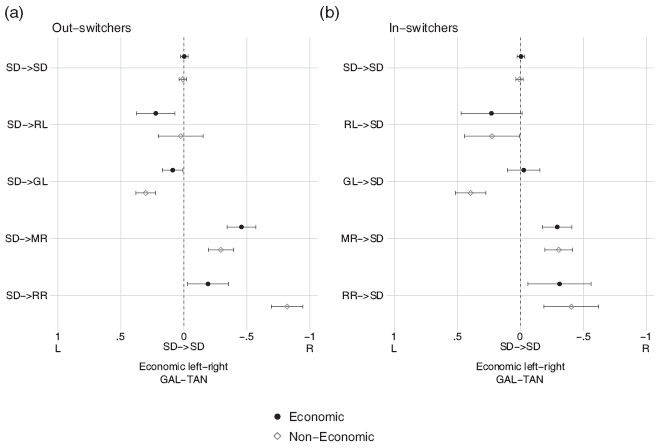
Figure 7.2(a) shows out-switchers from Social Democracy. As expected, voters who abandon Social Democracy in favor of radical left parties disagree with their parties of origin mostly on questions of economic redistribution and those who join the green and left-libertarian parties disagree with social democratic standpatters most sharply on the party’s position on societal issues. As a mirror image, former Social Democrats who move toward center-right parties disagree with social democratic standpatters most sharply on economic issues, while those who gravitate toward radical right parties differ from social democratic standpatters mostly on societal issues, such as immigration and family issues.
How about in-switchers coming to Social Democracy (Figure 7.2(b))? They exhibit essentially the same pattern of divergence from social democratic standpatters, but except for the radical left social democratic in-switchers who actually are more removed from the social democratic standpatters than out-switchers in the opposite direction. In most instances, however, on the dimensions where distance counts most for a competitor of Social Democracy, those who abandon other parties to join the center-left electorate embrace positions closer to social democratic standpatters than do the out-switchers in the opposite direction: Those coming from the Radical Left are less sharply on the redistributive side of economic policy than those who defected from Social Democracy. Likewise, social democratic joiners from green and left-libertarian parties are less different from social democratic standpatters on the societal dimension than are out-switchers. Once again, the same pattern of divergence applies with regard to in-switchers toward Social Democracy coming from the Moderate Right and the Radical Right: These in-switchers tend to inherit some of the positions of their parties of origin.
A note of caution must be added to these interpretations of Figure 7.2. As the confidence intervals surrounding the standpatters’ and switchers’ positions on issue dimensions show, there are indeed many instances where these two sets of voters exhibit opinion differences in a statistically robust way. This does not, however, extend to the comparison of social democratic out-switchers with in-switchers, where the confidence intervals typically overlap.
Our investigation of vote switchers thus provides robust evidence in favor of a spatial logic of vote choice where voters move toward party families that approximate their own ideal-typical preference profile better than the party they have abandoned. Substantively, the analysis highlights the difficulties Social Democrats face in strategic terms. Their voters defect in all directions, and with diverse good reasons. Switchers are – on average – engaging in deliberate moves to align choices with preferences leading them either to left and libertarian or right and authoritarian competitors of Social Democracy. This makes it all the harder for Social Democrats to win back big chunks of their net losses. The “issue yield” (Sio and Weber Reference De Sio and Weber2014) by moving programmatic appeals in one direction rather than another is severely constrained. Moving in any direction may dissuade some voters from defecting but may encourage all the more voters to depart in a different direction. Given the density of flows, the best promise to contain social democratic losses may be held out by moving either in a centrist direction, while shedding votes to the array of more radical parties, or by going after left-libertarian voters, well realizing that this might increase the outflow to authoritarian-parochial radical right and moderate right parties if not also to the Radical Left.
7.4.2 Are Working-Class Switchers Different? (Hypothesis 2)
As a baseline, our investigation establishes that political issue dimensions matter for vote switchers. But do policy considerations matter for voters in more precise ways, such that socioeconomic groups with different preference profiles mobilize different considerations, when switching in or out of Social Democracy? For reasons of data limitations, that is, the relatively small number of social democratic in-switchers, this more detailed analysis of socioeconomic groups confines itself to the largest category available, the broad working-class category of switchers out of Social Democracy. As mentioned earlier, we operationalize this group – which is comprised of lower skilled manual, clerical, and service wage earners – as survey respondents in the lower two-thirds of household income and without a tertiary educational certificate.
As an initial step, let us once again start with the flow of working-class voters between parties with a scheme replicating just for lower-education/lower-income voters in Figure 7.3 the information about vote switching contained for the entire electorates in Figure 7.1. At first sight, the patterns revealed by the two figures look very similar. Upon closer inspection, however, there are striking differences in terms of the percentages of working-class out-switchers that flow to the different destination parties, compared to the same movements by the nonworking-class groups. These percentages are displayed in Table 7.1 (left panel, columns 1 and 2). The table also displays the ratios of out-switcher percentages that each of the destination party families collects from the two different socioeconomic groups of former Social Democrats (Table 7.1, left panel, column 3). Finally, incorporating in-switching, the right panel of the table reports the difference (net flows) between out-switchers and in-switchers in the two different groups, expressed as percentage of all in- and out-switchers in that group.
| Out-switchers’ parties of destination | Out-flow (% of switchers leaving SD) | Net flow (Difference between in-switchers minus out-switchers: negative scores = net SD loss, % of all switchers/column) | ||||
|---|---|---|---|---|---|---|
| (1) Working-class | (2) Nonworking-class | (3) Ratio of (1):(2) | (1) Working-class | (2) Nonworking-class | (3) Ratio of (1):(2) | |
| Radical Right | 15.6 | 9.0 | 1.7 | −10.9 | −4.1 | 2.6 |
| Moderate Right | 33.3 | 28.8 | 1.2 | −8.4 | −3.3 | 2.6 |
| Radical Left | 11.1 | 10.7 | 1.0 | −4.9 | −5.6 | 0.9 |
| Green Left | 40.0 | 51.6 | 0.8 | −27.6 | −27.8 | 1.0 |
| No. of switcher observations | 912 | 1,282 | 1,351 | 2,041 | ||
| No. of all occupational observations | 5,874 | 6,888 | ||||
Voter movements, low-education/low-income group

Both working-class and nonworking class voters have roughly the same share of switchers (1,282/6,888 = 18.6% in the case of nonworkers; 912/5,874 = 15.5% in the case of workers). But the distribution of the outflows is quite different. As expected from the hypothesized average preference disposition of people in the working-class category, a larger share of social democratic working-class out-switchers accrues to radical right parties than is the case among nonworkers (15.6% vs. 9%). Conversely, the share of nonworkers to defect to green and left-libertarian parties is larger than that of workers opting for that destination. Interestingly, working-class switchers appear to favor radical left parties as a destination the least attractive option. Also, the propensity of working-class switchers to go for radical right parties is less pronounced than that for the Moderate Right, even when compared to nonworking-class voters. This pattern suggests that it would be wrong to consider the Radical Left and/or the Radical Right the natural ideological harbors of working-class dissenters from Social Democracy.
The general pattern is confirmed by the right panel of Table 7.1 reporting the net flow of switchers to and from Social Democracy for each party dyad. But there is more interesting information here. Social Democrats lose to all partisan camps, but once they lose workers, they are less likely to ever return. Working-class backflows to Social Democracy from radical right and moderate right parties are miniscule among workers, but large among non-workers, yielding a large net loss among working-class Social Democrats to the Moderate and Radical Right. Conversely, non-working-class out-switching yields large net losses to the Green Left among nonworkers, as few nonworkers can be persuaded to return Social Democracy, once having abandoned the Center Left. Social democratic parties appear to be more competitive to win workers back from the Radical Left and especially the Green Left, whereas Social Democrats appear to be more competitive to win non-workers from the center-right, if not marginally also from the Radical Right.
Our second hypothesis suggests that at least right-ward moves of working-class constituencies toward moderate or radical right parties should be primarily motivated by noneconomic societal dimension considerations (authoritarian parochialism). This should set working-class Social Democrats programmatically apart from other strata, particularly highly educated, high-income professionals, concentrated in business, technology, and finance pursuits.Footnote 7 Figure 7.4 reports the same information as Figure 7.2 (average positions of sociodemographic education-by-income groups defined by voting patterns), but disaggregated by select education-income groups. Figure 7.4(a) shows average attitudinal positions of low-education/low-income social democratic out-switchers, while Figure 7.4(b) displays the positions of high-education/high-income out-switchers. Differences between the two patterns tend to confirm the hypotheses, but with relatively small numbers of observations and small differences we are taxing the robustness of statistical analysis.
Attitudinal correlates of party family switching out of Social Democracy by select education-income groups
Note: Economic and noneconomic attitudes are standardized so that they have a mean of 0 for the SD-SD pattern of the respective education-income groups, and a standard deviation of 1. 95% confidence intervals.

Comparing the positions of social democratic working-class and nonworking-class out-switchers from Social Democracy, working-class out-switchers who defect to moderate or radical right parties are particularly more right-wing on the societal dimension, whereas for nonworking-class switchers out of Social Democracy economic considerations are setting them apart from social democratic standpatters more so than working-class defectors. Preference differences between social democratic standpatters and out-switchers are negligible when it comes to the Radical Left either for working-class or nonworking-class defectors. The social democratic out-switchers of sociodemographic categories exhibit the same reasons to join green and left-libertarian parties. Overall, the data about social democratic switcher preference profiles are consistent with the theoretical expectations.
7.4.3 Does Political Context Matter?
We have run disaggregated calculations by regional groups of countries, characterized by different economic prowess, welfare states, and electoral institutions, as well as by deleting individual countries. The quantities of defection from the various competitor parties differ substantially across countries and regions. Both in Anglo-Saxon first-past-the-post electoral systems and in Mediterranean Europe, there is very little defection of Social Democrats to the Green Left, but more to the Radical Left (Mediterranean) or the Moderate Right (both Mediterranean, Anglo-Saxon countries). Likewise, the Radical Right is not always a relevant competitor with which Social Democrats exchange any relevant share of votes.
Because of small numbers of observations, estimates become less reliable the further the disaggregation of data. Results reported in Table 7.1 are difficult to reproduce at the level of regions, let alone individual countries, because of the vanishing small number of observations available at those levels for many of the relevant switching pathways. Regardless of how we sliced the data, however, no striking qualitatively different patterns of out-switcher or in-switcher preference profiles appear across the different regions or individual countries compared to those reported at the aggregate level of all fifteen countries. Party switchers follow a spatial voter rationale such that their parties of destination are closer to their positions than those of their parties of origin.
7.5 Conclusion
Overall, the EES data lend much support to the proposition that vote switchers are motivated by programmatic considerations, comparing their own preference profiles to those advertised by competing parties. In this regard, the “folk theory” of “responsible partisan government” rings true no matter how much Achen and Bartels (Reference Achen and Bartels2016) may rail against it.
Our empirical findings offer little consolation to social democratic party strategists with the ambition to find a formula of appeal that will rally voters and push the needle of party support once again upward of 30% or even 40% of the whole electorate. At least in systems of PR with relatively low entry thresholds of new parties, realizing this ambition appears to be outside the strategy feasibility set. Voters have abandoned social democratic parties in very different directions that would require contradictory appeals to reassemble them again. Parties will have to choose which subset of lost voters they might want to chase, but the whole set of lost voters is beyond reach.
The findings of our investigation also pour cold water on the idea that out-switchers from Social Democracy, and especially working-class Social Democrats, are primarily antagonized by the parties’ economic and social policy moderation on the distributive policy dimension. This reasoning applies at most to a small segment of the mostly nonworking-class out-switchers, and even for the social democratic out-switchers to radical left parties, our data analysis could not unambiguously establish that the loss is because such voters harbor more leftist, redistributive policy preferences than the average social democratic standpatter. It appears that even for them, other considerations, and maybe not just policy-based ideas and sentiments, drive them away from Social Democracy.
At the same time, our study confirmed that the exchange with moderate right parties is critical to understanding social democratic party fortunes, as the highest share of voters is lost or won for such parties in the center of the preference space. We suspect that, in addition to spatial programmatic considerations, this electoral volatility in the center of the issue dimensional space is also driven by nonprogrammatic, short-term considerations that may have to do with valence/competence of parties in government office, political personalities, and other contingent factors. Vote switching to and from the more radical, peripheral parties on the field of party competition, however, are more clearly informed by programmatic considerations. But we could not investigate this question in the current chapter. It is possible that a fair share of voter defection in the center results from Social Democrats serving in government office, particularly in bad economic circumstances (cf. Chapter 12).
In this vein, the worst scenario for Social Democracy may feature the following elements: (1) The party faces a moderate contender to its center-right, while simultaneously (2) several other more “specialized” parties in the left-libertarian sector (left-socialists, left-libertarians, and even centrist-libertarian radicals) are awaiting disaffected social democratic defectors with open arms. Furthermore, (3) Social Democracy is in executive government office, during (4) a bad economic spell and (5) delivers a fiscal austerity treatment that retrenches social benefits. This configuration for sure will make social democratic voters run away in all possible directions. The Dutch election of 2017 may be the most extreme empirical realization of this scenario.
Let us finally remind readers that vote switching is, of course, only one mechanism that contributes to the changing vote share and alignment of parties in a democracy. A second one is generational replacement which we have not analyzed here, but which likely contributes to the decline of social democratic vote shares. At least with US data, we find that each subsequent generation of the old industrial society’s core center-left voter group – low-education/low-income voters – has a lower propensity to vote for such parties in the era of knowledge society. A third mechanism is the movement of past partisans into the pool of nonvoters who then later become supporters of other parties. Data constraints did not permit us to probe into this with EES data. But estimations for the United States reveal a pattern of behavior very similar to what we have found here for direct vote switchers. In any case, what we document in this chapter is just a first glimpse at the micro-dynamics of vote choice for social democratic parties.


 Open access