


1. Introduction
Sea ice is an important modulator of regional and global climate because of the insulating layer which it forms between the cold polar air masses and the relatively warm oceans beneath the ice. To understand the feed-backs between sea-ice and climate change, extensive satellite observations of the sea-ice extent and variability are necessary over long periods of time (Reference Carsey, Barry, Weeks and CarseyCarsey and others, 1992). Satellite sensors operating at visible and near-infrared optical wavelengths (e.g. Landsat and the Advanced Very High Resolution Radiometer) have made and will continue to make significant contributions to sea-ice surveillance (Reference MassomMassom, 1991) but are limited by weather and light conditions. Space-borne microwave radiometers have been designed and flown in the past two decades to overcome these limitations. Considerable work has been done to develop a capability for extracting sea-ice geophysical information from these data (Reference Steffen and CarseySteffen and others, 1992) but comparisons with other estimates (Reference Rothrock, Thorndike, Parkinson and RothrockRothrock, 1992) or results from other remote-sensing instruments (Reference Cavalieri and CarseyCavalieri, 1992) have shown that improvements are still needed to resolve ambiguities in ice types, and regional and global ice-concentration estimates. Despite a narrower swath and a higher cost, space-borne, active, synthetic-aperture, microwave systems may be a solution of the future for monitoring ice conditions in the polar Arctic at microwave frequencies. In contrast to passive microwave satellites, that are limited to observations at the scale of several tens of kilometers, SAR systems resolve ice-type variability, ice-deformation features and ice kinematics at the scale of several tens of meters.
Since mid-1991, two single-frequency, single-polarization, space-borne SAR instruments have been launched to be joined by several others before the end of the decade. These instruments provide the first calibrated, continuous, data set of SAR observations of the polar regions available on a long-term basis. Operational systems have been developed to accommodate the processing, archiving and distribution of the enormous volume of data generated by these instruments, and for generating SAR geophysical products. For instance, ice-motion maps are generated at the Alaska SAR Facility (ASF), in Fairbanks, Alaska, using C-band (λ = 5.7 cm), W-polarization (vertical transmit and receive) space-borne, SAR data from the European Remote Sensing Satellite, ERS-1 (Reference AttemaAttema, 1991). Similarly, ice-type and ice-concentration maps are generated at ASF using ERS-1 SAR data (Reference Kwok, Rignot, Holt and OnstottKwok and others, 1992). The ice-classification software separates multi-year ice, first-year ice and new ice/open water (at the system noise-power level) based on their radar back-scatter characteristics. The spatial variability of the distribution of these three ice types is used as a proxy indicator of the regional variability of ice thickness, a required parameter for estimating the dynamic and thermodynamic balance of the polar regions. In the near future, the ice-classification software will be extended to the L-band HH-polarization (horizontal transmit and receive) data from the Japanese Earth Resources Satellite, J-ERS-1 (Reference Nemoto, Nishino, Ono, Mizutamari, Nishikawa and TanakaNemoto and others, 1991), and the C-band HH-polarization data from Radarsat (Reference Raney, Luscombe, Langham and AhmedRaney and others, 1991). Evaluating the limitations of these single-channel SAR instruments for sea-ice-type mapping is an active area of research but the validation process will be long and difficult because it requires routine SAR observations and correlative data from many other sensors.
Most recently, a new radar technology has been developed to make SAR measurements at more than one frequency and/or one polarization. Numerous radar signature-modeling studies (Reference Winebrenner and CarseyWinebrenner and others, 1992), in-situ surface observations (Reference Onstott and CarseyOnstott, 1992) and controlled experiments (Reference Bredow, Gogineni, Gow, Blanchard and MooreBredow and others, 1989) have indicated that multi-channel SAR systems could improve our current capability to identify different ice conditions and permit the retrieval of geophysical parameters of importance such as snow-cover characteristics, ice salinity and thickness of new ice direcly from the microwave ice signatures. The first examples of multi-frequency, Polarimetrie, SAR observations of sea ice were acquired in March 1988 by the NASA/Jet Propulsion Laboratory aircraft SAR (AIRSAR) over the Beaufort, Chukchi and Bering Seas (Reference Drinkwater, Kwok, Winebrenner and RignotDrinkwater and others, 1991). The initial results confirmed that multi-parameter SAR data resolve different sub-categories of first-year sea ice better than single-channel instruments (Reference Eppler, Farmer, Lohanick and HooverDrinkwater and others, 1992). In this study, we present a more complete and quantitative evaluation of the performance level of various frequencies and polarizations, and combinations of both, for winter-ice mapping and for estimating ice fractions. Ice maps generated using multi-parameter SAR data and validated using a combination of ancillary information are used as a yardstick to determine the limitations of single-channel satellite SARs for winter-ice mapping and to determine whether combinations of frequencies and polarizations could overcome these current limitations. The analysis is based on the identification of six winter-ice conditions: (1) multi-year (MY) sea ice; (2) compressed first-year (CFY) sea ice; (3) first-year rubble and ice ridges (FYRR); (4) first-year rough ice (FYR); (5) first-year smooth ice (FYS); and (6) thin first-year ice (ThI). Open water is absent from all analyzed data but is included in the discussion because of its important influence on energy fluxes between ocean and atmosphere.
2. Airsar Data Set
AIRSAR acquired SAR observations of sea-ice in March 1988 over the Beaufort Sea, north of Alaska, at C- (λ = 5.6 cm), L- (λ = 24 cm) and Ρ- (λ = 68 cm) band frequencies. At each frequency, the complete scattering matrix (Reference Van de Hulstvan der Hulst, 1981; Reference Ulaby and ElachiUlaby and Elachi, 1990) of each resolution element is recorded and the data are processed such that the scattering matrices acquired at different frequencies are spatially registered. A scattering matrix comprises four complex numbers

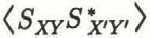

where


A total of ten scenes from the Beaufort Sea was processed at 12 m resolution in cross-product format but we limit the present analysis to two scenes, acquired at different dates and locations, that are representative of typical ice conditions in the Beaufort Sea in March 1988, and for which we have sufficient ancillary information for validating the ice-type labels. The two scenes were acquired in a transition zone between the extensive near-shore first-year ice region and the multi-year polar ice pack to the north. Image 1372 was acquired at a center location of 73°2.9′ N, 142° 17.1′ W at 171955 h GMT on 11 March 1988 and is shown in Figure 1a at C-band VV-polarization and in Figure 1b at L-band HH-polarization. Near range is on top, with the aircraft flying from right to left, looking to its left, and heading north. Pixel spacing is 6.7 m in range by 12.1m in azimuth. The scene is 12 km by 8 km in size on the ground and the incidence angle θ i of the radar illumination on to the surface varies between 29.3° and 52.4° from top to bottom. Image 1372 is one of the few scenes acquired in the Beaufort Sea in March 1988 where thin ice could be identified in a recently frozen lead. Image 311, shown in Figure 2a at C-band VV-polarization and in Figure 2b at L-band HH-polarization, was acquired at a center location of 72°38.2′N, 143°48.1′W at 043508 GMT on 19 March 1988. θ i varies between 19.8° and 50.2° across range. The buildings of the Applied Physics Laboratory(APL) drifting ice station (APLIS’88) (Reference Wen, Felton, Luby, Fox and KientzWen and others, 1989) appear as a bright-point target at the edge of a less bright multi-year ice floe (Fig. 2a).
SAR-amplitude image of sea ice in the Beaufort Sea, Alaska, acquired by AIRSAR at a center location of 73′2.9′ N, 142°17.1′ W at 171955 h GMT on 11 March 1988 (image 1372) at (a) C-band frequency, VV-polarization; (b) L-band frequency, HH-polarization; (c) MAP classification of L- and C-band fully polarimetric SAR data into six ice types; (d) Brightness temperature Tb from NORDA Ka-band radiometer microwave system.

SAR-amplitude image of sea ice in the Beaufort Sea, Alaska, acquired by AIRSAR at a center location of 72°38.2′ N, 143°48.1′ W at 043508 h GMT on 19 March 1988 (image 311) at (a) C-band frequency, VV-polarization; (b) L-band frequency, HH-polarization; (c) MAP classification of L- and C-band fully Polarimetrie. SAR data into five ice types (no ThI). The APLIS’88 ice camp (bright return) is located at the edge of a multi-year ice floe (darker background).

An accurate radiometric and polarimetric calibration of the SAR data is not necessary for segmenting and classifying SAR data but it is required for correct physical analysis of the extracted microwave signatures. Calibration of the phase difference

3. Weather and Ice Conditions
Weather data were collected within a 150 km radius at the APLIS88 ice station located approximately 350 km north of Prudhoe Bay, Alaska, between March and April 1988 (Reference Wen, Felton, Luby, Fox and KientzWen and others, 1989). These data provide the most reliable information about the meteorological conditions in the region where the SAR imagery was acquired. Daily observations of air temperatures, atmospheric pressure and wind direction and speed collected at APLIS’88 are summarized in Figure 3. Air temperatures were below −10°C on 11 March, rose to about −7°C and subsequently fell below −20°C on 19 March. Wind speeds were usually below 5 m s−1. Measurements of the drift speed of the ice station (Reference Wen, Felton, Luby, Fox and KientzWen and others, 1989) revealed rapid ice motion and deformation on 10 March correlated with high wind speeds of 7-8 m s−1. Sea-ice images of 11 March (Fig. 1) reveal important new cracks and leads in the ice created by divergent ice motion, with leads rapidly freezing under the cold conditions. The newly frozen ice leads remained relatively undeformed, indicating that little convergence was observed after freeze-up. Significant deformation is, however, revealed in first-year ice surrounding the large and rounded multi-year ice floes with the presence of a dense and complex network of rubble fields and ridges over the whole area. Ice conditions at APLIS’88 (Fig. 2) comprised a mixture of first-year ice and multi-year ice floes (Reference CavalieriCavalieri and others, 1991). The ice camp was located at the edge of a multi-year ice floe, near a smooth and undeformed refrozen lead which was used to build an aircraft runway. First-year ice in the vicinity of the station was 1.5–2.4 m thick, with a dry-snow cover of variable depth with a mean of 15 cm and a relatively flat surface. Reference Wen, Felton, Luby, Fox and KientzWen and others (1989) reported that multi-year ice floes were snow-covered and hummocked to amplitudes of 6 m. Pressure ridges and rubble fields fringed the lead near the camp. Immediately north of the lead was a relatively rough rubble field with large ice chunks. An aerial photograph of the ice camp looking north (Fig. 4) shows the boundaries of multi-year ice floes, deformed and rough first-year ice and a refrozen lead. An aerial photograph looking south (Fig. 5) reveals the hummocky surface of the large multi-year ice floe at the edge of the ice camp and zones of deformed first-year ice. Examination of the underside topography by divers revealed a large spatial variability in the growth rate of first-year ice and large differences in bottom-roughness features from those of multi-year ice where rounded and polished keels with no block structure contrasted with the young keels comprising randomly oriented blocks of ice in first-year ice. Ice cores taken from the smooth first-year ice in the lead to estimate temperature, salinity, density and brine-volume profiles (Fig. 6) revealed the recently grown ice to be columnar in structure.
Daily observations of air temperatures, atmospheric pressure and wind direction and speed collected at APLIS’88 between March and April (from Reference Wen, Felton, Luby, Fox and KientzWen and others, 1989).

Air photograph of the APLIS’88 ice camp looking north, showing areas of compressed first-year ice (CFY), multi-year ice (MY), deformed first-year ice (FY RR) and first-year smooth ice (FYS).

Air photograph of the APLIS’88 ice camp looking south.

Ice characteristics of an ice core taken from the FY ice lead near the ice camp APLIS’88 on 25 March 1988 (from Reference Wen, Felton, Luby, Fox and KientzWen and others, 1989).

4. Selection and Labeling of the Ice Types
Identifying ice types from remotely sensed imagery is difficult because: (1) the nomenclature of ice types is based on physical properties such as ice thickness, age, formation history, and surface roughness, which do not provide a unique relationship between ice types and radar signatures; (2) the microwave properties of sea ice vary widely with seasonal temperature (Reference Onstott and GogineniOnstott and Gogineni, 1985; Reference Onstott, Grenfell, Mätzler, Luther and SvendsenOnstott and others, 1987; Reference Cavalieri, Bums and OnstottCavalieri and others, 1990) and geographical location (Reference Livingstone, Singh and GrayLivingstone and others, 1987); and (3) in-situ surface observations, when available at all because of technical difficulties and costs of operation, are limited to sparse point measurements at the surface, which do not provide enough spatial details compared to the remotely sensed imagery. A standard procedure is to identify visually certain ice conditions present in the imagery, select training areas representative of each ice type, extract their microwave signatures, and then classify each image pixel into these ice conditions. This supervised procedure provides confidence in the results, and attempts at minimizing classification errors, but requires detailed independent surface information (often lacking), and homogeneous ice areas across swath, containing many pixels, and with clear and well-defined boundaries. As the dimensionality of the remotely sensed data increases (with polarimetry and multi-frequency), and the complexity of the scene features increases (in deformed first-year ice), manual selection of relevant ice classes becomes rapidly difficult and randomized.
Here, we select ice classes using an unsupervised clustering technique because it is nearly automatic; needs no training areas; provides a non-subjective characterization of unique and separable classes of radiometric and polarimetric radar back-scatter; and often performs a more sensitive selection of the mean cluster characteristics, because selection is a computer-optimized process. We use a cluster-analysis routine developed by Reference Rignot and ChellappaRignot and others (1992) for multi-parameter SAR data. To account for variations in radar back-scatter from each ice type due to changes in the incidence angle θθi across the swath, we separate each SAR scene into three distinctive regions, so that within each region changes in radar back-scatter with θθi of each ice type are less than their expected separability in radar back-scatter; followed by a cluster analysis of L- and C-band polarimetric data in each region. The three regions correspond in image 1372 to: (1) 29° ≤ θθi ≤ 36°; (2) 36° ≤ θθi ≤ 45°; (3) θθi ≥ 45°; and in image 311 to: (1) 20° ≤ θθi ≤ 29°; (2) 29° ≤ θθi ≤ 41°; (3) θθi ≥ 41°. The cluster-analysis routine is initialized with an expected number of clusters equal to 6 for image 311 separated by at least 4 dB, and to 7 for image 1372 (thin ice is an additional ice type present in image 1372) separated by 4 dB. A 4 dB minimum separation in radar back-scatter corresponds to a theoretical classification error of the image pixels of less than 1 % (Reference Rignot and ChellappaRignot and Chellappa, 1991). The final number of clusters, which is not bound to the initial guess, is 6 for image 311 and 8 for image 1372. The radar back-scatter characteristics of the clusters are given in Tables 1 and 2. We label the clusters into six different sea-ice types, thereby regrouping some of the clusters together into a single ice type. This regrouping of clusters is expected to be part of the selection process as clustering provides image classes independent from the fact that they may or may not share similar geophysical characteristics. Several clusters are expected in first-year ice because of the large dynamic range in radar back-scatter of first-year ice due to spatial changes in small-scale surface roughness, and the presence of pressure ridges and rubble fields. Multiple clusters are also expected in multi-year ice due to the variety of constituents that contribute to its radar signatures, including multi-year smooth/flat ice, hummocks, pressure ridges and melt-pools (Reference Onstott and CarseyOnstott, 1992). Independently in each region, each image pixel is subsequently classified into one of these ice classes using a Maximum A Posteriori (MAP) Bayesian classifier for multi-parameter SAR data (Reference Rignot and ChellappaRignot and Chellappa, 1992). The resulting sub-images are reconstituted, and matching is found to be excellent at the boundaries. P-band is not used because it is similar to L-band and reduces the classification quality for thin ice of low back-scatter. The six identified ice conditions are labeled in the following fashion (Figs 1c and 2c): (1) old compressed first-year ice (CFY); (2) first-year rubble and ridges (FYRR); (3) multi-year ice (MY); (4) first-year rough and deformed ice (FYR); (5) first-year smooth and undeformed ice (FYS); and (6) thin first-year ice (ThI).
Table of the polarimetric characteristics of the cluster centres of image 1372 for θθi ≥ 45° at L-, and C-band frequencies, along with their sea-ice label, σxy is the radar back-scatter at XY-polarization expressed in dB,


Table of the polarimetric characteristics of the cluster centers of image 311 for θθi ≥ 41° at L-, and C-band frequencies, along with their sea-ice type labeling. Notations are the same as in Table 1

Figure 7 shows examples of radar back-scatter curves for the six ice types present in image 1372. The plotted values are obtained for each ice type by averaging along each range line (same incidence angle) the radar back-scatter values of all the pixels classified into that particular ice type in Figure 1c, and smoothing the results using a ten-point moving window. The curves illustrate the separability between the different ice types at HH- and HV-polarization versus θi. At C-band, MY and CFY are confused, except from a small contrast at HV-polarization, but MY and FY are separated by several dB. The continuity of the curves at the transition between different regions confirms that matching of the sub-images is satisfactory. The radar back-scatter curves at L-band are consistent with published scatterometer measurements (Fig. 2; Reference Onstott, Grenfell, Mätzler, Luther and SvendsenOnstott and others, 1982), including the more rapid decay of MY with θi at HH-polarization compared to FY (Fig. 5; Reference Onstott, Moore and WeeksOnstott and others, 1979). Radar back-scatter values at HV-polarization are less sensitive to θi because volume-scattering effects dominate the radar returns and are less dependent upon incidence angle.
Radar back-scatter curves σ of six types identified in image 1372 vs the incidence angle θi at (a) C-band HH-polarization; (b) C-band HV-polarization; (c) L-band HH-polarization; (d) L-band HV-polarization. Vertical lines indicate the limits of the three regions used for clustering of the multi-parameter SAR data.

Figure 1d shows the brightness temperatures of the ice obtained from air-borne passive microwave data acquired by NORDA’s Ka-band (33.6GHz), V-polarization, Radiometric Mapping System (KRMS) (Reference Eppler, Farmer, Lohanick and HooverEppler and others, 1986) at the same location as image 1372. KRMS data were not available for image 311. The KRMS data were calibrated using the procedure described in Reference Cavalieri and CarseyFarmer and others (1990), and were resampled and projected into slant-range to facilitate intercomparison with the slant-range SAR data. The spatial resolution of the KRMS data is 145 m in the center of the swath, decreasing towards the edges of the swath with increasing geometric distortions. Because of residual calibration errors, geometric distortions, and coarse spatial resolution, the KRMS imagery is only used here to indicate the presence of certain ice types, and not as a validation procedure of the SAR results per se. Nevertheless, the brightness temperatures TB together with the contextual information clearly indicate the presence of multi-year ice (MY), first-year ice (FY), and thin ice (ThI); although MY is not well separated from ThI by TB alone Table 3. MY is colder than FY. ThI is the coldest, but not cold enough to correspond to open water since Τ B = 141 Κ ± 1 Κ for calm and cool open water (personal communication from D.T. Eppler, 1992).
Table of brightness temperature TB (in K) and standard deviations σTΒ of five ice types in image 1372

ThI is distinguished in image 1372 by its low radar back-scatter at all frequencies, and by the obvious presence of a recently frozen lead in the center of the scene consistent with the ice drift and divergence recorded in the nearby ice camp on 10 March. The polarimetric characteristics of ThI at L-band provide evidence that it does not contain any open water. The small perturbation model (SPM) (Reference RiceRice, 1951) predicts that for slightly rough surfaces the ratio
Histogram of the real part of the dielectric constant of thin ice in image 1372 at L-band frequency using the small perturbation model. The median value of the distribution is ɛr = 6 and the standard deviation is 4.5.

Labeling MY ice is facilitated by the highly recognizable rounded shape of MY floes, their cold brightness temperatures in the KRMS data in image 1372, and their existence at the ice camp. The boundaries of MY ice floes appear distinctly in the aerial photographs (Figs 4 and 5) due to a sharp transition in surface roughness, and in the L-band HH imagery (Figs 1b and 2b) due to a sharp transition in radar brightness. MY in image 1372 has radar back-scatter characteristics that are similar to those measured in image 311 (Tables 1 and 2). An exception is the large fragmented MY ice floe in the center of image 311 which includes numerous patches of CFY which correspond to the hummocks and ridges reported in Reference Wen, Felton, Luby, Fox and KientzWen and others (1989), and the features visible in Figure 5.
FYRR comprises extensive pressure ridges and rubbled fields of broken blocks of upstanding ice in the highly deformed FY ice present in the two scenes (Figure 4 and 5). Ridges are geophysically important because they modulate the drag coefficient of the surface strongly (Reference BurnsBurns, 1990), and account for a significant portion of the total ice mass. FYR also comprises rough, deformed FY ice, but does not include pressure ridges, and is less deformed and less rough than FYRR. Radar back-scatter model predictions clearly indicate that differences in radar back-scatter from deformed FY ice are mosdy due to differences in small-scale surface roughness as opposed to differences in dielectric constant and ridge structure (Reference Manninen and PutkonenManninen, 1991). Breaking rough first-year ice into two distinct classes is also relevant in our context since MY has an intermediate range of radar back-scatter between FYR and FYRR at L-band (Fig. 7), whereas MY is consistently brighter than both ice types at C-band (Fig. 7a and b), which explains why FYRR is likely to be misclassified as MY ice at L-band and not at C-band. FYS is another FY ice type that is easily identified due to its existence at the location of the aircraft runway in image 311, and its low radar back-scatter in images 1372 and 311, indicating a smoother surface at the wavelength scale.
CFY is deformed, rough ice which is mixed with MY ice at C-band and with deformed FY at L-band. No salinity profile was acquired at that particular location to establish on a strong basis that CFY is indeed FY ice; but examination of aerial photographs, KRMS data, and polarimetric SAR characteristics concur to indicate that CFY is younger than the MY ice which it glues together. The brightness temperature of CFY is 16 Κ warmer than that of MY ice although not as warm as the other types of FY ice, indicating an ice type younger than MY ice. CFY ice coincides with highly deformed surfaces consisting of large uplifted ice blocks both within and surrounding MY ice floes (Figure 4 and 5), clearly generated by compression and shear forces during ice drifting, indicating that CFY is very deformed FY ice that surrounds the MY floes. In both Tables 1 and 2, at L-band, the correlation coefficient between HH and VV, denoted


Estimating the classification error of the ice maps in Figures 1c and 2c is difficult in the absence of surface observations on a pixel-by-pixel basis, as typical of most remote-sensing experiments. Errors due to the classifier itself are of second-order magnitude due to the large contrast between ice types. Classification performance is therefore only limited by system errors (interferences, processing artifacts), and by confusion of certain ice types by the radar. In Figure 1c, FY is misclassified as MY in one line running in the center from top to bottom because of the corrupting influence of system interference in the C-band Η-received channel. These errors do not appear in Figure 9c since C-band Η-received channel is not used. In both Figures 1c and 2c, small patches of FY ice are detected within MY ice floes that could correspond to melt ponds. Refrozen melt ponds are perhaps misclassified as FY ice by the radar because the surface is likely very smooth and bubble-free. Similarly, a number of MY floes include segments of CFY ice which may correspond to MY pressure ridges or hummocks and are therefore misclassified as FY ice. MY pressure ridges are typically composed of blocks of ice with tilted surfaces that produce strong back-scatter due to scattering from individual facets, multiple facet scattering, and in some cases enhanced volume scattering due to a transition to a very low density ice form (Reference Onstott and CarseyOnstott, 1992), so that they may share common scattering characteristics with CFY ice. Except for the case of the large MY floe in the center of Figure 2c which is obviously fragmented and held together by large patches of CFY, CFY ice in the midst of MY ice floes should really be classified as MY ice, while CFY ice surrounding the MY ice floes and holding them together is not MY ice. By counting all the visually identified misclassified pixels discussed above, we estimated the classification accuracy of the ice maps in Figures 1c and 2c to be greater than 90%.
Classification map of image 1372 into six sea ice types at (a) C-band VV-polarization; (b) L-band HH-polarization; (c) C-band VV-polarization and L-band HH-polarization combined; (d) L-band polarimetric.

Reference Gray, Hawkins, Livingstone, Arsenault and JohnstoneGray and others (1982) reported similar classification accuracies combining scatterometer and radiometer data acquired over the Beaufort Sea in March-April 1979 to six separate ice conditions. In this study, we only use the radar data to identify the six ice conditions. Our classification software is more sophisticated, and classification accuracies are computed for all image pixels instead of being limited to homogeneous training sites. Combining frequencies and polarizations is essential for ice-type labeling. At a single-polarization, L-band reveals ridges and MY ice-floe boundaries, while C-band provides a large contrast in radar back-scatter between MY and FY ice. In FY ice, differences in radar back-scatter are interpreted as differences in small-scale surface roughness to identify different categories of deformed FY ice. At L-band, with two polarizations, 7 helps separate thin ice from thicker FY ice and thin ice from calm open water, and

5. Classification Accuracy vs Frequency and Polarization
The ice map obtained using L- and C-band polarimetric combined (Fig. 1c) is used as a reference map of the ice types present in image 1372, and ideally for the present time its classification accuracy is assumed to be 100%. Reclassified images are then generated using a reduced number of polarizations and frequencies, and a relative classification accuracy of each type is computed in reference to the classification map in Figure 1c and then recorded in confusion matrices. A representative sample of the confusion matrices obtained for each test case is given in Table 4 for image 1372 with θ i ≥ 45°. Each confusion matrix indicates how classification inaccuracy results in rebinning of pixels in the wrong ice classes, along with the percentage of misclassified pixels. Vertical columns indicate how, for a particular ice class, various pixels are misclassified. Each vertical column totals 100%, and components of each vertical column denote the percentage of misclassification (as other classes) relative to the results in Figure 1c. An overall relative classification accuracy of each combination of channels is computed from the average of the diagonal elements in each of the confusion matrices. These confusion matrices are computed from all the pixels included in the image. To simplify the presentation, FYRR and FYR are regrouped into one ice class, denoted FYR, as both correspond to deformed FY ice but with a larger variance.
Confusion matrices of five ice types at (a) C-band VV; (b) C-band HV; (c) C-band HH and HV; (d) C-band HH and VV; (e) C-band full polarimetry; (f) L-band HH; (g) L-band HH and VV; (h) L-band full polarimetry; (i) P-band H H and VV; (j) P-band full polarimetry; (k) L-band HH and C-band VV; (l) L-band HV and C-band HH

At C-band, a large contrast in radar back-scatter exists between MY and undeformed FY (Fig. 7) due to the additional volume back-scatter of the low-density bubble-rich layer contained in the upper part of the MY sea ice (Reference Kim, Moore and OnstottKim and others, 1984). Yet C-band VV-polarization alone achieves only 67% overall relative classification accuracy Table 4a because MY and CFY are not separated. C-band HV-polarization better separates MY and CFY, and MY and FY, but confuses ThI and FYS, yielding a 69% classification accuracy Table 4b. C-band HH-polarization has a relative classification accuracy of 71%. C-band HH- and HV-polarizations combined increase the C-band W-polar-ization results by 10% Table 4c. Other combinations of two polarimetric channels yield similar relative accuracies Table 4d. The best results are obtained using the complete polarimetry Table 4e, but two polarizations perform nearly as well and significantly better than one polarization.
The contrast between MY and FY is reduced at L-band (Fig. 7) because MY generates almost no additional volume scattering (Reference Winebrenner, Tsang, Wen and WestWinebrenner and others, 1989). Classification accuracy is 75% at L-band HH-polarization because MY is confused with FYRR and CFY Table 4f, confirming that L-band at one polarization is not useful for ice mapping (Reference Onstott, Grenfell, Mätzler, Luther and SvendsenOnstott and others, 1982; Reference Lyden, Burns and MaffetLyden and others, 1984). Two like-polarization channels however improve the relative accuracy by 9% Table 4g. The full polarimetry does not improve the results and actually yields a 1% drop in accuracy because the HV radar returns increase confusion between MY and FYR (Table 4h; Fig. 7d). This result shows that increasing the number of channels does not necessarily increase classification accuracy in a polarimetric classifier. Notwithstanding this observation, L-band performs better than C-band over all classes when more than one polarization is used, despite the reduced contrast between MY and deformed FY ice.
P-band is similar to L-band with a reduced contrast between MY and FY. P-band is not considered as particularly useful for ice mapping (Reference Parashar, Haralick, Moore and BiggsParashar and others, 1977), but the classification results are reported here for sake of completeness. The classification accuracy is 60% at HH-polarization, 70% at HH- and W-polarizations combined Table 4i, and only 58% with the full polarimetry Table 4j. The HV returns confuse several ice types resulting in a relative accuracy of 48% when used alone, and in a poor performance of the full polarimetry.
Finally, the classification accuracy combining two frequencies at one polarization is investigated. L-band HH-polarization and C-band W-polarization have an overall relative accuracy of 90% Table 4k, which is better than any fully polarimetric single frequency or indeed any non-polarimetric single frequency. Other combinations using L-band and C-band at a single polarization yield similar results Table 4. A summary comparison of the performance of various combinations of frequencies and polarizations is shown in Figure 9 with complete ice maps of image 1372 over the entire range of incidence angle at C-band VV, L-band HH, L-band HH and C-band VV combined, and L-band polarimetric. MY and CFY have the same color at C-band W (Fig. 9) because they are not separated. Floe boundaries are not distinguishable, and the MY ice fraction is clearly overestimated. This classification result, which uses the same image as in Reference Kwok, Rignot, Holt and OnstottKwok and others (1992), illustrates the inaccuracies inherent to a C-band ice-classification scene in a transition zone where CFY is present in large quantities. At L-band HH (Fig. 9), MY floe boundaries appear clearly, but many ice pixels in deformed FY ice are misclassified as MY ice. Combining the two frequencies yields a large improvement in classification accuracy, and the ice map (Fig. 9) even compares favorably to the one in Figure 1c, since errors induced by system interference are eliminated. This result shows that ice mapping could improve significantly by combining ERS-1 and J-ERS-1 SAR data, provided that both sensors could image the same area at the same time. MY ice-floe boundaries appear distinctly, MY is separated from CFY, and the distribution of ridges can be extracted. The results obtained using L-band polarimetry (Fig. 9) confirm that polarimetry is more useful at L-band than at C-band for ice mapping (Table 4e and h), and Table 4g shows that only two channels are needed at L-band to yield classification accuracies only 7% lower than that obtained using L- and C-band polarimetric.
6. Comparison of Ice-Fraction Estimates
Ice maps generated from SAR data yield estimates of the old ice fraction used for multisensor comparisons and for evaluation of the quantity of sea ice that survives summer melt, the thick-ice fraction used for fresh-water budget calculations, and the thin-ice fraction for area heat-flux estimates. Table 5 shows estimates of the old-, thick- and thin-ice fractions computed using various frequencies and polarizations for image 1372. CFY is regrouped with MY for estimation of the thick-ice fraction because CFY probably corresponds to extremely thick FY, possibly as thick as MY because of compression, ridging, and uplifting (Reference Johansson and AskneJohansson and Askne, 1987). At C-band W, the old ice fraction for the entire scene is overestimated by 15%. For θ i ≤ 30°, which corresponds to the imaging conditions of ERS-1 (Reference AttemaAttema, 1991), the error is 18% in Figure 9a. The errqr is 20% for image 311 (C-band W ice map not shown in the paper). Hence, ERS-1 probably overestimates the old-ice fraction in transition zones where CFY is present in large quantities. On the other hand, the error in the thick-ice fraction is less than 3% in Figure 9a, independent of θ i, suggesting that ERS-1 SAR provides reliable estimates of the thick-ice fraction. The results obtained at C-band HH are similar, indicating that Radarsat, despite different imaging conditions (Reference Raney, Luscombe, Langham and AhmedRaney and others, 1991), would also overestimate the old-ice fraction by 15%, and provide reliable estimates of the thick-ice fraction. At a single polarization, L-band largely misestimates both the old- and thick-ice fractions because MY and FY ice are not well-separated, indicating that J-ERS-1 would perform poorly in similar conditions. The addition of a second polarization at L-band however yields good estimates of both the old- (0% error compared to the last column of Table 5, and little confusion in Table 4g) and thick-ice fractions (4% error in Table 5, and little confusion in Table 4h). The results obtained combining L- and C-band at a single polarization are even better (2% error in Table 5, and litde confusion in Table 4k). Combining ERS-1 or Radarsat with J-ERS-1 could therefore improve the accuracy of ice-fraction estimates significantly compared to that obtained using each sensor separately, and also provide information on the spatial distribution of ridges which has been related to the spatial variability in atmospheric drag coefficient of the surface (Reference BurnsBurns, 1990).
Table of ice fractions (%) at various polarizations and frequencies. Columns without any polarization denoted indicate that the complete polarimetry is used. An asterisk indicates that mors are present, due to the contribution of a significant number of misclassified pixels to the totals shown

MY/old-ice fraction estimates are extensively used for multi-sensor comparisons and for validation of passive microwave sea-ice algorithms (Reference Cavalieri and CarseyCavalieri, 1992). Compared to space-borne, passive, microwave systems, SARs benefit from a much higher spatial resolution which permits them to separate MY and FY ice better, and distinguish several additional sub-categories of MY and FY ice. Nevertheless, single-frequency, single-polarization, space-borne SARs also have their limitations for sea-ice mapping. Our results shows that ERS-1 and Radarsat would systematically overestimate the MY ice fraction in transition zones where CFY is present in large quantities. The error could be drastically reduced if ERS-1 or Radarsat data were combined with J-ERS-1 data. Both sensors need to cover the same area almost simultaneously, since ice motion and changing environmental conditions set limits on the registration and synergistic use of multi-sensor datasets.
The thin-ice fraction is correctly estimated at both L- and C-band in image 1372. C-band W-polarization overestimates the thin-ice fraction by 2% compared to C-band HH-polarization because the contrast between FYS and ThI is 2 dB smaller at C-band VV (VV-signals increase faster with increasing ɛr than HH-signals), hence reducing the classification accuracy of thin ice of low back-scatter (Tables 1 and 2). For the same reason, L-band W-polarization overestimates the thin-ice fraction compared to L-band HH-polarization.
There is currently no algorithm for separating thin ice from open water using single-channel SAR data. In this study, we showed that using two polarizations at one frequency, preferably one for which the r.m.s. height of the surface is much smaller than the radar wavelength, one could separate thin ice from open water in calm conditions based on differences in dielectric properties. Perhaps additional sub-categories of thin-ice type can be separated using the same approach. Considerations for noise-limited signals of space-borne systems are however of considerable importance since the radar back-scatter from thin ice and open water is likely to be close to the system noise power level floor, hence setting limits on their separability. In the scenes analyzed in this paper, and other scenes acquired in the Beaufort Sea during the same period, the thin-ice fraction is too small to obtain conclusive results. In the SAR scenes collected over the Bering and Chukchi Seas in March 1988, FY ice is present in larger quantities and different types of thin ice are clearly distinguished (Reference Drinkwater, Kwok, Winebrenner and RignotDrinkwater and others, 1991), but we have no correlative information to validate the labeling of image classes into ice conditions and estimate classification accuracy. Further studies are required to evaluate more completely the potential of polarimetric SARs for thinner ice-type discrimination.
7. Conclusions
This paper presents examples of quantitative improvements in classification accuracy of six winter ice conditions using SAR data at various frequencies and polarizations combined. The indications are that 10% improvement in classification accuracy results from the use of two polarizations instead of a single polarization. Single-frequency full polarimetry does not significantly add to classification accuracy. Simply combining C- and L-band frequency at a single polarization improves classification accuracy by 10-20%. The addition of P-band does not improve the results. C- and L-band frequency at two polarizations would perform nearly as well as L-, C- and P-bands fully polarimetric combined, in terms of separating the ice conditions discussed in thjs paper. Adding a second polarization is most useful at L-band compared to C-band for winter ice mapping, and for separating thin ice and calm open water based on differences in dielectric properties.
Other frequencies have been suggested in the past, such as X-band (Reference Parashar, Haralick, Moore and BiggsParashar and others, 1977; Reference Onstott, Moore and WeeksOnstott and others, 1979 and Reference Onstott, Moore, Gogineni and Delker1982; Reference Kim, Moore and OnstottKim and others, 1984), for better discrimination between FY and MY ice. They have not been considered in this paper because they were not available, and because L- and C-band are the only two frequencies available from space over the polar regions for a number of years to come, and we need to establish clearly the level of performance of these different SAR systems for ice mapping. Our results suggest that deformed FY ice plays a critical role in the interpretation of microwave signatures of sea-ice, and in mapping of ice conditions, even in winter when MY and undeformed FY are well separated in radar back-scatter, but that these ambiguities can be resolved by combining complementary long and short wavelengths such as L- and C-band. In transition zones where CFY is present in large quantities, ERS-1 and Radarsat are expected to overestimate the MY ice fraction by 15-20%, but still provide a good representation of the spatial variability of ice thickness, and J-ERS-1 is expected to perform poorly. Simply combining ERS-1 or Radarsat data with J-ERS-1 data would overcome these limitations drastically.
Acknowledgements
The authors undertook this work in the Aircraft Radar Group of the Radar Science and Engineering Section and in the Polar Oceanography Group at the Jet Propulsion Laboratory, California Institute of Technology, under contract to the Oceanic Processes Branch of the U.S. National Aeronautics and Space Administration. The authors wish to thank D. Eppler and D. Farmer for use of the KRMS image data, and T. Wen for providing pictures of the APLIS’88 camp.
The accuracy of references in the text and in this list is the responsibility of the authors, to whom queries should be addressed. MS received 22 March 1993 and in revised form 15 July 1993



