


On October 18, 1990, a United States Intelligence operative issued a grim and concise report to the US government:
Yugoslavia will cease to function as a federal state within a year, and will probably dissolve within two. Economic reform will not stave off the breakup …. A full-scale interrepublic war is unlikely, but serious intercommunal conflict will accompany the breakup and will continue afterward. The violence will be intractable and bitter. There is little the United States and its European allies can do to preserve Yugoslav unity.Footnote 1
As noted in this report, in an uncanny play-by-play scenario, the Socialist Federal Republic of Yugoslavia ceased to exist in January 1992.
The collapse of communism in Eastern Europe in 1989, symbolized by the fall of the Berlin Wall, the subsequent unification of Germany in 1990, and the dissolution of the Soviet Union in 1991, all served to weaken Yugoslavia’s ruling Communist Party and its political stability. Slobodan Milošević had been Serbia’s president since 1989, rising steadily to power from life as a banker to president of the Serbian Communist Party in 1987. But in the national election of 1990, Yugoslavia’s first democratic election since the Second World War, Croatia and Slovenia gave power to the noncommunist parties, a decision that dealt a serious blow to Milošević’s authority and rhetoric of Serbian ultranationalism. On December 23, 1990, Slovenia voted to secede from Yugoslavia. Croatia followed in May 1991, with both former republics of the Yugoslav federation declaring themselves independent on June 25, 1991.Footnote 2
On March 9, 1991, the Serbian opposition party, led by Vuk Drašković, organized a massive protest in Belgrade against Milošević. It is estimated that between 70,000 and 150,000 people took to the streets, prompting Milošević, as head of the state-controlled police and Yugoslav National Army (JNA), to deploy troops to suppress the protest. A violent clash (illustrated in Figure E.1) claimed the lives of two people. The protests ended on March 14, 1991, with little change. Milošević remained in power, and in June 1991, he deployed the JNA to Slovenia and Croatia to forcibly stop the republics from seceding from the federation. While the military intervention in Slovenia ended in ten days, the war in Croatia, followed by the war in Bosnia and Herzegovina the following year, lasted through 1995. That same year, the war in Kosovo started, ending with the US- and NATO-led bombing of Serbia from March 29 to June 10, 1999. Two waves of economic sanctions imposed on Serbia, first from 1991 to 1995 and again from 1998 to 2000, devastated the country economically. What followed was a violent collapse of the political state and harsh economic sanctions, with subsequent hyperinflation, mass impoverishment, international isolation, and the destruction of infrastructure. This collapse led to an “unstoppable brain drain.”Footnote 3 The impact of the conflicts left the once-flourishing republics of Yugoslavia destitute, both economically and intellectually.
March 9, 1991: Massive protests in Belgrade in opposition to Slobodan Milošević’s rule and the imminent start of the conflict in the region. Photo by Goranka Matić.
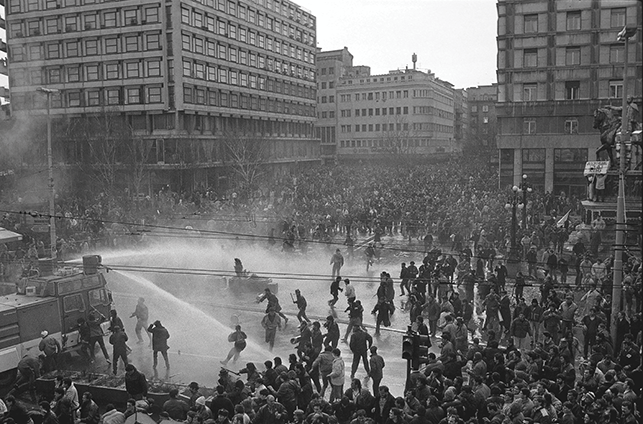
Figure E.1 Long description
Gathered in the center of the city in front of the Mihailo Obrenović, Prince of Serbia, on horseback statue at Republic Square, thousands of people are protesting. The state-controlled policemen are depicted chasing and hitting the citizens with sticks. In the middle, the crowd is dispersed by a truck firing massive water cannons on several sides directly at the people. The Republic Square is surrounded by grey buildings in the brutalist and modern socialist style. The photo is taken from above, likely from a terrace or a window.
In her research on the mass exodus of Yugoslav composers during the 1990s,Footnote 4 Ivana Medić reveals appalling statistics: While a few composers left Yugoslavia before the war – including Aleksandar Damnjanović, Miodrag Lazarov Pashu, and Miloš Raičković – hundreds (and hundreds of thousands of other intellectuals and professionals) left in a mass exodus during the early 1990s. In Serbia alone, Medić tracks more than seventy composers (many of mixed “Yugoslav” ethnicities) who left during the war. She notes that for a small country, the exile of such a large number of composers of different generations constituted “an irreparable loss.”Footnote 5 Among those who fled were six composers of the Magnificent Seven group: Ognjen Bogdanović, Nataša Bogojević, Ana Mihajlović, Katarina Miljković, and Igor Gostuški. Bogdanović reveals the horrors of 1991 and making the difficult decision to leave, the chilling details he still remembers vividly more than thirty years later:
It was late September 1991, and already there was war going on in Croatia. I did my compulsory army service not long before that (1988–1989), as I had been postponing it due to being a full-time student. It was the time when the whole of Belgrade was massively evading being drafted, so many guys did what I did – jumped balconies during raids and slept elsewhere at night, hiding from the military police. They were literally at my heels – obviously, they were given instructions to draft the “fresh out of the army” first. Going to the war was not an option for me, and it soon became apparent that the proper thing to do would be to escape for real – abroad. I booked a flight to London.
I remember it was the night before the flight – I had keys to the Association of Serbian Composers’ premises and stayed there very late, copying audio tapes of my music to take with me to London when I suddenly became aware of a very low, deep, distant rumble – at first, I thought something was wrong with the tape I was copying, but the rumble persisted even when I switched off the music. I went outside, and it was louder. I locked up [the building] and followed the ominous noise, which seemed to have been coming from the direction of Bulevar Revolucije. When I got there after a short walk, I saw a procession of army tanks rolling down the street and taking the turn into Street Kneza Miloša and then onwards, presumably to the highway towards Zagreb, moving on to join the war. At that moment, I knew that I couldn’t wait for the hours to pass before the flight.
It all went alright at the airport, no trouble at the border, but it was emotionally draining because my parents were there to see me off. It was Tuesday, October 1st; already on Friday of that week, it became impossible to leave the country without a special military permission if you were a male adult between 18 and 55. So in that sense, I took one of the last regular flights out.
Once in London, there were Belgrade refugees everywhere – loads of people I knew, “gradske face” [city faces], and even some friends I knew well, so it kind of helped “the transition.” Plenty of people eventually returned to Serbia, but I did not, even though I had already been employed as Vlasta’s [Trajković] assistant at the Faculty. I was given a year-long non-paid leave from work, ostensibly to “go to Paris to further my electronic music education” but after the year had elapsed and the political situation only got worse, I had to send in my notice by post, so Isidora [Žebeljan] went on to fill my shoes as the assistant in Vlasta’s class. To this day I wonder if such a radically life-changing decision was the right thing to do, but on the other hand, I knew I had little choice – had I remained in Belgrade, I would have most probably ended up in a psychiatric ward (and many people have, I hear). These were the nastiest years of our recent history, and I’m glad I had absolutely nothing to do with it.Footnote 6
Vuk Kulenović, a composer of mixed Bosnian and Serbian ethnicities, who had taught at the Faculty of Music since 1979, left due to political and economic reasons. In an interview, he explains:
I moved [to the US] at the age of 46. I had to start everything from scratch, which was incredibly hard …. But life [in Yugoslavia], with dreadful politics, was much more difficult. I remember I went for a bike ride with my son around Kalemegdan [park]. I had just received my monthly salary, and when I stopped by the ice cream stand, my monthly salary was not even enough to buy two ice creams.Footnote 7 That’s when I thought – enough is enough – and that’s when I made the decision to leave.Footnote 8
Together with the Magnificent Seven, an entire generation of promising young composers, most of whom would find success abroad, left, depleting the Faculty of Music, Belgrade, Serbia, and the fractured nation of its creative voice: Svetlana Maraš, Jug Konstantin Marković, Marko Nikodijević, Milica Paranosić, Jasna Veličković, Aleksandra Vrebalov, and Đuro Živković, among others.
Srđan Hofman, who was Professor of Composition, Head of the Tonski Studio, and Dean of Faculty during the war, elucidates in retrospect the heavy consequences of the war, economic sanctions, and brain drain on the Faculty of Music:
Although the gradual entropy of the social system [of the 1980s], as well as economic problems, became ever more clearly manifest, while the government seemed to endure in a kind of mild hibernation, higher education still enjoyed a considerable degree of autonomy …. However, after the failed historical opportunity for a painless transition into a multi-party democracy and market economy – for which Yugoslavia in the late 1980s was in every respect better prepared than the countries of the “Eastern Bloc” – the blood-and-soil ideology prevailed. Thus, after the orchestrated nationalist rallies in Serbia, and the elections in Croatia won by the Croatian Democratic Union permeated with elements of Ustasha ideology, after intimidation and shameless war-mongering propaganda through the media, we suddenly found ourselves in the midst of the creation (some called it a “revival”) of tiny national states. The claims for such nation-building were based now on some self-proclaimed historical rights, and then on the demographics of a given region, but the borders were drawn by weapons, and in the course of that process, the ethnic composition of disputed territories was being forcibly altered. As we all know, this was accompanied by war crimes, murders, and looting. In Serbia, there were sanctions to boot, with the accompanying economic, cultural, and every other form of isolation, galloping inflation, dreadfully empty shops, banks with no money, hospitals without medicines, salaries (of university professors, for instance) which at a certain moment fell to the equivalent of four to five German marks, shortages of fuel, heating …. The early 1990s saw not only the total breakdown of the Serbian economy, but also the destruction of the existing system of values, socially acceptable moral norms, and the functioning of the legal system.
In such circumstances, my main preoccupation was to sustain and advance the professional level of teaching at the Faculty, to create an atmosphere in which both teachers and students could devote themselves to the development of their profession. I was convinced that we would not allow our best students … to become a “lost generation.” … This is why I persevered – rather successfully at that – in keeping the Faculty outside of politics, and politics outside of the Faculty.Footnote 9
With the sudden violent dissolution of the political state, all artistic activities in Yugoslavia, and especially Serbia, once a major attraction for experimental musicians and artists from East and West, came to a complete halt. The post-1945 Yugoslav cultural programs vanished, and all academic and art institutions were on the brink of collapse during the 1990s. Vladan Radovanović recalls the challenges that led to the closure of the Electronic Studio of Radio Belgrade, noting that during the late 1980s, the Studio hosted thirty-eight Yugoslav and ten international artists, while in the 1990s, only three Serbian and one international artist (Thomas Wells, from the US). The Studio would become fully inoperable in 2002, unable to accommodate even local artists.Footnote 10 Without any available funding during the war, the legendary custom-made Synthi 100 was slated to be discarded.Footnote 11
Despite the recent computerization of both EMS Radio Belgrade and especially the Tonski Studio at the Faculty of Music in the mid 1980s that allowed Yugoslav composers to finally catch up to technological and musical innovations and trends from the West and organize conferences and festivals of computer art, the economic sanctions, the exodus of students and faculty, and the lack of funding for electronic maintenance and upgrades, resulted in a decades-long stalemate. All creative activities and collaborations were suspended. While the Music Biennale Zagreb continued its programming even during the war, the 1991 festival would be the last one to program Serbian composers (Zoran Erić, Vuk Kulenović, Rajko Maksimović, and Vladan Radovanović) for decades to come, and subsequent meetings had a significantly reduced international representation. The Student Cultural Center in Belgrade, once a beacon of progress, became irrelevant.Footnote 12
The most significant artistic and educational institutions of the former Yugoslavia survived the war. Survived. However, Yugoslavia, the progressive communist-socialist state, now broken into pieces, literally and metaphorically, would never recapture the glory of the momentous avant-garde and experimental scene of its past.

 Open access