





1 Introduction
Given functions $f, g$
from
$f, g$
from $\omega $
to the ordinals, a relation R in
$\omega $
to the ordinals, a relation R in $\{ <,>, \leq , \geq , =\}$
and
$\{ <,>, \leq , \geq , =\}$
and $n \in \omega $
, we write
$n \in \omega $
, we write
-
• $f R _{n} g$
to mean that
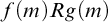
$f(m) R g(m)$
for all
$m \in \omega \setminus n$
;
$f R _{n} g$
to mean that
$f(m) R g(m)$
for all
$m \in \omega \setminus n$
; -
•
$f R^{*} g$
to mean that
$\{ n \in \omega : \neg ( f(n) R g(n))\}$
is finite.




This article concerns well-ordered sequences of functions from the integers to the ordinals, which are increasing in the following senses.
Definition 1. Given ordinals $\eta $
and
$\eta $
and $\gamma $
, we say that a sequence
$\gamma $
, we say that a sequence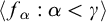 $\langle f_{\alpha } : \alpha < \gamma \rangle $
of functions from
$\langle f_{\alpha } : \alpha < \gamma \rangle $
of functions from $\omega $
to
$\omega $
to $\eta $
is strongly increasing if
$\eta $
is strongly increasing if
-
1. for all
$\alpha < \beta < \gamma $
,
$f_\alpha <^* f_\beta ;$
-
2. for each limit ordinal
$\beta < \gamma $
, there exist a club
$C_\beta \subseteq \beta $
and an
$n_\beta < \omega $
such that, for all
$\alpha $
in
$C_\beta $
,
$f_\alpha <_{n_\beta } f_\beta $
.


Definition 2. We say that a strongly increasing sequence $\langle f_{\alpha } : \alpha < \gamma \rangle $
is very strongly increasing if
$\langle f_{\alpha } : \alpha < \gamma \rangle $
is very strongly increasing if
-
1.
$n_{\beta }$
in part (2) of Definition 1 can be chosen to be
$0$
for each limit ordinal
$\beta $
of uncountable cofinality; -
2. for each ordinal of the form
$\beta + \omega < \gamma $
, and each
$n \in \omega $
, there is an
$\alpha $
in the interval
$[\beta + 1, \beta + \omega )$
such that
$f_{\alpha } \leq _{n} f_{\beta + \omega }$
and
$f_{\alpha }(m) = 0$
for all
$m < n$
.


The ordinal $\gamma $
is called the length of
$\gamma $
is called the length of $\langle f_{\alpha } : \alpha < \gamma \rangle $
, and a sequence is said to have successor length if its length is a successor ordinal.
$\langle f_{\alpha } : \alpha < \gamma \rangle $
, and a sequence is said to have successor length if its length is a successor ordinal.
Remark 3. Condition (2) of Definition 2 is designed to make condition (2) of Definition 1 hold automatically when $\beta $
has countable cofinality. In addition, it ensures that whenever
$\beta $
has countable cofinality. In addition, it ensures that whenever $\bar {f} = \langle f_{\alpha } : \alpha < \gamma \rangle $
is very strongly increasing and
$\bar {f} = \langle f_{\alpha } : \alpha < \gamma \rangle $
is very strongly increasing and $\gamma $
has countable cofinality and is not of the form
$\gamma $
has countable cofinality and is not of the form $\beta + \omega $
, there exists a function
$\beta + \omega $
, there exists a function $f_{\gamma }$
such that
$f_{\gamma }$
such that $\langle f_{\alpha } : \alpha \leq \gamma \rangle $
is very strongly increasing; moreover,
$\langle f_{\alpha } : \alpha \leq \gamma \rangle $
is very strongly increasing; moreover, $f_{\gamma }$
can be any function f such that
$f_{\gamma }$
can be any function f such that $f_{\alpha } <^{*} f$
for all
$f_{\alpha } <^{*} f$
for all $\alpha < \gamma $
. Extending a very strongly increasing sequence
$\alpha < \gamma $
. Extending a very strongly increasing sequence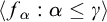 $\langle f_{\alpha } : \alpha \leq \gamma \rangle $
to one of the form
$\langle f_{\alpha } : \alpha \leq \gamma \rangle $
to one of the form $\langle f_{\alpha } : \alpha \leq \gamma + \omega \rangle $
can be done by letting
$\langle f_{\alpha } : \alpha \leq \gamma + \omega \rangle $
can be done by letting $f_{\gamma + \omega }(n)$
be
$f_{\gamma + \omega }(n)$
be $f_{\gamma }(n) + n$
for each
$f_{\gamma }(n) + n$
for each $n \in \omega $
, and letting
$n \in \omega $
, and letting $f_{\gamma + k}(n)$
(for all
$f_{\gamma + k}(n)$
(for all $k,n \in \omega $
with k positive) be
$k,n \in \omega $
with k positive) be $0$
if
$0$
if $n\leq k$
and
$n\leq k$
and $f_{\gamma }(n) + k$
otherwise.
$f_{\gamma }(n) + k$
otherwise.
Remark 4. If $\langle f_{\alpha } :\alpha < \gamma \rangle $
is a strongly increasing sequence, then there is a sequence
$\langle f_{\alpha } :\alpha < \gamma \rangle $
is a strongly increasing sequence, then there is a sequence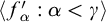 $\langle f^{\prime }_{\alpha } :\alpha < \gamma \rangle $
satisfying condition (2) of Definition 2 such that
$\langle f^{\prime }_{\alpha } :\alpha < \gamma \rangle $
satisfying condition (2) of Definition 2 such that $f_{\alpha } =^{*} f^{\prime }_{\alpha }$
for all
$f_{\alpha } =^{*} f^{\prime }_{\alpha }$
for all $\alpha < \gamma $
.
$\alpha < \gamma $
.
Our interest in strongly increasing sequences is partially motivated by two longstanding open problems:
-
1. Is the Chang’s Conjecture variant
$(\aleph _{\omega +1}, \aleph _\omega ) \twoheadrightarrow (\aleph _2, \aleph _1)$
consistent? -
2. Is there consistently a pair of inner models
$V \subseteq W$
of
$\mathsf {ZFC}$
such that
$(\aleph _{\omega +1})^V = (\aleph _2)^W$
.



In Section 2, we review some of what is known about these questions and show that a positive answer to either would entail the consistency of the existence of an ordinal $\eta < \omega _2$
and a strongly increasing sequence of length
$\eta < \omega _2$
and a strongly increasing sequence of length $\omega _2$
consisting of functions from
$\omega _2$
consisting of functions from $\omega $
to
$\omega $
to $\eta $
. We also show that there can exist no such sequence of length
$\eta $
. We also show that there can exist no such sequence of length $\omega _n$
for any
$\omega _n$
for any $4 \leq n < \omega $
.
$4 \leq n < \omega $
.
In Section 3, we prove the main result of our article (Theorem 22), using a variant of Woodin’s $\mathbb {P}_{\mathrm {max}}$
forcing to establish the consistency of the existence of a strongly increasing sequence of length
$\mathbb {P}_{\mathrm {max}}$
forcing to establish the consistency of the existence of a strongly increasing sequence of length $\omega _2$
consisting of functions from
$\omega _2$
consisting of functions from $\omega $
to
$\omega $
to $\omega $
. The following is a simplified version of the theorem.
$\omega $
. The following is a simplified version of the theorem.
Theorem 5. Suppose that $V =L(A, \mathbb {R})$
, for some
$V =L(A, \mathbb {R})$
, for some $A \subseteq \omega ^{\omega }$
, and that
$A \subseteq \omega ^{\omega }$
, and that $\mathsf {AD}^{+}$
holds. Then there is a forcing extension in which ZFC holds and there exists a very strongly increasing
$\mathsf {AD}^{+}$
holds. Then there is a forcing extension in which ZFC holds and there exists a very strongly increasing $\omega _{2}$
-sequence of functions from
$\omega _{2}$
-sequence of functions from $\omega $
to
$\omega $
to $\omega $
.
$\omega $
.
The axiom $\mathsf {AD}^{+}$
is a strengthening of the Axiom of Determinacy due to Woodin (see [Reference Larson9]). The theorem implies the weaker version where
$\mathsf {AD}^{+}$
is a strengthening of the Axiom of Determinacy due to Woodin (see [Reference Larson9]). The theorem implies the weaker version where $A= \emptyset $
and
$A= \emptyset $
and $\mathsf {AD}^{+}$
is replaced with
$\mathsf {AD}^{+}$
is replaced with $\mathsf {AD}$
. The partial order used in the proof is a variation of Woodin’s
$\mathsf {AD}$
. The partial order used in the proof is a variation of Woodin’s $\mathbb {P}_{\mathrm {max}}$
forcing [Reference Woodin14]. The use of the hypothesis AD +
$\mathbb {P}_{\mathrm {max}}$
forcing [Reference Woodin14]. The use of the hypothesis AD + $V = L(\mathbb {R})$
and the fact that ZFC holds in the corresponding extension are both part of the standard
$V = L(\mathbb {R})$
and the fact that ZFC holds in the corresponding extension are both part of the standard $\mathbb {P}_{\mathrm {max}}$
machinery.
$\mathbb {P}_{\mathrm {max}}$
machinery.
2 Chang’s conjecture and strongly increasing sequences
In this section we motivate our result by linking it to some well-known questions about variants of Chang’s Conjecture and collapsing successors of singular cardinals. None of the results in this section is essentially new,Footnote 1 but we include them for completeness. Some of the results have not been stated before in the precise forms we need.
We begin by noting the following consequence of Remark 3, which can be proved by induction on $\beta $
.
$\beta $
.
Lemma 6. If F is a very strongly increasing sequence in $\omega ^{\omega }$
,
$\omega ^{\omega }$
, $\gamma $
and
$\gamma $
and $\beta $
are ordinals with
$\beta $
are ordinals with $\beta < \omega _{2}$
and
$\beta < \omega _{2}$
and $\gamma + 1$
is the length of F, then there is a very strongly increasing sequence in
$\gamma + 1$
is the length of F, then there is a very strongly increasing sequence in $\omega ^{\omega }$
of length
$\omega ^{\omega }$
of length $\gamma + \beta $
extending F.
$\gamma + \beta $
extending F.
In particular, there is always a strongly increasing sequence in $\omega ^{\omega }$
of length
$\omega ^{\omega }$
of length $\omega _1$
. We next show that instances of Chang’s Conjecture at singular cardinals of countable cofinality entail the existence of more interesting strongly increasing sequences. Recall that the Chang’s Conjecture principle
$\omega _1$
. We next show that instances of Chang’s Conjecture at singular cardinals of countable cofinality entail the existence of more interesting strongly increasing sequences. Recall that the Chang’s Conjecture principle
 $$\begin{align*}(\kappa, \lambda) \twoheadrightarrow (\delta, \gamma)\end{align*}$$
says that whenever M is a structure of cardinality $\kappa $
over some countable language, and B is a subset of M of cardinality
$\kappa $
over some countable language, and B is a subset of M of cardinality $\lambda $
, then M has an elementary substructure X of cardinality
$\lambda $
, then M has an elementary substructure X of cardinality $\delta $
such that
$\delta $
such that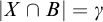 $|X \cap B| = \gamma $
. We use equivalent formulations of these principles below.
$|X \cap B| = \gamma $
. We use equivalent formulations of these principles below.
Lemma 7. Suppose that $\mu $
is a singular cardinal of countable cofinality,
$\mu $
is a singular cardinal of countable cofinality, $\kappa < \mu $
is a cardinal, and
$\kappa < \mu $
is a cardinal, and $(\mu ^+, \mu ) \twoheadrightarrow (\kappa ^+, \kappa )$
holds. Then there exist
$(\mu ^+, \mu ) \twoheadrightarrow (\kappa ^+, \kappa )$
holds. Then there exist $\eta < \kappa ^+$
and a strongly increasing sequence
$\eta < \kappa ^+$
and a strongly increasing sequence $\langle f_\alpha : \alpha < \kappa ^+ \rangle $
of functions from
$\langle f_\alpha : \alpha < \kappa ^+ \rangle $
of functions from $\omega $
to
$\omega $
to $\eta $
.
$\eta $
.
Proof. Let $\langle \mu _i : i < \omega \rangle $
be an increasing sequence of regular cardinals, cofinal in
$\langle \mu _i : i < \omega \rangle $
be an increasing sequence of regular cardinals, cofinal in $\mu $
. It is straightforward to recursively construct a strongly increasing sequence
$\mu $
. It is straightforward to recursively construct a strongly increasing sequence $\vec {g} = \langle g_\beta : \beta < \mu ^+ \rangle $
of functions in
$\vec {g} = \langle g_\beta : \beta < \mu ^+ \rangle $
of functions in $\prod _{i < \omega } \mu _i$
, letting
$\prod _{i < \omega } \mu _i$
, letting $n_{\beta }$
be the least i such that
$n_{\beta }$
be the least i such that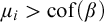 ${\mu _{i}> \mathrm {cof}(\beta )}$
, for each limit ordinal
${\mu _{i}> \mathrm {cof}(\beta )}$
, for each limit ordinal $\beta $
. Let
$\beta $
. Let $\theta $
be a sufficiently large regular cardinal, and use
$\theta $
be a sufficiently large regular cardinal, and use $(\mu ^+, \mu ) \twoheadrightarrow (\kappa ^+, \kappa )$
to find an elementary substructure
$(\mu ^+, \mu ) \twoheadrightarrow (\kappa ^+, \kappa )$
to find an elementary substructure $N \prec (H(\theta ), \in , \mu ^+, \mu , \vec {g})$
such that
$N \prec (H(\theta ), \in , \mu ^+, \mu , \vec {g})$
such that $|N \cap \mu ^+| = \kappa ^+$
and
$|N \cap \mu ^+| = \kappa ^+$
and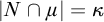 $|N \cap \mu | = \kappa $
. Since N contains a surjection from
$|N \cap \mu | = \kappa $
. Since N contains a surjection from $\mu $
to each element of
$\mu $
to each element of $\mu ^{+} \cap N$
,
$\mu ^{+} \cap N$
, $\mathrm {otp}(N \cap \mu ^+) = \kappa ^+$
.
$\mathrm {otp}(N \cap \mu ^+) = \kappa ^+$
.
By elementarity and the fact that $\vec {g}$
is strongly increasing, we know that, for every limit ordinal
$\vec {g}$
is strongly increasing, we know that, for every limit ordinal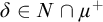 $\delta \in N \cap \mu ^+$
, there exist a club
$\delta \in N \cap \mu ^+$
, there exist a club $C_\delta \subseteq \delta $
and an
$C_\delta \subseteq \delta $
and an $n_\delta < \omega $
such that
$n_\delta < \omega $
such that $C_\delta \in N$
and, for all
$C_\delta \in N$
and, for all $\beta \in C_\delta $
, we have
$\beta \in C_\delta $
, we have $g_\beta <_{n_\delta } g_\delta $
. Let M be the transitive collapse of N, and let
$g_\beta <_{n_\delta } g_\delta $
. Let M be the transitive collapse of N, and let $\pi :N \rightarrow M$
be the collapse map.
$\pi :N \rightarrow M$
be the collapse map.
Claim 8. Suppose that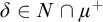 $\delta \in N \cap \mu ^+$
is a limit ordinal. Then
$\delta \in N \cap \mu ^+$
is a limit ordinal. Then $\pi (C_\delta )$
is closed in its supremum.
$\pi (C_\delta )$
is closed in its supremum.
Proof. Let $\bar {\beta } < \pi (\delta )$
be such that
$\bar {\beta } < \pi (\delta )$
be such that $\sup (\pi (C_\delta ) \cap \bar {\beta }) = \bar {\beta }$
. Let
$\sup (\pi (C_\delta ) \cap \bar {\beta }) = \bar {\beta }$
. Let $\beta = \pi ^{-1}(\bar {\beta })$
, and note that
$\beta = \pi ^{-1}(\bar {\beta })$
, and note that $\beta $
is a limit ordinal. If
$\beta $
is a limit ordinal. If $\alpha < \beta $
, then
$\alpha < \beta $
, then $\pi (C_\delta ) \cap (\pi (\alpha ), \bar {\beta }) \neq \emptyset $
, so
$\pi (C_\delta ) \cap (\pi (\alpha ), \bar {\beta }) \neq \emptyset $
, so $C_\delta \cap (\alpha , \beta ) \neq \emptyset $
. It follows that
$C_\delta \cap (\alpha , \beta ) \neq \emptyset $
. It follows that $N \models "C_\delta \cap \beta \mbox { is unbounded in } \beta ,$
” so, by elementarity,
$N \models "C_\delta \cap \beta \mbox { is unbounded in } \beta ,$
” so, by elementarity, $C_\delta $
is in fact unbounded in
$C_\delta $
is in fact unbounded in $\beta $
and, since
$\beta $
and, since $C_\delta $
is closed in
$C_\delta $
is closed in $\delta $
, we have
$\delta $
, we have $\beta \in C_\delta $
. But then
$\beta \in C_\delta $
. But then $\bar {\beta } \in \pi (C_\delta )$
, as desired.
$\bar {\beta } \in \pi (C_\delta )$
, as desired.
Since $\omega \subseteq N$
, it follows that for all
$\omega \subseteq N$
, it follows that for all $\beta \in N \cap \mu ^+$
, we have
$\beta \in N \cap \mu ^+$
, we have $\mathrm {range}(g_\beta ) \subseteq N$
. Let
$\mathrm {range}(g_\beta ) \subseteq N$
. Let $\langle \beta _\alpha : \alpha < \kappa ^+ \rangle $
enumerate
$\langle \beta _\alpha : \alpha < \kappa ^+ \rangle $
enumerate $M \cap \mu ^+$
in increasing order. Define a sequence
$M \cap \mu ^+$
in increasing order. Define a sequence $\vec {f} = \langle f_\alpha : \alpha < \kappa ^+ \rangle $
of functions from
$\vec {f} = \langle f_\alpha : \alpha < \kappa ^+ \rangle $
of functions from $\omega $
to
$\omega $
to $\pi (\mu )$
by letting
$\pi (\mu )$
by letting $f_\alpha (n) = \pi (g_{\beta _\alpha }(n))$
for all
$f_\alpha (n) = \pi (g_{\beta _\alpha }(n))$
for all $\alpha < \kappa ^+$
and all
$\alpha < \kappa ^+$
and all $n < \omega $
. Claim 8 and the fact that
$n < \omega $
. Claim 8 and the fact that $\pi (\mu ) < \kappa ^{+}$
imply that
$\pi (\mu ) < \kappa ^{+}$
imply that $\vec {f}$
is strongly increasing, as witnessed by
$\vec {f}$
is strongly increasing, as witnessed by $n_{\beta _\alpha }$
and
$n_{\beta _\alpha }$
and $\pi (C_{\beta _\alpha })$
for each limit ordinal
$\pi (C_{\beta _\alpha })$
for each limit ordinal $\alpha < \kappa ^+$
.
$\alpha < \kappa ^+$
.
In [Reference Levinski, Magidor and Shelah10], Levinski et al. prove, assuming the consistency of a certain large cardinal hypothesis, the consistency of a number of Chang’s Conjecture variants involving singular cardinals, most notably $(\aleph _{\omega + 1}, \aleph _\omega ) \twoheadrightarrow (\aleph _1, \aleph _0)$
. However, in any instance
$(\aleph _{\omega + 1}, \aleph _\omega ) \twoheadrightarrow (\aleph _1, \aleph _0)$
. However, in any instance $(\mu ^+, \mu ) \twoheadrightarrow (\kappa ^+, \kappa )$
known to be consistent in which
$(\mu ^+, \mu ) \twoheadrightarrow (\kappa ^+, \kappa )$
known to be consistent in which $\mu $
is a singular cardinal, we have
$\mu $
is a singular cardinal, we have $\mathrm {cf}(\mu ) = \mathrm {cf}(\kappa )$
. This leads to the following natural folklore question.
$\mathrm {cf}(\mu ) = \mathrm {cf}(\kappa )$
. This leads to the following natural folklore question.
Question 9. Is $(\aleph _{\omega + 1}, \aleph _\omega ) \twoheadrightarrow (\aleph _2, \aleph _1)$
consistent?
$(\aleph _{\omega + 1}, \aleph _\omega ) \twoheadrightarrow (\aleph _2, \aleph _1)$
consistent?
A closely related question, raised by Bukovský and Copláková-Hartová in [Reference Bukovský and Copláková-Hartová3], is the following.
Question 10. Is there consistently a pair of inner models $V \subseteq W$
of
$V \subseteq W$
of $\mathsf {ZFC}$
such that
$\mathsf {ZFC}$
such that $(\aleph _{\omega + 1})^V = (\aleph _2)^W$
?
$(\aleph _{\omega + 1})^V = (\aleph _2)^W$
?
To see one connection between these two questions, observe that, if
 $$\begin{align*}(\aleph_{\omega + 1}, \aleph_\omega) \twoheadrightarrow (\aleph_2, \aleph_1)\end{align*}$$
and there is a Woodin cardinal, then there is a V-generic filter G for Woodin’s stationary tower forcing such that $(\aleph _{\omega + 1})^V = (\aleph _2)^{V[G]}$
(see [Reference Larson7]).
$(\aleph _{\omega + 1})^V = (\aleph _2)^{V[G]}$
(see [Reference Larson7]).
Essentially the same argument as that given in the proof of Lemma 7 yields the following result, which states that a positive answer to Question 10 would entail the existence of interesting strongly increasing sequences.
Lemma 11. Suppose that $V \subseteq W$
are inner models of
$V \subseteq W$
are inner models of $\mathsf {ZFC}$
,
$\mathsf {ZFC}$
, $n < \omega $
, and
$n < \omega $
, and $(\aleph _{\omega + 1})^V = (\aleph _{n+1})^W$
. Then, in W, there is
$(\aleph _{\omega + 1})^V = (\aleph _{n+1})^W$
. Then, in W, there is $\eta < \omega _{n+1}$
and a strongly increasing sequence
$\eta < \omega _{n+1}$
and a strongly increasing sequence $\langle f_\alpha : \alpha < \omega _{n+1} \rangle $
of functions from
$\langle f_\alpha : \alpha < \omega _{n+1} \rangle $
of functions from $\omega $
to
$\omega $
to $\eta $
.
$\eta $
.
Proof sketch
As in the proof of Lemma 7, in V we can construct a strongly increasing sequence $\vec {f} = \langle f_\alpha : \alpha < \omega _{\omega +1} \rangle $
in
$\vec {f} = \langle f_\alpha : \alpha < \omega _{\omega +1} \rangle $
in $\prod _{i < \omega } \omega _i$
. In W, we have
$\prod _{i < \omega } \omega _i$
. In W, we have $(\omega _{\omega +1})^V = \omega _{n+1}$
, and
$(\omega _{\omega +1})^V = \omega _{n+1}$
, and $\vec {f}$
remains a strongly increasing sequence of functions. Thus, letting
$\vec {f}$
remains a strongly increasing sequence of functions. Thus, letting $\eta = (\omega _\omega )^V < (\omega _{n+1})^W$
, we see that
$\eta = (\omega _\omega )^V < (\omega _{n+1})^W$
, we see that $\vec {f}$
is as desired.
$\vec {f}$
is as desired.
For more information and partial progress on Questions 9 and 10, we refer the reader to [Reference Cummings4, Reference Sharon and Viale11].
For the next result, we need some notions from PCF theory [Reference Shelah12]. The following is a special case of a more general definition.
Definition 12. Suppose that $\vec {f} = \langle f_\alpha : \alpha < \gamma \rangle $
is a
$\vec {f} = \langle f_\alpha : \alpha < \gamma \rangle $
is a $<^*$
-increasing sequence of functions from
$<^*$
-increasing sequence of functions from $\omega $
to the ordinals. A function g from
$\omega $
to the ordinals. A function g from $\omega $
to the ordinals is an exact upper bound (eub) for
$\omega $
to the ordinals is an exact upper bound (eub) for $\vec {f}$
if:
$\vec {f}$
if:
-
• g is an upper bound, i.e., for every
$\alpha < \gamma $
, we have
$f_\alpha <^* g$
; -
• for every function h such that
$h <^* g$
, there is
$\alpha < \gamma $
such that
$h <^* f_\alpha $
.


An ordinal $\beta < \gamma $
is called good for
$\beta < \gamma $
is called good for $\vec {f}$
if
$\vec {f}$
if $\mathrm {cf}(\beta )> \omega $
and there is an eub h for
$\mathrm {cf}(\beta )> \omega $
and there is an eub h for $\vec {f} \restriction \beta = \langle f_\alpha : \alpha < \beta \rangle $
such that
$\vec {f} \restriction \beta = \langle f_\alpha : \alpha < \beta \rangle $
such that $\mathrm {cf}(h(i)) = \mathrm {cf}(\beta )$
for all but finitely many
$\mathrm {cf}(h(i)) = \mathrm {cf}(\beta )$
for all but finitely many $i < \omega $
.
$i < \omega $
.
Recall that $S^{\lambda }_{\kappa }$
denotes the set of ordinals below
$S^{\lambda }_{\kappa }$
denotes the set of ordinals below $\lambda $
of cofinality
$\lambda $
of cofinality $\kappa $
. The following theorem, due in a much more general form to Shelah [Reference Shelah12], is a basic result in PCF theory. For a proof, we refer the reader to [Reference Cummings5, Theorem 10.1].
$\kappa $
. The following theorem, due in a much more general form to Shelah [Reference Shelah12], is a basic result in PCF theory. For a proof, we refer the reader to [Reference Cummings5, Theorem 10.1].
Theorem 13. Suppose that $\kappa < \lambda $
are uncountable regular cardinals and that
$\kappa < \lambda $
are uncountable regular cardinals and that $\vec {f} = \langle f_\alpha : \alpha < \lambda \rangle $
is a
$\vec {f} = \langle f_\alpha : \alpha < \lambda \rangle $
is a $<^*$
-increasing sequence of functions from
$<^*$
-increasing sequence of functions from $\omega $
to the ordinals. If there are stationarily many
$\omega $
to the ordinals. If there are stationarily many $\beta \in S^\lambda _\kappa $
such that
$\beta \in S^\lambda _\kappa $
such that $\beta $
is good for
$\beta $
is good for $\vec {f}$
, then
$\vec {f}$
, then $\vec {f}$
has an eub h such that
$\vec {f}$
has an eub h such that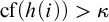 $\mathrm {cf}(h(i))> \kappa $
for all
$\mathrm {cf}(h(i))> \kappa $
for all $i < \omega $
.
$i < \omega $
.
We can now prove the following result bounding the lengths of strongly increasing sequences of functions.
Theorem 14. Suppose that $\lambda $
is an uncountable regular cardinal and
$\lambda $
is an uncountable regular cardinal and $\epsilon < \lambda ^{+3}$
. Then there is no strongly increasing sequence
$\epsilon < \lambda ^{+3}$
. Then there is no strongly increasing sequence $\vec {f} = \langle f_\alpha : \alpha < \lambda ^{+3} \rangle $
of functions from
$\vec {f} = \langle f_\alpha : \alpha < \lambda ^{+3} \rangle $
of functions from $\omega $
to
$\omega $
to $\epsilon $
.
$\epsilon $
.
Proof. Suppose for the sake of contradiction that $\vec {f} = \langle f_\alpha : \alpha < \lambda ^{+3} \rangle $
is a strongly increasing sequence of functions from
$\vec {f} = \langle f_\alpha : \alpha < \lambda ^{+3} \rangle $
is a strongly increasing sequence of functions from $\omega $
to
$\omega $
to $\epsilon $
. Fix a club-guessing sequence
$\epsilon $
. Fix a club-guessing sequence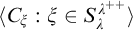 $\langle C_\xi : \xi \in S^{\lambda ^{++}}_\lambda \rangle $
, i.e., a sequence such that each
$\langle C_\xi : \xi \in S^{\lambda ^{++}}_\lambda \rangle $
, i.e., a sequence such that each $C_\xi $
is a club in
$C_\xi $
is a club in $\xi $
of order type
$\xi $
of order type $\lambda $
and, for every club
$\lambda $
and, for every club $D \subseteq \lambda ^{++}$
, there is a
$D \subseteq \lambda ^{++}$
, there is a $\xi \in S^{\lambda ^{++}}_\lambda $
such that
$\xi \in S^{\lambda ^{++}}_\lambda $
such that $C_\xi \subseteq D$
(see Claim 2.14B of Section III(2) of [Reference Shelah12], for instance, for a proof that this can be done).
$C_\xi \subseteq D$
(see Claim 2.14B of Section III(2) of [Reference Shelah12], for instance, for a proof that this can be done).
Our goal is to show that there are stationarily many elements of $S^{\lambda ^{+3}}_\lambda $
that are good for
$S^{\lambda ^{+3}}_\lambda $
that are good for $\vec {f}$
. To this end, fix a club
$\vec {f}$
. To this end, fix a club $C \subseteq \lambda ^{+3}$
. We now construct an increasing, continuous sequence
$C \subseteq \lambda ^{+3}$
. We now construct an increasing, continuous sequence $\langle \alpha _\eta : \eta < \lambda ^{++} \rangle $
of elements of C. Begin by letting
$\langle \alpha _\eta : \eta < \lambda ^{++} \rangle $
of elements of C. Begin by letting $\alpha _0 = \min (C)$
. If
$\alpha _0 = \min (C)$
. If $\eta < \lambda ^{++}$
is a limit ordinal, then
$\eta < \lambda ^{++}$
is a limit ordinal, then $\alpha _\eta = \sup \{\alpha _\zeta : \zeta < \eta \}$
. Suppose now that
$\alpha _\eta = \sup \{\alpha _\zeta : \zeta < \eta \}$
. Suppose now that $\eta < \lambda ^{++}$
and
$\eta < \lambda ^{++}$
and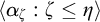 $\langle \alpha _\zeta : \zeta \leq \eta \rangle $
has been constructed. We show how to obtain
$\langle \alpha _\zeta : \zeta \leq \eta \rangle $
has been constructed. We show how to obtain $\alpha _{\eta + 1}$
.
$\alpha _{\eta + 1}$
.
For each $\xi \in S^{\lambda ^{++}}_\lambda $
, ask whether there exist
$\xi \in S^{\lambda ^{++}}_\lambda $
, ask whether there exist $\beta < \lambda ^{+3}$
and
$\beta < \lambda ^{+3}$
and $n < \omega $
such that, for all
$n < \omega $
such that, for all $\zeta \in C_\xi \cap (\eta + 1)$
, we have
$\zeta \in C_\xi \cap (\eta + 1)$
, we have $f_{\alpha _\zeta } <_n f_\beta $
. Note that if
$f_{\alpha _\zeta } <_n f_\beta $
. Note that if $\beta $
has this property, then so does every
$\beta $
has this property, then so does every $\gamma $
with
$\gamma $
with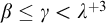 $\beta \leq \gamma < \lambda ^{+3}$
. If the answer is yes, then choose an ordinal
$\beta \leq \gamma < \lambda ^{+3}$
. If the answer is yes, then choose an ordinal ${\alpha ^\xi _\eta \in C \setminus (\alpha _\eta + 1)}$
witnessing this. If the answer is no, then let
${\alpha ^\xi _\eta \in C \setminus (\alpha _\eta + 1)}$
witnessing this. If the answer is no, then let $\alpha ^\xi _\eta = \min (C \setminus (\alpha _\eta + 1))$
. Let
$\alpha ^\xi _\eta = \min (C \setminus (\alpha _\eta + 1))$
. Let $\alpha _{\eta + 1} = \sup \{\alpha ^\xi _\eta : \xi \in S^{\lambda ^{++}}_\lambda \}$
.
$\alpha _{\eta + 1} = \sup \{\alpha ^\xi _\eta : \xi \in S^{\lambda ^{++}}_\lambda \}$
.
Let $\beta = \sup \{\alpha _\eta : \eta < \lambda ^{++}\}$
. By the fact that
$\beta = \sup \{\alpha _\eta : \eta < \lambda ^{++}\}$
. By the fact that $\vec {f}$
is strongly increasing, we can find a club
$\vec {f}$
is strongly increasing, we can find a club $D \subseteq \beta $
and a natural number n such that, for all
$D \subseteq \beta $
and a natural number n such that, for all $\alpha \in D$
, we have
$\alpha \in D$
, we have $f_\alpha <_n f_\beta $
. Let
$f_\alpha <_n f_\beta $
. Let $E = \{\eta < \lambda ^{++} : \alpha _\eta \in D\}$
, and note that E is club in
$E = \{\eta < \lambda ^{++} : \alpha _\eta \in D\}$
, and note that E is club in $\lambda ^{++}$
. Fix
$\lambda ^{++}$
. Fix $\xi \in S^{\lambda ^{++}}_\lambda $
such that
$\xi \in S^{\lambda ^{++}}_\lambda $
such that $C_\xi \subseteq E$
. For
$C_\xi \subseteq E$
. For $\eta \in C_\xi $
, let
$\eta \in C_\xi $
, let $\eta ^{\dagger }$
denote
$\eta ^{\dagger }$
denote $\min (C_\xi \setminus (\eta + 1))$
.
$\min (C_\xi \setminus (\eta + 1))$
.
Suppose $\eta \in C_\xi $
. When defining
$\eta \in C_\xi $
. When defining $\alpha _{\eta + 1}$
, the answer to the question asked about
$\alpha _{\eta + 1}$
, the answer to the question asked about $C_\xi $
was “yes,” as witnessed by
$C_\xi $
was “yes,” as witnessed by $\beta $
. Therefore,
$\beta $
. Therefore, $\alpha _{\eta + 1}$
was chosen to be large enough so that, for some
$\alpha _{\eta + 1}$
was chosen to be large enough so that, for some $n < \omega $
and all
$n < \omega $
and all $\zeta \in C_\xi \cap (\eta + 1)$
, we have
$\zeta \in C_\xi \cap (\eta + 1)$
, we have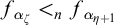 $f_{\alpha _\zeta } <_n f_{\alpha _{\eta + 1}}$
. The same obviously holds for all
$f_{\alpha _\zeta } <_n f_{\alpha _{\eta + 1}}$
. The same obviously holds for all $\eta '$
in the interval
$\eta '$
in the interval $(\eta , \lambda ^{++})$
. In particular, there is a natural number
$(\eta , \lambda ^{++})$
. In particular, there is a natural number $n_\eta $
such that, for all
$n_\eta $
such that, for all $\zeta \in C_\xi \cap (\eta + 1)$
, we have
$\zeta \in C_\xi \cap (\eta + 1)$
, we have $f_{\alpha _\zeta } <_{n_\eta } f_{\alpha _{\eta ^\dagger }}$
.
$f_{\alpha _\zeta } <_{n_\eta } f_{\alpha _{\eta ^\dagger }}$
.
Since $\lambda $
is regular and uncountable, we can fix a natural number n and an unbounded set
$\lambda $
is regular and uncountable, we can fix a natural number n and an unbounded set $A \subseteq C_\xi $
such that, for all
$A \subseteq C_\xi $
such that, for all $\eta \in A$
, we have
$\eta \in A$
, we have $n_\eta = n$
. Let
$n_\eta = n$
. Let $B = \{\alpha _{\eta ^\dagger } : \eta \in A\}$
. Then B is unbounded in
$B = \{\alpha _{\eta ^\dagger } : \eta \in A\}$
. Then B is unbounded in $\alpha _\xi $
and, for all
$\alpha _\xi $
and, for all $\zeta < \eta $
, both in A, we have
$\zeta < \eta $
, both in A, we have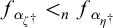 $f_{\alpha _{\zeta ^\dagger }} <_n f_{\alpha _{\eta ^\dagger }}$
. But now, if g is a function from
$f_{\alpha _{\zeta ^\dagger }} <_n f_{\alpha _{\eta ^\dagger }}$
. But now, if g is a function from $\omega $
to the ordinals such that, for all
$\omega $
to the ordinals such that, for all $n \leq m < \omega $
, we have
$n \leq m < \omega $
, we have $g(m) = \sup \{f_{\alpha _{\eta ^\dagger }}(m) : \eta \in A\}$
, it is easily verified that g is an eub for
$g(m) = \sup \{f_{\alpha _{\eta ^\dagger }}(m) : \eta \in A\}$
, it is easily verified that g is an eub for $\vec {f} \restriction \alpha _\xi $
. But then g witnesses that
$\vec {f} \restriction \alpha _\xi $
. But then g witnesses that $\alpha _\xi $
is good for
$\alpha _\xi $
is good for $\vec {f}$
. Moreover, by construction,
$\vec {f}$
. Moreover, by construction, $\alpha _\xi \in C$
. Since C was arbitrary, we have shown that there are stationarily many elements of
$\alpha _\xi \in C$
. Since C was arbitrary, we have shown that there are stationarily many elements of $S^{\lambda ^{+3}}_\lambda $
that are good for
$S^{\lambda ^{+3}}_\lambda $
that are good for $\vec {f}$
.
$\vec {f}$
.
By Theorem 13, it follows that there is an eub h for $\vec {f}$
such that
$\vec {f}$
such that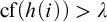 $\mathrm {cf}(h(i))> \lambda $
for all
$\mathrm {cf}(h(i))> \lambda $
for all $i < \omega $
.
$i < \omega $
.
Claim 15. $\mathrm {cf}(h(i)) \geq \lambda ^{+3}$
for all but finitely many
$\mathrm {cf}(h(i)) \geq \lambda ^{+3}$
for all but finitely many $i < \omega $
.
$i < \omega $
.
Proof. If not, then there exist $k \in \{1,2\}$
and an unbounded
$k \in \{1,2\}$
and an unbounded $A \subseteq \omega $
such that, for all
$A \subseteq \omega $
such that, for all $i \in A$
, we have
$i \in A$
, we have $\mathrm {cf}(h(i)) = \lambda ^{+k}$
. For each
$\mathrm {cf}(h(i)) = \lambda ^{+k}$
. For each $i \in A$
, let
$i \in A$
, let $\{\delta ^i_\eta : \eta < \lambda ^{+k}\}$
enumerate, in increasing fashion, a set of ordinals cofinal in
$\{\delta ^i_\eta : \eta < \lambda ^{+k}\}$
enumerate, in increasing fashion, a set of ordinals cofinal in $h(i)$
. For each
$h(i)$
. For each $\eta < \lambda ^{+k}$
, define a function
$\eta < \lambda ^{+k}$
, define a function $h_\eta $
from
$h_\eta $
from $\omega $
to the ordinals by letting
$\omega $
to the ordinals by letting $h_\eta (i) = \delta ^i_\eta $
if
$h_\eta (i) = \delta ^i_\eta $
if $i \in A$
and
$i \in A$
and $h_\eta (i) = 0$
otherwise. For each
$h_\eta (i) = 0$
otherwise. For each $\eta < \lambda ^{+k}$
, we have
$\eta < \lambda ^{+k}$
, we have $h_\eta <^* h$
, so, since h is an eub for
$h_\eta <^* h$
, so, since h is an eub for $\vec {f}$
, there is
$\vec {f}$
, there is $\beta _\eta < \lambda ^{+3}$
such that
$\beta _\eta < \lambda ^{+3}$
such that $h_\eta <^* f_{\beta _\eta }$
. Let
$h_\eta <^* f_{\beta _\eta }$
. Let $\gamma = \sup \{\beta _\eta : \eta < \lambda ^{+k}\}$
. Since
$\gamma = \sup \{\beta _\eta : \eta < \lambda ^{+k}\}$
. Since $k < 3$
, we have
$k < 3$
, we have $\gamma < \lambda ^{+3}$
. Therefore, for all
$\gamma < \lambda ^{+3}$
. Therefore, for all $\eta < \lambda ^{+k}$
, we have
$\eta < \lambda ^{+k}$
, we have $h_\eta <^* f_\gamma $
. Fix an unbounded
$h_\eta <^* f_\gamma $
. Fix an unbounded $B \subseteq \lambda ^{+k}$
and an
$B \subseteq \lambda ^{+k}$
and an $n < \omega $
such that, for all
$n < \omega $
such that, for all $\eta \in B$
, we have
$\eta \in B$
, we have $h_\eta <_n f_\gamma $
. But then, for all
$h_\eta <_n f_\gamma $
. But then, for all $i \in A \setminus n$
, we must have
$i \in A \setminus n$
, we must have $f_\gamma (i) \geq \sup \{\delta ^i_\eta : \eta \in B\} = h(i)$
, contradicting the fact that h is an upper bound for
$f_\gamma (i) \geq \sup \{\delta ^i_\eta : \eta \in B\} = h(i)$
, contradicting the fact that h is an upper bound for $\vec {f}$
.
$\vec {f}$
.
But this claim immediately contradicts the fact that $\vec {f}$
is a sequence of functions from
$\vec {f}$
is a sequence of functions from $\omega $
to
$\omega $
to $\epsilon $
and
$\epsilon $
and $\epsilon < \lambda ^{+3}$
. This is because, by the claim, we must have
$\epsilon < \lambda ^{+3}$
. This is because, by the claim, we must have $h(i)> \epsilon $
for all but finitely many
$h(i)> \epsilon $
for all but finitely many $i < \omega $
. But then the constant function, taking value
$i < \omega $
. But then the constant function, taking value $\epsilon $
, witnesses that h fails to be an eub.
$\epsilon $
, witnesses that h fails to be an eub.
The results in this section lead to the following corollary. We note that clauses (2) and (3) of the corollary were already known via slightly different proofs (see, e.g., [Reference Cummings4, Reference Sharon and Viale11]).
Corollary 16. Suppose that $3 \leq n < \omega $
.
$3 \leq n < \omega $
.
-
1. If
$\eta < \omega _{n+1}$
, then there is no strongly increasing sequence
$\langle f_\alpha : \alpha < \omega _{n+1} \rangle $
of functions from
$\omega $
to
$\eta $
. -
2.
$(\aleph _{\omega + 1}, \aleph _\omega ) \not \twoheadrightarrow (\aleph _{n+1}, \aleph _n)$
. -
3. There are no inner models
$V \subseteq W$
of
$\mathsf {ZFC}$
such that
$(\aleph _{\omega + 1})^V = (\aleph _{n+1})^W$
.








It also follows that the only regular cardinals that can possibly be lengths of strongly increasing sequences from $\omega ^{\omega }$
are
$\omega ^{\omega }$
are $\aleph _n$
for
$\aleph _n$
for $0 \leq n \leq 3$
. We have seen that there are always such sequences of length
$0 \leq n \leq 3$
. We have seen that there are always such sequences of length $\aleph _0$
and
$\aleph _0$
and $\aleph _1$
. We will prove, in Section 3, the consistency of the existence of a strongly increasing sequence of length
$\aleph _1$
. We will prove, in Section 3, the consistency of the existence of a strongly increasing sequence of length $\aleph _2$
. The question about the consistency of the existence of a strongly increasing sequence of length
$\aleph _2$
. The question about the consistency of the existence of a strongly increasing sequence of length $\aleph _3$
remains open.
$\aleph _3$
remains open.
3 Consistency via a
$\mathbb {P}_{\mathrm {max}}$
variation

In this section we use a natural variation of Woodin’s partial order $\mathbb {P}_{\mathrm {max}}$
to force over a model of
$\mathbb {P}_{\mathrm {max}}$
to force over a model of $\mathsf {AD}^{+} + \exists A \subseteq \mathbb {R}\, V =L(A,\mathbb {R})$
to produce a model of
$\mathsf {AD}^{+} + \exists A \subseteq \mathbb {R}\, V =L(A,\mathbb {R})$
to produce a model of $\mathsf {ZFC}$
with a very strongly increasing sequence in
$\mathsf {ZFC}$
with a very strongly increasing sequence in $\omega ^{\omega }$
of length
$\omega ^{\omega }$
of length $\omega _{2}$
. We refer the reader to [Reference Larson9] for background on
$\omega _{2}$
. We refer the reader to [Reference Larson9] for background on $\mathsf {AD}^{+}$
. Since
$\mathsf {AD}^{+}$
. Since $L(\mathbb {R}) \models \mathsf {AD} \rightarrow \mathsf {AD}^{+}$
(by a result of Kechris), our result applies to models of
$L(\mathbb {R}) \models \mathsf {AD} \rightarrow \mathsf {AD}^{+}$
(by a result of Kechris), our result applies to models of $\mathsf {AD}$
of the form
$\mathsf {AD}$
of the form $L(\mathbb {R})$
. We refer the reader to [Reference Woodin14] for background on
$L(\mathbb {R})$
. We refer the reader to [Reference Woodin14] for background on $\mathbb {P}_{\mathrm {max}}$
, especially Chapter 4 and Section 9.2. The article [Reference Larson8] may also be helpful.
$\mathbb {P}_{\mathrm {max}}$
, especially Chapter 4 and Section 9.2. The article [Reference Larson8] may also be helpful.
Conditions in our partial order $\mathbb {P}$
are triples
$\mathbb {P}$
are triples $(M, F, a)$
such that
$(M, F, a)$
such that
-
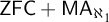
• M is a countable transitive model of
$\mathsf {ZFC} + \mathsf {MA}_{\aleph _{1}}$
which is iterable with respect to
$\mathrm {NS}_{\omega _{1}}^{M}$
; -
• F is in M a very strongly increasing sequence of successor length;
-
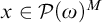
• a is an element of
$\mathcal {P}(\omega _{1})^{M}$
such that, for some
$x \in \mathcal {P}(\omega )^{M}$
,
$\omega _{1}^{M} = \omega _{1}^{L[a, x]}$
.



The order is: $(M, F, a) < (N, H, b)$
if there exists in M an iteration
$(M, F, a) < (N, H, b)$
if there exists in M an iteration
 $$\begin{align*}j \colon (N, \mathrm{NS}_{\omega_{1}}^{N}) \to (N^{*}, \mathrm{NS}_{\omega_{1}}^{N^{*}})\end{align*}$$
such that
-
•
$j(b) = a$
; -
•
$\mathrm {NS}_{\omega _{1}}^{N^{*}} = \mathrm {NS}_{\omega _{1}}^{M} \cap N^{*}$
; -
•
$j(H)$
is a proper initial segment of F.



The iterations referred to in the definition above are repeated generic elementary embeddings induced by forcing with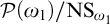 $\mathcal {P}(\omega _{1})/\mathrm {NS}_{\omega _{1}}$
; a model is iterable if this process always results in well-founded models (see Definition 3.5 of [Reference Woodin14]). The map j in the definition of the order embeds N elementarily into
$\mathcal {P}(\omega _{1})/\mathrm {NS}_{\omega _{1}}$
; a model is iterable if this process always results in well-founded models (see Definition 3.5 of [Reference Woodin14]). The map j in the definition of the order embeds N elementarily into $N^{*}$
;
$N^{*}$
; $N^{*}$
need not be an elementary substructure of M. However, since
$N^{*}$
need not be an elementary substructure of M. However, since $N^{*}$
and M have the same
$N^{*}$
and M have the same $\omega _{1}$
, and agree about stationarity for subsets of
$\omega _{1}$
, and agree about stationarity for subsets of $\omega _{1}^{M}$
in
$\omega _{1}^{M}$
in $N^{*}$
,
$N^{*}$
, $j(H)$
is a very strongly increasing sequence in M. The requirement above that F properly extends
$j(H)$
is a very strongly increasing sequence in M. The requirement above that F properly extends $j(H)$
simplifies the arguments below (by removing trivial cases), and adds no new complications, by Lemma 6. Note that j will be an element of
$j(H)$
simplifies the arguments below (by removing trivial cases), and adds no new complications, by Lemma 6. Note that j will be an element of $H(\aleph _{2})^{M}$
; moreover, the ordinal height of
$H(\aleph _{2})^{M}$
; moreover, the ordinal height of $N^{*}$
will be less than
$N^{*}$
will be less than $\omega _{2}^{M}$
.
$\omega _{2}^{M}$
.
Remark 17. If $(M, F, a)$
is a condition in our partial order
$(M, F, a)$
is a condition in our partial order $\mathbb {P}$
, then
$\mathbb {P}$
, then $\langle (M, \mathrm {NS}_{\omega _{1}}^{M}), a \rangle $
is a condition in
$\langle (M, \mathrm {NS}_{\omega _{1}}^{M}), a \rangle $
is a condition in $\mathbb {P}_{\mathrm {max}}$
. Conversely, if
$\mathbb {P}_{\mathrm {max}}$
. Conversely, if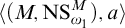 $\langle (M, \mathrm {NS}_{\omega _{1}}^{M}), a \rangle $
is a
$\langle (M, \mathrm {NS}_{\omega _{1}}^{M}), a \rangle $
is a $\mathbb {P}_{\mathrm {max}}$
condition, and
$\mathbb {P}_{\mathrm {max}}$
condition, and $M \models "F$
is a very strongly increasing sequence of successor length,” then
$M \models "F$
is a very strongly increasing sequence of successor length,” then $(M, F, a)$
is a condition in
$(M, F, a)$
is a condition in $\mathbb {P}$
. If
$\mathbb {P}$
. If $(M, F, a)$
and
$(M, F, a)$
and $(N, G, b)$
are conditions in
$(N, G, b)$
are conditions in $\mathbb {P}$
such that
$\mathbb {P}$
such that $\langle (M, \mathrm {NS}_{\omega _{1}}^{M}), a \rangle < \langle (N, \mathrm {NS}_{\omega _{1}}^{N}), b \rangle $
(as
$\langle (M, \mathrm {NS}_{\omega _{1}}^{M}), a \rangle < \langle (N, \mathrm {NS}_{\omega _{1}}^{N}), b \rangle $
(as $\mathbb {P}_{\mathrm {max}}$
conditions, as witnessed by an embedding j), then there is an
$\mathbb {P}_{\mathrm {max}}$
conditions, as witnessed by an embedding j), then there is an $F'$
in M such that
$F'$
in M such that $(M, F', a) < (N, G, b)$
(as conditions in
$(M, F', a) < (N, G, b)$
(as conditions in $\mathbb {P}$
); for instance
$\mathbb {P}$
); for instance $F'$
can be an extension of
$F'$
can be an extension of $j(G)$
formed by adding one additional member. Moreover, by Lemma 6,
$j(G)$
formed by adding one additional member. Moreover, by Lemma 6, $F'$
can be chosen in M to have any desired length below
$F'$
can be chosen in M to have any desired length below $\omega _{2}^{M}$
. Finally, the requirement that
$\omega _{2}^{M}$
. Finally, the requirement that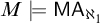 $M \models \mathsf {MA}_{\aleph _{1}}$
and the conditions on the set
$M \models \mathsf {MA}_{\aleph _{1}}$
and the conditions on the set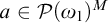 $a \in \mathcal {P}(\omega _{1})^{M}$
imply that the order on each comparable pair of
$a \in \mathcal {P}(\omega _{1})^{M}$
imply that the order on each comparable pair of $\mathbb {P}$
-conditions is witnessed by a unique iteration (this follows immediately from the corresponding fact for
$\mathbb {P}$
-conditions is witnessed by a unique iteration (this follows immediately from the corresponding fact for $\mathbb {P}_{\mathrm {max}}$
).
$\mathbb {P}_{\mathrm {max}}$
).
Remark 18. Much of the standard $\mathbb {P}_{\mathrm {max}}$
machinery can be applied directly to the partial order
$\mathbb {P}_{\mathrm {max}}$
machinery can be applied directly to the partial order $\mathbb {P}$
. In particular,
$\mathbb {P}$
. In particular, $\mathsf {AD}^{+}$
implies the following facts about
$\mathsf {AD}^{+}$
implies the following facts about $\mathbb {P}$
, each of which can be derived from Theorem 9.31 of [Reference Woodin14] and Remark 17 (the first follows from the second). The assertion that
$\mathbb {P}$
, each of which can be derived from Theorem 9.31 of [Reference Woodin14] and Remark 17 (the first follows from the second). The assertion that $(N, \mathrm {NS}_{\omega _{1}}^{N})$
is A-iterable means that
$(N, \mathrm {NS}_{\omega _{1}}^{N})$
is A-iterable means that $A \cap N \in N$
, and, whenever
$A \cap N \in N$
, and, whenever $j \colon (N, \mathrm {NS}_{\omega _{1}}^{N}) \to (N^{*}, \mathrm {NS}_{\omega _{1}}^{*})$
is an iteration,
$j \colon (N, \mathrm {NS}_{\omega _{1}}^{N}) \to (N^{*}, \mathrm {NS}_{\omega _{1}}^{*})$
is an iteration, $j(A \cap N) = A\cap N^{*}$
.
$j(A \cap N) = A\cap N^{*}$
.
-
• For each set
$x \in H(\aleph _{1})$
, there exists a
$\mathbb {P}$
-condition
$(M, F, a)$
with x in
$H(\aleph _{1})^{M}$
. -
• For each
$\mathbb {P}$
condition
$(M, F, a)$
and each
$A \subseteq \omega ^{\omega }$
there is a
$\mathbb {P}$
-condition
$(N, F', b) < (M, F, a)$
such that-
–
$(N, \mathrm {NS}_{\omega _{1}}^{N})$
is A-iterable; -
–
$\langle H(\aleph _{1})^{N}, \in , A \cap N \rangle \prec \langle H(\aleph _{1}), \in , A \rangle $
.
-


In conjunction with the previous two remarks, the proof of Theorem 4.43 of [Reference Woodin14] gives the $\omega $
-clousure of
$\omega $
-clousure of $\mathbb {P}$
. We sketch the proof since the same situation appears again in the proof of Theorem 20.
$\mathbb {P}$
. We sketch the proof since the same situation appears again in the proof of Theorem 20.
Lemma 19. Every descending $\omega $
-sequence in
$\omega $
-sequence in $\mathbb {P}$
has a lower bound.
$\mathbb {P}$
has a lower bound.
Proof. (Sketch) Suppose that $p_{i} = (M_{i}, F_{i}, a_{i})$
(
$p_{i} = (M_{i}, F_{i}, a_{i})$
( $i \in \omega $
) are the members of a descending
$i \in \omega $
) are the members of a descending $\omega $
-sequence in
$\omega $
-sequence in $\mathbb {P}$
. By the first part of Remark 18 we can work inside a countable transitive model N such that
$\mathbb {P}$
. By the first part of Remark 18 we can work inside a countable transitive model N such that $\langle p_{i} : i \in \omega \rangle \in H(\aleph _{1})^{N}$
and
$\langle p_{i} : i \in \omega \rangle \in H(\aleph _{1})^{N}$
and $(N, \mathrm {NS}_{\omega _{1}}^{N})$
is iterable. As in the proof of Theorem 4.43 of [Reference Woodin14], by combining the iterations witnessing the order on the
$(N, \mathrm {NS}_{\omega _{1}}^{N})$
is iterable. As in the proof of Theorem 4.43 of [Reference Woodin14], by combining the iterations witnessing the order on the $p_{i}$
’s we get a sequence of
$p_{i}$
’s we get a sequence of $\mathbb {P}$
-conditions
$\mathbb {P}$
-conditions $(\hat {M}_{i}, \hat {F}_{i}, \hat {a}_{i})\, (i \in \omega )$
such that, for each
$(\hat {M}_{i}, \hat {F}_{i}, \hat {a}_{i})\, (i \in \omega )$
such that, for each $i \in \omega $
,
$i \in \omega $
,
-
•
$(\hat {M}_{i}, \mathrm {NS}_{\omega _{1}}^{\hat {M}_{i}})$
is an iterate of
$(M_{i}, \mathrm {NS}_{\omega _{1}}^{M_{i}})$
and
$\hat {F}_{i}$
and
$\hat {a}_{i}$
are the corresponding images of
$F_{i}$
and
$a_{i}$
, respectively, -
•
$\omega _{1}^{\hat {M}_{i}} = \omega _{1}^{\hat {M}_{0}}$
, -
•
$\mathrm {NS}_{\omega _{1}}^{\hat {M}_{i}} = \mathrm {NS}_{\omega _{1}}^{\hat {M}_{i+1}} \cap \hat {M}_{i}$
, -
•
$\hat {F}_{i}$
is a proper initial segment of
$\hat {F}_{i+1}$
, and -
•
$\hat {a}_{i} = \hat {a}_{0}$
.


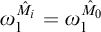



One can then iterate the sequence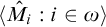 $\langle \hat {M}_{i} : i \in \omega \rangle $
(as in Definition 4.15 of [Reference Woodin14]) in N to produce a sequence of iterations
$\langle \hat {M}_{i} : i \in \omega \rangle $
(as in Definition 4.15 of [Reference Woodin14]) in N to produce a sequence of iterations
 $$\begin{align*}j_{i} \colon (\hat{M}_{i}, \mathrm{NS}^{\hat{M}_{i}}_{\omega_{1}}) \to (M^{*}_{i}, \mathrm{NS}^{M^{*}_{i}}_{\omega_{1}})\hspace{.1in}(i \in \omega)\end{align*}$$
such that
-
• each
$M^{*}_{i}$
is correct (in N) about stationary subsets of
$\omega _{1}$
; -
•
$\bigcup _{i \in \omega }j_{i}(\hat {F}_{i})$
(which we will call F) is (in N) a very strongly increasing sequence in
$\omega ^{\omega }$
whose length is a limit ordinal of countable cofinality; -
• each
$j_{i}(\hat {a}_{i})$
is the same set (which we will call a).


There exists by Remark 3 a very strongly increasing sequence $F^{*}$
in N which extends F by the addition of one function. Then
$F^{*}$
in N which extends F by the addition of one function. Then $(M, F^{*}, a)$
is a lower bound for
$(M, F^{*}, a)$
is a lower bound for $\langle p_{i} : i \in \omega \rangle $
.
$\langle p_{i} : i \in \omega \rangle $
.
The remaining argument concerns descending $\omega _{1}$
-sequences in
$\omega _{1}$
-sequences in $\mathbb {P}$
, from the point of view of some countable transitive model. The main point of this argument is to prove the second item from Remark 21 below: in the
$\mathbb {P}$
, from the point of view of some countable transitive model. The main point of this argument is to prove the second item from Remark 21 below: in the $\mathbb {P}$
-extension, every subset of
$\mathbb {P}$
-extension, every subset of $\omega _{1}$
arises from an iteration of a model coming from a condition in the generic filter (the model that we are working in can be taken to satisfy the second part of Remark 18 with respect to some set of reals A coding a
$\omega _{1}$
arises from an iteration of a model coming from a condition in the generic filter (the model that we are working in can be taken to satisfy the second part of Remark 18 with respect to some set of reals A coding a $\mathbb {P}$
-name for a subset of
$\mathbb {P}$
-name for a subset of $\omega _{1}$
). Less importantly for us, the same construction is also used to show that the nonstationary ideal is saturated in the
$\omega _{1}$
). Less importantly for us, the same construction is also used to show that the nonstationary ideal is saturated in the $\mathbb {P}$
-extension.
$\mathbb {P}$
-extension.
As in Lemma 5.2 of [Reference Larson8], we phrase the construction of our descending $\omega _{1}$
-sequence in terms of a game, where player I takes care of certain steps (typically, meeting each member of some
$\omega _{1}$
-sequence in terms of a game, where player I takes care of certain steps (typically, meeting each member of some $\aleph _{1}$
-sized collection of dense sets) which are repeated without change in our context.
$\aleph _{1}$
-sized collection of dense sets) which are repeated without change in our context.
Given a condition $(M, F, a)$
, the
$(M, F, a)$
, the $\omega _{1}$
-sequence game for
$\omega _{1}$
-sequence game for $p = (M, F, a)$
is the game of length
$p = (M, F, a)$
is the game of length $\omega _{1}$
where players I and
$\omega _{1}$
where players I and $II$
pick the members of a descending
$II$
pick the members of a descending $\omega _{1}$
-sequence of conditions
$\omega _{1}$
-sequence of conditions $p_{\alpha } = (M_{\alpha }, F_{\alpha }, a_{\alpha })\, (\alpha < \omega _{1})$
from
$p_{\alpha } = (M_{\alpha }, F_{\alpha }, a_{\alpha })\, (\alpha < \omega _{1})$
from $\mathbb {P}$
, where
$\mathbb {P}$
, where $p_{0} = p$
, player I picks
$p_{0} = p$
, player I picks $p_{\alpha }$
for all successor ordinals
$p_{\alpha }$
for all successor ordinals $\alpha $
and player
$\alpha $
and player $II$
picks
$II$
picks $p_{\alpha }$
for all limit ordinals
$p_{\alpha }$
for all limit ordinals $\alpha $
. We have in addition that for each
$\alpha $
. We have in addition that for each $\alpha < \omega _{1}$
, letting
$\alpha < \omega _{1}$
, letting $j_{\alpha , \alpha + 1}$
be the embedding of
$j_{\alpha , \alpha + 1}$
be the embedding of $M_{\alpha }$
into
$M_{\alpha }$
into $M_{\alpha +1}$
witnessing that
$M_{\alpha +1}$
witnessing that $p_{\alpha + 1} < p_{\alpha }$
,
$p_{\alpha + 1} < p_{\alpha }$
, $F_{\alpha + 1}$
properly extends
$F_{\alpha + 1}$
properly extends $j_{\alpha , \alpha + 1}(F_{\alpha })$
. Such a sequence induces (via composing the embeddings
$j_{\alpha , \alpha + 1}(F_{\alpha })$
. Such a sequence induces (via composing the embeddings $j_{\alpha , \alpha + 1}$
) an elementary embedding
$j_{\alpha , \alpha + 1}$
) an elementary embedding $k_{\alpha }$
of each model
$k_{\alpha }$
of each model $M_{\alpha }$
into a structure
$M_{\alpha }$
into a structure $M_{\alpha }^{*}$
of cardinality
$M_{\alpha }^{*}$
of cardinality $\aleph _{1}$
, and a sequence
$\aleph _{1}$
, and a sequence $F^{*} = \langle f_{\alpha }^{*} : \alpha < \gamma \rangle $
which is the union of the sequences
$F^{*} = \langle f_{\alpha }^{*} : \alpha < \gamma \rangle $
which is the union of the sequences $k_{\alpha }(F_{\alpha })$
. Player
$k_{\alpha }(F_{\alpha })$
. Player $II$
wins a run of the game if and only if
$II$
wins a run of the game if and only if
-
• each
$M_{\alpha }^{*}$
is correct about stationary subsets of
$\omega _{1}$
; -
• there is a very strongly increasing sequence in
$\omega ^{\omega }$
of successor length extending
$F^{*}$
.


The last condition above is equivalent to the existence of a function $f \in \omega ^{\omega }$
such that
$f \in \omega ^{\omega }$
such that $\{ \alpha < \gamma : f_{\alpha } <_{0} f\}$
contains a club subset of
$\{ \alpha < \gamma : f_{\alpha } <_{0} f\}$
contains a club subset of $\gamma $
(which will have cofinality
$\gamma $
(which will have cofinality $\aleph _{1}$
).
$\aleph _{1}$
).
Lemma 20 below is the only new ingredient in adapting the standard $\mathbb {P}_{\mathrm {max}}$
machinery to give the desired consistency result. The lemma is an adaptation of Lemma 4.46 of [Reference Woodin14]; the steps involving the sequences
$\mathbb {P}_{\mathrm {max}}$
machinery to give the desired consistency result. The lemma is an adaptation of Lemma 4.46 of [Reference Woodin14]; the steps involving the sequences $\sigma $
and the use of Hechler and club-shooting forcing are the only new elements. For those unfamiliar with
$\sigma $
and the use of Hechler and club-shooting forcing are the only new elements. For those unfamiliar with $\mathbb {P}_{\mathrm {max}}$
, the most mysterious part of the proof may be the iteration of the sequence
$\mathbb {P}_{\mathrm {max}}$
, the most mysterious part of the proof may be the iteration of the sequence $\langle \hat {M}_{\beta , i} : i < \omega \rangle $
. For details on this sort of construction (which was already sketched in the proof of Lemma 19) we refer the reader to Corollary 4.20 of [Reference Woodin14]. According to the standard arguments, the lemma is applied inside a countable transitive model M which is correct about
$\langle \hat {M}_{\beta , i} : i < \omega \rangle $
. For details on this sort of construction (which was already sketched in the proof of Lemma 19) we refer the reader to Corollary 4.20 of [Reference Woodin14]. According to the standard arguments, the lemma is applied inside a countable transitive model M which is correct about $\mathbb {P}$
(i.e., such that
$\mathbb {P}$
(i.e., such that
 $$\begin{align*}\langle H(\aleph_{1})^{M}, \in, A\rangle \prec \langle H(\aleph_{1}), \in, A\rangle\end{align*}$$
for some set of reals A coding $\mathbb {P}$
, and typically a
$\mathbb {P}$
, and typically a $\mathbb {P}$
-name for a subset of
$\mathbb {P}$
-name for a subset of $\omega _{1}$
) and which contains a Woodin cardinal, as given for instance by Theorem 9.30 of [Reference Woodin14]. The forcing in the proof of Lemma 20 (Hechler forcing followed by adding a club subset of
$\omega _{1}$
) and which contains a Woodin cardinal, as given for instance by Theorem 9.30 of [Reference Woodin14]. The forcing in the proof of Lemma 20 (Hechler forcing followed by adding a club subset of $\omega _{1}$
) is then followed by a two-stage forcing to produce a condition in
$\omega _{1}$
) is then followed by a two-stage forcing to produce a condition in $\mathbb {P}$
(a lower bound for the
$\mathbb {P}$
(a lower bound for the $\omega ^{M}_{1}$
-sequence constructed), first collapsing the Woodin cardinal to be
$\omega ^{M}_{1}$
-sequence constructed), first collapsing the Woodin cardinal to be $\omega _{2}$
to make the nonstationary ideal on
$\omega _{2}$
to make the nonstationary ideal on $\omega _{1}$
precipitous, and then forcing with a c.c.c. forcing (which preserves precipitousness) to make
$\omega _{1}$
precipitous, and then forcing with a c.c.c. forcing (which preserves precipitousness) to make $\mathsf {MA}_{\aleph _{1}}$
hold (see, for instance, the top of page 628 in [Reference Woodin14]).
$\mathsf {MA}_{\aleph _{1}}$
hold (see, for instance, the top of page 628 in [Reference Woodin14]).
We will use the following objects from the theory of cardinal characteristics of the continuum. The cardinal characteristic $\mathfrak {d}$
is defined to be the least cardinal
$\mathfrak {d}$
is defined to be the least cardinal $\kappa $
such that there is a set
$\kappa $
such that there is a set $A \subseteq \omega ^{\omega }$
of cardinality
$A \subseteq \omega ^{\omega }$
of cardinality $\kappa $
such that for every
$\kappa $
such that for every $f \in \omega ^{\omega }$
there is a
$f \in \omega ^{\omega }$
there is a $g \in A$
such that
$g \in A$
such that $f <^{*} g$
(see [Reference Blass2]). We let
$f <^{*} g$
(see [Reference Blass2]). We let $(\mathbb {H}, \leq _{\mathbb {H}})$
denote Hechler forcing [Reference Hechler6], where
$(\mathbb {H}, \leq _{\mathbb {H}})$
denote Hechler forcing [Reference Hechler6], where
-
•
$\mathbb {H}$
is the set of pairs
$(s, P)$
such that
$s \in \omega ^{<\omega }$
and
$P \in [\omega ^{\omega }]^{<\aleph _{0}}$
; -
•
$(s, P) \leq _{\mathbb {H}} (s', P')$
if s extends
$s'$
, P contains
$P'$
and
$s(n)> f(n)$
for all
$f \in P'$
and
$n \in |s| \setminus |s'|$
.


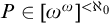


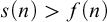


The partial order $\mathbb {H}$
adds an element of
$\mathbb {H}$
adds an element of $\omega ^{\omega }$
which is
$\omega ^{\omega }$
which is $<^{*}$
-above each element of
$<^{*}$
-above each element of $\omega ^{\omega }$
in the ground model. Moreover,
$\omega ^{\omega }$
in the ground model. Moreover, $\mathbb {H}$
is c.c.c. (in fact,
$\mathbb {H}$
is c.c.c. (in fact, $\sigma $
-centered) as conditions with the same first coordinate are compatible, so it preserves stationary subsets of
$\sigma $
-centered) as conditions with the same first coordinate are compatible, so it preserves stationary subsets of $\omega _{1}$
. It follows that, for any cardinal
$\omega _{1}$
. It follows that, for any cardinal $\kappa $
,
$\kappa $
, $\mathsf {MA}_{\kappa }$
implies that
$\mathsf {MA}_{\kappa }$
implies that $\mathfrak {d}> \kappa $
.
$\mathfrak {d}> \kappa $
.
Lemma 20. For each condition $p=(M, F, a)$
in
$p=(M, F, a)$
in $\mathbb {P}$
, there is a strategy for player
$\mathbb {P}$
, there is a strategy for player $II$
in the
$II$
in the $\omega _{1}$
-sequence game for p such that each run of the game in V according to this strategy is winning for player
$\omega _{1}$
-sequence game for p such that each run of the game in V according to this strategy is winning for player $II$
in some forcing extension which preserves the stationarity of each stationary subset of
$II$
in some forcing extension which preserves the stationarity of each stationary subset of $\omega _{1}$
in each model
$\omega _{1}$
in each model $M^{*}_{\alpha }$
arising from the run of the game.
$M^{*}_{\alpha }$
arising from the run of the game.
Proof. A run of the game builds a descending $\omega _{1}$
sequence of
$\omega _{1}$
sequence of $\mathbb {P}$
conditions
$\mathbb {P}$
conditions $p_{\alpha } = (M_{\alpha }, F_{\alpha }, a_{\alpha })$
, with (stationary set preserving, but not elementary) embeddings
$p_{\alpha } = (M_{\alpha }, F_{\alpha }, a_{\alpha })$
, with (stationary set preserving, but not elementary) embeddings $j_{\alpha , \beta } \colon M_{\alpha } \to M_{\beta }$
. Let
$j_{\alpha , \beta } \colon M_{\alpha } \to M_{\beta }$
. Let $\gamma _{\alpha }$
be such that
$\gamma _{\alpha }$
be such that $F_{\alpha }$
has length
$F_{\alpha }$
has length $\gamma _{\alpha } + 1$
in
$\gamma _{\alpha } + 1$
in $M_{\alpha }$
. The definition of the order on
$M_{\alpha }$
. The definition of the order on $\mathbb {P}$
requires that
$\mathbb {P}$
requires that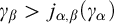 $\gamma _{\beta }> j_{\alpha , \beta }(\gamma _{\alpha })$
for all
$\gamma _{\beta }> j_{\alpha , \beta }(\gamma _{\alpha })$
for all $\alpha < \beta $
.
$\alpha < \beta $
.
We show how to play for player $II$
, i.e., how to choose
$II$
, i.e., how to choose $M_{\beta }$
,
$M_{\beta }$
, $F_{\beta }$
, and
$F_{\beta }$
, and $a_{\beta }$
for each limit ordinal
$a_{\beta }$
for each limit ordinal $\beta $
, assuming that
$\beta $
, assuming that $p_{\alpha }\, (\alpha < \beta )$
have already been chosen. Let us say that a countable limit ordinal
$p_{\alpha }\, (\alpha < \beta )$
have already been chosen. Let us say that a countable limit ordinal $\beta $
is relevant if
$\beta $
is relevant if $\beta $
is the supremum of
$\beta $
is the supremum of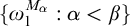 $\{ \omega _{1}^{M_{\alpha }} : \alpha <\beta \}$
. At the end of the game, the set of relevant ordinals will be a club subset of
$\{ \omega _{1}^{M_{\alpha }} : \alpha <\beta \}$
. At the end of the game, the set of relevant ordinals will be a club subset of $\omega _{1}$
. For limit ordinals
$\omega _{1}$
. For limit ordinals $\beta $
which are not relevant, player
$\beta $
which are not relevant, player $II$
can let
$II$
can let $p_{\beta }$
be any lower bound for
$p_{\beta }$
be any lower bound for $\{ p_{\alpha } : \alpha < \beta \}$
(lower bounds exist by Lemma 19).
$\{ p_{\alpha } : \alpha < \beta \}$
(lower bounds exist by Lemma 19).
As we carry out our construction, by some bookkeeping we associate to each pair $(\sigma , A)$
, where
$(\sigma , A)$
, where $\sigma \in \omega ^{<\omega }$
and A is, in some
$\sigma \in \omega ^{<\omega }$
and A is, in some $M_{\alpha }$
a stationary subset of
$M_{\alpha }$
a stationary subset of $\omega _{1}^{M_{\alpha }}$
, a stationary set
$\omega _{1}^{M_{\alpha }}$
, a stationary set $B_{\sigma , A} \subseteq \omega ^{V}_{1}$
, in such a way that the associated sets
$B_{\sigma , A} \subseteq \omega ^{V}_{1}$
, in such a way that the associated sets $B_{\sigma , A}$
are disjoint for distinct pairs
$B_{\sigma , A}$
are disjoint for distinct pairs $(\sigma , A)$
. We show how to play for
$(\sigma , A)$
. We show how to play for $II$
in such a way that, for all relevant limit ordinals
$II$
in such a way that, for all relevant limit ordinals $\beta $
, if
$\beta $
, if $\beta $
is in
$\beta $
is in $B_{\sigma , A}$
, for some A which is a stationary subset of
$B_{\sigma , A}$
, for some A which is a stationary subset of $\omega _{1}^{M_{\alpha '}}$
for some
$\omega _{1}^{M_{\alpha '}}$
for some $\alpha ' < \beta $
, then
$\alpha ' < \beta $
, then $\beta $
is in the induced image of A (i.e.,
$\beta $
is in the induced image of A (i.e., $j_{\alpha ', \alpha }(A)$
) for all
$j_{\alpha ', \alpha }(A)$
) for all $\alpha \in [\beta , \omega _{1}]$
(note that
$\alpha \in [\beta , \omega _{1}]$
(note that $\omega _{1}^{M_{\beta }}$
will be greater than
$\omega _{1}^{M_{\beta }}$
will be greater than $\beta $
) and
$\beta $
) and $\sigma $
is an initial segment of the first member of
$\sigma $
is an initial segment of the first member of $F_{\beta }$
which is not in the images of the preceding
$F_{\beta }$
which is not in the images of the preceding $F_{\alpha }$
’s (i.e., the member of
$F_{\alpha }$
’s (i.e., the member of $F_{\beta }$
indexed by the supremum of
$F_{\beta }$
indexed by the supremum of $\{j_{\alpha , \beta }(\gamma _{\alpha }) : \alpha < \beta \}$
).
$\{j_{\alpha , \beta }(\gamma _{\alpha }) : \alpha < \beta \}$
).
For each relevant limit ordinal $\beta $
, in round
$\beta $
, in round $\beta $
the triples
$\beta $
the triples $(M_{\alpha }, F_{\alpha }, a_{\alpha })\, (\alpha < \beta )$
will have been chosen, along with the maps
$(M_{\alpha }, F_{\alpha }, a_{\alpha })\, (\alpha < \beta )$
will have been chosen, along with the maps $j_{\alpha , \delta }$
(
$j_{\alpha , \delta }$
( $\alpha \leq \delta < \beta $
) witnessing that this is a descending sequence of conditions. Choosing a cofinal
$\alpha \leq \delta < \beta $
) witnessing that this is a descending sequence of conditions. Choosing a cofinal $\omega $
-sequence
$\omega $
-sequence $\langle \alpha _{i} : i \in \omega \rangle $
in
$\langle \alpha _{i} : i \in \omega \rangle $
in $\beta $
, and composing the maps
$\beta $
, and composing the maps $j_{\alpha _{i}, \alpha _{i+1}}\, (i \in \omega )$
, we get a sequence
$j_{\alpha _{i}, \alpha _{i+1}}\, (i \in \omega )$
, we get a sequence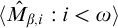 $\langle \hat {M}_{\beta , i} : i < \omega \rangle $
, where each
$\langle \hat {M}_{\beta , i} : i < \omega \rangle $
, where each $\hat {M}_{\beta , i}$
is the corresponding image of
$\hat {M}_{\beta , i}$
is the corresponding image of $M_{\alpha _{i}}$
. Let
$M_{\alpha _{i}}$
. Let $\hat {J }_{\alpha _{i}, \beta }$
be the induced embedding of
$\hat {J }_{\alpha _{i}, \beta }$
be the induced embedding of $M_{\alpha _{i}}$
into
$M_{\alpha _{i}}$
into $\hat {M}_{\beta , i}$
, for each
$\hat {M}_{\beta , i}$
, for each $i < \omega $
. Then
$i < \omega $
. Then $\omega _{1}^{\hat {M}_{\beta , i}} = \beta $
for all
$\omega _{1}^{\hat {M}_{\beta , i}} = \beta $
for all $i < \omega $
, and each
$i < \omega $
, and each $\hat {M}_{\beta , i}$
is a subset of the corresponding
$\hat {M}_{\beta , i}$
is a subset of the corresponding $\hat {M}_{\beta , i + 1}$
, and correct in
$\hat {M}_{\beta , i + 1}$
, and correct in $\hat {M}_{\beta , i + 1}$
about stationary subsets of its
$\hat {M}_{\beta , i + 1}$
about stationary subsets of its $\omega _{1}$
. Fix a countable transitive model
$\omega _{1}$
. Fix a countable transitive model $M_{\beta }$
of
$M_{\beta }$
of $\mathsf {ZFC}$
with
$\mathsf {ZFC}$
with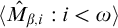 $\langle \hat {M}_{\beta , i} : i < \omega \rangle $
,
$\langle \hat {M}_{\beta , i} : i < \omega \rangle $
, $\langle p_{\alpha } : \alpha < \beta \rangle ,$
and
$\langle p_{\alpha } : \alpha < \beta \rangle ,$
and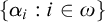 $\{ \alpha _{i} : i \in \omega \}$
in
$\{ \alpha _{i} : i \in \omega \}$
in $H(\aleph _{1})^{M_{\beta }}$
, and such that
$H(\aleph _{1})^{M_{\beta }}$
, and such that $(M_{\beta }, \mathrm {NS}_{\omega _{1}}^{M_{\beta }})$
is iterable.
$(M_{\beta }, \mathrm {NS}_{\omega _{1}}^{M_{\beta }})$
is iterable.
Working in $M_{\beta }$
, iterate
$M_{\beta }$
, iterate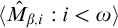 $\langle \hat {M}_{\beta , i} : i < \omega \rangle $
(building an embedding
$\langle \hat {M}_{\beta , i} : i < \omega \rangle $
(building an embedding $j^{*}_{\beta }$
of
$j^{*}_{\beta }$
of $\bigcup _{i \in \omega }\hat {M}_{\beta , i}$
into
$\bigcup _{i \in \omega }\hat {M}_{\beta , i}$
into $M_{\beta }$
) in such a way that
$M_{\beta }$
) in such a way that
-
• if
$\beta $
is in
$B_{\sigma , A}$
, for some
$\sigma \in \omega ^{<\omega }$
and some A which is a stationary subset of
$\omega _{1}^{M_{\alpha '}}$
for some
$\alpha ' < \beta $
, then the corresponding image of A (
$\hat {J }_{\alpha _{i}, \beta }(j_{\alpha ',\alpha _{i}}(A))$
for the least i such that
$\alpha _{i} \geq \alpha '$
) is in the first filter in the iteration (this ensures that
$\beta \in j^{*}_{\beta }(\hat {J }_{\alpha _{i}, \beta }(j_{\alpha ',\alpha _{i}}(A)))$
); -
• each model
$j^{*}_{\beta }(\hat {M}_{\beta , i})$
is correct in
$M_{\beta }$
about stationary subsets of
$\omega _{1}$
.


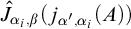




Having constructed $j^{*}_{\beta }$
, extend the union of the sets
$j^{*}_{\beta }$
, extend the union of the sets $j^{*}_{\beta }(\hat {J }_{\alpha _{i},\beta }(F_{\alpha _{i}}))$
(the length of which has countable cofinality, since each
$j^{*}_{\beta }(\hat {J }_{\alpha _{i},\beta }(F_{\alpha _{i}}))$
(the length of which has countable cofinality, since each $\gamma _{\alpha _{i+1}}$
is greater than
$\gamma _{\alpha _{i+1}}$
is greater than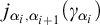 $j_{\alpha _{i}, \alpha _{i+1}}(\gamma _{\alpha _{i}})$
) with one element having
$j_{\alpha _{i}, \alpha _{i+1}}(\gamma _{\alpha _{i}})$
) with one element having $\sigma $
as an initial segment (which can be done by Remark 3), and let
$\sigma $
as an initial segment (which can be done by Remark 3), and let $F_{\beta }$
be this extension. Let
$F_{\beta }$
be this extension. Let $a_{\beta }$
be the common value of
$a_{\beta }$
be the common value of $j^{*}_{\beta }(\hat {J }_{\alpha _{i}, \beta }(a_{\alpha _{i}}))\, (i < \omega )$
. This completes the choice of
$j^{*}_{\beta }(\hat {J }_{\alpha _{i}, \beta }(a_{\alpha _{i}}))\, (i < \omega )$
. This completes the choice of $M_{\beta }$
,
$M_{\beta }$
, $F_{\beta }$
, and
$F_{\beta }$
, and $a_{\beta }$
.
$a_{\beta }$
.
Having constructed the entire run of the game, letting a be the union of the sets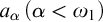 $a_{\alpha }\, (\alpha < \omega _{1})$
, there is for each
$a_{\alpha }\, (\alpha < \omega _{1})$
, there is for each $\alpha < \omega _{1}$
a unique iteration
$\alpha < \omega _{1}$
a unique iteration $j_{\alpha , \omega _{1}}$
of
$j_{\alpha , \omega _{1}}$
of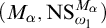 $(M_{\alpha }, \mathrm {NS}_{\omega _{1}}^{M_{\alpha }})$
sending
$(M_{\alpha }, \mathrm {NS}_{\omega _{1}}^{M_{\alpha }})$
sending $a_{\alpha }$
to a. Let
$a_{\alpha }$
to a. Let $\gamma ^{*}_{\alpha }$
denote the image of
$\gamma ^{*}_{\alpha }$
denote the image of $\gamma _{\alpha }$
under this iteration, and let
$\gamma _{\alpha }$
under this iteration, and let $F^{*}_{\alpha }$
be the corresponding image of
$F^{*}_{\alpha }$
be the corresponding image of $F_{\alpha }$
. Noting that the sequences
$F_{\alpha }$
. Noting that the sequences $F^{*}_{\alpha }$
extend one another, let
$F^{*}_{\alpha }$
extend one another, let $F^{*} = \bigcup _{\alpha < \omega _{1}}F^{*}_{\alpha }$
and let
$F^{*} = \bigcup _{\alpha < \omega _{1}}F^{*}_{\alpha }$
and let $\gamma ^{*}$
be the length of
$\gamma ^{*}$
be the length of $F^{*}$
. For each countable limit ordinal
$F^{*}$
. For each countable limit ordinal $\beta $
, let
$\beta $
, let $\eta _{\beta } = \sup \{ \gamma ^{*}_{\alpha } : \alpha < \beta \}$
. The set
$\eta _{\beta } = \sup \{ \gamma ^{*}_{\alpha } : \alpha < \beta \}$
. The set $\{\eta _{\beta } : \beta < \omega _{1} \}$
is closed below its supremum
$\{\eta _{\beta } : \beta < \omega _{1} \}$
is closed below its supremum $\gamma $
, which has cofinality
$\gamma $
, which has cofinality $\omega _{1}$
.
$\omega _{1}$
.
Force (over the model we have been working in, which we call V) with Hechler forcing to add a $g \in \omega ^{\omega }$
dominating each element of
$g \in \omega ^{\omega }$
dominating each element of $\omega ^{\omega }\cap V$
mod-finite. This forcing is c.c.c., and therefore preserves stationary sets.
$\omega ^{\omega }\cap V$
mod-finite. This forcing is c.c.c., and therefore preserves stationary sets.
We claim that, in $V[g]$
, for each A which is, for some
$V[g]$
, for each A which is, for some $\alpha < \omega _{1}$
, a stationary subset of
$\alpha < \omega _{1}$
, a stationary subset of $\omega _{1}^{M_{\alpha }}$
in
$\omega _{1}^{M_{\alpha }}$
in $M_{\alpha }$
, the set of
$M_{\alpha }$
, the set of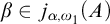 $\beta \in j_{\alpha , \omega _{1}}(A)$
such that g dominates
$\beta \in j_{\alpha , \omega _{1}}(A)$
such that g dominates $f^{*}_{\eta _{\beta }}$
everywhere is stationary. To see that this is the case, consider a Hechler condition
$f^{*}_{\eta _{\beta }}$
everywhere is stationary. To see that this is the case, consider a Hechler condition $(\sigma , P)$
and an A. In any club
$(\sigma , P)$
and an A. In any club $C \subseteq \omega _{1}$
, we can find a
$C \subseteq \omega _{1}$
, we can find a $\beta \in C \cap B_{\sigma , A}$
such that
$\beta \in C \cap B_{\sigma , A}$
such that
 $$\begin{align*}\sup\{\omega_{1}^{M_{\alpha}} : \alpha < \beta\} = \beta.\end{align*}$$
Then $(\sigma , P \cup \{ f^{*}_{\eta _{\beta }}\}) \leq (\sigma , P)$
. Since (by the construction above)
$(\sigma , P \cup \{ f^{*}_{\eta _{\beta }}\}) \leq (\sigma , P)$
. Since (by the construction above) $\sigma $
is an initial segment of
$\sigma $
is an initial segment of $f^{*}_{\eta _{\beta }}$
,
$f^{*}_{\eta _{\beta }}$
, $(\sigma , P \cup \{\beta \})$
forces that
$(\sigma , P \cup \{\beta \})$
forces that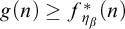 $g(n) \geq f^{*}_{\eta _{\beta }}(n)$
will hold for all
$g(n) \geq f^{*}_{\eta _{\beta }}(n)$
will hold for all $n \in \omega $
(i.e.,
$n \in \omega $
(i.e., $g \geq _{0} f^{*}_{\eta _{\beta }}$
).
$g \geq _{0} f^{*}_{\eta _{\beta }}$
).
Finally, force to shoot a club E (via the standard forcing with countable conditions) through the set of $\beta < \omega _{1}$
such that
$\beta < \omega _{1}$
such that $g \geq _{0} f^{*}_{\eta _{\beta }}$
. By the previous paragraph, this forcing preserves the stationarity of each set
$g \geq _{0} f^{*}_{\eta _{\beta }}$
. By the previous paragraph, this forcing preserves the stationarity of each set $j_{\alpha , \omega _{1}}(A)$
. It follows that in
$j_{\alpha , \omega _{1}}(A)$
. It follows that in $V[g][E]$
, letting
$V[g][E]$
, letting $g'(n) = g(n) + 1$
for all
$g'(n) = g(n) + 1$
for all $n \in \omega $
,
$n \in \omega $
, $F^{*} \cup \{(\gamma ^{*}, g')\}$
witnesses that the run of the
$F^{*} \cup \{(\gamma ^{*}, g')\}$
witnesses that the run of the $\omega _{1}$
-sequence game just produced is winning for player
$\omega _{1}$
-sequence game just produced is winning for player $II$
.
$II$
.
Remark 21. Lemma 20 and standard $\mathbb {P}_{\mathrm {max}}$
arguments (see Theorems 9.32 and 9.34 of [Reference Woodin14]) give the following.
$\mathbb {P}_{\mathrm {max}}$
arguments (see Theorems 9.32 and 9.34 of [Reference Woodin14]) give the following.
-
1. If
$G \subseteq \mathbb {P}$
is a filter, and
$A_{G} = \bigcup \{ a : (M, F, a) \in G\}$
, then for each
$p=(M,F,a) \in G$
there is a unique iteration
$j_{p,G}$
of
$(M, \mathrm {NS}_{\omega _{1}}^{M})$
sending a to
$A_{G}$
. -
2. If W is an inner model of
$\mathsf {AD}^{+}$
and
$G \subseteq \mathbb {P}$
is W-generic, then every element of
$\mathcal {P}(\omega _{1})^{W[G]}$
is an element of
$j_{p, G}[\mathcal {P}(\omega _{1})^{M}]$
for some
$p = (M, F, a)$
in G. -
3. If
$A \subseteq \mathbb {R}$
is such that
$L(A, \mathbb {R}) \models \mathsf {AD}^{+}$
, then forcing with
$\mathbb {P}$
over
$L(A, \mathbb {R})$
does not add
$\omega $
-sequences from the ground model, preserves
$\omega _{1}$
and
$\omega _{2}$
as cardinals, and makes the cardinal
$\Theta $
of the ground model the
$\omega _{3}$
of the extension.


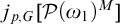





Remark 21 and standard arguments give the main theorem of this section.
Theorem 22. Suppose that $A \subseteq \mathbb {R}$
is such that
$A \subseteq \mathbb {R}$
is such that $L(A, \mathbb {R}) \models \mathsf {AD}^{+}$
, and
$L(A, \mathbb {R}) \models \mathsf {AD}^{+}$
, and $G \subseteq \mathbb {P}$
is
$G \subseteq \mathbb {P}$
is $L(A, \mathbb {R})$
-generic. Then
$L(A, \mathbb {R})$
-generic. Then $L(A, \mathbb {R})[G]$
satisfies
$L(A, \mathbb {R})[G]$
satisfies $\mathsf {ZFC}$
along with the following statements:
$\mathsf {ZFC}$
along with the following statements:
-
1.
$2^{\aleph _{0}} = \aleph _{2}$
; -
2.
$\exists B \subseteq \omega _{2}\, V = L[B]$
; -
3.
$\mathrm {NS}_{\omega _{1}}$
is saturated; -
4.
$\bigcup \{j_{p,G}(F) : p = (M, F, a) \in G\}$
is a very strongly increasing sequence of length
$\omega _{2}$
.


Proof. (Sketch) We sketch the proof of part (4); the other parts follow from standard $\mathbb {P}_{\mathrm {max}}$
arguments. For each condition
$\mathbb {P}_{\mathrm {max}}$
arguments. For each condition $p = (M, F, a)$
in the generic filter G, the elementarity of
$p = (M, F, a)$
in the generic filter G, the elementarity of $j_{p,G}$
gives that
$j_{p,G}$
gives that $j_{p,G}(F)$
is a very strongly increasing sequence. The order on
$j_{p,G}(F)$
is a very strongly increasing sequence. The order on $\mathbb {P}$
implies that the union of these sequences
$\mathbb {P}$
implies that the union of these sequences $j_{p,G}(F)$
is a very strongly increasing sequence of length at most
$j_{p,G}(F)$
is a very strongly increasing sequence of length at most $\omega _{2}^{V}$
. To see that the length is in fact
$\omega _{2}^{V}$
. To see that the length is in fact $\omega _{2}^{V}$
, fix
$\omega _{2}^{V}$
, fix $\gamma < \omega _{2}^{V}$
, a prewellording
$\gamma < \omega _{2}^{V}$
, a prewellording $\leq $
of
$\leq $
of $\omega _{1}^{V}$
of length
$\omega _{1}^{V}$
of length $\gamma $
and, by part (2) of Remark 21, a condition
$\gamma $
and, by part (2) of Remark 21, a condition $p=(M,F,a)\in G$
and a prewellordering
$p=(M,F,a)\in G$
and a prewellordering $\leq _{0}$
of
$\leq _{0}$
of $\omega _{1}^{M}$
in M such that
$\omega _{1}^{M}$
in M such that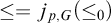 $\leq = j_{p,G}(\leq _{0})$
. Lemma 6 and the genericity of G imply that there exists a condition
$\leq = j_{p,G}(\leq _{0})$
. Lemma 6 and the genericity of G imply that there exists a condition $p' = (M', F', a') < (M, F, a)$
in G (with the order witnessed by an iteration j of
$p' = (M', F', a') < (M, F, a)$
in G (with the order witnessed by an iteration j of $(M, \mathrm {NS}_{\omega }^{M})$
) such that the length of
$(M, \mathrm {NS}_{\omega }^{M})$
) such that the length of $F'$
is greater than the length of the wellordering
$F'$
is greater than the length of the wellordering $j(\leq _{0})$
. The elementarity of
$j(\leq _{0})$
. The elementarity of $j_{p',G}$
then implies that
$j_{p',G}$
then implies that $j_{p',G}(F')$
has length greater than that of
$j_{p',G}(F')$
has length greater than that of $\leq = j_{p',G}(j(\leq _{0}))$
.
$\leq = j_{p',G}(j(\leq _{0}))$
.
Remark 23. One could naturally try to reproduce the result proved here using an iterated forcing consisting alternately of Hechler forcing and adding club subsets of $\omega _{1}$
. One issue with this approach is that if
$\omega _{1}$
. One issue with this approach is that if $F= \{ f_{\alpha } : \alpha < \omega _{1} \}\subseteq \omega ^{\omega }$
is
$F= \{ f_{\alpha } : \alpha < \omega _{1} \}\subseteq \omega ^{\omega }$
is $\leq ^{*}$
-unbounded, and
$\leq ^{*}$
-unbounded, and $g \in \omega ^{\omega }$
is added by a c.c.c. forcing over V, then there are cofinally many
$g \in \omega ^{\omega }$
is added by a c.c.c. forcing over V, then there are cofinally many $m \in \omega $
such that the set
$m \in \omega $
such that the set $\{ \alpha < \omega _{1} : f_{\alpha }(m) \geq g(m) \}$
is stationary (in V). If F is the range of a cofinal subsequence of some strongly increasing sequence (whose index set is closed in the length of the sequence) then the stationarity of some if these sets will have to be destroyed into order to use g to continue the sequence. The argument from Lemma 20 avoids this issue by requiring preservation only of the sets
$\{ \alpha < \omega _{1} : f_{\alpha }(m) \geq g(m) \}$
is stationary (in V). If F is the range of a cofinal subsequence of some strongly increasing sequence (whose index set is closed in the length of the sequence) then the stationarity of some if these sets will have to be destroyed into order to use g to continue the sequence. The argument from Lemma 20 avoids this issue by requiring preservation only of the sets $j_{\alpha , \omega _{1}}(A)$
coming from the models in the sequence being built. That is, it is not necessary to preserve the stationarity of every stationary subset of
$j_{\alpha , \omega _{1}}(A)$
coming from the models in the sequence being built. That is, it is not necessary to preserve the stationarity of every stationary subset of $\omega _{1}$
in V. The Semi-Properness Iteration Lemma on pages 485–486 of [Reference Shelah13] offers a parallel degree of freedom, as (using the notation there) for each successor j the quotient
$\omega _{1}$
in V. The Semi-Properness Iteration Lemma on pages 485–486 of [Reference Shelah13] offers a parallel degree of freedom, as (using the notation there) for each successor j the quotient $P_{j}/P_{i}$
is required to be semi-proper only for arbitrarily large nonlimit
$P_{j}/P_{i}$
is required to be semi-proper only for arbitrarily large nonlimit $i < j$
.
$i < j$
.
We conclude with a couple of remaining open questions. We first remark that the $\mathbb {P}_{\mathrm {max}}$
machinery is well-suited for constructing models with strongly increasing sequences of length
$\mathbb {P}_{\mathrm {max}}$
machinery is well-suited for constructing models with strongly increasing sequences of length $\omega _2$
but does not seem to be readily adaptable to construct models with longer strongly increasing sequences. Corollary 16 implies that there cannot exist strongly increasing sequences of length
$\omega _2$
but does not seem to be readily adaptable to construct models with longer strongly increasing sequences. Corollary 16 implies that there cannot exist strongly increasing sequences of length $\omega _4$
of functions from
$\omega _4$
of functions from $\omega $
to
$\omega $
to $\omega $
, but the corresponding question about
$\omega $
, but the corresponding question about $\omega _3$
remains open.
$\omega _3$
remains open.
Question 24. Is it consistent with $\mathsf {ZFC}$
that there exists a strongly increasing sequence of length
$\mathsf {ZFC}$
that there exists a strongly increasing sequence of length $\omega _3$
consisting of functions from
$\omega _3$
consisting of functions from $\omega $
to
$\omega $
to $\omega $
?
$\omega $
?
Lastly, we forced over a model satisfying $\mathrm {AD} + V = L(\mathbb {R})$
to obtain our main consistency result. We do not know if these hypotheses are optimal, or even if the existence of a strongly increasing
$\mathrm {AD} + V = L(\mathbb {R})$
to obtain our main consistency result. We do not know if these hypotheses are optimal, or even if the existence of a strongly increasing $\omega _2$
-sequence of functions from
$\omega _2$
-sequence of functions from $\omega $
to
$\omega $
to $\omega $
carries any large cardinal strength at all. The approach suggested by Remark 23 may answer the following question.
$\omega $
carries any large cardinal strength at all. The approach suggested by Remark 23 may answer the following question.
Question 25. What is the consistency strength of “ $\mathsf {ZFC} + $
there exists a strongly increasing
$\mathsf {ZFC} + $
there exists a strongly increasing $\omega _2$
-sequence of functions from
$\omega _2$
-sequence of functions from $\omega $
to
$\omega $
to $\omega $
”?
$\omega $
”?
Funding
The first author was partially supported by GAČR project 23-04683S and the Academy of Sciences of the Czech Republic (RVO 67985840). The research of the second author was partially supported by NSF grants DMS-1201494, DMS-1764320, and DMS-2452139. The main results in this article were proved in 2015.


 Open access

