


There is increasing evidence that lithium is effective in lowering the risk of suicide. Several meta-analyses have shown antisuicidal effects of lithium Reference Cipriani, Pretty, Hawton and Geddes1–Reference Guzzetta, Tondo, Centorrino and Baldessarini3 in people with mood disorders, namely major depression and bipolar disorder, but these studies have reviewed only randomised controlled trials primarily comparing lithium with placebo or other drugs in long-term prophylactic treatment which were maintained at so-called therapeutic levels. The potential benefits of low levels of lithium in reducing the risk of suicide have not been widely investigated; however, at least one study has suggested that very low levels of lithium in drinking water could have lowered the risk of suicide in Texas. Reference Schrauzer and Shrestha4 In that study, lithium levels in the drinking water of 27 Texas counties were arbitrarily divided into (relatively) high (70–160 μg/l), moderate (13–60 μg/l) and low (0–12 μg/l) areas. The authors reported suicide rates of 8.7 per 100 000 of population in the (relatively) high lithium area, 14.8 in the moderate lithium area and 14.2 in the low lithium area. Although it cannot be denied that such arbitrary division may have detected a spurious association between lithium and reduced risk of suicide, the findings are intriguing. Unfortunately, until now, no further studies have been conducted that could confirm or reject their findings.
In our study, lithium levels in drinking water (tap water) of all the municipalities of Oita prefecture, an average (economically, culturally, and politically) prefecture in Japan, are used to investigate the association with suicide rates in each municipality. In contrast to the Texas study, Reference Schrauzer and Shrestha4 lithium levels are used as a continuous value in order to exclude the potential for a spurious finding resulting from the arbitrary division of lithium levels.
Method
In 2006, the population of Oita prefecture was 1 206 174. Oita has 18 cities, towns and villages. Of the 18 municipalities, Oita city had the largest population (463 973; 38%); populations of other centres ranged from 126 781 (Beppu city) to 2408 (Hime-shima village). Thus, the difference of population is very large across the 18 municipalities.
By taking the difference in gender and age distribution of individual municipality populations into account, the standardised mortality ratio (SMR) of suicide was calculated for each individual municipality. The SMR is an indirect method of adjusting a mortality rate, defined as the number of observed deaths in an individual municipality population divided by the number of expected deaths compared with the gender- and age-matched general population. We examined Japanese government statistics on suicide in Oita prefecture and used them as the average suicide SMR for 5 years, 2002–2006, across all the 18 municipalities.
Lithium levels in the tap water suppliers of each municipality were measured by using ion chromatography at Oita City Waterworks Bureau or by using mass spectroscopy at Oita Yakuzaishi Kensa Center. Both methods can measure very small amounts of lithium; the minimal amount of lithium which can be measured is 0.1 ppb (0.1 μg/l). If lithium levels of drinking water were measured at multiple water suppliers in the same municipality, the mean value was calculated. Although lithium levels were measured once, we confirmed a very small fluctuation in levels because the correlation coefficient between the lithium levels and those remeasured after 1 year in the same places was 0.998.
The distribution of lithium levels was considerably skewed (skewness=3.39; kurtosis=12.80). We thus employed log-transformation (skewness=0.002; kurtosis=0.075) in order to use parametric statistical procedures. Because of greater differences in population size across the 18 municipalities, weighted least squares regression analysis adjusted for the size of each population was used to investigate the association of lithium levels in drinking water and the SMRs.
The study was approved by the Oita University ethics committee.
Results
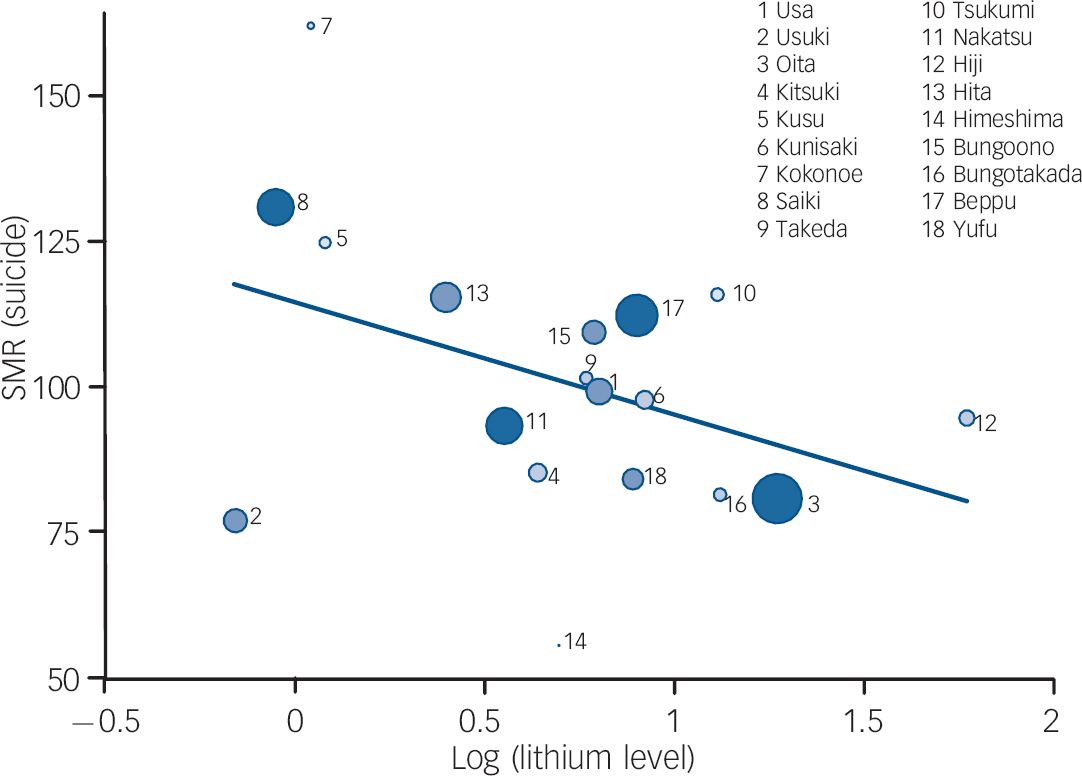
In 2006, the lithium levels in drinking water of 18 municipalities of Oita prefecture ranged from 0.7 to 59 μg/l. In total, the average suicide SMR in Oita prefecture for 2002–2006 was 105 (range 60–181), which corresponds well with the average SMR for Japan (100). The SMRs of suicide across the 18 municipalities were significantly and negatively associated with lithium levels (β=–0.65, P<0.004) (Fig. 1). The significant association remained in males (β=–0.61, P<0.008) and a marginal significance was found in females (β=–0.46, 0.05<P<0.06).
Lithium levels in drinking water and the average suicide standardised mortality ratio (SMR) for 2002–2006 in 18 municipalities of Oita prefecture. The lithium level is log-transformed and the size of the dot represents population size. The SMRs of suicide across 18 municipalities were significantly and negatively associated with the lithium levels (β=–0.65, P<0.004).
Discussion
In the present study, lithium levels were significantly and negatively associated with the SMRs across 18 municipalities. These findings suggest that even very low lithium levels may reduce the risk of suicide and that within the levels there is a dose–response relationship. Although it seems unlikely that such low lithium levels can bring about mood-stabilising effects and thereby reduce the risk of suicide, could the antisuicidal effect of lithium be unrelated to its prophylactic effect for mood disorders? Müller-Oerlinghausen et al Reference Müller-Oerlinghausen, Felber, Berghöfer, Lauterbach and Ahrens5 revealed that a significant reduction in suicide attempts occurred even in poor responders to lithium prophylaxis for mood disorders. Therefore, it seems probable that the antisuicidal effect of lithium may be unrelated to the mood-stabilising effects and that very low lithium levels may possess an antisuicidal effect. On the other hand, although lithium levels are extremely low in the drinking water, long-term exposure to lithium may be a factor which mitigates low absolute levels. It can be speculated that very low but very long lithium exposure can enhance neurotrophic factors, neuroprotective factors and/or neurogenesis, which may account for a reduced risk of suicide.
The limitations of the present study are as follows. First, although Oita prefecture is demographically average in Japan, the present findings were derived from a local prefecture and therefore only limited generalisation is possible. Second, other factors such as psychosocial and economic factors were not taken into consideration.
In conclusion, our study suggests that very low lithium in drinking water can lower the risk of suicide. Further studies are required to confirm this possibility and extrapolate it to other countries.
Acknowledgements
We thank Oita City Waterworks Bureau and Oita Yakuzaishi Kensa Center for measuring lithium levels.




eLetters
No eLetters have been published for this article.