

Introduction
Some of the earliest evidence for foraging and sailing on open seas can be found among the Early Mesolithic (9500–8000 BC) hunter-gatherer communities of coastal Scandinavia. Although organic remains are scarce, hundreds of coastal sites bear witness to an elaborate marine lifestyle. The settlements privilege natural harbours, and are frequently located on islands—suggesting off shore foraging as well as the use of seaworthy vessels.
Many instances of early marine adaptations are likely to have existed around the world but most remain undiscovered, as they are located on coastlines that were submerged in the 120m global sea level rise that followed the melting of the Late Pleistocene ice-shields. After the modern shoreline stabilised (5000–2000 BC), elaborate marine traditions can be found almost everywhere, from high latitudes to tropical seas, and it is tempting to believe that marine exploitation and the necessary knowledge, abilities and technology reach back to the cradle of humankind (see Bailey & Parkington 1988; Erlandson 2001; Bjerck 2009; Briz et al. 2009; Hardy & Piqué 2009).
However, the Scandinavian archaeological record seems to indicate otherwise. Here, postglacial rebound produced large stretches of raised shorelines going back to Late Pleistocene times (Figures 1 & 2). A marked time lag between the time of deglaciation, c. 13 000 years ago, and that of human colonisation, c. 11 500 years ago, can be deduced from the lack of settlements on lateglacial shores. Created by a series of glaciations, this seascape of shallows and deep channels, tidal currents, skerries, islands, headlands and fjords is ideal for foraging for the abundant marine and terrestrial fauna of the Late Glacial; this highly productive zone also has sheltered seas, which reduces the risk inherent in hunting, fishing and travelling off shore. One would expect this bountiful landscape to be colonised as soon as it emerged from the ice. But it did not happen, which may indicate that off shore foraging and seaworthy vessels were not part of the lateglacial hunter-gatherer tradition of north-western Europe, including Ireland and Britain (see Tolan-Smith 2003; Woodman 2003). Without seaworthy boats, this sea- and landscape would be out of reach, representing a risk rather than tempting hunting grounds. Although crossing frozen winter seas, aided by dogs and sledges, would be possible, would it be possible to survive even the first summer on an isolated island or headland surrounded by open, inaccessible seas?
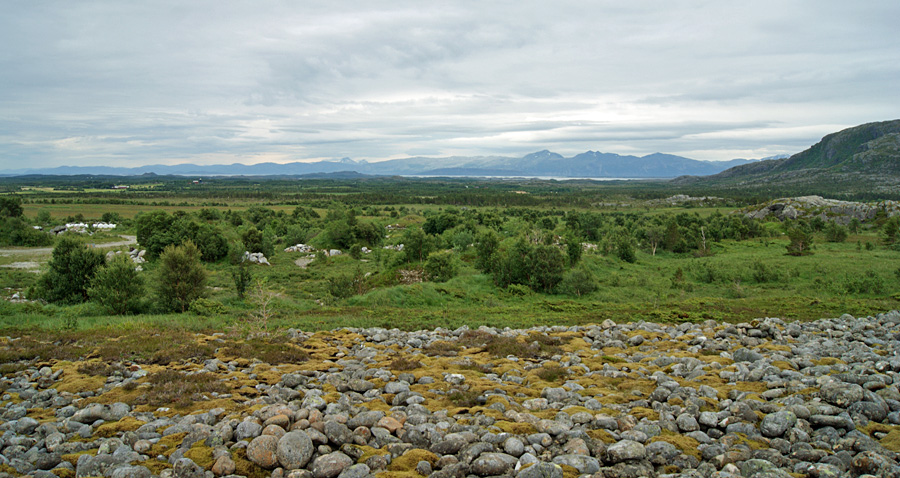
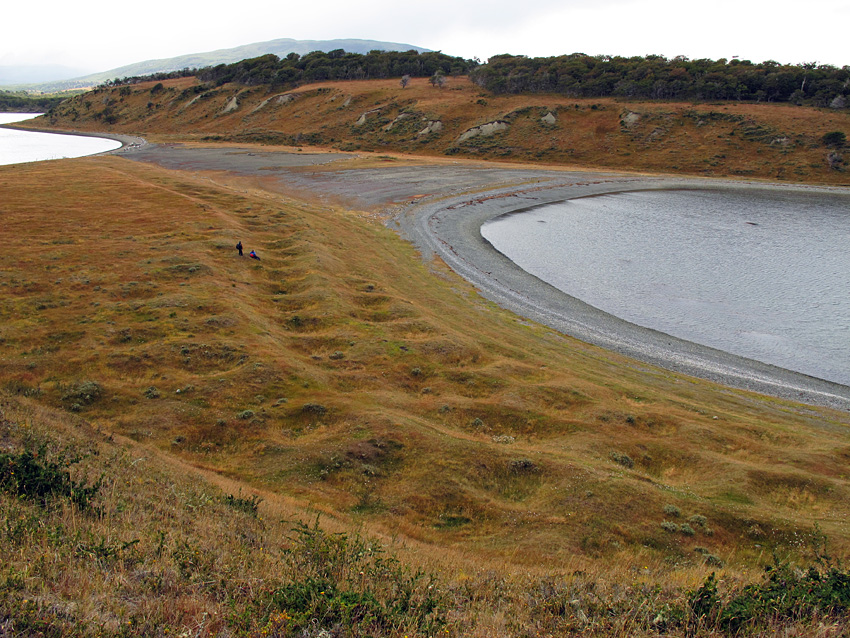
Lateglacial shoreline at Vega, northern Norway, 96m asl today. The first settlers (9500–9000 BC) had to cross 20km of open sea from the mainland (in the background) to reach the island, a strong indication that seaworthy vessels were at their disposal (photograph H.M. Breivik).

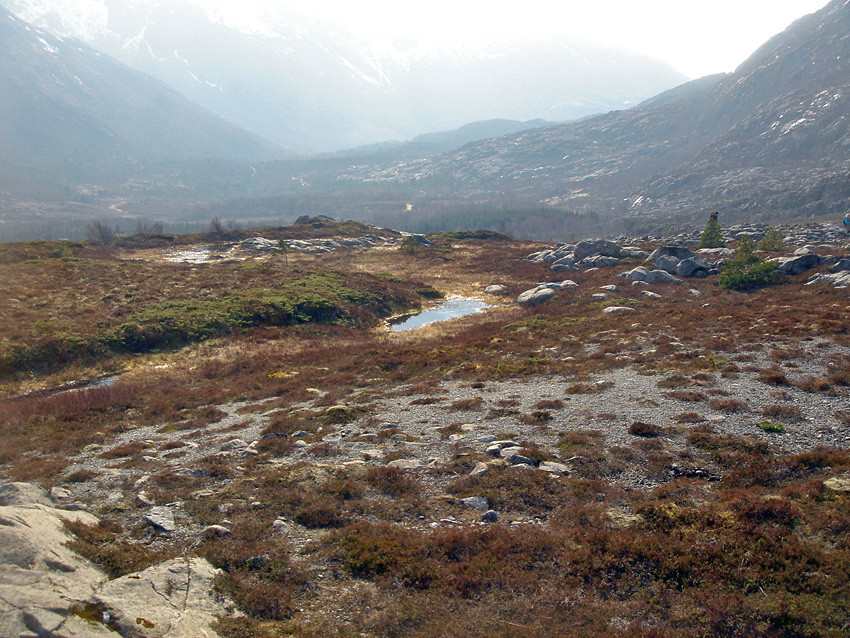
Early Mesolithic (c. 9000 BC) tent foundation (arrangement of rocks, foreground) at a raised shoreline at Vega, c. 70m asl. Small lithic scatters and expedient dwellings characterise the highly mobile colonisers of the Scandinavian seascapes (photograph H.B. Bjerck).

In sum, the colonisation of the Scandinavian seascapes and the development of open sea foraging and travelling seem to be two processes in one (Bjerck 2009). Technical, social and ontological challenges can be revealed in the archaeological record, as are environmental triggers and barriers which resulted in the cultural trajectories of a variety of past and present marine lifestyles.
The Marine Ventures project
Our project, Marine Ventures, comparative perspectives on the dynamics of early human approaches to the seascapes of Tierra del Fuego and Norway, follows a comparative approach. Tierra del Fuego also underwent Pleistocene glaciations, and the natural history, seascapes and marine biotopes are similar to those of Scandinavia. A further parallel is that the colonisation of the Patagonian seascapes (c. 5500 BC) seems to have occurred much later than the lateglacial settlement of the adjacent plains (Orquera & Piana 1988; Orquera et al. 2011). This constitutes a common platform for the study of relations between humans and the marine environment. The raised shorelines are an important factor, offering unique possibilities to track the triggers and trajectories of the earliest development of off shore traditions.
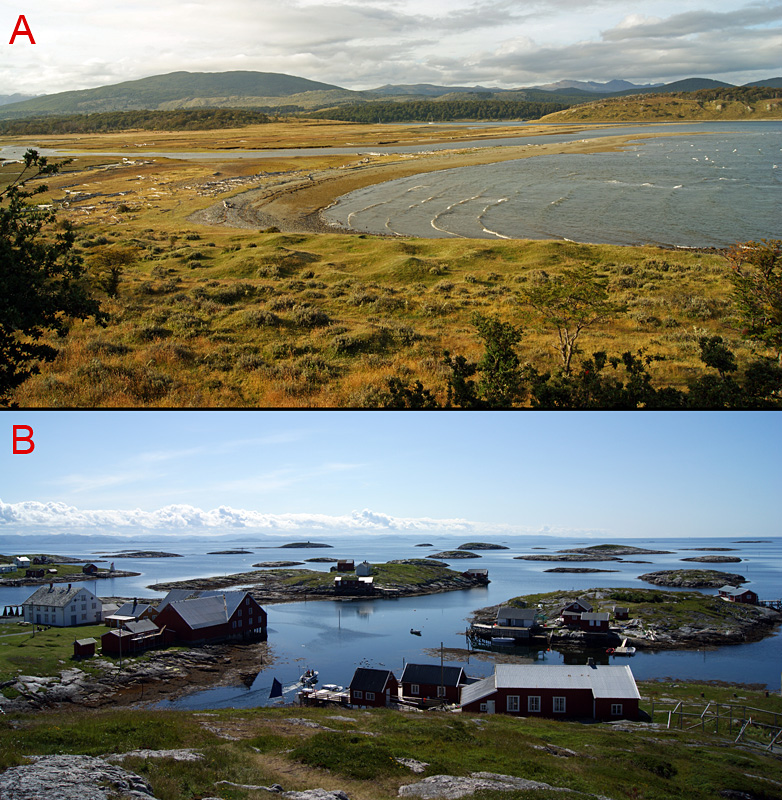
Nevertheless Patagonia and Scandinavia have followed different lines of cultural development (Figure 3a & b). In both traditions, seal hunting may have been an important motivator (Piana 2005; Bjerck 2009), and a reliance on a broad resource base is documented in later phases. Yet, substantial differences are apparent: Scandinavia's fish-based tradition eventually resulted in stable settlements at tidal currents, while Patagonia relied heavily on shell resources and consequently a mobile settlement structure related to widespread harvesting of shell beds (Bjerck 2007; Piana & Orquera 2009). The different activity patterns, technology, logistics and settlement systems offer thought-provoking perspectives on the complexity of coastal adaptation. The variety of sources offers another advantage. In Europe the maritime hunter-gatherer tradition is prehistoric, and is only documented archaeologically; in Patagonia this tradition existed alongside European colonisation, and is well documented in historical and ethnographical records (e.g. Bridges 1947; Orquera & Piana 1999; Briones & Lanata 2002). Finally the well-preserved shell middens of Patagonia constitute an important source of information (e.g. Orquera & Piana 1999; Piana & Orquera 2009; Zangrando 2009, 2010) whereas in Norway, shell middens are rare, and most prehistoric sites are badly preserved (Bjerck 2007).
Settled at the same time, similar environments, yet very different cultural trajectories. a): array of shell middens at the Yamana settlement of Halupai in the Beagle Channel, Tierra del Fuego, Argentina; b): the fishing village of Sør-Gjeslingan, outer coastal Trøndelag, Norway (note how islands and skerries create a safe harbour) (photographs H.M. Breivik).

Project objectives
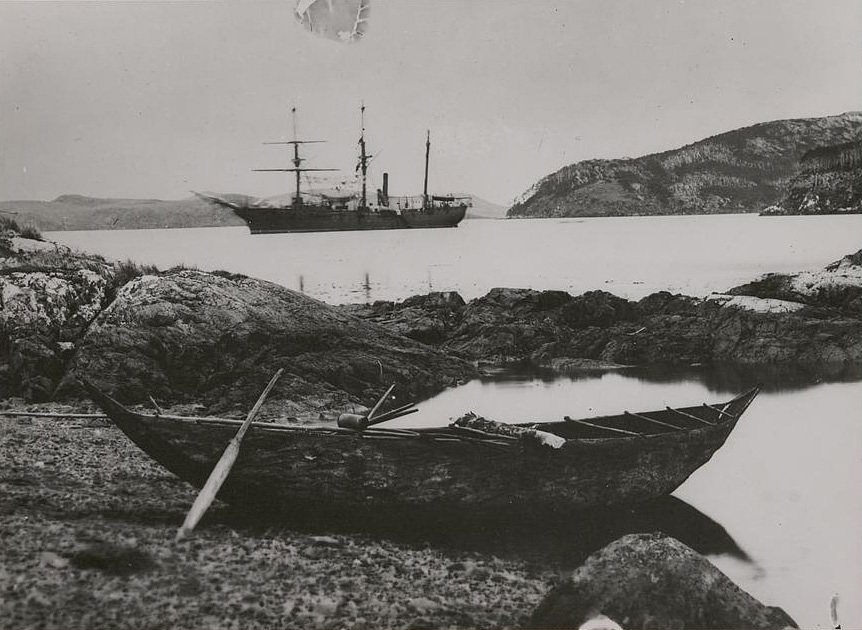
In addition to studying the dynamics of Colonising seascapes, the project aims to explore other aspects of the boreal-austral high latitudes pairing. In the wake of boats focuses on the relationships between dwelling sites and settlement systems, social groups and logistics. The earliest maritime sites in Norway are strikingly homogeneous, characterised by small, even-sized artefact scatters, similar in tool composition. Extensive use of boats (carrying the whole resident group and most of their material necessities) may be the key element, structuring activities as well as the social groups, their dwellings and settlements, thus leaving a similar archaeological footprint (Bjerck et al. 2008: 565–70). These relations can be studied in further detail in Tierra del Fuego: in addition to numerous standard-sized house foundations in shell middens, there are written and linguistic sources, as well as photographs of dwellings showing their inhabitants, canoes and crews (Orquera & Piana 1999; Piana & Orquera 2010) (Figure 4).
The French Mission scientifique du Cap Horn (1882–1883) is one of many intriguing sources of information about the lifestyles of maritime foragers in Patagonia, providing detail about the construction and carrying capacity of Yamana bark canoes, as well as about the size and social composition of their crews and where they travelled (photograph © 2012 Musée du Quai Branly/Scala, Florence).

Dwellings and settlement structure addresses the question of archaeological visibility. In Norway, Mesolithic dwelling structures are elusive; what were the processes that have rendered them so? Are structural variations a result of differing seasonal movements, activity patterns and environments, or do they reflect different trends in house-building? Here again the wide spectrum of information from sites in Tierra del Fuego should provide insights (Figure 5).
The Yamana settlement Wikirrh in Cambaceres, Beagle Channel, Argentinian Tierra del Fuego, known today as Huevera (Egg Box). The arrangement of shell middens in sheltering walls around thatched huts is a hallmark of the Yamana tribe. The site appears as a village, but historical information indicates that only a few of the house pits were occupied concurrently. Survey in Cambaceres Bay (c. 4km²) has detected over 700 house pits and 400 shell midden domes (photograph K.Ø. Oftedal).

Finally Cultural Heritage legislation and management compares how visitors and management relate to cultural landscapes at Vega, a World Heritage site in northern Norway, and in the Parque Nacional of Tierra del Fuego. This study analyses the implications of different heritage strategies as well as aspects of materiality and sociality in today's heritage concept (Skar 2006).
Acknowledgements
Marine Ventures (2011–2014) is owned and managed by the Norwegian University of Science and Technology (NTNU), in cooperation with the Argentinean CONICET (Consejo Nacional de Investigaciones Científicas y Técnicas), CADIC (Centro Austral de Investigaciones Científicas), and is supported by the Research Council of Norway (208828). Project members are Hein B. Bjerck (leader), Birgitte Skar, Silje Fretheim, Heidi M. Breivik, Karen Ø. Oftedal (NTNU), Ernesto L. Piana and Atilio Francisco J. Zangrando (CONICET–CADIC). Additional information is available at http://www.ntnu.no/vitenskapsmuseet/marine-ventures and http://www.cadic-conicet.gob.ar/