


Who has the power to influence American government and how that power is exercised are long-standing questions in the study of American political economy (Dahl [1961] Reference Dahl1974; Schattschneider Reference Schattschneider1960). When the target of special interest influence is the bureaucracy, these questions are generally approached through the study of regulatory capture, “the result or process by which regulation, in law or application, is consistently or repeatedly directed away from the public interest and toward the interests of the regulated industry, by the intent and action of the industry itself” (Carpenter and Moss Reference Carpenter, Moss, Carpenter and Moss2014, 13).
Scholarship on regulatory capture has thrived since the early 1970s, but also displays certain biases. First, it tends to focus on specific business demands but pays less attention to how bureaucrats construct the legal frameworks that guide regulatory review, even though these frameworks largely determine subsequent outcomes.Footnote 1 Second, it tends to assume that specific firms or industries work to undermine the public interest but neglects the role that experts and professionals play, not in their role as business lobbyists, but as a source of ideas for developing and justifying new regulatory frameworks. Third, it often equates the public interest with some other concept, like the consumer interest or the presidential interest, but seldom justifies those assumptions or seeks to empirically evaluate the public interest (see the next section).
In this article, we advance a theory for understanding an important and heretofore neglected dimension of regulatory capture that emerges from these biases, what we refer to as ideological capture. We use the term “ideology” to mean systems of belief that reinforce or normalize existing power relationships (Lukes Reference Lukes2005), not as a measure of left–right policy preferences, although this usage is nested within our broader definition. We specify the conditions under which ideological capture is (or is not) normatively troubling, and provide an empirical framework for measuring ideological capture using survey evidence. The relevant cleavage for understanding ideological capture is not that between producer and consumer nor that between principal and agent; it is instead that between public and expert. In American government, ideological capture arises when regulators adopt new regulatory standards, based on a particular ideological framework, that consistently and repeatedly marginalize important public values. Ideological capture, in other words, is not simply about what language is put into any given standard; it is also about the public goals that are left out of the standard. Crucially, surveys allow us to identify the values and goals that influence public preferences, estimate how voters trade off between excluded values and included objectives, and measure the extent to which experts diverge from the public in terms of preferences and values.
We explore these contentions with historical and survey evidence in an important policy setting: the policing of mergers involving large companies under federal antitrust law. Specifically, we evaluate whether the consumer welfare standard (CWS), which has guided antitrust enforcement for more than 40 years (Wilson Reference Wilson2019), represents a form of ideological capture. As we explain in the Consumer Welfare Debate section, the idea that the antitrust laws should minimize consumer prices—the main objective under the CWSFootnote 2—has always been controversial, and legal scholars have long argued that the CWS sidelines important public values, like the concern that companies, when they grow too large, might acquire more power to influence American government (Pitofsky Reference Pitofsky1979). Antitrust policy was also the tip of the proverbial spear for a much broader bipartisan movement to redefine the goals of major public policy initiatives, from poverty to environmental programs, according to the teachings of microeconomic thought (Berman Reference Berman2022). As a result, antitrust is an ideal policy domain to test for the presence of ideological capture.
Our central hypothesis is that the CWS marginalizes important public values but has deep support among a class of professionals who do not share those values, which suggests the presence of ideological capture. To test this claim, we designed an original survey (including a novel conjoint experiment) and fielded the survey to a national nonprobability sample of the public and to a convenience sample of antitrust lawyers. The main purposes of the survey are to (1) assess whether political goals and values (which are outside the CWS) are more important drivers of public attitudes than economic goals like reducing prices (the main objective of the CWS); and (2) determine if the public and antitrust lawyers significantly differ in their support for the CWS, and if this divergence is rooted in fundamental value differences. The survey also probed beliefs about the effects that large mergers have on the American political economy (see the Data and Methods section).
The results support the view that the CWS represents a strong form of ideological capture. We show, in the Analysis section, that when the public weighs various merger risks, they place relatively little weight on price reductions—the explicit goal of the framework—but much more weight on layoffs, diminished product quality, lobbying risk, and structural economic risk, concerns that are either excluded or marginalized in the consumer welfare framework. The public would also like to replace the CWS with a more subjective balancing test, and are dramatically different from antitrust lawyers in this regard. By one measure, being an antitrust lawyer has an effect on support for the CWS that is four times larger than the effect of being a Democrat versus being a Republican. And this divergence arises from differences in basic political values, like beliefs about whether large companies have too much power in the American political economy. Finally, the public also differs from antitrust lawyers in assessing the social and political risks that large mergers pose to American society and government.
Our study makes three major contributions. First, we contribute to a vast literature on regulatory capture by theorizing about ideological capture and proposing a set of tools that scholars can use to measure it. Second, we contribute to a growing literature on the role that lawyers and judges play in the American political economy (see, e.g., Bonica and Sen Reference Bonica and Sen2021). We move beyond aggregate measures like political ideology scores to show that lawyers are distinct from the public, using finer-grained measures of attitudes, beliefs, and policy preferences. In doing so, we also extend a rich literature in political science exploring elite–public and expert–public cleavages (Broockman, Ferenstein, and Malhotra Reference Broockman, Ferenstein and Malhotra2019; Jacobs and Page Reference Jacobs and Page2005; Kertzer Reference Kertzer2022; Mutz Reference Mutz2021) and empirical studies showing that professional training causes ideological divergence, even among elite actors like federal judges (Ash, Chen, and Naidu Reference Ash, Chen and Naidu2022; Carnes Reference Carnes2012; Zingales Reference Zingales, Carpenter and Moss2014). Finally, prior work suggests that, by emphasizing goals like efficiency, economic frameworks (in antitrust and elsewhere) conflict with “competing political claims grounded in values of rights, universalism, equity, and limiting corporate power” (Berman Reference Berman2022, 4). We empirically validate these claims in a specific policy context and conclude by commenting on the implications for theories of representation that emphasize the power of elections to cause comprehensive policy change.
What Is Ideological Capture?
Gaps in Existing Studies
Regulatory capture has long been an object of scholarly inquiry (for reviews, see Bó Reference Bó2006; McCraw Reference McCraw1975; Novak Reference Novak, Carpenter and Moss2014). With notable exceptions, however, the literature displays certain dominant tendencies when it comes to specifying the nature of the regulatory process, the actors who seek to influence that process, and the public’s interest in regulatory outcomes.
First, capture scholarship tends to take a transactional view of the regulatory process, one in which the industry objective is narrow and concrete, like preventing expansion of the broadband spectrum to stop competitors from entering the market (Moss and Decker Reference Moss, Decker, Carpenter and Moss2014) or obtaining a lease to drill for oil in deep water (Carrigan Reference Carrigan, Carpenter and Moss2014). It is true that agencies are tasked with making decisions of this nature; it is also true that, when specific firms obtain concrete outcomes from government agencies, it can have massive effects on public welfare (Meier Reference Meier2023). At the same time, most agencies also have the power to set the regulatory frameworks or guidelines by which business conduct is thereafter regulated, and the intensity of subsequent enforcement is often determined at this more preliminary stage. Agency rulemaking remains, however, an understudied component of regulatory capture (Carpenter et al. Reference Carpenter, Dagonel, Judge-Lord, Kenny, Libgober, Rashin, Waggoner and Yackee2023; Yackee Reference Yackee2019).
The policy setting that we examine in depth in this article—the policing of mergers involving large companies under federal antitrust law—illustrates this bias. On the one hand, there is little evidence of which we are aware that businesses wishing to merge can (or do) directly influence the decisions of antitrust officials at the Department of Justice or the Federal Trade Commission. On the other hand, government challenges to large mergers collapsed in 1981 when the agencies, under new leadership, rewrote the guidelines for investigating mergers, and merger challenges have remained at historically low levels since then (Short Reference Short2022a).Footnote 3 If business interests get what they want (merger approval) most of the time under the new guidelines, we would not expect to find pervasive evidence of intense lobbying or business influence. But we are left with the questions of who influenced the guidelines and whether those guidelines undermine the public interest in a way that can be conceived of as a form of capture.
Second, though a diverse array of elite actors might plausibly influence the bureaucracy, most work on regulatory capture starts from the assumption that business interests play the dominant role in undermining the public interest. In the popular definition above, for example, regulatory capture appears from the intentional acts of a “regulated industry” (Carpenter and Moss Reference Carpenter, Moss, Carpenter and Moss2014, 13). This emphasis is entirely reasonable given the historical circumstances that led to the growth of the administrative state in the early twentieth century, as well as the mid-century concern that regulators might not be as immune to business influence as originally hoped (Novak Reference Novak, Carpenter and Moss2014).
But in placing business or industry interests front and center, capture scholarship generally neglects or diminishes the role of other actors who have the power to undermine the public interest, including academics and highly educated professionals like lawyers and economists. These groups do not simply act as intermediaries for business interests in their role as lobbyists, though they do that too (Libgober and Carpenter Reference Libgober and Carpenter2024).Footnote 4 They are also, in many cases, the primary source of ideas for developing and justifying new regulatory frameworks. In the case of antitrust merger review, for example, legal scholars largely agree that judges, lawyers, and economists associated with the law and economics movement—not business interests—played the key role in shifting antitrust policy toward the CWS. Though these elite actors may have produced a framework congenial to business interests, there is no evidence (of which we are aware) that they acted directly at the behest of business interestsFootnote 5 while there is abundant evidence that they were motivated by ideology (Khan Reference Khan2018; Vaheesan Reference Vaheesan2019; Wu Reference Wu2018).
Third, capture scholarship tends to rely on modeling assumptions or qualitative work to define the “public interest,” but tends to forego measuring public attitudes. In models based on microeconomic theory, the public interest is equated with the consumer interest, though little evidence suggests that public preferences are rooted in demands for lower prices on consumer products or other forms of economic self-interest (Miller and Ratner Reference Miller and Ratner1998; Mutz Reference Mutz2021; Sears and Funk Reference Sears and Funk1990). In principal–agent models, the public interest is equated with the interest of Congress or the president, even though industry can influence both.Footnote 6
Similarly, in legal scholarship, the public interest is typically equated with congressional intent as derived from close (but subjective) readings of legislative history and statutory text. For example, the CWS became the dominant framework in antitrust law when the Supreme Court accepted a revisionist interpretation of the antitrust laws published by the law and economics scholar Robert Bork, as discussed below. Bork (Reference Bork1978) argued that Congress intended the 1890 Sherman Act to protect consumer welfare. Contrary interpretations abound, emphasizing other economic (Lande Reference Lande1999) or noneconomic goals (Millon Reference Millon1988; Pitofsky Reference Pitofsky1979; Schwartz Reference Schwartz1979). As a result, “there is no general consensus on the question of legislative goals of antitrust policy” (Flynn Reference Flynn1988). Confusion remains because debates about congressional goals are essentially proxy fights in debates about sound policy (Fox Reference Fox2013), and scholars interpret history (and congressional intent) through an ideological lens to promote their own views about sound policy (Page Reference Page1991).
Without an objective measure of public values and preferences, it is difficult to determine if regulations truly undermine the public interest, especially when those who wish to push policy in another direction try to influence officials across multiple branches of government. In our setting, for example, though abuse is extremely rare, the most egregious instance of abuse arose from presidential interference in agency practice for political gain.Footnote 7 Moreover, to the extent that businesses wanting to merge influence antitrust agency outcomes, they seem to do so indirectly, through Congress (Mehta, Srinivasan, and Zhao Reference Mehta, Srinivasan and Zhao2020). Methodological problems like these have led a leading scholar of the bureaucracy to assert that “empirical studies of capture must have some notion of the public interest in mind as a counterfactual” and must specify how the public interest will be identified (Carpenter Reference Carpenter, Carpenter and Moss2014, 58).
Because of these biases, capture scholarship has been slow to recognize a potentially widespread form of regulatory capture, what we refer to as ideological capture. With ideological capture, the regulatory behavior of interest is the process of developing new rules and regulatory frameworks, not the subsequent act of approving or rejecting specific business demands under those frameworks. The main actors are those who have sufficient expertise to design new frameworks, and while these experts may have ties to organized business interests, they are more likely to be ideologically motivated individuals, including academics and professionals, who benefit from their perceived lack of industry ties.
Ideology and Regulatory Capture
When political scientists speak of ideology, they generally refer to latent appetites for state intervention in American society (the liberal–conservative spectrum) (McCarty, Poole, and Rosenthal Reference McCarty, Poole and Rosenthal2016). We use the term in a different sense, one that borrows more from sociology than political science. We see ideologies as systems of ideas and values that shape the way people interpret social life, but which also establish and maintain power relations between social groups (Lukes Reference Lukes2005).Footnote 8 The law and economics ideology at issue in our case, for example, is one that has no obvious partisan anchor among elites. It is an ideology that leverages microeconomic theory to equate “welfare” with prices and to bracket consideration of outcomes that do not have “price equivalents,” assumes that “bigness” or “dominance” in the market is a just reward for superior performance, and ties these and other ideas together into a jurisprudence that elevates the demands of Homo economicus over more prosaic public concerns (Bork Reference Bork1978; Posner Reference Posner1978). Accordingly, it places significant emphasis on the pursuit of economic efficiency while sidelining “competing political claims grounded in values of rights, universalism, equity, and limiting corporate power” (Berman Reference Berman2022, 4).
Ideologies do not simply shape the way people interpret the world, however. They also enable some groups to exercise power over others (Lukes Reference Lukes2005, 6–8). The risk of an ideological form of regulatory capture arises, then, from the risk that unelected bureaucrats will invoke ideology to exercise power in a way that marginalizes important public values. Here, we follow Li (Reference Li2023, 1220) in conceiving of ideological capture as a form of capture that fundamentally involves the third face of power, where interest groups do not prioritize lobbying (the first face of power), or agenda setting (the second face of power), but attempt to “constrain and distort” the way that regulators define the “public interest.” Experts play a pivotal role in shaping the way regulators define the public interest, and they do so to pursue policy objectives (Li Reference Li2023, 1220–22).
We expand on this theory to emphasize that ideological capture essentially involves competing value systems and that the true “public interest” is observable, even in the absence of any overt expression of grievances. With ideological capture, the public interest—the counterfactual state of regulation that would have obtained in the absence of expert influence (Carpenter and Moss Reference Carpenter, Moss, Carpenter and Moss2014)—is in a regulatory process that broadly reflects public values. Observing a latent “contradiction between the interest of those exercising power and the real interests of those they exclude” (Lukes Reference Lukes2005, 28–29; emphasis in original) is not without its methodological challenges. When experts exercise their power to shape regulatory beliefs in the manner we have described, conflict will almost always be “suppressed entirely” (Li Reference Li2023, 1220). The public is also unlikely to be aware of, let alone have well-defined preferences about, the technocratic areas of law where ideological capture is most likely to occur.Footnote 9 But on these issues, the public routinely extrapolates from core political values (Goren et al. Reference Goren, Schoen, Reifler, Scotto and Chittick2016; Jung and Clifford Reference Jung and Clifford2025), and these values can be measured in surveys.
Our unique setting provides some advantages in this respect. The regulation of business mergers might seem like a technocratic domain of law on which the public would not have well-formed beliefs. But the regulatory turn toward the CWS inaugurated a period of extensive deregulation (Short Reference Short2022a), and mergers have become so common that they now directly affect large cross-sections of the American public. By one measure, there have been more than 300,000 mergers in the United States since the 1970s, and those deals have impacted more than five million workers per year (Zhang Reference Zhang2021, 378). In our own sample, 22.7% of the public indicated that they “had worked at a company that went through a merger with another company,” which suggests that as many as 50 million US adults may have firsthand experience with a business merger. In our pilot studies (based on convenience samples), we also found that the increasing number of very large companies in the economy is an important problem to all partisan groups and that antitrust policy positions influence candidate evaluations (online appendix D).
In short, merger conduct is pervasive, large cross-sections of the public have been directly exposed, and antitrust issues are important to the public. Even though the CWS is a technocratic regulatory standard, the public arguably has sufficient firsthand experience to formulate meaningful opinions. More importantly, we can also expect those opinions to be rooted in concrete and stable value-based predispositions. Berman (Reference Berman2022) contends, for example, that law and economics ideology marginalizes broader public concerns about the ability of large companies to influence elected officials and exercise power in the marketplace. Since the 1960s, American National Election Studies has routinely asked voters whether the government is pretty much run by a few big interests, and established polling companies (including the Pew Research Center) have asked whether too much power is concentrated in the hands of a few large companies. We can therefore test whether any observed preference divergence (between experts and the public) is rooted in these kinds of fundamental value differences. Similarly, as we argue in the Data and Methods section, we can use conjoint experiments to determine which values and goals have the most significant influence on public attitudes in a setting where respondents are forced to trade off across multiple conflicting values, and we can assess whether the most important goals and values are embodied in, or marginalized by, existing regulatory frameworks.
We therefore define ideological capture as occurring when (1) regulators create standards that (2) are based on an ideologically motivated (expert) view of the “public interest” and (3) consistently and repeatedly marginalize important public values and goals. As our definition makes clear, ideological capture does not arise whenever experts and the public disagree about a regulatory framework. Rather, the chosen framework must be rooted in an ideologically motivated view about the public interest, and that view must marginalize those values that inform the public’s conception of its own interest. Preference divergence is also suggestive, but not dispositive, in showing ideological capture: the public may disapprove of a regulatory framework, but so long as that framework does not marginalize important public values, it does not meet our definition of capture. Ideological capture also implicates regulatory behavior. Federal judges seem prone to abetting ideological capture, but they do so based on their power to interpret congressional intent (which, in turn, shapes and constrains regulatory action).Footnote 10 Judges may invoke ideology to interpret the scope of constitutional rights or apply the law to a given case, but this kind of behavior—though similar—does not amount to ideological capture in our definition.
When Is Ideological Capture a Problem?
Two hypotheticals help to illustrate our theory and its normative implications. In the wake of the thalidomide controversy, Congress passed new laws requiring regulators to obtain proof that a drug is safe and effective before approving its use. Had bureaucrats developed such a framework on their own (independent of Congress), based on scientific expertise, one might suspect a kind of ideological capture. But if surveys showed that, when the public thinks about drug approval, their primary goals are to ensure that the product works as intended (efficacy) and that innocent people are not harmed (safety), we would not say this framework amounts to ideological capture, even if surveys showed that large majorities of the public wanted to replace the framework with an alternative.
Similarly, we might imagine that regulators are asked by Congress to develop a tariff schedule and they choose a framework, based on economic theory, that sets tariffs high enough to protect industries crucial to national defense but otherwise low enough to maximize global trade. Such a framework balances competing goals and values like protecting national security and maximizing consumption. But if surveys revealed that the public conceives of trade policy mainly in ethnonationalist terms (Mutz Reference Mutz2021), we would say this framework amounts to ideological capture.
As these two examples suggest, the question of whether ideological capture exists is distinct from the normative question of whether ideological capture is a problem in a democratic polity. We do not presuppose that any specific set of public values or goals are “right.” On the contrary, our theory is rooted in the concern that experts (including political scientists) might use ideology to cloak their own interests and values in the mantle of “the public interest.” Instead, we conceive of ideological capture as varying along a continuum from weak to strong (Carpenter and Moss Reference Carpenter, Moss, Carpenter and Moss2014) according to two conditions: (1) whether the experts promoting a given framework have any special claim to scientific legitimacy (a question of truth); and (2) whether the regulators elicited and considered public views before making a decision (a question of process).
In this framework for evaluating the normative implications, ideological capture is weakest when expert influence is rooted in empirically validated claims and when regulators consider public views (even if they reject those views). For example, imagine that the Environmental Protection Agency solicited public comments on a framework for regulating building materials that included a ban on lead pipes, and then adopted the framework despite public opposition because of substantial evidence that lead is a carcinogen. We would question whether the scientific perspective that motivated this framework amounts to an ideology in the first instance. But even if it did, this kind of capture would not be normatively troubling, in our framework, because the public’s grievances were aired (moving conflict from the third to the first face of power) and because the experts opined on a question (does any exposure to lead cause cancer?) for which there is a “right” answer.
In the next section, we review prior historical work indicating that the CWS became the dominant antitrust framework in a way that suggests an especially strong form of ideological capture. We then test whether the CWS marginalizes important public values and whether there is a significant public–expert cleavage on regulatory preferences that arises from fundamental value differences.
The Consumer Welfare Debate
In the 1960s, a group of scholars developed compelling new arguments for applying the principles of microeconomic theory to the analysis and design of American law (Appelbaum Reference Appelbaum2019; Berman Reference Berman2022; Teles Reference Teles2008). The law and economics movement, as it came to be known, influenced policy development in many areas but arguably had its most significant impact in the field of antitrust law (Kovacic Reference Kovacic2007). One of the movement’s main accomplishments in this area was to usher in a new framework for analyzing potentially anticompetitive conduct called the consumer welfare standard (Khan Reference Khan2018). Under the CWS, federal officials consider whether the conduct at issue, like a merger between two large companies, will reduce output and raise prices and therefore hurt consumers (Hovenkamp Reference Hovenkamp2019).
The process by which the CWS became the lodestar of antitrust analysis suggests the potential for a strong form of ideological capture. It did not arise from new legislation to revise the main antitrust statutes, which Congress passed in 1890 (the Sherman Act) and 1914 (the Federal Trade Commission Act and Clayton Act). It arose instead when the Supreme Court decided, in 1979, that the nation’s antitrust laws were always meant to protect consumer welfare. For several years, ideological shifts in the Warren Burger court, not new insights or discoveries, had driven the court’s reworking of antitrust policy, especially the court’s willingness to embrace the teachings of the law and economics movement (Flynn Reference Flynn1977). And when it decided in 1979 that “Congress designed the Sherman Act as a ‘consumer welfare prescription,”’ the court cited not to precedent but to the revisionist historical work of Robert Bork.Footnote 11
The bureaucracy revised its guidelines for evaluating proposed mergers in 1982 and 1984. Two developments made the bureaucracy especially receptive to the new approach. Institutional changes within the antitrust agencies, in 1972, led to the hiring of many more staff economists (Eisner and Meier Reference Eisner and Meier1990). Also, the Ronald Reagan administration appointed officials aligned with the law and economics movement to lead the two main antitrust enforcement agencies (Short Reference Short2022b). As a result, the agencies had both the bureaucratic capacity—in the form of economic expertise—and the ideological motivation to promote the CWS and the economic approach to antitrust analysis more generally.Footnote 12
If the law and economics movement and the coalition supporting the CWS were politically conservative, it might suggest that the court-driven shift in agency priorities was rooted not in a victory of experts over the public, but in the victory of one partisan faction over another. But a variety of evidence suggests that the public interest was not being filtered, however imperfectly, through normal channels of political contestation.
First, within the expert class, support for the CWS (and for antitrust deregulation more broadly) was largely bipartisan in the 1970s and 1980s (Berman Reference Berman2022, chaps. 1, 4). Though many scholars in the law and economics movement were conservatives associated with the University of Chicago, prominent Harvard scholars Phillip Areeda and David Turner also played pivotal roles, as did their colleague, Stephen Breyer, after Democratic president Jimmy Carter appointed him to serve as a federal appellate judge in 1980 (Kovacic Reference Kovacic2007). The idea of an economic standard that focused on consumer interests also resonated with liberal lawyers, like Ralph Nader, and other leaders in the consumer rights movement (Cohen Reference Cohen2003; Short Reference Short2022b; Stoller Reference Stoller2019). Economists who advised Democratic presidential candidates and served in Democratic administrations also joined in questioning the utility of antitrust enforcement in general: Alan Greenspan (Reference Greenspan and Rand1967) characterized antitrust laws as “utter nonsense”; Lester Thurow (Reference Thurow1981; Lohr Reference Lohr1981) called for their abolition.
Second, though the parties were engaged in intense battles to define the appropriate role of the state in a capitalist society, they did not specifically politicize, or present voters with concrete alternatives for, antitrust enforcement policy. Though the Reagan administration played the most significant role in resetting agency priorities, the 1980 Republican Party platform hardly mentions antitrust policy.Footnote 13 When the newly Republican Senate confirmed law and economics ideologues like William Baxter to lead the antitrust agencies, they echoed the Burger court’s assertion that “[t]he objective and goal of the antitrust laws is, first and foremost, the protection of the American consumer.”Footnote 14 But archival evidence suggests that the Reagan administration pursued this strategy to deregulate antitrust “without asking for new legislation or higher appropriations” and to avoid “antagonizing politically influential constituencies” (ProMarket 2022). In other words, the proponents of the CWS believed their policy proposals reflected “the consensus of economists of all political persuasions,” but were unpopular with the broader public and influential groups like small-business owners. When Democratic presidential candidates won in later elections, their party platforms were also silent on antitrust policy.Footnote 15
Third, a majority of the public supported doing more to enforce the nation’s antitrust laws in most years from 1980 through 2014 (Short Reference Short2022a) and, even in a setting where deregulatory ideas were politically popular, there is little evidence that the public wanted bureaucrats to refashion the antitrust laws into a consumer rights bill. While survey evidence on antitrust policy during the 1980s and 1990s is scant and has limitations, the weight of the evidence suggests that the public did not want antitrust policy to be preoccupied with consumer interests. We reviewed all the public opinion polls we could find in the Roper iPoll database on mergers or antitrust enforcement in this time frame.Footnote 16 The results are summarized in online appendix I. The data show that, in the mid-1980s, when antitrust officials were applying the CWS, less than 20% of the public believed that mergers help consumers as a group or that mergers involving large companies result in lower prices. Those same surveys also display deep reservoirs of concern about layoffs, wage suppression, and increasing corporate influence over government arising from mergers, concerns that are not accounted for in the CWS framework.
In addition, the experts advocating for the CWS did so based on an ideology laden with strong assumptions rather than scientific analysis, and they leveraged that ideology to opine on questions for which there is no “right” answer. Take, for example, their central claim: that the CWS will only allow those mergers that deliver consumer benefits, especially lower prices. Because company pricing data are generally confidential, this question is difficult to assess empirically, but the most comprehensive meta-analysis of postmerger studies completed to date suggests that the CWS routinely allows mergers that increase rather than lower prices (Kwoka Reference Kwoka2014, table 6.4). Despite 50 years as the “lodestar” of antitrust analysis, there is scant evidence that the CWS delivers on its main promise. And if we broaden our understanding of the antitrust law’s purpose, we touch on political questions for which social scientists can produce, at best, tentative conclusions, like whether lax enforcement produces companies that have too much power in the market or too much influence in American government.
In sum, though the parties articulated competing visions for the appropriate role of the state in the US economy during this time frame, they did not present voters with concrete alternatives when it came to antitrust enforcement policy. Rather, the evidence suggests that the CWS became the new framework for implementing antitrust merger policy when ideologically motivated experts convinced federal judges and key members of the Reagan administration to unilaterally rewrite the nation’s antitrust laws. The policy shift did not arise from more democratic processes for creating new regulatory frameworks, like new legislation or normal rulemaking subject to notice and comment. New data or evidence also did not motivate the shift. It was driven, instead, by ideologues whose main goal was (in their own words) deregulation, but who also knew that deregulation would be politically unpopular. For these reasons, we interpret the historical evidence as suggesting the potential for a strong form of ideological capture.
Data and Methods
To determine whether the CWS marginalizes important public values, we measure public opinion about antitrust enforcement policy. Three major considerations motivated our research design.
First, though survey databases contain a good amount of polling about antitrust enforcement, the questions asked are generally quite coarse, out of date, and not targeted to specific research questions. They do not ask, for example, whether respondents approve of the CWS (online appendix I).
Second, no prior study has investigated which values motivate voter concerns about antitrust policy, or how voters trade off across competing values and goals. Trade-offs are central to our understanding of ideological capture, and to the ongoing antitrust reform debate.Footnote 17 If voters value entrepreneurship more than they value consumer benefits when thinking about antitrust enforcement policy, for example, then the fact that CWS only considers consumer benefits but not the effect on small-business owners means the policy marginalizes important public values.
To investigate trade-offs, we conduct a conjoint experiment modeled on the fair trade literature (see, e.g., Dragusanu, Giovannucci, and Nunn Reference Dragusanu, Giovannucci and Nunn2014). Prior work shows that consumers significantly change their behavior when presented with new information about producers, like CEO-to-worker wage ratios (Dragusanu, Giovannucci, and Nunn Reference Dragusanu, Giovannucci and Nunn2014; Mohan et al. Reference Mohan, Schlager, Deshpandé and Norton2018; Park Reference Park2018). We use similar techniques to understand how respondents weigh competing concerns when expressing opinions about whether the government should challenge hypothetical mergers.Footnote 18 We pretested our design in a series of three pilot studies conducted in February of 2021, November of 2021, and June of 2023 using convenience samples of survey volunteers.
Third, no prior study to our knowledge has explored whether the professionals who are involved in the day-to-day implementation of antitrust enforcement policy are significantly different from the public in terms of their preferences or the underlying attitudes that motivate those preferences. But our theory of ideological capture is rooted in the potential for deep cleavages between the public and experts when it comes to policy preferences, and the underlying values that motivate those preferences.
We therefore distributed our survey to a national sample of the public and to a convenience sample of antitrust lawyers. Specifically, we deployed our survey to a nonprobability sample of 2,092 adults through Bovitz/Forthright in January of 2024, with quotas to match national marginal distributions for Census region, age, ethnoracial identity, gender, education, and partisan identification.Footnote 19 Because the final sample differed from national targets by more than four percentage points on some measures of education and partisan identification, and because we wanted to achieve balance based on income as well, we developed poststratification weights using those three variables (DeBell and Krosnick Reference DeBell and Krosnick2009).Footnote 20
We also recruited antitrust lawyers to take the same survey from November of 2023 to March of 2024 through two separate channels: using Facebook advertising credits and emailing lawyers listed online as members of antitrust or merger practice groups at private law firms.Footnote 21 This yielded 48 and 55 usable completes, respectively, according to the same criterion described above, for a total sample of 103 antitrust lawyers.
Our analysis focuses on three theoretical quantities of interest:
-
• Marginalized values: does the public place more weight on considerations that fall outside the CWS, like layoffs, than on price savings?
-
• Expert–public cleavages: do antitrust lawyers and the public diverge in their support for the CWS, and what political values or goals explain this divergence?
-
• Policy skepticism: to what extent does the public believe that mergers deliver economic benefits or impose social and political costs?
To answer these questions, we test a series of registered hypotheses that map onto the broader areas of investigation.Footnote 22 Summaries of the main registered hypotheses tested in this article are shown in table 1. In the online appendix, table A.9 shows the outcome of every registered test; table A.11 shows the full text of all survey questions and response options; and appendix H describes deviations from the pre-analysis plan. We note exploratory analyses as such below. Bar plots show average support with 83% confidence intervals, equivalent to a two-tailed 0.05 t-test for a difference of means under some assumptions (Goldstein and Healy Reference Goldstein and Michael1995; Radean Reference Radean2023). Point plots show estimated coefficients from regression analysis with 95% confidence intervals.
Main Hypotheses

Table 1 Long description
The table consists of two columns: Concept and Hypothesis.
* Policy skepticism: H 1 states a majority of the public disagree that mergers produce economic benefits such as lower prices, higher quality, more entrepreneurship, or more innovation.
* Expert-public cleavage: H 2 states antitrust lawyers are more likely than the public to agree that mergers produce economic benefits.
* Policy skepticism: H 3 states a majority of the public agree that mergers have social costs including infringing individual liberties, political influence, weaker local ties, and becoming too big to fail.
* Policy skepticism: H 4 states a majority of the public and each partisan subgroup support replacing the C W S.
* Policy skepticism: H 5 states a majority of the public and each partisan subgroup support increasing antitrust enforcement.
* Expert-public cleavage: H 6 a states Republicans support replacing the C W S less than Democrats.
* Expert-public cleavage: H 6 b states antitrust lawyers support replacing the C W S less than the public.
* Expert-public cleavage: H 6 c states the expert-public gap on support for replacing the C W S exceeds the partisan gap.
* Marginalized values: H 8 states that in deciding whether to challenge a merger, the public will place more weight on layoffs, lobbying, bailouts, and product quality than on prices.
* Expert-public cleavage: H 9 states that trade-offs weighing price changes against other factors will be the same across partisan subgroups but different between antitrust lawyers and the public.
Note: Hypotheses 7 and 10 from the pre-analysis plan are discussed in the online appendix.
Analysis
Assessing Trade-Offs Revealed from Hypothetical Merger Assessments
If the CWS represents a form of ideological capture, we must first show that it marginalizes important public values. To probe this question, we developed a novel conjoint experiment, as described in the previous section, where we presented each respondent with four hypothetical mergers with randomly varying attributes, and then asked whether the government should challenge or allow the mergers, on a four-point scale.Footnote 23 We hypothesized that, when evaluating these hypothetical mergers, respondents would place more weight (as measured by average marginal component effects) on layoffs and the risk of lobbying and bailouts (factors that are excluded from the CWS) than on price savings (a central objective of the CWS) (hypothesis 8).
The merger attributes and their levels are presented in table 2. The baseline condition for each attribute is generally one of “no change.” We randomly varied the order of the attributes in each iteration as well as the attribute levels. Most changes in attributes were presented in qualitative terms (e.g., more or less, better or worse), but we included quantitative measures of price changes and layoffs in percentage terms, and we allowed both measures to vary on the same scale (from a 5% increase to a 20% decrease) to avoid biasing the results. In the real world, however, workforce reductions are generally much larger in percentage terms than price changes. In one analysis involving 42 mergers and 119 products, prices only decreased in 38.6% of the cases and the savings were modest in scale (about 3% on average and 16% maximum) (Kwoka Reference Kwoka2014, table 6.4). In contrast, workforce reductions for mergers in the same industry are 30% on average (Marks, Mirvis, and Ashkenas Reference Marks, Mirvis and Ashkenas2017).Footnote 24
Hypothetical Merger Attributes

Table 2 Long description
The table consists of two columns: Levels and Number of observations. It is divided into seven bolded categories:
* Bailout risk: No change in bailout risk (baseline) has 3,690 observations; Less likely has 3,707; More likely has 3,578.
* Firm size: 1,000 workers (baseline) has 3,618 observations; 25,000 workers has 3,678; 100,000 workers has 3,679.
* Industry: Bank (baseline) has 1,825 observations; Gas and oil has 1,794; Grocery store chain has 1,835; Hospital has 1,839; Pharmaceutical has 1,842; Telecom has 1,840.
* Employment: No layoffs (baseline) has 2,285 observations; 20% decrease has 2,264; 10% decrease has 2,215; 5% decrease has 2,162; 5% increase has 2,049.
* Political influence: No change in lobbying (baseline) has 3,616 observations; Less lobbying has 3,700; More lobbying has 3,659.
* Prices: No price change (baseline) has 2,185 observations; 20% lower has 2,138; 10% lower has 2,298; 5% lower has 2,188; 5% higher has 2,166.
* Quality: No quality change (baseline) has 3,614 observations; Worse has 3,665; Better has 3,696.
Note: This table shows each attribute included in the conjoint experiment, the levels of each attribute, and the number of observations for each level. Asterisks indicate the baseline (omitted) condition.
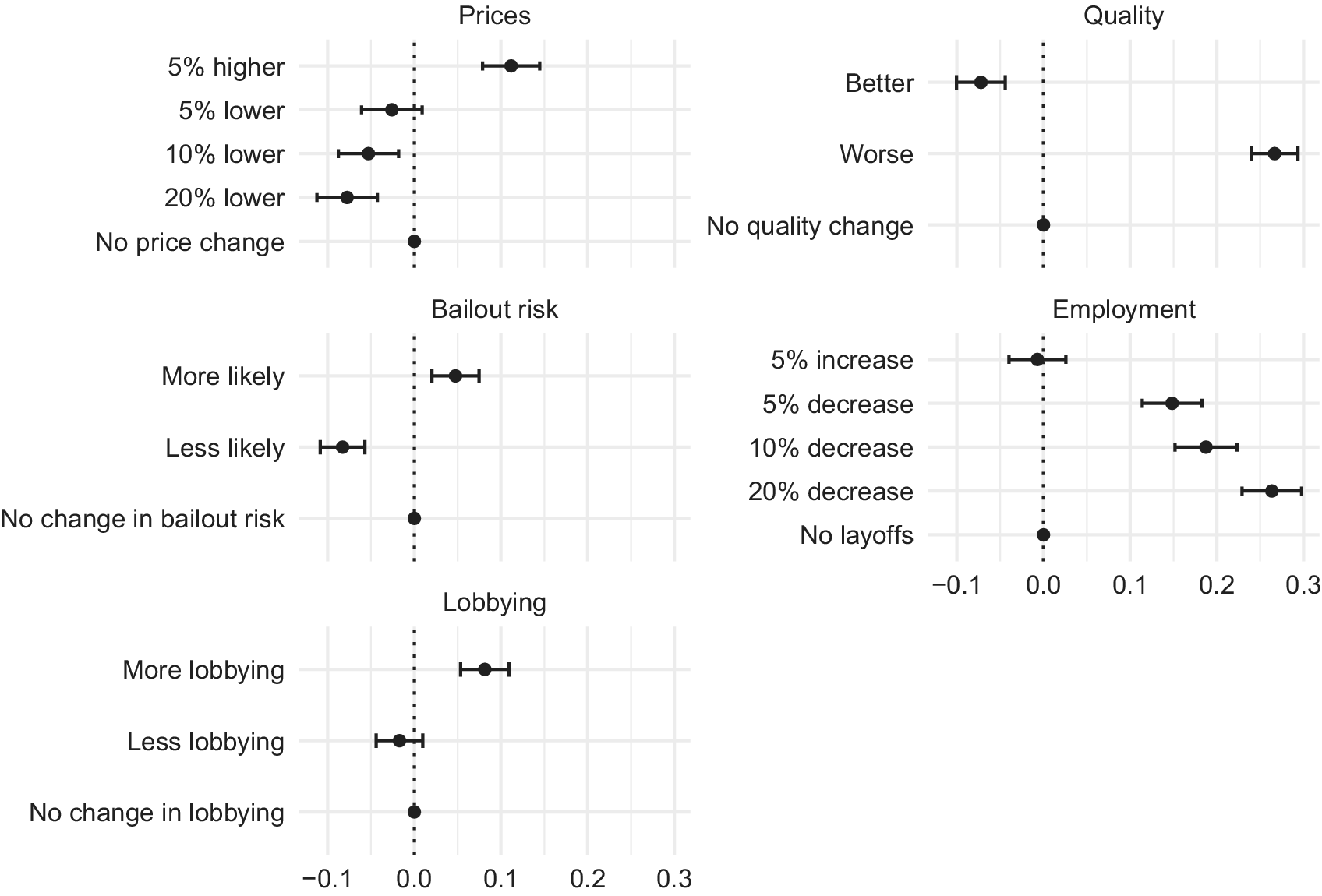
The data generally support our hypothesis. Figure 1 shows that, while the public is averse to price increases, they place relatively little weight on price savings. Though mergers approved under the CWS are supposed to deliver price reductions, they often do not,Footnote 25 and so we allowed for the possibility that some mergers would increase prices by 5%. Holding all else equal, respondents are 11.1 percentage points more likely to ask that the government challenge such a merger. Respondents are also 2.6 to 7.7 percentage points less likely to ask the government to challenge a merger that will lower prices by 5%, 10%, or 20%. However, these effect sizes are substantively small and only significantly different from zero in the case of 10% and 20% price reductions, extremely rare events according to existing evidence (Kwoka Reference Kwoka2014).
The CWS Marginalizes Important Public Values
Note: When evaluating whether a merger should be challenged, respondents weigh price reductions much lower than other risks like layoffs. Points represent average marginal component effect of merger attributes relative to reference categories (points at zero) with standard errors clustered at the respondent level. Regression output in table A.4, column 1, in the online appendix.

Figure 1 Long description
The figure consists of five panels arranged in three rows. The x-axis for all panels ranges from negative 0.1 to 0.3, with a vertical dotted line at zero representing the reference category.
* Top-left panel, Prices. 5 percent higher is positive at approximately 0.1. 5 percent lower, 10 percent lower, and 20 percent lower are all negative, with 20 percent lower being the most negative at approximately negative 0.08. No price change is the reference at zero.
* Top-right panel, Quality. Better is negative at approximately negative 0.07. Worse is positive at approximately 0.27. No quality change is the reference at zero.
* Middle-left panel, Bailout risk. More likely is positive at approximately 0.05. Less likely is negative at approximately negative 0.08. No change in bailout risk is the reference at zero.
* Middle-right panel, Employment. 5 percent increase is at zero. 5 percent decrease, 10 percent decrease, and 20 percent decrease are all positive, with 20 percent decrease showing the largest effect at approximately 0.27. No layoffs is the reference at zero.
* Bottom-left panel, Lobbying. More lobbying is positive at approximately 0.08. Less lobbying is slightly negative, near zero. No change in lobbying is the reference at zero.
All data points include horizontal error bars representing standard errors.
When it comes to consumer benefits, the public appears to be far more sensitive to changes in product quality than changes in prices, consistent with our hypothesis. Holding all else equal, respondents are 26.6 percentage points (p < 0.001) more likely to prefer a government challenge if the merger lowers product quality, and 7.2 percentage points (p < 0.001) less likely to prefer a challenge if the merger increases product quality.
The CWS allows antitrust officials to consider effects on product quality (in addition to prices), and so this finding could be interpreted to work against our core claim that the CWS marginalizes important public values: the public is highly averse to worsening product quality, and regulators can assess the risk to quality from within the CWS framework. At the same time, because the basis of agency decision making is generally not available to the public, we do not know how often antitrust agencies assess risks to product quality in practice (even though they are allowed to do so in theory) (Kwoka Reference Kwoka2014, 2–3). Antitrust officials and legal scholars have also argued for replacing the CWS with a standard that emphasizes product quality and other forms of nonprice competition, which suggests that quality is not a core concern in day-to-day policy implementation (Averitt and Lande Reference Averitt and Lande2007). We therefore interpret this finding as consistent with our core assertion of ideological capture.
Additionally, social and political risks that are excluded from consideration also play important roles in the public calculus, especially the risk of layoffs. Consistent with hypothesis 8a, mergers that lead to more lobbying increase the demand for a challenge by 8.1 percentage points (p < 0.001). Mergers that lead to workforce reductions increase the demand for a challenge by 14.8 to 26.3 percentage points (p < 0.001), depending on the size of the reduction.Footnote 26 And mergers that increase the risk that the company will need a bailout increase the demand for a challenge by 4.7 percentage points.
The results are also consistent with our hypothesis (8c) that the public will readily trade off price reductions to avoid social and political risks that are marginalized by the CWS. A 20% price reduction reduces the demand for a challenge by 7.7 percentage points. An increase in lobbying, in contrast, increases the demand for a challenge by 8.1 percentage points, a 20% workforce reduction by 26.3 percentage points, a decline in product quality by 26.7 percentage points, and an increased risk of a bailout by 4.8 percentage points. Just about any of these risks alone (except for increased bailout risk) more than offsets the public demand for a price reduction as large as 20%, a rare event. In combination, they do so by large margins. In more realistic tests with single-digit price savings, the trade-offs are even more severe.
We also hypothesized that the magnitude of these revealed trade-offs would not differ across partisan groups but would differ between antitrust lawyers and the public (hypothesis 9). To test this hypothesis, we exclude independents in the public survey and regress support for challenging a merger on party identification interacted with all merger attributes. In the combined survey, we run a similar regression but control for antitrust lawyer status interacted with all merger attributes.
The results generally support the hypothesis (table A.5 in the online appendix).Footnote 27 Republicans are about 10 percentage points less likely to support a challenge, holding all else equal, but the difference is not significant at conventional levels. Republicans also do not differ significantly from Democrats in the weights they assign to each merger attribute (there are no significant interactions). Antitrust lawyers, in contrast, are about 30 percentage points less likely to support a challenge, holding all else equal. They also differ significantly in how they weigh at least one merger attribute: they are an additional 14 percentage points less likely than the public to support a challenge even if the merger will result in a 20% workforce reduction. As a group, then, antitrust lawyers are much less concerned about the impact of mergers on workers than the broader public.
The results therefore suggest that the CWS marginalizes important public concerns about the influence large businesses have in government, the structural risk that large companies create for taxpayers, and the social and economic impact that mergers have on workers who will lose their jobs. These factors strongly motivate the public to demand government challenges, but the CWS ignores those concerns. The CWS framework does not allow regulators to consider these potential effects even though some of them (especially the impact on labor) can be estimated and quantified.Footnote 28 And these factors are important in the sense that the public is willing to trade off price savings to avoid these risks. These results, alone, suggest that the public’s true interest is much broader and less materialist than the narrow pecuniary interest pursued through the CWS. As a result, the CWS appears to marginalize important public values.
Expert–Public Cleavages in Antitrust Policy Preferences
Our theory of ideological capture hinges on proof that a regulatory standard marginalizes important public values. Though experiments, like the one described above, provide the best evidence of value marginalization, other evidence can bolster the underlying counterfactual claims that (1) a more informed public would prefer a different standard, and that (2) the standard responds to the demands of an expert class whose political values differ fundamentally from those of the public. Of course, we must interpret public preferences on complex regulatory standards with caution. However, large expert–public divergences on support for a given standard, and proof that such discrepancies are rooted in the stable value judgments known to anchor public expectations, suggest that regulatory goals and public goals differ because experts are exercising the third face of power (Lukes Reference Lukes2005).
Accordingly, we hypothesized that, across partisan subgroups, a majority of respondents would support replacing the CWS with a standard that gives “equal weight to the impact on consumers, workers, small businesses, and local communities” (hypothesis 4). We also hypothesized that a majority would indicate that the “government should challenge more mergers” (hypothesis 5). This is a more conservative test, as it probes support for more intervention without connecting that shift to a change in enforcement standards (i.e., abandoning the CWS).
To test these hypotheses, we first indicated, “Existing law tells government officials to approve a merger if they believe it will produce economic benefits for consumers, like lower prices and better product quality. Government officials typically do not consider other effects, like the impact on job security or worker’s wages.” We then indicated, “Some people believe that this law ensures that mergers deliver consumer benefits like lower prices to everyone and is relatively easy to enforce. Others believe that this law is too narrow and that the government should give equal weight to the impact on consumers, workers, small businesses, and local communities, even if it makes the law more complex.”Footnote 29
Finally, we asked respondents to identify which view came closer to their own beliefs, the alternative giving equal weight to a broader set of concerns, or the assertion that “the government should mainly consider the impact on consumers.” To make the connection between this policy change and government action more concrete,Footnote 30 we also asked whether the government should challenge more, fewer, or the same amount of mergers as it does currently.
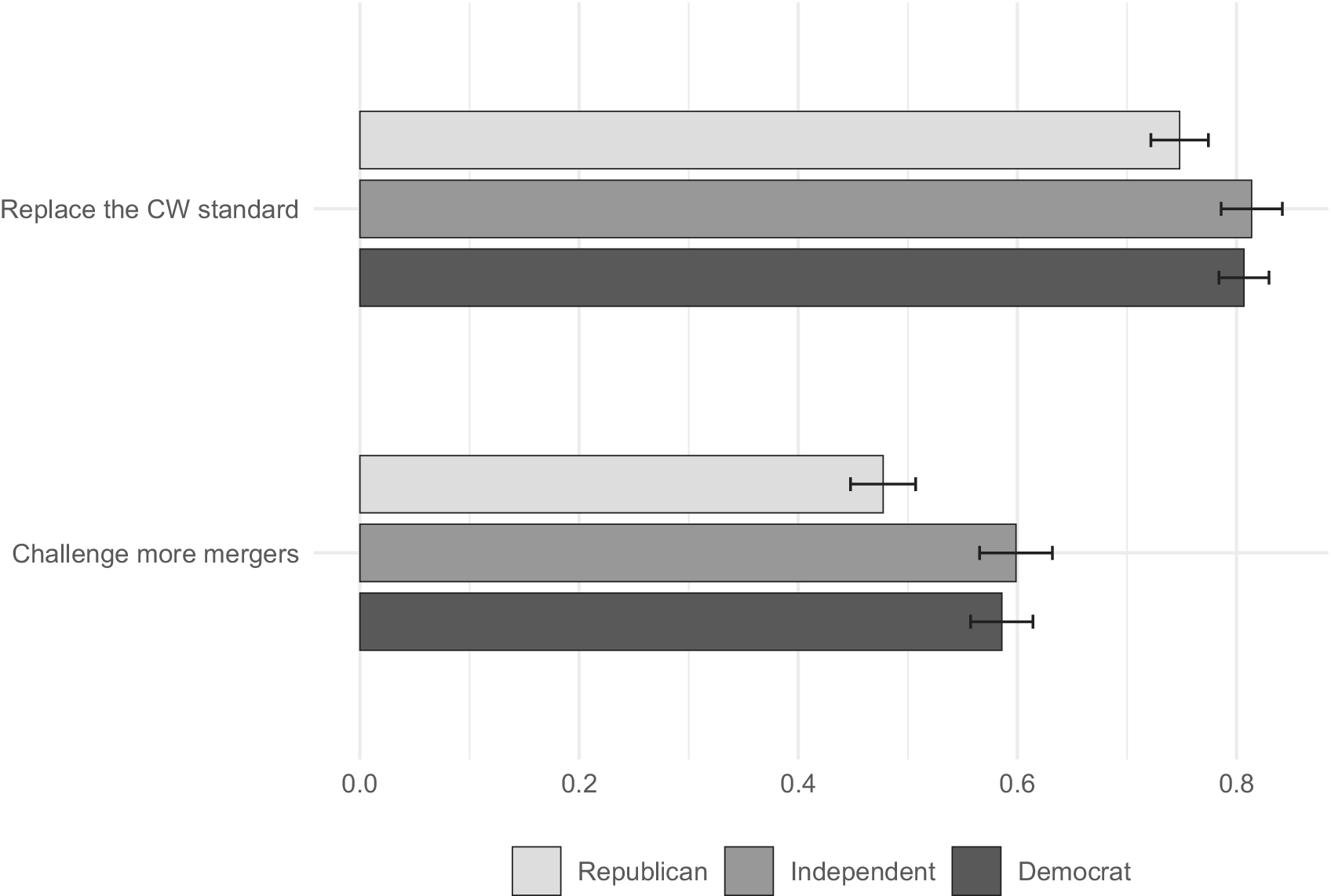
The results mostly support our hypothesis. As shown in figure 2, strong majorities of all partisan groups want the government to evaluate mergers with a standard that considers a wider range of effects on workers and local communities (80.6% of Democrats, 81.4% of independents, and 74.8% of Republicans). A majority of Democrats and independents (58.6% and 59.9%, respectively) also want the government to challenge more mergers; Republican support (47.7%) for challenging more mergers, though not quite a majority, is also quite high.Footnote 31
The Public Supports Replacing the CWS and Challenging More Mergers
Note: A majority of all major partisan groups in the public survey want the government to use a standard for evaluating mergers that gives equal weight to the impact on consumers, workers, small businesses, and local communities. A majority of Democrats and independents also want the government to challenge more mergers.

Figure 2 Long description
The chart features two main categories on the y-axis with three horizontal bars each. The x-axis represents a scale from 0.0 to 0.8.
Top Category: Replace the C W standard.
* Republican (light gray): Approximately 0.75.
* Independent (medium gray): Approximately 0.81.
* Democrat (dark gray): Approximately 0.80.
Bottom Category: Challenge more mergers.
* Republican (light gray): Approximately 0.48.
* Independent (medium gray): Approximately 0.60.
* Democrat (dark gray): Approximately 0.58.
Each bar includes a horizontal error bar indicating a margin of error. A legend at the bottom identifies the colors: light gray for Republican, medium gray for Independent, and dark gray for Democrat.
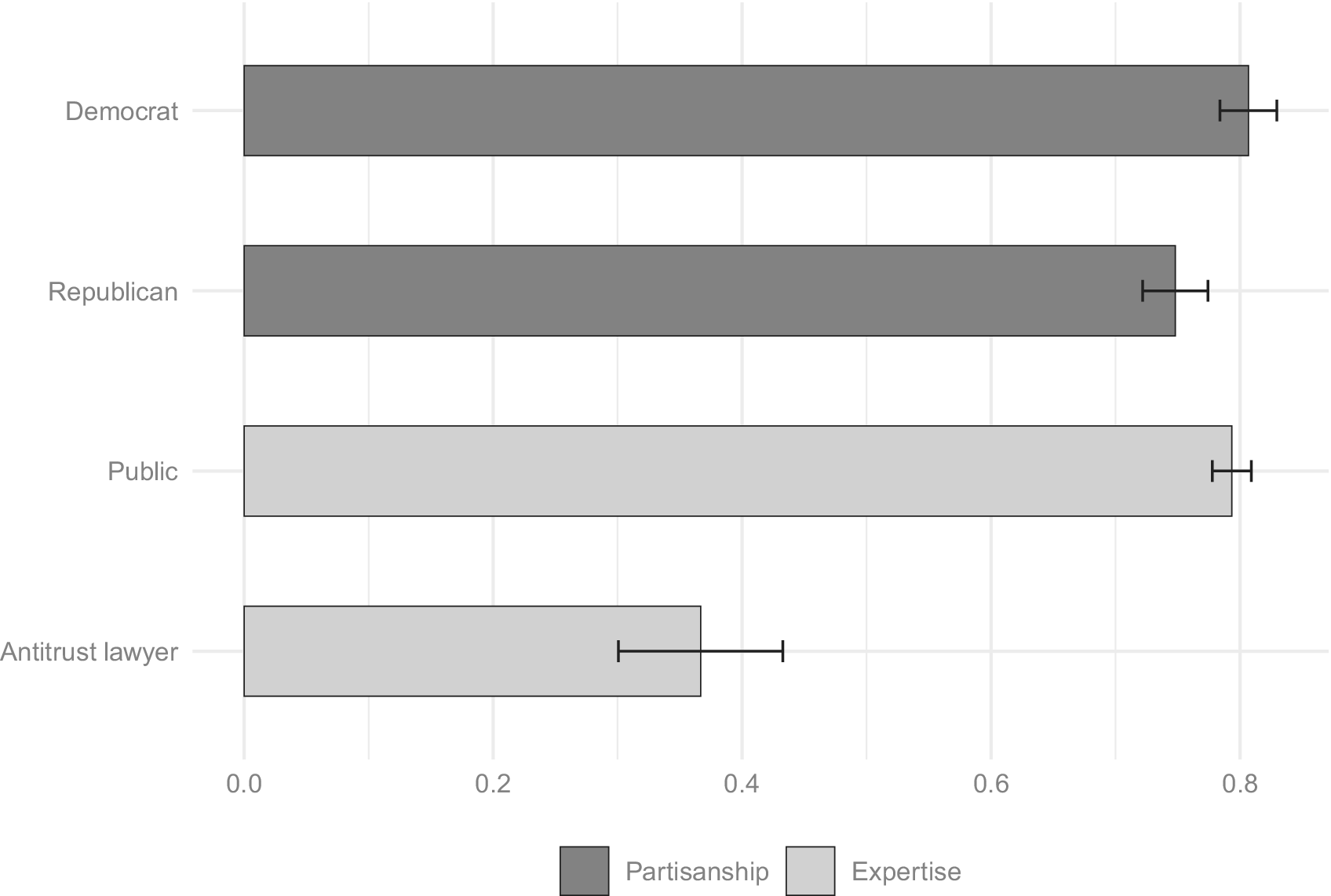
We also hypothesized that being an antitrust lawyer will have a larger independent effect than partisanship on antitrust policy preferences (hypothesis 6). Figure 3 illustrates the main finding, which confirms this hypothesis. The top two bars (in dark gray) reproduce the average support for replacing the CWS among Democrats and Republicans in the public survey (from the top of figure 2). The bottom two bars (in light gray) show the average support among the public and among antitrust lawyers in the combined survey. The partisan gap, of about 5.9 percentage points (p < 0.05), is significant but negligible in comparison to the dramatic gap between experts and the public (42.6 percentage points, p < 0.05). In this simple comparison, the effect of being an antitrust lawyer on policy preferences is, on average, seven times larger than the effect of changing partisanship from Democrat to Republican.
Expertise Outweighs Partisanship in Shaping Support for Replacing the CWS
Note: Average support for replacing the CWS is comparable between Democrats and Republicans, but dramatically different between lawyers and the public.

Figure 3 Long description
A horizontal bar chart with a Y-axis listing four groups and an X-axis ranging from 0.0 to 0.8.
Groups and Data Trends:
* Democrat: Dark gray bar extending to approximately 0.81 with a narrow error bar.
* Republican: Dark gray bar extending to approximately 0.75 with a narrow error bar.
* Public: Light gray bar extending to approximately 0.79 with a narrow error bar.
* Antitrust lawyer: Light gray bar extending to approximately 0.37 with a significantly wider error bar ranging from 0.3 to 0.43.
Legend and Scale:
* The legend at the bottom indicates dark gray represents Partisanship and light gray represents Expertise.
* The X-axis has major grid lines at intervals of 0.2.
* The chart shows that while partisan groups (Democrats and Republicans) have high and similar support levels, there is a large disparity between the general public and antitrust lawyers.
To put this finding in perspective, consider the following. Support for replacing the CWS is quite high even among those in the public survey who characterize themselves as strong Republicans (69.5%, n = 265) but is still about 12 percentage points lower than among those who characterize themselves as strong Democrats (81.5%, n = 290), using a conventional seven-point scale for measuring party identification. Average support for replacing the CWS among antitrust lawyers (36.7%, n = 103), in contrast, is more than 30 percentage points lower than among strong Republicans—even though our sample of antitrust lawyers skews heavily toward the political Left: Democrats make up only 28.2% of the public sample but make up 51.4% of the antitrust lawyer sample. Even in a sample dominated by Democrats, antitrust lawyers are dramatically more supportive of the status quo than the most conservative members of the public. These results are robust to controlling for differences arising from demographics in addition to partisan identification, as hypothesized (hypothesis 6) (online appendix F).Footnote 32
Importantly, this dramatic divergence between antitrust lawyers and the public is rooted in differences over the political values that influence preferences and which are implicated in law and economics ideology. Antitrust lawyers are not significantly different from the public in believing that business regulation is necessary to protect the public interest. As a form of placebo test, this suggests that the policy cleavage documented in figure 3 does not arise from different beliefs about the need for business regulation in general—beliefs that are extraneous to (and arguably prior to) acceptance of “law and economics” ideology during one’s professional training.Footnote 33 But antitrust lawyers are about 18 percentage points (p < 0.01) less likely to believe that large corporations have too much power and influence in the economy or that government is pretty much run by a few big interests, beliefs that are implicated in law and economics teaching.Footnote 34 Each of these beliefs significantly predicts public support for replacing the CWS (hypothesis 10) (online appendix G).
Evaluating the Benefits and Risks of Large Mergers
In many regulatory settings, public beliefs about how business conduct impacts society will have little probative value. To continue one of the examples above, we would not survey the public to understand whether lead is a carcinogen.Footnote 35 But questions such as this one—empirical questions amenable to hypothesis testing, however difficult—are not always the basis on which regulators build new standards. And on the more subjective questions that often influence rulemaking, public beliefs about policy effects can reveal whether the public believes expert assumptions to be true, or if they are skeptical that the regulatory policy works as intended.
In our setting, mergers approved under the CWS are supposed to deliver economic benefits, especially lower prices. But the most thorough empirical assessment of mergers to date indicates that mergers raise rather than lower prices on average (Kwoka Reference Kwoka2014), and the public may rightfully believe that these benefits seldom attain. An extensive law review literature also suggests that Congress intended the antitrust laws to address a much broader set of public concerns about the social and political risks associated with increasing market concentration (see, e.g., Fox Reference Fox2013). But no study of which we are aware has explored whether the public shares those concerns.Footnote 36
We hypothesized, first, that a majority of the public would disagree that mergers deliver various economic benefits (hypothesis 1) and we asked whether respondents agree or disagree, on a five-point scale, that mergers (1) make it easier for people to start new businesses (entrepreneurship), (2) increase the speed at which new technologies are developed (innovation), and lead to (3) higher quality or (4) lower prices on consumer products and services.Footnote 37
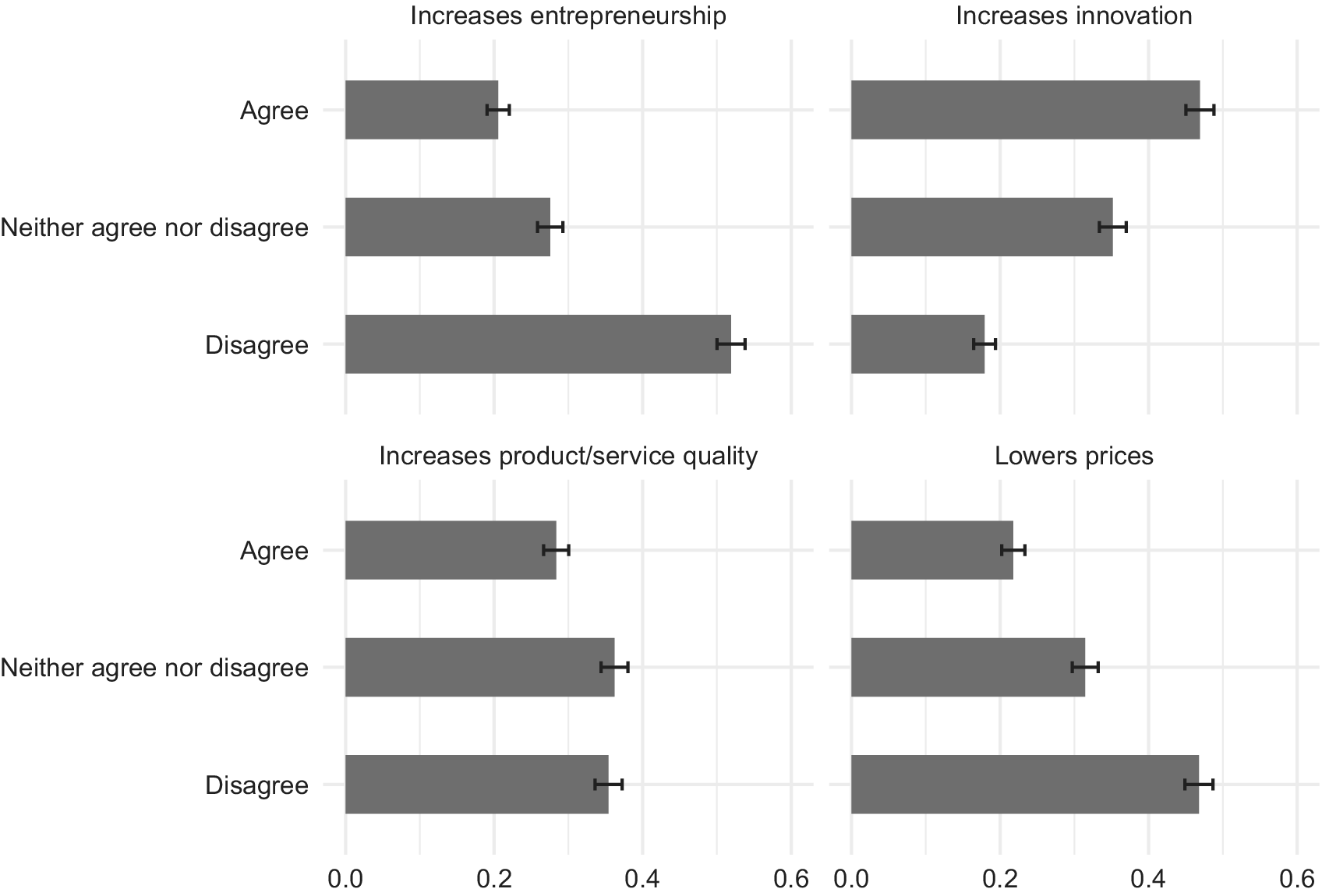
The results partially confirm the hypothesis, as shown in figure 4. In contrast to our hypothesis, a large share of respondents agree (rather than disagree) that mergers increase innovation (46.9%) and the share of respondents who disagree that mergers improve product and service quality is comparable to the share who took no position.
The Public Is Skeptical that Large Mergers Deliver Some Economic Benefits
Note: A plurality of the public disagrees that large mergers lower prices (their main purported benefit) or make it easier to start a new business but agrees that large mergers increase innovation. Respondents were less certain about the effect of large mergers on product quality.

Figure 4 Long description
The figure consists of four panels arranged in a two-by-two grid. Each panel shares a common Y-axis with three categories: Agree, Neither agree nor disagree, and Disagree. The X-axis represents a scale from 0.0 to 0.6. All bars include error bars indicating uncertainty.
* Top-Left Panel: Increases entrepreneurship. The Disagree bar is the longest at approximately 0.5. Neither agree nor disagree is at 0.28. Agree is the shortest at 0.2.
* Top-Right Panel: Increases innovation. The Agree bar is the longest at approximately 0.48. Neither agree nor disagree is at 0.35. Disagree is the shortest at 0.18.
* Bottom-Left Panel: Increases product forward slash service quality. All three bars are relatively similar in length. Neither agree nor disagree is slightly higher at 0.36, followed by Disagree at 0.35, and Agree at 0.28.
* Bottom-Right Panel: Lowers prices. The Disagree bar is the longest at approximately 0.46. Neither agree nor disagree is at 0.31. Agree is the shortest at 0.22.
However, more than a majority (51.9%) disagree that mergers increase entrepreneurship, consistent with our hypothesis. Also, 46.8% disagree that mergers lower prices, not quite high enough to accept our hypothesis, but still more than double the share who agree that mergers lower prices (21.8%).
Overall, the public is optimistic about the effect of mergers on innovation, uncertain about the effect on product and service quality, but skeptical that mergers make it easier for people to start new businesses or lower prices. These attitudes are consistent with prior surveys showing the public is suspicious of the view that mergers produce consumer benefits (online appendix I) and with empirical studies of real-world merger effects (Kwoka Reference Kwoka2014).
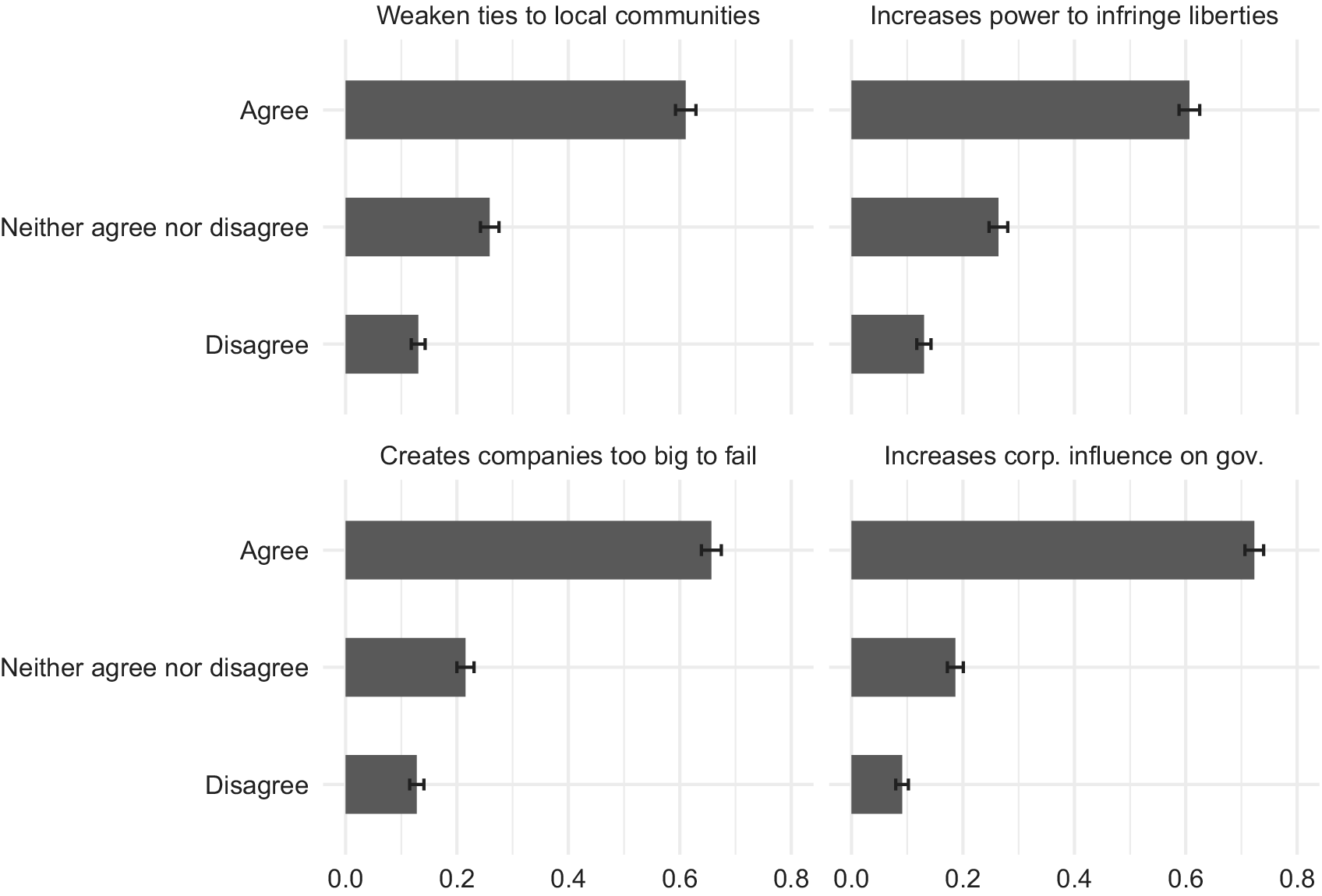
We also hypothesized that a majority of the public would agree that mergers produce undesirable social and political risks, even though these concerns are excluded from the CWS framework (hypothesis 3). To test this hypothesis, we asked whether respondents agree or disagree, on a five-point scale, that mergers (1) weaken the ties between companies and the local communities in which they operate, or create companies that (2) have too much power to infringe on individual liberties, like free speech or privacy; (3) are “too big to fail” and may have to be bailed out by the government; and (4) have too much influence in US politics.
The results support the hypothesis. As shown in figure 5, voters agree, by large margins, that mergers exacerbate these risks. About 72.3% believe mergers create companies that have too much influence in US politics, a share that is significantly higher than for the other three risks (p < 0.05). And 65.6% believe that mergers create companies that are “too big to fail” and may have to be bailed out by the government.Footnote 38 In this sense, the public’s dominant concerns do not focus on risks to individual liberties or local communities, but on risks to American democracy.
The Public Agrees that Large Mergers Have Significant Social Risks
Note: A majority of the public agree that large mergers weaken the ties between companies and local communities, create companies that are too big to fail, have too much power to infringe on individual liberties, and have too much influence in politics.

Figure 5 Long description
The figure consists of four horizontal bar charts. Each chart shares a common y-axis with three categories: Agree, Neither agree nor disagree, and Disagree. The x-axis represents a scale from 0.0 to 0.8. Each bar includes an error bar at its tip.
* Top-left panel: Weaken ties to local communities. The Agree bar reaches approximately 0.6. Neither agree nor disagree is at 0.25. Disagree is at 0.15.
* Top-right panel: Increases power to infringe liberties. The Agree bar reaches approximately 0.6. Neither agree nor disagree is at 0.25. Disagree is at 0.15.
* Bottom-left panel: Creates companies too big to fail. The Agree bar reaches approximately 0.65. Neither agree nor disagree is at 0.2. Disagree is at 0.15.
* Bottom-right panel: Increases corp. influence on gov. The Agree bar reaches approximately 0.7. Neither agree nor disagree is at 0.2. Disagree is at 0.1.
If, by virtue of their training or expertise, antitrust lawyers think about mergers through the ideological lens of the CWS, then they should differ from the public in assessing merger risks and benefits. Accordingly, we would expect antitrust lawyers to be much more sanguine about economic benefits and more skeptical about social and political risks. We therefore hypothesized that antitrust lawyers would be significantly more likely than the public to believe that mergers involving large companies produce economic benefits (hypothesis 2).Footnote 39
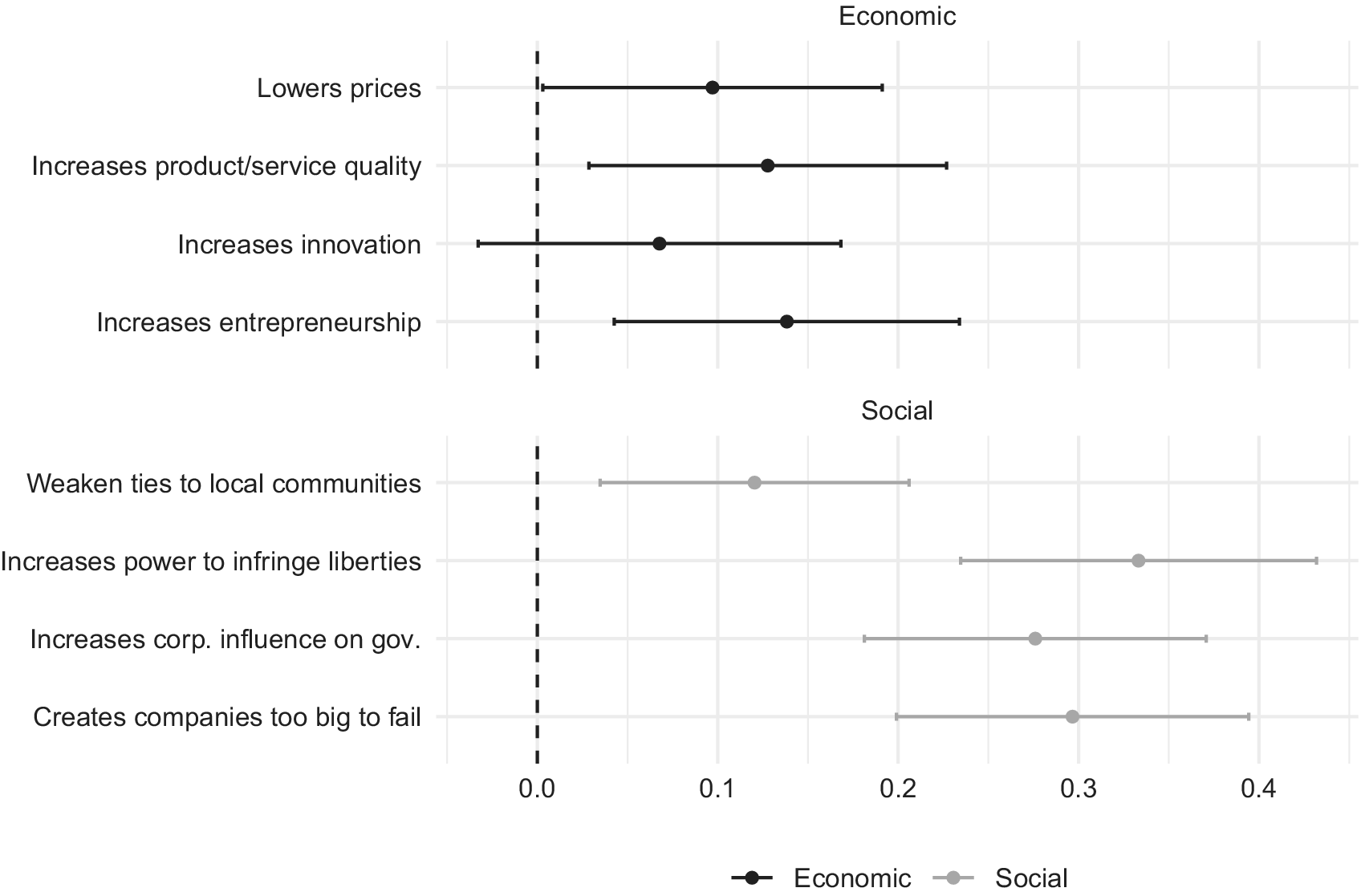
The results generally support this hypothesis.Footnote 40 A simple comparison of group means suggests that antitrust lawyers are more optimistic than the public about most economic benefits: antitrust lawyers are significantly more likely to agree that large mergers increase entrepreneurship (13.8 percentage points, p < 0.01), improve product or service quality (12.8 percentage points, p < 0.05), and lower prices (9.7 percentage points, p < 0.05). For this test, we regressed a binary variable indicating agreement that large mergers produce each economic benefit on a dummy variable indicating that the respondent is an antitrust lawyer. The top panel of figure 6 shows that the estimated coefficient for the antitrust lawyer variable in each regression is significantly different from zero, except on the question of whether mergers increase innovation.
Experts Assess Benefits and Risks Differently from the Public
Note: Antitrust lawyers are significantly different from the public in assessing the economic benefits and social and political risks of large mergers. Regression output in table A.12 in the online appendix.

Figure 6 Long description
A two-panel coefficient plot with a shared horizontal x-axis ranging from 0.0 to 0.4. A vertical dashed line marks the 0.0 baseline.
Top panel titled Economic. Contains four variables with black circular markers and horizontal error bars.
- Lowers prices. Marker at approximately 0.10.
- Increases product or service quality. Marker at approximately 0.13.
- Increases innovation. Marker at approximately 0.07.
- Increases entrepreneurship. Marker at approximately 0.14.
Bottom panel titled Social. Contains four variables with grey circular markers and horizontal error bars.
- Weaken ties to local communities. Marker at approximately 0.12.
- Increases power to infringe liberties. Marker at approximately 0.34.
- Increases corp. influence on gov. Marker at approximately 0.28.
- Creates companies too big to fail. Marker at approximately 0.30.
A legend at the bottom indicates black markers represent Economic and grey markers represent Social.
Antitrust lawyers are also significantly more likely than the public to disagree that large mergers produce social and political risks. The bottom panel of figure 6 shows the results of running similar regressions where the outcome is a binary variable indicating disagreement that mergers produce certain social risks. Compared to the public, antitrust lawyers are significantly more likely to disagree that large mergers create companies that have too much power to infringe on individual liberties (0.330, p < 0.001), are too big to fail (0.300, p < 0.001), and have too much influence in politics (0.276, p < 0.001). Each of these differences is significant and substantively large.Footnote 41
In sum, antitrust lawyers are, on average, much more sanguine that mergers produce economic benefits and much less wary about the possibility that mergers will generate social and political risks, compared to the public. The public is generally skeptical that the CWS works as intended; but the antitrust experts who work in this area are much less skeptical, even though the empirical assessment of these effects is unclear or favors the public perspective.
Conclusion
Scholars often invoke the term “ideological capture” but seldom define it or its relationship to the broader concept of regulatory capture (see, e.g., Chuang Reference Chuang2010). In this article, we provide a definition and specify a set of tools that scholars can use to identify whether, and to what extent, a regulatory framework evidences ideological capture, and whether that capture is normatively troubling. We validate our claims with a novel empirical study of American public opinion about antitrust enforcement policy. The results suggest that the main framework for evaluating anticompetitive conduct, the CWS, marginalizes important public concerns. Together with prior work showing that the standard did not arise from conventional processes for legal reform but from judicial and bureaucratic activism and a new analysis of public opinion about antitrust policy from the 1980s and 1990s, the evidence suggests that contemporary antitrust policy evidences a strong form of ideological capture.
Experts play an essential role in designing the regulatory frameworks that guide bureaucratic decision making. But with this privilege comes the potential for abuse. This potential emerges from two characteristics of American political institutions. First, it emerges from the unique role that the judiciary plays in setting regulatory standards in the US. Judges (who are also lawyers) are ideologically motivated actors who are insulated from public demands and, as the ultimate arbiter of congressional intent, they have the power to unilaterally specify legislative objectives and regulatory frameworks. Second, experts play an essential role in designing the frameworks that guide regulatory decision making, and these ideological perspectives often make strong assumptions about what is, or is not, in the “public interest.” Experts can and do use this privilege to develop frameworks that emphasize some concerns while minimizing others. Ideological capture emanates, in our view, from these two sources of structural power.
Though we have focused on a somewhat technocratic issue to illustrate our main arguments, we suspect ideological capture is pervasive in American government. The law and economics movements (and neoliberal thought, more broadly) influenced policy in many domains from criminal sentencing to regulatory cost-benefit analysis, where regulators routinely estimate the dollar value of human life (Viscusi Reference Viscusi2018). And there is reason to believe ideological capture exists in settings far beyond the law and economics movement. Prior work suggests, for example, that the law and economics movement arose as a countermobilization to a similar movement among liberal elites that leveraged the power of liberal judges, academics, and lawyers to stymie conservatives even when they won elections (Teles Reference Teles2008). Teles (Reference Teles2008, 3) claims, for example, “that changes in the form of political competition over the past half-century, especially the increasing importance of ideas and professional power, have led to a decline in the power of elections to cause comprehensive change, especially in highly entrenched political domains.”
If that is true, then significant amounts of policy stasis may arise not from typical sources, like the complex distribution of power in American government, but from ideological retrenchment among those professionals who play an outsized role in designing and enforcing laws and regulations. Whether we observe ideological capture in other domains and whether it has increased over time are therefore important empirical questions that scholars can explore in future work. The answers may change the way we think about power and influence in the American political economy and the ability of elections to advance the public interest.
Supplementary material
To view supplementary material for this article, please visit http://doi.org/10.1017/S153759272510323X.
Acknowledgments
The authors would like to thank participants of the American Politics Research Workshop at Harvard University and additional workshops held at the Center for Law and Economics at ETH-Zürich and at the Technical University of Munich. We especially want to acknowledge our discussants, Brian Highsmith and Felippo Lancieri, for their detailed and thoughtful critiques. This research was funded with advertising credits from Meta, Inc., and a grant from the Institute for Quantitative Social Science at Harvard University.
Data Replication
Data replication sets are available in Harvard Dataverse at: https://doi.org/10.7910/DVN/GW7WKI




 Open access

