





1 Introduction
The relationship between nonnegative polynomials and sums of squares is a fundamental problem in real algebraic geometry. Much is now known about the constructions and the existence of nonnegative polynomials that are not sums of squares (of polynomials) [Reference Choi and Lam14, Reference Reznick35, Reference Reznick39, Reference Blekherman3, Reference Blekherman, Iliman and Kubitzke6, Reference Brugallé, Degtyarev, Itenberg and Mangolte7]. Decomposing $P^k$
as a sum of squares, where k is an odd integer, also provides a certificate of nonnegativity of P, and it is reasonable to ask whether this works for all nonnegative polynomials P. We initiate a systematic study of nonnegative polynomials P such that
$P^k$
as a sum of squares, where k is an odd integer, also provides a certificate of nonnegativity of P, and it is reasonable to ask whether this works for all nonnegative polynomials P. We initiate a systematic study of nonnegative polynomials P such that $P^k$
is not a sum of squares for any odd positive integer k. We call such polynomials stubborn. Currently not much is known about stubborn polynomials, except for some isolated examples. One of our main results is that all extreme rays of the convex cone of nonnegative ternary sextics (homogeneous polynomials in
$P^k$
is not a sum of squares for any odd positive integer k. We call such polynomials stubborn. Currently not much is known about stubborn polynomials, except for some isolated examples. One of our main results is that all extreme rays of the convex cone of nonnegative ternary sextics (homogeneous polynomials in $3$
variables of degree
$3$
variables of degree $6$
) are stubborn. More generally, for a nonnegative ternary form P we develop a new invariant
$6$
) are stubborn. More generally, for a nonnegative ternary form P we develop a new invariant $\delta ^{\,\textrm {sos}}$
of real singularities of P, which we call a sum of squares invariant or SOS-invariant, such that if the sum of
$\delta ^{\,\textrm {sos}}$
of real singularities of P, which we call a sum of squares invariant or SOS-invariant, such that if the sum of $\delta ^{\,\textrm {sos}}$
over all real singularities of P is sufficiently large, then P is stubborn. This implies the result for ternary sextics, and allows us to construct stubborn forms in higher degrees. We compare the SOS-invariant to the classical delta invariant of a plane curve singularity, and show that they agree for singularities of multiplicity
$\delta ^{\,\textrm {sos}}$
over all real singularities of P is sufficiently large, then P is stubborn. This implies the result for ternary sextics, and allows us to construct stubborn forms in higher degrees. We compare the SOS-invariant to the classical delta invariant of a plane curve singularity, and show that they agree for singularities of multiplicity $2$
, but are not equal in general. We show that stubborn forms exist, for a fixed degree and number of variables, whenever nonnegative forms are not equal to sums of squares. We also prove that the set of nonnegative forms that are not stubborn is a convex cone, which includes the interior of the cone of nonnegative forms. We now go into more details and review the history of the problem.
$2$
, but are not equal in general. We show that stubborn forms exist, for a fixed degree and number of variables, whenever nonnegative forms are not equal to sums of squares. We also prove that the set of nonnegative forms that are not stubborn is a convex cone, which includes the interior of the cone of nonnegative forms. We now go into more details and review the history of the problem.
For positive integers $n, d$
, let
$n, d$
, let $F_{n,d}$
denote the space of real forms (homogeneous polynomials) of degree d in n variables. We note that for analyzing questions about nonnegativity and sums of squares it suffices to consider homogeneous polynomials, as homogenization and dehomogenization preserve the properties of being nonnegative and being a sum of squares. From now on we will work with forms. A form
$F_{n,d}$
denote the space of real forms (homogeneous polynomials) of degree d in n variables. We note that for analyzing questions about nonnegativity and sums of squares it suffices to consider homogeneous polynomials, as homogenization and dehomogenization preserve the properties of being nonnegative and being a sum of squares. From now on we will work with forms. A form $P\in F_{n,d}$
is said to be nonnegative if
$P\in F_{n,d}$
is said to be nonnegative if $P(\mathbf {X})\geq 0$
for any
$P(\mathbf {X})\geq 0$
for any $\mathbf {X}\in \mathbb {R}^n$
. If
$\mathbf {X}\in \mathbb {R}^n$
. If $P(\mathbf {X})>0$
for all
$P(\mathbf {X})>0$
for all $\mathbf {X}\neq \mathbf {0}$
, then P is called strictly positive. If
$\mathbf {X}\neq \mathbf {0}$
, then P is called strictly positive. If $P=H_1^2+\dots +H_r^2$
for some
$P=H_1^2+\dots +H_r^2$
for some $H_1,\dots , H_r\in F_{n,d/2}$
of degree
$H_1,\dots , H_r\in F_{n,d/2}$
of degree $d/2$
, then P is said to be a sum of squares. Trivially, every sum of squares is nonnegative and the degree d of a nonnegative form must be even. Following Choi and Lam [Reference Choi and Lam13], let
$d/2$
, then P is said to be a sum of squares. Trivially, every sum of squares is nonnegative and the degree d of a nonnegative form must be even. Following Choi and Lam [Reference Choi and Lam13], let $P_{n,d}$
and
$P_{n,d}$
and $\Sigma _{n,d}$
denote the closed convex cones of nonnegative forms and, respectively, sum of squares forms in
$\Sigma _{n,d}$
denote the closed convex cones of nonnegative forms and, respectively, sum of squares forms in $F_{n,d}$
. The interior
$F_{n,d}$
. The interior $\textrm {int}(P_{n,d})$
of
$\textrm {int}(P_{n,d})$
of $P_{n,d}$
consists exactly of strictly positive forms of degree d. Let
$P_{n,d}$
consists exactly of strictly positive forms of degree d. Let $\Delta _{n,d}:=P_{n,d}\setminus \Sigma _{n,d}$
be the difference of the two cones. Hilbert [Reference Hilbert23] proved that
$\Delta _{n,d}:=P_{n,d}\setminus \Sigma _{n,d}$
be the difference of the two cones. Hilbert [Reference Hilbert23] proved that $\Delta _{n,d} \neq \emptyset $
if and only if
$\Delta _{n,d} \neq \emptyset $
if and only if $n \ge 3$
and
$n \ge 3$
and $d \ge 6$
or
$d \ge 6$
or $n \ge 4$
and
$n \ge 4$
and $d \ge 4$
, see Figure 3. The ternary sextic Motzkin form
$d \ge 4$
, see Figure 3. The ternary sextic Motzkin form $M\in F_{3,6}$
,
$M\in F_{3,6}$
,
 $$ \begin{align} M\ =\ X_1^4X_2^2 +X_1^2X_2^4 + X_3^6 - 3X_1^2X_2^2X_3^2, \end{align} $$
was the first explicit example of a nonnegative form that is not a sum of squares [Reference Motzkin27]. Another early example of a form in $\Delta _{3,6}$
was
$\Delta _{3,6}$
was
 $$ \begin{align}\begin{aligned} R\ =&\ X_1^6 +X_2^6 + X_3^6 + 3X_1^2X_2^2X_3^2\\ &- (X_1^4X_2^2 + X_1^2X_2^4+X_1^4X_3^2+X_1^2X_3^4+X_2^4X_3^2+ X_2^2X_3^4), \end{aligned}\end{align} $$
found by Robinson in [Reference Robinson40].
Hilbert’s 17th Problem asks whether, for $P \in P_{n,d}$
, there exists Q in some
$P \in P_{n,d}$
, there exists Q in some $F_{n,d'}$
so that
$F_{n,d'}$
so that $Q^2P \in \Sigma _{n,d+2d'}$
. In 1927 Artin [Reference Artin1] solved this problem in the affirmative, even in a more general setting of real closed fields. In equivalent terms, any nonnegative form can be written as a sum of squares of rational functions. Later, multiple authors studied variations of Hilbert’s 17th problem [Reference Pólya31, Reference Habicht20, Reference Delzell17, Reference Reznick37]. In particular, for a nonnegative form Q it was desirable to know whether for all
$Q^2P \in \Sigma _{n,d+2d'}$
. In 1927 Artin [Reference Artin1] solved this problem in the affirmative, even in a more general setting of real closed fields. In equivalent terms, any nonnegative form can be written as a sum of squares of rational functions. Later, multiple authors studied variations of Hilbert’s 17th problem [Reference Pólya31, Reference Habicht20, Reference Delzell17, Reference Reznick37]. In particular, for a nonnegative form Q it was desirable to know whether for all $P\in P_{n,d}$
the form
$P\in P_{n,d}$
the form $PQ^k$
is a sum of squares for some large
$PQ^k$
is a sum of squares for some large $k\geq 1$
. This question is two-fold. For a fixed P one can consider it as a strengthening of the Hilbert’s 17th problem, as the denominator is constrained to be a power of a fixed polynomial Q. On the other hand, taking
$k\geq 1$
. This question is two-fold. For a fixed P one can consider it as a strengthening of the Hilbert’s 17th problem, as the denominator is constrained to be a power of a fixed polynomial Q. On the other hand, taking $P=1$
and allowing only odd k, one tries to represent some odd power of Q as a sum of squares. Reznick showed [Reference Reznick36] that any strictly positive form P multiplied by a large enough power
$P=1$
and allowing only odd k, one tries to represent some odd power of Q as a sum of squares. Reznick showed [Reference Reznick36] that any strictly positive form P multiplied by a large enough power $Q^k$
for
$Q^k$
for $Q=X_1^2+\dots +X_n^2$
is a sum of squares (this does not hold for all nonnegative forms P [Reference Reznick38]). More generally, Scheiderer proved [Reference Scheiderer42] that if
$Q=X_1^2+\dots +X_n^2$
is a sum of squares (this does not hold for all nonnegative forms P [Reference Reznick38]). More generally, Scheiderer proved [Reference Scheiderer42] that if $Q \in \textrm {int}(P_{n,d'})$
and
$Q \in \textrm {int}(P_{n,d'})$
and $P\in \textrm {int}(P_{n,d})$
are two strictly positive forms, then
$P\in \textrm {int}(P_{n,d})$
are two strictly positive forms, then $PQ^k\in \Sigma _{n,d+d'k}$
is a sum of squares for all sufficiently large k. Thus, if
$PQ^k\in \Sigma _{n,d+d'k}$
is a sum of squares for all sufficiently large k. Thus, if $P\in \textrm {int}(P_{n,d})$
is strictly positive, then
$P\in \textrm {int}(P_{n,d})$
is strictly positive, then $P^k\in \Sigma _{n,kd}$
is a sum of squares for all sufficiently large k. In the present work we study this property for non-sum of squares forms
$P^k\in \Sigma _{n,kd}$
is a sum of squares for all sufficiently large k. In the present work we study this property for non-sum of squares forms $P\in \partial P_{n,d}$
in the boundary of the cone of nonnegative forms. Being a square, an even power
$P\in \partial P_{n,d}$
in the boundary of the cone of nonnegative forms. Being a square, an even power $P^{2k}=(P^k)^2\in \Sigma _{n,2kd}$
of P is a sum of squares. We say that P admits an odd sum of squares power, if
$P^{2k}=(P^k)^2\in \Sigma _{n,2kd}$
of P is a sum of squares. We say that P admits an odd sum of squares power, if $P^{2k+1}\in \Sigma _{n,(2k+1)d}$
is a sum of squares for some
$P^{2k+1}\in \Sigma _{n,(2k+1)d}$
is a sum of squares for some $k\geq 0$
. Otherwise, the form
$k\geq 0$
. Otherwise, the form $P\in \partial P_{n,d}$
will be called stubborn.
$P\in \partial P_{n,d}$
will be called stubborn.
A nonnegative form $P\in P_{n,d}$
is said to be extremal, if it spans an extreme ray of the cone
$P\in P_{n,d}$
is said to be extremal, if it spans an extreme ray of the cone $P_{n,d}$
. The set of extremal forms in
$P_{n,d}$
. The set of extremal forms in $P_{n,d}$
is denoted by
$P_{n,d}$
is denoted by $\mathcal {E}(P_{n,d})$
. When
$\mathcal {E}(P_{n,d})$
. When $P\in \mathcal {E}(P_{n,d})$
spans an exposed extreme ray, we say that P is an exposed extremal form. The Motzkin form (1.1) is an example of a non-exposed extremal form in
$P\in \mathcal {E}(P_{n,d})$
spans an exposed extreme ray, we say that P is an exposed extremal form. The Motzkin form (1.1) is an example of a non-exposed extremal form in $P_{3,6}$
(see [Reference Choi and Lam14, p.
$P_{3,6}$
(see [Reference Choi and Lam14, p. $8$
], [Reference Reznick34, Thm.
$8$
], [Reference Reznick34, Thm. $5$
] and the proof of [Reference Blekherman, Hauenstein, Ottem, Ranestad and Sturmfels4, Thm.
$5$
] and the proof of [Reference Blekherman, Hauenstein, Ottem, Ranestad and Sturmfels4, Thm. $2$
]), while the Robinson form (1.2) is an exposed extremal ternary sextic (see [Reference Choi and Lam13, Thm.
$2$
]), while the Robinson form (1.2) is an exposed extremal ternary sextic (see [Reference Choi and Lam13, Thm. $3.8$
]). In [Reference Choi and Lam13, Reference Choi and Lam14] Choi and Lam also studied the following ternary sextic and quaternary quartic:
$3.8$
]). In [Reference Choi and Lam13, Reference Choi and Lam14] Choi and Lam also studied the following ternary sextic and quaternary quartic:
 $$ \begin{align} \begin{aligned} S\ &=\ X_1^4X_2^2+X_2^4X_3^2+X_3^4X_1^2-3X_1^2X_2^2X_3^2,\\ Q\ &=\ X_4^4+X_1^2X_2^2+X_1^2X_3^2+X_2^2X_3^2-4X_1X_2X_3X_4. \end{aligned} \end{align} $$
They showed that $S\in \Delta _{3,6}$
,
$S\in \Delta _{3,6}$
, $Q\in \Delta _{4,4}$
are non-sum of squares extremal nonnegative forms. In 1979 Stengle [Reference Stengle44] proved that the ternary sextic
$Q\in \Delta _{4,4}$
are non-sum of squares extremal nonnegative forms. In 1979 Stengle [Reference Stengle44] proved that the ternary sextic
 $$ \begin{align} \begin{aligned} T\ =\ X_1^3X_3^3 + (X_2^2X_3 - X_1^3 - X_1X_3^2)^2 \end{aligned} \end{align} $$
is stubborn. The paper [Reference Stengle44] reports that Reznick had proved that S is stubborn by a different argument. In 1982, Choi, Dai, Lam and Reznick [Reference Choi, Dai, Lam and Reznick12] cited Stengle’s example (1.4) and claimed the same property for M instead of S. No proofs for M or S were given at the time. In Subsection 3.4 we include this earlier proof of the fact that M is stubborn.
This work was in particular motivated by a query from Jim McEnerney about references for these claimed results. In his talk at the Conference on Applied Algebraic Geometry (AG23) held in Eindhoven in July 2023, Reznick posed a conjecture that all extremal forms in $\Delta _{3,6}$
are stubborn. In the present work we settle this conjecture.
$\Delta _{3,6}$
are stubborn. In the present work we settle this conjecture.
Theorem 1.1. Let $P\in \mathcal {E}(P_{3,6})\cap \Delta _{3,6}$
be an extremal nonnegative ternary sextic which is not a sum of squares. Then P is stubborn, that is,
$P\in \mathcal {E}(P_{3,6})\cap \Delta _{3,6}$
be an extremal nonnegative ternary sextic which is not a sum of squares. Then P is stubborn, that is, $P^{2k+1}\in \Delta _{3,6(2k+1)}$
is not a sum of squares for
$P^{2k+1}\in \Delta _{3,6(2k+1)}$
is not a sum of squares for $k\geq 0$
.
$k\geq 0$
.
As a direct consequence of this result we have the following.
Corollary 1.2. The forms M, R and S are all stubborn, that is, $M^{2k+1}, R^{2k+1}, S^{2k+1} \in \Delta _{3,6(2k+1)}$
are not sums of squares for all
$M^{2k+1}, R^{2k+1}, S^{2k+1} \in \Delta _{3,6(2k+1)}$
are not sums of squares for all $k\geq 0$
.
$k\geq 0$
.
Remark 1.3. Theorem 1.1 does not imply Stengle’s result above, as the ternary sextic $T\in \Delta _{3,6}$
is not extremal (see Subsection 3.5). Furthermore, by a result of Scheiderer [Reference Scheiderer42] that we stated above, all sufficiently large powers
$T\in \Delta _{3,6}$
is not extremal (see Subsection 3.5). Furthermore, by a result of Scheiderer [Reference Scheiderer42] that we stated above, all sufficiently large powers $P^{2k+1}$
of a strictly positive form
$P^{2k+1}$
of a strictly positive form $P\in \textrm{{int}}(P_{n,d})$
are sums of squares.
$P\in \textrm{{int}}(P_{n,d})$
are sums of squares.
More generally, we develop a new invariant of a real zero of a nonnegative ternary form, that we call the SOS-invariant. It can be compared to the classical delta invariant of a plane curve singularity (see Subsection 2.3). The main idea is that if the sum of SOS-invariants of $P\in P_{3,d}$
over all its real zeros is too large (specifically, greater than
$P\in P_{3,d}$
over all its real zeros is too large (specifically, greater than $d^2/4$
), then P must be stubborn, see Theorem 3.10. This happens, for example, for extremal ternary sextics in
$d^2/4$
), then P must be stubborn, see Theorem 3.10. This happens, for example, for extremal ternary sextics in $\Delta _{3,6}$
. For higher degrees such forms exist due to results of Brugallé et al. from [Reference Brugallé, Degtyarev, Itenberg and Mangolte7]. However, Theorem 1.1 does not admit a direct generalization, as no characterization of extremal forms in
$\Delta _{3,6}$
. For higher degrees such forms exist due to results of Brugallé et al. from [Reference Brugallé, Degtyarev, Itenberg and Mangolte7]. However, Theorem 1.1 does not admit a direct generalization, as no characterization of extremal forms in $P_{n,d}$
in terms of the number of real zeros is known except for
$P_{n,d}$
in terms of the number of real zeros is known except for $(n,d) = (3,6)$
.
$(n,d) = (3,6)$
.
By regarding a form $P\in P_{3,d}\subset P_{n,d}$
with more than
$P\in P_{3,d}\subset P_{n,d}$
with more than $d^2/4$
real zeros as a form in
$d^2/4$
real zeros as a form in $n\geq 4$
variables we show that stubborn forms exist in arbitrary number of variables, see Theorem 4.2. In Section 4 we also show that the quaternary quartic
$n\geq 4$
variables we show that stubborn forms exist in arbitrary number of variables, see Theorem 4.2. In Section 4 we also show that the quaternary quartic $Q\in \Delta _{4,4}$
defined in (1.3) and the Horn form
$Q\in \Delta _{4,4}$
defined in (1.3) and the Horn form $F\in \Delta _{5,4}$
:
$F\in \Delta _{5,4}$
:
 $$ \begin{align} F\ =\ \left(\sum_{j=1}^5 X_j^2\right)^2 - 4\ \sum_{j=1}^5 X_j^2X_{j+1}^2, \end{align} $$
are both stubborn.
Remark 1.4. The Horn form was originally defined as a quadric in $X_1^2,\dots , X_5^2$
. It was communicated to Hall by Horn in the early 1960s, as a counterexample to a conjecture of Diananda asserting that a quadratic form that is nonnegative on the nonnegative orthant is a sum of a nonnegative form and a quadratic form with nonnegative coefficients only (see [Reference Diananda18, p.25] and [Reference Hall and Newman21, p.334-5]).
$X_1^2,\dots , X_5^2$
. It was communicated to Hall by Horn in the early 1960s, as a counterexample to a conjecture of Diananda asserting that a quadratic form that is nonnegative on the nonnegative orthant is a sum of a nonnegative form and a quadratic form with nonnegative coefficients only (see [Reference Diananda18, p.25] and [Reference Hall and Newman21, p.334-5]).
In Section 5 we initiate a systematic study of the set of non-stubborn forms that admit odd sums of squares powers. For $k\geq 0$
let us define
$k\geq 0$
let us define
 $$ \begin{align} \Sigma_{n,d}(2k+1)\ =\ \left\{P \in P_{n,d} \, :\, P^{2k+1} \in \Sigma_{n,d(2k+1)} \right\}. \end{align} $$
Note that $\Sigma _{n,d}(1) = \Sigma _{n,d}$
and, since
$\Sigma _{n,d}(1) = \Sigma _{n,d}$
and, since $P^{2k+3} = P^{2k+1}\cdot P^2$
, we have the inclusion
$P^{2k+3} = P^{2k+1}\cdot P^2$
, we have the inclusion $\Sigma _{n,d}(2k+1) \subseteq \Sigma _{n,d}(2k+3)$
and so it makes sense to define
$\Sigma _{n,d}(2k+1) \subseteq \Sigma _{n,d}(2k+3)$
and so it makes sense to define
 $$ \begin{align} \Sigma_{n,d}(\infty)\ =\ \bigcup_{k\,\geq\, 0} \Sigma_{n,d}(2k+1). \end{align} $$
Let $\Delta _{n,d}(\infty )=P_{n,d}\setminus \Sigma _{n,d}(\infty )$
denote the set of stubborn forms in
$\Delta _{n,d}(\infty )=P_{n,d}\setminus \Sigma _{n,d}(\infty )$
denote the set of stubborn forms in $P_{n,d}$
. With these notations, we have that
$P_{n,d}$
. With these notations, we have that $M, R, S, T \in \Delta _{3,6}(\infty )$
,
$M, R, S, T \in \Delta _{3,6}(\infty )$
, $Q\in \Delta _{4,4}(\infty )$
and
$Q\in \Delta _{4,4}(\infty )$
and $F\in \Delta _{5,4}(\infty )$
. Since
$F\in \Delta _{5,4}(\infty )$
. Since $\Sigma _{n,d}$
and
$\Sigma _{n,d}$
and $P_{n,d}$
are closed convex cones, it is natural to ask whether this is also true for
$P_{n,d}$
are closed convex cones, it is natural to ask whether this is also true for $\Sigma _{n,d}(2k+1)$
and
$\Sigma _{n,d}(2k+1)$
and $\Sigma _{n,d}(\infty )$
.
$\Sigma _{n,d}(\infty )$
.
First observe that if $(P_i) \subset \Sigma _{n,d}(2k+1)$
is a sequence of forms converging to
$(P_i) \subset \Sigma _{n,d}(2k+1)$
is a sequence of forms converging to $P=\lim _{i\rightarrow \infty } P_i$
, then the sequence of powers
$P=\lim _{i\rightarrow \infty } P_i$
, then the sequence of powers $(P_i^{2k+1})\subset \Sigma _{n,d(2k+1)}$
converges to
$(P_i^{2k+1})\subset \Sigma _{n,d(2k+1)}$
converges to $P^{2k+1}=\lim _{i\rightarrow \infty } P^{2k+1}_i$
, which by closedness of the sums of squares cone means that
$P^{2k+1}=\lim _{i\rightarrow \infty } P^{2k+1}_i$
, which by closedness of the sums of squares cone means that $P\in \Sigma _{n,d}(2k+1)$
and so
$P\in \Sigma _{n,d}(2k+1)$
and so $\Sigma _{n,d}(2k+1)$
is closed. It is unclear whether
$\Sigma _{n,d}(2k+1)$
is closed. It is unclear whether $\Sigma _{n,d}(2k+1)$
is convex when
$\Sigma _{n,d}(2k+1)$
is convex when $k>0$
. That is, if
$k>0$
. That is, if $P_1^{2k+1}$
and
$P_1^{2k+1}$
and $P_2^{2k+1}$
are sums of squares, must
$P_2^{2k+1}$
are sums of squares, must $(P_1+P_2)^{2k+1}$
be a sum of squares as well? We prove in Theorem 5.1 that if
$(P_1+P_2)^{2k+1}$
be a sum of squares as well? We prove in Theorem 5.1 that if $P_1^{2k+1} $
is a sum of squares and
$P_1^{2k+1} $
is a sum of squares and $P_2$
is a sum of squares, then
$P_2$
is a sum of squares, then $(P_1+P_2)^{2k+1}$
is a sum of squares. This is a special case of the more general Theorem 5.3, which in particular yields convexity of
$(P_1+P_2)^{2k+1}$
is a sum of squares. This is a special case of the more general Theorem 5.3, which in particular yields convexity of $\Sigma _{n,d}(\infty )$
. Note however that
$\Sigma _{n,d}(\infty )$
. Note however that $\Sigma _{n,d}(\infty )$
is not closed, when
$\Sigma _{n,d}(\infty )$
is not closed, when $\Delta _{n,d}(\infty ) \neq \emptyset $
, that is, if
$\Delta _{n,d}(\infty ) \neq \emptyset $
, that is, if $\Delta _{n,d}\neq \emptyset $
(cf. Theorem 4.2). Indeed, a form
$\Delta _{n,d}\neq \emptyset $
(cf. Theorem 4.2). Indeed, a form $P\in \Delta _{n,d}(\infty )=P_{n,d}\setminus \Sigma _{n,d}(\infty )$
lies in the closure of the open cone
$P\in \Delta _{n,d}(\infty )=P_{n,d}\setminus \Sigma _{n,d}(\infty )$
lies in the closure of the open cone $\textrm {int}(P_{n,d}) \subset \Sigma _{n,d}(\infty )$
of strictly positive forms, each of which admits an odd power which is a sum of squares by [Reference Scheiderer42]. Thus, the Motzkin form (1.1) can be obtained as the limit
$\textrm {int}(P_{n,d}) \subset \Sigma _{n,d}(\infty )$
of strictly positive forms, each of which admits an odd power which is a sum of squares by [Reference Scheiderer42]. Thus, the Motzkin form (1.1) can be obtained as the limit $M=\lim _{\varepsilon \rightarrow 0+} M_\varepsilon $
, where
$M=\lim _{\varepsilon \rightarrow 0+} M_\varepsilon $
, where $ M_\varepsilon = M + \varepsilon (X_1^2 + X_2^2 + X_3^2)^3$
is strictly positive for
$ M_\varepsilon = M + \varepsilon (X_1^2 + X_2^2 + X_3^2)^3$
is strictly positive for $\varepsilon>0$
. By Theorem 5.1, we see that
$\varepsilon>0$
. By Theorem 5.1, we see that $\{ \varepsilon \geq 0: M_\varepsilon \in \Sigma _{3,6}(2k+1)\}$
is an interval of the form
$\{ \varepsilon \geq 0: M_\varepsilon \in \Sigma _{3,6}(2k+1)\}$
is an interval of the form $[\beta _{2k+1},\infty )$
for some
$[\beta _{2k+1},\infty )$
for some $\beta _{2k+1}>0$
. The coefficient of
$\beta _{2k+1}>0$
. The coefficient of $X_1^2X_2^2X_3^2$
in
$X_1^2X_2^2X_3^2$
in $M_\varepsilon $
is
$M_\varepsilon $
is $-3+6\varepsilon $
, so
$-3+6\varepsilon $
, so $\beta _1 \le \frac 12$
. Furthermore, one has
$\beta _1 \le \frac 12$
. Furthermore, one has $\beta _1\geq \beta _3\geq \beta _5\geq \dots $
and
$\beta _1\geq \beta _3\geq \beta _5\geq \dots $
and $\lim _{k\rightarrow \infty }\beta _{2k+1} = 0$
. Thus, there are infinitely many k so that
$\lim _{k\rightarrow \infty }\beta _{2k+1} = 0$
. Thus, there are infinitely many k so that $\Sigma _{3,6}(2k+1) \subsetneq \Sigma _{3,6}(2k+3) $
. We strongly believe that this is true for all
$\Sigma _{3,6}(2k+1) \subsetneq \Sigma _{3,6}(2k+3) $
. We strongly believe that this is true for all $k\geq 0$
.
$k\geq 0$
.
Remark 1.5. As the property of being nonnegative or a sum of squares is invariant under the (de)homogenization of a polynomial, $P^{2k+1}$
is a sum of squares for
$P^{2k+1}$
is a sum of squares for $P\in P_{n,d}$
if and only if so is
$P\in P_{n,d}$
if and only if so is $p^{2k+1}$
for the dehomogenized polynomial
$p^{2k+1}$
for the dehomogenized polynomial $p(x_1,\dots , x_{n-1}):=P(x_1,\dots , x_{n-1},1)$
. In particular, stubborn forms exist in
$p(x_1,\dots , x_{n-1}):=P(x_1,\dots , x_{n-1},1)$
. In particular, stubborn forms exist in $P_{n,d}$
if and only if there are stubborn nonnegative
$P_{n,d}$
if and only if there are stubborn nonnegative $(n-1)$
-variate polynomials of degree d.
$(n-1)$
-variate polynomials of degree d.
Based on Theorem 1.1 and Theorem 4.1 from Section 4 we make the following conjecture.
Conjecture 1.6. Let $\Delta _{n,d}\neq \varnothing $
, that is,
$\Delta _{n,d}\neq \varnothing $
, that is, $n\geq 3$
,
$n\geq 3$
, $d\geq 6$
or
$d\geq 6$
or $n\geq 4$
,
$n\geq 4$
, $d\geq 4$
. Then every extremal nonnegative
$d\geq 4$
. Then every extremal nonnegative $P \in \mathcal {E}(P_{n,d})\cap \Delta _{n,d}$
which is not a sum of squares is stubborn, that is,
$P \in \mathcal {E}(P_{n,d})\cap \Delta _{n,d}$
which is not a sum of squares is stubborn, that is, $P\in \Delta _{n,d}(\infty )$
.
$P\in \Delta _{n,d}(\infty )$
.
2 Preliminaries
Here we collect definitions and prove auxiliary results that are used throughout the text.
2.1 Order of vanishing
A form $F\in F_{n,d}$
has order of vanishing or, simply, multiplicity at least
$F\in F_{n,d}$
has order of vanishing or, simply, multiplicity at least $m\in \mathbb {N}$
at
$m\in \mathbb {N}$
at $\mathbf {X}^*\in \mathbb {P}_{\mathbb {C}}^{n-1}$
, if
$\mathbf {X}^*\in \mathbb {P}_{\mathbb {C}}^{n-1}$
, if $\partial _{\mathbf {X}}^{\,\alpha } F(\mathbf {X}^*)=0$
for all
$\partial _{\mathbf {X}}^{\,\alpha } F(\mathbf {X}^*)=0$
for all $\alpha \in \mathbb {N}^n$
with
$\alpha \in \mathbb {N}^n$
with $\vert \alpha \vert =\alpha _1+\dots +\alpha _n\leq m-1$
. This is equivalent to the vanishing of directional derivatives of order up to
$\vert \alpha \vert =\alpha _1+\dots +\alpha _n\leq m-1$
. This is equivalent to the vanishing of directional derivatives of order up to $m-1$
,
$m-1$
,
 $$ \begin{align} \frac{\mathrm{{d}}^i}{\mathrm{{d}}\varepsilon^i}\bigg|_{\varepsilon=0} F(\mathbf{X}^*+\varepsilon \mathbf{V})\ =\ 0\quad\textrm{for all} \quad \mathbf{V}\in \mathbb{C}^n\quad \textrm{and}\quad i=0,1,\dots, m-1. \end{align} $$
In particular, F has multiplicity at least $1$
at its zeros
$1$
at its zeros $\mathbf {X}^*\in \mathcal {V}(F)\subset \mathbb {P}_{\mathbb {C}}^{n-1}$
and multiplicity at least
$\mathbf {X}^*\in \mathcal {V}(F)\subset \mathbb {P}_{\mathbb {C}}^{n-1}$
and multiplicity at least $2$
at singular points of the hypersurface
$2$
at singular points of the hypersurface $\mathcal {V}(F)\subset \mathbb {P}_{\mathbb {C}}^{n-1}$
. If m is the largest integer satisfying (2.1), we say that the multiplicity of F at
$\mathcal {V}(F)\subset \mathbb {P}_{\mathbb {C}}^{n-1}$
. If m is the largest integer satisfying (2.1), we say that the multiplicity of F at $\mathbf {X}^*$
is (exactly) m and write
$\mathbf {X}^*$
is (exactly) m and write $m_{\mathbf {X}^*}(F)=m$
.
$m_{\mathbf {X}^*}(F)=m$
.
If $F\in F_{n,d}$
has multiplicity
$F\in F_{n,d}$
has multiplicity $2$
at
$2$
at $\mathbf {X}^*\in \mathbb {P}_{\mathbb {C}}^{n-1}$
and the Hessian matrix
$\mathbf {X}^*\in \mathbb {P}_{\mathbb {C}}^{n-1}$
and the Hessian matrix
 $$ \begin{align*}\textrm{Hess}_{\mathbf{X}^*} F\ :=\ \left(\partial_{x_i}\partial_{x_j} F(\mathbf{X}^*)\right)_{i,j=1}^n \end{align*} $$
of F at $\mathbf {X}^*$
is of maximal rankFootnote
1
$\mathbf {X}^*$
is of maximal rankFootnote
1 $\textrm {rk}\,( \textrm {Hess}_{\mathbf {X}^*} F) = n-1$
, one says that
$\textrm {rk}\,( \textrm {Hess}_{\mathbf {X}^*} F) = n-1$
, one says that $\mathbf {X}^*$
is an ordinary singularity of
$\mathbf {X}^*$
is an ordinary singularity of $\mathcal {V}(F)$
. A real zero
$\mathcal {V}(F)$
. A real zero $\mathbf {X}^*\in \mathbb {P}_{\mathbb {R}}^{n-1}$
of a nonnegative form
$\mathbf {X}^*\in \mathbb {P}_{\mathbb {R}}^{n-1}$
of a nonnegative form $P\in P_{n,d}$
is a singular point of
$P\in P_{n,d}$
is a singular point of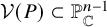 $\mathcal {V}(P)\subset \mathbb {P}_{\mathbb {C}}^{n-1}$
. If
$\mathcal {V}(P)\subset \mathbb {P}_{\mathbb {C}}^{n-1}$
. If $\mathbf {X}^*$
is an ordinary singularity, it is sometimes called a round zero of P [Reference Blekherman, Hauenstein, Ottem, Ranestad and Sturmfels4, Reference Iliman24]. Then, the Hessian matrix
$\mathbf {X}^*$
is an ordinary singularity, it is sometimes called a round zero of P [Reference Blekherman, Hauenstein, Ottem, Ranestad and Sturmfels4, Reference Iliman24]. Then, the Hessian matrix $\textrm {Hess}_{\mathbf {X}^*} P$
of
$\textrm {Hess}_{\mathbf {X}^*} P$
of $P\in P_{n,d}$
at such
$P\in P_{n,d}$
at such $\mathbf {X}^*$
must be positive semidefinite of corank one.
$\mathbf {X}^*$
must be positive semidefinite of corank one.
Remark 2.1. The multiplicity $m=m_{\mathbf {X}^*}(P)$
of a nonnegative
$m=m_{\mathbf {X}^*}(P)$
of a nonnegative $P\in P_{n,d}$
at
$P\in P_{n,d}$
at $\mathbf {X}^*\in \mathbb {P}_{\mathbb {R}}^{n-1}$
is even. If it was not the case, the Taylor expansion of P at
$\mathbf {X}^*\in \mathbb {P}_{\mathbb {R}}^{n-1}$
is even. If it was not the case, the Taylor expansion of P at $\mathbf {X}^*$
, would imply that the restriction
$\mathbf {X}^*$
, would imply that the restriction
 $$\begin{align*}P(\mathbf{X}^*+t \mathbf{V})\ =\ \frac{1}{m!} \frac{\mathrm{{d}}^m}{\mathrm{{d}}\varepsilon^m}\bigg|_{\varepsilon =0} P(\mathbf{X}^*+\varepsilon \mathbf{V})\, t^m+O(t^{m+1}) \end{align*}$$
of P to some line through $\mathbf {X}^*$
is not nonnegative.
$\mathbf {X}^*$
is not nonnegative.
Given a real zero $\mathbf {X}^*\in \mathbb {P}_{\mathbb {R}}^{n-1}$
of
$\mathbf {X}^*\in \mathbb {P}_{\mathbb {R}}^{n-1}$
of $P\in P_{n,d}$
, Reznick [Reference Reznick39] considers a subspace
$P\in P_{n,d}$
, Reznick [Reference Reznick39] considers a subspace
 $$ \begin{align*} E(P,\mathbf{X}^*)\ =\ \left\{Q\in F_{n,d/2}\,:\, P-\varepsilon Q^2\geq 0\ \textrm{in some neighborhood of}\ \mathbf{X}^*\ \textrm{for some}\ \varepsilon>0\right\} \end{align*} $$
of forms of half degree whose square (up to a constant) is bounded from above by P locally around $\mathbf {X}^*$
, where the topology is (induced by) the Euclidean one. In the following we refer to
$\mathbf {X}^*$
, where the topology is (induced by) the Euclidean one. In the following we refer to $E(P,\mathbf {X}^*)$
as the local SOS-support of P at
$E(P,\mathbf {X}^*)$
as the local SOS-support of P at $\mathbf {X}^*$
We call the codimension of this linear subspace of
$\mathbf {X}^*$
We call the codimension of this linear subspace of $F_{n,d/2}$
the half-degree invariant of P at
$F_{n,d/2}$
the half-degree invariant of P at $X^*$
and denote it by
$X^*$
and denote it by
 $$ \begin{align} \delta^{\,\textrm{hd}}(P,\mathbf{X}^*)\ =\ {n-1+d/2 \choose d/2} - \dim E(P,\mathbf{X}^*). \end{align} $$
In other words, the quantity $\delta ^{\,\textrm {hd}}(P,\mathbf {X}^*)$
defined in [Reference Reznick39] counts the number of linear conditions that one has to impose on a form Q of degree
$\delta ^{\,\textrm {hd}}(P,\mathbf {X}^*)$
defined in [Reference Reznick39] counts the number of linear conditions that one has to impose on a form Q of degree $d/2$
so that its square
$d/2$
so that its square $Q^2$
(up to a multiplicative constant) is bounded from above by P in some neighborhood of
$Q^2$
(up to a multiplicative constant) is bounded from above by P in some neighborhood of $\mathbf {X}^*\in \mathbb {R}^n$
.
$\mathbf {X}^*\in \mathbb {R}^n$
.
Example 2.2. If $\mathbf {X}^*$
is a real zero of P, then for
$\mathbf {X}^*$
is a real zero of P, then for $\varepsilon Q^2$
(with some
$\varepsilon Q^2$
(with some $\varepsilon>0$
) to be bounded from above by P locally, we must have
$\varepsilon>0$
) to be bounded from above by P locally, we must have $Q(\mathbf {X}^*)=0$
. Thus, the Taylor expansion of
$Q(\mathbf {X}^*)=0$
. Thus, the Taylor expansion of $Q^2$
near
$Q^2$
near $\mathbf {X}^*$
starts with terms of order two or higher. If
$\mathbf {X}^*$
starts with terms of order two or higher. If $\mathbf {X}^*$
is a round zero, by choosing a sufficiently small
$\mathbf {X}^*$
is a round zero, by choosing a sufficiently small $\varepsilon>0$
, the value of
$\varepsilon>0$
, the value of $\varepsilon Q(\mathbf {X}^*+\mathbf {X})^2$
is majorized by
$\varepsilon Q(\mathbf {X}^*+\mathbf {X})^2$
is majorized by $P(\mathbf {X}^*+\mathbf {X})=\frac {1}{2}\mathbf {X}^{\mathsf T}\textrm{{Hess}}_{\mathbf {X}^*}(P) \mathbf {X} + O(\Vert \mathbf {X}\Vert ^3)$
for all small enough
$P(\mathbf {X}^*+\mathbf {X})=\frac {1}{2}\mathbf {X}^{\mathsf T}\textrm{{Hess}}_{\mathbf {X}^*}(P) \mathbf {X} + O(\Vert \mathbf {X}\Vert ^3)$
for all small enough $\mathbf {X}\in \mathbb {R}^n$
. As a consequence, there are no further conditions on Q in the case of a round zero and so
$\mathbf {X}\in \mathbb {R}^n$
. As a consequence, there are no further conditions on Q in the case of a round zero and so $\delta ^{\,\textrm{{hd}}}(P,\mathbf {X}^*)=1$
. If, on the contrary,
$\delta ^{\,\textrm{{hd}}}(P,\mathbf {X}^*)=1$
. If, on the contrary, $\mathbf {X}^{\prime \mathsf T}\textrm{{Hess}}_{\mathbf {X}^*}(P) \mathbf {X}'=0$
for some
$\mathbf {X}^{\prime \mathsf T}\textrm{{Hess}}_{\mathbf {X}^*}(P) \mathbf {X}'=0$
for some $\mathbf {X}'\in \mathbb {R}^n$
not proportional to
$\mathbf {X}'\in \mathbb {R}^n$
not proportional to $\mathbf {X}$
, then (by the nonnegativity of P) the univariate polynomial
$\mathbf {X}$
, then (by the nonnegativity of P) the univariate polynomial $t\mapsto P(\mathbf {X}^*+t \mathbf {X}')$
has multiplicity at least
$t\mapsto P(\mathbf {X}^*+t \mathbf {X}')$
has multiplicity at least $4$
at
$4$
at $t=0$
. For
$t=0$
. For $\varepsilon Q(\mathbf {X}^*+t\mathbf {X}')^2$
to be bounded from above by
$\varepsilon Q(\mathbf {X}^*+t\mathbf {X}')^2$
to be bounded from above by $P(\mathbf {X}^*+t\mathbf {X}')$
for small
$P(\mathbf {X}^*+t\mathbf {X}')$
for small $t\in \mathbb {R}$
, one must have vanishing of the directional derivative,
$t\in \mathbb {R}$
, one must have vanishing of the directional derivative, $\frac {\mathrm{{d}}}{\mathrm{{d}} t}\big |_{t=0} Q(\mathbf {X}^*+t\mathbf {X}')=0$
. This is a linear condition imposed on
$\frac {\mathrm{{d}}}{\mathrm{{d}} t}\big |_{t=0} Q(\mathbf {X}^*+t\mathbf {X}')=0$
. This is a linear condition imposed on $Q\in E(P,\mathbf {X}^*)$
(along with
$Q\in E(P,\mathbf {X}^*)$
(along with $Q(\mathbf {X}^*)=0$
) and hence
$Q(\mathbf {X}^*)=0$
) and hence $\delta ^{\,\textrm{{hd}}}(P,\mathbf {X}^*)\geq 2$
.
$\delta ^{\,\textrm{{hd}}}(P,\mathbf {X}^*)\geq 2$
.
In a more general case one has to impose conditions on (higher order) directional derivatives of Q. A special case of interest is covered by the following lemma.
Lemma 2.3. Let $\mathbf {X}^*\in \mathbb {P}_{\mathbb {R}}^{n-1}$
be a real zero of a nonnegative form
$\mathbf {X}^*\in \mathbb {P}_{\mathbb {R}}^{n-1}$
be a real zero of a nonnegative form $P\in P_{n,d}$
, let
$P\in P_{n,d}$
, let $k\in \mathbb {N}$
and let
$k\in \mathbb {N}$
and let $H\in E(P^k,\mathbf {X}^*)$
. Then
$H\in E(P^k,\mathbf {X}^*)$
. Then $m_{\mathbf {X}^*}(P^k)= k\,m_{\mathbf {X}^*}(P)$
and
$m_{\mathbf {X}^*}(P^k)= k\,m_{\mathbf {X}^*}(P)$
and $m_{\mathbf {X}^*}(H)\geq k\,m_{\mathbf {X}^*}(P)/2$
.
$m_{\mathbf {X}^*}(H)\geq k\,m_{\mathbf {X}^*}(P)/2$
.
Proof. The first claim follows from the definition of multiplicity. In particular, for any $\mathbf {V}\in \mathbb {R}^n$
, the univariate polynomial
$\mathbf {V}\in \mathbb {R}^n$
, the univariate polynomial $t\mapsto P^k(\mathbf {X}^*+t \mathbf {V})$
is divisible by
$t\mapsto P^k(\mathbf {X}^*+t \mathbf {V})$
is divisible by $t^{k\,m_{\mathbf {X}^*}(P)}$
, meaning that all directional derivatives of
$t^{k\,m_{\mathbf {X}^*}(P)}$
, meaning that all directional derivatives of $P^k$
at
$P^k$
at $\mathbf {X}^*$
of order less than
$\mathbf {X}^*$
of order less than $k\,m_{\mathbf {X}^*}(P)$
are equal to zero. For
$k\,m_{\mathbf {X}^*}(P)$
are equal to zero. For $H\in E(P^k,\mathbf {X}^*)$
,
$H\in E(P^k,\mathbf {X}^*)$
, $\mathbf {V} \in \mathbb {R}^n$
and a sufficiently small
$\mathbf {V} \in \mathbb {R}^n$
and a sufficiently small $t\in \mathbb {R}$
,
$t\in \mathbb {R}$
, $H^2(\mathbf {X}^*+t \mathbf {V})$
is bounded (up to a multiplicative constant) by
$H^2(\mathbf {X}^*+t \mathbf {V})$
is bounded (up to a multiplicative constant) by $P^k(\mathbf {X}^*+t\mathbf {V} )= O(t^{k\,m_{\mathbf {X}^*}(P)})$
. Therefore, the multiplicity of H at
$P^k(\mathbf {X}^*+t\mathbf {V} )= O(t^{k\,m_{\mathbf {X}^*}(P)})$
. Therefore, the multiplicity of H at $\mathbf {X}^*$
is at least
$\mathbf {X}^*$
is at least $k\,m_{\mathbf {X}^*}(P)/2$
(here we know by Remark 2.1 that
$k\,m_{\mathbf {X}^*}(P)/2$
(here we know by Remark 2.1 that $m_{\mathbf {X}^*}(P)$
is even).
$m_{\mathbf {X}^*}(P)$
is even).
One can regard (2.2) as a measure of singularity of the curve $\mathcal {V}(P)$
at a singular point. As Example 3.12 shows, it is, in general, different from the invariants we introduce in Subsection 2.3 (among which is the classical delta invariant). For a nonnegative form
$\mathcal {V}(P)$
at a singular point. As Example 3.12 shows, it is, in general, different from the invariants we introduce in Subsection 2.3 (among which is the classical delta invariant). For a nonnegative form $P\in P_{n,d}$
with finitely many real zeros, the total sum of
$P\in P_{n,d}$
with finitely many real zeros, the total sum of $\delta ^{\,\textrm {hd}}(P,\mathbf {X}^*)$
over all real zeroes
$\delta ^{\,\textrm {hd}}(P,\mathbf {X}^*)$
over all real zeroes $\mathbf {X}^*$
of P is called the half-degree invariant of P and denoted by
$\mathbf {X}^*$
of P is called the half-degree invariant of P and denoted by $\delta ^{\,\textrm {hd}}(P)$
.
$\delta ^{\,\textrm {hd}}(P)$
.
2.2 Intersection multiplicity
We first discuss intersection multiplicities and state related results, see [Reference Shafarevich43, Chapter IV] for more details. For two bivariate polynomials $f, g\in \mathbb {C}[x_1,x_2]$
and a point
$f, g\in \mathbb {C}[x_1,x_2]$
and a point $\mathbf {x}^*=(x^*_1,x^*_2)\in \mathbb {A}^2_{\mathbb {C}}$
the intersection multiplicity of f and g at
$\mathbf {x}^*=(x^*_1,x^*_2)\in \mathbb {A}^2_{\mathbb {C}}$
the intersection multiplicity of f and g at $\mathbf {x}^*$
is defined as the dimension of the quotient of the local ring
$\mathbf {x}^*$
is defined as the dimension of the quotient of the local ring $\mathcal {O}_{\mathbf {x}^*}=\left \{\frac {p}{q}\,:\, p,q\in \mathbb {C}[x_1,x_2],\, q(\mathbf {x}^*)\neq 0\right \}$
of
$\mathcal {O}_{\mathbf {x}^*}=\left \{\frac {p}{q}\,:\, p,q\in \mathbb {C}[x_1,x_2],\, q(\mathbf {x}^*)\neq 0\right \}$
of $\mathbb {A}^2_{\mathbb {C}}$
at
$\mathbb {A}^2_{\mathbb {C}}$
at $\mathbf {x}^*$
by the ideal generated by f and g,
$\mathbf {x}^*$
by the ideal generated by f and g,
 $$ \begin{align} I_{\mathbf{x}^*}(f,g)\ =\ \dim_{\mathbb{C}}\left( \mathcal{O}_{\mathbf{x}^*}/\langle f,g\rangle\right). \end{align} $$
In particular, we have that $I_{\mathbf {x}^*}(f,g)$
is strictly positive if and only if
$I_{\mathbf {x}^*}(f,g)$
is strictly positive if and only if $f(\mathbf {x}^*)=g(\mathbf {x}^*)=0$
. In this case,
$f(\mathbf {x}^*)=g(\mathbf {x}^*)=0$
. In this case, $I_{\mathbf {x}^*}(f,g)=1$
if and only if the curves
$I_{\mathbf {x}^*}(f,g)=1$
if and only if the curves $f=0$
and
$f=0$
and $g=0$
intersect transversally at
$g=0$
intersect transversally at $\mathbf {x}^*$
, that is, the gradient vectors
$\mathbf {x}^*$
, that is, the gradient vectors $(\partial _{x_1} f(\mathbf {x}^*), \partial _{x_2} f(\mathbf {x}^*))$
and
$(\partial _{x_1} f(\mathbf {x}^*), \partial _{x_2} f(\mathbf {x}^*))$
and $(\partial _{x_1} g(\mathbf {x}^*), \partial _{x_2} g(\mathbf {x}^*))$
are linearly independent. If f and g share a common factor in
$(\partial _{x_1} g(\mathbf {x}^*), \partial _{x_2} g(\mathbf {x}^*))$
are linearly independent. If f and g share a common factor in $\mathbb {C}[x_1,x_2]$
that vanishes at
$\mathbb {C}[x_1,x_2]$
that vanishes at $\mathbf {x}^*$
, the intersection multiplicity
$\mathbf {x}^*$
, the intersection multiplicity $I_{\mathbf {x}^*}(f,g)=\infty $
is infinite. For ternary forms (homogenous polynomials in three variables)
$I_{\mathbf {x}^*}(f,g)=\infty $
is infinite. For ternary forms (homogenous polynomials in three variables) $F, G\in \mathbb {C}[X_1,X_2,X_3]$
and a point
$F, G\in \mathbb {C}[X_1,X_2,X_3]$
and a point $\mathbf {X}^*\in \mathbb {P}_{\mathbb {C}}^2$
one defines the intersection multiplicity of F and G at
$\mathbf {X}^*\in \mathbb {P}_{\mathbb {C}}^2$
one defines the intersection multiplicity of F and G at $\mathbf {X}^*$
as
$\mathbf {X}^*$
as $I_{\mathbf {X}^*}(F,G):=I_{\mathbf {x}^*}(f,g)$
, where f and g are dehomogenizations of F and G, and
$I_{\mathbf {X}^*}(F,G):=I_{\mathbf {x}^*}(f,g)$
, where f and g are dehomogenizations of F and G, and $\mathbf {x}^*\in \mathbb {A}_{\mathbb {C}}^2$
is the representative of
$\mathbf {x}^*\in \mathbb {A}_{\mathbb {C}}^2$
is the representative of $\mathbf {X}^*\in \mathbb {P}_{\mathbb {C}}^2$
in the corresponding affine chart. The celebrated Bézout theorem asserts that the number of intersection points of two projective plane curves counted with multiplicities is equal to the product of their degrees.
$\mathbf {X}^*\in \mathbb {P}_{\mathbb {C}}^2$
in the corresponding affine chart. The celebrated Bézout theorem asserts that the number of intersection points of two projective plane curves counted with multiplicities is equal to the product of their degrees.
Theorem 2.4 (Bézout’s theorem).
Let $F, G\in \mathbb {C}[X_1,X_2,X_3]$
be ternary forms that have no common factors of positive degree. Then
$F, G\in \mathbb {C}[X_1,X_2,X_3]$
be ternary forms that have no common factors of positive degree. Then
 $$ \begin{align} \sum_{\mathbf{X}^*\in \mathcal{V}(F)\,\cap \,\mathcal{V}(G)} I_{\mathbf{X}^*}(F,G)\ =\ \deg(F)\cdot \deg(G). \end{align} $$
In particular, $\mathcal {V}(F)\cap \mathcal {V}(G)\subset \mathbb {P}_{\mathbb {C}}^2$
consists of at most
$\mathcal {V}(F)\cap \mathcal {V}(G)\subset \mathbb {P}_{\mathbb {C}}^2$
consists of at most $\deg (F)\cdot \deg (G)$
points.
$\deg (F)\cdot \deg (G)$
points.
A (generalized) tangent to $\mathcal {V}(F)\subset \mathbb {P}^2_{\mathbb {C}}$
at
$\mathcal {V}(F)\subset \mathbb {P}^2_{\mathbb {C}}$
at $\mathbf {X}^*\in \mathcal {V}(F)$
is a projective zero
$\mathbf {X}^*\in \mathcal {V}(F)$
is a projective zero $\mathbf {X}'\in \mathbb {P}\left (\mathbf {X}^*\right )^{\perp }\simeq \mathbb {P}^1_{\mathbb {C}}$
of the homogeneous part of
$\mathbf {X}'\in \mathbb {P}\left (\mathbf {X}^*\right )^{\perp }\simeq \mathbb {P}^1_{\mathbb {C}}$
of the homogeneous part of $F(\mathbf {X}^*+ \mathbf {X}')$
,
$F(\mathbf {X}^*+ \mathbf {X}')$
, $\mathbf {X}'\in \left (\mathbf {X}^*\right )^\perp $
, of lowest degree
$\mathbf {X}'\in \left (\mathbf {X}^*\right )^\perp $
, of lowest degree $m_{\mathbf {X}^*}(F)$
. In particular, tangents to
$m_{\mathbf {X}^*}(F)$
. In particular, tangents to $\mathcal {V}(F)$
at
$\mathcal {V}(F)$
at $\mathbf {X}^*=[0:0:1]\in \mathcal {V}(F)$
are projective zeros
$\mathbf {X}^*=[0:0:1]\in \mathcal {V}(F)$
are projective zeros $\mathbf {X}'=[X^{\prime }_1:X^{\prime }_2]\in \mathbb {P}^1_{\mathbb {C}}$
of the degree
$\mathbf {X}'=[X^{\prime }_1:X^{\prime }_2]\in \mathbb {P}^1_{\mathbb {C}}$
of the degree $m_{\mathbf {x}^*}(f):=m_{\mathbf {X}^*}(F)$
part of the dehomogenized polynomial
$m_{\mathbf {x}^*}(f):=m_{\mathbf {X}^*}(F)$
part of the dehomogenized polynomial $f(X^{\prime }_1,X^{\prime }_2)=F(X^{\prime }_1,X^{\prime }_2,1)$
. A curve
$f(X^{\prime }_1,X^{\prime }_2)=F(X^{\prime }_1,X^{\prime }_2,1)$
. A curve $\mathcal {V}(F)\subset \mathbb {P}_{\mathbb {C}}^2$
can have at most
$\mathcal {V}(F)\subset \mathbb {P}_{\mathbb {C}}^2$
can have at most $m_{\mathbf {X}^*}(F)$
distinct tangents. The following known result inspired our proof of Theorem 1.1; this is essentially [Reference Liang26, Thm.
$m_{\mathbf {X}^*}(F)$
distinct tangents. The following known result inspired our proof of Theorem 1.1; this is essentially [Reference Liang26, Thm. $3.4$
].
$3.4$
].
Lemma 2.5. For ternary forms $F, G\in \mathbb {C}[X_1,X_2,X_3]$
and
$F, G\in \mathbb {C}[X_1,X_2,X_3]$
and $\mathbf {X}^*\in \mathbb {P}_{\mathbb {C}}^2$
,
$\mathbf {X}^*\in \mathbb {P}_{\mathbb {C}}^2$
,
 $$ \begin{align} I_{\mathbf{X}^*}(F,G)\ \geq\ m_{\mathbf{X}^*}(F)\cdot m_{\mathbf{X}^*}(G) \end{align} $$
with equality if and only if $\mathcal {V}(F)$
and
$\mathcal {V}(F)$
and $\mathcal {V}(G)$
do not share a tangent at
$\mathcal {V}(G)$
do not share a tangent at $\mathbf {X}^*$
.
$\mathbf {X}^*$
.
The blow-up of $\mathbb {A}^2_{\mathbb {C}}$
in a point
$\mathbb {A}^2_{\mathbb {C}}$
in a point $\mathbf {x}^*=(x_1^*,x_2^*)$
is a surface
$\mathbf {x}^*=(x_1^*,x_2^*)$
is a surface $S\subset \mathbb {A}^2_{\mathbb {C}}\times \mathbb {P}^1_{\mathbb {C}}$
defined by the polynomial
$S\subset \mathbb {A}^2_{\mathbb {C}}\times \mathbb {P}^1_{\mathbb {C}}$
defined by the polynomial $(x_1-x_1^*)X^{\prime }_2-(x_2-x_2^*)X^{\prime }_1$
(where
$(x_1-x_1^*)X^{\prime }_2-(x_2-x_2^*)X^{\prime }_1$
(where $[X_1':X_2']$
are the homogeneous coordinates on
$[X_1':X_2']$
are the homogeneous coordinates on $\mathbb {P}^1_{\mathbb {C}}$
) together with birational morphism
$\mathbb {P}^1_{\mathbb {C}}$
) together with birational morphism
 $$ \begin{align} \pi: S\ \rightarrow\ \mathbb{A}^2_{\mathbb{C}},\quad \left((x_1,x_2), [X_1':X_2']\right)\ \mapsto\ (x_1,x_2). \end{align} $$
Points in S with $[X^{\prime }_1:X^{\prime }_2]=[1:x^{\prime }_2]$
(respectively,
$[X^{\prime }_1:X^{\prime }_2]=[1:x^{\prime }_2]$
(respectively, $[X^{\prime }_1:X^{\prime }_2]=[x^{\prime }_1:1]$
) form a Zariski open set
$[X^{\prime }_1:X^{\prime }_2]=[x^{\prime }_1:1]$
) form a Zariski open set $S_1$
(respectively,
$S_1$
(respectively, $S_2$
) isomorphic to
$S_2$
) isomorphic to $\mathbb {A}^2_{\mathbb {C}}$
with coordinates
$\mathbb {A}^2_{\mathbb {C}}$
with coordinates $(x_1,x^{\prime }_2)$
(respectively,
$(x_1,x^{\prime }_2)$
(respectively, $(x_2,x^{\prime }_1)$
). The total transform of an affine curve
$(x_2,x^{\prime }_1)$
). The total transform of an affine curve $f=0$
in a point
$f=0$
in a point $\mathbf {x}^*\in \mathbb {A}^2_{\mathbb {C}}$
is the inverse image of
$\mathbf {x}^*\in \mathbb {A}^2_{\mathbb {C}}$
is the inverse image of $f=0$
under (2.6), that is, the total transform is a curve on S defined by
$f=0$
under (2.6), that is, the total transform is a curve on S defined by $\pi ^*f = f\circ \pi $
. The strict transform of
$\pi ^*f = f\circ \pi $
. The strict transform of $f=0$
in
$f=0$
in $\mathbf {x}^*$
is the closure of the inverse image of
$\mathbf {x}^*$
is the closure of the inverse image of $\{f=0\}\setminus \{\mathbf {x}^*\}$
, it coincides with the total transform unless
$\{f=0\}\setminus \{\mathbf {x}^*\}$
, it coincides with the total transform unless $f(\mathbf {x}^*)=0$
. If
$f(\mathbf {x}^*)=0$
. If $f(\mathbf {x}^*)=0$
, the total transform of
$f(\mathbf {x}^*)=0$
, the total transform of $f=0$
is the union of its strict transform and the exceptional line
$f=0$
is the union of its strict transform and the exceptional line $\pi ^{-1}(\mathbf {x}^*)=\{\mathbf {x}^*\}\times \mathbb {P}^1_{\mathbb {C}}$
, which is just a copy of the projective line.
$\pi ^{-1}(\mathbf {x}^*)=\{\mathbf {x}^*\}\times \mathbb {P}^1_{\mathbb {C}}$
, which is just a copy of the projective line.
Remark 2.6. More generally, one can regard the total transform of $f=0$
as the (pull-back) divisor on S given by the equation
$f=0$
as the (pull-back) divisor on S given by the equation $\pi ^*f = f\circ \pi $
. It splits into the strict transform of
$\pi ^*f = f\circ \pi $
. It splits into the strict transform of $f=0$
in
$f=0$
in $\mathbf {x}^*$
and the exceptional divisor
$\mathbf {x}^*$
and the exceptional divisor $m\,\pi ^{-1}(\mathbf {x}^*)$
, where
$m\,\pi ^{-1}(\mathbf {x}^*)$
, where $m=m_{\mathbf {x}^*}(f)$
is the multiplicity of f at
$m=m_{\mathbf {x}^*}(f)$
is the multiplicity of f at $\mathbf {x}^*$
.
$\mathbf {x}^*$
.
In a local chart ( $S_1$
or
$S_1$
or $S_2$
) of S, the strict transform of
$S_2$
) of S, the strict transform of $f=0$
is a curve in
$f=0$
is a curve in $\mathbb {A}^2_{\mathbb {C}}$
whose defining polynomial we denote by
$\mathbb {A}^2_{\mathbb {C}}$
whose defining polynomial we denote by $f'$
. Points
$f'$
. Points $[X^{\prime }_1:X^{\prime }_2]$
on
$[X^{\prime }_1:X^{\prime }_2]$
on $\mathbb {P}^1_{\mathbb {C}}\simeq \pi ^{-1}(\mathbf {x}^*)$
at which the strict transform intersects the exceptional line are called the first order infinitely near points of
$\mathbb {P}^1_{\mathbb {C}}\simeq \pi ^{-1}(\mathbf {x}^*)$
at which the strict transform intersects the exceptional line are called the first order infinitely near points of $f=0$
at
$f=0$
at $\mathbf {x}^*$
, they are identified with tangents of
$\mathbf {x}^*$
, they are identified with tangents of $\mathcal {V}(F)$
at
$\mathcal {V}(F)$
at $\mathbf {X}^*=[x_1^*:x_2^*:1]$
via
$\mathbf {X}^*=[x_1^*:x_2^*:1]$
via $[X^{\prime }_1:X^{\prime }_2]\mapsto [X^{\prime }_1:X^{\prime }_2:X_3']$
, where
$[X^{\prime }_1:X^{\prime }_2]\mapsto [X^{\prime }_1:X^{\prime }_2:X_3']$
, where $X^{\prime }_3=-x_1^*X^{\prime }_1-x_2^*X^{\prime }_2$
. Given a first order infinitely near point
$X^{\prime }_3=-x_1^*X^{\prime }_1-x_2^*X^{\prime }_2$
. Given a first order infinitely near point $\mathbf {x}'\in \pi ^{-1}(\mathbf {x}^*)$
of
$\mathbf {x}'\in \pi ^{-1}(\mathbf {x}^*)$
of $f=0$
at
$f=0$
at $\mathbf {x}^*$
, we can blow-up the affine chart
$\mathbf {x}^*$
, we can blow-up the affine chart $S_i$
containing
$S_i$
containing $\mathbf {x}'$
again and consider the associated strict transforms of
$\mathbf {x}'$
again and consider the associated strict transforms of $f'=0$
in
$f'=0$
in $\mathbf {x}'$
. After doing finitely many successive blow-ups at singular points of
$\mathbf {x}'$
. After doing finitely many successive blow-ups at singular points of $f=0$
and of its higher order strict transforms, we eventually end up with a smooth curve. This resolution of singularities process is guaranteed to terminate by [Reference Kollár25, Thm. 1.43].
$f=0$
and of its higher order strict transforms, we eventually end up with a smooth curve. This resolution of singularities process is guaranteed to terminate by [Reference Kollár25, Thm. 1.43].
Example 2.7. The polynomial $f=x_1^2+x_2^4-2x_1x_2^2+x_1^3+2x_1^4-2x_1^3x_2^2+x_1^6$
is singular at
$f=x_1^2+x_2^4-2x_1x_2^2+x_1^3+2x_1^4-2x_1^3x_2^2+x_1^6$
is singular at $(0,0)$
with
$(0,0)$
with $m_{(0,0)}(f)=2$
. Its strict transform (in the coordinates
$m_{(0,0)}(f)=2$
. Its strict transform (in the coordinates $(x_1', x_2)$
,
$(x_1', x_2)$
, $x_1=x_1'x_2$
) is given by
$x_1=x_1'x_2$
) is given by
 $$\begin{align*}f'\ =\ x_1^{\prime2}+x_2^2-2x_1'x_2+x_1^{\prime3}x_2+2x_1^{\prime4}x_2^2-2x_1^{\prime3}x_2^3+x_1^{\prime6}x_2^4\end{align*}$$
and the unique first order infinitely near point $(x_1',x_2)=(0,0)$
of
$(x_1',x_2)=(0,0)$
of $f=0$
at
$f=0$
at $(0,0)$
has multiplicity
$(0,0)$
has multiplicity $m_{(0,0)}(f')=2$
. The strict transform of
$m_{(0,0)}(f')=2$
. The strict transform of $f'=0$
in
$f'=0$
in $(0,0)$
(in the coordinates
$(0,0)$
(in the coordinates $(x_1",x_2)$
with
$(x_1",x_2)$
with $x_1'=x_1"x_2$
) is given by
$x_1'=x_1"x_2$
) is given by
 $$ \begin{align*} f"\ =\ (x_1"-1)^2+x_1^{\prime\prime3}x_2^2+2x_1^{\prime\prime4}x_2^4-2x_1^{\prime\prime3}x_2^4+x_1^{\prime\prime6}x_2^8 \end{align*} $$
and the unique first order infinitely near point $(x_1",x_2)=(1,0)$
of
$(x_1",x_2)=(1,0)$
of $f'=0$
at
$f'=0$
at $(0,0)$
has
$(0,0)$
has $m_{(1,0)}(f")=2$
. The third blow-up
$m_{(1,0)}(f")=2$
. The third blow-up $x_1"=1+x_1"'x_2$
reveals
$x_1"=1+x_1"'x_2$
reveals
 $$ \begin{align*} f"'\ =\ x_1^{\prime\prime\prime2}+(1+x_1"'x_2)^3+2(1+x_1"'x_2)^4x_2^2-2(1+x_1"'x_2)^3x_2^2+(1+x_1"'x_2)^6x_2^6. \end{align*} $$
Since $f"'=0$
does not have singular points on the exceptional fiber
$f"'=0$
does not have singular points on the exceptional fiber $x_2=0$
, the resolution of singularities process terminates after the third blow-up.
$x_2=0$
, the resolution of singularities process terminates after the third blow-up.
The following Noether’s formula gives us a way to compute the local intersection multiplicity (2.3) by doing successive blow-ups, it is a refinement of Lemma 2.5.
Theorem 2.8 [Reference Casas-Alvero8, Lemma $\mathrm{3.3.4}$
], [Reference Chalmovianská and Chalmovianský11, Theorem
$3.10$
].
$\mathrm{3.3.4}$
], [Reference Chalmovianská and Chalmovianský11, Theorem
$3.10$
].


Let $f, g\in \mathbb {C}[x_1,x_2]$
be polynomials that have no common factors of positive degree and let
$f, g\in \mathbb {C}[x_1,x_2]$
be polynomials that have no common factors of positive degree and let $\mathbf {x}^*\in \mathbb {A}^2_{\mathbb {C}}$
be their common zero. Then
$\mathbf {x}^*\in \mathbb {A}^2_{\mathbb {C}}$
be their common zero. Then
 $$ \begin{align*} I_{\mathbf{x}^*}(f,g)\ =\ m_{\mathbf{x}^*}(f)\cdot m_{\mathbf{x}^*}(g) + \sum_{\mathbf{x}'} I_{\mathbf{x}'}(f',g'). \end{align*} $$
where the sum is over common first order infinitely near points $\mathbf {x}'$
of
$\mathbf {x}'$
of $f=0$
and
$f=0$
and $g=0$
at
$g=0$
at $\mathbf {x}^*$
.
$\mathbf {x}^*$
.
We end this subsection with proving that blow-ups preserve nonnegativity of polynomials.
Lemma 2.9. Let $f\in \mathbb {R}[x_1,x_2]$
be a polynomial that is nonnegative locally around
$f\in \mathbb {R}[x_1,x_2]$
be a polynomial that is nonnegative locally around $\mathbf {x}^*\in \mathbb {A}^2_{\,\mathbb {R}}$
. If
$\mathbf {x}^*\in \mathbb {A}^2_{\,\mathbb {R}}$
. If $f(\mathbf {x}^*)=0$
and
$f(\mathbf {x}^*)=0$
and $[X_1':X_2']\in \mathbb {P}^1_{\mathbb {R}}$
is a real first order infinitely near point of
$[X_1':X_2']\in \mathbb {P}^1_{\mathbb {R}}$
is a real first order infinitely near point of $f=0$
at
$f=0$
at $\mathbf {x}^*$
, then the strict transform of
$\mathbf {x}^*$
, then the strict transform of $f=0$
at
$f=0$
at $\mathbf {x}^*$
is given by a polynomial that is nonnegative locally around
$\mathbf {x}^*$
is given by a polynomial that is nonnegative locally around $(\mathbf {x}^*, [X_1':X_2'])\in S$
.
$(\mathbf {x}^*, [X_1':X_2'])\in S$
.
Proof. The blow-up (2.6) maps the real points in $S\setminus \pi ^{-1}(\mathbf {x}^*)$
bijectively to the real points of
$S\setminus \pi ^{-1}(\mathbf {x}^*)$
bijectively to the real points of $\mathbb {A}_{\mathbb {R}}^2\setminus \{\mathbf {x}^*\}$
. Then the sign of f at
$\mathbb {A}_{\mathbb {R}}^2\setminus \{\mathbf {x}^*\}$
. Then the sign of f at $\mathbf {x}\in \mathbb {A}_{\mathbb {R}}^2\setminus \{\mathbf {x}^*\}$
agrees with the sign of
$\mathbf {x}\in \mathbb {A}_{\mathbb {R}}^2\setminus \{\mathbf {x}^*\}$
agrees with the sign of $f'$
at
$f'$
at $\pi ^{-1}(\mathbf {x})$
, where
$\pi ^{-1}(\mathbf {x})$
, where $f'$
is the polynomial defining (in a chart) the strict transform of
$f'$
is the polynomial defining (in a chart) the strict transform of $f=0$
in
$f=0$
in $\mathbf {x}^*$
. The claim follows by continuity of
$\mathbf {x}^*$
. The claim follows by continuity of $f'$
, as the real points of
$f'$
, as the real points of $S\setminus \pi ^{-1}(\mathbf {x}^*)$
are dense in the real points of S.
$S\setminus \pi ^{-1}(\mathbf {x}^*)$
are dense in the real points of S.
2.3 The delta invariant and the SOS-invariant
The (local) delta invariant $\delta _{\mathbf {x}^*}(f)$
is a classical invariant of an isolated singular point
$\delta _{\mathbf {x}^*}(f)$
is a classical invariant of an isolated singular point $\mathbf {x}^*\in \mathbb {A}^2_{\mathbb {C}}$
of an algebraic curve
$\mathbf {x}^*\in \mathbb {A}^2_{\mathbb {C}}$
of an algebraic curve $f=0$
that can be defined as the dimension
$f=0$
that can be defined as the dimension
 $$ \begin{align} \delta_{\mathbf{x}^*}(f)\ =\ \dim_{\mathbb{C}}\left(\, \overline{\mathcal{O}_{f,\mathbf{x}^*}} \,\big/\, \mathcal{O}_{f,\mathbf{x}^*}\right) \end{align} $$
of the integral closure $\overline {\mathcal {O}_{f,\mathbf {x}^*}}$
of the local ring
$\overline {\mathcal {O}_{f,\mathbf {x}^*}}$
of the local ring $\mathcal {O}_{f,\mathbf {x}^*}:=\mathcal {O}_{\mathbf {x}^*}/(f)$
of the curve
$\mathcal {O}_{f,\mathbf {x}^*}:=\mathcal {O}_{\mathbf {x}^*}/(f)$
of the curve $f=0$
at
$f=0$
at $\mathbf {x}^*$
. We set
$\mathbf {x}^*$
. We set $\delta _{\mathbf {X}^*}(F):=\delta _{\mathbf {x}^*}(f)$
for a form
$\delta _{\mathbf {X}^*}(F):=\delta _{\mathbf {x}^*}(f)$
for a form $F\in \mathbb {C}[X_1,X_2,X_3]$
and
$F\in \mathbb {C}[X_1,X_2,X_3]$
and $\mathbf {X}^*\in \mathbb {P}^2_{\mathbb {C}}$
, where f is a dehomogenization of F and
$\mathbf {X}^*\in \mathbb {P}^2_{\mathbb {C}}$
, where f is a dehomogenization of F and $\mathbf {x}^*$
is the affine representative of
$\mathbf {x}^*$
is the affine representative of $\mathbf {X}^*$
.
$\mathbf {X}^*$
.
Remark 2.10. The sum $\delta (F)$
of
$\delta (F)$
of $\delta _{\mathbf {X}^*}(F)$
over all singular points
$\delta _{\mathbf {X}^*}(F)$
over all singular points $\mathbf {X}^*\in \mathbb {P}^2_{\mathbb {C}}$
of a reduced plane curve
$\mathbf {X}^*\in \mathbb {P}^2_{\mathbb {C}}$
of a reduced plane curve $\mathcal {V}(F)$
is known as the (total) delta invariant. By the genus-degree formula [Reference Casas-Alvero9, Section 3.11],
$\mathcal {V}(F)$
is known as the (total) delta invariant. By the genus-degree formula [Reference Casas-Alvero9, Section 3.11], $\delta (F)$
equals the defect between the geometric genus of
$\delta (F)$
equals the defect between the geometric genus of $\mathcal {V}(F)$
and its arithmetic genus.
$\mathcal {V}(F)$
and its arithmetic genus.
Similarly to Noether’s formula, one can define the local delta invariant as $\delta _{\mathbf {x}^*}(f)=0$
in case of a nonsingular point (that is,
$\delta _{\mathbf {x}^*}(f)=0$
in case of a nonsingular point (that is, $m_{\mathbf {x}^*}(f)=1$
) and otherwise, recursively, as
$m_{\mathbf {x}^*}(f)=1$
) and otherwise, recursively, as
 $$ \begin{align} \delta_{\mathbf{x}^*}(f)\ =\ \frac{m_{\mathbf{x}^*}(f)(m_{\mathbf{x}^*}(f)-1)}{2} + \sum_{\mathbf{x}'} \delta_{\mathbf{x}'}(f'), \end{align} $$
where the sum is over all first order infinitely near points $\mathbf {x}'$
of
$\mathbf {x}'$
of $f=0$
at its isolated singularity
$f=0$
at its isolated singularity $\mathbf {x}^*\in \mathbb {A}^2_{\mathbb {C}}$
. Note that in case of an ordinary singularity, formula (2.8) reveals
$\mathbf {x}^*\in \mathbb {A}^2_{\mathbb {C}}$
. Note that in case of an ordinary singularity, formula (2.8) reveals $\delta _{\mathbf {x}^*}(f)=1$
. See [Reference Cassou-Noguès and Płoski10, Cor. 5.12] and [Reference Pham29, p. 389] for the equivalence between (2.7) and (2.8).
$\delta _{\mathbf {x}^*}(f)=1$
. See [Reference Cassou-Noguès and Płoski10, Cor. 5.12] and [Reference Pham29, p. 389] for the equivalence between (2.7) and (2.8).
Example 2.11. For the polynomial $f=x_1^3+(x_2^2-x_1^3-x_1)^2=x_1^2+x_2^4-2x_1x_2^2+x_1^3+2x_1^4-2x_1^3x_2^2+x_1^6$
from Example 2.7 the formula (2.8) gives us
$f=x_1^3+(x_2^2-x_1^3-x_1)^2=x_1^2+x_2^4-2x_1x_2^2+x_1^3+2x_1^4-2x_1^3x_2^2+x_1^6$
from Example 2.7 the formula (2.8) gives us
 $$ \begin{align} \begin{aligned} \delta_{(0,0)}(f)\ &=\ 1+\delta_{(0,0)}(f')\ =\ 1+1+\delta_{(1,0)}(f")\ =\ 1+1+1\ =\ 3, \end{aligned} \end{align} $$
where $f'$
and
$f'$
and $f"$
define strict transforms of
$f"$
define strict transforms of $f=0$
and
$f=0$
and $f'=0$
at
$f'=0$
at $(0,0)$
.
$(0,0)$
.
For a reduced real $f\in \mathbb {R}[x_1,x_2]$
and
$f\in \mathbb {R}[x_1,x_2]$
and $\mathbf {x}^*\in \mathbb {A}^2_{\mathbb {R}}$
we also define the real delta invariant as
$\mathbf {x}^*\in \mathbb {A}^2_{\mathbb {R}}$
we also define the real delta invariant as $\delta ^{\,\mathbb {R}}_{\mathbf {x}^*}(f)=0$
in case of a nonsingular point and otherwise as
$\delta ^{\,\mathbb {R}}_{\mathbf {x}^*}(f)=0$
in case of a nonsingular point and otherwise as
 $$ \begin{align} \delta^{\,\mathbb{R}}_{\mathbf{x}^*}(f)\ =\ \frac{m_{\mathbf{x}^*}(f)(m_{\mathbf{x}^*}(f)-1)}{2} + \sum_{\mathbf{x}'\,-\, \textrm{real} } \delta_{\mathbf{x}'}^{\,\mathbb{R}}(f'), \end{align} $$
where the sum is over only real first order infinitely near points of $f=0$
at
$f=0$
at $\mathbf {x}^*$
. The real delta invariant captures the complexity of resolving a real singularity, and thus it is the most relevant invariant for understanding local nonnegativity of a polynomial.
$\mathbf {x}^*$
. The real delta invariant captures the complexity of resolving a real singularity, and thus it is the most relevant invariant for understanding local nonnegativity of a polynomial.
Finally, the quantity that plays a prominent role in our work is the SOS-invariant $\delta ^{\,\textrm {sos}}_{\mathbf {x}^*}(f)$
of a nonnegative polynomial f at an isolated real zero
$\delta ^{\,\textrm {sos}}_{\mathbf {x}^*}(f)$
of a nonnegative polynomial f at an isolated real zero $\mathbf {x}^*$
.
$\mathbf {x}^*$
.
Definition 2.12. The SOS-invariant $\delta ^{\,\textrm{{sos}}}_{\mathbf {x}^*}(f)$
of a nonnegative polynomial f at an isolated real zero
$\delta ^{\,\textrm{{sos}}}_{\mathbf {x}^*}(f)$
of a nonnegative polynomial f at an isolated real zero $\mathbf {x}^*$
is defined by
$\mathbf {x}^*$
is defined by $\delta ^{\,\textrm{{sos}}}_{\mathbf {x}^*}(f)=1$
in case of an ordinary singularity and
$\delta ^{\,\textrm{{sos}}}_{\mathbf {x}^*}(f)=1$
in case of an ordinary singularity and
 $$ \begin{align} \delta^{\,\textrm{{sos}}}_{\mathbf{x}^*}(f)\ =\ \frac{m_{\mathbf{x}^*}(f)^2}{4} + \sum_{\mathbf{x}'\,-\,\textrm{{real}} } \delta^{\,\textrm{{sos}}}_{\mathbf{x}'}(f') \end{align} $$
in general, where again the sum is over real first order infinitely near points of $f=0$
at
$f=0$
at $\mathbf {x}^*$
.
$\mathbf {x}^*$
.
It is easy to see that, for nonnegative f with an isolated real singularity $\mathbf {x}^*$
one has that
$\mathbf {x}^*$
one has that
 $$ \begin{align} \delta^{\,\textrm{sos}}_{\mathbf{x}^*}(f)\ \leq\ \delta^{\,\mathbb{R}}_{\mathbf{x}^*}(f)\ \leq\ \delta_{\mathbf{x}^*}(f). \end{align} $$
By Lemma 3.5 we have equalities in (2.12), if $\mathbf {x}^*$
is a real zero of f of multiplicity two. However, this is not true in general, as we discuss in Example 3.12. Furthermore, if
$\mathbf {x}^*$
is a real zero of f of multiplicity two. However, this is not true in general, as we discuss in Example 3.12. Furthermore, if $f\in \mathbb {R}[x_1,x_2]$
is the dehomogenization of a nonnegative ternary form
$f\in \mathbb {R}[x_1,x_2]$
is the dehomogenization of a nonnegative ternary form $F\in \mathbb {R}[X_1,X_2,X_3]$
and
$F\in \mathbb {R}[X_1,X_2,X_3]$
and $\mathbf {x}^*\in \mathbb {A}^2_{\mathbb {R}}$
is the affine representative of
$\mathbf {x}^*\in \mathbb {A}^2_{\mathbb {R}}$
is the affine representative of $\mathbf {X}^*\in \mathbb {P}^2_{\mathbb {R}}$
, then we set
$\mathbf {X}^*\in \mathbb {P}^2_{\mathbb {R}}$
, then we set $\delta ^{\,\textrm {sos}}_{\mathbf {X}^*}(F)=\delta ^{\,\textrm {sos}}_{\mathbf {x}^*}(f)$
,
$\delta ^{\,\textrm {sos}}_{\mathbf {X}^*}(F)=\delta ^{\,\textrm {sos}}_{\mathbf {x}^*}(f)$
, $\delta ^{\,\mathbb {R}}_{\mathbf {X}^*}(F):=\delta ^{\,\mathbb {R}}_{\mathbf {x}^*}(f)$
.
$\delta ^{\,\mathbb {R}}_{\mathbf {X}^*}(F):=\delta ^{\,\mathbb {R}}_{\mathbf {x}^*}(f)$
.
Our definition of the SOS-invariant is motivated by two things. First, by using $\frac {1}{4}m_{\mathbf {x}^*}(f)^2$
(and not
$\frac {1}{4}m_{\mathbf {x}^*}(f)^2$
(and not $\frac {1}{2}m_{\mathbf {x}^*}(f)(m_{\mathbf {x}^*}(f)-1)$
as in (2.8) and (2.10)), we ensure that
$\frac {1}{2}m_{\mathbf {x}^*}(f)(m_{\mathbf {x}^*}(f)-1)$
as in (2.8) and (2.10)), we ensure that $\delta ^{\,\textrm{{sos}}}_{\mathbf {x}^*}(f)$
scales well under taking powers of f, see Proposition 3.2. Second,
$\delta ^{\,\textrm{{sos}}}_{\mathbf {x}^*}(f)$
scales well under taking powers of f, see Proposition 3.2. Second, $\delta ^{\,\textrm{{sos}}}_{\mathbf {X}^*}(F)$
(for
$\delta ^{\,\textrm{{sos}}}_{\mathbf {X}^*}(F)$
(for $F\in \Sigma _{3,d}$
) is a lower bound for the intersection multiplicity at
$F\in \Sigma _{3,d}$
) is a lower bound for the intersection multiplicity at $\mathbf {X}^*$
of two forms in
$\mathbf {X}^*$
of two forms in $E(F,\mathbf {X}^*)$
, see Proposition 3.1. These properties are crucial for the proof of Theorem 1.1.
$E(F,\mathbf {X}^*)$
, see Proposition 3.1. These properties are crucial for the proof of Theorem 1.1.
Remark 2.13. The notion of the SOS-invariant $\delta ^{\,\textrm{{sos}}}_{(0,0)}(f)$
makes sense if f is nonnegative only in a neighborhood of its real zero. Moreover, one can, more generally, consider a locally nonnegative convergent power series
$\delta ^{\,\textrm{{sos}}}_{(0,0)}(f)$
makes sense if f is nonnegative only in a neighborhood of its real zero. Moreover, one can, more generally, consider a locally nonnegative convergent power series $f\in \mathbb {R}\{x_1,x_2\}$
at
$f\in \mathbb {R}\{x_1,x_2\}$
at $(0,0)$
.
$(0,0)$
.
As we already mentioned, in Section 3 we show that for any $H_1,H_2\in E(P,\mathbf {X}^*)$
in the local SOS-support of
$H_1,H_2\in E(P,\mathbf {X}^*)$
in the local SOS-support of $P\in P_{n,d}$
we have that
$P\in P_{n,d}$
we have that $\delta ^{\,\textrm {sos}}_{\mathbf {X}^*}(P) \,\leq \, I_{\mathbf {X}^*}(H_1,H_2)$
. We conjecture that the equality holds if
$\delta ^{\,\textrm {sos}}_{\mathbf {X}^*}(P) \,\leq \, I_{\mathbf {X}^*}(H_1,H_2)$
. We conjecture that the equality holds if $H_1,H_2\in E(P,\mathbf {X}^*)$
are chosen generically.
$H_1,H_2\in E(P,\mathbf {X}^*)$
are chosen generically.
Finally, we define the (total) SOS-invariant of $P\in P_{3,d}$
with finitely many zeros in
$P\in P_{3,d}$
with finitely many zeros in $\mathbb {P}^2_{\mathbb {R}}$
via
$\mathbb {P}^2_{\mathbb {R}}$
via
 $$ \begin{align} \delta^{\,\textrm{sos}}(P)\ =\ \sum_{\mathbf{X}\in \mathcal{V}_{\mathbb{R}}(P)}\delta_{\mathbf{X}}^{\,\textrm{sos}} (P), \end{align} $$
where the summation is over all real zeros of P.
3 Ternary forms
The goal of this section is to prove Theorem 1.1 and investigate the question of stubbornness of ternary forms in general. We start with some properties of the SOS-invariant that we introduced in Subsection 2.3.
3.1 The SOS-invariant and applications
We show that the SOS-invariant gives a lower bound on the intersection multiplicity of any two elements of the local SOS-support.
Proposition 3.1. Let $P\in \Sigma _{3,d}$
be a sum of squares ternary form with a real zero
$P\in \Sigma _{3,d}$
be a sum of squares ternary form with a real zero $\mathbf {X}^*\in \mathbb {P}_{\mathbb {R}}^2$
. Then for any
$\mathbf {X}^*\in \mathbb {P}_{\mathbb {R}}^2$
. Then for any $H_1, H_2\in E(P,\mathbf {X}^*)$
we have
$H_1, H_2\in E(P,\mathbf {X}^*)$
we have $ I_{\mathbf {X}^*}(H_1,H_2) \geq \delta ^{\,\textrm{{sos}}}_{\mathbf {X}^*}(P) $
.
$ I_{\mathbf {X}^*}(H_1,H_2) \geq \delta ^{\,\textrm{{sos}}}_{\mathbf {X}^*}(P) $
.
Proof. We perform an induction on the number of blow-ups needed to reach a round zero (the resolution of singularities terminates after finitely many steps by [Reference Kollár25, Thm. 1.43]). If $\mathbf {X}^*=[0:0:1]\in \mathbb {P}_{\mathbb {R}}^2$
is a round zero of P, then
$\mathbf {X}^*=[0:0:1]\in \mathbb {P}_{\mathbb {R}}^2$
is a round zero of P, then $p(x_1,x_2)=P(x_1,x_2,1)=a x_1^2+2b x_1x_2+c x_2^2+\dots $
does not have real tangents (as the quadratic form
$p(x_1,x_2)=P(x_1,x_2,1)=a x_1^2+2b x_1x_2+c x_2^2+\dots $
does not have real tangents (as the quadratic form $a x_1^2+2b x_1 x_2+ c x_2^2$
must be positive definite) and we have
$a x_1^2+2b x_1 x_2+ c x_2^2$
must be positive definite) and we have $\delta _{\mathbf 0}^{\,\textrm{{sos}}}(p)=1$
. Any
$\delta _{\mathbf 0}^{\,\textrm{{sos}}}(p)=1$
. Any $H_1, H_2\in E(P,\mathbf {X}^*)$
must vanish at
$H_1, H_2\in E(P,\mathbf {X}^*)$
must vanish at $\mathbf {X}^*$
(see Lemma 2.3) and therefore
$\mathbf {X}^*$
(see Lemma 2.3) and therefore $I_{\mathbf {X}^*}(H_1,H_2)\geq 1=\delta _{\mathbf {0}}^{\,\textrm{{sos}}}(p)$
. In general, we have by Theorem 2.8 that
$I_{\mathbf {X}^*}(H_1,H_2)\geq 1=\delta _{\mathbf {0}}^{\,\textrm{{sos}}}(p)$
. In general, we have by Theorem 2.8 that
 $$ \begin{align} I_{\mathbf{X}^*}(H_1,H_2)\ =\ I_{\mathbf{0}}(h_1,h_2)\ =\ m_{\mathbf{0}}(h_1)m_{\mathbf{0}}(h_2)+\sum_{\mathbf{x}'} I_{\mathbf{x}'}(h_1',h_2'), \end{align} $$
where the sum is over all common first order infinitely near points $\mathbf {x}'$
of
$\mathbf {x}'$
of $h_1=0$
and
$h_1=0$
and $h_2=0$
at
$h_2=0$
at $\mathbf {0}$
. Because
$\mathbf {0}$
. Because $H_1, H_2$
are in
$H_1, H_2$
are in $E(P,\mathbf {X}^*)$
, we have by Lemma 2.3 that
$E(P,\mathbf {X}^*)$
, we have by Lemma 2.3 that $m_{\mathbf {0}}(h_1), m_{\mathbf {0}}(h_2)\geq m_{\mathbf {0}}(p)/2$
.
$m_{\mathbf {0}}(h_1), m_{\mathbf {0}}(h_2)\geq m_{\mathbf {0}}(p)/2$
.
Denote by $T(p,\mathbf {0})$
the set of real infinitely near points
$T(p,\mathbf {0})$
the set of real infinitely near points $\mathbf {x}'$
of
$\mathbf {x}'$
of $p=0$
at
$p=0$
at $\mathbf {0}$
. Thus, disregarding all
$\mathbf {0}$
. Thus, disregarding all $\mathbf {x}'$
in (3.1) that do not belong to
$\mathbf {x}'$
in (3.1) that do not belong to $T(p,\mathbf {0})$
, yields
$T(p,\mathbf {0})$
, yields
 $$ \begin{align*} I_{\mathbf{0}}(h_1,h_2)\ &\geq\ \left(\frac{m_{\mathbf{0}}(p)}{2}\right)^2+\sum_{\mathbf{x}'\,\in\, T(p,\, \mathbf{0})} I_{\mathbf{x}'}(h_1',h_2')\ \geq\ \frac{1}{4}m_{\mathbf{0}}(p)^2+\sum_{\mathbf{x}'\,\in\, T(p,\, \mathbf{0})} \delta_{\mathbf{x}'}^{\,\textrm{sos}}(p')\ =\ \delta^{\,\textrm{{sos}}}_{\mathbf{0}}(p), \end{align*} $$
where the last bound follows by the induction step as we explain in the rest of the proof.
Before, let us observe that for a generic form H in $E(P,\mathbf {X}^*)$
we have
$E(P,\mathbf {X}^*)$
we have $m_{\mathbf {0}}(h)=m_{\mathbf {0}}(p)/2$
. Indeed, let
$m_{\mathbf {0}}(h)=m_{\mathbf {0}}(p)/2$
. Indeed, let $\mathbf {x}^{2\alpha }$
be a monomial in P of even degree
$\mathbf {x}^{2\alpha }$
be a monomial in P of even degree $m_{\mathbf {0}}(p)$
. Because
$m_{\mathbf {0}}(p)$
. Because $P\in \Sigma _{3,d}$
is a sum of squares, there must exist a form H, entering a sum of squares decomposion of P (in particular,
$P\in \Sigma _{3,d}$
is a sum of squares, there must exist a form H, entering a sum of squares decomposion of P (in particular, $P-H^2$
is itself a sum of squares), that contains
$P-H^2$
is itself a sum of squares), that contains $\mathbf {x}^\alpha $
. Since
$\mathbf {x}^\alpha $
. Since $E(P,\mathbf {X}^*)$
is a linear subspace of
$E(P,\mathbf {X}^*)$
is a linear subspace of $F_{3,d}$
and the monomial
$F_{3,d}$
and the monomial $\mathbf {x}^\alpha $
of degree
$\mathbf {x}^\alpha $
of degree $m_{\mathbf {0}}(p)/2$
is present in
$m_{\mathbf {0}}(p)/2$
is present in $H\in E(P,\mathbf {X}^*)$
, it appears in a generic form in
$H\in E(P,\mathbf {X}^*)$
, it appears in a generic form in $E(P,\mathbf {X}^*)$
. Assume now that polynomials
$E(P,\mathbf {X}^*)$
. Assume now that polynomials $h_1$
and
$h_1$
and $h_2$
correspond to forms in
$h_2$
correspond to forms in $E(P,\mathbf {X}^*)$
that are generic in this sense. Since
$E(P,\mathbf {X}^*)$
that are generic in this sense. Since $p-\varepsilon h_i^2$
,
$p-\varepsilon h_i^2$
, $i=1,2$
, is nonnegative locally near
$i=1,2$
, is nonnegative locally near $\mathbf {0}$
, Lemma 2.9 implies that
$\mathbf {0}$
, Lemma 2.9 implies that $p'-\varepsilon h_i^{\prime 2}$
is nonnegative locally near
$p'-\varepsilon h_i^{\prime 2}$
is nonnegative locally near $\mathbf {x}'$
. As one now requires fewer blow-ups to reach a round zero, we can apply the inductive step and obtain
$\mathbf {x}'$
. As one now requires fewer blow-ups to reach a round zero, we can apply the inductive step and obtain $I_{\mathbf {x}'}(h_1',h_2')\geq \delta _{\mathbf {x}'}^{\,\textrm {sos}}(p')$
. Now, arbitrary
$I_{\mathbf {x}'}(h_1',h_2')\geq \delta _{\mathbf {x}'}^{\,\textrm {sos}}(p')$
. Now, arbitrary $h_1$
and
$h_1$
and $h_2$
(corresponding to
$h_2$
(corresponding to $H_1,H_2\in E(P,\mathbf {X}^*)$
) are obtained as limits of generic ones. By the upper semi-continuity of the local intersection multiplicity (see for example [Reference Hartshorne22, Thm. III.12.8]) and the inequality we have already in the generic case, we see that
$H_1,H_2\in E(P,\mathbf {X}^*)$
) are obtained as limits of generic ones. By the upper semi-continuity of the local intersection multiplicity (see for example [Reference Hartshorne22, Thm. III.12.8]) and the inequality we have already in the generic case, we see that $I_{\mathbf {x}'}(h_1',h_2')$
cannot be smaller than
$I_{\mathbf {x}'}(h_1',h_2')$
cannot be smaller than $\delta _{\mathbf {x}'}^{\,\textrm {sos}}(p')$
.
$\delta _{\mathbf {x}'}^{\,\textrm {sos}}(p')$
.
One of the key properties of the SOS-invariant is that it behaves well under taking powers.
Proposition 3.2. Let $P\in P_{3,d}$
be a nonnegative ternary form that has a real zero at
$P\in P_{3,d}$
be a nonnegative ternary form that has a real zero at $\mathbf {X}^*\in \mathbb {P}_{\mathbb {R}}^2$
. Then for any
$\mathbf {X}^*\in \mathbb {P}_{\mathbb {R}}^2$
. Then for any $k\geq 1$
we have
$k\geq 1$
we have $ \delta ^{\,\textrm{{sos}}}_{\mathbf {X}^*}(P^k)=k^2\delta ^{\,\textrm{{sos}}}_{\mathbf {X}^*} (P)$
.
$ \delta ^{\,\textrm{{sos}}}_{\mathbf {X}^*}(P^k)=k^2\delta ^{\,\textrm{{sos}}}_{\mathbf {X}^*} (P)$
.
Proof. It suffices to prove the claim for $\mathbf {X}^*=[0:0:1]$
. As usual, denote by
$\mathbf {X}^*=[0:0:1]$
. As usual, denote by $p(x_1,x_2)=P(x_1,x_2,1)$
the dehomogenization of P. The strict transform
$p(x_1,x_2)=P(x_1,x_2,1)$
the dehomogenization of P. The strict transform $p'$
of p satisfies
$p'$
of p satisfies $(p')^k=(p^k)'$
. Performing induction on the number of blow-ups needed to reach a real zero without real tangents, it is enough to prove the claim for the latter case. But in that case
$(p')^k=(p^k)'$
. Performing induction on the number of blow-ups needed to reach a real zero without real tangents, it is enough to prove the claim for the latter case. But in that case $\delta ^{\,\textrm{{sos}}}(p^k)=\frac {1}{4}m_{\mathbf {0}}(p^k)^2=\frac {k^2}{4} m_{\mathbf {0}}(p)^2$
, since the multiplicity is multiplied by k under taking k-th powers.
$\delta ^{\,\textrm{{sos}}}(p^k)=\frac {1}{4}m_{\mathbf {0}}(p^k)^2=\frac {k^2}{4} m_{\mathbf {0}}(p)^2$
, since the multiplicity is multiplied by k under taking k-th powers.
3.2 Ternary Sextics
Before passing to the proof of Theorem 1.1 on ternary sextics, we discuss some of their properties. We start with a folklore result (see, e.g., [Reference Reznick39, Thm. 7.1]).
Lemma 3.3. If $P\in P_{3,6}$
is reducible over
$P\in P_{3,6}$
is reducible over $\mathbb {C}$
, then it is a sum of squares.
$\mathbb {C}$
, then it is a sum of squares.
Proof. If $P\in P_{3,6}$
is reducible over
$P\in P_{3,6}$
is reducible over $\mathbb {C}$
but not over
$\mathbb {C}$
but not over $\mathbb {R}$
, then
$\mathbb {R}$
, then $P=(P_1+i P_2)(P_1-i P_2) = P_1^2+P_2^2$
is a sum of two squares (cf. [Reference Choi, Lam and Reznick16, Lemma 3.1]). Otherwise, let
$P=(P_1+i P_2)(P_1-i P_2) = P_1^2+P_2^2$
is a sum of two squares (cf. [Reference Choi, Lam and Reznick16, Lemma 3.1]). Otherwise, let $Q\in \mathbb {R}[X_1,X_2,X_3]$
be a real irreducible factor of P of degree
$Q\in \mathbb {R}[X_1,X_2,X_3]$
be a real irreducible factor of P of degree $d\geq 1$
. If either Q or
$d\geq 1$
. If either Q or $-Q$
(say, Q) is nonnegative, then
$-Q$
(say, Q) is nonnegative, then $d\in \{2,4\}$
and both
$d\in \{2,4\}$
and both $Q\in P_{3,d}=\Sigma _{3,d}$
and
$Q\in P_{3,d}=\Sigma _{3,d}$
and $P/Q\in P_{3,6-d}=\Sigma _{3,6-d}$
are sums of squares by a result of Hilbert [Reference Hilbert23]. If Q is sign indefinite, then P must be divisible by
$P/Q\in P_{3,6-d}=\Sigma _{3,6-d}$
are sums of squares by a result of Hilbert [Reference Hilbert23]. If Q is sign indefinite, then P must be divisible by $Q^2$
and we can again apply Hilbert’s result to
$Q^2$
and we can again apply Hilbert’s result to $P/Q^2$
. In either case, P is a sum of squares.
$P/Q^2$
. In either case, P is a sum of squares.
By considering $X_1^{2k}M(X_1,X_2,X_3)$
, we see that this result is false for degrees greater than six, see [Reference Choi and Lam14]. The following result can also be derived from [Reference Choi, Lam and Reznick15, Thm. 7.9], which appeared in earlier works of Djoković [Reference Djoković19], Yakubovich [Reference Yakubovich46], Popov [Reference Popov32], Rosenblum and Rovnyak [Reference Rosenblum and Rovnyak41]. However, we give an alternative proof.
$X_1^{2k}M(X_1,X_2,X_3)$
, we see that this result is false for degrees greater than six, see [Reference Choi and Lam14]. The following result can also be derived from [Reference Choi, Lam and Reznick15, Thm. 7.9], which appeared in earlier works of Djoković [Reference Djoković19], Yakubovich [Reference Yakubovich46], Popov [Reference Popov32], Rosenblum and Rovnyak [Reference Rosenblum and Rovnyak41]. However, we give an alternative proof.
Lemma 3.4. Let $P\in P_{3,6}$
be a nonnegative ternary sextic with a real zero
$P\in P_{3,6}$
be a nonnegative ternary sextic with a real zero $\mathbf {X}^*\in \mathbb {P}_{\mathbb {R}}^2$
of multiplicity
$\mathbf {X}^*\in \mathbb {P}_{\mathbb {R}}^2$
of multiplicity $m_{\mathbf {X}^*}(P)$
at least
$m_{\mathbf {X}^*}(P)$
at least $4$
. Then P is a sum of squares.
$4$
. Then P is a sum of squares.
The (maximal) support and the Newton polytope of a degree $6$
polynomial having a zero of multiplicity
$6$
polynomial having a zero of multiplicity $4$
at
$4$
at $(0,0)$

Proof. Without loss of generality we can assume that P has a zero at $\mathbf {X}^*=[0:0:1]$
. Since we assume that its multiplicity at
$\mathbf {X}^*=[0:0:1]$
. Since we assume that its multiplicity at $\mathbf {X}^*$
is at least
$\mathbf {X}^*$
is at least $4$
, the Newton polytope of
$4$
, the Newton polytope of $p(x_1,x_2)=P(x_1,x_2,1)$
is contained in a trapezoid
$p(x_1,x_2)=P(x_1,x_2,1)$
is contained in a trapezoid $\Delta :=\textrm {conv}((4,0),(0,4),(6,0),(0,6))$
on Figure 1. Let us consider vectors
$\Delta :=\textrm {conv}((4,0),(0,4),(6,0),(0,6))$
on Figure 1. Let us consider vectors $\mathbf {z}=(z_{\boldsymbol {\alpha }})_{\boldsymbol {\alpha }\in \Delta /2}$
and
$\mathbf {z}=(z_{\boldsymbol {\alpha }})_{\boldsymbol {\alpha }\in \Delta /2}$
and $m_{\Delta /2}(\mathbf {x})=\left (\mathbf {x}^{\boldsymbol {\alpha }}\right )_{\boldsymbol {\alpha }\in \Delta /2}$
of variables, respectively, monomials in
$m_{\Delta /2}(\mathbf {x})=\left (\mathbf {x}^{\boldsymbol {\alpha }}\right )_{\boldsymbol {\alpha }\in \Delta /2}$
of variables, respectively, monomials in $\mathbf {x}=(x_1,x_2)$
, indexed by lattice points in
$\mathbf {x}=(x_1,x_2)$
, indexed by lattice points in $\Delta /2$
. We also regard
$\Delta /2$
. We also regard $m_{\Delta /2}$
as a monomial map
$m_{\Delta /2}$
as a monomial map $\mathbf {x}\mapsto \left (\mathbf {x}^{\boldsymbol {\alpha }}\right )_{\boldsymbol {\alpha }\in \Delta /2}$
, the projective closure of whose image is a toric variety
$\mathbf {x}\mapsto \left (\mathbf {x}^{\boldsymbol {\alpha }}\right )_{\boldsymbol {\alpha }\in \Delta /2}$
, the projective closure of whose image is a toric variety $X:=\overline {\{ m_{\Delta /2}(\mathbf {x})\,:\, \mathbf {x}\in \mathbb {A}^2_{\,\mathbb {C}}\}}\subset \mathbb {P}_{\mathbb {C}}^{\vert \Delta /2\vert -1}$
. The support of the polynomial
$X:=\overline {\{ m_{\Delta /2}(\mathbf {x})\,:\, \mathbf {x}\in \mathbb {A}^2_{\,\mathbb {C}}\}}\subset \mathbb {P}_{\mathbb {C}}^{\vert \Delta /2\vert -1}$
. The support of the polynomial $p\in \mathbb {R}[x_1,x_2]$
is contained in
$p\in \mathbb {R}[x_1,x_2]$
is contained in $\Delta $
. Hence it can be regarded as a quadratic form
$\Delta $
. Hence it can be regarded as a quadratic form $\mathbf {z}^{\mathsf T} Q\, \mathbf {z}$
restricted to (an open dense subset of) X (cf.
$\mathbf {z}^{\mathsf T} Q\, \mathbf {z}$
restricted to (an open dense subset of) X (cf. $p(\mathbf {x})=m_{\Delta /2}(\mathbf {x})^{\mathsf T} Q \,m_{\Delta /2}(\mathbf {x})$
). In particular, the quadratic form
$p(\mathbf {x})=m_{\Delta /2}(\mathbf {x})^{\mathsf T} Q \,m_{\Delta /2}(\mathbf {x})$
). In particular, the quadratic form $\mathbf {z}^{\mathsf T} Q\,\mathbf {z}$
is nonnegative in the homogeneous coordinate ring
$\mathbf {z}^{\mathsf T} Q\,\mathbf {z}$
is nonnegative in the homogeneous coordinate ring $\mathbb {R}[X]:=\mathbb {R}[\mathbf {z}]\,\big /\,\mathcal {I}(X)$
of X. By [Reference Blekherman, Smith and Velasco5, Example 6.2], X is a variety of minimal degree. Then [Reference Blekherman, Smith and Velasco5, Thm. 1.1] implies that
$\mathbb {R}[X]:=\mathbb {R}[\mathbf {z}]\,\big /\,\mathcal {I}(X)$
of X. By [Reference Blekherman, Smith and Velasco5, Example 6.2], X is a variety of minimal degree. Then [Reference Blekherman, Smith and Velasco5, Thm. 1.1] implies that $\mathbf {z}^{\mathsf T} Q\, \mathbf {z}$
is a sum of squares in
$\mathbf {z}^{\mathsf T} Q\, \mathbf {z}$
is a sum of squares in $\mathbb {R}[X]$
, that is,
$\mathbb {R}[X]$
, that is, $\mathbf {z}^{\mathsf T}Q \mathbf {z}=\sum _{i=1}^rH_i(\mathbf {z})^2 \mod \mathcal {I}(X)$
for some linear forms
$\mathbf {z}^{\mathsf T}Q \mathbf {z}=\sum _{i=1}^rH_i(\mathbf {z})^2 \mod \mathcal {I}(X)$
for some linear forms $H_i\in \mathbb {R}[\mathbf {z}]$
. Thus,
$H_i\in \mathbb {R}[\mathbf {z}]$
. Thus, $p(\mathbf {x})=m_{\Delta /2}(\mathbf {x})^{\mathsf T} Q\, m_{\Delta /2}(\mathbf {x})=\sum _{i=1}^rH_i(m_{\Delta /2}(\mathbf {x}))^2$
is a sum of squares in
$p(\mathbf {x})=m_{\Delta /2}(\mathbf {x})^{\mathsf T} Q\, m_{\Delta /2}(\mathbf {x})=\sum _{i=1}^rH_i(m_{\Delta /2}(\mathbf {x}))^2$
is a sum of squares in $\mathbb {R}[\mathbf {x}]$
.
$\mathbb {R}[\mathbf {x}]$
.
With the help of the above lemma we can demonstrate that for forms in $\Delta _{3,6}$
, the delta invariant (2.8) agrees with the SOS-invariant defined in Subsection 2.3. We first prove a slightly more general result.
$\Delta _{3,6}$
, the delta invariant (2.8) agrees with the SOS-invariant defined in Subsection 2.3. We first prove a slightly more general result.
Lemma 3.5. Let $\mathbf {X}^*\in \mathbb {P}^2_{\mathbb {R}}$
be an isolated real zero of
$\mathbf {X}^*\in \mathbb {P}^2_{\mathbb {R}}$
be an isolated real zero of $P\in P_{3,d}$
with
$P\in P_{3,d}$
with $m_{\mathbf {X}^*}(P)=2$
. Then
$m_{\mathbf {X}^*}(P)=2$
. Then $\delta _{\mathbf {X}^*}(P)= \delta _{\mathbf {X}^*}^{\,\textrm{{sos}}}(P)$
.
$\delta _{\mathbf {X}^*}(P)= \delta _{\mathbf {X}^*}^{\,\textrm{{sos}}}(P)$
.
Proof. Assume without loss of generality that $\mathbf {X}^*=[0:0:1]$
and consider the dehomogenized polynomial
$\mathbf {X}^*=[0:0:1]$
and consider the dehomogenized polynomial $p(X_1,X_2)=P(x_1,x_2,1)$
.
$p(X_1,X_2)=P(x_1,x_2,1)$
.
If $\mathbf {x}'$
is a real first order infinitely near point of
$\mathbf {x}'$
is a real first order infinitely near point of $p=0$
at
$p=0$
at $\mathbf {x}^*=\mathbf {0}$
, formula (2.8) implies that
$\mathbf {x}^*=\mathbf {0}$
, formula (2.8) implies that $\delta _{\mathbf {x}^*}(p)=1+\delta _{\mathbf {x}'}(p')$
(recall that
$\delta _{\mathbf {x}^*}(p)=1+\delta _{\mathbf {x}'}(p')$
(recall that $m_{\mathbf {X}^*}(P)=2$
).
$m_{\mathbf {X}^*}(P)=2$
).
Also, by its definition, the invariant $\delta ^{\,\textrm{{sos}}}_{\mathbf {x}^*}(p)$
decreases by
$\delta ^{\,\textrm{{sos}}}_{\mathbf {x}^*}(p)$
decreases by $1$
after a blow-up, that is,
$1$
after a blow-up, that is, $\delta ^{\,\textrm{{sos}}}_{\mathbf {x}^*}(p)=1+\delta ^{\,\textrm{{sos}}}_{\mathbf {x}'}(p')$
. Moreover,
$\delta ^{\,\textrm{{sos}}}_{\mathbf {x}^*}(p)=1+\delta ^{\,\textrm{{sos}}}_{\mathbf {x}'}(p')$
. Moreover, $p'$
is of multiplicity at most
$p'$
is of multiplicity at most $2$
at
$2$
at $\mathbf {x}'$
. After finitely many blow-ups we arrive at an ordinary singularity (round zero) for which we have
$\mathbf {x}'$
. After finitely many blow-ups we arrive at an ordinary singularity (round zero) for which we have $\delta ^{\,\textrm{{sos}}}_{\mathbf {x}'}(p)=1=\delta _{\mathbf {x}'}(p)$
. The claim follows by induction on the number of blow-ups.
$\delta ^{\,\textrm{{sos}}}_{\mathbf {x}'}(p)=1=\delta _{\mathbf {x}'}(p)$
. The claim follows by induction on the number of blow-ups.
Corollary 3.6. Let $\mathbf {X}^*\in \mathbb {P}^2_{\mathbb {R}}$
be a real zero of
$\mathbf {X}^*\in \mathbb {P}^2_{\mathbb {R}}$
be a real zero of $P\in \Delta _{3,6}$
. Then
$P\in \Delta _{3,6}$
. Then $\delta _{\mathbf {X}^*}(P)= \delta _{\mathbf {X}^*}^{\,\textrm{{sos}}}(P)$
.
$\delta _{\mathbf {X}^*}(P)= \delta _{\mathbf {X}^*}^{\,\textrm{{sos}}}(P)$
.
Proof. By Lemma 3.4 we have that $m_{\mathbf {X}^*}(P)=2$
. Also, if
$m_{\mathbf {X}^*}(P)=2$
. Also, if $\mathbf {X}^*$
was not an isolated real zero of
$\mathbf {X}^*$
was not an isolated real zero of $P\in P_{3,6}$
, then P must have been reducible and hence a sum of squares (cf. Lemma 3.3). The claim now follows from Lemma 3.5.
$P\in P_{3,6}$
, then P must have been reducible and hence a sum of squares (cf. Lemma 3.3). The claim now follows from Lemma 3.5.
We now show that for extreme sextics in $\mathcal {E}(P_{3,6})\cap \Delta _{3,6}$
the half-degree invariant (2.2) agrees with the delta-invariant (2.8) and hence, by Corollary 3.6, also with the SOS-invariant. Note that forms in
$\mathcal {E}(P_{3,6})\cap \Delta _{3,6}$
the half-degree invariant (2.2) agrees with the delta-invariant (2.8) and hence, by Corollary 3.6, also with the SOS-invariant. Note that forms in $\mathcal {E}(P_{3,6})\cap \Delta _{3,6}$
have finitely many real zeros, so our invariants are well-defined.
$\mathcal {E}(P_{3,6})\cap \Delta _{3,6}$
have finitely many real zeros, so our invariants are well-defined.
Lemma 3.7. Let $P\in \mathcal {E}(P_{3,6})\setminus \Sigma _{3,6}$
. Then
$P\in \mathcal {E}(P_{3,6})\setminus \Sigma _{3,6}$
. Then $\delta ^{\,\textrm{{hd}}}(P)=\delta (P)=\delta ^{\,\textrm{{sos}}}(P)=10$
.
$\delta ^{\,\textrm{{hd}}}(P)=\delta (P)=\delta ^{\,\textrm{{sos}}}(P)=10$
.
Proof. Let us again assume that $\mathbf {X}^*=[0:0:1]$
and
$\mathbf {X}^*=[0:0:1]$
and $\mathbf {x}^*=(0,0)\in \mathbb {A}^2_{\mathbb {C}}$
is an isolated real zero of
$\mathbf {x}^*=(0,0)\in \mathbb {A}^2_{\mathbb {C}}$
is an isolated real zero of $p(x_1,x_2)=P(x_1,x_2,1)$
. By Lemma 3.4,
$p(x_1,x_2)=P(x_1,x_2,1)$
. By Lemma 3.4, $m_{\mathbf {x}^*}(p)=m_{\mathbf {X}^*}(P)=2$
.
$m_{\mathbf {x}^*}(p)=m_{\mathbf {X}^*}(P)=2$
.
Assume first that $\mathbf {X}^*$
is a round zero of P. Then
$\mathbf {X}^*$
is a round zero of P. Then $\mathbf {X}^*$
is an ordinary singularity of
$\mathbf {X}^*$
is an ordinary singularity of $\mathcal {V}(P)$
and (2.8) yields
$\mathcal {V}(P)$
and (2.8) yields $\delta _{\mathbf {X}^*}(P)=1$
. Moreover,
$\delta _{\mathbf {X}^*}(P)=1$
. Moreover, $\delta ^{\,\textrm {hd}}(P,\mathbf {X}^*)=1$
by Example 2.2 (see also [Reference Reznick39, p.
$\delta ^{\,\textrm {hd}}(P,\mathbf {X}^*)=1$
by Example 2.2 (see also [Reference Reznick39, p. $24$
]) and so the invariants agree in this case.
$24$
]) and so the invariants agree in this case.
If $\mathbf {X}^*$
is not a round zero of P, the nonnegativity of p and
$\mathbf {X}^*$
is not a round zero of P, the nonnegativity of p and $m_{\mathbf {x}^*}(p)=2$
imply that there is only one real first order infinitely near point
$m_{\mathbf {x}^*}(p)=2$
imply that there is only one real first order infinitely near point $\mathbf {x}'$
of
$\mathbf {x}'$
of $p=0$
at
$p=0$
at $\mathbf {x}^*$
and
$\mathbf {x}^*$
and $m_{\mathbf {x}'}(p')=2$
. Then (2.8) yields
$m_{\mathbf {x}'}(p')=2$
. Then (2.8) yields $\delta _{\mathbf {x}^*}(p)=1+\delta _{\mathbf {x}'}(p')$
. Applying the same argument to
$\delta _{\mathbf {x}^*}(p)=1+\delta _{\mathbf {x}'}(p')$
. Applying the same argument to $p'$
and
$p'$
and $\mathbf {x}'$
and performing if necessary further blow-ups, we obtain that
$\mathbf {x}'$
and performing if necessary further blow-ups, we obtain that $\delta _{\mathbf {x}^*}(p)=1+k$
, where k is the number of blow-ups needed to reach an ordinary singularity. We now show that
$\delta _{\mathbf {x}^*}(p)=1+k$
, where k is the number of blow-ups needed to reach an ordinary singularity. We now show that $\delta ^{\,\textrm {hd}}(P,\mathbf {X}^*)\leq 1+k$
. For this, recall that the half-degree invariant (2.2) counts the linear conditions that a polynomial h of degree
$\delta ^{\,\textrm {hd}}(P,\mathbf {X}^*)\leq 1+k$
. For this, recall that the half-degree invariant (2.2) counts the linear conditions that a polynomial h of degree $d/2=3$
has to satisfy in order for
$d/2=3$
has to satisfy in order for $p-\varepsilon h^2$
to be nonnegative locally around
$p-\varepsilon h^2$
to be nonnegative locally around $\mathbf {x}^*=(0,0)$
. In the first place,
$\mathbf {x}^*=(0,0)$
. In the first place, $h(0,0)=0$
by Example 2.2. Since
$h(0,0)=0$
by Example 2.2. Since $m_{\mathbf {x}^*}(p)=2$
, a general such h must have
$m_{\mathbf {x}^*}(p)=2$
, a general such h must have $m_{\mathbf {x}^*}(h)=1$
. If
$m_{\mathbf {x}^*}(h)=1$
. If $\mathbf {X}^*$
is not a round zero of P, after a linear change of variables we can assume that
$\mathbf {X}^*$
is not a round zero of P, after a linear change of variables we can assume that $\mathbf {X}'=[0:1:0]$
is the unique tangent of
$\mathbf {X}'=[0:1:0]$
is the unique tangent of $\mathcal {V}(P)$
at
$\mathcal {V}(P)$
at $\mathbf {X}^*$
, so we have
$\mathbf {X}^*$
, so we have $\mathbf {x}'=(0,0)$
in a local chart
$\mathbf {x}'=(0,0)$
in a local chart $S_2$
with coordinates
$S_2$
with coordinates $x_1', x_2$
. In the second place, by Lemma 2.9 the nonnegativity of
$x_1', x_2$
. In the second place, by Lemma 2.9 the nonnegativity of $p-\varepsilon h^2$
around
$p-\varepsilon h^2$
around $\mathbf {x}^*=(0,0)$
yields the nonnegativity of
$\mathbf {x}^*=(0,0)$
yields the nonnegativity of $p'-\varepsilon h^{\prime 2}$
around
$p'-\varepsilon h^{\prime 2}$
around $\mathbf {x}'=(0,0)$
. As
$\mathbf {x}'=(0,0)$
. As $\mathbf {x}'$
is a first order infinitely near point, we have
$\mathbf {x}'$
is a first order infinitely near point, we have $p'(\mathbf {x}')=0$
and thus also
$p'(\mathbf {x}')=0$
and thus also $h'(\mathbf {x}')=0$
. With each further blow-up step (and until we reach an ordinary singularity) we acquire (at most one) additional condition on the coefficients of h. Therefore,
$h'(\mathbf {x}')=0$
. With each further blow-up step (and until we reach an ordinary singularity) we acquire (at most one) additional condition on the coefficients of h. Therefore, $\delta ^{\,\textrm {hd}}(P,\mathbf {X}^*)\leq 1+k$
and hence we proved the inequality
$\delta ^{\,\textrm {hd}}(P,\mathbf {X}^*)\leq 1+k$
and hence we proved the inequality $\delta ^{\,\textrm {hd}}(P,\mathbf {X}^*)\leq \delta _{\mathbf {X}^*}(P)$
.
$\delta ^{\,\textrm {hd}}(P,\mathbf {X}^*)\leq \delta _{\mathbf {X}^*}(P)$
.
By [Reference Blekherman, Hauenstein, Ottem, Ranestad and Sturmfels4, Thm. 2], the curve $\mathcal {V}(P)\subset \mathbb {P}_{\mathbb {C}}^2$
defined by
$\mathcal {V}(P)\subset \mathbb {P}_{\mathbb {C}}^2$
defined by $P\in \mathcal {E}(P_{3,6})\setminus \Sigma _{3,6}$
is rational (over
$P\in \mathcal {E}(P_{3,6})\setminus \Sigma _{3,6}$
is rational (over $\mathbb {C}$
) and, by Straszewicz’s theorem [Reference Straszewicz45, p. 143] (see also [Reference Blekherman, Hauenstein, Ottem, Ranestad and Sturmfels4, Rem. 8]), it is a limit of forms in
$\mathbb {C}$
) and, by Straszewicz’s theorem [Reference Straszewicz45, p. 143] (see also [Reference Blekherman, Hauenstein, Ottem, Ranestad and Sturmfels4, Rem. 8]), it is a limit of forms in $\mathcal {E}(P_{3,6})\setminus \Sigma _{3,6}$
that span exposed rays of
$\mathcal {E}(P_{3,6})\setminus \Sigma _{3,6}$
that span exposed rays of $P_{3,6}$
. Therefore, by the genus-degree formula (see Remark 2.10) we have that
$P_{3,6}$
. Therefore, by the genus-degree formula (see Remark 2.10) we have that $\delta ^{\mathbb {R}}(P)=\sum _{\mathbf {X}\in \mathcal {V}_{\mathbb {R}}(P)} \delta _{\mathbf {X}}(P)=10$
, and
$\delta ^{\mathbb {R}}(P)=\sum _{\mathbf {X}\in \mathcal {V}_{\mathbb {R}}(P)} \delta _{\mathbf {X}}(P)=10$
, and $\delta (P)=10$
as well. Also,
$\delta (P)=10$
as well. Also, $\delta ^{\,\textrm {hd}}(P) \geq 10$
(cf. [Reference Reznick39, Thm. 7.8]) as we explain in the end of the proof. Combining these inequalities together, we obtain
$\delta ^{\,\textrm {hd}}(P) \geq 10$
(cf. [Reference Reznick39, Thm. 7.8]) as we explain in the end of the proof. Combining these inequalities together, we obtain
 $$ \begin{align} 10\ =\ \delta(P)\ =\ \sum_{\mathbf{X}\in \mathcal{V}_{\mathbb{R}}(P)} \delta_{\mathbf{X}}(P)\ \geq \sum_{\mathbf{X}\in \mathcal{V}_{\mathbb{R}}(p)} \delta^{\,\textrm{hd}}(P,\mathbf{X})\ =\ \delta^{\,\textrm{hd}}(P)\ \geq\ 10 \end{align} $$
and so $\delta ^{\,\textrm {hd}}(P)=\delta (P)=\delta ^{\,\textrm {sos}}(P)$
, where the second equality follows from Corollary 3.6.
$\delta ^{\,\textrm {hd}}(P)=\delta (P)=\delta ^{\,\textrm {sos}}(P)$
, where the second equality follows from Corollary 3.6.
It remains to justify $\delta ^{\,\textrm {hd}}(P)=\sum _{\mathbf {X}\in \mathcal {V}_{\mathbb {R}}(P)} \delta (P,\mathbf {X}) \geq 10$
. If this is false, then
$\delta ^{\,\textrm {hd}}(P)=\sum _{\mathbf {X}\in \mathcal {V}_{\mathbb {R}}(P)} \delta (P,\mathbf {X}) \geq 10$
. If this is false, then
 $$\begin{align*}\textrm{codim}\, \left(\bigcap_{\mathbf{X}\in \mathcal{V}_{\mathbb{R}}(P)} E(P,\mathbf{X})\right)\ \leq\ \sum_{\mathbf{X}\in \mathcal{V}_{\mathbb{R}}(P)} \textrm{codim}\, E(P,\mathbf{X})\ =\ \sum_{\mathbf{X}\in \mathcal{V}_{\mathbb{R}}(P)} \delta^{\,\textrm{hd}}(P,\mathbf{X})\ <\ 10,\end{align*}$$
and in the $10$
-dimensional space of ternary cubic forms there must exist
$10$
-dimensional space of ternary cubic forms there must exist $H\in \bigcap _{\mathbf {X}\in \mathcal {V}_{\mathbb {R}}(P)} E(P,\mathbf {X})$
. This in particular means that for a small enough
$H\in \bigcap _{\mathbf {X}\in \mathcal {V}_{\mathbb {R}}(P)} E(P,\mathbf {X})$
. This in particular means that for a small enough $\varepsilon>0$
, a degree six form
$\varepsilon>0$
, a degree six form $P-\varepsilon H^2$
is globally nonnegative (that is,
$P-\varepsilon H^2$
is globally nonnegative (that is, $P-\varepsilon H^2\in P_{3,6}$
) and hence
$P-\varepsilon H^2\in P_{3,6}$
) and hence $P=(P-\varepsilon H^2)+\varepsilon H^2$
is not extremal.
$P=(P-\varepsilon H^2)+\varepsilon H^2$
is not extremal.
Remark 3.8. Lemma 3.7 yields the formula
 $$ \begin{align*} \delta^{\,\textrm{{hd}}}(P)\ =\ \sum_{\mathbf{X}\in \mathcal{V}_{\mathbb{R}}(P)} \delta^{\,\textrm{{hd}}}(P,\mathbf{X})\ =\ 10 \end{align*} $$
for any $P\in \mathcal {E}(P_{3,6})\setminus \Sigma _{3,6}$
, which was conjectured in [Reference Reznick39, Conj. 7.9].
$P\in \mathcal {E}(P_{3,6})\setminus \Sigma _{3,6}$
, which was conjectured in [Reference Reznick39, Conj. 7.9].
Now we are ready to prove our main Theorem 1.1.
Proof of Theorem 1.1.
Let $P\in \mathcal {E}(P_{3,6})\cap \Delta _{3,6}$
. By Lemma 3.7 we know that
$P\in \mathcal {E}(P_{3,6})\cap \Delta _{3,6}$
. By Lemma 3.7 we know that $\delta ^{\,\textrm{{sos}}}(P)=10$
. Let now
$\delta ^{\,\textrm{{sos}}}(P)=10$
. Let now $k\geq 1$
be odd. Then we have by Proposition 3.2 that
$k\geq 1$
be odd. Then we have by Proposition 3.2 that
 $$ \begin{align*} \delta^{\,\textrm{{sos}}}(P^k)\ =\ \sum_{\mathbf{X}\in \mathcal{V}_{\mathbb{R}}(P)} \delta^{\,\textrm{{sos}}}_{\mathbf{X}}(P^k)\ =\ \sum_{\mathbf{X}\in \mathcal{V}_{\mathbb{R}}(P)}k^2\delta^{\,\textrm{{sos}}}_{\mathbf{X}}(P)\ =\ k^2 \,\delta^{\,\textrm{{sos}}}(P)\ =\ 10\,k^2. \end{align*} $$
If $P^k=\sum _{i=1}^r H_i^2$
was a sum of squares, then necessarily
$P^k=\sum _{i=1}^r H_i^2$
was a sum of squares, then necessarily $r\geq 3$
(since otherwise
$r\geq 3$
(since otherwise $P^k=H_1^2+H_2^2=(H_1+i H_2)(H_1-i H_2)$
and hence
$P^k=H_1^2+H_2^2=(H_1+i H_2)(H_1-i H_2)$
and hence $P\in \Delta _{3,6}$
is reducible, which is impossible by Lemma 3.3). Then again by Lemma 3.3 and [Reference Choi, Lam and Reznick15, Lemma
$P\in \Delta _{3,6}$
is reducible, which is impossible by Lemma 3.3). Then again by Lemma 3.3 and [Reference Choi, Lam and Reznick15, Lemma $4.5$
] the degree
$4.5$
] the degree $3k$
forms
$3k$
forms $H_1$
and
$H_1$
and $H:=a_2H_2+\dots +a_rH_r$
(for some
$H:=a_2H_2+\dots +a_rH_r$
(for some $a_2,\dots , a_r\in \mathbb {R}$
) are coprime and hence
$a_2,\dots , a_r\in \mathbb {R}$
) are coprime and hence $I(H_1,H)=(3k)\cdot (3k)=9k^2$
holds by Theorem 2.4. On the other hand, for any real zero
$I(H_1,H)=(3k)\cdot (3k)=9k^2$
holds by Theorem 2.4. On the other hand, for any real zero $\mathbf {X}^*\in \mathcal {V}_{\mathbb {R}}(P)$
of P, Proposition 3.1 gives
$\mathbf {X}^*\in \mathcal {V}_{\mathbb {R}}(P)$
of P, Proposition 3.1 gives $I_{\mathbf {X}^*}(H_1,H)\geq \delta ^{\,\textrm{{sos}}}_{\mathbf {X}^*}(P^k)$
. Combining everything together, we obtain that
$I_{\mathbf {X}^*}(H_1,H)\geq \delta ^{\,\textrm{{sos}}}_{\mathbf {X}^*}(P^k)$
. Combining everything together, we obtain that
 $$ \begin{align*} 9k^2\ =\ I(H_1,H)\ \geq\ \sum_{\mathbf{X}\in \mathcal{V}_{\mathbb{R}}(P)} I_{\mathbf{X}}(H_1,H)\ \geq\ \sum_{\mathbf{X}\in \mathcal{V}_{\mathbb{R}}(P)} \delta^{\,\textrm{{sos}}}_{\mathbf{X}}(P^k)\ =\ \delta^{\,\textrm{{sos}}}(P^k)\ =\ 10\,k^2, \end{align*} $$
which is an obvious contradiction.
3.3 Ternary forms of higher degree
We note that existence of stubborn ternary forms in degree $6$
implies existence of stubborn ternary forms of higher degree via the following well-known technique (see, e.g., [Reference Choi and Lam14,
$6$
implies existence of stubborn ternary forms of higher degree via the following well-known technique (see, e.g., [Reference Choi and Lam14, $(1.4)$
]).
$(1.4)$
]).
Proposition 3.9. Suppose that $F \in P_{n,d}$
is stubborn. Then
$F \in P_{n,d}$
is stubborn. Then $X_1^{2m}F\in P_{n,d+2m}$
is also stubborn for all nonnegative integers
$X_1^{2m}F\in P_{n,d+2m}$
is also stubborn for all nonnegative integers $m\geq 1$
.
$m\geq 1$
.
Proof. It is clear that $X_1^{2m}F$
is nonnegative. Suppose that
$X_1^{2m}F$
is nonnegative. Suppose that $(X_1^{2m}F)^k$
is a sum of squares for some odd k, that is,
$(X_1^{2m}F)^k$
is a sum of squares for some odd k, that is, $X_1^{2km}F^{k} = \sum _{i=1}^r H_i^2$
Then it follows that
$X_1^{2km}F^{k} = \sum _{i=1}^r H_i^2$
Then it follows that $X_1^{km}$
divides all
$X_1^{km}$
divides all $H_i$
, and therefore
$H_i$
, and therefore $F^k$
is a sum of squares. This contradicts the assumption that F is stubborn.
$F^k$
is a sum of squares. This contradicts the assumption that F is stubborn.
We can also use the same argument as in Theorem 1.1 to show that nonnegative ternary forms with sufficiently many zeros are stubborn, which leads to more interesting examples of stubborn ternary forms of higher degree.
Theorem 3.10. Let $P\in P_{3,d}$
be a nonnegative ternary form of degree d with finitely many real zeros and such that
$P\in P_{3,d}$
be a nonnegative ternary form of degree d with finitely many real zeros and such that $\delta ^{\,\textrm{{sos}}}(P)> d^2/4$
. Then P is stubborn.
$\delta ^{\,\textrm{{sos}}}(P)> d^2/4$
. Then P is stubborn.
Proof. Assume P is not stubborn, that is, $P^k=H_1^2+H_2^2+\dots $
for some odd
$P^k=H_1^2+H_2^2+\dots $
for some odd $k\geq 1$
. Then by Propositions 3.2 and 3.1 we have
$k\geq 1$
. Then by Propositions 3.2 and 3.1 we have $I_{\mathbf {X}^*}(H_1,H_2)\geq \delta ^{\,\textrm{{sos}}}_{\mathbf {X}^*}(P^k)=k^2\delta ^{\,\textrm{{sos}}}_{\mathbf {X}^*}(P)$
for every real zero
$I_{\mathbf {X}^*}(H_1,H_2)\geq \delta ^{\,\textrm{{sos}}}_{\mathbf {X}^*}(P^k)=k^2\delta ^{\,\textrm{{sos}}}_{\mathbf {X}^*}(P)$
for every real zero $\mathbf {X}^*\in \mathbb {P}_{\mathbb {R}}^2$
of P. Summing up over all real zeros of P, we obtain
$\mathbf {X}^*\in \mathbb {P}_{\mathbb {R}}^2$
of P. Summing up over all real zeros of P, we obtain
 $$\begin{align*}\left(\frac{dk}{2}\right)^2\ =\ I(H_1,H_2)\ \geq\ k^2\delta^{\,\textrm{{sos}}}(P)\>\ \frac{k^2d^2}{4},\end{align*}$$
which is a contradiction.
Since a real zero contributes to the SOS-invariant by at least one, we have a corollary.
Corollary 3.11. If $P\in P_{3,d}$
has finitely many but more than
$P\in P_{3,d}$
has finitely many but more than $d^2/4$
isolated zeros in
$d^2/4$
isolated zeros in $\mathbb {P}_{\mathbb {R}}^2$
, then P is stubborn.
$\mathbb {P}_{\mathbb {R}}^2$
, then P is stubborn.
The next example shows that in general the delta invariant, the SOS-invariant and the half-degree invariant can be different.
Example 3.12. The ternary octic
 $$ \begin{align} P\ =\ X_1^4X_2^4X_3^6 M(1/X_1, 1/X_2,1/X_3)\ =\ X_1^4X_2^4+ X_1^2X_3^6+X_2^2X_3^6-3X_1^2X_2^2X_3^4 \end{align} $$
belongs to $\mathcal {E}(P_{3,8})\cap \Delta _{3,8}$
[Reference Reznick34, p. 372]. It has five round zeros at
$\mathcal {E}(P_{3,8})\cap \Delta _{3,8}$
[Reference Reznick34, p. 372]. It has five round zeros at $[0:0:1]$
,
$[0:0:1]$
, $[\pm 1,\pm 1,1]$
and two more degenerate zeros
$[\pm 1,\pm 1,1]$
and two more degenerate zeros $\mathbf {X}^*$
at
$\mathbf {X}^*$
at $[1:0:0]$
and
$[1:0:0]$
and $[0:1:0]$
that have the same invariants, as P is symmetric in the first two arguments (cf. [Reference Reznick39, p. 25]). Using (2.2), (2.11) and (2.8), one computes
$[0:1:0]$
that have the same invariants, as P is symmetric in the first two arguments (cf. [Reference Reznick39, p. 25]). Using (2.2), (2.11) and (2.8), one computes $\delta ^{\,\textrm{{hd}}}(P,\mathbf {X}^*)=5$
,
$\delta ^{\,\textrm{{hd}}}(P,\mathbf {X}^*)=5$
, $\delta ^{\,\textrm{{sos}}}_{\mathbf {X}^*}(P)=6$
and
$\delta ^{\,\textrm{{sos}}}_{\mathbf {X}^*}(P)=6$
and $\delta _{\mathbf {X}^*}(P)=8$
that gives
$\delta _{\mathbf {X}^*}(P)=8$
that gives $\delta ^{\,\textrm{{hd}}}(P)=15=5+2\cdot 5$
,
$\delta ^{\,\textrm{{hd}}}(P)=15=5+2\cdot 5$
, $\delta ^{\,\textrm{{sos}}}(P)=5+2\cdot 6=17$
and
$\delta ^{\,\textrm{{sos}}}(P)=5+2\cdot 6=17$
and $\delta (P)=5+2\cdot 8=21$
for the total invariants. Theorem 3.10 implies that P is stubborn (that is,
$\delta (P)=5+2\cdot 8=21$
for the total invariants. Theorem 3.10 implies that P is stubborn (that is, $P\in \Delta _{3,8}(\infty )$
). This can be also derived from the stubbornness of the Motzkin form and (3.3) which is valid when the roles of M and P are reversed. This gives further evidence to our Conjecture 1.6.
$P\in \Delta _{3,8}(\infty )$
). This can be also derived from the stubbornness of the Motzkin form and (3.3) which is valid when the roles of M and P are reversed. This gives further evidence to our Conjecture 1.6.
Remark 3.13. In [Reference Brugallé, Degtyarev, Itenberg and Mangolte7, Thm. $4.5$
], via combinatorial patchworking, Brugallé et al. construct nonnegative forms
$4.5$
], via combinatorial patchworking, Brugallé et al. construct nonnegative forms $P\in P_{3,d}$
with more than
$P\in P_{3,d}$
with more than $d^2/4$
isolated real zeros for any d. By Corollary 3.11 all such forms are stubborn.
$d^2/4$
isolated real zeros for any d. By Corollary 3.11 all such forms are stubborn.
3.4 The earlier proof for the Motzkin form
Below we give the elementary proof (alluded to in [Reference Stengle44, Reference Choi, Dai, Lam and Reznick12]) that the Motzkin form is stubborn. Recall that the Newton polytope of a polynomial $p=\sum _{\alpha } p_{\alpha } \mathbf {x}^\alpha $
written in the basis of monomials is a convex polytope
$p=\sum _{\alpha } p_{\alpha } \mathbf {x}^\alpha $
written in the basis of monomials is a convex polytope $\mathrm{{New}}(p)=\textrm {conv}(\{\alpha \in \mathbb {Z}^n\,:\, p_\alpha \neq 0\})$
. The following property of the Newton polytope of a sum of squares form is well-known.
$\mathrm{{New}}(p)=\textrm {conv}(\{\alpha \in \mathbb {Z}^n\,:\, p_\alpha \neq 0\})$
. The following property of the Newton polytope of a sum of squares form is well-known.
Lemma 3.14 [Reference Reznick34, Thm. 1].
If $p = \sum _{i=1}^r h_i^2$
is a sum of squares, then
$p = \sum _{i=1}^r h_i^2$
is a sum of squares, then $2\cdot \mathrm{{New}}(h_i)\subseteq \mathrm{{New}}(p)$
.
$2\cdot \mathrm{{New}}(h_i)\subseteq \mathrm{{New}}(p)$
.
For the Motzkin form, this codifies the elimination of possible terms in a square. We have
 $$ \begin{align*} \mathrm{{New}}(M)\ =\ \textrm{conv}\left((4,2,0),(2,4,0),(0,0,6)\right) \end{align*} $$
and, if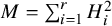 $M = \sum _{i=1}^r H_i^2$
was a sum of squares,
$M = \sum _{i=1}^r H_i^2$
was a sum of squares, $\mathrm{{New}}(H_i)$
,
$\mathrm{{New}}(H_i)$
, $i=1,\dots , r$
, would be contained in a triangle
$i=1,\dots , r$
, would be contained in a triangle $\Delta :=\textrm {conv}\left ((2,1,0),(1,2,0),(0,0,3)\right )$
. The only integer points in
$\Delta :=\textrm {conv}\left ((2,1,0),(1,2,0),(0,0,3)\right )$
. The only integer points in $\Delta $
are its vertices and the interior point
$\Delta $
are its vertices and the interior point $(1,1,1)$
, hence the only possible terms in
$(1,1,1)$
, hence the only possible terms in $H_i$
are
$H_i$
are $X_1^2X_2, X_1X_2^2, X_3^3, X_1X_2X_3$
. Another useful fact relates to representations of an even form as a sum of squares; this result appeared in [Reference Choi, Lam and Reznick16]. A form is called even if all monomials in its expansion have even exponents.
$X_1^2X_2, X_1X_2^2, X_3^3, X_1X_2X_3$
. Another useful fact relates to representations of an even form as a sum of squares; this result appeared in [Reference Choi, Lam and Reznick16]. A form is called even if all monomials in its expansion have even exponents.
Proposition 3.15 [Reference Choi, Lam and Reznick16, Thm.4.1].
Suppose $P\in \Sigma _{n,d}$
is an even sum of squares form, then we may write
$P\in \Sigma _{n,d}$
is an even sum of squares form, then we may write $P = \sum _{i=1}^r H_i^2$
, where
$P = \sum _{i=1}^r H_i^2$
, where $H_i = \sum _{\alpha } H_{i\alpha }\mathbf {X}^{\alpha }$
with
$H_i = \sum _{\alpha } H_{i\alpha }\mathbf {X}^{\alpha }$
with $H_{i\alpha }$
being scalars and so that
$H_{i\alpha }$
being scalars and so that $\alpha -\alpha '$
has only even entries for any exponents
$\alpha -\alpha '$
has only even entries for any exponents $\alpha , \alpha '$
appearing in
$\alpha , \alpha '$
appearing in $H_i$
(in particular, each
$H_i$
(in particular, each $H_i^2$
is even).
$H_i^2$
is even).
The Motzkin form is even and no two of the monomials $X_1^2X_2, X_1X_2^2, X_3^3, X_1X_2X_3$
(corresponding to
$X_1^2X_2, X_1X_2^2, X_3^3, X_1X_2X_3$
(corresponding to $(2,1,0)$
,
$(2,1,0)$
, $(1,2,0)$
,
$(1,2,0)$
, $(0,0,3)$
and
$(0,0,3)$
and $(1,1,1)$
respectively) belong to the same congruence class modulo 2. Thus, if M was a sum of squares, it would have to be of the form
$(1,1,1)$
respectively) belong to the same congruence class modulo 2. Thus, if M was a sum of squares, it would have to be of the form $M=c_1(X_1^2X_2)^2 + c_2(X_1X_2^2)^2 + c_3(X_3^3)^2 + c_4(X_1X_2X_3)^2$
with
$M=c_1(X_1^2X_2)^2 + c_2(X_1X_2^2)^2 + c_3(X_3^3)^2 + c_4(X_1X_2X_3)^2$
with $c_1,c_2,c_3,c_4 \ge 0$
, which is false.
$c_1,c_2,c_3,c_4 \ge 0$
, which is false.
The third fact is a special case of a result on the square of products of linear polynomials.
Lemma 3.16. Suppose $h_1,\dots , h_r \in \mathbb {R}[t]$
and let
$h_1,\dots , h_r \in \mathbb {R}[t]$
and let $k \ge 1$
. If
$k \ge 1$
. If
 $$ \begin{align} (t^2-1)^{2k}\ =\ \sum_{i=1}^r h_i(t)^2, \end{align} $$
then each $h_i(t)$
is a multiple of
$h_i(t)$
is a multiple of $(t^2-1)^k$
.
$(t^2-1)^k$
.
Proof. The proof is by induction on k. If $k = 1$
, then
$k = 1$
, then $0 = \sum _{i=1}^r h_i(\pm 1)^2$
, so
$0 = \sum _{i=1}^r h_i(\pm 1)^2$
, so $h_i(t) = \tilde h_i(t)\,(t^2-1)$
and after cancelling
$h_i(t) = \tilde h_i(t)\,(t^2-1)$
and after cancelling $(t^2-1)^2$
, we have
$(t^2-1)^2$
, we have $1 = \sum _{i=1}^r \tilde h_i(t)^2$
, so each
$1 = \sum _{i=1}^r \tilde h_i(t)^2$
, so each $\tilde h_i$
must be a constant. In the inductive step, we just need to factor out
$\tilde h_i$
must be a constant. In the inductive step, we just need to factor out $(t^2-1)^2$
from both sides of (3.4) and repeat the same argument.
$(t^2-1)^2$
from both sides of (3.4) and repeat the same argument.
We now prove the stubbornness of M.
Theorem 3.17. The Motzkin form (1.1) is stubborn, that is, $M^k$
is not a sum of squares for all odd
$M^k$
is not a sum of squares for all odd $k\geq 1$
.
$k\geq 1$
.
Proof. Suppose that $M^k\in \Sigma _{3,6k}$
is a sum of squares and write
$M^k\in \Sigma _{3,6k}$
is a sum of squares and write
 $$ \begin{align} M^{k}\ =\ \left(X_1^4X_2^2 + X_1^2X_2^4 + X_3^6 - 3X_1^2X_2^2X_3^2\right)^k\ =\ \sum_{i=1}^r H_i^2. \end{align} $$
We remark for later use that by taking $(X_1,X_2,X_3) = (0,0,1)$
above,
$(X_1,X_2,X_3) = (0,0,1)$
above,
 $$ \begin{align} 1\ =\ M^{k}(0,0,1)\ =\ \sum_{i=1}^r H_i(0,0,1)^2\ =\ \sum_{i=1}^r H_{i,(0,0,3k)}^2, \end{align} $$
where $H_{i,(0,0,3k)}:=H_i(0,0,1)$
is the coefficient of
$H_{i,(0,0,3k)}:=H_i(0,0,1)$
is the coefficient of $X_3^{3k}$
in
$X_3^{3k}$
in $H_i$
,
$H_i$
, $i=1,\dots , r$
. Evidently,
$i=1,\dots , r$
. Evidently,
 $$ \begin{align*} \mathrm{{New}}\left(M^{k}\right)\ =\ k\cdot\mathrm{{New}}(M)\ =\ \textrm{conv}\left((4k,2k,0),(2k,4k,0),(0,0,6k)\right) \end{align*} $$
and so by Lemma 3.14 the monomials in each $H_i$
must be taken from the triangle
$H_i$
must be taken from the triangle
 $$\begin{align*}\textrm{conv}\left((2k,k,0),(k,2k,0),(0,0,3k)\right). \end{align*}$$
When is $(\alpha _1,\alpha _2,\alpha _3) \in \mathbb Z^3$
in this triangle? We have
$(\alpha _1,\alpha _2,\alpha _3) \in \mathbb Z^3$
in this triangle? We have $\alpha _3 = 3k - \alpha _1 - \alpha _2 \ge 0$
and the other two edges give
$\alpha _3 = 3k - \alpha _1 - \alpha _2 \ge 0$
and the other two edges give $2\alpha _1 \ge \alpha _2$
and
$2\alpha _1 \ge \alpha _2$
and $2\alpha _2 \ge \alpha _1$
. Note that
$2\alpha _2 \ge \alpha _1$
. Note that $\alpha _2 \le 2k$
and if
$\alpha _2 \le 2k$
and if $\alpha _2 = 2k$
, then we must have
$\alpha _2 = 2k$
, then we must have $\alpha _1 = k$
. In particular,
$\alpha _1 = k$
. In particular, $\alpha _1$
must be odd. Further, if
$\alpha _1$
must be odd. Further, if $\alpha _2 = 0$
, then
$\alpha _2 = 0$
, then $\alpha _1=0$
. If
$\alpha _1=0$
. If $\alpha _2= 2$
, then
$\alpha _2= 2$
, then $1 \le \alpha _1 \le 4$
and if
$1 \le \alpha _1 \le 4$
and if $\alpha _2 = 2k-2$
, then
$\alpha _2 = 2k-2$
, then $k-1 \le \alpha _1 \le k+2$
.
$k-1 \le \alpha _1 \le k+2$
.
By Proposition 3.15, we may assume that each $H_i$
contains only terms
$H_i$
contains only terms $X_1^{\alpha _1}X_2^{\alpha _2}X_3^{\alpha _3}$
of a particular parity. In view of the interest in
$X_1^{\alpha _1}X_2^{\alpha _2}X_3^{\alpha _3}$
of a particular parity. In view of the interest in $X_3^{3k}$
(cf. (3.6)), consider those
$X_3^{3k}$
(cf. (3.6)), consider those $H_i$
’s in which
$H_i$
’s in which $\alpha _1$
and
$\alpha _1$
and $\alpha _2$
are even and
$\alpha _2$
are even and $\alpha _3$
is odd. By the above remarks, we must have
$\alpha _3$
is odd. By the above remarks, we must have $\alpha _2\le 2k-2$
, since
$\alpha _2\le 2k-2$
, since $\alpha _1$
is even, and also the only term for which
$\alpha _1$
is even, and also the only term for which $\alpha _2= 0$
has
$\alpha _2= 0$
has $\alpha _1=0$
as well. So we can write such an
$\alpha _1=0$
as well. So we can write such an $H_i$
in increasing powers of
$H_i$
in increasing powers of $X_2$
as
$X_2$
as
 $$ \begin{align} \begin{aligned} H_i\ =\ &H_{i,(0,0,3k)} X_3^{3k} + \left(H_{i,(2,2,3k-4)} X_1^2X_3^{3k-4} + H_{i,(4,2,3k-6)} X_1^4X_3^{3k-6}\right) X_2^2\\ &+ \cdots + \left(H_{i,(k-1,2k-2,3)} X_1^{k-1}X_3^3 + H_{i,(k+1,2k-2,1)} X_1^{k+1}X_3\right) X_2^{2k-2}. \end{aligned} \end{align} $$
Now observe that $M(1,t,1) = t^2 + t^4 + 1 - 3t^2 = (t^2-1)^2$
. Therefore, (3.5) specializes to
$M(1,t,1) = t^2 + t^4 + 1 - 3t^2 = (t^2-1)^2$
. Therefore, (3.5) specializes to
 $$ \begin{align*} M^{k}(1,t,1)\ =\ (t^2-1)^{2k}\ =\ \sum_{i=1}^r H_i(1,t,1)^2. \end{align*} $$
and by Lemma 3.16 we have $H_i(1,t,1)= c_i(t^2-1)^{k}$
for some
$H_i(1,t,1)= c_i(t^2-1)^{k}$
for some $c_i\in \mathbb {R}$
. On the other hand, from (3.7) we obtain
$c_i\in \mathbb {R}$
. On the other hand, from (3.7) we obtain
 $$ \begin{align*} H_i(1,t,1)\ =\ H_{i,(0,0,3k)} +(H_{i,(2,2,3k-4)} + H_{i,(4,2,3k-6)})t^2 + \cdots + (H_{i,(k-1,2k-2,3)} + H_{i,(k+1,2k-2,1)}) t^{2k-2}. \end{align*} $$
and so $\deg (H_i(1,t,1)) =\deg (c_i (t^2-1)^k)\le 2k-2$
. Thus
$\deg (H_i(1,t,1)) =\deg (c_i (t^2-1)^k)\le 2k-2$
. Thus $c_i = 0$
and, from the constant term,
$c_i = 0$
and, from the constant term, $H_{i,(0,0,3k)}=H_i(0,0,1) = 0$
for all
$H_{i,(0,0,3k)}=H_i(0,0,1) = 0$
for all $i=1,\dots ,r$
. This contradicts (3.6).
$i=1,\dots ,r$
. This contradicts (3.6).
In the case of even k, the monomials $X_1^{\alpha _1}X_2^{\alpha _2}X_3^{\alpha _3}$
entering
$X_1^{\alpha _1}X_2^{\alpha _2}X_3^{\alpha _3}$
entering $H_i$
with
$H_i$
with $\alpha _1,\alpha _2$
even include
$\alpha _1,\alpha _2$
even include $X_3^{3k}$
,
$X_3^{3k}$
, $X_1^{2k}X_2^{k}$
and
$X_1^{2k}X_2^{k}$
and $X_1^{k}X_2^{2k}$
, so
$X_1^{k}X_2^{2k}$
, so $H_i(1,t,1)$
has degree
$H_i(1,t,1)$
has degree $2k$
, which does not prevent
$2k$
, which does not prevent $H_i(1,t,1)$
from being a multiple of
$H_i(1,t,1)$
from being a multiple of $(t^2-1)^k$
.
$(t^2-1)^k$
.
Remark 3.18. Using similar arguments, one can show stubbornness of the form $S\in \mathcal {E}(P_{3,6})\cap \Delta _{3,6}$
from (1.3).
$S\in \mathcal {E}(P_{3,6})\cap \Delta _{3,6}$
from (1.3).
3.5 Stengle’s form
Stengle showed [Reference Stengle44] that the ternary sextic
 $$ \begin{align*} T\ =\ X_1^3X_3^3 + (X_2^2X_3 - X_1^3 - X_1X_3^2)^2 \end{align*} $$
is stubborn. It is interesting to note that T is not extremal, as we now explain. It is easy to check that T has $2$
real zeros at
$2$
real zeros at $[0:0:1]$
and
$[0:0:1]$
and $[0:1:0]$
(see, e.g., the proof of Proposition 3.20 below). By (2.9) we have that
$[0:1:0]$
(see, e.g., the proof of Proposition 3.20 below). By (2.9) we have that $\delta _{[0:0:1]}(T)=3$
. In the next example we compute the delta invariant of T at
$\delta _{[0:0:1]}(T)=3$
. In the next example we compute the delta invariant of T at $[0:1:0]$
showing that
$[0:1:0]$
showing that $\delta _{[0:1:0]}(T)=6$
.
$\delta _{[0:1:0]}(T)=6$
.
Example 3.19. The strict transforms of
 $$ \begin{align} t\ =\ (x_3-x_1^3-x_1x_3^2)^2+x_1^3x_3^3 \end{align} $$
under two consecutive blow-ups $x_3=x_1x_3'$
and
$x_3=x_1x_3'$
and $x_3'=x_1x_3"$
are given as
$x_3'=x_1x_3"$
are given as
 $$ \begin{align*} t'\ &=\ (x_3'-x_1^2-x_1^2x_3^{\prime2})^2+x_1^4x_3^{\prime3},\quad t"\ =\ (x_3"-x_1-x_1^3x_3^{\prime\prime2})^2+x_1^5x_3^{\prime\prime3} \end{align*} $$
and hence $\delta _{(0,0)}(t)=1+\delta _{(0,0)}(t')=1+1+\delta _{(0,0)}(t")$
. Blowing up with
$\delta _{(0,0)}(t)=1+\delta _{(0,0)}(t')=1+1+\delta _{(0,0)}(t")$
. Blowing up with $x_3"=x_1x_3"'$
gives
$x_3"=x_1x_3"'$
gives
 $$ \begin{align} t"'\ &=\ (x_3"'-1-x_1^4x_3^{\prime\prime\prime2})^2+x_1^6x_3^{\prime\prime\prime3} \end{align} $$
Since the first order infinitely near point of $t"=0$
at
$t"=0$
at $(x_1,x_3")=(0,0)$
is at
$(x_1,x_3")=(0,0)$
is at $(x_1,x_3"')=(0,1)$
, it is convenient to write
$(x_1,x_3"')=(0,1)$
, it is convenient to write $t"'$
in the coordinates
$t"'$
in the coordinates $x_1=\tilde x_1$
,
$x_1=\tilde x_1$
, $x_3"'=\tilde x_3+1$
,
$x_3"'=\tilde x_3+1$
,
 $$ \begin{align*} \tilde t\ &=\ (\tilde x_3-\tilde x_1^4(\tilde x_3+1)^2)^2+\tilde x_1^6(\tilde x_3+1)^3, \end{align*} $$
so that $\delta _{(0,1)}(t"')=\delta _{(0,0)}(\tilde t)$
. Now, the consecutive blow-ups
$\delta _{(0,1)}(t"')=\delta _{(0,0)}(\tilde t)$
. Now, the consecutive blow-ups $\tilde x_3=x_1\tilde x_3'$
and
$\tilde x_3=x_1\tilde x_3'$
and $\tilde x_3'=x_1\tilde x_3"$
give
$\tilde x_3'=x_1\tilde x_3"$
give
 $$ \begin{align*} \tilde t'\ &=\ (\tilde x_3'-\tilde x_1^3(\tilde x_1\tilde x_3'+1)^2)^2+\tilde x_1^4(\tilde x_1\tilde x_3'+1)^3,\quad \tilde t"\ =\ (\tilde x_3"-\tilde x_1^2(\tilde x^2_1\tilde x_3"+1)^2)^2+\tilde x_1^2(\tilde x^2_1\tilde x_3"+1)^3 \end{align*} $$
Finally, $\tilde t"$
has an ordinary singularity at
$\tilde t"$
has an ordinary singularity at $(0,0)$
and
$(0,0)$
and $\delta _{(0,0)}(\tilde t)=1+\delta _{(0,0)}(\tilde t')=1+1+\delta _{(0,0)}(\tilde t")=3$
. Summarizing, we obtain that
$\delta _{(0,0)}(\tilde t)=1+\delta _{(0,0)}(\tilde t')=1+1+\delta _{(0,0)}(\tilde t")=3$
. Summarizing, we obtain that $\delta _{(0,0)}(t)=2+\delta _{(0,0)}(t")=3+\delta _{(0,1)}(t"')=3+\delta _{(0,0)}(\tilde t)=3+3=6$
.
$\delta _{(0,0)}(t)=2+\delta _{(0,0)}(t")=3+\delta _{(0,1)}(t"')=3+\delta _{(0,0)}(\tilde t)=3+3=6$
.
As a consequence, the total delta invariant of T is equal to $\delta (T)=3+6=9$
. As it is less than
$\delta (T)=3+6=9$
. As it is less than $10$
, by Lemma 3.7, Stengle’s form
$10$
, by Lemma 3.7, Stengle’s form $T\in \partial P_{3,6}$
is not extremal. Proposition 3.20 below gives an explicit representation of T as a convex combination of two nonnegative sextics that are not proportional to it.
$T\in \partial P_{3,6}$
is not extremal. Proposition 3.20 below gives an explicit representation of T as a convex combination of two nonnegative sextics that are not proportional to it.
Proposition 3.20. The form $T\in \partial P_{3,6}$
is not extremal, that is,
$T\in \partial P_{3,6}$
is not extremal, that is, $T\notin \mathcal {E}(P_{3,6})$
.
$T\notin \mathcal {E}(P_{3,6})$
.
Proof. Let $c>0$
be a positive real number and consider
$c>0$
be a positive real number and consider
 $$ \begin{align*} T_c\ =\ c X_1^3X_3^3 + (X_2^2X_3 - X_1^3 - X_1X_3^2)^2 \end{align*} $$
so that $T = T_1$
. Stengle’s argument [Reference Stengle44] shows that
$T = T_1$
. Stengle’s argument [Reference Stengle44] shows that $T_c \notin \Sigma _{3,6}(\infty )$
, whether or not it is nonnegative.
$T_c \notin \Sigma _{3,6}(\infty )$
, whether or not it is nonnegative.
We have $T_c(X_1,X_2,0) = X_1^6 \ge 0$
, so to check whether
$T_c(X_1,X_2,0) = X_1^6 \ge 0$
, so to check whether $T_c$
is nonnegative, it is enough to consider the dehomogenized polynomial
$T_c$
is nonnegative, it is enough to consider the dehomogenized polynomial
 $$ \begin{align*} T_c(X_1,X_2,1)\ =\ c X_1^3 + (X_2^2 - X_1^3 - X_1)^2. \end{align*} $$
Note that $T_c(X_1,X_2,1) \geq 0$
when
$T_c(X_1,X_2,1) \geq 0$
when $X_1 \geq 0$
and if
$X_1 \geq 0$
and if $X_1 < 0$
, then
$X_1 < 0$
, then $-X_1^3-X_1> 0$
, so
$-X_1^3-X_1> 0$
, so $T_c(X_1,X_2,1) \geq T_c(X_1,0,1)$
. Thus,
$T_c(X_1,X_2,1) \geq T_c(X_1,0,1)$
. Thus, $T_c(X_1,X_2,1) \geq 0$
for all
$T_c(X_1,X_2,1) \geq 0$
for all $(X_1,X_2)\in \mathbb {R}^2$
if and only if
$(X_1,X_2)\in \mathbb {R}^2$
if and only if
 $$ \begin{align*} T_c(X,0,1)\ =\ c X^3 + (-X^3 - X)^2 = X^2(cX + (X^2 + 1)^2)\ \geq\ 0,\quad X\in \mathbb{R}. \end{align*} $$
An easy calculation shows that the largest value of $c>0$
for which it is possible is
$c>0$
for which it is possible is $\kappa := \sqrt {256/27} \approx 3.079$
and
$\kappa := \sqrt {256/27} \approx 3.079$
and
 $$ \begin{align} T_{\kappa}(X,0,1) = X^2 \left( X + \frac{1}{\sqrt{3}}\right)^2\left(X^2 - \frac{2}{\sqrt{3}} X+ 3\right)\ \geq\ 0. \end{align} $$
Thus, $T_{\kappa }$
is nonnegative and
$T_{\kappa }$
is nonnegative and $T=T_1$
is a convex combination of
$T=T_1$
is a convex combination of $T_{\kappa }$
and
$T_{\kappa }$
and $T_0$
.
$T_0$
.
Remark 3.21. By the same computation as in Examples 2.11 and 3.19, we can show that $\delta _{[0:0:1]}(T_c)=3$
and
$\delta _{[0:0:1]}(T_c)=3$
and $\delta _{[0:1:0]}(T_c)=6$
for any
$\delta _{[0:1:0]}(T_c)=6$
for any $c\neq 0$
.
$c\neq 0$
.
It follows from the above proof that T belongs to the relative interior of a face $\mathcal {F}\subset \partial P_{3,6}$
of the cone of nonnegative ternary sextics with
$\mathcal {F}\subset \partial P_{3,6}$
of the cone of nonnegative ternary sextics with $\dim \mathcal {F}\geq 2$
. We now show that the dimension of this face
$\dim \mathcal {F}\geq 2$
. We now show that the dimension of this face $\mathcal {F}$
is exactly two.
$\mathcal {F}$
is exactly two.
Proposition 3.22. The unique smallest face $\mathcal {F}$
of
$\mathcal {F}$
of $P_{3,6}$
containing T in its relative interior is
$P_{3,6}$
containing T in its relative interior is $2$
-dimensional. It is generated by
$2$
-dimensional. It is generated by $T_0$
and
$T_0$
and $T_{\kappa }$
,
$T_{\kappa }$
, $\kappa =\sqrt {256/27}$
, both of which are extremal in
$\kappa =\sqrt {256/27}$
, both of which are extremal in $P_{3,6}$
.
$P_{3,6}$
.
Proof. The idea of the proof is to show that a form $F\in \partial P_{3,6}$
contained in the relative interior of the face
$F\in \partial P_{3,6}$
contained in the relative interior of the face $\mathcal {F}\subset P_{3,6}$
, must satisfy
$\mathcal {F}\subset P_{3,6}$
, must satisfy $26$
linear conditions, which define the plane spanned by
$26$
linear conditions, which define the plane spanned by $T_0$
and
$T_0$
and $T_{\kappa }$
. If
$T_{\kappa }$
. If $F=\sum _{\vert \alpha \vert =6} F_{\alpha }\mathbf {X}^{\alpha }\in \mathcal {F}$
is such a nonnegative sextic (written in the monomial basis), then we can write
$F=\sum _{\vert \alpha \vert =6} F_{\alpha }\mathbf {X}^{\alpha }\in \mathcal {F}$
is such a nonnegative sextic (written in the monomial basis), then we can write $T=F+\tilde F$
for some other nonnegative
$T=F+\tilde F$
for some other nonnegative $\tilde F\in \mathcal {F}$
. By [Reference Reznick34, Thm.
$\tilde F\in \mathcal {F}$
. By [Reference Reznick34, Thm. $1$
] we have that
$1$
] we have that $\mathrm{{New}}(F)$
is contained in
$\mathrm{{New}}(F)$
is contained in $\mathrm{{New}}(T)=\textrm {conv}((6,0,0),(2,0,4),(0,4,2))$
. Thus, we can write
$\mathrm{{New}}(T)=\textrm {conv}((6,0,0),(2,0,4),(0,4,2))$
. Thus, we can write
 $$ \begin{align*} F\ &=\ F_{(2,0,4)}X_1^2X_3^4+F_{(1,2,3)}X_1X_2^2X_3^3+F_{(0,4,2)}X_2^4X_3^2+F_{(3,0,3)}X_1^3X_3^3+F_{(2,1,3)}X_1^2X_2X_3^3\\&\quad +F_{(4,0,2)}X_1^4X_3^2+F_{(3,1,2)}X_1^3X_2X_3^2+F_{(2,2,2)}X_1^2X_2^2X_3^2+F_{(1,3,2)}X_1X_2^3X_3^2+F_{(5,0,1)}X_1^5X_3\\&\quad +F_{(4,1,1)}X_1^4X_2X_3+F_{(3,2,1)}X_1^3X_2^2X_3+F_{(6,0,0)}X_1^6, \end{align*} $$
see Figure 2. Let us first treat $[0:0:1]$
and consider dehomogenizations
$[0:0:1]$
and consider dehomogenizations $f_1(x_1,x_2)=F(x_1,x_2,1)$
,
$f_1(x_1,x_2)=F(x_1,x_2,1)$
, $\tilde f_1(x_1,x_2)=\tilde F(x_1,x_2,1)$
,
$\tilde f_1(x_1,x_2)=\tilde F(x_1,x_2,1)$
, $t_1(x_1,x_2)=T(x_1,x_2,1)$
. The strict transform of
$t_1(x_1,x_2)=T(x_1,x_2,1)$
. The strict transform of $f_1$
(in the coordinates
$f_1$
(in the coordinates $(x_1',x_2)$
with
$(x_1',x_2)$
with $x_1=x_1'x_2$
) is
$x_1=x_1'x_2$
) is
 $$ \begin{align*} f_1'\ &=\ F_{(2,0,4)}x_1^{\prime2}+F_{(1,2,3)}x_1'x_2+F_{(0,4,2)}x_2^2 +F_{(3,0,3)}x_1^{\prime3}x_2+F_{(2,1,3)}x_1^{\prime2}x_2+F_{(4,0,2)}x_1^{\prime4}x_2^2+F_{(3,1,2)}x_1^{\prime3}x_2^2\\ &\quad+F_{(2,2,2)}x_1^{\prime2}x_2^2+F_{(1,3,2)}x_1'x_2^2+F_{(5,0,1)}x_1^{\prime5}x_2^3+F_{(4,1,1)}x_1^{\prime4}x_2^3+F_{(3,2,1)}x_1^{\prime3}x_2^3+F_{(6,0,0)}x_1^{\prime6}x_2^4 \end{align*} $$
The second blow-up at $(x_1',x_2)=(0,0)$
(in the coordinates
$(x_1',x_2)=(0,0)$
(in the coordinates $(x_1",x_2)$
, where
$(x_1",x_2)$
, where $x_1'=x_1"x_2$
) reveals
$x_1'=x_1"x_2$
) reveals
 $$ \begin{align*} f_1"\ &=\ F_{(2,0,4)}x_1^{\prime\prime2}+F_{(1,2,3)}x_1"+F_{(0,4,2)} +F_{(3,0,3)}x_1^{\prime\prime3}x^2_2+F_{(2,1,3)}x_1^{\prime\prime2}x_2+F_{(4,0,2)}x_1^{\prime\prime4}x_2^4+F_{(3,1,2)}x_1^{\prime\prime3}x_2^3\\ &\quad+F_{(2,2,2)}x_1^{\prime\prime2}x_2^2+F_{(1,3,2)}x_1"x_2 +F_{(5,0,1)}x_1^{\prime\prime5}x_2^6 +F_{(4,1,1)}x_1^{\prime\prime4}x_2^5+F_{(3,2,1)}x_1^{\prime\prime3}x_2^4+F_{(6,0,0)}x_1^{\prime\prime6}x_2^8 \end{align*} $$
We also have $t^{\prime \prime }_1=f^{\prime \prime }_1+\tilde f_1"$
. By Lemma 2.9 and Example 2.11,
$t^{\prime \prime }_1=f^{\prime \prime }_1+\tilde f_1"$
. By Lemma 2.9 and Example 2.11, $f_1"$
must have a singular point at
$f_1"$
must have a singular point at $(x_1",x_2)=(1,0)$
, which gives
$(x_1",x_2)=(1,0)$
, which gives $F_{(2,0,4)}+F_{(1,2,3)}+F_{(0,4,2)}=0$
,
$F_{(2,0,4)}+F_{(1,2,3)}+F_{(0,4,2)}=0$
, $2 F_{(2,0,4)}+F_{(1,2,3)}=0$
and
$2 F_{(2,0,4)}+F_{(1,2,3)}=0$
and $F_{(2,1,3)}+F_{(1,3,2)}=0$
or, equivalently,
$F_{(2,1,3)}+F_{(1,3,2)}=0$
or, equivalently,
 $$ \begin{align} F_{(2,0,4)}\ =\ F_{(0,4,2)},\quad F_{(1,2,3)}\ =\ -2 F_{(0,4,2)},\quad F_{(1,3,2)}\ =\ -F_{(2,1,3)}. \end{align} $$
We now turn to the point $[0:1:0]$
and consider
$[0:1:0]$
and consider $f_2(x_1,x_3)=F(x_1,1,x_3)$
,
$f_2(x_1,x_3)=F(x_1,1,x_3)$
, $\tilde f_2(x_1,x_3)=\tilde F(x_1,1,x_3)$
,
$\tilde f_2(x_1,x_3)=\tilde F(x_1,1,x_3)$
, $t_2(x_1,x_3)=T(x_1,1,x_3)$
. Following a sequence of blow-ups
$t_2(x_1,x_3)=T(x_1,1,x_3)$
. Following a sequence of blow-ups $x_3=x_1x_3'$
,
$x_3=x_1x_3'$
, $x_3'=x_1x_3"$
and
$x_3'=x_1x_3"$
and $x_3"=x_1x_3"'$
from Example 3.19 we obtain
$x_3"=x_1x_3"'$
from Example 3.19 we obtain
The maximal support and the Newton polytope of a dehomogenization $f_2(x_1,x_3)=F(x_1,1,x_3)$
of a sextic
$f_2(x_1,x_3)=F(x_1,1,x_3)$
of a sextic $F\in \mathcal {F}$

 $$ \begin{align*} f_2'\,&=\,F_{(0,4,2)}x_3^{\prime2}+F_{(3,2,1)}x_1^2x_3'+F_{(6,0,0)}x_1^4-F_{(2,1,3)}x_1x_3^{\prime2}-2F_{(0,4,2)}x_1^2x_3^{\prime3}+F_{(2,2,2)}x_1^2x_3^{\prime2}+F_{(2,1,3)}x_1^3x_3^{\prime3}\\& \quad +F_{(3,1,2)}x_1^3x_3^{\prime2}+F_{(4,1,1)}x_1^3x_3' +F_{(0,4,2)}x_1^4x_3^{\prime4}+F_{(3,0,3)}x_1^4x_3^{\prime3}+F_{(4,0,2)}x_1^4x_3^{\prime2}+F_{(5,0,1)}x_1^4x^{\prime}_3,\\f_2"\,&=\, F_{(0,4,2)}x_3^{\prime\prime2}+F_{(3,2,1)}x_1x_3"+F_{(6,0,0)}x_1^2-F_{(2,1,3)}x_1x_3^{\prime\prime2}-2F_{(0,4,2)}x_1^3x_3^{\prime\prime3}+F_{(2,2,2)}x_1^2x_3^{\prime\prime2}\\& \quad +F_{(2,1,3)}x_1^4x_3^{\prime\prime3}+F_{(3,1,2)}x_1^3x_3^{\prime\prime2}+F_{(4,1,1)}x_1^2x_3"+F_{(0,4,2)}x_1^6x_3^{\prime\prime4} +F_{(3,0,3)}x_1^5x_3^{\prime\prime3}+F_{(4,0,2)}x_1^4x_3^{\prime\prime2}\\& \quad +F_{(5,0,1)}x_1^3x^{\prime\prime}_3,\\f_2"'\,&=\, F_{(0,4,2)}x_3^{\prime\prime\prime2}+F_{(3,2,1)}x_3"'+F_{(6,0,0)}-F_{(2,1,3)}x_1x_3^{\prime\prime\prime2}-2F_{(0,4,2)}x_1^4x_3^{\prime\prime\prime3}+F_{(2,2,2)}x_1^2x_3^{\prime\prime\prime2}\\& \quad +F_{(2,1,3)}x_1^5x_3^{\prime\prime\prime3}+F_{(3,1,2)}x_1^3x_3^{\prime\prime\prime2}+F_{(4,1,1)}x_1x_3"'+F_{(0,4,2)}x_1^8x_3^{\prime\prime\prime4}+F_{(3,0,3)}x_1^6x_3^{\prime\prime\prime3}+F_{(4,0,2)}x_1^4x_3^{\prime\prime\prime2}\\& \quad +F_{(5,0,1)}x_1^2x^{\prime\prime}_3. \end{align*} $$
Since $t_2"'=f_2"'+\tilde f_2"'$
, Lemma 2.9 and Example 3.19 imply that
$t_2"'=f_2"'+\tilde f_2"'$
, Lemma 2.9 and Example 3.19 imply that $f_2"'$
must have a singular point at
$f_2"'$
must have a singular point at $(x_1,x_3"')=(0,1)$
, that is,
$(x_1,x_3"')=(0,1)$
, that is, $F_{(0,4,2)}+F_{(3,2,1)}+F_{(6,0,0)}=0$
,
$F_{(0,4,2)}+F_{(3,2,1)}+F_{(6,0,0)}=0$
, $-F_{(2,1,3)}+F_{(4,1,1)}=0$
and
$-F_{(2,1,3)}+F_{(4,1,1)}=0$
and $2F_{(0,4,2)}+F_{(3,2,1)}=0$
or, equivalently,
$2F_{(0,4,2)}+F_{(3,2,1)}=0$
or, equivalently,
 $$ \begin{align} F_{(6,0,0)}\ =\ F_{(0,4,2)},\quad F_{(3,2,1)}\ =\ -2F_{(0,4,2)},\quad F_{(4,1,1)}\ =\ F_{(2,1,3)}. \end{align} $$
Looking at the leading terms of (3.9) at $(0,1)$
(cf. Figure 2), we require vanishing of
$(0,1)$
(cf. Figure 2), we require vanishing of
 $$ \begin{align*} \frac{\partial^2 f_2"'}{\partial x_1^2}(0,1)\ &=\ 2(F_{(2,2,2)}+F_{(5,0,1)}),\qquad \frac{\partial^2 f_2"'}{\partial x_1 \partial x_3"'}(0,1)\ =\ -2F_{(2,1,3)}+F_{(4,1,1)},\\ \frac{\partial^3 f_2"'}{\partial x_1^3}(0,1)\ &=\ 6F_{(3,1,2)},\qquad \frac{\partial^3 f_2"'}{\partial x_1^2 \partial x_3"'}(0,1)\ =\ 4 F_{(2,2,2)}+2F_{(5,0,1)},\\ \frac{\partial^4 f_2"'}{\partial x_1^4}(0,1)\ &=\ 4!(-2F_{(0,4,2)}+F_{(4,0,2)}),\qquad \frac{\partial^5 f_2"'}{\partial x_1^5}(0,1)\ =\ 5!F_{(2,1,3)} \end{align*} $$
Combining these conditions with (3.12) we update F:
 $$ \begin{align*} F\ &=\ F_{(0,4,2)}(X_1^2X_3^4-2X_1X_2^2X_3^3+X_2^4X_3^2+2X_1^4X_3^2-2X_1^3X_2^2X_3+X_1^6)+F_{(3,0,3)}X_1^3X_3^3\\ &=\ F_{(0,4,2)}(X_2^2X_3-X_1^3-X_1X_3^2)^2+F_{(3,0,3)}X_1^3X_3^3. \end{align*} $$
Since $F\in \mathcal {F}\subset \partial P_{3,6}$
is nonnegative,
$F\in \mathcal {F}\subset \partial P_{3,6}$
is nonnegative, $F_{(0,4,2)}$
cannot be zero (and hence has to be positive). On the other hand,
$F_{(0,4,2)}$
cannot be zero (and hence has to be positive). On the other hand, $F_{(3,0,3)}=F(1,\sqrt {2},1)$
must be nonnegative. It follows that F is proportional to
$F_{(3,0,3)}=F(1,\sqrt {2},1)$
must be nonnegative. It follows that F is proportional to $T_c$
for some
$T_c$
for some $c\geq 0$
and so the face
$c\geq 0$
and so the face $\mathcal {F}$
is two-dimensional.
$\mathcal {F}$
is two-dimensional.
It is easy to argue that $T_0$
, which is a single square of an indefinite cubic, is an extreme ray of
$T_0$
, which is a single square of an indefinite cubic, is an extreme ray of $P_{3,6}$
. The form
$P_{3,6}$
. The form $T_{\kappa }$
has zeroes at
$T_{\kappa }$
has zeroes at $[0:0:1]$
and
$[0:0:1]$
and $[0:1:0]$
, with
$[0:1:0]$
, with $\delta _{[0:0:1]}(T_{\kappa })=3$
and
$\delta _{[0:0:1]}(T_{\kappa })=3$
and $\delta _{[0:1:0]}(T_{\kappa })=6$
. Additionally, the form
$\delta _{[0:1:0]}(T_{\kappa })=6$
. Additionally, the form $T_{\kappa }$
has also a round zero at
$T_{\kappa }$
has also a round zero at $[1:0:-\sqrt {3}]$
(cf. (3.10)) which makes
$[1:0:-\sqrt {3}]$
(cf. (3.10)) which makes
 $$ \begin{align*} \delta(T_{\kappa})\ =\ \delta_{[0:0:1]}(T_{\kappa})+\delta_{[0:1:0]}(T_{\kappa})+\delta_{[1:0:-\sqrt{3}]}(T_{\kappa})\ =\ 3+6+1\ =\ 10. \end{align*} $$
Therefore, $T_{\kappa }\in \mathcal {E}(P_{3,6})$
is extremal, and
$T_{\kappa }\in \mathcal {E}(P_{3,6})$
is extremal, and $\mathcal {F}$
is generated by two extreme rays
$\mathcal {F}$
is generated by two extreme rays $T_0$
and
$T_0$
and $T_{\kappa }$
.
$T_{\kappa }$
.
4 n-variate forms
We now discuss n-variate forms ( $n>3$
) with the perspective of understanding the relation between
$n>3$
) with the perspective of understanding the relation between $\Sigma _{n,d}(\infty )$
and
$\Sigma _{n,d}(\infty )$
and $P_{n,d}$
. We first show that the quaternary quartic (1.3) is stubborn.
$P_{n,d}$
. We first show that the quaternary quartic (1.3) is stubborn.
Theorem 4.1. The quaternary quartic Q from (1.3) is stubborn.
Proof. If we dehomogenize $Q = X_4^4 + X_1^2X_2^2 + X_1^2X_3^2 + X_2^2X_3^2 -4X_1X_2X_3X_4$
by setting
$Q = X_4^4 + X_1^2X_2^2 + X_1^2X_3^2 + X_2^2X_3^2 -4X_1X_2X_3X_4$
by setting $X_4 = 1$
, and simultaneously set
$X_4 = 1$
, and simultaneously set $X_3 = x_1x_2$
, then (cf. [Reference Choi and Lam13, Prop. 3.7])
$X_3 = x_1x_2$
, then (cf. [Reference Choi and Lam13, Prop. 3.7])
 $$ \begin{align*} Q(x_1,x_2,x_1x_2,1) &=\ 1 + x_1^2x_2^2 + x_1^4x_2^2 + x_1^2x_2^4 - 4x_1^2x_2^2\ =\ M(x_1,x_2,1). \end{align*} $$
Thus, if $Q^k = \sum _{i=1}^r H_i^2\in \Sigma _{4,4k}$
was a sum of squares for some odd
$Q^k = \sum _{i=1}^r H_i^2\in \Sigma _{4,4k}$
was a sum of squares for some odd $k\geq 1$
, then
$k\geq 1$
, then
 $$ \begin{align*} M^k(x_1,x_2,1)\ =\ Q^k(x_1,x_2,x_1x_2,1)\ =\ \sum_{i=1}^r H_i(x_1,x_2,x_1x_2,1)^2, \end{align*} $$
which we know to be impossible by Theorem 1.1 and Remark 1.5.
As a consequence of Theorems 1.1 and 4.1 we now obtain that $\Sigma _{n,d}(\infty )=P_{n,d}$
if and only if
$\Sigma _{n,d}(\infty )=P_{n,d}$
if and only if $\Sigma _{n,d}=P_{n,d}$
, see Figure 3.
$\Sigma _{n,d}=P_{n,d}$
, see Figure 3.
Theorem 4.2. Let $\Delta _{n,d}\neq \emptyset $
, that is,
$\Delta _{n,d}\neq \emptyset $
, that is, $n\geq 3$
and
$n\geq 3$
and $d\geq 6$
or
$d\geq 6$
or $n\geq 4$
and
$n\geq 4$
and $d\geq 4$
. Then there exists a stubborn form
$d\geq 4$
. Then there exists a stubborn form $P\in P_{n,d}$
.
$P\in P_{n,d}$
.
Proof. By Proposition 3.9 or by combining Theorems 1.1 and 3.10 there are stubborn forms $P\in \Delta _{3,d}$
for any even
$P\in \Delta _{3,d}$
for any even $d\geq 6$
. By regarding such forms as forms in
$d\geq 6$
. By regarding such forms as forms in $P\in P_{n,d}\supset P_{3,d}$
in
$P\in P_{n,d}\supset P_{3,d}$
in $n\geq 4$
variables, we see that
$n\geq 4$
variables, we see that $P^k$
cannot be a sum of squares whatever odd
$P^k$
cannot be a sum of squares whatever odd $k\geq 1$
one takes. Indeed, if
$k\geq 1$
one takes. Indeed, if $P^k$
was in
$P^k$
was in $\Sigma _{n,d}$
, then by setting
$\Sigma _{n,d}$
, then by setting $X_4=\dots =X_n=0$
we would have that
$X_4=\dots =X_n=0$
we would have that $P^k=P^k|_{X_4=\dots =X_n=0}$
is in
$P^k=P^k|_{X_4=\dots =X_n=0}$
is in $\Sigma _{3,d}$
, which is a contradiction.
$\Sigma _{3,d}$
, which is a contradiction.
Similarly, considering the quaternary quartic $Q\in \Delta _{4,4}$
from (1.3), which by Theorem 4.1 satisfies
$Q\in \Delta _{4,4}$
from (1.3), which by Theorem 4.1 satisfies $Q\notin \Sigma _{4,4}(\infty )$
, and regarding it as a form
$Q\notin \Sigma _{4,4}(\infty )$
, and regarding it as a form $Q\in P_{n,4}\supset P_{4,4}$
in
$Q\in P_{n,4}\supset P_{4,4}$
in $n\geq 5$
variables, we obtain that
$n\geq 5$
variables, we obtain that $Q^k$
is not a sum of squares for any odd
$Q^k$
is not a sum of squares for any odd $k\geq 1$
.
$k\geq 1$
.
Cases $(n,d)$
when
$(n,d)$
when $\Sigma _{n,d}(\infty )=P_{n,d}$
or, equivalently, when
$\Sigma _{n,d}(\infty )=P_{n,d}$
or, equivalently, when $\Sigma _{n,d}=P_{n,d}$

Instead of trivially regarding a ternary form $P\in P_{3,d}\subset P_{n,d}$
,
$P\in P_{3,d}\subset P_{n,d}$
, $P\notin \Sigma _{3,d}(\infty )$
, as a form in n variables, one can consider an n-variate form
$P\notin \Sigma _{3,d}(\infty )$
, as a form in n variables, one can consider an n-variate form $\tilde {P}(\mathbf {X},\tilde {\mathbf {X}}):=P(\mathbf {X}+ A\tilde {\mathbf {X}})$
, where
$\tilde {P}(\mathbf {X},\tilde {\mathbf {X}}):=P(\mathbf {X}+ A\tilde {\mathbf {X}})$
, where $\mathbf {X}=(X_1,X_2,X_3)$
,
$\mathbf {X}=(X_1,X_2,X_3)$
, $\tilde {\mathbf {X}}=(X_4,\dots , X_n)$
and A being any
$\tilde {\mathbf {X}}=(X_4,\dots , X_n)$
and A being any $3\times (n-3)$
matrix. Then
$3\times (n-3)$
matrix. Then $\tilde P\notin \Sigma _{n,d}(\infty )$
by the same argument as in the proof of Theorem 4.2.
$\tilde P\notin \Sigma _{n,d}(\infty )$
by the same argument as in the proof of Theorem 4.2.
An example of a stubborn nonnegative form in $5$
variables which cannot be obtained in the way described above is the Horn form
$5$
variables which cannot be obtained in the way described above is the Horn form $F = \bigg (\sum _{i=1}^5 X_i^2\bigg )^2 - 4\ \sum _{i=1}^5 X_i^2X_{i+1}^2$
. The proof of the following result relies on the idea from [Reference Diananda18, p.
$F = \bigg (\sum _{i=1}^5 X_i^2\bigg )^2 - 4\ \sum _{i=1}^5 X_i^2X_{i+1}^2$
. The proof of the following result relies on the idea from [Reference Diananda18, p. $25$
] (cf. [Reference Powers and Reznick33, Sect.
$25$
] (cf. [Reference Powers and Reznick33, Sect. $4$
]).
$4$
]).
Theorem 4.3. The Horn form $F = \left (\sum _{i=1}^5 X_i^2\right )^2 - 4\ \sum _{i=1}^5 X_i^2X_{i+1}^2$
is stubborn.
$F = \left (\sum _{i=1}^5 X_i^2\right )^2 - 4\ \sum _{i=1}^5 X_i^2X_{i+1}^2$
is stubborn.
Proof. Viewing the subscripts cyclically modulo 5, one sees that the coefficient of $X_i^2X_j^2$
(for
$X_i^2X_j^2$
(for $i\neq j$
) in F is
$i\neq j$
) in F is $-2$
(resp. 2) if
$-2$
(resp. 2) if $\vert i-j\vert = 1$
(resp.
$\vert i-j\vert = 1$
(resp. $\vert i-j\vert = 2$
) and
$\vert i-j\vert = 2$
) and
 $$ \begin{align*} F(X_1,X_2,X_3,X_4,X_5)\ &=\ F(X_2,X_3,X_4,X_5,X_1)\ =\ F(X_3,X_4,X_5,X_1,X_2)\\ &=\ F(X_4,X_5,X_1,X_2,X_3)\ =\ F(X_5,X_1,X_2,X_3,X_4), \end{align*} $$
that is, F is cyclically symmetric. We have an alternative representation
 $$ \begin{align} F(X_1,\dots,X_5) = (X_1^2-X_2^2+X_3^2-X_4^2+X_5^2)^2 + 4(X_2^2-X_1^2)X_5^2 + 4X_1^2X_4^2, \end{align} $$
from which it is straightforward to see that $F\in P_{5,4}$
is nonnegative (one can assume that
$F\in P_{5,4}$
is nonnegative (one can assume that $X_1^2\leq X_2^2$
by cyclic symmetry).
$X_1^2\leq X_2^2$
by cyclic symmetry).
Suppose now $F = \sum _{i=1}^r H_i^2\in \Sigma _{5,4}$
is a sum of squares and let the coefficient of
$F = \sum _{i=1}^r H_i^2\in \Sigma _{5,4}$
is a sum of squares and let the coefficient of $X_{j}^2$
in
$X_{j}^2$
in $H_i$
be denoted by
$H_i$
be denoted by $H_{ij}$
. Then
$H_{ij}$
. Then
 $$ \begin{align*} (X_1^2-X_2^2+X_3^2)^2\ =\ F(X_1,X_2,X_3,0,0)\ =\ \sum_{i=1}^r H_i^2(X_1,X_2,X_3,0,0). \end{align*} $$
Since the quadratic form $H_i(X_1,X_2,X_3,0,0)$
vanishes on
$H_i(X_1,X_2,X_3,0,0)$
vanishes on $X_1^2-X_2^2+X_3^2=0$
, it must be a multiple of
$X_1^2-X_2^2+X_3^2=0$
, it must be a multiple of $X_1^2-X_2^2+X_3^2$
and thus,
$X_1^2-X_2^2+X_3^2$
and thus, $H_{i1} = -H_{i2} = H_{i3}$
. By cycling the variables, we see that
$H_{i1} = -H_{i2} = H_{i3}$
. By cycling the variables, we see that $H_{i2} = -H_{i3} = H_{i4}$
as well as
$H_{i2} = -H_{i3} = H_{i4}$
as well as $H_{i3} = -H_{i4} = H_{i5}$
and
$H_{i3} = -H_{i4} = H_{i5}$
and $H_{i4} = -H_{i5} = H_{i1}$
, so that
$H_{i4} = -H_{i5} = H_{i1}$
, so that $H_{i1} = -H_{i1} = 0$
for all
$H_{i1} = -H_{i1} = 0$
for all $i=1,\dots ,r $
. This implies that the coefficient of
$i=1,\dots ,r $
. This implies that the coefficient of $X_1^4$
in
$X_1^4$
in $F=\sum _{i=1}^r H^2_i$
is
$F=\sum _{i=1}^r H^2_i$
is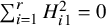 $\sum _{i=1}^r H_{i1}^2 = 0$
, which is a contradiction.
$\sum _{i=1}^r H_{i1}^2 = 0$
, which is a contradiction.
The proof is nearly identical if we take an odd power of F. We first show by induction on $k\geq 1$
odd that if
$k\geq 1$
odd that if
 $$ \begin{align} (X_1^2-X_2^2+X_3^2)^{2k}\ =\ \sum_{i=1}^r Q^2_i(X_1,X_2,X_3), \end{align} $$
then $Q_i(X_1,X_2,X_3) = \alpha _i (X_1^2-X_2^2+X_3^2)^{k}$
for some
$Q_i(X_1,X_2,X_3) = \alpha _i (X_1^2-X_2^2+X_3^2)^{k}$
for some $\alpha _i\in \mathbb {R}$
. If
$\alpha _i\in \mathbb {R}$
. If $k=1$
, the claim follows by the above argument. Otherwise, since
$k=1$
, the claim follows by the above argument. Otherwise, since $Q_i$
vanishes on
$Q_i$
vanishes on $X_1^2-X_2^2+X_3^2=0$
, it must be divisble by
$X_1^2-X_2^2+X_3^2=0$
, it must be divisble by $X_1^2-X_2^2+X_3^2$
and we can write
$X_1^2-X_2^2+X_3^2$
and we can write $Q_i= (X_1^2-X_2^2+X_3^2)\tilde Q_i$
for some degree
$Q_i= (X_1^2-X_2^2+X_3^2)\tilde Q_i$
for some degree $2k-2$
forms
$2k-2$
forms $\tilde Q_i\in \mathbb {R}[X_1,X_2,X_3]$
. We factor out
$\tilde Q_i\in \mathbb {R}[X_1,X_2,X_3]$
. We factor out $(X_1^2-X_2^2+X_3^2)^2$
from (4.2) and apply the induction hypothesis to derive the claim.
$(X_1^2-X_2^2+X_3^2)^2$
from (4.2) and apply the induction hypothesis to derive the claim.
Suppose now that $F^{k} = \sum _{i=1}^r H_i^2\in \Sigma _{5,4k}$
is a sum of squares and let
$F^{k} = \sum _{i=1}^r H_i^2\in \Sigma _{5,4k}$
is a sum of squares and let $H_{ij}$
be the coefficient of
$H_{ij}$
be the coefficient of $X_{j}^{2k}$
in
$X_{j}^{2k}$
in $H_i$
. Then
$H_i$
. Then
 $$ \begin{align} (X_1^2-X_2^2+X_3^2)^{2k} = F^{k}(X_1,X_2,X_3,0,0)\ =\ \sum_{i=1}^r H_i^2(X_1,X_2,X_3,0,0). \end{align} $$
Applying the auxiliary result we showed above to (4.3), we see that each $H_i(X_1,X_2,X_3,0,0)$
is a multiple of
$H_i(X_1,X_2,X_3,0,0)$
is a multiple of $(X_1^2-X_2^2+X_3^2)^{k}$
, and so by looking at
$(X_1^2-X_2^2+X_3^2)^{k}$
, and so by looking at $X_{j}^{2k}$
in
$X_{j}^{2k}$
in $H_i$
, we see that
$H_i$
, we see that $H_{i1} = -H_{i2} = H_{i3}$
. Again, by cycling the variables, we obtain that
$H_{i1} = -H_{i2} = H_{i3}$
. Again, by cycling the variables, we obtain that $H_{i2} = -H_{i3} = H_{i4}$
,
$H_{i2} = -H_{i3} = H_{i4}$
, $H_{i3} = -H_{i4} = H_{i5}$
and
$H_{i3} = -H_{i4} = H_{i5}$
and $H_{i4} = -H_{i5} = H_{i1}$
, so that
$H_{i4} = -H_{i5} = H_{i1}$
, so that $H_{i1} = -H_{i1} = 0$
for all
$H_{i1} = -H_{i1} = 0$
for all $i=1,\dots , r$
. From this we have that the coefficient of
$i=1,\dots , r$
. From this we have that the coefficient of $X_1^{4k}$
in
$X_1^{4k}$
in $F^k=\sum _{i=1}^r H^2_i$
is
$F^k=\sum _{i=1}^r H^2_i$
is $\sum _{i=1}^r H_{i1}^2 = 0$
, which is a contradiction.
$\sum _{i=1}^r H_{i1}^2 = 0$
, which is a contradiction.
In contrast to $Q\in P_{4,4}\setminus \Sigma _{4,4}(\infty )$
and forms in
$Q\in P_{4,4}\setminus \Sigma _{4,4}(\infty )$
and forms in $P_{3,d}\setminus \Sigma _{3,d}(\infty )$
considered in Section 3, the Horn form
$P_{3,d}\setminus \Sigma _{3,d}(\infty )$
considered in Section 3, the Horn form $F\in P_{5,4}\setminus \Sigma _{5,4}(\infty )$
has infinitely many real zeros. Indeed, by the proof of Theorem 4.3 (see (4.1)), the Horn form vanishes on the plane curve
$F\in P_{5,4}\setminus \Sigma _{5,4}(\infty )$
has infinitely many real zeros. Indeed, by the proof of Theorem 4.3 (see (4.1)), the Horn form vanishes on the plane curve $\mathcal {V}(X_1^2-X_2^2+X_3^2, X_4, X_5)$
as well as on the curves
$\mathcal {V}(X_1^2-X_2^2+X_3^2, X_4, X_5)$
as well as on the curves $\mathcal {V}(X_2^2-X_3^2+X_4^2, X_5, X_1),\dots , \mathcal {V}(X_5^2-X_1^2+X_2^2, X_3, X_4)$
obtained from the former one by cyclically permuting the variables.
$\mathcal {V}(X_2^2-X_3^2+X_4^2, X_5, X_1),\dots , \mathcal {V}(X_5^2-X_1^2+X_2^2, X_3, X_4)$
obtained from the former one by cyclically permuting the variables.
5 Convexity of
$\Sigma _{n,d}(\infty )$

Our goal here is to prove Theorem 5.3 below, which implies that the set $\Sigma _{n,d}(\infty )$
of non-stubborn forms is convex. We begin with a special case.
$\Sigma _{n,d}(\infty )$
of non-stubborn forms is convex. We begin with a special case.
Theorem 5.1. Suppose $P_1$
and
$P_1$
and $P_2$
are nonnegative forms such that
$P_2$
are nonnegative forms such that $P_1^k$
and
$P_1^k$
and $P_2$
are both sums of squares for some odd
$P_2$
are both sums of squares for some odd $k\geq 1$
. Then
$k\geq 1$
. Then $(P_1+P_2)^{k}$
is also a sum of squares.
$(P_1+P_2)^{k}$
is also a sum of squares.
Proof. The function $x^k$
,
$x^k$
, $x\in \mathbb {R}$
, is strictly monotone. Then for any real
$x\in \mathbb {R}$
, is strictly monotone. Then for any real $t_1,t_2$
,
$t_1,t_2$
,
 $$ \begin{align*} F_{k}(t_1,t_2)\ :=\ \frac{(t_1+t_2)^{k} - t_1^{k}}{(t_1+t_2) - t_1} = \sum_{i=0}^{k-1}{k \choose i+1}\, t_1^{k-1-i}t_2^i \end{align*} $$
is a quotient of two positive numbers when $t_2> 0$
and two negative numbers when
$t_2> 0$
and two negative numbers when $t_2 < 0$
, which implies that
$t_2 < 0$
, which implies that $F_{k}\in P_{2,k-1}$
considered as a binary form is nonnegative. Thus,
$F_{k}\in P_{2,k-1}$
considered as a binary form is nonnegative. Thus, $F_{k}(t_1,t_2) = G_k^2(t_1,t_2) + H_k^2(t_1,t_2)$
for some forms
$F_{k}(t_1,t_2) = G_k^2(t_1,t_2) + H_k^2(t_1,t_2)$
for some forms $G_k,H_k$
of degree
$G_k,H_k$
of degree $(k-1)/2$
. The claim now follows, since
$(k-1)/2$
. The claim now follows, since
 $$ \begin{align*} (P_1 + P_2)^{k}\ &=\ P_1^{k} + P_2 \cdot \frac{(P_1 + P_2)^{k} - P_1^{k}}{(P_1+P_2) - P_1}\ =\ P_1^{k} + P_2 \cdot F_{k}(P_1,P_2) \\ &=\ P_1^{k} + P_2 \cdot \left(G_k^2(P_1,P_2) + H_k^2(P_1,P_2)\right). \end{align*} $$
is a sum of squares, since it is a sum of a sum of squares form and a product of sum of squares forms.
For the more general case, we need to look at other truncated binomial sums. For integers $n\geq r\geq 0$
let
$n\geq r\geq 0$
let
 $$ \begin{align*} f_{n,r}(t)\ =\ \sum_{i=0}^r \binom ni\, t^i \end{align*} $$
denote the truncated binomial polynomial. Extensive numerical computation suggested that if $n> 2r$
, the polynomial
$n> 2r$
, the polynomial $f_{n,2r}>0$
is positive. The third author posed this as an unproved conjecture on MathOverflow, and the solution was quickly presented by Prof. Iosif Pinelis, which is included with his kind permission.
$f_{n,2r}>0$
is positive. The third author posed this as an unproved conjecture on MathOverflow, and the solution was quickly presented by Prof. Iosif Pinelis, which is included with his kind permission.
Theorem 5.2 (Pinelis, [Reference Pinelis30]).
For all $n> 2r$
and
$n> 2r$
and $t \in {\mathbb R}$
,
$t \in {\mathbb R}$
, $f_{n,2r}(t)> 0$
.
$f_{n,2r}(t)> 0$
.
Proof. We argue by induction on n for fixed r. As before, $f_{2r+1,2r}(t) = (1+t)^{2r+1} - t^{2r+1}$
is positive because
$f_{2r+1,2r}(t) = (1+t)^{2r+1} - t^{2r+1}$
is positive because $x^{2r+1}$
is strictly increasing. We use two combinatorial identities:
$x^{2r+1}$
is strictly increasing. We use two combinatorial identities:
 $$ \begin{align} f_{n,r}'(t) &= \sum_{i=0}^r \binom ni\ i t^{i-1} = n \sum_{i=1}^r \binom {n-1}{i-1}\ t^{i-1} = nf_{n-1,r-1}(t),\end{align} $$
 $$ \begin{align} f_{n,r}(t) &= \sum_{i=0}^r \binom {n-1}i\, t^i + \sum_{i=1}^r \binom {n-1}{i-1}\, t^i = f_{n-1,r}(t) + tf_{n-1,r-1}(t).\end{align} $$
Since $f_{n,2r}(t) \to \infty $
as
$f_{n,2r}(t) \to \infty $
as $t \to \pm \infty $
, it suffices to look at values of
$t \to \pm \infty $
, it suffices to look at values of $f_{n,2r}$
at its critical points. Suppose
$f_{n,2r}$
at its critical points. Suppose $f_{n,2r}'(t_0) = 0$
. Then by (5.1),
$f_{n,2r}'(t_0) = 0$
. Then by (5.1), $f_{n-1,2r-1}(t_0) = 0$
and so by (5.2),
$f_{n-1,2r-1}(t_0) = 0$
and so by (5.2),
 $$\begin{align*}f_{n,2r}(t_0)\ =\ f_{n-1,2r}(t_0) + t_0f_{n-1,2r-1}(t_0)\ =\ f_{n-1,2r}(t_0), \end{align*}$$
which is positive by the inductive hypothesis.
Observe that by this theorem there are polynomials $g_{n,2r}(t)$
and
$g_{n,2r}(t)$
and $h_{n,2r}(t)$
such that
$h_{n,2r}(t)$
such that $f_{n,2r}(t) = (g_{n,2r}(t))^2 + (h_{n,2r}(t))^2$
, and upon homogenization that there exist binary forms
$f_{n,2r}(t) = (g_{n,2r}(t))^2 + (h_{n,2r}(t))^2$
, and upon homogenization that there exist binary forms $G, H$
of degree r so that
$G, H$
of degree r so that
 $$\begin{align*}F_{n,2r}(t_1,t_2)\ =\ \sum_{i=0}^r \binom ni\, t_1^it_2^{2r-i}\ =\ (G_{n,2r}(t_1,t_2))^2 + (H_{n,2r}(t_1,t_2))^2. \end{align*}$$
We need this representation in the main result of this section.
Theorem 5.3. Let $P\in \Sigma _{n,d}(k)$
and
$P\in \Sigma _{n,d}(k)$
and $\tilde P\in \Sigma _{n,d}(\tilde k)$
, where numbers k and
$\tilde P\in \Sigma _{n,d}(\tilde k)$
, where numbers k and $\tilde k$
are both odd. Then
$\tilde k$
are both odd. Then $P+\tilde P\in \Sigma _{n,d}(k+\tilde k-1)$
. In particular,
$P+\tilde P\in \Sigma _{n,d}(k+\tilde k-1)$
. In particular, $\Sigma _{n,d}(\infty )$
is a convex cone.
$\Sigma _{n,d}(\infty )$
is a convex cone.
Proof. We expand $(P+\tilde P)^{k+\tilde k-1}$
, and using
$(P+\tilde P)^{k+\tilde k-1}$
, and using $i' = i - k$
below, we obtain its representation as a sum of squares:
$i' = i - k$
below, we obtain its representation as a sum of squares:
 $$ \begin{align*} (P+\tilde P)^{k+\tilde k-1} &= \sum_{i = 0}^{k+\tilde k-1} \binom{k+\tilde k -1}i P^{i}\tilde P^{\,k+\tilde k-1-i}\\&= \sum_{i = 0}^{k-1} \binom{k+\tilde k-1}i P^{i}\tilde P^{k+\tilde k-1-i} + \sum_{i = k}^{k+\tilde k-1} \binom{k+\tilde k-1}i P^{i}\tilde P^{k+\tilde k-1-i}\\&= \tilde P^{\tilde k} \sum_{i = 0}^{k-1} \binom{k+\tilde k-1}i P^{i}\tilde P^{k-1-i} + P^{k} \sum_{i' = 0}^{\tilde k-1} \binom{k+\tilde k-1}{i '+k}P^{i'}\tilde P^{\tilde k-1-i'}\\&= \tilde P^{\tilde k} \sum_{i = 0}^{k-1} \binom{k+\tilde k-1}i P^{i}\tilde P^{k-1-i} + P^{k} \sum_{i' = 0}^{\tilde k-1} \binom{k+\tilde k-1}{\tilde k-1-i'}P^{i'}\tilde P^{\tilde k-1-i'}\\&= \tilde P^{\tilde k}F_{k+\tilde k-1,k-1}(P,\tilde P) + P^{k}F_{k+\tilde k-1,\tilde k-1}(\tilde P,P) \\&= \tilde P^{\tilde k}(G_{k+\tilde k-1,k-1}^2(P,\tilde P) + H_{k+\tilde k-1,k-1}^2( P,\tilde P)) \\&\quad+ P^{k}(G^2_{k+\tilde k-1,\tilde k-1}(\tilde P,P) + H_{k+\tilde k-1,\tilde k-1}^2(\tilde P,P)). \end{align*} $$
The second claim follows immediately.
6 Further remarks and questions
In this section we make some remarks around our results and state some open questions.
Conjecture 1.6 asserts that any extremal form in $P_{n,d}$
that is not a sum of squares is stubborn.
$P_{n,d}$
that is not a sum of squares is stubborn.
Also, we do not know whether for a fixed odd k, the closed cone $\Sigma _{n,d}(k)$
is convex or not. We expect the answer should not depend on the values of the parameters.
$\Sigma _{n,d}(k)$
is convex or not. We expect the answer should not depend on the values of the parameters.
We showed in Subsection 3.5 that Stengle’s form (1.4) is not extremal. In fact, by Proposition 3.22 the face containing T in its relative interior is two-dimensional. One can show that all forms in the relative interior of this face are stubborn. This motivates the following question: “What is the maximal dimension of a face $\mathcal {F}\subset P_{n,d}$
whose relative interior consists of stubborn forms?”
$\mathcal {F}\subset P_{n,d}$
whose relative interior consists of stubborn forms?”
Extremal ternary sextics $P\in \mathcal {E}(P_{3,6})\cap \Delta _{3,6}$
satisfy
$P\in \mathcal {E}(P_{3,6})\cap \Delta _{3,6}$
satisfy $\delta ^{\,\textrm {sos}}(P)=\delta (P)=10$
and are stubborn by Theorem 1.1. We saw in Subsection 3.5 that
$\delta ^{\,\textrm {sos}}(P)=\delta (P)=10$
and are stubborn by Theorem 1.1. We saw in Subsection 3.5 that $\delta ^{\,\textrm {sos}}(T)=\delta (T)=9$
for Stengle’s form, which is stubborn as well [Reference Stengle44]. Based on this and Proposition 3.22 we make the following conjecture.
$\delta ^{\,\textrm {sos}}(T)=\delta (T)=9$
for Stengle’s form, which is stubborn as well [Reference Stengle44]. Based on this and Proposition 3.22 we make the following conjecture.
Conjecture 6.1. Let $P\in \Delta _{3,6}$
be a nonnegative form that is not a sum of squares and such that
$P\in \Delta _{3,6}$
be a nonnegative form that is not a sum of squares and such that $\mathcal {V}(P)$
has only real singularities with
$\mathcal {V}(P)$
has only real singularities with $\delta (P)=9$
. Then P is stubborn and lies in the relative interior of a
$\delta (P)=9$
. Then P is stubborn and lies in the relative interior of a $2$
-dimensional face of
$2$
-dimensional face of $P_{3,6}$
.
$P_{3,6}$
.
Recently it has been shown in [Reference Baldi, Blekherman, Kozhasov, Plaumann, Reznick and Sinn2, Thm 1.2] that $P\in \Delta _{3,6}$
is stubborn if and only if the plane curve
$P\in \Delta _{3,6}$
is stubborn if and only if the plane curve $\mathcal {V}(P)\subset \mathbb {P}_{\mathbb {C}}^2$
has only real singular points with
$\mathcal {V}(P)\subset \mathbb {P}_{\mathbb {C}}^2$
has only real singular points with $\delta (P)\in \{9,10\}$
, thus proving Conjecture 6.1.
$\delta (P)\in \{9,10\}$
, thus proving Conjecture 6.1.
The Robinson form (1.2) (as well as any $P\in \mathcal {E}(P_{3,6})\cap \Delta _{3,6}$
that generates an exposed extreme ray) has
$P\in \mathcal {E}(P_{3,6})\cap \Delta _{3,6}$
that generates an exposed extreme ray) has $10$
round zeros. The Motzkin form (1.1) has four round zeros
$10$
round zeros. The Motzkin form (1.1) has four round zeros $[\pm 1:\pm 1:1]$
and two zeros
$[\pm 1:\pm 1:1]$
and two zeros $[1:0:0]$
,
$[1:0:0]$
, $[0:1:0]$
at each of which the SOS-invariant is equal to
$[0:1:0]$
at each of which the SOS-invariant is equal to $3$
. This motivates the following problem.
$3$
. This motivates the following problem.
Problem 6.2. Classify partitions $(\delta _1,\dots , \delta _s)$
of
$(\delta _1,\dots , \delta _s)$
of $10=\delta _1+\dots +\delta _s$
that can be realized as the set of local SOS-invariants (equivalently, delta invariants) at real zeros of some
$10=\delta _1+\dots +\delta _s$
that can be realized as the set of local SOS-invariants (equivalently, delta invariants) at real zeros of some $P\in \mathcal {E}(P_{3,6})\cap \Delta _{3,6}$
.
$P\in \mathcal {E}(P_{3,6})\cap \Delta _{3,6}$
.
For $ a \le 3$
, let us now define
$ a \le 3$
, let us now define
 $$\begin{align*}M_a\ =\ X_1^4X_2^2 + X_1^2X_2^4 + X_3^6 - aX_1^2X_2^2X_3^2\ =\ M + (3-a)X_1^2X_2^2X_3^2 \end{align*}$$
and consider for $k\geq 0$
the set
$k\geq 0$
the set
 $$\begin{align*}V_{2k+1}\ =\ \{a\,:\, M_a^{2k+1} \in \Sigma_{3,6(2k+1)}\}\ =\ \{ a \,:\, M_a \in \Sigma_{3,6}(2k+1)\} \end{align*}$$
of parameters $a\leq 3$
for which the
$a\leq 3$
for which the $(2k+1)$
-th power of
$(2k+1)$
-th power of $M_a$
is a sum of squares.
$M_a$
is a sum of squares.
Theorem 6.3. There exists a non-decreasing sequence $(c_k) \subset [0,3)$
so that
$(c_k) \subset [0,3)$
so that
 $$\begin{align*}V_{2k+1} = (-\infty, c_k],\quad k\geq 0. \end{align*}$$
Proof. For each $k\geq 0$
we obviously have
$k\geq 0$
we obviously have $(-\infty ,0] \subseteq V_{2k+1}$
and
$(-\infty ,0] \subseteq V_{2k+1}$
and $3 \notin V_{2k+1}$
by Corollary 1.2. Let
$3 \notin V_{2k+1}$
by Corollary 1.2. Let $c_k = \sup (V_{2k+1})$
. Since the cone
$c_k = \sup (V_{2k+1})$
. Since the cone $\Sigma _{3,6(2k+1)}$
is closed, it follows that
$\Sigma _{3,6(2k+1)}$
is closed, it follows that $c_k \in V_{2k+1}$
and so
$c_k \in V_{2k+1}$
and so $c_k \in [0,3)$
. Suppose
$c_k \in [0,3)$
. Suppose $a = c_k - c$
is any number smaller than
$a = c_k - c$
is any number smaller than $c_k$
(so
$c_k$
(so $c> 0$
). Then
$c> 0$
). Then
 $$\begin{align*}X_1^4X_2^2 + X_1^2X_2^4 + X_3^6 - aX_1^2X_2^2X_3^2\ =\ \left(X_1^4X_2^2 + X_1^2X_2^4 + X_3^6 - c_kX_1^2X_2^2X_3^2\right)+ c X_1^2X_2^2X_3^2, \end{align*}$$
is in $\Sigma _{3,6}(2k+1)$
by Theorem 5.3 applied to forms
$\Sigma _{3,6}(2k+1)$
by Theorem 5.3 applied to forms $P=X_1^4X_2^2 + X_1^2X_2^4 + X_3^6 - c_kX_1^2X_2^2X_3^2\in \Sigma _{3,6}(2k+1)$
and
$P=X_1^4X_2^2 + X_1^2X_2^4 + X_3^6 - c_kX_1^2X_2^2X_3^2\in \Sigma _{3,6}(2k+1)$
and $\tilde P = c X_1^2X_2^2X_3^2\in \Sigma _{3,6}$
.
$\tilde P = c X_1^2X_2^2X_3^2\in \Sigma _{3,6}$
.
From the proof that M is not a sum of squares [Reference Motzkin27] one infers that $V_1 = (-\infty , 0]$
, that is,
$V_1 = (-\infty , 0]$
, that is, $c_0=0$
. Now, the third power of
$c_0=0$
. Now, the third power of $M_a$
satisfies
$M_a$
satisfies
 $$ \begin{align*} M_a^3\ &=\ \frac{3}{2} \left(X_1^5X_2^4 - a X_1^3X_2^4X_3^2\right)^2 + \frac{3}{2} \left(X_1^4X_2^5 - a X_1^4X_2^3X_3^2\right)^2 +\frac{3}{2} \left(X_1^4X_2^2X_3^3 - a X_1^2X_2^2X_3^5\right)^2\\&\quad + \frac{3}{2} \left(X_1^2X_2^4X_3^3 - a X_1^2X_2^2X_3^5\right)^2 +\frac{3}{2} \left(X_1X_2^2X_3^6 - a X_1^3X_2^4X_3^2\right)^2 + \frac{3}{2}\left(X_1^2X_2X_3^6 - a X_1^4X_2^3X_3^2\right)^2\\&\quad +\frac{3}{2} \left(X_1^2X_2^4X_3^3- X_1^4X_2^2X_3^3\right)^2 + \frac{3}{2}\left(X_1^4X_2^5 - X_1^2X_2X_3^6\right)^2 + \frac{3}{2}\left(X_1^5X_2^4 - X_1X_2^2X_3^6\right)^2\\&\quad + \left(X_3^9 - 2a X_1^2X_2^2X_3^5\right)^2 + a \left(X_1 X_2 X_3^7 - 2a X_1^3X_2^3X_3^3\right)^2 + \left(X_1^3X_2^6 - 2a X_1^3X_2^4X_3^2\right)^2\\&\quad + a \left(X_1^3X_2^5X_3 - 2a X_1^3X_2^3X_3^3\right)^2 + \left(X_1^6X_2^3 - 2a X_1^4X_2^3X_3^2\right)^2 + a \left(X_1^5X_2^3X_3 - 2a X_1^3X_2^3X_3^3\right)^2\\&\quad + \left(15 - 13a^3\right)\left(X_1^3X_2^3X_3^3\right)^2 \end{align*} $$
and as a consequence we have that $\frac {15}{13}^{1/3} \approx 1.04886\le c_1$
. Note that we cannot apply Scheiderer’s theorem from [Reference Scheiderer42] here, because
$\frac {15}{13}^{1/3} \approx 1.04886\le c_1$
. Note that we cannot apply Scheiderer’s theorem from [Reference Scheiderer42] here, because $M_c$
for
$M_c$
for $c> 0$
is not strictly positive (it has real zeros at
$c> 0$
is not strictly positive (it has real zeros at $[1:0:0]$
and
$[1:0:0]$
and $[0:1:0]$
). Pablo Parrilo has experimentally found out [Reference Parrilo28] that
$[0:1:0]$
). Pablo Parrilo has experimentally found out [Reference Parrilo28] that $c_1 \approx 2.56548$
and also
$c_1 \approx 2.56548$
and also $c_2 \approx 2.88905$
. One interesting question is whether
$c_2 \approx 2.88905$
. One interesting question is whether $\lim _k c_k = 3$
. Another natural question here is whether the sequence
$\lim _k c_k = 3$
. Another natural question here is whether the sequence $(c_k)$
is strictly increasing.
$(c_k)$
is strictly increasing.
Acknowledgments
We thank Pablo Parrilo, Adam Parusiński and Isabelle Shankar for useful discussions. Moreover, we thank Iosif Pinelis for his proof of Theorem 5.2 and Jim McEnerney, whose query to the third author partially motivated this work. We also thank two anonymous reviewers, whose comments helped us to improve the paper greatly.
Competing interests
The authors have no competing interests to declare.


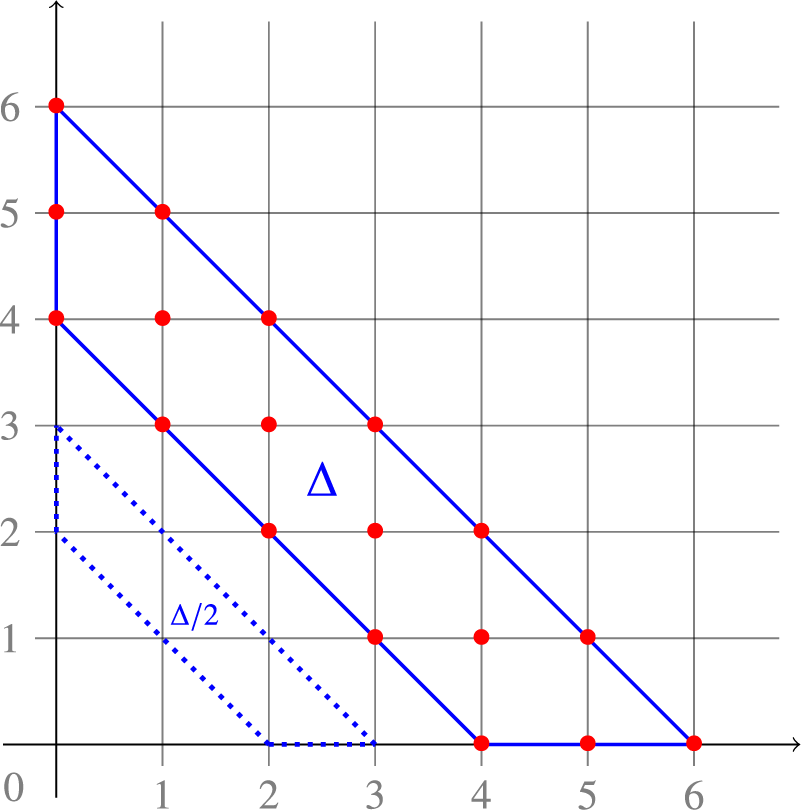


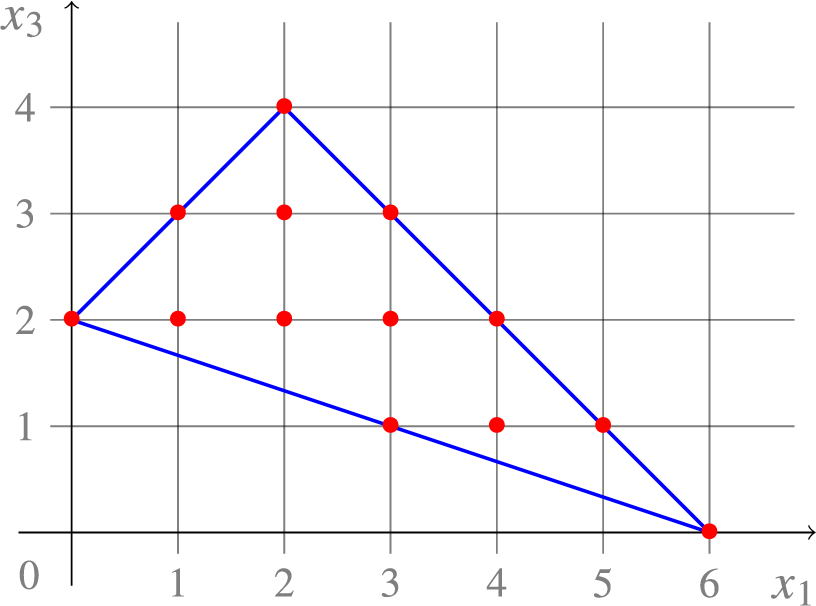


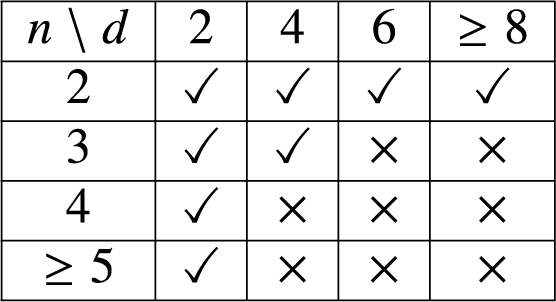


 Open access

