

Introduction
The northwestern Iberian Peninsula contains numerous gold deposits. Many have been exploited since Roman times; they include different types of deposits, including alluvial gold as well as gold in gossan and in quartz veins (Fuertes-Fuente et al., Reference Fuertes-Fuente, Cepedal, Lima, Dória, Ribeiro and Guedes2016).
A gossan is defined as iron-bearing weathered rocks usually overlying sulfide-bearing deposits, and predominantly consisting of iron oxides and hydroxides, exhibiting a massive or powdery appearance with about 30–50% porosity and around 45 vol.% Fe (Jensen and Bateman, Reference Jensen and Bateman1979; Taylor et al., Reference Taylor, Wilmshurst, Butt and Smith1980; Taylor and Thornber, Reference Taylor, Thornber, Butt and Zeegers1992).
The primary gold mineralization is generally considered to be a product of the Variscan orogeny, but the origin and age of many of the deposits is still unclear. The gold (both native gold and electrum) occurs within sulfides, along grain boundaries, filling late fractures or in cavities in quartz veins. The occurrence of mineralized veins, which cut both Precambrian–Palaeozoic metasedimentary rocks and Carboniferous granites, suggests that the mineralization is late-Variscan in age. This is supported by the spatial relationship between the mineralized structures and late faults that typically trend between N10°E and N40°E (Noronha and Ramos, Reference Noronha and Ramos1993).
Some authors (e.g. Neiva and Neiva, Reference Neiva and Neiva1990), suggested a genetic relation between hydrothermal-fluid activity and late-stage fractional crystallization of granites for the Portuguese gold deposits. In contrast, Noronha et al. (Reference Noronha, Cathelineau, Boiron, Banks, Dória, Ribeiro, Nogueira and Guedes2000) concluded that the gold ores in quartz veins appear to be the result of three successive periods of fluid circulation in response to high heat flow and the intrusions of the granites: Stage 1 corresponds to the deposition of a milky quartz after the emplacement of synorogenic peraluminous granites; Stage 2 is characterized by a clear quartz and some sulfides and minor gold overprinting the early milky quartz associated with a fluid flow related with orogenic uplift and tectonic reactivation; and Stage 3 is characterized by intense microfissuring of the earlier minerals, deposition of more sulfides (galena, chalcopyrite and bismuthinite) in addition to native bismuth and sulfosalts (Pb-Bi-Ag dominant). The main episode of gold deposition coincides with Stage 3.
In the present study the various modes of gold occurrence associated with the different stages of primary and supergene mineralization are characterized. Samples obtained from a gold exploration campaign in the Castromil and Serra da Quinta areas, within the Lagares Licence which is currently being explored by Medgold Resources Corporation, were used.
The Castromil-Serra da Quinta gold deposit, as with many other Iberian mines, was mined by the Romans as open pits (exploiting mineralized gossans) and surface galleries, and their workings are still preserved. Recent diamond drilling, which penetrated below the oxidation level, has provided samples that were only affected by hydrothermal alteration associated with the highest primary gold mineralization grades.
Materials and methods
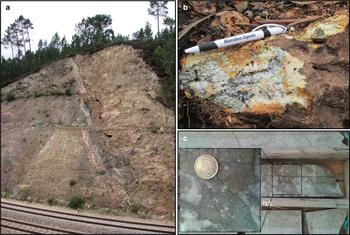
Representative rock samples were collected at Castromil and Serra da Quinta on both outcrop and cores obtained by drilling (Fig. 1).
Field images: (a) ‘Railway Fault’, along the contact between the late-D3 biotite granite (on the right) and the Silurian metasediments (on the left); (b) outcrop with boxworks and preserved sulfides; and (c) drill core with sulfides.
Sample preparation and petrographic studies were undertaken at the Department of Geosciences, Environment and Spatial Planning (DGAOT) of the Faculty of Sciences, University of Porto (FCUP).
The petrographic studies were carried out using a Leica petrographic polarizing microscope in reflected light at DGAOT-FCUP and observations were made both in reflected and transmitted light.
Complementary studies for characterization of gold ores were carried out using SEM and X-ray Microanalysis (EDS) at the Materials Center of the University of Porto. The SEM study was performed using a high-resolution JEOL JSM 6301F SEM coupled with an Oxford INCA Energy 350 system. Samples were carbon coated using a JEOL JEE-4X Vacuum Evaporator. The composition of the gold particles was established using EPMA operating at an accelerating voltage of 15 kV. The EPMA instruments used were a JEOL JXA 8500F at the National Laboratory of Energy and Geology (Portugal) and a JEOL JXA-8200 at the Faculty of Sciences of the University of Lisbon. These studies were carried out on both polished thin and thick sections.
Castromil-Serra da Quinta area
Geological setting
The Castromil-Serra da Quinta gold deposit is located to the east of Porto, close to Sobreira (Paredes Municipality), in northwestern Portugal (Fig. 2) and is part of the Central Iberian Zone (CIZ), which represents the autochthonous domain of the Variscan belt in the northwest Iberian Peninsula (Fig. 2a).
(a) Simplified tectonostratigraphic terrane of the Iberian Peninsula (modified after Lotze, Reference Lotze1945; Julivert et al., Reference Julivert, Fontboté, Ribeiro and Conde1974). (b) Simplified geological map of the Valongo anticlinal area with the location of the main Au and/or Au-Sb mineralizations. Carboniferous: (1) continental sediments and coal beds; Devonian: (2) quartzites and greywackes; Silurian: (3) black shales and cherts; Ordovician: (4) quartzites, shales and greywackes, (5) black shales, (6) quartzites; Cambrian: (7) schist and greywack complex. Faults in heavy solid lines; CTSZ: Carboniferous trough shear zone (after Gonçalves et al., Reference Gonçalves, Mateus and Oliveira2001).

The European Variscan belt resulted from the convergence of the continents of Laurasia and Gondwana in Devonian and Carboniferous time (Franke, Reference Franke1989; Ribeiro et al., Reference Ribeiro, Pereira, Dias, Dallmeyer and Martinez Garcia1990; Kroner and Romer, Reference Kroner and Romer2013). Three main deformation phases have been documented in northern Portugal, namely D1, D2 and D3 (Noronha et al., Reference Noronha, Ramos, Rebelo, Ribeiro and Ribeiro1981). Most of the granite intrusions and the associated thermal metamorphic peak are coeval with the last phase (D3; Dias and Ribeiro, Reference Dias and Ribeiro1995; Noronha et al., Reference Noronha, Cathelineau, Boiron, Banks, Dória, Ribeiro, Nogueira and Guedes2000).
The Valongo anticline is an important D1 structure of the autochthonous domain, affected by a D3 shear zone, the ‘Carboniferous Trough Shear Zone’ (CTSZ), which strikes NNW–SSE to NW–SE and represents a major structural feature of the northwestern domain of the autochthon.
Several Au and Sb-Au occurrences are closely associated with both the Valongo anticline and the CTSZ and belong to a major metallogenic province extending from Póvoa de Varzim (north of Porto) to the Castro D'Aire granite (Fig. 2b) (Gonçalves et al., Reference Gonçalves, Mateus, Barriga, Borges and Marques1995).
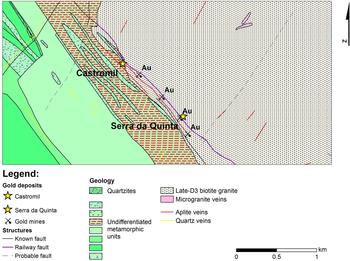
The gold deposit studied occurs on the eastern flank of the northern part of the Valongo anticline. The Castromil-Serra da Quinta mineralized system is related spatially to a fault zone referred to as the ‘Railway Fault’, which is mainly located along the contact between the late-D3 porphyritic biotite granite and the Silurian metasediments (Figs 1a and 3). The main host-rock of mineralized structures is the porphyritic granite. The ‘Railway Fault’ is also a NW–SE post-D3 regional fault (N40°W, 70°N) (Gonçalves et al., Reference Gonçalves, Mateus, Barriga, Borges and Marques1995; Vallance et al., Reference Vallance, Cathelineau, Boiron, Fourcade, Shepherd and Naden2003).
Geological map and location of the study area (after: Folha 9D – Penafiel; Carta Geológica de Portugal na escala de 1:50.000, 1981).
Mineralogical and fluid characteristics
Many studies have been done on the mineralogy of the Castromil-Serra da Quinta gold deposit. A report by Anamet Services (1994) stated that the primary ore mineral assemblage consists mostly of arsenopyrite and pyrite together with minor galena and löllingite (FeAs2). The gold was interpreted to occur in three forms: primary metallic gold, supergene gold and refractory gold (in ultrafine particles). Small crystals of bismuthinite and metallic bismuth were observed within arsenopyrite and pyrite.
Weathering processes have oxidized and destroyed the primary ore to form secondary minerals, mainly scorodite (FeAsO4·2H2O) and goethite (FeO(OH)). Less abundant phases are Pb- or Bi-bearing sulfates (jarosite), arsenides (ludlockite, philipsbornite, arsenobismite) and phosphates (plumbogummite). Arsenobismite is rare and occurs in fine-grained aggregates intergrown with goethite and scorodite (Anamet Services, 1994). Gomes and Couto (Reference Gomes and Couto2016) described other minerals in variably weathered and altered ore samples from Castromil-Serra da Quinta. These include iodargyrite (AgI), enargite (CuAsS4), lepidocrocite (FeO(OH)) and a suite of less common hydrated Al/Fe-arsenides (mansfieldite, kankite, symplesite), Pb/Fe-arsenide sulfates (beudantite, hidalgoite, bukovskuite, pitticite, zykaite) and alkali-bearing sulfates (huangite, walthierite, alunite).
Selwyn (Reference Selwyn2015) described three main styles of primary gold occurrence at Castromil/Serra da Quinta: (1) electrum in sulfides (pyrite and arsenopyrite); (2) electrum in fractures; and (3) electrum hosted in quartz. He also observed the presence of minor amounts of native gold hosted within Fe oxide boxwork structures. The gold grains range in size from 12 to 48 μm across.
Vallance et al. (Reference Vallance, Cathelineau, Boiron, Fourcade, Shepherd and Naden2003) defined several stages of fluid percolation during mineralization at Castromil. The earliest stage (Stage I) was characterized by fluids dominated by CO2 and CH4 at temperatures between 400 and 500°C, with pressures ranging from 230 to 300 MPa. These fluids were responsible for significant alteration (greisenization) of the aplite and its host granite. Fluids associated with a second stage of mineralization (Stage II) were also characterized by aqueous-carbonic fluids. Stage II was interpreted to be responsible for the main phase of quartz-arsenopyrite-pyrite-gold deposition in the deposit. A third stage (Stage III: main Au-ore stage) was contemporaneous of the deposition of gold, mainly along microfractures in the earlier sulfides.
In this contribution we have examined fresh samples of primary origin from drill cores and oxidized samples from the outcrops using a variety of different approaches to corroborate the nature of gold occurrence in the Castromil-Serra da Quinta deposit.
Petrography of the fresh and oxidized ores
Primary sulfides at Castromil/Serra da Quinta are associated with quartz and they are hosted by granite, aplite, greisen and a breccia. The main sulfides are pyrite and arsenopyrite (Fig. 4a). The arsenopyrite generally displays a rhombic or cubic shape, and pyrite is sometimes euhedral cubic in shape. Arsenopyrite is observed to be cross-cut by pyrrhotite, chalcopyrite and pyrite (Fig. 4b), and replaced by later galena, bismuthinite and native bismuth (Fig. 4c,d). Arsenopyrite, chalcopyrite, sphalerite and galena are also found to be included within pyrite (Fig. 4e), possibly suggesting two generations of pyrite, although both styles of pyrite have a similar shape, colour and composition.
Photomicrographs of ore minerals in fresh and oxidized samples: (a, b, c, d) reflected light and (e, f) SEM (Py – pyrite; Apy – arsenopyrite; Qz – quartz; Ccp – chalcopyrite; Po – pyrrhotite; Gn – galena; Bi – bismuthinite; Sp – sphalerite, Scor – scorodite).

The distribution of major minerals throughout the deposit reveals different zones within the oxide ore and the unweathered deposit (fresh ore), with gradual contacts between them which are roughly parallel to the current topography: (1) an upper zone near the surface, consisting mainly of goethite and scorodite, which is depleted of arsenopyrite and pyrite, as well as precious metals; (2) a middle zone dominated by goethite and scorodite and subordinate arsenopyrite and pyrite and significant enrichment in Ag and Au; and (3) a lower zone with arsenopyrite and pyrite and subordinate goethite. The oxidized zones of the deposit extend to a maximum depth of 40 m.
Local intergrowths of goethite with scorodite were observed, as well as interpenetration of scorodite with muscovite, especially in the greisen samples from gossan (Fig. 4f). Sulfides in outcrop samples are rare, because the rocks at, or near surface, are strongly weathered, and the primary sulfides have mainly been altered to goethite and scorodite. Analysis by SEM has identified other minerals, including plumbogummite (Pb, Al, P oxide) associated with scorodite, and the resistate minerals xenotime, monazite and zircon.
Modes of gold occurrences
Petrographic studies of samples from gossan and drill core make it possible to define different modes of gold occurrence in the Castromil-Serra da Quinta deposit. The studies were carried out utilizing transmitted and reflected microscopic observations as described above.
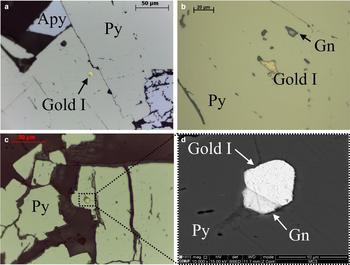
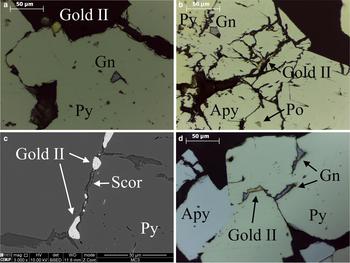
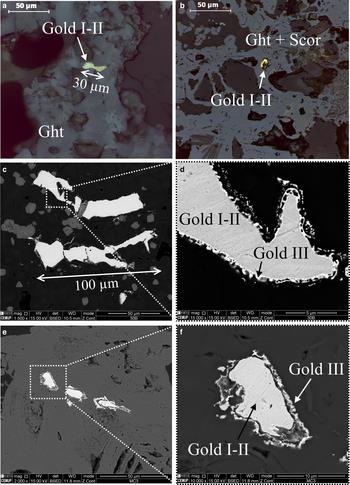
Three distinct modes of occurrence of gold were observed. These are: Gold I, occurring encapsulated in primary sulfides such as arsenopyrite and pyrite (Fig. 5); Gold II, associated with sulfides (arsenopyrite ± pyrite ± galena ± bismuthinite) but occurring along grain boundaries or in fractures in the sulfides and quartz (Fig. 6); and Gold III, as particles within iron oxides or as rims on Gold I or Gold II grains (Fig. 7).
Photomicrographs of Gold I (encapsulate in sulfides): (a, b, c) taken under reflected light and (d) was taken by SEM (Py – pyrite; Apy – arsenopyrite; Gn – galena).
Photomicrographs of Gold II (in sulfides filling later fractures or in grain boundaries): (a, b, d) under reflected light and (c) SEM (Py – pyrite; Gn – galena; Apy – arsenopyrite; Po – pyrrhotite; Scor – scorodite).
Photomicrographs of Gold I–II and Gold III (hosted in Fe oxides): (a, b) reflected light and (c, d, e, f) SEM (Ght – goethite; Scor – scorodite).
In the present study, we have focused in particular on the nature and origin of gold hosted in Fe oxides, and whether they might be related to a supergene enrichment process.
Most gold particles have a whitish-yellow colour which suggests a significant Ag content and are classified as electrum. A small proportion of the gold has a yellow colour, suggesting that those particles are essentially Ag-free, and are classified as native gold.
In outcrops of supergene mineralization, gold mostly occurs associated with scorodite and goethite minerals. Native gold occurs locally coating particles from other gold types and also in isolated grains or associated with galena (Fig. 5c,d).
Gold I
This gold is essentially present in samples from drill core. The gold particles are commonly rounded in shape, and are encapsulated in arsenopyrite and pyrite crystals (Fig. 5). Most gold grains of this generation are 25–50 µm in size and whitish-yellow in colour.
Gold II
These gold particles occur in pyrite and arsenopyrite filling late fractures (Fig. 6), and along grain boundaries and/or as inclusions in quartz. From SEM observations we conclude that fractures are mainly filled by scorodite (Fig. 6c) and/or galena (Fig. 6d). Gold II was also recognized in previous studies (Anamet Services, 1994; Vallance et al., Reference Vallance, Cathelineau, Boiron, Fourcade, Shepherd and Naden2003; Selwyn, Reference Selwyn2015) and appears to be associated with quartz. The present investigations confirm previous studies which describe Gold II occurring together with sulfides, including galena, bismuthinite, sulfosalts (Pb-Bi-Ag dominated), that replaces the older ores, and native bismuth. This gold is clearly younger than the main stage of primary arsenopyrite deposition (e.g. Noronha et al., Reference Noronha, Cathelineau, Boiron, Banks, Dória, Ribeiro, Nogueira and Guedes2000; Vallance et al., Reference Vallance, Cathelineau, Boiron, Fourcade, Shepherd and Naden2003). Most Gold II grains are 10–50 µm in size and also exhibit a whitish-yellow colour.
Gold III
This gold is hosted in the gossan and typically occurs as dispersed fine yellow particles which outline the shape of electrum grains that existed prior to supergene alteration. However, the alteration of primary sulfides to Fe oxides makes it very difficult to distinguish whether the remaining cores are Gold I, Gold II, or both; and therefore those particles are described here as Gold I–II. The Gold I–II grains occur in a range of size from 30 to 100 µm in their longest dimension (Fig. 7). The surrounding rim of Gold III only occurs in the gossans, and is hosted in Fe oxide or hydroxide minerals such as goethite (Fe oxide) and scorodite (As-Fe-hydroxide). Gold III exhibits a distinctive yellow colour, suggesting a very low Ag content, typical of native gold. These particles are very small in size (<3 µm). They occur both intergrown with goethite and scorodite and as thin coatings or rims on older electrum grains (Gold I–II). A boundary contact between a Gold I–II particle and Fe oxides and the development of a rim of Gold III subparallel to the particle outline is shown in Fig. 7. This rim consists of numerous small particles of gold.
Mineralogical analyses in gold particles
The EPMA microanalyses of 16 gold particles from the gossan and from unoxidized samples reveal that most of them have a relatively high Ag content (electrum), but a small proportion of them are essentially Ag-free and occur as native gold.
Gold I has moderate Ag contents (15.5–39.76% Ag), whereas Gold II has greater Ag contents (37.46–51.45% Ag) and Gold III is native gold (<16.11% Ag). The more Ag-rich particles within Fe oxides in gossan (designated Gold I–II), have identical compositional ranges to the Gold I and Gold II particles in the primary ore (39.18–51.73% Ag; Table 1).
EPMA data and mean values of Au and Ag contents in auriferous particles.
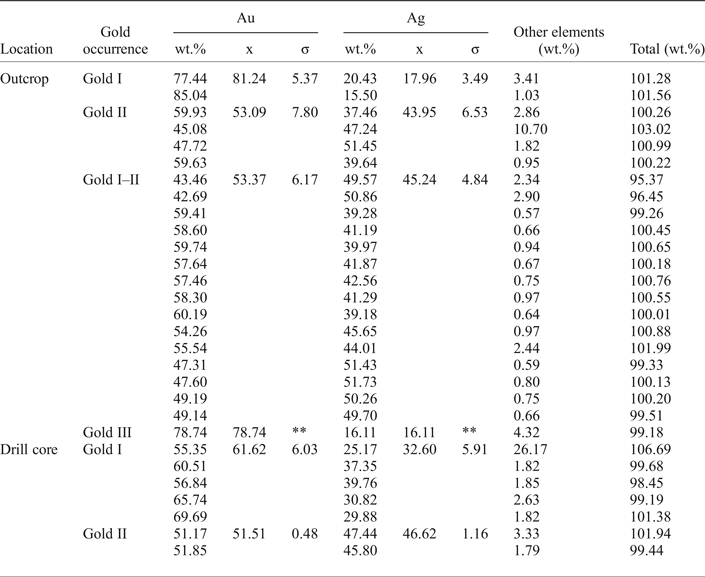
x – mean values; σ – standard deviation. **not available.
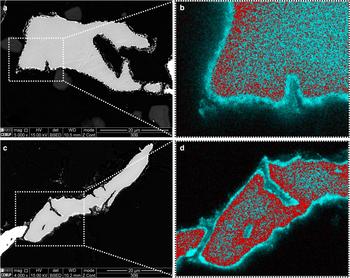
A detailed distribution of Au and Ag in a Gold I–II particle outlined by Gold III is shown in Figure 8, a distribution map which seems to reflect growth of electrum particles by addition of a thin coating of native gold.
(a, c) SEM images and (b, d) X-ray microanalysis maps where Au is shown in blue and Ag in red.
Discussion
The Castromil-Serra da Quinta deposit represents a system of Au-bearing quartz veins which are associated spatially with regional Variscan faults and cross-cutting synkinematic Variscan granites.
Supergene mineralization is represented in the oxide zone of the deposits characterized by hematite and goethite which replaces hypogene or primary mineral associations.
Mineralogical study of the ores reveals a hypogene sulfide association of arsenopyrite ± pyrite ± galena ± Bi minerals and different types of gold occurrences. This mineral association is similar to others occurring in the NW Iberian Peninsula, representing an As ± Fe ± Pb ± Bi ± Au system (Gómez-Fernández et al., Reference Gómez-Fernández, Vindel, Martín-Crespo, Sánchez, González Clavijo and Roberto Matías2012; Cepedal et al., Reference Cepedal, Fuertes-Fuente, Martin-Izard, García-Nieto and Boiron2013; Fuertes-Fuente et al., Reference Fuertes-Fuente, Cepedal, Lima, Dória, Ribeiro and Guedes2016). The deposits studied do not contain Sb minerals like some Variscan Sb-Au deposits that are present in northern, central and western Iberia.
The gold is characterized by two main types of electrum particles: Gold I, which is typically <50 µm in diameter (rarely up to 100 µm), and Gold II, occurring in discrete stringers or elongate bodies, and locally filling pre-existing fractures in sulfide grains, suggesting two different stages of primary (hypogene) gold deposition, where the second is the more important, as already assumed for several other deposits in the NW of the Iberian Peninsula (Noronha et al., Reference Noronha, Cathelineau, Boiron, Banks, Dória, Ribeiro, Nogueira and Guedes2000; Rosa and Romberger, Reference Rosa and Romberger2003; Vallance et al., Reference Vallance, Cathelineau, Boiron, Fourcade, Shepherd and Naden2003).
Supergene mineralization is developed in the oxide zone of the deposit, which is characterized by hematite and goethite replacing the hypogene or primary minerals. Residual hypogene arsenopyrite and pyrite are trace minerals in the oxide zone or gossan. At the boundary contact between electrum particles and Fe oxides the development of a rim of gold subparallel to the particle outline was observed. This rim consists of numerous small particles of gold. Analysis by SEM showed that they contain less Ag than the electrum particles. This may suggest that the electrum particle was subjected to dissolution along its rim at or about the time of formation of Fe oxide. This process led to the formation of very fine supergene gold by preferential leaching of Ag from the electrum particles. Supergene processes upgrade the quality of gold because they involve the leaching of silver from electrum hypogene particles that occur in the quartz veins. The gold found in the gossans studied represent the presence of both primary grains Gold I–II and supergene gold, Gold III (finer).
The gold-grade distribution in diamond-drill intersections obtained as part of Medgold's exploration program at Castromil-Serra da Quinta has led to the suggestion that significant gold enrichment is a result of the supergene processes that affected the deposit. Drill-hole MLG003 intersected 19.95 m @ 3.16 ppm Au with a higher-grade zone in the upper part of the hole (from 5.45 m) of 8.55 m @ 12.46 ppm Au. This later, richer intersection is related to a zone of siliceous, vuggy, gossanous veining, located within a silica-sericite alteration envelope. A similar zone occurs in drill hole MLG004, from surface to a depth of 27.45 m. Assays returned 17.49 m @ 4.44 ppm Au from 10.00 m with peak grades of 19.95 ppm Au. A sulfide-rich zone up to 2.00 m thick (21.50–23.50 m) occurs within this interval (Medgold's Channel Sampling Results, 2015). These results suggest a supergene enrichment in upper zones of the deposit.
Important gossans developed from primary volcanogenic massive sulfide (VMS) deposits are preserved and described in the Iberian Pyrite Belt (IPB), and some of them (e.g. Tharsis, Río Tinto), were also mined during Roman times for precious metals (Velasco et al., Reference Velasco, Herrero, Suárez, Yusta, Alvaro and Tornos2013). At the Las Cruces VMS deposit, a major Pb-Ag-Au mineralization resulting from recent sub-surface replacement of supergene oxyhydroxides by carbonate and sulfide minerals is considered to be an ore assemblage related to recent microbial activity (Tornos et al., Reference Tornos, Velasco, Menor-Salván, Delgado and Escobar2014).
Within the supergene zone at Castromil-Serra da Quinta, weathering and oxidation has transformed the main primary sulfides, which become oxidized and decomposed, resulting in metals being leached and/or reprecipitated. The resulting supergene phases are mainly goethite and scorodite. Goethite aggregates commonly display a moderate degree of porosity and these spaces can enclose small gold particles.
Several different models have been proposed for gold enrichment. Hypogene gold is released by chemical dissolution. Dissolution followed by reprecipitation of the gold in coarser particles appears to have taken place largely in situ with little evidence of supergene enrichment. On the other hand, the residual gold enrichment, under supergene conditions, can be formed by Ag dissolution from Au ± Ag hypogene particles (Bowell, Reference Bowell1992).
Pyrite is a ubiquitous mineral in quartz veins and its oxidation can contribute strongly to the oxidation and hydrolysis of iron or ferrolysis (Mann, Reference Mann1984). Experimental evidence suggests that the very acid solutions generated by ferrolysis are responsible for dissolution of Ag and/or Au. Laboratory experiments by Mann (Reference Mann1984) showed that solutions of FeSO4 in the presence of NaCl dissolved Ag but not Au. Electrum modelling suggests that primary electrum is liberated and electrochemically dissolved by the leaching solution with partial removal of the associated Ag to produce new particles with greater Au contents.
Selwyn (Reference Selwyn2015) described a plausible hypothesis for the dissolution process, where the primary Au-Ag alloy is dissolved and reprecipitated electrochemically as a purer phase. During the transition from the primary to the supergene zone, with mixing of meteoric waters in a highly oxidizing environment, hypogene gold particles and sulfides hosting electrum are broken down by chemical weathering and the gold is released from the hypogene orebody by chemical dissolution (Selwyn, Reference Selwyn2015).
Craw et al. (Reference Craw, MacKenzie and Grieve2015) demonstrated that gold can be leached by thiosulfates; electrum and native gold can be transported by thiosulfates (Au(S2O3)23−) or bisulfide complexes (Au(HS)2−) under acidic conditions or even by organic or inorganic ligands.
In the areas of postulated supergene gold enrichment, thin rims of pure gold are commonly observed surrounding electrum grains with core compositions similar to that of the primary gold. Three different mechanisms can lead to the formation of such Au-rich rims: (1) preferential leaching of Ag from the primary Au-Ag alloy (released from the breakdown of the gold-bearing lodes); (2) a self-electro-refining process where the Au-Ag alloy at the grain-solution interface dissolves and the Au immediately precipitates back onto the surface of the electrum grains; (3) precipitation of Au-rich grains on primary Au-Ag alloy. This process occurs when oxidizing gold-bearing supergene fluids encounter a more reducing environment. The latter mechanism may also be used to explain the formation of the accreted supergene gold grains (e.g. Desborough, Reference Desborough1970; Groen et al., Reference Groen, Craig and Rimstidt1990; Bowell, Reference Bowell1992).
The nature and mode of occurrence of Gold III at Castromil-Serra da Quinta which developed within the oxidation zone strongly suggest that there was gold enrichment on at least a microscopic scale (few hundred micrometres) during supergene oxidation of the gold-bearing ore. It is possible, although still unproven, that the presence of Gold III in some of the highest-grade gold intersections obtained from the deposit indicates that significant supergene enrichment has occurred in the upper parts of the deposit, resulting from processes related to the weathering of the primary Au (Bi) mineralization.
Conclusions
Examination of the Castromil-Serra da Quinta deposits suggests that oxidation of primary sulfides containing Gold I and Gold II grains released scattered grains of electrum (Gold I–II) now hosted by goethite and scorodite. The individual electrum particles commonly exhibit anhedral outlines and occur locally in clusters within masses of goethite and/or scorodite in which one or more larger particles of electrum (typically 25–50 µm) are surrounded by very much smaller particles of pure native Au (Gold III). This suggests that the electrum particles were subjected to dissolution along their rims at or about the time of formation of Fe oxide leading to a supergene formation of very fine gold. The enrichment was caused by preferential leaching of Ag from the electrum particles (Gold I–II). Supergene processes upgrade the quality of gold because they imply the leaching of Ag from hypogene electrum particles occurring in the quartz veins. The gold found in the gossans studied represents the presence of both primary grains and supergene gold (finer).
Acknowledgements
The present study was supported financially by the Portuguese Foundation for Science (FCT-Portugal) Project ERAMIN - ERA-MIN/0002/2013 SUSMIN–‘Tools for sustainable gold mining in EU’. C. Cruz received a scholarship. The authors acknowledge the funding by COMPETE 2020 through the ICT (Institute of Earth Sciences) project (UID / GEO / 04683/2013) with POCI-01-0145 reference - FEDER-007690. Medgold Resources are acknowledged for their technical and scientific assistance as partners of the SUSMIN project. The authors are grateful to John Bowles and Frederica Zaccarini, S. Suárez and an anonymous referee for their helpful comments.


 Open access

