


1. Introduction
Organizational capability is critical for sustaining competitive advantage and driving success in dynamic environments (Reference CollisCollis, 1994; Reference TeeceTeece, 2014; Reference Ulrich and LakeUlrich & Lake, 1991). It enables organizations to allocate resources, design strategies, and implement business models aligned with their goals. This integration of resources, knowledge, and skills ensures operational efficiency, adaptability, and resilience in responding to external pressures (Reference BarneyBarney, 1991; Reference TeeceTeece, 2018).
Organizational capability defines how resources and people are structured to deliver products and services, shaping an organization’s identity and market perception (Reference CollisCollis, 1994). Organizational capabilities have been analyzed through various frameworks, each highlighting different pathways to achieving competitive advantage. The Dynamic Capabilities Framework (Reference TeeceTeece, 2023; Reference Teece, Pisano and ShuenTeece et al., 1997) focuses on sensing, seizing, and transforming opportunities in dynamic environments, with applications in education and supply chain (Reference Chen, Li and ZhangChen et al., 2024; Reference Eslami, Jafari, Achtenhagen, Carlbäck and WongEslami et al., 2024). The Resource-Based View (RBV) (Reference BarneyBarney, 1991) highlights the role of resources that are valuable, rare, inimitable, and organized (VRIO) for sustained success, while the Core Competencies Framework (Reference Prahalad and HamelPrahalad & Hamel, 1999) focuses on unique strengths that deliver superior customer value. Broader alignment is explored in the Balanced Scorecard (Reference Kaplan and NortonKaplan & Norton, 1996), which integrates financial, customer, process, and learning perspectives. The Organizational Learning Framework (Reference Argyris and SchönArgyris & Schön, 1997) and the Knowledge-Based View (Reference NonakaNonaka, 2009) stress continuous learning and knowledge as critical resources (Reference Ifenthaler, Hofhues, Egloffstein and HelbigIfenthaler et al., 2021). Operational models, such as the McKinsey 7S Framework (Reference Waterman, Peters and PhillipsWaterman Jr et al., 1980) and Porter’s Value Chain (Reference PorterPorter, 2001), highlight internal alignment and value creation, with application in healthcare (Reference Chmielewska, Stokwiszewski, Markowska and HermanowskiChmielewska et al., 2022). Recent research like the TASKS Framework (Reference Yang, Yang, Quan and ZengYang et al., 2021), explore workload dynamics, linking affect, skills, and knowledge to productivity and creativity, demonstrating versatility in fields such as healthcare (Reference YangYang, 2024), education (Reference Ma, Wang, Xu and LiMa et al., 2022), organizational management (Reference Wang, Cao, Yang and ZengWang et al., 2024), and engineering (Reference Mohammadi, Yang, Borgianni and ZengMohammadi et al., 2024). Collectively, these frameworks provide a robust foundation for understanding and enhancing organizational success.
This study explores organizational capability using the TASKS framework (Reference Yang, Yang, Quan and ZengYang et al., 2021), a model that assesses five interconnected dimensions: Task, Affect, Skills, Knowledge, and Stress. Unlike traditional bottom-up case study methods, our study employs a top-down approach, leveraging theory-driven evaluation to assess organizational capability. The case study demonstrates the framework’s practical effectiveness in measuring organizational capability in real-world settings.
2. Methods
2.1. Theoretical foundations: TASKS framework
Organizational capability is the collective ability of an organization to effectively achieve its strategic objectives by integrating individual and collective resources, knowledge, and skills (Reference Wang and ZengWang & Zeng, 2017). It reflects the organization’s capacity to adapt to changing environments, solve problems, and deliver value to stakeholders. Central to this concept is the alignment between individual capabilities and organizational goals, which ensures that efforts are harmonized at every level (Reference Albers, Shlonsky and MildonAlbers et al., 2020; Reference Damschroder, Aron, Keith, Kirsh, Alexander and LoweryDamschroder et al., 2009). The TASKS framework (Reference Yang, Yang, Quan and ZengYang et al., 2021) is a deductive, theory-based model designed to analyze and optimize the performance of individuals and organizations. It emphasizes the relationships between five core components, as shown in Figure 1:
Organizational TASKS framework

The TASKS framework (Reference Yang, Yang, Quan and ZengYang et al., 2021) analyzes organizational capability through five interconnected dimensions as shown in equation (1):
 $$\mathbf{\mathit{\bf Mental\;stress}} = {{{\rm{Perceived\; Taskload}}} \over {{\rm{Mental\; Capability}}}} = {{{\rm{Perceived\; Taskload}}} \over {({\rm{Knowledge}} + {\rm{Skills}})*{\rm{Affect}}}}$$
-
T askload: The specific objective or activity to be accomplished.
-
A ffect: The emotional and motivational states influencing engagement with tasks.
-
S kills: The cognitive and practical abilities required for effective task execution.
-
K nowledge: The informational foundation enabling informed decision-making.
-
S tress: The mental load or pressure experienced in balancing taskload demands with resources.
The framework’s foundation lies in the inverse U-shaped relationship between mental stress and performance, where optimal stress levels maximize performance, and deviations—either under- or overstress—impair it (Reference Nguyen and ZengNguyen & Zeng, 2012). This framework provides a structured methodology to assess how organizational capability aligns across different hierarchical roles.
2.2. Data collection and assessment
2.2.1. Sources of data: questionnaire
Data was collected using structured questionnaires designed to assess five key dimensions of organizational capability: taskload, affect, skills, knowledge, and stress. The questionnaire was developed following the Environment-Based Design (EBD) methodology (Reference ZengZeng, 2015) to reduce cognitive load and improve the accuracy of responses. The questionnaire design was guided by the principles outlined in Reference CaoCao (2022). The full questionnaire is provided as supplementary material for further details.
Company A, the organization involved in this study, is a manufacturing company in Montreal planning a lean transformation. The questionnaire was distributed across three hierarchical levels: top managers, middle managers, and employees. Each group received a tailored version designed to reflect their specific roles and responsibilities.
Each questionnaire included both Likert-scale and open-ended questions. Likert-scale questions measured perceptions of organizational alignment, workload, and change readiness, while open-ended questions provided additional role-specific insights, serving as a supplementary rather than primary data source. For instance, senior managers contributed perspectives on strategic alignment, whereas employees focused on task-specific and immediate operational concerns.
To ensure transparency, a presentation explaining the study’s purpose, procedures, and participant rights was delivered to approximately 300 employees, emphasizing voluntary participation and survey anonymity. Due to anonymity, participants could not withdraw after submission. A total of 44 employees voluntarily completed the survey and placed it in a sealed box, which was retrieved and accessed only by the university research team. The data remained confidential and was analyzed by the research team, with aggregated results reported to the company’s top manager for change management. The study was approved by the Concordia Human Research Ethics Committee before implementation.
2.2.2. Methods for analyzing data
Data Assessment Process
The data assessment combines quantitative and qualitative methods to comprehensively evaluate organizational capability. The process involves the following key steps:
-
Analyzing the taskload: taskload forms the foundation for aligning resources, processes, and activities. By analyzing taskload, organizations can ensure tasks are clearly defined, actionable, and effectively delivered.
-
Evaluating the affect: Emotional and cultural factors, such as organizational morale, motivation, and shared values, play a critical role in shaping a supportive and productive environment. The TASKS framework emphasizes these elements to foster a positive organizational capability.
-
Leveraging collective knowledge and skills: Knowledge serves as a cornerstone of organizational capability. Additionally, the framework integrates diverse skill sets—including technical expertise, problem-solving abilities, and adaptability etc.—to achieve strategic goals and enhance organizational performance.
Cross-Assessment Methods
To validate and cross-analyze the results from the above three processes, the following methods are applied:
-
Quantitative techniques: The study utilizes descriptive statistical analysis (e.g., means, standard deviations, and percentages) to assess organizational capability across hierarchical roles. Additionally, cluster analysis is applied to group employees based on response patterns, providing insights into different organizational dynamics.
-
Qualitative insights in a supporting role: While the study includes open-ended responses, they are used in a supporting rather than a primary analytical role. These responses are integrated into the findings to provide contextual depth.
-
Perception-centered cross-assessment: Perception, defined as an individual’s belief or understanding of organizational conditions, becomes a tool to assess alignment, gaps, and the organization’s readiness for transformation. Responses from middle managers and employees were systematically compared to identify discrepancies in workload expectations, transformation confidence, and resource availability.
To ensure the trustworthiness of our results, we validated the findings through managerial cross-assessment. The management team reviewed and confirmed that the identified patterns and misalignments aligned with their organizational experiences.
3. Case study
A total of 44 responses were collected, including 40 employees, 3 middle managers, and 1 top manager. Four employee responses were excluded due to incompleteness. Middle managers’ responses were used as a reference to assess whether employees’ perceptions aligned with those of their managers. Due to the limited number of middle manager responses, we excluded the comparison between top manager and middle manager perceptions.
3.1. Taskload
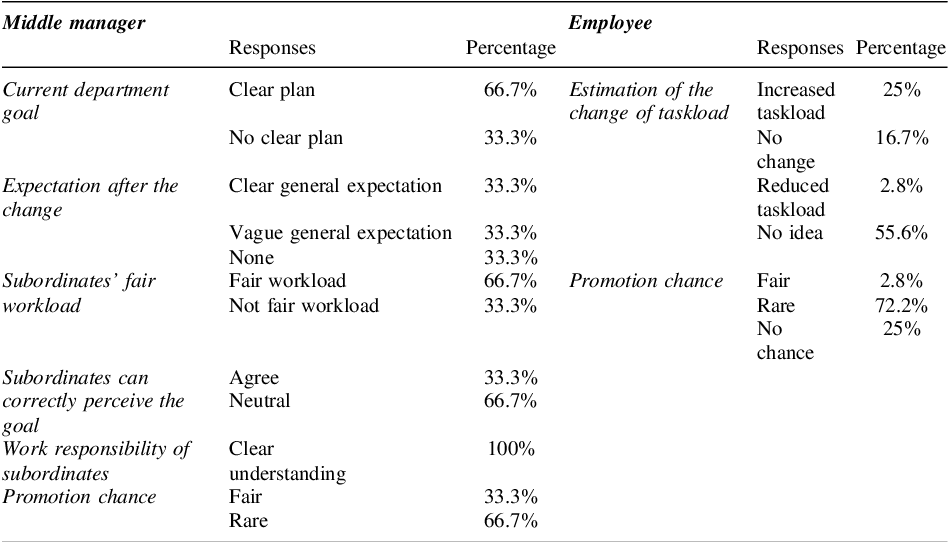
The data shown in Table 1 highlights discrepancies between middle managers’ and employees’ perceptions regarding organizational goals, taskload, and opportunities, underscoring a critical gap in communication and alignment across hierarchical levels.
Taskload results

Department Goals and Expectations
Middle managers largely report clarity regarding departmental goals, with 66.7% indicating a clear plan and 33.3% acknowledging a general expectation. However, 33.3% remain uncertain, reflecting some inconsistency. In contrast, employees exhibit significant uncertainty: 55.6% stated they had no idea about changes in taskload, while 25% estimated an increase and 16.7% estimated no change. This discrepancy signals a lack of communication about departmental goals and expectations following organizational changes.
Workload Perception
Middle managers perceive workload fairness positively, with 66.7% reporting fair workload for subordinates, while 33.3% disagree. On the employee side, perceptions are less optimistic. Taskload estimations are mixed, with 25% estimating an increase, 2.8% expecting a reduction, and a majority (55.6%) unsure about potential changes. These findings suggest a disconnect between managerial perceptions of fairness and employee uncertainty regarding workload changes.
Promotion Opportunities
A pronounced disparity exists in perceptions of promotion chances. While 33.3% of middle managers believe promotion opportunities are fair, employees overwhelmingly perceive limited advancement opportunities: 72.2% describe them as rare, and 25% see no chance for promotion.
The data reveals a significant disconnect between managerial and employee perspectives on goals, workloads, and opportunities. While middle managers perceive greater clarity and fairness, employees report heightened uncertainty, dissatisfaction, and limited prospects for advancement. This misalignment underscores the need for improved communication, better alignment of expectations, and targeted interventions to enhance employee understanding, motivation, and morale.
3.2. Affect
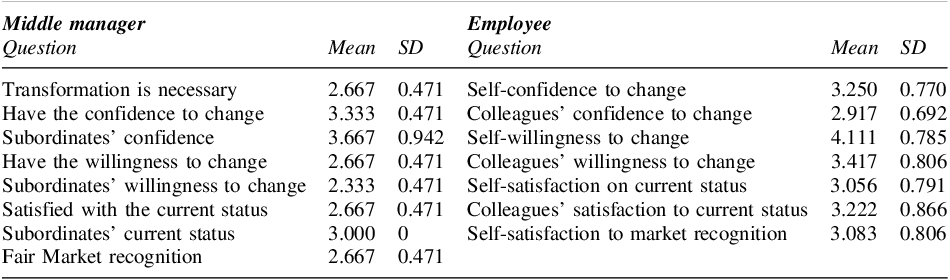
The combined affect analysis of middle managers’ and employees’ perceptions reveals key insights into willingness to change, confidence to change, satisfaction, and recognition, highlighting few gaps impacting transformation readiness, as shown in Table 2.
Willingness to Change
Middle managers remain largely neutral about their own willingness to change (mean = 2.667, SD = 0.471) and view employees as willing mean = 2.333, SD = 0.471). Employees report lower self-willingness (mean = 4.111, SD = 0.785), closer to disagreement, while their perception of peers’ willingness trends neutral (3.417, SD = 0.806). Managers overestimate collective willingness, while employees’ hesitation highlights a need to strengthen shared commitment.
Confidence to Change
Middle managers express moderate confidence in change (mean = 3.333, SD = 0.471), while their perception of subordinates’ confidence is lower (mean = 3.667, SD = 0.942), suggesting that they may perceive employees as struggling with change. Employees report moderate both self-confidence (3.250, SD = 0.770) and colleagues (2.917, SD = 0.692). Employees and managers share the same perceptions in this aspect.
Satisfaction
Managers report neutral satisfaction with the current organizational state (mean = 2.667, SD = 0.471). Their perception of subordinates’ satisfaction is slightly more positive (mean = 3.000, SD = 0.000), though the lack of variation (SD = 0) suggests uniformity in responses. Employees mirror this, with self-satisfaction (mean = 3.056) and colleagues’ satisfaction (mean = 3.222) reflecting neutrality. Neutral satisfaction signals complacency that could mask underlying dissatisfaction and lower morale.
Recognition
Managers perceive recognition favorably, with 33.3% agreeing on fairness.
Managers perceive fair market recognition at a moderate level (mean = 2.667, SD = 0.471), while employees report similar perceptions of self-satisfaction with market recognition (mean = 3.083, SD = 0.806). However, employees’ slightly lower satisfaction suggests unmet expectations, indicating a need for enhanced recognition and career development opportunities.
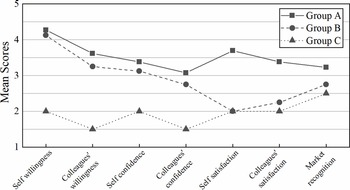
As shown in Figure 2, employees were grouped into three clusters based on their responses:
-
Group A (26): Positive attitude toward change, moderate satisfaction, and willingness to engage.
-
Group B (8): Mixed attitudes, moderate willingness, and dissatisfaction with current conditions.
-
Group C (2): Negative attitudes across all dimensions, including low willingness and confidence.
Table 3 highlights gaps in training needs, superior support, and individual goals. Group A has a strong need for training, limited support, and over half have individual goals. Group B shows even higher training needs and goals but less support. Group C has minimal engagement.
Overall, 69.44% need training, 55.56% have goals, but only 13.89% receive adequate support. Addressing these gaps is crucial to enhancing managerial support and employee readiness for change.
Affect results (scale: 1 = Strongly Agree, 5 = Strongly Disagree)
Shape profile of three groups for employees

Clustering for binary attributes

3.3. Knowledge and skills
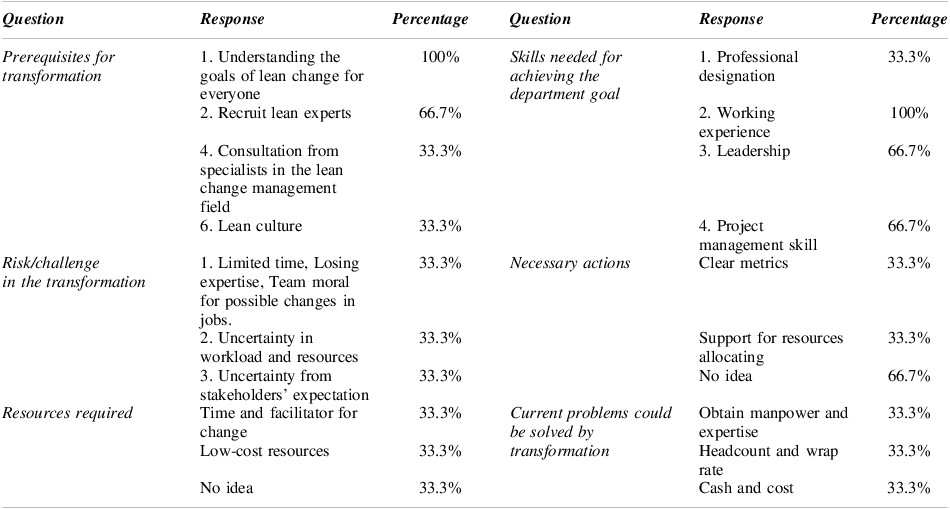
The analysis of middle managers’ knowledge and skills, presented in Table 4, highlights key prerequisites, challenges, and necessary actions for achieving organizational goals during transformation. All middle managers (100%) emphasized the importance of understanding the goals of lean change, while 66.7% indicated the need to recruit lean experts and develop leadership and project management skills. Additionally, 33.3% identified lean culture and consultation from specialists as essential prerequisites.
Transformation challenges include limited time, expertise loss, and team morale concerns (33.3%), as well as uncertainty in workload, resources, and stakeholder expectations (33.3% each). Managers also stressed the need for resources, including time facilitators for change (33.3%), low-cost solutions (33.3%), and clear metrics (33.3%). However, 66.7% admitted to having no clear ideas for resource allocation, indicating a critical gap in planning.
The data in Figure 3 identifies key knowledge and skills among employees (N=36). Relevant experience and qualifications (91.67%) and problem-solving skills (83.33%) are the most frequently cited competencies, followed closely by teamwork and strong analytical skills (83.33% and 63.89%, respectively). Emotional management, creativity, and project management also appear critical, suggesting a diverse skill set within the workforce.
The results highlight alignment between managers’ priorities and employees’ existing competencies, but also reveal gaps in expertise and resource clarity that could hinder transformation efforts. Targeted actions, such as upskilling in leadership, emotional management, and problem-solving, alongside clearer resource allocation strategies, are essential to strengthen organizational capability during transformation.
Middle managers’ knowledge and skills

Findings indicate that Company A’s organizational capability is insufficient for transformational change, primarily due to a low organizational capability. The further detailed data analysis is shown in the paper (Reference CaoCao, 2022). Employees struggle with workload uncertainty, increasing anxiety and disengagement. Middle managers lack clarity on lean transformation, exhibit low motivation, and struggle to align departmental and organizational goals. Minimal communication and supervisor support exacerbate these issues, hindering progress.
The analysis was validated by the management team, who confirmed the findings aligned with their daily experiences. The results revealed shared perceptions influencing employee behaviour, offering valuable insights into employees’ views on change and their underlying concerns. These findings emphasize the need for adaptive leadership, targeted training, and stress management to enhance organizational alignment, capability, and readiness for transformation.
Employees’ knwledge and skill (N=36)

4. Discussion: perception-centered organizational capability
In this study, perception-centered organizational capability refers to evaluating the organization’s actual capability by comparing perceptions across different roles—middle managers and employees. There are three types of perceptions: self-perception, perception of colleagues, and perception of subordinates. The questionnaire design embodies this perception-centered approach by framing role-specific questions that allow us to compare responses across hierarchical levels. For instance, middle managers answered questions such as, “Your subordinates are confident toward the transformation,” while employees responded to, “You are confident towards the transformation.” These paired questions enabled us to cross-verify perceptions: middle managers’ evaluation of their subordinates’ confidence could be compared with employees’ self-reported confidence. Such comparisons uncover discrepancies or alignments that reflect the actual organizational capability.
The findings reveal notable misalignments. For example, middle managers perceived their subordinates are neutrally willing to change, however, the employee report lower self-willingness, closer to disagreement. However, employee also report peers’ willingness trends neutral. This disconnects highlights gaps in understanding that hinder organizational readiness. Similarly, middle managers’ unclear perception of transformation goals contrasts with employees’ reported uncertainty about workload and support, revealing systemic issues in clarity and alignment across roles.
By synthesizing perceptions across levels, the perception-centered approach enables a more accurate assessment of organizational capability. Instead of relying on isolated perspectives, this method integrates role-based evaluations to identify key issues such as communication breakdowns, misaligned goals, and lack of support. These insights offer a comprehensive understanding of how individuals within the organization view change and where interventions are needed.
5. Conclusion and future work
This study evaluated organizational capability using the TASKS framework, analyzing taskload, affect, skills, knowledge, and stress through a perception-centered assessment. Employees’ perceptions were compared against middle managers’ responses as a reference to assess alignment and discrepancies in organizational readiness for change.
The findings reveal misalignments in workload expectations, managerial support, and transformation readiness. Employees reported uncertainty about their tasks and future roles, leading to anxiety and hesitation toward change. The results emphasize the need for strategic interventions to enhance employee confidence, engagement, and readiness for transformation.
This study contributes to the understanding of team behavior and organizational capability in dynamic environments. Future research will focus on expanding the framework’s application across industries and organizational contexts to refine strategies for building adaptable and high-performing teams. Additionally, further studies should explore longitudinal assessments to track the evolution of organizational capability over time and assess the impact of targeted interventions.




 Open access

