




Introduction
Children’s language acquisition rests on prelinguistic communication skills for shared reference. This is most obvious in infants’ communicative use of the canonical index-finger pointing gesture, which emerges around 9-15 months of age across a range of diverse cultural settings (Carpenter, Nagell, Tomasello, Butterworth & Moore, Reference Carpenter, Nagell, Tomasello, Butterworth and Moore1998; Liszkowski, Brown, Callaghan, Takada & Vos, Reference Liszkowski, Brown, Callaghan, Takada and Vos2012; Lock, Young, Service & Chandler, Reference Lock, Young, Service, Chandler, Volterra and Erting1990). Longitudinal studies demonstrate that index-finger pointing predicts language development (Colonnesi, Stams, Koster & Noom, Reference Colonnesi, Stams, Koster and Noom2010). A delayed emergence of index-finger pointing after 12 months of age indicates a risk for language delay at 24 months of age (Lüke, Grimminger, Rohlfing, Liszkowski & Ritterfeld, Reference Lüke, Grimminger, Rohlfing, Liszkowski and Ritterfeld2016), and its continued atypical development is part of autism syndrome, which is characterized by impaired language use (Baron-Cohen, Reference Baron-Cohen1989; Sansavini et al., Reference Sansavini, Guarini, Zuccarini, Lee, Faldella and Iverson2019). Experimental studies provide further support for the interpretation that by 12 months of age, pointing (in production and comprehension) is underlain by social-cognitive skills for shared reference and indeed constitutes a prelinguistic fundament of human communication (for an overview, see Liszkowski, Reference Liszkowski, Newen, de Bruin and Gallagher2018).
Despite its all-embracing importance in the development of language and social cognition, however, surprisingly little is known about the ontogeny of the index-finger pointing gesture itself (Liszkowski & Rüther, Reference Liszkowski, Rüther, Gontier, Lock and Sinha2021; Lock et al., Reference Lock, Young, Service, Chandler, Volterra and Erting1990). Without a deeper understanding of its ontogenetic roots, developmental theories of language acquisition and social cognition remain incomplete.
Socialization views emphasize the role of caregivers’ social-interactional input in the form of modelling behaviors and/or contingent responding for communicative pointing to emerge (Carpendale & Carpendale, Reference Carpendale and Carpendale2010; Kishimoto, Shizawa, Yasuda, Hinobayashi & Minami, Reference Kishimoto, Shizawa, Yasuda, Hinobayashi and Minami2007; Rowe & Leech, Reference Rowe and Leech2018; Vygotskiĭ, Reference Vygotskiĭ1978). Here, one suggestion has been that once pointing has emerged, it still needs to be socialized into a meaningful communicative act and therefore is initially not synchronously related to other communicative behaviors and skills (Carpendale & Carpendale, Reference Carpendale and Carpendale2010; Slaughter & McConnell, Reference Slaughter and McConnell2003).
Cognitive views emphasize social-cognitive processes by which infants understand and follow others’ attention and intentions, and so come to purposefully direct others’ attention through role reversal (Carpenter et al., Reference Carpenter, Nagell, Tomasello, Butterworth and Moore1998; Carpenter, Tomasello & Striano, Reference Carpenter, Tomasello and Striano2005) or spontaneous insight (Butterworth, Reference Butterworth and Kita2003). Here, the suggestion is that a cognitive understanding actually gives rise to infant pointing, which should be synchronously related to other communicative behaviors when it emerges, as manifestation of a foundational infrastructure of human communication.
Socialization and cognitive views are not entirely incompatible: social-constructivist theories of development consider both a cognitive basis and the social input it processes, and emphasize developmental change in the contexts of infants’ own directed activities (Bruner, Reference Bruner1983; Tomasello, Reference Tomasello2019). Relevant empirical predictors of index-finger pointing should thus pertain to social-interactional input, infant social-cognitive processes, and infants’ own directed activities. Empirically, however, it is not settled whether the hypothesized predictors emerge as a synchronously correlated conglomerate from the beginning, or instead reflect independent behaviors; and whether all or any of these behaviors are actually longitudinally predictive of the age at which pointing first emerges.
Predictors of infant pointing
Regarding social-interactional input, several studies have revealed empirical relations between caregivers’ and infants’ pointing. Most of these correlational studies, however, have been limited in establishing a developmental directionality from caregiver behavior to infant pointing, because they are either cross-sectional (e.g., Liszkowski & Tomasello, Reference Liszkowski and Tomasello2011; Liszkowski et al., Reference Liszkowski, Brown, Callaghan, Takada and Vos2012; Lock et al., Reference Lock, Young, Service, Chandler, Volterra and Erting1990), or have found longitudinal relations when infants are already able to point (Ger, Altınok, Liszkowski & Küntay, Reference Ger, Altınok, Liszkowski and Küntay2018; Kishimoto, Reference Kishimoto2017; Rowe & Goldin-Meadow, Reference Rowe and Goldin-Meadow2009). In a training study (Matthews, Behne, Lieven & Tomasello, Reference Matthews, Behne, Lieven and Tomasello2012), parents were instructed to point for their infants for a month (age range: 9-11 months), and infants were then tested on their pointing a month later. The training group revealed no selective effect on the emergence of infant pointing compared to a control group. However, the frequency of parents’ pointing did not differ between the experimental and control groups when assessed during free play in an intermediate motivation control session two weeks after the first visit. Parents’ pointing during this intermediate free play session did correlate positively with infants’ pointing two weeks later, but it is possible that this relation was rather synchronous than longitudinal and already present two weeks before infants were tested. In another recent training study (Rowe & Leech, Reference Rowe and Leech2018), parents were instructed to point for their infants at age 10 months. At 12 months, parents of this group pointed more compared to parents of a control group with no instruction. During the same session, their 12-month-old infants also pointed more than infants from the control group. While consistent with a socialization view, it is possible that increased parental pointing had a direct, synchronous effect on the frequency of infant pointing during the session at 12 months, rather than a longitudinal effect. Another relevant study consistent with a socialization view (Salomo & Liszkowski, Reference Salomo and Liszkowski2013) found that infants of cultural settings in which parents pointed less, also pointed less, and at later months of age, compared to infants of cultural settings in which parents pointed more. However, since cross-cultural comparisons do not involve experimental control it is at least theoretically possible that other aspects of the samples may have been confounded with parental pointing as a causal factor (e.g., health, SES, nutrition, number of siblings, among others). More controlled longitudinal evidence is thus needed to test for a positive directionality from parental input, before infants begin to point, to the ontogenetic onset of the pointing gesture.
Regarding social-cognitive correlates, index-finger pointing and point-following are interrelated at 12 months of age (Liszkowski & Tomasello, Reference Liszkowski, Brown, Callaghan, Takada and Vos2011). Carpenter et al. (Reference Carpenter, Nagell, Tomasello, Butterworth and Moore1998) established that point-following emerged reliably before pointing. Matthews et al. (Reference Matthews, Behne, Lieven and Tomasello2012) found a longitudinal relation between point-following at 9-11 months and index-finger pointing a month later. Ger et al. (Reference Ger, Altınok, Liszkowski and Küntay2018) found a longitudinal relation in the opposite direction between the frequency of pointing at 10 months and the frequency of following pointing gestures at 12 months. Current findings thus suggest mutual relations in this age range. To test the developmental hypothesis that social-cognitive processes of point-following are positively predictive of the emergence of pointing (Butterworth, Reference Butterworth and Kita2003; Matthews et al., Reference Matthews, Behne, Lieven and Tomasello2012), more controlled longitudinal evidence is thus needed.
Regarding infants’ own directed activities, visuo-motor skills alone do not appear to be a sufficient predictor of pointing, because much younger infants can already extend the isolated index-finger and reach goal-directedly but do not use these motor skills to engage in meaningful pointing acts. Ger et al. (Reference Ger, Altınok, Liszkowski and Küntay2018) did not find relations between early pointing and assessments of infants’ visuo-motor skills, including index-finger explorations. Others have suggested that infants’ individual activities include a form of non-communicative pointing-for-self (Bates, Camaioni & Volterra, Reference Bates, Camaioni and Volterra1975), perhaps to direct their own attention or explore proximal objects with the index-finger, but the evidence for a distinction, let alone primacy, to communicative pointing has remained less clear (Delgado, Gómez & Sarriá, Reference Delgado, Gómez, Sarriá, Winsler, Fernyhough and Montero2009).
In contrast, infants’ socially directed activities within social settings appear crucial in the acquisition of pointing gestures. For example, several months before they point to objects at a distance, infants engage in joint coordinated activities (Bakeman & Adamson, Reference Bakeman and Adamson1984) and they hold out objects, seemingly for others to attend to. These so-called ‘showing’ gestures (Bates et al., Reference Bates, Camaioni and Volterra1975) may be interpreted on different levels, ranging from individual exploratory activities to giving acts to communicative-referential attention-directing gestures, akin to pointing acts. Cameron-Faulkner, Theakston, Lieven and Tomasello (Reference Cameron-Faulkner, Theakston, Lieven and Tomasello2015) recently found that the frequency of showing and giving behaviors (so-called ‘Hold-out and Gives’; HoGs) at 10 and 11 months correlated with the frequency of index-finger pointing at 12 months, providing first empirical evidence for a developmental forerunner of the pointing gesture in infants’ own behavior. Further, before they point with the index-finger, infants point with the whole hand (Liszkowski & Tomasello, Reference Liszkowski and Tomasello2011; Lock et al., Reference Lock, Young, Service, Chandler, Volterra and Erting1990). Notably, this behavior is different from reaching attempts. It lacks requestive accompaniments, and infants use it in contexts of joint regard, just like index-finger pointing. However, it differs from index-finger pointing not just morphologically but also in cognitive and communicative complexity: Liszkowski and Tomasello (Reference Liszkowski and Tomasello2011) found that 12-month-olds who only point with the open hand, but not with the extended index-finger, pointed less often, coordinated the points less with vocalizations, and were less proficient in comprehending referential intentions compared to 12-month-olds who pointed also with the index-finger. Further, Lüke et al. (Reference Lüke, Grimminger, Rohlfing, Liszkowski and Ritterfeld2016) found that 12-month-olds who only point with the whole hand, not the index-finger, had less proficient language skills at 24 months of age and were at higher risk for language delay than those 12-month-olds who already pointed with the index-finger. Whole-hand pointing thus seems to be a less complex behavioral precursor to index-finger pointing.
The current study
The current study sought to provide systematic longitudinal evidence on the ontogenetic emergence of the index-finger pointing gesture by considering potential ontogenetic predictors in caregivers’ interactional input, infants’ social-cognitive processes, and infants’ own social activities. Because most longitudinal studies started assessments at an age when infants may have already begun pointing, we chose to start data collection at an earlier age, at 8 months, when infants do not yet use the index-finger pointing gesture, but the hypothesized predictive behaviors are already in place or just emerging. Our main goal was to predict the age of emergence of the index-finger pointing gesture, not an increase in its frequency once it had emerged. Because it is notoriously difficult to catch the single moment of the ontogenetic onset of a behavior (e.g., the first word; the first step; etc.) we took several precautions. First, we defined our outcome measure narrowly based on the behavioral form of the extended index-finger (excluding touch). Index-finger pointing has been found across a range of diverse cultural settings, likely constituting a gestural universal (Liszkowski et al., Reference Liszkowski, Brown, Callaghan, Takada and Vos2012), and it is cognitively and communicatively different from hand pointing (Liszkowski & Tomasello, Reference Liszkowski and Tomasello2011; Lüke et al., Reference Lüke, Grimminger, Rohlfing, Liszkowski and Ritterfeld2016). Second, we measured it in a context previously shown to elicit pointing naturally across a wide range of cultural settings, i.e., in the ‘decorated room’ paradigm (Liszkowski & Tomasello, Reference Liszkowski and Tomasello2011; Liszkowski et al., Reference Liszkowski, Brown, Callaghan, Takada and Vos2012). The paradigm sets up a format of joint regard, analogous to situations in an exhibit or a zoo, excluding actions and construction play. In a direct comparison to the commonly used ‘free play’ setting, which creates a format of joint action and construction play, the ‘decorated room’ paradigm elicited drastically more index-finger pointing in both parents and infants (Puccini, Hassemer, Salomo & Liszkowski, Reference Puccini, Hassemer, Salomo and Liszkowski2010). Further, we chose parents as interaction partners instead of experimental elicitation procedures, because infants are more likely to naturally engage with their caregivers than strangers, and because experimentally controlled elicitation procedures likely underestimate the natural use and thus the ontogenetic onset of a behavior. Finally, we sampled at every month from 8 to 13 months of age with a narrow age range of 4 weeks, to be more precise in catching the month of onset of index-finger pointing, and the group median. We conservatively defined an infant as index-finger pointer when she used the gesture at least twice during a session (we noted that if infants pointed, they rarely pointed just once) and also used it in the subsequent month, to exclude potential imprecisions from coding and ‘accidental’ configurations of the extended index-finger and arm that did not really reflect intentional index-finger pointing acts (for the notion of ‘slip-out’ points, see Lock et al., Reference Lock, Young, Service, Chandler, Volterra and Erting1990).
As predictors we measured parental pointing for their infants; infants’ point-following skills in a standard interaction-based setting; and infants’ own interactive gestures, particularly hand pointing and showing gestures. Because the showing gesture requires contact with and acting on objects, we assessed it in an uninstructed free play setting. Based on previous experimental findings and cognitivist accounts we expected index-finger pointing once it had emerged to be synchronously positively related to early parental pointing, infant point-following, and infants’ showing gestures, reflecting the prelinguistic fundament of shared reference. We then tested whether any of these behaviors would be longitudinally positively predictive of the age of emergence of index-finger pointing. To this end we also tested whether the behaviors would actually be inter-individually stable across months, as an indication of behavioral competence. Further, to substantiate the meaning of longitudinal predictions we conducted further analyses regarding the longitudinal direction of relations, checking that the outcome variable would not also predict the hypothesized predictor variables at later time points. Finally, because it turned out that all parents pointed for their infants at 8 months of age, we added a second cross-sectional study to test whether parents’ pointing for their infants is ontogenetically developing, perhaps as a form of adapting to infants’ development. We used the same method as in our main study and compared parent pointing for their infants cross-sectionally at 5 months and 7 months. We report this secondary study along with the main study and discuss it in light of the current findings of our main study.
Method
Participants
Thirty-one infants (15 male, 16 female) and their parents took part in the main longitudinal study. Sample size was based on previous literature (e.g., Carpenter et al., Reference Carpenter, Nagell, Tomasello, Butterworth and Moore1998, n = 24) and practicalities of testing every day for half a year. One dyad was removed from data analysis because they only participated in two sessions. The infants were recruited from a database of parents who had been contacted via the city’s birth register and had expressed interest to participate in child development studies. Participants lived in Nijmegen, a small city in the Netherlands in Europe with middle to high socioeconomic backgrounds, and were monolingual. Before participating, parents signed letters of informed consent. After every monthly meeting, infants received a small gift (a toy).
The mean age of the infants was 259.6 days (SD = 7.6 days) for the 8 months session; 292.7 days, (SD = 7.3 days) for the 9 months session; 323.4 days, (SD = 7.2 days) for the 10 months session; 352.4 days, (SD = 7.6 days) for the 11 months session; 381.3 days, (SD = 8.4 days) for the 12 months session; and 411.8 days (SD = 9.3 days) for the 13 months session. Table 1 displays the number of participants at each time point. Seven infants missed one session, one infant missed two sessions.
Number of Participant Dyads Included in Data Analysis at each month. Unequal cases within a session are due to insufficient recording quality, experimenter error, or fussing

Forty-four dyads participated in our secondary study, 21 at 5 months (169-195 days); twenty-three at 7 months (258-283 days). One dyad (from the 5mos age group) was excluded because the parent had encouraged the child to touch all the objects in the room thus impeding communication through pointing.
Procedures
In order to assess the development of infant and parent pointing the “decorated room” procedure (Liszkowski et al., Reference Liszkowski, Brown, Callaghan, Takada and Vos2012) was used, which is broadly analogous to a visit in a museum or exhibit. For the “decorated room” parents and their infants were led into a room decorated with 20 interesting objects hung on the walls and ceilings – including, for example, a feather boa, photos of animals, a cup and flowers. Parents were asked to look at the objects together with their infant while holding them on their hip. Parents were asked not to touch or remove any of the items and make sure their infants would not do so. The scene was recorded by four cameras, each in one corner, for five minutes. If sessions lasted more than 10 seconds longer, only the first 5 minutes were coded. None of the sessions were more than 10 seconds shorter. Parents were kept blind to the precise purpose and hypotheses of the study, and pointing was never mentioned during any of the sessions. Instead, parents were informed that we were interested in how infants would naturally behave in a variety of situations because it would provide us with hints about social and cognitive development. Parents were fully debriefed after the last session, with explanations and hypotheses for each task and received the videos as well as interim conclusions of the study. For our secondary cross-sectional study, the identical procedure was used.
Immediately after the decorated room procedure infants’ ability to follow a simple pointing gesture was measured. The experimenter stood facing the infant. Parents were asked to hold their infant in front of their body. At the beginning of each trial the experimenter called the infant’s name and made sure to have eye contact with the infant. She then turned her head to fixate one of the objects either to the right or the left of the infant hanging either in their peripheral field of vision or slightly behind the infant. Her facial expression was excited while extending her arm to point at the target and exclaiming “oh”. This was followed by one gaze alternation to infant and back to object while the arm remained extended, and another gaze alternation to infant and back to object while the arm was retracted. Afterwards the experimenter waited for 10 seconds before starting the next trial by establishing eye contact and calling the infants name. To maintain ecological validity, turning the head, looking at the referred object, pointing at it and vocalizing were naturally synthesized. There were four trials, two for each side, starting with the item on the right side, lasting approximately one minute (M = 50:33 s, SD = 16:05 s). Each of the four items was a different one. Pointing was always done cross-laterally.
Right after this, parents and infants were asked to freely interact with a set of toys (a small ball, a small toy car, stacking rings, stacking cups, a hand puppet, wooden blocks, a plush drum toy and a slinky toy) during a free play setting, in order to measure infants’ spontaneous showing gestures. There was no specific instruction, parents were simply asked to stay on a carpet that was laid out on the floor and behave as if they were at home. Sessions were recorded using four cameras, one in each corner of the room, and lasted for five minutes. If sessions lasted more than 10 seconds longer, only the first 5 minutes were coded. None of the sessions were more than 10 seconds shorter. In addition, after these three settings, several other tasks were run on distinct months of age, in part for exploratory investigation not of relevance to the current study. The free play setting was not administered at 13 months due to time constraints and (since it was used to elicit showing gestures at a predictive age) before pointing had emerged.
Coding
Coding for the “decorated room” included both parental and infant pointing gestures. The arm had to be either fully or half way extended toward an identifiable object or location, accompanied by looks in that direction, excluding clear attempts to grab or touch an object, and wiggling movements of the arm due to balancing or position shifting by the parent. Points could be directed at near-by objects or locations or objects further away. Visual checking with the partner (see Franco & Butterworth, Reference Franco and Butterworth1996) was not coded, because the bodily closeness of being on the caregiver’s arms seemingly rendered checking unnecessary. Index-finger points were coded when the index-finger was distinctly extended relative to all other fingers, else it was coded as a whole-hand point.
The age of emergence (AoE) of infant index-finger pointing was defined as the first month in which an infant pointed at least twice with their index-finger during that session. In this way we excluded ambivalences from coding or ‘accidental’ bodily configurations. Index-finger pointing had to be present also in the next session, at least once. Indeed, only few infants pointed just once during a session (n = 5) and of those, most (n = 3) did not point in the next months. If an infant pointed at least twice for the first time during the last session, the last session was counted as the month of emergence.
Point following was coded as ‘correct following’ when the infant looked in the direction of the indicated object clearly beyond the experimenters’ index-finger. Trials were excluded when the infant did not attend to the pointing gesture, or due to experimenter error (15 trials). The AoE of Point Following was defined as the infant correctly following the experimenter’s point in more than 50% of the valid trials in one session. Due to technical issues, not all recorded sessions could be coded.
Showing gestures during free play were coded when an infant held an object into the field of vision of their parents, seemingly with the intention to direct their parents’ attention towards the object. Parents could either take the object or not, or the object could afterwards be placed/thrown by the infant into the proximity of their parents, or be kept by the infant. The arm could be stretched or bent and afterwards the infant could also retract the object. Similarly to the decorated room procedure, the AoE for showing gestures was determined by the use of at least two gestures during a session and in the next session at least once, again to avoid imprecisions from coding, accidental, non-purposeful wiggling of toys, over-interpretation and false positives. Table 1 displays the included sessions for each measure.
Reliability
A second trained coder, who was blind to the objective of the study, coded 10 different dyads, randomly chosen from each age. Reliability of scoring was determined by calculating Cohen’s kappa. For the decorated room, the Kappa for parental points was .84, the Kappa for infant points was .82 (Kappa for infant index-finger points was .92, and Kappa for hand points was .79), and the Kappa for the decorated room overall was .83 – all of which were substantial. For point following, the kappa was .84, which is substantial. The kappa for showing gestures was .82 which is also substantial. For the cross-sectional study, reliability for parent pointing based on 20% of the sample was very good, k = .86.
Plan of Analyses
We broke down our analyses of the main longitudinal study into three main steps. First, we provide descriptives of the sample across the months, repeated measurement ANOVAs for each behavior to test for differences between months, and directed t-tests to test for the expected longitudinal increase of each of the behaviors. Sample sizes differed between behaviors according to participation in the respective sessions (see Table 1). In addition, we tested for positive relations between each behavior from month to month as an indication of stable competence and usefulness for longitudinal predictions. Here we used Pearson Product-Moment Correlations and tested for one-tailed significance to test the directed hypothesis of inter-individual stability against the null-hypothesis of no positive relations. A negative relation would be difficult to interpret as it would indicate a less plausible systematic loss of skills.
In a second step, we addressed the theoretical prediction about a synchronous relation of the communicative behaviors once pointing has emerged. We tested whether the communicative behaviors would be synchronously positively interrelated as part of a common capacity emerging around 11-12 month. Here, too, we used accordingly one-tailed Pearson Product-Moment Correlations to test against the null-hypothesis of no positive relations.
In a third step, we addressed our main question regarding longitudinal predictors of index-finger pointing. We tested for each behavior once it had emerged at its median age, whether its frequency was longitudinally positively predictive of the age of emergence (AoE) of index-finger pointing. We chose the median AoE as predictive time point instead of our first measurement timepoint to assure to have sufficient variance for prediction (e.g., about half of the participants would show the respective behavior). In addition, to capture individual differences in the age of emergence of the predictors, we tested whether the AoE of the predictors would be positively related to the AoE of index-finger pointing. We used one-tailed Pearson Product-Moment Correlations to test against the null hypothesis that there are no systematic positive relations. All correlation analyses were based on the Monte Carlo Permutation model which does not rely on central distributions and is robust against deviations from normality assumptions (e.g., Gentle, 2003). For significant correlations, scatterplots were visually inspected for outliers. None of the reported correlations were driven by outliers. When predictors were interrelated in a given month, we applied partial correlations to identify the stronger association. As a conceptual control analysis for the longitudinal directedness of correlations, we tested whether significant predictors would themselves be longitudinally predicted at a later time point by infant pointing. Analyses were run on the counts of events in the settings, except for point-following, which was based on the proportion of trials. The pattern of results remained the same when relativizing the counts on the time of a setting.
We also ran a multiple regression with all predictors. Due to the within-subject design the multiple regression included a smaller sample based on the participants that contributed to the predictive measurement points at 8 and 9 months and the outcome measurement (n = 22), requiring cautious interpretation. After the analyses of the main longitudinal study we report the results of the cross-sectional study that simply compared the mean frequency of parental pointing at 5 months and 7 months of infant age. Preliminary analyses showed no effect of gender for infant behavior (all p> .5), thus data were collapsed across gender for further analyses.
Results
Behavioral increase and stability
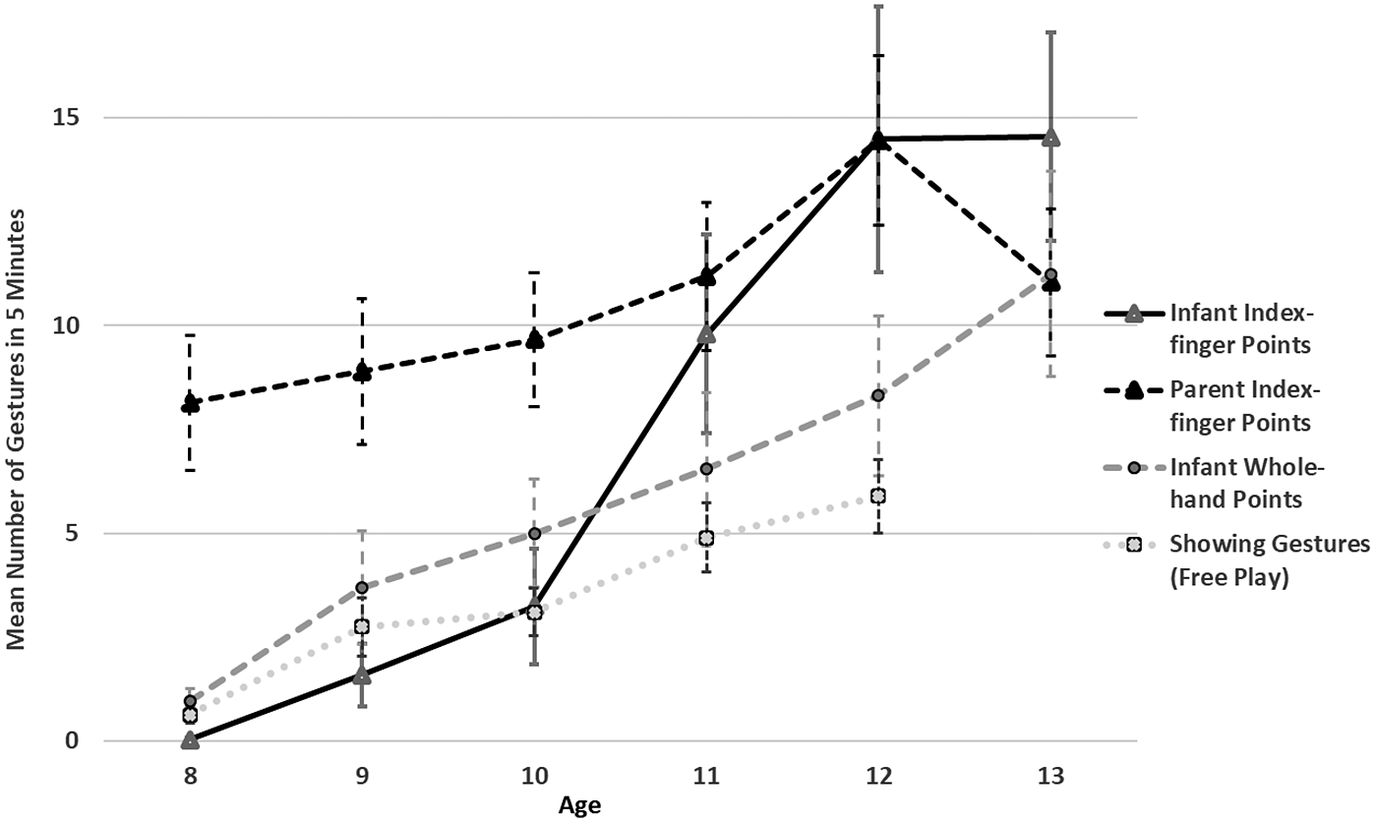
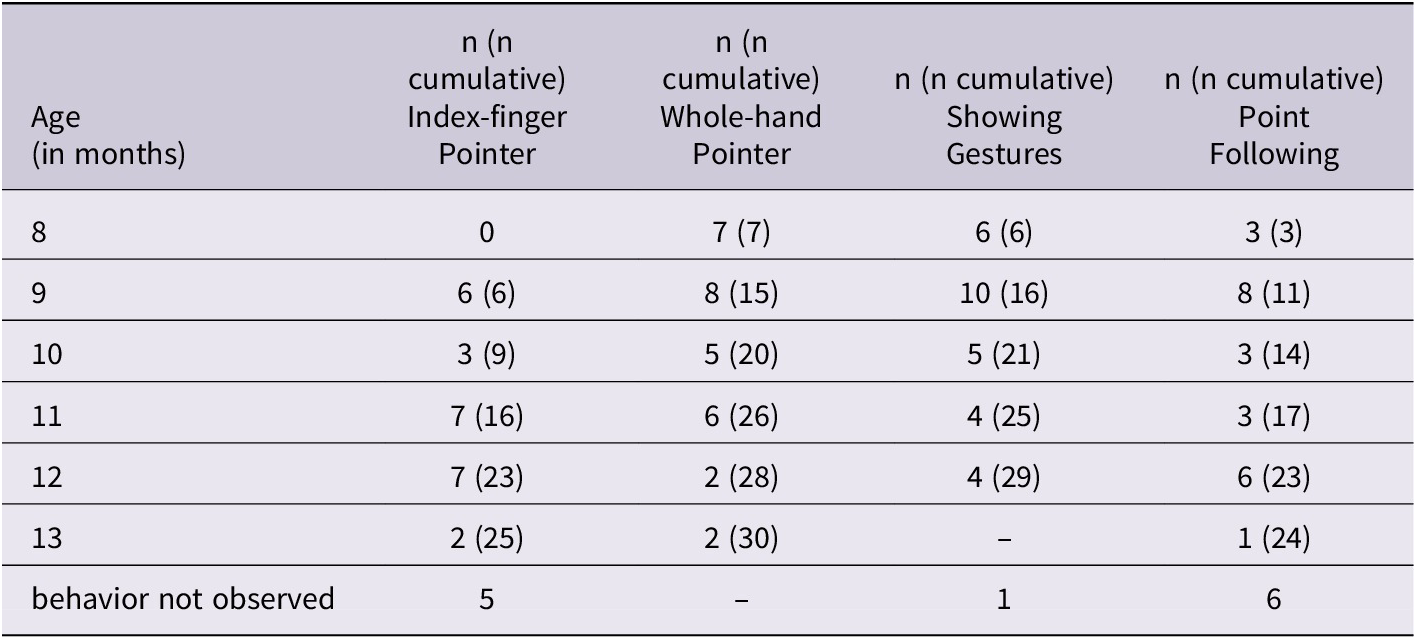
Figure 1 displays the increase of behaviors across months. Table 2 displays the month-to-month correlations revealing interindividual stability. Table 3 displays the age of emergence (AoE) of infants’ behaviors.
Longitudinal development of parents’ and infants’ pointing in the ‘decorated room’, and infants’ showing gestures in ‘free play’. Bars depict standard errors of the mean.
Month-to-Month Correlations
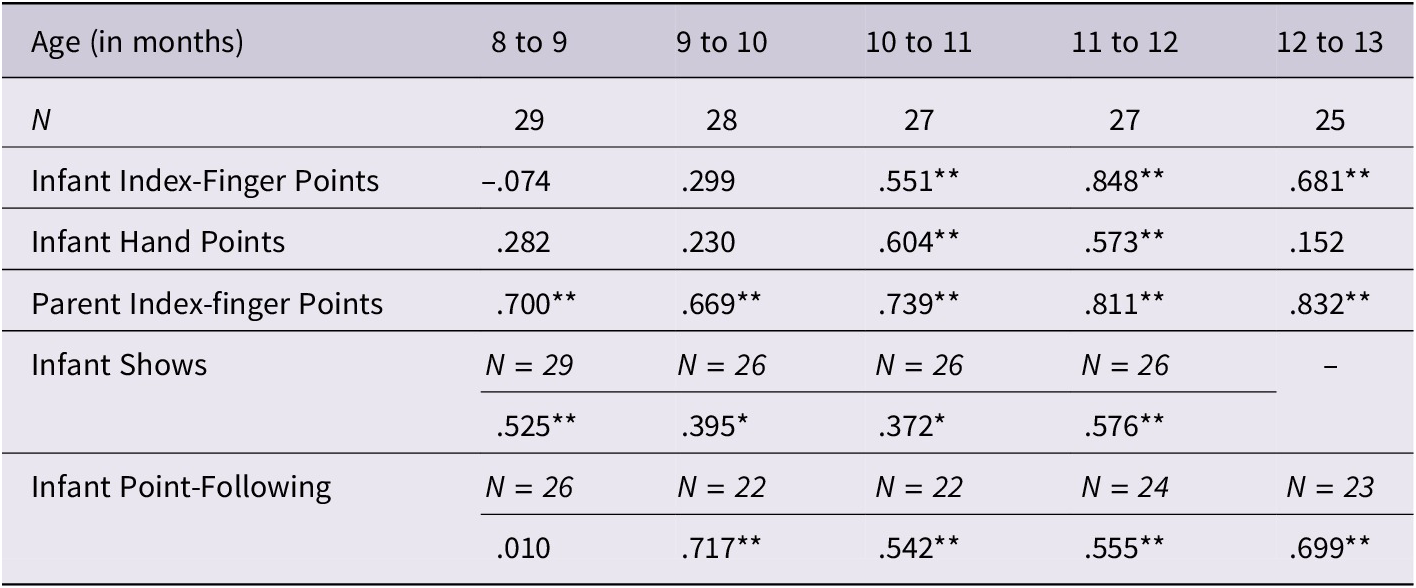
**p < .01; *p < .05; one-tailed.
Age of Emergence of Infant Behaviors
Pointing
Index-finger pointing differed significantly across timepoints (F(5, 105) = 11.82, p< .001, ηp2 = .36), with single steep significant increases from 10 to 11 months (t(27) = 2.81, p = .009, d = .54) and 11 to 12 months (t(27) = 3.17, p = .004, d = .61). Month-to-month correlations were high and significant from 10 months onwards. The median AoE was 11 months.
Hand points differed significantly across timepoints (F(5, 105) = 5.06, p = .008, ηp2 = .19), with a significant increase between 8 and 13 months (t(25) = 3.92, p = .001, d = .77). Month-to-month correlations for hand pointing emerged relatively later than the first use of hand pointing, and vanished at 12 months. The median AoE was 9 months. All infants continued using hand points together with index-finger points throughout our assessment.
All except one parent pointed at least once during each session. A repeated measures ANOVA was significant (F(5, 105) = 5.48, p = .002, ηp2 = .21), but paired t-tests revealed a significant increase of parental pointing only from 11 to 12 months (t(24) = 2.99, p = .006, d = .57), followed by a significant decrease from 12 to 13 months (t(25) = 2.62, p = .015). Month-to-month correlations were high and significant across all time points revealing high inter-individual stability in parents’ pointing for their infants.
Point following
Point following differed significantly across timepoints (F(5, 70) = 7.89, p< .001, ηp2 = .36), with a significant increase from 11 to 12 months (t(23) = 4.3, p< .001, d = .87). Month-to-month correlations emerged from 9 months onwards. The median AoE was between 9 and 10 months.
Showing gestures
The number of showing gestures differed significantly across timepoints (F(4, 96) = 11.61, p< .001, ηp2 = .34) with significant increases from 8 to 9 months (t(28) = 4.40, p< .001, d = .72) and from 10 to 11 months (t(25) = 2.75, p = .005, d = .45). Month-to-month correlations were apparent from 8 months (9 infants [30%] used show gestures at least once at 8 months). The median AoE was 9 months.
Synchronous Correlations at median age of emergence of index-finger pointing
We tested whether at the median AoE of index-finger pointing (11 months), infants’ communicative behaviors would be interrelated, reflecting a common capacity as suggested by previous findings. Table 4 shows that the frequencies of index-finger pointing, point-following, and showing gestures were indeed all quite strongly synchronously interrelated at 11 months, while hand pointing was unrelated. To conceptually replicate a finding by Liszkowski and Tomasello (Reference Liszkowski and Tomasello2011) we correlated parent pointing with infant index-finger pointing at 12 months. Results confirmed the previous finding of a split median correlation, revealing a significant positive relation between parents’ and infants’ median split groups (ϕ(28) = .358, p = .031). No further synchronous relations between infant and parent behaviors emerged at any other time points.
Synchronous correlations of infant behaviors at 11 months.

*p< .05,**p< .01, one-tailed.
Longitudinal Predictors of Index-Finger Pointing
We tested for longitudinal predictions of the AoE of index-finger pointing (from 8- to 13 months). As predictors we used the earliest months at which sufficient meaningful behavior was present, as indicated by median age or stable correlations to the next months. For parent pointing this was at 8 months, and for infant hand pointing, point-following, and show gestures, it was at 9 months. All four variables significantly predicted the AoE of index-finger pointing, see Table 5.
Longitudinal predictions of the age of emergence of index-finger pointing

*p< .05,**p< .01, one-tailed.
In addition, we correlated the AoE of the predictors with the AoE of index-finger pointing to obtain developmental information about the individual relations between the emergence of behaviors. The AoE of index-finger pointing correlated positively with the AoE of point following (r(22) = .621. p = .002) and the AoE of showing (r(24) = .371. p = .037). A correlation with the AoE of hand pointing failed to reach statistical significance (r(25) = .270, p = .097).
In addition, complementary to the correlation analyses, we ran a multiple linear regression analysis. To predict the AoE of index-finger pointing we entered all potential predictors at once: showing gestures at 9 months, point following at 9 months, hand points at 9 months and parental points at 8 months. Given the within-subject design, this analysis included only a sample of n = 22. Regarding the issue of multicollinearity, at 9 months the frequency of showing gestures and hand points were significantly correlated (r(22) = .492, p = .002); however, collinearity diagnostics revealed no Variance Inflation Factor values above 3, making an influence of multicollinearity unlikely (Franke, Reference Franke, Sheth and Malhotra2010). As expected from our correlation analyses, we found a significant regression equation (F(4,17) = 7.16, p = .001), with an adjusted R² = .540. Parental points at 8 months emerged as a significant predictor, β = –.357, T = –2,19, p = .043 (non-standardized B = –.053; 95% CI of B: -.104 to -.002), as well as mean hand points at 9 months, β = –.521, T = –2,91, p = .01 (non-standardized B = –.078; 95% CI of B: -.134 to -.021). Showing and point-following failed to reach statistical significance (showing: β = –.206, T = –1,08, p = .295 (non-standardized B = –.060; 95% CI of B: -.178 to .058); point-following: β = –.158, T = -.994, p = .334 (non-standardized B = –.580; 95% CI of B: -1.81 to .650).
Control analyses
In order to assure a direct relationship between the predictors and the AoE of index-finger pointing, we tested for intercorrelations between the predictors at 9 months and later months. Should predictors of the AoE be interrelated, we conducted partial correlations.
Showing gestures and hand pointing were significantly correlated at 9 months (r(30) = .377, p = .044). When controlling for showing gestures at 9 months, the partial correlation between hand pointing at 9 months and the AoE of index-finger pointing remained significant (r partial(19) = –.372, p = .047). Similarly, when controlling for hand pointing at 9 months, the correlation between showing gestures at 9 months and the AoE of index-finger pointing remained significant (r partial(19) = –.439, p = .012).
Point following at 9 months correlated with showing gestures at 11 months (r(25) = .586, p = .002). Since showing gestures at 11 months were also correlated with the frequency of index-finger points at 11 months (see Table 4), a partial correlation analysis was conducted. Point following at 9 months remained a significant predictor of index-finger pointing when controlling for showing gestures at 11 months (r partial(22) = .41, p = .047). None of the other predictors were significantly correlated with each other (all r< .327, all p> .114).
Because parental pointing was the earliest predictor of index-finger pointing we also tested whether it had an early longitudinal influence on the other communicative measures. There was no evidence that mean parental pointing at 8 months was predictive of the onset or frequency of point following skills at 10 months or 11 months (all r< .317, all p> .114), or the onset or frequency of showing gestures at 9 or 10 months (all r< .225, all p> .242).
For each of our significant longitudinally predictive correlations we also checked for a reverse developmental directionality to confine the conceptual scope of interpretation of developmental directionality and counter arguments of chance findings. For example, when parent pointing predicted AoE of infant pointing, we then tested whether AoE of infant pointing would also predict parent pointing at 13 months. None of these correlations became significant, making the longitudinal directionality of the significant correlations even more meaningful.
Comparisons of parent pointing at 5 and 7 months of infant age
None of the infants pointed with the index-finger at 5 or 7 months of age. The mean frequency of parent pointing was significantly lower at 5 months (M = 3.05; SD = 4.5) compared to 7 months (M = 5.13; SD = 4.22), Mann-Whitney U(20,23) = 149.5, z = –2.00, p = .02, d = .75. Ten out of 20 parents (50%) never pointed at 5 months. This was significantly different at 7 months of age, when 19 of 23 parents (83%) pointed at least once for their infants (Fisher’s exact, N = 43, p = .048).
Discussion
The current study investigated the ontogenetic emergence of the index-finger pointing gesture. First, findings confirmed an interrelated fundament of infants’ and parents’ social-interactional behaviors at the end of the first year of life as evidenced by synchronous correlations. Second, findings revealed multifaceted predictors of index-finger pointing from 8 and 9 months of age, as evidenced by positively predictive longitudinal relations. The pattern of findings presents index-finger pointing not just as a foundation for subsequent social-constructive development – it is as much a developmental outcome of social-constructive processes in the first year of life.
The dense monthly within-subjects assessments enabled us to pinpoint the median group age of emergence of parents’ and infants’ interactive behaviors and skills more precisely than in previous studies (Bates et al., Reference Bates, Camaioni and Volterra1975; Cameron-Faulkner et al., Reference Cameron-Faulkner, Theakston, Lieven and Tomasello2015; Carpenter et al., Reference Carpenter, Nagell, Tomasello, Butterworth and Moore1998). The median age of emergence for the showing gesture and hand pointing were 9 months; for point-following 10 months; and for the index-finger pointing gesture 11 months. Further, a majority of parents typically begin to point for their infants sometime between 5 to 7 months of age. Notably, the current study was able to reveal that all behaviors, once emerged, showed high inter-individual stability across development, including parents’ interactional behavior, which is remarkable for this early age. Inter-individual differences in language skills should thus be traceable to this inter-individual stability of earlier triadic behaviors, even before index-finger pointing has emerged (Choi, Wei & Rowe, Reference Choi, Wei and Rowe2021).
The finding of synchronous interrelations at 11 months of age between infants’ showing gestures, point-following, and pointing, as well as between parental and infant pointing at 12 months, confirms and extends previous findings (Carpenter et al., Reference Carpenter, Nagell, Tomasello, Butterworth and Moore1998; Liszkowski & Tomasello, Reference Liszkowski and Tomasello2011). Thus, contrary to some socialization accounts of pointing (Carpendale, Atwood & Kettner, Reference Carpendale, Atwood and Kettner2013), when pointing first emerges, it is not an isolated independent behavior which becomes meaningful and integrated with other communicative behaviors only later after a protracted period of its further development. Instead, the current synchronous correlations add to previous evidence that by 11 to 12 months of age infants engage meaningfully in diverse communicative activities based on flexible skills for shared reference (Liszkowski, Reference Liszkowski, Newen, de Bruin and Gallagher2018). In line with previous studies, hand pointing was not part of this conglomerate (Liszkowski & Tomasello, Reference Liszkowski and Tomasello2011; Lüke et al., Reference Lüke, Grimminger, Rohlfing, Liszkowski and Ritterfeld2016), suggesting it to reflect a simpler form of communicative and social-cognitive competence. While showing, point-following, and hand-pointing (and to a lesser extent index-finger pointing) were all present before 11 to 12 months, the absence of synchronous interrelations between these behaviors at earlier months currently does not support the possibility that the social-cognitive fundament of shared reference is already present much before 11 to 12 months of age.
What then predicted the emergence of the index-finger pointing gesture? The main findings from our planned correlational analyses were longitudinal predictors on all three levels – that is, parents’ behaviors, infants’ social cognition, and infants’ directed social activities longitudinally predicted the age of emergence of index-finger pointing. Our main finding pertained to the frequency of predictive behaviors. Additional analyses further revealed that an earlier age of onset of infants’ predictive behaviors, except for hand pointing, related to an earlier onset of index-finger pointing. One may note that starting data collection at earlier ages could increase variance in the AoE of hand pointing, and perhaps contributed to a significant prediction, although we remain skeptical that hand pointing emerges substantially earlier given the low numbers at the current first data collection time point. None of the predictors fully accounted for each other’s predictive relations, and synchronous interrelations between predictors emerged only later in ontogeny. The planned correlational analyses were justified one-tailed, because they tested for positive, not any, relations. The control analyses further confirmed these main findings as truly longitudinal predictors and selective relations. A larger sample would clearly substantiate the empirical findings, although post hoc G*Power calculations with a power set at .80 for medium to large correlations between .4 -.5 as found in the current study confirm sample sizes of 21 to 32. The regression analysis yielded a significant model when including all four predictors and suggested that parents’ pointing and infants’ hand pointing were stronger predictors than point-following and showing gestures, albeit one should also caution that the analysis included fewer cases and was underpowered to detect medium-size effects.
The primacy of predictors was evident from the longitudinal ordering. Parent pointing emerged as the earliest predictor. This finding provides a first empirical demonstration of a direct relation between the amount of parent pointing and the age of onset of infant index-finger pointing. One interpretation is that parents model pointing for their infants to imitate it. However, this would implicate very early imitative competencies in infants, and given that pointing acts do not produce salient effects on objects, it would appear challenging for young infants to understand them as object-directed from mere observation (Woodward & Guajardo, Reference Woodward and Guajardo2002). Liszkowski and Tomasello (Reference Liszkowski and Tomasello2011) found no synchronous relations between imitation skills and pointing at 12 months of age. An alternative interpretation is that parent pointing is less of a modeling behavior than an attempt at sharing reference. From this perspective, other deictic behaviors, like showing, giving, offering, reaching, placing, and bouts of triadic joint engagement should be equally predictive, as a cross-sectional cultural comparison study indeed suggests (Salomo & Liszkowski, Reference Salomo and Liszkowski2013).
The finding of our secondary study, that the majority of parents begin to point for their infants around 5 to 7 months, suggests that parents react to some child-internal development around this age. One candidate could be infants’ point- and gaze-following. However, current findings render it unlikely that parents begin to point as a function of infants’ point-following, because point-following skills emerged clearly after parent pointing, and did not predict parent pointing. Prime candidates likely will have to do with infants’ motor and attentional development enabling them to partake in activities and flexibly shift and follow gaze.
Infants’ own interactive behaviors were also predictive of the age of emergence of index-finger pointing. Although hand pointing was not part of the synchronous conglomerate of infant interaction skills around 11-12 months of age, its frequency at the median AoE was predictive of index-finger pointing. This may suggest that hand pointing reflects some simpler bodily form of relating to an object, which emanates from infants’ individual activities. Certainly, infants do not acquire it via imitation, as none of the parents modelled hand pointing. Interestingly, hand-pointing also showed a relatively later emerging, and then vanishing, inter-individual stability. Future studies will have to investigate to what extent the relation between infants’ early forerunner gestures, i.e., hand pointing and showing gestures, and their index-finger pointing is mediated by parental responses to these forerunner gestures, like referential uptake, as theoretical views and some initial findings may suggest (Cameron-Faulkner et al., Reference Cameron-Faulkner, Theakston, Lieven and Tomasello2015; Carpendale & Carpendale, Reference Carpendale and Carpendale2010).
Point-following was correlated with infant pointing synchronously and longitudinally. However, it was not predicted by parent pointing or infants’ earlier behaviors. It may thus likely reflect a more general skill of switching and following attention that rests on skills of individual cognition – as evident, for example, in early attentional priming effects (Farroni, Massaccesi, Pividori & Johnson, Reference Farroni, Massaccesi, Pividori and Johnson2004) and in non-human primates, who also follow others’ attention (Tomasello, Hare, Lehmann & Call, Reference Tomasello, Hare, Lehmann and Call2007). The correlation with index-finger pointing suggests that point-following is a necessary component in the emergence of index-finger pointing. However, given the current findings of additional predictors it appears not to be a sufficient predictor of pointing.
The current study assessed parental pointing only in the ‘decorated room’ paradigm which sets up a format of joint regard inducive to pointing (Puccini et al., Reference Puccini, Hassemer, Salomo and Liszkowski2010). In everyday interactions, however, the sheer presence of this format differs across dyads and settings (Salomo & Liszkowski, Reference Salomo and Liszkowski2013). Current data may thus not adequately estimate a natural rate of parent-infant pointing interactions (and obviously refer only to the sampled population). However, since parents were not instructed to behave in any specific ways, their pointing rates within the prescribed format likely do reflect natural inter-individual differences, as reflected by our findings of strong inter-months correlations. Sampling parent-infant interaction in their natural environments will be an important asset to complement current results. Ultimately, to establish the causality implied by our longitudinal, uni-directional positive relations, training studies may succeed at manipulating any of the predictive factors.
The current study advances our understanding of the ontogeny of the human pointing gesture and demonstrates empirically that index-finger pointing rests on earlier interactional behaviors and skills. Current findings reveal the human pointing gesture as the outcome of an ontogenetic process beginning as early as 5-7 months of age, when parents begin to refer their infants to entities and events. This process also entails cognitive skills on the infant side, and object-related activities in social interactions. More evidence is needed to disentangle the emergence of the identified predictors themselves. The current study reveals the prelinguistic fundament of human communication around 12 months of age as a socially co-constructed outcome of mutual social activities and experiences in the first year of life.
Acknowledgements
This research was supported by the Max Planck Society and a grant from the German Federal Ministry of Education (BMBF) to Ulf Liszkowski (grant number: 01DL14007). The authors declare no conflicts of interest with regard to the funding. We are thankful to Janne Willems, Marloes van der Goot, Sanna Higgins, and Franziska Geissler for data collection and coding as well as Anne Kraus, Peter Marinow, and Xiaoxing Lu for data coding. We thank all of the Koku Lab members for their feedback and interesting discussions. We greatly appreciate the contribution of all parents and infants who participated in the study.
Competing interests
The author(s) declare none.


 Open access

