

Childhood bilingualism has been reported to show academic advantages over monolingualism. In optimal circumstances of learning, these advantages have been reported to include, in comparison with monolinguals, at least as good and often better performance by bilinguals in language, literacy, and various realms of cognition (Ben Zeev, 1977a; Bialystok, 1991; Collier, 1989; Cummins, 1979, 2000; Lindholm, 2001; Peal & Lambert, 1962). At the same time, others have claimed the opposite, that bilingualism corresponds to significant academic disadvantages (Baker & de Kanter, 1983; Macnamara, 1967; Rossell & Baker, 1996; Smith, 1923).
In fact, expectations of either advantages or disadvantages of bilingualism should be tempered by awareness that academic effects of bilingualism differ substantially according to the domain of skill assessed (Cobo-Lewis, Pearson, Eilers, & Umbel, 2002a, 2002b; de Houwer, 2002; Fernández, Pearson, Umbel, Oller, & Molinet-Molina, 1992; Oller, 2003; Umbel, Pearson, Fernández, & Oller, 1992; Verhoeven, 1994). During elementary school, children of immigrant families acquiring a second language (L2) tend to show much better performance on some tasks than others, as reflected in differing scores on particular tests. In a salient example of such discrepancy, bilingual children have been reported to do comparably well on basic reading (phonics) tasks when compared with monolingual peers, while trailing significantly on oral vocabulary (Cobo-Lewis et al., 2002a, 2002b; Verhoeven, 1994).
The patterns indicating that bilingual children obtain relatively high standard scores on certain widely utilized tests, juxtaposed with the relatively low standard scores on other tests, have been referred to as “bilingual profile effects” (Oller, 2003, 2005). Monolingual children tend to conform to the expected mean of 100 in the United States regardless of the test type on standardized tests, because monolinguals constitute the primary sampling group for normed tests. At the same time, bilingual children show different scores for different tests. The pattern of systematically different scores, the profile effects, are the topic of this article.
THE DISTRIBUTED CHARACTERISTIC OF BILINGUAL KNOWLEDGE AS AN ANCHOR FOR EXPLANATION OF THE PROFILE EFFECTS
Our proposed explanation for bilingual profile effects is built around the “distributed characteristic” of bilingual knowledge (Oller & Pearson, 2002). Bilingual children tend to know both translation equivalents for some vocabulary items but not others. This pattern tends to apply to both languages, so that some words are known in one language and some in the other whereas others are known in both languages. Their vocabulary is thus partially distributed across the languages, presumably because their experience with words is distributed across different circumstances of usage of the two languages.
The distributed characteristic of bilingual knowledge provides an explanation for the low standard scores that have often been reported in bilingual children on vocabulary tests in both the first language (L1) and the L2 (Ben Zeev, 1977a; Fernández et al., 1992; Pearson & Fernández, 1994; Umbel et al., 1992). The low scores do not indicate that bilingual children are poor vocabulary learners, but that some of the vocabulary possessed by bilingual children is encoded in the L1 but not the L2, and vice versa, the signature pattern of the distributed characteristic.
The distributed characteristic appears to apply to vocabulary learning much more strongly than to other domains of language and literacy. We propose that this differential impact of the distributed characteristic across different domains of skill and learning is the primary source of the observed bilingual profile effects, and this article illustrates both the nature of some of these effects and how the distributed characteristic in vocabulary can account for them.
BACKGROUND ON THE DISTRIBUTED CHARACTERISTIC FROM EARLIER RESEARCH
Indications from the Miami project
To explain the sources of our proposal, we offer here a concise history of studies that have influenced the thinking behind it. Our largest project in bilingualism to date evaluated English monolingual and Spanish–English bilingual children in Miami. The study included emphasis on the effects of elementary school training designed to maintain the L1 (Spanish) while the L2 (English) is learned. The research, published in the volume Language and Literacy in Bilingual Children (LLBC; Oller & Eilers, 2002a), supported the idea that children educated from kindergarten (K) forward in a two-way1
The term “two way” is used here in the same way it was in LLBC (Oller & Eilers, 2002a), with the proviso that the Miami programs so designated may not have included at least one-third native speaking peers in both languages. Thus, the two-way programs in Miami may not have met the technical criteria for two-way programs as defined since the 1990s by the Center for Applied Linguistics (see http://www.cal.org/twi/directory/). In fact, over 90% of the children in the two-way schools in Miami came from households where Spanish was spoken either as the primary or as a significant language. Still, the bilingual children as a whole preferred to speak in English (see Eilers et al., 2002), and consequently, it is uncertain whether at least one-third of the children in these programs should have been designated as native English speakers or, for that matter, whether at least one-third of the children should have been designated as native Spanish speakers.
These results generally supported the idea that bilingualism, when nurtured in well-designed environments of teaching, was advantageous, because the L1 was maintained whereas L2 learning was not hindered. The basic multivariate statistical analysis of the LLBC data (Oller & Eilers, 2002a) was focused, as in much prior research, on the role of the instructional method at school (IMS; two way or English immersion), but it included in addition, evaluation of possible interactions of IMS with other factors thought to play roles in academic success in bilingualism, namely, socioeconomic status (SES; high or low) and language spoken at home (LSH; Spanish only, or equally English and Spanish). The effects indicating relative maintenance of the L1 and lack of deleterious effects on the L2 in children educated in the two-way approach generally held regardless of SES. At the same time, SES showed strong main effects: children of high SES outperformed children of low SES in both languages. For the LSH factor, children with only Spanish at home outperformed children with English and Spanish at home in Spanish, whereas children with English and Spanish at home outperformed children with Spanish only at home in English.
There were, however, additional effects embedded in the LLBC research (Oller & Eilers, 2002a) that were not associated with the primary hypotheses planned for analysis. In particular there were significant interactions of the test type variable (representing different standardized subtest scores) with lingualism (monolingual vs. bilingual), pertaining in particular to relative differences between performance of monolingual and bilingual children on various academic tests. It was noted that, in general, oral vocabulary scores tended to show particularly large discrepancies favoring monolingual children in both languages whereas basic reading (phonics) scores tended to show relative equality of performance in bilinguals and monolinguals.
The following is a brief summary of specific effects from LLBC (Oller & Eilers, 2002a) that helped inspire the present reanalysis. For English tests, multivariate analyses of variance in LLBC indicated significant main effects of test, grade, lingualism (bilingual vs. monolingual), SES, and LSH, two-way interactions of test with all the other primary factors (grade, lingualism, SES, LSH, and IMS), and three-way interactions of Test × Grade × Lingualism, Test × Grade × LSH, Test × Grade × IMS, and Test × SES × LSH (see LLBC, table 4.1, Oller & Eilers, 2002a). For Spanish tests, where there was no lingualism factor because there were no monolingual Spanish speakers in the study, multivariate analyses confirmed significant main effects of test, grade, LSH, and IMS, and two-way interactions of test with all the other primary factors (grade, SES, LSH, and IMS), of Grade × IMS, and a three-way interaction of Test × Grade × IMS (see LLBC, table 5.1, Oller & Eilers, 2002a). After publication of the LLBC monograph, it became increasingly clear that the Test Type × Lingualism interactions suggested the need for a much more detailed analysis and interpretation.
Indications of profile effects from other research
This “unevenness” of performance on various tests by bilingual children (de Houwer, 2002) had been foreshadowed by work as far back as that of Ben Zeev (1977b), who explored similarities and differences between bilingual and monolingual children in vocabulary tasks. In one specially developed task, called “symbol substitution” (a metalinguistic task of word substitution), bilinguals outperformed monolingual comparators. In the same research, however, Ben Zeev reported bilinguals trailed on receptive word knowledge.
The LLBC publication (Oller & Eilers, 2002a) was also preceded by Verhoeven's research on academic performance of monolingual Dutch and bilingual Turkish, Moroccan, and Caribbean children in The Netherlands (Verhoeven, 1994, 2000). Similar results to those of LLBC (Oller & Eilers, 2002a) were obtained, indicating statistically reliable differences favoring native Dutch over minority students in vocabulary performance in Dutch, whereas no such differences were observed for phonics. The results of these efforts provided clear indications of patterns of academic performance that are heavily dependent upon the type of task with which children are presented.
Vocabulary knowledge and patterns of usage in early bilingualism
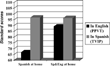
We propose that understanding bilingual profile effects requires, in particular, understanding the widely reported vocabulary limitations of bilingual children (Abudarham, 1997; Ben Zeev, 1977a, 1977b, 1984; Li, 1996; Miccio, Tabors, Paez, Hammer, & Wagstaff, 2003; Rosenblum & Pinker, 1983; Schaufeli, 1992; Verhoeven, 2000). In a Miami study that predated LLBC (Oller & Eilers, 2002a), first-grade bilingual children took the Peabody Picture Vocabulary Test (PPVT) and the Test de Vocabulario en Imágenes, Peabody (TVIP; Dunn & Dunn, 1981; Dunn, Padilla, Lugo, & Dunn, 1986). Replotted results in Figure 1 (Umbel et al., 1992) show low scores with respect to the norming populations in both languages. A subsequent study extended the findings to first, third, and sixth grade; vocabulary deficiencies compared to monolinguals were present for bilingual children in both languages (Umbel & Oller, 1994). The investigators ruled out the possibility that the low scores might have been related to low SES of the bilingual children. Empirical results showed the children were actually above average in SES compared to the norming samples, a predictable pattern given the affluence of the Miami Latin community.
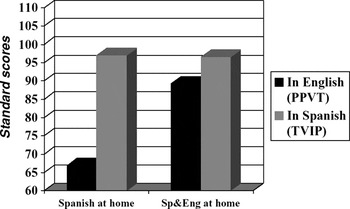
Vocabulary scores for normally developing bilingual first graders in Miami. The data are replotted from Umbel, Pearson, Fernández, and Oller (1992)
The factor that we presume to be the key in explaining the discrepancy was hinted at by Ben Zeev (1977a), who noted that bilinguals have less total time of exposure to the words of each language than monolingual children. However, sheer amount of exposure has been called into question as a determiner of rate of vocabulary learning. Dale, Dionne, Eley, and Plomin (2000) point to the functional or semantic category of what is being learned as an important consideration affecting the role of exposure. Gathercole (2002) suggests a mechanism whereby vocabulary learning may take place only after a threshold amount of exposure has been reached. Consequently, there may be discontinuities in the rate of learning depending on precisely how much exposure to vocabulary children have had in each language. Further, children learn words extremely rapidly beyond an early point, and this rapid learning is well in place by elementary school. Carey (1982) has suggested that English-learning children typically recognize 14,000 words before they can tie their shoes, a pace that suggests they must learn around nine words per day, presumably learning many with a single exposure in the third year of life. This rapid learning makes it uncertain how much effect differences in sheer amount of exposure may have in causing differences of vocabulary size between children.
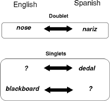
We have suggested that vocabulary size of bilingual children in elementary school may be due not so much to raw amount of exposure as to a pattern of exposure that is special in the bilingual circumstance (Oller, Cobo-Lewis, & Pearson, 2004; Oller & Pearson, 2002). Often bilingual individuals learn and speak one of their languages consistently in certain circumstances and the other language in different circumstances. Of course, the great bulk of vocabulary learned in one language is required in the other as well. So in most instances bilinguals eventually learn translation equivalents for words. When a child knows equivalents, such as “nose” in English and “nariz” in Spanish (see Figure 2), we say the child possesses a “doublet.” “Nose” is circumstance general, because our noses go with us wherever we go and talking about noses can occur wherever we may be, making it important, and presumably likely, that bilingual children will be exposed to and learn to use words like nose/nariz as doublets.
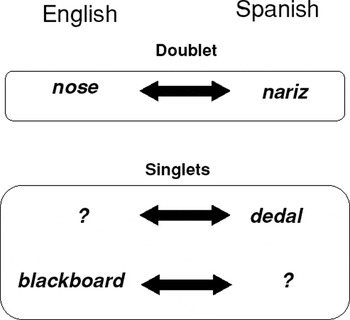
A diagram explicating doublet and singlet vocabulary knowledge
However, in some instances vocabulary usage is distributed in a circumstance-specific manner, and doublet knowledge is not required. Sewing, for example, may occur primarily in the home, and consequently the child who speaks Spanish at home may learn the words associated with sewing (e.g., “dedal,” which means “thimble”) in Spanish, but not English. Thimbles may tend to be talked about at home more than elsewhere. Similarly, the child who speaks English at school may learn words associated with the classroom in English, but not Spanish (e.g., “blackboard,” but not the Spanish word “pizarra”). When children know a word in one language but not the other, we say they possess a “singlet” (Figure 2). The circumstance-specificity of vocabulary can be thought of in terms of semantic domains or interactive scripts that are more likely to be invoked during conversations occurring in one circumstance than another. In addition to our own work from LLBC (especially Oller & Pearson, 2002), Genesee, Paradis, and Crago (2004) have also outlined the idea that circumstance-specific learning can engender vocabulary gaps in bilinguals.
One of the key findings of our vocabulary efforts that helped to inspire reasoning about circumstance specificity and the distributed characteristic was that bilingual children statistically reliably possessed singlets in both languages (Umbel et al., 1992). To demonstrate this fact we analyzed the content of receptive vocabulary tests. Most of children's vocabulary occurred in both languages, as doublets (about 60% at first grade according to Umbel et al., 1992, and further analysis by Pearson, Umbel, Andrews de Flores, & Cobo-Lewis, 1999). However, singlet vocabulary knowledge was shown to be statistically significant in both languages, that is, the number of singlets in each language was greater than predicted by guessing in the four-choice word recognition task. Words known in each language thus tended to show the distributed characteristic; some words were known in one language but not the other, consistent with the hypothesized circumstance specificity of word learning (Oller & Pearson, 2002).
Although it may have been tempting in the past to interpret weakness in vocabulary of bilinguals in each language compared to monolinguals as reflecting a general vocabulary deficiency in bilingual children, it is clear now that this interpretation is untenable, because it depends on the assumption that bilingual children should possess translation equivalents for every word. The more interesting question is whether for any potential “concept,” bilinguals and monolinguals are similarly likely to possess a word to represent the concept. Pearson coordinated a series of studies (Pearson, 1998; Pearson, Fernandez, Lewedeg, & Oller, 1997; Pearson, Fernández, & Oller, 1993, 1995) illustrating that bilingual and monolingual children had comparable levels of “conceptual vocabulary” from very early in word learning; they appeared to map potential semantic space in ways that resulted in similar coverage. Bilinguals and monolinguals could refer to similar amounts of semantic material, although bilinguals used words from both languages to refer to some concepts, but words from only one language for others. Moreover, of course, if one considered “total” vocabulary (counting doublets twice and singlets once), bilinguals could be seen to exceed monolinguals dramatically in vocabulary size. Consequently, the notion of a general deficiency in vocabulary learning capability in bilinguals is utterly inconsistent with the facts.
Importance of assessing both languages in bilinguals
One of the key points that emerges from recognition of the distributed characteristic is that is it impossible to make sense of bilingual linguistic capabilities without assessing linguistic knowledge in both the L1 and L2 (Abudarham, 1997). Of course, it is important to assess all aspects of bilingual knowledge in both languages. In particular, low vocabulary scores in bilingual children may be due entirely to the distributed characteristic, and this distributed pattern of vocabulary cannot be recognized in evaluation of single-language knowledge. Yet, a great deal of research conducted on bilingualism has been focused on only one language (even the important data of Verhoeven, 1994, pertain to Dutch only). The LLBC database (Oller & Eilers, 2002a) provides a particularly important source of information about profile effects, in part because it includes a large dataset on standardized tests in both languages. The data thus provides a key opportunity to evaluate robustness of profile effects across both languages of bilinguals, as well as across two educational settings (two way and English immersion), two levels of SES (high and low), and two conditions of language spoken at home (Spanish only vs. Spanish and English).
RATIONALE FOR THE PRESENT STUDY
Although there is solid evidence from prior research that profile effects occur in bilingual children, a more detailed analysis of the robustness of these effects across a variety of conditions and across both bilingual languages is needed. The present empirical analysis is intended to provide a direct test of the robustness of the sorts of profile effects that have been observed in LLBC (Oller & Eilers, 2002a) and in the work of Verhoeven (1994, 2000). The robustness of the effects will be evaluated here across all the conditions of the LLBC database, in both English and Spanish for all the children at both second and fifth grade. The profile effects to be considered will include both phonics scores (predicted to be relatively high in bilinguals) and vocabulary scores (predicted to be low), as well as scores on other tests that are predicted according to the rationale below to fall intermediate between phonics and vocabulary.
The present work evaluates the proposal that low bilingual vocabulary scores are the primary source of the profile effects. Because low vocabulary scores appear to be attributable to the distributed characteristic, and because the distributed characteristic applies to vocabulary learning more than to other domains of language and literacy, the pattern seen across a variety of profile effects is postulated to be attributable to the differential role of the distributed characteristic in different domains. The evaluations are constructed to clarify the role of the distributed characteristic in the profile effects, and thus in the performance of bilingual children in a variety of domains of language and literacy.
METHODS
Background on the LLBC methods
Subjects
The present work presents a reanalysis of data from LLBC (Oller & Eilers, 2002a). The original study included 952 children (704 bilinguals, 248 monolinguals) at K (332), second (306), and fifth grade (314) selected by staff of the LLBC project prior to testing. The present analysis focuses on the data from the 620 children at second and fifth grade. The reanalyzed data here focus on two of the three grades studied, in part because psychometric limitations of some subtests (owing especially to floor effects) at K complicated comparisons across tests for K. Some Hispanic children at K appeared to have had very little experience in English, so may have been scarcely bilingual at that point. In contrast, second- and fifth-grade tests showed substantial psychometric robustness (with neither floor nor ceiling effects), and all the children in those grades had had notable exposure to English. The second- and fifth-grade data include exactly the same design characteristics as for the LLBC sample as a whole.
Children were preselected such that half were high SES and half low SES, based upon an extensive questionnaire administered to parents. The SES scale was based on a synthesis of widely utilized tools (Hollingshead, 1978; Nam & Powers, 1983), emphasizing mother's educational level and occupational status of the parents. Similarly, half the bilinguals at each grade came from homes where English and Spanish were spoken equally, and half from homes where only Spanish was spoken.
All the children in the study were in one of 10 neighborhood schools. Based on US Census data, it was determined that the bilingual schools were well matched on SES of the neighborhood population, as well as ethnicity, monetary allotment per child from the government in support of the school, and average standard achievement test mathematics scores in K and first grade. Bilingual children were all from schools where near 90% of children were Hispanic, whereas most monolingual children were from schools where approximately 40% were Hispanic. Among the bilingual children half were in two-way programs and half were in English-immersion programs. All had been in these programs throughout their elementary schooling and all were born in the United States.
Educational characteristics of the schools
In the two-way schools 40% of each school day was conducted in Spanish, and 60% in English. In English-immersion programs 90% of instruction was in English. Classroom observations confirmed that teachers in the schools conducted their instruction, including one-to-one comments to individual students during class, in the language designated by the administrative protocol (Eilers, Oller, & Cobo-Lewis, 2002).
Standardized test battery
The standardized battery was drawn from the Woodcock–Johnson and Woodcock–Muñoz language and literacy evaluations normed in both English and Spanish (Woodcock, 1991; Woodcock & Muñoz-Sandoval, 1995) and from the PPVT, a receptive vocabulary test, and its Spanish normed companion, the TVIP (Dunn & Dunn, 1981; Dunn et al., 1986). These tests required children on each trial to point to one of four pictures in response to a label spoken by the tester. The subtests of the Woodcock battery that were included were word attack (WA), letter–word recognition (LW), passage comprehension (PC), proofreading, dictation, picture vocabulary (PV), verbal analogies (VA), and oral vocabulary (OV). For WA, children were required to read nonsense words, constructed according to the phonotactics of the language, and for LW, they were required to read real words. WA and LW were the tests used to assess “phonics,” which can be thought of here as the skill domain requiring mapping of orthographic (or “graphemic”) symbols to phonemic elements in each language. The WA test is particularly useful as an assessment of pure phonics (because the “words” to be read are novel to the child and cannot have been memorized as Gestalt orthographic patterns). The LW test presumably assesses a combination of pure phonics skill along with memory for Gestalt patterns of real words. The PC test required children to read a passage and answer questions about it. The proofreading task required children to supply corrections to brief segments of written text, and dictation required children to write words, phrases or sentences as they were presented by the examiner. PV was a picture naming task. VA required children to fill in the blanks in sequences such as “fish is to swim as bird is to___.” OV required children to supply synonyms or antonyms in each of two subsections.
Every child was tested on the batteries indicated above plus several additional evaluations that were constructed specially for the research (see LLBC, chapters 7– 11, Oller & Eilers, 2002a). Bilingual children had four to five sessions of testing on separate days, 30–40 min in length, and order of administration of the Spanish and English batteries was counterbalanced. Monolingual children required fewer test sessions because they were tested in English only. All testers were trained in administration of the standardized instruments in accord with recommendations of the test developers, and all were thoroughly bilingual in English and Spanish.
Additional details on the study's procedures can be found in the original volume (Cobo-Lewis et al., 2002a, 2002b; Eilers et al., 2002; Oller & Eilers, 2002b).
Design
The design of the current study thus included 20 cells for tests administered in English; at each of two grade levels (second and fifth) there was a lingualism2
The term “lingualism” was introduced in LLBC (Oller & Eilers, 2002a) to designate a variable contrasting bilingual and monolingual subjects.
Rationale for theoretical expectations
In keeping with our supposition that profile effects in bilingual learners can be explained in terms of differential degrees to which the distributed characteristic applies in different domains of language and literacy, we propose specific predictions listed in the Research Propositions Section. To understand the predictions regarding vocabulary, consider the fact that different circumstances of living correspond to different topics of conversation (and consequently to different semantic domains or interactive scripts) along with particular vocabulary items corresponding to the different topics. If the circumstances of life are distributed such that the L1 is spoken systematically in some of them and the L2 is spoken systematically in others, then vocabulary learning distributed across the two languages is a predictable outcome. The nature of the distribution of vocabulary in such cases would tend to be such that certain semantic domains (e.g., objects found in the kitchen or objects found on the school playground) would be more well known by individual bilingual speakers in one language than the other.
To understand why the distributed characteristic applies to vocabulary, but why we think it does not apply (or does not apply strongly) in other domains of language or literacy, consider certain structural characteristics of vocabulary. (a) There are thousands of root words (or morphemes) in every natural language. (b) These root words must essentially be learned throughout life, one by one. To command translation equivalents, bilingual learners are required (with the exception of some cognate words if the two languages are related) to learn each translation-equivalent root word twice, once for each language. (c) Each translation-equivalent word pair represents a coupling of two different phonological or orthographic forms (a sequence of phonemes or letters), with a particular meaning (a semantic content). (d) One does not need to know all the vocabulary in a language to function effectively in that language in certain circumstances. If a particular circumstance only requires communicating about a limited range of topics and corresponding semantic domains, there is no need to possess certain vocabulary, namely, that vocabulary not pertaining to the topics and domains required for communication in that circumstance. These structural characteristics of vocabulary set the stage for the distributed characteristic of bilingual vocabulary learning, because bilingual children learn some root words in one language without needing to learn them in the other.
Other aspects of language and literacy do not show these structural characteristics. The skill that maximally contrasts with vocabulary in our data (in terms of test scores) is phonics, and our contention is that phonics scores are not low in either language of bilinguals compared to monolinguals at least in part because the distributed characteristic does not play a significant role (if any) in phonics for Spanish and English bilinguals. In the following we present the reasoning behind our proposal that phonics does not show the distributed characteristic because phonics does not possess the structural characteristics that set the stage for it.
Here we use the term “phonics” to refer to the set of individual pairings of phonemes with letters that occur in a particular writing system. Any individual combination of a phoneme with a letter (or letters) that can represent it will be called a “phonics pairing.” We assume these pairings to be the basic elements of phonics just as we assume root words (or morphemes) to be the basic elements of vocabulary.
Note now that phonics pairings differ from root words on all the structural characteristics listed above. (a) Although root words number in the thousands in any language, phonics pairings are much more limited in number. In Spanish, where the orthography is largely transparent, there are about 30 phonics pairings, whereas in English, the opaque orthography produces a number of pairings that is several times that large, but still minuscule by comparison with the number of root words in a language. Although vocabulary learning continues throughout life to acquire many thousands of items, phonics learning can be completed early in acquisition because the set of phonics pairings is relatively small. (b) The great bulk of phonics pairings in any alphabetical language must be acquired (either tacitly or explicitly) very early in learning to read, because productive reading in an alphabetical language requires command of them (Liberman, Shankweiler, & Liberman, 1989; Treiman, 2000). (c) Although each vocabulary item consists of a phonological (orthographic) form (a sequence of phonemes or letters) that represents a meaning, each phonics pairing is in and of itself meaningless. Individual phonemic and orthographic elements serve merely as vehicles for transmission of meaning, possessing no linguistic meaning of their own (de Saussure, 1968; Hockett, 1977). Consequently, the notion “translation equivalent,” which is so important in understanding the distributed characteristic in vocabulary, has no obvious parallel in phonics; there are no meanings to translate from one language to the other in phonics, because the elements of phonics are meaningless. Equivalency of phonics pairings across languages is consequently different in kind from translation equivalency in vocabulary, and undercuts sorting of phonics pairings as singlets and doublets, a critical feature of the analysis of the distributed characteristic in vocabulary. (d) Although an individual can function well in a language with limited vocabulary as long as that vocabulary covers the necessary semantic domains required for the circumstances where the individual uses the language, the same is not true of phonics. When reading in any semantic domain, in any alphabetical language, essentially the totality of phonics pairings may be invoked, and this fact makes it critical that the number of phonics pairings be relatively small and learnable in toto. Regardless of the topic or semantic content one reads about, there is no reason to expect to find a particular range of phonics pairings, because the phonics pairings are themselves semantically void, by design (Studdert-Kennedy, 2000). Thus, although circumstance specificity can naturally drive segregation of vocabulary in a bilingual's two languages because particular vocabulary items can pertain to particular semantic domains, the same cannot naturally happen in phonics. Phonics pairings are inherently not semantic-domain specific, so no matter where reading is done or how it is learned, a similar range of phonics pairings should always be invoked, according to our reasoning.3
One might point out that there may exist circumstance specificity for learning of phonics or for the act of reading. For example, school may be the setting for learning of phonics and the primary setting for reading. If circumstance specificity produces the distributed characteristic in vocabulary, why not in phonics? For circumstance specificity to produce a distributed characteristic in phonics, it would have to meet several additional conditions: (a) learning would have to be focused on particular phonics pairings in one language but not the other; (b) these phonics pairings would have to be in some sense equivalent across the languages; (c) the knowledge of the pairings would have to remain exclusively in one language and not transfer to the other; and (d) the learner would have to be prevented from learning the pairings in the other language, even though they would presumably be needed for reading on any topic or in any semantic domain. If our reasoning about differences between the structural characteristics of vocabulary and phonics is correct, these conditions would be very unlikely ever to be met.
Assuming now that these structural differences are correctly formulated and empirically accurate, there is no straightforward basis upon which a distributed characteristic could develop in phonics. The fact is that it is hard to envision a way that distributed learning could ever produce low scores in phonics for English and Spanish learners.
Consider an imaginary example. The letter “e” occurs in both English and Spanish. For a child who is learning to read in both languages, a distributed characteristic for phonics with regard to the letter “e” might be thought to require exposure to the phonics pairings for the letter “e” in one language but not in the other. The child might learn then to sight read words in English involving the letter “e” (real words like “need,” “feet,” or “bread,” or nonsense words like “keat,” “jeel,” “kreach,” etc.) but, to show a distributed characteristic, would have to not learn to read words in Spanish involving the letter “e” (real words like “perro,” “cerdo,” or “creo” or nonsense words like “tero,” “breu,” or “quespo”). Conversely, the child would have to learn the requisite pairings in Spanish but not English.
However, learning of the pairings for “e” in one language but not the other based on differential exposure would be extremely unnatural, because as explained above, one has to learn all the letters and their pairings to be able to read at even the most basic level in either language in any semantic domain. If one cannot decode the letter “e” in either language, one is handicapped in a very general way with regard to reading in that language.
Further, many phonics pairings in English and Spanish, once learned in either language, would appear to be quite transferable to the other. Pairings for the letters “f, s, m, n, y, and l” are extremely similar across the languages, and pairings for “p, t, k, c, b, d, g, and ch” differ only in minimal ways. Consequently, knowledge for these phonics pairings can hardly be distributed across the languages the way vocabulary knowledge can be, because once learned in either language, the phonics pairings may become immediately available by generalization in the other. Even vowel and diphthong pairings show substantial commonalities across the languages and may produce important transfer. Letters or letter sequences that clearly pertain to one language's phonics but not to that of the other (e.g., “ñ” in Spanish or “th” in English) cannot be acquired in either language in such a way as to contribute to a distributed characteristic the way we have defined it. These phonics pairings in one language have no equivalent pairings in the other, and thus cannot be sorted in terms of whether or not the learner acquires the equivalent structure in both languages; these structures have no equivalents across languages, and hence no possible doublets. The distributed characteristic as we observe it in bilingual vocabulary depends on the existence of very large numbers of cases where words have (translation) equivalents in the two languages. With translation equivalents, a word learned in one language (a singlet) can occupy a semantic domain that can be left empty by the learner in the other language because it may not be needed in the circumstances of usage of the other language for the individual learner.
Thus, in accord with Research Proposition 1, we propose that vocabulary scores of bilingual children may tend to be low with respect to monolinguals in both the L1 and L2 because bilingual vocabulary is selectively distributed. Phonics scores tend to be higher in English–Spanish bilinguals (who thus may not trail monolinguals in the L1 or L2), because, according to our reasoning, there is presumably no possibility of similarly distributed learning in phonics.
We speculate further, in accord with Research Proposition 2, that tests of vocabulary reasoning, such as VA or synonym/antonym determination (OV), should also show intermediate standard scores in bilingual children, with scores falling between those for phonics and vocabulary. The basis for this expectation requires that we envision a combination of two skills, one involving retrieval of vocabulary items from memory, a skill reflected directly in scores on pure vocabulary tests, and another skill involving reasoning about vocabulary once it has been retrieved, a skill that is not directly reflected in behavioral tests, but must be inferred from comparing scores on vocabulary reasoning tests and pure vocabulary tests. Although retrieval of vocabulary items may be more limited for bilingual children within both the L1 and L2 than for monolinguals, the ability to reason about vocabulary items once they have been successfully retrieved should be equivalent for bilingual and monolingual children, we presume. Thus, scores on vocabulary reasoning tests are expected to be higher than for vocabulary tests alone (because reasoning itself should be unimpaired), but are expected even so to show limitations with respect to monolingual performance, because vocabulary retrieval is predictably more limited in bilinguals than monolinguals owing to the distributed characteristic.
We speculate also, in accord with Research Proposition 3, that tests requiring both vocabulary and phonics skills, tests such as reading comprehension, for example, should show standard scores intermediate between those of phonics and vocabulary in bilingual children, because, again, the combination of the two skills may tend to mitigate the extremes. Reading/writing (a composite of PC, proofreading, and dictation) scores would be predictably higher in bilinguals than vocabulary scores because the scores are influenced by phonics skills, which tend to be high. At the same time reading/writing scores would be predictably lower in bilinguals than phonics scores because the scores are influenced by vocabulary skills, which tend to be low.
It is anticipated that second-grade profile effects will be stronger than fifth-grade effects (Research Propositions 1–3). This expectation is based on change in the distributed characteristic across time. About 70% of vocabulary in 2-year-old bilinguals in Miami consisted of singlets (Pearson et al., 1999), but the number dropped to about 40% in elementary school. By college the rate was below 20% according to Pearson et al.'s analysis. We predict that as the proportion of singlets decreases (and it is reasonable to expect that it decreases from second to fifth grade), the relative influence of low vocabulary scores on profile effects in either language should similarly decrease.
In addition, in each case it is anticipated that the bilingual profile effects will be stronger in Spanish than in English (Research Propositions 1–3) because data from LLBC indicated the bilingual children were more competent in English vocabulary than Spanish by second grade and preferred to speak English (LLBC, chapters 3– 5, Oller & Eilers, 2002a). With higher English vocabulary scores, the profile difference of vocabulary with respect to phonics scores for bilingual children is naturally anticipated to be lower in English than in Spanish.
Research propositions
We predict that standard scores on vocabulary will tend to be lowest, phonics scores highest, and other test scores intermediate. We propose that this pattern will apply across both the L1 and L2 (although more strongly in the L1) and should be relatively stable across differing conditions, namely, two-way or English-immersion education, high or low SES, and Spanish only or English and Spanish in the home (LSH). To be clear, the prediction is not that the size of profile effects should be the same for all subgroups, but that profile effects should be evident in all subgroups. The bilingual profile effects should be present at both second and fifth grade, but stronger at second grade.
Specific predictions in keeping with the reasoning above are as follows:
- Basic reading (phonics) scores will exceed basic vocabulary scores consistently across bilingual subgroups to a reliably greater extent than in monolinguals, and the profile effect in bilinguals will apply to both languages and both grade levels, but more strongly in Spanish and more strongly at second grade.
- Pure phonics scores (WA) will consistently be highest, vocabulary reasoning scores intermediate, and picture-naming scores lowest across the bilingual subgroups. This pattern will occur to a reliably greater extent in bilinguals than in the monolinguals, and the profile effect in bilinguals will apply to both languages, but more strongly in Spanish and more strongly at second than at fifth grade.
- Reading/writing scores will also be intermediate between WA and picture-naming scores across the bilingual subgroups. This pattern will occur to a reliably greater extent in bilinguals than in the monolinguals, and the profile effect in bilinguals will apply to both languages, but more strongly in Spanish and more strongly at second than at fifth grade.
Analysis procedures
Comparisons of composite scores
For each research proposition the primary comparisons of interest concern relative performance on the various tests as reflected by standard scores. To the extent that the scores differ reliably across tests, the existence of profile effects will be confirmed. For each child composite scores were calculated as linear combinations of subtests to represent focused areas of language or literacy. Table 1 presents the weights by which subtests (shown in the columns) were combined to produce the composite scores (in the rows). The profile effects that we analyzed for this article constituted differences among these composite scores (e.g., basic reading vs. basic vocabulary).
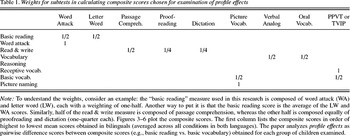
Our exposition of the analysis below involves two steps: we report effect sizes based on standard score comparisons across the tests and take note of effect consistency in a semiformal manner, referencing the sign test, and we conduct formal statistical tests of the profile effects utilizing the very conservative Scheffé test. We now turn to descriptions of the two steps.
Standard score interpretation and adjustment
One way to evaluate bilingual profile effects is simply to compare standard scores of bilingual children to the expected mean of 100 for every test. A pattern of relatively higher and lower scores on different tests can be interpreted as a profile effect with respect to the (overwhelmingly monolingual) norming group. The eight bilingual subgroups of the design were orthogonal; this means that every child's data were represented in one and only one subgroup. Consequently, each left–right pair of open symbols in Figures 3–6 represents an independent test of the profile effects in question. In Figure 3, for instance, because all eight bilingual comparisons favor a profile effect, the result (if it were not post hoc) could be legitimately interpreted as statistically significant even by a sign test (p=.008). If seven out of eight cells show a particular profile, the sign test could be interpreted as approaching statistical significance (p=.070).
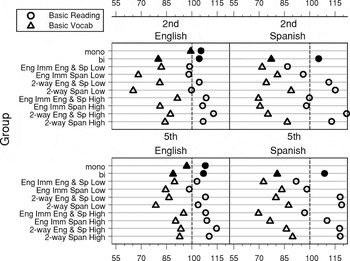
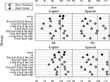
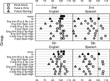
Profile effects for basic reading and basic vocabulary. For second grade (top row) and fifth grade (bottom row), open symbols show means for each of the eight cells in the LLBC design (Oller & Eilers, 2002a) for bilingual children for basic reading (word attack and letter–word recognition) and basic vocabulary (picture vocabulary and Peabody Picture Vocabulary Test). Filled symbols show unweighted means across the cells for all the bilingual children as well as for all monolingual controls. Data from monolingual controls are available only for English tests (left column), not for Spanish tests (right column). The vertical line at 100 indicates the expected mean for the norming sample on all tests; mono, monolingual mean across low SES and high SES; bi, bilingual mean across all subgroups; Eng Imm, English-immersion school type; 2-way, two-way school type; Span, only Spanish spoken at home; Eng & Span, equally English and Spanish spoken at home; Low, low SES; High, high SES
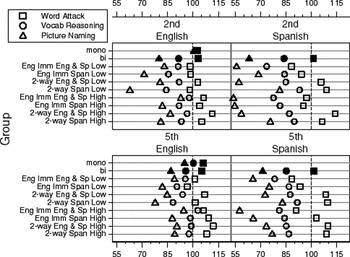
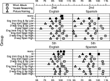
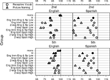
Profile effects for word attack, vocabulary reasoning (oral vocabulary and verbal analogies subtests of Woodcock–Johnson and Woodcock–Muñoz), and picture naming. For second grade (top row) and fifth grade (bottom row), open symbols show means for each of the eight cells in the LLBC design (Oller & Eilers, 2002a) for bilingual children for word attack, vocabulary reasoning, and picture naming. Filled symbols show unweighted means across the cells for all the bilingual children as well as for all monolingual controls. Data from monolingual controls are available only for English tests (left column), not for Spanish tests (right column). The vertical line at 100 indicates the expected mean for the norming sample on all tests; mono, monolingual mean across low SES and high SES; bi, bilingual mean across all subgroups; Eng Imm, English-immersion school type; 2-way, two-way school type; Span, only Spanish spoken at home; Eng & Span, equally English and Spanish spoken at home; Low, low SES; High, high SES
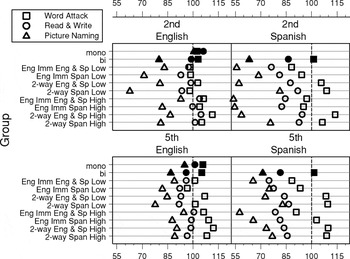
Profile effects for word attack, reading/writing (passage comprehension/2 + proofing/4 + dictation/4), and picture naming. For second grade (top row) and fifth grade (bottom row), open symbols show means for each of the eight cells in the LLBC design (Oller & Eilers, 2002a) for bilingual children for word attack, reading and writing, and picture naming. Filled symbols show unweighted means across the cells for all the bilingual children as well as for all monolingual controls. Data from monolingual controls are available only for English tests (left column), not for Spanish tests (right column). The vertical line at 100 indicates the expected mean for the norming sample on all tests; mono, monolingual mean across low SES and high SES; bi, bilingual mean across all subgroups; Eng Imm, English-immersion school type; 2-way, two-way school type; Span, only Spanish spoken at home; Eng & Span, equally English and Spanish spoken at home; Low, low SES; High, high SES
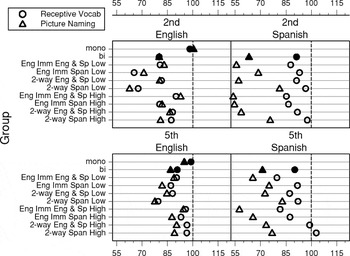
Profile effects for receptive vocabulary (Peabody Picture Vocabulary Test) and picture naming (picture vocabulary subtest of Woodcock–Johnson and Woodcock–Muñoz tests). For second grade (top row) and fifth grade (bottom row), open symbols show means for each of the eight cells in the LLBC design (Oller & Eilers, 2002a) for bilingual children for receptive vocabulary and picture naming. Filled symbols show unweighted means across the cells for all the bilingual children as well as for all monolingual controls. Data from monolingual controls are available only for English tests (left column), not for Spanish tests (right column). The vertical line at 100 indicates the expected mean for the norming sample on all tests; mono, monolingual mean across low SES and high SES; bi, bilingual mean across all subgroups; Eng Imm, English-immersion school type; 2-way, two-way school type; Span, only Spanish spoken at home; Eng & Span, equally English and Spanish spoken at home; Low, low SES; High, high SES
However, we treated the sign test approach with caution because it was post hoc and included no correction for multiple comparisons of tests (a more rigorous statistical evaluation is described below). Furthermore, it was important to consider the standard scores for bilingual children on the English tests in light of differences among scores across tests in the monolingual children evaluated in the same study. Although one would expect the standard scores for monolinguals to approximate the normed mean of 100 on all standardized tests, any particular cohort could differ from 100 due to an unexpected difference between the particular cohort and the norming sample. Consequently, another comparison considered below was based on subtraction of the monolingual profile effects from the bilingual ones. For example, the differences for bilinguals on basic reading and basic vocabulary scores in English were compared to monolinguals' score differences. Thus, if bilinguals scored 10 points higher in basic reading than basic vocabulary, but monolinguals scored 2 points higher in basic reading, the net profile effect for the bilinguals after subtraction would be 8 points. The bilingual profile effects that remained after subtraction for each of the eight subgroups could then be evaluated by the sign test, although we reiterate that these evaluations would be post hoc and uncorrected for multiple comparisons.
Score adjustment (implemented by subtracting monolingual from bilingual profile effects) was necessary because there were cases where apparent profile effects in the bilinguals could be the result, not of special characteristics of bilingual learning, but of a special characteristic of schooling in the location of sampling that could have affected both bilingual and monolingual patterns of performance with respect to the normed scores. In fact, both monolingual and bilingual children did show standardized scores on particular tests that were systematically different from 100. For example, both monolingual and bilingual children in some comparisons showed especially high scores on phonics tests with regard to the expected/normed mean of 100, while not showing such high scores on other tests. We speculate that the high scores on phonics may have been the result of a greater emphasis on teaching phonics in Miami during the period of LLBC testing (Oller & Eilers, 2002a) than during the time of the norming of the tests. In cases where both monolingual and bilingual children showed elevated scores on phonics with respect to the expected mean of 100, and both showed lower scores on other tests, profiles of difference favoring phonics over other test scores were evident for both groups with regard to the normed scores. However, as will be seen, the bilingual profile effects were larger and more consistent than monolingual profile effects. This conclusion can be seen to meet the sign test standard in any case where all eight bilingual subgroups show profile effects even after subtraction of monolingual profile effects.
Formal evaluation of the profile effects
Multivariate analysis of variance (the primary method of analysis in LLBC, Oller & Eilers, 2002a) is not ideally suited to the formal analysis goals of the present study. The goal here was to reanalyze the data from second and fifth grade conservatively while focusing on a number of comparisons of subgroups of children in both English and Spanish, and to illustrate the extent of and reliability of profile effects for each subgroup. Consequently, we analyzed the data in formal evaluations for each hypothesis and subhypothesis by parametric Scheffé tests, as explained below. This approach provides an optimal fit with the goal of the analysis to focus on profile effects within each subgroup of children and language at both second and fifth grade.
In our formal statistical evaluations, each examined profile effect amounted to a specific single degree of freedom contrast among levels of test type (test), representing any composite score. A very rigorous statistical adjustment for profile effects in monolinguals was made. Examining the difference in profile effects for bilinguals and monolinguals is equivalent to examining the statistical interaction of each profile effect with lingualism (monolingual vs. bilingual). If the interaction of a bilingual profile effect by lingualism was significant in any case, it indicated that the bilingual effect was significant after correction for (after subtracting) the monolingual effect.
For the Spanish tests, no comparison with monolingual profiles was available, because no Spanish monolinguals were tested in LLBC (Oller & Eilers, 2002a) on the standardized battery (monolingual Spanish subjects meeting the study preselection criteria were not available in the schools). Consequently, the data on Spanish are presented without comparison to a monolingual control group (i.e., we examined single degree of freedom contrasts in Spanish but could not examine the interaction of test by lingualism). In general, the profile effects in Spanish were even stronger than in English (verified by examining the interaction of profile effects with tested language, and by considering effect sizes in standard deviation units of difference between test scores for Spanish and English), suggesting that the Spanish-language profile effects were real and were not the result of teaching styles that may have been different in Miami during the period of LLBC testing from the way they were for children in schools where and when the tests were normed. The formal statistical evaluation chosen here is much more conservative than multivariate analysis of variance as reported in LLBC. As a primary assessment of statistical significance of the profile effects, we utilized parametric Scheffé post hoc tests that allowed examination of any linear combination of the nine subtests in the LLBC study while guaranteeing familywise an α value below 0.05. This provided a very rigorous control for post hoc examination of the data. For an α value of 0.05, the critical value of the Scheffé t for examining any combination of nine subtests was never less than ±3.94 and it was always more than twice the critical value of the t statistic for planned comparisons with equivalent degrees of freedom. We were thus able (in accord with this conservative method) to declare significant only those effects that were more than twice as large as would be required to achieve significance with planned comparisons. This test is so conservative that even if only one of the many comparisons to be made with the Scheffé test proved to be statistically significant, it would demonstrate incontrovertibly that a multivariate analysis of variance for the dataset would also have yielded a significant F value.
In a further commitment to rigor, we also used separate error terms for each profile effect to avoid having to make any assumption of sphericity. Finally, in performing the post hoc tests of the profile effects and their interactions, we statistically controlled for other effects in the design by partialing out, as appropriate, any main effects and/or interactions among IMS, LSH, and SES, and first language tested (this last effect pertained only to bilinguals, approximately half of whom took the Spanish battery first and the remainder of whom took the English battery first).
Scheffé tests determined statistical significance by evaluating the reliability or consistency of effects. However, there is always a distinction to be drawn between reliability of an effect, and effect size, that is, the amount by which test scores differed in terms of standard scores or standard deviations from the expected (or normed) mean scores; a score 15 points above or below the expected/normed mean of 100 represents a full standard deviation of difference on the tests utilized here. Because of sampling error and especially because of differential covariance among tests in various profile effects, the sample standard deviation of some interactions involving profile effects in this paper ranged as low as 10 points or as high as 26 points. Consequently, effect sizes are reported below in terms of Cohen's d, a corrected effect size.
RESULTS
Research Proposition 1: Profile effects for basic reading and basic vocabulary
Second- and fifth-grade data from LLBC (Oller & Eilers, 2002a) are compiled for basic reading and basic vocabulary tests in Figure 3. The mean scores on the WA and LW tests were selected to reflect basic reading skill. Basic vocabulary in the figure represents the mean score for the PV score (termed picture naming to make clear that this was a productive and not a receptive vocabulary test) and the PPVT or TVIP, the receptive vocabulary tests.
Second-grade English
The data in the top left panel of Figure 3 display a strong and consistent second-grade profile effect for bilingual children. For all eight bilingual subgroups, the basic reading score greatly exceeded the basic vocabulary score. The basic reading score was on average 24.4 points higher (much more than a full standard deviation) than the Basic Vocabulary score. The eight bilingual subgroups also all showed profile effects higher (average = 18.3 points higher) than seen in the LLBC (Oller & Eilers, 2002a) monolingual comparison group (top, Figure 3). By the conservative Scheffé test, basic reading scores for bilinguals significantly exceeded basic vocabulary, d=1.5, t(211)=21.96, Scheffé p=.007, whereas monolinguals' smaller profile effect was not significant, d=0.4, t(77)=3.52, Scheffé p=.89. The interaction of lingualism by the profile effect showed that bilingual second-graders' profile effect was significantly larger than monolinguals', d=1.1, t(288)=8.50, Scheffé p [Lt ] .0001.
Second-grade Spanish
The profile effects were also observed in Spanish at second grade (top right panel, Figure 3). As noted previously, there were no Spanish monolinguals in the LLBC study (Oller & Eilers, 2002a) to use as a basis for comparison. Again, the bilingual basic reading score exceeded the basic vocabulary score in all eight subgroups, and this profile effect was significant by the Scheffé test, d=1.4, t(211)=20.54, Scheffé p [Lt ] .0001. The significant mean profile difference for bilinguals on these Spanish tests (28.1 points) was even larger than the significant mean profile difference (24.4) for the same children in English. The size of the bilingual second-graders' profile effect was not, however, significantly different in Spanish than English, as indicated by the interaction with tested language.
Fifth-grade English
The scores for fifth-grade bilinguals in English (bottom left, Figure 3) also displayed consistent profile effects. In all eight bilingual subgroup comparisons, the basic reading score exceeded the basic vocabulary score (average = 18.1 points). All eight bilingual subgroups also showed a larger profile effect than the monolinguals. The Scheffé tests showed that the bilingual profile effect was significant, d=1.2, t(210)=18.31, Scheffé p=.02, whereas the monolinguals' smaller profile effect (average = 11 points) was not. The difference in profile effects for bilingual and monolingual fifth graders approached significance, d=0.5, t(296)=3.84, Scheffé p=.07. The average difference of 7.0 points at fifth grade was notably lower than at second grade, where the bilingual profile effect was 18.3 points higher than in monolinguals. The difference in English between bilingual and monolingual profile effects was significantly lower in fifth grade than second grade, d=−0.7, t(584)=−4.02, Scheffé p=.04.
Fifth-grade Spanish
In Spanish at fifth grade, the profile effects were revealed strongly, as seen in the bottom right panel of Figure 3. Basic reading scores were higher than basic vocabulary scores for all eight subgroups. The mean profile difference for fifth-grade bilinguals on the Spanish tests was significant: 28.1 points, d=1.4, t(210)=21.11, p [Lt ] .0001. The profile difference in Spanish was substantially larger in magnitude than for the same children on the English tests (18.1 points), and the interaction with tested language was also significant: d=0.6, t(210)=8.74, Scheffé p [Lt ] .0001. In Spanish, the profile effect at both second and fifth grade was 28.1 points. Consequently, although the profile effects for the bilingual children were stronger in second than fifth grade in English, they were unchanged from second to fifth grade in Spanish.
Research Proposition 2: Profile effects for WA, vocabulary reasoning, and picture naming
Although bilingual children showed much higher basic reading scores on the standardized tests than on the basic vocabulary tests, other test scores were consistently intermediate in the bilingual profiles between phonics and vocabulary. Figure 4 illustrates a powerful three-way profile effect of this sort. The scores compared were the following: (a) WA, (b) vocabulary reasoning, and (c) picture naming.
There were theoretical reasons for comparing exactly these tests. WA, reading of nonsense words, was chosen to represent phonics in its purest form. This is the aspect of reading that can be argued to be most independent of particular word knowledge. In contrast, the LW test (which requires reading real words), even though it involves phonics, is clearly also affected by word knowledge, so should be less favored as a proxy for pure phonics ability.
Similarly, we reasoned that picture-naming scores were the best choice as a proxy for basic vocabulary capability, for both theoretical and practical reasons. Receptive vocabulary knowledge is often passive, and may include words not accessible to the speaker except in comprehension. Productive vocabulary scores, on the other hand, reveal both comprehension ability and the ability to retrieve words while speaking. A profile difference between receptive and productive vocabulary in bilingual children in Spanish but not English (documented below) appears to result from the greater role of passive vocabulary in Spanish than in English among the children. This difference across languages would have complicated the three-way profile if both receptive and productive vocabulary were combined. Consequently, we deemed picture naming to be the most appropriate proxy for the construct of basic vocabulary knowledge.
The vocabulary reasoning scores in Figure 4 consist of means for two tests (OV, the synonym/antonym test and VA, the verbal analogies test) that yielded a measure of the degree to which children could both access vocabulary knowledge and make judgments about relations between the meanings of words thus accessed. These tests assessed not only accessibility from memory for words as names of classes of entities, but also the ability to manipulate information about meanings of accessed words, a task that would seem to recruit problem solving capabilities and perhaps even metalinguistic knowledge.
Second-grade English
The profile outcomes for second-grade bilinguals (Figure 4) were remarkable. All eight bilingual subgroups showed the three-way profile effect, WA > vocabulary reasoning > picture naming. In all eight subgroups the three-way profile effect was also stronger than in monolinguals. Considering pairwise comparisons of the three measures, the significant mean profile difference between WA and picture naming in bilinguals was 23.1 points, d=1.2, t(211)=18.39, Scheffé p [Lt ] .0001. The nonsignificant profile difference between WA and picture naming was only 2.0 points for the monolinguals. The interaction of the profile effect of WA versus picture naming in second-grade English with lingualism was thus significant, with the effect being 21.2 points larger in bilinguals, d=1.1, t(288)=8.66, Scheffé p [Lt ] .0001. The profile effects for WA versus vocabulary reasoning, and for vocabulary reasoning versus picture naming were also significant for bilingual second graders in English: WA > vocabulary reasoning by 11.6 points, d=0.8, t(211)=11.82, Scheffé p [Lt ] .0001; vocabulary reasoning > picture naming also by 11.6 points, d=0.9, t(211)=13.08, Scheffé p [Lt ] .0001. In both cases these profile effects were significantly stronger in bilinguals than monolinguals: the interaction of lingualism with WA versus vocabulary reasoning showed the profile effect was 10.7 points larger for bilinguals, d=0.7, t(288)=5.45, Scheffé p=.0004, and the interaction of lingualism with vocabulary reasoning versus picture naming showed the profile effect was 10.5 points larger for bilinguals, d=0.8, t(288)=6.30, Scheffé p<.0001.
Second-grade Spanish
In Spanish, the profile effects were even larger (top right, Figure 4). Again, all eight subgroups showed the three-way profile effect. The mean pairwise profile differences were all significant: WA > picture naming, 38.0 points, d=1.6, t(211)=24.04, Scheffé p [Lt ] .0001; WA > vocabulary reasoning, 17.3 points, d=1.0, t(211)=14.55, Scheffé p [Lt ] .0001; and vocabulary reasoning > picture naming, 20.7 points, d=1.1, t(211)=17.00, Scheffé p [Lt ] .0001. All three pairwise comparisons were significantly larger in Spanish than in English, as indicated by interactions with tested language: for WA versus picture naming, the profile difference was 14.9 points larger in Spanish: interaction effect, d=0.6, t(211)=8.41, p [Lt ] .0001; for WA versus vocabulary reasoning the profile difference was 5.7 points larger in Spanish: interaction effect, d=0.4, t(211)=5.65, p=.0002; and for vocabulary reasoning versus picture naming the profile difference was 9.1 points larger in Spanish: interaction, d=0.4, t(211)=6.26, p<.0001.
Fifth-grade English
At fifth grade also, all eight subgroups of bilinguals showed the three-way profile pattern, WA > vocabulary reasoning > picture naming, as seen in Figure 4. Even after the monolingual profile effect was subtracted, seven of the eight comparisons conformed to the profile pattern WA > vocabulary reasoning > picture naming, and all eight conformed to WA > picture naming, and vocabulary reasoning > picture naming. The only exceptional subgroup consisted of bilinguals in the English-immersion English and Spanish at home high SES group, whose WA–vocabulary reasoning gap was smaller than that of monolinguals.
The pairwise comparisons effects in bilinguals were all significant, indicating the three-way profile effect: WA > picture naming, 18.3 points, d=1.0, t(210)=15.15, p [Lt ] .0001; WA > vocabulary reasoning, 9.5 points, d=0.5, t(210)=8.16, p<.0001; vocabulary reasoning > picture naming, 8.8 points, d=0.9, t(210)=13.55, p [Lt ] .0001. The monolingual profile effects were also significant for WA > picture naming, 10.8 points, d=0.6, t(86)=5.59, p<.001, and vocabulary reasoning > picture naming, 5.3 points, d=0.47, t(86)=4.31, p<.03, but not for WA versus vocabulary reasoning. The three-way profile effects thus did not interact significantly with lingualism by the very conservative Scheffé test, even though at least seven of eight subgroup comparisons in each case showed greater bilingual than monolingual profile effects. The difference between the bilingual and monolingual profiles for WA versus picture naming was significantly lower (13.8 points) in fifth than in second grade, d=−0.8, t(584)=−4.12, Scheffé p=.03. Differences between bilingual and monolingual English profiles for WA versus vocabulary reasoning and vocabulary reasoning versus picture naming in Figure 4 did not change significantly from second to fifth grade, although the differences were smaller for all eight subgroups at fifth for both pairwise comparisons.
Fifth-grade Spanish
In Spanish at fifth grade (bottom right, Figure 4) the three-way profile outcome was again strong and consistent across all eight subgroups. The mean profile differences for each of the pairwise comparisons were significant; for WA > picture naming, 30.3 points, d=1.4, t(210)=20.73, Scheffé p [Lt ] .0001; for WA > vocabulary reasoning, 16.4 points, d=1.0, t(210)=14.34, Scheffé p [Lt ] .0001; and for vocabulary reasoning > picture naming, 14.0 points, d=0.9, t(210)=13.07, Scheffé p [Lt ] .0001. For all three pairwise comparisons the profile effect was smaller at fifth than at second grade, but only the 6.7-point drop for vocabulary reasoning versus picture naming was significant; interaction of profile with grade, d=−0.4, t(421)=−4.14, Scheffé p=.03. In all eight subgroups, the vocabulary reasoning > picture naming effect was greater at second than fifth grade. All three profile effects for the fifth-grade bilinguals were significantly larger in Spanish than English, as shown by the interactions with tested language; for WA versus picture naming there was a 12.1-point profile difference across languages, d=0.5, t(210)=7.63, p<.0001; for WA versus vocabulary reasoning the difference was 6.9 points, d=0.4, t(210)=6.13, p<.0001; and for vocabulary reasoning versus picture naming, there was a 5.1 point difference, d=0.4, t(210)=6.26, p<.0001.
Research Proposition 3: Profile effects for WA, reading/writing, and picture naming
Just as scores for vocabulary reasoning in bilinguals fell in between extremes of bilingual performance for phonics and vocabulary recall, there were other tests in the battery that could be reasoned logically to represent combinations of capabilities involving both phonics and vocabulary, and thus could be expected also to yield intermediate scores. For reading/writing tasks it is clear that both phonics abilities and vocabulary knowledge are required, in addition to other capabilities. For the comparisons in Figure 5, the reading/writing tasks represent the mean of (a) the passage comprehension test and (b) the mean of the proofreading test and the dictation test. The passage comprehension score was doubly weighted here to equalize the weight of the “reading” measure with that of the two “writing” measures.
Second-grade English
Bilingual second graders showed the consistent order WA > reading/writing > picture naming, across all eight subgroups (Figure 5), although the WA > reading/writing difference was small. Monolinguals showed a small reversal, reading/writing > WA, at second grade. After subtraction of the monolingual tendencies, the data for bilingual second graders in English showed the consistent order WA > reading/writing > picture naming across all eight bilingual subgroups. Although the profile effect for bilingual second graders for WA > reading/writing was only 4.1 points, this effect was significant, d=0.4, t(211)=5.46, Scheffé p=.0004, as was the 19.1-point effect for reading/writing > picture naming, d=1.2, t(211)=18.50, Scheffé p [Lt ] .0001. The highly significant WA versus picture naming effect for second-grade bilinguals in Spanish represented in both Figures 4 and 5 was described under Research Proposition 2. For all these pairwise comparisons, the bilingual profile effects exceeded the monolingual effects significantly as indicated by the interactions with lingualism: for WA > reading/writing the profile effect was 7.7 points higher in bilinguals than monolinguals, d=0.7, t(288)=5.23, p=.0009, and for reading/writing > picture naming, 13.4 points higher in bilinguals, d=0.9, t(288)=6.77, Scheffé p [Lt ] .0001.
Second-grade Spanish
The three-way profile effects in Spanish (top right, Figure 5) were large and consistent across all eight bilingual subgroups at second grade; the WA scores exceeded the reading/writing scores by an average of 14.9 points, d=1.3, t(211)=19.17, Scheffé p [Lt ] .0001, reading/writing exceeded picture naming by 23.1 points, d=1.1, t(211)=16.67, Scheffé p [Lt ] .0001. The WA versus picture naming effect for second-grade bilinguals in Spanish represented in both Figures 4 and 5 was described under Research Proposition 2. The profile at second grade for WA versus reading/writing was significantly larger in Spanish than in English by 10.8 points: interaction with tested language, d=0.9, t(211)=12.74, Scheffé p [Lt ] .0001. For reading/writing versus picture naming, the profile difference favoring Spanish over English by 4.1 points was not significant.
Fifth-grade English
At fifth grade the three-way profile effect WA > reading/writing > picture naming was apparent for all eight bilingual subgroups. Monolinguals also showed the same ordering, although the profile effect was smaller. After subtracting the monolingual profile effect, the bilingual effect still showed WA > reading/writing, and reading/writing > picture naming for seven of eight subgroups, and WA > picture naming for all eight subgroups. Although the bilingual fifth-graders/English profile for reading/writing versus picture naming was significant, 9.1 points, d=0.9, t(210)=13.30, Scheffé p [Lt ] .0001, it was only 3.0 points larger than the same profile effect for the monolinguals, and the interaction with lingualism was not significant. Similarly, although the bilingual fifth-graders' English profile for WA versus reading/writing was significant, 9.2 points, d=0.7, t(210)=9.95, p [Lt ] .0001, it was only 4.5 points larger than the same profile effect for the monolingual fifth graders, and the interaction with lingualism was not significant. Recall from the analyses of Research Proposition 2 that the WA versus picture naming profile effect did not interact significantly with lingualism at fifth grade even though all eight bilingual subgroups showed a larger effect than the monolinguals. As noted under Research Proposition 2, the profile effect for fifth grade bilinguals in English, after subtraction of the monolingual effect, was significantly smaller than at second grade for WA versus picture naming. The profile effect for reading/writing versus picture naming was also significantly smaller at fifth than second grade, by 10.5 points, d=0.7, t(584)=4.47, p<.02, but not for WA versus reading/writing.
Fifth-grade Spanish
The three-way profile effects were seen in all eight bilingual subgroups at fifth grade in Spanish. The pairwise comparisons were significant; WA > reading/writing by 20.0 points, d=1.6, t(210)=23.35, Scheffé p [Lt ] .0001, and reading/writing > picture naming by 10.4 points, d=1.1, t(211)=16.67, Scheffé p [Lt ] .0001. The pairwise difference for WA > picture naming was described under Research Proposition 2.
Comparing the profile effects from second to fifth grade in Spanish, the pattern of change was complex, although it primarily showed smaller effects at fifth grade. The profile effect for WA > picture naming was lower by 7.7 points at fifth than at second grade, but the change was not significant (p=0.12). At the same time, the reading/writing > picture naming difference was significantly lower at fifth grade by 12.8 points, d=0.67, t(421)=7.07, Scheffé p [Lt ] .0001. In contrast, the WA > reading/writing was significantly larger (5.1 points) at fifth grade, d=0.41, t(421)=4.40, Scheffé p<.02.
The profile effect at fifth grade for WA versus reading/writing was 10.8 points larger in Spanish than in English, and the interaction with tested language was significant, d=0.7, t(210)=10.73, Scheffé p [Lt ] .0001. The profile effect at fifth grade of reading/writing versus picture naming was only 1.3 points larger in Spanish than English, and the interaction was not significant.
A supplementary analysis: Profile effects for receptive vocabulary and picture naming in Spanish
Although the profile effects illustrated in Figures 3–5 suggest both the L1 and L2 showed large and consistent differences between scores on particular test types, the tendency for the L1 and L2 to show these patterns differed in one important case. Reanalysis of the LLBC data (Oller & Eilers, 2002a) revealed a profile effect that applied to the L1 (Spanish) only. The effect concerned receptive vocabulary on the TVIP and productive vocabulary (or picture naming) from the Woodcock–Johnson.
Second-grade English
For second-grade English the scores on receptive vocabulary and picture naming were quite similar (top left, Figure 6). The eight bilingual subgroups split evenly with four showing receptive vocabulary greater than picture naming and four the opposite pattern. Obviously the mean difference (0.2 points) favoring receptive vocabulary in bilinguals was not significant, nor was the 2.2-point difference favoring picture naming for monolinguals. Comparing the bilinguals to the monolinguals, these small profile effects did not differ significantly (as indicated by the nonsignificant interaction with tested language).
Second-grade Spanish
The top right panel of Figure 6, however, illustrates dramatic profiles for bilinguals in Spanish favoring receptive vocabulary scores over picture naming. All eight subgroups of the design showed the profile effects. The significant mean difference was 28.1 points, d=1.4, t(211)=20.98, Scheffé p [Lt ] .0001. The profile effect was significantly larger (27.8 points) in Spanish than English, as indicated by the interaction of the profile effect with tested language, d=1.1, t(211)=17.11, p [Lt ] .0001.
Fifth-grade English
At fifth grade, both bilingual and monolingual children showed an approximately 4.0-point advantage in receptive vocabulary, and a profile effect (though small) was seen for all eight bilingual subgroups. The bilingual profile effect was significant, d=0.4, t(210)=5.35, Scheffé p=.0006; for monolinguals the effect was not significant. Comparing the bilinguals to the monolinguals, the profile effects differed by 0.0 points. Thus, bilinguals showed no tendency for a greater profile effect than monolinguals on receptive vocabulary versus picture naming, and both bilinguals and monolinguals showed only small profile effects.
Fifth-grade Spanish
All eight subgroups showed a strong profile effect favoring receptive vocabulary at fifth grade. The difference was 19.1 points, and was significant, d=1.1, t(210)=15.71, Scheffé p [Lt ] .0001. The profile effect was significantly larger in Spanish than in English (15.0 points), as indicated by the interaction of the profile effect with tested language, d=0.8, t(210)=11.18, p [Lt ] .0001. The bilingual profile effects were thus much larger in Spanish than in English, although significantly less so at fifth grade: the Profile Effect × Tested Language × Grade interaction was significant, d=−0.6, t(421)=−6.07, p<.0001.
DISCUSSION
Robustness of profile effects in early bilingualism
The common, although contradictory expectations that bilingualism may yield general advantages or disadvantages in academic performance should be tempered by awareness of profile effects in the performance of bilingual children across various test types when compared with monolinguals. The systematic unevenness seen in the profile effects in this research was quite robust, applying to bilingual children of both high and low SES, to children with Spanish only or equally English and Spanish at home, and to children in English-immersion or two-way schools. The profile effects applied strongly to bilingual second graders in both English and Spanish across all the variables (in all pairwise comparisons at least p<.001, by the conservative Scheffé test), and applied strongly to bilingual fifth graders in Spanish (in all cases p [Lt ] .0001), but more weakly to bilingual fifth graders in English (failing to meet the rigorous Scheffé criterion, but still always showing the predicted profile effects, and exceeding those of monolinguals in at least seven of eight bilingual subgroups).
The robustness of the profile effects was also seen in effect sizes, namely, in the fact that the profile effects often matched or exceeded the magnitude of other effects that were found to be highly statistically significant in the original LLBC analysis (Oller & Eilers, 2002a). For example, the main effect of SES was consistent and powerful in LLBC. The differences between the high and low SES groups, both bilingual and monolingual at both second and fifth on the basic vocabulary and basic reading tests ranged from 7 to 18 points, always favoring high SES. The bilingual profile effects observed in the present research and recorded in Figures 3–5 had effect sizes for the comparison of phonics with vocabulary that were, then, much larger than the SES effects in Spanish for both grades and in English at second grade. Even at fifth grade in English the comparison of phonics with vocabulary yielded a bilingual profile effect within the range of SES effect sizes.
The primary research propositions evaluated in the present research were thus confirmed. For Research Proposition 1, a profile effect favoring basic reading over basic vocabulary in bilingual children was seen, and it was consistent across grade level and language for all eight bilingual cells of the design representing levels of SES, LSH, and IMS. For Research Proposition 2, a three-way profile effect showing vocabulary reasoning falling intermediate between phonics represented by WA (highest scores) and picture naming (lowest scores) was shown to have the same robustness in the bilingual children. For Research Proposition 3, again, a three-way profile effect showed reading/writing scores (represented by a combination of passage comprehension, proofreading, and dictation scores) falling consistently in between WA (highest scores) and picture naming (lowest scores) in the bilingual children.
All three research propositions included predictions that bilingual profile effects would be greater in the second than fifth grade. These predictions were confirmed by differences in bilingual profile effects favoring the second grade in 10 of 12 pairwise comparisons, and four of these differences across grade were statistically significant by the Scheffé test (in each case p<.05). However, in one pairwise comparison, the predicted effect was significantly reversed, with a greater effect at fifth grade.
As expected based on the research propositions, profile effects for the bilingual children as seen in Figures 3–5, although present in both languages, were found to be larger in Spanish than in English. In 9 of the 12 possible pairwise comparisons, the bilingual profile effects were significantly greater in Spanish than English (in all these cases at least p<.001), and there were no cases in which the profile effects were greater in English than Spanish.
The single exception in our results to the pattern of profile effects in both languages is reported in Figure 6. The profile effects for receptive versus productive vocabulary were very strong in Spanish, but much smaller or nonexistent in English.
The distributed characteristic as an anchor for explanation of the bilingual profile effects
The results presented in Figures 3–5 are broadly consistent with the reasoning presented above regarding differential effects of the distributed characteristic of bilingual knowledge in different domains of skill. Because vocabulary knowledge tended to be distributed across the L1 and L2 in bilingual children, scores in vocabulary tended to be lower for bilingual children on vocabulary for each of the children's languages than for monolinguals, but the distributed characteristic did not appear to play an important role in phonics, where bilinguals' scores were as high as monolinguals' scores. We reason that phonics scores did not show the distributed characteristic because learning the elements of phonics is subject to different structural requirements than vocabulary (see Rationale for theoretical expectations above). All the phonemic elements and all the phonemic–graphemic mappings of a language need to be accessible in essentially all environments of reading. To put the point another way, if a child is learning a language, an approximation of the whole phonics has to be learned or else the child will encounter persistent difficulties in all circumstances of the application of phonics. As a consequence, the distributed characteristic, with bilingual disadvantage compared to monolinguals, may be found strongly in vocabulary, but may be weak or absent in areas such as phonology or phonics. Gathercole (2002) has argued similarly that for many syntactic features of language, the impact of the distributed characteristic must also be minimal because of the necessity to master essentials of syntax in each language for all circumstances of usage and for all semantic domains. Of course, because syntactic features are often embedded in lexical frames (e.g., as subcategorization features), it is not necessarily easy to evaluate such features independently of lexical knowledge, so the distributed characteristic may have some influence on bilinguals' scores for traditional syntax tests, although less than on pure vocabulary tests.
Systematically intermediate scores, between those for phonics and vocabulary, were seen in profile effects of bilingual children for vocabulary reasoning and reading/writing tasks. As argued above in the rationale for theoretical expectations, the latter test types call upon combinations of two skill types, one of which (vocabulary recall in each language) is more restricted in bilinguals than in monolinguals and the other of which is presumably not restricted in bilinguals with respect to monolinguals. We suggest that the skills may combine to produce standard scores in bilinguals for vocabulary reasoning and reading/writing that fall between the scores found for the picture-naming task and those found for the phonics task. We propose, then, that the distributed characteristic affects pure vocabulary knowledge tests strongly, and other language or literacy tests to extents that vary according to the extent that they require vocabulary recall. Thus, vocabulary recall and the distributed characteristic that affects it in bilinguals seem to be the primary source of the bilingual profile effects.
The generally higher profile effects in second compared to fifth grade are also consistent with the speculation that the distributed characteristic of bilingual vocabulary knowledge is the primary source of the effects. Evidence has shown that the proportion of singlets distributed across the L1 and L2 reduces with age in bilingual learners, and consequently, it is sensible to expect that the effects of the apparent vocabulary deficiency of bilinguals should be attenuated with time.
Similarly, the fact that bilingual profile effects were stronger in the present study in Spanish than in English is consistent with the idea that limited vocabulary knowledge in each language (and the distributed characteristic that accounts for limited vocabulary in bilinguals) is the primary source of profile effects. Spanish was clearly the less-preferred language of children in the LLBC (see chapter 3, Oller & Eilers, 2002a), despite the presumed high prestige of Spanish in Miami. One consequence of the preference for English was lower vocabulary scores (especially picture-naming scores) in bilinguals for Spanish than for English, and these lower scores clearly contributed to the tendency toward greater profile effects in Spanish.
Finally, a variety of interactions that were found in the original multivariate analysis of LLBC (reviewed above, Oller & Eilers, 2002a) indicate there were sometimes predictable variations in vocabulary scores across the bilingual subgroups, and these vocabulary variations can be seen to have played a role in variations in profile effects across subgroups. For example, data reflecting the significant interaction found in LLBC for LSH × Lingualism × Test can be seen in Figure 3; English vocabulary scores were systematically higher for groups with English and Spanish at home (average = 7.7 points), whereas Spanish vocabulary scores were higher for groups with only Spanish at home (8.2 points). These differences corresponded to variations in the profile effects, which were higher for Spanish-only groups in English (4.4 points), and higher for English and Spanish groups in Spanish (5.2 points).
Similar influences of the vocabulary scores on the profile effects can be seen in the data from Figures 3 to 5, corresponding to significant interactions found in the LLBC analysis (Oller & Eilers, 2002a) for SES × Test and IMS × Test. Wherever there was a tendency for vocabulary scores to be influenced by a variable, profile effects tended to follow in a predictable manner; as vocabulary scores of bilingual children increased, profile effects decreased.
Because vocabulary provided the lowest scores and phonics the highest in bilinguals, any variable affecting phonics would also naturally influence the profile effects. The IMS × Test interaction in LLBC (Oller & Eilers, 2002a) showed that groups with two-way education did better in phonics than groups with English-immersion education, especially in Spanish (e.g., see Figure 4). This was one way that the bilingual profile effects were influenced by a factor other than vocabulary.
Other possible influences on the profile effects
Although limited vocabulary knowledge and the distributed characteristic that accounts for the limitation are strongly implicated by our reasoning regarding the profile effects seen in Figures 3–5, there are additional factors that may have provided influences. The first was that children learning phonics may have profited from the similarity of elements and mappings to be learned in the two languages. Vocabulary versus phonics differ across languages in the possibility of generalization of learned information. Vocabulary acquisition proceeds item by item and, except with cognate words, cannot be expected to generalize across languages. Even with cognates, generalization is limited by differences in pronunciation and semantic usage across languages (Meara, 1993). In contrast, learning the skills of basic reading (phonics) appears to have substantial potential for generalization across languages, especially for languages like Spanish and English where nearly identical alphabets are used. When children learn the letters of Spanish, they merely need to learn to pronounce many letter names a bit differently in English, and knowledge of letters transfers. Although mappings of graphemic to phonemic elements in Spanish and English are far from identical, they are similar in important ways (see Goswami, Gombert, & Barrera, 1998), so much of phonics learning in one language can generalize to the other. The existence of such generalization has been confirmed in observation of cross-language transfer of graphemic–phonemic mappings for Spanish–English bilingual beginning readers (Durgunoglu, Nagy, & Hancin-Bhatt, 1993), and such apparent transfer is also supported by the LLBC (Oller & Eilers, 2002a) cross-language generalization outcomes for literacy (Cobo-Lewis, Eilers, Pearson, & Umbel, 2002).
Sharing across languages would not necessarily produce faster learning in either of the languages of bilinguals compared to the monolingual rate, because bilingual learners would still have to acquire more material in total than monolinguals, but sharing might offset costs of extra learning required for two languages, yielding roughly equal performance of monolinguals and bilinguals in phonics. Indeed, the results above show comparable scores for bilinguals and monolinguals in phonics.
Spanish–English learners also might especially profit from relatively transparent phonemic–graphemic mappings in Spanish. Rapid learning of Spanish mappings might produce confidence, yielding a scaffolding effect and producing more persistent work on the more opaque mappings of English. Labov (2004) reported evidence that, indeed, bilingual readers tended to be more persistent in decoding than monolinguals. If there is a scaffolding effect in phonics from Spanish to English, it could minimize or offset any disadvantage that bilinguals might have as a result of the fact that they have to learn two somewhat different systems of phonics.
Another possibility for the relatively good performance of bilinguals in phonics concerns a skill we have named “phonological translation” (Oller & Cobo-Lewis, 2002; Oller, Cobo-Lewis, & Eilers, 1998). To exemplify, bilingual individuals often talk about people whose names come from one language, when speaking the other language. They often articulate according to the language being spoken rather than the language where the name originated. Thus, speaking English, bilingual children pronounce “Fernando” with an English accent. Our research has shown that bilingual children at second and fifth grades are very good at phonologically translating names, even if the names are fictitious, but constructed to conform to the phonotactics of English or Spanish. Monolingual English speakers in Miami were also surprisingly able to perform phonological translation at above chance levels by second grade (especially from Spanish to English), but did not perform as well as bilinguals, especially on fictitious names.
We have reasoned that phonological translation may reflect a kind of phonological awareness, because it involves mapping of phonological elements from one language to the other. Children who are especially good at it are better at reading and writing than children who are not (Oller & Cobo-Lewis, 2002; Oller et al., 1998), so there is reason to suspect that phonological translation may influence some aspects of reading. If phonological translation helps the bilingual child with reading, especially with basic reading skills such as phonics, it might be another source of influence on the profile effects seen in Figures 3–5.
Of course, there is no reason to rule out interactions among various influences that may heighten performance of bilinguals in basic reading. Combinations of factors such as those mentioned or other metalinguistic factors that have been argued to be among the advantages of bilingual children could be involved (Bialystok, 2001).
Explanation of the Spanish-only profile effect for receptive and productive vocabulary
The profile effects seen in Figure 6 indicate that bilingual children in Miami during the LLBC study (Oller & Eilers, 2002a) had Spanish receptive abilities that were much better than their Spanish productive abilities.4
Since the date this article was accepted, concerns have emerged about the picture vocabulary subtest of the Woodcock–Muñoz (i.e., the Spanish picture naming task used here); we have not been able to find evidence of any group of Spanish-speaking children achieving standard scores on that subtest near the expected mean of 100. It is important to clear up this concern by research on monolingual Spanish-speaking children. If the test proves to yield misleadingly low scores in general, then some of the results related to Spanish performance reported here will need to be reinterpreted, although the results on English will be unaffected.
Consequently, the pattern of receptive–productive gap in Spanish did not indicate a simple pattern of “subtractive” bilingualism (Lambert & Tucker, 1972; Veltman, 1983) across grades. Vocabulary knowledge in Spanish among the bilingual children changed in a complex pattern across the various subgroups of the design. Overall, receptive vocabulary scores diminished a small amount relative to norms from second to fifth grade, whereas productive vocabulary scores increased substantially, but the pattern was not consistent across subgroups. Hakuta and D'Andrea (1992) provide further interpretation of vocabulary data, indicating that there may be asymmetrical difficulties for Hispanic children in production but not reception of words in Spanish, especially for words that occur at low frequency. Our interpretation of the profile effects in Figure 6 focuses not on a loss of Spanish across time in the bilingual children, but on a relative gain in the importance of English in peer communication, and in the command of English overall, along with a relative weakness in access to Spanish vocabulary for production. Spanish appears to have been more passively accessible to bilingual children, as evidenced by the receptive–productive gap, whereas English appears to have been more active, as evidenced by relatively equal vocabulary abilities in both receptive and productive realms with respect to monolingual norms.
FUTURE LINES OF RESEARCH
Practical and scientific aspects of the distributed characteristic
The distributed characteristic appears to have major effects in bilingual performance. From a practical perspective it is crucial to recognize that low vocabulary scores in bilinguals may be due purely to the distributed characteristic, and that they may not indicate any deficiency of language ability. For standardized tests in the United States, bilinguals are not well represented in norming groups, and thus standardized scores are generally not appropriate measures for evaluating skills of bilinguals relative to monolinguals. The striking bilingual profile effects are proof of this point. It is especially important to understand the relationship of vocabulary scores to other scores. The fact that vocabulary skills show a consistent difference relative to other skills invalidates the common but obviously erroneous use of vocabulary scores as a proxy for more general language abilities. More appropriate bilingual assessment tools, sensitive to bilingual patterns of ability and normed on bilingual children, are clearly called for.
On the scientific side, although research has unambiguously established the distributed characteristic of bilingual knowledge, the mechanism of the distributed characteristic has not been pinned down. The role of circumstance specificity in the distributed characteristic has not been studied quantitatively to our knowledge. One effective method would be to examine vocabulary input in differing life circumstances to individual children (who, e.g., hear Spanish only at home but go to school in English), and vocabulary produced by them.
It is important also to consider the long-term role of the distributed characteristic. We know that the distributed pattern changes dramatically over the lifespan, with only about 30% of vocabulary items of 2-year-old bilinguals consisting of doublets, about 60% in elementary school, and over 80% in college (Pearson et al., 1999). Bahrick, Hall, Goggin, Bahrick, and Berger (1994) conducted a study of over 800 Cuban and Mexican immigrants in Miami and El Paso, finding that for those who continued to speak Spanish on a regular basis along with regular usage of English, vocabulary recognition and oral comprehension of Spanish equaled or exceeded that of monolinguals in Spanish from age 30 onward. By this age, most subjects in the study had been living in the United States for many years. Similarly, in English, the subjects showed surprisingly good performance (nearly as good as monolinguals) on the same tests. Bahrick and colleagues acknowledged that although the bilingual subjects were accented speakers of English, with notable nonnativeness, they seemed to have overcome much of the early limitation of command in the L2.
Speculations about mechanisms by which older bilinguals might come to command vocabulary recognition well in the L2 include the possibility that cognates could play an increasingly important role in cross-language generalization in adult speakers. In addition, the distributed characteristic of bilingual vocabulary could weaken with time, as speakers face increasing demands to use vocabulary from both languages in a variety of circumstances.
In any case, it is important to note that the literature reporting vocabulary limitations in bilingual speakers applies only to childhood as far as we know. Bilinguals who utilize both languages consistently far into adulthood may overcome the limitations, but more research will be needed to confirm or refute this conjecture.
In Miami, Spanish and English are often thought to enjoy relatively equal status, but children in the LLBC study (chapter 3, Oller & Eilers, 2002a) clearly preferred to speak English with each other. Thus, there appeared to exist sociocultural pressure favoring English in Miami, and perhaps to utilize English and Spanish in different settings. It seems possible that the distributed characteristic could show less intensity in societies where there is especially strong pressure favoring equality of languages in contact, and perhaps a tendency to use both languages across a wider variety of settings. It would be of interest to evaluate the distribution of vocabulary knowledge in bilinguals speaking German and Italian in northern Italy, or French and English in Montreal, where both languages may enjoy equally high status.
The patterns we have examined to this point concern English and Spanish, languages that differ substantially in types of syllables and phonemic elements utilized, but that are similar in sharing the Latin alphabet and a vast store of cognate Latinate vocabulary. The reasoning we have presented about vocabulary knowledge may not apply nearly as well to other language pairings as it does to English and Spanish. Consider, for example, pairings of English with non-Indo-European languages such as Cantonese or Hebrew, both of which have been shown to yield low vocabulary scores in both languages for bilingual learners compared to monolinguals (Ben Zeev, 1977b; Li, 1996). Assuming, consistent with the Bahrick results, that in the case of the English–Spanish pairing, long-term effects of the distributed characteristic wane, and assuming that a significant basis for this waning is cognate generalization across the languages, we can reason that more long-term (perhaps permanent) effects of the distributed characteristic might occur in pairings such as Cantonese–English and Hebrew–English, where cognates are rare. Considered from the standpoint of testing, the importance of developing more appropriate norms for bilingual speakers could turn out to be even more critical in cases of languages that differ greatly than in the cases of closely related languages, but this is a question that can only be resolved through research on the distributed characteristic for a variety of language pairings.
Cross-linguistic issues in phonics and phonological translation
Similarly, our reasoning about such factors as possible scaffolding for phonics learning in English (where the orthography is opaque) based on learning of the more transparent Spanish system, could be inapplicable in cases of languages with substantially different orthographies (see review in Goswami, 2002). Exploration of phonological awareness along with its possible generalization across languages and orthography types has been reported (Arab-Moghaddam & Senechal, 2001; Cho & Chen, 1999; Mumtaz & Humphreys, 2001; Shu, Anderson, & Wu, 2000; Tzeng, Hung, & Wang, 1977). Goswami, Ziegler, Dalton, and Schneider (2003) provide an example of empirical research unpacking the role of transparency in decoding through cross-language comparison.
Phonological translation may also operate differently across different language pairings. Phonological translation has not been studied, to our knowledge, for language pairings other than English and Spanish. It is worth speculating that phonological translation in languages that differ greatly in phonological features (consider Chinese and English) may be a very different task, and skills of children in performing phonological translation for such languages could have either greater or lesser effects on typical phonological awareness measures or on the learning of phonics. Additional research on a variety of language pairings is necessary in order to sort out these possibilities.
This research was supported by a grant from the National Institutes of Health (R01 HD30762) to D. Kimbrough Oller (Principal Investigator) and Rebecca E. Eilers (Co-Principal Investigator) and by support to D. Kimbrough Oller by the Plough Foundation. The completion of the analysis and writing of this document was also supported by the NICHD (R01 HD046947 to D.K.O., Principal Investigator).