

Introduction
With global population aging and the increasing severity of natural disasters, securing locations where individuals requiring long-term care can continue their daily lives during emergencies has become increasingly important.Reference Saito, Takita and Abe1 This is because evacuation shelters often pose considerable health risks for older adults, and displacement may be prolonged. For example, following Hurricane Katrina, the median time to obtain stable housing was 1,086 days.
To address such needs, Japan—the world’s most rapidly aging country—has established designated shelters for individuals with special needs, formally classified as “welfare evacuation shelters” within its disaster preparedness framework. These facilities are intended to accommodate individuals requiring care and their caregivers during disasters. However, their actual function during emergencies remains unclear.
The 2024 Noto Peninsula Earthquake, which occurred on January 1, severely affected regions with aging rates exceeding 50%,Reference Saito, Takita and Abe1 and there were cases in which the continuity of medical care and support became difficult, including interruptions in outpatient services.Reference Kitamura, Nakai and Naruse2 In response, the welfare evacuation shelter Umyu-dosora began operating on January 8 to receive individuals requiring care,Reference Kosaka, Yamamoto and Ishikawa3 with the aim of maintaining continuity of care and daily living for vulnerable individuals. Previous studies have identified practical challenges in the establishment and operation of the facility, including securing a sustainable workforce, managing nutritional care, and ensuring appropriate secondary evacuation sites.Reference Kosaka, Yamamoto and Ishikawa3 Cases requiring management of aspiration pneumoniaReference Endo, Ozaki and Ikeguchi4 and provision of end-of-life care were also reported. In addition, the essential role of interprofessional collaboration, including the involvement of physical therapists, in supporting the health and mobility of evacuees in this shelter setting has been highlighted.Reference Abe, Saito and Yamamoto5 Nevertheless, the actual scale of demand for such a facility has not been fully clarified.
This study aimed to assess the demand for welfare evacuation shelters following a disaster by analyzing the temporal trends in the number of residents at Umyu-dosora, which served as a welfare evacuation shelter after the Noto Peninsula Earthquake.
Methods
Setting and Participants
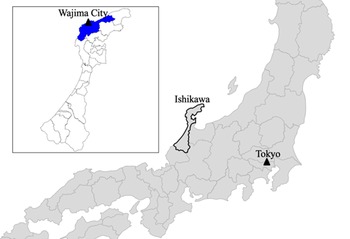
Wajima City, located on the northern tip of the Noto Peninsula in Ishikawa Prefecture, has a population of approximately 24,000 (Figure 1).
Geographic location of Wajima City in Ishikawa Prefecture, Japan.

Following the 2024 Noto Peninsula Earthquake, the number of evacuation shelters in Wajima City reached a maximum of 154, and the number of evacuees peaked at approximately 12,900. Although 24 welfare evacuation centers had been designated in advance in Wajima City, only 4—including this facility—were able to begin operations on January 8.6 This study was conducted at Umyu-dosora, a regional living support center in Wajima City, Japan. The facility functioned as a group home for individuals with disabilities, but served as a welfare evacuation shelter from January 1 to March 31, 2024, in response to the 2024 Noto Peninsula Earthquake.
Data Collection
Data on evacuees’ admission and discharge dates were extracted from a cloud-based Kintone database used to record shelter resident information. Data collection for the purpose of organizing records at the welfare evacuation shelter began on January 10, 2025. Only records with complete admission and discharge dates were included; cases with missing dates were excluded to ensure the reliability and consistency of the temporal data. This retrospective study was conducted after the facility’s closure and used information on evacuees’ sex, age, and the dates of admission and discharge to identify patient flow patterns and residence durations within the shelter.
Data Analysis
Daily resident counts were analyzed as a time series using descriptive statistics and visual inspection to identify temporal trends. Periods of increase and decline were defined as consecutive days showing a consistent rise or fall in resident numbers, respectively, while stabilization was defined as minimal day-to-day variation within a narrow range.
Qualitative data were collected through contemporaneous field notes documented by researchers involved in shelter operations, focusing on practical challenges encountered during daily activities. These records were systematically reviewed to identify recurring themes related to care demand and operational issues. The qualitative findings were used to supplement and contextualize the quantitative trends.
Ethical Statement
This study was determined to be outside the scope of the Ethical Guidelines for Medical and Health Research Involving Human Subjects in Japan. Nevertheless, the study protocol was reviewed and approved by the Ethics Committee of Fukushima Medical University (Approval No. REC2025-199).
Results
Supplementary Material 1 shows the age and sex distribution of the evacuees (N = 83). Among men (N = 24), the most common age group was 70-79 years, comprising 8 individuals (33.3%). Similarly, among women (N = 37), the largest proportion was also aged 70-79 years, comprising 13 individuals (35.1%). Information on either age or sex was unavailable for 22 individuals.
Figure 2 illustrates the change in the number of evacuees at the welfare evacuation shelter from early January to late March 2024. The number of evacuees increased sharply in early January, likely in response to a disaster event, and peaked at approximately 40 individuals by mid to late January. This peak was followed by a relatively stable period lasting several weeks, during which the number remained between 30 and 35. From mid-March 2024, the number of evacuees declined rapidly, suggesting returns to homes or transfers to alternative accommodations. By early April, occupancy had decreased to approximately 15, indicating the gradual closure of the shelter.
The number of evacuees at the welfare evacuation shelter.
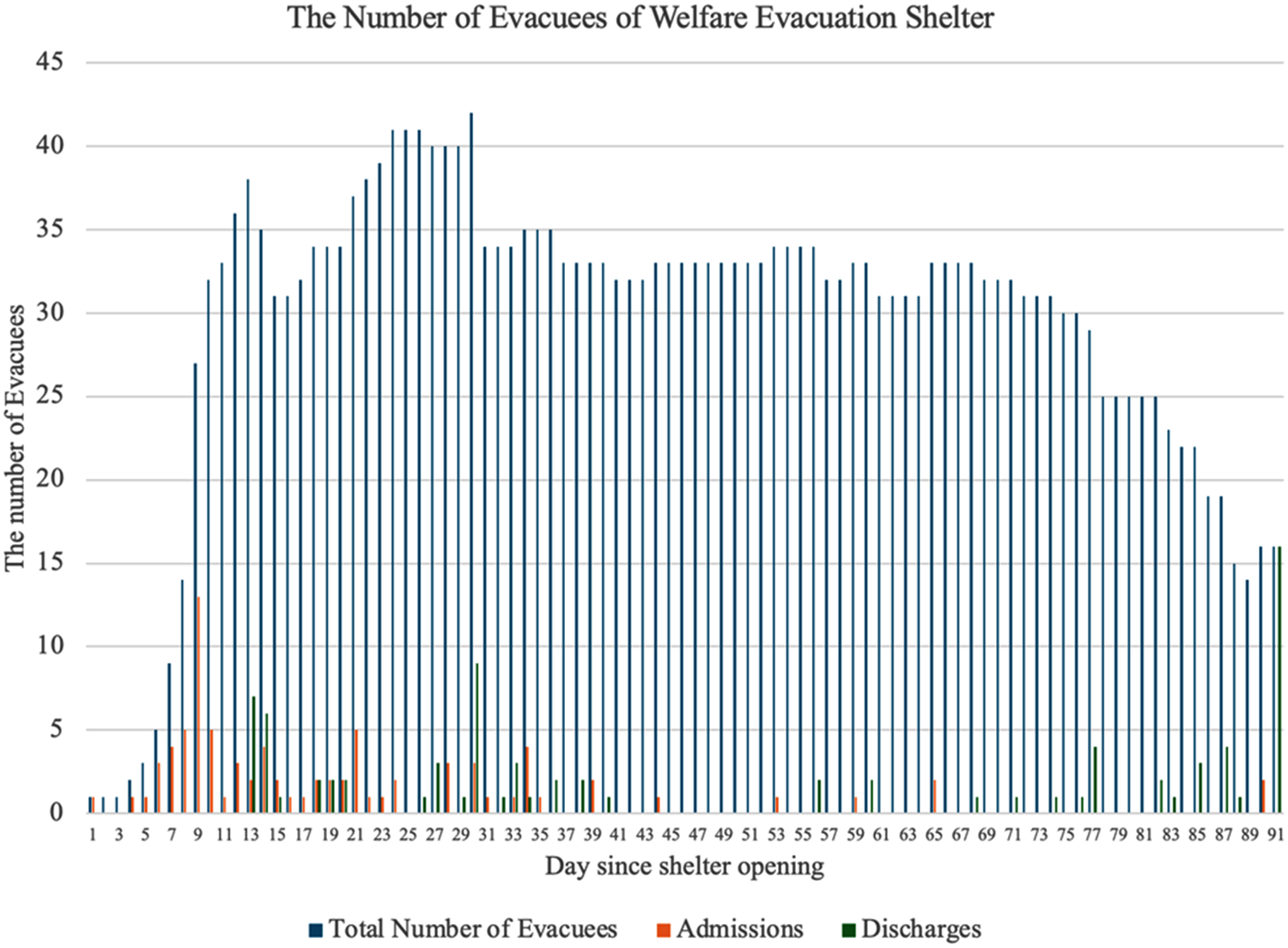
Figure 2. Long description
The bar graph has three data series: total number of evacuees (blue), admissions (red), and discharges (green). The x-axis is labeled ‘Day since shelter opening’ and ranges from 1 to 91. The y-axis is labeled ‘The number of Evacuees’ and ranges from 0 to 45. Blue bars, representing the total number of evacuees, rise sharply in the first 10 days, peaking between days 10 and 30 at around 40 evacuees, then remain steady before gradually declining after day 60. Red bars for admissions are highest in the first 15 days, with the largest spike around day 8, then decrease and become sporadic. Green bars for discharges appear after day 10, with small peaks around days 15, 30, and 90. The legend at the bottom identifies blue as total evacuees, red as admissions, and green as discharges. The overall trend shows an initial surge in admissions, a plateau in total evacuees, and a gradual increase in discharges toward the end.
Discussion
This study showed that evacuees in their 70s constituted the largest proportion of the welfare evacuation shelter users across both men and women. National data in Japan indicate that the proportion of individuals certified as requiring long-term care is 5.5% among those in their early 70s and 12.4% among those in their late 70s, which is substantially lower than the 57% observed among individuals aged 85 and older. Despite typically living independently, individuals in their 70s might be more likely to require assistance during disasters.7 However, demographic information was unavailable for approximately one-third of evacuees (20 of 66), which may limit the generalizability of these findings.
Operation as a welfare evacuation center began on January 8, after which the number of evacuees increased rapidly, exceeding 40 residents by late January. With other welfare shelters remaining non-operational, the facility adopted a policy of accepting all referrals from the city hall and accommodated evacuees up to its maximum capacity. Despite the existence of pre-designated shelters, the limited number of operational facilities resulted in demand exceeding supply during the first month. Consequently, some general evacuation centers accommodated evacuees requiring nursing care, effectively functioning as welfare evacuation shelters. These findings suggest that, for at least 1 month after the disaster, the supply of welfare evacuation services was insufficient to meet demand.
In February, the number of evacuees decreased to approximately 30 and remained relatively stable. From late January, secondary evacuations progressed, involving relocation to other regions, including Katsuyama City in Fukui Prefecture and Takaoka City in Toyama Prefecture.Reference Kosaka, Yamamoto and Ishikawa3 The social population decline (out-migration) of Wajima City was recorded as 200 individuals in January, 230 in February, and 400 in March,8 suggesting that secondary evacuations continued through February and March.
In early March, a decision was made to close the welfare evacuation center, and new admissions were substantially restricted. According to official records, 16 evacuees remained at the end of March. Even after the facility resumed its original function as a group home for individuals with mental illness, it continued to function in part as a welfare evacuation center.
The high demand for welfare evacuation shelters during the first month post-disaster underscores the critical need for facilities addressing health risks from unsanitary conditions, lack of food and medicine,Reference Ochi, Hodgson, Landeg, Mayner and Murray9 and spread of infectious diseases. In the case of the 2024 earthquake, 421 disaster-related hospitalizations were recorded at the nearest university hospital within the first month following the disaster.Reference Uramoto, Shimasaki and Sasaki10
Most evacuees were older adults previously living at home but exhibited care facility–level needs, including complex medical management. The shelter also accommodated patients with dementia, highlighting the challenges of managing mental health symptoms in evacuation settings. Therefore, welfare evacuation shelters with enhanced care capacity are crucial for these vulnerable populations.
Limitations
This study utilized data from a single welfare evacuation shelter. Although up to 10 such shelters were established within Wajima City,6 the findings may not fully reflect the overall needs. In addition, among the 66 individuals included in the analysis, age and sex data were missing for 20 individuals, limiting the accuracy of the demographic distribution. This study was conducted in a small city with a population of approximately 24,000, where specific challenges such as disrupted roads and heavy snowfall were observed. Other regions may experience smoother secondary evacuations.
Conclusions
The high demand for evacuation support for individuals requiring long-term care in the first month after the Noto Peninsula Earthquake underscores the importance of the planned establishment of welfare shelters. Future studies should examine multiple welfare evacuation shelters to capture regional variation in demand and capacity. Future studies should examine multiple welfare evacuation shelters to capture regional variation in demand and capacity.
Supplementary material
To view supplementary material for this article, please visit http://doi.org/10.1017/dmp.2026.10377.
Data availability statement
The data that support the findings of this study are available from the corresponding author (M.K.) upon reasonable request. The data are not publicly available because they contain information that could compromise the privacy of research participants.
Acknowledgment
We would like to thank Editage (www.editage.jp) for English language editing.
Author contribution
MK and AO conceived and designed the study. MK collected the data. MK and AO drafted the manuscript. KI, EK, HB, CY, MY, RI, YN, TA, TZ, ME, TS, NM, and MT critically revised the manuscript for important intellectual content. All authors approved the final version of the manuscript.
Competing interests
Akihiko Ozaki declares personal fees from MNES Inc. It is outside the submitted work. Akihiko Ozaki declares personal fees from Kyowa Kirin Inc. It is outside the submitted work. Akihiko Ozaki declares personal fees from Taiho Pharmaceutical. It is outside the submitted work. The remaining authors declared no interest.
Sources of support
This work was supported by the Japan Science and Technology Agency (JST) under the Program on Open Innovation Platform for Industry-Academia Co-creation (COI-NEXT) (Grant Number JU2025902).


 Open access

