


1. Introduction
On October 3, 2015, in the German town of Altena, a firefighter set fire to a building housing several Syrian refugees. The firefighter later admitted that he wanted to scare away refugees from his town, because he assumed they were dangerous criminals (Welle, Reference Welle2016). Unfortunately, that attack was not an isolated incident. Anti-refugee hate crimes increased across Germany (and Western Europe more broadly) during the 2010s (Dancygier, Reference Dancygier2023), spreading fear and alienation among refugees (Graeber and Schikora, Reference Graeber and Schikora2021; Jaschke et al., Reference Jaschke, Sardoschau and Tabellini2021).
However, political violence can affect people even if they are not in the targeted group. Political violence can increase public hostility against the targets, when they are viewed as deserving their fate. Political violence can also cause public opinion to sway in favor of the targets, when the violence is seen as unjustified. How anti-refugee violence affects public opinion is especially relevant in Europe, where there are active debates about whether societies should be open or restrictive to asylum seekers (Bansak et al., Reference Bansak, Hainmueller and Hangartner2023). Unfortunately, existing research does not provide much evidence on how exposure to anti-refugee hate crimes shapes public support for refugees.
In this research note, we analyze how exposure to anti-refugee hate crimes in the local community (municipality) affects support for refugees, among non-refugee residents in Germany. This local focus is important because anti-refugee hate crimes rarely become national news and resonate deeply in the local community (Riaz et al., Reference Riaz, Bischof and WagnerForthcoming).
Our results suggest that living in a municipality where anti-refugee hate crimes occur has no direct effect on general attitudes about refugees or on willingness to help refugees. We do find that living in a municipality where anti-refugee hate crimes occur can increase anxieties about crime, although it is unclear how those anxieties relate to support for refugees.
Our results have several implications. First, increased violence against refugees is unlikely to be counterbalanced by increased mobilization to support refugees. At a minimum, this is troubling news for refugees, and suggests the balance of power might swing toward the anti-refugee side. However, hate crimes are not the only anti-refugee actions that can mobilize a backlash. Other research suggests electoral success among xenophobic far right parties increases social welfare mobilization—by the opponents of the Far Right—to aid migrants (Pulejo, Reference Pulejo2023). Our findings open new questions about the precise conditions that generate support for attacked target groups.
Second, our results appear to contradict recent research which suggests anti-refugee hate crimes mobilize people who are already hostile toward immigrants to become even more anti-immigrant (Igarashi, Reference Igarashi2021) and more supportive of anti-immigrant political parties (Eger and Olzak, Reference Eger and Olzak2023; Krause and Matsunaga, Reference Krause and Matsunaga2023). This “contradiction” may be because previous research analyzes larger aggregations (states and the nation) where specific hate crimes become big political stories. The mobilizing effects they observe may be related to those broader dynamics. In contrast, our results suggest local exposure to hate crimes does not have those effects. Our research thereby contributes to a broader understanding of anti-refugee hate crimes, by suggesting their political power in mainstream society may come more from the broader media and political conversation that they spark, as opposed to the immediate effect of the violent act.
Finally, our results suggest that attitudes about refugees may be deeply held and invulnerable to short-term swings. In that sense, our results are consistent with a growing body of research which suggests that attitudes about migrants are part of broader worldviews that are formed early in life and stable throughout the life course (Kustov et al., Reference Kustov, Laaker and Reller2021; Lancaster, Reference Lancaster2022).
2. Hypotheses
Existing research identifies two predictions for how exposure to political violence might affect support for the victims. The first is that the public may become more supportive of the victims. This is more likely when the public views the political violence as unjustified (Liebe and Schwitter, Reference Liebe and Schwitter2021). Under those circumstances, people react with moral outrage that blames the perpetrator (O'Reilly et al., Reference O'Reilly, Aquino and Skarlicki2016; Hershcovis and Bhatnagar, Reference Hershcovis and Bhatnagar2017). Moreover, moral outrage can spark an increase in prosocial responses toward the victim, as a way of counteracting the injustice (Priesemuth and Schminke, Reference Priesemuth and Schminke2019). Given the vulnerability of refugees in Germany and the association of hate crimes with extremist far-right groups, this logic predicts that anti-refugee hate crimes boost support for refugees in Germany.
H1: Exposure to anti-refugee hate crimes will increase support for refugees in Germany.
The second scenario is that the public becomes less supportive of the victims. This may operate through multiple channels. One possibility is that perpetrators of the violence convince the broader public that their cause is justified (Enos et al., Reference Enos, Kaufman and Sands2019). However, we do not expect this dynamic with anti-refugee hate crimes in Germany. Although there is some evidence that anti-refugee hate crime supporters are found across a wide range of demographic groups in Germany (Dancygier, Reference Dancygier2023), the number of perpetrators is fairly small and associated with extremism (Riaz et al., Reference Riaz, Bischof and WagnerForthcoming). As a result, anti-refugee hate crimes seem unlikely to convince the masses that refugees are the problem.
Instead, another channel for reduced support operates through increased anxiety. Research suggests exposure to violence leads to increased anxiety and other negative psychological outcomes. This is true whether people are directly exposed through an in-person event, or even through second-hand news of something that occurred in their community (Hopwood and Schutte, Reference Hopwood and Schutte2017; Thompson et al., Reference Thompson, Jones, Holman and Silver2019). Increased fear and anxiety makes people believe their environment is less safe, which often leads people to become more reclusive and more anti-social, even toward the victims of the crimes (Sampson et al., Reference Sampson, Raudenbush and Earls1997). In this case, that would mean less support for refugees in Germany.
H2: Exposure to anti-refugee hate crimes will decrease support for refugees in Germany.
3. Research design
Identifying the effect of hate crime exposure on attitudes is difficult for three main reasons. First, hate crimes are not distributed randomly. Local demography, crime, media, and political factors all shape the risk of anti-refugee violence, as well as support for refugees (Jäckle and König, Reference Jäckle and König2017; Marbach and Ropers, Reference Marbach and Ropers2018; Dancygier et al., Reference Dancygier, Egami, Jamal and Rischke2022). As a result, any difference in support for refugees between places with and without anti-refugee hate crimes could be explained by several factors other than exposure.
To deal with this challenge, we use a regression discontinuity design. We link individual-level survey data to geo-referenced data on the municipalities where hate crimes occur. Our design is structured around the hate crime that occurred closest in time to a respondent's date of interview, with some interviewed before and others after. We model native attitudes toward refugees as a function of days elapsed since or until the occurrence of a local hate crime, under the assumption that the date of an interview relative to the occurrence of a hate crime is as good as random. Our estimand is therefore the local average treatment effect (LATE) of a hate crime in a respondent's municipality.Footnote 1 We borrow this design from Graeber and Schikora (Reference Graeber and Schikora2021), who estimated the effect of anti-refugee hate crimes on refugee integration outcomes.
The second challenge is that anti-refugee hate crimes cluster in time (Jäckle and König, Reference Jäckle and König2017; Frey, Reference Frey2020; Liebe and Schwitter, Reference Liebe and Schwitter2021) and effects may vary with levels of exposure. To address this concern, we follow Graeber and Schikora (Reference Graeber and Schikora2021) and exclude respondents living in municipalities that experienced a hate crime in the thirty days prior to the hate crime that designates treatment status.
Finally, we must determine what geographic context is most appropriate. Earlier studies tested the effect of hate crime exposure at the level of the German federal states (Bundeslander) (Igarashi, Reference Igarashi2021; Eger and Olzak, Reference Eger and Olzak2023). Instead, we measure exposure at the municipal level, which is the finest-grained level that our data will allow. The advantage of a finer-grained analysis is that people are more likely to be aware of hate crimes that occur in their local community as opposed to elsewhere in the country. We acknowledge that some forms of political violence become national news stories, with the potential to affect people well beyond the local community (Frey, Reference Frey2020; Helbling and Meierrieks, Reference Helbling and Meierrieks2022). However, anti-refugee hate crimes are not systematically covered nationally, so we cannot assume widespread knowledge.
4. Data
We use three main data sources. First, we use a geo-referenced event database that includes anti-refugee violence and social unrest in Germany (Benček and Strasheim, Reference Benček and Strasheim2016). The database (henceforth, ARVIG) was updated last in 2018, and includes almost 7000 events between 2014 and 2017.Footnote 2
ARVIG contains several event types, including xenophobic demonstrations, arson, assaults, attacks against refugee housing, as well as a small number of other incident types. Given how different these event types are, we analyze effects of arson, assaults, and attacks on refugee housing separately. As others have done before us (Jäckle and König, Reference Jäckle and König2017; Riaz et al., Reference Riaz, Bischof and WagnerForthcoming), we exclude xenophobic demonstrations from consideration. Demonstrations do not fit neatly into the category of hate crime, as they can be interpreted as legitimate forms of political participation in a democracy. Demonstrations may also be announced before they occur, which means they are incompatible with a regression discontinuity design focused on the date of the event.
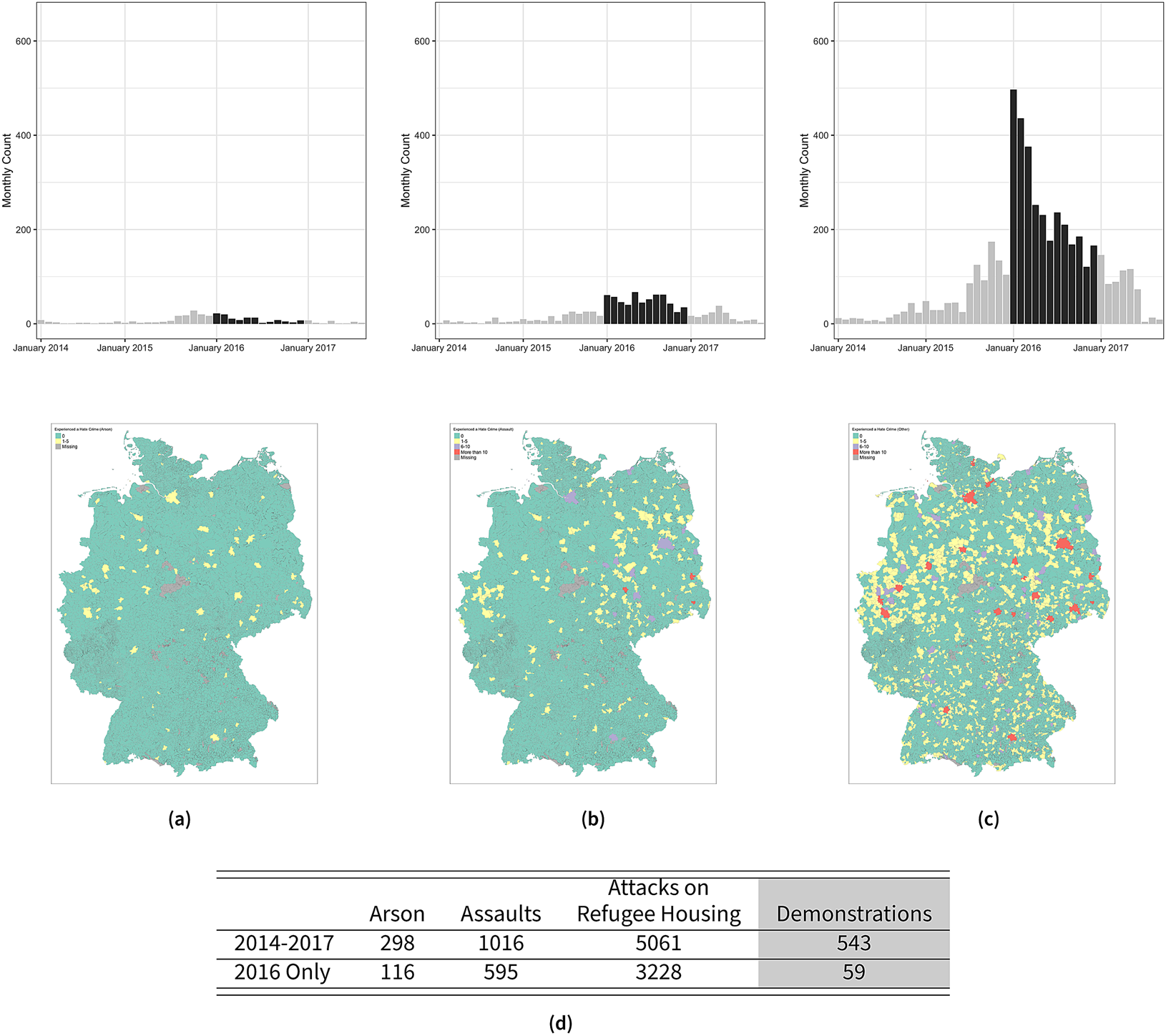
Figure 1 presents a descriptive summary of anti-refugee hate crimes. The time series plots show sharp increases in assaults and attacks on refugee housing in 2016. Moreover, the maps depict significant variation across German municipalities. Although more than 80 percent of municipalities did not experience any incidents between 2014 and 2017, other municipalities experienced multiple incidents.
Number of anti-refugee hate crimes in Germany (2014–2017): (a) arson incidents, (b) assaults, (c) attacks on refugee housing, (d) anti-refugee hate crimes: incident types.
Data Source: ARVIG (Benček and Strasheim, Reference Benček and Strasheim2016). Demonstrations excluded from all subsequent analyses. Survey data are limited to the 2016 wave of the SOEP (details below), however certain 2016 respondents are linked to local hate crimes that occurred before/after that calendar year.
Our second data source is the German Federal Statistical Office. Here we get contextual data to account for the various ways in which municipalities vary, other than hate crime incidents.
Finally, we use individual-level data from the German Socio-Economic Panel (SOEP). The SOEP is an annual panel of roughly 15,000 households, designed to be representative of the German resident population aged 16 and older. Our analysis is limited to the 2016 wave, the only in year in which items about support for refugees overlap with ARVIG.Footnote 3 Given our interest in the effects of anti-refugee hate crimes on individuals outside the target group, we exclude respondents sampled as part of the SOEP Survey of Refugees. Our final sample contains 16,736 respondents who live in a municipality that experienced a hate crime event.Footnote 4 Respondents living in municipalities that did not experience a hate crime are de facto excluded because they are not a viable counterfactual for the treated group.
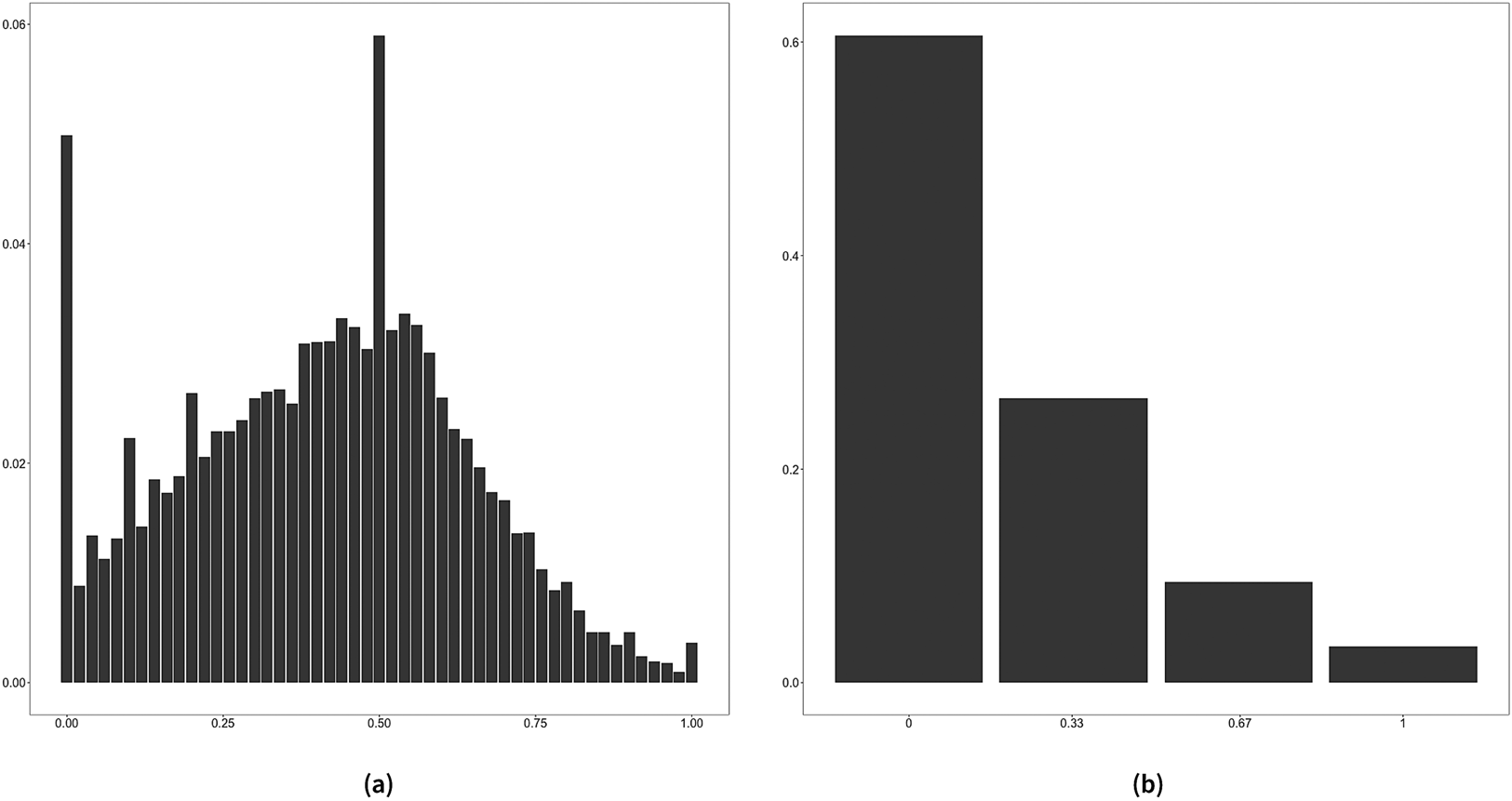
We analyze two outcome measures: general attitudes about refugees and plans to help refugees. General attitudes about refugees is an additive index of five survey items.Footnote 5 Plans to help refugees is an additive index we construct from three survey items.Footnote 6 Full details on the index items are in the Appendix. Histograms for the indices are in Figure 2. Both indices range from 0 to 1, with larger values denoting higher levels of support for refugees.
Distribution of outcome variables: (a) attitudes toward refugees and (b) plans to help refugees.
Data source: SOEP v37. Values closer to one reflect (a) more positive assessments of how refugees will affect Germany, and (b) more plans to help refugees.
We also use the SOEP to measure individual-level variables for testing key assumptions and exploring effect heterogeneity. These additional measures are described in Appendix 1.
5. Validating the research design
Regression discontinuity designs require several identifying assumptions. We review these in detail in Appendix 2, and for the most part our design satisfies the necessary assumptions. There is minor evidence of imbalance at the threshold for the attacks on refugee housing treatment.
6. Analysis
6.1. Estimation strategy
Our main analysis uses a regression discontinuity (RD) design. We estimate a non-parametric, local linear regression that uses only observations within a mean squared error (MSE) optimal bandwidth around the cutoff and is estimated using a triangular kernel (Skovron and Titiunik, Reference Skovron and Titiunikn.d.; Imbens and Kalyanaraman, Reference Imbens and Kalyanaraman2012; Calonico et al., Reference Calonico, Cattaneo, Farrell and Titiunik2017; Cattaneo et al., Reference Cattaneo, Idrobo and Titiunik2019; Gelman and Imbens, Reference Gelman and Imbens2019). Given ex ante uncertainty about temporal dynamics in hate crime effects on native attitudes, we allow bandwidths to vary in size on either side of the cutoff. Our analysis excludes individuals interviewed on the day a hate crime occurred as well individuals for whom the hate crime designating treatment status occurred within 30 days of an earlier hate crime in the same municipality. Standard errors are clustered at the state level.
Figure A4 flexibly depicts the relationship between our outcomes and the running variables, to visualize the functional form of the regression and the variability of our data (Cattaneo et al., Reference Cattaneo, Idrobo and Titiunik2019). These plots are initial evidence that support for refugees is static in the aftermath of hate crime exposure.
6.2. Main results
Our main results are in columns 1 and 2 of Table 1.Footnote 7 For the most part, these results suggest exposure to anti-refugee hate crimes has no effect on support for refugees. For some estimates the direction is negative, for other estimates the direction is positive, but for most estimates the results are not statistically significant at the 90 percent level.
LATE of municipal hate crime exposure
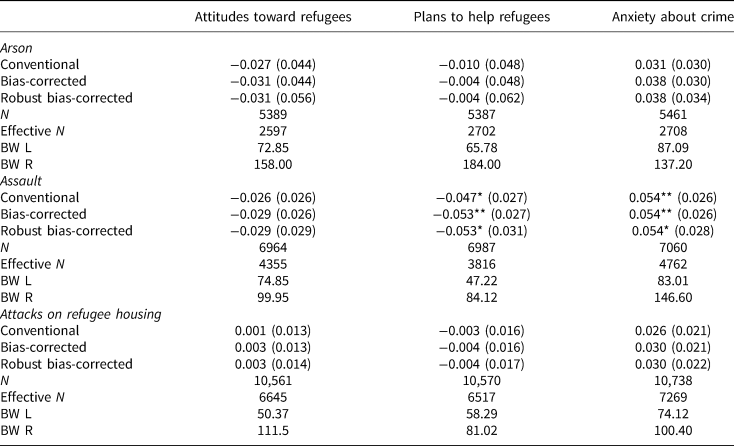
**p < 0.05, *p < 0.1.
The one exception is the effect of living in a municipality with a recent assault on refugees, which is associated with being less likely to help refugees (statistically significant at either the 95 or 90 percent level, depending on specification). This is consistent with H 2, but it is not robust to a series of additional tests, which we present in full detail in Appendix 3.3. Most notably, given evidence of minor imbalances in certain individual-level characteristics at the threshold, we estimate models that control for individual-level characteristics. The results from these models are in Table A6, which indicate that the negative and significant effect of exposure to assaults on plans to help refugees attenuates to zero and is no longer statistically significant. We take this attenuation to mean that the effects in Table 1 on plans to help refugees are biased downward. As a result, we do not have reliable evidence to support H 2.
We also test for heterogeneous treatment effects across different individual- and municipal-level characteristics. We find no evidence that exposure to hate crimes either increases or decreases support for refugees among specific subsets of our sample. Full results are reported in Appendix 3.4.
6.3. Awareness of events, worries about crime, and media coverage
One interpretation of our results is that Germans are not motivated to change their support for refugees when they are exposed to local hate crimes. Another possibility is that hate crimes do not affect Germans through local channels, either because people are unaware of hate crimes in their community, or because people are aware of hate crimes all across the country. We do not have data that directly measures knowledge of specific events. Instead, we indirectly test whether people are likely to be aware of local hate crimes, in two ways.
First, we test for exposure to local hate crimes by exploring anxieties about crime. We construct an additive index of anxiety about crime.Footnote 8 Next, we estimate the effect of local exposure to anti-refugee hate crime on anxiety about crime, and present results in column 3 of Table 1. Results are positive for all three types of hate crimes, and statistically significant (at p < 0.05 or p < 0.10) for assaults, which causes a sizeable 0.05 point (0.22 standard deviation) increase in anxieties about crime. Various robustness tests in Appendix 3.3 show that this finding is consistent. These findings suggest Germans are sensitive to hate crimes in their local municipality.
Next, we explore German-language newspaper coverage of hate crime events using a subset of cases in ARVIG.Footnote 9 We look for two key pieces of evidence. First, we ask whether stories about hate crimes are primarily covered in the local community where they occur. An affirmative finding would suggest that people are likely to be treated by the hate crimes in their local community and not by hate crimes in other communities. Here, our results suggest that hate crimes are indeed primarily covered in local and regional newspapers as opposed to national newspapers. Events are between 1.44× (arson) and 2.21× (attacks on housing) more likely to be covered in a local/regional newspaper than in a national newspaper. Moreover, these local/regional newspapers are predominantly local or regional to the municipality where the hate crime occurred. To the extent people receive information about hate crimes from newspapers, this suggests that people are more likely to be aware of local hate crimes, limiting concerns about informational spillover.
We also explore the rate of newspaper coverage for anti-refugee hate crimes. The results vary by event type: arson events (60.4 percent) receive significantly higher coverage than assaults (21.6 percent) and attacks on refugee housing (14.4 percent). This suggests uneven awareness of hate crimes, although these figures are likely lower-bounds for awareness, as our repository does not contain all regional and local German newspapers. Moreover, an individual may learn of a hate crime through various means besides newspaper coverage. Nonetheless, the fact that local exposure increases anxieties about crime, and the fact that the crimes are primarily covered in local papers, suggests that Germans are likely to be aware of local hate crimes.
6.4. Indirect effects?
The logic of H 2 is that exposure to political violence increases anxiety, which reduces support for the targets because people fear for their personal safety if they get involved. Therefore, it is possible that although we do not observe direct effects of hate crimes on refugee support, there are indirect effects that operate through anxieties about crime. The ideal test of this pathway would be a mediation analysis, but our data do not support that approach. Nonetheless, we can get leverage on potential indirect effects.
If we disaggregate the index for plans to help refugees, Figure A15 suggests that exposure to anti-refugee assaults has no effect on donating money or going to demonstrations but does reduce plans to work with refugees directly. This is consistent with the logic of indirect effects. Effects are limited to the type of refugee help that would most expose respondents to potential violence. In addition, Figure A16, which disaggregates our anxiety about crime index, shows that exposure to assault is positively associated with worries about social order and crime in Germany, but not with worries about hostility toward foreigners. This is again consistent with the logic of indirect effects: worries about social order and crime could make the non-refugee respondents fear for their personal safety.
Next, we conduct an exploratory test of whether increased generalized anxiety about crime reduces support for refugees. Full results, in Table A10, present a mixed picture. Greater anxiety about crime is associated with plans to give more help to refugees, as well as with more negative attitudes toward refugees. These results are speculative, so we do not want to over-interpret the dynamics. Yet, at a minimum, they do not provide robust evidence for the notion that hate crimes reduce support for refugees through the channel of increased anxiety. These findings are also consistent with previous research in suggesting that attitudes toward refugees and behavior toward refugees do not necessarily move together (Adida et al., Reference Adida, Lo and Platas2018; Lo and Lang, Reference Lo and Lang2023).
7. Discussion
This research note has explored the effect of anti-refugee hate crimes on support for refugees. We find no evidence of a direct effect between local exposure to hate crimes and support for refugees. Instead, we find evidence that local exposure to hate crimes increases anxiety about crime and disorder.
Our findings advance discussions about refugee integration in Europe, because they suggest attitudes about refugees may be strongly held and resistant to change. This is consistent with a growing body of literature on the stability of migration attitudes, and suggests that debates about refugees and migration could become entrenched, with little movement or persuasion from one side to the other. Instead, the way forward may be through compromises among people with moderate preferences (Helbling et al., Reference Helbling, Maxwell and Traunmüller2024).
Our findings also open avenues for future research. One possible interpretation of our results is that people are unaware of local hate crimes. This is unlikely, given the effects we observe for local hate crimes on anxiety. Nevertheless, media coverage of hate crime events is far from ubiquitous, with certain events less likely to be covered than others. The media's failure to consistently cover hate crime events may lead the public to underestimate overall rates of violence against refugees. Underestimating the baseline rate of incidence may in turn lead natives to discount the importance of an event in their region, thereby limiting the attitudinal and behavioral effects.
It is also possible that hate crimes affect public opinion through the broader national political narrative. That is a different research question, as it involves complicated interactions between media dynamics and political entrepreneurs. In summary, future research should explore in more detail how people learn about hate crimes, and the various information biases that those pathways may facilitate.
Another research question that merits attention is whether anti-refugee hate crimes shape anxieties about crime via egocentric or sociotropic mechanisms. Are natives worried about their own well-being, or about the well-being of refugees? Our results paint an ambiguous picture, but future research should address this more directly.
Finally, our null result may be specific to Germany. Future research should analyze reactions to hate crimes in other countries or with other target groups. Alternatively, future studies could consider contexts with lower baseline rates of anti-refugee violence, where any given hate crime might have a more powerful effect.
Supplementary material
The supplementary material for this article can be found at https://doi.org/10.1017/psrm.2024.43. To obtain replication material for this article, https://doi.org/10.7910/DVN/0SOJBA
Competing interests
None.


 Open access

