












1 Introduction
The binary sequence $r=(1,1,0,1,0^3,1,0^7,1,0^{15},1,\ldots )$
has been studied by a number of authors. In [Reference Rueppel11], Rueppel conjectured that r has a perfect linear complexity profile (PLCP), that is, for any
$r=(1,1,0,1,0^3,1,0^7,1,0^{15},1,\ldots )$
has been studied by a number of authors. In [Reference Rueppel11], Rueppel conjectured that r has a perfect linear complexity profile (PLCP), that is, for any $n\geq 1$
, the linear complexity of the first n terms is
$n\geq 1$
, the linear complexity of the first n terms is $\lfloor (n+1)/2\rfloor $
. According to Dai [Reference Dai1, page 441], this was verified by Massey for
$\lfloor (n+1)/2\rfloor $
. According to Dai [Reference Dai1, page 441], this was verified by Massey for $n=2^k-1$
and
$n=2^k-1$
and $n=2^k$
using his linear-feedback shift register (LFSR) algorithm [Reference Massey5]. The PLCP of this sequence was first proved in [Reference Dai1] by applying the Euclidean algorithm (EA) to shift-register synthesis; the essential proposition [Reference Dai1, Proposition 2] is proved in [Reference Dai and Wan2, Lemma 5]. The proof in [Reference Dai1] also uses an unmotivated element
$n=2^k$
using his linear-feedback shift register (LFSR) algorithm [Reference Massey5]. The PLCP of this sequence was first proved in [Reference Dai1] by applying the Euclidean algorithm (EA) to shift-register synthesis; the essential proposition [Reference Dai1, Proposition 2] is proved in [Reference Dai and Wan2, Lemma 5]. The proof in [Reference Dai1] also uses an unmotivated element $\rho $
in a quadratic extension of the rational function field
$\rho $
in a quadratic extension of the rational function field $\mathrm {GF}(2)(x)$
.
$\mathrm {GF}(2)(x)$
.
The continued fraction algorithm for the power series of r in $\mathrm {GF}(2)[[x^{-1}]]$
was used in [Reference Niederreiter, Chaum and Price6, Corollary 2], a quadratic algorithm requiring polynomial division. We note that the methods of [Reference Lidl and Niederreiter4, page 439] and [Reference Fitzpatrick3, Example 4.8] do not apply since the first
$\mathrm {GF}(2)[[x^{-1}]]$
was used in [Reference Niederreiter, Chaum and Price6, Corollary 2], a quadratic algorithm requiring polynomial division. We note that the methods of [Reference Lidl and Niederreiter4, page 439] and [Reference Fitzpatrick3, Example 4.8] do not apply since the first $2b$
terms of the sequence are required, where b is an upper bound for the linear complexity (LC) of the sequence of length
$2b$
terms of the sequence are required, where b is an upper bound for the linear complexity (LC) of the sequence of length $2b$
(compare [Reference Fitzpatrick3, Example 4.8] and [Reference Norton10, Example 3.7]). A derivation via the LFSR algorithm for
$2b$
(compare [Reference Fitzpatrick3, Example 4.8] and [Reference Norton10, Example 3.7]). A derivation via the LFSR algorithm for $n=2^k$
appeared in [Reference Rueppel12, pages 46–47]. However, the derivation in [Reference Rueppel12] assumes that the ‘discrepancy’
$n=2^k$
appeared in [Reference Rueppel12, pages 46–47]. However, the derivation in [Reference Rueppel12] assumes that the ‘discrepancy’ $\Delta _n=1$
if and only if n is odd. As far as we know, the PLCP of r has not been established using the LFSR algorithm.
$\Delta _n=1$
if and only if n is odd. As far as we know, the PLCP of r has not been established using the LFSR algorithm.
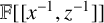
Let $\mathbb {F}$
be any field. Recall that the
$\mathbb {F}$
be any field. Recall that the $\mathbb {F}[x,z]$
module
$\mathbb {F}[x,z]$
module $\mathbb {F}[[x^{-1},z^{-1}]]$
of ‘inverse series’ in variables
$\mathbb {F}[[x^{-1},z^{-1}]]$
of ‘inverse series’ in variables $x^{-1},z^{-1}$
is known as Macaulay’s inverse system (in two variables, z will be our homogenising variable). Now,
$x^{-1},z^{-1}$
is known as Macaulay’s inverse system (in two variables, z will be our homogenising variable). Now, $\mathbb {F}[x^{-1},z^{-1}]$
is an
$\mathbb {F}[x^{-1},z^{-1}]$
is an $\mathbb {F}[x,z]$
submodule of
$\mathbb {F}[x,z]$
submodule of $\mathbb {F}[[x^{-1},z^{-1}]]$
. This elementary algebraic structure underlies our approach. The sequence
$\mathbb {F}[[x^{-1},z^{-1}]]$
. This elementary algebraic structure underlies our approach. The sequence $(s_0,\ldots ,s_{n-1})$
has a ‘generating form’
$(s_0,\ldots ,s_{n-1})$
has a ‘generating form’ $s_{n-1}x^{1-n}+\cdots +s_0z^{1-n}$
and hence a (homogeneous) annihilator ideal. In [Reference Norton8], we gave an inductive construction for the generators of such an ideal, yielding an
$s_{n-1}x^{1-n}+\cdots +s_0z^{1-n}$
and hence a (homogeneous) annihilator ideal. In [Reference Norton8], we gave an inductive construction for the generators of such an ideal, yielding an $\mathcal {O}(n^2)$
algorithm which is easier to understand, analyse and remember than the LFSR algorithm.
$\mathcal {O}(n^2)$
algorithm which is easier to understand, analyse and remember than the LFSR algorithm.
Here, we specialise to $\mathbb {F}=\mathrm {GF}(2)$
and r, with
$\mathbb {F}=\mathrm {GF}(2)$
and r, with $(r_{0},\ldots ,r_{9})$
and its inverse form as a running example (see Examples 4.2, 4.3). Our main results are Theorem 4.4 and linear Algorithm 4.7. We conclude by relating Theorem 4.4 to [Reference Dai1] and LFSRs.
$(r_{0},\ldots ,r_{9})$
and its inverse form as a running example (see Examples 4.2, 4.3). Our main results are Theorem 4.4 and linear Algorithm 4.7. We conclude by relating Theorem 4.4 to [Reference Dai1] and LFSRs.
Our approach is simpler and more efficient than the previous $\mathcal {O}(n^2)$
methods in the literature and: (i) it is inductive, adapting to the next term of the sequence, so we do not need all of
$\mathcal {O}(n^2)$
methods in the literature and: (i) it is inductive, adapting to the next term of the sequence, so we do not need all of $(r_0,\ldots ,r_{n-1})$
as in [Reference Dai1]; (ii) it does not use multiplication in
$(r_0,\ldots ,r_{n-1})$
as in [Reference Dai1]; (ii) it does not use multiplication in $\mathbb {F}[x,y]$
; (iii) we do not use the roots
$\mathbb {F}[x,y]$
; (iii) we do not use the roots $\rho ,\rho ^{-1}$
of
$\rho ,\rho ^{-1}$
of $Y^2+xY+1$
in an extension of
$Y^2+xY+1$
in an extension of $\mathrm {GF}(2)(x)$
as in [Reference Dai1]. In fact,
$\mathrm {GF}(2)(x)$
as in [Reference Dai1]. In fact, $\rho $
arises naturally in the solution of a polynomial recurrence (Theorem 4.9); (iv) we do not assume an upper bound b on LC and
$\rho $
arises naturally in the solution of a polynomial recurrence (Theorem 4.9); (iv) we do not assume an upper bound b on LC and $2b$
terms of the sequence as in [Reference Fitzpatrick3, Reference Lidl and Niederreiter4]; (v) unlike [Reference Niederreiter, Chaum and Price6], we use no polynomial multiplications or divisions, but work with forms in
$2b$
terms of the sequence as in [Reference Fitzpatrick3, Reference Lidl and Niederreiter4]; (v) unlike [Reference Niederreiter, Chaum and Price6], we use no polynomial multiplications or divisions, but work with forms in $\mathbb {F}[x^{-1},z^{-1}]$
, so there are no convergence or irrationality considerations and we work with denominators only.
$\mathbb {F}[x^{-1},z^{-1}]$
, so there are no convergence or irrationality considerations and we work with denominators only.
2 Preliminaries
We let $\mathbb {F}$
be an arbitrary field. For
$\mathbb {F}$
be an arbitrary field. For $f\in \mathbb {F}[x]^\times $
, we write
$f\in \mathbb {F}[x]^\times $
, we write $f^\ast $
for the reciprocal of f. We put
$f^\ast $
for the reciprocal of f. We put $\mathrm {R}=\mathbb {F}[x,z]$
; multiplication in
$\mathrm {R}=\mathbb {F}[x,z]$
; multiplication in $\mathrm {R}$
is written as juxtaposition. For
$\mathrm {R}$
is written as juxtaposition. For $\varphi ,\varphi '\in \mathrm {R}$
and
$\varphi ,\varphi '\in \mathrm {R}$
and $k\in \mathbb {N}^\times $
,
$k\in \mathbb {N}^\times $
, $x^k\,\varphi +\varphi '$
means
$x^k\,\varphi +\varphi '$
means $x^k\varphi (x,z)+\varphi '(x,z)$
and similarly for
$x^k\varphi (x,z)+\varphi '(x,z)$
and similarly for $\varphi +\,z^k\varphi '$
. The total degree of
$\varphi +\,z^k\varphi '$
. The total degree of $\varphi \in \mathrm {R}^\times $
is
$\varphi \in \mathrm {R}^\times $
is $|\varphi |$
, with
$|\varphi |$
, with $|x|=|z|=1$
. The ideal of
$|x|=|z|=1$
. The ideal of $\mathrm {R}$
generated by
$\mathrm {R}$
generated by $\varphi ,\psi \in \mathrm {R}$
is written
$\varphi ,\psi \in \mathrm {R}$
is written $\langle \varphi ,\psi \rangle $
.
$\langle \varphi ,\psi \rangle $
.
We write $\succ $
for the graded-lexicographic order (grlex) on monomials of
$\succ $
for the graded-lexicographic order (grlex) on monomials of $\mathrm {R}^\times $
, with
$\mathrm {R}^\times $
, with $|x|=|z|=1$
and
$|x|=|z|=1$
and $x\succ z\succ 1$
. The leading term of a form
$x\succ z\succ 1$
. The leading term of a form $\varphi \in \mathrm {R}$
is written
$\varphi \in \mathrm {R}$
is written $\mathrm {LT}(\varphi )$
. We define
$\mathrm {LT}(\varphi )$
. We define $\mathcal {L}$
to be the set of ‘leading forms’:
$\mathcal {L}$
to be the set of ‘leading forms’:
 $$ \begin{align*}\mathcal{L}=\{\varphi\in \mathrm{R}^\times: \varphi \ \mathrm{is\ a\ form\ and} \ z\nmid\mathrm{LT}(\varphi)\}.\end{align*} $$
We also use $|\ |$
for the degree function on
$|\ |$
for the degree function on $\mathbb {F}[x]$
, with
$\mathbb {F}[x]$
, with $|0|=-\infty $
. Recall that the homogenisation of
$|0|=-\infty $
. Recall that the homogenisation of $c\in \mathbb {F}[x]^\times $
is the form
$c\in \mathbb {F}[x]^\times $
is the form $c^\wedge \in \mathrm {R}$
given by
$c^\wedge \in \mathrm {R}$
given by $c(x,z)=z^{|c|}c(x/z)$
and the dehomogenisation of
$c(x,z)=z^{|c|}c(x/z)$
and the dehomogenisation of $f\in \mathrm {R}[x,z]^\times \cap \mathcal {L}$
is
$f\in \mathrm {R}[x,z]^\times \cap \mathcal {L}$
is $f^\vee (x)=f(x,1)\in \mathbb {F}[x]$
.
$f^\vee (x)=f(x,1)\in \mathbb {F}[x]$
.
Throughout the paper, $F\in \mathrm {M}^\times =\mathbb{F}[x^{-1},z^{-1}]^\times $
denotes a typical nonzero inverse form of total degree
$F\in \mathrm {M}^\times =\mathbb{F}[x^{-1},z^{-1}]^\times $
denotes a typical nonzero inverse form of total degree $m=|F|\leq 0$
. We also order the monomials of
$m=|F|\leq 0$
. We also order the monomials of $\mathrm {M}^\times $
using grlex, now written
$\mathrm {M}^\times $
using grlex, now written $\prec $
, but with
$\prec $
, but with $|x^{-1}|=|z^{-1}|=-1$
and
$|x^{-1}|=|z^{-1}|=-1$
and $x^{-1}\prec z^{-1}\prec 1$
.
$x^{-1}\prec z^{-1}\prec 1$
.
If F is also a form, that is, an inverse form, we write $F=\sum _{j=m}^0F_{j,m-j}x^jz^{m-j}$
; when m is understood, we write
$F=\sum _{j=m}^0F_{j,m-j}x^jz^{m-j}$
; when m is understood, we write $F_j$
for
$F_j$
for $F_{j,m-j}$
. We will use a restriction of the exponential valuation
$F_{j,m-j}$
. We will use a restriction of the exponential valuation $\mathrm {v}$
for inverse forms: the order of F is
$\mathrm {v}$
for inverse forms: the order of F is
 $$ \begin{align*}\mathrm{v}=\mathrm{v}(F)=\max\{j: |F|\leq j\leq 0, F_j\neq0\}. \end{align*} $$
The augmentation of F by $a\in \mathbb {F}$
is
$a\in \mathbb {F}$
is $ax^{m-1}+Fz^{-1}$
, an inverse form of total degree
$ax^{m-1}+Fz^{-1}$
, an inverse form of total degree $m-1$
. For example, the augmentation of
$m-1$
. For example, the augmentation of $z^m$
by a is
$z^m$
by a is $ax^{m-1}+z^{m-1}$
. A form F defines (nonzero) inverse subforms
$ax^{m-1}+z^{m-1}$
. A form F defines (nonzero) inverse subforms $\{F^{(j)}: m\leq j\leq \mathrm {v}\}$
by
$\{F^{(j)}: m\leq j\leq \mathrm {v}\}$
by $F^{(\mathrm {v})}=x^{\mathrm {v}}$
and
$F^{(\mathrm {v})}=x^{\mathrm {v}}$
and
 $$ \begin{align*} F^{(j)}=F_jx^j+F^{(j+1)}z^{-1}=F_jx^j+\cdots +x^{\mathrm{v}} z^{j-\mathrm{v}}\quad \text{for}\ m\leq j\leq \mathrm{v}-1. \end{align*} $$
Throughout, $n\geq 1$
,
$n\geq 1$
, $(s_0,\ldots ,s_{n-1})$
is a nonzero sequence (of elements of
$(s_0,\ldots ,s_{n-1})$
is a nonzero sequence (of elements of $\mathbb {F}$
) and
$\mathbb {F}$
) and $F=F_{(s_0,\ldots ,s_{n-1})}=s_{n-1}x^{1-n}+\cdots +s_0z^{1-n}$
is the inverse form of
$F=F_{(s_0,\ldots ,s_{n-1})}=s_{n-1}x^{1-n}+\cdots +s_0z^{1-n}$
is the inverse form of $(s_0,\ldots ,s_{n-1})$
;
$(s_0,\ldots ,s_{n-1})$
; $s_{-\mathrm {v}(F)}$
corresponds to the first nonzero term of the sequence,
$s_{-\mathrm {v}(F)}$
corresponds to the first nonzero term of the sequence, $ax^{m-1}+Fz^{-1}$
corresponds to the augmented sequence
$ax^{m-1}+Fz^{-1}$
corresponds to the augmented sequence $(s_0,\ldots ,s_{n-1},a)$
and the inverse subforms of F correspond to (nonzero) initial subsequences of
$(s_0,\ldots ,s_{n-1},a)$
and the inverse subforms of F correspond to (nonzero) initial subsequences of $(0,\ldots ,0,s_{-\mathrm {v}(F)},\ldots ,s_{n-1})$
.
$(0,\ldots ,0,s_{-\mathrm {v}(F)},\ldots ,s_{n-1})$
.
We recall the $\mathrm {R}$
submodule
$\mathrm {R}$
submodule $\mathrm {M}=\mathbb {F}[x^{-1},z^{-1}]$
of inverse polynomials.
$\mathrm {M}=\mathbb {F}[x^{-1},z^{-1}]$
of inverse polynomials.
Definition 2.1. For nonnegative integers $p,q,u,v$
,
$p,q,u,v$
,
 $$ \begin{align} x^pz^q\circ x^{-u}z^{-v}=\left\{\begin{array}{@{}ll} x^{p-u}z^{q-v}&\quad\text {if }p-u\leq 0, q-v\leq0,\\ 0&\quad\text{otherwise.} \end{array} \right. \end{align} $$
The $\mathrm {R}$
module structure of
$\mathrm {R}$
module structure of $\mathrm {M}$
is obtained by linearly extending (2.1) to all of
$\mathrm {M}$
is obtained by linearly extending (2.1) to all of $\mathrm {R}$
and
$\mathrm {R}$
and $\mathrm {M}$
.
$\mathrm {M}$
.
By linearity and without loss of generality, we can assume that an inverse form F satisfies $F_{\mathrm {v}}=1$
, that is,
$F_{\mathrm {v}}=1$
, that is, $F=F_mx^m+\cdots +F_{\mathrm {v}-1}x^{\mathrm {v}-1}z^{m-\mathrm {v}+1}+x^{\mathrm {v}} z^{m-\mathrm {v}}$
.
$F=F_mx^m+\cdots +F_{\mathrm {v}-1}x^{\mathrm {v}-1}z^{m-\mathrm {v}+1}+x^{\mathrm {v}} z^{m-\mathrm {v}}$
.
The annihilator ideal of an inverse form F is $\mathcal {I}_F=\{\varphi \in \mathrm {R}: \varphi \circ F=0\}$
.
$\mathcal {I}_F=\{\varphi \in \mathrm {R}: \varphi \circ F=0\}$
.
Proposition 2.2 [Reference Norton8, Proposition 3.7].
The ideal $\mathcal {I}_F$
is homogeneous.
$\mathcal {I}_F$
is homogeneous.
Proposition 2.3 [Reference Norton8, Lemma 3.1].
For forms $\varphi \in \mathrm {R}$
and
$\varphi \in \mathrm {R}$
and $F\in \mathrm {M}$
with
$F\in \mathrm {M}$
with $d=|\varphi |+|F|$
either (i)
$d=|\varphi |+|F|$
either (i) $d>0$
and
$d>0$
and $\varphi \circ F=0$
or (ii)
$\varphi \circ F=0$
or (ii)
 $$ \begin{align*}\varphi\circ F=\sum _{j=d}^0[\varphi\cdot F]_j\,x^jz^{d-j}.\end{align*} $$
Thus, we trivially have $x^n\in \mathcal {I}_F$
if
$x^n\in \mathcal {I}_F$
if $n>-|F|$
.
$n>-|F|$
.
2.1 A bijection
Next, we detail the bijection between characteristic polynomials of a sequence and the leading annihilating forms of its inverse form.
We use polynomial coefficients in their natural order, not the reversed order of ‘feedback coefficients’ and without using ‘shift registers’ as in the engineering literature. This definition enables us to exhibit a bijection between the set of ‘characteristic polynomials’ of a sequence and the leading forms of the homogeneous ideal $\mathcal {I}_F$
of
$\mathcal {I}_F$
of $\mathrm {R}$
.
$\mathrm {R}$
.
We say that $c\in \mathbb {F}[x]^\times $
is a characteristic polynomial of
$c\in \mathbb {F}[x]^\times $
is a characteristic polynomial of $(s_0,\ldots ,s_{n-1})$
if c is monic,
$(s_0,\ldots ,s_{n-1})$
if c is monic, $l=|c|$
and either: (i)
$l=|c|$
and either: (i) $l\geq n$
or (ii)
$l\geq n$
or (ii)
 $$ \begin{align} c_ls_{k+l}+\cdots+c_0s_k=0\quad \text{for}\ 0\leq k\leq n-l-1 \end{align} $$
 $$ \begin{align*} and\ \chi(s_0,\ldots,s_{n-1})=\{c\in\mathbb{F}[x]^\times:c \ \textit{is a characteristic polynomial of } (s_0,\ldots,s_{n-1})\}. \end{align*} $$
As $x^n$
is (vacuously) a characteristic polynomial of
$x^n$
is (vacuously) a characteristic polynomial of $(s_0,\ldots ,s_{n-1})$
,
$(s_0,\ldots ,s_{n-1})$
, $\chi (s_0,\ldots ,s_{n-1})$
is nonempty and
$\chi (s_0,\ldots ,s_{n-1})$
is nonempty and
 $$ \begin{align*}\lambda=\lambda(s_0,\ldots,s_{n-1})=\min \{|c|:\ c\in\chi(s_0,\ldots,s_{n-1})\}\end{align*} $$
is well defined. Thus, minimal polynomials of $(s_0,\ldots ,s_{n-1})$
, that is, characteristic polynomials of minimal degree
$(s_0,\ldots ,s_{n-1})$
, that is, characteristic polynomials of minimal degree $\lambda =\lambda (s_0,\ldots ,s_{n-1})\in \mathbb {N}$
are well defined;
$\lambda =\lambda (s_0,\ldots ,s_{n-1})\in \mathbb {N}$
are well defined; $\lambda $
is the LC of
$\lambda $
is the LC of $(s_0,\ldots ,s_{n-1})$
. We note that in [Reference Dai1], a characteristic polynomial of
$(s_0,\ldots ,s_{n-1})$
. We note that in [Reference Dai1], a characteristic polynomial of $(s_0,\ldots ,s_{n-1})$
is written
$(s_0,\ldots ,s_{n-1})$
is written $c_n$
, that is, it is indexed by the length of the sequence, not its last term.
$c_n$
, that is, it is indexed by the length of the sequence, not its last term.
Recall that $\mathcal {L}$
is the set of monic, leading forms in
$\mathcal {L}$
is the set of monic, leading forms in $\mathrm {R}$
, that is,
$\mathrm {R}$
, that is, $\varphi $
such that
$\varphi $
such that $z\nmid \mathrm {LT}(\varphi )$
. If F is an inverse form, then
$z\nmid \mathrm {LT}(\varphi )$
. If F is an inverse form, then $x^{1-|F|}\in \mathcal {I}_F^\times \cap \mathcal {L}$
. Thus,
$x^{1-|F|}\in \mathcal {I}_F^\times \cap \mathcal {L}$
. Thus, $\mathcal {I}_F^\times \cap \mathcal {L}\neq \emptyset $
and we can consider forms in
$\mathcal {I}_F^\times \cap \mathcal {L}\neq \emptyset $
and we can consider forms in $\mathcal {I}_F^\times \cap \mathcal {L}$
of minimal total degree. So we define
$\mathcal {I}_F^\times \cap \mathcal {L}$
of minimal total degree. So we define
 $$ \begin{align*}\lambda(F)=\min\{|f|:\ f\in\mathcal{I}_F^\times\cap\mathcal{L}\}\end{align*} $$
and call $\lambda (F)$
the LC of F.
$\lambda (F)$
the LC of F.
Theorem 2.4. Let $(s_0,\ldots ,s_{n-1})$
be a sequence with inverse form
$(s_0,\ldots ,s_{n-1})$
be a sequence with inverse form $F\in \mathrm {M}^\times $
. Then,
$F\in \mathrm {M}^\times $
. Then,
 $$ \begin{align*}\wedge: \chi(s_0,\ldots,s_{n-1})\leftrightarrows \mathcal{I}_F^\times\cap \mathcal{L}: \vee\end{align*} $$
given by $\wedge (c)=c^\wedge $
and
$\wedge (c)=c^\wedge $
and $\vee (f)=f^\vee $
are mutual, degree-preserving bijections so that for
$\vee (f)=f^\vee $
are mutual, degree-preserving bijections so that for $c\in \chi (s_0,\ldots ,s_{n-1})$
,
$c\in \chi (s_0,\ldots ,s_{n-1})$
, $|\wedge (c)|=|c|$
and for
$|\wedge (c)|=|c|$
and for $f\in \mathcal {I}_F^\times \cap \mathcal {L}$
,
$f\in \mathcal {I}_F^\times \cap \mathcal {L}$
, $|\vee (f)|=|f|$
. Therefore,
$|\vee (f)|=|f|$
. Therefore, $\lambda (s_0,\ldots ,s_{n-1})=\lambda (F)$
.
$\lambda (s_0,\ldots ,s_{n-1})=\lambda (F)$
.
Proof. We have $|F|=1-n$
and
$|F|=1-n$
and $|c^\wedge |=|c|=l$
. From Proposition 2.3,
$|c^\wedge |=|c|=l$
. From Proposition 2.3, $c^\wedge \circ F=0$
if and only if
$c^\wedge \circ F=0$
if and only if $[c^\wedge \cdot F]_j=0$
for
$[c^\wedge \cdot F]_j=0$
for $l+|F|\leq j\leq 0$
. Now,
$l+|F|\leq j\leq 0$
. Now, $c\in \chi (s_0,\ldots ,s_{n-1})$
if and only if c satisfies (2.2), and substituting k for
$c\in \chi (s_0,\ldots ,s_{n-1})$
if and only if c satisfies (2.2), and substituting k for $-j$
, one sees that (2.2) is equivalent to
$-j$
, one sees that (2.2) is equivalent to $[c^\wedge \cdot F]_j=0$
for
$[c^\wedge \cdot F]_j=0$
for $l+|F|\leq j \leq 0$
, that is, equivalent to
$l+|F|\leq j \leq 0$
, that is, equivalent to $c^\wedge \in \mathcal {I}_F\cap \mathcal {L}$
. So
$c^\wedge \in \mathcal {I}_F\cap \mathcal {L}$
. So $c\in \chi (s_0,\ldots ,s_{n-1})$
if and only if
$c\in \chi (s_0,\ldots ,s_{n-1})$
if and only if $c^\wedge \in \mathcal {I}_F^\times \cap \mathcal {L}$
, we have the required bijections and hence,
$c^\wedge \in \mathcal {I}_F^\times \cap \mathcal {L}$
, we have the required bijections and hence, $\lambda (s_0,\ldots ,s_{n-1})=\lambda (F)$
.
$\lambda (s_0,\ldots ,s_{n-1})=\lambda (F)$
.
Remark 2.5. Instead of (2.2), the LFSR algorithm uses the equivalent l and ‘connection’ polynomial $\gamma \in \mathbb {F}[x]^\times $
satisfying
$\gamma \in \mathbb {F}[x]^\times $
satisfying
 $$ \begin{align*} \gamma_0s_j+\cdots+\gamma_ls_{j-l}=0\quad \text{for}\ l\leq j\leq n-1, \end{align*} $$
where $\gamma _0=1$
and
$\gamma _0=1$
and $\gamma _l$
may be zero (put
$\gamma _l$
may be zero (put $j=k+l$
and
$j=k+l$
and $\gamma (x)=c^\ast (x)=x^l\cdot c(x^{-1})$
, the reciprocal of c, made monic). Then the LFSR synthesis algorithm returns l and
$\gamma (x)=c^\ast (x)=x^l\cdot c(x^{-1})$
, the reciprocal of c, made monic). Then the LFSR synthesis algorithm returns l and $\gamma $
. Unfortunately, the formulation using reciprocal polynomials vitiates our algebraic approach.
$\gamma $
. Unfortunately, the formulation using reciprocal polynomials vitiates our algebraic approach.
3 Viable ordered pairs (VOPs)
3.1 The inductive construction and algorithm
We recall from [Reference Norton8] how to construct a ‘leading generator’ f of $\mathcal {I}_F$
in
$\mathcal {I}_F$
in $\mathcal {L}$
which gives a minimal annihilator of F and, hence, a minimal polynomial
$\mathcal {L}$
which gives a minimal annihilator of F and, hence, a minimal polynomial $f^\vee $
of
$f^\vee $
of $(s_0,\ldots ,s_{n-1})$
. Then we give some additional properties and discuss LC profiles.
$(s_0,\ldots ,s_{n-1})$
. Then we give some additional properties and discuss LC profiles.
This construction is iterative, with a simple inductive basis (Proposition 3.1) and an undemanding inductive step (Theorem 3.3).
Let F be an inverse form. We say that an ordered pair of forms $(f,g)\in \mathrm {R}^2$
is a viable ordered pair (VOP) for
$(f,g)\in \mathrm {R}^2$
is a viable ordered pair (VOP) for $\mathcal {I}_F$
if:
$\mathcal {I}_F$
if:
-
(i) $f,g$
are nonzero monic forms,
$f\in \mathcal {L}$
and
$z \mid g$
;
$f,g$
are nonzero monic forms,
$f\in \mathcal {L}$
and
$z \mid g$
; -
(ii)
$\mathcal {I}_F=\langle f,g\rangle $
(we call f a leading generator and g a cogenerator of
$\mathcal {I}_F$
); -
(iii)
$|f|+|g|=2-|F|$
.


Proposition 3.1 [Reference Norton8, Proposition 3.8].
If $F=x^m$
, then
$F=x^m$
, then $\mathcal {I}_F=\langle x^{1-m},z\rangle $
.
$\mathcal {I}_F=\langle x^{1-m},z\rangle $
.
The reader may check that $(f,g)=(x^{1-m},z)$
is a VOP for
$(f,g)=(x^{1-m},z)$
is a VOP for $\mathcal {I}_{\,x^m}$
. If
$\mathcal {I}_{\,x^m}$
. If $f\in \mathcal {I}_F\cap \mathcal {L}$
, we call f a leading form for
$f\in \mathcal {I}_F\cap \mathcal {L}$
, we call f a leading form for $\mathcal {I}_F$
. Given a VOP
$\mathcal {I}_F$
. Given a VOP $(f,g)$
for
$(f,g)$
for $\mathcal {I}_F$
and
$\mathcal {I}_F$
and $G=ax^{m-1}+Fz^{-1}$
for some
$G=ax^{m-1}+Fz^{-1}$
for some $a\in \mathbb {F}$
, we need to know how to construct a VOP
$a\in \mathbb {F}$
, we need to know how to construct a VOP $(\varphi ,\psi )$
for
$(\varphi ,\psi )$
for $\mathcal {I}_G$
. This requires a notion of ‘discrepancy’ that shows how a and
$\mathcal {I}_G$
. This requires a notion of ‘discrepancy’ that shows how a and $\mathcal {I}_F$
affect
$\mathcal {I}_F$
affect $\mathcal {I}_G$
. It is our analogue of ‘discrepancy’ introduced in [Reference Massey5]; it is the obstruction to extending f to a leading form of
$\mathcal {I}_G$
. It is our analogue of ‘discrepancy’ introduced in [Reference Massey5]; it is the obstruction to extending f to a leading form of $\mathcal {I}_G$
.
$\mathcal {I}_G$
.
Definition 3.2. If $f\in \mathcal {I}_F^\times $
is a form and
$f\in \mathcal {I}_F^\times $
is a form and $G= ax^{m-1}+z^{-1}F$
, then the discrepancy
$G= ax^{m-1}+z^{-1}F$
, then the discrepancy $\Delta (f;G)$
of f and G is 0 if
$\Delta (f;G)$
of f and G is 0 if $|f|+|G|>0$
and
$|f|+|G|>0$
and $[f\cdot G]_{(|f|+|G|,0)}\in \mathbb {F}$
otherwise.
$[f\cdot G]_{(|f|+|G|,0)}\in \mathbb {F}$
otherwise.
The inductive step is given by the following result.
Theorem 3.3 [Reference Norton8, Proposition 4.6, Theorem 4.12].
Let $(f,g)$
be a VOP for
$(f,g)$
be a VOP for $\mathcal {I}_F$
,
$\mathcal {I}_F$
, $a\in \mathbb {F}$
and
$a\in \mathbb {F}$
and $G=ax^{|F|-1}+Fz^{-1}$
. Suppose that
$G=ax^{|F|-1}+Fz^{-1}$
. Suppose that $g\not \in \mathcal {I}_G$
and put
$g\not \in \mathcal {I}_G$
and put $\Delta '=\Delta (g;G)\in \mathbb {F}^\times $
,
$\Delta '=\Delta (g;G)\in \mathbb {F}^\times $
, $d=|g|-|f|$
,
$d=|g|-|f|$
, $\Delta =\Delta (f;G)\in \mathbb {F}$
. If
$\Delta =\Delta (f;G)\in \mathbb {F}$
. If $\Delta =0$
, set
$\Delta =0$
, set $(\varphi ,\psi )=(f,zg)$
and
$(\varphi ,\psi )=(f,zg)$
and $d=d+1$
. However, if
$d=d+1$
. However, if $\Delta \neq 0$
, put
$\Delta \neq 0$
, put $q=\Delta /\Delta '$
and
$q=\Delta /\Delta '$
and
 $$ \begin{align*} (\varphi,\psi)=\left\{\begin{array}{@{}ll} (f-q\,x^{-d}g,z\,g)&\quad\text {if } d\leq0,\\ (x^{+d}f-q\,g,zf)&\quad\text{otherwise.} \end{array} \right. \end{align*} $$
Then, $(\varphi ,\psi )$
is a VOP for G and manifestly
$(\varphi ,\psi )$
is a VOP for G and manifestly $|\varphi |=|f|$
if
$|\varphi |=|f|$
if $d\leq 0$
and
$d\leq 0$
and $|\varphi |=|g|$
otherwise. In particular,
$|\varphi |=|g|$
otherwise. In particular, $|\varphi |=\max \{|g|,|f|\}$
.
$|\varphi |=\max \{|g|,|f|\}$
.
For the next iteration:
-
(i)
$e=|\psi |-|\varphi |=1$
if
$\Delta =0$
and
$e=1-|d|$
if
$\Delta \neq 0$
; -
(ii) if
$d>0$
,
$b\in \mathbb {F}$
and
$\Delta (\varphi ;b\,x^{|G|-1}+Gz^{-1})\neq 0$
, we put
$\Delta '=\Delta $
, otherwise
$\Delta '$
is unchanged.


Proposition 3.4 [Reference Norton8, Proposition 3.5].
If $(f,g)$
is a VOP for F, then
$(f,g)$
is a VOP for F, then $\lambda (F)=|f|$
.
$\lambda (F)=|f|$
.
We will often write $d_k=|g^{(k)}|-|f^{(k)}|$
and
$d_k=|g^{(k)}|-|f^{(k)}|$
and $\Delta _k=\Delta (f^{(k)};F^{(-k-1)})$
. We will refer to
$\Delta _k=\Delta (f^{(k)};F^{(-k-1)})$
. We will refer to $x^{d_k}$
(if
$x^{d_k}$
(if $\Delta _k\neq 0\ \text {and}\ \ d_k>0)$
and
$\Delta _k\neq 0\ \text {and}\ \ d_k>0)$
and $x^{-d_k}$
(if
$x^{-d_k}$
(if $\Delta _k\neq 0\ \text {and}\ d_k\leq 0)$
as the intermediate shifts in the construction. The following
$\Delta _k\neq 0\ \text {and}\ d_k\leq 0)$
as the intermediate shifts in the construction. The following $\mathcal {O}(m^2)$
algorithm is based on Theorem 3.3.
$\mathcal {O}(m^2)$
algorithm is based on Theorem 3.3.
Algorithm 3.5 (VOP)

We note that homogenising $(\mu ,\nu )\in \mathbb {F}[x]^2$
of [Reference Norton7] also yields a VOP (see [Reference Norton8, Theorem 6.15]).
$(\mu ,\nu )\in \mathbb {F}[x]^2$
of [Reference Norton7] also yields a VOP (see [Reference Norton8, Theorem 6.15]).
3.2 Some additional properties
If $F=x^m$
, then
$F=x^m$
, then $\mathcal {I}_F=\langle x^{1-m},z\rangle $
by Proposition 3.1 and
$\mathcal {I}_F=\langle x^{1-m},z\rangle $
by Proposition 3.1 and $\gcd (x^{1-m},z)=1$
. The next result shows that a VOP
$\gcd (x^{1-m},z)=1$
. The next result shows that a VOP $(f,g)$
always satisfies
$(f,g)$
always satisfies $\gcd (f,g)=1$
.
$\gcd (f,g)=1$
.
Proposition 3.6. If $(f,g)$
is a VOP for
$(f,g)$
is a VOP for $\mathcal {I}_F$
,
$\mathcal {I}_F$
, $\gcd (f,g)=1$
and
$\gcd (f,g)=1$
and $\varphi ,\psi $
are as constructed, then
$\varphi ,\psi $
are as constructed, then $\gcd (\varphi ,\psi )=1$
.
$\gcd (\varphi ,\psi )=1$
.
Proof. If $\Delta =0$
and
$\Delta =0$
and $h \mid \gcd (f,zg)$
, then
$h \mid \gcd (f,zg)$
, then $h=z$
or
$h=z$
or $h \mid g$
. However, if
$h \mid g$
. However, if $z \mid f$
, then
$z \mid f$
, then $z \mid \mathrm {LT}(f)$
which is impossible, so
$z \mid \mathrm {LT}(f)$
which is impossible, so $h \mid \gcd (f,g)$
. Suppose that
$h \mid \gcd (f,g)$
. Suppose that $\Delta \neq 0$
and
$\Delta \neq 0$
and $d\leq 0$
. Then,
$d\leq 0$
. Then, $\gcd (\varphi ,\psi )=\gcd (f,zg)=\gcd (f,g)=1$
as before. However, suppose that
$\gcd (\varphi ,\psi )=\gcd (f,zg)=\gcd (f,g)=1$
as before. However, suppose that $d>0$
. If
$d>0$
. If $h \mid zf$
and
$h \mid zf$
and $h \mid g$
, then either: (i)
$h \mid g$
, then either: (i) $h=z$
and
$h=z$
and $h \mid \varphi $
or (ii)
$h \mid \varphi $
or (ii) $h \mid f$
and
$h \mid f$
and $h \mid (x^df-q\,g)$
. However, item (i) is impossible since
$h \mid (x^df-q\,g)$
. However, item (i) is impossible since $z\nmid \mathrm {LT}(\varphi )$
so item (ii) is obtained and
$z\nmid \mathrm {LT}(\varphi )$
so item (ii) is obtained and $h \mid \gcd (f,g)=1$
.
$h \mid \gcd (f,g)=1$
.
We know that $(x^{1-m},z)$
is a VOP for
$(x^{1-m},z)$
is a VOP for $\mathcal {I}_F$
and
$\mathcal {I}_F$
and $x^{1-m}$
is a leading form of minimal degree. However, so is
$x^{1-m}$
is a leading form of minimal degree. However, so is $x^{1-m}+\varphi \,z$
for any form with
$x^{1-m}+\varphi \,z$
for any form with $|\varphi |=-m$
. More generally, we have the following result.
$|\varphi |=-m$
. More generally, we have the following result.
Corollary 3.7 (Compare [Reference Niederreiter, Chaum and Price6, Theorem 1]).
Let $\Theta {\kern-1pt}={\kern-1pt}\Theta _F{\kern-1pt}={\kern-1pt}\{\theta {\kern-1pt}\in{\kern-1pt} \mathcal {I}_F{\kern-1pt}\cap{\kern-1pt} \mathcal {L} {\kern-1pt}:{\kern-2pt}\ |\theta\kern0.2pt |\ is\ minimal\}$
. If
$\Theta {\kern-1pt}={\kern-1pt}\Theta _F{\kern-1pt}={\kern-1pt}\{\theta {\kern-1pt}\in{\kern-1pt} \mathcal {I}_F{\kern-1pt}\cap{\kern-1pt} \mathcal {L} {\kern-1pt}:{\kern-2pt}\ |\theta\kern0.2pt |\ is\ minimal\}$
. If $(f,g)$
is a VOP for
$(f,g)$
is a VOP for $\mathcal {I}_F$
, then
$\mathcal {I}_F$
, then
 $$ \begin{align*}\Theta=\left\{\begin{array}{@{}ll} \{ f\} & \quad\text{if}\ |g|>|f|,\\ \{ f\}\cup\{ f+\psi\cdot g: \psi\ \text{is a form and}\ |\psi|=|f|-|g|\} & \quad\text{otherwise.} \end{array} \right. \end{align*} $$
Proof. If $|g|>|f|$
and then f is the only monic leading annihilating form of minimal degree
$|g|>|f|$
and then f is the only monic leading annihilating form of minimal degree $|f|$
since
$|f|$
since $\mathcal {I}_F=\langle f,g\rangle $
. However, if
$\mathcal {I}_F=\langle f,g\rangle $
. However, if $|g|\leq |f|$
and
$|g|\leq |f|$
and $\psi \in \mathrm {R}^\times $
is a form with
$\psi \in \mathrm {R}^\times $
is a form with ${|\psi |=|f|-|g|}$
, then
${|\psi |=|f|-|g|}$
, then $h=f+\psi \cdot g\in \mathcal {I}_F$
is a monic leading form since
$h=f+\psi \cdot g\in \mathcal {I}_F$
is a monic leading form since $\mathrm {LT}(h)=\mathrm {LT}(f)$
and
$\mathrm {LT}(h)=\mathrm {LT}(f)$
and $|h|=|f|$
is minimal.
$|h|=|f|$
is minimal.
In [Reference Norton8, Example 4.24], we obtained $(f,g)=(x^4+x^3z+x^2z^2,x^3z+x^2z^2+xz^3+z^4)$
for the inverse form
$(f,g)=(x^4+x^3z+x^2z^2,x^3z+x^2z^2+xz^3+z^4)$
for the inverse form $F=x^{-6}+x^{-4}z^{-2}+x^{-3}z^{-3}+z^{-6}$
. Here,
$F=x^{-6}+x^{-4}z^{-2}+x^{-3}z^{-3}+z^{-6}$
. Here, $f(0,1)=0$
. However,
$f(0,1)=0$
. However, $h=f+g\in \mathcal {I}_F$
satisfies
$h=f+g\in \mathcal {I}_F$
satisfies $h(0,1)=1$
. (In fact,
$h(0,1)=1$
. (In fact, $h\in \mathcal {I}_{z^{-1}F}$
.)
$h\in \mathcal {I}_{z^{-1}F}$
.)
More generally, if we have an inverse form F and begin iterating with $(x^{1-|F|},z)$
, then the construction provides a VOP
$(x^{1-|F|},z)$
, then the construction provides a VOP $(f,g)$
with
$(f,g)$
with $\gcd (f,g)=1$
. Hence, if
$\gcd (f,g)=1$
. Hence, if $f(a,b)=0$
for some
$f(a,b)=0$
for some $a,b\in \mathbb {F}$
, then
$a,b\in \mathbb {F}$
, then $g(a,b)\neq 0$
and if
$g(a,b)\neq 0$
and if $|g|\leq |f|$
, then
$|g|\leq |f|$
, then $h=f+x^{|f|-|g|}g$
is a leading form in
$h=f+x^{|f|-|g|}g$
is a leading form in $\mathcal {I}_F$
such that
$\mathcal {I}_F$
such that $h(a,b)\neq 0$
. However, if
$h(a,b)\neq 0$
. However, if $|g|> |f|$
, then
$|g|> |f|$
, then $h=x^{|g|-|f|}f+g\in \mathcal {I}_F$
is a leading form such that
$h=x^{|g|-|f|}f+g\in \mathcal {I}_F$
is a leading form such that $h(a,b)\neq 0$
, but of increased degree
$h(a,b)\neq 0$
, but of increased degree $|g|$
.
$|g|$
.
3.3 LC profiles
An inverse form F has subforms $F^{(j)}$
for
$F^{(j)}$
for $m=|F|\leq j\leq \mathrm {v}=\mathrm {v}(F)$
, with
$m=|F|\leq j\leq \mathrm {v}=\mathrm {v}(F)$
, with $F^{(\mathrm {v})}=x^{\mathrm {v}}$
and
$F^{(\mathrm {v})}=x^{\mathrm {v}}$
and $F^{(m)}=F$
. We write
$F^{(m)}=F$
. We write $\lambda (F^{(j)})$
for the LC of the subform
$\lambda (F^{(j)})$
for the LC of the subform $F^{(j)}$
.
$F^{(j)}$
.
We call the sequence $(\lambda (F^{(\mathrm {v})}),\ldots , \lambda (F^{(m)}))$
of integers the LC profile of F and say that F has a PLCP if
$(\lambda (F^{(\mathrm {v})}),\ldots , \lambda (F^{(m)}))$
of integers the LC profile of F and say that F has a PLCP if $\mathrm {v}=0$
and
$\mathrm {v}=0$
and $\lambda (F^{(-k)})=\lfloor (k+1)/2\rfloor $
for
$\lambda (F^{(-k)})=\lfloor (k+1)/2\rfloor $
for $0\leq k\leq -m$
. From Theorem 2.3, this agrees with the usual notion of the LC profile of a sequence. Next we relate the notion of PLCP to the intermediate shifts occurring in Theorem 3.3.
$0\leq k\leq -m$
. From Theorem 2.3, this agrees with the usual notion of the LC profile of a sequence. Next we relate the notion of PLCP to the intermediate shifts occurring in Theorem 3.3.
Proposition 3.8. Let F be an inverse form with $F_0=1$
. For
$F_0=1$
. For $1\leq k<-m$
, let
$1\leq k<-m$
, let $(f^{(k)},g^{(k)})$
be a VOP for
$(f^{(k)},g^{(k)})$
be a VOP for $\mathcal {I}_{F^{(-k)}}$
and
$\mathcal {I}_{F^{(-k)}}$
and $F^{(-1-k)}$
be the
$F^{(-1-k)}$
be the $(-1-k)$
th subform of F. Put
$(-1-k)$
th subform of F. Put $\Delta _k=\Delta (f^{(k)};F^{(-1-k)})$
. The following are equivalent:
$\Delta _k=\Delta (f^{(k)};F^{(-1-k)})$
. The following are equivalent:
-
(i) F has a PLCP;
-
(ii) the intermediate shift is x if and only if k is odd.
Proof. The quantity $\lfloor (k+1)/2\rfloor $
is 1 for
$\lfloor (k+1)/2\rfloor $
is 1 for $k=1$
, and increases by 1 if and only if k is odd. Since
$k=1$
, and increases by 1 if and only if k is odd. Since $F_0=1$
,
$F_0=1$
, $(f^{(0)},g^{(0)})=(x,z)$
, that is,
$(f^{(0)},g^{(0)})=(x,z)$
, that is, $|f^{(0)}|=1$
and
$|f^{(0)}|=1$
and $d_0=0$
. Thus, either
$d_0=0$
. Thus, either $(f^{(1)},g^{(1)})=(x,z^2)$
or
$(f^{(1)},g^{(1)})=(x,z^2)$
or $(f^{(1)},g^{(1)})=(x-z,z^2)$
. Next, the degree
$(f^{(1)},g^{(1)})=(x-z,z^2)$
. Next, the degree $|f^{(k)}|$
increases by 1 if and only if k is odd, and is equivalent to
$|f^{(k)}|$
increases by 1 if and only if k is odd, and is equivalent to $f^{(k+1)}=xf^{(k)}-q_k g^{(k)}$
if k is odd and
$f^{(k+1)}=xf^{(k)}-q_k g^{(k)}$
if k is odd and $f^{(k+1)} =f^{(k)}-q_k g^{(k)}$
if k is even.
$f^{(k+1)} =f^{(k)}-q_k g^{(k)}$
if k is even.
Proposition 3.8 is an analogue of [Reference Niederreiter, Chaum and Price6, Theorem 2] without an irrationality hypothesis and our intermediate shifts are analogous to the partial quotients of [Reference Niederreiter, Chaum and Price6].
Moreover, $\Delta _k$
is arbitrary when k is even. The average LC of a random binary
$\Delta _k$
is arbitrary when k is even. The average LC of a random binary $(s_0,\ldots ,s_{n-1})$
is
$(s_0,\ldots ,s_{n-1})$
is $n/2+a_n$
, where
$n/2+a_n$
, where $0\leq a_n\leq 5/18$
[Reference Rueppel12, Ch. 4]. Thus, a binary sequence with
$0\leq a_n\leq 5/18$
[Reference Rueppel12, Ch. 4]. Thus, a binary sequence with $s_0=1$
and
$s_0=1$
and $s_i$
chosen so that
$s_i$
chosen so that $\Delta _k=1$
when k is odd and randomly when k is even will: (i) have a PLCP and (ii) be a good approximation to a random binary sequence.
$\Delta _k=1$
when k is odd and randomly when k is even will: (i) have a PLCP and (ii) be a good approximation to a random binary sequence.
4 The sequence r and its inverse forms
From now on, $\mathbb {F}=\mathrm {GF}(2)$
and
$\mathbb {F}=\mathrm {GF}(2)$
and $r=(1,1,0,1,0^3,1,0^7,1,0^{15},1,\ldots )$
, where
$r=(1,1,0,1,0^3,1,0^7,1,0^{15},1,\ldots )$
, where $r_i=1\in \mathbb {F}$
if
$r_i=1\in \mathbb {F}$
if $i=2^k-1$
for some
$i=2^k-1$
for some $k\geq 0$
and
$k\geq 0$
and $r_i=0$
otherwise.
$r_i=0$
otherwise.
Definition 4.1. For $n\geq 1$
, the inverse form of
$n\geq 1$
, the inverse form of $(r_0,\ldots ,r_{n-1})$
is
$(r_0,\ldots ,r_{n-1})$
is
 $$ \begin{align*}R^{(1-n)}=R^{(1-n)}(x^{-1},z^{-1})=\sum_{j=1-n}^0 r_{-j}x^jz^{1-n-j}\in\mathbb{F}[x^{-1},z^{-1}].\end{align*} $$
We write $\mathcal {I}_{n-1}$
for
$\mathcal {I}_{n-1}$
for $\mathcal {I}_{R^{(1-n)}}$
. Note that
$\mathcal {I}_{R^{(1-n)}}$
. Note that $R^{(1-n)}$
and
$R^{(1-n)}$
and $\mathcal {I}_{n-1}$
are indexed using the last index of
$\mathcal {I}_{n-1}$
are indexed using the last index of $(r_0,\ldots ,r_{n-1})$
rather than the length of the sequence. We have
$(r_0,\ldots ,r_{n-1})$
rather than the length of the sequence. We have $|R^{(1-n)}|=1-n$
,
$|R^{(1-n)}|=1-n$
, $R^{(1-2^k)}=\sum _{j=k}^0 x^{1-2^j}z^{2^j-2^k}$
for
$R^{(1-2^k)}=\sum _{j=k}^0 x^{1-2^j}z^{2^j-2^k}$
for $k\geq 0$
, and if
$k\geq 0$
, and if $k\geq 1$
, then
$k\geq 1$
, then $R^{(1-2^k)}=x^{1-2^k}+R^{(1-2^{k-1})}z^{-2^{k-1}}$
. In addition, if
$R^{(1-2^k)}=x^{1-2^k}+R^{(1-2^{k-1})}z^{-2^{k-1}}$
. In addition, if $2^k-1<n<2^{k+1}-1$
, then
$2^k-1<n<2^{k+1}-1$
, then $R^{(-n)}=R^{(1-2^k)}z^{2^k-1-n}\in z^{-1}\mathrm {M}$
.
$R^{(-n)}=R^{(1-2^k)}z^{2^k-1-n}\in z^{-1}\mathrm {M}$
.
Example 4.2. The inverse forms $R^{(j)}$
for
$R^{(j)}$
for $-9\leq j\leq 0$
are given in Table 1.
$-9\leq j\leq 0$
are given in Table 1.
Recall that $\Delta _{k-1}=\Delta (f^{(k-1)};R^{(-k)})=[f^{(k-1)}\cdot R^{(-k)}]_{(|f^{(k-1)}|-k,0)}$
and
$\Delta _{k-1}=\Delta (f^{(k-1)};R^{(-k)})=[f^{(k-1)}\cdot R^{(-k)}]_{(|f^{(k-1)}|-k,0)}$
and $q_{k-1}=\Delta _{k-1}$
for
$q_{k-1}=\Delta _{k-1}$
for $0\leq k-1\leq n-1$
.
$0\leq k-1\leq n-1$
.
Example 4.3 (Example 4.2 continued).
Since $R^{(0)}=1$
,
$R^{(0)}=1$
, $\mathcal {I}_0=\langle f^{(0)},g^{(0)}\rangle =\langle x,z\rangle $
from Proposition 3.1. However, we can and will take
$\mathcal {I}_0=\langle f^{(0)},g^{(0)}\rangle =\langle x,z\rangle $
from Proposition 3.1. However, we can and will take $(f^{(0)},g^{(0)})=(x+z,z)$
so that
$(f^{(0)},g^{(0)})=(x+z,z)$
so that $f^{(0)}(0,1)=1$
. The key ingredients for the construction are the degree increment
$f^{(0)}(0,1)=1$
. The key ingredients for the construction are the degree increment $d_{k}=|g^{(k)}|-|f^{(k)}|$
and the discrepancy
$d_{k}=|g^{(k)}|-|f^{(k)}|$
and the discrepancy $\Delta _k$
, so that we know how to update
$\Delta _k$
, so that we know how to update $(f^{(k)},g^{(k)})$
. We obtain the results shown in Table 2. For
$(f^{(k)},g^{(k)})$
. We obtain the results shown in Table 2. For $0\leq k\leq 9$
,
$0\leq k\leq 9$
, $f^{(k)}=\lfloor (k+2)/2\rfloor =\lambda _{k+1}$
(recall that
$f^{(k)}=\lfloor (k+2)/2\rfloor =\lambda _{k+1}$
(recall that $f^{(k)}\circ (r_0,\ldots ,r_k)=0$
where there are
$f^{(k)}\circ (r_0,\ldots ,r_k)=0$
where there are $k+1$
terms of r). From Corollary 3.7,
$k+1$
terms of r). From Corollary 3.7, $f^{(k)}$
is the unique leading annihilating form of minimal total degree if k is odd and
$f^{(k)}$
is the unique leading annihilating form of minimal total degree if k is odd and $f^{(k)}+g^{(k)}$
is the only other leading annihilating form of minimal total degree when k is even.
$f^{(k)}+g^{(k)}$
is the only other leading annihilating form of minimal total degree when k is even.
The significance of the underlined terms will become clear in the proof of Theorem 4.4.
We now come to our main result.
Theorem 4.4. Let $(f^{(0)},g^{(0)})=(x+z,z)$
and for
$(f^{(0)},g^{(0)})=(x+z,z)$
and for $k\geq 0$
, let
$k\geq 0$
, let $(f^{(k+1)},g^{(k+1)})$
be as constructed in Theorem 3.3.
$(f^{(k+1)},g^{(k+1)})$
be as constructed in Theorem 3.3.
-
(A) If k is even, then
$\Delta _k=0$
; otherwise,
$\Delta _k=1$
and
$d_k=1$
. -
(B) We have
$$ \begin{align*} (f^{(k+1)},g^{(k+1)})=\left\{\begin{array}{@{}ll} (f^{(k)},zg^{(k)})&\quad\text {if } \ k\ \text{is even},\\ (xf^{(k)}+g^{(k)},zf^{(k)})&\quad\text{otherwise}. \end{array} \right. \end{align*} $$
-
(C)
$|f^{(k+1)}|=\lfloor (k+3)/2\rfloor $
. -
(D)
$f^{(k+1)}(0,1)=g^{(k+1)}(0,1)=1$
.


Proof. We have $(f^{(0)},g^{(0)})=(x+z,z)$
, where
$(f^{(0)},g^{(0)})=(x+z,z)$
, where $\Delta _0=0$
,
$\Delta _0=0$
, $|f^{(0)}|=1=\lfloor 2/2\rfloor $
and
$|f^{(0)}|=1=\lfloor 2/2\rfloor $
and $f^{(0)}(0,1)=1=g^{(0)}(0,1)$
. Suppose inductively that the result is true for k.
$f^{(0)}(0,1)=1=g^{(0)}(0,1)$
. Suppose inductively that the result is true for k.
Inverse forms $R^{(j)}$
for Example 4.2.
$R^{(j)}$
for Example 4.2.

Calculations for the VOP algorithm for Example 4.2.

(A) For $f^{(k+1)}$
, we have to determine
$f^{(k+1)}$
, we have to determine $\Delta _k=[f^{(k)}\cdot R^{(-1-k)}]_{(|f^{(k)}|-1-k,0)}$
. Let
$\Delta _k=[f^{(k)}\cdot R^{(-1-k)}]_{(|f^{(k)}|-1-k,0)}$
. Let $P=2^p-1\leq k+1<2^{p+1}-1$
for some
$P=2^p-1\leq k+1<2^{p+1}-1$
for some $p\geq 1$
. Put
$p\geq 1$
. Put $e=|f^{(k)}|$
and
$e=|f^{(k)}|$
and $l=e-1-k$
. Then,
$l=e-1-k$
. Then,
 $$ \begin{align*}S=R^{(-1-k)}=\bigg(\sum_{j=p}^0 x^{1-2^j}z^{2^j-2^p}\bigg)z^{P-1-k}\quad \text{and}\quad \Delta_k=[f^{(k)}\cdot S]_{(l,0)}.\end{align*} $$
We consider three cases.
Case (i): k even, $P=k+1$
. We have to show that
$P=k+1$
. We have to show that $\Delta _k=0$
. Since
$\Delta _k=0$
. Since $k-1$
is odd, the inductive hypothesis gives
$k-1$
is odd, the inductive hypothesis gives $\Delta _{k-1}=1$
,
$\Delta _{k-1}=1$
, $d_{k-1}=1$
and
$d_{k-1}=1$
and $(f^{(k)},g^{(k)})=(xf^{(k-1)}+g^{(k-1)}, zf^{(k-1)})$
. Also,
$(f^{(k)},g^{(k)})=(xf^{(k-1)}+g^{(k-1)}, zf^{(k-1)})$
. Also, $|f^{(k)}|=|f^{(k-1)}|+1= k/2+1=2^{p-1}$
, so
$|f^{(k)}|=|f^{(k-1)}|+1= k/2+1=2^{p-1}$
, so $l=|f^{(k)}|-k-1=2^{p-1}+1-2^p= 1-2^{p-1}$
. By part (A),
$l=|f^{(k)}|-k-1=2^{p-1}+1-2^p= 1-2^{p-1}$
. By part (A), $f^{(k)}(0,1)=1$
, so we can write
$f^{(k)}(0,1)=1$
, so we can write $f^{(k)}\cdot S$
as
$f^{(k)}\cdot S$
as
 $$ \begin{align*} (x^e+\alpha+z^e)\cdot (x^{1-2^p}+x^{1-2^{p-1}}z^{-2^{p-1}}+\beta). \end{align*} $$
Then $x^e\cdot x^{1-2^p}=x^l$
, and one checks that
$x^e\cdot x^{1-2^p}=x^l$
, and one checks that $(\alpha +z^e)\cdot (x^{1-2^{p-1}}z^{-2^{p-1}}+\beta )=x^l$
plus terms in
$(\alpha +z^e)\cdot (x^{1-2^{p-1}}z^{-2^{p-1}}+\beta )=x^l$
plus terms in $z^{-1}\mathrm {M}$
, so
$z^{-1}\mathrm {M}$
, so $\Delta _k=[f^{(k)}\cdot S]_{(l,0)}=0$
and
$\Delta _k=[f^{(k)}\cdot S]_{(l,0)}=0$
and $f^{(k+1)}=f^{(k)}$
.
$f^{(k+1)}=f^{(k)}$
.
Case (ii): k even, $P<k+1<2^{p+1}-1$
. Here,
$P<k+1<2^{p+1}-1$
. Here, $P-k-1<0$
and
$P-k-1<0$
and $S\in z^{-1}\mathrm {M}$
. As in case (i),
$S\in z^{-1}\mathrm {M}$
. As in case (i), $(f^{(k)},g^{(k)})=(xf^{(k-1)}+g^{(k-1)},zf^{(k-1)})$
and
$(f^{(k)},g^{(k)})=(xf^{(k-1)}+g^{(k-1)},zf^{(k-1)})$
and $e=|f^{(k)}|=|f^{(k-1)}|=2^{p-1}$
. Then,
$e=|f^{(k)}|=|f^{(k-1)}|=2^{p-1}$
. Then,
 $$ \begin{align*}f^{(k)}\cdot S=(x^e+(f^{(k)}+x^e))\cdot R^{(-P)}z^{P-k-1}.\end{align*} $$
However, $x^e\cdot R^{(-P)}z^{P-k-1}$
,
$x^e\cdot R^{(-P)}z^{P-k-1}$
, $(f^{(k)}+x^e)\cdot x^{-P}$
,
$(f^{(k)}+x^e)\cdot x^{-P}$
, $(f^{(k)}+x^e)\cdot (R^{(-P)}+x^{-P})z^{P-k-1}\in z^{-1}\mathrm {M}$
, so
$(f^{(k)}+x^e)\cdot (R^{(-P)}+x^{-P})z^{P-k-1}\in z^{-1}\mathrm {M}$
, so $\Delta _k=0$
and again
$\Delta _k=0$
and again $f^{(k+1)}=f^{(k)}$
.
$f^{(k+1)}=f^{(k)}$
.
Case (iii): k odd and $P\hspace{-1pt}\leq\hspace{-1pt} k\hspace{-1pt}<\hspace{-1pt}2^{p+1}\hspace{-1pt}-\hspace{-1pt}1$
. For
$P\hspace{-1pt}\leq\hspace{-1pt} k\hspace{-1pt}<\hspace{-1pt}2^{p+1}\hspace{-1pt}-\hspace{-1pt}1$
. For $k\hspace{-1pt}=\hspace{-1pt}1$
,
$k\hspace{-1pt}=\hspace{-1pt}1$
, $\Delta _1\hspace{-1pt}=\hspace{-1pt}[(x\hspace{-1pt}+\hspace{-1pt}\underline {z})\cdot (x^{-1}z^{-1}\hspace{-1pt}+\hspace{-1pt}z^{-2})]_{(1-2,0)}\hspace{-1pt}=\hspace{-1pt}1$
; the term
$\Delta _1\hspace{-1pt}=\hspace{-1pt}[(x\hspace{-1pt}+\hspace{-1pt}\underline {z})\cdot (x^{-1}z^{-1}\hspace{-1pt}+\hspace{-1pt}z^{-2})]_{(1-2,0)}\hspace{-1pt}=\hspace{-1pt}1$
; the term $\underline {z}$
of
$\underline {z}$
of $f^{(1)}$
has triggered
$f^{(1)}$
has triggered $\Delta _1=1$
. The reader may easily verify that
$\Delta _1=1$
. The reader may easily verify that $\underline {xz}=\alpha z$
triggers
$\underline {xz}=\alpha z$
triggers $\Delta _3=1$
and that
$\Delta _3=1$
and that $\underline {z}^3=\beta z$
triggers
$\underline {z}^3=\beta z$
triggers $\Delta _5=1$
. Now let k be odd and
$\Delta _5=1$
. Now let k be odd and $p\geq 3$
,
$p\geq 3$
, $P=2^p-1\leq k<2^{p+1}-1$
. Define maps
$P=2^p-1\leq k<2^{p+1}-1$
. Define maps $\alpha ,\beta :\mathrm {R}\rightarrow \mathrm {R}$
by
$\alpha ,\beta :\mathrm {R}\rightarrow \mathrm {R}$
by $(\alpha \ f)(x,z)=x\cdot f(x,z)$
and
$(\alpha \ f)(x,z)=x\cdot f(x,z)$
and $(\beta \ f)(x,z)=z^2\cdot f(x,z)$
. Since
$(\beta \ f)(x,z)=z^2\cdot f(x,z)$
. Since $k-1$
is even, the inductive hypothesis gives
$k-1$
is even, the inductive hypothesis gives
 $$ \begin{align*}f^{(k)}=f^{(k-1)}=xf^{(k-2)}+ g^{(k-2)}=\alpha\ f^{(k-2)}+ \beta\ f^{(k-4)},\end{align*} $$ $e=|f^{(k)}|=|f^{(k-1)}|=(k+1)/2$
and
$e=|f^{(k)}|=|f^{(k-1)}|=(k+1)/2$
and $l=e+|S|=(k+1)/2-1-k=-(k+1)/2$
.
$l=e+|S|=(k+1)/2-1-k=-(k+1)/2$
.
Put $t_k= x^{u_k}z^{v_k}$
, where
$t_k= x^{u_k}z^{v_k}$
, where $u_k=P-{(k+1)}/{2}$
,
$u_k=P-{(k+1)}/{2}$
, $v_k=k+1-P$
. Then,
$v_k=k+1-P$
. Then, $|t_k|=(k+1)/2=|f^{(k)}|$
and
$|t_k|=(k+1)/2=|f^{(k)}|$
and $t_k=\alpha ^{u_k}\beta ^{(v_k-1)/2}z$
. Since z is a term of
$t_k=\alpha ^{u_k}\beta ^{(v_k-1)/2}z$
. Since z is a term of $f^{(1)}$
,
$f^{(1)}$
, $t_k$
is a term of
$t_k$
is a term of $f^{(2u_k+2v_k-1)}=f^{(k)}$
.
$f^{(2u_k+2v_k-1)}=f^{(k)}$
.
Let $L=\mathrm {LT}(S)$
, where
$L=\mathrm {LT}(S)$
, where $S=R^{(-P)}z^{P-k-1}\in z^{-1}\mathrm {M}$
. Then,
$S=R^{(-P)}z^{P-k-1}\in z^{-1}\mathrm {M}$
. Then,
 $$ \begin{align*} f^{(k)}\cdot S=f^{(k)}\cdot (L+S)+f^{(k)}\cdot L=f^{(k)}\cdot (L+S)+t_k\cdot L+(f^{(k)}+t_k)\cdot L \end{align*} $$
and $t_k\cdot L=x^{(k-1)/2}z\cdot x^{-k}z^{-1}=x^l$
. It is straightforward that
$t_k\cdot L=x^{(k-1)/2}z\cdot x^{-k}z^{-1}=x^l$
. It is straightforward that $f^{(k)}\cdot (L+S)\in z^{-1}\mathrm {M}$
and
$f^{(k)}\cdot (L+S)\in z^{-1}\mathrm {M}$
and $(f^{(k)}+t_k)\cdot L\in z^{-1}\mathrm {M}$
. Thus,
$(f^{(k)}+t_k)\cdot L\in z^{-1}\mathrm {M}$
. Thus, $\Delta _k=[f^{(k)}\cdot S]_{(l,0)}=[t_k\cdot L]_{(l,0)}=1$
, the term
$\Delta _k=[f^{(k)}\cdot S]_{(l,0)}=[t_k\cdot L]_{(l,0)}=1$
, the term $t_k$
of
$t_k$
of $f^{(k)}$
triggers
$f^{(k)}$
triggers $\Delta _k=1$
and
$\Delta _k=1$
and $(f^{(k+1)},g^{(k+1)}) =(xf^{(k)}+g^{(k)},zf^{(k)})$
.
$(f^{(k+1)},g^{(k+1)}) =(xf^{(k)}+g^{(k)},zf^{(k)})$
.
(B) This is a simple consequence of part (A).
(C) Suppose that $|f^{(k)}|=\lfloor (k+2)/2\rfloor $
. From part (B), if k is even, then
$|f^{(k)}|=\lfloor (k+2)/2\rfloor $
. From part (B), if k is even, then $|f^{(k+1)}|=|f^{(k)}|=(k+2)/2=\lfloor (k+3)/2\rfloor $
and if k is odd, then
$|f^{(k+1)}|=|f^{(k)}|=(k+2)/2=\lfloor (k+3)/2\rfloor $
and if k is odd, then $|f^{(k+1)}|=|f^{(k)}|+1=\lfloor (k+2)/2\rfloor +1=(k+1)/2+1=(k+3)/2=\lfloor (k+3)/2\rfloor $
.
$|f^{(k+1)}|=|f^{(k)}|+1=\lfloor (k+2)/2\rfloor +1=(k+1)/2+1=(k+3)/2=\lfloor (k+3)/2\rfloor $
.
(D) We know that $f^{(k)}(0,1)=g^{(k)}(0,1)=1$
for
$f^{(k)}(0,1)=g^{(k)}(0,1)=1$
for $k=0,1$
, so suppose that the result is true for k. If k is even,
$k=0,1$
, so suppose that the result is true for k. If k is even, $f^{(k+1)}(0,1)=f^{(k)}(0,1)=1$
and
$f^{(k+1)}(0,1)=f^{(k)}(0,1)=1$
and $g^{(k+1)}(0,1)=1$
, whereas if k is odd,
$g^{(k+1)}(0,1)=1$
, whereas if k is odd, $f^{(k+1)}(0,1)=g^{(k)}(0,1)=1$
and
$f^{(k+1)}(0,1)=g^{(k)}(0,1)=1$
and $g^{(k+1)}(0,1)=f^{(k)}(0,1)=1$
.
$g^{(k+1)}(0,1)=f^{(k)}(0,1)=1$
.
Remark 4.5. In Example 4.3, the underlined terms trigger a discrepancy of 1: for odd k and $2^p-1\leq k< 2^{p+1}-1$
,
$2^p-1\leq k< 2^{p+1}-1$
, $u_{k+1}=u_k-1$
,
$u_{k+1}=u_k-1$
, $v_{k+2}=v_k+2$
, so that the
$v_{k+2}=v_k+2$
, so that the $t_k$
in the proof of Theorem 4.4 take the values
$t_k$
in the proof of Theorem 4.4 take the values $x^pz^1,x^{p-1}z^3,x^{p-2}z^5, \ldots , x^0z^{2^p-1}$
.
$x^pz^1,x^{p-1}z^3,x^{p-2}z^5, \ldots , x^0z^{2^p-1}$
.
The next result is immediate from Proposition 3.8, Theorem 4.4 and Corollary 3.7.
Corollary 4.6.
-
(i) The sequence
$(r_0,r_1,\ldots )$
has a PLCP. -
(ii) If n is odd,
$(r_0,\ldots ,r_{n-1})$
has a unique leading form of minimal degree, namely
$f^{(n-2)}$
, or the leading forms of minimal degree are precisely the two forms
$f^{(n-2)}$
and
$f^{(n-2)}+g^{(n-2)}$
.


From Theorem 4.4, no multiplications in $\mathrm {R}$
are required to compute a VOP, giving the following linear algorithm.
$\mathrm {R}$
are required to compute a VOP, giving the following linear algorithm.
Algorithm 4.7 (VOP algorithm specialised to
$R^ {(1-n)}$
).


For additional properties of $\mathcal {I}_{n-1}$
, for example, its codimension and how to compute its (unique) reduced grlex Groebner basis, see [Reference Norton8, Corollary 5.18, Algorithm 5.24] and [Reference Norton9, Section 4].
$\mathcal {I}_{n-1}$
, for example, its codimension and how to compute its (unique) reduced grlex Groebner basis, see [Reference Norton8, Corollary 5.18, Algorithm 5.24] and [Reference Norton9, Section 4].
4.1 Relating Theorem 4.4 to [Reference Dai1] and LFSRs
We next give a closed-form expression for $f^{(2k-1)}$
dehomogenised; this also motivates the use of the roots
$f^{(2k-1)}$
dehomogenised; this also motivates the use of the roots $Y^2+xY+1$
in an extension of
$Y^2+xY+1$
in an extension of $\mathbb {F}(x)$
, which were unmotivated in [Reference Dai1].
$\mathbb {F}(x)$
, which were unmotivated in [Reference Dai1].
Lemma 4.8. Let $h^{(k)}\in \mathbb {F}[x]$
be given by
$h^{(k)}\in \mathbb {F}[x]$
be given by $h^{(0)}=x$
,
$h^{(0)}=x$
, $h^{(1)}=x+1$
,
$h^{(1)}=x+1$
, $h^{(2)}=x^2+x+1$
and
$h^{(2)}=x^2+x+1$
and $h^{(k)}=x\,h^{(k-1)}+h^{(k-2)}$
for
$h^{(k)}=x\,h^{(k-1)}+h^{(k-2)}$
for $k\geq 3$
. Then,
$k\geq 3$
. Then,
 $$ \begin{align*}x\, h^{(k)}= (1+\rho)\rho^k+(1+\rho^{-1})\rho^{-k},\end{align*} $$
where $\rho =\overline {Y}\in \mathbb {F}(x)[Y]/(Y^2+xY+1)=\mathbb {K}$
.
$\rho =\overline {Y}\in \mathbb {F}(x)[Y]/(Y^2+xY+1)=\mathbb {K}$
.
Proof. The given recurrence has characteristic polynomial $Y^2+xY+1\in \mathbb {F}(x)[Y]$
, which is irreducible. (One easily shows that if
$Y^2+xY+1\in \mathbb {F}(x)[Y]$
, which is irreducible. (One easily shows that if $Y^2+xY+1=(Y+u)(Y+v)$
for some
$Y^2+xY+1=(Y+u)(Y+v)$
for some $u,v\in \mathbb {F}(x)$
, then
$u,v\in \mathbb {F}(x)$
, then $x=0$
.) So let
$x=0$
.) So let $\rho =\overline {Y}\in \mathbb {K}$
. Solving
$\rho =\overline {Y}\in \mathbb {K}$
. Solving $h^{(k)}=A\rho ^k+B\rho ^{-k}$
for
$h^{(k)}=A\rho ^k+B\rho ^{-k}$
for $A,B\in \mathbb {F}(x)$
subject to
$A,B\in \mathbb {F}(x)$
subject to $h^{(1)}=x+1$
,
$h^{(1)}=x+1$
, $h^{(2)}=x^2+x+1$
gives the required expression.
$h^{(2)}=x^2+x+1$
gives the required expression.
We note that the $2\times 2$
matrix
$2\times 2$
matrix $(\begin {smallmatrix} 1&0\\ 0&x \end {smallmatrix})$
much used in [Reference Dai1] has characteristic polynomial
$(\begin {smallmatrix} 1&0\\ 0&x \end {smallmatrix})$
much used in [Reference Dai1] has characteristic polynomial $Y^2+xY+1$
.
$Y^2+xY+1$
.
We now set $\rho =\overline {Y}\in \mathbb {F}(x)[Y]/(Y^2+xY+1)$
.
$\rho =\overline {Y}\in \mathbb {F}(x)[Y]/(Y^2+xY+1)$
.
Theorem 4.9. For $k\geq 1$
,
$k\geq 1$
, $x\,f^{(2k-2)}(x,1)=x\,f^{(2k-1)}(x,1)=(1+\rho )\rho ^k+(1+\rho ^{-1})\rho ^{-k}.$
Proof. Theorem 4.4 implies that we may take $h^{(k)}=f^{(2k-2)}(x,1)$
in Lemma 4.8;
$h^{(k)}=f^{(2k-2)}(x,1)$
in Lemma 4.8; $f^{(2k-2)}=f^{(2k-1)}$
and
$f^{(2k-2)}=f^{(2k-1)}$
and $|g^{(2k-1)}|=|f^{(2k-1)}|+1$
, so
$|g^{(2k-1)}|=|f^{(2k-1)}|+1$
, so $f^{(2k-1)}$
is unique.
$f^{(2k-1)}$
is unique.
Corollary 4.10 (See [Reference Dai1, Lemma 5]).
Let $\eta =(1+\rho )\rho ^k+(1+\rho ^{-1})\rho ^{-k}\in \mathbb {K}$
as in Lemma 4.8. Then,
$\eta =(1+\rho )\rho ^k+(1+\rho ^{-1})\rho ^{-k}\in \mathbb {K}$
as in Lemma 4.8. Then, $\eta \in \mathbb {F}[x]$
,
$\eta \in \mathbb {F}[x]$
, $x \mid \eta $
and
$x \mid \eta $
and $|\eta |=k+1$
.
$|\eta |=k+1$
.
Corollary 4.11. For $k\geq 1$
, let
$k\geq 1$
, let $c_k$
be the minimal polynomial for
$c_k$
be the minimal polynomial for $(r_0,\ldots ,r_{2k-1})$
as in [Reference Dai1]. Then,
$(r_0,\ldots ,r_{2k-1})$
as in [Reference Dai1]. Then, $c_k(x)=f^{(2k-1)}(x,1)$
.
$c_k(x)=f^{(2k-1)}(x,1)$
.
Proof. Reference [Reference Dai1, Lemma 3] implies that $c_k$
satisfies the recurrence of Lemma 4.8.
$c_k$
satisfies the recurrence of Lemma 4.8.
Corollary 4.12. The LFSR algorithm applied to $(r_0,\ldots ,r_{2k-1})$
returns k and the reciprocal polynomial
$(r_0,\ldots ,r_{2k-1})$
returns k and the reciprocal polynomial $f^{(2k-1)}(x,1)^\ast $
.
$f^{(2k-1)}(x,1)^\ast $
.


 Open access

